Reefer Madness – 1895 To The Present – Chapter 15: 2010 to 2015 – The U.S. Cannabis Cartel
Beginning in 2010, cannabis activists were no longer simply focused on why pot should be legalized. Instead, their focus became how legalization should occur.
On the one hand there were scores of politicians, cops, lawyers, journalists and activists who were willing to accept – or worked hard to create – a pot cartel, where only the rich could afford to grow and deal cannabis. The exclusive nature of the cartel was (and is) based on the myth of cannabis psychosis – if pot makes kids crazy, it requires expensive security and accounting regulations that only wealthy growers can afford to adhere to – and it justifies limiting the number of retail licenses. On the other hand there were a few activists and others who imagined a more inclusive distribution model, where anyone who had access to sun, seeds, soil, water and fertilizer – or anyone who could cough up a nominal retail license fee – could participate in the pot economy. These people tended to doubt many of the scare stories about pot, and figured – at the very least – it should be regulated like wine or beer . . . or even coffee. The battle between these two groups began to take shape between 2010 and 2020. This battle would dominate all future cannabis activism from this point onward. Canada’s current pot cartel began to be imagined in 2013, and became a reality in 2018 with the installation of the Cannabis Act. That will be covered in Chapter 16.
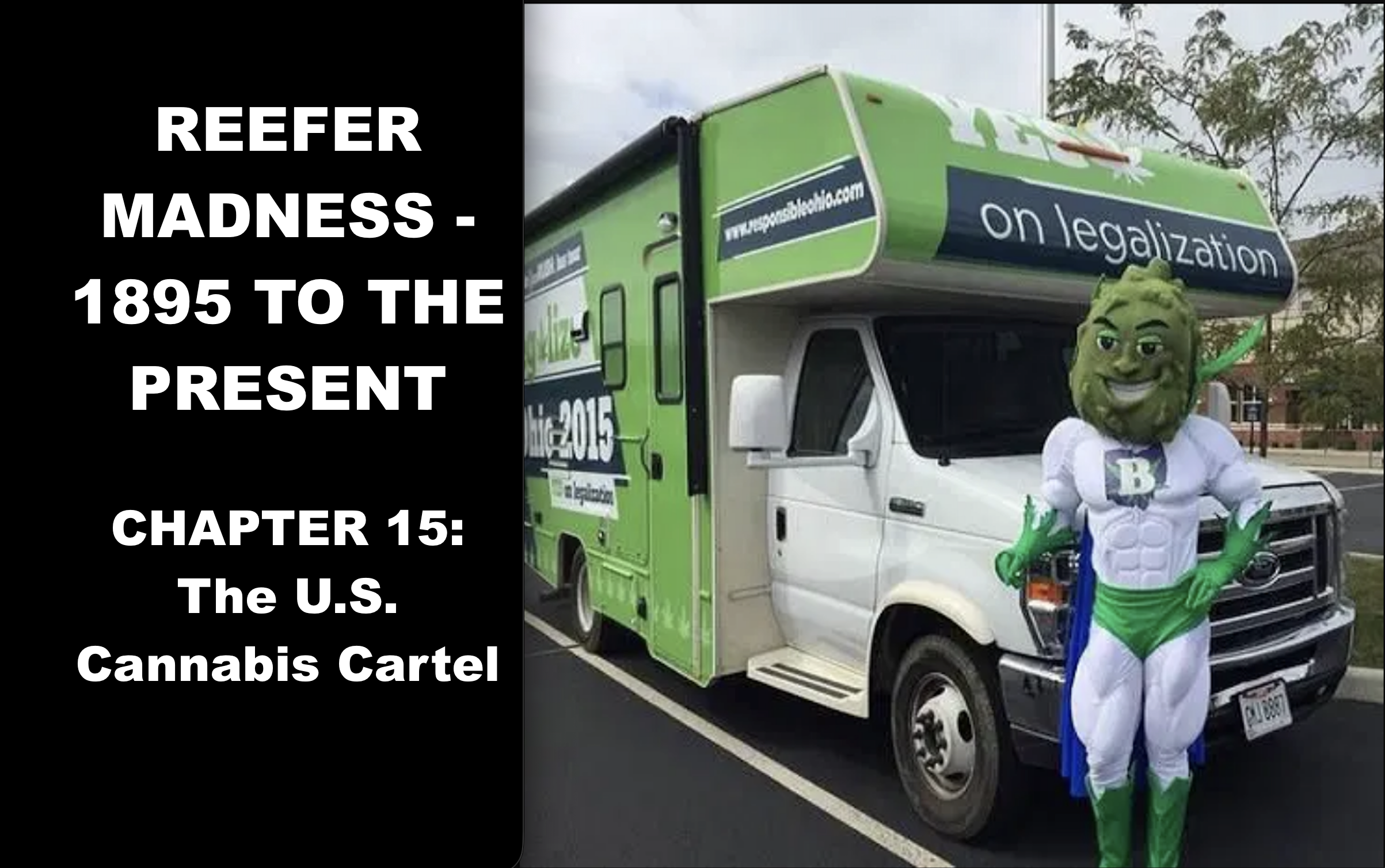
Efforts to create a U.S. pot cartel came state by state, and began with the “Make Richard Lee a billionaire initiative” – otherwise known as California’s Prop 19 of 2010. It was defeated – in part because some pot activists refused to accept a probable pot monopoly to replace pot prohibition with. Another monopolistic “legalization” (cartelization) initiative came in the form of Issue 3 in Ohio in 2015, and was defeated for the same reason – except a cartel wasn’t just a probable hazard, it was an explicit, guaranteed feature. It was these successes of anti-monopoly pot activists in the United States – along with the ongoing failure of anti-monopoly pot activists in Canada – that serve as the most important lessons for those who choose to be genuine pot activists in the 21st century: the kind of pot activists who fight both prohibition and cartelization.
Special thanks to the Cannabis Museum for sponsoring the creation of this series. The introduction to this series (Reefer Madness – 1895 to the Present) can be found here. Chapter 1 can be found here. Chapter 2 can be found here. Chapter 3 can be found here. Chapter 4 can be found here. Chapter 5 can be found here. Chapter 6 can be found here. Chapter 7 can be found here. Chapter 8 can be found here. Chapter 9 can be found here. Chapter 10 can be found here. Chapter 11 can be found here. Chapter 12 can be found here. Chapter 13 can be found here. Chapter 14 can be found here.
“‘I’ve been involved in this for 40 years,’ says Don Wirtshafter, 63, an ORG member with a white beard and a penchant for Hawaiian shirts (think Santa Claus on holiday in Tijuana). ‘But this new rush toward greed, it’s rolling over all the good work we did. ResponsibleOhio, they sabotaged our campaign, they blackened our name. And now off they go like heroes into their financial scam.’ (ResponsibleOhio executive director Ian) James dismisses the accusations with a snort and says that anyone who is for legalization but not backing Issue 3 is ‘fucking crazy. Do you or do you not want to end prohibition?’ he continues. ‘And anybody who says no — they need to have their fucking heads examined.’”
– “Ohio’s Weed War: Corporations, Activists Clash Over Legal Pot,” Ben Wofford, Rolling Stone, OCTOBER 23, 2015 (1)
“Knowing that a ballot measure would be very expensive, ResponsibleOhio, the group behind the state’s legalization measure, structured its initiative to reward the top contributors to the campaign — and therefore get them on board. As a result, the state would have only allowed 10 marijuana farms, and more than 20 wealthy contributors signed on to the campaign would have been guaranteed licenses to all 10 sites. These contributors varied — ranging from 98 Degrees band member Nick Lachey to the local Taft family.”
– “Ohio’s marijuana legalization ballot measure, explained,” German Lopez, vox.com, Nov 3, 2015 (2)
“But I gotta say, I’m not very happy with this new commercialization of the plant. Right? You know, we set out to legalize the plant. And the people who wanted to commercialize it – mostly a lot of right-wing billionaires – are now controlling it and making sure each state only has a limited number of grows and a limited number of dispensaries, and that they all own it – this one big market. And you got Canadian alcohol companies puttin’ billions of dollars into marijuana companies, and, you know how’s the little guy gonna compete? . . . I got friends left and right going out of business because of the big guys. . . . It’s really a struggle to set the plant free when you got a lot of billionaires trying to make it really expensive. . . . there’s this model of taxing it to hell, to regulating it to death – treating it like tobacco or alcohol – it’s just not like that.”
– “Don E. Wirtshafter on Legislative Progress at Hempfest 2018,” Seattle, Washington, youtube.com, Aug 18, 2018 (3)
 Image #1: “Don E. Wirtshafter on Legislative Progress at Hempfest 2018,” Seattle, Washington, Aug 18, 2018 https://www.youtube.com/watch?v=Jyzodcz0tdE
A cannabis activist since 1968, (4) Don Wirtshafter graduated from Ohio University in 1973 with a law degree. (5) In 1990 he founded the Ohio Hempery, which has promoted all the various uses of the cannabis plant – industrial, nutritional and medicinal.
 Image #2: Some of the most influential cannabis/hemp activists at a pivotal moment in pot history. Photo taken in February, 1997, in front of Hemp BC, at 307 West Hastings in Vancouver, British Columbia. https://westcoastleaf.net/www.equalrights4all.org/docs/potpride/hempsters1.htm (photo no longer online)
 Image #3: Wirtshafter is standing just to the right of the centre of the group. “1999 HIA Convention in Ontario” https://hempology.org
 Image #4: A look at the career of Don Wirtshafter. “Pipe Dreams,” Backdrop Magazine, Winter 2010, Vol. 3, Issue 2, pp. 32-33. https://issuu.com/backdropmag/docs/backdrop_final_master_winter_redhea
 Image #5: “Local attorney key player in pot legalization effort,” Jun 16, 2013 https://www.athensmessenger.com/anewsarchive/news/local/local-attorney-key-player-in-pot-legalization-effort/article_7f125328-7fe7-5a72-91e4-a48f0fbb5b1d.html
Known for his courageous and selfless activism – much of the time representing the downtrodden in the courts, (6) Wirtshafter has served as the conscience of the North American cannabis movement, from his removal from the NORML board of directors for his outspoken views on how it should be “more responsive to grassroots activists” and allow three of the board seats to be elected by NORML’s general membership, (7) to (more recently) his involvement in organizing against an attempt at creating a blatant ‘structured oligopoly’ of the cannabis market in his home state of Ohio.
 Image #6: “Don Wirtshafter, a lawyer in Guysville, Ohio, who has long fought to make marijuana legal, is against an Ohio measure that would give a group of wealthy investors exclusive rights to grow marijuana commercially. (ANDREW SPEAR/NYT)” “Ohio initiative would give investors a monopoly on marijuana,” November 1, 2015 https://www.seattletimes.com/nation-world/ohio-initiative-would-give-investors-a-monopoly-on-marijuana/
The “Responsible Ohio initiative” was an attempt made by investor Ian James and his organization “Responsible Ohio” in an Ohio citizen’s initiative – AKA Issue 3 – to create an Ohio-based pot cartel during the 2015 US federal election. NORML founder Keith Stroop supported Issue 3, while admitting the monopolistic elements turned the issue into a “mess.” (8) Ohio’s NORML branch got rid of their leader after he expressed support for Issue 3. (9)
 Image #7: “Political profiteers push Ohio’s pot vote,” June 18, 2015 https://publicintegrity.org/politics/state-politics/political-profiteers-push-ohios-pot-vote/
 Image #8: “Marijuana mascot named ‘Buddie’ greets voters in Ohio. ResponsibleOhio, a pro-marijuana advocacy group, rolled out a weed-themed mascot named ‘Buddie.’ The group has traveled with the mascot across the state hoping to drub up support for recreational pot.” USA TODAY, Nov. 3, 2015 https://www.usatoday.com/videos/news/2015/11/03/75114692/
 Image #9: “Pro Marijuana Group Leads Opponents In Campaign Cash,” WCBE 90.5FM | Jim Letizia, Associated Press, October 27, 2015 https://www.wcbe.org/news/2015-10-27/pro-marijuana-group-leads-opponents-in-campaign-cash
 Image #10: “Ohio Issue 3, Marijuana Legalization Initiative (2015)” https://ballotpedia.org/Ohio_Issue_3,_Marijuana_Legalization_Initiative_(2015)
 Image #11: Notice that James Gould – one of the founders of ResponsibleOhio – is the brother of Barbara Gould of the NG Green investments Limited Liability Company. Ian James, the other founder of ResponsibleOhio, stood to gain through consulting fees from his consulting company, The Strategy Network. “Ohio Issue 3, Marijuana Legalization Initiative (2015)” https://ballotpedia.org/Ohio_Issue_3,_Marijuana_Legalization_Initiative_(2015)
 Image #12: “Investors in proposed Ohio marijuana farms are diverse lot,” Alan Johnson, The Columbus Dispatch, Sept. 2, 2015 https://www.dispatch.com/story/news/politics/2015/09/02/investors-in-proposed-ohio-marijuana/23706093007/
 Image #13: “James Gould on Donald Trump,” Oct 27, 2015 https://www.youtube.com/watch?v=_90ffzL0LBw
High Times came out against Issue 3 in a couple of editorials, written by their policy director Jon Gettman. (10) Apparently, Ian James, one of the authors of the initiative, got the idea of a “structured oligopoly” from a Rand report on marijuana published in 2015, (11) which argued that – contrary to every example from history without exception – a cartel arrangement would “get for-profit businesses to behave in the public interest.” (12)
 Image #14: “Considering Marijuana Legalization Insights for Vermont and Other Jurisdictions,” Rand Corporation, 2015 https://www.rand.org/content/dam/rand/pubs/research_reports/RR800/RR864/RAND_RR864.pdf
The Rand argument – simplified – is that if there were fewer cannabis suppliers to regulate, it would be easier to regulate them. The reality was that if there were fewer – and richer – cannabis suppliers to regulate, it would be easier for them to come up with big bribes – also called campaign contributions – to help these suppliers buy off elected representatives, avoid consequences of immoral business practices and consolidate their power and privilege.
 Image #15: Editorial Cartoon, The Plain Dealer, Cleveland, Ohio, November 6th, 2015, p. E3

Image #16: “Why A Former Boy-Bander Is Bankrolling This Hated Pot Legalization Proposal – This fall, a potential marijuana legalization initiative in Ohio would give control of all commercial pot farms to the group of investors who are bankrolling the campaign. The plan, which many call a monopoly, has infuriated local officials and weed activists nationwide.” Amanda Chicago Lewis, BuzzFeed, August 6, 2015 https://www.buzzfeednews.com/article/amandachicagolewis/nick-lachey-gets-ohio-high
 Image #17: https://en.wikipedia.org/wiki/Monopoly
 Image #18: “Playing the Greed Card in Ohio,” Steve Bloom, November 4, 2015 https://www.celebstoner.com/blogs/steve-bloom/2015/11/04/playing-the-greed-card-in-ohio/
 Image #19: “Oligopolies Have No Place in the Cannabis Industry,” November 16, 2015 https://www.linkedin.com/pulse/oligopolies-have-place-cannabis-industry-gilbert-smith-mba/
 Image #20: https://en.wikipedia.org/wiki/Oligopoly
 Image #21: “Ohio Gothic,” Kirk Walters, October 31st, 2015 https://www.toledoblade.com/Editorial-Cartoons/2015/11/01/Kirk-Ohio-Gothic/stories/
 Image #22: “Proposed Legalization Measure Would Create Ohio Pot Cartel,” December 22, 2014 https://www.cannabisbusinesstimes.com/legislation-and-regulation/news/15704163/proposed-legalization-measure-would-create-ohio-pot-cartel
 Image #23: https://en.wikipedia.org/wiki/Cartel
 Image #24: So why can a cartel be legal when a drug cartel can only be illegal? Seems like a greasy PR marketing strategy. https://en.wikipedia.org/wiki/Drug_cartel
Faced with this blatant power grab by the greedy, Wirtshafter wrote this response, which was printed in the Athens News, and deserves to be reprinted in full:
“Promoted as a ‘responsible’ way to legalize marijuana, Issue 3 fails. Its purpose is to carve into Ohio’s constitution exclusive rights for its wealthy and undisclosed funders. These funders are asking Ohio citizens to create law-free zones on their real estate, forever making their properties the only places in Ohio the cannabis plant can be commercially grown. If Issue 3 passes and you are caught on the street carrying anything other than sealed packets of the cartel’s inferior, factory-grown product, today’s harsh laws will still apply. As a lawyer and lifelong proponent of cannabis reform, let me explain why Issue 3 fails to legalize marijuana and must be defeated. Issue 3 is an investment scheme, not marijuana reform. The schemers optioned 10 properties and created 10 numbered corporations to sell to investors wanting in on the green rush. Stock sales are paying for this divisive campaign. What you have heard about Issue 3 is true: it is all about the money. Issue 3 backers are spending millions to convince Ohio voters that a group of wealthy investors deserve exclusive rights to grow cannabis in Ohio. Who these investors are, we don’t know and may never know. Unknown, un-vetted money is hiding behind numbered corporations organized so nobody ever has to disclose who is really in control. The Issue 3 campaign has not responded to reports that celebrities such as Frostee Rucker and Oscar Robertson are being used as fronts for seamy, out-of-state investors. Issue 3 will supply Ohioans with factory-grown schwag. Quality pot is lovingly cultivated in small spaces or outdoors. Profit-motivated Issue 3 backers are planning to grow in huge, very likely bug-, mold- and mildew-prone factories. These ‘mega-grows’ require pesticides, fungicides and a huge supply of electricity. They will be miserable places to work in. With only second-class products available in the stores, the black market for quality products will continue to thrive. The result will be continuing arrests and spiraling costs of enforcement. Issue 3 will be permanently enshrined into the Ohio Constitution. The Ohio Legislature has no power to repair the onerous provisions of this power grab. The only way to fix Issue 3 is another constitutional amendment. Remember when we had to have a statewide initiative campaign and election just to move the location of one casino? With Issue 3’s backers making their projected hundreds of millions of dollars per year, they will be able to spend whatever is necessary to prevent Ohio citizens from removing their stranglehold over Ohio’s production. Issue 3 is promoted as allowing home growing, but the Ohio Supreme Court has already ruled this to be impractical. When Issue 3 was first introduced, it contained no homegrown provision at all, figuring homegrown would dilute monopoly sales. Public pressure forced a revision of the original petition to include the most meaningless home-growing provision imaginable; home growing is limited to four flowering plants and eight ounces of homegrown, and only at home. The Ohio Supreme Court has ruled, ‘Under the amendment, growing up to eight ounces of marijuana plus four flowering marijuana plants is permitted only by persons holding valid state licenses, and even those persons are not permitted to transport the marijuana.’ Those who wish to grow at home will be forced to register as a grower, pay $50 per year for a license, and grant permission for government inspections of their homes. Four plants and eight ounces is not enough. The intrusion of privacy is unacceptable. Issue 3 preserves Ohio’s draconian drug laws. It carves out a limited exception for the products of the Issue 3 monopoly players, now called ‘marijuana’ as distinguished from ‘medical marijuana’ and ‘homegrown marijuana’ and plain old illegal marijuana. Only monopoly marijuana contained in its original, sealed container is legal outside your home. If the package is open, you have no way of proving this was legal monopoly-grown marijuana and not somebody’s ‘homegrown marijuana’ stuck into a monopoly bag. This gives incentive to police to want to see the contents of your pockets and continue to force searches of your car. Search and seizure, forfeiture and harsh criminal penalties remain the law. With police encouraged to enforce the anti-homegrown laws by the Issue 3 corporations, I doubt felony arrests and costs for legal enforcement will go down under Issue 3. Issue 3 is all about money, not about medical patients. Issue 3 is about retail sales to adults. Its weak medical provisions are being used as an afterthought to get your vote. Issue 3 pandering itself as medical has split the pro-cannabis community. Some people are so desperate for freedom that they are willing to give up all rights to a new master. Others see potential for personal profit and are jumping on the Issue 3 bandwagon so as not to be frozen out if the forces of greed actually win this election. Sensible cannabis reform uses merit-based licensing. The best-prepared and best-planned efforts are rewarded permits to operate. Issue 3 schemers grab all this momentum for themselves, while admitting they know nothing about pot, its medical uses, or how to supply it to consumers and patients. A state-sanctioned monopoly assures no competition and ensures predatory pricing. Competition and market forces should determine prices, not collusion. Regulated adult use is a success in Colorado, Washington, Alaska and Oregon. Medical programs are working in two dozen other states. Polls confirm that 90 percent of Ohio voters favor medical use, and more than 50 percent already support adult use. Ohioans, too, will soon get freedom from these unjust laws, but only if we don’t lock this monopoly power grab into our state’s constitution. If you like cannabis, don’t like monopolies or simply want to see its availability regulated sensibly, please vote against Issue 3 on Nov. 3. We can and must do better for Ohio.” (13)
 Image #25: “Don Wirtshafter, of Athens, Ohio, poses for a portrait in the backyard of his home in Guysville, Ohio. Wirtshafter is a long-time Athens area lawyer who serves on the Ohio Rights Group, whose work it is to pass a constitutional amendment that would legalize medical marijuana and permit the cultivation of hemp.” “On Ballot, Ohio Grapples With Specter Of Marijuana Monopoly,” November 2nd, 2015 Photo: https://www.nytimes.com/2015/11/02/us/on-ballot-ohio-grapples-with-specter-of-marijuana-monopoly.html
Wirtshafter’s opposition of Issue 3 made it into the New York Times on the eve of the election. (14) Issue 3, the initiative that would have only allowed 10 commercial cultivation licenses, failed to pass on election night. (15) But issue 2, the initiative that would prevent monopolies from being created through the initiative process, passed – preventing any future attempts at cannabis cartels in Ohio . . . through initiatives, at least. (16)
 Image #26: https://ballotpedia.org/Ohio_Issue_2,_Ballot_Initiatives_to_Create_Monopolies_Amendment_(2015)
Wirtshafter and his associates at Grassroots Ohio attempted to get a more inclusive legalization model on the ballot in 2016, but their efforts were sabotaged by powerful interests – monopolists and prohibitionists – and they failed to get enough signatures. (17) However, Wirtshafter and a group of local activists from Athens, Ohio were successful in getting a “lowest police priority” ordinance – dubbed the Athens Cannabis Ordinance – on the ballot in 2017. It passed, with 77 percent support. (18)
 Image #27:
  Image #28: “City voters cut pot penalties to zero,” David DeWitt, Nov 8, 2017 athensnews.com (no longer online)
 Image #29: “Citizens toke to celebrate local pot reform,” Conor Morris, Apr 21, 2019 athensnews.com (no longer online)
While busy battling greasy monopolists, Wirtshafter was also busy assembling his collection of cannabis medicine bottles and other cannabis artifacts into the Cannabis Museum. (19) While there are similar museums open in Amsterdam, Holland and Barcelona, Spain, (20) up until Wirtshafter’s museum, North America did not have a pot museum of similar caliber – the DEA museum in Arlington, Virginia left much to be desired. (21) Today, North America has an excellent marijuana-themed museum, now open in Athens, Ohio, with travelling exhibit capabilities. This series of articles you are reading now will be turned into a real book – Reefer Madness: 1895 To The Present – and will be one of the Cannabis Museum’s first publications. (22)
 Image #30: “Don Wirtshafter poses for a portrait in his home. Don has been collecting cannabis artifacts including medicine jars like the ones behind him for over 40 years.” “An Overview of Marijuana in Ohio – The Cannabis Museum: History of Cannabis” https://hruhoff.wixsite.com/cannabis
 Image #31: https://cannabismuseum.com/
 Image #32: Some of the postcards in the Cannabis Museum collection. Photo from the Cannabis Museum Facebook page.

Image #33: A photo of just some of the cannabis medicine bottles, taken from an earlier version of the Cannabis Museum website. Definitely check out the Cannabis Museum archive: https://cannabismuseum.com/archive
 Image #34: The trophy says “2019 SEATTLE HEMPFEST.org, FRI-SUN AUG. 16-18 MYRTLE EDWARDS PARK – Don Wirtshafter – Outstanding Cannabis Activist 2019” – Photo from the Wirtshafter archive.
 Image #35: “Wirtshafter, a big advocate for cannabis, hopes to teach people the history of cannabis with his museum in hopes of spreading awareness of the plant.” “An Overview of Marijuana in Ohio – The Cannabis Museum: History of Cannabis” https://hruhoff.wixsite.com/cannabis
The reason why this chapter began with the story of Don Wirtshafter is because the attempted – and sometimes successful – cartelization of the cannabis economy has come to define the relationship between humans and cannabis in the beginnings of the 21st century. The Ohio oligopoly/cartel attempt wasn’t the only proposed monopolistic pot regulation – just the most greedy, and thus most obvious. In fact, when cannabis was finally “legalized” in Canada in October 2018, the business press described it as a cartel.
 Image #36: Quote from: “William Watson: At least weed dealers catered to customers. Government pot sure doesn’t,” Financial Post, Oct. 18, 2018 https://financialpost.com/opinion/william-watson-at-least-weed-dealers-catered-to-customers-government-pot-sure-doesnt
Most of the time, the cartel seems justified, because the tight pot regulations seem justified, because the myth of cannabis psychosis has been accepted by fact by the vast majority of the population – including most of the cannabis activist community. More than any other pot activist, Wirtshafter represents a sign of hope – an example of a spirited and successful resistance to the cannabis cartel, by one of the few remaining activists who 1) hasn’t sold out, and 2) understand that cannabis is not a hard drug, and should not be regulated as such.
 Image #37: Cannabis Culture headquarters, June 21, 2010 https://flickr.com/photos/cannabisculture/4994972229/in/album-72157624964688208
 Image #38: Cannabis Culture headquarters, 307 West Hastings, Vancouver, British Columbia. circa 2010. Photo from the Cannabis Culture archive.
The cartel attempts began in earnest in 2010, with Prop. 19 in California.
 Image #39: “Legal pot supporters ready for likely vote in November,” Ventura County Star, Ventura, California, January 11th, 2010, p. 1
 Image #40: “Legal pot supporters ready for likely vote in November,” Ventura County Star, Ventura, California, January 11th, 2010, p. 2
2010 also began with this author stuck in a jail cell, half-way through serving four months for herbal medicine-related, civil disobedience-based drug crimes in relation to his Herb School operation – the story of which was told in the previous chapter. My prison blog, which I wrote in jail, dictated to a phone on to a recording device on the other line and then was transcribed, can still be read at cannabisculture.com or my personal website, pot-shot.ca .
The newspapers in California at the time were full of typical parental hysteria over teen cannabis use, with The Coalition to Promote Drug Free Youth getting their 2 cents into an article about local jurisdictions banning marijuana dispensaries from their neighborhoods in the January 14th, 2010 edition of the Santa Ynez Valley News:
“The Coalition to Promote Drug Free Youth, a volunteer group based in Solvang, also supports a ban. It contends that marijuana is addictive, and that allowing medical marijuana dispensaries would give young people more access to the drug. ‘Limiting access to alcohol, marijuana, tobacco for our youth would reduce underage substance abuse,’ said Mary Conway of the coalition.” (23)
 Image #41: “An illegal medical-marijuana dispensary in Santa Barbara was closed and six people arrested after an undercover investigation, the Santa Barbara Police Department said Monday.” SB dispensary shut down, 6 arrested – Pounds of pot, live plants seized in Santa Ynez,” Santa Ynez Valley News, Solvang, California, January 14th, 2010, p. A1
The reporter didn’t bother to ask the Coalition why age limits would suffice for hard drugs like alcohol and tobacco, but an outright ban was required for a soft drug like cannabis, or why the Coalition didn’t support encouraging less teen alcohol and tobacco use by encouraging more teen cannabis use, given the relative harm of each drug. To this author, this is what an evidence-based discussion on cannabis policy regarding young people would entail. The year is now 2026, and the lingering stigma and misinformation around the effects of cannabis on young people is still so dominant, this author wonders if a more evidence-based discussion will ever transpire.
 Image #42: “AMA wants more research on medicinal pot,” Santa Ynez Valley News, Solvang, California, January 14th, 2010, pp. A1, A7
Elsewhere in the newspaper, it was mentioned that Santa Barbara prohibited dispensaries “within 500 feet of schools, parks and other dispensaries,” another double standard that didn’t apply to harder drugs, no doubt meant to maintain an irrational fear of cannabis and an irrational stigma against cannabis users, growers, dealers and exporters. (24)
 Image #43: “SAUDI ARABIA: MAN EXECUTED FOR HASHISH TRAFFICKING – A man was beheaded in Dammam, in the eastern region of Saudi Arabia, after being found guilty of trafficking hashish.” January 25th, 2010 https://nessunotocchicaino.it/it/notizie/arabia-saudita-giustiziato-per-traffico-di-hashish-13300658
 Image #44: “Saudis execute drug trafficker,” The Windsor Star, Windsor, Ontario, January 25th, 2010, p. B2
 Image #45: The Cannabian flag flies from the window of the CCHQ headquarter at 307 West Hastings st. across from Victory Square as the “Homes Not Games” anti-Olympics protesters clash with the cops on Hastings St. and Cambie St. on February 12th, 2010. Photo from https://flickr.com/photos/cannabisculture/4355109350/in/album-72157623304708515
 Image #46: Jeremiah, Ryan and Marijuana Man pose with the Olympic torch bearer in
Victory Square, February 12th, 2010. Photo from https://flickr.com/photos/cannabisculture/albums/72157623304708515/with/4355144614
 Image #47: “‘Cannabis Planet’ promotes cultivation, cooking with marijuana,” San Francisco Chronicle, San Francisco, California, February 17th, 2010, p. 37/E1
 Image #48: The first signs of activist resistance to Prop 19 – Dennis Peron speaks out against the initiative. “‘Cannabis Planet’ promotes cultivation, cooking with marijuana,” San Francisco Chronicle, San Francisco, California, February 17th, 2010, p. 43/E7
 Image #49: As progressive as we could possibly hope people from Iowa to be in 2010. “‘Reefer madness, reefer madness . . .’ in Iowa?” Quad City Times, Davenport, Iowa, February 21st, 2010, p. 1
 Image #50: Notice the “Welcome to Vansterdam” poster on the door? “Clayton Perry, Cannabis Culture Headquarters, February 27, 2010” https://www.flickr.com/photos/claytonperry/4393370917
On March 2nd, 2010, the recently-released McGrath study was reported on in the Casper Star-Tribune, a Wyoming newspaper. The 2010 study – titled “Association Between Cannabis Use and Psychosis-Related Outcomes Using Sibling Pair Analysis in a Cohort of Young Adults” – argued there is an association between early cannabis use and “psychosis-related outcomes.” The newspaper reported on the kinds of questions McGrath et al. used to identify a psychosis-related outcome:
“McGrath said two of the questions posed to participants were ‘Do you ever feel as if you are possessed by someone or something else?’ and ‘Do you ever feel as if other people can read your mind?’” (25)
An affirmative answer to either question doesn’t seem particularly psychotic. The researchers inevitably misdiagnosing some people, such as those with an active imagination, or in possession of broad definitions of “possessed,” or with friends who can read body language. Assuming some sort of association between cannabis use and psychosis was found, the possibility of cannabis being used to diagnose and/or mitigate the psychosis wasn’t considered. Instead, the article implied that cannabis use caused the psychosis, even if the study itself didn’t mention causation:
“The findings build on previous research and show that marijuana use isn’t as harmless as some people think, lead study author John McGrath said Sunday.” (26)
On the same page as this reefer madness story were articles on an increase in teen pot and alcohol use and another about “drug gangs” growing pot on public lands. Similar articles covering the McGrath study appeared in the March 2nd Vancouver Sun and the March 3rd Leader-Post in Regina, Saskatchewan. The McGrath study is one of the studies analyzed in a future chapter of this series.
Also on March 2nd, a letter to the editor in Toronto’s National Post from Dr. Meldon Kahan of the Addiction Medicine Service of St. Joseph’s Health Center in Toronto was filled with every type of pot-related myth available to him:
“I have seen patients whose lives have been destroyed by cannabis addiction or cannabis-induced psychosis. Smoked cannabis has been shown to cause precancerous changes in various tissues. Also, THC serum levels rise rapidly when smoked, creating a risk for motor vehicle accidents. The oral and inhaled versions of cannabis are far safer.” (27)
Perhaps by “inhaled,” Dr. Kahan meant some sort of pharmaceutical product such as a metered dose inhaler rather than vaporized buds. Dr. Kahan should have known – or may have just ignored the fact – that smoked or vaporized cannabis is easier to titrate than orally-ingested cannabis. Dr. Kahan should have known – or may have just ignored the fact – that the “precancerous changes” never lead to cancer. (See citation #299, Chapter 14 of this series.) The ignorance displayed by “addiction experts” is only matched by their endless capacity to endorse pharmaceutical products rather than whole plant medicine regardless of safety or efficacy.
 Image #51: “Marijuana raids continue,” Lincoln Journal Star, Lincoln, Nebraska, March 19th, 2010, p. 1
 Image #52: “Police probe blaze at drug raid garage,” The Leader, Wrexham edition, Wrexham, Wales, March 31st, 2010, p. 3
 Image #53: R.I.P. Jack Herer, April 15th, 2010. Image from Wikipedia, “Jack Herer”. https://en.wikipedia.org/wiki/Jack_Herer
 Image #54: The beginning of the great “from above” crowd shots – at least the ones that this author has been able to find. The 4/20 Rally at the Vancouver Art Gallery, April 20th, 2010. Photo by unicellular on flickr: https://www.flickr.com/photos/unicellular/albums/72157623778013601/
 Image #55: “A marijuana emblazed mohawk adorns a participant at the Annual 420 event for marijuana smokers outside the Vancouver Art Gallery, Vancouver, B.C. Tuesday, April 20, 2010.” Photo by GERRY KAHRMANN / PNG (Pacific Newspaper Group – The Vancouver Sun and The Province).
 Image #56: Me in my pot-leaf hat, Marijuana Man in his pot-leaf shirt, and Jodie Emery in her pot-leaf boa. “4/20 2010 in Vancouver by Cannabis Culture – Four-Twenty, the international day of celebration for the cannabis culture held annually on April 20, saw record numbers of marijuana consumers and legalization advocates at a rally in Vancouver this year. Photos by Jeremiah Vandermeer.” https://www.flickr.com/photos/cannabisculture/albums/72157623778814213/ See also: “Record Numbers Celebrate Cannabis on 4/20,” Jeremiah Vandermeer, Cannabis Culture, April 21, 2010 https://www.cannabisculture.com/content/2010/04/21/record-numbers-celebrate-marijuana-420/
 Image #57: Before we began charging money for booth space in order to afford a stage, we just used the stairs – or in this case the Lion podiums – to be seen when anyone spoke or performed. This author, doing his thing. Photo by Jeremiah Vandermeer, from the Cannabis Culture flickr collection. https://www.flickr.com/photos/cannabisculture/albums/72157623778814213/
 Image #58: Watermelon, selling ginger snap cookies with added snap. And other items. Photo by Jeremiah Vandermeer.” https://www.flickr.com/photos/cannabisculture/albums/72157623778814213/with/4540893622
 Image #59: “420 Vancouver BC Marijuana rally 2010 at the Art Gallery,” BUTCH HIMSELF, Apr 20, 2010 https://www.youtube.com/watch?v=i-J9XxkIUVw
 Image #60: 4:20 pm, April 20th, 2010, at the Vancouver Art Gallery. The Olympic clock – visible in the background on the left – indicates that the countdown to the Olympics (and 4/20) has finished, and the time has arrived. Photo by Jeremiah Vandermeer.” https://www.flickr.com/photos/cannabisculture/albums/72157623778814213/with/4540893622
 Image #61: “Marijuana advocate David Malmo-Levine is interviewed at the annual 420 event for marijuana smokers outside the Vancouver Art Gallery on Tuesday.” “Thousands gather for April pot celebration,” Vancouver Sun, Vancouver, British Columbia, April 21st, 2010, p. 3
 Image #62: “Vancouver Global Marijuana March 2010 by Cannabis Culture CANNABIS CULTURE – Photos from the Vancouver Global Marijuana March on May 1, 2010. Photos by Ryan Dee, Megan McRae, and Bert Easterbrook.” https://www.flickr.com/photos/cannabisculture/albums/72157623923555075/
 Image #63: Michelle Rainey. “Vancouver Global Marijuana March 2010 by Cannabis Culture CANNABIS CULTURE – Photos from the Vancouver Global Marijuana March on May 1, 2010. Photos by Ryan Dee, Megan McRae, and Bert Easterbrook.” https://www.flickr.com/photos/cannabisculture/albums/72157623923555075/

Image #64: This author, holding up a Herb School banner. “Vancouver Global Marijuana March 2010 by Cannabis Culture CANNABIS CULTURE – Photos from the Vancouver Global Marijuana March on May 1, 2010. Photos by Ryan Dee, Megan McRae, and Bert Easterbrook.” https://www.flickr.com/photos/cannabisculture/albums/72157623923555075/
 Image #65: Everything you need to know about the Global Marijuana Marches happening across Canada on May 5 by Amanda Siebert on May 4th, 2018 at 4:50 PM https://www.straight.com/cannabis/1070486/everything-you-need-know-about-global-marijuana-marches-happening-across-canada-may#
 Image #66: “Vancouver Global Marijuana March 2010 by Cannabis Culture CANNABIS CULTURE – Photos from the Vancouver Global Marijuana March on May 1, 2010. Photos by Ryan Dee, Megan McRae, and Bert Easterbrook.” https://www.flickr.com/photos/cannabisculture/albums/72157623923555075/
In a May 5th commentary in the Ottawa Citizen titled “‘Reefer Madness’ close to truth worldwide evidence suggests,” a reporter interviewed Dr. Robert Milin, a psychiatrist and substance-abuse expert, who argued that “Reefer Madness” is an actual thing:
“‘I laugh,’ Dr. Milin said in a light aside this week, ‘that Reefer Madness thing that you heard about is not that far off.’” (28)
The reporter allowed the physician to qualify that conclusion – if not in the headline, at least in the body of the text:
“The physician was careful to warn about jumping to conclusions. So far, the relationship between smoking weed and developing a psychotic disorder is not, as scientists like to caution, a ‘causal’ one. Evidence from studies around the world, however, points to a link or an association, possibly after a single use.” (29)
That’s another way of saying “We know there has been no rise in mental illness to match the rise in cannabis use rates so we can’t really claim cannabis causes mental illness, but if we admit this fact we couldn’t attempt to promote the idea that ‘that Reefer Madness thing’ is real, so instead we will just avoid any mention of mental illness rates over time, admit we can’t prove causation and let the vague, unexplained association create the stigma all by itself.”
 Image #67: “1,000 drug offenders executed annually, but that figure appears to be dropping,” Philadelphia Daily News, Philadelphia, Pennsylvania, May 17th, 2010, p. 36
 Image #68: A very Vancouver cannabis protest banner. Posted into the grass on the south side of Victory Square, the photographer facing west. Photograph by John S. Prentice, 2010.
 Image #69: “Emergency Free Marc Protest and March by Cannabis Culture – Marijuana activists blocked traffic and smoked joints while marching through the streets of Vancouver protesting the extradition of Marc Emery to the United States. The same morning (on May 20, 2010), Marc was taken to Seattle to be sentenced in an American court.” Photos by Jeremiah Vandermeer. https://www.flickr.com/photos/cannabisculture/albums/72157624107879330/
On June 12th, 2010, an L.A. Times article about Marc Emery and his looming extradition to the United States to face years in jail for pot seed sales looked into the origin of the investigation against Emery:
“Emery won few friends in President George W. Bush’s administration when former drug czar John Walters, apparently seeking to stamp out rumblings of marijuana decriminalization among Canada’s then-ruling Liberal Party, addressed the Vancouver Board of Trade in 2002. Emery surreptitiously bought a table at the event, and along with fellow activists David Malmo-Levine and Chris Bennett, heckled Walters mercilessly. The next day, activists blew marijuana smoke in Walters’ face during a tour of downtown. Not long after that, they figure, is when the U.S. investigation of Emery was launched. But his friends say that only increased his sense of mission — and self-esteem. ‘A lot of people take great offense when he gets compared to people like Martin Luther King and Gandhi, and they say, ‘Marc, you can’t compare yourself to someone like that.’ And he says, ‘These are men who stood up for things . . . who suffered for what they represented, and to many, many people, they were the leader of their movement,’’ Jodie said. ‘Marc does have a gigantic ego,’ she said. ‘Majestic,’ said Malmo-Levine.” (30)
 Image #70: “Canadian can’t escape U.S. pot laws,” The Los Angeles Times, Los Angeles, California, June 12th, 2010, p. 1
 Image #71: “PUNISHED: Marc Emery, left, with his wife Jodie outside the Supreme Court in Vancouver, will likely face five years in U.S. prison. He was ‘the largest supplier of marijuana seeds into the United States,’ a prosecutor said.” “Canadian can’t escape U.S. pot laws,” The Los Angeles Times, Los Angeles, California, June 12th, 2010, p. 14

Image #72: “Canadian can’t escape U.S. pot laws,” The Los Angeles Times, Los Angeles, California, June 12th, 2010, p. 15
 Image #73: “PROTESTERS ARRESTED,” The Tribune, Welland, Ontario, June 12th, 2010, p. 3
 Image #74: “REAPING WHAT HE SOWED,” Calgary Herald, Calgary, Alberta, June 20th, 2010, p. C2
 Image #75: “He melds pot activism, humor,” The Sacramento Bee, Sacramento, California, June 29th, 2010, p. B6
 Image #76: Jodie Emery. “Cannabis Day 2010 – CANNABIS CULTURE – Every year on the first of July, thousands of ardent marijuana-lovers gather in downtown Vancouver for Cannabis Day; a patriotic, pot-infused celebration that has over time developed into an open marketplace for THC-laden treats of all types.” https://flickr.com/photos/cannabisculture/albums/72157624429904600/
 Image #77: Jodie Emery and Marijuana Man. “Cannabis Day 2010 by Cannabis Culture” https://flickr.com/photos/cannabisculture/albums/72157624429904600/
 Image #78: Jodie Emery speaks to the Vancouver cannabis community. “Cannabis Day 2010 by Cannabis Culture” https://flickr.com/photos/cannabisculture/albums/72157624429904600/page2
 Image #79: This author speaks to the Vancouver cannabis community. “Cannabis Day 2010 by Cannabis Culture” https://flickr.com/photos/cannabisculture/albums/72157624429904600/
 Image #80: Dana Larsen speaks to the Vancouver cannabis community next to a HEMP ETHANOL NOW banner that has been taped to a Vancouver Art Gallery pillar, “Vancouver Cannabis Day 2010,” July 1st, 2010, Pot TV https://www.youtube.com/watch?v=b9m_pIe5i7A

Image #81: Rebecca Ambrose and Dana Larsen in the Vancouver Seed Bank tent. “Cannabis Day 2010 by Cannabis Culture” https://flickr.com/photos/cannabisculture/albums/72157624429904600/
 Image #82: A nice photo of Rebecca and Dana. “Cannabis Day 2010 by Cannabis Culture” https://flickr.com/photos/cannabisculture/albums/72157624429904600/
 Image #83: Ardent, well decorated freedom activists celebrate Cannabis Day, July 1st, 2010, at the Vancouver Art Gallery. From the Cannabis Culture photo archive.
 Image #84: One of the ardent, well decorated freedom activists celebrating Cannabis Day, July 1st, 2010, at the Vancouver Art Gallery. From the Cannabis Culture photo archive.
 Image #85: Another one of the ardent, well decorated freedom activists celebrating Cannabis Day, July 1st, 2010, at the Vancouver Art Gallery. From the Cannabis Culture photo archive.
On August 4th, it was reported that two brothers were sentenced for a marijuana smuggling operation that brought a total of 5,200 pounds of pot from Mexico to Pittsburg beginning in 2002. Noah Landfried, 26, got life in prison. His brother, Ross Landfried, got 20 years. (31)
 Image #86: One of the display windows at Cannabis Culture Headquarters – and one of the sandwich boards – promoted the Urban Shaman shop inside. “Urban Shaman Entheo Botanicals – Aug. 9 2010“ https://www.yelp.ca/biz_photos/urban-shaman-entheo-botanicals-vancouver
The war against the cannabis community, brutal as it was, also contained lighter moments. The same month, singer George Michael (famous for fronting the pop music group Wham) was charged with possession of cannabis and driving under the influence of drugs when he crashed his Range Rover into a photoshop in North London. The dent in the wall was still visible, and someone added one word of graffiti to it: “Wham.” (32)
In September of 2010, the case of R. v. Payette was decided in the B.C. Court of Appeal. The case involved a suitcase of marijuana discovered at a “road safety checkpoint.” The trial judge found no Charter breach had occurred, but the BC Court of Appeal found that the trial judge erred in finding the radar detector found in the vehicle and the state of the vehicle as “lived in” justified a drug dog sniff search. The case was an early victory for cannabis lawyer Kirk Tousaw. (33)
On Oct. 20th, 2010, Michelle Rainey, business partner of Marc Emery, died of cancer. She was a personal friend, and had discussed her medical condition with me before dying. I was dismayed at her treatment in the press following her death, which portrayed her as a naïve believer in a snake-oil cancer cure, (34) instead of someone who might have been cured if just a bit of money that currently went to proprietary cancer medicine research went to herbs such as cannabis instead. I felt compelled to write about it. Here is an excerpt from my article about Michelle:
“Michelle had lived with Crohn’s disease since she was a teenager. In the last few years she began her battle with cancer. There was a lot of cancer in Michelle’s family – her Dad and her oldest half-brother both died of the same type of cancer Michelle did, and two other family members also contracted cancer. This March a PET scan detected a few lumps in her lungs and liver. In June a CAT scan confirmed stage 4 melanoma – non-aggressive lumps in her lungs and liver. But strangely, her Crohn’s was in virtual remission. Michelle believed that cannabis was responsible for that. But it was hard to celebrate that fact as stage 4 metastasized melanoma only has an 8 to 12 % survival rate. Chemo does not treat it. Michelle was not using cannabis in lieu of something more conventional. One of my most recent memories of Michelle involves sitting next to her on a plane heading for the ‘Treating Yourself Medical Marijuana and Hemp Expo’ in Toronto this past July. On the plane she showed me her anti-cancer medicine. In addition to using the ‘Rick Simpson oil’ – 4 oz in 60 days – she began using Afghani Bull Rider powdered hashish in a capsule. She was using twelve capsules per day – according to Michelle just one capsule was enough to put any normal chronic marijuana junky on the couch for hours. She was also using synthetic THC pills – up to 8 per day. Perhaps the tumors were attracting all the medicine away from altering her perceptions. Perhaps her tolerance was simply at “heroic dose” levels. On the last occasion she and her partner Jef came to visit with me, for the purpose of showing me all the little black tumors that were being pushed out of her body – apparently a result of her treatment with the oil and hash capsules. She insisted on me touching them – they were hard and round and black. There were a few dozen of them around her neck and she told me they were being pushed out everywhere. I figure she made sure I saw them because she knew I was completely and totally unable to sit on an important truth when it needed to be said. She knew I would do my best to let everyone know that there WAS an anti-cancer effect that the hash-capsules were having. She also mentioned an MRI she just had done – her liver was ravaged but her kidneys, lungs and spleen were clean! Michelle smoked non-stop so this alone was news-worthy. Had the cannabis cured SOME of Michelle’s cancer? I wish I could interview her doctor and get an official response to counter-act the spin regarding Michelle on CTV on Oct. 23rd. The CTV video makes no mention of the success she was having with some of her cancer – only that she stated she was going to prove that cannabis cured cancer and that she died of cancer. It was either sloppy journalism or an effort to leave the most important element of the story out on purpose. It made Michelle – and everyone else who believes that cannabis may be a cure for some forms of cancer – look foolish. Cancer treatment is a multi-billion-dollar industry, and CTV takes money from advertisers who make money in that industry. Pharmaceutical companies such as GW Pharmaceuticals and their partner Bayer are fully aware of cannabis’s tumor-shrinking abilities, as is evident from the cursory mention of some of the research found on page 240 of GW’s 488 page hard-cover book ‘The Medicinal Uses of Cannabis and Cannabinoids’ 2004 . . . but instead of pouring money into research and issuing press releases, GW and Bayer are – I suspect – waiting to figure out which specific ratios of cannabinoids and terpenes work best for tumor shrinking so that it can patent those ratios and or register the strains and clean up, as they are currently doing with ‘Sativex’, their medicine for MS and cancer pain. According to their website, ‘As soon as Dr Guy’s clinical research indicates the exact desired composition our scientists can breed and register new medicinal varieties’. Translation? ‘Once we’re figured out a cure for cancer we’re gonna make sure only we can sell it.’ I just wish the reporter who reported on Michelle Rainey’s death looked into her death a little more closely – perhaps interviewed her doctor, or perhaps took five minutes to Google ‘cannabis’ and ‘shrinks tumors’ . . . she would have found two movies – ‘What if Cannabis Cured Cancer’ and ‘Run From The Cure’ – and loads of links – that indicated that Michelle Rainey was right. Even if Michelle didn’t survive, she proved that cannabis was effective in treating some forms of cancer. If the evidence of what Michelle experienced from her cannabis treatment became common knowledge, it could not only help to speed up the end of the war on pot but could also save many, many lives from a horrible, untimely and painful cancer death – two things I know Michelle would have wanted her life to result in.” (35)
 Image #87: Michelle Rainey. Photo from: https://x.com/MichelleRainey
 Image #88: Michelle Rainey and a friend. Photo from the Cannabis Culture photo archive.
 Image #89: “Michelle and Jodie, February 2008.” Photo from: https://www.cannabisculture.com/content/2010/10/23/goodbye-michelle-rainey-rest-peace/
The coverage of Michelle’s death in the Vancouver Sun contained a hint of the great changes to the pot activist landscape in the near future – California was on the verge of “legalization” – or something being called legalization;
“‘I want people to keep working, keep working for change – too many sick people are still having difficulty getting their medication,’ Rainey recently said. ‘That’s what I want as my legacy – change.’ She did not live to see the historic marijuana legalization vote that will occur in California on Nov. 2. She predicted, though: ‘Change is going to come.’” (36)
 Image #90: “Michelle Rainey ‘is a shining example of how much is possible, even under great duress,’ Marc Emery wrote.” “‘One of the greatest activists’ for medical pot – Michelle Rainey, a former business partner of Marc Emery, said she hoped her legacy would be change,” The Vancouver Sun, Vancouver, B.C., October 22nd, 2010, p. 9
In 2010, the media was buzzing about how recreation pot production and sales were about to be legalized in California through various types of local and state-wide legislation – including Prop. 19 – and how much money could be made by investors in the process:
“A proposed ordinance going before Oakland City Council’s Public Safety Committee next week aims to curtail indoor cannabis growers in the city by regularizing major producers for the medical market. Councilmembers Rebecca Kaplan and Larry Reid propose permitting four large, industrial-scale cultivators, who would then supply Oakland’s six dispensaries (the ordinance would add two dispensaries to the currently permitted four) with the 6,000 pounds of cannabis the dispensaries sell a year. Fire officials and police have been complaining for years about the risks posed by large indoor operations. Electrical fires in Oakland increased from 133 to 276 between 2006 and 2009, a trend that’s partly blamed on indoor growing. The Oakland Police Department reports that in 2008 and 2009 there were eight robberies, seven burglaries, and two murders ‘linked to cannabis cultivation.’ The police think those numbers only show part of the problem. Richard Lee, the founder of Oaksterdam University and the brains behind Proposition 19, helped craft the ordinance.” (37)
“Growing marijuana can be lucrative, but the city’s proposed new rules would eliminate small-timers. It would cost $5,000 just to apply for a cultivation permit, and a regulatory fee of $211,000 for the lucky winners. If one has the cash, it’s a small price to pay for the right to produce a crop with an estimated retail value of $7 million. The fee pays for regulating cultivation in Oakland, which will include enforcement against the guys with grow lights in their garages and backyard sheds.” (38)
“‘One would-be applicant is planning a 7.4-acre complex that could produce over 21,000 pounds of marijuana a year. Based on current prices, such a factory would generate about $60 million in annual revenue, more than twice the gross receipts for Oakland’s four medical marijuana dispensaries last year. . . . The ordinance . . . would also require the factories to pay a $211,000 ‘regulatory fee.’” (39)
“The estimated value of California’s pot crop is $13.8 billion, according to an analysis for California NORML, a nonprofit organization devoted to marijuana reform. About 3 million people in the state use marijuana, medical and recreational, and consume an estimated 1 million pounds a year. Oakland’s marijuana dispensaries do their share, supplying patients with 6,000 pounds of pot worth $28 million last year. . . . Perhaps the most convincing argument arrived in a report commissioned by Jeff Wilcox, a retired contractor who first approached city leaders about the commercial grow idea. His proposal for a 100,000-square-foot AgraMed cultivation facility would produce 21,000 pounds of pot with a wholesale value of $60 million. That translates into $3 million in new tax revenue for the city and 300 to 400 jobs for Bay Area residents — from just one business.” (40)
“The tax, which makes no distinction between medical and recreational cultivation, would cost a resident $15,000 a year if he or she cultivates pot in a 5-foot-by-5-foot growing space indoors. The measure would allow the city to lower the tax. The tax proposal is drawing the ire of Don Duncan, California director of Americans for Safe Access, an advocacy group for medical marijuana. ‘I think that will have the effect of essentially banning legal cultivation,’ Duncan said. ‘I don’t know anyone who is prepared to pay $600 a square foot.’ Rancho Cordova Mayor Ken Cooley said the city is protecting its interests should California voters approve Proposition 19. The state initiative, also on the Nov. 2 ballot, would legalize recreational marijuana use for adults over 21, allow small residential cultivation and permit cities to tax retail pot sales.” (41)
 Image #91: “This bill is on the ballot for one and only one reason- to make Richard Lee a billionaire.” “COMMENTING ON CANNABIS: TESTING NEWS FRAGMENTATION USING READER COMMENTS ON CALIFORNIA’S PROPOSITION 19 by John D. Beecham A THESIS Presented to the Faculty of The Graduate College at the University of Nebraska In Partial Fulfillment of Requirements For the Degree of Master of Arts” – Lincoln, Nebraska December, 2010 https://digitalcommons.unl.edu/cgi/viewcontent.cgi?article=1009&context=journalismdiss
But while Richard Lee and his supporters were enthusiastic about their Oakland growing ordinance and about Prop. 19, there was another group of pot activists – this author included – who were skeptical about the promises made by the pro-Prop 19 faction and who looked closely at the fine print. One of those activists was Dennis Peron, the father of Prop. 215, the initiative that legalized medical marijuana in California. Dennis famously said;
“People think it’s legalization, it’s being sold as legalization—even though it’s the opposite of legalization.” (42)
 Image #92: “PROP. 19: FRIENDS AND FOES,” Oakland Tribune, Oakland, California, August 23rd, 2010, p. 1
 Image #93: “PROP. 19: FRIENDS AND FOES,” Oakland Tribune, Oakland, California, August 23rd, 2010, p. 9
 Image #94: Prop. 19 did not repeal California’s then-existing laws governing minors’ possession of marijuana or adults’ conduct involving marijuana in the presence of, or furnished to, minors; consequently, had Prop. 19 passed, those pre-existing offences and their applicable penalties—including, in specified circumstances, juvenile confinement or incarceration and, for certain adult offences involving minors, state-prison imprisonment—would have remained legally available. “PROP. 19: FRIENDS AND FOES,” Oakland Tribune, Oakland, California, August 23rd, 2010, p. 9
Peron’s partner and associate John Entwistle Jr., another co-author of Prop. 215, relayed their concerns in a personal communication to this author in 2010:
“Isn’t the affirmative defense un-American (guilty until proven innocent, Napoleonic law, etc.)? Also if the whole thing is based on the affirmative defense (which it specifies it is) then it is really not legalization at all, it is just a defense in court. The race issue comes up. Considering that the vast majority of cannabis arrests involve people under 21 years of age, and this law specifies (among other things) that a 18 year old person caught passing a joint to a 17 year old person must be sentenced to a three year sentence in the state prison (not county jail) I have to wonder about how that will work out racially in California. Will black kids get convicted at the same rate as white kids. I presume the plea bargaining step will be available to all but the details of that process are not reassuring. This law is also unfair and stupid on its face. At San Francisco State University we have a bar on campus (in the basement of the student union building) where anyone over 21 can get drunk in front of everyone and we have designated smoking areas where anyone over 18 can smoke cigarettes in public on campus. But we are being asked to pass a law that prohibits public consumption or possession on a campus of cannabis and prohibits its use by anyone under 21? So the idea is that cigarettes are safer than pot and so is alcohol? That is stupid and untrue! Likewise, you don’t have to send your kids away from the house to drink a glass of wine with dinner, but parents are forbidden under this initiative to have any pot at all in the same house as their children. So we are going to legalize pot for people over 21 who are not parents? Think about this just a little bit. But wait a minute Jerry Brown gave it the title, ‘Legalize marijuana’. Isn’t that interesting considering the fact that he is not supporting the initiative and says he is against the legalization of marijuana. Hmmm. Beyond this the details that seek to essentially prevent any meaningful ability to grow ones own medicine are really mean spirited and tremendously arbitrary. Does Richard Lee and Jeff Jones ever explain why growing 30 square feet of pot is such a bad thing (or 40 or 200). Once again, if more than 25 square feet of pot is such a bad thing, why would we legalize it in the first place? Why should we grow any at all if it is so bad? The same question applies to the one ounce limit. If possessing two ounces is so bad that you should go to jail (or at least have to hire a lawyer and fight it in court) why is one O.K.? This initiative is extremely self contradictory. It is a good thing that I don’t believe a guy would ever try to further his own business interests (in this case selling small bags of pot for large amounts of money) through the initiative process or I would be very suspicious of this particular proposition.” (43)
Peron’s lawyer – famous in his own right – J. Tony Serra (who had represented Black Panther Huey Newton, John Sinclair’s White Panthers, and Earth First! in previous years) sounded the alarm over the corporatization of cannabis back in 2009:
“Once it is legalized the greedy corporations will get their hands in it and it creates this corporate moral disability. Some large dispensaries already practice acts of corporate moral disability. I want it to stay with the mammas and the pappas. The small and unique places. I want the government out of my closet. It should be free, man.” (44)
Another member of the skeptics was a young woman named Dragonfly De La Luz, who set up a website called “Stoners Against the Prop. 19 Tax Cannabis Initiative” (at votetaxcannabis2010.blogspot.com) and who wrote extensively on the subject. In one article published July 10th, 2010, titled “WHY PRO-POT ACTIVISTS OPPOSE PROP. 19: 19 REASONS TO VOTE KNOW,” De La Luz wrote
“This is not a question of whether to legalize or not to legalize. Legalization is the goal and it is inevitable. The question is whether we want to rush in and settle for an initiative that is so poorly-worded as to be ambiguous, and so vague as to be open to vast interpretation from judges—or choose a better option, like the Jack Herer Initiative, in 2012. If we hold out for a perfect initiative we will wait forever. But if we at least hold out for an initiative that is direct, unambiguous, well-defined and clearly written, we will have an unprecedented opportunity to inspire the world to join the movement to legalize marijuana.” (45)
She also wrote
“This is not our only chance to vote yes to legalization, but it may be our only chance to vote no to the corporatization of cannabis.” (46)
De La Luz questioned Prop. 19 author Richard Lee directly about the finer details of the enforcement of Prop. 19:
“‘. . . let’s say I get pulled over by a cop and I’m carrying an ounce. how will I be able to prove that it was ‘legally obtained?’ I asked. Lee’s response: ‘you’ll have to keep your receipt.’” (47)
 Image #95: “Stoners Against the Prop. 19 Tax Cannabis Initiative this blog takes an intelligent approach to evaluating the 2010 tax cannabis initiative proposed for california’s november ballot. STONER BEWARE: this initiative is NOT what you think it is. if you are passionate about marijuana and legalization, read this blog and see what the initiative really says. then just vote KNOW.” https://votetaxcannabis2010.blogspot.com/2010/07/why-pro-pot-activists-oppose-2010-tax.html?no-on-19
 Image #96: Dragonfly de la Luz, wearing red, on assignment in Argentina for Cannabis Culture magazine. Photo taken August 29th, 2008. “Dragonfly de la Luz in Argentina by Cannabis Culture” https://www.flickr.com/photos/cannabisculture/albums/72157622325687319/
 Image #97: “Belville lambastes conspiracy theorists’ insistence that tobacco giant Philip Morris has its eyes fixed on the California weed market . . .” “Pro-pot bloggers fight legalization, calling it a corporate scheme,” The Sacramento Bee, Sacramento, California, August 18th, 2010, p. 3
 Image #98: Just six years later, Philip Morris invests millions of dollars into the cannabis economy, because of the corporate structure favours exclusivity (intellectual property) over quality. “Philip Morris already invested $20 million in Syqe in 2016, acknowledging the promise of their innovative approach.” “Philip Morris To Acquire Israeli Cannabis Inhaler Company Syqe Medical For Up To $650 Million,” Jul 20, 2023, https://www.forbes.com/sites/dariosabaghi/2023/07/20/philip-morris-to-acquire-israeli-cannabis-inhaler-company-syqe-medical-for-up-to-650-million/
Stephen DeAngelo, owner of Harborside Health Center, the largest medical marijuana dispensary in the world, had this to say about the corporatization of cannabis:
“‘Society has a chance to get it right this time,’ he said. ‘We didn’t get it right with tobacco. We didn’t get it right with alcohol. We put those potentially dangerous substances in the hands of corporations who had no interest other than making as much money as possible . . . Do we want those kinds of companies getting their hands on cannabis?’” (48)
DeAngelo was accused of using an anti-corporate argument to justify holding on to his exclusive privilege of being one of the only 4 dispensaries licensed to sell cannabis in Oakland, as the city of Oakland was planning on permitting “legal marijuana farms,” which would no doubt include both large and small producers:
“‘Really, they’re just wanting to protect their market share,’ said Indigo Moonstar, 28, who said he operates a small marijuana growing facility in Oakland. ‘They’ve had a corner on the market.’” (49)
Another member of the skeptics was lawyer Letitia Pepper, who wrote
“Prop. 19 is clearly aimed at reducing competition by restricting who can cultivate and distribute. Prop. 19, if passed, will be interpreted as affecting patients and collectives because the Prop. 19 folks intentionally chose not to specify that it was NOT intended to affect patients in Section 2, ‘Intent.’ So why are the pro-Prop. 19 folks lying about what it will do? Something sneaky’s going on.” (50)
Another skeptic was Rick Horowitz, a California attorney who wrote in a blog on his website (since taken down) that:
“The concern I am raising about Proposition 19 is not that it has bad intentions. It doesn’t. It has good intentions. But the proposed law was apparently written by someone who fails to completely grasp the ways in which those who do not approve of marijuana might try to legally thwart that intent. By allowing local governments to control and regulate cultivation, transportation, sale, and consumption of marijuana ‘notwithstanding any other provision of state or local law,’ including the provisions of the state laws known as the Compassionate Use Act, Proposition 19 potentially allows anti-marijuana local governments to place limitations on everyone who uses marijuana, including medical marijuana users. And the mere fact that my argument — even if you don’t like it — makes sense shows that this is a danger. When — not if — some local government tries to pass an ordinance that effectively makes it difficult, or impossible, to grow or obtain medical marijuana, some court could very well look at this the same way I just did. I hope they don’t, but there’s nothing in Proposition 19 that prevents it.” (51)
California attorney Omar Figueroa called Prop 19 the “Make Richard Lee a billionaire initiative.” In a phone interview with this author, he stated
“Maybe the Feds are going to come get him – he makes a juicy target . . . Lee can get any regulation passed within short order. He’ll either become a marijuana mogul or marijuana martyr.” (52)
Another of the skeptics was Lanette Davies, spokesperson for Crusaders for Patient Rights, who, in the Prop. 19 debate at HempCon in Los Angeles in September of 2010, said this:
“We’re coming across city ordinances that are saying – especially because of Proposition 19 – that ‘yes you can grow as much as you need as long as you’re growing in a 5 by 5 area.’ That is really a limiting proposition that’s coming across. We have cities in Rancho Cordova and we also have cities in Eureka that as of September 3rd, our patients – right now – have to grow in a five by five area. But this is part of the regulations that can be set only by local governments. Right now we can actually file and say ‘that is unconstitutional – it’s against Proposition 215 and we’re going to challenge that.’ However you can’t challenge it if Proposition 19 goes through because it’s the will of the people to give each local government the ability to tax, regulate and control.” (53)
The problem that I myself had with Prop 19 was it would allow a very limited number of licenses. Los Angeles City (population 2.92 million) had already capped the number of permitted dispensaries to 70 at the time Proposition 19 was voted on – down from 800 a year earlier. That’s approximately one dispensary for every 41,000 adults. Those 70 lucky dispensary owners would have had a massive incentive to lobby to keep the number of licenses at 70. In contrast, there were 2000 places to buy alcohol in Los Angeles City for take home, and another 4000 places to sit down and have a drink. That’s approximately one bar or liquor store for every 480 adults. Pot sellers stood to become 100 times richer than booze sellers. That’s an average. For a few major players with a head start, some stood to become billionaires.
Concentrations of economic power tend to stay concentrated. Think of the Rockefeller family. The anti-trust laws broke up Standard Oil in 1911, but the wealth of the owner (John D. Rockefeller Sr.) multiplied substantially. His 5 grandsons ended up much more powerful than he had ever been, and Exxon & Mobil ended up merging together again in 1999. The heirs to the Rockefeller fortune learned how to hide that money in foundations, trusts, stocks, art, real estate, offshore accounts and influence peddling. People with lots of money spend that money on staying in power. Those with pot licenses would have certainly done so to whatever extent they deemed necessary.
The newspapers in California were sometimes anti-Prop 19, but for reasons other than concern over the cartelization of the cannabis economy. In the Salinas, California paper named The Californian, an editorial titled “Prop. 19 blows smoke; vote no” contained the following reasoning:
“. . . the federal government has made it clear that Prop. 19 is not something it’s willing to live with. The drug czar said this week that Prop. 19 faces court challenge if passed because the feds consider it an affront to federal laws, which classify marijuana as an illegal drug. . . . Prop. 19 also gives no rules for cultivation. You can grow it in your front yard, back yard on any residence, in any neighborhood without respect to schools, civic centers, etc. And at 25 square feet per person, a family of four or more could grow a lot of pot – to the chagrin of neighbors.” (54)
The first issue – court challenges from the federal government – turned out to be a non-issue with subsequent legalization initiatives. And concerns over growing near schools is just more parental hysteria. As for the “25 square feet per person,” the actual wording of the initiative specifies that it’s “an area of not more than twenty-five square feet per private residence or, in the absence of any residence, the parcel” (55) – not “per person.” In other words, newspaper editors argued that Prop. 19 gave pot growers too much freedom lied and claimed it gave much more freedom than it actually provided.
The Sacramento Bee published a debate on Prop. 19 in late October between pro-legalizer Mike Gray and anti-legalizer Robert Bonner that was devoid of details about the initiative. Instead, Gray (an author and chairman of Common Sense for Drug Policy, an L.A.-based anti-prohibitionist think tank) argued that “Proposition 19 will free us from the bondage of this misbegotten policy and free our lawmen to focus on real rapists, robbers and murderers,” while Bonner (ex-head of the DEA and ex California judge) argued that
“As President Barack Obama’s national drug control strategy states, these ‘studies clearly indicate that marijuana use is associated with dependence, respiratory and mental illness, poor motor performance and cognitive impairment, among other negative effects, and legalization would only exacerbate these problems.’” (56)
Intelligent critiques of Prop 19 from pro-legalization activists were being kept out of the mainstream press. Another of the skeptics was Valerie Corral, a pioneer of the med-pot industry and executive director of the Wo/Men’s Alliance for Medical Marijuana, who said this about Prop. 19 in High Times Medical Marijuana News and Reviews #3 in November of 2010:
“This plant should not follow in the path of Coca Cola, Marlboro or Merck.” (57)
These concerns were reflected, somewhat, by the defeatist attitude taken by Dale Gieringer, one of the co-authors of Prop 215 and state coordinator of California NORML, who said in High Times in Nov. of 2010;
“If it goes totally legal, the mom-and-pop growers are going to be a thing of the past . . .” (58)
This last statement is not entirely true, as there were (and still are) various legalization models that include small operators: the multitude of mom-and-pop growers and dealers involved in the early grey market in cannabis in Holland, for example, or the proposed regulations of the California Cannabis Hemp Initiative (CCHI). (59) Gieringer’s critique might have been true of Prop. 19, however.
With the benefit of hindsight, one can see that the Herer initiative wasn’t/isn’t perfect, in that it excludes teens and young adults from the benefits of legalization with its “21 years of age and older” age limit, which thus allows for over-regulation of both cannabis and hemp, and subjects young people to all the perils of the black market, including being shot by the police during the enforcement of low-level marijuana offences. (60) But the Herer initiative did remove economic barriers from growing and dealing, and proved that the cartel model wasn’t the only model of legalization there was to choose from.
 Image #99: “Prop 19: The marijuana campaign that’s dividing California,” 2 Nov 2010 https://www.theguardian.com/world/2010/nov/02/prop-19-marijuana-campaign-california
Prop 19 failed to pass, losing 57% no to 43% yes. The Victoria, B.C. paper Times Colonist equated the pro-Prop. 19 forces with “Pro-marijuana forces” (61)
And – like the lead-up to the vote – the debate over the cartelistic nature of the initiative was kept out of most of the mainstream media coverage of the vote results. The Times Colonist characterized Prop. 19 allowing “anyone 21 years and older” could “grow up to 2.25 square meters of marijuana,” but excluded the important facts that one needed the landlord’s permission to do so, and one needed to be living alone – it was per property, not per person.
 Image #100: “Vancouverite Jodie Emery, wife of jailed marijuana activist Marc Emery, was busy working the phones in Oakland, Calif., yesterday to promote Proposition 19.” “Californians reject bid to legalize marijuana,” Times Colonist, Victoria, B.C., November 3rd, 2010, p. 3
In one of the few honest appraisals in the mass media of the failure of Prop. 19 to pass, the lack of buy-in for legacy growers was mentioned in The Times-Standard, a Humboldt County newspaper:
“The key thing here is we need to consult all the stakeholders, which is something that didn’t happen this time around,’ Whitney said. ‘Whether it’s the growers in Humboldt, the dispensary owners or the marijuana activists — they need to be involved in the very conception of an initiative.” (62)
When one looked at the fine print of Prop. 19, one could see how the cartelization of the economy was carefully hidden within its seemingly innocuous regulations. Most of the Vancouver pot activist community was pro-Prop. 19 – including everyone running Cannabis Culture – which prevented this author from publishing his concerns on the Cannabis Culture website before the vote. The editorial staff was kind enough to permit this author to publish his analysis of why the initiative didn’t pass after the vote, however, and the following was a key part of that analysis:
“Prop 19 limited the number of legal growers to 1) those over 21 who 2) lived on their own in their own house or who rented from a landlord who was willing to risk their property being seized and who 3) would allow themselves to be limited to 25 square feet of grow space – smaller than the average jail cell. It’s hard to estimate what percentage of current growers this would have left ‘illegal’, but I suspect the percentage is greater than 50%. The meaning of this section was debated constantly before the vote. Did the ‘25 square feet in your own house to be shared with the rest of the people living in the residence’ rules also apply to med pot users who currently enjoyed no such restrictions? Suffice to say that attorney Bill Panzer – despite voting for Prop 19 for the message it would send regarding support for eventual ‘full’ legalization – made the strongest argument (and yet to be answered in public by the yes side) as to why med pot cultivation rights could have been threatened by Prop 19: ‘If an appellate court were inclined to find that Prop 19 preserved all 215/420 rights, there is language in 19 to support that. If, on the other hand, an appellate court was inclined to find that 19 allowed local municipalities to impinge on 215/420, there is language that could support that position too. The bottom line is that the body of the statute could have clearly stated that local municipalities are not authorized to pass any ordinance or regulation that infringes on 215/420 in any manner, but it doesn’t.’ Another section of Prop 19 made sure only licensed dealers would be allowed to deal – all other dealers were going to be punished by civil fines or worse. The trouble with only allowing licensed dealers to deal is that – in one third of California, places such as Los Angeles and Oakland – there are very few licenses handed out. Oakland has four licenses in a city of 400,000 people – one license for every 100,000 people. Los Angeles has 41 licenses for 14.8 million people – or one license for every 360,000 people. Author of Prop 19 Richard Lee could have chosen to insist on ‘Sufficient community outlets’ to prevent illegal dealing (in other words, unlimited outlets) and affordable, competition-encouraging $1000 licenses for retailers (instead of the current $60,000 or more Oakland retailers must pay) as Jack Herer did in his initiative.” (63)
Even though concerns over monopoly, exclusivity and privilege was the main concern of the activist community, the major media paid little attention to it, preferring to characterize activist opposition to Prop. 19 as being a matter of strategy rather than principle. (64) A window into Prop. 19 author Richard Lee’s mindset was revealed in an interview of Lee, at one time posted on the internet, which – like so much of the material gathered back in 2010 – is no longer online. This author transcribed it back in 2010. Lee said:
“We’ve been able to work with the OPD (Oakland Police Department) to regulate the dispensaries and protect them, guard them, and so we’ve had a very good working relationship with the OPD. When, back in the mid 90’s, when this issue first came up, the OPD actually had training sessions where advocates would go and try to educate the police about the new laws and about how medical marijuana works and how they can distinguish really legit patients from non-legit ones.” (65)
Lee then nodded his head “yes” to the question of whether his “taxation structure” “grew” out of “that law enforcement relationship.”
This author still wonders if there is any need to distinguish “legit patients from non-legit ones.” Given the fact that cannabis is a preventive medicine that keeps healthy people healthy, is there really such a thing as an illegitimate marijuana user? And why pretend cannabis is so dangerous it requires the type of hard drug regulations that would limit the number of producers and distributors to more-easily-manageable few? If pot was regulated like organic, fair trade coffee beans, actual concerns over quality and/or exploitation could be addressed without limiting the number of producers or distributors to a chosen few, and arrests would cease entirely.
One last word about Prop. 19. The effect it had on the movement was to tear it in two, with traumatizing effects on both sides. Marc Emery – who was in jail during the majority of the battle over whether it should be accepted or not by our community – was no doubt under a lot of stress, and probably hoped that a “yes” vote would lead to a possible reduction in his jail sentence. This would explain his vehemence while lambasting me and others who opposed the proposition, which made it onto his Facebook page in spite of him being incarcerated:
“I have seen the debates, the transcripts, the comments by Dennis Peron, Bruce Cain, David Malmo-Levine, and they are all sad, pathetic defenses of the very inadequate status quo. They are, in fact, treasonous and disingenuous, in their attempt to derail the greatest opportunity ever put before the cannabis culture. These so-called activists should be given no credibility nor debated further. It is a waste of time. David Malmo-Levine is a gleeful hater of the initiative, let history record his perfidy and judge him. If the initiative fails, people who opposed Proposition 19 should be completely ostracized from the legitimate movement and recognized as the prohibition profiteers they truly are.” (66)
I felt like my entire life-long career as a pot activist was threatened by Marc’s attack. I didn’t know how many of my friends felt the same way, or who would shun me from then on. But since Emery insisted that history record my perfidy, here’s the full history, with all the context required to understand the statement fully.
After reading Marc’s post, I immediately looked up the word “perfidy.” It means “deceitfulness” and “untrustworthiness.” I didn’t understand the accusation. I had been a proponent of legalization for everyone – rich and poor – from the beginning, and made no attempt to conceal this fact from anyone. I reprinted the following tract from The Emperor Wears No Clothes on page 4 of issue #5 of my ‘zine – Potshot – which Emery financed the publication of:
“This decentralized green economy will enable everyone to participate and share in the wealth of a truly free market democracy. For there can be no true democracy unless every citizen has the opportunity to share in the wealth of the nation.” (67)
There were other examples of my anti-monopoly stance, on Pot TV (also financed by Emery), (68) in a blog I wrote about industrial hemp, (69) on Dragonfly’s website, (70) and pretty much every time I commented on the pot economy, I mentioned that it should be inclusive. How, exactly had I been deceitful?
I had remained true to a vision of “legalization for all” – a vision I thought I shared with Marc Emery. This “unconcerned with monopoly” Marc Emery was not the Marc Emery I first met and began working with in 1995. That Marc was decidedly anti-monopoly in both word and deed, as was evident from his 1996 interview in High Times magazine:
“What matters is that the government should not be permitted to hand over production or distribution of hemp to monopolies once it’s legalized. As long as we are all able to compete, that’s the main concern.” (71)
The BC Marijuana Party – founded by Emery – had an anti-privilege, anti-corporate statement in its platform:
“The BCMP also believes that government has a responsibility to the people, and must be accountable, because without accountability democracy becomes a tyranny run by the privileged minority, corporations, lobbyists, and big party machines.” (72)
His “5 conditions for peace”, published in the first issue of Cannabis Canada #1 (which then became Cannabis Culture), contained the following condition:
“NO regulatory controls on who may cultivate and distribute cannabis: marijuana, hashish, hemp and all their by-products. No government controls on the economic aspect of our culture is to be permitted. (No provincial marijuana control boards, or quotas in cultivation, no discriminatory licensing requirements for vending, etc.).” (73)
The first “NO” in that paragraph, capitalized to emphasize the absolute unwillingness to compromise on this condition, was capitalized in the original. Marc responded from his prison cell to my throwing his own “conditions for peace” back in his face:
“David Malmo-Levine brings up my 5 conditions for peace constantly, yet those are utopian long-term goals. Any movement towards those goals is acceptable in the short or medium term, any student of democratic change ought to realize that. But Malmo is so obstructive.” (74)
Dismissing the 5 conditions for peace as “utopian long-term goals” reminded me of how communists held out the “withering away of the state” as a carrot on a stick – a promise that could be postponed forever. That’s the realization that any proficient student of democratic change would have to admit to. I agreed that any movement towards long term goals would be acceptable. But I disagreed with Marc that Prop. 19 – or any other initiative or regulatory model that would set up a cartel – would be a movement towards such goals. To add a “except temporarily” caveat to that condition renders it meaningless. The concept of a “short-term cartel” was a naïve one. Maximizing the freedom obtainable to all under Prop. 215 until a cartel-proof initiative became law was a much better option.
If you give a few dispensary owners – or pot growers – exclusivity, they will then spend their millions on maintaining their exclusivity, which will consolidate the privilege and exclusivity and make it very, very difficult to remove. Such has been the case with the Canadian licensed producers, who have goaded the police into attacking their legacy competitors and financed the stigmatization of cannabis at every opportunity, in order to consolidate their power and justify the hard drug regulations which ensure their exclusive privilege. (75)
I was very fortunate that the only person in the movement to listen to Emery and call me a “turncoat” was Kirk Tousaw, who also attacked me on Facebook. (76) The simple fact of the matter is that I have never quit fighting for inclusive legalization, whereas Kirk “retired” from activism after the Canadian pot cartel was formed in 2018 to pursue his corporate pot goals, (77) so I think there might have been a bit of projection going on there.
Emery would take a very different position on the danger of pot cartels and their claim to be manifestations of incremental progress when Canada’s pot cartel was established between late 2015 and 2018 through the Cannabis Act, and Emery’s unlicensed pot dispensaries were raided and put out of business in the 2017 “Project Gator” raids. Emery didn’t consider his dispensaries “utopian” then, nor did he consider the consolidation of the cartel through the exclusivity found in the 2018 Cannabis Act (or those raids – a manifestation of that exclusivity) “movement towards” “utopian long-term goals.” Basically, the 2018 Cannabis Act (which Emery opposed) – which destroyed Emery’s businesses – did exactly what the 2010 Prop. 19 (which Emery supported) was designed to do: create an exclusive pot market. The only real difference between Prop. 19 and the Cannabis Act was that Justin Trudeau promised to create a legalization model that would “suit Canadians broadly,” whereas Richard Lee promised a legalization model that would suit the wealthy and well-connected. Trudeau brazenly lied, while Lee brazenly told the truth.
TIME magazine ran a cover story on marijuana on November 22nd, 2010, with the following text on the cover: “The United States of Amerijuana: Legalization went up in smoke, but ‘medicinal’ pot has gone mainstream.” TIME did its best to confuse Prop. 19 with legalization and painted opposition to Prop. 19 as “Anti-pot forces,” but instead of viewing the defeat of Prop. 19 as a defeat for marijuana legalization, instead spun it as “no big deal – it was practically legal anyways:”
“It’s not clear that even political setbacks discourage, much less stop, the mainstreaming of marijuana. Anti-pot forces cheered on Nov. 2when voters in four states apparently rejected pro-pot ballot initiatives – including California’s Prop 19, which would have legalized possession of an ounce (28 g) of pot or less. But by Election Day, Governor Arnold Schwarzenegger and the state legislature had already rendered Prop 19 moot. A month earlier, he signed a bill that reduced possession of up to an ounce from a misdemeanor to a civil infraction. By Jan. 1, 2011, jaywalkers may have more to fear from California cops than potheads do.” (78)
 Image #101: “The United States of Amerijuana – Legalization went up in smoke, but ‘medicinal’ pot has gone mainstream,” TIME magazine, November 22nd, 2010
A problem with the medical marijuana system that was mentioned but not identified as a problem in the TIME article was the barrier for entry into the legal market for medical marijuana users: $90 dollars and an address:
“Would-be patients must obtain a recommendation from a doctor and mail a notarized application and a check for $90 to the state department of health. If they can prove to a budtender that they’ve applied for a card, they’re eligible to buy medicine after 35 days. The card arrives in the mail eventually: the backlog at the health department is nine months long and getting longer.” (79)
 Image #102: “American entrepreneur Joe DeFabio’s upscale boutique in northern Colorado Springs,” “How Marijuana Got Mainstreamed,” TIME magazine, November 22nd, 2010, p. 39
Sure, it was stupid that people had to wait for over nine months to get permission to smoke a relatively harmless herb. But also consider this: homeless people don’t have $90 dollars to spend on getting permission to smoke pot, nor do they have an address to receive their weed card. For the poor, the pot war continued apace, med pot initiative or not.
The TIME article also mentioned that dispensary license fees “now run as high as $18,000” and “anyone with a felony drug conviction is barred from the industry for life” (80) – excluding both the poor and many of the legacy growers and dealers from the legal pot economy. The drug war is a class war, and so-called “legalization” hasn’t removed the class war elements.
The TIME article also trotted out some Reefer Madness:
“Use of marijuana has been linked clinically to the onset of depression, anxiety and schizophrenia; the link is especially strong in younger users and stronger still in young men with a predisposition to mental illness. . . . He cites studies that suggest marijuana use in adolescence doubles the risk of schizophrenia in later life.” (81)
In a subsection of the TIME article titled “The Science of Pot,” that author ended with this characterization:
“There may never be a final word on the health effects of pot, but if there were, it would not lie at the extremes. Somewhere between Reefer Madness and Alice’s Restaurant is the truth.” (82)
In other words, “The movie Reefer Madness may be somewhat of an exaggeration, but cannabis will never be regulated like a soft drug.” This “semi-Reefer Madness” justified the consolidation of the U.S. pot market, which the Time article also reported on:
“The Los Angeles city council recently moved to reduce the number of local dispensaries from an estimated 1,000 to roughly 200.” (83)
The effect of the new Reefer Madness mythology is to make sure – post-legalization – that money flows into the hands of the few – so that the pot market begins to resemble the rest of the economy (the prosperous few and the restless many), and the once relatively inclusive legacy market is no more.
One country music star who knew all too well the dangers of a post-legalization pot monopoly was Wille Nelson. On November 26th, 2010, the same month that Prop. 19 failed to pass in California, Nelson was busted coming into Texas from Mexico for marijuana possession. Within days of his arrest, Nelson created a new pot-based political party – the Teapot Party:
“Willie, who was arrested at a U.S. Border Patrol checkpoint the morning of November 26, has already created a new group to focus on his efforts. ‘There’s the Tea Party. How about the Teapot Party?’ he suggests. ‘Our motto: We lean a little to the left.’” (84)
 Image #103: “Hudspeth County Sheriff’s Office/Spinner” “Here Are Willie Nelson’s Mug Shots From 1974 And 2010,” Rebecca Baird-Remba, Apr 30, 2013 https://www.businessinsider.com/willie-nelson-birthday-mugshots-arrests-2013-4
Willie Nelson being the super-star that he is, was – according to one source – given a slap on the wrist, and sung his way out of court:
“Singer-songwriter and marijuana enthusiast Willie Nelson could have faced a lengthy jail term after he was arrested for possession in November. But perhaps the Texas prosecutor has been smoking some of Willie’s special cigarettes, because he has agreed to let the 77-year-old legend avoid prison but only if he gives the court a song. Hudspeth County Attorney Kit Bramblett said: ‘I’m gonna let him plead, pay a small fine and he’s gotta sing “Blue Eyes Crying in the Rain” with his guitar right there in the courtroom.’ . . . Nelson is a keen advocate of legalising the drug and is co-chair of the advisory board of the National Organization for the Reform of Marijuana Laws. Local laws say that anything below three ounces is considered a misdemeanour, which Bramblett usually pushes for a fine and court costs, which are paid through the mail. . . . Bramblett, who prosecutes between 10 and 12 marijuana possession cases a month joked: ‘Between me and the sheriff, we threw out enough of it or smoked enough so that there’s only three ounces, which is within my jurisdiction.’ . . . It is understood the singer will agree to the demand when his tour is next in town. It is not the first time the singer has been arrested for drug possession. In January of this year, six of Nelson’s band and crew members were stopped in North Carolina for allegedly possessing moonshine and cannabis in a vehicle they travelling in. They were issued with citations. And back in 2006 Louisiana authorities searched Nelson’s tour bus and found about a pound-and-a-half of marijuana and magic mushrooms. ‘It’s a matter of time, a matter of education, a matter of people finding out what cannabis, marijuana is for, why it grows out of the ground and why it’s prescribed as one of the greatest stress medicines on the planet,’ he said during an interview in 2008.” (85)
As much as this author wished activist Willie Nelson to have the power to avoid prohibitionist punishment with the power of song, apparently, he didn’t. According to a 2012 article in the Fort Worth Weekly:
“Agents found marijuana in Nelson’s tour bus and arrested him, and the iconic singer’s mug shot went viral. Phone calls and e-mails flooded the sheriff’s office. County Attorney Kit Bramlett fanned the flames by telling a reporter that Nelson might get off easy if he came back and played ‘Blue Eyes Crying in the Rain’ for the judge. He was joking, but the media ran with it. Reporters from Holland, New Zealand, Australia, France, Germany, and England called with interview requests. That pissed off the judge, and she later tried to block a plea deal for Nelson.” (86)
 Image #104: “A cloak of anonymity hung over Sierra Blanca for much of its 131-year history — until Willie Nelson got thrown in the pokey in 2010. The Hudspeth County Jail is a big employer in this desolate little town about 20 miles from the U.S.-Mexico border and about 80 miles from Juárez, considered murder central in North America. Just outside Sierra Blanca, U.S. Border Patrol agents stop eastbound vehicles at a checkpoint on I-10 to confirm citizenship and look for drugs. People with drugs often wind up at the local jail. Agents found marijuana in Nelson’s tour bus and arrested him, and the iconic singer’s mug shot went viral. Phone calls and e-mails flooded the sheriff’s office.” “Happy New Year from Sierra Blanca … but leave your weed at home.” By JEFF PRINCE – December 27, 2012 https://www.fwweekly.com/2012/12/27/happy-new-year-from-sierra-blanca/
Nelson’s interaction with pot activism didn’t end there. In 2014, Nelson’s third eldest daughter, Paula Nelson, was arrested for marijuana possession in Menard, Texas, on April 20th – by that time a recognized international holiday for cannabis users. Paula Nelson was coming back from a two-week tour of Colorado. She is a singer, and, according to her, “Because of my lineage I got a lot of gifts while we were there.” In a post since deleted on Facebook, Paula wrote “Let’s just say I’m writing a new song called ‘Spread ‘em, squat and cough.’” About his daughter, Willie said “There’s something to the apple not falling far from the tree. She’s a tough little outlaw.” Her charges were later dismissed. (87)
In a 2015 story in New York magazine, Willie Nelson shared his plan to fight the pot cartels. Titled “WILLIE NELSON’S CRUSADE TO STOP BIG POT,” his plan was to act as a nexus hub for thousands of small pot growers across the United States. In the article, a health/environmental reason for the new initiative was revealed;
“The arrival of corporate marijuana also raises public-health concerns. Pot smokers might prefer to imagine their plants being raised on a sunny organic farm near Boulder, but Keith Stroup, who founded the National Organization for the Reform of Marijuana Laws, points out that when big companies grow things, they tend to rely on the chemical methods of industrial agriculture. ‘For the average little black-market grower, it’s done on such a small scale that they’re not even using pesticides,’ Stroup told me. ‘But when you’re investing millions of dollars in a large cultivation center, you can bet they are not going to take the risk of their crop getting wiped out by mold or mildew or insects.’” (88)
 Image #105: “NEW YORK MAGAZINE Willie Nelson Big Pothead vs. Big Pot Nov. 2 – 8, 2015” Image from: https://www.ebay.com/itm/284640541458
Nelson’s non-corporate alternative business model was described in some detail:
“The business model he was developing, he explained, is ‘a hub and ever-growing wheel.’ By this he meant that the brand will consist of a national holding company and will form partnerships with smaller companies to manage the individual states. Unlike the model at Diego Pellicer, Davison has no interest in acquiring those local companies and prefers for them to be small owners operating privately. To maintain consistency, he will establish standards for potency, environmental impact, and organic growing methods, and in exchange for adherence to these guidelines, Willie’s Reserve will provide the growers with access to a network of internal support systems, including advice on how to organize and operate a small business. ‘We define the processes in detail,’ Davison said. ‘Whether it’s grow processes, genetic processes, production processes — all of that is going to be defined by us.’ He imagines the company, ultimately, as a network of mutually supportive growers, bound together like a cooperative and committed to a shared standard. ‘Using the word standards is kind of generic and mundane,’ he said. ‘But in that word are a lot of proprietary approaches that are designed to enable the growers to avoid a lot of the business hassles that are intrinsically difficult in this industry.’” (89)
Nelson himself had this to say about his plan:
“‘These problems could have been fixed on the first day,’ he says finally, ‘but you have a lot of bureaucracy and bullshit, a lot of big corporations. So that’s what we’re up against. They’re trying to monopolize it all. That’s horseshit. That ain’t right, and we’ll do everything we can to keep that from happening.’” (90)
When I checked in November 2022, the Willie’s Reserve farmer’s page looked well-maintained and vibrant, (91) but when I checked again in September of 2026, the farmer’s page had been removed. You can still find over five hundred retailers associated with Willie’s products – on a map on their website, which has a new URL. (92)
Back in 2010, a letter to the editor appeared in the December 24th National Post. (93) In it, Gilla Shapiro of the Youthdale Child and Adolescent Sleep Center, and Dr. Leslie Buckley-Hunter of the University Health Network discussed their study linking cannabis use and psychosis, but insisted that the reporter who initially used their study to justify a policy of cannabis prohibition was mistaken. They argued that their study could have also justified “decriminalization” (a catch-all term that could mean zero punishment or could also mean 2 years of “rehabilitation” in an institution for users and the death penalty for dealers) (94) and robust education for young people. What arose instead was a pot cartel and a new myth of cannabis psychosis to justify tight enough regulations to guarantee exclusivity for some.
The year 2010 included the release of the documentary film What If Cannabis Cured Cancer by filmmaker Len Richmond. Aside from being an excellent review of the massive amount of evidence of cannabis being a potential cancer treatment, the film touched on many of the myths used to prevent cannabis research. Dr. Donald Abrams discussed cannabis psychosis:
“Many of the people who are sort of phobic about marijuana say that it leads to schizophrenia. And I think what we really know is that that’s not the case – that adolescents that seem to have a bit of a thought disorder – perhaps pre-schizophrenia – find that smoking marijuana helps their thought disorder and therefore you have more people who are schizophrenic who found that they can self-medicate with marijuana and they smoke marijuana. It’s not that marijuana is causing the schizophrenia, it’s that these people discovered this as a potential therapy for their disorder.” (95)
 Image #106: “What If Cannabis Cured Cancer,” 2010 https://www.imdb.com/title/tt1638943/ WHAT IF CANNABIS CURED CANCER – FULL MOVIE https://vimeo.com/66474740
Another interesting quote is from Dr. Philip Robson, director of the Cannabinoid Research Institute at GW Pharmaceuticals and Senior Research Fellow in the Oxford University Department of Psychiatry, (96) who points out that an element of cannabis – CBD – shows potential as a treatment for psychosis, rather than a cause of it:
“There’s quite a lot of CBD in that particular one as well – cannabidiol – which is another cannabinoid – a non-psychoactive cannabinoid – which we think is actually a very important component of the medicine. We’re fascinated by this stuff, which has tremendous potential as an anti-inflammatory, but also rather surprisingly as an anti-psychotic. . . . Isn’t that ironic? With all the sort of tremendous publicity around the link with cannabis smoking and the potential of increasing the risk of psychosis, here we have a component of the plant, which itself is antipsychotic.” (97)
The potential of CBD to be a treatment for psychosis is explored further in Chapter 16.
 Image #107: One of the most interesting – and important – articles ever written about the biochemistry of cannabis / cannabinoid pharmacology was accepted on the 12th of January, 2011: “Taming THC: potential cannabis synergy and phytocannabinoid-terpenoid entourage effects,” Ethan B Russo GW Pharmaceuticals, Salisbury, Wiltshire, UK Themed Issue: Cannabinoids in Biology and Medicine, Part I REVIEW, British Journal of Pharmacology (2011) 163, p. 1344 www.brjpharmacol.org https://www.researchgate.net/publication/51485891_Taming_THC_Potential_cannabis_synergy_and_phytocannabinoid-terpenoid_entourage_effects
 Image #108: “Taming THC: potential cannabis synergy and phytocannabinoid-terpenoid entourage effects,” Ethan B Russo GW Pharmaceuticals, Salisbury, Wiltshire, UK Themed Issue: Cannabinoids in Biology and Medicine, Part I REVIEW, British Journal of Pharmacology (2011) 163, p. 1344 www.brjpharmacol.org https://www.researchgate.net/publication/51485891_Taming_THC_Potential_cannabis_synergy_and_phytocannabinoid-terpenoid_entourage_effects
 Image #109: “10 PEOPLE WERE HANGED IN TEHRAN THIS MORNING” 19 Jan 11 https://iranhr.net/en/articles/659/
 Image #110: “One Person’s Story: K. N. . . .Date of Killing: January 27, 2011 . . . The charges against Mr. K. N. were announced as ‘supplying, hiding, and selling of 49 kilograms and 70 grams of hashish.'” https://www.iranrights.org/memorial/story/72141/k-n
 Image #111: “Iranians waiting to view an execution . . . 26 October 2011” https://en.wikipedia.org/wiki/Public_executions_in_Iran
 Image #112: “ANNUAL REPORT ON THE DEATH PENALTY IN IRAN 2023,” This report has been drafted by Iran Human Rights (IHRNGO: https://iranhr.net/en/about/) with the support of ECPM (Together Against the Death Penalty: https://www.ecpm.org/en/about-us/). https://ecpm.org/app/uploads/2024/03/Full-Report-The-death-penalty-in-Iran-2023.pdf
 Image #113: “Critics say the extensive use of the death penalty — including frequent mass hangings that the public is encouraged to attend — has done little to stop drug use and trafficking in Iran.” “Why Iran Quietly Abolished Death Penalty For Some Drug Crimes,” November 14, 2017 https://en.radiofarda.com/a/iran-death-penalty-quietly-abolished-drug-crimes/28853800.html
 Image #114: “Marijuana not a steppingstone drug,” Telegram & Gazette, March 11, 2011 https://www.telegram.com/story/news/local/east-valley/2011/03/12/marijuana-not-steppingstone-drug/50166922007/
 Image #115: “State’s U.S. attorney defends medical marijuana raids,” Great Falls Tribune, Great Falls, Montana, March 16th, 2011, p. 1
 Image #116: “State’s U.S. attorney defends medical marijuana raids,” Great Falls Tribune, Great Falls, Montana, March 16th, 2011, p. 4
 Image #117: “GW signs Sativex cannabis-based drug deal with Novartis,” 11 April 2011 https://www.telegraph.co.uk/finance/newsbysector/pharmaceuticalsandchemicals/8443914/GW-signs-Sativex-cannabis-based-drug-deal-with-Novartis.html
 Image #118: Evidence of Hermann Schmitz’s ties to war crimes and to I.G. Chemie Basel, p. 11 of https://corregidor.org/mnl/Refdocs/War%20Crimes/Law-Reports-War-Crimes-HMSO-Vol-10/Law-Reports-of-Trials-of-War-Criminals,-Volume-X/22/index.html Photo from https://en.wikipedia.org/wiki/Hermann_Schmitz See also my own research on the subject: Potshot Issue #19: “The marriage of Bayer and Exxon . . . or . . . how the ‘hemp-subsitute industries’ work together to create (and profit from) global wars.” March 2003 https://pot-shot.ca/2017/11/04/issue-19/
 Image #119: “GW Pharma takes back control of UK Sativex sales from Bayer,” pharmafile | March 2, 2020 https://pharmafile.com/news/gw-pharma-takes-back-control-uk-sativex-sales-bayer/ The original 2003 partnership allowed Bayer to market, sell and distribute Sativex in the UK, Europe, Canada, Australia and New Zealand: BAYER AG and GW PHARMA LTD LICENSE AND DISTRIBUTION AGREEMENT, May 20, 2003 https://www.sec.gov/Archives/edgar/data/1351288/000104746913003351/a2213875zex-10_1.htm
 Image #120: Even the current BASF (former Farben member) website admits “Involvement in Crimes”: “The Nazis misused IG Farben product Zyklon B, originally developed as a pesticide, for industrial mass murder. Today, historical research indicates that the company’s top management was aware of this. The same applies to the ruthless exploitation of concentration camp inmates for the construction of the IG Farben plant at Auschwitz-Monowitz, where a company-owned concentration camp (Buna/Monowitz) was established in 1942 in cooperation with the SS. An estimated 25,000 inmates died as a result of forced labor for IG Farben. Forced laborers were also used at the Ludwigshafen/Oppau plants, with over 30,000 prisoners of war and civilian foreign workers from 34 nations—though not concentration camp inmates. These crimes were part of the IG Farben trial in 1947/48. The historical responsibility was denied by the accused and convicted for a long time.” “A Troubled Chapter in German Industrial History,” 2025 https://www.basf.com/global/en/who-we-are/history/IG-Farben
 Image #121: In the 1947 Farben trial, certain crimes were admitted or exposed, but Farben’s role in helping the NAZIs gain power – and helping the NAZIs plan their aggressive war – was downplayed or ignored. Multiple historians who looked closely at Farben have exposed the dangers of such concentrations of economic power in the hands of the big chemical companies: Hell’s Cartel: IG Farben and the Making of Hitler’s War Machine, Diarmuid Jeffreys, 2008. Photo from: https://www.amazon.com/Hells-Cartel-Farben-Hitlers-Machine/dp/0805078134 free downloadable copy: https://dokumen.pub/qdownload/hells-cartel-ig-farben-and-the-making-of-hitlers-war-machine-0805091432-9780805091434.html See also: https://en.wikipedia.org/wiki/IG_Farben_Trial See also: Richard Sasuly, IG Farben, Boni & Gaer, New York, 1947: https://archive.org/details/ig-farben-richard-sasuly/page/n3/mode/2up See also: Josiah DuBois, The Devil’s Chemists—24 Conspirators of the International Farben Cartel Who Manufacture Wars, Beacon Press, Boston, 1952 https://www.yumpu.com/en/document/read/25272645/the-devils-chemists-josiah-dubois1952/1
 Image #122: The best book on the subject by far was written by Joseph Borkin: The Crime and Punishment of IG Farben, The Free Press, division of Macmillan Publishing Co., New York & London, 1978, p. 71 https://archive.org/details/crimepunishmento0000bork
 Image #123: “Homes, businesses targeted in medical marijuana raids,” Detroit Free Press, Detroit, Michigan, April 13th, 2011, p. 4
On April 11th, 2011, the case of R. v. Mernagh was handed down from the Ontario Superior Court. Justice Donald Taliano declared that the pot laws were invalid:
“Justice Taliano found that medical marijuana had key benefits for patients in need of it, and he found that forcing doctors to accept liability for their patients’ actions meant that MMAR was on paper there to help Canadians, but in practice was near-impossible to attain. Taliano upheld previous court rulings that stated that patients with genuine needs should be able to access marijuana legally, and he found that, as currently in place, MMAR violates Section 7 of the Charter of Rights and Freedoms by effectively denying access to medication they have every right to access. As a result, Justice Taliano declared that the entirety of the MMAR was unconstitutional, and also struck down the personal possession and cultivation sections (Sections 4 and 7, respectively) of the Controlled Drugs and Substances Act as also unconstitutional and unenforceable. However, in order to give the government and communities time to react, these changes were held for three months. Justice Taliano also permanently stayed the cultivation charge against Mernagh and granted him a personal exemption to possess and grow, effective immediately, during the suspension.” (98)
As usual, the government was given time to amend their regulations to conform with the constitution – this time just three months. The government appealed the decision, and won the appeal in 2013. (99)
 Image #124: https://www.canlii.org/en/on/onsc/doc/2011/2011onsc2121/2011onsc2121.html
 Image #125: “Pot victory ‘unbelievable’,” The Standard, St. Catharines, Ontario, April 14th, 2011, p. 1
In essence, the trial judge in Mernagh saw it was unfair that doctors could boycott the program. The appeal judges however – Doherty, Simmons and LaForme – were like “did you ask every doctor in Ontario?”
“The crux of the decision comes down to this: because Mr. Mernagh was arguing that he could not get a medical exemption under the MMAR as Canadian doctors were boycotting it, he had to first prove that he should have been able to access the exemption, but could not only because no doctor would sign a medical declaration. Mr. Mernagh’s failure to sufficiently establish this fact represents a key reason why this appeal succeeded.” (100)
 Image #126: “Don’t expect Nicholson at pot rally,” The Tribune, Welland, Ontario, April 14th, 2011, pp. 1, 2
 Image #127: “Pot activist Dana Larsen, the fourth candidate, has asked his supporters to make Horgan their second choice.” “New Democrats choose party leader today,” The Province, Vancouver, British Columbia, April 17th, 2011, p. 4
 Image #128: Vancouver’s 2011 4/20 rally was the first to have an impressive, constructed stage and a substantial sound system that could allow speakers to be seen and heard by most of the increasingly massive crowd. This, however, dramatically increased the over-all cost of the event, which in the future would require coordinating costs between most of the cooperative and profitable dealers setting up tents. Vancouver Art Gallery, April 20th, 2011. Photo courtesy of Cannabis Culture. Photo from the Flickr album “Vancouver 4/20 2011 by Cannabis Culture” @ https://www.flickr.com/photos/cannabisculture/albums/72157626421922991/
 Image #129: Pot dealers at the 4/20 rallies also really began to step up their game, at least one going so far as to using Bob High illustrations and branding for their weed sales. Vancouver Art Gallery, April 20th, 2011. Photo from the Flickr album “Vancouver 4/20 2011 by Cannabis Culture” @ https://www.flickr.com/photos/cannabisculture/albums/72157626421922991/
 Image #130: As a socialist pot activist, this author was highly motivated to help create an inclusive pot economy, and funded efforts – such as the creation of this banner – to send out messages saying as much. Photo from the Flickr album “Vancouver 4/20 2011 by Cannabis Culture” @ https://www.flickr.com/photos/cannabisculture/albums/72157626421922991/
 Image #131: At the Vancouver pot rallies, if you could scrape together a piece of cardboard, a sharpie and some joints, you could partake in the pot economy. Photo from the Vancouver Sun, taken from a Slovak website. “The world’s largest marijuana party: 15,000 people smoked at once!” https://www.topky.sk/cl/11/1307983/Najvacsia-marihuanova-zurka-na-svete–Naraz-hulilo-15-tisic-ludi-
 Image #132: Some retailers put a little more effort into making their sign. Photo from the Flickr album “Vancouver 4/20 2011 by Cannabis Culture” @ https://www.flickr.com/photos/cannabisculture/albums/72157626421922991/
 Image #133: And it wasn’t just joints. There were all kinds of edibles. Photo from the Flickr album “Vancouver 4/20 2011 by Cannabis Culture” @ https://www.flickr.com/photos/cannabisculture/albums/72157626421922991/
 Image #134: And it wasn’t just drugs. There were “drug adjacent” businesses too. Nothing corporate – just small time hustlers, all of us. Photo from the Flickr album “Vancouver 4/20 2011 by Cannabis Culture” @ https://www.flickr.com/photos/cannabisculture/albums/72157626421922991/
 Image #135: I made an attempt to organize the dealers into a self-regulating community. I wrote up some basic “responsible dealer” and “responsible user” guides, and managed to get most of the dealers to agree to post it somewhere visible in their tents. For the text to these rules, see the “Important 4/20 Rally Information” pamphlet in the 4/20 2014 section of this article. Photo from the Flickr album “Vancouver 4/20 2011 by Cannabis Culture” @ https://www.flickr.com/photos/cannabisculture/albums/72157626421922991/
 Image #136: Any dealers who agreed to adhere to the “responsible dealer” rules got a free flag to hang up, letting people know they were responsible dealers. Photo from the Flickr album “Vancouver 4/20 2011 by Cannabis Culture” @ https://www.flickr.com/photos/cannabisculture/albums/72157626421922991/
 Image #137: Some people were there just to rock some cool signs, like this Towelie sign. Photo from the Flickr album “Vancouver 4/20 2011 by Cannabis Culture” @ https://www.flickr.com/photos/cannabisculture/albums/72157626421922991/
 Image #138: Jodie Emery, with Marijuana Man recording her for Pot TV. Photo from the Flickr album “Vancouver 4/20 2011 by Cannabis Culture” @ https://www.flickr.com/photos/cannabisculture/albums/72157626421922991/
 Image #139: By 2011, Jodie had become one of the most articulate voices for cannabis freedom anywhere on planet earth. Photo from the Flickr album “Vancouver 4/20 2011 by Cannabis Culture” @ https://www.flickr.com/photos/cannabisculture/albums/72157626421922991/
 Image #140: NDP Member of Parliament Libby Davies speaks to the crowd. Photo from the Flickr album “Vancouver 4/20 2011 by Cannabis Culture” @ https://www.flickr.com/photos/cannabisculture/albums/72157626421922991/
 Image #141: Jeremiah taking photos for Cannabis Culture. Photo from the Flickr album “Vancouver 4/20 2011 by Cannabis Culture” @ https://www.flickr.com/photos/cannabisculture/albums/72157626421922991/
 Image #142: Dana Larsen, speaking truth to puffers. Photo from the Flickr album “Vancouver 4/20 2011 by Cannabis Culture” @ https://www.flickr.com/photos/cannabisculture/albums/72157626421922991/
 Image #143: Nearly 4:20 pm, looking at Georgia and Howe from the stage. Photos from the Flickr album “Vancouver 4/20 2011 by Cannabis Culture” @ https://www.flickr.com/photos/cannabisculture/albums/72157626421922991/
 Image #144: Almost 4:20 pm, looking at Georgia and Hornby from the stage. Photos from the Flickr album “Vancouver 4/20 2011 by Cannabis Culture” @ https://www.flickr.com/photos/cannabisculture/albums/72157626421922991/
 Image #145: 4:20 pm, looking at Georgia and Howe again. Photo from the Flickr album “Vancouver 4/20 2011 by Cannabis Culture” @ https://www.flickr.com/photos/cannabisculture/albums/72157626421922991/
 Image #146: Dana Larsen and Greg Williams (Marijuana Man) in a rare moment where neither of them are smoking pot. “Vancouver 4/20 2011 by Cannabis Culture” https://www.flickr.com/photos/cannabisculture/albums/72157626421922991/page2
 Image #147: “On April 20, 2011, an estimated 10,000 people gathered on the Norlin Quadrangle at the University of Colorado Boulder for an unsanctioned annual 4/20 smoke-out, erupting into cheers and forming a massive communal cloud of smoke as the clock struck 4:20 p.m.” – Google. “Boulder 4/20 2011 Smoke Cloud at 4:20pm (Norlin Quad, CU)” https://www.youtube.com/watch?v=PfbaY_pIrpQ
 Image #148: “4/20 in Boulder: 10,000 light up on Norlin Quad for smoke-out” April 20th, 2011 https://www.dailycamera.com/2011/04/20/420-in-boulder-10000-light-up-on-norlin-quad-for-smoke-out/
 Image #149: “Thousands light up, lighten up,” The Province, Vancouver, British Columbia, April 21st, 2011, p. 6
 Image #150: “Crowd estimates hazy at marijuana rally,” Vancouver Sun, Vancouver, British Columbia, April 21st, 2011, p. 7
 Image #151: “Feds to appeal marijuana ruling,” The Windsor Star, Windsor, Ontario, April 21st, 2011, p. C1
 Image #152: “Protesters toke and vote,” Toronto Sun, Toronto, Ontario, April 21st, 2011, p. 7
 Image #153: The Vancouver Global Marijuana Marches were never very big. The Toronto Global Marijuana Marches were extraordinarily huge. “Toronto Freedom Festival and Global Marijuana March 2011 by Cannabis Culture – The Toronto Freedom Festival/Global Marijuana March was a huge, smoking success. Thousands of prohibition protestors (and what seemed like hundreds of people wearing Free Marc shirts) filled Queens Park for the annual celebration and march on May 7. Photos by CC Editor Jeremiah Vandermeer.” https://www.flickr.com/photos/cannabisculture/albums/72157626689606266/
 Image #154: Dana Larsen speaks in Toronto. “Toronto Freedom Festival and Global Marijuana March 2011 by Cannabis Culture – The Toronto Freedom Festival/Global Marijuana March was a huge, smoking success. Thousands of prohibition protestors (and what seemed like hundreds of people wearing Free Marc shirts) filled Queens Park for the annual celebration and march on May 7. Photos by CC Editor Jeremiah Vandermeer.” https://www.flickr.com/photos/cannabisculture/albums/72157626689606266/
 Image #155: Jodie Emery speaks in Toronto. “Toronto Freedom Festival and Global Marijuana March 2011 by Cannabis Culture – Photos by CC Editor Jeremiah Vandermeer.” https://www.flickr.com/photos/cannabisculture/albums/72157626689606266/
 Image #156: “Official Toronto Global Marijuana March” Facebook page, uploaded February 23, 2012 Photo from: https://www.facebook.com/photo.php?fbid=178245335619911&set=pb.100064429582293.-2207520000&type=3
 Image #157: “The march that gets no mention,” National Post, Toronto, Ontario, May 10th, 2011, p. 13
 Image #158: “Two-timed on medical marijuana,” The Evening Sun, Hanover, Pennsylvania, May 14th, 2011, p. 6
 Image #159: “‘Reefer Madness’ a wacky look at weed,” The Grand Rapids Press, Grand Rapids, Michigan, May 22nd, 2011, p. E6
Sometimes the messaging from activists fell short of the maximum freedom and dignity deserved by the users of a herbal medicine. In a May 24th, 2011 article on the evolving Canadian legal landscape of medical marijuana, long-time activist John Conroy was quoted as saying;
“Marijuana should be distributed through pharmacies, also to normalize it like other drugs, Conroy believes.” (101)
But cannabis isn’t like synthetic medicines. Or alcohol. Or tobacco. It comes closest to coffee beans in risk of harm and costs to society – but in spite of the coffee shop model of Holland being the first distribution model that arose from the modern pot community, it was often overlooked by some prominent activists.
In June of 2011, the Canadian Association of Medicinal Cannabis Dispensaries – or “CAMCD” – began getting attention for their efforts to lobby the Canadian government for better med pot regs. (102) Formed in 2010, CAMCD initially consisted of 40 dispensaries across Canada. Their BC lobbyist registration client information stated:
“Since 2010, the Canadian Association of Medical Cannabis Dispensaries (CAMCD) has provided information and consultation to government related to the reform of cannabis laws. Current priorities for the organization include the transition of dispensaries into a regulated framework, and continuity of safe, affordable access for patients. We also believe that steps should be taken to incorporate the existing supply chain into the legal system and to respect the product diversity that patients and consumers rely upon.” (103)
When cannabis was legalized in Canada in 2018, CAMCD transformed itself into the Association of Canadian Cannabis Retailers – or “ACCRES.” That organization says it represents 52 retailers, but no longer lists them on their website.
Unfortunately, none of their current resources – their publications, research and educational materials – focus on removing the misinformation and stigma that prevent the incorporation of the “existing supply chain into the legal system.” (104) It’s as if Reefer Madness 2.0 transformed the economy overnight, and those who kept their jobs bought in to the myth of Reefer Madness for job security, and those who lost their jobs were silenced, because it costs money to participate in the public dialogue, and their revenue streams dried up.
It is unclear what attempts – if any – were made by CAMCD or ACCRES to move the existing supply chain into the legal system, as the vast majority of the supply chain that existed in 2011 was raided or otherwise forced to shut down by 2018. The silence from the majority of the organized pot community regarding the new Reefer Madness mythology was deafening – and the complicity by some activists in encouraging the destruction of the existing supply chain will be explored below and in the next chapter.
 Image #160: Jeremiah Vandermeer at the Cannabis Day celebration at the Vancouver Art Gallery. “Cannabis Day in Vancouver on July 1, 2011 by Cannabis Culture” https://www.flickr.com/photos/cannabisculture/albums/72157626992984639/with/5902331923
 Image #161: Pot TV’s Al the Alchemist (left) gets down with his bad self and his accomplices. “Cannabis Day in Vancouver on July 1, 2011 by Cannabis Culture” https://www.flickr.com/photos/cannabisculture/albums/72157626992984639/with/5902331923
 Image #162: Drum Wizard performing his magic. “Cannabis Day in Vancouver on July 1, 2011 by Cannabis Culture” https://www.flickr.com/photos/cannabisculture/albums/72157626992984639/with/5902331923
 Image #163: Watermelon offering deals on wheels: ginger snap cookies with an “extra snap” and her “Baking A Fool of Myself” DVD. One-stop shopping. “Cannabis Day in Vancouver on July 1, 2011 by Cannabis Culture” https://www.flickr.com/photos/cannabisculture/albums/72157626992984639/with/5902331923 Baking A Fool of Myself: https://www.youtube.com/playlist?list=PLJSa3Syn8H_5CQbMRBIRObs6oNediwbNG
 Image #164: Jodie Emery, repping the Canabian flag & letting the kids know the 411, while Marijuana Man records it all for Pot TV. “Cannabis Day in Vancouver on July 1, 2011 by Cannabis Culture” https://www.flickr.com/photos/cannabisculture/albums/72157626992984639/with/5902331923
 Image #165: “Emery has spoken regularly at ‘4/20’, ‘Cannabis Day’ and Global Marijuana March rallies in Vancouver and Toronto, as well as other events in Canada and the United States, including Moses Znaimer’s Idea City conference in June 2012 and 2014, the New Hampshire Liberty Forum in February 2012, Canadian University Press conference in 2010, Canadian Investors Conference in 2014, Boston Freedom Rally in 2012 and 2013, and the Burgundy Luncheon Club in 2011.” https://en.wikipedia.org/wiki/Jodie_Emery Photo from: “Cannabis Day in Vancouver on July 1, 2011 by Cannabis Culture Photos by Jeremiah Vandermeer” https://www.flickr.com/photos/cannabisculture/albums/72157626992984639/page2
 Image #166: The camera likes Jodie. Her beauty is an effective tool against the stigmatization of cannabis users. She doesn’t give off even the slightest hint of psychotic vibes. And those who dare debate her in public inevitably underestimate her, as she is as intelligent and articulate as she is beautiful. The movement is blessed to have her, and equally blessed that – in spite of the hell she’s been put through – she hasn’t given up the fight. Photos from the Cannabis Culture archive.
 Image #167: Most of those lucky enough to get to know Jodie inevitably love her – me included. Jodie Emery and this author, sharing some oxytocin. “Cannabis Day in Vancouver on July 1, 2011 by Cannabis Culture” https://www.flickr.com/photos/cannabisculture/albums/72157626992984639/with/5902331923
 Image #168: In addition to her other attributes, Jodie has a wonderful sense of humour. Photo by this author, June 3rd, 2011. Other photos from this event: “Treating Yourself Medical Marijuana and Hemp Expo 2011 by Cannabis Culture” https://www.flickr.com/photos/cannabisculture/albums/72157626912430294/
 Image #169: Jodie Emery in the Cannabis Culture stairwell, circa 2011. Photo from the Cannabis Culture archive.
 Image #170: A major part of the effort to destigmatize cannabis use was the widespread multitude of performances of the Reefer Madness musical during this decade. “‘Reefer Madness’ high on energy, fun,” The Post-Standard, Syracuse, New York, July 20th, 2011, p. C-6
In an article rife with confusion, the Regina Leader-Post and the Regina Sun both published a piece in September 2011 about psychosis and cannabis. It was titled “Pot poses psychosis puzzle.” In it, the reader learned that a 15-year-old “detoxed from meth and pot” which he called “these horrible, horrible things I was putting in my body.” Meth wasn’t mentioned in either title of each version of the article, by the way – only pot. (105) If you combine meth with mother’s milk, you’ll probably get a psychosis puzzle from that too.
 Image #171: “Pot poses psychosis puzzle,” Leader Post, Regina, Saskatchewan, September 16th, 2011, p. 3
Cannabis was also the focus of the project mentioned in the article: the Cannabis and Psychosis Awareness Project – “We worked with them to investigate the relationship of cannabis and psychosis from the perspective of youth who have experienced both” said Catherine Willinsky, manager of national programs for the Schizophrenia Society of Canada. Even though one of the reasons “young people with psychosis” gave for using cannabis was “anxiety reduction,” self-medication was never discussed as a possible explanation for the association. The article ended with this lesson:
“When you’re experimenting with anything that’s mind altering, you are running the risk of damaging something that can’t be fixed.” (106)

Image #172: https://cannabisandpsychosis.ca/wp-content/uploads/2020/03/Research_Cannabis_And_Psychosis_Nov_2012.pdf
 Image #173: https://www.madinamerica.com/2013/12/canadian-study-links-cannabis-psychosis/ Many more videos available on their website: https://cannabisandpsychosis.ca/videos/
 Image #174: “Teens who smoke pot at risk for psychosis,” The Toronto Sun, Toronto, Ontario, October 24th, 2011, p. 16
 Image #175: “LEGALIZE MARIJUANA GLOBALLY: COLUMBIA,” National Post, Toronto, Ontario, October 27th, 2011, p. 15
In a couple of CTV (a Canadian television network) news stories from November, 2011 – one titled “Youth hospitalization from marijuana on the rise” and the other titled “Legalization of weed questioned by researchers,” the Reefer Madness myth was cranked up to maximum. The first of the two articles claimed;
“Canada’s youth are using marijuana at a rate rivaled by few industrialized nations, with many parents who smoked in their youth dismissing it as the same harmless habit. However, the current crop of cannabis has its own unique dangers, with many more youth admitted to hospital because of marijuana use than in the past. The RCMP said genetic engineering has increased the amount of THC (the active ingredient) in marijuana from one to three per cent in the 1970s to ten to 12 per cent today, even as high as 32 per cent.” (107)
The idea that potent cannabis products are a new thing is all kinds of ridiculous. In previous chapters, this author has pointed out that hashish has been available for decades, and has always been very potent. Recently, cannabis activist Dana Larsen, writing for cracked.com, addressed the myth of an “increased . . . amount of THC” in a different way. (108)
Larsen noted that it was claimed by the U.S. Surgeon General in 2019 that cannabis was 3 times stronger than 20 years earlier, (109) that 24 years earlier, in 1995, drug czar Lee Brown claimed that cannabis was “40 times more potent . . . than 10, 15, 20 years ago,” (110) that in 1986, the National Institute of Drug Abuse claimed that “The potency of marijuana has increased sevenfold in the past eleven years,” (111) that in 1975, national columnist Paul Harvey claimed that “The potency of the Jamaican Colombian variety is 15 to 20x stronger than our 1960s variety,” (112) that in 1967, the Associated Press reported that “A more potent strain of marijuana – reportedly capable of addicting those who use it – is now being smuggled into the United States,” (113) and that way back in 1947, it was reported in the St. Louis Globe-Democrat that “The Mexican crop of stronger, newly developed marijuana weeds . . . is believed to relax muscular and mental tension, and permit musicians to play faster.” (114)
Using these official statistics from government agents and corporate reporters as a guide, Larsen calculated that the cannabis of today is approximately 67,200 times as potent as the Reefer Madness-inducing cannabis of the 1930s.
But “increased amounts of THC” wasn’t the only myth the RCMP were relying on. The first CTV article continues;
“That’s on top of the gallons of pesticides, fungicides and fertilizers used by grow-ops.” (115)
In reality, there is every indication that the black market cannabis of 2011 was actually cleaner than the legal, corporate cannabis of 2021, (116) and that the best way to make sure “pesticides, fungicides and fertilizers” don’t harm consumers is not prohibition, nor a corporate cartel run by greedy capitalists who cut corners on quality to save a buck, but rather to create organic growing standards, as has been done successfully with many brands of herbal medicines, chocolate products and coffee beans.
The first CTV article also quoted a doctor who stated;
“‘We do have patients who come into the ER with a bad outcome from a single use of marijuana,’ said Dr. Mark Norris with CHEO’s adolescent medicine unit. ‘We’ve had other patients who have come in with psychotic breaks from a single use of cannabis.’” (117)
This is, of course, also known as “acute cannabis poisoning” and the effects are temporary, and – unlike acute alcohol poisoning – non-lethal.
The first CTV article also claimed that
“There’s a growing body of evidence that suggests marijuana use increases the risk of anxiety, depression and even schizophrenia. With no evidence suggesting that cannabis causes schizophrenia, the risk among regular users who start to smoke at a young age is double that of those who don’t.” (118)
In other words: “We can’t explain why schizophrenia rates have decreased while cannabis use rates have increased, so we can’t claim that cannabis causes schizophrenia, but we’ll claim that it doubles the risk of schizophrenia and hope that people just assume it’s a matter of a lack of certainty rather than actual evidence to the contrary that we forgot to mention.”
According to the Government of Canada’s Canadian Chronic Disease Surveillance System (CCDSS), the schizophrenia crude incidence rate, per 100,000, age 10 years and older in Canada for both sexes was 61 in 2002 and 49 in 2016. Incidence of schizophrenia has been decreasing in Canada. (119)
And according to an article in the Canadian Medical Association’s online journal “CMAJ,” cannabis use prevalence for both men and women has gone up during the same period:
“In 2004, the prevalence of cannabis use was 12.2% . . . in men and 6.6% . . . in women. By 2017, the prevalence of cannabis use increased to 18.7% . . . in men and 11.1% . . . in women.” (120)
So in Canada, incidence of schizophrenia has been decreasing at the exact same time cannabis use rates have increased. If it was true that “the risk among regular users who start to smoke at a young age is double that of those who don’t,” it would be reflected in the schizophrenia incidence rates, but it never is, and those who suggest cannabis causes schizophrenia never, ever provide a satisfactory answer as to why this is so – in fact, nearly all the researchers who argue that cannabis use causes psychosis avoid the question entirely, as will be demonstrated in Chapter 16.
In the second of the two CTV articles, it was claimed that it was the “casual use” of cannabis – not the various injustices that come with cannabis prohibition – that “sparked” a call for legalization;
“As far as illegal drugs go, cannabis doesn’t carry the same stigma as the others. In fact, its casual use for many has sparked calls for legalization. However, as we reported yesterday, stronger drugs and new evidence is making some experts speak out against the dangers of marijuana to young, developing brains. Sgt. Pat Poitevan of the RCMP said people smoke marijuana in public with little fear, just like drinking alcohol. ‘There’s a normalization of drug culture about marijuana . . . where people think it’s not that bad,’ he said.” (121)
By ignoring the many downsides of prohibition, cannabis legalization is removed from a proper cost-benefit analysis, with discussion limited to the possible positive and negative side effects of cannabis itself. This is typical of the corporate media, who, in this case, chose the least articulate, most uninformed “activist” to represent the voice of legalization:
“Adam Smolcic, owner of the Marijuana Awareness Initiative, said he’s convinced smoking pot is safe. ‘I believe right now marijuana should be legalized,’ he said. ‘There are many more harmful substances out there . . . kids have pill popping parties from their parents’ prescriptions.’” (122)
Smolcic didn’t bother to (or wasn’t presented the opportunity to) debunk the myth of cannabis psychosis – nor has he since, as a Google search for the “Marijuana Awareness Initiative” reveals exactly 3 links – none of which involve “marijuana awareness” of any type.
The second CTV article continued:
“Addiction psychiatrist Dr. Robert Milin said there’s a difference between cannabis and alcohol. ‘What is interesting is marijuana is linked to psychosis in studies – alcohol is not,’ he said, speaking of today’s marijuana with much higher levels of THC.” (123)
This, of course, is demonstrably false – not only the “higher levels of THC” part, but also the “no link between alcohol and psychosis” part. From a 2021 paper (one of many to choose from):
“Psychosis associated with alcohol can occur with acute intoxication, alcohol withdrawal, and chronic alcoholism. Alcohol-related psychosis is also known as alcohol hallucinosis.” (124)
The second CTV article continued;
“‘There is preliminary evidence to suggest the increased strength of the marijuana has an effect on the increased risk of first episode psychosis.’ Bill McPhee, publisher of Schizophrenia Digest, said he has a prediction for if marijuana is legalized. ‘If they legalize pot . . . I’m sure there would be a spike in mental illnesses and psychosis,’ he said.” (125)
So far that spike hasn’t materialized. In the state of Colorado, where cannabis was legalized way back in 2014, there was no spike in mental illness – or any other type of pathology – noticed by Colorado’s chief medical officer;
“‘We haven’t experienced any significant issues as a result of legalization. One in four adults and one in five youth use marijuana on a somewhat regular basis,’ said Wolk, and those numbers haven’t changed since legalization.” (126)
As of 2018, there were only acute psychotic episodes – no spike in actual long-term psychosis – as a result of legalization in Colorado. Most of the problems have been tourist (novice-user tourist) related;
“‘A lot of that is panic attacks or overuse, and actually we’ve seen a greater increase in hospitalizations among tourists who are visiting the state,’ she said. But although the hospitalization rate has gone up, it’s still ‘negligible’ compared with alcohol-related hospitalizations, Ghosh said.” (127)
To be sure, if there was a spike in psychosis post-legalization, that fact would be on the front cover of every newspaper in North America. The myths mentioned in the CTV article – that cannabis is stronger than it used to be, that nothing can be done about contamination, that there is inherent Reefer Madness and other mental health problems from using it – these myths will probably repeat themselves over and over again in the coming years, with no new data required to justify them, just like today.
 Image #176: “Judge takes higher road in pot-religion ruling,” Calgary Herald, Calgary, Alberta, November 24th, 2011, p. 13
 Image #177: “Cannabis raid: man is charged,” Sunday World (Southern edition), Dublin, Ireland, December 4th, 2011, p. 4
At the end of 2011, the municipal government of the Canadian city of Toronto, Ontario passed a resolution to conduct a “comprehensive review” of the illegal “bring-your-own-bud” cafes that had sprung up during the previous ten years. (128)
Beginning with the opening of the Hot Box Café in 2003, followed by Puff Mama’s Underground Comedy Club/Cafe 420 and Vapor Central in 2006, the Village Vapor Lounge in 2010, and Vapor Social and Vape-on-the-Lake, both established in 2011, the Toronto BYOBud café scene reflected the growing tolerance for cannabis by the Canadian public, and the growing assertiveness of the Toronto cannabis community. Unfortunately, between an anti-pot smoking bylaw, “legalization” excluding the existing community from legitimacy and the COVID pandemic of 2020-2022 preventing many “non-essential” businesses from operating, most of these venues have since closed down.
Puff Mama summed up the situation in a March 2022 email to this author, in a short summary titled “Timeline of Toronto Cannabis businesses since 2015:”
“2015: Existing lounges that I know of in this year: Underground Comedy / Café 420 (mine), Vapor Central, Hot Box Café, Planet Paradise, Vape On The Lake, Vapor Social. That year might have been the last Treating Yourself Expo.
2016: May 25 – Project Claudia: 78 warrants & notices issued, 90 individual arrests (over half dropped later in 2018). We got a warning but no busts. May: Might have been the last GMM (Global Marijuana March) in Toronto. July: Vapor Social closes because of changes to the laws. Sept.: Our tenth anniversary if that matters lol.
2017: March: Ontario Smoke Free Act quietly adds cannabis to their list of banned substances. April: Abi Roach spearheaded a petition regarding the above, but it was quashed as we had little time to protest about that, people were still angry over the dispensary raids and thought little of the ramifications of no lounges in the future. April: Last 420 Rally in Toronto: we all made passionate speeches about Project Claudia and the provinces sneaky move to ban smoking cannabis indoors anywhere. I mooned the crowd after Tracy Curley wrote Fuck Bill 45 on my arse, not that it mattered lol.
2018: March: Vape On The Lake lounge closed suddenly after Shane King passed away in a tragic accident. Oct.: Legalization/Commercialization. I started focusing more on comedy and less on cannabis events in anticipation of the changes in the lounge scene.
2019: Jan.: By-law officers started shaking us down hard for smoking indoors. All the lounges got warnings. We lost 2/3 of our revenue for sure, possibly more. All the lounges suffered tremendously. I ate a lot of ramen.
2020: Jan.: Hot Box was officially sold and split into dispensary and lounge. March: Stupid COVID lockdown. April: We closed our doors officially. I did comedy shows in various locations including the short lived 420 Cannabis Court, opened briefly from July to Sept.. May: Green Leaf Lounge closed down. June: Kelly’s Green Lounge OPENS in Orono, Ontario. Nov.: Vapor Central closed down officially. Planet Paradise went off grid as well as (I believe) Hamilton Vape but neither are officially open to the public.
2021: Explosion of dispensaries opened to most likely calm the locked down people. No lounges. Some underground events. Lyft Expo is still happening I believe.
2022: At the present I’m mainly producing comedy shows with weed themes at Comedy Bar now, as there are few places to do shows.” (129)
A huge in-depth report in the December 10th 2011 Ottawa Citizen explored medical marijuana in Canada, 10 years after the program began. The report began by claiming that many of the cannabis users enrolled in the program claimed to have “severe arthritis” but didn’t really have it:
“But unless there has been an enormous, undocumented surge in arthritis rates in Canada over the past three years, the data suggests that patients or their doctors may be gaming the government’s rules to obtain medical marijuana more easily.” (130)
Elsewhere in the newspaper, the reporter examined the new med pot rules being installed by the Conservative government, and whether or not this government might try to create a pot cartel using expensive-to-meet regulations to do so:
“But still unclear is who would qualify for growing licences, or whether there would be a variety of products available to patients. Many of the so-called compassion clubs that provide marijuana to sick people outside the Health Canada program would like to be approved. They are encouraged they were included in the consultations on the new rules, but worry that the government will create regulatory blocks on security grounds, or make the cost of getting a licence unviable. That would allow only a small number of big companies the right to grow and sell legally.” (131)
The first thing one notices in this article is the contempt the writer displays for the entire cannabis community, as if to say that the medical users are faking their conditions and the compassion clubs use the term “compassion” to mask their avarice. The corporate press would not level such critiques at the corporate cannabis cartel that would take the economy over by the end of the decade – in spite of the fact that the latter critique would actually be applicable in the case of the actual greed displayed by the “medical” corporate pot suppliers. As time went on, the replacement for the Canadian Conservatives – the Liberals – would indeed use both expensive security criteria and expensive licensing to exclude most people from both the medical and recreational pot growing economies.
In an article in the December 13th Montreal Gazette titled “Debate rages on drug’s benefits,” the “Reefer Madness in the already mad” spin was mentioned, as if to make sure everyone knew pot was not a soft drug and needed extra regulations:
“Kahan says cannabis may trigger psychosis in people with a genetic vulnerability. He says more users – young and old – are becoming addicted. ‘It’s harming their social relationships, their work.’” (132)
Regarding the first point, if cannabis triggers psychosis in those genetically predisposed to the condition, it could be used to help identify and diagnose those with a genetic predisposition to psychosis, at a time and setting of one’s choice. That’s a benefit, not a drawback. It has been demonstrated that early interventions are of benefit:
“Treating psychosis as early as possible after symptoms have appeared is important because research indicates that a shorter duration of untreated psychosis is associated with a better response to treatment and increases the likelihood of a good recovery. A prolonged delay in getting treatment may result in poorer symptomatic and functional recovery.” (133)
Delaying the discovery of latent psychosis unnecessarily may subject one to a discovery time that does not lend itself conducive to treatment options – for example, coincidentally being thrown in jail after smoking your first joint and then having a psychotic episode in jail, where access to the anti-psychotic CBD is difficult if not impossible. In a sane world, family doctors would take advantage of cannabis’s psychosis-revealing powers and say to young people with a family history of psychosis: “Smoke this to see if you have gene-related mental problems – under the supervision of a pot-savvy psychologist, of course.”
Regarding the second point, there is no data to back up the argument that cannabis use harms social relationships. Perhaps cannabis prohibition harms social relationships, with all the ways prohibition-related harms can interfere with work or family duties and responsibilities, and/or drive a wedge between the cannabis-aware and the cannabis-ignorant. But cannabis is a drug that helps to create relationships and make them stronger, as scientist Carl Sagan famously noted;
“The illegality of cannabis is outrageous, an impediment to full utilization of a drug which helps produce the serenity and insight, sensitivity and fellowship so desperately needed in this increasingly mad and dangerous world.” (134)
 Image #178: “Burning question – Can science confirm marijuana’s medical benefits?” Edmonton Journal, Edmonton, Alberta, December 11th, 2011, pp. B1, B2
 Image #179: “Dr. Mark Ware of the Alan Edwards Pain Management Unit at the MUHC argues smoking marijuana is just a different delivery system for cannabinoids.” “MEDICAL POT – Debate rages on drug’s benefits – THERE’S A SURGE IN INTEREST on marijuana research with evidence emerging of its ability to relieve pain and its apparent safety,” The Gazette, Montreal, Quebec, December 13th, 2011, p. 4
 Image #180: Jodie Emery and Dana Larsen. “Cannabis Culture Christmas Party 2011 by Cannabis Culture – The CCHQ Christmas Party at the BCMP Vapour Lounge in Vancouver was packed with holiday cheer and fat buds.” https://www.flickr.com/photos/cannabisculture/albums/72157628489235577/
 Image #181: Rob Callaway, David Malmo-Levine and Karlis Kalnins. “Cannabis Culture Christmas Party 2011 by Cannabis Culture – The CCHQ Christmas Party at the BCMP Vapour Lounge in Vancouver was packed with holiday cheer and fat buds.” https://www.flickr.com/photos/cannabisculture/albums/72157628489235577/
 Image #182: “Medical marijuana raids net no arrests,” Times Herald, Port Huron, Michigan, December 29th, 2011, p. 1
At some point in 2012, this author managed to co-author two booklets with fellow cannabis scholar Rob Callaway: A Brief History of the Use of Cannabis as an Anxiolytic, Hypnotic, Nervine, Relaxant, Sedative and Soporific and A Brief History of the Use of Cannabis as an Antidepressant and Stimulant. The booklets served as some of the most comprehensive explorations of cannabis as a preventive medicine yet written, and are still (as of September 2026) available online in a couple of places for the curious. (135)
 Image #183: “A Brief History of the Use of Cannabis as an Antidepressant and Stimulant,” David Malmo-Levine and Rob Callaway, M.A., 2012 https://www.stressedanddepressed.ca/booklets-forms-and-downloads/ https://www.academia.edu/11761666/A_Brief_History_of_the_Use_of_Cannabis_as_an_Antidepressant_and_Stimulant
 Image #184: “A Brief History of the Use of Cannabis as an Anxiolytic, Hypnotic, Nervine, Relaxant, Sedative, and Soporific,” David Malmo-Levine and Rob Callaway, M.A., 2012 https://www.academia.edu/11761753/A_Brief_History_of_the_Use_of_Cannabis_as_an_Anxiolytic_Hypnotic_Nervine_Relaxant_Sedative_and_Soporific https://www.stressedanddepressed.ca/booklets-forms-and-downloads/
On January 4th, 2012, Kentucky attorney and author Gatewood Galbraith passed away. Having run for governor five times, he was a vocal champion of hemp, cannabis, liberty and was instrumental in the eventual decriminalization of cannabis in Kentucky in 2011. I had the pleasure of interviewing Galbraith for my Pot TV show High Society back in 2001, and marveled at his ability to accurately summarize the situation facing cannabis activists:
“Remember, there is a ‘THEY’ and ‘THEY’ ARE out to get you. ‘THEY’ are the petrochemical pharmaceutical military-industrial trans-national fascist corporate elite son-of-a-bitches. . . . the war against marijuana . . . the war against this natural plant is their attempt to keep the farmers, the people . . . and folks like you and me out of power . . .” (136)
 Image #185: R.I.P. Gatewood Galbraith, January 4th, 2012. Image from Wikipedia: “Gatewood Galbraith”: https://en.wikipedia.org/wiki/Gatewood_Galbraith
 Image #186: “Lexington, Ky. attorney Gatewood Galbraith stood next to a historic marker in Jessamine County, July 17, 1990, that tells the story of Kentucky’s early cash crop. Kentucky, the largest producer or hemp from 1840 to 1860, could once again start the production of this crop if Galbraith is elected governor in 1991. AP Photo by Tim Sharp AP,” “Gatewood Galbraith 1947-2012” https://www.kentucky.com/news/article43930407.html
 Image #187: “Police seize $1.3M of marijuana in raids,” Guelph Mercury, Guelph, Ontario, January 7th, 2012, p. 2
 Image #188: “A Saudi and a Syrian were executed for smuggling hashish and pills,” “The Ministry of Interior today carried out the death penalty against Hamad bin Salem bin Mohammed Al-Ghabari Al-Yami (a Saudi national) in the city of Jizan, after he was found guilty of smuggling hashish.” February 14th, 2012 https://www.akhbaar24.com/article/detail/48879
 Image #189: “Pot legalization activists caught in a ‘cannabis conundrum’ – About 75 years ago, parliamentarians sounded the alarm over an emerging ‘menace’ — marijuana — that if left unchecked, could have ‘far-reaching, poisonous and demoralizing effects’ on the country’s youth. How far we’ve come.” Feb 23, 2012 https://vancouversun.com/news/pot-legalization-activists-caught-in-a-cannabis-conundrum
 Image #190: “Pot legalization activists caught in a ‘cannabis conundrum’ – About 75 years ago, parliamentarians sounded the alarm over an emerging ‘menace’ — marijuana — that if left unchecked, could have ‘far-reaching, poisonous and demoralizing effects’ on the country’s youth. How far we’ve come.” Feb 23, 2012 https://vancouversun.com/news/pot-legalization-activists-caught-in-a-cannabis-conundrum
 Image #191: David Malmo-Levine, February, 2012. “Pot legalization activists caught in a ‘cannabis conundrum’ – About 75 years ago, parliamentarians sounded the alarm over an emerging ‘menace’ — marijuana — that if left unchecked, could have ‘far-reaching, poisonous and demoralizing effects’ on the country’s youth. How far we’ve come.” Feb 23, 2012 https://vancouversun.com/news/pot-legalization-activists-caught-in-a-cannabis-conundrum
The March 10th, 2012 Regina, Saskatchewan newspaper the Leader-Post printed a different version of the online February 23rd Vancouver Sun article. This author was interviewed, and my vision – “inclusive, doesn’t deny consumers a variety of choices of strains and potencies, doesn’t push aside companies and private citizens who want a piece of the commercial pie . . . making licenses available to everyone . . .” – was published, but I was not given the opportunity to address the stigma pushed by some activists (comparing cannabis to hard drugs and the endorsement of a prohibition on pot advertising) or address the terrible strategies of other activists (incremental exclusivity/cartel models that give cartels the opportunity to consolidate themselves). (137)
 Image #192: “Mark Haden, an author and educator on drug issues in Vancouver, British Columbia, favours a legalization model that is focused on public health with some government regulations. Haden says one of the keys to legalization would be not to brand products.” “Pro-pot activist David Malmo-Levine favours a legalization model that allows all members of the community to be involved in growing and distribution.” “MARIJUANA – Legalization activists face a conundrum – What exactly would a world with legal pot look like?” The Leader-Post, Regina, Saskatchewan, March 10th, 2012, p. 56
On April 13th, 2012, the decision in R. V. Smith was handed down. Owen Smith of the Cannabis Buyers’ Club of Canada’s constitutional challenge was successful. The court concluded that
“People authorized to use medical marijuana can bake it in brownies and drink it in their tea, not just smoke it in dried form, the B.C. Supreme Court ruled Friday.” (138)
 Image #193: “Medical pot ruling suspended for a year,” Times Colonist, Victoria, British Columbia, April 28th, 2012, p. 1
The challenge, which was appealed by the crown and eventually made it to the Supreme Court of Canada in 2015, solidified the right of Canadian medical marijuana users to diversity of the types of marijuana products allowed to be used. The Supremes found
“ . . . the objective of the prohibition is the same in both analyses: the protection of health and safety. It follows that the same disconnect between the prohibition and its object that renders it arbitrary under s. 7 frustrates the requirement under s. 1 that the limit on the right be rationally connected to a pressing objective [. . .] Like the courts below, we conclude that the infringement of s. 7 is not justified under s. 1 of the Charter. (Smith, para 28)” (139)
No matter how hard they tried, the prohibitionists couldn’t make pot tea or pot brownies seem very menacing.
 Image #194: “The cases and faces that shaped our Canadian rights,” The Globe and Mail, Toronto, Ontario, April 17th, 2012, p. 7
In the meantime, the pot rallies in Vancouver had gotten so big that they required supporting literature to function properly. By April 20th, 2012, the Vancouver Seed Bank took the initiative and published a 4/20 guidebook, which included a history of the event and a history of cannabis seed selling in Canada – both by Marc Emery -, a description of the non-violent arrest resistance tactic “Hug Power” by this author, and information on how to become involved with Dana Larsen’s “Sensible BC” referendum-on-decriminalization campaign.
 Image #195: “THE VANCOUVER SEED BANK PRESENTS The Unofficial 2012 4/20 GUIDE – Useful Maps, Amazing Information, and Monstrous Bud Shots all FREE!” April 20th, 2012
 Image #196: Jodie at the window of the Hotel Georgia, With an incredible view of the 2012 420 rally at the Vancouver Art Gallery. “Vancouver 4/20 2012 by Jeremiah Vandermeer by Cannabis Culture” https://www.flickr.com/photos/cannabisculture/albums/72157629884951307/page2
 Image #197: Jodie always took the opportunity at the rallies to make new friends. “Vancouver 4/20 2012 by Jeremiah Vandermeer by Cannabis Culture” https://www.flickr.com/photos/cannabisculture/albums/72157629884951307/
 Image #198: Jodie, giving the media excellent soundbites. Photo from the Cannabis Culture archive.
 Image #199: This author, rocking a way-too-vague protest shirt. “Vancouver 4/20 2012 by Jeremiah Vandermeer by Cannabis Culture” https://www.flickr.com/photos/cannabisculture/albums/72157629884951307/page3
 Image #200: “OK everybody! Make a path for our joint-throwers to walk down … and then sit down on the ground to avoid a stampede.” “Vancouver 4/20 2012 by Jeremiah Vandermeer by Cannabis Culture” https://www.flickr.com/photos/cannabisculture/albums/72157629884951307/
 Image #201: Everybody thought it was Lefty who was the dealer on Sesame Street. It was Cookie Monster the whole time. Of course . . . that guy always had the munchies. “Vancouver 4/20 2012 by Jeremiah Vandermeer by Cannabis Culture” https://www.flickr.com/photos/cannabisculture/albums/72157629884951307/with/7107225597
 Image #202: Dana Larsen addresses the crowd. “Vancouver 4/20 2012 by Jeremiah Vandermeer by Cannabis Culture” https://www.flickr.com/photos/cannabisculture/albums/72157629884951307/page3
 Image #203: Dana continues to address the crowd. “Vancouver 4/20 2012 by Jeremiah Vandermeer by Cannabis Culture” https://www.flickr.com/photos/cannabisculture/albums/72157629884951307/page3
 Image #204: 4:20 pm. “Vancouver 4/20 2012 by Marius Stoner by Cannabis Culture” https://www.flickr.com/photos/cannabisculture/albums/72157629885252845/page2
 Image #205: Unexpected stigma-foisting from one of the organizers I mistook for an ally. It’s easier to just join in with the stigma-foisting and tell people what you think they want to hear – especially if you are just using your time as a pot activist to springboard into a career in politics. It’s a lot harder to do the research needed to tell the medical establishment that it’s mistaken. “420 organizer admits underage takers a problem,” The Province, Vancouver, British Columbia, April 24th, 2012, p. 4
 Image #206: I’ve spent over a decade attempting to undue the damage done by the above interview. My response to the stigma: Teens created 4:20 – it’s literally a code for “after high school classes are done let’s go get high” – and helped to create both the recreational and medical pot movements. Teens also die from prohibition-related harms (overdoses, impaired driving, suicides) and botched pot law enforcement – and pot doesn’t harm them any more than caffeine does – in fact, cannabis use does less harm than caffeine use. Let the teens grow, sell, purchase and smoke pot. “4/20 – the Teen Pot Holiday,” March 29, 2022, David Malmo-Levine https://pot-shot.ca/2022/03/29/4-20-the-teen-pot-holiday/
 Image #207: “Back Chat,” The Province, Vancouver, British Columbia, April 25th, 2012, p. 15
 Image #208: “Jodie Emery rises to the occasion,” Vancouver Sun, Vancouver, British Columbia, April 28th, 2012, p. 7
 Image #209: Puff Mama, May 5th, 2012. “Toronto Global Marijuana March 2012 by Cannabis Culture CANNABIS CULTURE – Thousands of passionate potheads filled Toronto’s Queen’s Park and then made their weedy way through the city streets for the 2012 Global Marijuana March. Photos by CC Editor Jeremiah Vandermeer.” https://www.flickr.com/photos/cannabisculture/albums/72157629655991824/
 Image #210: Dana Larsen. “Toronto Global Marijuana March 2012 by Cannabis Culture” https://www.flickr.com/photos/cannabisculture/albums/72157629655991824/page3
 Image #211: Jodie hoists the Cannabian flag high. “Toronto Global Marijuana March 2012 by Cannabis Culture” https://www.flickr.com/photos/cannabisculture/albums/72157629655991824/page3
 Image #212: “Toronto Global Marijuana March 2012 by Cannabis Culture” https://www.flickr.com/photos/cannabisculture/albums/72157629655991824/page3
 Image #213: “Toronto Global Marijuana March 2012 by Cannabis Culture” https://www.flickr.com/photos/cannabisculture/albums/72157629655991824/page3
 Image #214: “Toronto Global Marijuana March 2012 by Cannabis Culture” https://www.flickr.com/photos/cannabisculture/albums/72157629655991824/page3
 Image #215: “Ashland restaurant serves up free medical pot,” The Bellingham Herald, Bellingham, Washington, May 7th, 2012, p. 7
 Image #216: “Man arrested in cannabis raid,” Irish Independent, Dublin, Ireland, May 11th, 2012, p. 2
 Image #217: “Five arrested during Wednesday marijuana raid,” Lake County News Reports | Jun 16, 2012 https://lakeconews.com/en/25534-five-arrested-during-wednesday-marijuana-raid
 Image #218: Poster for the 2012 Cannabis Day rally at the Vancouver Art Gallery, July 1st, 2012. Illustration by Bob High. Image from the David Malmo-Levine archive.
 Image #219: The view from the Georgia Hotel. “Cannabis Day 2012 in Vancouver – Part 1/2 by Cannabis Culture” https://www.flickr.com/photos/cannabisculture/albums/72157630418024100/page3
 Image #220: Looking out at the crowd from the stairs at the Cannabis Day rally. “Cannabis Day 2012 in Vancouver – Part 1/2 by Cannabis Culture” https://www.flickr.com/photos/cannabisculture/albums/72157630418024100/page2
 Image #221: My good friends Frank and Helen. “Cannabis Day 2012 in Vancouver – Part 1/2 by Cannabis Culture” https://www.flickr.com/photos/cannabisculture/albums/72157630418024100/
 Image #222: This year Jodie rocked the purps. “Cannabis Day 2012 in Vancouver – Part 2/2 by Cannabis Culture” · https://www.flickr.com/photos/cannabisculture/albums/72157630423085400/
 Image #223: Yeah, that’s a burlesque performer inside a bong. What of it? “Cannabis Day 2012 in Vancouver – Part 2/2 by Cannabis Culture” · https://www.flickr.com/photos/cannabisculture/albums/72157630423085400/
 Image #224: We had a smoke machine too, so it was artsy. “Cannabis Day 2012 in Vancouver – Part 2/2 by Cannabis Culture” · https://www.flickr.com/photos/cannabisculture/albums/72157630423085400/
 Image #225: Relax. No actual illegal bits were in view. There’s more nudity on Third Beach in Stanley Park. “Cannabis Day 2012 in Vancouver – Part 2/2 by Cannabis Culture” https://www.flickr.com/photos/cannabisculture/albums/72157630423085400/page2
 Image #226: When the burlesque performer was done, it was time for the illegal drug distribution. This year I needed co-conspirators to reach further into the crowd. “Cannabis Day 2012 in Vancouver – Part 2/2 by Cannabis Culture” https://www.flickr.com/photos/cannabisculture/albums/72157630423085400/page2
 Image #227: A path for the joint tossers combined with people sitting down to avoid a stampede – or “organized crime” as I liked to call it. “Cannabis Day 2012 in Vancouver – Part 2/2 by Cannabis Culture” https://www.flickr.com/photos/cannabisculture/albums/72157630423085400/page2
 Image #228: There really are few greater joys than having joints thrown at you. “Cannabis Day 2012 in Vancouver – Part 2/2 by Cannabis Culture” https://www.flickr.com/photos/cannabisculture/albums/72157630423085400/page2
 Image #229: Then the smash-hit hip hop group – Run THC – performed their hit song: “Time To Light Them Bad Boys”. “Cannabis Day 2012 in Vancouver – Part 2/2 by Cannabis Culture” https://www.flickr.com/photos/cannabisculture/albums/72157630423085400/page2
 Image #230: And light them they did. “Cannabis Day 2012 in Vancouver – Part 2/2 by Cannabis Culture” https://www.flickr.com/photos/cannabisculture/albums/72157630423085400/page2
 Image #231: These pot activists were very fashion-forward. “Cannabis Day 2012 in Vancouver – Part 2/2 by Cannabis Culture” https://www.flickr.com/photos/cannabisculture/albums/72157630423085400/page2
 Image #232: July 1st just happened to also be Jeremiah’s birthday. Here he is eating birthday cake. “Cannabis Day 2012 in Vancouver – Part 2/2 by Cannabis Culture” https://www.flickr.com/photos/cannabisculture/albums/72157630423085400/page2
 Image #233: “Feds target $20 million ‘Weed Wars’ medical marijuana dispensary in Calif.” July 12, 2012 https://www.nbcnews.com/news/world/feds-target-20-million-weed-wars-medical-marijuana-dispensary-calif-flna877413
 Image #234: “Weed Wars ep 1” https://vimeo.com/122609215 See also: https://en.wikipedia.org/wiki/Weed_Wars
Then, later in the summer, a story came out of the U.S. that put a smile on the face of everyone in the cannabis community. Initial reports of the “Vermont man accused of crushing cop cars with tractor” made no mention of a relentless campaign of police bullying, only that Roger Pion, of Newport
“. . . was angry over a recent arrest for resisting arrest and marijuana possession when he drove the tractor into the parking lot of the sheriff’s department and rolled it multiple times across cruisers and a transport van parked in the lot. No one was injured in Thursday’s incident. . . . Sheriffs said that after Pion left their lot, they were unable to pursue him because they had no intact vehicles.” (140)
 Image #235: “Vt. man with grudge against sheriff’s department destroys fleet of cruisers in tractor rampage,” Aug 3, 2012 https://www.unionleader.com/news/crime/vt-man-with-grudge-against-sheriffs-department-destroys-fleet-of-cruisers-in-tractor-rampage/article_6a0ee89d-fd78-58ae-b1dd-d7e5078e0722.html
 Image #236: “Vermont man uses tractor to flatten 8 police cars,” Aug. 3, 2012 https://www.nbcnews.com/news/us-news/vermont-man-uses-tractor-flatten-8-police-cars-flna921702
 Image #237: “Vermont man uses tractor to flatten 8 police cars,” Aug. 3, 2012 https://www.nbcnews.com/news/us-news/vermont-man-uses-tractor-flatten-8-police-cars-flna921702
 Image #238: “A CRUSHED CRUISER SITS Thursday at the Orleans County Sheriff’s Department in Newport, Vt. Authorities say 34-year old Vermont farmer Roger Pion, angry over a recent arrest on charges of resisting arrest and marijuana possession, used a large tractor like a monster truck, destroying seven police cruisers.” “$50K bail for Vermont man accused of crushing cop cars,” The Montana Standard, Butte, Montana, August 4th, 2012, p. 4
 Image #239: “Bail set for Vt. man accused of crushing cops’ cruisers,” Battle Creek Enquirer, Battle Creek, Michigan, August 4th, 2012, p. 5
 Image #240: “$50K bail for Vermont man accused of crushing cop cars,” The Daily Nonpareil, Council Bluffs, Iowa, August 5th, 2012, p. 11
But later on, a local TV station did interviews with family members, to try and understand what pushed Pion over the edge, turn him into a “folk hero” and “internet sensation” for crushing 7 police cruisers:
“Pion’s family responding to the charges on YouTube – they say the sheriff’s department had targeted Roger. ‘It seemed like everywhere he went they were there. And that discouraged him.’ Roger’s mother, Linda, recalls a traffic stop when she says Roger was pulled out of the car. ‘So he went to get out, and they grabbed him by the arm, here, and squeezed him so hard that there was fingerprints – black and blue fingerprints.’” (141)
 Image #241: “Roger Pion becomes Internet sensation,” MyNBC5-WPTZ, Aug 12, 2012 https://www.youtube.com/watch?v=SS3k9sOENIY
 Image #242: “Roger Pion becomes Internet sensation,” MyNBC5-WPTZ, Aug 12, 2012 https://www.youtube.com/watch?v=SS3k9sOENIY
Two years later, both the State’s attorney and Pion’s attorney agreed that Pion “was insane at the time of the Aug. 2, 2012 incident” and “will not be prosecuted.” (142) Just another case of “reefer madness,” no doubt.
 Image #243: “Cannabis ‘damages teens’ IQ’ – The major study into the effect of long term and persistent cannabis use has found the drug permanently damages IQ, memory and attention span. The study shows the drug has a different and more damaging effect on teenagers than adults.” 28 August 2012 https://www.itv.com/news/story/2012-08-28/cannabis-use-permanently-damages-iq/
In September of 2012, a study which linked cannabis smoking and testicular cancer made headlines. (143) The study utilized subjects from the Los Angeles area, (144) and did not control for chemical pesticides or chemical fertilizers, the latter of which are known to be radioactive and cause most if not all of the tobacco-related cancer. (145)
A literature review on cannabis and cancer published in 2019 found the evidence of a connection between cannabis smoking and testicular cancer to be within the realm of possibility, but “the strength of evidence was low.” (146) This study, too, ignored the possibility of chemical pesticides and chemical fertilizers as confounding factors, as well as only superficially considered the now-well-known tumour-shrinking powers of cannabinoids, which is explored below in some detail.
 Image #244: “Two years for ‘gardener’ in cannabis raid,” Hampshire Chronicle, Winchester, England, September 27th, 2012, p. 1
 Image #245: “‘Vansterdam’ visitors want to partake in city’s liberal approach to pot,” The Whitehorse Star, Whitehorse, Yukon, September 27th, 2012, p. 14
On September 29th, 2012, in a newspaper from Palm Beach, Florida, “cannabis (marijuana) use as a teenager” was called an “environmental trigger” for bipolar disorder. No details or evidence or sources were cited. (147) The connection between cannabis and bipolar is also explored in great detail below.
 Image #246: “Saudi beheaded for drug trafficking,” The Daily Star, Riyadh, Saudi Arabia, October 4th, 2012 https://www.thedailystar.net/news-detail-252545
 Image #247: “Detectives seize hundreds of pounds of marijuana, arrest eight in Oct. 5 raid,” Lake County News Reports | Oct. 10, 2012 https://lakeconews.com/en/27403-detectives-seize-hundreds-of-pounds-of-marijuana-arrest-eight-in-oct-5-raids
 Image #248: Entrance to the Herb Museum. Photo from https://www.tripadvisor.co.uk/LocationPhotoDirectLink-g154943-d3386473-i54110256-The_Herb_Museum-Vancouver_British_Columbia.html (no longer online)
 Image #249: Shot of the main office of the Herb Museum. “Welcome to Marc Emery’s Cannabis Culture Headquarters,” Pot TV, Oct 20, 2012 https://www.youtube.com/watch?v=VDef1xco-ho
 Image #250: Bob High and Chris, in the gift shop and office of the Herb Museum, circa 2012. Photo from the Cannabis Culture archive.
 Image #251: David Malmo-Levine begins the process of rolling a joint in the Herb Museum, circa 2013. From a now-lost online travel documentary series.
 Image #252: David Malmo-Levine striking a recalcitrant pose in the Herb Museum, circa 2013. From the Cannabis Culture photo archive.
 Image #253: Izl, the Herb Museum webmaster, sits in the hidden chair in the non-psychoactive/big pharma room, circa 2013. From the Malmo-Levine photo archive.
 Image #254: “The Herbal Museum includes four exhibits that tell visitors about the history of cannabis, opium, coca, plant aphrodisiacs, and medicinal herbs. The first two of the four exhibitions feature so-called ‘invisible’ drugs—such as coffee, cocoa, and tobacco—and also house an extensive art gallery. There is no admission fee for these exhibits. The following compositions feature various types of smoking devices and pipes, cannabis, opium, aphrodisiacs, hallucinogens, non-psychoactive herbal medicines and synthetic materials. In total, the museum presents more than 1,500 exhibits and an extensive library that can be used to study any type of herb. The museum is open 7 days a week from 15:00 to 21:00.” https://openarium.ru/poi/type/muzei/canada/vancouver/
 Image #255: “The only museum of its kind in North America, The Herb Museum houses from 1st Century AD onwards! Liz G. on December 16, 2012” https://www.yelp.ca/biz_photos/the-herb-museum-vancouver
 Image #256: High-resolution photo of the main room of the Herb Museum, by Bert Easterbrooke. From the Malmo-Levine archive.
 Image #257: The marijuana display in the Herb Museum main room. Photo by Bert Easterbrooke. From the Malmo-Levine archive.
 Image #258: The opium display in the Herb Museum main room. Photo by Bert Easterbrooke. From the Malmo-Levine archive.
 Image #259: Part of the pipe/hookah display and part of the hallucinogens display in the Herb Museum main room. Photo by Bert Easterbrooke. From the Malmo-Levine archive. Some choice items displayed in the cabinets of the Herb Museum can be found in the photos immediately below.
 Image #260: Cannabis from a “German woodcut by Kandel – 1565.” “The Kreuterbuch (or “The Book of the Herbs”), by Hieronymus Bock, used woodcuts of a quality far ahead of its time. Commissioned by Bock, Kandel contributed some 550 woodcuts to the second edition published in 1546.” https://en.wikipedia.org/wiki/David_Kandel Photo by Bert Easterbrooke. From the Malmo-Levine archive.
 Image #261: “General History of Voyages is a 15-volume work by Abbé Prévost , published from 1746 to 1759. Its full title is General History of Voyages or New Collection of all accounts of voyages by sea and land, which have been published so far in the different languages of all known nations . It was a great publishing success, with numerous reissues, pirated editions and adaptations.” https://fr.wikipedia.org/wiki/Histoire_g%C3%A9n%C3%A9rale_des_voyages The plate depicts a bakka plant (cannabis) and references Peter Kolbe (Kolben), a German naturalist who famously documented the flora, fauna, and indigenous customs of the Cape of Good Hope and global trade routes in the early 1700s. Photo by Bert Easterbrooke. From the Malmo-Levine archive.
 Image #262: This fascinating illustration depicts a tobacco plant on the left, a hemp plant on the right, three weaving shuttles at the centre top, and a person drying what appears to be hemp plants on a rooftop. The weaving shuttles may very well reference hemp for fabric, and hauling hemp up to the rooftop to dry may very well reference hemp for medicinal purposes. Circa 1800. Photo by Bert Easterbrooke. From the Malmo-Levine archive.
 Image #263: A beautiful cannabis medicine bottle from the late 1800s or early 1900s. “Tinct. Cannabis B.P.C.” stands for Tincture of Cannabis, British Pharmaceutical Codex. “1795 – James Curtis & Co, wholesale druggist; 1867 – W V Wright Jr (d. 1913) moved his firm, Wright, Sellers & Layman, to premises at 50 Southwark Street, Southwark, London. 1876 – Charles Umney (1843-1909) taken into partnership; Mr Sellers retired and company name changed to Wright, Layman & Umney, proprietors of Wright’s Coal Tar Soap. factory warehouse extended into 44, 46, and 48 Southwark Street; 1899 – incorporated as limited company; 1899 – Drug Laboratories and Soap Factory moved to 66-76 Park Street, Southwark . . .” https://collection.sciencemuseumgroup.org.uk/people/cp88352/wright-layman-and-umney-limited Photo by Bert Easterbrooke. From the Malmo-Levine archive.
 Image #264: From Google: “Avenin (1/200 grain) – Included as a foundational nerve tonic. • Cannabin / Extract of Indian Cannabis (1/5 grain) – Used to calm spasms, relieve pain, and alleviate anxiety. • Strychnine Sulphate (1/40 grain) – A highly toxic alkaloid that was used in ultra-micro doses at the time as a central nervous system stimulant. • Zinc Phosphide (1/10 grain) – Added to provide phosphorus, which early psychiatrists mistakenly believed ‘recharged’ depleted brain matter.” Photo by Bert Easterbrooke. From the Malmo-Levine archive.
 Image #265: A bottle of Battle & Co.’s Papine, with the opium poppy featured on the label. This company also made Bromida – a cannabis-based medicine. The cork top – and legal landscape – indicate this bottle was no longer for sale by some time in the 1920s. Photo by Bert Easterbrooke. From the Malmo-Levine archive.
 Image #266: Ad for Bromida and Papine.” Advertisements From the 1889 Journal of the American Medical Association” https://pieroth.org/scwhite/1889AMA/1889AMA06.jpg https://pieroth.org/scwhite/1889AMA/index.html
 Image #267: The Papine bottle appears to have the remnants of a U.S. narcotic stamp on it, such as this example here. Narcotic stamps ranged in price from 1 cent to 4 dollars, and were issued between 1919 and 1971. “US Narcotic Revenue – SC# RJA 51B – MNH – From Smithsonian Sale – SCV $10.00 La Verne Stamp Company (8212)” https://www.ebay.com/itm/257606534381?itmmeta=01M3SS81F73EDZ3BFPEQP01C04&hash=item3bfa8bc4ed:g:t~0AAeSw5q1qSnAL
 Image #268: A bottle of Mrs. Winslows Soothing Syrup. “Morphine was finally removed from the UK formula in 1909 and the American recipe in 1915. But the syrup continued to include alcohol for a number of years.” https://wellcomecollection.org/stories/the-poor-child-s-nurse “… it was quietly withdrawn from the market around 1920.” https://omeka.camden.rutgers.edu/items/show/2 See also: Mrs. Winslow’s Soothing Syrup: The Baby Killer https://www.museumofhealthcare.ca/blog/mrs-winslows-soothing-syrup-the-baby-killer Photo by Bert Easterbrooke. From the Malmo-Levine archive.
 Image #269: This is a physician’s syringe pack. The soluble hypodermatic tablets which included “Cactoid Compound” was made of hyoscine (Scopolamine), morphine and extract of Selenicereus grandiflorus – the Night Blooming Cactus. This pack also contained tablets of morphine sulphate and heroin hydrochloride. Legal pharmaceutical heroin was available between the years 1898 and 1924. Bayer put heroin on sale in 1898. Because the chemical compound (diacetylmorphine) had already been discovered and published by an English chemist named C.R. Alder Wright in 1874, it was considered prior art and could not be patented by Bayer. Instead of a patent, Bayer relied on a trademark for the brand name “Heroin”. The company ultimately lost its U.S. trademark rights to the name “Heroin” (along with “Aspirin”) in 1919 under the Treaty of Versailles, following Germany’s defeat in World War I. During and after the war, the U.S. government seized Bayer’s foreign assets, trademarks, and properties, effectively ending their exclusive legal use of the name in the United States. That would date the creation of this heroin bottle to sometime between 1919 and 1924. Photo by Bert Easterbrooke. From the Malmo-Levine archive.
 Image #270: A doctor’s letter opener. This was the ingenious way the Smith company promoted their products. They would give them to doctors for free, so that every time a doctor opened a letter, they were reminded of Smith’s Glyco-Heroin. The Martin H. Smith Company of New York launched Glyco-Heroin around the turn of the 20th century as a proprietary remedy for coughs, bronchitis, asthma, and pneumonia. It was available for sale until 1924. Photo by Bert Easterbrooke. From the Malmo-Levine archive.
 Image #271: Merck’s opium powder. These red lid bottles existed in the 1940s and 1950s. Photo by Bert Easterbrooke. From the Malmo-Levine archive.
 Image #272: Merck’s morphine sulfate. These red lid bottles existed in the 1940s and 1950s. Photo by Bert Easterbrooke. From the Malmo-Levine archive.
 Image #273: An empty bottle of Coca Mariani, Paris. Vin Mariani was coca-leaf infused wine. It was very, very famous, and many famous people drank it. From the Wikipedia page: “Vin Mariani (French: Mariani wine) was a coca wine and patent medicine created in the 1860s by Angelo Mariani, a French chemist from the island of Corsica. Mariani became intrigued with coca and its medical and economic potential after reading Paolo Mantegazza’s paper on the effects of coca. Between 1863 and 1868. Mariani started marketing a coca wine called Vin Tonique Mariani (à la Coca du Pérou) which was made from Bordeaux wine and coca leaves.[3] The ethanol in the wine acted as a solvent and extracted the cocaine from the coca leaves. It originally contained 6 mg of cocaine per fluid ounce of wine (211.2 mg/L), but Vin Mariani that was to be exported contained 7.2 mg per ounce (253.4 mg/L), in order to compete with the higher cocaine content of similar drinks in the United States. Advertisements for Vin Mariani claimed that it would restore health, strength, energy and vitality.” https://en.wikipedia.org/wiki/Vin_Mariani Photo by Bert Easterbrooke. From the Malmo-Levine archive.
 Image #274 An “advertisement” (one of the earliest advertisements for anything) for Vin Mariani, published in 1902. “Design for a bas-relief by Louis-Ernest Barrias (1841-1905) in Albums Mariani, Vol. 7” Image from COCA WINE – Angelo Mariani’s Miraculous Elixir and the Birth of Modern Advertising, by Aymon De Lestrange, Park Street Press, Rochester, Vermont, 2016, p. 89. For a deep dive on coca, check out “The Amazing World of the Coca Leaf,” August 31, 2021 David Malmo-Levine https://pot-shot.ca/2021/08/31/the-amazing-world-of-the-coca-leaf/
 Image #275: A beautiful example of a paperweight, from the New York office of C.F. Boehringer & Soehne, “LARGEST MAKERS IN THE WORLD OF QUININE AND COCAINE.” Circa 1896 to 1906. Photo by Bert Easterbrooke. From the Malmo-Levine archive.
 Image #276: Cocaine Hydrochloride, Parke, Davis & Co., circa 1906-1914. Photo by Bert Easterbrooke. From the Malmo-Levine archive.
 Image #277: John Wyeth and Brother’s compressed triturate cocaine hydrochlor., sold between the mid 1880s to 1914. Photos by Bert Easterbrooke. From the Malmo-Levine archive.
 Image #278: An early collection of psychoactive plants. “DEADLY NIGHTSHADE OR DWALE. (DEADLY DWALE.) BLACK-CHERRY NIGHTSHADE. (Atropa Belladonna) – FLY BLOWN MUSHROOM FLY AMANITA. (Agarious Muscarius or Amanita Muscaria) – STRONG SCENTED or POISONOUS LETTUCE. (Lactuca Virosa)” from “plate x: common poisonous plants” from The household physician: a family guide to the preservation of health and to the domestic treatment of ailments and disease, with chapters on food and drugs, and first aid in accidents and injuries, by McGregor-Robertson, Joseph, 1858-1925; University of Leeds. Library, 1890, p. 892 https://archive.org/details/b21530300/page/n892/mode/1up Photo by Bert Easterbrooke. From the Malmo-Levine archive.
 Image #279: The Doors of Perception, Aldous Huxley, first edition, 1954. From the Wikipedia page: “The Doors of Perception is an autobiographical book written by Aldous Huxley. Published in 1954, it elaborates on his psychedelic experience under the influence of mescaline in May 1953. Huxley recalls the insights he experienced, ranging from the ‘purely aesthetic’ to ‘sacramental vision’, and reflects on their philosophical and psychological implications. In 1956, he published Heaven and Hell, another essay which elaborates these reflections further. The two works have since often been published together as one book; the titles of both come from William Blake’s 1793 book The Marriage of Heaven and Hell. The Doors of Perception provoked strong reactions for its evaluation of psychedelic drugs as facilitators of mystical insight with great potential benefits for science, art, and religion. While many found the argument compelling, others including German writer Thomas Mann, Vedantic monk Swami Prabhavananda, Jewish philosopher Martin Buber, and Orientalist scholar Robert Charles Zaehner countered that the effects of mescaline are subjective and should not be conflated with objective religious mysticism. Huxley himself continued to take psychedelics for the rest of his life, and the alleged understanding he gained from them influenced his final novel Island, published in 1962.” https://en.wikipedia.org/wiki/The_Doors_of_Perception Photo by Bert Easterbrooke. From the Malmo-Levine archive.
 Image #280: A very early description of an LSD trip. MACLEAN’S, October 1st, 1953: “My 12 hours as a madman,” Free online copy: https://www.trippingly.net/lsd/2018/5/17/my-12-hours-as-a-madman Photo by Bert Easterbrooke. From the Malmo-Levine archive.
 Image #281: SANDOZ LSD 25 – circa 1960-1966. “To be distributed only to physicians – Before using read enclosed leaflet carefully” At the time, nobody had seen any psychoactive have any effect in such low doses before. Photo by Bert Easterbrooke. From the Malmo-Levine archive.
 Image #282: SANDOZ INDOCYBIN (psilocybin), circa 1960-1966. For a deep dive on the safety and efficacy of Psilocybe mushrooms, check out “LEGALIZE SHROOMS,” May 4, 2022, David Malmo-Levine https://pot-shot.ca/2022/05/04/legalize-shrooms-2/ Photo by Bert Easterbrooke. From the Malmo-Levine archive.
 Image #283: Eli Lilly’s Fluid Extract Ergot, used to induce uterine contractions and control excessive uterine bleeding, particularly during and after childbirth (postpartum hemorrhage). “Ergot does not contain lysergic acid diethylamide (LSD) but instead contains lysergic acid as well as its precursor, ergotamine. Lysergic acid is a precursor for the synthesis of LSD.” https://en.wikipedia.org/wiki/Ergot Photo by Bert Easterbrooke. From the Malmo-Levine archive.
 Image #284: Dr. R. Schiffmann’s Asthmador Cigarettes with alkaloids of Datura stramonium and Atropa belladonna. The effects of smoking small amounts of some herbs can be quite different than ingesting larger amounts of these same herbs orally. Please be extra careful of these two herbs in particular. “Atropa bella-donna and related plants, such as Datura stramonium (commonly known as thornapple or jimson weed), have occasionally been used as recreational drugs because of the vivid hallucinations and delirium they produce. These hallucinations are most commonly described as very unpleasant, and recreational use is considered extremely dangerous because of the high risk of unintentional fatal overdose. The main psychoactive ingredients are the alkaloids scopolamine and, to a lesser extent, hyoscyamine.The effects of atropine on the central nervous system include memory disruption, which may lead to severe confusion. The major effects of belladonna consumption last for three to four hours; visual hallucinations can last for three to four days, and some negative aftereffects are preserved for several days. https://en.wikipedia.org/wiki/Atropa_bella-donna “Henry Hyde Salter discusses D. stramonium as a treatment for asthma in his 19th-century work On Asthma: its Pathology and Treatment. Smoking of herbs, including D. stramonium, was thought to provide relief for asthmatics since antiquity and into the early 20th century. The use of smoking D. stramonium to treat asthma would later wane following new understandings of asthma as an allergic inflammatory reaction, and developments in pharmacology that provided more effective treatments.” https://en.wikipedia.org/wiki/Datura_stramonium Photo by Bert Easterbrooke. From the Malmo-Levine archive.
 Image #285: Eli Lilly Tincture Hyoscyamus, from henbane (Hyoscyamus niger), also known as black henbane or stinking nightshade, which is a toxic plant in the nightshade family (Solanaceae). A tincture made from henbane has been used historically as a sedative, pain reliever, and antispasmodic. Photo by Bert Easterbrooke. From the Malmo-Levine archive.
 Image #286: Sigma 5-Methoxy-N,N-Dimethyl-Tryptamine – 5-MeO DMT, derived from the secretions of the Incilius alvarius / Bufo alvarius toad. “For laboratory use only. Not for drug, household or other uses.” What would be a “household use” for 5-MeO DMT I wonder? I suppose it depends on the household. Photos by Bert Easterbrooke. From the Malmo-Levine archive.
 Image #286: Sassafras albidum, a tree native to eastern North America. Indigenous peoples and early colonists used root bark infusions to treat fevers, rheumatism, diarrhea, and skin inflammations. It was historically brewed into spring tonics, teas, and used as a primary flavouring agent in traditional root beer. Sassafras can damage lab rats when concentrated doses are injected into them but is relatively harmless when used as a tea by humans. While tea is dilute, pure sassafras essential oil is highly toxic. Ingesting just a few drops of the pure oil can be fatal to an infant, and less than a teaspoon (5 mL) can cause acute poisoning, hallucinations, and death in an adult. Safrole crosses the placenta and can stimulate uterine contractions, making it strictly unsafe during pregnancy. Safrole is heavily restricted by agencies like the DEA not just for health concerns, but because it is a primary chemical precursor used in the illicit manufacturing of MDMA. “While safrole remains classified as a probable human carcinogen based on animal studies, more recent research has complicated these findings. These studies suggest that its biological effects may vary based on dosage, metabolism, and method of preparation, raising questions about how laboratory conditions compare to traditional uses. Furthermore, recent research indicates that small amounts of safrole may ‘play a protective role in human cancers,’ thus introducing nuance to the oversimplified perspective established by the FDA’s broad regulatory approach. Taken together, these findings suggest that traditional uses of sassafras may not align wholly with the risks identified in controlled experimental settings using rodents.” “Sassafras: From Scent to Science in American Medicine,” April 30, 2026 https://daily.jstor.org/sassafras-from-scent-to-science-in-american-medicine/ Photo by Bert Easterbrooke. From the Malmo-Levine archive.
 Image #287: Tea. “An Embassy from the East-India Company of the United Provinces is a book written by the Dutch explorer Johan Nieuhof in 1665, providing a somewhat embellished account of the first Dutch embassy to visit China in 1655, 1656, and 1657. It was promptly translated into French, Latin, and German by the original publisher and then translated into English with some additions by John Ogilby in two editions in 1669 and 1673.” https://en.wikipedia.org/wiki/An_Embassy_from_the_East-India_Company An english version appears online, with tea appearing on p. 248: https://archive.org/details/McGillLibrary-126081-3026/page/n263/mode/2up “Black tea is considered likely effective for improving alertness and possibly effective for certain conditions such as low blood pressure, but evidence does not support its effectiveness for preventing several types of cancer or diabetes; there is currently limited high-quality scientific evidence supporting most specific therapeutic uses of black tea. The United States Food and Drug Administration has approved a topical ointment formulated with a specific green tea extract for the treatment of external genital and perianal warts; although green tea and its extracts have been widely studied, the evidence remains inconclusive overall, with only modest or inconsistent benefits observed. Two reviews of randomized controlled trials concluded that long-term consumption of black tea slightly lowers systolic and diastolic blood pressures (about 1–2 mmHg), a finding based on limited evidence. A 2013 Cochrane review found some evidence of benefit from tea consumption on cardiovascular markers (total and LDL cholesterol). In regions without access to safe drinking water, boiling water is effective for reducing waterborne diseases by destroying pathogenic microorganisms, and this water can be used to make tea.” https://en.wikipedia.org/wiki/Health_effects_of_tea Photo by Bert Easterbrooke. From the Malmo-Levine archive.
 Image #288: Eli Lilly Fluid Extract of Ginger. Eli Lilly and Company sold Fluid Extract of Ginger (U.S.P. No. 221) from 1876 until roughly the late 1940s. In Eli Lilly’s earliest surviving product catalogs (dating to 1877 and 1880), fluid extracts were the company’s core business. They manufactured an extensive line of these extracts for drugstores, which included official United States Pharmacopeia (U.S.P.) standard fluid extract of ginger. Legitimate pharmaceutical houses—including Eli Lilly, Upjohn, and Wyeth—mass-manufactured pure, highly concentrated ginger fluid extract for medicinal uses (such as treating stomach upset). During Prohibition (1920–1933), ginger fluid extract (often called ‘Ginger Jake’) became widely sought after because its high alcohol content exempted it from liquor laws. While bootleggers infamously distributed poisonous, adulterated ginger extracts, Lilly continued to sell its pure, stringently tested version to pharmacies. One of the biggest surprises for me personally was discovering how many plants commonly understood as foods were at one time drugs – fluid extracts – available in a drug store: ginger, yam, cherry, orange, blackberry – they all had their medicine bottles, and they all had their particular medicinal uses. Photo by Bert Easterbrooke. From the Malmo-Levine archive.
 Image #289: Sulfanilamide. The Herb Museum had a section of non-botanical medicines to serve as a contrast to the botanical ones. Sulfanilamide served as the basis for a variation called “elixir sulfanilamide” – a patent medicine which, in 1937, killed more than 100 people in the US and led to the 1938 Federal Food, Drug and Cosmetic Act, which mandated animal testing for all new drugs pre-approval. Elixir sulfanilamide was an antibiotic created to meet a demand that was previously met by cannabis medicines – a result of natural antibiotics such as cannabis being phased out of use by a medical establishment that favoured proprietary products and that stigmatized medicines that couldn’t be easily monopolized. https://en.wikipedia.org/wiki/Elixir_sulfanilamide For more about the problems that come with the bias against natural, non-proprietary medicines and the stigmatization of natural medicines by ignoring evidence of the pathology of contaminants, check out “Cannabinoid Hyperemesis Syndrome – Genetics, Pesticides, or Both?” July 1, 2023 David Malmo-Levine https://pot-shot.ca/2023/07/01/cannabinoid-hyperemesis-syndrome-genetics-pesticides-or-both/ Photo by Bert Easterbrooke. From the Malmo-Levine archive.
 Image #290: Tonophosphan ‘Fortius,’ manufactured by Bayer, with the I.G. Farbenindustrie Aktiengesellschaft clearly written on the label. Tonophosphan is a specialized veterinary metabolic stimulant and restorative tonic. Tonophosphan was introduced around 1919 and was prominently manufactured and commercialized by Bayer (and the I.G. Farbenindustrie A.G. consortium, of which Bayer was a primary component) until the aftermath of World War II in 1945. Bayer product packages featured the name I.G. Farbenindustrie Aktiengesellschaft from 1925 until 1945. For a history of I.G. Farben, please check out this link here: https://pot-shot.ca/2017/11/04/issue-19/ Photo by Bert Easterbrooke. From the Malmo-Levine archive.
 Image #291: Another Bayer/I.G. Farben offering: Aspirin. The origins of this medicine are highly controversial, and probably involve a lot of Jew hate on the part of Bayer, who were the biggest supporters of the Nazis rise to power – and the biggest war profiteers in WW2. “A precursor to aspirin found in the bark of the willow tree (genus Salix), salicin, is metabolized in the human gut into the medicinally active compound salicylic acid and has been used for its health effects for at least 2,400 years. Pharmacology sought a synthetic alternative. In 1853, the chemist Charles Frédéric Gerhardt treated the medicine sodium salicylate with acetyl chloride to produce acetylsalicylic acid for the first time. Over the next 50 years, other chemists, mostly of the German company Bayer, established the chemical structure and devised more efficient production methods. Felix Hoffmann (or perhaps Arthur Eichengrün) of Bayer was the first to produce acetylsalicylic acid in a pure, stable form in 1897. By 1899, Bayer had dubbed this drug Aspirin and was selling it globally.” https://en.wikipedia.org/wiki/Aspirin “Eichengrün claimed to have directed the initial synthesis of aspirin in 1897, but his claim has been disputed by Bayer. For many years Bayer credited Felix Hoffmann, Eichengrün’s junior, with the invention of aspirin. However, according to some historians the first attribution of the discovery to Hoffmann appears in 1934, and may have reflected anti-Jewish revisionism. Nonetheless, Bayer has denied these claims indicating that Hoffman already figured as the inventor in the American patent of aspirin filed in 1899. During World War II, Eichengrün was imprisoned in the Theresienstadt concentration camp.” https://en.wikipedia.org/wiki/Arthur_Eichengrün “In 1949, ex-Bayer employee Arthur Eichengrün published a paper in Pharmazie, in which he claimed to have planned and directed Hoffman’s synthesis of aspirin along with the synthesis of several related compounds. He also claimed to be responsible for aspirin’s initial surreptitious clinical testing. Finally, he claimed that Hoffmann’s role was restricted to the initial lab synthesis using his (Eichengrün’s) process and nothing more. Eichengrün died the same month he published in Pharmazie. The Eichengrün version was ignored by historians and chemists until 1999, when Walter Sneader of the Department of Pharmaceutical Sciences at the University of Strathclyde in Glasgow re-examined the case and came to the conclusion that indeed Eichengrün’s account was convincing and correct and that Eichengrün deserved credit for the invention of aspirin. Bayer denied this in a press release, asserting that the invention of aspirin was due to Hoffmann.” https://en.wikipedia.org/wiki/Felix_Hoffmann Photo by Bert Easterbrooke. From the Malmo-Levine archive.
 Image #292: “Amsterdam coffee shops to stay open despite law,” San Francisco Chronicle, San Francisco, California, November 2nd, 2012, p. 2
In the November, 2012 U.S. elections, Montana experienced a ballot question regarding a pot law passed a year earlier
“. . . asked voters to affirm or repeal a law that restricts who qualifies to register for medical marijuana, limits the number of people a provider can distribute it to and bans profits or compensation for providing it.” (148)
These restrictions were approved on November 6th, 2012, (149) but were later (mostly) removed in the next election year, November 2016, (150) and by November 2020, Montana had embraced the legalization of “recreational” marijuana, with certain restrictions, (151) and the next year regulators came up with even more restrictions:
“Some of the biggest changes include a three-month delay in the start of recreational marijuana sales, a new 35% THC potency cap for adult-use flower and an 18-month head start for existing medical marijuana companies over market newcomers.” (152)
One can find many examples of an overly restrictive medical marijuana distribution model that sought to limit legitimacy criteria to as few people as possible, making pot seem more dangerous than it actually is in order to justify both prohibitions in some states and cartels in other states. One example of that was brought to light in the October 14th, 2012 edition of the Santa Fe New Mexican, where an expose on how few U.S. states permitted legal cannabis use for PTSD was published. (153)
The shocking truth was that only New Mexico, Connecticut and Delaware explicitly permitted cannabis use for PTSD. California’s general criteria for medical use was broad enough to allow for it, but not explicitly. And Vermont, Colorado, Oregon, Arizona all had activists living in those states who attempted to put PTSD on the list of legitimate uses but were denied that right by legislators.
Finally, after decades of activism and incremental steps forward, recreational cannabis use by adults – and a highly regulated, one might argue over-regulated recreational pot distribution model – was legalized in November 2012 in both Colorado and the State of Washington.
When the Colorado initiative was first conceived in 2011 by activists Mason Tvert and Brian Vicente, the language regarding the purpose of the initiative was very “regulate like alcohol” specific:
“(a) IN THE INTEREST OF THE EFFICIENT USE OF LAW ENFORCEMENT RESOURCES, ENHANCING REVENUE FOR PUBLIC PURPOSES, AND INDIVIDUAL FREEDOM, THE PEOPLE OF THE STATE OF COLORADO FIND AND DECLARE THAT THE USE OF MARIJUANA SHOULD BE LEGAL FOR PERSONS TWENTY-ONE YEARS OF AGE OR OLDER AND TAXED IN A MANNER SIMILAR TO ALCOHOL.
(b) IN THE INTEREST OF THE HEALTH AND PUBLIC SAFETY OF OUR CITIZENRY, THE PEOPLE OF THE STATE OF COLORADO FURTHER FIND AND DECLARE THAT MARIJUANA SHOULD BE REGULATED IN A MANNER SIMILAR TO ALCOHOL SO THAT:
(I) INDIVIDUALS WILL HAVE TO SHOW PROOF OF AGE BEFORE PURCHASING MARIJUANA;
(II) SELLING, DISTRIBUTING, OR TRANSFERRING MARIJUANA TO MINORS AND OTHER INDIVIDUALS UNDER THE AGE OF TWENTY-ONE SHALL REMAIN ILLEGAL;
(III) DRIVING UNDER THE INFLUENCE OF MARIJUANA SHALL REMAIN ILLEGAL;
(IV) LEGITIMATE, TAXPAYING BUSINESS PEOPLE, AND NOT CRIMINAL ACTORS, WILL CONDUCT SALES OF MARIJUANA; AND
(V) MARIJUANA SOLD IN THIS STATE WILL BE LABELLED AND SUBJECT TO ADDITIONAL REGULATIONS TO ENSURE THAT CONSUMERS ARE INFORMED AND PROTECTED.
(c) IN THE INTEREST OF ENACTING RATIONAL POLICIES FOR THE TREATMENT OF ALL VARIATIONS OF THE CANNABIS PLANT, THE PEOPLE OF COLORADO FURTHER FIND AND DECLARE THAT INDUSTRIAL HEMP SHOULD BE REGULATED SEPARATELY FROM STRAINS OF CANNABIS WITH HIGHER DELTA-9 TETRAHYDROCANNABINOL (THC) CONCENTRATIONS.
(d) THE PEOPLE OF THE STATE OF COLORADO FURTHER FIND AND DECLARE THAT IT IS NECESSARY TO ENSURE CONSISTENCY AND FAIRNESS IN THE APPLICATION OF THIS SECTION THROUGHOUT THE STATE AND THAT, THEREFORE, THE MATTERS ADDRESSED BY THIS SECTION ARE, EXCEPT AS SPECIFIED HEREIN, MATTERS OF STATEWIDE CONCERN.” (154)
The language on the ballot ended up being more focused on the taxes generated and where they might be spent:
“Shall there be an amendment to the Colorado constitution concerning marijuana, and, in connection therewith, providing for the regulation of marijuana; permitting a person twenty-one years of age or older to consume or possess limited amounts of marijuana; providing for the licensing of cultivation facilities, product manufacturing facilities, testing facilities, and retail stores; permitting local governments to regulate or prohibit such facilities; requiring the general assembly to enact an excise tax to be levied upon wholesale sales of marijuana; requiring that the first $40 million in revenue raised annually by such tax be credited to the public school capital construction assistance fund; and requiring the general assembly to enact legislation governing the cultivation, processing, and sale of industrial hemp?” (155)
In contrast to this, the State of Washington’s initiative purpose was to create a “tightly regulated, state-licensed system similar to that for controlling hard alcohol”;
“PART I INTENT NEW SECTION. Sec. 1. The people intend to stop treating adult marijuana use as a crime and try a new approach that: (1) Allows law enforcement resources to be focused on violent and property crimes; (2) Generates new state and local tax revenue for education, health care, research, and substance abuse prevention; and (3) Takes marijuana out of the hands of illegal drug organizations and brings it under a tightly regulated, state-licensed system similar to that for controlling hard alcohol. This measure authorizes the state liquor control board to regulate and tax marijuana for persons twenty-one years of age and older, and add a new threshold for driving under the influence of marijuana.” (156)
There were a number of problems with the Washington State initiative that did not exist with the Colorado initiative:
- You were automatically considered too “impaired” to drive a car if your test revealed over 5 nanograms of THC in your blood.
- Everyone participating in the pot economy had to register with the state, leaving them vulnerable to prosecution by the federal government.
- It taxed marijuana at a 100% rate, making cannabis much more expensive than it should have been.
- It did not allow for personal cultivation. (157)
There was an uptick in impaired driving charges in Washington State post-legalization, but this, according to Amanda Reiman of the Drug Policy Alliance, was a result of a change in the testing procedures that were utilized after an accident:
“Prior to legalization, alcohol was tested for first at the scene of an accident. If alcohol was shown to be a factor, many times the person was not tested for anything else. After legalization, states started testing for marijuana along with alcohol in every crash situation. This gives the appearance of an increase in drivers testing positive for marijuana after a crash, when in reality it reflects a change in testing protocol.” (158)
Coverage of an uptick in Colorado in those testing positive for cannabis who are also involved in accidents fails to mention the change in testing protocols:
“But police, victims’ families and safety advocates say the numbers of drivers testing positive for marijuana use — which have grown at a quicker rate than the increase in pot usage in Colorado since 2013 — are rising too quickly to ignore and highlight the potential dangers of mixing pot with driving.” (159)
The Colorado initiative passed with 55.32% in favor. (160) The Washington State legalization initiative passed with 55.7% in favor. (161) In comparison, Obama won 51.1% of the popular vote in the 2012 US federal election. (162)
The coverage of the 2012 legalization votes in the Vancouver media was generally positive, with a cover story in the Province. This author tried to delineate between good and bad legalization in the activist media, (163) but was only permitted to provide a brief “it’s the beginning of the end” spin in the local corporate press;
“‘The war on drugs is over,’ said euphoric pot activist David Malmo-Levine. ‘This is the beginning of the end. You put one hole in the dam – the water starts rushing faster, and eventually the dam breaks.’” (164)
Coverage of the vote in the U.S. press was more tepid, with some reporters wondering if and when the federal government would interfere with those states and their more progressive models. (165)
 Image #293: “Amanda Jetter celebrates Tuesday along with others attending an Amendment 64 watch party in a Denver Bar after a local television station announced the marijuana amendment’s passage. The amendment makes it legal in Colorado for individuals to possess and for businesses to sell marijuana for recreational use.” “Feds could crash Colo. Pot party,” The Santa Fe New Mexican, Santa Fe, New Mexico, November 8th, 2012, p. A008
 Image #294: “U.S. states legalize marijuana, support same-sex marriage,” The Cranbrook Townsman, Cranbrook, British Columbia, November 8th, 2012, p. 11
 Image #295: “100% responsible use”? You could prohibit every drug, every book and every tool using that standard. “Reefer madness?” The Daily Sentinel, Grand Junction, Colorado, November 8th, 2012, p. 1
 Image #296: “Reefer madness?” The Daily Sentinel, Grand Junction, Colorado, November 8th, 2012, p. 5
 Image #297: “FIRST DANCE WITH MARY JANE,” Spokesman-Review, Spokane, Washington, November 8th, 2012, p. 1
 Image #298: “Rethinking marijuana law?” November 8, 2012 https://www.cbc.ca/player/play/video/1.453096
 Image #299: “CBC News: US Marijuana Legalization Could Influence Canada’s Pot Politics,” • Nov 8, 2012 (no longer available online)
 Image #300: “POT ADVOCATES PUSH B.C. VOTE – REFERENDUM – Legalization victories in U.S. boost efforts here,” The Province, Vancouver, British Columbia, November 8th, 2012, p. 1
 Image #301: “Pro-pot votes stoke optimism,” The Province, Vancouver, British Columbia, November 8th, 2012, p. 3
 Image #302: “Cannabis crusader wants cops to butt out,” The Northern View, Prince Rupert, British Columbia, November 14th, 2012, p. 3
 Image #303: “Working in a nearby office, activist Greg Williams blows smoke rings and complains only the Conservative government stands in their way. Wearing a pot-inspired T-shirt, Williams tracks countries debating marijuana policies — from Central America to India. Some may dismiss old activists as stoners, Williams knows: ‘But when Richard Branson and Morgan Freeman speak, people listen.’ On his desk is a coffee, so he’s asked which is worse — caffeine or pot? ‘Who says either?’ he counters, smoke and steam finding common ground above his desk.” “Legal pot push for Canada comes closer to reality,” Nov 30, 2012 https://torontosun.com/2012/11/30/legal-pot-push-for-canada-comes-closer-to-reality
 Image #304: “In a basement in Port Alberni, B.C., licensed medical marijuana grower Mik Mann checks his plants. The crop sways with artificial breezes supplied by fans and grow lush under a 2400 watt Sun. A three-legged black cat watches his work. Mann believes — despite the federal government increasing minimum sentencing — the future of ganja in Canada is as bright as his bulbs. ‘Takes more work than you would believe,’ he says picking dead leaves from the weeds. ‘But it’s worth it in the end.’ In Canada, he’s sure, it’s that much closer to harvest time for all.” “Legal pot push for Canada comes closer to reality,” Nov 30, 2012 https://torontosun.com/2012/11/30/legal-pot-push-for-canada-comes-closer-to-reality
 Image #305: “€800,000 CANNABIS FARM RAID,” New Ross Standard, New Ross, Ireland, December 25th, 2012, p. 3
 Image #306: “Roots of marijuana cultivation in national forests hard to trace,” The Bulletin, Bend, Oregon, December 30th, 2012, p. B5
In Canada, the federal government had recently released a draft of the new revamped medical marijuana regulations – the Marijuana for Medical Purposes Regulations, or MMPR – which was designed to eliminate home cultivation. (166)
Dr. Mark Ware, who “has advised the Canadian federal government on cannabis policy since 2001,” and who, in 2016, “served as the Federal Task Force’s vice-chair on the Legalization and Regulation of Cannabis in Canada” – and who joined with licensed producer Canopy Growth as Chief Medical Officer in July 2018 (167) but was intentionally vague when disclosing his industry ties in 2017 (168) outlined the proposed changes to the MMPR in a December 2012 article in the Montreal Gazette. He wrote that “Gone is the ability for patients to grow their own cannabis” and “Psychiatrists, alerted about adolescent cannabis use and psychosis, are also aware of positive effects on post-traumatic stress and attention disorders.” The most disturbing thing he wrote, however, had to do with medical autonomy, or rather the lack of it:
“It is time for clinicians to accept our role in the cannabis program. It is now a health issue, and not a legal one. . . . We are the custodians of our patients’ health, and cannabis use may be a help or a hindrance. Waiting for pharmaceutical-type data on this drug is a convenient cop-out. We have an opportunity under these new regulations to work with licensed producers to develop research priorities, support education and inform patients and the public.” (169)
 Image #307: “Moving forward on marijuana – FOR THE SAKE OF PATIENTS who stand to benefit, it’s time for clinicians to accept their role in the medical cannabis program,” The Gazette, Montreal, Quebec, Canada, December 19th, 2012, p. 21
Not only did Dr. Ware shape regulations around medical and recreational cannabis, encouraging and allowing for prohibitions on personal cultivation and severely limited production and retail licenses, not only did he promote Reefer Madness 2.0 when doing so, but he then profited personally from the cartel he helped to create with his fraudulent cannabis psychosis-based argument.
 Image #308: Some people used the emergence of the MMPR as an opportunity to foist as much stigma and double standards as they could manifest. Ted Adlem – the mayor of Mission – provided a perfect example of that. A letter to Minister Aglukkag from Ted Adlem, Mayor of Mission, dated December 28th, 2012 and published in The Mission Record, Mission, British Columbia, January 17th, 2013, p. 20
 Image #309: “New marijuana regulations may drive some into the bush,” The Daily Gleaner, Fredericton, New Brunswick, February 22nd, 2013, p. A9
 Image #310: “Having a tea and a toke / Proposed federal overhaul puts dispensaries at risk,” The Vancouver Sun, Vancouver, British Columbia, April 20th, 2013, p. A6
 Image #311: Marijuana for Medical Purposes Regulation – What Do I Need to Know? https://www.slideshare.net/slideshow/marijuana-for-medical-purposes-regulation-what-do-i-need-to-know/51872711
Fortunately, the medical marijuana users did not take the denial of their right to grow their own medicine lying down, and they fought back and won that right in 2014. What was said in court during that process was quite revealing. In a March, 2014 CBC report titled “Patient’s medical marijuana juice to dry up under new law,” the reporter Kirk Williams stated that;
“The government argued it was unfounded speculation that patients would be harmed by the new regime. In fact the lawyers said it was the new licensed producers that would be harmed because they would need a captive market to get established.” (170)
 Image #312: “Patient’s medical marijuana juice to dry up under new law – Starting April 1, Canadian medical marijuana users have to buy dried buds from licensed businesses,” CBC News, Mar 18, 2014, at 1:33 of the video. https://www.cbc.ca/news/canada/british-columbia/patient-s-medical-marijuana-juice-to-dry-up-under-new-law-1.2576678# http://pot-facts.ca/pot-monopolists-lobbied-the-liberals-for-a-captive-market/
That’s an interesting choice of words: “captive market.” It’s interesting because six months earlier, in September 2013, the CBC called the new med pot regulations a “free market” (171) as did the corporate press and government in the newspapers:
“Health Canada currently sells medical marijuana, produced on contract by Prairie Plant Systems, for $5 a gram, and acknowledges the new system will be more expensive for patients. But Galarneau says competition will help keep prices in check. ‘We expect that over time, prices will be driven down by the free market,’ she said. ‘The lower price range will likely be about $3 a gram. . . . It’s hard to predict.’” (172)
 Image #313: “$1.3B medical marijuana free market coming to Canada – New system will use large indoor marijuana farms certified by RCMP,” The Canadian Press · Sep 29, 2013 https://www.cbc.ca/news/canada/1-3b-medical-marijuana-free-market-coming-to-canada-1.1872652
 Image #314: “BUDDING BUSINESS – Health Canada presides over birth of billion-dollar free market in marijuana – Chuck Rifici of Tweed Inc, has applied for a licence to produce medical marijuana in an abandoned chocolate factor in Smith Falls, Ont. Rifici, a senior adviser to federal Liberal leader Justin Trudeau, says he wants to provide jobs to a struggling community while offering suffering patients a quality product.” Vancouver Sun, Vancouver, British Columbia, September 30th, 2013, p. B1, B4
A “free market” is the opposite of a “captive market.” Health Canada’s pot market was a free in the media but captive in court – a perfect arrangement for the cartel.
Health Canada’s home-growing prohibition was eventually defeated, and the corporate monopolization of the cultivation of medical pot was eliminated. It was revealed in Allard v. Canada that the cost of home cultivation (beyond set-up costs) were 230 dollars per month, whereas the costs of buying 20 grams per day (at 5 dollars per gram) would have been about 3000 dollars per month (100 dollars per day times 30 days), which would have exceeded Allard’s “total tax pension income.” (173) Even at the “lower price range” price of 3 dollars per gram – a price few if any legal retail stores currently sell their cannabis at – a medical marijuana user who needed 20 grams per day would have to shell out 1800 dollars per month.
This author has inspected an indoor/ outdoor patio pot garden operations at the CannaEmbassy in person in the temperate climate of The Hague, Holland in the year 2000. Holland, at that time, had an informal policy of tolerating five plants per household – even a few more if you could stay off the police’s radar completely. There was no artificial lights whatsoever, so the cost of production was limited to the cost of the seeds, soil, fertilizer, water, the containers the soil was contained in, and the time and effort required to maintain the garden – literally pennies per dose. This was the economic benefit of not having to hide one’s plants.
On January 11th, 2013, a paper was published titled “Stronger evidence is needed before accepting that cannabis plays an important role in the aetiology of schizophrenia in the population.” “Aetiology” is a fancy word for “the study of the cause” of something. The article is notable, first, for being co-authored by Stanley Zammit, who argued that cannabis causes schizophrenia in a 2002 paper (see a future chapter of this series). This article began with a strong rebuke of the causal argument:
“One source of evidence that does not support a causal relationship between cannabis use and schizophrenia is the comparison of cannabis use and schizophrenia incidence over time. There is evidence that cannabis use in many developed countries has increased greatly over the past 40 years. . . . For example, in the UK, cannabis use has risen 10-20 fold since the 1970s. However, recent data on new admissions for schizophrenia have shown no increase at all; indeed, there is a suggestion of a downward trend in diagnoses.” (174)
Notice how nobody ever suggests that the increase in cannabis use is responsible for the decrease in psychosis incidence? The article then called attention to a very interesting statistic:
“. . . estimates of the number of people that need to stop heavy cannabis use to prevent one case of schizophrenia are in the thousands (e.g. between 3000 and 5000 heavy cannabis users and between 10,000 and 20,000 young men and women with any cannabis use, respectively).” (175)
The problem with the presentation of this statistic is that the context is missing – namely, 1) that it’s impossible to reduce cannabis use rates with scare tactics or policing (cannabis crimes continue to happen in places with the death penalty for them), 2) that there are a great many medical reasons that people use cannabis and denying them their medicine is harmful, and 3) that the process of attempting to prevent cannabis use is itself harmful. These facts are almost always missing from any cost-benefit analysis.
This ridiculous view, that cannabis use can be prevented at all, was echoed in the conclusion:
“Whether preventing cannabis use will have any substantial impact on preventing psychotic disorders in the population, or within specific subgroups at risk, is yet to be adequately determined.” (176)
 Image #315: “Stronger evidence is needed before accepting that cannabis plays an important role in the aetiology of schizophrenia in the population,” Suzanne H. Gage , Stanley Zammit , Matthew Hickman, F1000 Med Reports 2013, 5:2, 11 Jan 2013 https://facultyopinions.com/prime/reports/m/5/2/ or https://pmc.ncbi.nlm.nih.gov/articles/PMC3544397/
This author has both worked as a recreational therapist at a maximum-security prison and been incarcerated in maximum security jails, and cannabis use was not prevented at any of these locations. It would be difficult to imagine the amount of policing needed to actually prevent cannabis use. Each individual assigned their own police officer who follows them around 24 hours per day? Such police officers paid enough to prevent any possible bribery situation? Daily urine tests? A lack of privacy in bathrooms to prevent urine-switching? The entire idea of preventing cannabis “abuse” is either nonsense or a totalitarian, Orwellian nightmare, yet academics and politicians and cops routinely talk about it as if it was an actual option.
At the beginning of 2013, the Liberal Party of BC came up with a white paper called Legalization of Marijuana: Answering Questions and Developing a Framework. This may have been the beginning of the process which would result in the new Liberal Party leader Justin Trudeau endorsing legalization in July of 2013, running for PM with legalization as a central part of his platform in 2015, winning the election, and then creating a Canadian pot cartel in 2018.
The white paper is not easy to find, and doesn’t show up on Google searches. The Liberal Party has since taken this paper down from their website, but it remains uploaded on Liberal MP Ron McKinnon’s website as of November 2022. (177) In it, there was explicit support for home growing:
“While we expect the interest or need for individuals to grow their own to be greatly reduced post-prohibition, it should not – and likely could not – be eliminated. At the same time, sale of marijuana should be limited to businesses and require proper licensing. The State of Colorado is planning to impose a limit of six plants per person as part of their legalization plan scheduled to take effect in January 2013. We believe a maximum number of plants for personal use should be determined following consultation with provinces, local governments and other stakeholders.” (178)
 Image #316: “Legalization of Marijuana: Answering Questions and Developing a Framework”, DRAFT-JANUARY 2013, SUBMITTED BY: LIBERAL PARTY OF CANADA (BC) STANDING POLICY COMMITTEE https://discourse.ron-mckinnon.ca/wp-content/uploads/DRAFT-Marijuana-Policy-Paper-Jan-13.pdf
One of the few other indications of this white paper’s existence is a Georgia Straight article, which mentions a 4-ounce possession limit, and some sort of support for home-growing;
“Marijuana is already legal in Washington state and Colorado, as long as it’s an ounce or less and the person who has it is at least 21 years old. But is one ounce good enough for Canadians? How about four ounces? The policy committee of the B.C. branch of the Liberal Party of Canada discusses this point and a lot more in a draft policy paper entitled Legalization of Marijuana: Answering Questions and Developing a Framework. ‘We feel Washington’s one ounce limit may create unnecessary, ongoing enforcement requirements and restrict people growing their own for personal use—where one plant may yield more than an ounce of product,’ the draft paper states.” (179)
In the 2018 “recreational legalization” pro-cartel regulations known as the Cannabis Act, the Trudeau government chose to leave it up to the provinces whether home growing would be allowed or not. Quebec, Nunavut and Manitoba all chose to prohibit home cultivation. (180) The prohibition on home growing was challenged in Quebec. The lower court declared that home growing should be allowed, but the Quebec Court of Appeal reversed that decision. (181) Manitoba cannabis activists, attempting to sue their provincial government over the personal cultivation ban, have also joined with Quebec activists to attempt to appeal the case to the Supreme Court of Canada. (182)
 Image #317: “Pot bust nets $300,000 worth of plants,” The Franklin News Post, Rocky Mount, Virginia, January 18th, 2013, p. 1
 Image #318: “A worker tends to marijuana plants, grown for medicinal use, in a former bus barn near Denver. The legal sale of marijuana for recreational use in Colorado could begin in October.” “Colorado blazes trail for pot rules,” Chicago Tribune, Chicago, Illinois, January 29th, 2013, pp. 1, 10
In a January 2013 article in the Spokane, Washington newspaper the Spokesman-Review, it was revealed how the parental hysteria surrounding Reefer Madness 2.0 could be tapped to justify a “rich-people-only” retail pot economy;
“Then-state Sen. Chris Romer, son of a former governor, in 2010 pushed through medical marijuana regulations envisioned to be ‘as strict, if not twice as strict, as alcohol.’ Five-figure licensing and application fees – plus security and requirements that dispensaries grow most of their own product – added up to $500,000 or more. That was intentional, Romer said. ‘If you raise the bar high enough, they won’t risk their $500,000 or million-dollar investment to sell to youngsters,’ Romer said.” (183)
Using this logic, one could then argue that only the rich should be involved in commerce of any type, because only they stand to lose enough to be regulated. But if Reefer Madness 2.0 was proven to be as much of a fraud as the Reefer Madness of the 1930s, the entire scam would fall apart, and the pot market would quickly become as inclusive as the coffee market currently is – that is to say, totally inclusive of anyone, including the poor, some of whom at the very least could brew and sell cups of coffee to their peers.
The same month, an article about the Colorado pot scene appeared in the Chicago Tribune, with a statement made by Denver-based Dixie Elixirs & Edibles managing director Tripp Keber:
“Ultimately, my goal is to sell our business to big alcohol, big tobacco or potentially big pharma . . .” (184)
Dixie did eventually merge with a big-money corporation, but one that remained exclusively in the cannabis sector. In 2020, Dixie merged with BR Brands to form BellRock Brands – a “multi state operator” in the cannabis sector, with (as of November 2022) 11 different brands under its umbrella. (185)
Corporations weren’t the only force behind exclusivity and consolidation. The United Food and Commercial Workers union (UFCW) – the “largest retail union” in the U.S. – was also looking to make the cannabis market a vehicle for their control of labor, as was revealed in an article in the Chicago Tribune in February:
“UFCW gathered enough signatures for a local ballot measure in May that would limit the number of dispensaries in Los Angeles to fewer than 130. The 50-plus dispensaries with union ties would be allowed to stay in business, said Rigo Valdez, an organizing director with UFCW. One city councilman estimates there may be as many as 900 dispensaries open in Los Angeles. If the union-backed initiative is successful, it would put most of those dispensaries out of business and make the UFCW a dominant player in one of the nation’s most important markets for legal marijuana sales.” (186)
Unfortunately for both organized labor and the overall workforce, the union leadership seem to value immediate membership increases over long-term employment and robust, independent, small businesses. With a little imagination, one could visualize the union getting stronger by expanding – rather than contracting – the number of cannabis retailers in existence. One might even envision worker’s co-ops replacing both parasitic employers and parasitic unions – both of whom threaten people’s jobs with artificial, hierarchical, monopolistic exclusivity-based distribution models for cannabis in particular and the economy in general.
It was in February of 2013 that Hawaiian pot activist and cannabis minister Roger Christie began getting media attention. He was charged with “large-scale marijuana trafficking” with “60 to 70 customers a day under the guise of religious freedom.” (187) Christie was arrested in July of 2010, and was denied bail seven times because he was a “danger to the community,” (188) although the court never specified whether it was the red-eyed, dry-mouth type of danger or the danger of upsetting the established economic order.
 Image #319: “Trial for Big Island advocate delayed,” Honolulu Star-Advertiser, Honolulu, Hawaii, February 24th, 2013, p. A1
 Image #320: “Trial for Big Island advocate delayed,” Honolulu Star-Advertiser, Honolulu, Hawaii, February 24th, 2013, p. A12
Christie had come across his belief of cannabis as a holy sacrament by reading Books by Chris Bennett, but was denied the right to call witnesses that might be able to provide expert testimony to make that argument – or any other:
“The discovery of Cannabis hemp being the ‘fragrant cane’, Kaneh Bosom in Hebrew, in the Bible recipe of Exodus 30:23 for holy anointing oil was made by researcher and author Chris Bennett. . . . During the proceedings U.S. District Court Judge Leslie Kobayashi denied Roger’s motion that ‘marihuana’ was misclassified as a Schedule 1 most dangerous substance with ‘no recognized medical use in treatment in the U.S.A.’ despite medical Cannabis being legal in Hawaii since June 2000 and in many other jurisdictions. A hopeful ruling did come when Judge Kobayashi ruled that Roger and his wife Share were ‘sincere’ and ‘religious’ Cannabis Ministers, but soon afterwards she denied their religious defense because she ruled that the U.S. government had a ‘compelling interest’ in keeping Cannabis illegal, AND that the government used the ‘least restrictive means’ to deny their religious freedom. . . . most of their evidence and witnesses were never seen or heard by the Judge or a jury.” (189)
Christie was transferred to a halfway house in 2014. He finished his probation in May of 2020, and still intends to one day win the right to distribute cannabis as a sacrament – legally. Somehow.
 Image #321: https://www.thc-ministry.org/
 Image #322: “Supreme Court refuses to hear case involving THC Ministry,” Honolulu Star-Advisor, Honolulu, Hawaii, January 18th, 2026, p. B2
The 2013 “4/20” celebration in Vancouver was – as usual – a record setter in terms of attendance and the quality of entertainment, with live music, circus performers, and massive pot leaves propped up next to huge joints that pumped out realistic-looking pot smoke over the crowd.
 Image #323: The 420 2013 Rally Poster. Illustration by Bob High. Activist Bob Erb won 25 million dollars in a lottery in November 2012. A marijuana consumer for 40+ years, Bob pledged to donate one million towards legalizing cannabis in Canada. He was also a Marijuana Party Candidate in Terrace B.C.. Bob gave a bunch of activists (including this author) a bunch of money in 2013, as well as paid for the 4/20 rally, and thus his “Erb4Herb” logo was on all the posters. Bob Erb’s website was https://erb4herb.ca/ From the Malmo-Levine image archive.
 Image #324: As literally a “Vancouver street dealer” as one could be. “4/20 2013 in Vancouver by Jeremiah Vandermeer by Cannabis Culture” https://www.flickr.com/photos/cannabisculture/albums/72157633406771196/
 Image #325: Greg “Marijuana Man” Williams did much of the MC duties during this decade. Here Greg is in a photo where – atypically – he has no joint in his hand (no joint visible, that is). “4/20 2013 in Vancouver by Jeremiah Vandermeer by Cannabis Culture” https://www.flickr.com/photos/cannabisculture/albums/72157633406771196/
 Image #326: Jodie and a leafed-up VAG lion. “4/20 2013 in Vancouver by Jeremiah Vandermeer by Cannabis Culture” https://www.flickr.com/photos/cannabisculture/albums/72157633406771196/page3
 Image #327: One didn’t need much infrastructure to participate in the pot rally economy. Photo: “420 – Cannabis Day by GoToVan: https://flickr.com/photos/gotovan/albums/72157633290732771/page2
 Image #328: It was always appreciated when the merchants would put potency warnings in their advertising. Another sales pitch that screamed “Vancouver.” Photo: 420 – Cannabis Day by GoToVan https://flickr.com/photos/gotovan/albums/72157633290732771/page2
 Image #329: Invariably, some of the performers showed up to the rally already super-high. In this case, it was a couple of professional stilt walkers. “4/20 2013 in Vancouver by Jeremiah Vandermeer by Cannabis Culture” https://www.flickr.com/photos/cannabisculture/albums/72157633406771196/page4
 Image #330: Everybody’s got something to hide, except me and . . . and this guy right here. Because Bob Erb had supplied us with a real budget, we went all out and rented us some circus performers. This one happened to be particularly a-peeling. “4/20 2013 in Vancouver by Jeremiah Vandermeer by Cannabis Culture” https://www.flickr.com/photos/cannabisculture/albums/72157633406771196/page2
 Image #331: Jeremiah, rocking the much coveted 420 volunteer t-shirt. “4/20 2013 in Vancouver by Jeremiah Vandermeer by Cannabis Culture” https://www.flickr.com/photos/cannabisculture/albums/72157633406771196/page4
 Image #332: I really don’t know of any other pot rally anywhere in the world that had two massive fake joints on either side of the stage attached to smoke machines. These pinners would be rolled fatter in future rallies. “4/20 2013 in Vancouver by Jeremiah Vandermeer by Cannabis Culture” https://www.flickr.com/photos/cannabisculture/albums/72157633406771196/page5
 Image #333: This author does his best to prevent a stampede during the joint toss. “We now need a path for our joint tossers to walk . . . right about here.” 4/20 2013 in Vancouver by Jeremiah Vandermeer by Cannabis Culture https://www.flickr.com/photos/cannabisculture/albums/72157633406771196/page4
 Image #334: When I zoom into the photo it looks like there are 21 airborne joints thrown by this author, but some are at a weird angle or in front of a building so it’s difficult to tell for sure. “4/20 2013 in Vancouver by E.D.I. by Cannabis Culture” https://www.flickr.com/photos/cannabisculture/albums/72157633418921703/page2
 Image #335: On stage at around 4:19 pm. Photo: “420 – Cannabis Day by GoToVan” https://flickr.com/photos/gotovan/albums/72157633290732771/page2
 Image #336: Approximately 4:20 pm from behind the stage. “4/20 2013 in Vancouver by Jeremiah Vandermeer by Cannabis Culture” https://www.flickr.com/photos/cannabisculture/albums/72157633406771196/page4
 Image #337: Approximately 4:20 pm from a very tall building one block North of the Art Gallery. At this point in time the 4/20 rally at the Vancouver Art Gallery filled both sides of the Art Gallery, Howe St., and a big chunk of Georgia st. as well. Vancouver Art Gallery, April 20th, 2013. Photo from “Art Gallery on 4/20 from a Penthouse” April 21 2013 https://imgur.com/art-gallery-on-4-20-from-penthouse-LvPRTlc
 Image #338: A quiet moment with this author and Izl. “4/20 2013 in Vancouver by Stoner Advisory by Cannabis Culture” https://www.flickr.com/photos/cannabisculture/albums/72157633434530494/page2
 Image #339: Torontonians always did protest costumes better than anyone else. “Smokin’ Out Yonge-Dundas at 420,” April 20, 2013 https://shutterjet.wordpress.com/2013/04/20/smokin-out-yonge-dundas-at-420/
 Image #340: Torontonians always did protest costumes better than anyone else. “Smokin’ Out Yonge-Dundas at 420,” April 20, 2013 https://shutterjet.wordpress.com/2013/04/20/smokin-out-yonge-dundas-at-420/
The same celebration in Denver, Colorado was a different story entirely. Gang members decided to use the gathering as an occasion to settle a dispute . . . with gunfire – three people were shot, but apparently all survived. The shooting led to much more national coverage of the Colorado rally than in the years previous. (190)
 Image #341: “DENVER, CO. – APRIL 20TH: Thousands gather in Civic Center Park and light up for ‘420’ day Saturday afternoon, April 20th, 2013. (Photo By Andy Cross/The Denver Post)” April 20, 2013 https://www.denverpost.com/2013/04/20/two-shot-at-denvers-civic-center-420-pot-rally/#
 Image #342: “DENVER, CO. – APRIL 20: April 20: Denver Paramedics, Denver Police officers and good samaritans at the scene attend to a shooting victim at Civic Center Park in Denver Colorado, Saturday April 20th, 2013 after the 4/20 pot rally. Two people were shot during Saturday’s annual 4/20 marijuana rally, held on a day cannabis enthusiasts regard as a holiday called 4/20 that drew tens of thousands to Denver’s Civic Center park. This is the first 4/20 marijuana rally since Colorado voters legalized marijuana use for people 21 and older in November. April 20, 2013 Denver, Colorado.” https://www.denverpost.com/2013/04/20/two-shot-at-denvers-civic-center-420-pot-rally/#
 Image #343: “People attending the 4/20 rally Saturday at Civic Center in Denver take cover or flee after hearing shots about 5 p.m. (Joe Amon, The Denver Post)” “Denver police: 4/20 shooting followed argument between gang rivals,” April 22, 2013 https://www.denverpost.com/2013/04/22/denver-police-420-shooting-followed-argument-between-gang-rivals/
The day after 4/20 in 2013, the Longview Daily News from Longview, Washington – a town of about 37 thousand people – did a story about two local dispensaries that had been recently raided, in spite of medical marijuana collective growing operations being legal since 1998, and recreational sales having been freshly legalized in November of 2012. (191)
A Google search for the two med pot dispensaries – Grass Rootz and Naturally Yours – revealed that both owners are no longer in business, with Grass Rootz under new management, and Naturally Yours dissolved the next year, replaced with a recreational cannabis retail store in 2019: The Link. This story would be replicated in thousands of places all over the United States and Canada in the coming years, as “legalization” replaced most med pot activist organizations with recreational opportunists. A few of the pioneer organizations survived legalization, but they were the exceptions.
 Image #344: Dana Larsen speaks at the 2013 Global Marijuana March. “Vancouver blazed through the city streets on May 4, 2013 for the Global Marijuana March, an annual worldwide cannabis celebration and protest of marijuana prohibition. Photos by Cannabis Culture Editor Jeremiah Vandermeer” https://www.flickr.com/photos/cannabisculture/albums/72157633436788176/
 Image #345: Cindy Heemeryck at the Global Marijuana March, May 4th, 2013. “Photos by Cannabis Culture Editor Jeremiah Vandermeer” https://www.flickr.com/photos/cannabisculture/albums/72157633436788176/
 Image #346: Don Briere at the Global Marijuana March, May 4th, 2013. “Photos by Cannabis Culture Editor Jeremiah Vandermeer” https://www.flickr.com/photos/cannabisculture/albums/72157633436788176/
 Image #347: “NO MORE RULERS.” “NO POT MONOPOLIES.” The Global Marijuana March, May 4th, 2013, Vancouver. “Photos by Cannabis Culture Editor Jeremiah Vandermeer” https://www.flickr.com/photos/cannabisculture/albums/72157633436788176/
 Image #348: Jodie managed to march 14 blocks from the Art Gallery to English Bay in high heels, demonstrating real dedication to the medication. The Global Marijuana March, May 4th, 2013, Vancouver. “Photos by Cannabis Culture Editor Jeremiah Vandermeer” https://www.flickr.com/photos/cannabisculture/albums/72157633436788176/
 Image #349: “PUNISHMENT HURTS TEENS MORE THAN PROPER CANNABIS USE EVER COULD.” The Global Marijuana March, May 4th, 2013, Vancouver. “Photos by Cannabis Culture Editor Jeremiah Vandermeer” https://www.flickr.com/photos/cannabisculture/albums/72157633436788176/
 Image #350: Marijuana Man gathering images of pot pride for Pot TV. The Global Marijuana March, May 4th, 2013, Vancouver. “Photos by Cannabis Culture Editor Jeremiah Vandermeer” https://www.flickr.com/photos/cannabisculture/albums/72157633436788176/
 Image #351: Al the Alchemist, rocking the “ZAPPA FOR PRESIDENT” t-shirt. If only. The Global Marijuana March, May 4th, 2013, Vancouver. Photos by Cannabis Culture Editor Jeremiah Vandermeer” https://www.flickr.com/photos/cannabisculture/albums/72157633436788176/
 Image #352: David Malmo-Levine providing canna-commentary and offering chant suggestions. “1! 2! 3! 4! We don’t want your drug war!” The Global Marijuana March, May 4th, 2013, Vancouver. “Photos by Cannabis Culture Editor Jeremiah Vandermeer” https://www.flickr.com/photos/cannabisculture/albums/72157633436788176/
 Image #353: We were only a fraction of the size of Toronto’s march, but we had many more and much better flags, banners and signs. The Global Marijuana March, May 4th, 2013, Vancouver. “Photos by Cannabis Culture Editor Jeremiah Vandermeer” https://www.flickr.com/photos/cannabisculture/albums/72157633436788176/
A May 2013 feature in the Indiana daily – the South Bend Tribune – pointed to a recent Pew poll indicating 52 percent in favor of legalization, with 45 percent against – the first time a majority of the U.S. public favored legalization. The feature also provided a cross-section of local opinions on the subject, with a) an addictions service provider promoting the myths of marijuana causing cancer, addiction and paranoia, amongst other problems, b) a prosecuting attorney who argued pot was addictive and it mis-developed adolescent brains and caused psychosis, depression and anxiety, and that both recreation and medical autonomy were bad things in and of themselves, c) a director of the local “Healthy Communities Initiative” who argued that the gateway theory was “completely debunked” and that cannabis was an “exit drug” away hard drugs, d) a couple of med pot users: a mom who used cannabis for pain resulting from rotator cuff surgery mishap and her daughter, who used cannabis for her epilepsy, e) an emergency medicine physician who was at first skeptical but changed his mind after someone in his family was helped by cannabis to get off narcotics, and f) the medical director of a local hospital’s pain control center, who suggested that legalization could have hidden costs, but so far cannabis was helping those with AIDS and cancer. (192)
 Image #354: It turns out it’s news reporters that lead to harder drugs. “Global Marijuana March Madness,” Toronto, May 11, 2013 https://shutterjet.wordpress.com/2013/05/11/global-marijuana-march-madness/
 Image #355: “Global Marijuana March Madness,” Toronto, May 11, 2013 https://shutterjet.wordpress.com/2013/05/11/global-marijuana-march-madness/
 Image #356: “Global Marijuana March Madness,” Toronto, May 11, 2013 https://shutterjet.wordpress.com/2013/05/11/global-marijuana-march-madness/
And the war on pot pressed on, with 15 arrested and charged in a sting operation that shut down a Bel Air/Emeryville California to Harford County Maryland smuggling and distribution ring. The police wanted everyone to know that – in spite of changing public opinion – they would still put energy into enforcing pot laws:
“‘It sends a message that even though you’re selling or dealing marijuana, that we are going to take it seriously,’ said Lt. Lee Dunbar of the Sheriff’s Office and a member of the task force.” (193)
In an article about the Michigan med pot scene, “reefer madness hysteria” – in this case unjustified concerns over pot – was seen as dying out:
“Reefer madness hysteria is dying with the elderly. ‘A fair amount of the baby boomer population – not everybody – a lot of these parents use marijuana,’ he said. ‘Kids are born, they get older, and they learn from parents that some parents just don’t quit smoking marijuana.’” (194)
The same article brought out Charlene McGunn, executive director of the Chippewa Valley Coalition for Youth & Families, who cited all the usual myths – without citing any actual studies – and then lamented the fact that young people weren’t buying it:
“Studies have shown that marijuana affects teenage brains more drastically than that of an adult. Ms McGunn also said heavy marijuana use leads to poor performance in school and substance abuse issues later in life. ‘A year ago, we conducted focus groups of about 250 high school students, and we also administered a state survey. The results were alarming,’ she said. ‘Kids now see, at least in Michigan, marijuana as safer than tobacco. They told us in focus groups there is nothing wrong with using marijuana because it is medicine, it’s a plant.’” (195)
The same day, the Ottawa Citizen also used the term “reefer madness.” This time it was in the headline – “Reefer madness takes hold in Colorado” – a reference to enthusiasm about legal cannabis and the corporate insanity over reefer profits:
“As soon as the legalization movement takes hold nationally, as Keber feels it surely must, cannabis is going to be a multi-billion-dollar industry in competition with, say, the brewing industry. Private equity firms are already scouting investment opportunities and there are rumors that Philip Morris has bought tracts of land in Denver.” (196)
 Image #357: Jodie Emery. “Treating Yourself Marijuana Expo 2013 – Part 1 by Cannabis Culture – The 4th Annual Treating Yourself Expo in Toronto was off the hook! Marco Renda outdid himself once again with another successful year at the biggest marijuana trade show in the country. Part 1 of 3 of CC Editor Jeremiah Vandrmeer’s TY photo gallery.” https://www.flickr.com/photos/cannabisculture/albums/72157633833433268/page2
 Image #358: Dr. Paul Hornby, Bob High and Jodie Emery. “Treating Yourself Marijuana Expo 2013 . . . Part 1 of 3 of CC Editor Jeremiah Vandrmeer’s TY photo gallery.” https://www.flickr.com/photos/cannabisculture/albums/72157633833433268/page2
A cover story in the Louisville, Kentucky paper the Courier-Journal about how cannabis grown in various states where med pot is legal is now commonly smuggled into Kentucky – where med pot is still illegal – outlined what kind of attractive profits were still being made in the black market:
“A dealer can go to a state like California and purchase a pound of medical marijuana for about $1,500 and turn around and resell it for upward of $6,000 on the streets of Louisville, Hatmaker said.” (197)
Truth be told, the worst “madness” involving reefer is a) obedience to an obviously unjust law, and b) continuing to enforce a law that harms the harmless, the helpful, and the sick.
 Image #359: “The end of reefer madness?” The Herald News, Fall River, Massachusetts, June 11th, 2013, p. 4
In a June 23rd 2013 Miami Herald feature article about med pot, Kevin Sabet – the highest profile cannabis prohibitionist of the last ten years – provided a more nuanced (and insidious) argument against cannabis legalization;
“‘There is no doubt that marijuana has some medical properties.’ Sabet says. ‘The question is, do we need to smoke it? We don’t smoke opium to get the effects of morphine. We don’t chew willow bark to get the effects of aspirin.’” (198)
 Image #360: “GROWING POT: Robert Jordan grows a variety of cannabis high in CBD, which helps his ailing wife’s motor symptoms without making her high.” “Fla.’s fight over medical marijuana,” The Miami Herald, Miami, Florida, June 23rd, 2013, p. A18
Firstly, many people still do smoke opium and chew willow bark. A recent World Health Organization report estimates there was “about 1.4 million” opium users in India alone. (199) And you can still buy willow bark in any well-stocked herbal medicine store and choose from a variety of willow bark products online. (200)
Secondly, if opium or willow bark had hundreds of medicinal elements instead of just one, and people wanted to experience the effects from this medicine immediately rather than wait for 40 minutes, and also wanted to pay the smallest price for this medicine, it is a near certainty that billions of people would grow poppies and smoke opium and wildcraft/chew willow bark. Sabet, who is neither poor nor ill, is apparently unable to empathize with those who are.
Sabet – and his accomplice and NIDA director Dr. Nora Volkow – were given the lion’s share of the column space in a widely syndicated article on how marijuana is going more mainstream, published the same month. All the usual elements were there: cannabis psychosis, young people preyed upon, parental hysteria. The Meriden, Connecticut version of the article was titled “Marijuana marching toward mainstream” and the text read
“Opponents counter with a 2012 study finding that regular use of marijuana during teen years can lead to a long-term drop in IQ, and another study indicating marijuana use can induce and exacerbate psychotic illness in susceptible people. . . . They warn that baby boomers who draw on their own innocuous experiences with pot are overlooking the much higher potency of today’s marijuana. In 2009, concentrations of THC, the psychoactive ingredient in pot, averaged close to 10 percent in marijuana, compared with about 4 percent in the 1980s, according to the National Institute on Drug Abuse. ‘If marijuana legalization was about my old buddies at Berkeley smoking in People’s Park once a week I don’t think many of us would care that much,’ says Sabet, who helped to found Smart Approaches to Marijuana, a group that opposes legalization. ‘It’s really about creating a new industry that’s going to target kids and target minorities and our vulnerable populations just like our legal industries do today.’ . . . The National Institute on Drug Abuse says research is ongoing. Dr. Nora Volkow, the institute’s director, worries that legalizing pot will result in increased use of marijuana by young people, and impair their brain development. ‘Think about it: Do you want a nation where your young people are stoned?’ she asks. Partisans on both sides think people in other states will keep a close eye on Colorado and Washington as they decide what happens next. But past predictions on pot have been wildly off-base. ‘Reefer Madness,’ the 1936 propaganda movie that pot fans turned into a cult classic in the 1970s, spins a tale of direct consequences ‘ending often in incurable insanity.’” (201)
 Image #361: “AMERICA’S ‘REEFER MADNESS’ – Marijuana’s march towards mainstream confounds feds,” Sun Herald, Biloxi, Mississippi, June 30th, 2013, p. A17
 Image #362: “Marijuana’s march towards mainstream confounds feds,” The Daily Dispatch, Henderson, North Carolina, June 30th, 2013, p. A9
A different version of the article appeared a few days later, with the Reefer Madness 2.0 from Sabet and Volkow replaced with different Reefer Madness 2.0 from Sabet and from those within the legal cannabis market;
“‘There’s no real win on this from a political perspective,’ says Sabet. ‘Do you want to be the president that stops a popular cause, especially a cause that’s popular within your own party? Or do you want to be the president that enables youth drug use that will have ramifications down the road?’ Marijuana legalization advocates offer politicians a rosier scenario, in which legitimate pot businesses eager to keep their operating licenses make sure not to sell to minors. ‘Having a regulated system is the only way to ensure that we’re not ceding control of this popular substance to the criminal market and to black marketeers,’ says Aaron Smith, executive director of the National Cannabis Industry Association, a trade group for legal pot businesses in the U.S.” (202)
The coffee bean market doesn’t prohibit teen use, and thus doesn’t have involvement with the “criminal market and black marketeers,” whereas keeping teen pot use illegal guarantees the continued existence of the criminal market – much of it run by teens themselves.
 Image #363: Jodie Emery on the cover of fresh VANCOUVER, July/August 2013
 Image #364: Cops literally looking the other way as some rebellious retailer brandishes their buds on Howe St.. Cannabis Day, Vancouver, B.C., July 1st, 2013. “Cannabis Day 2013 by Cannabis Culture – July 1, 2013 was Cannabis Day at the Vancouver Art Gallery with activist speakers, live music, contests, free weed, and an open-to-all marijuana farmers market! We were there at 6am to set up and make sure everyone was high and happy – and to get hundreds of photos for y’all! Photos by Jeremiah Vandermeer and Courtney Vorlop” https://www.flickr.com/photos/cannabisculture/albums/72157634586563090/
 Image #365: This author, David Malmo-Levine, sitting atop a VAG lion. “Cannabis Day 2013 by Cannabis Culture – Photos by Jeremiah Vandermeer and Courtney Vorlop” https://www.flickr.com/photos/cannabisculture/albums/72157634586563090/
 Image #366: Jodie Emery standing next to a VAG lion. “Cannabis Day 2013 by Cannabis Culture – July 1, 2013. Photos by Jeremiah Vandermeer and Courtney Vorlop” https://www.flickr.com/photos/cannabisculture/albums/72157634586563090/
 Image #367: Watermelon – AKA Mary Jean Dunsdon – and her famous cookies. “Cannabis Day 2013 by Cannabis Culture – July 1, 2013. Photos by Jeremiah Vandermeer and Courtney Vorlop” https://www.flickr.com/photos/cannabisculture/albums/72157634586563090/
 Image #368: Watermelon, selling her cookies, while one of the giant marijuana joints (fatter than the ones a few months ago) is smoking in the background. “Cannabis Day 2013 by Cannabis Culture – July 1, 2013. Photos by Jeremiah Vandermeer and Courtney Vorlop” https://www.flickr.com/photos/cannabisculture/albums/72157634586563090/
 Image #369: McChronald’s – “I’m puffin’ it!” I did like it when people put effort into their booths. And humor. And cheekiness. This one ticked all the boxes. “Cannabis Day 2013 by Cannabis Culture – July 1, 2013. Photos by Jeremiah Vandermeer and Courtney Vorlop” https://www.flickr.com/photos/cannabisculture/albums/72157634586563090/
 Image #370: The notorious A.M. Fresh, master of artwork and t-shirts. “Cannabis Day 2013 by Cannabis Culture – July 1, 2013. Photos by Jeremiah Vandermeer and Courtney Vorlop” https://www.flickr.com/photos/cannabisculture/albums/72157634586563090/
 Image #371: Dana Larsen, promoting his Sensible B.C. initiative. “Cannabis Day 2013 by Cannabis Culture – July 1, 2013. Photos by Jeremiah Vandermeer and Courtney Vorlop” https://www.flickr.com/photos/cannabisculture/albums/72157634586563090/
 Image #372: Kayla, one of the Herb Museum docents, being the Sensible BC cheerleader. “Cannabis Day 2013 by Cannabis Culture – July 1, 2013. Photos by Jeremiah Vandermeer and Courtney Vorlop” https://www.flickr.com/photos/cannabisculture/albums/72157634586563090/
 Image #373: Izl, the Herb Museum webmaster, with a provocative pot activist t-shirt. “Cannabis Day 2013 by Cannabis Culture – July 1, 2013. Photos by Jeremiah Vandermeer and Courtney Vorlop” https://www.flickr.com/photos/cannabisculture/albums/72157634586563090/
 Image #374: 4:20pm. “Cannabis Day 2013 by Cannabis Culture – July 1, 2013. Photos by Jeremiah Vandermeer and Courtney Vorlop” https://www.flickr.com/photos/cannabisculture/albums/72157634586563090/
 Image #375: 4:21pm. In spite of the meta data that goes along with this photo, I’m pretty sure this is July 1st, 2013, due to the amount of sunlight. Photo from https://604now.com/wp-content/uploads/2013/04/420vancouver-571×381.jpg
 Image #376: Jeremiah Vandermeer, celebrating his birthday. “Cannabis Day 2013 by Cannabis Culture – July 1, 2013. Photos by Jeremiah Vandermeer and Courtney Vorlop” https://www.flickr.com/photos/cannabisculture/albums/72157634586563090/
The case of George Zimmerman and his second-degree murder charge in the slaying of 17-year-old Travyon Martin was yet another occasion to revisit the history of Reefer Madness. Zimmerman’s defense lawyers wanted to explore the fact that Martin had a small amount of marijuana in his system, arguing that it was the pot that made him attack Zimmerman. The reporter from the Tampa Bay Times drew parallels to the 1933 Victor Licata case, (see Chapter 6) which – like the Martin slaying – also took place in central Florida:
“Testimony expected in the George Zimmerman murder trial about whether marijuana can make people violent brings to mind a seminal case that played out decades ago in Tampa and that influenced the way Americans think of the drug. In October 1933, Victor Licata, a 21-year-old Tampa man, killed his mother, father, two brothers, sister and the family dog with an ax at the home they shared in Ybor City. Police found him crouched in the bathroom, mumbling incoherently. He refused to talk at first but later told police of a dream in which he hit six people with an ax. A Tampa police detective told reporters that he had investigated Licata earlier and found he was addicted to smoking marijuana cigarettes. The Tampa police chief soon chimed in, saying that even if Licata’s marijuana use ‘only had a small indirect part in the alleged insanity of the youth,’ he was ‘declaring now and for all time that the increasing use of this narcotic must stop and will be stopped.’ The case became a cause celebre in the press and inspired the anti-marijuana propagandists as American alcohol prohibition came to an end. STOP THIS MURDEROUS SMOKE was the headline on the lead Tampa Times editorial a few days later. Several books, articles and films began to portray normal people driven to insanity by marijuana, including the 1936 film Tell Your Children, also known as Reefer Madness. The sensational case was used by highly placed antimarijuana officials to steer the debate over whether marijuana was safe, including Federal Bureau of Narcotics Commissioner Harry Anslinger, who cited the Licata case often in pushing for the passage of the Marihuana Tax Act. He was successful, despite the fact that Licata was later diagnosed with ‘Dementia Praecox with homicidal tendencies’ at the Florida Hospital for the Insane, and doctors did not mention his marijuana usage. It was also learned that his family had a long history of mental illness, and Licata had been identified as mentally ill long before the murder. The judge in the trial of George Zimmerman has ruled that the defense can introduce a toxicology report that shows Trayvon Martin had the active ingredient of marijuana in his system when Zimmerman shot him dead in February 2012. The ruling was based in part on the testimony of medical examiner Shiping Bao. He testified last week that the level of tetrahydrocannabinol, or THC, in Martin’s blood was so slight it would have had no effect on Martin. But he testified later that further research in preparation for the trial showed the drug might have impacted Martin’s behavior in an unknown way. . . . The federal government’s position: Research shows that chronic marijuana use may increase the risk of schizophrenia in vulnerable individuals, and high doses of the drug can produce acute psychotic reactions.” (203)
 Image #377: “Trial has echoes of ‘Reefer Madness’,” Tampa Bay Times, St. Petersburg, Florida, July 10th, 2013, p. B1
 Image #378: “Trial has echoes of ‘Reefer Madness’,” Tampa Bay Times, St. Petersburg, Florida, July 10th, 2013, p. B8
Ultimately, the defense did not present this information to the jury, and it wasn’t put into evidence either, (204) probably because of the general contempt most of the public had shown lately towards those who tried to argue pot smoking turned one into a homicidal maniac.
On July 25th, 2013, Federal Liberal Leader Justin Trudeau announced what was to become the centerpiece campaign promise of his 2015 run for Prime Minister of Canada: the legalization of pot. He initially claimed it was for the sake of the children:
“‘Tax it, regulate it. It’s one of the few ways to keep it out of the hands of our kids because the current war on drugs, the current model is not working. We have to use evidence and science to make sure we’re moving forward on that.’ . . . In November, the Charlottetown Guardian reported remarks Trudeau made at a Prince Edward Island high school, in which he said he was a ‘huge fan of decriminalization’ of pot. . . . In that appearance, Trudeau also emphasized, however, some of the negative effects marijuana might have on the brain.” (205)
 Image #379: “Liberal leader Trudeau urges legalization of pot,” Calgary Herald, Calgary, Alberta, July 25th, 2013, p. 20
 Image #380: “weed freedom,” The Georgia Straight, Vancouver, British Columbia, Volume 47 Number 2379, July 25th-August 1st, 2013
Trudeau was known for stigmatizing the use of cannabis in the past, having said in a 2012 interview that “One of the things that pot does is disconnects you a little bit from the world, and it’s not great for health.” (206) On the other hand, in a 2013 YouTube video Trudeau appears to support home-growing, and throughout his speech on legalization he said he’s in favour of “freedom” and a model based on “evidence,” “science,” and “liberty.” (207) On this occasion, the press caught Trudeau’s comments about favoring small gardens over massive corporate pot farms:
“Federal Liberal Leader Justin Trudeau says the Conservative government’s decision to launch a free market for medical marijuana is a move in the wrong direction. . . . When pressed for his views on the subject, Trudeau said he’s not in favour of replacing small, home-grown operations with larger commercial farms.” (208)
The moment Trudeau was elected, replacing small home-grown operations with larger commercial farms was exactly what he and his government set about doing.
The details underlying his legalization plan were sparse in 2013. By the time Trudeau was in the thick of the campaign in 2015, he discussed a broadly inclusive cannabis legalization model that suited everyone:
“We have to create an entire system that controls and regulates marijuana that will include medical marijuana and properly licensed dispensaries. How we go about doing that will be deeply informed by the lessons learned by the United States and other places so we build the right model for Canada,” (209)
“We need a fresh approach that controls and regulates marijuana…” (210)
In an October 2015 YouTube video Trudeau mentioned medical marijuana dispensaries in a list of things he was in support of. (211)
Trudeau was elected PM on October 19th, 2015. On October 28th, the Vancouver Sun published an article speculating on what type of legalization model Trudeau would adopt, but the spin was all about the effort to “set prices and tax rates to squeeze out illegal drug dealers” rather than figure out a way to bring those illegal drug dealers to the table and regulate them. The spin was all about creating exclusivity, rather than inclusivity. (212) But the local dispensary spokespeople were still optimistic they would be included;
“The election of Justin Trudeau’s Liberals was cause for jubilation at Eden Medicinal Society’s five marijuana dispensaries across Vancouver. ‘We went into the election hoping that people would be able to see through the anti-pot ideology, see the evidence that has mounted, and it appears that they did,’ Eden spokesman Danny Kresnyak said. ‘Our reaction is obviously very positive.’ He hopes Trudeau will move quickly on his promise to legalize recreational pot, and that at least some of the approximately 120 illegal dispensaries now operating in Vancouver will be a part of that.” (213)
Even in December of 2015, Trudeau was still pretending that he was going to build an inclusive pot market:
“‘The challenge of getting this important initiative right is one of ensuring we are broadly listening to partners, to folks in the medical marijuana industry, to municipal partners, to provinces and drawing from best practices from around the world . . .’ he said. ‘We’re going to get this right in a way that suits Canadians broadly.’” (214)
Between the exclusive, expensive licensing process and the raids on existing dispensaries, this was not to be. This will all be reviewed in great detail in the next chapter – let’s return back to 2013.
On August 2nd, the state of Illinois announced the roll-out of its med pot laws – said to be “among the toughest in the nation.” By “toughest” they meant the right combination of stigma and parental hysteria needed to allow for both legal sales and exclusivity – as in the smallest number of legal growers and dealers justifiable in a state that had over 12.9 million people in 2013:
“The decision by Illinois leaders to take the plunge on medical marijuana after decades of resistance will unfold amid concerns that stretch from law enforcement officials who fear unused pot will be sold illegally to anti-drug educators who worry about the mixed message the law sends to kids to suburban zoning boards who’d rather pot shops not pop up on Main Street. . . . The law, which sets up a four-year trial program, doesn’t take effect until Jan. 1. After that, state regulators will spend months coming up with rules spelling out who gets to open the 22 marijuana growing operations across Illinois, which businesses get the 60 licenses to sell the finished product and how patients will get medical marijuana cards from doctors. . . . Growers and dispensaries will be charged a 7 percent ‘privilege tax,’ which will be used to enforce the medical marijuana law. . . . Marijuana use would be banned in public, in vehicles, around minors and near school grounds.” (215)
To their credit, the sponsors of the bill avoided an outright ban on driving under the influence of pot, instead calling for field sobriety tests. The police were quick to call for urine testing and more draconian limits on the amount one could purchase at one time, otherwise
“An 18-year-old high school student will be able to get marijuana . . . with the amount of marijuana that has been approved, the excess joints will be accessible to other students.” (216)
Also on August 2nd, 2013, the South American country of Uruguay announced that it would legalize recreational marijuana – the first country in the world to do so. The distribution model would be a government monopoly. The London Daily Telegraph reported on the event, and the Ottawa Citizen picked up the story:
“Uruguay is on the brink of becoming the first country to legalize and regulate the cultivation and distribution of marijuana, after an experimental new law passed the country’s lower house of congress. The law, which will come ‘within a matter of weeks’ according to government sources, will legalize the drug for adult use, but only the government will be able to sell it. The bill must be approved by the senate – a near certainty given President Jose Mujica’s majority – despite opposition claims that government was ‘playing with fire.’ The International Narcotics Control Board, the United Nations drug monitoring body, said Thursday it was concerned about the decision, saying that the law would ‘be in complete contravention to the provisions of the international drug treaties to which Uruguay is party.’ The legalization of marijuana was aimed at ‘improving public health and safety’ according to Hannah Hetzer, who works for the Drug Policy Alliance in Montevideo. Uruguay aims to put an end to street-level drug dealing, which it believes funds more serious criminal activity as a result of the gangs that control its distribution. . . . Anyone buying marijuana would have to be over 18 years old and be registered on a database. They would be limited to buying 1.4 ounces per month from licensed pharmacies.” (217)
 Image #381: “URUGUAY’S PRESIDENT DEFENDS LEGAL POT PLAN,” Nanaimo News Bulletin Daily, Nanaimo, British Columbia, August 2nd, 2013, p. 13
Meanwhile, the Canadian Conservative government, nervous about the Liberal Party’s embrace of legalization, began to tout the punishment-switching scam otherwise known as “decrim” as a more viable alternative:
“Prime Minister Stephen Harper said on Thursday that his government is looking carefully at whether drug enforcement policies should be changed to make the possession of relatively small quantities of marijuana a fineable offence rather than subject to criminal prosecution. At a press conference in Toronto, Mr. Harper said his government was seriously evaluating the proposal recently put forward by the Canadian Association of Chiefs of Police (CACP). The group voted overwhelmingly at a meeting earlier this month to reform drug enforcement so that anyone caught with up to 30 grams of cannabis would be subject only to a ticket.” (218)
In the same article, activist Dana Larsen pointed out that the police would still be able to arrest for small-time pot offences:
“The current laws would stay on the books, meaning small marijuana possession would not be technically decriminalized, let alone legalized. But Dana Larsen, founder of Sensible BC, a group working to decriminalize simple marijuana possession in British Columbia, said the ticketing option would only make it more likely that police would punish pot users, rather than overlooking minor possession and usage, as frequently happens now. ‘They are not looking to replace arrests with tickets: they are looking to have both options,’ Mr. Larsen said. ‘The result of putting such a scheme in place will be [that] all those people currently getting off with warnings will get tickets. It’s not progressive, it’s about finding other ways to punish marijuana users because they can’t afford to arrest and incarcerate us all.’” (219)
In contrast to Harper’s “decrim,” Larsen’s Sensible BC referendum initiative – if it had been adopted by BC – would have ended all arrests – indeed all punishment entirely – for simple possession of marijuana. (220) The specifics of the Sensible Policing Act that Sensible BC proposed would be to prevent funding for the enforcement of simple possession, punish any police officer who did so with a mountain of paperwork, but allow the police to retain the right to seize cannabis possessed by a minor and punish them in the same way they might be punished for possession of alcohol. (221)
In the opinion of this author, true progressive reform involves eliminating punishments, rather than switching one type of punishment for another type. Unlike Harper’s “decrim,” Sensible BC seemed to maximize the punishment elimination that was possible and viable on a provincial level in 2013, and thus was worthy of support. Ultimately, punishing teens for having an intelligent preference for pot is unjustifiable.
In an August 31st National Post cover story titled “Welcome to pot nation,” the author of the Washington State legalization initiative – Alison Holcomb – stated that she “focused more on prevention than the rights of users” – which is revealing in that it demonstrates that if you view cannabis use as a vice to be prevented rather than a herbal medicine that can be beneficial if used properly, then you can go ahead and justify prioritizing the needs of the pot cartel over measures that may benefit the user – all under the guise of “prevention.” The prohibition of home growing, the prohibition of teen use, the prohibition of driving under the influence, and especially the prohibition of the creation of an inclusive economy that would allow the participation of anyone who wishes to participate is all a result of the tight restrictions that “prevention” justified. (222)
In 2015, I asked Washington State pot activist Allison Bigelow to provide for me the “real story” of legalization in Washington State two years after it was introduced. Here is what she wrote back to me in response:
“The real story in Washington State? Farmer’s markets where patients were helping patients have been forced closed. While they were open it was a usual occurrence to go in and access high THC, and High CBD strains for $150./$200. per ounce. Full Extract Cannabis Oil was $20 per gram at the Farmer’s market and it’s $90. for a half gram at the recreational store. Patient growers who shared the expenses in collectives are no longer allowed to grow more than 15 plants and help four people, but only if they register their location with the state, if they do not they are only allowed to grow 4 plants for their self. It is illegal to gift or share cannabis with a friend, even the healing oil. A recent purchase at the legal recreational store called the White Rabbit had a good amount of stem just sitting in the bottom of the jar. This article is bullshit lies, outsiders making wrong assumptions! The good people are snitching out the bad people, but the people getting snitched out are really good people. The media and some activists say that people that are being prosecuted deserve it. The prosecutors are saying they are going to start giving civil and criminal charges to people that continue to sell cannabis without a license, but the liquor control board never has allowed any medical producers to even apply for a license. The only time the licensing was opened up for producers was a few years ago when the state asked for people to apply to produce for recreational, Many of the medical growers did not apply, because they were not in this for the recreational folks, but for the medicine. So we waited. The legal producers have convinced the legislature that they can produce all the cannabis our state needs, so the application process was never opened up for medical. In Washington state . . . the licensed producers and retailers have suffered financially because of the costs of complying with the regulations, the taxes, and not being able to take any tax deductions for traditional operating expenses. The only reason the prices have dropped is to try to compete with the reemerging black market, the medical people that have been forced to close. The legislature gave the date of July 2016 for the unlicensed shops to close, but since then the city of Seattle, King County, and a week ago, even the liquor and marijuana control board have been closing places prematurely, sending letters of pending civil, or even criminal charges. Crazy, but with a phone call, most patients can still find an ounce for $150., or a gram of Full Extract Cannabis Oil for $20. This is illegal, so considered black market. How is this legalization? Do you think those that have been helping patients for years should stop now because the state didn’t choose them or even give them a chance to begin with?” (223)
In a September 15th article in an Ohio paper titled “Pot advocates planting seeds for new markets,” the history of activist opposition to cartel-prone initiatives like California’s Prop 19 was thrown into Orwell’s memory hole. Instead, the official narrative was that the final arbiter of whether a legalization initiative will succeed or not was police support:
“. . . as the experience in California showed, if law enforcement officials take a firm stand against legalization, voters listen.” (224)
Of course, one could find lots of police in support of Prop 19 in California, (225) and aside from Black and Latino police officers in Colorado (226) there was “an organized opposition campaign” to both the Colorado and Washington State initiatives involving the police, (227) but that didn’t stop the corporate press from pushing the new narrative: “The police will decide what kind of legalization will take place in future initiatives.”
The actual truth of the matter – given the experiences regarding both successful and unsuccessful legalization efforts in both Canada and various US states is this; if those most affected by legalization initiatives (users, growers and dealers) find out it’s not in their best interest to support the initiative, it will probably fail. Canada has at least ten million cannabis users, but only slightly over 70 thousand cops. The US has at least 50 million users, but only 660 thousand cops. The key to a successful legalization initiative is broad-based cannabis community support and buy-in (or, in the case of Canadian legalization, the appearance of buy-in) for the primary stakeholders – police support for the initiative isn’t important.
Amongst a smattering of pot-related articles in the September 15th edition of the Grand Junction, Colorado paper The Daily Sentinel, was a quote regarding how legalization was a form of genocide against the hippie culture. Not the mass murder type of genocide, just the economy-theft, forced-assimilation type:
“At marijuana-related businesses across Colorado, hippies in Birkenstocks are being pushed aside by profit-driven investors in business suits who studied the numbers and want a piece of the actions, (broker’s assistant John) Wickens said.” (228)
 Image #382: “Spreading his wealth,” The Province, Vancouver, British Columbia, October 20th, 2013, p. 1
 Image #383: “The $25-million man,” The Province, Vancouver, British Columbia, October 20th, 2013, p. 8
 Image #384: “The $25-million man,” The Province, Vancouver, British Columbia, October 20th, 2013, p. 9
In a surprisingly positive article from the New York Times and reprinted in the October 27th Honolulu Star-Advertiser titled “Legalized pot offers lessons,” a study was cited that put the kibosh on the myth that cannabis had no health benefits to offer young people:
“In a broad study on the ramifications of legalizing recreational marijuana about to be published in The Journal of Policy Analysis and Management, economics professors D. Mark Anderson of Montana State University and Daniel I. Rees of the University of Colorado said a survey of evidence showed a correlation between increased marijuana use and less alcohol use for people ages 18 to 29. ‘(Colorado and Washington) will experience a reduction in the social harms resulting from alcohol use; reducing traffic injuries and fatalities is potentially one of the most important,’ The professors said.” (229)
In a myth-laden Reefer Madness 2.0 article that appeared in the October 28th Chicago Tribune, Dr. Eric Voth shared one of his many anti-pot concerns:
“‘It’s very hard to differentiate whether somebody feels better because they’re stoned or because they’re getting a true therapeutic benefit from the drug.’ Voth said.” (230)
Actually, that’s not true. It’s super easy: if they smoked herbal medicine, they’re “stoned,” and if they are taking a pharmaceutical product, they’re “getting a true therapeutic benefit” – it’s all about whether or not the right people are making money from it. The Dr. went on to say “It just (shouldn’t) be smoked. That is a crazy precedent.” (231)
Dr. Voth is a “pain specialist,” but doesn’t care that the pain pills he prescribes take a half hour or more to work, while smoked medicine like cannabis and opium begin working in minutes or less. Where the interests of the pharmaceutical companies are more important to doctors than the interests of the patients, you have hucksters, not healers. The “crazy precedent” he’s worried about is the needs of the patients coming first, and/or the medical establishment cut out of the equation entirely.
The October 30th, 2013 issue of The Economist had an article titled “Joint Ventures” involving all the different places illegal drugs were becoming legal drugs. Beginning with cannabis in the US and Uruguay, the article also touched on coca in Bolivia and synthetic analogs (low-risk designer drugs) in New Zealand. The article favoured wealth-transfer rather than wealth-legitimization, and ended with this message:
“But, with any luck, in 2014 criminals will lose more market share to businesses whose products are tested, licensed – and taxed.” (232)
Cannabis, coca and opium were all tested, licensed and taxed before they were made illegal, so these can’t be the criteria for what differentiates legal drugs from illegal ones. Are the “criminals” in question excluded from legal economies because they would never participate in testing, licensing and taxation, or is it because sometimes they aren’t white, most aren’t chemists, and that they work with farmers and sell a product for which the rationalizations for exclusive production and distribution within a legal framework are not yet – or impossible to put – in place?
 Image #385: “Colorado pot raids show industry is not without risk,” The Olympian, Olympia, Washington, November 23rd, 2013, p. 11
 Image #386: “Who’s afraid of the big, bad weed? In Canada, it’s Reefer Madness 2.0,” The Globe And Mail, December 7th, 2013, p. 2
On December 9th, 2013, a Maryland newspaper reported on a recently-released ACLU report on racial disparity in marijuana arrests:
“While blacks make up 30 percent of Maryland’s population, they account for 58 percent of arrests for marijuana possession in the reported years. Between 2001 and 2010, black arrests for marijuana possession increased by 69 percent while white arrests only increased by 4 percent, according to the report.” (233)
The local Sheriff – Dallas Pope – was in total denial;
“‘We view marijuana as a drug that has complications and criminal overtones just as we do other drugs. We look at this in an unbiased, non-discriminatory manner and apply the law fairly and reasonably to everyone we encounter, regardless of race, regardless of sex,’ Pope said.” (234)
The Sheriff – who was coincidentally white – had his position backed up by the Talbot Partnership for Alcohol and Other Drug Abuse Prevention director Gary Pearce, who was also coincidentally white. Pearce was quoted as saying;
“‘Instead of legalization, we encourage a health first policy that keeps marijuana illegal – safe from American style commercialization and promotion – but also keeps in mind the health of the user and the safety of him and those around him,’ Pearce wrote.” (235)
Both of these men seemed to be suffering from “racial profiling denial syndrome.” Of course, ignoring the fact that cannabis is a much less dangerous relaxant than alcohol allows one to dismiss the harm-reduction potential of allowing legal cannabis sales and legal cannabis advertising. Ignoring the very real danger of harm from cannabis arrests (the risks of buying from the illegal market, hardships suffered from fines, jail for unpaid fines, accidental death or disability from botched arrests, the dangers of jail, the effects of racial profiling on race relations and the mental health of the victims etc) allows one to focus on the various imagined or real harms from cannabis abuse, ignoring also the ease at which any existing harms could be mitigated through education and other harm-reduction strategies.
Media attention to problems with racist enforcement practices wasn’t limited to the state of Maryland. Take, for example, the City of Albany, New York;
“From July 9, 2019 to July 9, 2020 Albany, New York police made arrests or issued tickets for cannabis crimes 134 times and just four of those enforcement actions were against a white person, the Times-Union reports. According to the data outlined by the newspaper, 97 percent of the time those arrested or ticketed were Black — Black people, however, represent just under 30 percent of Albany’s population, according to recent census data.” (236)
That was in New York State, where cannabis was illegal for nearly everyone until 2014, when their met pot laws came into being (237) and illegal for healthy adults to possess until March 2021. (238)
Evidence of racist enforcement has been found in totally-legal-for-adults states too, as was proven in a 2016 report regarding legalization in Colorado:
“The decrease in the number of marijuana arrests by race is the greatest for White arrestees (51%) compared to Hispanics (33%) and African‐Americans (25%). The marijuana arrest rate for Whites and Hispanics is comparable, but the marijuana arrest rate for African‐Americans is almost three times that of Whites (348/100,000 for Blacks and 123/100,000 for Whites).” (239)
In fact, Colorado legalization has been even worse for black teens:
“A Colorado Health Department survey found there wasn’t a huge racial difference in who smokes pot. But the marijuana arrest rate for white 10- to 17-year-olds fell by nearly 10 percent from 2012 to 2014, while arrest rates for Latino and black youths respectively rose more than 20 percent and more than 50 percent.” (240)
Clearly, if one lives in a racist society with racist drug prohibitions, that racism will survive any superficial reforms to drug policy, and will only be eliminated with significant reforms to drug policy – the type of reforms that involve punishment elimination rather than punishment switching/lessening/partial removal. This, along with removal of all other institutional racist elements: racial profiling, racist courts, racist judges, racist hiring and housing practices, tolerance for white supremacist influence in the military/police, ignorance of the racist history of the world, etc. Removing these institutional racist practices from society, along with removing all drug prohibitions and the symbols and trappings of white supremacism from their glorified current prominent public locations and into museums, where they belong, are all necessary for humans to evolve and move forward.
 Image #387: “Pot referendum petition falls short of mark,” News Leader, Burnaby, British Columbia, December 11th, 2013, p. 31
 Image #388: “Court says pot patient should get hashish back,” The Oregonian, Portland, Oregon, December 20th, 2013, p. 2
January of 2014 brought with it a new era in cannabis history – the era of modern legal recreational sales. The new type of “Reefer Madness” had swept over Colorado – the madness of dollar signs in the eyes of pot entrepreneurs. The article – written by a Washington Post staffer and reprinted in a Pittsburgh paper – was literally titled “Reefer Madness arrives in Colorado as sales begin,” and contained both tales of avarice spreading across the nation like wildfire and more bogus concerns from the anti-pot crowd:
“Backers say enough signatures have been gathered to put legalization before voters this year in Alaska. Oregon would probably come next, and by 2016, they hope to see measures on the ballot in six other states: Arizona, California, Maine, Massachusetts, Montana and Nevada. Supporters are also hopeful that lawmakers will push for legalization in Delaware, Hawaii, Maryland, New Hampshire, Rhode Island and Vermont. . . . some have estimated that pot sales could add more than $200 million to Colorado’s economy. . . . Toni Fox, the owner of the 3D Cannabis Center, where Mr. Azzariti made his purchase, said she expects her average monthly revenue of $30,000 to grow more than eightfold, to $250,000, once improvements are made. . . . ‘Today, we’re witnessing the dawn of Big Marijuana, in a similar way that we had Big Tobacco for over 80 years,’ said Kevin Sabet, who co-founded Project SAM (Smart Approaches to Marijuana) with former Rhode Island Rep. Patrick Kennedy. ‘We’re opening the doors to allowing a new, powerful industry to downplay the effects of a substance that they will be profiting off of and to downplay the effects of addiction.’” (241)
 Image #389: “Reefer madness arrives in Colorado as sales begin,” Pittsburgh Post-Gazette, Pittsburgh, Pennsylvania, January 2nd, 2014, p. 1
 Image #390: “Reefer madness arrives in Colorado as sales begin,” Pittsburgh Post-Gazette, Pittsburgh, Pennsylvania, January 2nd, 2014, p. 7
The irony of the situation was that without the baseless Reefer Madness 2.0 that groups like SAM were pushing on the public, “Big Marijuana” couldn’t exist. There would only be “Little Marijuana.” Cannabis would be everywhere – every farm, every backyard, every balcony, every window box. It would be everywhere instead of concentrated in the hands of the lucky few. Instead of a few billionaires or multi millionaires, the farmers and gardeners would gain more modest profits – but there would be hundreds of thousands of farmers and gardeners – potentially millions of them. The true “madness” is that this “growing everywhere” scenario – arguably the best scenario – had been made out to be the worst scenario by nearly all policy analysts, public servants and even some pot activists.
 Image #391: “Jon Stewart Sends David Brooks’ and Bill O’Reilly’s Marijuana Screeds Up In Smoke,” January 8, 2014 https://www.theatlantic.com/culture/2014/01/jon-stewart-sends-david-brooks-and-bill-oreillys-marijuana-screeds-up-in-smoke/356799/
 Image #392: Jon Stewart. Image from https://assets.hightimes.com/jonstewart.jpg
A report issued in December of 2013 and reported on in January of 2014 announced that U.S. teenagers were smoking more pot, but drinking less alcohol, using less synthetic marijuana and using less inhalants. The National Institute on Drug Abuse spun the news as a bad thing:
“‘We should be extremely concerned,’ said Nora Volkow, director of the National Institute on Drug Abuse. The growing use parallels an increase in the potency of marijuana, so the drug can be more harmful to developing brains than in the past.” (242)
 Image #393: “NIDA’s Dr. Nora Volkow Discusses Marijuana’s Effects on the Brain, Body & Behavior,” Feb 10, 2014 https://www.youtube.com/watch?v=RSDnLSU3owc For more on Dr. Volkow, check out: “Reefer Madness: 2023 Edition,” July 24, 2023, David Malmo-Levine https://pot-shot.ca/2023/07/24/reefer-madness-2023-edition/
 Image #394: “Faces of Pot,” Toronto Star, Toronto, Ontario, January 11th, 2014, p. L1/77
 Image #395: “Faces of Pot,” Toronto Star, Toronto, Ontario, January 11th, 2014, p. L6/82
 Image #396: “Healing with hemp,” Toronto Star, Toronto, Ontario, January 14th, 2014, p. E1/27
 Image #397: How many Canadians followed Health Canada’s “instructions” regarding the destruction of the illegal marijuana? Is the number higher than zero? “Healing with hemp / Destroy banned marijuana by mixing it with water, cat litter: Health Canada,” Toronto Star, Toronto, Ontario, January 14th, 2014, p. E6/32
 Image #398: “Cannabis and the brain connection,” “Medical marijuana a ‘tool in the tool box’,” The Toronto Star, Toronto, Ontario, January 16th, 2014, p. 43
 Image #399: Faces of pot stigma foisting. “Cannabis and the brain connection,” “Medical marijuana a ‘tool in the tool box’,” The Toronto Star, Toronto, Ontario, January 16th, 2014, p. 47
As a February, 2014 article in a Fort Lauderdale, Florida newspaper explained, the anti-pot forces seemed split between decrim (punishment-switching) or outright prohibition:
“The generational shift change has greatly diminished the organized opposition. Few parents groups remain active; Sue Rusche’s National Families in Action still exists, but its founder now supports decriminalization. Rusche, 75, still believes marijuana is harmful, but she has concluded that the parents’ movement erred in failing to present alcohol and tobacco as the same sort of gateway drugs as marijuana. ‘There are a whole lot of arrests that shouldn’t be happening,’ Rusche says. ‘We don’t want to see laws unfairly applied with people of color overwhelmingly being the ones arrested.’ Her longtime ally is startled to hear of Rusche’s altered stance. ‘I’m just stunned,’ Carla Lowe says. ‘Decriminalization is just a step to legalization. What we’re seeing today is a grab for taxes and a power play by a fast-growing industry.’” (243)
 Image #400: “Makoto Anderson, left, Anthony Ramirez and Jeremiah Harvey help people sample products at the Warrior Extracts booth at the Cannabis Cup in San Bernardino, Calif. – David Walter Banks/The Washington Post,” “Michael Aldrich founded the nation’s first campus group advocating for legalized pot – LEMAR. He smoked his first joint on Aug. 6, 1963, as a junior studying at Harvard and has smoked every day since then.” “Fight for legalization nearly over? 10,000 pot users gather without a cop in sight,” South Florida Sun Sentinel, Fort Lauderdale, Florida, February 27th, 2014, p. 13
Both women are totally deluded. The anti-pot rhetoric is what justifies the over-regulation that creates the “power play” – the concentration of economic power through exclusive privileges and limited licenses can only be justified using the fiction that cannabis is a hard drug, instead of a herb of great benefit when used properly.
As for decrim, most versions of it lead to “net-widening” (more people being punished) or, sometimes, in increased punishment itself. There are many, many examples of this being so. (244) For example, New York City decriminalized pot possession in 1977. In 1994, Rudolph Giuliani became Mayor. Soon after that, the police began a strategy of tricking people into exposing themselves to arrests and fines:
“From 1997 to 2006, the New York City Police Department arrested and jailed more than 353,000 people simply for possessing small amounts of marijuana. This was eleven times more marijuana arrests than in the previous decade, and ten times more than in the decade before that. All of these 353,000 people were charged with misdemeanors, the lowest level of criminal offense. Even so, nearly everybody was handcuffed, put in the back of a police car or van, and taken to the local police station where they were photographed and fingerprinted by the arresting officer. Most people were then incarcerated overnight in one of the city’s large jails. Marijuana possession arrests in New York City are racially skewed. Blacks were 52% of the arrests, but only about 26% of the city’s population. Hispanics were 31% of the arrests, but about 27% of the population. Non-Hispanic Whites were 15% of the arrests, but over 35% of New York’s population. . . . Most people who did possess marijuana had it concealed, hidden in their clothing and belongings. The police obtained the marijuana by several methods including intimidating and tricking people into revealing it, and by putting their hands in people’s pockets in the course of a pat down. When the police found marijuana by any method they made the arrest reporting that the marijuana was ‘open to public view.’ This converted the offense from a violation to a fingerprintable crime, an arrest and an overnight stay in New York’s jail system.” (245)
For another example, more people began going to jail for unpaid fines in South Australia after decriminalization than were going to jail under total prohibition:
“It is a well-recognized fact that the form decrim took in South Australia resulted in a ‘two and a half times’ increase in pot possession offences between 1987 and 1996, ‘because police found it so much easier to hand out an instant ticket’. Under the 1987 Cannabis Expiation Notice (CEN) scheme, adults caught growing ten or fewer plants, or possessing under 100 grams of cannabis, or possessing ‘equipment’ for using cannabis would get a fine of between $50 and $150 dollars. Almost half of those ticketed ended up not paying their fine due to financial reasons and ended up with criminal records. At the beginning, jail was also a penalty for unpaid fines. This later switched to property seizures, community service and suspended driver’s licenses.” (246)
The fact that decrim is heralded as progressive by so many conservative politicians, anti-pot police and anti-drug groups is a clue to its true punishment-enhancing nature. The mere name-based association that zero-punishment decrim has with punishment-switching decrim makes it a problematic tool for reform groups to use. We need true equality with the users of other soft drugs – not to be punished (somewhat) less or punished differently.
 Image #401: “VPD to feds: We won’t enforce new pot law,” Vancouver Sun, Vancouver, British Columbia, March 5th, 2014, p. 1
 Image #402: “VPD to feds: We won’t enforce new pot law,” Vancouver Sun, Vancouver, British Columbia, March 5th, 2014, p. 9
In a different area of drug policy research, a report came out in March of 2014 titled “The Effect of Medical Marijuana Laws on Crime” that made it clear that the effect of medical marijuana laws (MML) were – if anything – to reduce serious crimes, not increase them:
“The central finding gleaned from the present study was that MML is not predictive of higher crime rates and may be related to reductions in rates of homicide and assault. . . . medical marijuana dispensaries may actually reduce crime (robbery and burglary) in the immediate vicinity.” (247)
Sticking a business selling quality relaxants – a business equipped with security guards and surveillance video cameras – in the middle of a tough neighborhood might just have a calming effect on the immediate vicinity. The “medical marijuana dispensaries lower crime” evidence was ignored by the prohibitionists, just as all the other bits of evidence of the benefits from drug peace were also ignored.
Prohibitionists come in all shapes and sizes, including “addiction experts.” Created in 1988 at the height of Reagan drug war hysterics, the Canadian Center on Substance Abuse had by 2020 gotten to the stage where they acknowledge that harms from cannabis abuse could be reduced, but they still did not mention that substances such as cannabis also had benefits – “beneficial use” wasn’t mentioned in their “Strategic Framework.” (248) Back in 2014, the CCSA weighed in on the pot legalization debate – with the typical prohibitionist myths and hysteria:
“Chronic use can increase the risk of developing psychosis, depression and anxiety, not to mention respiratory difficulties and possibly lung cancer. . . . Some expressed mistaken beliefs about the effects of cannabis, indicating that it helps to improve their focus at school and can prevent or even cure cancer. Youth also expressed mixed beliefs as to whether cannabis improves or impairs driving performance, and felt that cannabis and driving was not as dangerous as drunk driving.” (249)
The increased “risk of developing psychosis” has never shown up in the general population statistics. Depression and anxiety experienced by cannabis users, growers and dealers may also be related to persecution and discrimination. As was demonstrated last chapter, there is evidence that marijuana-only smokers do not go on to get lung cancer, while extracts from cannabis show remarkable anti-tumour effects. As for cannabis as a tool to help with focus, if cannabis doesn’t help with focus, why do so many top-level athletes and musicians admit to – or test positive for – cannabis use? As for driving performance, Chapter 16 reviews the evidence that cannabis impairment is a function of dose and familiarity, is over-blown in the euphoriphobic mass media, and doesn’t even come close to approaching the level of impairment from legal levels of alcohol. It turns out the CCSA is actually wrong about everything having to do with cannabis, and the teens that they look down on with contempt are actually right.
Looking closer at the issue of whether or not cannabis prevents and/or cures cancer, there is no doubt that it has tumour-shrinking powers, and that one day that proof that qualifies as worthy of the term “cure” (the patient had cancer, cannabis was the only medicine used, and the cancer disappeared for at least five years) will manifest. From 2011 to 2014 this author worked closely with a researcher named Rob Callaway who had collected a long list of studies which indicated the positive effects of cannabis in the treatment of cancer:
“As it turns out, many of the medicinal elements in cannabis are some of the most effective anti-cancer agents known. According to research done by Rob Callaway in a yet-to-be published work, cannabis has been found to be effective in wide range of cancers; ‘Multiple animal and preclinical studies, as well as a few case and/or pilot studies strongly suggest that cannabinoids are cancer fighting agents for a wide range of cancers, including breast carcinoma (Cafferal et al., 2010; Cafferal, Sarrió, Palacios, Guzmán, & Sánchez, 2006; De Petrocellis et al., 1998; Ligresti et al., 2006; McAllister, Christian, Horowitz, Garcia, & Desprez, 2007), prostate cancer (Mimeault, Pommery, Wattez, Bailly, & Hénichart, 2003; Ruiz, Miguel, & Diaz-Laviada, 1999; Sarfaraz, Afaq, Adhami, & Muhktar, 2005), pancreatic adenocarcinoma (Carracedo et al., 2006; Michalski et al., 2008), colorectal carcinoma (Patsos et al., 2005), skin carcinoma (Casanova et al., 2003), neuroblastoma (Guzmán, 2003), lung carcinoma (Guzmán, 2003; Preet, Ganju, & Groopman, 2008), uterus carcinoma (Guzmán, 2003), oral cancer (Whyte et al., 2010), cervical carcinoma (Ramer & Hinz, 2008), lymphoma (Gustafsson, Christensson, Sander, & Flygare, 2006; Gustafsson et al., 2008), gliomas (Blázquez et al., 2003; Blázquez et al., 2004; Galve-Roperh et al., 2000; Guzmán et al., 2006; Massi et al., 2004; Sánchez, Galve-Roperh, Canova, Brachet, & Guzmán, 1998), leukemia cells (Jia et al., 2006; Powles et al., 2005), and biliary tract cancers (Leelawat, Leelawat, Narong, & Matangkasombut, 2010). In fact, the evidence overwhelmingly demonstrates that the cannabinoids have anticancer properties, with hundreds of peer-reviewed studies to date demonstrating these effects (see http://www.cannabisscience.com/ for a list of over 800 peer-reviewed cannabis and cancer references).’” (250)
Furthermore, there is some evidence that the research into the beneficial effects of cannabis – both in general and as a cancer treatment – has been suppressed by the powers-that-be:
“At present, the National Institute on Drug Abuse (NIDA) has a monopoly on the supply of marijuana that can be used in research, provides low-potency material, and only makes it available to projects it approves. MAPS needs its own independent source of marijuana since NIDA’s arbitrary and lengthy review process for providing marijuana essential to research can derail any drug development plan. NIDA has refused to supply marijuana to two MAPS-sponsored protocols that the FDA had already approved.” (251)
“The University of Mississippi grows and harvests cannabis for studies funded by the National Institute on Drug Abuse, yet because NIDA’s congressionally mandated mission is to research the harmful effects of controlled substances and stop drug abuse, the institute isn’t interested in helping establish marijuana as a medicine. ‘If you’re going to run a trial to show this is going to have positive effects, they’re essentially not going to allow it,’ Lyle Craker, a professor and horticulturist at the University of Massachusetts Amherst, says. The federal government’s position on marijuana, according to a January 2011 document featured prominently on the DEA’s homepage, is that ‘The clear weight of the currently available evidence supports [Schedule I] classification, including evidence that smoked marijuana has a high potential for abuse, has no accepted medicinal value in treatment in the United States, and evidence that there is a general lack of accepted safety for its use even under medical supervision… Specifically, smoked marijuana has not withstood the rigors of science–it is not medicine, and it is not safe.’ Burge tells a different story. ‘The United States government has gone to great lengths to prevent [medical] research on whole-plant marijuana,’ he says, though research into isolated components of the plant has gone on. ‘We have an FDA-approved protocol, but the only way to actually get marijuana for the study, the only federally approved source, is at University of Mississippi,’ he says. ‘NIDA refused to sell us the marijuana for this study.’ There’s a lot of investment in marijuana remaining illegal.” (252)
“Research on this area (cannabis as a cancer cell-killer) is in its infancy. And that is because the United States government has discouraged that kind of research both in the United States and elsewhere.” (253)
Clearly, everyone at the CCSA should have been fired and replaced with the stoner teens that they interviewed – the latter were clearly more knowledgeable about cannabis than the former.
 Image #403: Fake MAD magazine cover, circa April 2014
Back in 2012, this author took it upon himself to come up with a short list of common-sense rules which – given his then 21 years of experience as a rally organizer – would be calculated to address any matters of concern likely to arise. One a single sheet of paper titled “Tips for responsible use and rules for responsible dealers at Vancouver pot rallies:” this author printed out 9 “Tips for users,” and on the other side of the paper was printed 8 “Rules for dealers.” On the 2012 420 rally these rules were pasted on to foam board and handed out to all the pot dealers who had booths to hang them from. In 2014, these “tips and rules” were printed in a pamphlet and handed out at the 420 rally again.
“Tips for users:
- If you’ve never smoked pot before, don’t pick a rally for your first time. You could have an allergic or otherwise bad reaction and it’s difficult to get an ambulance near you or get medics to look after you. Save your first time for close friends who have had some experience … be somewhere out in nature.
- Please use in moderation. Two puffs is usually enough for the desired effects. Take only tiny hits of ‘budder’ or hash oil. Don’t eat more than one pot cookie – if you are small eat less than one. Don’t take cannabis on an empty stomach. If you accidentally take too much sit down and eat something sweet. Remember: nobody has ever died of a pot over-dose. You will be fine in an hour or so.
- Don’t drink alcohol or eat shrooms or do drugs that might cause problems at the rally – rally organizers are not your babysitters and this isn’t about getting wasted. There’s a time and a place for every herbal drug – limit the pot rally to pot.
- When you are high a minute can feel like an hour, so save cannabis use for high-pleasure, low-pressure situations. Don’t use cannabis while you’re learning how to drive, or about to take a big test on a subject you’re not good at, or about to identify a body at the morgue, or right before something unpleasant like the dentist. Save getting high for activities you enjoy doing: protesting/celebrating!
- Always remember it’s easier to control your dose or ‘self titrate’ when you smoke or vaporise cannabis than when you eat cannabis cookies. It takes 45 minutes to 1.5 hours for edibles to take effect, so start small and start slow when trying a new batch of cookies for the first time.
- Avoid unrefrigerated products with butter in them.
- Check what you are buying or taking before hand, if it smells moldy or like chemicals don’t buy it or consume it. Try to locate people you have dealt with in the past or go with names you trust. Remember, not everyone at the rallies is concerned with getting high, some are just here to make a buck, as always, BUYER BEWARE!
- Remember to stay hydrated. Water is important.
- In order to avoid transmitting germs, don’t put a joint to your lips. Learn how to smoke ‘chillum style’ or try touching your lips to your finger tips only.
Rules for dealers:
- Don’t sell or give teens hash oil or budder. Those are power-tools for adults only.
- Don’t sell other drugs at the rally and don’t bring other drugs to the rally. If you want to risk arrest by handing out business cards to people go ahead, but careful who you hand them to because there ARE undercover cops in the crowd.
- Don’t bring ANY weapons to the rally. If you have a dispute with someone solve it peacefully and if you can’t do that then just let it go. If you have a problem with the activists putting this gig on – we’re not hard to find.
- Products made with real butter require refrigeration. At the very least they should be properly wrapped and in a cooler with some ice packs.
- Don’t sell anything moldy, or that has been cut with anything, or anything with a chemical taste to it, or anything you know has been sprayed with chemical pesticides (some people are allergic to that shit).
- The way organizers plan to defend our cannabis free market is with non-violent assertive resistance and conscientious obstruction. If you are getting arrested by the police, shout ‘help I’m getting arrested’ – expect peopple to come hug you. Do NOT violently resist police or even be impolite to the police (they have the shitty job of witch-hunter – just feel sorry for them) but resist as much as you can non-violently (grab a hold of things or willing people and don’t let go). You & the police will be videotaped by activists – the police hate being caught on film using force without justification. This video documentation will help us dissuade them from attempting arrests in the future by shaming the police in the mass media. If you don’t like being videotaped and you don’t wish to risk arrest then don’t come to pot rallies – non-violent arrest resistance and video cameras is our only proven defense. Do not wear a mask – we do not operate like the ‘black block’ do … we do not let ourselves be vulnerable to agent provocateurs.
- Hash oil mixed with shake is NOT hash. Don’t you dare try and sell it as such.
- The rally is a special experiment in self-regulating free markets – consider yourself a lucky participant. If you break any of these rules you will be identified forever as an ‘irresponsible dealer,’ your endorsement flag will be taken away from you and you will be asked to leave.” (254)
Along with the 2012 board handout this author gave away “endorsement flags” consisting of a scale, coins and leaf design, denoting participation in the rally as a designated dealer.
 Image #404: “Important 4/20 Rally Information,” David Malmo-Levine, April 2014
 Image #405: “Important 4/20 Rally Information,” David Malmo-Levine, April 2014
 Image #406: “4/20 Vancouver 2014 – Part 1 by Jeremiah Vandermeer by Cannabis Culture – 4/20 2014 in Vancouver was our biggest marijuana rally yet! Hundreds of vendors selling a rainbow of cannabis products and thousands of attendees gathered to hear activist speakers and live music. Here is Part 1 of the 4/20 2014 photo gallery by Cannabis Culture Editor Jeremiah Vandermeer.” https://www.flickr.com/photos/cannabisculture/albums/72157644384123583/
 Image #407: “You got a 4 foot pipe? It would be a LOT COOLER if you did!” Jeremiah Vandermeer doing quality control. “Here is Part 1 of the 4/20 2014 photo gallery by Cannabis Culture Editor Jeremiah Vandermeer.” https://www.flickr.com/photos/cannabisculture/albums/72157644384123583/
 Image #408: Greg “Marijuana Man” Williams, in one of those rare “between joints” moments. “Here is Part 1 of the 4/20 2014 photo gallery by Cannabis Culture Editor Jeremiah Vandermeer.” https://www.flickr.com/photos/cannabisculture/albums/72157644384123583/
 Image #409: 420/2014 was totally LIT. The performances were FIRE. “4/20 Vancouver 2014 – Part 1 by Jeremiah Vandermeer by Cannabis Culture.” https://www.flickr.com/photos/cannabisculture/albums/72157644384123583/page4
 Image #410: As an anarchist, I must say I approve of the colour scheme. 5 stars. Would recommend. “4/20 Vancouver 2014 – Part 1 by Jeremiah Vandermeer by Cannabis Culture” https://www.flickr.com/photos/cannabisculture/albums/72157644384123583/page4
 Image #411: Dana Larsen, saying something in tents. “4/20 Vancouver 2014 by Stoner Advisory by Cannabis Culture” https://www.flickr.com/photos/cannabisculture/albums/72157644534551705/
 Image #412: Herb Museum webmaster Izl, who, regardless of work, play or protest, always had a unique and attractive style about her. “4/20 Vancouver 2014 – Part 2 by Jeremiah Vandermeer by Cannabis Culture” https://www.flickr.com/photos/cannabisculture/albums/72157644349807445/
 Image #413: This author with the joints for the 4:20 p.m. smoke signal and the 6 p.m. to midnight clean-up crew. “4/20 Vancouver 2014 – Part 1 by Jeremiah Vandermeer by Cannabis Culture” https://www.flickr.com/photos/cannabisculture/albums/72157644384123583/page2
 Image #414: “If you sit on the wet ground I’ll keep throwing joints at your head until this whole bag is empty.” Preventing a stampede was always harder to do in the rain, but we somehow managed to do it every time. Jodie Emery and this author at approximately 4:16 pm. “4/20 Vancouver 2014 by Stoner Advisory by Cannabis Culture” https://www.flickr.com/photos/cannabisculture/albums/72157644534551705/page2
 Image #415: This author, hurling joints at people’s heads, 4:17 pm. “4/20 Vancouver 2014 – Part 1 by Jeremiah Vandermeer by Cannabis Culture” https://www.flickr.com/photos/cannabisculture/albums/72157644384123583/page3
 Image #416: Jodie taking pictures for the cloud. 4:20 pm. ”4/20 Vancouver 2014 – Part 1 by Jeremiah Vandermeer by Cannabis Culture” https://www.flickr.com/photos/cannabisculture/albums/72157644384123583/page3

Image #417: The crowd creates the cloud. 4:20 pm, April 20th, 2014, at the Vancouver Art Gallery. Photo by Jeremy Mckay.
 Image #418: “Four arrested in Ono marijuana raids,” Record Searchlight, Redding, California, April 26th, 2014, p. B1
In contrast to the pot-friendly community – who often treated teen cannabis overdoses and bad reactions at the pot rallies with some orange juice and a nap on a comfortable cot – the psychiatric community were contemplating drug injections:
“It was the way we took charge of them (stimulant users). We brought out the canons, the most intensive treatment that we have for them. We tended to treat them more aggressively,’ Abdel-Baki said, by seeking court-mandated therapy to provide anti-psychotic medication by injection. ‘And these youths improved, there were fewer relapses.’ In contrast, perhaps researchers trivialized the effects of cannabis because, in the beginning, users’ symptoms were less severe, she said. ‘Perhaps they deteriorated because we didn’t treat them aggressively enough?’” (255)
The options psychiatrists should consider before using “court-mandated anti-psychotic medication by injection” are: removing people from stressful situations, improving diet and sleep patterns, CBD (available in both infusions and cannabis flowers) and – in the case of a bad reaction to cannabis – orange juice and a nap. The less invasive treatment, the better off the patient.
 Image #419: “Official Toronto Global Marijuana March May 3, 2014” https://www.facebook.com/photo.php?fbid=527574504020324
 Image #420: Al the Alchemist and Marijuana Man prepare to march, May 3rd, 2014. ”The 2014 Global Marijuana March in Vancouver by Jeremiah Vandermeer by Cannabis Culture” https://www.flickr.com/photos/cannabisculture/albums/72157644118110918/
 Image #421: Jodie Emery leads the parade. I’m to her left, pushing the co-founder of the 1996 Harm Reduction Club – Chad Rowsell – who was injured in an extreme wrestling match while playing a character known as “Weed.” “The 2014 Global Marijuana March in Vancouver by Jeremiah Vandermeer by Cannabis Culture” https://www.flickr.com/photos/cannabisculture/albums/72157644118110918/
 Image #422: Landlord takes his turn leading the parade. “The 2014 Global Marijuana March in Vancouver by Jeremiah Vandermeer by Cannabis Culture” https://www.flickr.com/photos/cannabisculture/albums/72157644118110918/
 Image #423: “PUNISHMENT HURTS TEENS MORE THAN PROPER CANNABIS USE EVER COULD,” In the background V from V for Vendetta makes some sales along the way. “The 2014 Global Marijuana March in Vancouver by Jeremiah Vandermeer by Cannabis Culture” https://www.flickr.com/photos/cannabisculture/albums/72157644118110918/
 Image #424: Dana Larsen, talking the science and walking the defiance. “The 2014 Global Marijuana March in Vancouver by Jeremiah Vandermeer by Cannabis Culture” https://www.flickr.com/photos/cannabisculture/albums/72157644118110918/
 Image #425: Jodie Emery and Dana Larsen, looking iconic together. “The 2014 Global Marijuana March in Vancouver by Jeremiah Vandermeer by Cannabis Culture” https://www.flickr.com/photos/cannabisculture/albums/72157644118110918/
 Image #426: Jeremiah Vandermeer’s turn to think up something to say. “Global Marijuana March 2014 in Vancouver by Stoner Advisory by Cannabis Culture” https://www.flickr.com/photos/cannabisculture/albums/72157644181625717/
 Image #427: “Above left: David Johns (from left) listens Sunday with his wife, Tonia, as Mary Thomas-Spears, all of Bowling Green, speaks on Chestnut Street. While fewer than 10 people participated, the event was originally planned to be part of a global marijuana march to advocate legalizing marijuana. Spears shared her views on why marijuana should be legalized. Above right: A displayed sign quotes Genesis 1.” “Marijuana march draws small crowd.” The Park City Daily News, Bowling Green, Kentucky, May 5th, 2014, p. A3
On May 23rd, 2014, NORML Canada began three days of its National Conference, held at the Toronto Convention Center. On the second day, Vice President of NORML Canada Alan Young spoke, giving a historical review to the formation of the laws against cannabis. What was interesting to this author was when he said
“So we get to the 1920s. Largely American – but also Canada has complicity in this as does South Africa – there was a movement to demonize all drugs. Even the plants. And it was all based – and everybody knows this now, this is . . . the historical record is clear. It was all based on racist lies, misinformation, hysteria, and corporate greed.” (256)
Why this is interesting to me is that, around the same time as Young was speaking out against corporate greed, he was also making statements like this on the (since-removed) MediJean Licensed Producer website – which could very well be a rationalization to allow for corporate greed:
“I agree with the aspect of the new, revamped program allowing licensed producers to be the sole providers of medical marijuana to Canadians – people normally don’t produce their own medicine.” (257)
 Image #428: “I agree with the aspect of the new, revamped program allowing licensed producers to be the sole providers of medical marijuana to Canadians – people normally don’t produce their own medicine.” – Alan Young, 2014 http://medicalmarijuana.medijean.com/debate/the-law/debaters-bio/#alan-young (no longer online) The fact is, most people around the world do grow their own medicine – what most people around the world don’t try to do is create a herbal oligopoly.
Arguably anyone who grows their own medicinal herbs – including but not limited to cannabis – is producing their own medicine. Even without the cannabis growers, the number of people who grow other herbs is not a small number of people. It was reported in 2018 that 77 percent of US households participate in gardening, (258) and 57 percent of Canadian households reported that they “grew fruits, herbs, vegetables or flowers for personal use in the last twelve months.” (259) Even more would start growing pot if they knew cannabis could replace half of all prescription drugs.
Alan Young should have known that evidence-free statements such as this – flaunted by a member of the pot cartel on their website – wouldn’t go unnoticed by those of us within the “anti-pot cartel” community. Alan Young wasn’t the only cannabis activist to jump from denouncing corporate greed and prohibitionists to participating in corporate greed with cartelists, but he was one of the first to do so.
 Image #429: “Boycott Canada’s Medical Marijuana Profiteers,” June 12, 2014, David Malmo-Levine https://pot-shot.ca/2014/06/12/boycott-canadas-medical-marijuana-profiteers/
All this was a couple of years after Young – unbeknownst to me – began besmirching the reputation of John Conroy and myself by claiming his case – Clay – was the only real case, and that Conroy’s case (Caine) and my case “followed along,” ignoring the massive amount of work Conroy and myself put into our cases, ignoring also that you needed both a dissenting opinion in a court of appeal AND an indictable offense to be guaranteed an appearance at the Supremes (a combination of which I supplied – but Young did not) and dismissed my contribution to the challenge by claiming – wrongly – that I had told the Supreme Court that I was “really high” when I gave them my presentation. (260) What actually happened was that I told reporters outside the courtroom that I was happy, hungry and relaxed but not impaired – I never once mentioned to the Supremes – or anyone else – that I was high.
It’s hard to tell if this was some sort of attempt to malign the anti-cartel pot activist before joining up with the cartel, or if it was just your garden-variety form of conceit. Something tells me that if I bothered to ask Young to explain it to me I still wouldn’t know. In this same interview Young actually took credit for the creation of the cartel – or at least the “elimination of home growing” aspect of it:
“I went to Health Canada with a proposal. They liked it. And it’s ultimately what they’ve chosen: To license four or five producers, and strip people of the right to grow for themselves, which is constitutionally problematic, and strip designated producers to grow for patients, which won’t be constitutionally problematic.” (261)
The fact that ethical considerations regarding taking away people’s right to supply themselves (or those they care for) with their own herbal medicine didn’t come up says a lot about how someone like Young could come up with such a corporate-focused distribution model. If one only considers what is legal and disregards what is ethical, one can commit any type of atrocity.
In June of 2014 the ACLU released a report titled War Comes Home: The Excessive Militarization of American Policing. The report pointed out evidence of the racist nature of the drug war, namely that
“. . . all of the drug-related SWAT raids we studied were more likely to impact people of color than whites, though all people use drugs in roughly the same rates.” (262)
 Image #430: WAR COMES HOME – The Excessive Militarization of American Policing, American Civil Liberties Union, June 2014: https://www.aclu.org/publications/war-comes-home-excessive-militarization-american-police or https://www.aclu.org/sites/default/files/assets/jus14-warcomeshome-report-web-rel1.pdf
The report also pointed out that 62 percent of SWAT deployments were for drug searches, and that these searches were often for inconsequential amounts of drugs, rather than the “hostage, sniper, or terrorist situations” for which SWAT teams were originally created to handle:
“Further, often the quantity of drugs found did not seem to justify a SWAT deployment. For example, the Allentown SWAT team was deployed to search someone’s house for drugs. They executed the warrant at 6:00 a.m., knowing children were likely to be present. When gathering intelligence the day before, the team did not see any weapons. Nonetheless, the team deployed a distraction device, broke the door down with a battering ram, and entered the residence to find three adults and three children asleep in the home. The team found no weapons and what the report described as a ‘small amount of marijuana.’” (263)
 Image #431: Most SWAT team activity is Drug War activity. Last Week Tonight with John Oliver, Season 8, Episode 3: “Police Raids and No-Knock Warrants in the United States.” Air date: February 28, 2021.
On June 24th, 2014, Professor Raphael Mechoulam – the lead discoverer of THC, CBD and of the endocannabinoids such as anandamide – spoke at the Schara Tzedeck Synagogue Wosk Auditorium in Vancouver, with several cannabis activists including myself in attendance. Also speaking was Dr. Kathryn Selby, a pediatric neurologist with all the usual Reefer Madness 2.0 to share. A local writer described the event this way:
“It may be a common occurrence in many parts of the city, but it is still a rare thing to pass through marijuana smoke while entering an Orthodox synagogue. But that was the case on June 24, when a panel discussion took place at Schara Tzedeck on the topic Should I Change My Mind About Weed? A small number of attendees, unsatisfied with a merely academic consideration of the topic, opted for a more psychoactive engagement. . . . Mechoulam said that cannabidiol (CBD), a component in marijuana, may have medical uses ‘in almost all diseases affecting humans.’ Unlike tetrahydrocannabinol (THC), the component that causes a high, CBD does not deliver a high and has no known side effects. However, there have been almost no clinical trials on humans, probably because pharmaceutical corporations would not be able to patent it and governments, for various reasons, have avoided the matter. . . . In treatment of schizophrenia, current drugs have some extremely unpleasant side effects, he noted, while CBD has none. . . . Dr. Kathryn Selby, a clinical professor in the University of British Columbia’s pediatrics department specializing in developmental neurosciences, spoke on marijuana’s effect on the adolescent brain. She spoke of the ‘enormous plasticity of the teen brain’ and said that THC can alter the brain’s structure and function, and that the neurotoxic effects can be lifelong. . . . Trauma, stress, substance abuse and sedentary habits can negatively affect development. The effects of marijuana use in the short term can be loss of motivation, fatigue and, in about 10 percent of users, addiction. Neuroimaging indicates that the longer-term impact of marijuana use by adolescents is strongly associated with psychoses such as schizophrenia later in life. Selby said there is a 40 percent increase in prevalence of psychosis among users, with a 50 to 200 percent increase in psychoses among heavy users and, among those who use marijuana daily during high school, there is a 600 percent increase in depression and anxiety later in life. . . . Were minds changed? After Mechoulam’s presentation, he received an enthusiastic standing ovation from about half the audience of 200 or so. After her presentation, Selby was greeted with polite applause, while one man jumped to his feet.” (264)
The next day Mechoulam shared stories of the early days of cannabis research with reporters at Global TV, including the time his material was “smuggled” into the US to be experimented with. (265)
 Image #432: “Evidence for and against pot,” July 4, 2014 https://www.jewishindependent.ca/evidence-for-and-against-pot/
The same day Professor Mechoulam was being interviewed for Global TV, the concept of “reverse causality” in the cannabis/schizophrenia association was getting attention in a Tampa, Florida newspaper, which was reprinted from an article in the Los Angeles Times. (266) The title of the piece was “Madness may lead to pot use, study says,” and the article reported on a study from Kings College, London, titled Genetic predisposition to schizophrenia associated with increased use of cannabis. The concept of “Reefer Madness” was once again the frame of reference – this time with a twist at the end:
“Does marijuana smoking cause psychosis? Or could psychosis drive pot smoking? If you believe the panned and parodied 1936 film ‘Reefer Madness,’ smoking weed will make one crazy and drive you to a life of crime. Medical science has taken the question seriously, however, and found a strong link between schizophrenia symptoms and cannabis use in many large-scale, peer-reviewed studies. Data from four such studies suggest that cannabis use doubles the likelihood of developing a psychotic illness later in life. But a few small studies have flipped the direction of causation, suggesting that a genetic predisposition to schizophrenia (a disease marked by psychotic episodes such as hallucination) is itself a risk factor for smoking pot. That might explain why pot use is perennially high among those diagnosed with schizophrenia. A European research team led by Kings College, London, suggests that at least part of the reason schizophrenic symptoms and pot smoking overlap may lie in shared genetic markers. Their study was published online Tuesday in the journal Molecular Psychiatry. The results could influence debate over the legalization of marijuana for medical and recreational use. Researchers studied 2,082 people, about 49 percent of whom reported having smoked pot. They analyzed the participants’ genome, looking for known variations that have been associated with schizophrenia. They found that those with the strongest genetic profile for schizophrenia risk also were more likely to use cannabis, and to use it in greater quantities. Madness, they suggest, may lead to reefer.” (267)
 Image #433: “A still shot from the 1936 movie ‘Reefer Madness.’ (Public Domain)” “Schizophrenia-marijuana study flips the reefer madness equation,” GEOFFREY MOHAN, Los Angeles Times, Los Angeles, California, June 24th, 2014 https://www.latimes.com/science/sciencenow/la-sci-sn-schizophrenia-marijuana-20140624-story.html
The newspaper attempted to paint it simply as a matter of “crazy people are prone to crazy drugs” but the authors of the paper attempt a more nuanced argument – cannabis is an anti-psychotic herb:
“There is also the possibility of attempts by patients at self-medication, as it has been suggested that cannabis use can reduce negative and affective symptoms in patients with an established psychotic disorder.” (268)
This possibility undermines the entire Reefer Madness 2.0 narrative.
 Image #434: Greg made sure the First Nations folks felt welcome, got access to the microphone, and received the respect they deserved. “Canada / Cannabis Day, Marijuana Party 2014 @ Art Gallery” https://flickr.com/photos/gotovan/14554930394/in/album-72157633290732771
 Image #435: This rally was my favourite from a “excellent photo op” perspective. The Rasta Lions, for example. “Cannabis Day 2014 – by Jeremiah Vandermeer by Cannabis Culture” · https://www.flickr.com/photos/cannabisculture/albums/72157645839954316/
 Image #436: Or the vendor signs. “Cannabis Day 2014 – by Jeremiah Vandermeer by Cannabis Culture” · https://www.flickr.com/photos/cannabisculture/albums/72157645839954316/
 Image #437: Jer and his inevitable birthday clouds. “Cannabis Day 2014 – by Jeremiah Vandermeer by Cannabis Culture” https://www.flickr.com/photos/cannabisculture/albums/72157645839954316/page2
 Image #438: This author, helping the participants paint a picture of what legalization should look like: inclusive. And with big fat smoking stage cones. “Cannabis Day 2014 – by Jeremiah Vandermeer by Cannabis Culture” https://www.flickr.com/photos/cannabisculture/albums/72157645839954316/page3
 Image #439: Marijuana Man, dropping the science. “Cannabis Day 2014 – by Jeremiah Vandermeer by Cannabis Culture” https://www.flickr.com/photos/cannabisculture/albums/72157645839954316/page2
 Image #440: Dana Larsen, planting thought seeds. “Cannabis Day 2014 – by Jeremiah Vandermeer by Cannabis Culture” https://www.flickr.com/photos/cannabisculture/albums/72157645839954316/page2
 Image #441: Jodie walks over to the front of the stage with a cannabian flag . . . “Cannabis Day 2014 – by Jeremiah Vandermeer by Cannabis Culture” https://www.flickr.com/photos/cannabisculture/albums/72157645839954316/page4
 Image #442: Other photographers notice Jodie and her iconic flag waving. “Cannabis Day by GoToVan” https://flickr.com/photos/gotovan/albums/72157633290732771/
 Image #443: This author was inspired to take photos. Finally got one with the leaf visible on the flag, plus the big joint smoking in the background. Some of the crowd. Some pot retail tents. The band is getting ready to play. Plus Rasta Lion. Plus Jodie with max rizz. Kind of says it all. Photo by this author, from the Malmo-Levine archive.
 Image #444: Nor was I the only one snapping photos that day. Al the Alchemist, showing off a Polaroid someone took of him between two of his favourite people. This photo is so meta. “Cannabis Day 2014 – by Jeremiah Vandermeer by Cannabis Culture” https://www.flickr.com/photos/cannabisculture/albums/72157645839954316/page4
 Image #445: Joints were aflyin’! “Cannabis Day 2014 – by Jeremiah Vandermeer by Cannabis Culture” https://www.flickr.com/photos/cannabisculture/albums/72157645839954316/page4
 Image #446: More joints were aflyin’! “Cannabis Day by GoToVan” https://flickr.com/photos/gotovan/albums/72157633290732771/
 Image #447: Some joints were way too big to throw at people. Dana Larsen and David Malmo-Levine. “Cannabis Day 2014 – by Stoner Advisory by Cannabis Culture” https://www.flickr.com/photos/cannabisculture/albums/72157645982719045/page2
In a Ohio paper’s cover story in July of 2014, in an article titled “HIGH IN OHIO – Feelings toward pot are changing,” the police did their best to spin pot legalization as not a substitute for harder drugs:
“Colorado might have just begun regulating recreational marijuana, but medical marijuana has been approved there since 2000. Although there’s been an increased demand from youth for marijuana, there hasn’t been a decrease in demand for harder drugs, said Ernie Martinez, Colorado Drug Investigators Association president.” (269)
 Image #448: “Johnnie Seitz tends to plants in the mother room, where a larger marijuana plant is kept to produce small ‘clone’ plants at Sea of Green Farms, a recreational pot grower and processor in Seattle.” ““HIGH IN OHIO – Feelings toward pot are changing,” The News-Messenger, Fremont, Ohio, July 14th, 2014, p. 1
 Image #449: “HIGH IN OHIO – Feelings toward pot are changing,” The News-Messenger, Fremont, Ohio, July 14th, 2014, p. 2
If you consider alcohol a “harder drug,” then you can easily prove the above statement to be a false one. Exactly one month earlier, in June 2014, it was reported that approximately 49% of high school students recently used alcohol in 1992, but that number was reduced to about 35% in 2012. In the same time period, approximately 14% of high school students had recently used cannabis in 1992, which rose to around 24% in 2012. Alcohol use was decreasing while cannabis use was increasing – there was a decrease in demand for harder drugs! (270) By 2019, the same survey revealed that recent use of alcohol by high school students had continued to drop down to about 30%, while the recent use of cannabis by high school students had leveled off at around 20%. (271)
Wall Street noted this move from hard to soft drugs amongst youth, saying in 2017 that
“. . . during the three most recent cycles of alcohol consumption there was a ‘notable inverse correlation with cannabis use.’ She cited how during the 1980s and 1990s alcohol consumption fell 22 percent while marijuana use rose 18 percent. In addition, alcohol drinking in the 18 to 25-year-old demographic has declined for five straight years through 2015 as marijuana use increased, according to Azer. ‘For TAP, (Molson stock ticker name) the emerging cannabis category could prove more problematic, given the company’s exposure to mainstream beer in both the US and Canada,’ she wrote.” (272)
Furthermore, the evidence indicated that the more legal cannabis was, the less likely teens were to use it:
“While overall use among US youth went up, the likelihood of teen use declined by nearly 10% in states where recreational use was legalised.” (273)
The forbidden fruit factor was removed. For some, pot use was no longer a signal of rebellion – it was a boring medicine used by really old and weak people. Even more evidence of pot being used instead of alcohol or other harder drugs can be found a bit further down in this chapter.
In an article which ran alongside another article about Canadian public opinion on pot law reform, it was announced in the July 31st Ottawa Citizen that Health Canada had just released a memo to the pot cartel, informing them just how illegal it was to advertise the benefits of cannabis use in any way, shape or form:
“The memo states that under the Food and Drugs Act producers cannot use misleading information and cannot market or advertise marijuana as a treatment, preventive or cure for diseases, disorders or abnormal physical states.” (274)
A quick look at the websites of industry leaders today indicate how carefully such a rule is currently enforced. The Lethbridge Tweed-affiliate retail store Dutchie currently sells 152 strains/cultivars of cannabis, each one with a short description of the effects. (275) For example, it sells a bud called “Lemon Z”, which is described as “A sativa-dominant strain that provides a punchy lemon aroma with hints of warm brown sugar and chocolate.” Under “Effects” it lists “Creative Energetic Focused Happy Inspired.” (276) Tweed is owned by Canopy Growth, the second-largest pot corporation in Canada. (277) If Dutchie or Tweed began spending their profits in ways that the Canadian government didn’t like, the government could suddenly view their effects list as a form of marketing marijuana as a preventive against or treatment for depression and/or fatigue.
Aphria, the largest pot corporation in Canada, has many cannabis varieties for sale. One can look at the THC and CBD ratios of each bud, along with a terpene profile. (278) Aphria also has a blog on its website with many of the 71 (so far) entries discussing the latest research regarding medical cannabis. (279) While some of the blogs deal with the latest research on cannabis and epilepsy (280) or cannabis and stress/anxiety, (281) currently none of the blogs mention cannabis as a treatment for psychosis – that might undermine the justification for all the hard drug regulations and the exclusivity Aprhia and other cartel members currently enjoy.
This author isn’t arguing that it’s unfair that big pot companies can get away with listing the research on, effects of and cannabinoid/terpenoid profiles of their products on their websites. This author is arguing that it’s unfair that only big pot companies can do such things, while most smaller operators are left out of the marketplace, and must now dodge the police, or go work for the lucky license-holders as low-paid employees. The only justifiable criteria for being allowed to be a professional grower or dealer of cannabis should be that one has enough knowledge of organic gardening techniques and the skills to properly purchase, store and package cannabis to avoid harm to soil microbes, earthworms, farmers/gardeners, or customers.
 Image #450: “Saudi Arabia executes four for hashish possession,” 19 August 2014 “Authorities in Saudi Arabia have executed four members of the same extended family for drugs possession. The two sets of brothers were killed on Monday in the south-eastern city of Najran after being convicted of receiving large quantities of hashish. The case against them was reportedly based on confessions extracted under torture, Amnesty International said,” https://www.bbc.com/news/world-middle-east-28851512
 Image #451: “Saudi Arabia: Four men executed for possession of hashish August 18, 2014 – Amnesty International is calling on Saudi authorities to immediately impose a moratorium on executions after four members of the same family were executed on August 18. This comes amid a worrying increase in death sentences in Saudi Arabia. The four men are the brothers Hadi bin Saleh Abdullah al-Mutlaq and Awad bin Saleh Abdullah al-Mutlaq, as well as the brothers Mufrih bin Jaber Zayd al-Yami and Ali bin Jaber Zayd al-Yami, who belong to the same extended family. They were executed on the morning of August 18 in the southeastern city of Najran after being found guilty of ‘obtaining large quantities of hashish.’ Reports indicate that the verdict against the men was based on ‘confessions’ extracted through torture.” https://www.amnesty.de/2014/8/21/saudi-arabien-vier-maenner-wegen-haschisch-besitzes-hingerichtet
 Image #452: No mention of the verdicts arrived at by “confessions through torture” in the U.S. newspapers. That’s a bit of a glaring omission. “Saudi Arabia says it has executed four for drug smuggling,” The Park City Daily News, Bowling Green, Kentucky, September 2nd, 2014, p. 10
 Image #453: The police used an accusation of cannabis use to justify the murder of both Trayvon Martin and Michael Brown. “‘Reefer Madness’ reprised,” The Pioneer, Bemidji, Minnesota, August 22nd, 2014, p. 4
 Image #454: “Colorado city puts off anti-pot campaign,” The Santa Fe New Mexican, Santa Fe, New Mexico, August 27th, 2014, p. B002
In September of 2014, The College of Family Physicians of Canada released a report titled Authorizing Dried Cannabis for Chronic Pain or Anxiety. The report should have been called “How to Avoid Authorizing Dried Cannabis for Chronic Pain or Anxiety.” The document is a collection of myths and attempts to stigmatize cannabis use, pretending to be a series of reasonable recommendations. For example, “RECOMMENDATION 12” contains a bunch of handy phrases recommended for dealing with a patient “who disagrees with your decision to not authorize cannabis treatment:”
“• Dried cannabis is not a good treatment for you, even if you experience less anxiety or pain right after use. Overall, it may be harming you. It can cause sedation and fatigue, depression, anxiety, or memory impairment. It can also interfere with your work, school, or social relationships.
• Dried cannabis has some serious risks and there is little evidence of benefit.
• Neither Health Canada nor any national medical organization has endorsed dried cannabis as a medicine. As a doctor I am bound to comply with the standards of my profession.
• We will work together to come up with an individualized treatment plan for you. Safe and effective treatments are available for your condition.
• If the patient is at high risk for cannabis-related harms, eg, is young or has a concurrent anxiety or substance use disorder: As your doctor I cannot prescribe any treatment that may harm you.
• If the patient refuses a trial of oral cannabinoids prior to any consideration of dried cannabis, explore the possibility that the patient is using dried cannabis for its effects on mood: If these drugs are not helping with pain relief or function, is it possible that you are getting a high from cannabis that makes it seem like it is helping pain for a while? If that’s so, the trouble is that the high can also impair your thinking and perception, which can create bigger problems for you.
• If the patient remains dissatisfied: I can’t authorize the use of an untested therapy when we have other, carefully studied and effective treatments that are safer and subject to strict quality control. I won’t authorize dried cannabis for you. I can refer you to a doctor who is a pain specialist, who can advise you on the risks and benefits of dried cannabis for your condition.
• If you suspect a cannabis use disorder: In my opinion, your use of cannabis could be causing you harm. We need to talk about ways to reduce or stop your cannabis use.
• If the patient says that your refusal forces him or her to purchase cannabis illegally: I advise you not to buy cannabis or any other drug from the street. In my opinion, using street cannabis is not benefiting your health, and it could be causing you harm.” (282)
 Image #455: “Authorizing Dried Cannabis for Chronic Pain or Anxiety,” THE COLLEGE OF FAMILY PHYSICIANS OF CANADA, September 2014, p. 15 https://www.cfpc.ca/CFPC/media/Resources/Addiction-Medicine/Authorizing-Dried-Cannabis-for-Chronic-Pain-or-Anxiety.pdf
The core authors of this wondrous denial of herbal access by the gatekeepers of herbal autonomy consists of Ruth E. Dubin (pain expert), Sharon Cirone and Meldon Kahan (addiction experts) and Mark A. Ware, who from 2018 to 2022, served as Chief Medical Officer of Canopy Growth Corporation, (283) but who was then getting money from Cannimed (which was at one time Prairie Plant Systems – the first Licensed Producer – and later became a subsidiary of Aurora) while creating this document. (284) Perhaps the reason this document foisted so much stigma is that three of the four core authors – the “addiction experts” and the pot cartel employee – drew an income that required such stigma. And the pain expert probably wasn’t offered classes on the comparative safety and efficacy of herbal medicine versus synthetic medicine during their medical education.
 Image #456: “Stop Iowa’s reefer madness,” Quad-City Times, Davenport, Iowa, September 15th, 2014, p. 13
 Image #457: Raid on a pot farm in the Eastern Highlands province of Papua New Guinea. Cultivation became illegal in Papua New Guinea in 1952, while possession became illegal in 1970. https://www.youtube.com/watch?v=i6if96Xb1HM
 Image #458: It might have been hashish Ali was accused of trafficking. It might not have. The type of drug Ali was accused of selling seems as inconsequential as his innocence or guilt. The drug war isn’t really about drugs at all. It’s about the power of the state over who they rule. “ALI AGIRDAS,” “Ali Agirdas, a Turkish man convicted of drug trafficking after an unfair trial, was executed on 20 November 2014 in Saudi Arabia’s capital, Riyadh. . . . Ali Agirdas had been arrested on 24 February 2007, when he was 28, and charged with trafficking drugs in Riyadh. He was convicted and sentenced to death by the General Court in Riyadh on 18 June 2008. His sentence was later upheld by a court of appeal and the Supreme Court before being ratified by the King. Ali Agirdas had no interpreter or lawyer during his interrogation and trial. He was only assisted by a lawyer during his appeal and was convicted on the basis of a written statement in which he “confessed”. Ali Agirdas had told the interrogator that he did not know about the drugs he was accused of trafficking. However, the interrogator presented him with a document in Arabic and said signing it would help his case. At his trial, the judge told Ali Agirdas that he had signed a confession in Arabic, a language he spoke a little but could not read, which said he had known he was carrying drugs when he was arrested. Ali Agirdas told the court he had not known what was in the document.” “‘KILLING IN THE NAME OF JUSTICE’ THE DEATH PENALTY IN SAUDI ARABIA,” August 2015, p. 29 https://amnesty.no/sites/default/files/94/killing_in_the_name_of_justice_-_the_death_penalty_in_saudi_arabia_final.pdf
 Image #459: There’s no limit to how bad the drug war can get – or how quickly it can get that bad. “GRAPH 3: EXECUTIONS FOR DRUG-RELATED OFFENCES AS A PERCENTAGE OF TOTAL EXECUTIONS: JANUARY 1991 – JUNE 2015” “‘KILLING IN THE NAME OF JUSTICE’ THE DEATH PENALTY IN SAUDI ARABIA,” August 2015, p. 23 https://amnesty.no/sites/default/files/94/killing_in_the_name_of_justice_-_the_death_penalty_in_saudi_arabia_final.pdf
 Image #460: The Herb Museum began as a tiny display in front of the Herb School at 123 East Hastings st. from 2004 until 2007. In 2007 it moved to it’s own location at 343 East Hastings st., and was there until 2008, when I moved it into the CCHQ. It sat there in the dark, waiting for Jodie Emery to get the proper licenses for it, which never came. Finally in 2012 she said “fuck it – open it up!” – and I did. I kept the museum running for two years but it never made a profit. Had we been allowed to sell drugs . . . different story entirely. “Vancouver Pot Museum Goes Up in Smoke,” By Jane Deacon, 24hrs Vancouver, November 20, 2014 https://www.cannabisculture.com/content/2014/11/20/vancouver-pot-museum-goes-smoke/
 Image #461: The author in front of his Herb Museum, circa 2014. From the Malmo-Levine archive.
 Image #462: With choppy editing and ignoring the evidence and context, this interviewer made me sound crazy. But I’m not crazy. Jesus was a pot dealer – that was proven by Chris Bennett’s research, and covered in chapter 2 of this series, citations 10 to 13. G.H.W. Bush was the world’s biggest drug dealer AND helped kill JFK – that was covered fully in Vansterdam Comix pp. 289-390 AND partially in my two articles on Bush here and here. I tried to share the evidence with him but he wasn’t interested. Some people’s salaries depend upon them not understanding things. “Canada’s War on Weed,” VICE, May 2, 2013 “With a reported value of over six billion dollars, it’s no secret that marijuana in British Columbia is big business. However, due to the recent legalization of weed in Washington and Colorado, the draconian crime laws pushed forward by the Canadian Conservative government’s omnibus crime bill, and recent changes to medical marijuana regulations, the entire industry is suddenly facing an identity crisis. VICE Canada went west to talk to the people directly affected by these recent events: from the legalization activists and the large and small scale growers, to the illegal traffickers and law enforcement, we talked to the people on the front lines of the battle for control over one of Canada’s most undervalued resource.” https://www.youtube.com/watch?v=1rEbBB-Hfoc
 Image #463: 4-part tour of the Herb Museum, provided by David Malmo-Levine on July 6th, 2013, on YouTube. Part 1: “Cannabis Community Corner” https://www.youtube.com/watch?v=B41Gtkk2vXk
 Image #464: 4-part tour of the Herb Museum, provided by David Malmo-Levine on July 6th, 2013, on YouTube. Part 1-4: “Cannabis Community Corner” https://www.youtube.com/@RevRonSac420/videos
 Image #465: This author, packing up the Herb Museum to (eventually) mail to Ohio. It got shipped in chunks. The last chunk got shipped in early 2025. December 30th, 2014. Photo by Bert Easterbrook. From the Malmo-Levine archive.
 Image #466: This author, packing up the Herb Museum to (eventually) mail to Ohio. December 30th, 2014. Photo by Bert Easterbrook. From the Malmo-Levine archive.
 Image #467: “Cannabis raid,” St. Helens Star, Saint Helens, England, January 15th, 2015, p. M7
 Image #468: “Man cleared of cannabis raid charge,” Telegraph and Argus, Bradford, England, January 22nd, 2015, p. 6
Finished with his jail time from his Da Kind operation (in which he was busted in the fall of 2004), cannabis activist Don Briere was back in the news, featured in a story in the February 9th, 2015 edition of the Ottawa Citizen. What set Briere apart from all the other dispensaries in Vancouver, however, was that he was selling recreational cannabis . . . to the healthy . . . and admitting it:
“He’s selling potent cannabis products from a chain of eight stores he has opened – and has managed to keep open, despite admitting he sells his product for ‘recreational’ use – over the past 20 months in Vancouver. Weeds Glass and Gifts does a brisk business. He’s got six more shops on the way, including new outlets in Surrey, North Vancouver, Whistler and Sechelt, a vacation paradise just up the coast. Briere says he’s also looking at potential stores in Toronto and Montreal. . . . Weeds doesn’t yet own the local market: competition is fierce in Vancouver. There are now 61 so-called medical marijuana dispensaries in the city, according to the Vancouver Police Department, with more opening all the time. . . . Briere acknowledges that some customers have no medical use for his marijuana, and he agrees that his stores aren’t all about healthcare. ‘Of course not,’ he says. ‘We’re setting this up to be recreational, full on recreational.’ Making a profit is not his main objective, he insists. But he’s in serious expansion mode, and he’s looking for equity partners.” (285)
 Image #469: “Pot king back in the game,” Ottawa Citizen, Ottawa, Ontario, February 9th, 2015, p. 15
The cannabis activist definition of “recreational” and the corporate press definition of “recreational” tended to be two different things. For the press, “recreational” was about cannabis used for fun. For activists, it was about preventive medicine to keep healthy people healthy. Stress and depression were two medical conditions which otherwise healthy people might occasionally suffer from, and which cannabis was notoriously famous for being a safe and effective treatment for. A careful look at the etymology of the word “recreation” reveals the word is all about health:
“late 14c., recreacioun, ‘refreshment or curing of a person, refreshment by eating,’ from Old French recreacion (13c.), from Latin recreationem (nominative recreatio) ‘recovery from illness,’ noun of action from past participle stem of recreare ‘to refresh, restore, make anew, revive, invigorate,’ from re- ‘again’ (see re-) + creare ‘create’ (from PIE root *ker- (2) ‘to grow’). Meaning ‘refresh oneself by some amusement’ is first recorded c. 1400.” (286)
 Image #470: “UN, Europe aiding execution of drug offenders in Iran: rights groups Report shows how UN aid comes with targets encouraging death sentences,” February 13th 2015 https://www.middleeasteye.net/news/un-europe-aiding-execution-drug-offenders-iran-rights-groups
 Image #471: “Scientists show cannabis TRIPLES psychosis risk: Groundbreaking research blames ‘skunk’ for 1 in 4 of all new serious mental disorders,” 14 February 2015 https://www.dailymail.com/news/article-2953915/Scientists-cannabis-TRIPLES-psychosis-risk-Groundbreaking-research-blames-skunk-1-4-new-mental-disorders.html
 Image #472: “So smoking skunk causes psychosis, but milder cannabis doesn’t? Research that looks at different potencies of cannabis could advance our understanding of the relationship between the drug and psychosis,” February 16, 2015 https://www.theguardian.com/science/sifting-the-evidence/2015/feb/16/does-smoking-skunk-cause-psychosis-but-milder-cannabis-doesnt
In February of 2015, an attempt was made in the media to link marijuana use with murderous insanity, particularly in the case of the 2013 murder of Chris Kyle – the author of the book American Sniper – and his friend Chad Littlefield, both shot and killed by Eddie Ray Routh. In spite of being “prescribed a large range of powerful medication” and “self-medicating with marijuana and alcohol,” (287) the prosecution ignored the powerful medication and the alcohol and blamed his psychosis on cannabis, which would disallow an insanity plea:
“But experts hired by prosecutors said Routh was faking mental illness when he was arrested for the crime. They said he suffered from cannabis-induced psychosis, which means Routh cannot be found legally insane.” (288)
“Dr. Randall Price, a forensic psychologist, testified Friday that Routh had a paranoid disorder made worse by his use of alcohol and marijuana, calling his condition ‘cannabis-induced psychosis.’” (289)
 Image #473: “Drugs found in suspect’s home,” Laredo Morning Times, Laredo, Texas, February 14th, 2015, p. 7
 Image #474: “Medication in the home of suspect in ‘American Sniper’ trial,” The Naples Daily News, Naples, Florida, February 14th, 2015, p. 18
In some versions of the story, the media reported that “Routh had spent the prior evening drinking and smoking marijuana.” (290) A more careful investigation revealed that those Routh were with that night “smoked marijuana, and Routh drank whiskey.” (291)
 Image #475: “Prosecutor’s expert calls Routh sane,” The Atlanta Constitution, Atlanta, Georgia, February 21st, 2015, p. A4
Doctors prescribed Routh “Risperidone, an anti-psychotic,” a little over a year after he was discharged from the Marines. (292) According to Wikipedia, Risperidone has many side effects. Common side effects that involve more than 1% of users include “major depression, self harm and suicidal thoughts” as well as “agitation” – itself linked to “anger.” (293)
 Image #476: “‘Ameican Siniper’ jury convicts man in killing of author, friend,” St. Louis Post-Dispatch, St. Louis, Missouri, February 25th, 2015, p. A004
Similar efforts had been made to link cannabis use and murder in the cases of Muhammad Youssef Abdulazeez (who killed four Marines and a Navy sailor in Chattanooga, Tennessee in 2015), James Holmes (responsible for the 2012 Aurora Colorado movie theater massacre), Jared Lee Loughner (who perpetrated the 2011 rampage in Tucson, Arizona), and even the My Lai massacre during the Vietnam War back in 1969 – all without a shred of evidence to back up such a link, all while ignoring evidence of hard drug use (pharmaceuticals and alcohol) in the case of the first three examples and a direct military policy to target civilians in the case of the My Lai massacre. (294)
 Image #477: “12 Prisoners Executed in Iran,” 23 Feb 15 https://iranhr.net/en/articles/1173/
 Image #478: “Nine for Ninety,” by Anita Knuz, THE NEW YORKER, Feb. 23 & Mar. 2, 2015: “Cover Story: Nine for Ninety,” February 16, 2015 https://www.newyorker.com/culture/culture-desk/cover-story-nine-ninety
 Image #479: “UK ‘helps to fund’ Saudi drug mule executions – Home Office pressed to rethink funding for UN narcotics programme,” The Guardian, London, England, March 22nd, 2015, p. E25
 Image #480: “ANALYSIS: Rising Saudi death penalty targets most vulnerable – Migrants and impoverished Saudis are overwhelmingly the victims of executions, which have risen dramatically since 2013,” “43 percent of those executed overall in 2015 were for smuggling drugs ranging from heroin to marijuana. The vast majority of offenders in these kinds of cases are non-Saudi nationals – of 24 executions for drug smuggling in the first three months of the year, 18 of them were for non-Saudi citizens.” April 4th, 2015 https://www.middleeasteye.net/news/analysis-rising-saudi-death-penalty-targets-most-vulnerable
In March of 2015, former Broncos tight end Nate Jackson publicly admitted to using marijuana to avoid excessive pharmaceutical use for pain, as well as “visualize successful play.” He argued that the NFL should remove marijuana from its list of banned substances;
“He said he believes most NFL players use marijuana – they’re only tested for street drugs once a year whereas random tests for steroids are conducted year-round – and that the league knows this. ‘They’re aware that probably over half of their players smoke weed. They’ve been doing it since they were teenagers. The fact that they’ve been doing it that whole time and still made it to the NFL and are able to satisfy the demands of very, very strict employers on a daily basis means that their marijuana use is in check,’ Jackson said. ‘Marijuana is not a problem in their lives.’ The real danger is that they’re ‘smashing their skulls over and over and over again,’ he said.” (295)
In March of 2015, in one of many “special edition” magazines focusing on cannabis – this one produced by Newsweek – an infographic illustration of a woman smoking pot linking the different effects experienced by different parts of the body revealed to the reader that, in the brain
“Chronic use of cannabis in adolescents has been shown to deteriorate the brain’s ability to learn, and some studies suggest they may trigger latent depression or psychosis in those genetically predisposed to such conditions.” (296)

Image #481: “WEED NATION,” Newsweek, to be displayed until March 24, 2015
 Image #482: “WEED NATION,” Newsweek, to be displayed until March 24, 2015
No citations were provided for the “deteriorate” claim and no mention of the diagnostic benefits such a “trigger” could produce were made.
 Image #483: It’s a much, much higher high. And it’s much, much more effective and quick. The kids these days, they inject a dozen marijuanas straight into their spinal chord. They call it “spineing.” “Potency of pot raises questions in Ohio,” Mar 24, 2015 https://www.youtube.com/watch?v=5bhZ0RM7r5U
The grand opening of this author’s cannabis dispensary – The Stressed And Depressed Association (SADASS), located at 1353 E 41st ave, in Vancouver, occurred on March 25th, 2015. There was an art auction and “free samples.” The opening was accompanied with a billboard ad campaign and the dispensary possessed an information-heavy website, the skeletal remains of which still exist as of September 2022. (297) The SADASS dispensary became newsworthy later on, for reasons which are themselves quite sad and which are explored below.
 Image #484: Chad Rowsell, my partner in the Harm Reduction Club in 1996, returned to work with me on a new project: The Stressed And Depressed cannabis dispensary – or “SAD” – run by the Stressed And Depressed Association – or “SADASS.” We obtained the funding to set it up through the sale of the Herb Museum to Don Wirtshafter, and we obtained the location from Don Briere of Weeds in exchange for the original art and printing rights to Vansterdam Comix. This is what the dispensary – located at 41st just off Knight St. In Vancouver – looked like shortly after we took it over. Photo taken March 3rd, 2015, taken from the Malmo-Levine archive.
 Image #485: Poster by Bob High, advertising the STRESSED AND DEPRESSED ASSOCIATION GRAND OPENING AND ART AUCTION, March 25th, 2015. From the Malmo-Levine archive.
 Image #486: The STRESSED AND DEPRESSED ASSOCIATION GRAND OPENING AND ART AUCTION, March 25th, 2015. Photo by Bert Easterbrook. https://www.stressedanddepressed.ca/dispensary-photos/
 Image #487: Carol Gwilt and Don Briere of Weeds look on as David Malmo-Levine pours some Damiana liquor to celebrate the grand opening of the Stressed and Depressed Association’s dispensary, March 25th, 2015. https://www.stressedanddepressed.ca/dispensary-photos/
 Image #488: This author speaking to media at the STRESSED AND DEPRESSED ASSOCIATION GRAND OPENING AND ART AUCTION, March 25th, 2015. Bob High can be seen behind one of the cameras. https://www.stressedanddepressed.ca/dispensary-photos/
 Image #489: Stressed and Depressed Association pamphlet circa March 2015 – “The Real Dope On Cannabis Strains – An Introduction To Terpenes – Dangerous Risks Of Bad Dab Production” https://www.stressedanddepressed.ca/wp-content/uploads/2015/04/SandD_TerpenesStrainsDabs.pdf
 Image #490: Stressed And Depressed Association pamphlet circa March 2015 – “The Real Dope On Cannabis Strains – An Introduction To Terpenes – Dangerous Risks Of Bad Dab Production” https://www.stressedanddepressed.ca/wp-content/uploads/2015/04/SandD_TerpenesStrainsDabs.pdf
 Image #491: Stressed And Depressed menu and jars of cannabis, circa 2015. From the Malmo-Levine archive.
 Image #492: An assortment of SAD billboard advertisements for a digital billboard in North Vancouver. From the Malmo-Levine archive.
 Image #493: The digital billboard in North Vancouver. Photo by David Malmo-Levine, April 13th, 2015. Photo from the Malmo-Levine archive.
 Image #494: Marc Emery – now out of jail – reposted one of my photos of the billboard on his Facebook page. Social media was the only media attention our billboards got. Marc Emery, Facebook, April 13th, 2015.
In a Vancouver Sun article from April 2015, Dr. Siavash Jafari of Vancouver Coastal Health and the Burnaby Centre for Mental Health and Addiction argued that the term “medical marijuana” was misleading:
“‘To say ‘medical’ means it is supported by the medical community. It is not. That’s a misconception among the public.’” (298)
 Image #495: “A pot advocate takes part in rally in Vancouver in 2011. A public forum is being held Tuesday at Vancouver’s Technical Secondary School for parents and teens to discuss the consequences of marijuana use. – MEDICAL MARIJUANA: Shops cloud truth about pot, says expert – Use can affect brain development, he cautions,” Vancouver Sun, Vancouver, B.C., April 13th, 2015, p. 4
This statement contained a couple of assumptions:
- There is an assumption that the definition of “medical” is an institutional definition, involving what has been accepted and supported by something called the “medical community,” rather than an operative definition, involving what works as a medicine. This assumption denies the possibility of anything medicinal happening outside of the academic medical community, including all herbal medicine throughout history. Being self-sufficient with herbal medicine is either considered impossible, or at the very least illegitimate, unless one includes herbalists and those who cultivate and/or use herbs withing the definition of medical community, in which case the medical community is definitely not of one mind about cannabis, given the hundreds of thousands of people growing cannabis.
- For the sake of argument, adopting a definition of medical community that excludes herbalism/herbalists, there is an assumption of consensus within this medical community that cannabis is not medical. No evidence was produced to support this assumption, and there is a massive amount of evidence to the contrary, including but not limited to the dozens of doctors who have come out in favor and/or have written books in support of cannabis as a medicine, the dozens of doctors that have involved themselves in court cases or the tens of thousands of doctors working with hundreds of compassion clubs and pot dispensaries all over North America.
For example, a 2013 report by the Canadian Association of Medical Cannabis Dispensaries mentioned that
“Approximately 26 000 patients are currently authorized to possess cannabis under the MMAP (Health Canada’s Medical Marijuana Access Program).” (299)
A Vancouver Police Department report from September 2015 pointed to a Health Canada statistic that there were 37,884 Canadians authorized to possess cannabis in Canada as of December 31st, 2013 – half of them living in B.C.. (300) This means that – just in Canada alone, there were tens of thousands of medical marijuana patients – each one requiring a doctor or someone from the medical community to sign on to their medical use of medical marijuana. The U.S. med pot market was about ten times bigger than the Canadian one – so one could safely assume there was hundreds of thousands of participants, with tens of thousands of doctors.
Just a year before, a survey conducted by WebMD/Medscape concluded that “a majority of doctors say that medical marijuana should be legalized nationally and that it can deliver real benefits to patients.” A closer look at the data is telling:
“69% (of doctors) say it can help with certain treatments and conditions. 67% say it should be a medical option for patients. 56% support making it legal nationwide. 50% of doctors in states where it is not legal say it should be legal in their states. 52% of doctors in states considering new laws say it should be legal in their states.” (301)
Aside from the disturbing statistic that about two percent of doctors both admit it can help but don’t want to see it legal, the above poll informs us that there is a sizeable percentage of U.S. doctors – perhaps a majority – that support medical marijuana. There is ample evidence to suggest that tens of thousands of Canadian doctors – and hundreds of thousands of U.S. doctors – support medical marijuana. Therefore, Dr. Jafari was lying when he said medical marijuana is not supported by the medical community.
The same article containing Dr. Jafari’s baseless claim also mentioned the
“effect cannabis has on the human brain, which continues to develop into the early 20s. . . . A study by researchers from Harvard Medical School published this month concluded that participants who started smoking marijuana regularly before the age of 16 had lower scores on a test used to determine brain damage than subjects who started later and people who had never smoked.” (302)
The myth of the human brain stopping development is exposed as a fraud in a future chapter. The online version of the Vancouver Sun article that Dr. Jafari is quoted in (303) links to the Harvard Medical School study titled The impact of initiation: Early onset marijuana smokers demonstrate altered Stroop performance and brain activation, (304) which doesn’t bother to explain why IQ test scores indicate humans are getting smarter – the Flynn effect – while at the same time (between the 1970s and 1990s) the number of people using cannabis grew dramatically. In fact, none of the studies attempting to link cannabis to brain damage attempt to account for this fact.
Both the newspaper article and the online version also mentioned a free public forum – “Teens and Cannabis” that would be held the next day at the Vancouver Technical Secondary School at 2600 East Broadway, in the neighborhood this author has lived in since 1995. Excited by the prospect of discussing facts related to the myth of inherent cannabis harms in public, I attended this event.
 Image #496: One of the many problems with this event was that the organizers got Jamie Shaw of the BCCCS to appear, who did not push back against their “pot is bad for teens” messaging, which helped them sell their “Reefer Madness 2.0” messaging as legitimate, which in turn helped the powers that be cartelize the pot economy, which then led to the closure of many legacy retail outlets, including the BCCCS. “’If you compare it to say, alcohol — alcohol is not harmless, (it’s) significantly more harmful than cannabis, and yet that is everywhere. Yet the message has gotten through to teenagers about the harm of alcohol to some degree.’ Shaw also disagrees with the assumption that dispensaries encourage younger people to try self-medicating. ‘Vancouver police and the city have both said that selling to minors without medical need is a reason they will investigate and shut down dispensaries, and they have shut down a couple, so I don’t think that’s a big concern.’”“Teens and marijuana use to be discussed at Vancouver forum A public forum will discuss how the rise in medical marijuana dispensaries could impact teens The Early Edition · CBC News · Posted: Apr 14, 2015” https://www.cbc.ca/news/canada/british-columbia/teens-and-marijuana-use-to-be-discussed-at-vancouver-forum-1.3032303
The forum consisted of one of the lamest, fact-free power-point presentations in the history of lame, fact-free power-point presentations. Titled “Talking about Cannabis with Youth,” it is still available on the “Cannabis Corner” page of the “SACY” (Supporting And Connecting Youth) section of the Vancouver School Board website. (305) The power-point had no harm reduction information, or accurate data on cannabis risks and benefits, or any real information on cannabis of any kind.

Image #497: “You sound curious about the 420 rally.” It’s difficult to know for sure whether it’s the parent or the teen making the statement. One of the power-point presentation images at the forum for teens and parents put on by the Vancouver School Board – “Talking with Teens about Cannabis,” Vancouver Technical Secondary School, 2600 East Broadway, April 14th, 2015. https://www.vsb.bc.ca
 Image #498: This author went to the event, and took this picture, and held his tongue when they started talking about what “420” meant and what rally organizers believed. April 14th, 2015, Vancouver Technical Secondary School. Photo by David Malmo-Levine, from the Malmo-Levine archive.
The “Cannabis Corner” page had many links to similar useless or misleading information, such as the “Facts, Fiction and Conversation Starters 2019 Parent Document” which mentions the 420 rally in Vancouver, but left out the fact that the term 420 was created by teenagers and refers to meeting after school at 4:20 pm to get high, and lied about the views held by 420 rally organizers, one of which is this author:
“It is important for youth to know that many pro-marijuana advocates are aware of and speak openly about the potential harms of marijuana use and misuse and the specific risks for youth. It is also important for youth to know that advocates feel that youth presence at the event negatively impacts the political cause.” (306)
 Image #499: Notice how near the bottom of the page, where it says “What’s the origin of 420?” – there’s no mention of the fact that it was teens who came up with the term, or that they were meeting after high school classes were over: 4:20 pm. I wonder why they omitted these facts at the “pot is too dangerous for teens” event? Document from https://media.vsb.bc.ca/docs/e9dd987d-d17a-4315-883a-fce5eaf7ad61_420%20and%20cannabis%20doc%20for%20Parents.pdf
 Image #500: Notice where it says “It is important for youth to know that many pro-marijuana advocates are aware of and speak openly about the potential harms of marijuana use and misuse and the specific risks for youth. It is also important for youth to know that advocates feel that youth presence at the event negatively impacts the political cause.” Well this advocate spoke more often about the harms of cannabis prohibition faced by youth – killed by a botched pot raid or arrest gone wrong, killed by anti-drug death squads in other countries, killed by the suppression of hemp ethanol and the resulting crop failures from climate destabilization – and that it was the unjustified stigma against young cannabis users – not their presence at the event they helped to create – that negatively impacted the cause. Document from https://media.vsb.bc.ca/docs/e9dd987d-d17a-4315-883a-fce5eaf7ad61_420%20and%20cannabis%20doc%20for%20Parents.pdf
As the Vancouver 420 rally organizer most associated with compiling and publishing information about harms and risks – and also benefits – of cannabis for youth, I can honestly say that the information I distribute at the rally reflects both harm reduction and benefit enhancement information which is sorely lacking from SACY and the Vancouver School Board (VSB). None of the 2015 rally organizers were opposed to “youth presence” or even cannabis use by youth at the rallies, although there is some debate between us over the sale of cannabis to youth (and by youth). This consensus on youth presence is why we never made an effort to dissuade youth from participating, nor did we make an attempt to determine the age of participants when handing out joints at 4:19 pm.
 Image #501: The Nature of Things doc: “The Downside of High” that SACY recommended everyone watch. The trailer is available for viewing on the website: “The Downside of High,” Dreamfilm Productions, March 10, 2016 https://vimeo.com/ondemand/downsideofhigh
 Image #502: “The Downside of High,” Dreamfilm Productions, March 10, 2016 https://vimeo.com/ondemand/downsideofhigh
For the 2015 420 rally, this author created materials designed to counter the stigma foisted on teen cannabis users by organizations such as SACY and the CBC (almost every media company and scholastic organization, quite frankly). For the 2016 420 rally this author created a simplified form of the “novice user” information pack, which was distributed in the 420 guide the rally organizers provided to participants for free. (307) This author also used the 420 guide as an opportunity to provide information on youth cannabis use (308) and the coffee/cannabis comparison (309) in order to further destigmatize cannabis use by young people.
 Image #503: I created this pamphlet to address the massive amount of stigma directed against young cannabis users appearing in the mass media and academia in 2015. I handed out thousands of these at the rallies and other places and not once did anyone ever provide any counter evidence – or even challenge my facts – including all of Vancouver’s pot activist community. David Malmo-Levine, 2015. From the Malmo-Levine archive.
 Image #504: David Malmo-Levine, 2015. From the Malmo-Levine archive.
The VSB/SACY “Cannabis Corner” links page also had a document titled “Cannabis Use and Youth – A parent’s guide,” (310) developed by CISUR (Canadian Institute for Substance Use Research) – a document which correctly identified the link between cannabis and psychosis as an association rather than a causal relationship, but still minimized and/or ignored the benefits of cannabis as a primary tool to 1) treat psychosis (with high-CBD strains), 2) mitigate teen mortality – as a substitute for harder drugs like alcohol, meth, opiates and other pharmaceuticals, or 3) serve as a powerful anti-depressant and relaxant to help deal with whatever problems lead to unacceptable North American youth suicide rates. (311)
With much of today’s cannabis research funded by the same pot cartel that benefits from exclusivity-justifying hard drug regulations for cannabis, (312) it’s highly unlikely that such research will involve itself in anything that might suggest that cannabis use is beneficial to teen users – for that would help turn hard-drug regulations into soft-drug regulations, and destroy the justification for exclusivity that the corporate pot cartel research-sponsors currently enjoy.
It is true that activist Dana Larsen was quoted in the Vancouver Province on April 20th as saying “If you want to eliminate that (teen pot use), legalize marijuana.” (313) There is quite a lot of pressure involved in being an outspoken, high-profile cannabis activist – under such pressure one can easily forget the fact that cannabis use doesn’t hurt teens, that it is black-market harms and police enforcement and cannabis deprivation which hurts teens, that most users started smoking pot in their teens, and that the powers that be use an enormous amount of stigma surrounding teen pot use to reinforce marijuana prohibition, and eventually, to reinforce marijuana cartelization. What’s more, if one doesn’t forget all that, and one insists on reminding others as often as possible, one might find one’s self no longer being as high a profile pot activist as one once was. It’s a dilemma that only a major myth-debunking and destigmatization campaign could possibly solve.
 Image #505: A conservative estimate. “20,000 tipped to roll up for pot fest,” The Province, Vancouver, British Columbia, April 20th, 2015, p. 3
 Image #506: The poster for Vancouver’s 2015 420 rally. Simple, yet effective. From the Malmo-Levine archive.
 Image #507: The stage is set. It’s nowhere near 4:20 pm and already Howe St. Is jam packed. “4/20 Vancouver 2015 – by Jeremiah Vandermeer by Cannabis Culture – 4/20 2015 in Vancouver was insane. More marijuana smoked and sold than ever before and the highest numbers ever in attendance at the Vancouver Art Gallery.” https://www.flickr.com/photos/cannabisculture/albums/72157652140397201/page3
 Image #508: Trudeau had spoken out against corporate pot and hinted at an inclusive legalization model, so activists took a chance and endorsed him. Now, instead of pot prohibition, Canadian activists must focus on removing the pot cartel. “4/20 Vancouver 2015 – by Jeremiah Vandermeer by Cannabis Culture.” https://www.flickr.com/photos/cannabisculture/albums/72157652140397201/page3
 Image #509: This author did his very best to draw attention to the hemp ethanol issue, including having this banner made. 4/20 at the Vancouver Art Gallery. April 20th, 2015. Photo by this author, from the Malmo-Levine archive.
 Image #510: Vicky. “4/20 Vancouver 2015 – by Stoner Advisory by Cannabis Culture” https://www.flickr.com/photos/cannabisculture/albums/72157652154725491/
 Image #511: Tegan. “4/20 Vancouver 2015 – by Stoner Advisory by Cannabis Culture” https://www.flickr.com/photos/cannabisculture/albums/72157652154725491/
 Image #512: Kate, Melissa and Tegan. “4/20 Vancouver 2015 – by Jeremiah Vandermeer by Cannabis Culture” https://www.flickr.com/photos/cannabisculture/albums/72157652140397201/
 Image #513: Chris Bennett: “4/20 Vancouver 2015 – by Stoner Advisory by Cannabis Culture” https://www.flickr.com/photos/cannabisculture/albums/72157652154725491/page2
 Image #514: Jeremiah Vandermeer. 4/20 Vancouver 2015 – by Jeremiah Vandermeer by Cannabis Culture https://www.flickr.com/photos/cannabisculture/albums/72157652140397201/page4
 Image #515: Al the Alchemist. “4/20 Vancouver 2015 – by Jeremiah Vandermeer by Cannabis Culture” https://www.flickr.com/photos/cannabisculture/albums/72157652140397201/
 Image #516: Carly Marley. “4/20 Vancouver 2015 – by Jeremiah Vandermeer by Cannabis Culture” https://www.flickr.com/photos/cannabisculture/albums/72157652140397201/page2
 Image #517: Annette. “4/20 Vancouver 2015 – by Jeremiah Vandermeer by Cannabis Culture” https://www.flickr.com/photos/cannabisculture/albums/72157652140397201/page2
 Image #518: Dana Larsen. “4/20 Vancouver 2015 – by Jeremiah Vandermeer by Cannabis Culture” https://www.flickr.com/photos/cannabisculture/albums/72157652140397201/page2
 Image #519: A performer, performing extremely high . . . up on stilts. “4/20 Vancouver 2015 – by Stoner Advisory by Cannabis Culture” https://www.flickr.com/photos/cannabisculture/albums/72157652154725491/page3
 Image #520: She was literally the highest anyone has ever been on stage at a 420 rally. “4/20 Vancouver 2015 – by Stoner Advisory by Cannabis Culture” https://www.flickr.com/photos/cannabisculture/albums/72157652154725491/page3
 Image #521: Marijuana Man, looking astounded. “4/20 Vancouver 2015 – by Jeremiah Vandermeer by Cannabis Culture” https://www.flickr.com/photos/cannabisculture/albums/72157652140397201/page2
 Image #522: Stoner Advisory. “4/20 Vancouver 2015 – by Jeremiah Vandermeer by Cannabis Culture” https://www.flickr.com/photos/cannabisculture/albums/72157652140397201/page3
 Image #523: Jodie Emery and myself, approximately 4:18 pm. “4/20 Vancouver 2015 – by Jeremiah Vandermeer by Cannabis Culture” https://www.flickr.com/photos/cannabisculture/albums/72157652140397201/page3
 Image #524: 4:20 pm – the cloud begins to rise into the Vancouver downtown core. I love the smell of rallies in the afternoon. They smell like . . . victory. “4/20 Vancouver 2015 – by Stoner Advisory by Cannabis Culture” https://www.flickr.com/photos/cannabisculture/albums/72157652154725491/page3
 Image #525: I gotta keep Jer irie. I mean, what if he wasn’t high enough? “4/20 Vancouver 2015 – by Jeremiah Vandermeer by Cannabis Culture” https://www.flickr.com/photos/cannabisculture/albums/72157652140397201/page3
 Image #526: Approximately 4:20 pm, April 20th, 2015. Tens of thousands of people – packed on all four sides of the Art Gallery and then some. To organize such an event without permission and without serious injuries, you need a multitude of well-organized, highly motivated, high functioning people working together for months at a time. And yet every organizer was smoking lots of pot all day every day, including the day of the demonstration. That could have been the spin in the media – the pot use does not hinder the high-level performance of the activists – but that was never the spin. Not once. Photo from the Malmo-Levine archive.
In order to fight back against the destigmatization and dignity-related work of the cannabis activists, the Canadian Center on Substance Abuse released conclusions from their major report – The Effects of Cannabis Use during Adolescence – the day before April 20th, so it would be in the papers on 4/20. The full report was published in June, but the Ottawa Citizen provided a point-by-point summary of the findings in their April 20th article titled: “Early use of pot linked to lower IQs:”
“Cannabis use negatively affects cognitive and motor functions and is a safety hazard for drivers; Early and frequent cannabis use is linked with lower IQ scores, lower school performance and the risk of dropping out; There is ‘consistent evidence’ of a link between psychosis and cannabis use; About one out of six people who start using cannabis during adolescence will develop a dependency. That rate is higher than among adults; and ‘Adolescents are at particular risk for cannabis-related harms since their brains are undergoing rapid and extensive development ,’ according to the research.” (314)
 Image #527: “A Canadian study has found that despite growing evidence early and frequent pot use is harmful, teens continue to see it as benign. HEALTH: Early marijuana use can lower teens’ IQs, new study shows – Canadian youth are the top users of cannabis in the developed world,” The Vancouver Sun, April 20th, 2015, p. 8
The IQ-lowering part of the message carried over into the headlines of other papers the article was reprinted in. (315) Since the IQ part of the message made all the headlines, it should be addressed – and will be again in future chapters. The short answer is, if it is true that cannabis use negatively effects IQ, and that cannabis use rates have risen dramatically all over the world between the 1970s and the 1990s, then IQ rates should have fallen dramatically all over the world during – or immediately after – that same time period. But the “Flynn Effect” disproves the “pot smoking drops IQ” argument.
The Flynn Effect is the “observed rise in IQ scores over time . . . across different age groups, measures, samples, and levels of performance” (316) all over the world. (317) It is conceded that there is also a “negative Flynn Effect” being noted in a few countries in certain populations, (318) but these reports are recent and involve mostly military men who it might be argued are already less likely to smoke pot due to a higher obedience tendency. It could also be possible that the same type of intelligence that allows one to score high on an I.Q test is the type of intelligence that would steer one away from a career in the military in the first place, and/or that the facts that paint a career in the military as disadvantageous to an individual become easier to access as time goes on – especially for the mentally gifted.
 Image #528: That’s weird that Canadian teens use the most cannabis in the developed world, and it supposedly lowers their I.Q., and yet Canada is 16th out of 150 countries for highest I.Q. – only Russia and Spain (another pot-friendly country) have higher IQ averages out of European countries. It’s almost as if the studies that say pot harms I.Q. are being deceptive! “Cannabis Use by Country 2026,” https://worldpopulationreview.com/country-rankings/cannabis-use-by-country “Average IQ by Country 2026” https://worldpopulationreview.com/country-rankings/average-iq-by-country
 Image #529: “Average IQ by Country 2026” https://worldpopulationreview.com/country-rankings/average-iq-by-country
Over-all, humans are both smoking pot at greater rates over time and increasing their IQ levels over time. If smoking pot decreased IQ levels, it would have shown up in the general population statistics. But it doesn’t. Those who argue that pot lowers IQ ignore this fact. Also, if it was true that pot smoking lowers the IQ, it would mean that a bunch of low-IQ idiots figured out a way to peacefully and effectively resist the tyranny of the high-IQ genius anti-pot people through various types of civil disobedience. If prohibitionists were actually being out-witted by a bunch of morons, what did that say about them? The myth of the low-I.Q. pothead didn’t pass the smell test.
 Image #530: “Vancouver Art Gallery 4/20 pot fest sends dozens to hospital – Crowds swelling to 25,000 closed downtown streets in annual celebration of marijuana Lisa Johnson · CBC News · Apr 21, 2015” https://www.cbc.ca/news/canada/british-columbia/vancouver-art-gallery-4-20-pot-fest-sends-dozens-to-hospital-1.3042394
 Image #531: To be fair, most stayed at the hospital for 30 to 60 minutes – all walked away on their own steam by the end of the night. “Vancouver’s 4/20 Marijuana Smoke Fest Sees 64 Taken to Hospital,” Apr 22, 2015 https://time.com/3830815/vancouver-420-pot-weed-marijuana-celebration-hospital/
 Image #532: Let’s put “64-pot related hospital visits” in perspective. In a 2010 BC vital statistics report, alcohol took up 6 of the 55 pages on deaths – cannabis/marijuana wasn’t even mentioned once. The important statistic to note from Table 39 is that 1832 people died in BC in 2010 from alcohol-related causes – that’s a little over 5 per day average. In Table 41 it was indicated that of those 1832 deaths in 2010, 165 were in Vancouver – nearly 14 per month. So the media focused on the stigmatized relaxant – the pot overdoses that didn’t kill anyone – while ignoring the sanctioned relaxant – the alcohol overdoses that did kill people – probably on the same day . . . maybe even the same hospital. “Selected Vital Statistics and Health Status Indicators – ONE HUNDRED AND THIRTY-NINTH ANNUAL REPORT 2010 – British Columbia Vital Statistics Agency” https://www2.gov.bc.ca/assets/gov/birth-adoption-death-marriage-and-divorce/statistics-reports/annual-reports/2010/pdf/ann2010.pdf
 Image #533: Or if you want to compare apples to apples, let’s compare what happened at 420 with an alcohol-specific one-day event four years earlier in the same part of Vancouver – the Stanley Cup Riot of 2011. 140 injuries – 3 serious, 1 critical: “Nearly 150 people were injured during the incident, including four by stabbing. On the night of the riot, nearly 100 arrests were made by the Vancouver police, including 85 for breach of peace, eight for public intoxication and eight for criminal code offenses such as assault and theft . . . An independent review commissioned by the province of British Columbia and the City of Vancouver released its 396-page report titled The Night the City Became a Stadium on August 31, 2011. This report labeled alcohol consumption as a primary cause of the riot..” https://en.wikipedia.org/wiki/2011_Vancouver_Stanley_Cup_riot In contrast, the 420 event had zero stabbings, zero seriously injured, zero arrests, zero breaches of the peace, zero charges of public intoxication, zero assaults and zero thefts. And zero riots.
 Image #534: The lead up to the Stanley Cup playoffs – and the Stanley Cup final – was an orgy of alcohol sponsorship, promotion and sales. Molson’s Canadian recently landed a deal with the NHL and they began with YouTube videos and internet promotions, complete with side by side logo placements and 16-empty-beer-bottle photo ops. “”Check out my Canucks Molson Canadian buddies Peter Verge and ‘Street Pete’ Henderson also roaming the streets of Vancouver during and leading up to Game 1 below.” https://www.rickchung.com/2011/06/vancouver-is-awesome-canucks-fever.html
 Image #535: From 1988 to 1998, “Hockey Night In Canada” was known as “Molson’s Hockey Night In Canada” “Molson Canadian Canucks Stanley Cup Video – Game 1 Peter Verge” https://www.youtube.com/watch?v=jN5fnmDUluY
 Image #536: “What a fun job. Last night, I tagged along as they went bar hopping downtown, giving away beers to fans watching the game. We hit up Granville Street to pump up fans rushing from work to see the game. First stop was Roxy Burger. I’ll be honest. Full disclosure: I drank a few free Molson Canadian beers. It was fun. The vibe downtown was stellar as our Canucks played great in the most lopsided one-goal game I’ve ever seen. . . . Last stop was the newish Forum Sports Bar. This was the loudest, most raucous joint of the night with some rowdy fans cheering on their team for some free Molsons. It was a blast. Big thanks to Molson Coors sales rep Matt for letting me tag along and report on the fan reactions from bar to bar. It was a ton of fun interacting with jubilant fans and soaking up the hockey-filled vibes of the city. The boys will be next out at the bars again on Saturday and for the rest of the Vancouver playoff run. Go Canucks!” https://www.rickchung.com/2011/04/vancouver-is-awesome-molson-canadian.html
 Image #537: On the night of the riot, the Bruins celebrated the traditional way – by drinking champagne from the cup itself. And also drinking from a 30 litre “Ace of Spades Midas” champagne bottle. And also running up a $156,000 dollar bar tab. “imstillsports” Instagram page: https://www.instagram.com/p/DaqFUwJBcBd/
 Image #538: Bud Light used their sponsorship deal and the Bruins win to sell more alcohol with – to keep the party going as long as possible. “Rare BUD Light 2011 STANLEY CUP Toast to the Champs BOSTON BRUINS 24 x 36 Poster” https://www.ebay.com/itm/325605726419
 Image #539: But Light even made a limited edition can celebrating the Bruins win – announced the day after the riot. The streets weren’t even cleaned up yet. “Bruins Fans – This Bud’s For You By Reid Ramsay · June 16, 2011” https://beerstreetjournal.com/bruins-fans-this-buds-for-you/
 Image #540: It’s not just beer companies that sponsor the NHL. Canadian whisky company Crown Royal also sponsors both amateur Hockey and NHL teams. Coincidentally, it was the year of the riot that was also the first year of hard liquor sponsorship of Hockey Canada: “3M, Lowe’s, Crown Royal, TIM-BR Mart and Starwood Hotels joined the Hockey Canada family as international partners for the 2010-11 season.” Hockey Canada 2011 annual report. https://pdfs.semanticscholar.org/5779/e2d65fa1ad343d2c0da2939db1eb45e844e8.pdf Photo: “Crown Royal Billboard – Crown Royal and hockey: Canadian culture.” https://flickr.com/photos/pokoroto/6377892937
 Image #541: By 2024, Crown Royal was a sponsor of the Toronto Maple Leafs: “That Deserves A Crown: A hero spot that features Curtis Joseph in a hero spot highlighting why the Glue Guy matters. Enhanced through a contest platform where fans were invited to nominate the Glue Guy in their lives for a chance to win a Royal Experience at a Leafs game during the 2024/25 season.” “Crown Royal That Deserves a Crown” https://partners.mlse.com/case-study/that-deserves-a-crown
 Image #542: Everyone who watched the playoffs that year – including the final series and the final game – was subjected to the Molson Canadian beer logo. Notice it on the lower right corner of the image. Screenshot taken from the final game of the 2011 Stanley Cup – a few minutes before the game ended and the riot began. “Bruins-Canucks Game 7 Cup Finals Highlights+Celebration NBC 6/15/11” https://www.youtube.com/watch?v=0Kc0dNOY1k0
 Image #543: There are approximately 30 places to buy alcohol in the Roger’s hockey arena where the Canucks play – including 25 individual alcohol concession stands, a bar, a dining room, a lounge, and “other premium hospitality spaces” that serve alcohol. You can’t walk 10 feet around the edge of the arena without seeing an advertisement for alcohol. “How much Vancouver Canucks are charging for beer at Rogers Arena this season,” Oct 24 2025 https://dailyhive.com/vancouver/how-much-canucks-charging-beer-rogers-arena
 Image #544: It’s not just beer sold at the arena – but “COOLERS & CIDERS” AKA liquor: “Beer menu in section 110” https://www.smoochfood.com/2024/01/2024-rogers-arena-food-menu-and-prices.html
 Image #545: Rogers Arena beer parlours are marketed as “social hub” – because to the alcohol marketing division, you’re not trying to “get sloshed,” you’re trying to “escape your horrible, painful loneliness and meet fun and interesting people.” “3. Molson Hockey House and Madrí Excepcional Lounge: New Social Hubs” https://www.nhl.com/canucks/news/six-big-changes-coming-to-rogers-arena
 Image #546: 1000 people are needed to sell food and beverages in the Rogers Arena: “The arena’s chief operating officer Victor de Bonis said ‘big changes’ in the arena’s food and drink services are going to be unveiled July 1, and they plan to run the concession themselves, including hiring 1,000 new workers.” “Vancouver Canucks concession staff’s contract terminated” https://www.cbc.ca/news/canada/british-columbia/vancouver-canucks-concession-staff-s-contract-terminated-1.2567701
 Image #547: Is that three separate alcohol ads in section 319 of Rogers Arena, or just two? Photo: https://www.google.com/maps/place/Rogers+Arena
 Image #548: The photo on the cover of the report is a massive drunken crowd gathered to watch the Stanley Cup final, which was located just a few blocks down Georgia St. From the massive crowds that gathered every year to enjoy cannabis at 4/20. If we include all bars, pubs & nightclubs, licensed restaurants, retail liquor stores, hotels, casinos, and private clubs, there’s about 500 places to buy alcohol in downtown Vancouver. From the report: “St. Paul’s hospital in downtown Vancouver reported alcohol consumption as responsible for a major percentage of patients treated the night of the riot. According to their data, a total of 144 patients were seen that evening and of these, 114 or 80 per cent were due to riot-related problems (including tear gas exposure). Of the riot-related cases, up to 70 per cent of patients had evidence of alcohol consumption or intoxication in addition to their other injuries. Some may look to this report for moral lessons about alcohol abuse. Our mandate is alcohol moderation at large-scale public events in the Metro Vancouver region. The night of June 15, downtown Vancouver turned into a drunken street party. Without a real effort to reduce the supply of alcohol, those who wished to openly drink, and become intoxicated, used all covert means possible to find a supply. We have been told bars had record food sales but alcohol sales were about normal. Alcohol juiced up the whole event, seeming to transform the behaviour not just of riot instigators but the many others who joined in or simply milled about. . . . The families had to leave and others were scared off. What was left behind was a crowd of party crashers – 18-to-25 year olds, mostly male, a huge number of them intoxicated — whose twisted bravado turned a historic night into a nightmare experience.” “The Night the City Became a Stadium INDEPENDENT REVIEW OF THE 2011 VANCOUVER STANLEY CUP PLAYOFFS RIOT CO-CHAIRS: John Furlong and Douglas J. Keefe, Q.C. Vancouver, British Columbia August 31, 2011” https://www2.gov.bc.ca/assets/gov/law-crime-and-justice/about-bc-justice-system/inquiries/report.pdf The report recommended expensive fines instead of just “pour outs” by police, greater powers to search and seize, more cops, more road checks, more checks on public transit and even less alcohol available overall, along with educational campaigns. What wasn’t suggested was ending corporate alcohol sponsorship of professional and amateur hockey games, or perhaps one day even switching sponsors from alcohol to cannabis businesses, and promoting the substitution of a relaxant and euphoric that isn’t associated with aggression, violence and destruction: marijuana.
 Image #549: “10 years later: Unique perspectives of the 2011 Stanley Cup riot – Ten years ago today, the Vancouver Canucks lost Game 7 of the Stanley Cup Final to the Boston Bruins 4-0. In the hours following the game at Rogers Arena, rioters caused more than $5 million in damage to buildings and vehicles in the downtown core.” Jun 15, 2021 https://theprovince.com/sports/hockey/nhl/vancouver-canucks/10-years-later-unique-perspectives-of-the-2011-stanley-cup-riot
 Image #550: The Vancouver media’s response to Stanley Cup Riot mayhem: “. . . could have been worse . . . not enough police.” “St. Paul’s ER swamped by injured / Errors were made, but it could have been worse,” The Province, Vancouver, British Columbia, June 17th 2011, p. 17
 Image #551: Had reporters – or government officials – bothered to check with local researchers regarding the pros and cons of the 420/2015 pot rally’s effects on the healthcare system, they could have easily run into the “pot substitution for alcohol scholarship” that had begun to manifest as early as 1970: “Cannabis substitution. An adjunctive therapeutic tool in the treatment of alcoholism,” T H Mikuriya, Med Times . 1970 Apr;98(4):187-91. https://pubmed.ncbi.nlm.nih.gov/5422576/ This research had returned by 2009 as a result of the medical marijuana movement making access to research-friendly med pot using research subjects slightly easier: “The substitution of one psychoactive substance for another with the goal of reducing negative outcomes can be included within the framework of harm reduction. Medical cannabis patients have been engaging in substitution by using cannabis as an alternative to alcohol, prescription and illicit drugs.” Reiman A. “Cannabis as a substitute for alcohol and other drugs.” Harm Reduct J. 2009 Dec 3;6:35. doi: 10.1186/1477-7517-6-35. https://pmc.ncbi.nlm.nih.gov/articles/PMC2795734/
 Image #552: Both Vancouver and Victoria had plenty of researchers looking into cannabis as a substitute for alcohol at the exact same time the riot was happening – explicitly as a way to reduce the social costs of alcohol-related mayhem – and had published this research the very next year, in 2012: “…since alcohol has a far greater social, health and financial impact on individuals and communities than all illicit substances combined, public policies informed by evidence that cannabis might be a substitute or actual treatment for alcohol addiction (Mikuriya, 2004; Reiman, 2006, 2009) could have a significant impact on overall rates of alcoholism, as well as alcohol-related automobile accidents, violence, and property crime.” “Cannabis as a substitute for alcohol and other drugs A dispensary-based survey of substitution effect in Canadian medical cannabis patients,” Philippe Lucas, Amanda Reiman, Mitch Earleywine, Stephanie K. McGowan, Megan Oleson, Michael P. Coward & Brian Thomas, Addiction Research & Theory November 20, 2012 https://undrugcontrol.info/images/stories/documents/cannabis-as-a-substitute.pdf
 Image #553: Media coverage of the study was minimal, ignored the alcohol-substitution aspect in the headline, didn’t mention the vast array of healthcare benefits or social benefits in the body of the text and then had a Reefer Madness expert weigh in for “balance.” “Cannabis a substitute for prescription drugs: Lucas,” Times Colonist, Victoria, British Columbia, December 11th, 2012, p. 6
 Image #554: Once in a blue moon there was reporting comparing the costs of alcohol abuse and cannabis abuse to tax payers in the newspapers – but just as a sidebar. Never on the front page, and never while reporting on the supposed high costs of 4/20 rallies: “Hospital visits due to substance abuse up 63 per cent – Doctor blames increasingly easy access to alcohol, which accounts for 10 times more medical costs than all other drugs combined,” The Vancouver Sun, Vancouver, British Columbia, November 25th, 2014, p. 6
 Image #555: Another pot substitution for alcohol study was being worked on at the exact same time the 420/2015 rally occurred – in part by Vancouver researchers – and was released the next year: “Substituting cannabis for one or more of alcohol, illicit drugs or prescription drugs was reported by 87% (n = 410) of respondents, with 80.3% reporting substitution for prescription drugs, 51.7% for alcohol, and 32.6% for illicit substances.” Lucas P, Walsh Z, Crosby K, Callaway R, Belle-Isle L, Kay R, Capler R, Holtzman S. “Substituting cannabis for prescription drugs, alcohol and other substances among medical cannabis patients: The impact of contextual factors.” Drug Alcohol Rev. 2016 May;35(3):326-33. doi: 10.1111/dar.12323. Epub 2015 Sep 14. PMID: 26364922. https://pubmed.ncbi.nlm.nih.gov/26364922/
 Image #556: In spite of being ignored by the media, pot substitution for alcohol continued to fascinate researchers in the Vancouver/Victoria area, and another study was published in 2017: “Cannabis is perceived to be an effective treatment for diverse conditions, with pain and mental health the most prominent. Findings include high self-reported use of cannabis as a substitute for prescription drugs (63%), particularly pharmaceutical opioids (30%), benzodiazepines (16%), and antidepressants (12%). Patients also reported substituting cannabis for alcohol (25%), cigarettes/tobacco (12%), and illicit drugs (3%).” “Medical cannabis access, use, and substitution for prescription opioids and other substances: A survey of authorized medical cannabis patients,” P. Lucas, Z. Walsh / International Journal of Drug Policy 42 (2017) 30–35 https://greenleafmc.ca/wp-content/uploads/2019/02/Cannabis-as-a-substitute-for-opioids-and-other-substances-2017.pdf
 Image #557: By 2018 cannabis substitution for hard drugs was getting even less media attention – again the alcohol aspect was downplayed. “Could cannabis be useful in fight against opioid crisis,” The Times, Clearwater, British Columbia, October 11th, 2018, p. A19
 Image #558: Another Canadian study – focused only on pot substitution for alcohol and included recreational as well as medical use – was completed in late 2022, and looked at recent changes of retail activity in the alcohol sector: “From an academic perspective, this study found evidence that cannabis on average was a substitute, not a complement, for alcohol in Canada.” 27 Nov 2022, Michael J. Armstrong, “Relationships between sales of legal medical cannabis and alcohol in Canada” https://brocku.scholaris.ca/server/api/core/bitstreams/a7031f5f-fcbd-4550-ac46-d3202686ff0e/content
Two days after the massive 420 rally at the Vancouver Art Gallery, the Georgia Straight put out an article on the College of Physicians and Surgeons of B.C. and their “professional standards and guidelines” for cannabis memo, which has since gone on to become part of their current “Cannabis for Medical Purposes” “Practice Standard.” (319) The coverage of this memo in the Georgia Straight drew attention to the “not appropriate” for patients under the age of 25 part as the story was titled “No pot for anyone under 25 among B.C. doctors’ new rules for medicinal marijuana.” (320) Reaction to the memo from some B.C. doctors was decidedly negative:
“In a telephone interview, Dr. Ian Mitchell, a Kamloops-based physician and clinical associate professor at UBC, described the new rules as ‘excessive’ and ‘beyond Health Canada requirements’. ‘This is very restrictive and a big change from the past,’ he told the Georgia Straight. ‘These new regulations make it almost impossible for anybody to comply with them.’ . . . It states that cannabis is ‘not appropriate’ for patients under the age of 25; for those who have a history of psychosis, a cannabis disorder, or a substance-use disorder; or for anybody with a cardiovascular or respiratory disease. The document is an official college ‘standard’, according to the regulator’s website, which means it reflects ‘relevant legal requirements’ that are enforced under the province’s Health Professions Act. . . . He said that chief among the college’s concerns is the increasing number of physicians who are charging patients for the completion of Health Canada’s required medical document. Wilson argued that this has created a potential conflict of interest, where doctors have a cash incentive to find a reason to recommend marijuana. . . . Wilson stressed that in revising standards around marijuana, the College of Physicians and Surgeons of B.C. is taking cues from the College of Family Physicians of Canada, which issued a 28-page report on the matter in September 2014. The new rules will apply to more than 25,000 British Columbians who are authorized to purchase medicinal marijuana from Ottawa-approved suppliers. They could also impact Vancouver residents who purchase cannabis products from the city’s estimated 65 storefront dispensaries. Although those businesses operate illegally, some require clients to hold proper Health Canada authorization to possess marijuana. Doctors across the country are debating the B.C. college’s new rules. That’s evident in a package of emails obtained by the Straight that were sent between some 70 Canadian physicians who have formed a group called Practitioners for Medicinal Cannabis (PMC). Many messages argue that the new standards are overly stringent. One email, for example, suggests that the college is ‘endangering the public by indirectly obstructing access’. Others express similar sentiments. Dr. Arnold Shoichet is a board member for the Vancouver-based Medicinal Cannabis Resource Centre and a founding PMC member. In a telephone interview, he described the dominant reaction to the college’s move on marijuana as ‘distress’. ‘Many of the participants within the PMC have verbalized their concerns about the way the college is choosing to address its responsibilities,’ Shoichet said. ‘Their restrictions are, in a sense, tying the hands of the medical practitioners who are supportive and willing to get involved.’ In separate interviews, Shoichet and Mitchell took issue with the college’s order that physicians treat Health Canada’s medical document as a prescription. They argued the form is significantly more complicated and time-consuming than any prescription and should, therefore, be subject to a fee at the discretion of physicians. Shoichet added that B.C. isn’t the only province whose medical regulatory agency has moved against marijuana. The Ontario College’s policy on cannabis includes similar provisions, he noted. ‘Regulatory authorities across the country seem to be doing the same thing,’ Shoichet observed. ‘Why are they doing that?’” (321)
 Image #559: Of course researchers were interested mostly in understanding what was and suggesting what could be, while doctors were interested mostly in prescribing – and promoting – patented medicines. “No pot for anyone under 25 among B.C. doctors’ new rules for medicinal marijuana,” Georgia Straight, Vancouver, B.C., April 22nd, 2015. https://www.straight.com/news/435241/no-pot-anyone-under-25-among-bc-doctors-new-rules-medicinal-marijuana
This author finds it suspicious that the various Colleges of Physicians within Canada limit their “conflict of interest” concerns to doctor’s activities which threaten the medical monopolies of big pharma, but not to those activities which reinforce such monopolies. Also, anyone who would deny an under-25-year-old cancer or AIDS patient access to medical marijuana because of ill-defined concerns over possible improper “brain development” while ignoring very well-defined concerns over suffering and dying from a potentially-effective cannabis treatment option has absolutely zero skills in conducting a cost-benefit analysis, and has most likely abandoned any ethical considerations within the practice of medicine in favor of the pursuit of money, power and influence.
 Image #560: The media quickly discover that they can’t fool all of the people all of the time. Had these polls been more anti-pot, they would have made the front page. They were pro-pot, so they were ignored entirely. Vancouver Province (blue) and Vancouver Sun (red) online polls, circa April 23rd, 2015.
Three days after the 420 rally, the Vancouver Sun published a cover story about the “pot dispensary explosion” in Vancouver, and the municipal government’s reaction:
“Vancouver is about to become the first city in Canada where the business of selling marijuana will be regulated and permitted. Although the drug is illegal in Canada and technically only available to people by a mail-order, prescription system set up by the federal government, the city will permit the operation of dispensaries under a proposed framework that selects which businesses can open and imposes rigid operating conditions. . . . It will not be cheap, however, for anyone to operate a shop. The city will levy a $30,000 annual administration fee, followed by business licences that will cost up to $5,000 per year, depending on square footage.” (322)
 Image #561: “1997 – the first marijuana-related business opened in Vancouver,” What about Hemp BC in 1994? The Vancouver Medical Marijuana Cooperative in 1995? The Harm Reduction Club in 1996? How soon they forget. “ONE TO 80+ – Vancouver moves to defuse pot dispensary explosion,” The Vancouver Sun, Vancouver, British Columbia, April 23rd, 2015, p. 1
 Image #562: “Licensing fee of $30,000 ‘ridiculously high’ / Vancouver moves to defuse pot dispensary explosion,”” The Vancouver Sun, Vancouver, B.C., April 23rd, 2015, p. 7
To compare the Vancouver licensing costs involved in the distribution of another soft drug – coffee beans – is somewhere in the neighborhood of $600 dollars per year, depending on the square footage of the business in question. Reaction to the sky-high licensing fees by most of the local activist community ranged from a “that’s fine for other dispensaries but not ours” to “we’re willing to be discriminated against – just not that discriminated against:”
“‘We think it’s a great first step,’ Jamie Shaw, president of the Canadian Association of Medical Cannabis Dispensaries and spokeswoman for the B.C. Compassion Club Society, said of the regulations. ‘We’ve been asking for the city to regulate cannabis for a long time and we’ve asked for anybody to do it for 18 years. We might have some concerns, but usually these proposals are never accepted exactly the way they are. When we work with the city, we can probably work most of those (concerns) out and come to some sort of agreement.’ Shaw said it makes sense to have a licensing fee, although the $30,000 figure ‘is probably one of the details we’ll have to work out and come to some sort of agreement on.’ This cost would be a concern for a non-profit like the B.C. Compassion Club Society, she said, although it might be justified for a for-profit dispensary. . . . Dana Larsen, a director with the Vancouver-based non-profit Medicinal Cannabis Dispensary and vice-president of the Canadian Association of Medical Cannabis Dispensaries, agreed that regulation is necessary but that the $30,000 fee is too high. ‘First, we welcome regulation,’ Larsen said. ‘We want there to be rules, bylaws and structures in place. We think it’s a very positive step the city’s bringing forward. They’re not talking about how to get rid of us, they’re talking about reasonable regulation. But there are some things that are worrisome that we hope the city will negotiate and move on. Thirty thousand dollars seems like a very high fee for a business like this. We’re happy to pay a premium on our business licence, but that seems pretty high to me. So we’ll certainly be bringing our feedback to the city.’ Larsen said the requirement that dispensaries be at least 300 metres from schools or community centres is also worrisome because one of their two dispensaries that’s been open seven years is close to a community center.” (323)
With hindsight, it can be said that arguing for equal rights with distributors of other soft drugs (herbal medicines or coffee and tea) would have been much more assertive, would have called into question the bogus science behind cannabis psychosis, and could have possibly one day led to reasonable regulations and an inclusive market. Unfortunately, few activists back in 2015 had the foresight to possess such hindsight.
In the same edition, Vancouver Sun op-ed writer Stephen Hume – who likes to pretend to be progressive but often writes things – or forgets to mention other things – in ways that corporations truly appreciate – wrote an article titled “What if smokers acted like tokers?” – comparing the genocide of the young and poor members of the pot community who face raids, arrests, jail and worse on a daily basis with the “oppression” faced by tobacco smokers. (324)
The fact Hume steadfastly remained ignorant about was that second-hand cigarette smoke (unlike second-hand pot smoke) was the third leading cause of preventable death – behind smoking cigarettes and drinking alcohol. Second-hand smoke kills about 38,000 people every year in the US (325) by causing cancer – second-hand pot smoke (and first-hand pot smoke) have never killed anyone by causing cancer.
But these facts didn’t stop Hume from calling the cannabis community “self-righteous” and “self-indulgent” and pretending that justified, life-saving regulations around second-hand cigarette smoke needed the same type of civil disobedience response that life-destroying prohibitions of cannabis did. Add this column to the huge pile of smarmy columns in the corporate press dismissing the concerns of the pot community as trivial, and our protests as a nuisance.
The “bounding of debate” between the Conservative party’s position (legalization will harm kids by providing greater access to cannabis) and the Liberal party’s position (legalization will protect kids by removing their access to cannabis) forced Canadians to choose between a cannabis prohibition and a cannabis cartel. The most accurate, reality-based view – that the legalization of cannabis should actually involve every grower and dealer in reasonable organic standards and fair-trade regulations and protect kids by giving them a safe place to buy and smoke high quality cannabis – was beyond the pale. It wasn’t even an option – and still isn’t considered one by the mainstream press to this day.
These two positions were typified by two Vancouver Sun letters to the editor: one from the Conservative Minister of Health Rona Ambrose on April 17th (“Put a lid on pot”) and the other by Lawrence Woo – Liberal Party candidate for Richmond Centre – on April 23rd (“Legalize, regulate marijuana”). (326)
Another April 23rd letter – the “letter of the week,” in fact, was one written by a Robert Austin and titled “Make pot pedlars pay,” making the argument that would be heard again and again in the coming years: “There is nothing left to protest – the rallies should disappear or at the very least evolve into something only the rich can easily afford and everyone else can easily ignore:”
“Re: Pot protest evolves into cannabis craft fair, April 21. Now that the 4/20 ‘celebration’ has evolved from a protest into a trade show, it is time Vancouver police and city council treat it like any other event of that nature. Enforce city bylaws and require the organizers to obtain necessary permits and foot the bills for policing and all other associated costs. While they’re at it, they should also insist it take place at a time that is much less disruptive to traffic. I can’t think of any other trade show that would be allowed to be so intrusive. As the number of smokers at the event indicate, marijuana is easy and cheap to obtain, and the legalization (or certainly decriminalization) of it is inevitable, as evidenced by the lack of law enforcement. The need to protest is long past, so treat this trade show as any other and stop using Vancouver tax dollars to support it.” (327)
What Mr. Austin did not know – nor was he made aware of in the coverage of the rally fallout over the last two days – was that the rally was never allowed to get a permit because the permit providers would always insist on there not being any pot smoking or pot dealing or lawbreaking – which was the entire point of the demonstration in the first place. Until every act within the rally was legalized, the protest would be necessary.
On April 21st, the Vancouver Sun did a story about how the protest evolved into a “craft fair” – but didn’t bother to explain that everything happening at the protest was still illegal and would quite possibly remain illegal post-legalization. The Sun article didn’t even interview any organizers to get our side of the story. (328)
 Image #563: “Thousands of marijuana users attended 4/20 at the Vancouver Art Gallery, Monday. Dubbed a protest, it’s more like a cannabis craft fair.” “Pot protest evolves into cannabis craft fair – Major streets closed to traffic for hours,” The Vancouver Sun, Vancouver, B.C., April 21st, 2015, p. 2
On April 22nd, The Vancouver Sun published a follow-up cover story which did take quotes from organizers, but the response from activists was still incomplete, and the coverage was designed to turn public opinion against the rally. The front cover of the newspaper screamed these incendiary headlines:
“THE 4-1-1 ON 4/20 POT PROTEST: COSTS: Why organizers of the event don’t have to pay for policing. CONSENT: Other cities require permits for 4/20. Why not Vancouver? CHAOS: This year’s rally clogged downtown streets and sent dozens to hospital.” (329)
The activist response within the body of the story was only part of the picture:
“Vancouver’s rally is organized by a team from the Cannabis Culture organization that includes Jodie Emery. When asked why the organizers don’t obtain a permit for 4/20, she had a succinct answer: ‘The reason 4/20 can’t get permits is because it is an illegal event with hundreds of people selling marijuana.’ She went on to explain that a special event permit would simply be too expensive. ‘I do have an email outlining what you would need to meet it – million dollar insurance and all of that. We can’t afford it,’ she said. Other big events are able to cover the cost because they have corporate sponsors. Last year, for example, TD Bank sponsored Pride and Honda backed the Celebration of Lights fireworks festival. Unless marijuana is legalized, Emery has strong doubts that any large business would be interested in funding 4/20. . . . Emery said the city has asked her group to look into helping pay for policing costs, but she argued the rally is relatively problem-free compared to the annual fireworks in English Bay. Vancouver police spokesman Sgt. Randy Fincham confirmed there were no significant police incidents of note this year. . . . Some concerns have also been raised about the health impacts of unregulated marijuana sales. A total of 64 people who attended 4/20 – or about 0.3 percent of all participants – were treated at St. Paul’s Hospital on Monday. All but two of those were for marijuana-related complaints, including nausea, vomiting, heart palpitations and partial loss of consciousness. ‘It does appear that a lot of them had eaten the marijuana in the form of either cakes or smoothies or cookies,’ Providence Health spokesman Dave Lefebvre said.” (330)
0.3 of 21333 people is about 64 people. What was left out of that story was this: none of those people who visited St. Paul’s Hospital that day died, or even stayed over-night. They all walked out of the hospital the same day on their own steam. Most didn’t bother to stay more than a half-hour. In comparison, the drug that cannabis was most likely to replace – alcohol – killed about 5.7 people per day – every day – in B.C. over the last decade. (331) And overdoses from other drugs that cannabis could help replace – heroin, cocaine, MDMA, methamphetamine, illicit fentanyl – would go on to kill about 6.5 people per day by October of 2021. (332)
 Image #564: If reporters in the established media were curious at all about the potential benefits of cannabis becoming the number one recreational drug in society, they hid it very well. “THE 4-1-1 ON 4/20 POT PROTEST: COSTS: Why organizers of the event don’t have to pay for policing. CONSENT: Other cities require permits for 4/20. Why not Vancouver? CHAOS: This year’s rally clogged downtown streets and sent dozens to hospital.” The Vancouver Sun, Vancouver, B.C., April 22nd, 2015, p. 1
 Image #565: “THE 4-1-1 ON 4/20 POT PROTEST,” The Vancouver Sun, Vancouver, B.C., April 22nd, 2015, p. 8
If you begin to add up the policing and hospital costs of alcohol and other hard drugs, the costs of cannabis end up being quite a bargain in comparison, even when concentrated into a single cannabis event – an event designed to maximize efforts to improve the chance of cannabis use replacing hard drug use in B.C., the rest of Canada and around the world.
 Image #566: “4/20 coverage bad for kids,” The Province, Vancouver, British Columbia, April 22nd, 2015, p. 17
Just to recap, on April 20th, 2015, Vancouver had its biggest 420 rally ever, with tens of thousands of people filling up the Art Gallery and spilling out into the streets, blocking traffic and gridlocking the downtown core. There were no major health problems and“no significant police incidents of note.” The Vancouver Sun ran a story that day about how pot smoking lowers IQs. On April 21st, the Vancouver Sun ran a story about how the 420 rally has turned into a craft fair and there was nothing more to protest. On the 22th of April, the cover story of the Vancouver Sun made the rally out to be a complete disaster instead of the total success story that it actually was. On the 23rd of April, the Sun’s cover story was that the City of Vancouver announced its proposed “dispensary regulations” including 31,000 to 35,000 dollars-worth of licensing fees.
And on the 24th, of April, the Sun’s cover story was the Canadian federal government’s official response to the City of Vancouver’s proposed regulations:
“The federal government drew battle lines with the City of Vancouver Thursday over the city’s plans to regulate marijuana dispensaries, saying they are dangerously close to legitimizing an illegal substance. Prime Minister Stephen Harper’s government said municipal governments have no authority to regulate and license businesses that sell pot. ‘I am deeply concerned by reports that the City of Vancouver intends to discuss a proposal to regulate illegal drug dispensaries at an upcoming council meeting,’ Health Minister Rona Ambrose told Mayor Gregor Robertson in a letter. Vancouver’s growing sector of dispensaries goes beyond the federal government’s 2013 regulations on the sale of pot for medical purposes, Ambrose said. She dismissed city manager Penny Ballem’s argument that the city is not seeking to regulate the drug itself and that federal rules have created a ‘grey zone,’ leading to an explosion of pot dispensaries. . . . New rigid rules, if adopted, would control who can operate pot shops and prohibit them from operating within 300 metres of schools, community centres and other dispensaries. Successful dispensary applicants will be charged a $30,000 annual administration fee, the highest in the city’s suite of licence fees it charges businesses. The nearest fee to that is $16,331, which the Pacific National Exhibition pays for its annual fair. Ambrose’s letter made no concrete demands, but it appears to set the stage for another showdown with Vancouver over federal drug policies, especially as they relate to health. In 2003, citing a rising level of drug overdoses, the city approved the first supervised injection site in North America. It initially had the support of the federal Liberal government, but the Harper government in later years repeatedly tried to shut it down. In 2011, the Supreme Court of Canada struck down the federal government’s decision to deny Insite a special health exemption from criminal law. Last year, the Vancouver Police Department told Ottawa its officers wouldn’t shut illegal pot dispensaries when a new law delegated weed production and distribution to a handful of licensed operators. . . . Neil Boyd, a B.C. criminologist, said Ottawa’s warnings may be little more than rhetoric given that the RCMP does not police the city. ‘In real terms, there is little that the Harper Conservatives can do about the approach Vancouver is taking – and I don’t think they really want to do anything, at least in practical terms,’ said Boyd, head of Simon Fraser University’s criminology department. ‘Most Canadians believe that marijuana use and distribution should be regulated in accordance with public health, and not regarded as a crime. This is not conduct deserving of moral condemnation and the possibility of imprisonment.” . . . Pot activist Jodie Emery applauded the city’s direction, saying it will help the argument to legalize marijuana. ‘I think it is positive because it sends a message to both the provincial and the federal government and all other local governments that marijuana is not going away, marijuana is big business and since dispensaries are operating here without significant problems or harm, it is time to treat them like other businesses as best as they can,’ she said. Emery also warns that the city’s yet-to-be approved rules around where dispensaries can operate and who can own them may be too stringent. She said the annual administration fee of $30,000 is too high. ‘Regulation is good because it means acceptance, but over-regulation can kill an industry and cause problems and maintain a black market,’ Emery said. Ballem admitted the administration fee is high but said it reflects the fact seven city departments, including police, fire, inspections and planning, as well as the Vancouver Coastal Health Authority, have to oversee the plan.” (333)
 Image #567: “Ottawa blasts city pot shop plan,” Vancouver Sun, Vancouver, British Columbia, April 24th, 2015, p. 1
 Image #568: “Nothing confusing about pot laws,” Vancouver Sun, Vancouver, British Columbia, April 24th, 2015, p. 2
 Image #569: “Most dispensaries break proposed rules / Ottawa blasts city pot shop plan,” Vancouver Sun, Vancouver, British Columbia, April 24th, 2015, p. 3
Except these seven city departments didn’t really need to oversee the plan – any more than they were required to oversee the licensing of a coffee shop that just served coffee and muffins. They just pretended to need to oversee the plan in order to perpetuate the stigma that they needed to justify further persecution, further prohibition, a licensing fee that would exclude all but the wealthy from participation in pot retail and would help create the new cartel to replace some prohibitions.
The same edition of the Sun also had an op-ed titled “Nothing confusing about pot laws” by Ian Mulgrew, one of the Sun’s hip, pothead reporters. He equated the federal government’s response to the City’s plan as . . . “Reefer Madness:”
“Federal Health Minister Rona Ambrose is unequivocal in the current Reefer Madness-like TV campaign that warns marijuana fries teenage brains, provides no provable medical benefit and is most definitely illegal. . . . In 2004, then-mayor-now-Sen. Larry Campbell (who wanted to tax and regulate marijuana) and the cops shut down the mega-successful Da Kine café to emphasize discretion was an essential element of the laissez-faire city policy toward pot. The international news coverage about the shop and lineups down the street embarrassed the good burghers, who wanted liberal tourism but no overt boasting or profit-making that called attention to the thriving underground economy. Not surprisingly, when Da Kine owner Don Briere got out of jail, he returned to the lucrative illegal business and now is a major player in the current green rush. . . . The outrageous fees, the wrong-headed ban on edibles and derivatives, the sudden haste: all are big red flags the proposal was thrown together without serious thought. This city has the most experience and the longest history of dealing with widespread open marijuana use and its retail sale. It should take advantage of that. Vancouver’s politicians, civic staff and police should be using the insight gained over the last 20 years to lead an honest, evidence-based discussion. Instead, the vapid comments and the badly framed approach leaves me wondering what they are smoking.” (334)
 Image #570: That “HEMP ETHANOL NOW” banner could be used to sail a ship. With hindsight, cutting holes in between the leaves at the top and the bottom of the banner would have made the banner easier to manage, as would a pole in the centre. Big banners with no holes are a major hassle – especially on windy days. “Vancouver Global Marijuana March 2015 – by Stoner Advisory by Cannabis Culture” https://www.flickr.com/photos/cannabisculture/albums/72157650073149394/
 Image #571: Jer in his G.I. Joe Ganja t-shirt . . . wayyyyyyyy out in front of the rest of the parade. He was “holding space” for us. “Vancouver Global Marijuana March 2015 – by Danny Kresnyak by Cannabis Culture” https://www.flickr.com/photos/cannabisculture/albums/72157650101545774/
 Image #572: The autonomous had hit the street. You could tell – the signs were everywhere. “Vancouver Global Marijuana March 2015 – by Stoner Advisory by Cannabis Culture” https://www.flickr.com/photos/cannabisculture/albums/72157650073149394/page2
 Image #573: This author speaks in front of a bevy of Cannabian flags at English Bay. “Vancouver Global Marijuana March 2015 – by Stoner Advisory by Cannabis Culture” https://www.flickr.com/photos/cannabisculture/albums/72157650073149394/page3
 Image #574: Dana speaking at English Bay. “Vancouver Global Marijuana March 2015 – by Jeremiah Vandermeer by Cannabis Culture” https://www.flickr.com/photos/cannabisculture/albums/72157652374389235/page2
 Image #575: Carly Marley, contemplating immoderate use. Vancouver Global Marijuana March 2015 – by Jeremiah Vandermeer by Cannabis Culture https://www.flickr.com/photos/cannabisculture/albums/72157652374389235/page2
 Image #576: Al the Alchemist, just hanging out at the beach with his buds. “Vancouver Global Marijuana March 2015 – by Stoner Advisory by Cannabis Culture” https://www.flickr.com/photos/cannabisculture/albums/72157650073149394/page3
 Image #577: Interestingly, while other activist groups were defunded or abandoned after “legalization,” the www.pace-online.ca website is still (as of October 2026) online. “Toronto Global Marijuana March 2015 – by Brittni Mitchell by Cannabis Culture” https://www.flickr.com/photos/cannabisculture/albums/72157652319832566/
 Image #578: Jodie Emery, marching and chanting and waving the Cannabian flag. “Toronto Global Marijuana March 2015 – by Brittni Mitchell by Cannabis Culture” https://www.flickr.com/photos/cannabisculture/albums/72157652319832566/
 Image #579: The sponsor of this fantastic costume – https://thedragon.ca/blog/ – had a few blog posts between 2013 and 2014 but did not seem to survive “legalization,” unfortunately. “Toronto Global Marijuana March 2015 – by Brittni Mitchell by Cannabis Culture” https://www.flickr.com/photos/cannabisculture/albums/72157652319832566/
 Image #580: “WALKING THE GREEN MILE,” Calgary Herald, Calgary, Alberta, May 4th, 2015, p. 9
 Image #581: “Over 7.000 demonstrated at Global Marijuana Marches in Germany” 02.06.2015 https://hanfverband.de/over-7000-demonstrated-at-global-marijuana-marches-in-germany
On April 29th, 2015, one of Don Briere’s Weeds shops was raided in Kitsilano by the VPD. Briere was generous with his reaction, claiming the VPD were “just doing their job” in the next day’s paper. (335) In response to the City’s proposal (and the raid), Don Briere and I founded the Vancouver Dispensary Coalition (VDC). It was an attempt to unify Vancouver’s dispensaries in opposition to the proposed rules.
 Image #582: “Pot shops budding issue for city,” The Province, Vancouver, British Columbia, May 4th, 2015, p. 6
Unfortunately, the majority of the dispensaries were happy to be represented by the Canadian Association of Medical Cannabis Dispensaries (CAMCD), the president of which – Jamie Shaw – was happy to negotiate an exemption for her own compassion club but leave the rest of us to hang in the wind. All that remains of the VDC was a letter by Briere and myself published in the Vancouver Sun:
“The Vancouver Dispensary Coalition was formed to give dispensaries a voice in this time of transition. We are trying to use the website vancouverdispensarycoalition.ca to sign up members interested in fair regulation of cannabis sales. While we applaud the city’s efforts to legitimize our community, we are aghast at reefer madness treated as scientific fact, and repulsed by the discrimination against dispensaries. According to many sources, the harm from cannabis costs taxpayers a fraction of what alcohol and tobacco do. Cannabis is more in line with caffeine in terms of risk to society. Why is the city attempting to regulate cannabis as if it was a serpent that spits heroin? We want an end to the stigma that a dispensary near a school will somehow result in children abusing cannabis more often. If anything, a cannabis dispensary near a school will teach children cannabis is like any other medicine – it helps you if you use it properly.” (336)
 Image #583: “Let facts guide city’s pot policy,” David Malmo-Levine & Don Briere, Vancouver Sun, Vancouver, British Columbia, May 13th, 2015, p. 21/B7
On April 27th, 2015, CAMCD president Jamie Shaw sent out a press release, which argued that the restrictions on edibles would be resolved in the R v Smith case which was at that time before the courts, and said (among other things) this:
“Other issues CAMCD has noted is the impact to some communities if certain long-standing dispensaries are forced to abandon them, ‘We have dispensaries that have been part of the fabric of their community for over a decade, in one case, almost two decades,’ said Shaw, ‘so that also will be an issue we address.’ While much has been made in the media of dispensaries being a Vancouver-only problem, Shaw says the facts just don’t bear that out. Some smaller cities have a greater number of dispensaries per capita than Vancouver has. Victoria for example has an estimated 25 dispensaries, and has announced they may soon be following Vancouver’s lead.” (337)
 Image #584: “CAMCD ON VANCOUVER DISPENSARY REGULATIONS – A bold step showing strong leadership”, April 27, 2015, Contact: Jamie Shaw, President https://nanopdf.com/download/april-27-2015-camcd_pdf
Note that – according to Shaw – a large number of dispensaries was a “problem” and that the solution proposed by CAMCD was to focus on keeping the long-standing dispensaries open – like the one Shaw was a spokesperson for: the BC Compassion Club Society (BCCCS). The conflict of interest was glaring.
I emailed Shaw in early May to attempt to convince her and the BCCCS to join the Vancouver Dispensary Coalition and fight the regulations in the most assertive way possible. On May 20th, 2015, I was emailed her reply:
“I brought your letter to circle today. BCCCS doesn’t want to sign it. While they agreed in principle, they found the tone and some of the language to be inappropriate. They also expressed confusion about why this coalition was started in the first place, and feel that CAMCD has been doing all the work on this for the last two years already, and they’re satisfied with those efforts.” (338)
This was my response:
“Unless CAMCD is doing more than it has announced on its website, it seems that it does not speak up for the dispensaries that don’t qualify as ‘long-standing’: ‘Other issues CAMCD has noted is the impact to some communities if certain long-standing dispensaries are forced to abandon them, ‘We have dispensaries that have been part of the fabric of their community for over a decade, in one case, almost two decades,’ said Shaw, ‘so that also will be an issue we address.’ http://camcd-acdcm.ca/category/news/ As a dispensary owner, I feel my ‘not-long-standing’ dispensary (operated by three people who were Vancouver cannabis activists before the BC Compassion Club society began) has no representation. I’m certain I’m not the only person in the industry who feels this way. It is a shame that the Compassion Club has made such a competitive choice in their survival strategies.” (339)
On June 9th, 2015, The Vancouver Province reported that Shaw would represent the BCCCS – not CAMCD – at the City’s cannabis regulation hearing the following day.
 Image #585: “CITY GOES TO POT – Fear and loathing as dozens line up for contentious debate on rules for marijuana-related businesses in Vancouver,” The Province, Vancouver, British Columbia, June 9th, 2015, p. 1
 Image #586: “Hashing out new regulations for pot,” The Province, Vancouver, British Columbia, June 9th, 2015, p. 10
 Image #587: “Vancouver becomes first to regulate pot dispensaries,” The Globe and Mail, Toronto, Ontario, June 25th, 2015, p. 15
 Image #588: “Vancouver to weed out illegal marijuana dispensaries,” Vancouver Sun, Vancouver, British Columbia, June 25th, 2015, p. 1
 Image #589: “Vancouver to weed out illegal marijuana dispensaries,” Vancouver Sun, Vancouver, British Columbia, June 25th, 2015, p. 8
 Image #590: “‘I REALLY SMELL SOMETHING BIG HERE’ – Business owners question future of B.C.’s pot industry following a rash of police busts,” The Province, Vancouver, British Columbia, December 4th, 2015, p. 1
On December 4th, 2015, as the RCMP continued to raid and arrest dispensary operators, the Province printed this:
“Jamie Shaw, president of the Canadian Association of Medical Cannabis Dispensaries, said: ‘It seems like such a heavy-handed approach . . . it’s like using a sledgehammer as a fly swatter.” (340)
 Image #591: “Pot shop busts worry weed industry,” The Province, Vancouver, British Columbia, December 4th 2015, p. 3
Note that – according to Shaw – the dispensaries competing with the BCCCS she represented but outside VPD jurisdiction – the ones vulnerable to RCMP enforcement (such as those just outside of VPD territory like Richmond or Burnaby) – were flies that needed to be swatted. A sledgehammer was overkill – they just needed to be gently eliminated with minimal force.
In a now-removed video from the Regina Leader Post in Saskatchewan, Shaw actually encouraged the RCMP to go after at least some of the pot dispensaries in existence.
“If (the RCMP raids were) focused and targeted it would be great, but it’s not. It’s blanket.” (341)
I am unaware of any problems in any dispensary in Canada – then or now – that warranted police raids.
Unfortunately, there was more than one pot activist with visions of exclusivity in dancing in their heads at that City of Vancouver cannabis regulations meeting. The founder of the BCCCS – Hilary Black – who by that time was a consultant for Bedrocan (and who later served as a consultant for Canopy Growth) (342) argued that there should be a limit of 20 dispensaries in Vancouver:
“I believe 90 medical cannabis dispensaries in Vancouver is too many. The needs of patients could be more than adequately be met by 20 high quality responsible organizations spread across the city. I suggest starting with a smaller program that is more manageable and easier to regulate.” (343)
 Image #592: “Submission of Hilary Black to the City of Vancouver on the Proposed Regulation of Retail Dealers – Medical Marijuana-Related Uses” https://thecompassionclub.org/wp-content/uploads/2014/08/Submission-to-Vancouver-City-Council-and-Mayor-June12.pdf (The Compassion Club website is no longer online, but Black’s submission is available here: https://web.archive.org/web/20170112204913/https://thecompassionclub.org/wp-content/uploads/2014/08/Submission-to-Vancouver-City-Council-and-Mayor-June12.pdf )
To contrast, there are 65 Starbucks coffee shops in Vancouver (344) which is in addition to all the other dozens and dozens of locations of all the other coffee shop franchises (Tim Hortons, Waves, Bean Round The World etc.) and independent sole proprietorships and cafeterias and grocery stores and corner stores and gas stations selling bags of beans and/or ground coffee and cups of hot coffee in various forms, of which there are hundreds if not thousands. And coffee has only three medicines in it – caffeine, antioxidants and diterpenes (345) – cannabis has hundreds.
It saddens me that Hilary Black – a bold, bright pioneer of cannabis rights – did not view the herb as a coevolutionary plant partner that each and every human had a right to access and draw an income from the way they best see fit. Or in that moment she didn’t. Exclusive privilege is the dark side of the force that corrupts the noble warriors. It’s the ring of power – a ring than needs to be destroyed instead of worn.
The BCCCS did benefit from their support of the regulations – they won their Board of Variance appeal the following year, and was allowed to remain in their location in spite of being located close to a school. (346)
I began working with Black in 1995. I supported myself and my wife while she volunteered as one of the BCCCS’s first staff members back in 1997. Since then, our paths have crossed on occasion, and she always retained her powers to impress. My respect for her was and is enormous. Listening to her interviews these days, I still hold out a sliver of hope that she will be one of the people that make the Licensed Producers pay for the transformation of the cannabis market from exclusive to inclusive and allow the poor and the young to benefit from legalization. If anyone can – it would be Hilary. In a December 14th 2020 interview on YouTube, she said:
“When we legalized cannabis for adult use in Canada, we basically treated cannabis like plutonium. And we kind of legalized with a prohibitionist mentality. And what I mean by that is sell legalization to the conservative wing of our government. We basically needed to say ‘this is how we’re going to reduce the harms of cannabis – cannabis is harmful, legalizing it is how we’re going to reduce the harms. We’re going to keep it out of the hands of children. We’re going to keep it out of the hands of organized crime. We’ll be able to better manage the harms and risks of cannabis.’ When what should have happened was: ‘I am so sorry for a hundred years of this legislation that is based on misinformation and racism, and this is a great injustice that the government of Canada has done to the people for almost a hundred years and we’re going to apologize, we’re going to repeal it, and we’re going to create a legal cannabis industry that’s totally inclusive and absolutely wraps our arms around everybody who has been engaged in the illicit industry up until this point.’ That is not what we did. So the barriers to access to the industry were very very capital intensive. They were really intense. In order to be able to get one of those original licenses you basically had to build a bomb-proof building. You needed a massive safe. You needed a huge amount of capital. And the security clearance that was required for the people who were actually working with the cannabis – managing it – was like the requirements were very intense.” (347)
Although I respect Black immensely, I can’t help but wonder what scenario we would be facing now if – back in 2015 – instead of many of us endorsing exclusivity, the most prominent activists were united in opposing it. None of us, myself included, were successful in making the case for inclusivity back then. Now – with the benefit of hindsight – we can see the advantages of such a unified front, and – perhaps – by welcoming the exclusivists back into the inclusive activist ranks (once they renounce any legitimacy to exclusivity, of course), we can form such a front. Maybe it’s not too late to unite and turn cartelization into a model worthy of the name “legalization.”
 Image #593: “Medicinal pot use to be tracked in Quebec,” The Globe and Mail, Toronto, Ontario, May 14th, 2015, p. 65
 Image #594: “Three convicted Yemeni drug traffickers were beheaded Wednesday, bringing to 83 the number of executions this year. The men — Eisa Ali Ahmed Hajri, Mohammed Ali Saifi and Majid Gasim Al-Ahdal — were convicted of trying to smuggle hashish into the Kingdom, the Saudi Press Agency quoted an Interior Ministry statement as saying. They were executed in Jazan province which borders Yemen. On Tuesday, Saudi citizen Rabie Al-Sai’ari, who had been convicted of trying to smuggle hashish into the country, was executed in Najran. Eighty-seven people were executed last year. Drug trafficking, rape, murder, apostasy and armed robbery are punishable by death under the Kingdom’s law.” “Three drug smugglers executed,” JEDDAH: ARAB NEWS, May 15th, 2015. https://www.arabnews.com/saudi-arabia/three-drug-smugglers-executed-747006
 Image #595: “Lawsuit: Man has Ill. marijuana monopoly,” Daily Times, Pekin, Illinois, May 20th, 2015, p. 3
In May 2015, TIME magazine came out with a terrible article on “The Highly Divisive, Curiously Underfunded and Strangely Promising World of Pot Science” – with the image of a mouse smoking a joint on the cover and an article filled with stories of super bored rats in cages and the effects of various drugs on them. The Rat Park experiments of the early 1980s – where the effects of the tiny, boring cages on the rats were contrasted with the effects of a “rat park” – weren’t mentioned. The article does contain quotes from the horror-story-laden anti-pot propagandist and NIDA chief Dr. Nora Volkow and “pot harms the developing brain” researcher Jodi Gilman, while ignoring “CBD treats psychosis” researchers Schubart et al and McLoughlin et al, who had by then published their research into cannabis as a treatment for psychosis (see Chapter 16 for the breakdown of these three studies). The article was filled with “pot is harmful for schizophrenics” statements, but no “pot could help diagnose schizophrenia” insight. This article, written by Bruce Barcott and Michael Scherer, would be recycled in future TIME special editions and spun into a book by Barcott: “Weed The People,” also published in 2015. (348)
 Image #596: “The Highly Divisive, Curiously Underfunded and Strangely Promising World of Pot Science,” TIME magazine, May 25th, 2015
On the 30th of May, 2015, the first of a series of stressful, depressing calamities befell the Stressed And Depressed Association. A stolen van was rammed through the front wall and a bunch of product was taken:
“A wave of thefts has hit Vancouver pot businesses over the past two weeks, including two apparent ram-raiding attempts on medical marijuana dispensaries early Saturday. Thieves drove a van through the front windows of Stressed and Depressed Association at 1353 E. 41st Ave. about 4:20 a.m., Saturday, manager Chad Rowsell said. They made off with about $6,000 worth of marijuana, hash oil, edibles and other pot products. The thieves didn’t gain access to the dispensary’s backroom, where more products were stored, but did cause significant damage to the building, Rowsell said. ‘I’m always concerned about this s—t happening, I have been from day one,’ he added. He said police were investigating the robbery but he’d learned that a suspect was taken into custody in South Vancouver later that morning.” (349)
The end result was that the club incurred a few days of lost business, thousands of dollars worth of damage, and had to pay hundreds of dollars to install massive flower boxes in front of the store to prevent future attempts at a smash-and-grab. The up-side was that we finally got some attention in the major media, which did increase the amount of traffic our store experienced. Slightly.
 Image #597: The Stressed And Depressed cannabis dispensary, 1353 East 41st ave, Vancouver, B.C., April 30th, 2015. Photo by this author, from the Malmo-Levine archive.
 Image #598: Sometimes barriers to access are a good thing. Someone stole a van and drove it through the front of The Stressed And Depressed cannabis dispensary, 1353 East 41st avenue, May 30th, 2015. Photo by this author, from the Malmo-Levine archive.
 Image #599: “Pot businesses a hit with thieves,” The Province, Vancouver, British Columbia, May 31st, 2015, p. 3
 Image #600: a.t. and Sean, standing in the doorway of our new temporary fix to our crisis hole. Our homage to the film “Clerks” – an obscure film reference to be sure, but it was a favourite movie of Chad’s. Photo by this author, May 31st, 2015. From the Malmo-Levine archive.
 Image #601: CTV helped with the publicity needed to recover. “Smash and grab: Thief targets Vancouver pot dispensaries,” CTV Vancouver, May 31, 2015 https://www.ctvnews.ca/vancouver/article/smash-and-grab-thief-targets-vancouver-pot-dispensaries/
 Image #602: Necessity turned me into a drug art dealer. “‘Store Crasher’ Art Auction Fundraiser for the Stressed and Depressed Association,” Cannabis Culture, June 17, 2015 https://www.cannabisculture.com/content/2015/06/17/store-crasher-art-auction-fundraiser-stressed-and-depressed-association/
 Image #603: “Chad Rowsell smokes marijuana from a Volcano Medic vaporizer, a medical device approved by Health Canada.” “Vancouver plans to outlaw illegal marijuana ‘vapour lounges’,” MIKE HAGER, VANCOUVER — The Globe and Mail, June 6th, 2015 https://dopechef.com/2015/06/vancouver-plans-to-outlaw-vapour-lounges/
 Image #604: Flower pots – big ones filled with rocks that could stop a stolen van – seemed to be the solution to our “steal a van and smash through the front wall” problems. The Stressed And Depressed cannabis dispensary, 1353 East 41st ave, Vancouver, B.C., circa spring/summer 2016. Photo by this author, from the Malmo-Levine archive.
 Image #605: “Vancouver marijuana public hearing under fire – Group, Smart Approaches to Marijuana Canada, vows to boycott meeting, describes it as circus for pot lobby,” · CBC News · Jun 08, 2015 https://www.cbc.ca/news/canada/british-columbia/vancouver-marijuana-public-hearing-under-fire-1.3103441
The City of Vancouver announced that their hearings over their new dispensary regulations would happen on June 10th. This author sent in his presentation in advance – on May 25th, 2015 – in an email which is reprinted in its entirety:
“Dear Your Worship and honourable council people, It has come to my attention that you are planning to hold a hearing on the regulation of cannabis dispensaries. While I am in favour of regulation, agree with the ‘no corporations’ approach and admire your bold action in the face of a repressive Federal Government, I have some concerns. The regulatory model you propose is too restrictive, and will result in unnecessary suffering. I myself have had my small cannabis businesses destroyed twice by police (in 1996 and 2008) and I will probably have my new business (opened March 2015) destroyed again with your over-regulation. I haven’t hurt anyone and I’ve helped many people and yet I still can’t make my businesses work because the regulations are nearly as bad as the total prohibition. It’s not fair to have one’s life’s work destroyed repeatedly just because the powers-that-be can’t be bothered to look into the matter of cannabis’s true nature and give it the attention it deserves. The entire regulatory process relies upon a myth of cannabis’s inherent harm to teens to justify over-regulation. I have reviewed these harms along with the City’s proposal and recently published them on line here:
http://www.cannabisculture.com/blogs/2015/05/18/Impairment-Memory-Response-City-Vancouvers-Proposed-Medical-Marijuana-Regulations
To sum up the concerns outlined in more detail (with sources and citations) in the above link: 1) The harms you seek to prevent to justify the extreme regulations you propose are assumed/unproven harms, taken from some of the most shoddy research into cannabis in the entire history of cannabis research – one of the two reports cited from THE most discredited researcher in the field. The City uses these shoddy reports while ignoring multi-million dollar studies taken by the Canadian government (Le Dain 1972 and the Senate Report 2003) that reveal no such inherent harms. 2) There is ample evidence that cannabis – when compared to the relaxant alcohol – results in a fraction of the social cost, and therefore should result in a fraction of the regulatory cost. Cannabis is actually similar to coffee beans, and a more just regulatory model would be the coffee bean model, with perhaps some allowance for a parental permission policy to be more able to sell it to the public. 3) The stigmatization surrounding cannabis and teen use is similar to the parental hysteria invoked by scapegoaters of yesteryear – those who attacked witches, Jews and Socrates did so claiming that these scapegoats would harm the young, and they were similarly without evidence of that claim. I wrote a history of the claims of ‘inherent harm to young people’ – also looking at 24 studies on cannabis and youth – and published it online: http://www.cannabisculture.com/content/2014/11/11/Does-Cannabis-Inherently-Harm-Young-Peoples-Developing-Minds
4) Similar stigma was used to reduce the number of cannabis cafes in Holland during the 1990’s with similar results – no evidence of harm from cannabis, but lots of evidence of people’s businesses destroyed by over-regulation. 5) By adopting the ‘upper middle class only’ model of cannabis distribution, you insure there will still be plenty of poor pot dealers – harmless, helpful people – being caught in the policeman’s destructive grip. And by treating cannabis as if it was a serpent that spits heroin instead of the soft drug that it is, you risk foisting stigma onto its users, growers and dealers that will take another generation or more to remove – perhaps globally, as Vancouver is seen as a model for other cities to follow. You are about to do a very bad thing, and people will suffer because of what you do, but you don’t have to do it. Agriculture used to provide jobs to 70% percent of the population, and now provides jobs to less than 2% of the population. If there’s a solution to poverty and homelessness, it lies in giving the medicine economy back to the farmers and gardeners, and allowing high-value medicine crops to be grown on a small scale, everywhere, and distributed through ma and pa cafes and dispensaries. The more retail outlets the better – lower prices, more jobs, less welfare, less harmless targets for punishment, cops freed up to go after harmful people or look for missing women and children. Do you ever wonder why there are no ‘victim impact statements’ at a cannabis-related trial? It’s because there are no cannabis victims. There are no coffee bean victims either – just a few people who misuse coffee. I ask that you take a look at the intellection underpinnings of your discriminatory proposals. If you can’t prove that cannabis is more harmful than coffee beans, perhaps it is time to treat it like coffee beans, and in doing so do more to reduce poverty and homelessness than any other single program you could possibly propose. I trust you were serious when you said, Mr. Mayor, that you wished to end homelessness. According to the media, the number of homeless is on the rise. Making the cannabis market as inclusive as possible would actually have an impact on that statistic more than affordable housing ever could:
http://globalnews.ca/video/1898863/has-gregor-robertson-eliminated-homelessness http://news.nationalpost.com/news/canada/vancouver-mayor-says-citys-warmer-weather-to-blame-as-he-fails-goal-to-end-homelessness-by-2015
I shall attend your meeting and provide for you materials and a presentation that hopefully drive this point home in a way which will allow you the opportunity to do the right thing for all your constituents – not just the ones who go along with the scapegoating rituals of the day and have an extra 30-35 grand per year to consolidate the marketplace with. Sincerely, David Malmo-Levine Owner and spokesperson at the Stressed And Depressed Association of Vancouver” (350)
 Image #606: “SAMC—which launched itself in Ottawa in March 2014 with a breakfast for politicians and describes itself as ‘nonpartisan’ and a ‘not-for-profit Canadian corporation’—is an offshoot of Project SAM USA, a coalition of groups that pushes for anti-cannabis legislation. That group was cofounded by reformed cocaine and OxyContin addict Patrick Kennedy, son of the late long-time U.S. senator Ted Kennedy. Canadian conservative commentator David Frum is also a member of Project SAM. Kennedy spoke at an event earlier this year that was hosted by a group called Community Anti-Drug Coalition of America (CADCA), which is against marijuana-policy reform; the event’s sponsor was OxyContin manufacturer Purdue Pharmaceutical. Some affiliate organizations of Project SAM have similar ties. CADCA is partially funded by other pharmaceutical companies as well, including opiod makers, according to an investigative article in the July 21-28, 2014, issue of the Nation. The article examined monetary ties between multi-billion-dollar pharmaceutical interests such as Purdue (which has earned $27 billion from OxyContin alone since 1996), Abbott Laboratories (Vicodin), and Irish drug giant Alkermes (Zohydro) and U.S. anti-drug organizations.” “Group against city pot-dispensary hearings associated with U.S. group with ties to Big Pharma” June 9th, 2015 https://www.straight.com/blogra/467446/group-against-city-pot-dispensary-hearings-associated-us-group-ties-big-pharma#
On June 10th, the City of Vancouver began its hearings on the licensing of cannabis dispensaries. This author dropped off copies of his history booklets on cannabis as a medicine for healthy people – as a relaxant and antidepressant – to each of the city councillors. (351) This author also supplied each of them with a freshly-printed booklet on the supposed harms of cannabis, titled Does Cannabis Inherently Harm Young People’s Developing Minds? This author supplied each member of the attending public with a copy, too. (352) The city ignored all the statements made by myself and the other anti-over-regulation activists, listened to the “over-regulate everyone but us” activists instead, and came out with regulations that provided an exemption to the BCCCS so that one dispensary could avoid the massive 31-to-35K license fee. (353)
In June of 2015, National Geographic magazine came out with an article/cover story titled “WEED – THE NEW SCIENCE OF MARIJUANA,” with a great big sativa pot leaf for the cover photo. The article went a bit deeper into the cutting-edge research currently being conducted in anti-cancer and anti-epilepsy treatments, but echoed sentiments (without going into details) about harm to the developing brain:
“In Siberia charred seeds have been found inside burial mounds dating back to 3000 B.C. The Chinese were using cannabis as a medicine thousands of years ago. Marijuana is deeply American too – as American as George Washington, who grew hemp at Mount Vernon. For most of the country’s history, cannabis was legal, commonly found in tinctures and extracts. Then came Reefer Madness, Marijuana, the Assassin of Youth. The Killer Weed. The Gateway Drug. For nearly 70 years the plant went into hiding, and medical research largely stopped. . . . Crossbreeding has yielded powerful new hybrid strains that are much higher in psychoactive THC than those in decades past – a source of concern for health officials, who cite evidence that the prolonged smoking of high-THC varieties can adversely affect the developing brain.” (354)
Cannabis was quickly morphing from “almost completely forbidden” to “too dangerous for young people to use or poor people to grow” – it was the fallback position of our rulers, endorsed by an academia who tacitly understood that articulating the needs of powerful people would keep that grant money flowing.
 Image #607: “WEED: THE NEW SCIENCE OF MARIJUANA,” National Geographic magazine, June 2015
 Image #608: “Risk to developing brains.” = “Excuse to treat pot like a hard drug while still allowing some sales under cartel-esque conditions.” It was (and is) the “fallback position” of our rulers. “WEED: THE NEW SCIENCE OF MARIJUANA,” National Geographic magazine, June 2015, p. 45
In early June, the CBC conducted two debates about Vancouver’s proposed med pot regulations: one with this author and Pam McColl of Smart Approaches to Marijuana Canada (SAM Canada), and one with Dana Larsen and McColl. (355) I attempted to point out that schizophrenia rates hadn’t increased along with cannabis use rates in Canada or anywhere else, but the CBC edited out the part where I held out a pamphlet (then available online) with the evidence collected in one place. Larsen spent most of his interview being interrupted by McColl or addressing her outrageous accusations of his supposed criminality (Larsen had yet to be arrested during his entire decades-long activist career). McColl served as an excellent example of the unhinged nature of the 21st century pot prohibitionist.
 Image #609: “Marijuana stores in Vancouver: Should they be regulated? City’s lack of proposed safety regulation is problematic, says anti-marijuana activist,” CBC News · Jun 10, 2015 https://www.cbc.ca/news/canada/british-columbia/marijuana-stores-in-vancouver-should-they-be-regulated-1.3108857
 Image #610: “Marijuana debate in Vancouver: Dana Larsen vs Pamela McColl,” Pot TV Pot TV June 11th, 2015 https://www.youtube.com/watch?v=WP9xBtV94Mg
SAM Canada is now defunct. Their last Twitter post was from July of 2018 (356) – shortly before their last public protest on Canadian cannabis legalization day, which this author crashed and heckled, mercilessly. Their website, which was at one time learnaboutsam.ca for a while redirected to a marijuana retail website: westcoastsupply.net – their efforts transformed into aiding the very people they sought to hinder. That website is currently defunct. Not even worth stealing.
 Image #611: “Patrick Kennedy, son of the late Senator Ted Kennedy, did several stints in rehab after crashing his car into a barricade on Capitol Hill in 2006, a headline-making event that revealed the then–US congressman for Rhode Island had been abusing prescription drugs, including the painkiller OxyContin. Kennedy went on to make mental health—including substance abuse—a cornerstone of his political agenda, and he is reportedly at work on a memoir about his struggles with addiction and mental illness. In 2013, he also helped found an advocacy group, Project SAM (Smart Approaches to Marijuana), which has barnstormed the country opposing the growing state and federal efforts to legalize pot.” “The Real Reason Pot Is Still Illegal – Opponents of marijuana-law reform insist that legalization is dangerous—but the biggest threat is to their own bottom line.” July 2, 2014 https://www.thenation.com/article/archive/anti-pot-lobbys-big-bankroll/
The downside to cartelization is that a pot activist’s attention must be turned towards eliminating exclusivity rather than outright prohibition – which is in some ways harder to do, because many more people can be coopted – or discouraged – by a cartel than by prohibitionists. The upside is that under a cartel, the prohibitionists – whose imagined harms from legalization don’t materialize – sometimes then go away.
On June 11, 2015, in a unanimous decision, the Supreme Court of Canada in R. v. Smith found the requirement that medical cannabis patients be permitted to access only “dried marijuana” to be unconstitutional. The Court found the requirement that cannabis patients access their medication only by way of smoking dried marijuana flowers, instead of cannabis edibles or other modes of administration, to be a breach of section 7 guarantees of liberty and security of the person and not in accordance with the principles of fundamental justice. As a result, the Court declared sections 4 and 5 of the CDSA to be of no force and effect to the extent that they prevented patients from accessing cannabis derivative medicines. (357)
 Image #612: “Court OKs cannabis edibles,” Montreal Gazette, Montreal, Quebec, June 11th, 2015, A11
 Image #613: “Right to edibles upheld,” Kootenay News Advisor, Cranbrook, British Columbia, June 15th, 2015, p. 2
The federal government feigned outrage, defending their pro-proprietary medicine/ anti-non-proprietary medicine corporate medical system in spite of all the evidence of its pathological nature;
“‘Frankly, I’m outraged by the Supreme Court,’ said Health Minister Rona Ambrose. ‘Let’s remember, there’s only one authority in Canada that has the authority and the expertise to make a drug into a medicine and that’s Health Canada,’ she said during a press conference. ‘Marijuana has never gone through the regulatory approval process at Health Canada, which of course, requires a rigorous safety review and clinical trials with scientific evidence.’ . . . ‘We will continue to combat it. We will continue our anti-drug strategy, we will target youth with the message that marijuana pot is bad for them,’ the minister said. ‘We’ll continue to work with medical authorities across the country to make sure they’re involved in the message.’” (358)
Let’s also remember that the “safety review” protocols the Health Minister refers to arose from problems with Elxir of Sulfanilamide (a synthetic, proprietary antibacterial drug) and Thalidomide (a synthetic, proprietary sedative for pregnant mothers) – two synthetic cannabis substitutes, not from a problem with herbal medicines. This historical context is always missing from calls for cannabis to meet the very expensive threshold to qualify as medicine – a threshold established by synthetics, not herbs. Also missing from that discussion is the history of the repression of research that has prevented any cannabis clinical trials up until very recently.
Owen Smith, the baker behind the edibles constitutional challenge, had this to say in response to the Health Minister’s outrage at the “normalization” of marijuana;
“I wouldn’t be surprised if they put up roadblocks. When I was arrested we were just seeing the introduction of mandatory minimum sentences for doing the things that I was doing. They fought me all the way to the Supreme Court of Canada, which must have cost Canadians quite a lot of money. They really did lose quite poorly . . . because they had no evidence to support their claims. The judges saw the expert witnesses in trial and reviewed it extensively, and it is very clear that cannabis is an effective medicine for people who really need it for quality of life.” (359)
The day after the federal government failed in their attempt to suppress pot cookies and pot brownies, the Vancouver municipal government announced its intention to suppress pot rallies, by insisting organizers “cease and desist” with their plans to gather at the Art Gallery. The reason? “Public safety:”
“City spokesman Jag Sandhu said in an email that public safety is the city’s first concern when it comes to events happening on July 1st, and there is no addition capacity to host such a large event in the downtown core. The city is already booked with events that include Canada Day festivities, FIFA Women’s World Cup and VIVA Vancouver’s Robson Redux.” (360)
 Image #614: A letter outlining how the City of Vancouver can suppress pro-pot-legalization protests at will. From the Cannabis Culture Twitter (X) page, June 10th, 2015: https://x.com/CannabisCulture
 Image #615: “MARIJUANA FESTIVAL: Marijuana enthusiasts light up at 4:20 p.m. to mark the annual Cannabis Day festivities at the Vancouver Art Gallery in 2011. This year’s event may not happen as the city tells organizers to ‘cease and desist.’ City puts brakes on Canada Day pot party – Organizers told event ‘violates a number bylaws’,” The Vancouver Sun, Vancouver, B.C., June 12th, 2015, p. 2
In other words, “we’re too busy celebrating Canada’s birthday, sporting events and ‘public space design competitions’ to allow for outbreaks of democracy and public demonstrations.” Had this argument won the day, municipal governments could from that day forward prevent any and all future public demonstrations just by scheduling enough other events to justify a lack of police resources needed to ensure “safety.” Keep in mind this “public safety” concern when evaluating the city’s reaction to the demonstration on July 1st, 2015, when Cannabis Day went ahead anyway, without a permit, just as it had done every year for the previous 21 years without notable incident.
The newspapers were also awash in reports that the City of Vancouver was planning on shutting down the vapor lounges and hookah lounges:
“A few cannabis cafés run by legalization activists tested the leniency of authorities over the years. Several vapour lounges, similar to the cafés but offering high-tech smoking devices, have opened more recently, including some run by dispensaries, as illegal pot shops exploded throughout Vancouver. The city has made it clear the vapour lounges will banned under forthcoming dispensary regulations, which will create a new business licence for marijuana dispensaries and restrict where they can open. Ms. Ballem said officials can shut down the lounges under an anti-smoking bylaw amended last fall that bans vaping in public spaces, ‘whether it’s marijuana or anything else.’ Dispensaries that allow customers to consume any cannabis products on site would not be able to get the special business licences, she said. . . . The basement smoking and vapour lounge run by David Malmo-Levine, a philosophical pot evangelist, was raided 20 years ago for letting anyone toke, including teenagers as young as 13. Mr. Malmo-Levine, who fought and lost his drug trafficking charge from that raid in the Supreme Court of Canada, now owns the Stressed and Depressed Society Association dispensary. At the East Vancouver pot shop, clients must have a Skype consultation with a naturopath before getting a membership – a comparatively strict barrier to entry compared with the ‘smoke-easy’ that landed him in jail. He said he still believes Canada should legalize marijuana, even for recreational use. ‘What does the word recreation mean?’ he said. ‘If you look at the etymology, it means to restore to health. Well, I thought health was a part of medicine, so recreation is not actually the antithesis of medicine, it’s a subset of medicine. And once that epiphany reaches everybody, there will be no one left to hate, fear or despise for trying to be relaxed, hungry and happy.’ Still, he has every intention of making potential clients jump through the necessary hoops at his dispensary to navigate the current grey system. ‘I don’t want to go to jail again, it’s not very nice there. The food leaves much to be desired and I can’t say much for the view either.’” (361)
And it wasn’t just pot getting the bad rap this time. The owner of one of the city’s two remaining hookah lounges was involved in a seven-year court battle which, predictably, ignored the radioactive chemical fertilizer source of the problem, focused on the smoke only, and resulted in the owner conducting a hunger strike:
“‘I’m looking to God and if one day I have to go, I go to talk to mayor myself,’ Mohammadian said. ‘They close me, I am open, because this is my life. I am 68. What can I do?’ In an act of protest, he began a 23-day hunger strike before the appeal hearing in April.” (362)
The lounge permanently closed in late 2023 or sometime in 2024. Tenacity wasn’t enough.
On June 22nd, 2015, the Canadian Center on Substance Abuse – who in April of 2014 and again in April of 2015 wrote articles for the Province that got every aspect of their cannabis analysis wrong – came out with a massive textbook-sized magazine titled The Effects of Cannabis Use during Adolescence. (363)
 Image #616: “The Effects of Cannabis Use during Adolescence,” Canadian Centre on Substance Abuse, Ottawa, Ontario, 2015 https://ccsa.ca/effects-cannabis-use-during-adolescence-report
Consisting of 93 pages in English and another 103 pages in French, it was handed out for free at various talks and discussions during 2015. Meant to be the final word on the subject, it was fraught with myths and errors of omission. What could one expect from an organization that was limited to the study of the abuse of drugs while seemingly unable or unwilling to explore the beneficial use of these same drugs?
The second chapter of the report – “Is There a Link Between Cannabis and Mental Illness?” cites six studies by three lead researchers known to make causal arguments for a cannabis/psychosis link (Arseneault, Fergusson & Zammit) including the 2002 Zammit article that makes a causal argument, but only cites one researcher (Degenhardt) who brought up evidence to the contrary, and that single paper they cite wasn’t the one such evidence was mentioned in. These and other researchers are examined more closely in Chapter 16.
An op-ed that ran in the Vancouver Province on June 22nd summed up the assertions made in the report – but only after a bunch of snide remarks such as “the profit-motivated pot pushers who are trying to control the debate . . . around what is hilariously referred to as medical marijuana” and how so many healthy people are using med pot so it must be a scam. The op-ed pointed out that
“In her forward to the CCSA report, Joy Johnson, vice-president, research at Simon Fraser University, highlights some of its findings:
- Cannabis is not a harmless drug; it can be addictive, especially if use starts in adolescence;
- Early and frequent cannabis use is linked with reduced IQ, lower school performance and increased risk of dropping out;
- Cannabis use affects cognitive and motor functions, and is a safety hazard for drivers;
- Early and frequent use can alter the structure of the developing brain, including areas responsible for memory, decision making and executive functioning;
- There is a link between cannabis and mental illness; and
- Some adverse effects might be irreversible, with the potential to seriously limit a young person’s educational, occupational and social development.” (364)
 Image #617: “A new report by the Canadian Center on Substance Abuse says ‘evidence is mounting that cannabis affects the young brain in a harmful way that cannot be ignored.’” “When it comes to kids and pot, we got too many dopes,” The Province, Vancouver, B.C., June 22nd, 2015, p. 10
The same op-ed writer – Gordon Clark – who wrote the June 22nd 2015 column also wrote another one two days later titled “Medical pot proponents are blowing smoke,” making so many outrageous claims it was difficult to keep track of them all. (365) He wrote that the American Medical Association just released “the most comprehensive study yet into pot’s effectiveness as a medicine.” It wasn’t – it was a 17-page literature review of “cannabinoids” – only 2 of the 79 studies examined involved whole-plant cannabis. (366)
 Image #618: “Vancouver failing to consider harms of using marijuana,” / “Medical pot proponents are blowing smoke,” The Province, Vancouver, British Columbia, June 24th, 2015, p. 15
It was much, much less comprehensive than Grinspoon & Bakalar’s 1993 Marijuana, The Forbidden Medicine, or Christian Ratsch’s 1997 Marijuana Medicine, or Mitch Earleywine’s 2002 Understanding Marijuana, or Guy, Whittle and Robson’s 2004 The Medicinal Uses of Cannabis and Cannabinoids, amongst bookshelves full of other books or studies.
Clark also made the ignorant claim that inaccurate and varying amounts of active ingredients in medical marijuana made “dosing the drug virtually impossible” – ignoring the fact that smoked or vaporized medicine, with the rapid onset of effects, allowed for self-titration (stopping inhalation when the desired effects are felt).
Clark echoed the sentiments of JAMA editorialists when he said that research should be done before – not after – medical marijuana is legitimized. This ignores the facts that there was no research done to make marijuana illegal in the first place, there was no research done since then to justify it being illegal, there has been many million dollar Royal Commissions and comprehensive government studies recommending legalization or lessening penalties in multiple countries, and that many millions of people in North America and all over the world were suffering and sometimes dying every year from the enforcement of – or incarceration due to -marijuana laws.
Finally, Clark called medical marijuana shops “a scam for people who like to get high” – as if getting “high” wasn’t a common term for medicating for stress, depression, fatigue, loss of appetite, lack of sleep, lack of motivation and lack of focus . . . the ailments suffered by most people – otherwise healthy people – that kept them from truly enjoying their lives.
Clark was at that time the editorial pages editor, which explains why the editorial pages of The Province were so anti-pot. Clark worked as the editorial pages editor until the fall of 2019, writing many pro-corporate articles in the process. (367) He was finally let go after publishing an “anti-tolerance” article by an Alt Right politician that the editor-in-chief had to apologize for. (368)
The Vancouver Sun saw fit to explain why most dispensaries needed eliminating, the rest needed to be charged about 35k to operate, and why some people didn’t deserve cannabis jobs. It was all about “structure” and avoiding “business as usual” – even if they couldn’t actually point to any problems with the way things were running. The dispensaries were destroyed through vagueness. City Councilor Kerry Jang put it this way:
“You know, we’re putting structure where none exists. Is it Don Briere who is creating the rules around here or is it the City of Vancouver who is trying to manage these things? . . . The point is, a lot of these guys think they can just continue to open and it’s business as usual. Well, we told them all up front it ain’t going to be business as usual. . . . It’s not going to be a problem, because money talks. When we start fining them $10,000 a day they’ll shut down pretty quick . . .” (369)
In other words, “we have the power and the authority to arbitrarily oppress people, so that’s what we’re going to do.” The City used the 35K operating fee as a way to shut down as many of the ma and pa dispensaries as possible. There was at one time over 80 cannabis dispensaries in Vancouver. In 2022 (by my count) there were still about a half-dozen unregulated dispensaries in Vancouver and about 58 federally regulated pot stores, with another 550 sovereign Indigenous cannabis dispensaries scattered around Canada and the United States. (370) Raids continued on the remaining unregulated dispensaries. (371) As of 2026, there’s only one left – Dana Larsen’s Medicinal Cannabis Dispensary at Hastings (and a sister store at Davie). I sometimes cover a shift there when I’m not working at the Mushroom Dispensary next door.
The difference between a legacy dispensary and legal dispensaries is that the federally regulated pot stores are all selling corporate-produced and government-regulated cannabis, which is produced with maximum profit as the main focus rather than customer service, integrity, reputation and making an honest living. The resulting licensed producer product is more often subject to quality-control issues. (372)
July 1st – Cannabis Day – finally rolled around and the City of Vancouver municipal government made good on its promise to attempt to shut down the event. As the day began and vendors and activists began to set up their booths, the VPD came out in force – over 14 uniformed cops lined up to attack. A photo exists of this author attempting to hand out copies of my book – Does Cannabis Inherently Harm Young People’s Developing Minds? – (373) to the police. No takers. This wasn’t about concern over harm – this was all about concern over obedience. Or lack thereof.
 Image #619: “Does Cannabis Inherently Harm Young People’s Developing Minds?” David Malmo-Levine, Cannabis Culture, November 11, 2014 https://www.cannabisculture.com/content/2014/11/11/does-cannabis-inherently-harm-young-peoples-developing-minds/
 Image #620: I did my best to use the book to counter the messaging used to justify the cartel. It didn’t work. “David Malmo-Levine in his ‘Stressed and Depressed’ marijuana dispensary shop in Vancouver, B.C., on Feb. 19, 2016. Photo by Steve Bosch /Vancouver Sun” B.C. Cannabis: From ‘ground zero of pot activism,’ the start of a new world While Canada drew the world’s attention as the largest country to legalize recreational cannabis, for Vancouver’s longtime activists, the roots of the story are here.” Oct 17, 2018 https://vancouversun.com/news/local-news/vancouvers-dispensaries-on-legalization-day
 Image #621: “Hey – any of you cops want to learn the factual context for the unjust laws you’re about to enforce? No takers?” There were no takers. This photo was taken just a few minutes before the storm. Cannabis Day, Vancouver Art Gallery, July 1st, 2015. Photo courtesy of Cannabis Culture.
The police attacked. The entire episode was recorded in 18 pages of Vansterdam Comix, (374) from both the activist and the police perspective. The police released their report to Crown Council in discovery and this author used it to create a comic book version, in that he altered it just enough to avoid legal problems but not so much that the VPD mentality and tactics towards the activists would be lost.
 Image #622: The storm. At least 14 VPD attempt to extract one pot dealer from the middle of the crowd. This author (in the green cat-in-the-hat pot-leaf hat) can be seen far off in the distance ditching his drugs and phone with a trusted friend so he could then move into position to run interference on the play. “Cannabis Day 2015: Vancouver Police Smash Pot Protest,” July 21, 2015 https://pot.tv/video/2015/07/21/cannabis-day-2015-vancouver-police-smash-pot-protest/
 Image #623: Interference on the play. This author, in green hat, hugging the arrestee. If done properly, non-violent arrest-resistance tactics can require over a dozen police to spend quite a considerable amount of time arresting one individual, creating multiple photo opportunities of obvious injustice, as long as the resistance is non-violent and in the context of protesting the criminalization of what appears to be relatively harmless activities. Cannabis Day, Vancouver Art Gallery, July 1st, 2015. Photo from CTV News – video no longer available online. Video originally posted here: “Anti-prohibition protesters and police clash at Cannabis Day event,” CTV Vancouver, July 01, 2015 https://www.ctvnews.ca/vancouver/article/anti-prohibition-protesters-and-police-clash-at-cannabis-day-event/
 Image #624: Nobody sold any pot to minors at this event. During “discovery” the prosecutor shared a video with the accused the cops shot. They had video of a person selling pot to young adults taller than the dealer, and zero evidence presented that they were 18 or under. But for the sake of argument, let’s say teens were sold pot – where’s the harm? Five minutes before the arrest this author had been attempting to hand out evidence that the “cannabis damages developing minds” argument wasn’t factually based. They’re not concerned with the evidentiary basis – they just need a story (backed up by decades of propaganda) that will help them justify the violence they wanted to use to shut down our demonstration. “Cannabis Day protest sees 4 arrests after youth allegedly were sold drugs – Police say at least 1 suspect was openly selling marijuana in Vancouver to youth and refused to stop,” CBC News · Jul 01, 2015 https://www.cbc.ca/news/canada/british-columbia/cannabis-day-protest-sees-4-arrests-after-youth-allegedly-were-sold-drugs-1.3134882
To sum it up, the police arrested one retailer who was (supposedly – though never proven) dealing pot to minors. The police also arrested three others for obstruction, including this author. The police later released surveillance video to the self-represented arrestees of the retailer dealing to a bunch of people – all of which looked over the age of 19. The whole confrontation made it on the TV news, and the police did not look like the good guys.
 Image #625: “Pepper spray used at Cannabis Day protests after police arrest someone for selling pot to minors ‘Police were required to pepper spray at least one person to complete the arrest,’ read a statement from Vancouver Police force on its rare move,” Jul 01, 2015 https://nationalpost.com/news/canada/pepper-spray-used-at-cannabis-day-protests-after-police-arrest-someone-for-selling-pot-to-minors
A press release issued on the day of the arrests asserted that one of the protesters sold pot to “young people” and refused to stop. (375) But the coverage in the Vancouver Sun the next day changed the words “young people” into “minors” so that the police themselves could avoid lying in their press release while getting help from the media in making the protesters appear as villainous as possible. (376)
 Image #626: “Four arrested during Cannabis Day protest,” Vancouver Sun, July 2nd, 2015, p. 9
The Vancouver Sun decided not to print any photos to accompany their short article. The Province did print a photo – of a handful of protesters – a small fraction of the turnout – choosing not to print any photos of the confrontation/arrests or the crowd when it got sizable. (377) The Province also didn’t mention the police press release, instead framing it as a matter of having a rally without a permit (not mentioning, of course, that the City has never permitted any of the dozens of pot rallies over the years, nor would they permit any rally which involved any illegal activity).
 Image #627: “A Cannabis Day of highs and lows,” The Province, Vancouver, B.C., July 2nd, 2015, p. 4
The local community tabloid The Georgia Straight did publish photos of the confrontation, along with both the police and activist versions of the event (378) not to mention cover the lead-up to the rally. (379)
 Image #628: “Vancouver police say they were confronted and swarmed when arresting a man selling marijuana at Cannabis Day,” Charlie Smith, July 1st, 2015 https://www.straight.com/news/482241/vancouver-police-say-they-were-confronted-and-swarmed-when-arresting-man-selling#
 Image #629: “Police clash with Marijuana protesters during Cannabis Day,” Pot TV, July 1st, 2015 https://www.youtube.com/watch?v=satFdUsFpao
Reporting on the lead-up indicated the whole “saturation of events” excuse the City used to crack down was a set up. The “saturation” situation wasn’t mentioned by the City until June 9th, leaving no time to find an alternate venue (not that we needed or wanted or should have been forced to find one):
“How communication became so hazy after decades of events isn’t clear. ‘In previous years, we had always met with the city four or five times a year, the VPD has always been at our meetings. For some reason nobody contacted us this time,’ Vandermeer said.” (380)
There was no mention made of the “selling to young people” claim by the VPD until after the arrests. The excuse given to activists for the arrests during the day was “no open sales of marijuana.” (381) Unable to produce any evidence of “sales to minors”, the VPD still claimed it was a matter of “safety” that caused them to introduce violence into an event that had transpired peacefully for decades:
“‘The safety of everyone is always our priority’ Const. Brian Montague said in the statement. ‘That includes the safety of the public, police, and protesters. It is unfortunate there are some at this unsanctioned Cannabis Day event who do not feel that way.’” (382)
 Image #630: “Marc and Jodie Emery blame deputy city manager Sadhu Johnston for heavy police response to Cannabis Day,” Charlie Smith, July 1st, 2015 https://www.straight.com/news/482206/marc-and-jodie-emery-blame-deputy-city-manager-sadhu-johnston-heavy-police-response
 Image #631: “John Berfelo speaks about pot busts,” The Georgia Straight, July 1st, 2015 https://www.youtube.com/watch?v=sf49Y0IjMis&t=43s
It appears that the “selling to young people” excuse for the violence was merely an imaginary pretext, as the arrestee was warned not to set up his booth and sell to anyone – regardless of their age:
“Police reported he was arrested for selling marijuana to youth, though selling to youth was not mentioned before or during the arrest.” (383)
“Selling marijuana to youth” wasn’t mentioned at the time on the CTV coverage of the event – just “openly selling marijuana” and “openly defying” the City government. They also lied about the protesters who felt dizzy or passed out from too much pot/edibles at previous rallies – calling their symptoms “severe:”
“Three months ago 64 pot users were hospitalized with severe symptoms at a similar rally.” (384)
Remember, nobody stayed overnight at the hospital. Most walked to the hospital on their own, and walked out within half an hour of walking in. Compare that with the “severity” of the deaths from alcohol and opioid-drug overdoses experienced every day in B.C. – by some accounts a dozen each and every day. This messaging came from the same mass media famous for promoting wine festivals and beer-tasting events.
One of those arrested for obstruction was Bert Easterbrook, who had previously been given an award for heroism from the VPD for his noble attempt at preventing arson during the Stanley Cup riot of 2011. Easterbrook promised to burn his award – which he did.
 Image #632: “Bert Easterbrook stops rioters from trying to burn a truck during the 2011 Stanley Cup riot in Vancouver. He recieved a commendation Wednesday.” “The Riot Stuff,” The Province, Vancouver, British Columbia, January 10th, 2013, p. 1 https://www.pressreader.com/canada/the-province/20130110/page/1
 Image #633: “Cup riot heros honoured,” The Province, Vancouver, British Columbia, January 10th, 2013, p. 6
 Image #634: The cops will commend you in public for standing up to injustice – unless the cops are the source of the injustice. In this video the police attack a very non-aggressive and non-violent Bert Easterbrook, subject him to pain compliance techniques, a chokehold, pepper spray directly in the eyes, and other forms of brutality. The Province will put you on the cover if you’re protecting a car from rioters, but will ignore you completely if you’re protecting a human from police. “Up-Close Video of Aggressive Police Takedown at Cannabis Day in Vancouver ,”Pot TV, July 2nd, 2015 https://www.youtube.com/watch?v=4U1-2UF_yJM&t=90s
The pretext for the crackdown was in a report by the Globe & Mail a day after the event, by which time the City had picked up the VPD’s spin of youth sales and repeated it:
“The city has made it clear that marijuana sales to youth will not be tolerated and that dispensaries cannot sell to minors under the new regulations, she said.” (385)
After they made their arrests, the rally proceeded as planned. Not only did the police fail to scare off the rest of the protesters and pot retailers, it unified the protesters and steeled their commitment. Eventually, the charges against the obstructing protesters were dropped. This happened soon after this author told the Crown he was prepared to go ahead with an “anti-genocide of the medically autonomous” argument in court.
Proof of just how tolerated cannabis was by the citizens of Vancouver came just three weeks later when various media reported that a cannabis plant had been growing inside a Vancouver traffic circle for months, and nobody pulled it up or complained to either the City or the VPD. Heck, the VPD checked the plant out, determined it was male, and then left it alone.
“If the plant was female, it would be illegal and would have to be destroyed. Police found the plant was male, which means it is just a (totally legal) hemp plant and the other marijuana plants in the traffic circle can remain.” (386)
 Image #635: “Marijuana found growing in Vancouver traffic circle – Vancouver police are investigating a marijuana plant found growing in a residential neighbourhood.” July 21, 2015 https://www.thestar.com/news/canada/marijuana-found-growing-in-vancouver-traffic-circle/article_5141b101-eda2-5258-9c4a-a4019a644c11.html
Hemp wasn’t technically allowed to grow just anywhere, but nobody bothered to correct the VPD about that.
 Image #636: “Marijuana industry flourishing amid Tories’ war on pot,” July 2, 2015 https://www.theglobeandmail.com/news/politics/illegal-marijuana-dispensaries-flourish-amidst-tories-war-on-pot/article25243062/
 Image #637: “Police Raid Vancouver Cannabis Distributor,” Jul 2, 2015 “On July 2, 2015, Vancouver (Washington State) police raided Grow Systems Northwest for, police say, illegal manufacturing, distributing and delivering of cannabis.” https://www.youtube.com/watch?v=iQS9Wt0v11Q
 Image #638: Authorities seize marijuana from tribal operations in California Wednesday, July 8, 2015 https://indianz.com/News/2015/07/08/authorities-seize-marijuana-fr.asp
 Image #639: “Chair of Pit River Tribe slams federal raid of marijuana operation,” July 13, 2015 https://indianz.com/News/2015/018164.asp
On August 3rd, 2015, yet another study on cannabis use and “physical or mental health problems” (such as psychosis) in young men was published and then ignored, because the conclusions arrived at did not follow the official narrative. In Bechtold, et al., the conclusion was that cannabis use by young men in Pittsburgh Pennsylvania didn’t cause any detectable problems;
“After controlling for potential confounding variables such as alcohol, tobacco, and hard drug use, socioeconomic status, whether the young men had health insurance, and early health status (prior to marijuana use), findings from this sample indicated that chronic marijuana users were not more likely than late increasing users, adolescence-limited users, or low/nonusers to experience several physical or mental health problems in their mid-30s. In fact, there were no significant differences between marijuana trajectory groups in terms of adult health outcomes, even when models were run without controlling for potential confounds. This is particularly striking given that men in the early onset chronic group were using marijuana (on average) once per week by late adolescence and continued using marijuana approximately 3– 4 times a week from age 20 to 26 years.” (387)
 Image #640: “£6million cannabis farm workers sent back home,” Warrington Guardian, Warrington, England, August 13, 2015, p. 9
 Image #641: “Legal marijuana – Dueling issues head to the ballot,” The Plain Dealer, Cleveland, Ohio, August 18th, 2015, p. 1
 Image #642: “Legal marijuana – Dueling issues head to the ballot,” / “Coalition fighting Ohio amendment,” / “ResponsibleOhio campaign hits the road,” The Plain Dealer, Cleveland, Ohio, August 18th, 2015, p. 3
 Image #643: Kate and Cathy. Cannabis Culture HQ vapour lounge, circa August 2015. Photo from Facebook.
 Image #644: “‘Buddie The Marijuana Mascot’ Might Be The Worst Idea In The History Of Marijuana Politics,” August 27th, 2015 https://theweedblog.com/ending-marijuana-prohibition/buddie-the-marijuana-mascot-worst-idea-marijuana-politics
 Image #645: “CANNABIS FLAT RAID,” West Somerset County Gazette, Tauton, UK, August 27th, 2015, p. 1
 Image #646: “CANNABIS FLAT RAID,” West Somerset County Gazette, Tauton, UK, August 27th, 2015, p. 2
In September of 2015, the VPD produced a report to answer the question as to why they weren’t enforcing laws against pot dispensaries, following a complaint from Pam McColl of SAM Canada. The police concluded that there was “no overt public safety issue” and dismissed the complaint:
“Deploying police resources to criminal enforcement against marihuana dispensaries where there is no overt public safety issue, in the current circumstances in Vancouver, is generally not an effective, efficient or proportional use of police resources. If the City’s regulatory framework is successful, the number of dispensaries should be reduced and the more problematic ones eliminated. However, where there are public safety concerns that rise to the thresholds the VPD has set, enforcement action has been taken: since 2013, the VPD has executed 11 search warrants and has recommended charges against multiple individuals, which are currently at various stages of the charge approval and/or court process. This approach will continue, and demonstrates an appropriate, lawful, harm-based approach to prioritizing the deployment of police resources to address public safety concerns.” (388)
It’s ironic that the Vancouver police themselves report most of the dispensaries present “no overt public safety issue,” and a few years later the special B.C. police unit focused on raiding and shutting down dispensaries was called the “Community Safety Unit.” (389) By “problematic” dispensaries, they no doubt meant “political” dispensaries, as by the year 2022, the City of Vancouver reduced the number of politically active ones from dozens to approximately three. It was all about keeping money out of the wrong hands, because the VPD themselves admitted it wasn’t about safety.
 Image #647: Lil Dicky and Sarah Silverman smoke the roaches to save money. “Lil Dicky – $ave Dat Money feat. Fetty Wap and Rich Homie Quan (Official Music Video)” https://www.youtube.com/watch?v=yvHYWD29ZNY
On September 23rd, 2015, the prestigious journal Nature did an entire issue devoted to cannabis. The cover announced it was an issue of “nature OUTLOOK: CANNABIS – An old crop with a new lease on life”. In the bottom left hand corner it stated: “Produced with support from GW pharmaceuticals.” (390)
 Image #648: “CANNABIS: An old crop with a new lease of life,” Grayson, M. Cannabis. Nature Outlook, 525, S1 (2015). https://www.nature.com/articles/525S1a
In it there were many articles regarding what was known about the medical constituents and therapeutic potential of the herb, and one article dealing specifically with cannabis psychosis. While failing to explore the diagnostic potential of a drug that could help identify a genetic predisposition to mental illness in young people, it nevertheless explored what was known about “cannabis psychosis” in an open and honest way – admitting there was no actual evidence of cannabis psychosis from the research community until 1987. This means that every pro-Reefer Madness statement up until 1987 was pure propaganda, and that evidence of cannabis psychosis first emerged – not in San Francisco, or Jamaica or anywhere else cannabis use was glorified, but in Sweden – where cannabis use was vilified. It’s worth reading in its entirety:
“The 1936 film Reefer Madness depicted cannabis as a drug that provoked uncontrollable insanity, leading to manslaughter, suicide and attempted rape. This was a ridiculous characterization of the effects of cannabis, but there is a long history of associating the drug with psychotic disorders. In research terms, the first evidence came from a 1987 study, which found that Swedish conscripts had an increased risk of developing schizophrenia if they had consumed cannabis more than 50 times in their life. This finding has been replicated, implying, at the very least, an intricate relationship between cannabis use and schizophrenia. The nature of this relationship is still a matter of debate and is not as clear as some researchers or policymakers would suggest. ‘If cannabis is related to the development of schizophrenia then incidence of the disease would have increased.’ One interpretation is that cannabis is an instigating factor in the development of schizophrenia. Some researchers have argued that removing cannabis, particularly high potency strains, from society would reduce the prevalence of the disease. Although this may seem alluring from a drug regulatory standpoint, from a scientific one we need look at the evidence. The history of cannabis use in the Western world stands as an enlightening social experiment. Before the 1960s, cannabis use in Europe and North America was relatively uncommon; today, use varies between countries, but in certain regions upwards of 20% of the adolescent population use the drug. If cannabis is causally related to the development of schizophrenia, then it would be expected that the incidence of the disease would have increased significantly with increased use of the drug. Yet schizophrenia rates since the 1960s have remained stable worldwide, and in fact even declined slightly in the West between the mid-1960s and the mid-1990s. Although changes in diagnostic practices and disease classification may have contributed to this drop, if cannabis does induce schizophrenia, then we would expect to have seen a jump in the number of cases. There also seems to be no difference in schizophrenia rates between countries where cannabis use is prevalent and those where its use is rare. Again, if the drug were an instigating factor alone, we would expect to see differences in the population data. Other evidence purporting to support the causal hypothesis is also inconclusive. Clinical studies have shown that pure tetrahydrocannabinol (the psychoactive constituent of cannabis) can produce an acute psychotic state. But these states are transient and do not lead to mental illness. It is also known that people with schizophrenia consume cannabis more than the general population. Although cannabis may worsen schizophrenic symptoms such as delusions and hallucinations, it might also mitigate negative symptoms, such as anxiety and social withdrawal — explaining why people with schizophrenia would want to use it. As with any correlation, there is the possibility that a third variable mediates the relationship. The finding that genetic variance could predispose a person to schizophrenia and also increase risk of cannabis use could explain the co-occurrence of these variables on a biological basis. What does seem to be clear is that heavier than average cannabis use, particularly in early adolescence, can accelerate the onset of schizophrenia. Although this seems damning at first glance, it is less so when examined more closely. A reasonable interpretation is that individuals with schizophrenia, in their attempt to self-medicate, tend to use the drug more frequently than the general population. A vicious circle could develop whereby an adolescent in the early phases of psychosis begins to use cannabis to mitigate some aspects of their developing symptoms, but in fact speeds up disease onset. In this sense, cannabis would be one influence in an already developing illness as opposed to a stimulus that induces the development of the disease itself. In support of the hypothesis that cannabis only triggers the onset of schizophrenia, gene variants have been identified that predict the development of schizophrenia in response to cannabis use. This suggests that cannabis promotes the development of schizophrenia only in people with a specific biological predisposition. Imagine that the disease is like a campfire: adding fuel to a pile of sticks has little effect, but throwing fuel on a weakly burning fire will increase its strength. Regardless of whether fuel is added, the embers will continue to burn. This hypothesis would also explain the epidemiological data: that higher rates of cannabis use are associated with schizophrenia, but cannabis use does not affect disease rate at a population level. Importantly, this would mean that cannabis does not induce schizophrenia in non-vulnerable individuals. The distinction between the causal and the trigger hypothesis is significant in the message that is conveyed to the public. The former suggests that cannabis use alone can cause the disease, whereas the latter indicates that cannabis is merely a risk factor for someone who would probably develop schizophrenia anyway. Clearly, understanding the nature of the risk of schizophrenia is important when developing social policies surrounding cannabis. Education about the drug’s effects on mental health should highlight the association of cannabis use with schizophrenia. But scientists should be careful with the language that they use, particularly when presenting this relationship to the public. It is important to ensure we do not confuse correlation with causation and incite another Reefer Madness-style panic. By offering careful, evidence-based interpretations of the data, scientists can effectively contribute to policy decisions related to cannabis use and mental health.” (391)
Contrast this article with the one from the 1938 issue of Nature, which claimed that “marihuana” has “led many individuals to take part in violent crimes.” (392) What a difference 77 years make.
Reporting from CTV News revealed in late September that 176 applicants were attempting to open or continue to operate pot dispensaries in Vancouver. It was also apparent that the local government and media had adopted Hilary Black’s suggestion that a maximum of 20 dispensaries be allowed to exist.
“There are currently about 120 dispensaries in Vancouver, but Jang estimates only 15 to 20 will meet the city’s licensing requirements, which exclude owners with criminal records and ban shops from operating within 300 metres of schools and community centres.” (393)
 Image #649: “Easy access to Vancouver pot shops ending soon: city councillor,” CTV Vancouver, September 28, 2015 https://bc.ctvnews.ca/easy-access-to-vancouver-pot-shops-ending-soon-city-councillor-1.2585676
And it was also discovered that – for the time being – the police didn’t require a doctor’s verification of diagnosis (mistakenly called a “prescription” in the article) to look the other way when it came to enforcing the law against dispensaries – just that the dispensary avoided “selling to children” links to “gangs” or posing “a public safety issue.” (394)
One assumes that the VPD meant “selling to children without parental permission,” as there were more than a few dispensaries that supplied kids with much-needed cancer and epilepsy medicine made from cannabis that parents had insisted they supply them with, including this author’s dispensary.
 Image #650: “Image shows drugs haul under garage,” Oxford Mail, Oxford, England, October 2nd, 2015, p. 3
 Image #651: “Old-guard marijuana activists have charged the group ResponsibleOhio with usurping the leg alization movement for corporate profits, rather than for personal freedom or medical need. CONOR MORRIS/ATHENS NEWS,” “Ohio’s Weed War: Corporations, Activists Clash Over Legal Pot – Why are corporate raiders and old-school activists locked in a battle for the soul of the marijuana movement?” October 23, 2015 https://www.rollingstone.com/culture/culture-news/ohios-weed-war-corporations-activists-clash-over-legal-pot-188058/
 Image #652: “Nuggie” – the anti-pot-monopoly mascot from Don Wirtshafter’s anti-pot-monopoly campaign in Ohio, circa October 2015. From the Wirtshafter archive.
 Image #653: “Voters may like idea of legalizing pot, but monopoly aspect fogs the issue,” The Plain Dealer, Cleveland, Ohio, October 28th, 2015, p. E2
 Image #654: “Time to take Reefer Madness out of pot discussion, says local advocate,” The Cranbrook Townsman, Cranbrook, British Columbia, October 29th, 2015, p. N5
 Image #655: “On ballot, Ohio grapples with marijuana monopoly,” The Times-Tribune, Scranton, Pennsylvania, November 2nd, 2015, p. 10
On November 3rd, 2015, Ohio’s “pot monopoly” initiative – Issue 3 – failed to pass. . It was soundly rejected, receiving 36% “Yes” votes to 64% “No” votes. Issue 2 – the “anti-monopoly” initiative, did pass. It passed with 51.33% “Yes” votes to 48.67% “No” votes. In the aftermath of the results, “the movement” was included as one of the factors involved in the defeat of the pot monopoly initiative. The details are instructive:
“Marijuana activists always squabble over legalization initiatives. One reason that a 2010 proposition lost in California was because the marijuana farmers in the state’s ‘emerald triangle’ voted it down by 70 percent. Marijuana activists in Ohio were almost uniformly opposed to the measure. The prospect of wealthy investors suddenly swooping down to throw money at the issue and then cashing in on the Green Rush was galling to many activists. Don. E. Wirtshafter of Athens, Ohio, a lawyer and longtime activist, called Issue 3 ‘evil’ and campaigned against it with a man dressed up as the banker from the Monopoly board game.” (395)
 Image #656: “Ohio Rejects Marijuana Legalization: A Closer Look – Late Night with Seth Meyers,” Nov 5, 2015 https://www.youtube.com/watch?v=RbtX8cDL59E
 Image #657: “6 reasons why marijuana legalization failed in Ohio,” El Paso Times, El Paso, Texas, November 5th, 2015, p. 3
The defeats of California’s Prop 19 in 2010 and Ohio’s Issue 3 in 2015 did not go unnoticed by the big money pot bros that wanted to monopolize cannabis in Canada. They realized that any proposed legalization model that looked even slightly monopolistic would not get the support of the public. So what did they instruct their tools in Ottawa to do? They told them to lie. They told their campaign contribution recipients in the Conservative Party in 2013 to loudly proclaim a med pot “free market” and to instead attempt to quietly install a med pot captive market.
When the Canadian public grew sick of the captive market and the broken promises and the Liberals looked like they were going to win the next election, our corporate rulers instructed their new campaign contribution recipients to promise an inclusive legalization model that would “get this right in a way that suits Canadians broadly.” They told their main campaign contribution recipient to tell Canadians he would “not (be) in favour of replacing small, home-grown operations with larger commercial farms.”
Justin Trudeau said a lot of things. None of them were really just and true, though. The story of what Trudeau actually promised and what Trudeau actually provided makes up the main lesson of the next chapter.
Citations:
1) “Ohio’s Weed War: Corporations, Activists Clash Over Legal Pot,” Ben Wofford, Rolling Stone, OCTOBER 23, 2015 https://www.rollingstone.com/culture/culture-news/ohios-weed-war-corporations-activists-clash-over-legal-pot-188058/
2) “Ohio’s marijuana legalization ballot measure, explained,” German Lopez, Nov 3, 2015 https://www.vox.com/2015/8/13/9146471/ohio-marijuana-legalization-vote
3) “Don E. Wirtshafter on Legislative Progress at Hempfest 2018,” Seattle, Washington, Aug 18, 2018
4) “Don E. Wirtshafter has been a cannabis activist since he was first turned on to the herb in 1968.” “Don E. Wirtshafter Home » 2018 World Medical Cannabis Conference & Expo » Speakers” https://www.compassionatecertificationcenters.com/2018-world-medical-cannabis-conference-expo/speakers/don-wirtshafter/
5) “Pipe Dreams”, Issuu magazine, Winter 2010 (Vol. 3 Issue 2), p. 32 https://issuu.com/backdropmag/docs/backdrop_final_master_winter_redhea
6) “Don E. Wirtshafter really needs a shout out of thanks from an entire tribe of ours! He is the Rainbow Family attorney, representing the unfortunate family members who have run-ins with local law enforcement and Homeland Security thugs, who annually harass the July 4 gathering of the tribes, the National Gathering. He has each year rounded up lawyers from the local area to rep-resent and help this tribe of ours that is almost entirely cultural creatives, with very little money and a profile that has them stopped everywhere the family goes.”
“Mitzvah”
7) “Don Wirtshafter removed from NORML board,” Pete Brady, May 22, 2000 https://www.cannabisculture.com/content/2000/05/22/1562/
8) “At NORML, we recognize there are many inequities in the free market system, with an ever-increasing gap between the rich and the rest of us. But NORML is not an organization established to deal with income inequality; we are a lobby for responsible marijuana smokers. So we will leave other issues, including income inequality, to other organizations who focus on those issues, and we will continue to focus on legalizing marijuana. And if the investor driven legalization initiative in Ohio qualifies for the ballot, national NORML will almost certainly support it. And we hope, so will a majority of the voters in Ohio.”
“Sorting Through the Marijuana Mess in Ohio,” KEITH STROUP, NORML LEGAL COUNSEL, JULY 27, 2015
9) “Ohio NORML ousts leader for supporting ResponsibleOhio,” Anne Saker, July 24th, 2015
10) “A group of ambitious capitalists in Ohio, under the name of ResponsibleOhio, want to amend the state constitution to give them control of the legal marijuana market in the state. The group has proposed that marijuana be legalized in Ohio in a three-tiered commercial system consisting of retail outlets, manufacturers of cannabis products and a limited number of wholesalers—that is, them. Only them. The amendment is designed to limit wholesale grow facilities to 10 specific sites owned and operated by the financial backers of ResponsibleOhio. Oh, wait, personal cultivation would be okay. According to their website, ‘You are allowed up to four plants per household (there is no set limit on how many non-flowering plants you can have) and eight ounces of useable product at a time.’ ‘You are allowed…’ This one comment sums up all that is wrong with this proposal. Think about that. Allowed by whom? By the cartel, that’s who. ResponsibleOhio wants to take over the marijuana business and use criminal law to enforce a constitutionally mandated monopoly. ResponsibleOhio argues that they are not establishing a monopoly because their 10 grow facilities will have to ‘compete with each other on price and quality, which is the exact opposite of a monopoly. There is no coordination between them, they will be trying to make money by selling the best goods at the best prices to stores, dispensaries and manufacturers.’ The proper description, then, is oligopoly—the control of a closed market by a few firms, commonly referred to as a cartel. Economic terminology aside, there are a few obvious problems with this proposal. But the most prominent of them concerns the way it further corrupts criminal law to serve private economic interests. Consider this scenario. An individual grows 12 flowering plants, and sells some of the harvest. They have broken the law. But what is the purpose of that law? The purpose of the law is now to prevent anyone from competing with the cartel’s 10 licensed wholesale grow facilities, on any scale whatsoever. The progressive movement in American politics has served to respond to corporate excess, to balance the self-serving actions of greedy industrialists with concern for the interests of consumers and the general public. The campaign of ResponsibleOhio is just the opposite of this; the government is being used to advance private interests at public expense. This is bad public policy. The public interest in ending marijuana prohibition is to put an end to the illegal and unregulated market of marijuana cultivation and sales. A closed market, such as the cultivation oligopoly proposed by ResponsibleOhio, will not achieve this objective. Criminal law has been unable to restrict cultivation activity—how can anyone argue that any sort of closed market can successfully monopolize marijuana cultivation? Why does ResponsibleOhio want to restrict cultivation to 10 sites? It is because they have promised a profitable return to the financial backers behind this greedy initiative. Restricting production is a classic way to keep prices high, and high prices means high profits. They can dress this up anyway they want, but the bottom line is that is a scheme to corner the market and maximize the return on their collective investment. This is an anti-competitive racket, yes, a racket, and it won’t work because high prices invite lower priced competition. And it is small scale growers who will provide such competition, regardless of Ohio law, the Ohio Constitution and the best efforts of ResponsibleOhio to corner the market. As such, this may make a lot of money for these private interests, but the public interest in shutting down the illegal market will not be served. There will be no closed markets. Today’s marijuana users and growers will not allow it.”
“‘As goes Ohio, so goes the nation,’ Mr. James quoted. This is perhaps the most troubling aspect of this initiative. The cannabis movement is at a precarious crossroads, the plant’s future as a commodity in the United States depends on the decisions that voters and lawmakers make today. If big money initiatives like this are allowed to pass without scrutiny, America can end up with a new kind of prohibition, one that keeps the citizen from participating in the new industry and steers the bulk of the profits into the hands of a select few.”
11) “But Issue 3 turns out to be surprisingly fascinating—or venal and repellent, depending on your tolerance for sleaze. Apparently one of the authors of the initiative came across a Rand report on marijuana written by a bevy of drug-policy worthies, and it offered up a dozen possible options for legalization. One of them is called ‘structured oligopoly’ . . .”
“Marijuana for Millionaires,” Kevin Drum, NOVEMBER 1, 2015
https://www.motherjones.com/kevin-drum/2015/11/marijuana-millionaires/ “Considering Marijuana Legalization Insights for Vermont and Other Jurisdictions,” Jan 16, 2015 https://www.rand.org/pubs/research_reports/RR864.html
12) “If a commercial free market would not serve the social interest and the other middle-ground options are not politically viable, it is natural to ask whether there is some way to get for-profit businesses to behave in the public interest. The answer is ‘Perhaps.’ The challenge is to figure out how to insulate the regulatory agencies from industry influence, empower regulators with big sticks, structure incentives so that companies prefer complying with regulations voluntarily to breaking the rules and taking the chance of getting hit by that stick, and get regulators to see their task as promoting public health rather than simply keeping the industry lawful. One key might be restricting licensing to the appropriate number of firms that are of appropriate size. Colorado makes no effort to limit the number of licenses. Applicants have to meet certain criteria, but the state awards licenses to all who meet the criteria, depending on market competition to balance supply and demand. Economists would predict that, in such circumstances, competition would drive the value of a license down to zero. If obtaining a license were a ticket to easy profits, then more firms would join the market until those potential rents were bid away. States might prefer instead to offer only a limited number of licenses, creating artificial scarcity that makes the licenses valuable—valuable enough that firms will have a strong incentive to cooperate with regulators rather than risk revocation. Requiring the payment of license fees on an annual basis, rather than issuing permanent licenses, could also help nudge prices in a useful direction. Limiting the number of licensees also makes monitoring their behavior easier. A rogue company could more easily break the rules if it were one of 1,000 licensees than if it were one of just ten. Vermont might have had this in mind when it restricted the number of medicalmarijuana dispensaries to four. So a structured-oligopoly strategy might involve licensing a limited number of firms, monitoring them closely, and not being shy about rescinding a firm’s license if it behaves in ways contrary to the public interest.”
Research Report Considering Marijuana Legalization Insights for Vermont and Other Jurisdictions Jonathan P. Caulkins, Beau Kilmer, Mark A. R. Kleiman, Robert J. MacCoun, Gregory Midgette, Pat Oglesby, Rosalie Liccardo Pacula, Peter H. Reuter, 2015, Rand Corporation, Santa Monica, California https://www.rand.org/content/dam/rand/pubs/research_reports/RR800/RR864/RAND_RR864.pdf
13) “Provided bio: Don E Wirtshafter is an Athens lawyer who has been a long-time leader in cannabis reform. In 1990, he founded the Ohio Hempery, the pioneer industrial hemp business. Wirtshafter also has been involved in the leading-edge development of cannabis pharmaceuticals.”
“Anyone who likes marijuana should hate Ohio Issue 3,” Don Wirtshafter Oct 21, 2015
14) “Don Wirtshafter, a lawyer in Guysville, Ohio, who has long fought to make marijuana legal, is against an Ohio measure that would give a group of wealthy investors exclusive rights to… (ANDREW SPEAR/NYT) More Issue 3 is bankrolled by wealthy investors spending nearly $25 million to put it on the ballot and sell it to voters. If it passes, they’d have exclusive rights to growing commercial marijuana in Ohio. COLUMBUS, Ohio — As a member of the International Cannabinoid Research Society, a collector of antique marijuana apothecary jars, the founder of an industrial hemp business and ‘a pot smoker consistently for 47 years,’ Don Wirtshafter, an Ohio lawyer, has fought for decades to make marijuana legal, calling it ‘my life’s work.’ But when Ohio voters go to the polls Tuesday to consider a constitutional amendment to allow marijuana for both medical and personal use, Wirtshafter will vote against it. Issue 3, as the proposed amendment is known, is bankrolled by wealthy investors spending nearly $25 million to put it on the ballot and sell it to voters. If it passes, they would have exclusive rights to growing commercial marijuana in Ohio. The proposal has a strange-bedfellows coalition of opponents: law-enforcement officers worried about crime, doctors worried about children’s health, state lawmakers, and others who warn that it would enshrine a monopoly in the Ohio Constitution. The result has been one of the nation’s oddest legalization campaigns, a battle that pits a new generation of corporate investors against grass-roots advocates like Wirtshafter, who deplores ‘opportunists seeking monopolistic gains’ and laments that the United States would have been much better off ‘if they would have just let the hippies have their weed.’”
“Ohio initiative would give investors a monopoly on marijuana,” November 1, 2015, MITCH SMITH and SHERYL GAY STOLBERG, The New York Times
15) https://ballotpedia.org/Ohio_Marijuana_Legalization_Initiative,_Issue_3_(2015)
16) https://ballotpedia.org/Ohio_Initiated_Monopolies_Amendment,_Issue_2_(2015)
17) “Second Medical Marijuana Ballot Petition Gets the Ohio Ballot Board’s Go-Ahead,” WKSU | By Jo Ingles, April 14, 2016 https://www.wksu.org/government-politics/2016-04-14/second-medical-marijuana-ballot-petition-gets-the-ohio-ballot-boards-go-ahead
18) “Don E. Wirtshafter and Saraquoia Bryant, local advocates of the Athens Cannabis Ordinance, celebrate voters approving the measure at the Pigskin Bar & Grille on election night Tuesday in Athens. Athens city voters passed the Athens Cannabis Ordinance Tuesday with a landslide 77 percent of the vote according to unofficial results from the county Board of Elections.”
“City voters cut pot penalties to zero,” David DeWitt, Nov 8, 2017
19) https://www.cannabismuseum.com/
20) https://hashmuseum.com/en/
21) https://deamuseum.org/
22) “Don E Wirtshafter is an attorney who curates The Cannabis Museum in Ohio. His presentation is based on 40 years of research into the historical use of cannabis medicines in the western world. Don presents his amazing collection of antique containers used to sell cannabis in history. Ephemeria like this was mostly lost to prohibition and the effort to wipe the uses of this plant from our memories. Don presents on the History of Cannabis Medicines ‘The First Golden Era of the Cannabis Pharmacy – 1830 – 1937.’ The purpose of the presentation is to demonstrate, using the remaining historical evidence, that cannabis medicines had mainstream acceptance prior to their being banned for political reasons in 1937. At that point the medicines themselves became illegal and were destroyed. Even museums and educational institutions were forced to remove all evidence of cannabis use. The study of the bottles demonstrates just how much the old herbal practitioners understood about cannabis and its uses. The presentation shows that the apothecaries of old understood the difference between CBD and THC bearing plants as well as the uses for the combination of these two varieties. Scientists also understood the use of tinctures as well decarboxylation.”
“DON E WIRTSHAFTER, Collector, The Cannabis Museum”
See also:
23) “Medicine or Menace? Board of Supervisors to consider moratorium on medical-marijuana clinics,” Santa Ynez Valley News, Solvang, California, January 14th, 2010, p. A6
24) Ibid, p. 7
25) “Study links marijuana use to psychosis in young adults,” Casper Star-Tribune, Casper, Wyoming, March 2nd, 2010, p. 15
26) Ibid.
27) “MDs should not encourage pot use,” National Post, Toronto, Ontario, March 2nd, 2010, p. 17
28) “‘Reefer Madness’ close to truth worldwide evidence suggests,” Ottawa Citizen, May 5th, 2010, p. 23
29) Ibid.
30) “‘Prince of Pot’ is at a low”, The Los Angeles Times, June 12th, 2010, pp. A1, A14-A15
31) “Two Moon brothers sentenced for marijuana,” Pittsburgh Post-Gazette, Pittsburgh, Pennsylvania, August 4th, 2010, p. 16
32) “George Michael pleads guilty to drug offences,” Valley Morning Star, Harlingen, Texas, August 25th, 2010, p. A20
33) R. v. Payette (S.) (2010), 291 B.C.A.C. 289 (CA); 492 W.A.C. 289 https://ca.vlex.com/vid/r-v-payette-s-680836273
34) “For the past four years, Rainey had a YouTube channel called Michelle’s Medical Marijuana. In her last video, uploaded in August, she announced that her cancer had progressed to stage four, but remained optimistic she would pull through. ‘I believe that cannabis and alternative medicine can cure cancer,’ she said. ‘I am gonna beat this and I’m gonna show all of you that you can do it as well,’ she said. ‘We all can be proactive with our health and also with our minds.’”
Prominent B.C. pot activist succumbs to cancer ctvbc.ca Published Saturday, October 23, 2010 https://bc.ctvnews.ca/prominent-b-c-pot-activist-succumbs-to-cancer-1.566396
35) “The Post-Mortem Crucifixion of Michelle Rainey by CTV,” David Malmo-Levine https://12160.info/group/marijuanagodsplant/forum/topics/the-postmortem-crucifixion-of
See also: “According to their website, ‘As soon as Dr Guy’s clinical research indicates the exact desired composition our scientists can breed and register new medicinal varieties.’” http://www.gwpharm.com/23july1998.aspx
36) “‘One of the greatest activists’ for medical pot,” Vancouver Sun, Vancouver, British Columbia, Oct. 22nd, 2010, p. 9
37) “Oakland city council considers new cannabis rules,” The Oakbook, July 1st, 2010
38) “Oakland City Council Considers New Cannabis Rules,” Alex Gronke, OakBook on July 5, 2010
http://www.baycitizen.org/marijuana/story/oakland-city-council-considers-new-rules/
39) “Small Marijuana growers oppose corporate Hydroponic farms,” July 24, 2010 http://dwiattorneysloane.blogspot.com/2010/07/small-marijuana-growers-oppose.html
40) “Oakland’s pot dreams could burst,” Cecily Burt, East Bay Times, July 30th, 2010 https://www.eastbaytimes.com/2010/07/30/oaklands-pot-dreams-could-burst/
41) “California town wants to tax marijuana grown at home,” PETER HECHT, SACRAMENTO BEE, AUGUST 29, 2010
42) “WHY PRO-POT ACTIVISTS OPPOSE PROP. 19: 19 REASONS TO VOTE KNOW” Saturday, July 10, 2010
http://votetaxcannabis2010.blogspot.com/2010/07/why-pro-pot-activists-oppose-2010-tax.html
43) John Entwistle, Jr., personal communication
44) http://www.freetainted.com/weblog/2009/08/10/j.tony-serra…legal-legend-cannabis-consumer-and-patient
45) “WHY PRO-POT ACTIVISTS OPPOSE PROP. 19: 19 REASONS TO VOTE KNOW” Saturday, July 10, 2010
http://votetaxcannabis2010.blogspot.com/2010/07/why-pro-pot-activists-oppose-2010-tax.html
46) Ibid.
47) Ibid.
48) “Medical pot at center of California battle,” AUG. 7, 2010 https://www.upi.com/Health_News/2010/08/07/Medical-pot-at-center-of-California-battle/62461281215616/
49) Ibid.
50) “Dragonfly Is Correct About Prop. 19’s Impact on Patients,” Letitia Pepper, Chief analyst for California Supreme Court, 2010-08-19 http://thehive.modbee.com/node/20404
51) http://www.rhdefense.com/blog/marijuana-law/toke-it-easy-man-more-on-proposition-19/
52) Omar Figueroa, personal communication
53) http://vodpod.com/watch/4466312-prop-19-debate-at-hempcon-1-of-4
54) “Prop. 19 blows smoke; vote no,” The Californian, Salinas, California, October 22nd, 2010, p. 2
55) https://ballotpedia.org/Text_of_Proposition_19,_the_”Regulate,_Control_and_Tax_Cannabis_Act_of_2010″_(California)
56) “Should voters legalize marijuana?” Sacramento Bee, Sacramento, California, October 29th, 2010, p. A17
57) Valerie Corral, High Times Medical Marijuana News and Reviews #3, Nov. 2010, p. 68
58) Dale Gieringer, High Times, Nov. 2010, p. 80
59) “7. Commerce in cannabis hemp euphoric products shall be limited to adults, 21 years of age and older, and shall be regulated in a manner analogous to California’s wine industry model. For the purpose of distinguishing personal from commercial production, 99 flowering female plants and 12 pounds of dried, cured cannabis hemp flowers, bud, not leaf, produced per adult, 21 years of age and older, per year shall be considered as being for personal use.
. . .
III. The legislature is authorized upon thorough investigation, to enact legislation using reasonable standards to: 1. License concessionary establishments to distribute cannabis hemp euphoric products in a manner analogous to California’s wine industry model. Sufficient community outlets shall be licensed to provide reasonable commercial access to persons of legal age, so as to discourage and prevent the misuse of, and illicit traffic in, such products. Any license or permit fee required by the State for commercial production, distribution or use shall not exceed $1,000.00.”
See also: Jack Herer legacy lives on in California Cannabis Hemp Initiative Posted on February 19th, 2020
60) “Killed Over Pot,” David Malmo-Levine, May 18, 2021 https://www.cannabisculture.com/content/2021/05/18/killed-over-pot/
61) “Californians reject bid to legalize marijuana,” Times Colonist, Victoria, B.C., November 3rd, 2010, p. 3
62) “Up in smoke: A closer look at how Humboldt voters shot down Proposition 19 Thadeus Greenson”, The Times-Standard, 12/09/2010
63) “Legalization For All,” David Malmo-Levine, January 7, 2011 https://www.cannabisculture.com/content/2011/01/07/legalization-all/
64) “Lee drafted Prop. 19 and put it on the ballot despite opposition from the established players in the marijuana legalization community. National groups like Drug Policy Alliance told him 2010 was a bad year and that 2012 would be better, given the broader turnout of a presidential race. Staid voices in the political pot scene also told Lee he was writing it wrong. Prop. 19, as it was drafted, would only legalize possession and personal cultivation statewide; it would be up to individual cities and counties to allow, regulate, and tax commercial growth and sale, as well as public places (nightclubs, for instance) where pot could be smoked in public. This was wrong, Lee was told: a more statewide model–a mandated regulatory regime to treat pot like alcohol across the state, with the state collecting taxes–was the only way to sell legalization to the public.”
“The Man Behind Prop. 19: Richard Lee on Marijuana’s Chances,” Chris Good OCTOBER 19, 2010
65) Richard Lee, 41.00 to 41.57 of http://fora.tv/2009/07/30/Marijuana_Economics#fullprogram
66) Marc Emery, communication to his Facebook page from jail, circa August 2010 http://www.facebook.com/pages/Marc-Emery/108058412549288?v=stream
67) Potshot #5, p. 4 https://pot-shot.ca/
68) High Society – “Could you patent the sun?” [1of5] https://www.youtube.com/watch?v=xOxhX4v_Nx4
69) http://hemp-ethanol.blogspot.com/2008/01/economics-history-and-politics-of-hemp.html
70) http://votetaxcannabis2010.blogspot.com/p/prop-19-ma-and-pa-are-out-of-work-and_26.html
71) Marc Emery, High Times, April 1996, p. 29
72) http://bcmarijuanaparty.com/platform
73) Marc Emery, condition #2, the “Five conditions for peace”, Cannabis Canada #1, April 14, 1995
74) Marc Emery – written from prison, circa August 2010 http://www.facebook.com/marc.emery
75) “Boycott Canada’s Medical Marijuana Profiteers,” David Malmo-Levine, June 12, 2014
“Traditional Medicine,” David Malmo-Levine, June 9, 2022 https://www.cannabisculture.com/content/2022/06/09/traditional-medicine/
“The Raid Lobby,” David Malmo-Levine, September 25, 2022 https://www.cannabisculture.com/content/2022/09/25/the-raid-lobby/
See also:
Pot monopolists lobbied the Liberals for a “captive market”
76) “A turncoat is a member of a movement or cause that leaves and joins with the other side.”
Kirk Tousaw, Facebook post, November 5, 2010, at 7:45pm
77) “After twenty years fighting in the courts, Kirk retired from law and is currently the CEO of Great Gardener Farms, a British Columbia, Canada based cannabis company. Kirk is also a consultant with Canopy Growth Corporation.” https://ocannabiz.com/archives/speakers/kirk-tousaw
“Kirk is a leading cannabis advocate and lawyer who has been actively involved in pushing for the modernization of cannabis policies. He has extensive experience defending those charged with cannabis offences and has also worked with organizations across the cannabis industry. In 2013, Kirk was awarded the Queen’s Diamond Jubilee Medal in recognition of his work on behalf of medical cannabis patients and providers. ‘I’m excited about helping Canopy Growth as they enter the existing and vibrant industry here in BC. As we move toward a legal cannabis market, I think long-time advocates have a responsibility to help guide the evolution of the industry and I really appreciate the opportunity to do that with Canopy.’” “Building the West Coast team and welcoming Kirk Tousaw and Mat Beren to the Canopy Growth family,” NEWS PROVIDED BY Canopy Growth Corporation, Jun 25, 2018
78) “The United States of Amerijuana: Legalization went up in smoke, but ‘medicinal’ pot has gone mainstream,” Time magazine, November 22nd, 2010, p. 32
79) Ibid, p. 34
80) Ibid, p. 36
81) Ibid, pp. 37, 38
82) Ibid, p. 37
83) Ibid, p. 38
84) “Wille Nelson Creates ‘Teapot Party’ for Marijuana Legalization,” Gayle Thompson, November 29, 2010
85) “Any last requests? Judge offers to let Willie Nelson off drugs jail sentence . . . so long as he sings her favourite song in court,” 28 March 2011 https://www.dailymail.co.uk/news/article-1370646/Willie-Nelson-ordered-sing-judges-favourite-song-court-avoid-marijuana-jail-sentence.html
86) “Happy New Year from Sierra Blanca … but leave your weed at home.” JEFF PRINCE, December 27, 2012
87) “Willie Nelson’s Daughter Busted for Weed in Texas Comments,” Steve Bloom, June 16, 2014
88) “WILLIE NELSON’S CRUSADE TO STOP BIG POT,” November 1, 2015 https://nymag.com/intelligencer/2015/10/willie-nelson-crusade-stop-big-pot.html
89) Ibid.
90) Ibid.
91) https://williesreserve.com/farmers
92) Old page: https://williesremedy.com/retail-locator/
Old page: https://www.williesremedy.com/retailers
New page: https://williesreserve.com/pages/find-us
See also: https://www.forbes.com/sites/emilyprice/2019/02/04/willie-nelson-has-a-new-cbd-brand-and-its-first-product-is-whole-bean-coffee/
93) “Cannabis clarity”, National Post, Toronto, Ontario, December 24th, 2010, p. 21
94) “1975: Marijuana is ‘decriminalized’ in Singapore. Over seven ounces gets one the death penalty, but under that amount means one is an addict with ‘behavioral problems’ – not a criminal. Those found guilty are put in a ‘rehabilitation center’ where they are subjected to military training, group therapy, and two years of urine tests after they get sent home.”
“DESCRIMinalization: Decrim Myths, Decrim Facts,” David Malmo-Levine, Cannabis Culture, October 1, 2009
95) WHAT IF CANNABIS CURED CANCER – FULL MOVIE, Len Richmond, Dr. Donald Abrams quoted at 6:54 of the video: https://vimeo.com/66474740
96) https://ir.gwpharm.com/management/philip-robson
97) WHAT IF CANNABIS CURED CANCER – FULL MOVIE, Len Richmond, Dr. Philip Robson quoted at 39:35 of the video: https://vimeo.com/66474740
98) https://rationalwiki.org/wiki/R_v_Mernagh
99) https://bccla.org/wp-content/uploads/2012/03/20130201-Judgment-Mernagh.pdf
100) http://www.thecourt.ca/r-v-mernagh-onca-upholds-constitutionality-of-physician-as-gatekeeper-aspect-of-medical-marihuana-laws/
101) “Locked in litigation: MEDICAL MARIJUANA: PART 3 OF A SERIES,” Vancouver Sun, Vancouver, B.C., May 24th, 2011, pp. 8-9
102) “Compassion Clubs form group to push for better regulations,” The Vancouver Sun, Vancouver, B.C., June 1st, 2011, p. 3
103) https://www.lobbyistsregistrar.bc.ca/app/secure/orl/lrs/do/vwRg?cno=676®Id=34374768
104) https://accres.ca/member-directory/ (no longer posted online) https://accres.ca/category/resources/
105) “Pot poses psychosis puzzle,” Leader-Post, Regina, Saskatchewan, September 16th, 2011, p. 3
“Marijuana usage poses psychosis puzzle,” Regina Sun, Regina, Saskatchewan, September 25th, 2011, p. 12
106) Ibid.
107) “Youth hospitalization from marijuana on the rise,” ctvottawa.ca, November 7, 2011
108) “Marijuana Is 67,200 Times Stronger Than It Used To Be (According To The Media),” Dana Larsen August 18, 2021
109) “‘This ain’t your mother’s marijuana,’ surgeon general says,” Aug 29, 2019
110) “Reefer Madness 1997: The New Bag of Scare Tactics,” Ethan Nadelmann, FEBRUARY 20, 1997
111) “Marijuana potency increased sevenfold,” Enterprise-Journal, McComb, Mississippi, September 25th, 1986, p. 10
112) “Marijuana Laws Relaxed, But Drug Is Much Stronger,” Florida Today, Cocoa, Florida, September 23rd, 1975, p. 5A https://www.newspapers.com/clip/35472646/florida-today/
113) “Stronger Marijuana Is Imported Into US,” The Sacramento Bee, Sacramento, California, September 21st, 1967, p. 6 https://www.newspapers.com/clip/77415418/the-sacramento-bee/
114) “$250,000 Marijuana Ring Smashed by Arrests Here,” St. Louis Globe-Democrat, St. Louis, Missouri 03 Mar 1947, p. 3 https://www.newspapers.com/clip/77415487/st-louis-globe-democrat/
115) “Youth hospitalization from marijuana on the rise,” ctvottawa.ca, November 7, 2011
116) “LP Soil Scandal?” David Malmo-Levine, November 10, 2021 https://www.cannabisculture.com/content/2021/11/10/lp-soil-scandal/
117) “Youth hospitalization from marijuana on the rise,” ctvottawa.ca, November 7, 2011
118) Ibid.
119) Canadian Chronic Disease Surveillance System (CCDSS) https://health-infobase.canada.ca/ccdss/data-tool/Index?G=00&V=5&M=4&Y=2016
120) “Trends and correlates of cannabis use in Canada: a repeated cross-sectional analysis of national surveys from 2004 to 2017,” Dana E. Lowry and Daniel J. Corsi, July 31, 2020
121) “Legalization of weed questioned by researchers,” November 8, 2011 https://ottawa.ctvnews.ca/legalization-of-weed-questioned-by-researchers-1.722752
122) Ibid.
123) Ibid.
124) “Alcohol Related Psychosis,” Holly A. Stankewicz; John R. Richards; Philip Salen, July 19, 2021
125) “Legalization of weed questioned by researchers,” November 8, 2011 https://ottawa.ctvnews.ca/legalization-of-weed-questioned-by-researchers-1.722752
126) “No ‘significant issues’ from marijuana legalization, says Colorado medical officer,” Oct 23, 2017
127) “What lessons can N.L. learn about cannabis legalization from Colorado? State unprepared for edibles, which caused a few ‘high-profile’ deaths early, says chief public health officer,” Oct 15, 2018
128) “City Government Eyes Toronto’s Cannabis Vapor Lounges,” Matt Mernagh, December 8th, 2011, tokeofthetown.com
129) Puff Mama, personal communication, March 15th, 2022
130) “Arthritis claims push huge surge in demand,” Ottawa Citizen, December 10th, 2011, pp. 1, 2
131) “Pot & Politics,” Ottawa Citizen, December 10th, 2011, p. B2/16
132) “Debate rages on drug’s benefits,” The Gazette, Montreal, Quebec, December 13th, 2011, p. 4
133) “Why Intervene Early?”
134) Carl Sagan, writing as “Mr. X” in Dr. Lester Grinspoon’s Marihuana Reconsidered, Harvard University Press, Cambridge, Mass., 1971, p. 116
Mr. X by Carl Sagan
135) “A Brief History of the Use of Cannabis as an Anxiolytic, Hypnotic, Nervine, Relaxant, Sedative, and Soporific,” David Malmo-Levine and Rob Callaway, M.A., 2012
“A Brief History of the Use of Cannabis as an Antidepressant and Stimulant,” David Malmo-Levine and Rob Callaway, M.A., 2012
136) Gatewood Galbraith, “High Society” interview with David Malmo-Levine, Pot TV, 26 Oct. 2001, at 3:05 of this video:
High Society: Gatewood Galbraith [2 of 4] https://www.youtube.com/watch?v=JNP-09lJEmc
See also:
High Society: Gatewood Galbraith, part 1 https://www.youtube.com/watch?v=KEOTzGLRROI
High Society: Gatewood Galbraith [3 of 4] https://www.youtube.com/watch?v=qavc7x8Hz-o
High Society: Gatewood Galbraith [4 of 4] https://www.youtube.com/watch?v=fS9itpFli2M
137) “Legalization activists face a conundrum,” The Leader-Post, Regina, Saskatchewan, March 12th, 2012, p. 56
138) “Medical pot users can have it in tea and brownies,” Times Colonist, Victoria, B.C., April 14th, 2012, pp. 1, 4
139) http://www.thecourt.ca/r-v-smith-removing-arbitrariness-in-the-regulation-of-medical-marihuana/
See also: R. v. Smith 2015 SCC 34 http://canlii.ca/t/gjgtl
140) “Vermont man accused of crushing cop cars with tractor,” Rock Island Argus, Rock Island, Illinois, August 4th, 2012, p. 22
141) “Roger Pion becomes Internet sensation,” MyNBC5-WPTZ, Aug 12, 2012 https://www.youtube.com/watch?v=SS3k9sOENIY at 0:52 of video
See also: “Finally out on bail: Roger Pion speaks,” Aug 30, 2012 MyNBC5-WPTZ https://www.youtube.com/watch?v=PKbb692KuLg
142) “Vermont decides not to prosecute man charged with driving tractor over police cars,” Oct. 02, 2014
143) “Marijuana smoking linked to testicular cancer,” Vancouver Sun, Vancouver, B.C., September 12th, 2012, p. 16
144) “Population-Based Case-Control Study of Recreational Drug Use and Testis Cancer Risk Confirms Association between Marijuana Use and Non-Seminoma Risk,” John Charles A. Lacson, Joshua D. Carroll, Ellenie Tuazon, Esteban J. Castelao, Leslie Bernstein, and Victoria K. Cortessis, Cancer. 2012 Nov 1; 118(21): 5374–5383.
145) http://pot-facts.ca/big-tobacco-knew-radioactive-particles-in-cigarettes-posed-cancer-risk-but-kept-quiet/
Chemical fertilizers are radioactive and the real cause of tobacco-related cancer
146) “Association Between Marijuana Use and Risk of Cancer A Systematic Review and Meta-analysis,” Mehrnaz Ghasemiesfe, Brooke Barrow, Samuel Leonard, et al, JAMA Netw Open. 2019;2(11):e1916318., November 27, 2019 https://jamanetwork.com/journals/jamanetworkopen/fullarticle/2755855
147) “Experts: Bipolar disorder hard to identify, treat,” Palm Beach Daily News, Palm Beach, Florida, September 29th, 2012, pp. 1, 3
148) “Initiatives range from marijuana to abortion,” The Missoulian, Missoula, Montana, October 9th, 2012, p. 41
149) https://ballotpedia.org/Montana_Medical_Marijuana_Veto_Referendum,_IR-124_(2012)
See also: https://leg.mt.gov/content/Committees/Interim/2011-2012/Children-Family/Meeting-Documents/June-2011/sb423-summary-of-changes.pdf
150) “BALLOT LANGUAGE FOR INITIATIVE NO. 182 (I-182) INITIATIVE NO. 182 A LAW PROPOSED BY INITIATIVE PETITION” https://sosmt.gov/Portals/142/Elections/archives/2010s/2016/I-182.pdf
151) https://weedmaps.com/learn/laws-and-regulations/montana
152) “Montana lawmakers water down adult-use marijuana law, but industry says result ‘workable’,” May 20, 2021
153) “A cannabis Catch-22,” The Santa Fe New Mexican, Santa Fe, New Mexico, October 14th, 2012, pp. A001, A005
154) “Be it Enacted by the People of the State of Colorado – Article XVIII of the constitution of the state of Colorado is amended BY THE ADDITION OF A NEW SECTION to read:” June 3rd, 2011
155) Amendment 64 – Use and Regulation of Marijuana
See also:
156) Initiative Measure No. 502 Filed July 8, 2011
157) Sensible Washington: Here’s Why We Oppose I-502 ‘Legalization’ BY STEVE ELLIOTT, OCTOBER 7, 2012 https://www.tokeofthetown.com/2012/10/sensible_washington_heres_why_we_oppose_i-502_lega.php/
158) Amanda Reiman, personal communication. See also:
Increases in marijuana-related car crashes is a result of changes to testing protocol
159) “Exclusive: Traffic fatalities linked to marijuana are up sharply in Colorado. Is legalization to blame?” August 25, 2017 https://www.denverpost.com/2017/08/25/colorado-marijuana-traffic-fatalities/
160) https://ballotpedia.org/Colorado_Marijuana_Legalization_Initiative,_Amendment_64_(2012)
161) https://ballotpedia.org/Washington_Marijuana_Legalization_and_Regulation,_Initiative_502_(2012)
162) https://en.wikipedia.org/wiki/2012_United_States_presidential_election
163) “Legalization For All Part 2 – 2012 Voters Guide,” David Malmo-Levine, November 4, 2012
164) “Pro-pot votes stoke optimism,” The Province, Vancouver, B.C., November 8th, 2012, p. 1, 2
165) “Feds could crash Colo. pot party,” Santa Fe New Mexican, Santa Fe, New Mexico, November 8th, 2012, p. A008
166) https://laws-lois.justice.gc.ca/eng/regulations/sor-2013-119/20130607/P1TT3xt3.html
“In 2014 the government introduced the Marihuana for Medical Purposes Regulations SOR/2013-119 (MMPR), an exemption scheme that fundamentally altered the prior MMAR system by removing from patients the option of producing for themselves and requiring them, instead, to purchase cannabis from mail-order only commercial producers and retailers. Patients were required to purchase their cannabis from licensed producers which are the companies licensed by the federal government to grow and sell medical cannabis. Under the MMPRs, patients could not grow their own cannabis and could not purchase cannabis at a storefront dispensary. They were not allowed to attend at the licensed producer facilities to purchase cannabis – they were limited to receiving their cannabis by mail. Under the MMPRs the government prohibited the making and selling of anything other than dried marijuana.”
167) https://www.canopygrowth.com/about/leadership-team/dr-mark-ware/
168) “I’m going to begin with some disclosures – just to clear the air. I have a number of associations . . . I run a non-profit organization called the Canadian Consortium for the Investigation of Cannabinoids for which I receive a small stipend. I have a grant at my institution from one of the licensed producers to run a clinical trial. And I’ve just recently started a small consulting company and I’m doing some consulting for small and large pharma companies in Canada and the U.S..” “Cannabis and Pain Management | Mark Ware, Sep 16, 2020, (video shot on March 2nd, 2017, while Ware was vice chair of the Task Force on Cannabis Legalization and Regulation) SFU Graduate & Postdoctoral Studies, at 4:06 of this video: https://www.youtube.com/watch?v=WnkPhtXJzak&t=246s
169) “Moving forward on marijuana – FOR THE SAKE OF PATIENTS who stand to benefit, it’s time for clinicians to accept their role in the medical cannabis program,” The Gazette, Montreal, Quebec, Canada, December 19th, 2012, p. 21
170) “Patient’s medical marijuana juice to dry up under new law – Starting April 1, Canadian medical marijuana users have to buy dried buds from licensed businesses,” CBC News, Mar 18, 2014, at 1:33 of the video.
Pot monopolists lobbied the Liberals for a “captive market”
171) “$1.3B medical marijuana free market coming to Canada – New system will use large indoor marijuana farms certified by RCMP,” The Canadian Press, Sep 29, 2013
172) “Business: Health Canada presides over birth of billion-dollar free market in marijuana,” Vancouver Sun, Vancouver, B.C., September 30th, 2013, pp. 13, 16 (pp. B1, B4)
173) Allard v. Canada 2016 FC 236, at para. 166
See also: http://johnconroy.com/mmar.htm
Allard v. Canada 2016 FC 236 http://canlii.ca/t/gngc5
“Allard is the seminal case on access to cannabis by medical patients. Kirk was part of a legal team headed by John Conroy, QC that convinced a Federal Court Judge to strike down Canada’s medical cannabis system as unduly restrictive in large part because it took away patients’ rights to produce cannabis for their own medical use. As a result, Canada implemented a new system of access in August 2016.”
http://www.tousawlaw.ca/representative-cases/
174) “Stronger evidence is needed before accepting that cannabis plays an important role in the aetiology of schizophrenia in the population,” Suzanne H. Gage , Stanley Zammit , Matthew Hickman, F1000 Med Reports 2013, 5:2, 11 Jan 2013 https://facultyopinions.com/prime/reports/m/5/2/
175) Ibid.
176) Ibid.
177) http://discourse.ron-mckinnon.ca/legalize-regulate-tax/
178) “Legalization of Marijuana: Answering Questions and Developing a Framework”, DRAFT-JANUARY 2013, SUBMITTED BY: LIBERAL PARTY OF CANADA (BC) STANDING POLICY COMMITTEE
179) “Liberal party committee suggests four-ounce marijuana possession limit” by Carlito Pablo on January 23rd, 2013
180) https://www.gov.mb.ca/cannabis/knowthelaw/cantgrowathome.html#
181) https://educaloi.qc.ca/en/legal-news/illegal-again-grow-cannabis-quebec/
182) https://www.newswire.ca/news-releases/tobagrown-will-join-quebec-s-supreme-court-appeal-while-continuing-their-lawsuit-against-the-manitoba-government-s-ban-on-home-grown-cannabis-869522610.html
183) “Colorado sets the bar for legalized pot industry,” The Spokesman-Review, Spokane, Washington, January 13th, 2013, p. e6
184) “Colorado blazes trail for pot rules,” Chicago Tribune, Chicago, Illinois, January 29th, 2013, p. 10
185) https://stockhouse.com/companies/bullboard/c.brck.u/bellrock-brands-inc-sub-voting?postid=31801847
186) “In marijuana, union sees chance to grow,” Chicago Tribune, Chicago Illinois, February 8th, 2013, p. 2-4/36
187) “Trial for Big Island advocate delayed,” Honolulu Star-Advertiser, Honolulu, Hawaii, February 24th, 2013, pp. A1, A12
188) Marijuana Activist Roger Christie March 20, 2013, https://bigislandnow.com/2013/03/20/hearing-scheduled-for-resolution-urging-roger-christies-release/
189) https://en.m.wikipedia.org/wiki/Roger_Christie
190) “Gunfire injures two at pot holiday,” Longview Daily News, Longview, Washington, April 21st, 2013, p. 6
“Two shot at Denver’s Civic Center 4/20 pot rally,” April 20, 2013 https://www.denverpost.com/2013/04/20/two-shot-at-denvers-civic-center-420-pot-rally/
“Denver police: 4/20 shooting followed argument between gang rivals,” April 22, 2013 https://www.denverpost.com/2013/04/22/denver-police-420-shooting-followed-argument-between-gang-rivals/
“TWO SHOT AT POT CELEBRATION,” Kansas City Star, Kansas City, Missouri, April 21st, 2013, p. A2
“Two shot at Colorado pot rally,” Herald and Review, Decatur, Illinois, April 21st, 2013, p. 5
“Shooting mars pot holiday,” Leader-Telegram, Eau Claire, Wisconsin, April 21st, 2013, p. A3
191) “MEDICAL MARIJUANA SALES – Legal, or not?” Longview Daily News, Longview, Washington, April 21st, 2013, pp. 1, 4
192) “The Great Debate,” The South Bend Tribune, South Bend Indiana, May 5th, 2013, p. C6
193) “15 charged in marijuana distribution ring sting,” The Baltimore Sun, Baltimore, Maryland, May 24th, 2013, p. T5
194) “Marijuana trade blossoming throughout Midwest,” Pittsburg, Pennsylvania, May 27th, 2013, p. 6
195) Ibid.
196) “Reefer madness takes hold in Colorado,” The Ottawa Citizen, Ottawa, Ontario, May 27th, 2013, p. 32
197) “‘MEDICAL’ POT INFLUX,” The Courier-Journal, Louisville, Kentucky, June 8th, 2013, pp. A1, A4
198) “Florida’s forthcoming cannabis conundrum,” The Miami Herald, Miami, Florida, June 23rd, 2013, pp. A1, A18
199) “However, the ground reality currently is a bit different in spite of stringent laws and other enforcement measures. According to the recently conducted National Household Survey on Drug Abuse in 2002, it was reported that 0.5% of adult males were current (use within last month) opium users in India. The report projected that there were about 1.4 million opiate users in the country.”
“Opium Abuse and Its Management: Global Scenario,” Ray, Kattimani and Sharma,
200) https://www.amazon.ca/Natures-Way-White-Willow-Count/dp/B000PG5I4W
201) “Marijuana marching toward mainstream,” Record-Journal, Meriden, Connecticut, June 30th, 2013, p. D5
“Marijuana’s march toward mainstream,” Arizona Daily Star, Tucson, Arizona, June 30th, 2013, p. A011
“Marijuana going mainstream?” Southern Illinoisan, Carbondale, Illinois, June 30th, 2013, p. 44
202) “Marijuana’s march toward mainstream confounds feds,” The Daily Journal, Flat River, Missouri, July 2nd, 2013, p. A8
203) “Trial has echoes of ‘Reefer Madness’,” Tampa Bay Times, St. Petersburg, Florida, July 10th, 2013, pp. B1, B8
204) “On July 8, Judge Nelson ruled that the defense could tell the jury that Martin had a small amount of marijuana in his system at the time of his death. Assistant State Attorney John Guy argued that it was a backdoor attack on Martin’s character, while defense attorney Don West argued that an expert will tell the jury that the amount was enough to create ‘some level of impairment’. Although admissible, the defense ultimately did not present this information to the jury, and it was not put into evidence.”
205) “Liberal leader Trudeau urges legalization of pot,” Calgary Herald, Calgary, Alberta, July 25th, 2013, p. 20
206) Quote at 1:03 of Interview with Justin Trudeau at the 2012 Liberal Convention, Jan 14, 2012 34 https://www.youtube.com/watch?v=llTcoaBhU14
“There’s a lot of good arguments that say that pot is not as dangerous as tobacco or alcohol, and those are legalized. However, if you look at the big narrative of things, we’re trying to get away and reduce the consumption of alcohol and reduce the consumption of tobacco and we’re trying to encourage people to be healthier and to be more engaged with the world and one of the things that pot does is disconnects you a little bit from the world. It’s not great for your health . . . “
“Justin Trudeau: Marijuana Decriminalization The Way To Go” The Huffington Post Canada 11/14/2012
207) “Steven Stairs asks Justin Trudeau about Medical Marijuana,” Oct. 9, 2013 https://www.youtube.com/watch?v=8AvVIajt8xc
208) “Trudeau disagrees with move toward large free market pot farms,” Global News / The Canadian Press, October 9th, 2013
https://globalnews.ca/news/893926/trudeau-disagrees-with-move-toward-large-free-market-pot-farms/
209) “Trudeau voices support for regulated marijuana dispensaries,” Jeff Keele, CTV Winnipeg, July 22, 2015. Quote at 0:52 of video: https://winnipeg.ctvnews.ca/trudeau-voices-support-for-regulated-marijuana-dispensaries-1.2482907
210) “Trudeau backs illegal pot dispensary,” Joyanne Pursaga, Jul 23, 2015 https://winnipegsun.com/2015/07/23/trudeau-backs-illegal-pot-dispensary
211) “Justin Trudeau Tells Steven Stairs & Glenn Price He Supports Dispensaries,” Oct 12, 2015 https://www.youtube.com/watch?v=jslclZE4hlk
212) “Trudeau government can learn from other regions – legalization should employ best practices: experts,” Vancouver Sun, Vancouver, B.C., October 28th, 2015, p. 7
213) “Cities treat dispensaries in varying ways across B.C.” Vancouver Sun, Vancouver, B.C., October 28th, 2015, p. 7
214) “Marijuana legalization policies still in research stage, Trudeau says”, IAN BAILEY, VANCOUVER, DECEMBER 17, 2015
215) “Medical marijuana is in the pipeline,” Chicago Tribune, Chicago, Illinois, August 2nd, 2013, pp. 1, 6
216) Ibid.
217) “Uruguay to legalize, reuglate marijuana,” Ottawa Citizen, Ottawa, Ontario, August 2nd, 2013, p. 47
218) “Tories explore fines for pot possession,” National Post, Toronto, Ontario, August 30th, 2013, pp. 1, 4
219) Ibid.
220) “. . . a citizen led bid to have a referendum to end arrests for marijuana prohibition in BC.”
221) https://elections.bc.ca/docs/init/Sensible-Policing-Act.pdf
222) “Welcome to pot nation,” National Post, Toronto, Ontario, August 31st, 2013, p. 6
223) Washington State Cannabis activist Allison Bigelow, January 23rd, 2015, personal communication
224) “Pot advocates planting seeds for new markets,” The Journal News, Hamilton, Ohio, September 15th, 2013, p. 7
225) Supporters: Norm Stamper, former Seattle, Washington police chief, Joseph McNamara, Research Fellow at the Hoover Institution and former Chief of Police of San Jose, California and of Kansas City, Missouri, Stephen Downing, former Los Angeles, California, police chief David Doodridge, former Los Angeles, California narcotics detective, National Black Police Association, National Latino Officers Association, Law Enforcement Against Prohibition.
226) “Supporters Hope Amendment 64, Colorado’s Campaign to Regulate Marijuana Like Alcohol, Might Increase Safety, Increase Community Trust in Police,” LUCY STEIGERWALD | 9.20.2012
227) “The Washington Association of Sheriffs and Police Chiefs voted last November to oppose I-502, fearing broadening drug use and easier access for youth. . . . In Colorado, a legalization measure on the November ballot has drawn an organized opposition campaign supported by the business community, including the Denver Chamber of Commerce, as well as law-enforcement groups, the Democratic governor and the teachers union. Police are particularly motivated by the lack of a driving-while-stoned provision in the measure in Amendment 64, said No on 64 spokeswoman Laura Chapin. . . . Skagit County Sheriff Will Reichardt, who opposes I-502, disagrees with Strachan that police are divided on legalization and sees I-502 as ‘just bad policy’ that ‘sets the wrong message for youth.’”
“Little organized opposition to marijuana-legalization initiative,” October 4, 2012
228) “Universe of pot-related businesses bigger than many think,” The Daily Sentinel, Grand Junction, Colorado, September 15th, 2013, p. 7
229) “Legalized pot offers lessons,” Honolulu Star-Advertiser, Honolulu, Hawaii, October 27th, 2013, p. A3
230) “Experts argue pot’s benefits,” Chicago Tribune, Chicago, Illinois, October 28th, 2013, p. 1-6/8
231) Ibid.
232) “Joint Ventures,” The Economist, October 30th, 2013, p. 126
233) “Report suggests racial disparities in marijuana charges on Mid-Shore,” The Star-Democrat, Easton, Maryland, December 9th, 2013, pp. 1, 6
234) Ibid.
235) Ibid.
236) “Black People Comprise 97% of Albany Cannabis Arrests & Tickets,” Aug 4th, 2020
“In Albany, marijuana arrests fall almost entirely on Black residents,” Steve Hughes July 27, 2020
237) https://www.health.ny.gov/regulations/medical_marijuana/docs/two_year_report.pdf
238)
239) “Marijuana Legalization in Colorado: Early Findings A Report Pursuant to Senate Bill 13-283,” March 2016, Colorado Department of Public Safety Division of Criminal Justice Office of Research and Statistics
cdpsdocs.state.co.us/ors/docs/reports/2016-SB13-283-Rpt.pdf
240) “As Adults Legally Smoke Pot In Colorado, More Minority Kids Arrested For It,” June 29, 2016
241) “Reefer Madness arrives in Colorado as sales begin,” Pittsburgh Post-Gazette, Pittsburgh, Pennsylvania, January 2nd, 2014, pp. 1, 7
242) “Study finds U.S. teens smoking more marijuana,” Hartford Courant, Hartford, Connecticut, January 8th, 2014, p. D3
243) “Fight for legalization nearly over?” South Florida Sun Sentinel, Fort Lauderdale, Florida, February 27th, 2014, p. A13
244) “DESCRIMinalization: Decrim Myths, Decrim Facts,” David Malmo-Levine, Cannabis Culture, October 1, 2009
245) “MARIJUANA ARREST CRUSADE RACIAL BIAS AND POLICE POLICY IN NEW YORK CITY 1997 – 2007,” HARRY G. LEVINE AND DEBORAH PETERSON SMALL, NEW YORK CIVIL LIBERTIES UNION / WWW.NYCLU.ORG / APRIL 2008 https://www.nyclu.org/sites/default/files/publications/nyclu_pub_marijuana_arrest_crusade.pdf
246) “DESCRIMinalization: Decrim Myths, Decrim Facts,” David Malmo-Levine, Cannabis Culture, October 1, 2009, citations 31-34 https://www.cannabisculture.com/content/2009/10/01/descriminalization-decrim-myths-decrim-facts/
247) The Effect of Medical Marijuana Laws on Crime: Evidence from State Panel Data, 1990-2006, Robert G. Morris, Michael TenEyck, J. C. Barnes, Tomislav V. Kovandzic, March 26, 2014 https://journals.plos.org/plosone/article?id=10.1371/journal.pone.0092816
248) https://www.ccsa.ca/sites/default/files/2020-11/CCSA-Strategic-Framework-2020-en.pdf
249) “Let’s clear the smoke on cannabis,” Vancouver Province, Vancouver, BC, April 17th, 2014, p. 14
250) “Cannabis Myths Exposed,” Rob Callaway, M.A., (unpublished), quoted in
“The Devil in the Details: Why Russ Belville is Slightly Wrong About His ‘5 Pot Myths That Must Be Busted,’” David Malmo-Levine, March 6, 2014 https://www.cannabisculture.com/content/2014/03/06/devil-details-why-russ-belville-slightly-wrong-about-his-pot-myths-must-be-busted/
251) R&D Medicines > Medical Marijuana, Summary of the Process to Develop Marijuana into a Prescription Medicine
252) “Why It’s So Hard For Scientists To Study Medical Marijuana – The nation’s research-grade cannabis is controlled by the National Institute on Drug Abuse, whose mission to curb use is at odds with that of researchers looking to study pot’s therapeutic properties.” SHAUNACY FERRO | APR 18, 2013 https://www.popsci.com/science/article/2013-04/why-its-so-hard-scientists-study-pot/
“Drugs of Abuse, A DEA Resource Guide (2020 Edition)”
253) WHAT IF CANNABIS CURED CANCER – FULL MOVIE, Len Richmond, quote from Dr. David Bearman at 27:30 of video: https://vimeo.com/66474740
254) David Malmo-Levine, April 20th, 2014
255) “Pot bad for youths with psychosis, study says,” The Gazette, Montreal, Quebec, May 3rd, 2014, p. 7
256) Alan Young, May 24th, 2014, NORML Canada National Conference: Alan Young, Jun 4, 2014 beginning at 5:51 of this video: https://www.youtube.com/watch?v=5mlwShzagr4&t=375s
257) Quote originally found at http://medicalmarijuana.medijean.com/debate/the-law/debaters-bio/#alan-young
Taken from “Boycott Canada’s Medical Marijuana Profiteers,” David Malmo-Levine on June 12, 2014 https://www.cannabisculture.com/content/2014/06/12/boycott-canadas-medical-marijuana-profiteers/
258) “Gardening Reaches an All Time High – Your ‘Typical’ Gardener is Younger These Days – And Has a LOT of Questions!” April 18, 2018
259) “Canadians and Nature: Homegrown fruits, herbs, vegetables and flowers,” 2013 https://www150.statcan.gc.ca/n1/pub/16-508-x/16-508-x2015006-eng.htm
260) “The case was called Malmo-Levine, unfortunately, but the actual case was Clay, on which I was lead counsel. Malmo-Levine and Caine followed along. I did all the work and research. By the time it got to the Supreme Court of Canada, I was erased from the equation because my dad was in the hospital. I couldn’t attend. The whole thing got shifted to David. He didn’t hurt the case, but he didn’t help the case. When you’re dealing with self-represented pot users, a lot of them aren’t realistic about what people will accept and not accept. David just wanted to get really high and make his presentation, and the last thing he said was, by the way, I was really high and I bet you didn’t know, and I said to him, that’s the worst strategy possible, you’re just going to alienate them and make them feel stupid. They’re not going to be impressed by you being articulate when you’re high, so I don’t think it helped that I wasn’t there.”
“From the Archives: Professor Alan Young on Pot and Policy,” Nadia Guo, October 22, 2019 – originally published November 12th, 2012
261) Ibid.
262) “War Comes Home: The Excessive Militarization of American Policing,” 23 June 2014
263) “WAR COMES HOME: THE EXCESSIVE MILITARIZATION OF AMERICAN POLICE,” p. 31
264) Evidence for and against pot https://www.jewishindependent.ca/evidence-for-and-against-pot/
265) Prof. Raphael Mechoulam interviewed on Global TV – June 25, 2014, at 2:15 of the interview. https://www.youtube.com/watch?v=zgSDitWz7Xg
266) Schizophrenia-marijuana study flips the reefer madness equation, GEOFFREY MOHAN, JUNE 24, 2014 https://www.latimes.com/science/sciencenow/la-sci-sn-schizophrenia-marijuana-20140624-story.html
267) “Madness may lead to pot use, study says,” The Tampa Tribune, Tampa, Florida, June 25th, 2014, p. 6
268) “Genetic predisposition to schizophrenia associated with increased use of cannabis,” R A Power, K J H Verweij, M Zuhair, G W Montgomery, A K Henders, A C Heath, P A F Madden, S E Medland, N R Wray & N G Martin, Molecular Psychiatry, volume 19, pages 1201–1204, 24 June 2014
269) “Feelings toward pot are changing,” News Herald, Port Clinton, Ohio, July 14th, 2014, pp. A1-A2
270) “Teens are ditching booze and getting high,” Jun 13, 2014 https://www.vox.com/2014/6/13/5804950/teens-are-ditching-booze-and-getting-high-marijuana-alcohol
271) “Currently drank alcohol (at least one drink of alcohol, on at least 1 day during the 30 days before the survey): 29.8 (27.3–32.4)
Currently used marijuana (also called pot, weed, or cannabis, one or more times during the 30 days before the survey): 19.8 (18.1–21.6)”
2019 High School results
Youth Risk Behavior Surveillance System (YRBSS) https://www.cdc.gov/healthyyouth/data/yrbs/index.htm
272) “Weed will soon clobber beer sales, Wall Street says,” APR 20, 2017 https://www.cnbc.com/2017/04/20/beer-sales-are-going-to-fall-because-marijuana-is-getting-so-popular-wall-street-says.html
273) “Teens less likely to use cannabis when it’s legal, US study finds,” 9 July 2019 https://www.bbc.com/news/world-us-canada-48921265
274) “Marijuana memo fires up debate,” Ottawa Citizen, Ottawa, Ontario, July 31st, 2014, p. 8
275) https://dutchie.com/stores/tweed-street-south-lethbridge/products/flower
276) https://dutchie.com/stores/tweed-street-south-lethbridge/product/5ff75e9972110e00038925ef
277) https://www.canopygrowth.com/brands/
278) https://aphria.ca/product/skywalker-kush/
279) https://aphria.ca/blog/
280) https://aphria.ca/blog/cannabis-in-managing-epilepsy/
281) https://aphria.ca/blog/managing-stress-and-anxiety-with-cannabis/
282) “Authorizing Dried Cannabis for Chronic Pain or Anxiety,” THE COLLEGE OF FAMILY PHYSICIANS OF CANADA, September 2014, p. 15 https://www.cfpc.ca/CFPC/media/Resources/Addiction-Medicine/Authorizing-Dried-Cannabis-for-Chronic-Pain-or-Anxiety.pdf
283) https://www.mcgill.ca/familymed/mark-ware (current as of October 2026) https://www.canopygrowth.com/about/leadership-team/dr-mark-ware/ (no longer online)
284) “Financial disclosures: Dr Ware has received research funding from Cannimed for clinical trials of vapourized cannabis for chronic pain disorders through the McGill University Health Centre Research Institute” “Authorizing Dried Cannabis for Chronic Pain or Anxiety,” THE COLLEGE OF FAMILY PHYSICIANS OF CANADA, September 2014, p.20 https://www.cfpc.ca/CFPC/media/Resources/Addiction-Medicine/Authorizing-Dried-Cannabis-for-Chronic-Pain-or-Anxiety.pdf
285) “Pot king back in the game,” Ottawa Citizen, Ottawa, Ontario, February 9th, 2015, p. 15
286) https://www.etymonline.com/word/recreation
287) “AMERICAN SHOOTER: Who is Eddie Ray Routh, the man who killed Chris Kyle?” Apr 30 2021
288) “Defendant guilty of killing ‘Sniper’ author,” Tampa Tribune, Tampa, Florida, February 25th, 2015, pp. 1, 6
289) “Prosecution expert says ‘American Sniper’ suspect not insane,” The Montana Standard, Butte, Montana, February 21st, 2015, p. A7
290) “AMERICAN SHOOTER: Who is Eddie Ray Routh, the man who killed Chris Kyle?” Apr 30 2021
291) “The Undoing of Eddie Ray Routh – Private medical records of Chris Kyle’s killer reveal the true story behind the ‘American Sniper’ murder,” Nov 23, 2015
292) Ibid.
293) https://en.m.wikipedia.org/wiki/List_of_adverse_effects_of_risperidone
294) “New Tragedies, Same Tactics: A History of Big Media Blaming Cannabis for Mass Shootings”, David Malmo-Levine, August 16, 2019 https://www.cannabisculture.com/content/2019/08/16/new-tragedies-same-tactics-a-history-of-big-media-blaming-cannabis-for-mass-shootings/
295) “Former player calls for league to allow marijuana,” Stevens Point Journal, Stevens Point, Wisconsin, March 5th, 2015, p. B3
296) “WEED NATION,” Newsweek, to be displayed until March 14, 2015
297) https://www.stressedanddepressed.ca/
298) “Shops cloud truth about pot, says expert,” The Vancouver Sun, April 13th, 2015, p. 4
299) “Certification Program for Medical Cannabis Dispensaries in Canada,” 1st Edition, Canadian Association of Medical Cannabis Dispensaries, 2013, p. 7
300) “Of note, of the 37,884 ‘Authorizations to Possess’ marihuana as at December 31, 2013, almost half of them were held by British Columbians. Information downloaded July 23, 2015 from Health Canada’s website at http://www.hc-sc.gc.ca/dhpmps/ marihuana/stat/index-eng.php.”
VANCOUVER POLICE DEPARTMENT REPORT TO THE VANCOUVER POLICE BOARD, September 1st, 2015, Doug LePard, Deputy Chief Constable Commanding Investigation Division, Service and Policy Complaint #2015-112 regarding enforcement against marihuana dispensaries
301) “Legalize Medical Marijuana, Doctors Say in Survey,” WebMD Health News, Mar 27, 2014
302) “Shops cloud truth about pot, says expert,” The Vancouver Sun, April 13th, 2015, p. 4
303) “Medical marijuana dispensaries lull teens, parents into thinking it’s harmless, say experts,” April 11, 2015 https://vancouversun.com/health/medical-marijuana-dispensaries-lull-teens-parents-into-thinking-its-harmless-say-experts
304) “The impact of initiation: Early onset marijuana smokers demonstrate altered Stroop performance and brain activation,” K.A. Sagara, M.K. Dahlgrena, A. Gönençab, M.T. Racinea, M.W. Dremana, S.A. Gruberab, Developmental Cognitive Neuroscience, Volume 16, December 2015, Pages 84-92 https://www.sciencedirect.com/science/article/pii/S1878929315000407
305) “‘420’ Cannabis Event: ‘420’ (pronounced ‘four twenty’) is a term used mostly in North America. It refers to the consumption of cannabis (marijuana) and may be used to identify oneself with cannabis subculture. 420 observances are based on time (4:20pm) as well as date (April 20th) each year. Vancouver Board of Education Policy: – When April 20th falls on a school day school attendance is expected – Attendance will be taken, and students will be marked absent as on any other day – For many reasons, VSB does not endorse students participating in 420”
– SACY ‘420’ 2019 document for teachers and others
– Facts, Fiction and Conversation Starters 2019 Parent Document
– VCH harm reduction ‘420’/cannabis use document”
306) 420 – April 20th FACTS, FICTION AND CONVERSATION STARTERS WITH YOUTH
http://vlns.ca/sites/default/files/docs/420-Parents.pdf
307) “Be Aware, Take Care: How To Avoid Bad Trips and Have a Fun Time at 4/20,” David Malmo-Levine, April 20, 2016
308) “Kids and Cannabis: 9 Reasons To Not Be Afraid of Young People Using Marijuana,” David Malmo-Levine, April 20, 2016
309) “Cannabis vs Caffeine: Which is Safer, a Cup of Coffee or a Puff of Weed?” David Malmo-Levine, April 20, 2016
310) No longer at: https://www.vsb.bc.ca/Student_Support/Safe_Caring/SACY_Substance_Use_Health_Promotion/Cannabis-Corner/Documents/sbfile/190128/%5E%5E%5Ecannabis-use-and-youth.pdf
311) “Teens need legal access to pot cafes to help avoid drunk driving, suicide and drug overdoses,” April 12, 2017
Teens need legal access to pot cafes to help avoid drunk driving, suicide and drug overdoses
312) “The Canadian Cannabis Patient Survey of 2019, a national, cross-sectional study sponsored by a pharmaceutical and cannabis company named Tilray, . . .”
HEALTH & WELLNESS Study shows cannabis use leads to reduction in alcohol use, but are we just swapping one vice for another? Nov. 2, 2020 https://www.thestar.com/life/health_wellness/2020/11/02/study-shows-cannabis-use-leads-to-reduction-in-alcohol-use-but-are-we-just-swapping-one-vice-for-another.html
“. . . Natural Green BioMed, Ltd., a private firm applying for a license to produce cannabis, pledged $1-million to UBC to study the therapeutic effects of cannabis and its potential to treat HIV.”
Dr. Michael John Milloy
313) “20,000 tipped to roll up for pot fest,” The Province, Vancouver, B.C., April 20th, 2015, p. 3
314) “Early use of pot linked to lower IQs,” Ottawa Citizen, Ottawa, Ontario, April 20th, 2015, p. 6
315) “Early pot use can lower teens’ IQs: study,” The Windsor Star, Windsor, Ontario, April 20th, 2015, p. 7
“Early marijuana use can lower teens’ IQs, new study shows,” Vancouver Sun, Vancouver, B.C., April 20th, 2015, p. 8
316) “The Flynn Effect: A Meta-analysis,” Lisa Trahan, Karla K. Stuebing, Merril K. Hiscock, and Jack M. Fletcher, Psychol Bull. 2014 Sep; 140(5): 1332–1360.
317) “The same pattern, an average increase of over three IQ points per decade, was found for virtually every type of intelligence test, delivered to virtually every type of group. The pattern applied to some 20 countries for which data were available, including the USA, Canada and different European nations, although the rate increase varied somewhat according to country and type of test. The increase was highest, 20 points per generation (30 years), in Belgium, Holland and Israel, and lowest, 10 points per generation, in Denmark and Sweden. Although the data are limited, it moreover seems that the increase is accelerating. In Holland, for example, scores went up most (over 8 points) for the last measured period, 1972 to 1982. For one type of test, Raven’s Progressive Matrices, Flynn found data that spanned a complete century. He concluded that someone who scored among the best 10% a hundred years ago, would nowadays be categorized among the 5% weakest. That means that someone who would be considered bright a century ago, should now be considered a moron!”
“Increasing intelligence: the Flynn effect”
pespmc1.vub.ac.be/FLYNNEFF.html
318) “The negative Flynn Effect: A systematic literature review,” Dutton, E., et al., Intelligence (2016), http://dx.doi.org/10.1016/ j.intell.2016.10.002 https://www.gwern.net/docs/iq/2016-dutton.pdf
“Likewise, if your scored 67 (an “average” iq), this means you were 11 points below the person mean Average IQ of each military branch.” https://personalityanalysistest.com/average-iq/average-iq-of-each-military-branch-best-guide/
“There are a whole host of opportunities to use high intelligence that did not exist even a few decades ago. The military might have been a great option for those with high intelligence in 1980, but those same people have many more options today.” https://foreignpolicy.com/2017/04/27/you-arent-wrong-our-military-officers-actually-seem-to-be-getting-stoopider/
319) “Practice Standard Cannabis for Medical Purposes,” Effective: November 14, 2016 Last revised: February 25, 2021 Version: 3.1 Next review: February 2023 https://www.cpsbc.ca/files/pdf/PSG-Cannabis-for-Medical-Purposes.pdf
320) “No pot for anyone under 25 among B.C. doctors’ new rules for medicinal marijuana,” Georgia Straight, Vancouver, B.C., April 22nd, 2015
321) Ibid.
322) “ONE TO 80+ – Vancouver moves to defuse pot dispensary explosion,” Vancouver Sun, Vancouver, B.C., April 23rd, 2015
323) “Licensing fee of $30,000 ‘ridiculously high’,” Vancouver Sun, Vancouver, B.C., April 23rd, 2015, p. 7
324) “What if smokers acted like tokers?” Vancouver Sun, April 23rd, 2015, p. 5
325) “SHS exposure is the third leading cause of preventable death. Approximately 38,000 deaths per year are attributed to SHS exposure in the USA.”
“Methods in tobacco abuse: proteomic changes following second-hand smoke exposure,” Joy Guingab-Cagmat et al. Methods Mol Biol. 2012. https://pubmed.ncbi.nlm.nih.gov/22231825/
326) “Put a lid on pot,” Rona Ambrose, Minister of Health, Vancouver Sun, April 17th, 2015, p. 21; “Legalize, regulate marijuana,” Lawrence Woo, Liberal party candidate for Richmond Centre, Vancouver Sun, April 23rd, 2015, p. 21
327) “Make pot pedlars pay,” Robert Austin, Vancouver, Vancouver Sun, April 23rd, 2015, p. 21
328) “Pot protest evolves into cannabis craft fair – Major streets closed to traffic for hours,” Vancouver Sun, Vancouver, B.C., April 21st, 2015, p. 2
329) “THE 4-1-1 ON 4/20 POT PROTEST,” The Vancouver Sun, Vancouver, B.C., April 22nd, 2015, pp. 1, 8
330) Ibid.
331) “The following tables present the number of alcohol-related deaths in British Columbia from 2002 to 2011. . . Total: 18,752” 18,752 deaths divided by 9 years (3285 days) equals approx. 5.7 deaths per day.
Alcohol-Related Deaths in British Columbia, University of Victoria, Center for Addictions Research of BC https://www.uvic.ca/research/centres/cisur/assets/docs/report-alcohol-related-deaths.pdf
332) “The number of illicit drug toxicity deaths in October 2021 equates to about 6.5 deaths per day.” Illicit Drug Toxicity Deaths in BC January 1, 2011 – October 31, 2021 https://www2.gov.bc.ca/assets/gov/birth-adoption-death-marriage-and-divorce/deaths/coroners-service/statistical/illicit-drug.pdf
333) “Ottawa blasts city pot shop plan,” Vancouver Sun, April 24th, 2015, pp. 1, 3
334) “Nothing confusing about pot laws,” Ian Mulgrew, Vancouver Sun, Vancouver, B.C., April 24th, 2015, p. 2
335) “Police raid pot dispensary, arrest staff,” Vancouver Sun, Vancouver, B.C., April 30th, 2015, p. 4
336) “Let facts guide city’s pot policy,” David Malmo-Levine, Don Briere, Founders of the Vancouver Dispensary Coalition, Vancouver Sun, Vancouver, B.C., May 13th, 2015, p. 21
337) “CAMCD ON VANCOUVER DISPENSARY REGULATIONS – A bold step showing strong leadership”, April 27, 2015, Contact: Jamie Shaw, President
338) Jamie Shaw, May 20th, 2015, personal communication
339) David Malmo-Levine, May 20th, 2015, personal communication
340) “Pot shop busts worry weed industry,” Province, Vancouver, B.C., December 4th, 2015, p. 3
341) http://www.leaderpost.com/video+jamie+shaw+rcmp+enforcement+actions+against+cannabis+dispensaries/11563948/story.html at 1:23 of the video.
342) https://www.canopygrowth.com/about/leadership-team/hilary-black/ (no longer online)
343) “Submission of Hilary Black to the City of Vancouver on the Proposed Regulation of Retail Dealers – Medical Marijuana-Related Uses” https://thecompassionclub.org/wp-content/uploads/2014/08/Submission-to-Vancouver-City-Council-and-Mayor-June12.pdf (No longer online, but available here: https://web.archive.org/web/20170112204913/https://thecompassionclub.org/wp-content/uploads/2014/08/Submission-to-Vancouver-City-Council-and-Mayor-June12.pdf )
344) https://www.scrapehero.com/location-reports/Starbucks-Canada/
345) https://www.coffeeandhealth.org/topic-overview/compounds-in-coffee-2/
346) “A unanimous decision by the City of Vancouver’s Board of Variance (BOV) on April 20th means the BC Compassion Club Society (BCCCS) will not have to close its doors after providing important medicinal marijuana and holistic services for 18 years. ‘This decision comes as a great relief to our 6000 members who have been waiting, terrified for this day’, said Hilary Black, founder of the BCCCS. ‘The BOV understood that we are a safety net for patients falling through the cracks of the healthcare system. We have been taking care of our community 18 years. I am grateful the BOV chose to support us. The heart of the issue is that we are near two schools, both of which have no opposition to our presence in the neighborhood, this is our home. Clearly the BOV has seen that we are not a threat to the public or the safety of children. Our Wellness Centre provides 3,400 health care appointments each year, and closing it would cause massive hardship on our patients.’”
“Board of Variance votes in favour of BC Compassion Club Society to remain in its home,” April 21, 2016
347) “EPISODE #92 ESG In The Cannabis Industry with Hilary Black, Chief Advocacy Officer at Canopy Growth,” December 14, 2020, beginning at 25:37 of the video: https://www.youtube.com/watch?v=hzBOHL5sVw8
348) “The Highly Divisive, Curiously Underfunded and Strangely Promising World of Pot Science”, Time magazine, May 25, 2015, pp. 38-45
349) “Pot businesses a hit with thieves,” The Province, Vancouver, B.C., May 31st, 2015, p. 3
350) Author, May 25th, 2015, personal communication
351) https://www.academia.edu/11761666/A_Brief_History_of_the_Use_of_Cannabis_as_an_Antidepressant_and_Stimulant https://www.academia.edu/11761753/A_Brief_History_of_the_Use_of_Cannabis_as_an_Anxiolytic_Hypnotic_Nervine_Relaxant_Sedative_and_Soporific https://www.stressedanddepressed.ca/booklets-forms-and-downloads/
352) “Does Cannabis Inherently Harm Young People’s Developing Minds?” David Malmo-Levine, Cannabis Culture, November 11, 2014 https://www.cannabisculture.com/content/2014/11/11/does-cannabis-inherently-harm-young-peoples-developing-minds/
353) June 24th, 2015 Vancouver City pot retail license regulations: https://council.vancouver.ca/20150624/documents/ptecbylaws.pdf#page=13
354) “High Science,” National Geographic, June 2015, pp. 30-57
355) Marijuana stores in Vancouver: Should they be regulated? Jun 10, 2015 https://www.cbc.ca/news/canada/british-columbia/marijuana-stores-in-vancouver-should-they-be-regulated-1.3108857
David Malmo Levine heated debate with Pamela McColl, Pot TV, Jun 11, 2015 https://www.youtube.com/watch?v=coUcREiAyUw
Marijuana debate in Vancouver: Dana Larsen vs Pamela McColl, Pot TV, Jun 11, 2015 https://www.youtube.com/watch?v=WP9xBtV94Mg
356) https://twitter.com/satmcanada
357) R. v. Smith, 2015-06-11, 2015 SCC 34, Case number 36059
Smith Factum: https://docslide.us/documents/tousaw-smith-factum-pdf-ott-law-5039245-v1.html
358) “Medical marijuana legal in all forms, Supreme Court rules,” Jun 11, 2015
359) “Medical marijuana activist Owen Smith ‘vindicated on the highest level’,” Jun 11, 2015
360) “City puts brakes on Canada Day pot party,” Vancouver Sun, Vancouver, B.C., June 12th, 2015, p. 2
361) Vancouver plans to outlaw illegal marijuana ‘vapour lounges’ MIKE HAGER, JUNE 19, 2015
Vancouver plans to outlaw vapour lounges, Mike Hager, 2015.06.22 https://dopechef.com/2015/06/vancouver-plans-to-outlaw-vapour-lounges/
362) “End is near for hookah lounges,” The Province, Vancouver, B.C., June 21st, 2015, p. 6
See also: Smoke-a-phobia, David Malmo-Levine, July 2, 2016 https://www.cannabisculture.com/content/2016/07/02/smoke-a-phobia/
363) “The Effects of Cannabis Use during Adolescence,” Canadian Centre on Substance Abuse, Ottawa, Ontario, 2015
364) “When it comes to kids and pot, we got too many dopes,” Gordon Clark, The Province, Vancouver, B.C., June 22nd, 2015, p. 10
365) “Medical pot proponents are blowing smoke,” Gordon Clark, The Province, Vancouver, B.C., June 24th, 2015, p. 15
366) “Table 1. Evaluation of Interventions by Included Studies . . . Cannabis (marijuana) . . . No. of Studies: 2”
“Cannabinoids for Medical Use: A Systematic Review and Meta-analysis,” 2015 Jun 23-30;313(24):2456-73.
367) https://theprovince.com/author/gclarkprovince/
368) “Former Vancouver Sun and Province editorial page editor writes 11,000-word article slamming some ex-colleagues,” December 13th, 2021 https://www.straight.com/news/former-vancouver-sun-and-province-editorial-page-editor-writes-11000-word-article-slamming-some
369) “For-profit pot shops look to skirt rules,” Vancouver Sun, Vancouver, B.C., June 26th, 2015, pp. 1, 8
370) https://dispensingfreedom.com/directory/
371) “Downtown Eastside dispensary raid raises questions about equal access to cannabis,” Joe Paris / Mar 1, 2022
“Traditional Medicine,” David Malmo-Levine, June 9, 2022 https://www.cannabisculture.com/content/2022/06/09/traditional-medicine/
“The Raid Lobby,” David Malmo-Levine, September 25, 2022 https://www.cannabisculture.com/content/2022/09/25/the-raid-lobby/
372) “LP Soil Scandal?” David Malmo-Levine, November 10, 2021 https://www.cannabisculture.com/content/2021/11/10/lp-soil-scandal/
373) “Does Cannabis Inherently Harm Young People’s Developing Minds?” David Malmo-Levine, Cannabis Culture, November 11, 2014 https://www.cannabisculture.com/content/2014/11/11/does-cannabis-inherently-harm-young-peoples-developing-minds/
374) Vansterdam Comix, David Malmo-Levine & Bob High, WEEDS, Vancouver, 2018, pp. 391-409
375)
https://vpd.ca/news/2015/07/01/arrests-made-at-cannabis-day-protest/ (no longer online)
376) “Four arrested during Cannabis Day protest,” Vancouver Sun, July 2nd, 2015, p. 9
377) “A Cannabis Day of highs and lows,” The Province, Vancouver, B.C., July 2nd, 2015, p. 4
378) “Vancouver police say they were confronted and swarmed when arresting a man selling marijuana at Cannabis Day,” Charlie Smith, July 1st, 2015
“Marc and Jodie Emery blame deputy city manager Sadhu Johnston for heavy police response to Cannabis Day,” Charlie Smith, July 1st, 2015
379) “Cannabis Day goes ahead at Vancouver Art Gallery despite cease and desist order from city,” Jonathon Brown, June 24th, 2015 https://www.straight.com/news/478371/cannabis-day-goes-ahead-vancouver-art-gallery-despite-cease-and-desist-order-city
380) Ibid.
381) “Berfelo said that when police were asked why the men were arrested, officers replied, ‘No open sales of marijuana.’”
“Marc and Jodie Emery blame deputy city manager Sadhu Johnston for heavy police response to Cannabis Day,” Charlie Smith, July 1st, 2015
382) “Vancouver police say they were confronted and swarmed when arresting a man selling marijuana at Cannabis Day,” Charlie Smith, July 1st, 2015
383) “Cannabis Day organizers claim intimidation and aggressive tactics by Vancouver police,” Travis Lupick, July 3rd, 2015 https://www.straight.com/blogra/482886/cannabis-day-organizers-claim-intimidation-and-aggressive-tactics-vancouver-police
384) “Anti-prohibition protesters and police clash at Cannabis Day event,” CTV Vancouver, July 1, 2015
385) “Man arrested at Vancouver pot protest won heroism award at Stanley Cup riot,” LAURA KANE VANCOUVER THE CANADIAN PRESS, JULY 2, 2015 https://www.theglobeandmail.com/news/british-columbia/man-arrested-at-vancouver-pot-protest-won-heroism-award-at-stanley-cup-riot/article25242626/
386) “Marijuana found growing in Vancouver traffic circle,” July 21st 2015
387) “Chronic Adolescent Marijuana Use as a Risk Factor for Physical and Mental Health Problems in Young Adult Men,” Jordan Bechtold, University of Pittsburgh School of Medicine, Theresa Simpson and Helene R. White, Rutgers University, Psychology of Addictive Behaviors, © 2015 American Psychological Association, August 3rd, 2015, Vol. 29, No. 3, 552–563, p. 557
388) “VANCOUVER POLICE DEPARTMENT REPORT TO THE VANCOUVER POLICE BOARD,” September 1st, 2015, Doug LePard, Deputy Chief Constable Commanding Investigation Division, Service and Policy Complaint #2015-112 regarding enforcement against marihuana dispensaries
389) “The Community Safety Unit (CSU), under the Policing and Security Branch of the Ministry of Public Safety and Solicitor General, is responsible for compliance and enforcement under the Cannabis Control and Licensing Act (CCLA), with a focus on the illegal sale of cannabis.” “Community Safety Unit – cannabis enforcement” https://www2.gov.bc.ca/gov/content/safety/public-safety/csu
390) “CANNABIS: An old crop with a new lease of life,” Grayson, M. Cannabis. Nature Outlook, 525, S1 (2015). https://www.nature.com/articles/525S1a
391) “Perspective: Be clear about the real risks.” Hill, M., Nature 525, S14 (2015).
392) Nature Magazine, Vol. 31, No. 5. May 1938 – published by the American Nature Association. 1214 16th St. N.W., Washington DC, pp. 271-272
393) “Easy access to Vancouver pot shops ending soon: city councillor,” CTV Vancouver, September 28, 2015 https://bc.ctvnews.ca/easy-access-to-vancouver-pot-shops-ending-soon-city-councillor-1.2585676
394) “DISPENSARIES FOUND INCONSISTENT IN VANCOUVER,” CANNABIS LIFE NETWORK, SEPTEMBER 29, 2015
395) “6 reasons why marijuana legalization failed in Ohio,” El Paso Times, El Paso, Texas, November 5th, 2015, p. 3