Reefer Madness – 1895 to the Present – Chapter 13: 1994 to 2000 – The Market Will Decide
It is now 2026, and humans are in the middle of another war involving oil in the Middle East. It seems inevitable. But is it? Could hemp save us from all these oil wars? The previous chapter provided evidence that David Watson did his best to make sure the Hempsters didn’t insist on reasonable regulations for industrial hemp in 1997, during the Canadian government’s hemp regs roll-out. Reasonable regulations would have reflected that neither industrial hemp nor recreational cannabis was all that dangerous or harmful. The main reason why the Hempsters didn’t insist on reasonable regulations in 1997 was because back in 1994 Ed Rosenthal had convinced most of us that hemp could not save the world, so obtaining reasonable regulations were no longer a life-or-death situation for humanity. An incremental pace for cannabis law reform was acceptable in a lower-stakes scenario.
But Rosenthal was wrong. Hemp could save the world – if it wasn’t over-regulated. If hemp ethanol could compete with non-renewable energy in a reasonable market (such as temporarily shifting to hemp ethanol the subsidies that non-renewables had enjoyed for decades) then the money would math, the hemp ethanol economy could quickly ramp up production and distribution, and humanity would enjoy the clean, affordable, grow-almost-anywhere, climate stabilizing effects of hemp as a fuel crop. Watson made sure that the industrial hemp market would not be reasonable, and that hemp – not oil and gas – would permanently be hobbled. And Rosenthal convinced most of the Hempsters that it would be market forces – not over-regulation – that would determine what the legal hemp economy would look like.
Special thanks to the Cannabis Museum for sponsoring the creation of this series. The introduction to this series (Reefer Madness – 1895 to the Present) can be found here. Chapter 1 can be found here. Chapter 2 can be found here. Chapter 3 can be found here. Chapter 4 can be found here. Chapter 5 can be found here. Chapter 6 can be found here. Chapter 7 can be found here. Chapter 8 can be found here. Chapter 9 can be found here. Chapter 10 can be found here. Chapter 11 can be found here. Chapter 12 can be found here.
“Hemp has jumped from magazines such as Britain’s The Ecologist and High Times in the U.S., to the press wires, TV, and national journals. Much of this media attention has accepted the ‘hemp hype’ without investigation. Recent books have focused on hemp’s past history and its idealized potential. One popular volume even claims that this plant alone can save the world from ecological disaster. . . . Will it help lead us to a greener future or is it just a pipedream? The market will decide in the next few years.”
– Ed Rosenthal, Forward to Hemp Today, 1994 (1)
“There is no question that ‘corn ethanol is energy efficient.’ It has ‘an energy ratio of 1.34, which means for every BTU dedicated to producing ethanol there is 34 percent energy gain.’ Unfortunately, corn puts high demands on land and water resources, and producing biofuel from it is energy and resource-intensive. Industrial hemp, by comparison, because of its high cellulose content has an estimated 540 percent energy gain.”
– Nicole M. Keller, “THE LEGALIZATION OF INDUSTRIAL HEMP AND WHAT IT COULD MEAN FOR INDIANA’S BIOFUEL INDUSTRY,” Indiana International & Comparative Law Review, 2013 (2)
“At the moment corn is the number one energy crop in the United States – but only because corn is so heavily subsidized, and hemp is so heavily over-regulated.”
– David Malmo-Levine, “Hemp Can Still Save The World,” 2020 (3)
“The disagreement between Ed Rosenthal and Jack Herer in the April 1995 issue of HIGH TIMES is fairly instructive. . . . Herer also engages in frequent hyperbole and is so enthusiastic about hemp’s potential that he sometimes overstates his case. That said, Jack Herer and Lynn Osburn are right on the mark when they claim that biomass is the energy source of the future, and that hemp has exciting contributions to make to bioenergy development. . . . The key to hemp’s potential as an energy source is new technology. To explain this requires an understanding of how developing technologies can extract the energy value of the molecular chains within the seed and stalk of the cannabis plant. Rosenthal is correct that hemp has little or no value as an energy crop today; Herer is correct that it will have considerable value as one in the future.”
– JON GETTMAN, HEMP AND THE NEW ENERGY TECHNOLOGIES, High Times, January 1996 (4)
“A broken heart don’t appear on no x-ray.”
– Dennis Peron, to the author, Vancouver, August 1996
 Image #1: Sophocles, from his lost play Phaedra, circa 420 BCE
In November 1994, Ed Rosenthal published a book called Hemp Today. (5) This was the book that transformed most of the hemp movement from one that claimed hemp could save the world into one that stopped talking about hemp saving the world. When people were led to believe industrial hemp could no longer save the world, they stopped fighting for it as lifeline to our future, and instead treated it like just another novel commodity – a quaint link to the past.
 Image #2: Hemp Today, Ed Rosenthal, editor, Quick Trading Company, San Francisco, 1994
From the end of 1994 onward, no longer did most Hempsters sport a “HEMP CAN SAVE THE PLANET” t-shirt, or wear a “Hemp Can Save the Earth” button. No longer did High Times put “we’ve found a plant that can save the world” or anything similar on the front cover. This removal of the enthusiasm (combined with the hemp over-regulation that was waiting just around the corner) limited the emerging hemp economy to a much smaller market than was possible: mostly hemp seed oil for human consumption, and hemp hurd for animal bedding.
 Image #3: High Times, cover dated January 1996, with the cover mentioning the JON GETTMAN article: HEMP AND THE NEW ENERGY TECHNOLOGIES. Image from: https://archive.hightimes.com/issue/19960101 Article at: https://www.ukcia.org/industrial/hemp-fuel.php
Ever since 1997, this author has been carefully researching this topic. I moved in with hemp activist/farmer Brian Taylor in 1999. I studied the history of hemp and the history of oil. I first began publishing my research in 2008. (6) Each time this author attempted to fact-check Rosenthal, Herer’s conclusions ended up being the ones that fit the evidence better. The same is true today.
 Image #4: “Fuel of the Future? The Economics, History and Politics of Hemp Fuels,” David Malmo-Levine, 2008 https://web.archive.org/web/20240126143208/http://hemp-ethanol.blogspot.com/2008/01/economics-history-and-politics-of-hemp.html
 Image #5: Image from “Hemp Biofuel: A Viable Alternative to Fossil Fuels?” Scarlet Palmer, 07/31/2020 https://sensiseeds.com/en/blog/hemp-biofuel-a-viable-alternative-to-fossil-fuels/
In Hemp Today, Rosenthal and his fellow hemp fuel skeptic Dr. David Walker published two chapters claiming economically viable hemp ethanol fuel was unrealistic. Rosenthal’s chapter was called “Hemp Realities,” and Walker’s chapter was called “Can Hemp Save Our Planet?” Their arguments against Jack Herer’s and Lynn Osburn’s evaluation of hemp ethanol, summarized, are;
1) “… there are many plants which can produce a higher biomass on an annual basis.” (p. 76)
2) “Hemp producers cannot match the low prices of waste paper.” (p. 77)
3) “Hemp cannot be grown on the same field continuously without fertilizer.” (p. 79)
4) Hemp needs too much water and too much land to meet modern fuel needs (pp. 77-80).
5) “Energy production would yield a low profit to farmers.” (p. 81)
6) “It would be dangerous to rely on one species or even one method for virtually all energy needs.” (Ibid)
If one assumes we humans are able to transform society into a sustainable one, in which subsidies are switched from non-renewable energy to renewable energy, in which the health and environmental costs are factored into the cost of each product, and in which the red tape around industrial hemp is removed, then hemp ethanol will immediately become economically viable. None of these things are impossible, or even technically difficult. They could all be done quite easily – with the stroke of a pen – so long as there is enough public pressure to have them done.
 Image #6: “Puritan policy – Morals slow use of hemp and ethanol,” Southern Illinoisan, Carbondale, Illinois, December 6th, 1990, p. 12
Obscenely rich people may need to be convinced that their control over the economy must be relinquished – allowing the wealth of the energy sector to instead flow to millions of farmers and gardeners – so that humans can survive. This admittedly difficult task is also not impossible. A sustainable society is just a matter of educating society about what necessary steps must be taken.
The evidence against Rosenthal’s assertions can be summarized with the following counter arguments, one by one, responding to each of Rosenthal’s and Walker’s arguments.
1) “… there are many plants which can produce a higher biomass on an annual basis.”
There are two problems with this assertion that come up upon close inspection of the details:
A) Is it “green weight” or “dry weight” being discussed? Is it the entire plant, or just the stems? The dry weight is typically 15% to 30% of the green weight. One must specify each time, or the numbers are inaccurate.
B) High biomass by itself does not necessarily translate into an ideal fuel crop – the evidence suggests that one must also factor in the cost per acre, the energy efficiency ratio (how much energy you get out compared to how much energy you put in to make the fuel), the volume of fuel per acre, and the efficacy of each crop as a carbon sink – so that the greenhouse effect can be reversed. If hemp ethanol ends up being cheaper than other types of ethanol because of massive amounts of hemp stalk being available for pennies as a waste product from a huge hempseed and CBD medicine economy, then that scenario becomes much more important than a simple “yield per acre” analysis.
 Image #7: “Kentuckians sometimes referred to hemp as a ‘nigger crop,’ owing to a belief that no one understood its eccentricities as well or was as expert in handling it as the Negro. A Lexingtonian stated in 1836 that it was almost impossible to hire workmen to break a crop of hemp because the work was ‘very dirty, and so laborious that scarcely any white man will work at it,’ and he continued by saying that the task was done entirely by slave labor.” Hopkins, Jame F., A History of the Hemp Industry in Kentucky, Lexington: University of Kentucky, 1951. https://www.edwardtdodge.com/2019/11/10/the-surprising-story-of-hemp-slavery-in-america/ Image from: Herb Museum
On the topic of yield, there is compelling evidence from multiple sources which suggests that Rosenthal’s estimate for hemp biomass production of 3 to 5 tons per acre (p. 71) is low. (7) Keep in mind that a global metric tonne is roughly 10% heavier than a US imperial ton, as measurements from various sources use different standards. Hemp dry weight yields of 6.5 tonnes (8), 8.7 tons (9), 8.59 tonnes (10) and 12.5 tons (11) per acre have been reported . . . so well over double the maximum estimate from Rosenthal at the high end.
As well, there is evidence that Rosenthal’s estimates for dry weight yields of “other-than-hemp” biomass producing plants (pp. 78-79) were ridiculously high – in at least one case it was nearly triple the actual recorded maximum yield. For example, Rosenthal claimed (without citing his source) there were sugarcane yields of dry biomass per acre per year of up to 50 tons. The highest yield that I could find was 43.37 tonnes per hectare – about 17.6 tonnes per acre. (12) For another example, Rosenthal claimed (again, no source) that there were sorghum yields of dry biomass per acre of up to 30 tons. The highest yield that I could find was 42.1 tonnes per hectare – about 17 tonnes per acre. (13)
If you’re going to low-ball hemp yield estimates by well over double and inflate hemp-substitute yield estimates by nearly triple, it’s going to end up being a gross under evaluation of hemp’s potential viability as a fuel crop. Accidentally estimating low yield for hemp and high yield for hemp substitutes is a weird couple of coincidences. But this is just the beginning of the long list of things Rosenthal got wrong.
The French hemp cultivar known as Futura 75 – famous for being high-yielding in seed, fibre and biomass – was responsible for the 8.59 tonnes of dry weight per acre statistic. It also had the strongest yields of hemp ethanol per ton out of multiple cultivars, at 91.1 gallons. (14) That cultivar was bred absent of a hemp fuel market. Breeding will improve yields still further when the incentives for breeding hemp fuel cultivars arise as a result of a reasonably regulated hemp fuel market finally being allowed.
 Image #8: “Futura 75 € 138.75–€ 1,110.00 Futura 75 is the only variety that allows growers in Southern Europe to earn a double income from straw and seed. It is also attractive due to its CBD yield (content and biomass).” https://hemp-impact.com/offer/?product=futura-75
 Image #9: “Hemp Traders September 14, 2021 · The world’s tallest hemp plant was harvested from our farm in California on September 10, 2021. This event was witnessed and conformed by the county department of agriculture. The plant measured an incredible 24 feet, 1 inch which is a world record. The evidence is being submitted to Guinness World Records who will verify our claim. We are now encouraging farmers to break our record. For an inspiring hemp experience, check out our website. www.hemptraders.com [email protected] (562)630-3334” https://www.facebook.com/HempTraders/posts/the-worlds-tallest-hemp-plant-was-harvested-from-our-farm-in-california-on-septe/4282047855195249
 Image #10: “Ganesh Yedi September 23, 2021 · Some of the tall plant from Nepal still there were more tall – Rellevart Himalaya” https://www.facebook.com/photo.php?fbid=1876556149192538&set=p.1876556149192538&type=3
 Image #11: “JinMa Hemp Fiber Seeds” (In Chinese, “Jin” means “gold” or “money” and “Ma” means “hemp.” Image from: https://www.farmtiva.com/seed-catalog/inma-fiber-seeds-7zk2w
 Image #12: “Dwarf germplasm: the key to giant Cannabis hempseed and cannabinoid crops,” Ernest Small, Apr 2018 https://www.researchgate.net/figure/Cross-sections-of-stems-of-Cannabis-sativa-at-internodes-A-Marijuana-plant-B-Fibre_fig6_321779324
 Image #13: “Workers harvest cannabis at a licensed farm in Tochigi Prefecture. | JUNICHI TAKAYASU” https://heritageofjapan.wordpress.com/just-what-was-so-amazing-about-jomon-japan/ways-of-the-jomon-world-2/fashion-clothing-and-jewellery-of-jomon-times/in-the-news-earliest-looms-in-japan-found-in-late-jomon-site-4th-3rd-c-in-kyushu/jomon-people-wore-clothes-made-from-cannabis-sativa-fibres-and-used-the-fibres-for-bow-strings-and-fishing-lines/
 Image #14: “Mitch McConnell wants to legalize hemp — here’s how it’s different from marijuana,” Mar 27, 2018 https://www.businessinsider.com/what-is-hemp-different-from-weed-2018-3
 Image #15: “Industrial Hemp in the United States,” USDA, 1995, p. 17 https://ers.usda.gov/sites/default/files/_laserfiche/publications/41740/15859_ages001ei_1_.pdf
Some of the few fuel-crop specific hemp cultivars are being combined with certain cultivation techniques to boost yields even more. For example, the late-flowing CBD rich Hungarian cultivar Kompolti – along with a particular spacing strategy – achieved a 30% higher yield. (15) Rosenthal did not factor in the possibility of improving the hemp genetics and farming strategies after a 60 year hiatus in the North American (and most of the rest of the world’s) market.
 Image #16: “Kompolti Hemp Seeds – Agromag Kft · High CBD & Biomass Yield · EU Certified Dioecious Strain for Fiber and Flowers Rate and win (0) star star star star star_border Looking for a reliable, all-in-one hemp strain? Kompolti is an EU-certified, dioecious variety famous for its massive biomass, premium fiber, and high-CBD flowers with a unique Kush flavor. Highly adaptable to Mediterranean and continental climates, this Hungarian legend guarantees heavy yields and legal THC levels under 0.2%. Perfect for growers who want maximum versatility without complications.” https://pevgrow.com/en/hemp-seeds-kompolti.html
But it’s not just about yield. There’s also the “cost to turn biomass into fuel” to consider.
In 1994 it was argued by Hayo M.G. van der Werf (in David Watson’s publication, the Journal of the International Hemp Association) that “maize, sugar beet or potato produced similar dry matter yields.” (16) Van der Werf then dismisses the possibility that hemp would make a good fuel crop without first determining what kind of crop could meet the needs of the entire fuel market.
The next year a study was published which asked the question “what crop could provide enough fuel to replace gasoline?” What source of fuel biomass could meet the needs of hundreds of millions – if not billions – of vehicles? Lorenz and Morris had an answer:
“If annual ethanol sales expand beyond 2 billion gallons, cellulosic crops, not starch, will probably become the feedstock of choice. The data in the last column suggest a very large energy gain from converting cellulosic crops into ethanol. Cellulosic crops, like fast growing tree plantations, use relatively little fertilizer and use less energy in harvesting than annual row crops. The crop itself is burned to provide energy for the manufacture of ethanol and other co-products. A major co-product of cellulosic crops is lignin, which currently is used only for fuel but which potentially has a high chemical value. Were it to be processed for chemical markets, the net energy gain would be even greater.” (17)
 Image #17: Hao, X., Liu, C., Cao, H., Liu, Y., Peng, H., and Shen, J. (2015). “Use of byproduct from cellulosic ethanol production as an additive for concrete: A possible win-win strategy?” BioRes. 10(4), 6314-6317. https://bioresources.cnr.ncsu.edu/resources/use-of-byproduct-from-cellulosic-ethanol-production-as-an-additive-for-concrete-a-possible-win-win-strategy/

Image #18: Brar, K.K., Raheja, Y., Chadha, B.S. et al. “A paradigm shift towards production of sustainable bioenergy and advanced products from Cannabis/hemp biomass in Canada.” Biomass Conv. Bioref. 14, 3161–3182 (2024). https://doi.org/10.1007/s13399-022-02570-6
 Image #19: Biofuel Crops by Yield per Acre (North America). Image from: https://chatgpt.com/
And it’s not just about capacity, it’s about the over-all cost determined by whether the biomass used for making fuel with is the primary end product of the crop or a secondary “waste product” of the crop. A study in 2017 concluded that hemp would be more profitable than other fuel crops (kenaf, switchgrass & biomass sorghum) due to the lower costs of converting hemp biomass to ethanol, and the fact that hemp could provide food and fuel from the same crop:
“A comparative cost analysis indicates that industrial hemp could generate higher per hectare gross profit than the other crops if both hemp grains and biofuels from hemp stem were counted. … The potential of converting industrial hemp for biofuels and bio-products in comparison with other biomass feedstocks was evaluated. Dilute acid pretreatment was more effective in term of sugar yield from enzymatic hydrolysis when compared with dilute alkali pretreatment. Cost analysis indicates that industrial hemp could generate higher per hectare gross profit than the other crops. In summary, hemp has great potential to become a promising commodity crop for producing both biofuels and value-added products that can improve the stigma surrounding its applications. Future research will extend the preliminary techno-economic analysis to incorporate harvesting, preprocessing, conversion and the other hemp derived coproducts.” (18)
This author asked ChatGPT whether hemp was a better fuel crop than other high-biomass, low-water use crops. The A.I. program pointed out that hemp was a better multi-use crop, which made it more economically viable, because the biomass could be considered a waste product rather than the primary economic commodity, which would result in a significantly lower end price to the consumer.
 Image #20: Final Comparison between Hemp, Switchgrass & Miscanthus in five key economic viability categories. Image from: https://chatgpt.com/
Put simply, if you’re making $600 bucks per acre from corn stalks biomass, but $1200 per acre from hemp seed and $12,000 per acre from hemp CBD (from the same crop as the hemp seed), you can afford to give away the hemp stalks biomass for free. “Just get it off the farm, out of my way, and save me the hassle of disposing it myself and you can have it.” Fun fact: hemp is a “multi-use” or “multipurpose” crop. Corn is a “competing use” crop. As agronomists recently pointed out:
“Increased energy consumption and climate change, driven by greenhouse gas emissions, pose significant risks to global sustainability. Concerns about using agricultural land for fuel production and its competition with food production have made feedstocks like corn (Zea mays) highly controversial. . . . Hemp (Cannabis sativa) is a multipurpose plant that offers a wide range of different products (Figure 2). Utilizing the entire plant, it finds applications for nutritional, medicinal, and industrial purposes. Hemp’s high biomass (Figure 3a) content and energy yield make it suitable for ethanol production from the whole plant. . . . Hemp can be characterized as a low-cost feedstock crop with minimal pesticide and fertilizer requirements, making it a weed-competitive crop. It can effectively reduce weed growth and is generally regarded as a pesticide-free crop. From an economic standpoint, hemp is a plant that generates minimal waste, with every component, from the roots to the leaves, holding value.” (19)
The most important fact when it comes to fuel crops – a fact that is not in dispute – is that – at the moment – corn is the number one energy crop in the United States (20) – but only because corn is so heavily subsidized – 3.2 billion dollars of corn subsidies in the U.S. in 2024 (21) – and hemp is so heavily over-regulated.
 Image #21: “Federal farm subsidies: What the data says – Federal farm subsidies make up an average of 13.5% of net farm income.” Jun 23, 2025 https://usafacts.org/articles/federal-farm-subsidies-what-data-says/
How is hemp over-regulated? When the Canadian hemp economy was first legalized in 1998, the hemp economy was described as being under “tight controls.” (22) In spite of some of the regulations loosening in 2017, the Canadian hemp economy is still being made artificially expensive. From 1997 until 2017, a minimum of 10 acres was required to have been grown. (23) The hemp initially had to test below 0.3% in THC. (24) THC testing is still in place for certified seed production to this day. (25) Any strain farmers wish to grow still to this day must first be “approved.” (26) Hundreds of potentially profitable industrial strains are denied to farmers. (27) Hemp seed still must be rendered non-viable and tested for viability. (28)
In the US, those with criminal records for cannabis farming are not allowed to grow hemp. (29) This restriction was recently lifted in Canada – after unfairly excluding some farmers from industrial hemp jobs for 20 years. (30)
Hempseed breeding licenses – permitting access to the most economically rewarding element of industrial hemp farming and allowing farmers self-sufficiency and independence – are still difficult to obtain. In Canada, one needs the equivalent of a science degree and 10 years of experience working under an accredited breeder. (31) US seed breeder licensing rules are different, but still onerous. (32) In fact, ChatGPT could only list 15 licensed hemp seed breeders in all of North America! There are only 5 Canadian and 10 American (5 private and 5 public) hemp seed breeders. A revenue stream that should be available to every hemp farmer is monopolized by the lucky few. To truly share the wealth of the hemp economy and maximize hemp’s potential, we need millions of hemp breeders in North America – not 15.
 Image #22: North American Hemp Seed Breeding licensees. Image from: https://chatgpt.com/
To illustrate what a massive scam the hemp seed breeding monopoly is, here are some cost estimates. If the average Canadian farm is 811 acres, (33) and the hemp seed requirements (for a multi-use crop) is around 30 pounds of seed per acre, (34) then the farmer will have to obtain 24,330 pounds of hemp seed. At 6 dollars per pound wholesale (not including shipping costs), (35) that will be a cost of $145,980 – the hemp seed cost to the average Canadian farmer. If every farmer was allowed to breed their own hemp seed, their costs would be the cost of seed production instead – over 90% percent cheaper. That’s a bigger markup than most black market pot dealers take.
 Image #23: “Figure 7. Hemp-licensed area (ha) in Canada since hemp production permits were available beginning in 1998.” Cherney, J.H.; Small, E. Industrial Hemp in North America: Production, Politics and Potential. Agronomy 2016, 6, 58. https://doi.org/10.3390/agronomy6040058 https://www.mdpi.com/2073-4395/6/4/58
Put another way, there was 55,400 acres (22,420 hectares) of hemp grown in Canada in 2023. (36) If each acre required 30 pounds of hemp seed, and each pound cost 6 dollars (again, not including shipping) then the total hemp seed costs for all Canadian hemp farmers in 2023 would be somewhere north of 10 million dollars. Per year. Multiply that by the 30 years hemp has been “legal” in Canada and that’s 300 million. That would make a nice down payment on some hemp fuel production plants and/or distribution networks, had Canadian hemp farmers been given the opportunity to supply themselves with their own hemp seed and pooled the resulting savings in their own interest. And had hemp not been over-regulated, there would have been more hemp farmers, and their combined wealth would have been much greater.
The US market for hemp is approximately ten times bigger than the Canadian market, given the population ratio of the two countries. In 30 years, US hemp farmers would probably spend at least 3 billion dollars on seed that they could have supplied to themselves. That’s ten times the wasted potential – ten times the scam.
The excuse given for the hemp seed breeder cartel is that regular untrained hemp farmers are too dumb to breed good seeds, and hemp genetics will suffer. I asked Arthur Hanks of the Canadian Hemp Trade Alliance about the seed breeder cartel back in 2006, and he responded that;
“Certified seed is supposed to deliver known quantity. For a lot of buyers this is very important. Using common seed might be a false savings.”
“Can you provide me with an example of a false savings?” I asked.
“Well, there was that problem with USO 14 …” Arthur responded. “… breeders were not crossing it back with its parents.”
“But that’s a fuck-up by accredited breeders.” I replied, “So certified seed doesn’t necessarily mean fuck-up free seed.”
“Good point.” Responded Arthur. “It’s also true that cheap common seed will help make biomass hemp fuel more economically viable.”
“Do you think that the seed growers association may be acting like an elitist club that – like doctors and lawyers – is concerned more with controlling an industry than helping clients?”
“There may be some of that in there …” (37)
 Image #24: ” . . . breeding of monoecious hemp varieties USO-14, USO-31 and Glukhovskaya 33 (Dr. V. G. Virovets and Dr. I. Sherban) . . . Variety Name: ‘USO-14’ monoecious (registered 1980). Maintaining Institution: Institute of Bast Crops of Ukranian Academy of Agrarian Sciences. Region of Cultivation (see map): 3, 4, 5, 7, 9, 11″ “Hemp cultivars and research in the former USSR,” Robert C. Clarke, circa 1996 https://www.druglibrary.net/olsen/HEMP/IHA/iha03214.html
It seems to this author that it is the pinnacle of audacity that the very person who had never had any formal training or certification in medicinal cannabis seed breeding (and who gained considerable financial benefits from being a pioneer in cannabis seed breeding) – David Watson – was the same person who insisted that industrial cannabis seed breeders go through an arduous licensing process before they could gain any similar financial benefit (see previous chapter). If certification was necessary to get quality seed, then Skunk #1, Afghani #1, Haze, Durban Poison, and the rest of the seeds that began the medicinal cannabis seed economy in Holland could never have been considered “world class” – as all of Watson’s “Cultivator’s Choice” seed ads promised (see previous chapter). If training wasn’t required to breed “world class” medicinal cultivars, why would training be needed to get “world class” industrial cultivars?
 Image #25: “Seed Variety: varieties selected for seed yield, ideal for the production of oil, flour and food.” https://canapuglia.it/collections/varieta-da-seme
Hemp is so over-regulated, hemp seeds for human food has become the only reliable market for it (in Canada), because hemp seed and hemp seed oil is so valuable as a source of essential fatty acids that consumers will pay a premium price for it in spite of the added costs from the over-regulation. (38) Because of the way “legalization” (over-regulation) rolled out differently in the United States – CBD farming was legalized in the 2018 Farm Bill – CBD farming is the biggest market for U.S. hemp farmers. (39)
 Image #26: Where is CBD Legal in North America in 2026? https://www.covasoftware.com/blog/where-is-cbd-legal-in-north-america-in-2025
 Image #27: Global CBD market current size and projections. “CBD Consumer Health Market Size, Share, and Trends 2025 to 2034,” 29 Jan 2025 https://www.precedenceresearch.com/cbd-consumer-health-market
 Image #28: US CBD market current size and projections. “CBD Consumer Health Market Size, Share, and Trends 2025 to 2034,” 29 Jan 2025 https://www.precedenceresearch.com/cbd-consumer-health-market

Image #29: Global CBD market share by region, 2024. “CBD Consumer Health Market Size, Share, and Trends 2025 to 2034,” 29 Jan 2025 https://www.precedenceresearch.com/cbd-consumer-health-market
 Image #30: Global CBD market share by product type. “CBD Consumer Health Market Size, Share, and Trends 2025 to 2034,” 29 Jan 2025 https://www.precedenceresearch.com/cbd-consumer-health-market
 Image #31: The difference between Over The Counter medicinal CBD products and “Vitamin category” CBD products. Image from: https://chatgpt.com/
If hemp wasn’t over-regulated, it would replace corn as the number one fuel crop in North America. Hemp is a superior energy crop to corn for many reasons. Hemp: A) doesn’t need as much fertilizer or water as corn, switchgrass or other energy crops, (40) B) doesn’t require as much drying as corn does, (41) C) can be grown where other energy crops can’t, (42) D) has long been known to be the highest-cellulose low-moisture crop – ideal for fuel production. The hemp stalks are “over 75% cellulose” according to a 1929 paper from Schafer and Simmonds with more conservative estimates indicating the hurds being between 32% and 38% percent cellulose, while the bark is between 53% and 74%, (43) E) is much more energy efficient than corn. One estimate asserts that corn has a 34 percent energy gain, while hemp has an estimated 540 percent energy gain. (44) This means hemp may be 16 times as efficient an energy crop as corn!
 Image #32: GHA Event Hemp to Biofuel and Bioproducts System https://www.youtube.com/watch?v=UeU1H33QF10&t=962s
 Image #33: Hemp vs Corn – Full Comparison (with Carbon Sequestration). Image from: https://chatgpt.com/
 Image #34: “Jet Flown by United Airlines Entirely Powered by 100% Plant-Based Fuel from Corn Stalk Waste,” Andy Corbley, Dec 9, 2021 https://www.goodnewsnetwork.org/united-airlines-operate-first-flight-with-100-percent-plant-based-fuel-from-corn/
The 540% energy gain estimation was based on a 2008 evaluation of the energy efficiency of switchgrass. (45) Current EROI (Energy Return On Investment) numbers or energy gain percent numbers for hemp do not reflect maximized yields/maximized conversion-to-fuel techniques. Switchgrass and corn both improved their EROI & energy gain after decades of improvements, and hemp will likely see similar improvements upon the removal of over-regulation and the development of the hemp fuel industry.
 Image #35: North American Biofuel Crops By Energy Return On Investment. Image from: https://chatgpt.com/
 Image #36: Energy Return On Investment and energy gain comparison between switchgrass, corn and hemp, based on initial technology/technique and developed or projected technology/technique. Image from: https://chatgpt.com/
 Image #37: Hemp Ethanol: Gasoline-Equivalent Energy per Acre estimates based on 5 different scenarios. Image from: https://chatgpt.com/
A 2017 study compares hemp favourably to switchgrass, because of the high profitability of “multi-use” hemp:
“This study takes combined field trial, lab experiment, and economic analysis approaches to evaluate the potential of industrial hemp in comparison with kenaf, switchgrass and biomass sorghum. Agronomy data suggest that the per hectare yield (5437 kg) of industrial hemp stem alone was at a similar level with switchgrass and sorghum; while the hemp plants require reduced inputs. Field trial also showed that 1230 kg/ha hemp grain can be harvested in addition to stems. Results show a predicted ethanol yield of 82 gallons/dry ton hemp stems, which is comparable to the other three tested feedstocks. A comparative cost analysis indicates that industrial hemp could generate higher per hectare gross profit than the other crops if both hemp grains and biofuels from hemp stem were counted. These combined evaluation results demonstrate that industrial hemp has great potential to become a promising regional commodity crop for producing both biofuels and value-added products.” (46)
 Image #38: Hemp vs. Switchgrass (Energy + Economics). Image from: https://chatgpt.com/
On top of all this, hemp is F) possibly the best carbon sink fuel crop in the world. Recent evaluations of hemp as a carbon sink consider it the “best possible option” (47) and “more efficient than agro-forestry” (48) and that it absorbs C02 “4 times faster than a forest.” (49)
 Image #39: “COAL CONSUMPTION AFFECTING CLIMATE,” The Northam Adviser, Northam, Australia, August 31st, 1912, p. 7
 Image #40: Tom Athanasiou, US Politics and Global Warming, Open Magazine pamphlet series #14, 1991
 Image #41: Australian fire extent during a one month period between December 5th, 2019 and January 5th, 2020. Image from Australia is Burning / A 3D Visualisation https://anthonyhearsey.com/australia-is-burning-a-3d-visualisation
 Image #42: “Stunning map shows 11 years of U.S. wildfires This map by John Nelson shows all major U.S. wildfires (and probably some prescribed fires) since 2001, with yellow being more intense. That bright purple over most of the country except the lucky Northeast is fires that put out maybe half as much energy as a power plant produces in the course of a year.” Jul 23, 2012 https://grist.org/climate-energy/stunning-map-shows-11-years-of-u-s-wildfires/
 Image #43: “Six trends to know about fire season in the western U.S.” Dec 05, 2018 https://science.nasa.gov/earth/natural-disasters/wildfires/six-trends-to-know-about-fire-season-in-the-western-us/
 Image #44: “Six trends to know about fire season in the western U.S.” Dec 05, 2018 https://science.nasa.gov/earth/natural-disasters/wildfires/six-trends-to-know-about-fire-season-in-the-western-us/
 Image #45: Image from: “The weather is getting weirder – The Nature of Things,” https://www.youtube.com/watch?v=jN3aFXaTq90
 Image #46: “Antarctica’s Doomsday Glacier ‘really holding on today by its fingernails’,” Sep. 9, 2022 https://www.theweathernetwork.com/en/news/climate/impacts/antarctica-doomsday-thwaites-glacier-holding-on-by-its-fingernails
 Image #47: “The change seen in these images can largely be pinned on human-caused warming.” “Repeat Photos of Grinnell Glacier,” https://www.nps.gov/articles/000/repeat-photos-of-grinnell-glacier.htm
 Image #48: “Venice mayor declares state of emergency after ‘apocalyptic’ floods,” Nov. 13, 2019 https://www.nbcnews.com/news/world/venice-floods-hit-second-highest-levels-ever-n1081076
 Image #49: Image from: “Venice Has Its Worst Flood in 53 Years,” November 14, 2019 https://www.scientificamerican.com/blog/eye-of-the-storm/venice-has-its-worst-flood-in-53-years/
 Image #50: “Could Cannabis Provide an Answer to Climate Change?” Marc R. Deeley, Journal of Industrial Hemp, Vol. 7(1) 2002, p. 133 www.internationalhempassociation.org/pdf/J237.pdf
 Image #51: “Numerous studies have shown that hemp captures up to 16 tons of greenhouse gas annually, while trees suck up about six tons.” “Cannabis Plants Could Help Fight Climate Change,” Stacy Liberatore, Daily Mail, November 24, 2022 https://www.cannabisculture.com/content/2022/11/24/cannabis-plants-could-help-fight-climate-change/
 Image #52: “Smoke on this! Cannabis plants could help fight climate change because they absorb carbon dioxide more than TWICE as effectively as trees” STACY LIBERATORE, US SCIENCE & TECHNOLOGY EDITOR 24 November 2022 https://www.dailymail.co.uk/sciencetech/article-11467061/Cannabis-plants-help-fight-climate-change-absorbing-carbon-dioxide.html
 Image #53: “Smoke on this! Cannabis plants could help fight climate change because they absorb carbon dioxide more than TWICE as effectively as trees” STACY LIBERATORE, US SCIENCE & TECHNOLOGY EDITOR 24 November 2022 https://www.dailymail.co.uk/sciencetech/article-11467061/Cannabis-plants-help-fight-climate-change-absorbing-carbon-dioxide.html
 Image #54: “Crop Comparison: Ranked by Max Carbon & Profit,” Image from: https://chatgpt.com/
 Image #55: “Fuel Crop Comparison (Profit + Carbon + Total Value),” Image from: https://chatgpt.com/
 Image #56: “Key Insights (What the chart actually shows),” Image from: https://chatgpt.com/
 Image #57: “Greta Thunberg: ‘They see us as a threat because we’re having an impact’,” 21 Jul 2019 https://www.theguardian.com/culture/2019/jul/21/great-thunberg-you-ask-the-questions-see-us-as-a-threat
As one research team put it, hemp isn’t just carbon neutral, it’s carbon negative;
“As global CO2 levels rise, cannabis (hemp) plants grow larger naturally. For every ton grown above-ground, another half a ton of carbon is stored in the soil as root mass, where it belongs. . . . Cannabis is an ancient ‘C3’ plant species which means it can absorb CO2 up to 1200 parts per million. Our modern ‘C4’ plants reach saturation and do not absorb additional CO2 beyond 500 ppm as cannabis does. Cannabis has this remarkable ability to absorb CO2 directly from the atmosphere. As global CO2 levels rise, cannabis (hemp) plants grow larger naturally. For every ton grown above-ground, another half a ton of carbon is stored in the soil as root mass, where it belongs. This creates a ‘carbon negative’ opportunity to capture CO2 for the life of the products made from the crop.” (50)
The academic world has already realized hemp’s carbon negative potential. In a study titled “Hemp as A Sustainable Carbon Negative Plant: A Review of Its Properties, Applications, Challenges and Future Directions,” the authors sum up hemp’s potential to sequester carbon in a range of different industries, including biofuels:
“This review paper has presented an overview of hemp’s properties, applications, challenges, and future directions in the context of its role as a sustainable carbon-negative plant. The key conclusions drawn from this study are as follows: Unique properties of hemp – The review has brought out the unique properties of hemp that make it an ideal candidate for carbon sequestration. Hemp’s rapid growth, high biomass production, and deep root system contribute to its carbon sequestration capabilities, allowing it to absorb and store substantial amounts of carbon dioxide (CO2) during its growth cycle. Such unique properties of hemp have the potential in making it a valuable tool in combating climate change. This review also highlights the importance of hemp’s carbon-rich fibers and their potential for long-term carbon storage in various applications, such as textiles, construction materials, and biofuels.” (51)
 Image #58: Muttil, Nitin, Sadath, Sayaad, Coughlan, Darren, Paresi, Prudvireddy and Singh, Swadesh Kumar (2024) “Hemp as A Sustainable Carbon Negative Plant: A Review of Its Properties, Applications, Challenges and Future Directions.” International Journal of Integrated Engineering, 16 (2). pp. 1-12. https://vuir.vu.edu.au/48906/1/Hemp%20_as_A_Sustainable_Carbon_Negative_Plant.pdf
This carbon-negative potential of hemp has already received publicity through the house building industry, where hempcrete (hemp-based concrete) features carbon capture as just one of many attractive elements of hemp as a building material;
“But more recently its ability to capture more than twice its own weight in carbon – twice as fast as traditional forestry – has come into focus. By some estimates, hemp can capture up to 15 tonnes of CO2 per hectare, through photosynthesis. Hemp cultivation taking up only 25% of the world’s agricultural land used for dairy and livestock would close the UN emissions gap of 23 gigatons of CO2 annually.” (52)
 Image #59: Hempen March 6, 2018 https://www.facebook.com/photo/?fbid=989610054527301&set=a.774202207225983
 Image #60: “Hemp Hurd | A Carbon Negative Alternative” – Hemp In A Pot https://www.youtube.com/watch?v=KVapl_r9BZI
 Image #61: “Builder set to deliver ‘carbon negative’ hemp homes,” East Anglian Daily Times, Ipswich, Suffolk, England, December 20th, 2023, p. S2
 Image #62: “Dear Environmental Leaders, CO2 Reuse Is Key To Negative Carbon Emissions, Profits and Jobs.” The Burlington Free Press, Burlington, Vermont, January 3rd, 2021, p. A5
When asked what combination of utilization strategies would maximize hemp’s “carbon negative” potential as a fuel crop, the AI program ChatGPT suggested that if biomass production was maximized, if significant carbon was stored in hempcrete, roots and hemp biochar (a soil-improvement substance – technically known as a soil amendment – that enhances soil structure, water retention, and nutrient availability) and if some of the hemp was used for biofuels to displace fossil fuels, that strategy could make hemp carbon negative.
 Image #63: Evaluating Crop Options For Meeting Food, Fuel And Climate Stabilization Simultaneously. Image from: https://chatgpt.com/
 Image #64: Hemp Fuel Can Be Carbon Negative. Image from: https://chatgpt.com/
 Image #65: An Academically Defensible Claim Regarding Hemp Ethanol As A Carbon Negative Fuel. Image from: https://chatgpt.com/
This 2020 assessment appears to be very optimistic regarding hemp as an energy crop:
“Industrial hemp biomass is an excellent alternative candidate for bioethanol production due to its high cellulose content compared to other agricultural residues.” (53)
This 2022 assessment also appears (justifiably) optimistic:
“The quest for cheaper technologies required for the bioconversion of lignocellulosic feedstock into sustainable bioenergy and advanced products has placed Cannabis sativa in the limelight. Moreover, hemp is a profitable crop over other energy crops due to its high energy potential (~ 100 GJ/ha/y) and generates fewer carbon footprints. . . . Cannabis is a sustainable future raw material for the production of value-added products and this area needs to be explored further.” (54)
The key to understanding hemp ethanol economics is that the over-regulation of hemp keeps hemp from reaching its true potential in other-than-fuel economies, which then keeps hemp from reaching its true potential in the fuel economy. Subsidies to hemp fuel substitutes (corn and fossil fuels) locks in the disadvantages to hemp, making it even harder for hemp to compete. When hemp is set free from over-regulation, when subsidies are shifted to cleaner, renewable energy, and when hemp is used for everything it can be used for, then there will be lots and lots and lots of waste-hemp lying around that makes hemp biofuels make sense, economically.
It is clear that hemp is the superior fuel crop – when all the factors that make a good fuel crop are considered. It is only the fact that other crops are subsidized and hemp is over-regulated that prevents hemp from being economically competitive at this moment. This situation could change overnight – at the stroke of a pen – if somehow the public became aware of the fraud behind hemp over-regulation and the immediate environmental benefits that would occur if fossil fuels were replaced with hemp ethanol.
2) “Hemp producers cannot match the low prices of waste paper.”
“Low prices” – this is basically an economic question. Waste paper itself would be made from hemp instead of trees if the red tape around industrial hemp would be removed. Waste hemp paper would no doubt be used for many things, including both ethanol production and the manufacture of recycled paper. Ideally there would be a place to take the waste paper that wasn’t used for recycled paper – the cellulose manufacturing plant – which would also be where any other excess cellulose from other sources would be taken. But replacing all the gasoline in the world would require more than the cellulose that wasn’t already used in recycled paper – multipurpose hemp crops that included biomass production would also be required to meet these needs.
But the main factor that determines society’s main fuel choice is not biomass source. The main factor is subsidies. Looking at any economic question regarding hemp ethanol viability without looking at subsidies is missing most of the equation.
According to Rolling Stone magazine, (55) the United States spends $649 billion dollars every year on “direct and indirect subsidies for coal, oil and gas” – and another $599 billion every year on the Pentagon budget, a lot of which is spent on controlling the energy reserves of other countries. According to Forbes magazine, these fossil fuel subsidies are the main obstacle to transitioning to a sustainable energy economy. (56) The decision to subsidize non-renewable, easy-to-monopolize energy is just that – a decision. Our energy grid doesn’t choose us. The market doesn’t choose it. Our representatives – many of whom are beholden to the hemp substitute industries . . . they choose it.
 Image #66: “Study: U.S. Fossil Fuel Subsidies Exceed Pentagon Spending – The world would be richer and healthier if the full costs of fossil fuels were paid, according to a new report from the International Monetary Fund,” TIM DICKINSON May 8, 2019 “The IMF found that direct and indirect subsidies for coal, oil and gas in the U.S. reached $649 billion in 2015. Pentagon spending that same year was $599 billion.” https://www.rollingstone.com/politics/politics-news/fossil-fuel-subsidies-pentagon-spending-imf-report-833035/
 Image #67: “How much in subsidies do fossil fuels receive?” January 27, 2025 https://ourworldindata.org/how-much-subsidies-fossil-fuels
 Image #68: “How much in subsidies do fossil fuels receive?” January 27, 2025 https://ourworldindata.org/how-much-subsidies-fossil-fuels
 Image #69: “No Warming, No War: How Militarism Fuels the Climate Crisis — and Vice Versa,” April 14, 2020 https://ips-dc.org/climate-militarism-primer/
 Image #70: “No Warming, No War: How Militarism Fuels the Climate Crisis — and Vice Versa,” April 14, 2020 https://ips-dc.org/climate-militarism-primer/
 Image #71: “No Warming, No War: How Militarism Fuels the Climate Crisis — and Vice Versa,” April 14, 2020 https://ips-dc.org/climate-militarism-primer/
When those subsidies are switched over to renewable energy sources and when the health and environmental costs of each product is factored into the price and when the red tape around industrial hemp is removed, fossil fuels and non-renewable energy will suddenly become too expensive to produce and a massive demand for renewable energy sources – including hemp ethanol – will make hemp as a fuel crop suddenly viable. You can make lots of biomass-to-ethanol conversion plants – and lots of ethanol conversion kits for cars – and lots of ethanol pumps to fill those cars – with 1.248 trillion dollars. You could probably make enough of those things in the first couple of years to build the necessary infrastructure for hemp ethanol to be competitive – and then end all fuel subsidies forever.
3) “Hemp cannot be grown on the same field continuously without fertilizer.”
This is true, but it is also true that hemp can provide some of its own fertilizer, and hemp biochar may be able to reduce the need for other fertilizers. There are two ways hemp can help with the fertilization of its own field. The first way is the old way – through “field retting” – letting the rain wash the soil nutrients off the stalks and into the field:
“If the crop is retted in the field, nearly all soluble nutrients are washed into the soil during retting (Dewey, 1913).” (57)
 Image #72: “Spreading harvested hemp in Kentucky, 1898” “From fields to bioreactors: hemp water retting,” July 2, 2023 https://lampoonmagazine.com/industrial-hemp-water-retting-bioreactor-fiber-textile-operations-innovation-italy/
According to another source, hemp’s fertilization requirements are minimal:
“Once hemp begins to grow, it requires very little care. Fertilizers, especially those containing nitrogen, can help farmers achieve optimal fiber yields, but little else is required.” (58)
Organic sources of nitrogen include animal manures and guanos, waste from fish and poultry processing plants and animal slaughterhouses, and crops such as alfalfa, cottonseed and soybeans. (59) There is some indication that field retting to replace lost nitrogen may not be ideal, but this needs more research with different fertilization methods to be better understood. (60)
 Image #73: “Water retting of hemp in Yugoslavia. (Courtesy of Dr. J. Berenji, Institute of Field and Vegetable Crops, Novi Sad.)” “From fields to bioreactors: hemp water retting,” July 2, 2023 https://lampoonmagazine.com/industrial-hemp-water-retting-bioreactor-fiber-textile-operations-innovation-italy/
 Image #74: “Figure 10. Shiv changes during retting stalks on the field. Own figure prepared on the basis of research results in the publication (Arufe et al. Citation2021).” Dudziec, P., Warmiński, K., & Stolarski, M. J. (2024). “Industrial Hemp As a Multi-Purpose Crop: Last Achievements and Research in 2018−2023.” Journal of Natural Fibers, 21(1). https://www.tandfonline.com/doi/full/10.1080/15440478.2024.2369186#d1e1737
The second way hemp can help “amend” its own field is through the creation of “biochar” – a byproduct of the pyrolysis hemp ethanol fuel making process. The biochar is added to the field before the sowing of next year’s hemp seeds:
“Returning the biochar into the soil rather than removing it all for energy production reduces the need for nitrogen fertilizers, thereby reducing cost and emissions from fertilizer production and transport.” (61)
 Image #75: “Hemp + Biochar: New Study Explores Big Benefits For Soil and Climate,” 24 Mar, 2025 https://hempco.net.au/hemp-biochar-new-study-explores-big-benefits-for-soil-and-climate/blog
 Image #76: “Understanding Biochar: A Catalyst for Carbon Sequestration,” Jan 26, 2024 https://nationalhempassociation.org/understanding-biochar-a-catalyst-for-carbon-sequestration/
The above quote being true depends upon soil type. Researchers are still learning how to tailor biochar for specific soils, crops or climates. Clearly, more research needs to be done before biochar’s maximum utility is realized. It is clear that the benefits of biochar have not fully been realized because hemp ethanol production has been hampered with over-regulation and unfair subsidies to hemp substitutes. With more intelligent subsidies and more reasonable regulations, the resulting conditions will allow research into retting and biochar fertilization techniques, which will result in hemp fertilization to reach its full potential.
4) Hemp needs too much water and too much land to meet modern fuel needs.
According to one source, the United States has 60 million acres of idle arable land. (62) According to another source, the United States has 52 million acres left fallow, 38.1 million acres for ethanol production (mostly from corn), 127.4 million acres for livestock feed, 21.5 million acres for wheat exports, 13.6 million for “cotton/non-food,” 62.8 million acres for other grain & livestock feed exports, 77.3 million acres for domestic food production, for a total 391.5 million acres of cropland. (63) Separate from all this land use is livestock grazing land – which is extensive. (64)
 Image #77: “Here’s How America Uses Its Land,” July 31st, 2018 https://www.bloomberg.com/graphics/2018-us-land-use/
 Image #78: “Here’s How America Uses Its Land,” July 31st, 2018 https://www.bloomberg.com/graphics/2018-us-land-use/
If the health and environmental costs of each product were factored into the price tag and over-regulation of hemp was removed, hemp would suddenly replace much of these other crops. Fallow land could be replaced with hemp ethanol farming that was either field retted or biochar-amended, in order to replenish soils while at the same time hemp would choke out all the weeds. Corn for ethanol would be replaced with hemp for ethanol – a much more water and energy efficient choice. Livestock – due to its environmental costs – would become more expensive, and hemp seed would then suddenly become a preferable source for protein – and one could get both hempseed and hemp ethanol from the same crop. Cotton – which is pesticide and water intensive – would be replaced with hemp for fabric. (65)
 Image #79: “HEMP CPH // TEXTILES ORGANIC, SUSTAINABLE, ANTIBACTERIAL BY NATURE” https://cdn.shopify.com/s/files/1/0663/9999/4098/files/Hemp-cph-sustain-vs-cotton-linen_6cbc8775-bd09-407b-927c-c97b3b6970ed.pdf
Factoring in the health and environmental costs into the costs of products is not a new concept. These costs are called “externalities” – a cost of an economic activity that affects a third party who did not choose to incur that cost – and they have been the subject of research for over a hundred years. The followers of the economist A.C. Pigou began using the term “externalities” in the 1930s, and the U.S. Clean Air Act (1963) and later Clean Water Act (1972) could be seen as early attempts to address externalities in the United States.
One estimate for how much US land is needed to produce enough biomass energy to meet US needs is “6-8% of the land area of the 48 contiguous 48 states.” (66) For comparison, 41% of US land is used to feed and graze livestock. (67)
Another way to calculate the area needed is to start with the fact that an acre of hemp can produce up to a thousand gallons of ethanol. (68) This would be the equivalent of 800 to 1000 gallons of gasoline, depending on efforts to maximize ethanol engine efficiency, fuel efficiency and which fuel expert you talk to. In 2024, the people of the United States used nearly 138 billion gallons of gasoline (69) down from a peak of nearly 143 billion in 2018. (70) At one thousand gallons per acre, this would require 134 million acres of hemp ethanol-growing land to replace. If you add up all the fallow land, corn ethanol land, cotton land and half the livestock feed land, you get 167.4 million acres – more than enough to become energy self-sufficient.
A willingness to factor in the health and environmental costs into the cost of each product – and thus address externalities head on – is needed to evolve into a sustainable species. We are faced with being forced to consider the ecology, the environment and the wellbeing of ourselves, farmers and future generations in order to survive. The interconnectedness of all things was best articulated in a speech attributed to Chief Seattle:
“Whatever befalls the earth, befalls the sons of the earth. If men spit upon the ground, they spit upon themselves. This we know. The earth does not belong to the white man, the white man belongs to the earth. This we know. All things are connected like the blood which unites our family. If we kill the snakes, the field mice will multiply and destroy our corn. All things are connected. Whatever befalls the earth, befalls the sons and daughters of earth. Man did not weave the web of life; he is merely a strand in it. Whatever he does to the web, he does to himself.” (71)
 Image #80: “Native Knowledge: What Ecologists Are Learning from Indigenous People,” April 26, 2018 https://e360.yale.edu/features/native-knowledge-what-ecologists-are-learning-from-indigenous-people
Many indigenous cultures have these “all things are connected” ecological considerations as foundations of both their concept of the environment and their religious beliefs (72) – it’s not impossible to imagine a global culture emerging with the same ecological foundation within both its economic and spiritual communities. When we see the planet as a single living entity, there are no longer “externalities” – we are all one, and must live as one.
5) “Energy production would yield a low profit to farmers.”
When subsidies are transformed from permanent subsidies to fossil fuels into temporary subsidies to renewable energy – especially hemp ethanol – the economy will get the kick start it needs to quickly replace gasoline. And one can get hemp seeds and CBD and soil amendments from the exact same crop that’s being grown for fuel, making sure farmers enjoy not one but four revenue streams from the same crop.
 Image #81: “Figure 2. Białobrzeskie as a multi-directional industrial hemp variety. Own figure prepared on the basis of research results in the publication (Ji et al. Citation2021).” Dudziec, P., Warmiński, K., & Stolarski, M. J. (2024). “Industrial Hemp As a Multi-Purpose Crop: Last Achievements and Research in 2018−2023.” Journal of Natural Fibers, 21(1). https://www.tandfonline.com/doi/full/10.1080/15440478.2024.2369186#d1e1737
There are already a trickle of hemp ethanol projects – either small scale or research-based – in the works. (73) (74) (75) (76) (77) These projects represent a significant investment into a market with an obviously not-level playing field. This trickle will no doubt become a flood the moment subsidies are switched and over-regulation is removed.
 Image #82: “Big Isle eyed for ethanol plant – Lawmaker: Firm from mainland would make fuel from hemp,” Hawaii Tribune-Herald, Hilo, Hawaii, April 26th, 1999, p. 1
 Image #83: “Big Isle eyed for ethanol plant – Lawmaker: Firm from mainland would make fuel from hemp,” Hawaii Tribune-Herald, Hilo, Hawaii, April 26th, 1999, p. 10
 Image #84: “Hemp Innovations The Movie” https://www.youtube.com/watch?v=9gwT88-eauQ
 Image #85: https://www.hempinnovations.bio/insights
 Image #86: “Powering the Future with Hemp-Based Renewable Energy” https://longhornbiofuel.com
 Image #87: “The Geodyn Solutions – Green Revolution – Hemp is a strain of the Cannabis sativa plant species that is grown specifically for industrial uses.” https://www.geodynsolutions.com/geodyn-solution-hemp-ethanol-and-biofuel/
 Image #88: “Learn About the Story of Hemp-BioRefineries” hemp-biorefinery.com/about/
 Image #89: “A paradigm shift towards production of sustainable bioenergy and advanced products from Cannabis/hemp biomass in Canada,” Kamalpreet Kaur Brar, Yashika Raheja Guru Nanak Dev University Bhupinder Chadha Guru Nanak Dev University Sara Magdouli Springer Biomass Conversion and Biorefinery March 202214(3):3161-3182 https://www.researchgate.net/publication/359256956_A_paradigm_shift_towards_production_of_sustainable_bioenergy_and_advanced_products_from_Cannabishemp_biomass_in_Canada
There are two major cellulosic ethanol manufacturing plants operating in the world (both in Brazil, with more there under construction) and just a handful of “demonstration” plants scattered around the rest of the world. (78) The reason Brazil can make cellulosic ethanol viable is because the sugarcane biomass availability makes sugarcane cheap enough to make it work. If hemp stops being over-regulated and is used to its maximum potential, hemp biomass too would become cheap enough to make it work.
 Image #90: “Raizen celebrates opening of new cellulosic ethanol plant,” Raizen May 29, 2024 https://ethanolproducer.com/articles/raizen-celebrates-opening-of-new-cellulosic-ethanol-plant
6) “It would be dangerous to rely on one species or even one method for virtually all energy needs.”
Perhaps suggesting “all” energy needs can be met with hemp is an exaggeration. But hemp is probably the only currently known crop capable of producing both carbon-negative fuel and significant edible protein/oil from the same land area. Achieving this at climate-relevant scale would require careful balance of biomass vs. seed allocation, advanced processing infrastructure, and management of market variability for co-products. The CBD market would have to be fully researched and maximized. But the vital take-away is that hemp is the zero-choice option when it comes to dealing with carbon sinks AND food production on limited land. Hemp is the answer to the bio-fuel skeptics who claim gasoline can’t be replaced due to “not-enough-land” to both fuel our vehicles and feed our people. Hemp is a key part of any transformation to a sustainable energy grid, and might make the difference between a vibrant bioethanol industry and a stagnant one.
 Image #91: “Reflections on Sources of US Energy Consumed” October 28, 2022 https://conversableeconomist.com/2022/10/28/reflections-on-sources-of-us-energy-consumption/
 Image #92: “How Has U.S. Energy Use Changed Since 1776?” https://cleantechnica.com/2025/07/02/how-has-u-s-energy-use-changed-since-1776/
 Image #93: “How Has U.S. Energy Use Changed Since 1776?” https://cleantechnica.com/2025/07/02/how-has-u-s-energy-use-changed-since-1776/
All the renewable energy systems – sun, wind, wave, geothermal and cellulosic ethanol – should be subsidized instead of non-renewable energy, so that humanity isn’t dependent on just one energy source. Depending on climate and land use, hemp production may be limited by land or water availability or even a year of bad weather, so it makes sense to have many different renewable energy options available. Having said that, it can also be argued that, as a crop that can potentially reverse the Greenhouse effect, and as a fuel source that can be grown nearly anywhere on earth, can be stored in a tank, can be utilized when the sun isn’t shining and the wind isn’t blowing, and can provide food and medicine and weed control and soil amendments all at the same time – hemp has no equal.
Other fuel crops can potentially be carbon negative, and other renewable fuel sources can be carbon neutral (or nearly so), but only hemp can be both a carbon negative fuel and a source of protein. And lithium car batteries have a huge carbon footprint and possible land-fill problems that cellulosic ethanol doesn’t. (79) Ethanol has the added benefit of requiring no cleanup in the case of a spill – it simply evaporates. (80) Hemp can even grow in sand (81) and help turn desert regions into farmland (82) – allowing energy independence for nearly every country on Earth, which would essentially end armed conflict over limited energy resources.
 Image #94: “Giant cannabis plant growing WILD in Britain – and experts predict there’s more out there,” 03 Oct 2014 https://www.mirror.co.uk/news/weird-news/giant-cannabis-plant-growing-wild-4372104
 Image #95: “Giant cannabis plant growing WILD in Britain – and experts predict there’s more out there,” 03 Oct 2014 https://www.mirror.co.uk/news/weird-news/giant-cannabis-plant-growing-wild-4372104
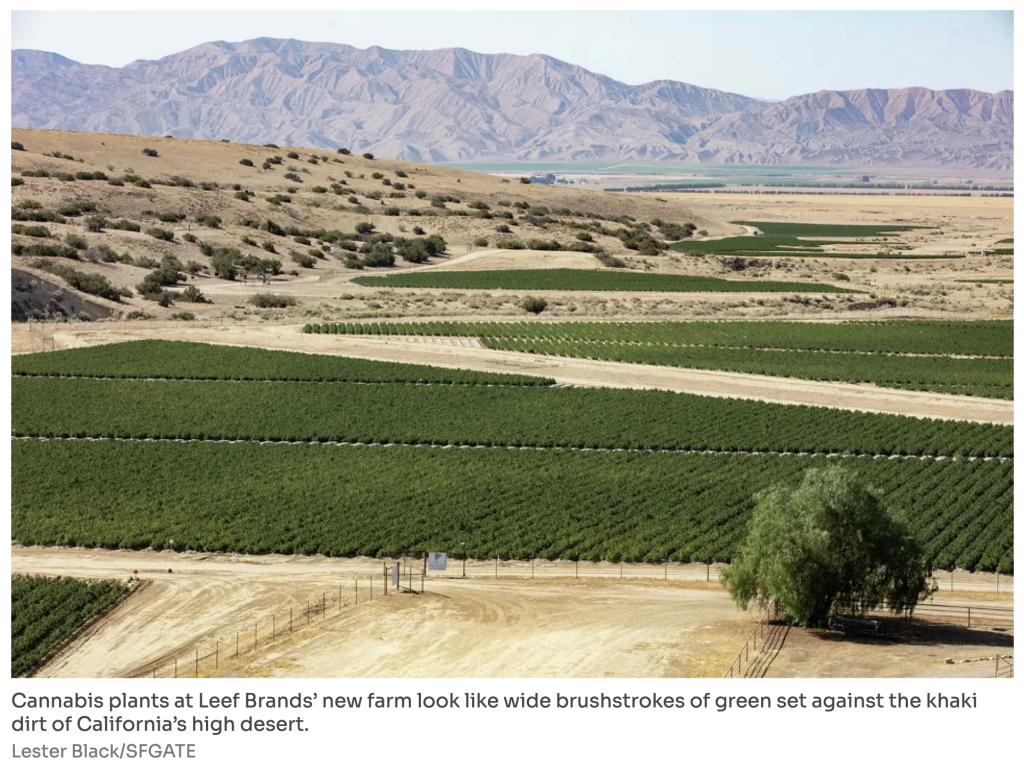
Image #96: “The man behind California’s brand-new $15M weed ranch,” Lester Black, Aug 15, 2025 https://www.sfgate.com/cannabis/article/santa-barbara-california-biggest-cannabis-farm-20764634.php
No more oil wars. No more oil spills. No more climate destabilization. A $135 to $420 dollar conversion kit turns every gas-powered car into a 85% to 100% hemp ethanol powered car. (83) Hemp ethanol would be about 5 times cheaper than gasoline at the pump (84) – the conversion kit will pay for itself with just a few trips to the gas station.
 Image #97: “Plug-and-Play E85 Flex Fuel Kit Unlock Performance with Integrated Cold Start Assist or Temp Sensor for 4-Cylinder” https://www.aliexpress.com/item/1005010634502882.html
 Image #98: PRO Series 2 Cyl-Ethanol E85 Kits https://www.ethanolflex.com/en/28-2cyl-e85-ethanol-kits
 Image #99: “Technical questions” https://www.ethanolflex.com/en/module/faq/frontend.html
It’s for these reasons that Ed Rosenthal was wrong about hemp ethanol, and Jack Herer was right. It turns out that Herer was correct when he said “I don’t know if hemp is going to save the world, but it’s the only thing that can.” (85)
When I tried to publish my article on hemp ethanol in High Times back in 2006, they sat on it for 6 months and then told me they would only give me 300 words. I had given them 3000. I didn’t know which 9/10ths I could do without. When I attempted to then publish it in Cannabis Culture, Marc Emery sat on it for another 6 months and then told me he wasn’t interested in publishing it – it “wasn’t sexy enough” of a topic. The effects of Rosenthal dismissing the potential of hemp as a fuel crop had destroyed any momentum the hemp movement once had. Saving the world was no longer “sexy” or deserving of any serious attention. After Jon Gettman’s January 1996 article on hemp fuel in High Times, there would be no major attention on hemp ethanol in the major pot media for another 24 years – until my editors at Cannabis Culture finally gave me the support I needed to do the topic justice.
As for why Rosenthal would want to sabotage Herer’s attempt to save the world, I don’t understand it. Professional jealousy? Destruction of the side of the hemp cultivation economy that he’s not the master of? A humanity-threatening-level case of being a contrarian? Just an honest miscalculation? Unlike David Watson, Ed Rosenthal is still alive, and could potentially undo the damage he has done to the hemp movement. If he is unable to find factual error in this review of his work, he should apologize for underestimating hemp’s potential to save the world, and help revitalize a movement that he was responsible for killing, while there’s still time for it to make a difference.
 Image #100: Ed Rosenthal, wearing a “HEMP WILL SAVE THE PLANET” sweatshirt . . . ironically, because he convinced everyone that it couldn’t. High Times magazine, April 1995, p. 45
 Image #101: Rosenthal was prepared to entertain the possibility of pharmaceutical corporations having an interest in hemp prohibition – but ignored the possibility that energy companies (a much larger sector of the economy) had a similar interest. “Hemp the baking soda of plants,” Arizona Daily Sun, Flagstaff, Arizona, July 4th, 1997, p. 48
 Image #102: Ed Rosenthal, still wearing his “HEMP WILL SAVE THE PLANET” sweatshirt in 2026 – over thirty years later. Nobody wears this sweatshirt (or any shirt with a similar message) anymore except Ed . . . and because of Ed. https://www.instagram.com/cannabisculture.official/
Admitting our mistakes is not a trait humans are famous for. I have zero expectations of Rosenthal ever doing so. But with extreme weather events and massive global crop failures looming – hanging over our heads like a Sword of Damocles of our own making . . . it would be nice if Rosenthal helped remove the sword. His reversal of opinion would hold a lot of weight amongst the remaining Hempsters . . . and potential future Hempsters.
 Image #103: Rosenthal attended the Cannabis Cub in Amsterdam in December 1994, along with Jack Herer and Marc Emery and many of the leading cannabis activists in the world. “Marijuana growers, users hold trade fair,” The Times-Transcript, Moncton, Moncton Parish, New Brunswick, December 3rd, 1994, p. 29
 Image #104: Michka Seeliger-Chatelain, Ben Dronkers, Mary Kane, Robert Clarke, Marc Emery, Hans Georg Behr – hanging out together at the Cannabis Cup, December 1994. https://ziarnozycia.pl/produkt/michka-sensi-seeds/
 Image #105: “The Cannabis Cup Review 1994,” Marc Emery https://www.cannabisculture.com/content/2009/07/22/cannabis-cup-review-1994/
 Image #106: Marc Emery in front of Hemp BC, 324 West Hastings (the first location) circa November 1994. https://www.cannabisculture.com/content/2014/02/28/marc-emery-prison-blog-how-i-began-my-plan-overgrow-government/
 Image #107: Shell, working behind the counter at Hemp BC, circa 1995. Photo from Cannabis Culture Archives.
 Image #108: Sasha, working at Hemp BC, circa 1995. Photo from Cannabis Culture Archives.
 Image #109: The bookshelves at Hemp BC, circa 1995. Photo from “Hemp BC in 1995,” https://caneve.ca/en/hemp-bc-in-1995/
 Image #110: Hemp BC, circa 1995. Photo from “Hemp BC in 1995,” https://caneve.ca/en/hemp-bc-in-1995/
 Image #111: Hemp BC, circa 1995. Photo from “Hemp BC in 1995,” https://caneve.ca/en/hemp-bc-in-1995/
 Image #112: Jeremy (right), talking with a customer, Hemp BC, circa 1995. Photo from Cannabis Culture Archives.
In mid January of 1995, Vince Cain, the Chief Coroner of B.C., Canada, had his “Caine Report” released to the public. In this report, he recommended the province legalize heroin as a way to deal with the overdose crisis, and also recommended B.C. look into legalizing “soft drugs” such as cannabis. He made many recommendations in a report that touched on all the illegal drug-related issues of the day, but the two most controversial ones were;
“61. Enter into discussions with the federal Ministers of Justice and Health on the propriety and feasibility of decriminalizing the possession and use of specific substances by people shown to be addicted to those specific substances;
62. In concert with the establishment of a Substance Abuse Commission, seriously inquire into the merits of legalizing the possession of some of the so-called ‘soft’ drugs, such as marijuana.” (86)
The prohibitionist editorial reaction came seven months later, in July of 1995 – with a lame attempt to confuse the effects of street heroin and prescription heroin, as well as pretend that illegal drugs can never be used to one’s benefit;
“. . . his recommendation to decriminalize heroin and legalize the use of certain drugs is either so progressive that its logic escapes the average citizen – or it is so absurd that there is no room for logic.” (87)
In spite of all the evidence that was presented in the Cain report, the corporate media has been – up until recently – consistently against harm reduction and medical autonomy policies. Recently, it has been demonstrated that small scale heroin assisted treatment programs have been successful in achieving significant positive outcomes in Vancouver and other places, with the only real problems related to severely limited funding. (88)
As for legalizing soft drugs, there has been no negative health effects from legalization in places where it has been evaluated, (89) with the only real downside of pot legalization being the continued prohibition for the young, the poor and non-whites who were excluded from it, (90) and problems related to organized crime and quality control and corporate greed that apply only to the cartel version of legalization created in Canada and some US states. (91)
In letters of response to the prohibitionist reaction to the Cain report, Vancouver cannabis activists Danna Rozek (92) and Marc Emery (93) both pointed out that coffee was more dangerous than cannabis, which turns out to be a very compelling and effective argument (94) and should be used more often by cannabis activists to fight both prohibition and overregulation.
 Image #113: “Court proceedings stayed against pro-pot supporter,” Edmonton Journal, Edmonton, Alberta, January 18th, 1995, p. 4
 Image #114: “GET IT TOGETHER – FIGHT BILL C-7” Potshot #7, p. 60. Image from: https://pot-shot.ca/2017/11/04/issue-7/
 Image #115: “From Pothead To Crackhead?” Newsday, New York, New York, February 7th, 1995, p. 36
 Image #116: “From Pothead To Crackhead?” Newsday, New York, New York, February 7th, 1995, p. 38
 Image #117: Protesting for an OPEN DEBATE on Bill C-7 near the entrance to the Edmonton Journal building. Edmonton, Alberta, circa March 1995. Photos by Jana.
 Image #118: Potshot #8, March 1995. Image from https://pot-shot.ca/2017/11/04/issue-8/
On April 1st, 1995, Edmonton had another smoke in. Grassroots wanted to focus on the Edmonton Journal’s refusal to print a letter dealing with the misinformation they insisted on printing about cannabis. The letter was in response to an article which lied about the harms of marijuana smoking on young people:
“This year’s token marijuana feature; ‘Should you tell your kids you did pot?’ (Edmonton Journal, April 30th, 1994, p. B6) quotes extensively from Victor Strasburger, the author of Getting Your Kids to say ‘No’ in the ‘90s When You Said ‘Yes’ in the ‘60s. Strasburger says that ‘Parents do not have to feel like hypocrites for asking their children to do as they say, not as they did’ because ‘marijuana is more potent now’ and ‘they might get addicted’. First, unlike alcohol, no one has ever died from an ‘overdose’ of pot. The oral dose of cannabis required to kill a mouse is 40,000 times the dose required to produce typical symptoms of intoxication in humans (Loewe, Journal of Pharmacological and Experimental Therapeutics, October, 1946). As well, there has never been one documented case of cancer by marijuana. There have been over 38,000 cases of cancer from tobacco documented every year in Canada, or ‘20% of all deaths’ (Edmonton Journal, Feb. 12th, 1994, p. G3). What’s the difference between tobacco and cannabis? The phosphate fertilizers used to grow tobacco contain especially high concentrations of these (polonium-210) radioisotopes.’ (Whole Life Times, May 1985) Unlike tobacco, cannabis tars contain no radioactivity. Second, unlike tobacco and alcohol, there is no proven physical dependence on pot. The term ‘psychological dependence’ could apply to marijuana, as well as chocolate, T.V., and masturbation. Ex-DEA Administrative Law Judge Francis L. Young called marijuana ‘far safer than many foods we commonly consume . . . one of the safest therapeutically active substances known.’ David Friedman, Deputy Director of the National Institute on Drug Abuse, noted in late 1990 that ‘Its probably true that (cannabis’s) greatest danger is if a bale of it falls on you.’” (95)
 Image #119: Protest against Bill C-7, Ice Cream Park, Jasper Avenue, Edmonton, Alberta. April 1st, 1995. Photo by Jana.
 Image #120: Protest against Bill C-7, Ice Cream Park, Jasper Avenue, Edmonton, Alberta. April 1st, 1995. Photo by Jana. Image from Potshot #9, Summer 1995, p. 9: https://pot-shot.ca/2017/11/04/issue-9/
The media seemed like a good target for cannabis activists. Articles printed in the Ubyssey (96), the Emperor Wears No Clothes (97) and The New Age Patriot (98) all pointed to the fact that the corporate media were biased against cannabis – only by pointing this fact out and insisting on a fair debate were activists ever to have a chance of changing public opinion in favour of legalization. So the focus of Grassroots Edmonton in 1994 and 1995 became an effort to draw attention to the Edmonton Journal’s bias, mainly by putting a big sign up next to the Journal office building on Jasper Ave insisting they print our letter, and holding smoke-ins – and eventually rock concerts – behind that sign.
 Image #121: “Let’s execute drug dealers,” Don Feder, The Indianapolis News, Indianapolis, Indiana, April 10th, 1995, p. 10
The approach of the Vancouver activists – who were not then having any trouble getting media attention or their letters published in the newspapers – was much more laid-back. Then manager HEMP BC Danna Rozek and her coworker Cindy Lassu were hip to the term Deadheads used as code for marijuana, and decided in March of 1995 to organize a gathering on April 20th – “4/20” – to smoke pot and speak about the benefits of hemp in nearby Victory Square. Marc Emery retold the tale on the Huffington Post website:
“I arrived in Vancouver on March 1, 1994, completely new to the West Coast and Vancouver, and in May I met Ian Hunter. On a few occasions I had heard him say, ‘It’s 4:20, everyone,’ to anybody nearby, and he’d light up a joint. I thought, ‘What strange creatures these west-coasters be!’ Ian was a known hempster hipster in Vancouver. . . . Ian explained the 4:20 daily ritual to me, but I didn’t think much of it at first. However, when I hired the dread-Deadheaded Danna Rozek to be the store manager in August 1994, she hired fellow Deadhead Cindy Lassu, and with Ian they became the nucleus of the HEMP BC store staff. We smoked pot in the store non-stop. At 4:20 p.m., all three would yell, ‘Four-twenty, smoke ’em if you got ’em!’ – which seemed redundant to me, since we were always smoking anyway – it became a fun loud exclamation every day. I got used to that afternoon celebration, and I noticed that most customers to our store were unfamiliar with it, but it quickly became popular in our limited circle of customers and within the small but growing culture we were part of. One day in early March 1995, Danna and Cindy came to me at my desk at HEMP BC, and we had this exchange I remember vividly. Danna said, ‘Marc, we’d like to have a ‘Four-Twenty’ celebration on April 20. We’d like your permission and approval to put on a Four-Twenty concert and rally and fun time in Victory Square next door.’ Victory Square – which we were calling ‘Hemp-For-Victory Square’ (named after the re-discovered 1942 US Department of Agriculture film ‘Hemp for Victory’ that Jack Herer had found after years of the US government denying its existence), and at that time a staple in the nascent hemp and legalization movement – was a park 50 feet down the street from HEMP BC, at the southwest corner of Cambie St. and West Hastings St.
‘What do you mean? A rally at 4:20 that day, on April 20?’ I asked in clarification.
‘No, an all-day celebration of Four-Twenty, on Four-Twenty, because April 20 is like, Four-Twenty, get it?’ Danna further explained, though I had ‘gotten’ it.
‘You mean, hold a celebration, a party, rally, good time in the park, all day on April 20?!’ I was aghast. ‘Could we get away with that?’
‘Yeah, that’s exactly what we mean,’ said Danna, representing her and Cindy. ‘I’m sure we could get away with it. We could try anyway. I’m sure it’ll work.’
As I come from an Ayn Rand capitalist-hardwork-ethos background (since October 1979), this idea that we’d enshrine a whole day of celebrating cannabis by smoking pot for several hours in a public square seemed outrageous, outlandish, and playing into the slacker-stoner stereotype.
‘No, we can’t do that.’ I said.
‘Yes, we could!’ Danna and Cindy immediately responded enthusiastically.
‘No, I can’t condone that.’ I reiterated.
Half an hour later the two came back to my desk as I was working. ‘Even if you don’t approve, can we go ahead and do it anyway?’ they implored.
I had always believed in taking initiative, and admired self-starters. I considered them for a few moments and said, ‘Yes.’
They both jumped up and down and embraced each other and cried ‘Yay!!!’ and then they immediately asked, ‘If we organize it, will you help?’
‘What does that mean?’ I asked.
‘Well, we drew up a budget and we’ll need $200, and electrical cables from the store here to the square to provide power for the amplification system, and we’ll need to work at the park most of the day, so will you help in those things and whatever else might come up?’ …
‘Yes. Put your plan together. Tell the rest of the staff (8 people at the time) and we’ll make sure it happens.’” (99)
Marc Emery, Dana Larsen, Danna Rozek and Leeroy Campbell all spoke at the first 420 rally. There were no arrests, and everyone had a good time. It got bigger and bigger every year. It was first moved from Victory Square to Grandview Park in 1997, then The Art Gallery in 1998, and finally to Sunset Beach in 2016, as the Art Gallery and surrounding streets could no longer contain the massive crowd. The 420 Rally in 2019 had an estimated 150,000 people in attendance, (100) and the world-famous rap group Cypress Hill performed, with Mix-Master Mike of the Beastie Boys opening for them. (101)
 Image #122: Ian Hunter posing with 4:20 poster, circa 1995. Photo from Cannabis Culture archive.
 Image #123: Danna Rozek posing with pot plants, circa 1995. Photo from Cannabis Culture archive.
 Image #124: Cindy Lassu, circa 1995. Photo from Cannabis Culture archive.
 Image #125: Marc Emery speaking at the first 4/20 rally. Victory Square, Vancouver, B.C., April 20th, 1995. Photo from Cannabis Culture archive.
 Image #126: Danna Rozek and Hemp BC webmaster Karlis Kalnins at the first 420 rally Victory Square, Vancouver, B.C., April 20th, 1995. Photo from Cannabis Culture archive.
 Image #127: Danna Rozek speaking with Dana Larsen. Victory Square, Vancouver, B.C., April 20th, 1995. Photo from Cannabis Culture archive.
 Image #128: Dana Larsen speaking, Barge (the photographer for nearly all of the Cannabis Culture archive photos) is standing and listening. Victory Square, Vancouver, B.C., April 20th, 1995. Photo from Cannabis Culture archive.
 Image #129: Dana Larsen speaking. Victory Square, Vancouver, B.C., April 20th, 1995. Photo from Cannabis Culture archive.
 Image #130: Brother Leeroy James Campbell speaking. Victory Square, Vancouver, B.C., April 20th, 1995. Photo from Cannabis Culture archive.
 Image #131: Brother Leeroy James Campbell speaking. Victory Square, Vancouver, B.C., April 20th, 1995. Photo from Cannabis Culture archive.
 Image #132: The audience at the first 4/20 rally. Victory Square, Vancouver, B.C., April 20th, 1995. Photo from Cannabis Culture archive.
 Image #133: Danna Rozek speaks at the first 4/20 rally. Victory Square, Vancouver, B.C., April 20th, 1995. Photo from Cannabis Culture archive.
 Image #134: Brother Leeroy James Campbell speaks to Karlis Kalnins at the first 4/20 rally. Victory Square, Vancouver, B.C., April 20th, 1995. Photo courtesy of Cannabis Culture.
 Image #135: A group of teens keeping the tradition of civil disobedience at cannabis legalization protests alive at the first 4/20 rally. Victory Square, Vancouver, B.C., April 20th, 1995. Photo courtesy of Cannabis Culture.
420 rallies have spread beyond Vancouver to include places all over the world, including but not limited to New York City at Washington Square Park in Manhattan, San Francisco at “Hippie Hill” in Golden Gate Park near the Haight-Ashbury, Montreal at the Mount Royal monument, Denver at the Civic Center Park, Ottawa, Boulder at campus of the University of Colorado Boulder, Ontario, Canada at Parliament Hill and Major’s Hill Park, Edmonton, Alberta, Canada at The Alberta Legislature Building, Sydney City at Martin Place, New South Wales, Australia, Melbourne, Victoria, Australia, Hyde Park in London, England, Dunedin at the University of Otago in New Zealand, and Lefkoşa, in Northern Cyprus. (102)
 Image #136: “Police constable ‘Denver Sas’ smokes a water pipe known as a ‘hubbly bubbly’ filled with marijuana on May 11, 1995 before the start of a protest march to legalize cannabis in Cape Town, South Africa.” “Get Up Stand Up, 1995,” June 8, 2017. Image from: www.thecannachronicles.com/get-up-stand-up-1995/
 Image #137: “COP LIKES FREE GANJA,” The Edmonton Sun, Edmonton, Alberta, May 12th, 1995.
 Image #138: “Hemp scoring big as haute couture,” The Plain Dealer, Cleveland, Ohio, June 4th, 1995, p. 20
 Image #139: “Drugs bill withdrawn for more discussion,” The Vancouver Sun, Vancouver, British Columbia, June 16th, 1995, p. 10. Image from Potshot #10, p. 8. https://pot-shot.ca/2017/11/04/issue-10/
In May of 1995, something akin to a miracle happened in Vancouver. The federal government of Canada instructed the Vancouver police to stop filing drug possession charges:
“Simple drug possession in Vancouver will no longer be prosecuted, under new federal government guidelines, The Province has learned. Senior federal drug prosecutor Lindsay Smith wrote to Vancouver police on May 17th advising them of the relaxed stance. The letter said the Crown would only approve possession charges if there was an aggravating factor, such as if the person was ‘a known gang member.’ ‘We were simply indicating the system is badly overtaxed and we have more drug cases than we can deal with,’ explained Tony Dohm, of the justice department. . . . Prof. Neil Boyd, head of Simon Fraser University’s criminology department, said giving up on drug-possession charges is ‘probably the right way to go.’ He advocated decriminalizing drug possession, saying drug use should not be a criminal offense. ‘It does not make sense to criminalize the chemical alteration of consciousness with some drugs when we allow people to do it with tobacco and alcohol,’ Boyd Said.” (103)
 Image #140: “Users off the hook,” The Province, Vancouver, British Columbia, June 18th, 1995, p. 5
My intuition told me that this “truce” was really a way to showcase western tolerance, similar to how the Nazis used the Theresienstadt Ghetto in Czechoslovakia during World War 2 to show everyone how nice they were to the Jews – to allow for their crimes everywhere else to proceed without resistance. (104) The opposite view, suggested to this author on more than one occasion by Vancouver activist Ian Hunter, was that “you should be pronoid – it’s the opposite of paranoid – it’s the belief that everyone is out to help you!”
Regardless of whether the motive behind the policy change was nefarious, indifferent, pragmatic, expedient, utilitarian or altruistic, the effect was that Vancouver suddenly became a beachhead and/or a showcase of drug peace. An opportunity to experiment with different levels – different manifestations or entities – of drug peace activity had suddenly become available. Vancouver became a “testing grounds” for different ways to use, research, produce, distribute and regulate illegal drugs. Vancouver drug-peace activists would exploit this tolerance to the maximum over the next 31 years.
 Image #141: “Looser drug rules get a mellow thumbs-up,” The Province, Vancouver, British Columbia, June 19th, 1995, p. 4
Reaction to the policy change – leaked to The Province newspaper (which made it public on June 18th, 1995) – was mixed. The Mayor at the time – Philip Owen – thought the sky was falling:
“The winner is the drug-dealing punk who makes off with all this tax-free money and leaves us with the social chaos and destruction in his wake. I have great difficulty with that . . .” (105)
High Times magazine, on the other hand, had a different spin;
“Nonetheless, Marc Emery of Hemp BC, Canada’s largest hemp store, says that things have changed. ‘In an informal poll of eight police officers taken by Hemp BC – asking the question ‘What would you do if someone lit a joint up right in front of you?’ – not one of the officers said they’d make an arrest. They might not have anyway because drugs are so prevalent in downtown Vancouver, but now they certainly won’t, knowing the feds are going to drop the charges.” (106)
Meanwhile, the Partnership for a Drug Free America were getting their cotton underwear in a bunch over the success of the hemp movement to go mainstream. In an article entitled “Slip into Something HEMP” in a Lincoln, Nebraska newspaper, the Partnership vice president Steve Denistrain was quoted as saying;
“At its core, the hemp movement is an attempt to legitimize a drug. There are plenty of other fibers.” (107)
There are a few things wrong with this statement. 1) At its core, the hemp movement was not just an attempt to improve access to high quality fibres, it was actually an attempt to stop climate destabilization, deforestation, oil spills, oil wars, pollution, the chemical-heavy cotton industry, and general eco-destruction. Eco-destruction is a huge buzz-kill. 2) Hemp is the most durable of all the fibres. As Don Wirtshafter insightfully pointed out in the same article;
“Hemp is . . . the strongest material fabric on Earth. . . . Cotton clothes you wear out, but hemp clothes you wear in. They get softer with age.”
3) If the drug you’re trying to legitimize is non-toxic, has no examples of death from overdose, and can replace half of the prescription medicines when fully researched, it deserves to be legitimized and fully legal. The Partnership for a Drug Free America did not make the case that hemp (or marijuana) was too dangerous to legalize in that article, or anywhere else.
On July 1st, 1995, the Edmonton activist group Grassroots attempted to stage an over-night rally to protest the Edmonton Journal refusing to print our letter. It started out pretty smoothly, with tips on non-violent arrest resistance, a lot of smoking pot, and the local death-metal rock band Perceptual Distortion belting out their own brand of morbid ambiance to an enjoyable afternoon that turned into a fascistic, cop-filled evening. Pawn, Weepfod, No Insentive, Dr. Oxide and XIIth House also performed. To make a long story short, the cops made a show of force and scared the crowd out of the park. Our group stayed together, marched through downtown and chanted the only songs we all knew: “Oh Canada” and the theme from the TV show “Spiderman.”
 Image #142: Protest banner and Canadian cannabis flag, hung up in honour of Cannabis Daze. Ice Cream Park, Jasper Avenue, Edmonton, Alberta. July 1st, 1995. Photo: Mike LaRiviere. Image from: Potshot #10, p. 37. https://pot-shot.ca/2017/11/04/issue-10/
 Image #143: Practicing Hug Power arrest resistance tactics. Cannabis Daze. Ice Cream Park, Jasper Avenue, Edmonton, Alberta. July 1st, 1995. Photo: Mike LaRiviere. Image from: Potshot #10, p. 36. https://pot-shot.ca/2017/11/04/issue-10/
 Image #144: The death metal band Perceptual Distortion entertains. Cannabis Daze. Ice Cream Park, Jasper Avenue, Edmonton, Alberta. July 1st, 1995. Photo: Mike LaRiviere. Image from: Potshot #10, p. 37. https://pot-shot.ca/2017/11/04/issue-10/ For a taste of PERCEPTUAL DISTORTION – SUCK MY HEAVEN (FULL) https://www.youtube.com/watch?v=SEXEK6Ynshg
 Image #145: Drummer from one of the many bands who played that day. Cannabis Daze. Ice Cream Park, Jasper Avenue, Edmonton, Alberta. July 1st, 1995. Photo: Mike LaRiviere.
 Image #146: Voting on how to respond to police threats of arrest and/or forcibly being removed from Ice Cream Park. Cannabis Daze, July 1st, 1995. Photo: Mike LaRiviere. Image from Potshot #10, p. 38: https://pot-shot.ca/2017/11/04/issue-10/
 Image #147: The threat. Each of these cops were over 7 feet tall. Cannabis Daze, July 1st, 1995. Photo: Mike LaRiviere. Image from Potshot #10, p. 39: https://pot-shot.ca/2017/11/04/issue-10/
Eventually, the police moved in and arrested five of us who they thought were the ringleaders. Three were let go in the morning, Gateway journalist Peter Moore got charged with “obstructing an officer” while I was charged with “causing a disturbance.” (108)
We decided to push “freedom of speech” and “freedom of assembly” as far as we could, and realized those freedoms are meaningless when the police and corporate media conspire to mischaracterize your non-violent actions. You have freedom of speech, so long as you can be ignored. The moment you make yourself difficult to ignore, your freedom evaporates.
 Image #148: “Pot activists busted after noisy party,” Edmonton Journal, Edmonton, Alberta, July 5th, 1995, p. 14, Image from Potshot #10, p. 41: https://pot-shot.ca/2017/11/04/issue-10/
In a story about how HEMP BC activists expected legalization sooner rather than later that ran in full in the July 20th, 1995 Vancouver Sun, (109) and in a much-shortened version in the Mountreal Gazette on July 23rd, (110) the “no charge for simple possession in Vancouver” policy was mentioned. But in the Edmonton Journal version of the article published on July 21st, (111) the editors removed the mention of the dramatic change of policy out of the article, making it seem like activists were being optimistic for no good reason.
 Image #149: “Hemp shot isn’t worried about police,” Vancouver Sun, Vancouver, British Columbia, July 20th, 1995, p. 19. Image from Potshot #10, p. 5: https://pot-shot.ca/2017/11/04/issue-10/
 Image #150: “Smokeless toke: Using a Toke-O-Matic, Hemp BC store owner Marc Emery, 37, and store manager Danna Rozek, 22, toke up some marijuana at the store. His device which is new, allows smoking of pot without actually inhaling any smoke. The pot is heated inside the bowl until the THC active ingredient releases from the pot. Then it’s inhaled through the hose.” IAN SMITH / VANCOUVER SUN. July 23rd, 1995. https://calgaryherald.com/health/Photos+Scenes+from+Vancouver+narcotic+history/6493513/story.html
 Image #151: Hemp BC, 324 West Hastings, Vancouver, B.C., circa 1995. Photo from “HempBC in 1995,” Nov 27, 2019 https://caneve.ca/en/hemp-bc-in-1995/
 Image #152: Hemp BC and the old “SUPEROCK” head shop next door. Circa 1995. From the Cannabis Culture archives.
 Image #153: The Pot Block, circa 1995. From the Cannabis Culture archives.
In the same July 20th edition of the Vancouver Sun, James Bissell, the regional director for the Canadian Justice department in Vancouver denied the “no charge” policy for simple possession, instead saying that each case is evaluated on its own merits, the courts are clogged with minor drug cases, and the police are choosing to focus more on the importers and traffickers of hard drugs such as heroin and cocaine. (112) Bissell didn’t bother to explain why Senior federal drug prosecutor and justice department representative Tony Dohm wrote that letter to the VPD informing them of the policy change, however.
 Image #154: “KANESATAKE: 1990/1995,” The Gazette, Montreal, Quebec, July 27th, 1995, p. 16. Image from: https://www.cannabisculture.com/content/2022/06/09/traditional-medicine/
 Image #155: Edmonton Journal, Edmonton, Alberta, July 29th, 1995, p. 3. Image from: “Traditional Medicine,” David Malmo-Levine, June 9, 2022 https://www.cannabisculture.com/content/2022/06/09/traditional-medicine/
A month later, the Edmonton Journal ran a feature article entitled “GOING TO POT,” which outlined the two possible positions the corporate press believed one could have on the cannabis issue: The “most reformers” position, which was “decriminalization” – with fines replacing a criminal record, or the Canadian government position, which is increasing police powers and going after users, growers and dealers with vigour:
“Most proponents of reform are not interested in total decriminalization, partly because they know Canada’s signature on international anti-drug conventions probably wouldn’t allow it anyway.” (113)
“Eliminating all punishments related to cannabis” wasn’t even an option worth considering, according to the mass media. Sadly, it still isn’t. The lesson from the above quote is that reporters are often wrong about what reformers are interested in, or what the limits of reform actually are.
 Image #156: “Reefer madness,” Edmonton Journal, Edmonton, Alberta, August 20th, 1995, p. 37
 Image #157: “GOING TO POT,” Edmonton Journal, Edmonton, Alberta, August 20th, 1995, p. 39
The Canadian government position was something the Canadian government was attempting to manifest into reality at the time with a series of bills (Bill C-85, which became Bill C-7, which became Bill C-8, which was passed into law as the Controlled Drugs and Substances Act). In 1993, the Liberal party defeated the Conservative party, but the Bill that the Liberals then introduced (C-7) was identical to the one the Conservatives had introduced (C-85). (114)
In 1993, the most notable feature of the new drug bill (C-85) was that it would make just asking for pot a crime, (115) and double fines from $1,000 to $2,000 dollars, with subsequent offences rising from $2,000 to $5,000 dollars. (116) In the “GOING TO POT” article, the government defended its position by saying relaxing the pot laws would be “sending the wrong signal to criminals” and that pot is a gateway to heroin and cocaine. The “most reformers” position was made to seem like the only rational position in comparison. The way the government shoves terrible decisions down our throats is to make it the less terrible of two terrible options. The general population must learn to identify “false dichotomy edicts” and resist them better.
The same debate limits were used by the Globe & Mail in 1994, when you could be in favour of either fines for possession on the one side, or increased fines and police powers on the other side. The first option – possession is punished like a parking ticket – was articulated by Ottawa Police Chief Brian Ford. The second option was favoured by the establishment (in this case by Liberal chairman of the C-7 subcommittee MP Paul Szabo) because “we can’t show weakness in terms of drugs right now . . . Drugs scare people.” It was reported that the 1994 version of Bill C-7 included warrants that would allow police to search everyone in the place, even if the place was a stadium. (117)
The United States media was busy pushing the “inherently harmful pot” narrative in August 1995, such as the “fatigue, paranoia, possible psychosis” mentioned in a Utah newspaper, (118) or the syndicated USA Today column (reprinted various newspapers including the Edmonton Sun) which mentioned “memory loss, lower male testosterone levels, increased anxiety levels, and a cancer risk.” (119)
 Image #158: “Body surfers make their way over the audience at Boston Common during the Sixth Annual Freedom Rally, held yesterday to promote the end of marijuana prohibition.” The Boston Globe, Boston, Massachusetts, September 24th, 1995, p. 36
The only policy change being discussed in the US was Newt Gingrich suggesting in August 1995 that “major drug smugglers” should now be executed:
“And so I think we should say to them, ‘When you make the decision that you’ll get rich at the expense of our children, you are signing your own death warrant because we will have a death penalty for anyone who brings a commercial quantity of drugs into the United States.’” (120)
 Image #159: “Gingrich reiterates: Execute drug dealers,” The Atlanta Journal, Atlanta, Georgia, September 24th, 1995, p. 13
What “major drug smugglers” and “commercial quantity” meant, exactly, was made clear the next year in a news report on the application of the death penalty: “100 individual doses of heroin, cocaine, crack, LSD, marijuana, and other drugs.” (121) In other words, a couple ounces of pot smuggled into the US would get repeat offenders executed. First time convictions would get mandatory life sentences. Holland, which had coffee shops that sold that much pot every hour of every day for years on end, was the subject of a 1994 documentary titled Sex, Drugs and Democracy.
 Image #160: Sex, Drugs & Democracy https://www.youtube.com/watch?v=uQj7uvUfDDY
In September of 1995, the Boston Globe ran a review of the film (a film which happened to be an excellent examination of what a nation that valued freedom and tolerance of diversity might manifest in terms of drug policy), complete with a photo of a bonsai pot plant in front of a street sign for “THE WORLDS’ ONLY HASH INFO MUSEUM – AMSTERDAM.” (122)
 Image #161: “‘Sex, Drugs’ has only view of ‘vice’”, The Boston Globe, Boston, Massachusetts, September 22nd, 1995, p. 58
Two days after that article was published, the Vancouver Province published another article about Hemp BC entitled “Hemp store thrives as cops shut an eye.” Vancouver was quickly turning in the Amsterdam of North America;
“Rozek said the store has a great relationship with the police. ‘I’ve smoked it in front of them lots of times when they’re in the store, and they’re cool about it.’ Said Cpl. Jens Linde of the Vancouver drug squad: ‘I’ve got bigger fish to fry.’” (123)
 Image #162: “Hemp store thrives as cops shut an eye,” The Province, Vancouver, British Columbia, September 24th, 1995, p. 5
Incidentally, this was two days after this author moved from the harsh drug-war battlefield of Edmonton, Alberta, to the idyllic, breezy hills and valleys of drug peace that was Vancouver, to work at Hemp BC. It was the first job where pot smoking wasn’t just looked on positively, it was practically compulsory. We had to demonstrate to the public that high doses and high productivity were possible to achieve simultaneously. There were some rules, however. The moment we broke a glass bong, we had to put the hacky-sac away.
In a complementary article on the preceding page of The Province, Hemp BC assistant manager Hilary Black was quoted as the resident expert on its medicinal qualities:
“‘People who have cancer and get (nauseated) from chemotherapy use it to settle their stomach . . . and it relieves the pressure on the eyes in glaucoma patients.’ Black said toking up has rid her of migraines and done wonders for her asthma. ‘Pot relaxes you and opens up your capillaries, so it’s great for headaches. And it’s legendary for relieving PMS. I’ve had friends who’ve cut up a bud, mixed it with alcohol and applied it to herpes sores, and they’ve cleared right up.’ Besides easing pain for AIDS patients, pot helps them eat. ‘We all know smoking up gives you the munchies, so it really helps increase their appetite.’” (124)
 Image #163: Med pot activist/pioneer Hilary Black is quoted in the press for the first time, regarding medical marijuana. “Soother or killer?” The Province, Vancouver, British Columbia, September 24th, 1995, p. 4
 Image #164: “VANCOUVER DECRIM? – FEDS DECLINE FURTHER PROSECUTION OF DRUG POSSESSION BUT MAYOR PROMISES CONTINUED ARRESTS,” High Times magazine, October 1995, p. 21. Article online in Potshot #10, p. 6: https://pot-shot.ca/2017/11/04/issue-10/
The very next month, Marc Emery announced the beginning of the medical marijuana movement in Canada – basically bragging about his employee Hilary Black’s secret side hustle – the Vancouver Medical Marijuana Cooperative – without naming it or her directly;
“Mark (sic) Emery, owner of the popular pot store Hemp B.C. in Vancouver, says the decision is part of the turning tide for pot. ‘Ultimately it’s not the politicians that are legalizing it, it’s the police officers, the courts and the public,’ said Emery. ‘We deal with lots of people who are using pot medicinally – we provide it for them.’” (125)
 Image #165: Marc Emery announces that Hilary Black is selling medical marijuana, without naming her. “Pot-for-pain plea heard,” The Province, Vancouver, British Columbia, October 4th, 1995, p. 5
There is much debate over when the first activist med pot distribution began in Canada. This is the earliest evidence of that happening that this author could find. Hilary Black initially set up an office in a heritage building at the corner of Homer and Pender St. – less than two blocks away from Hemp BC. This was the first medicinal cannabis dispensary in Canada. It was set up no later than October 3rd, 1995. The person who has claimed to have been the first have yet to produce any evidence that they began before this date.
 Image #166: Pamphlet for the VANCOUVER MEDICAL MARIJUANA COOPERATIVE – Canada’s first medical marijuana organization – what would later evolve into the BC Compassion Club Society. It was begun by Hilary Black and her associate Theo. It began as late as October 1995, and by the time this pamphlet was produced, Hilary Black had left for California, to learn from Todd McCormick, and later Amsterdam, to learn from an assortment of famous growers and retailers.
 Image #167: Pamphlet for the VANCOUVER MEDICAL MARIJUANA COOPERATIVE, circa 1996.
In early 1996, Black headed to Amsterdam to learn about cannabis from the marijuana masters – Robert Clarke, Ben Dronkers, David Pate, Wernard Bruning, and Todd McCormick. (126) She left the Vancouver Medical Marijuana Cooperative in the hands of her friend Theo, and went off to study pot medicine from the experts, and work at Positronics – the first grow shop in Europe, owned by Wernard Bruning, onetime owner of Mellow Yellow, the western world’s first cannabis coffee shop, which opened in 1973. (127)
Before she left for Holland, Black would join this author in protesting the raids on hemp stores, the first of which came on November 2nd, 1995, in North Vancouver:
“‘It’s clearly harassment,’ said David Malmo-Levine from Hemp B.C.’s Vancouver office. North Vancouver RCMP raided The Joint (BBK Cool Shop) at 165 East 1st St. and seized hemp products that included pipes, magazines, scales and seeds, according to a North Vancouver RCMP spokesman. The police also seized the stores business license, which had been issued for retail sale of sporting goods and equipment. Malmo-Levine said the North Vancouver RCMP had been in the store once since the business opened about three weeks ago. ‘The other stores haven’t had similar problems as of yet,’ said Malmo-Levine.” (128)
 Image #168: “Pot luck,” North Shore News, North Vancouver, British Columbia, November 8th, 1995, p. 1. By this time this author had moved to Vancouver and began organizing protests, which was good timing, because it was then that the police raids of the hemp stores began.
In spite of this author doing his very best to stress the point that there were no victims and nobody was harmed by the actions of the store owner – Ryan Mawhinney – the reporters at North Shore News didn’t see fit to include that element in their reporting. The media has ample room to publish or broadcast every possible stigma, negative speculation or baseless accusation against pot, but seldom any room or time to explore evidence that might exonerate pot.
 Image #169: Photo of Hemp BC associates and/or Hempology 101 students protesting Bill C7 at the Art Gallery, Robson Side, Vancouver, B.C., November, 1995. This author is in the blue and black checkered lumberjacket in the centre rear. To his left holding another pot leaf sign is Theo of the Vancouver Medical Marijuana Cooperative. In the very front row with curly hair is Darren Morgan, who went on to win 3rd place at the Cannabis Cup in Holland in early December of this year. Immediately behind Morgan is Cannabis Canada editor Dana Larsen. Two seats to the right from Larsen is Karlis Kalnins, the webmaster for Hemp BC. Photo from the Cannabis Culture archives.
 Image #170: Photo of Dana Larsen speaking at Vancouver City Hall, protesting in support of medical marijuana. November, 1995. Photo courtesy of Cannabis Culture.
On October 30th, 1995, the Canadian Parliament, using the cover of the Quebec referendum happening the same evening, passed Bill C-7/C-8 into law. The Canadian public was not consulted – only a limited number of experts were consulted on the bill, the name of the bill was changed, the name of the bill wasn’t mentioned when the bill was passed, and the reporting on the passing of the bill was non-existent the night it was passed, due to the Quebec referendum. The first the public heard about it was November 10th, 1995, when a brief letter from Dana Larsen was published in The Province;
“The day before Halloween was a very scary day for Canadians. Many of us were afraid that we would lose our country because of a public vote in Quebec. We didn’t realize that we were also losing our freedom because of a private vote. As the ballots were being counted in Quebec, the Canadian Parliament passed Bill C-7, the Controlled Drugs and Substances Act. The Official Opposition, the Bloc Quebecois, was not present to speak or vote against the bill, as it chose to boycott Parliament that day because of the referendum. Bill C-7 makes no provision for the medical use of marijuana, and makes no reduction to the harsh penalties for marijuana possession. According to MP Hedy Fry, the bill will ‘streamline’ the judicial process, which means that more pot smokers will go to jail without the inconvenience of an expensive and time-consuming trial by jury. Is this justice? This issue deserves serious, open debate. We must not tolerate a government that plots more efficient ways to imprison its citizens while the fate of a country hangs in the balance.” (129)
The first reporting (by the media itself) on the passing of bill C-7/C-8 on October 30th, took place on November 15th 1995. But the coverage was of an imaginary positive feature of the bill – the bill would supposedly result in “no more criminal records.” The Vancouver Sun put “Bill to eliminate criminal record for marijuana possession” at the top of their front page. (130) The Toronto Sun put “FEDS PUSHING SOFTER POT LAW” at the top of their front page. (131) The story inside the Toronto Sun had the heading “Potheads high on grass law changes,” but the quotes from the pot activists were extremely qualified:
“For some, the change is not enough. ‘I’m elated, but we are still very much behind the times,’ said Umberto Iorfida, the local president of the National Organization for the Reform of Marijuana Laws (NORML). Chris Clay, who was charged with trafficking in marijuana after his London shop allegedly sold plants to customers, is also cautiously optimistic. ‘Let’s get rid of the black market all together.’”
 Image #171: “Bill to eliminate criminal record for marijuana possession,” The Vancouver Sun, Vancouver, British Columbia, November 15th, 1995, pp. 1, 2 Image from Potshot #11, p. 16: https://pot-shot.ca/2017/11/04/issue-11/
The Edmonton Journal put “Convictions for pot possession untraceable under new bill” on page A3. (132) The Montreal Gazette had the headline “Easing the pot law” on page 10. The Calgary Herald had “Pot possession off the record” on page 1. (133) The Winnipeg Free Press had “Dope stigma to ease” on page 1. (134) The Nanaimo Daily News had “Pot law relaxed” on page 1. (135) The only front-page attention Bill C7/C8 ever got turned out to be a lie. The truth was also printed, but in just one newspaper – the Vancouver Sun – and on page B12, the next day:
“Canadians convicted of minor marijuana possession will still have problems crossing the U.S. border despite new legislation eliminating traceable criminal records, immigration lawyers predicted Wednesday. Michael Jacobsen, a Canadian and U.S. lawyer dealing with immigration matters, said clients have been barred entry to the U.S. based on a simple arrest – never mind a conviction. ‘The exchange of information between Canadian and U.S. authorities is like an open phone line,’ he said. Jacobsen said he doubts a new bill eliminating traceable criminal records will stop that flow of information. ‘Even though they’re not going to be fingerprinted, I just think the information lines are so open that information is shared holus-bolus.’ The amendments to Bill C-7, which is now before a Senate committee, would prevent police from fingerprinting people convicted of possessing less that 30 grams of marijuana or less than one gram of hashish. Since no fingerprints would go to the RCMP database, the offence would not normally be traceable. Possession of even small amounts of cannabis would remain a criminal offence punishable with a fine of up to $1,000 and a jail term of up to six months. David Hopkins, district counsel with the Immigration and Naturalization Service in Seattle, also said he doubts the new Canadian legislation will open the borders. ‘I really don’t think it’s going to affect the way we would handle someone,’ he said. Border guards will still be able to get information on a person’s criminal past, he said. ‘Presumably they would get it if the people tell the truth. And if they don’t tell the truth – that’s a federal offence.’ But Liberal MP Hedy Fry disputes the idea that customs officers will still have access to information on minor drug convictions. ‘They can’t. How can they get that information? It is not going to be in any place. It is not going to be recorded, because the recording goes with the fingerprinting. So there is no fingerprinting, there is no recording.’” (136)
 Image #172: “Canadians busted for pot still face border block, lawyer says,” Vancouver Sun, Vancouver, British Columbia, November 16th, 1995, p. B12. Image from Potshot #11, p. 19: https://pot-shot.ca/2017/11/04/issue-11/
This alternate perspective wasn’t in any other newspaper but the Vancouver Sun, and because it was in the back pages of one newspaper rather than the front cover of most newspapers, most people missed it and assumed the Liberals were being progressive on pot policy. There were no follow up stories done by the media about how traceable or untraceable pot criminal records ended up being in the first few years after the Controlled Drugs and Substances Act was put in place in 1996.
As it turns out, Liberal MP Hedy Fry was lying about arrests for simple possession not being recorded anywhere, as stories on cannabis arrests stopping people at the US border would eventually attest to. The Liberals won two subsequent elections, in 1997 and 2000. In 2002, when the public had forgotten about their 1995 promise of “untraceable” records, the Liberal Party decided to once again hold out “no more border problems for pot users” as a promise for their latest decrim bill (just seven years after they broke the same promise);
“Martin Cauchon, the Justice Minister, has said he wants to rescind the law against marijuana possession, saying a lifelong criminal record is too great a penalty since it leaves young people unable to travel to the U.S. or to take up certain jobs. He wants anyone caught with possession of less than 30 grams to be given a fine akin to a parking ticket rather than be saddled with a criminal record.” (137)
When pot was finally “legalized” in Canada in 2018, the whole “untraceable” record was nowhere to be seen – and we learned that from 1995 to 2018, the records were being kept (without fingerprints) in the CPIC database, contrary to MP Hedy Fry’s assertions;
“Until Wednesday, simple possession of up to 30 grams of marijuana had been punishable by a fine of up to $1,000 and six months in jail. Possession of that quantity is now legal. ‘Now that the laws on cannabis have changed, individuals who previously acquired criminal records for simple possession of cannabis should be allowed to shed the stigma and the burden of that record,’ Goodale said. When someone’s criminal record is suspended, it’s removed from the Canadian Police Information Center database. At that point, anyone – including a U.S. border guard – who searches CPIC would see no evidence of that record or notice of its suspension, according to the federal government. . . . Also, the removal of a record from the CPIC database doesn’t mean that it’s also removed from all police information systems or from courthouses.” (138)
The Liberals promised to eliminate criminal records for simple possession in 1995, and again in 2002, and again in 2015. The Liberals were very fortunate that reporters had the memory powers of goldfish – otherwise they wouldn’t have been able to recycle that promise over and over again.
One last fact worth mentioning about cannabis and the Canadian/U.S. border: the law preventing those who have admitted, publicly, to cannabis use from crossing into the United States doesn’t apply to the powerful people. Canadian Prime Minister Justin Trudeau has visited the United States 20 times since being elected PM in 2015 (139) in spite of coming out of the closet as someone who has smoked pot back in 2013 – over two years before he became Prime Minister. (140)
In November, 1995, Marc Emery, Dana Larsen, Hilary Black and myself hopped into a car and headed out from Vancouver to Abbotsford, BC, where a “public forum on the issue of decriminalization of marijuana” was to take place. The local newspaper had a difficult time understanding why Marc would compare “Jews in Germany in the 1930s to Canadian marijuana users today,” (141) probably because the editors were oblivious to all the places where cannabis distribution could illicit the death penalty, or the ongoing debate about the death penalty for pot crimes in the United States, or how the science behind “inherent cannabis harms” was all a bunch of contrived bunk designed to scapegoat the pot community, similar to how the Protocols of the Elders of Zion was a fake document designed to scapegoat the Jewish community. (142)
 Image #173: “College campus hemp forum goes to pot,” Abbotsford & Mission News, Abbotsford, British Columbia, November 18th, 1995, p. 3
On November 24th, the Vancouver Sun reported on the pot smoking ban at HEMP BC, instituted after the police visited/raided the store on Nov. 22 and arrested three people for smoking pot there. Everyone moved back to Victory Square Park – a few doors down from HEMP BC – to smoke joints. (143)
On December 5th 1995, the rules of drugpeace activism changed forever. On that day, the Wall Street Journal published a front-page story about Marc Emery and Hemp BC, turning him into the highest profile full-time cannabis legalization activist who ever lived;
“Marc Emery has a mind-blowing idea: Be nice to the police, pay your taxes and blanket the world with marijuana. The weed’s enemies should worry. This year, Mr. Emery’s company, Hemp BC, will sell 130,000 seeds, with brand names like Mighty Mite, Northern Lights and Time Warp. That’s enough to produce about 30,000 pounds of potent marijuana. ‘Next year,’ says the 37-year-old libertarian, ‘we’ll sell 500,000 seeds.’ Mr. Emery’s enterprise is illegal. But, for 19 months, the Vancouver police have done little more than sneer. ‘He’s blatant . . . but he’s not a priority,’ says police spokeswoman Constable Anne Drennan, who adds: ‘We don’t want to send out the message that it’s OK.’ But Vancouver has more serious crimes to worry about. . . . Perhaps they will worry more if the ambitious seed king gets closer to his long-term vision. ‘I figure we’ll eventually overgrow the government.’ Mr. Emery says.” (144)
 Image #174: “Pot Seed Merchant, Winked at by Police, Prospers in Canada,” Wall Street Journal, Federal Way, Washington, December 5th, 1995, p. 1 – Image from: Potshot #12, p. 14: https://pot-shot.ca/2017/11/04/issue-12/
 Image #175: “Local pot a big hit in Holland,” The Province, Vancouver, British Columbia, December 6th, 1995, p. 22
The attention led to more attention. The media visited the store on a daily basis, as did seed customers from all over the world. And other Canadians were inspired to come out of the seed-dealing closet;
“Dom Cramer doesn’t like to think of himself as breaking the law. Instead, the computer and economics grad thinks of himself as planting the seeds of change. Or, at least, selling them – $20 for 10 seeds of potential marijuana plants. Cramer, 22, has been peddling the pot seeds for a few months from his Yonge St. head shop, Toronto Hemp Co. While it’s against the law, Cramer believes a healthy combination of libertarian attitude, retail savvy and careful business practices will keep him running long enough to change the way Canada views cannabis. Police here and in Vancouver seed it differently. Metro Police spokesman Mike Sale noted the sale of pot seeds was illegal. ‘We will enforce the law,’ Sale warned. In Vancouver, RCMP spokesman Sgt. Peter Montague was more blunt. ‘Marijuana is the most dangerous drug in Canada,’ he said, noting West Coast pot farmers had made marijuana the province’s leading cash crop.” (145)
 Image #176: “A potshot at the law,” The Toronto Sun, Toronto, Ontario, December 8th, 1995. Image from Potshot #13, p. 13: https://pot-shot.ca/2017/11/04/issue-13/
 Image #177: “Uncle Sam’s Farm,” Los Angeles Times, Los Angeles, California, December 11th, 1995, p. 57
 Image #178: “There’s a pot of gold in this, he will tell Ottawa,” The Province, Vancouver, British Columbia, December 19th, 1995, p. 8
On January 4th 1996, the Vancouver Police Department raided Hemp BC – both the retail store and the wholesale office – and charged Emery with cannabis seed sales and the promotion of vaporizers.
 Image #179: The arrest of Jeremy and Jason, two of the employees at Hemp BC. Image from: Citizen Marc | FULL DOCUMENTARY | prohibition https://www.youtube.com/watch?v=IMaVnTuyDHg
 Image #180: “Jan. 1996: The marijuana and hemp centre at 324 West Hastings, as Vancouver police check the scene after making arrests.” RALPH BOWER / VANCOUVER SUN, vancouversun.com
 Image #181: Shell, being cuffed by the VPD in the blue checker shirt while other cops look for stuff to steal. Photo from the Cannabis Culture archive.
 Image #182: “Jan. 1996: The marijuana and hemp centre at 324 West Hastings, as Vancouver police check the scene after making arrests.” RALPH BOWER / VANCOUVER SUN, vancouversun.com
 Image #183: VPD bike parked out in front of the Hemp BC window during the raid. Photo from the Cannabis Culture archive.
 Image #184: The author (with green hair) attempts to photograph the VPD during the raid. Photo from the Cannabis Culture archive.
 Image #185: The author, asking the VPD if they have any victims or if it’s just another witch hunt. Photo from the Cannabis Culture archive.
 Image #186: VPD car parked out in front of Hemp BC during the raid. Photo from the Cannabis Culture archive.
 Image #187: VPD loading up their score in the getaway truck. Photo from the Cannabis Culture archive.
Things did not go well for the police. The headlines the next day were splashed across the front pages of both local newspapers. The Vancouver Sun’s headline was “Hemp store charged with selling marijuana seeds.” The coverage included comments from hecklers who made fun of police spokesperson Const. Anne Drennan during her scrum with reporters:
“Why did it take police so long to bust the store, which has been selling the seeds for the last 19 months? Police needed to grow the seeds into marijuana plants and make lab tests before they could make a bust, Drennan said. And the first seeds bought months ago by undercover officers proved to be duds.
‘The seeds didn’t grow at all,’ Drennan explained to reporters and a number of Hemp B.C. supporters gathered outside the store.
‘Bad farmers,’ observed one marijuana supporter.
‘Bad gardeners,’ said another.
‘You were growing marijuana yourself?’ another supporter asked Drennan.
‘I’m just making a press statement – back off,’ Drennan told the young man with dreadlocks.
‘We’ve since made other purchases and the seeds have grown very well . . .’” (146)
Emery used the “and the seeds have grown very well” quote in subsequent editions of his seed catalogue.
 Image #188: The first seed catalog to be put in Cannabis Canada magazine. Unlike the Hight Times pot seed ads from the early 1990s where the ads led to raids, in Canada, a raid led to the ads. Cannabis Canada #6, fall 1996, p. 12
The coverage in The Province was even worse for the VPD. The headlines took up half the front page: “FURY OVER HEMP RAID – Cops taunted as they seize records with clients’ names.” The body of the text was mostly about the spirited resistance to the raid:
“Nearly 50 angry protesters last night surrounded Hemp B.C.’s warehouse while the Vancouver police drug squad carted out its inventory – including a list of 1,000 clients. The crowd pounded drums and taunted cops as they removed tens of thousands of dollars’ worth of computers and equipment. Also seized were hallucinogenic mushrooms, syringes and drug-weighing scales.” (147)
 Image #189: “FURY OVER HEMP RAID,” The Province, Vancouver, B.C., January 5th, 1996, p. 1
 Image #190: “Cops taunted in hemp raid,” The Province, Vancouver, B.C., January 5th, 1996, p. 6
The raid didn’t succeed in slowing down sales – suppliers restocked the store the next day. And it didn’t scare customers away – the opposite happened. Customers came to buy things in a show of solidarity. The end result was that Emery was found guilty and had to pay a $2,200 dollar fine. The publicity the police provided Hemp BC was priceless – and resulted in hundreds of thousands of dollars’ worth of sympathy sales. The key to customer and supplier support was the attitude of the staff and the local protesters – we were going to resist regardless of what they threatened to do to us . . . and we made sure the world knew that.
 Image #191: “SEEDS OF DISSENT: The B.C. Hemp store on West Hastings was open again Friday after being raided Thursday. Officers seized about $45,000 of marijuana seeds and $45,000 in drug paraphernalia. A staff member, who didn’t want to be identified, stands by a sign expressing the management’s attitude toward the raid.” “Hemp store open for business,” The Vancouver Sun, Vancouver, B.C., January 6th, 1996, p. 10
In the coverage of the raid picked up by the Canadian Press and printed in newspapers such as the Victoria Times Colonist and the Edmonton Journal, store manager Hilary Black was quoted extensively. She was allowed the last word, and left the reader with some insight into the pot war;
“‘Hopefully we’ll get our mushroom kits in really quick. We’ll have everything restocked again except for the seeds. There’ll be some delay on that.’ Police didn’t get all the smoking paraphernalia, Black said, arranging tiny glass karma pipes as Aretha Franklin wailed R-E-S-P-E-C-T on the sound system. ‘The cops that came in had to do their job. The sergeant who was conducting the search at the warehouse . . . I looked at him right up close in the face and said to him very softly and quietly,’, ‘You know, my friend, this is a waste of your time and my time.’ ‘And he just looked at me with big, kind grandfather eyes and nodded his head. He knew that it was just a big game.’” (148)
 Image #192: “Shut by raid, pot purveyor reopens,” Times Colonist, Victoria, British Columbia, January 6th, 1996, p. 3
On January 7th, readers of the Vancouver Province were treated to a double dose of cannabis-related civil disobedience. The first story concerned Hemp BC relocating its seed sales in a secret location and Emery denying accusations made by city councilors that Hemp B.C. gave Vancouver a bad name:
“‘I think it’s fabulous that Vancouver could develop the reputation of being North America’s most tolerant city, similar to Amsterdam.’” (149)
 Image #193: “Hemp B.C. employee David Malmo-Levine checks drawer emptied of marijuana seeds.” “Councillors fuming over hemp store,” The Province, Vancouver, B.C., January 7th, 1996, p. 5
Immediately below that story was a story about Brian Taylor, the farmer who grew hemp in the shape of the word “HEMP” on the side of a hill in Grand Forks, BC.
“Taylor, 50, a spokesman for the Granby Hemp Co-operative in Grand forks, says his new year’s resolution is to make 1996 the year Canada dumps its laws against growing marijuana. . . . Taylor said his plants aren’t the drug strain, but a type grown for hundreds of years for everything from clothes and paper to rope. ‘All we need is a judge that can see the difference,’ Taylor said.” (150)
Taylor would go on to run for Mayor in Grand Forks – and win.
 Image #194: “GROWER ECSTATIC WHEN POLICE NAB HIM,” The Province, Vancouver, B.C., January 7th, 1996, p. 5
 Image #195: Brian Taylor’s hemp crop, with the word “HEMP” carved into it – visible from the highway. Photo from the Cannabis Culture archives.
Hemp B.C. had all the momentum – and friends in high places (and high friends in places). Kay Stockholder, president of the BC Civil Liberties Association, wrote a letter of support which was published in the January 9th 1996 Vancouver Sun. Entitled “Why Vancouver police should not have busted the Hemp B.C. store,” the letter touched on the myths underlying the persecution of the cannabis community:
“That adults who use marijuana endanger neither themselves nor society has been demonstrated by various studies. The myth that it causes brain damage or injures the reproductive systems have no foundation in fact. The use of marijuana neither flattens brain waves nor impairs short-term memory beyond the time of its immediate impact. It has shown to be less addictive than tobacco. It is not associated with violence. And while it is dangerous to drive while stoned, doing so causes fewer accidents than does drunk driving. There is no evidence that its use incapacitates adults from fulfilling their responsibilities, either in the work place or in the home, or that children of pot-smoking parents are endangered. Finally, the argument that smoking marijuana begins a slippery slope into the world of hard drugs has been discredited. In Holland the legalization of marijuana was correlated with decreased use of heroin and cocaine.” (151)
 Image #196: “VICIOUS, IMMORAL LAW,” letters to the editor section, The Province, Vancouver, British Columbia, January 10th, 1996, p, 19
 Image #197: The interview was done right before the raid. The publication hit the news stand 12 days after the raid. “Millionaire drug dealer is never busted – because he pays taxes,” National Enquirer, January 16th, 1996, Vol. 70, No. 26. Image taken from The Principle of Pot (Part 2 – Segment 2) https://www.youtube.com/watch?v=RkC9MsXryNA
After more letters of support appeared in the following days, Hemp BC staged a protest against the raid out in front of City Hall. On February 3rd 1996, well over one thousand people protested the raid.
 Image #198: This author does a little postering just before the rally, to decorate the area. February 2nd Anti-Raid Pro-Legalization Rally at Vancouver City Hall, February 3rd, 1996. Photo from the Cannabis Culture archive.
 Image #199: Vancouver City Hall. February 2nd Anti-Raid Pro-Legalization Rally at Vancouver City Hall, February 3rd, 1996. Photo from the Cannabis Culture archive.
 Image #200: Marc Emery addresses the crowd. February 2nd Anti-Raid Pro-Legalization Rally at Vancouver City Hall, February 3rd, 1996. Photo from the Cannabis Culture archive.
 Image #201: The crowd. February 2nd Anti-Raid Pro-Legalization Rally at Vancouver City Hall, February 3rd, 1996. Photo from the Cannabis Culture archive.
 Image #202: Dana Larsen addresses the crowd. February 2nd Anti-Raid Pro-Legalization Rally at Vancouver City Hall, February 3rd, 1996. Photo from the Cannabis Culture archive.
 Image #203: Dana Larsen addresses the crowd while I, wearing the green beret, look on. February 2nd Anti-Raid Pro-Legalization Rally at Vancouver City Hall, February 3rd, 1996. Photo from the Cannabis Culture archive.
 Image #204: I address the crowd. February 2nd Anti-Raid Pro-Legalization Rally at Vancouver City Hall, February 3rd, 1996. Photo from the Cannabis Culture archive.
 Image #205: Ed Rosenthal addresses the crowd. February 2nd Anti-Raid Pro-Legalization Rally at Vancouver City Hall, February 3rd, 1996. Photo from the Cannabis Culture archive.
 Image #206: Some of the crowd, from the view of the speakers. February 2nd Anti-Raid Pro-Legalization Rally at Vancouver City Hall, February 3rd, 1996. Photo from the Cannabis Culture archive.
 Image #207: More of the crowd, including Dana Larsen, Brother Leroy James Campbell, and Marc Emery. February 2nd Anti-Raid Pro-Legalization Rally at Vancouver City Hall, February 3rd, 1996. Photo from the Cannabis Culture archive.
 Image #208: Theo, of the Vancouver Medical Marijuana Cooperative, addresses the crowd. February 2nd Anti-Raid Pro-Legalization Rally at Vancouver City Hall, February 3rd, 1996. Photo from the Cannabis Culture archive.
 Image #209: Jeremy, Hil and Shell. Hil is working at Hemp BC and the Vancouver Medical Marijuana Cooperative, and is about to go abroad to study with the world’s most knowledgeable cannabis experts. February 2nd Anti-Raid Pro-Legalization Rally at Vancouver City Hall, February 3rd, 1996. Photo from the Cannabis Culture archive.
 Image #210: The crowd was a lot bigger than reported. February 2nd Anti-Raid Pro-Legalization Rally at Vancouver City Hall, February 3rd, 1996. Photo from the Cannabis Culture archive.
 Image #211: City Hall’s surrounding area wasn’t big enough to fit the crowd. February 2nd Anti-Raid Pro-Legalization Rally at Vancouver City Hall, February 3rd, 1996. Photo from the Cannabis Culture archive.
 Image #212: British Columbia has the best drug peace protest signs. February 2nd Anti-Raid Pro-Legalization Rally at Vancouver City Hall, February 3rd, 1996. Photo from the Cannabis Culture archive.
 Image #213: “PROTECT OUR CHARTER – KILL C-7” and “HEMP IS – AN ALTERNATIVE RENEWABLE CANADIAN RESOURCE – A MEDICAL TREATMENT – NOT CRIMINAL” – February 2nd Anti-Raid Pro-Legalization Rally at Vancouver City Hall, February 3rd, 1996. Photo from the Cannabis Culture archive.
 Image #214: Out-of-the-closet pot grower. February 2nd Anti-Raid Pro-Legalization Rally at Vancouver City Hall, February 3rd, 1996. Photo from the Cannabis Culture archive.
 Image #215: Brother Leeroy James Campbell. February 2nd Anti-Raid Pro-Legalization Rally at Vancouver City Hall, February 3rd, 1996. Photo from the Cannabis Culture archive.
 Image #216: Barge, the photographer for most of these photos. February 2nd Anti-Raid Pro-Legalization Rally at Vancouver City Hall, February 3rd, 1996. Photo from the Cannabis Culture archive.
 Image #217: Illegal Barge selfie. February 2nd Anti-Raid Pro-Legalization Rally at Vancouver City Hall, February 3rd, 1996. Photo from the Cannabis Culture archive.
 Image #218: Most (but not all) of the crowd – spilling out into heavy traffic. Way more than 200 people. February 2nd Anti-Raid Pro-Legalization Rally at Vancouver City Hall, February 3rd, 1996. Photo from the Cannabis Culture archive.
The Vancouver Sun reported “about 200 people” protested, (152) and a Penticton paper provided a close-up shot of the crowd. (153) Activists took a few photographs from a distance and from different angles to keep our history from disappearing down an Orwellian memory hole.
 Image #219: “Anti-drug bill draws anger of hundreds,” Times Colonist, Victoria, British Columbia, February 4th, 1996, p. 1
 Image #220: “200 people join rally for legalization of marijuana,” Vancouver Sun, Vancouver, British Columbia, February 5th, 1996, p. 14
 Image #221: “Pot smokers demand a little more respect,” Penticton Herald, February 5th, 1996. Image from Potshot #13, p. 10: https://pot-shot.ca/2017/11/04/issue-13/
 Image #222: Hilary Black, Dana Larsen and Shel, circa early 1996. Photo from Tia’s archives.
 Image #223: Tia, working at the Hemp BC office’s front desk, circa early 1996. Photo from Tia’s archives.
 Image #224: Shell, Rachel, Tia, Deb, Rob & Robs parents who were visiting the office, circa early 1996. Photo from Tia’s archives.
On February 9th 1996, Ronald Wilson McCulloch, was arrested in Singapore for being found in the same place as 8 kilos of cannabis – along with 25 other people. He faced the death penalty. Cannabis Canada magazine told his story this way;
“On June 4 the Associated Press reported that Ronald Wilson McCulloch, a 43-year-old Canadian, was among 25 people arrested on February 9, 1996, by Singaporean and Malaysian police. Singaporean police said they found eight kilograms of marijuana in a house where McCulloch was staying. McCulloch faced two marijuana trafficking charges, both of which carry a mandatory death sentence, but he apparently plea-bargained to a lesser offence, and has ultimately received nine years in prison.” (154)
In June, the month his fate was to be decided, Cannabis Canada editor Dana Larsen wrote a letter of support for McCulloch to the Province newspaper, which ended with this argument;
“The ruthless persecution of those who use marijuana is an affront to common decency and any sense of human rights. Singapore must not be permitted to execute a Canadian citizen over a few pounds of dried flowers.” (155)
In a bizarre barrage of negativity, the Province found three people who thought it was a good idea to execute a Canadian for flower crimes, and printed their letters a few days later. Their arguments were cold-hearted and without compassion, which makes you wonder how close Canada came – or could still one day come – to participating in the drug war holocaust that is currently taking a bloody toll in countries like China, Singapore and the Philippines;
“I agree the penalty is quite harsh, but had Mr. McCulloch not broken the law, he would not find himself in this dilemma.”
“. . . if a Canadian were to commit murder in the U.S., he/she shouldn’t expect immunity from the death penalty (unless he/she were in one of the 13 states that doesn’t have it).”
“The Canadian government has no right or reason to interfere with what is due process. McCulloch was carrying illegal drugs, he broke the law and he deserves what he gets.” (156)
It’s possible that – without the efforts of and risks taken by North American pot activists – North America would now be just as murderous to the pot community as some more totalitarian countries currently are. That was certainly the direction the Governments of the US and Canada were headed back in the first half of the 1990s.
 Image #225: “Marijuana Club Helps Those in Pain,” The New York Times, New York, New York, February 25th, 1996, p. 9. Image from Potshot #12, p. 26: https://pot-shot.ca/2017/11/04/issue-12/
On March 10th 1996, another “how to be an effective hypocrite” instruction manual appeared in the Edmonton Journal. Titled “Joint decisions,” it involved all the reasons the newspaper could muster about why it was OK to tell your kids not to do the things you did when you were their age. The reasoning was that cannabis became stronger and society became wiser:
“Parents who smoked marijuana in the ‘60s or ‘70s had different experiences than teenagers experimenting today. For one, the psychoactive ingredient in marijuana known as THC (which produces the dangerous effects) is stronger today than in the 1960s. And the health risks are better known, according to the National Institute on Drug Abuse in Rockville, Md.” (157)
 Image #226: “‘Sacred’ smoke,” Times Colonist, Victoria, British Columbia, April 17th, 1996, p. 1
In an article about hemp in the Santa Cruz Sentinel, Susie Dugan, the executive director of PRIDE, an anti-drug organization from Omaha, Nebraska, and Sandra Bennett, vice president of Drug Watch International and who operated out of Oregon (158) found themselves arguing against the environmental benefits of hemp – in order to keep anti-marijuana laws intact:
“‘Hemp needs as many pesticides as anything else. The drug culture is not being completely honest here.’ ‘We know,’ said Sandra Benett, ‘from police accounts of raiding marijuana farmers that marijuana plants are heavy users of fertilizers. Trees grow without fertilizers. The claim we’re running out of wood pulp just isn’t true either.’ Bennett says that there are a number of other potentially useful alternative fibers not being championed because they don’t have the hip factor of hemp and won’t lead to the abolition of marijuana laws, the real aim of hemp advocates. ‘There’s flax, which has a good deal of potential and kenaf. Poplar and cottonwood trees grow very fast.’ She also mentions the untapped potential of grass straw and banana leaves. ‘There are many fibers we can look at without going down the road to cannabis.’” (159)
 Image #227: “LIKE IT OR NOT Hemp is Here,” Santa Cruz Sentinel, Santa Cruz, California, April 21st, 1996, p. 20
THC and other cannabinoids and terpenes are antibacterial and repel some pests, so hemp has an advantage over plants that don’t come with their own pesticides. (160) Hemp is doesn’t need as much fertilizer as other plants if field retted, if just the fiber is extracted, (161) or if biochar – an amendment created as a side product of hemp ethanol – is put back into the soil. Hemp does not need the same amount or type of fertilizer than marijuana does, because resin production is not essential, and the economy of scale found in farming doesn’t require the high-resin per square foot ratio of gardening. Trees aren’t as good a carbon sink as hemp, don’t provide the same amount of dry, woody mass for ethanol production, and take years before they are ready for harvest. And good luck growing bananas in a temperate zone.
Senator Joseph Biden of Delaware, then the ranking Democrat in the Senate Caucus on International Narcotics Control, took the lead in demonizing cannabis in the 1990s, claiming that “today’s marijuana” was far more potent than the marijuana of the 60s and 70s:
“It’s like comparing the buckshot in a shotgun shell to a laser-guided missile – they’re different . . . It’s much more dangerous to their children than it was to them.” (162)
 Image #228: “Experts warn against potent pot,” The Hanford Sentinel, Hanford, California, April 26th, 1996, p. 17
 Image #229: “Woods: Some killing is all right – GOP Senate candidate says he would put bounty on Saddam, execute drug dealers,” The Mobile Register, Mobile, Alabama, April 26th, 1996, pp. 1, 4
During this period activist Ian Hunter, now in Victoria, BC, was using a “little-used section of the Criminal Code that prohibits anyone from disrupting a ‘religious service’” to fight an arrest during a smoke-in & ”spiritual circle” in Beacon Hill park. Hunter was determined to win in court with the following argument;
“It’s not up to the state to decide what is or is not a spiritual gathering. . . . If you ring a bell and have a moment’s silence, you are at a spiritual gathering.” (163)
 Image #230: “Well, holy smoke,” The Province, Vancouver, British Columbia, May 12th, 1996, p. 22
Hunter was not successful in his efforts, possibly because the rules regarding what defines what is a “sacrament” and what is a “religious service” are so arbitrary, most judges are inclined to invent criteria that disallow legitimacy to the particular case before them:
“On April 14, Judge Drake rejected Hunter’s constitutional challenge (Victoria Registry, Action No. 8807, Her Majesty The Queen v. Ian Fergus Hunter). Drake said Hunter’s arguments were largely political, not legal, matters. ‘It was an elaborate plea of confession and avoidance,’ he said of Hunter’s five-day argument, much of which he called ‘massive irrelevant matter.’ The judge said Hunter’s marijuana use was an unlawful act. ‘A religion condoning the commission of an indictable offence is no religion at all, as far as the Charter of Rights is concerned,’ said Drake. The Judge also noted that it is not mandatory for Church of the Universe members to smoke marijuana. Hunter goes to trial before a jury September 8 on marijuana possession charges.” (164)
 Image #231: China kills thousands of people every year for drug offences, but keeps the circumstances secret. There are no publicized executions of cannabis criminals in China on record. Given the fact that other countries in the same region execute people for cannabis offences, the odds are pretty good that China does too. “‘Execute Immediately’,” The Province, Vancouver, British Columbia, May 12th, 1996, p. 38
 Image #232: “‘Execute Immediately’,” The Province, Vancouver, British Columbia, May 12th, 1996, p. 39
 Image #233: “Promoting pot,” Green Bay Press-Gazette, Green Bay, Wisconsin, May 25th, 1996, p. 10
On May 26th 1996, another pot activist, MS sufferer Grant Krieger, tried to bring a kilo of pot from Holland to Toronto to create a test case using a medical defence, but Dutch military police stopped him before he could even get on the plane. (165)
 Image #234: “Pot-smoker’s plan backfires,” Calgary Herald, Calgary, Alberta, May 27th, 1996, p. 3
On the 30th of May 1996, the newspaper The Age from Melbourne, Australia, published an op-ed piece by two legal academics, pointing out that the Premier’s Drug Advisory Council had recently recommended – amongst other things – that under 25 grams of cannabis should be legalized and 5 or less plants should be allowed to be grown. In defence of these recommendations, the academics argued;
“Marijuana has not been associated with severe physical problems, although unusually heavy use has sometimes been linked with psychosis.” (166)
The next day, actor/environmentalist Woody Harrelson gave a presentation to some Simpsonville Kentucky fifth-graders about hemp, wearing a shirt, pants and hat made from it. (167) One day later, Harrelson was arrested for planting four hemp seeds in an act of civil disobedience:
“Woody Harrelson got busted for pot – on purpose. Taking his campaign for legalized industrial hemp to Beattyville, Ky., Harrelson was arrested on Saturday after planting four marijuana seeds while a CNN news crew recorded the staged event for broadcast. Beforehand, Harrelson told state officials about his intentions. A guest of the Kentucky Industrial Fiber Hemp Conference, the former Cheers co-star was accompanied by an attorney, a spokesman and a photographer. The marijuana-cultivation charge he faces is a misdemeanor. Planting five seeds would have been a felony. Harrelson, who was released on bond, will go to trial to challenge state law because it doesn’t differentiate between industrial hemp and smokeable marijuana, his lawyer, Burl McCoy, said. Lee County Attorney Thomas P. Jones said Harrelson will be prosecuted like any other alleged offender, adding that Harrelson could be jailed for up to a year if convicted.” (168)
 Image #235: “Actor dishes out the data on hemp’s industrial virtues,” The Courier-Journal, Louisville, Kentucky, May 31st, 1996, p. 8
 Image #236: “Harrelson holds hemp show-and-tell,” Lexington Herald-Leader, Lexington, Kentucky, May 31st, 1996, p. 1
 Image #237: “Lexington Herald-Leader, Lexington, Kentucky, May 31st, 1996, p. 4
 Image #238: “Busted on purpose,” South Florida Sun Sentinel, Fort Lauderdale, Florida, June 3rd, 1996, p. 2
 Image #239: “Actor Woody Harrelson faces pot charge for publicity stunt,” The Courier-Journal, Louisville, Kentucky, June 3rd, 1996, p. B3
While all these individual efforts from pot activists were going on, the effort that would end up making the most difference in the 1990s took one step closer to being realized. On June 10th, 1996, it was announced that Prop 215 – an initiative to legalize medical marijuana in the state of California – made the November ballot. Letters and editorials were supportive. (169)
 Image #240: “Long-time pot activist finally gets his arrest wish,” Times Colonist, Victoria, British Columbia, June 19th, 1996, p. 2
 Image #241: Protest outside the Singapore consulate-general on West Hastings street, protesting the imminent execution of Canadian Ronald McCulloch by Singaporean authorities for the crime of possession of 8 kilograms of cannabis. June 19th, 1996. Photo courtesy of Cannabis Culture.
 Image #242: Protest outside the Singapore consulate-general on West Hastings street, protesting the imminent execution of Canadian Ronald McCulloch by Singaporean authorities for the crime of possession of 8 kilograms of cannabis. June 19th, 1996. Photo courtesy of Cannabis Culture.
 Image #243: “Life is cheap in Singapore – So a Canadian caught in a house where there was pot is going to die,” The Province, Vancouver, B.C., June 20th, 1996, p. 14
 Image #244: “Canadian won’t hang – 11th-hour plea bargain,” The Province, Vancouver, B.C., June 25th, 1996, p. 19
This author had been the principal organizer for Cannabis Day – an event he had organized back in Edmonton to coincide with Canada Day – July 1st – Canada’s national holiday, similar to July 4th for the United States. When I attempted to get a permit in Vancouver to hold the event, I was told that I needed to promise there wouldn’t be any pot smoking in order to get the permit. (170) It’s easier to get forgiven than it is to get permission – especially if the offence in question is victimless in nature. I opted for the pot smoke instead of the permit. It’s funny how the newspapers assumed that because we didn’t get permission, that our plans were “extinguished.” That was the headline in the next day’s Vancouver Sun. (171)
 Image #245: Ignore those who deny you permission to protest. Those who wait for permission from their oppressors to protest injustice effectively will wait forever. It’s easier to get forgiven than to get permission. When the people lead, the leaders follow. “Cannabis-Day plan extinguished,” The Vancouver Sun, Vancouver, British Columbia, June 25th, 1996, p. 3
This author has never gotten permission to protest, and has protested three or four times every year between 1993 and 2019. It seemed intuitive that the reason we Canadian citizens were given the constitutional right of peaceful assembly was so that we wouldn’t have to go grovel to some local functionary such as the chair of the Parks Board every time we wanted to exert our political rights.
 Image #246: “China executes hundreds on Anti-Drugs Day,” Saint John Times Globe, Saint John, New Brunswick, June 27th, 1996, p. 8
On June 28th 1996, The Province newspaper in Vancouver tried to confuse the issue by making it seem like the arrest-resistance tactics we were employing to deter arrests and/or making the protest reflect the seriousness of the cause was to hug the police officers, not what the actual tactic was . . . to hug the person getting arrested:
“Dope smoking pro-pot protesters say they’re ready to give Vancouver cops a great big hug. It’s not that they’re happy with police, it’s to stop arrests at a Cannabis Day rally planned for Monday night at Sunset Beach.” (172)
 Image #247: “Cannibis Day rally promises hugs for cops,” The Province, Vancouver, British Columbia, June 28th, 1996, p. 2
“Hug power” was always about hugging the arrestee, not hugging the police. Hugging police is an assault. Technically, so is hugging someone who is getting arrested by police, but it’s much more defendable in court and/or in the court of public opinion.
As it turns out, the rally was a spectacular success. We first gathered at Victory Square Park, the sight of the first 420 event, then marched to the Art Gallery, then on to Sunset Beach, where we smoked pot with impunity and had a fun time dancing and listening to speeches. US med pot activist and glaucoma patient Elvy Musikka spoke and sang, and after cleaning up the beach this author walked from the beach back to the pot block underneath a full moon with the belly dancer who performed that day. It was a magical day.
 Image #248: People began to gather in Victory Square before heading off to the Art Gallery for Cannabis Day, July 1st, 1996. Photo from the Cannabis Culture archive.
 Image #249: The big rainbow spliff. The beginnings of Cannabis Day, July 1st, 1996, at the Vancouver Art Gallery. Photo from the Cannabis Culture archive.
 Image #250: Barge, taking a selfie with the extra-big publicity rainbow joint. As usual, Barge took most of the Cannabis Culture photos this day. Cannabis Day, July 1st, 1996, at the Vancouver Art Gallery. Photo from the Cannabis Culture archive.
 Image #251: The author, making sure the mass civil disobedience remained both civil and disobedient, at Cannabis Day, July 1st, 1996, at the Vancouver Art Gallery. Photo from the Cannabis Culture archive. https://www.flickr.com/photos/cannabisculture/albums/
 Image #252: The rabble. Cannabis Day, July 1st, 1996, at the Vancouver Art Gallery. Photo from the Cannabis Culture archive.
 Image #253: The original lyrics to “Oh Cannabis” are: “Oh cannabis, our holy rollie herb. True pothead’s love, we think you are superb. With glowing joints and reddened eyes we smoke the strongest weed. From far and wide oh Cannabis we party on for thee. God keep my stash from the police. Oh cannabis we party on for thee, oh cannabis we party on for thee!” Originally written down July 1993 in Potshot #1, p. 3: https://pot-shot.ca/2017/11/04/issue-1/ Photo from the Cannabis Culture archive. https://www.flickr.com/photos/cannabisculture/albums/72157630304639028/with/7450755050
 Image #254: The march from the Art Gallery to Sunset Beach. Cannabis Day, July 1st, 1996, Vancouver B.C.. Photo from the Cannabis Culture archive.
 Image #255: The author, participating in the march from the Art Gallery to Sunset Beach. Cannabis Day, July 1st, 1996, Vancouver B.C.. Photo from the Cannabis Culture archive.
 Image #256: Theo of the Vancouver Medical Marijuana Cooperative participating in the march from the Art Gallery to Sunset Beach. Cannabis Day, July 1st, 1996, Vancouver B.C.. Photo from the Cannabis Culture archive. https://www.flickr.com/photos/cannabisculture/albums/72157630304639028
 Image #257: The author, participating in the march from the Art Gallery to Sunset Beach. Cannabis Day, July 1st, 1996, Vancouver B.C.. Photo from the Cannabis Culture archive. https://www.flickr.com/photos/cannabisculture/albums/72157630304639028
 Image #258: Cannabis Day, July 1st, 1996, marching to Sunset Beach, Vancouver. Photo courtesy of Cannabis Culture.
 Image #259: The end of the march from the Art Gallery to Sunset Beach. Cannabis Day, July 1st, 1996, Vancouver B.C.. Photo from the Cannabis Culture archive. https://www.flickr.com/photos/cannabisculture/albums/72157630304639028
 Image #260: The end of the march from the Art Gallery to Sunset Beach. Cannabis Day, July 1st, 1996, Vancouver B.C.. Photo from the Cannabis Culture archive. https://www.flickr.com/photos/cannabisculture/albums/72157630304639028
 Image #261: The VPD helplessly videotaping all the people who no longer care about obeying the stupid pot laws anymore. Cannabis Day, July 1st, 1996, Sunset Beach, Vancouver B.C.. Photo from the Cannabis Culture archive. https://www.flickr.com/photos/cannabisculture/albums/72157630304639028
 Image #262: Some musicians, dancers and performers who attended the rally. Cannabis Day, July 1st, 1996, Sunset Beach, Vancouver B.C.. Photo from the Cannabis Culture archive.
 Image #263: One of the performers took off her big paper mache head and proceeded to enchant everyone with her dancing. Cannabis Day, July 1st, 1996, Sunset Beach, Vancouver B.C.. Photo from the Cannabis Culture archive. https://www.flickr.com/photos/cannabisculture/albums/72157630304639028
 Image #264: Elvy Musikka, med pot activist and one of the three surviving members of the U.S. Compassionate Investigational New Drug Program (which provided free prescription joints to 15 people beginning in the late 1970s) speaks to the crowd at Cannabis Day, at Sunset Beach, Vancouver. July 1st, 1996. Photo courtesy of Cannabis Culture. https://www.flickr.com/photos/cannabisculture/albums/72157630304639028
 Image #265: Participant smokes a “self-lighting solar bong” at Cannabis Day, at Sunset Beach, Vancouver. July 1st, 1996. Photo courtesy of Cannabis Culture. https://www.flickr.com/photos/cannabisculture/albums/72157630304639028
The Vancouver Sun covered the rally with just a photo and a “CANADA’S BIRTHDAY HAS GONE TO POT” caption. (173) The Province had a photo and a brief article about how the officers were instructed not to make arrests:
“‘We will not move in with regard to marijuana,’ said Const. Anne Drennan. ‘Anything criminal other than the smoking of marijuana will not be tolerated.’” (174)
We tested that theory of hers out over the years. Apparently, with a few exceptions, the VPD weren’t going to do anything about pot dealing, pot plants, and magic mushroom dealing either. But we started off slow – just pot smoking, a free joint hand-out when we got to the beach, and an ounce bud raffle . . . the last two crimes the reporters failed to mention.
 Image #266: “Protest a mellow affair,” The Province, Vancouver, B.C., July 2nd, 1996, p. 2
 Image #267: “Waving the flag for marijuana legalization,” Vancouver Sun, Vancouver, B.C., July 2nd, 1996, p. 17
 Image #268: An angry letter addressed to me, by someone incapable of imagining a noisy daytime public protest of the genocide of the medically autonomous after all other forms of protest have been tried and failed could possibly be more important than her access to silence every day of the year. “Peacenik ramblings,” West End Times, July 5th, 1996
Brownie Mary – the face of the US med pot movement – got attention in the New York Times, which also drew attention to California’s Prop. 215 in November. Brownie Mary shattered previous stereotypes of what a pot dealer looked like. By 1996 she was holding on to life in order to live to see prohibition dealt a fatal blow:
“‘I say to her every day, I say, ‘Mary, you’ve got to live,’’ said Dennis Peron, probably San Francisco’s most prominent marijuana advocate and Ms. Rathbun’s longtime comrade-in-arms. ‘She had given up three months ago — she said she was going to Michigan to see Dr. Kevorkian, because she was just in so much pain, and I said, ‘Mary, you can’t go see Kevorkian until November.’” (175)
Brownie Mary would live until 1999 – which allowed her to witness some of the most amazing transformations that were to happen beginning in November 1996. To understand fully what would happen next, one first must understand the battle Dennis Peron waged for decades to get this far. The following was taken from a news story in 1990, covering one of his many, many arrests:
“‘I’m gonna tell you the story of Dennis Peron, Our neighborhood drug dealer, well-liked and well known, His stuff was organic and always on sale, Now he’s facing more time in jail.’ – The Ballad of Dennis Peron, 1978. When Fred Gardner wrote the Ballad of Dennis Peron back in the glorious late ‘70s, it told the story of a counterculture hero in the Castro, Denis Peron, a gay Italian Catholic who came back from Vietnam to open a down-home soft drug supermarket known as the ‘big top’ – ‘they didn’t sell hard drugs, no downers, no speed, only some mild psychedelics and weed’ – where shoppers could pick and choose from weed in wicker baskets and were welcome to roll a joint to sample the merchandise. Dennis used some of his modest profits – everything he sold was at people’s prices – to open an organic food restaurant and folk-rock club at 16th and Sanchez called The Island, which was a mellow neighborhood hangout and magic carpet flying on instruments through cannabis clouds. He was busted at least a dozen times for pot before a major police raid in 1977 when an overachieving narc shot him in the leg. He did six months in county jail, where he orchestrated the successful campaign for Proposition W in 1978, when the citizens of San Francisco voted 58 percent to 32 percent that it should be city policy to legalize possession, sale and cultivation of marijuana. As I recall, Arlo Smith, who was running for district attorney at the time, said if Proposition W passed, he would abide by the will of the people. I wonder if he still means that, because Dennis Peron has, once again, been busted for possessing pot with the intent to sell. Busted is an unpoetic choice of words to describe what went down. At about 1 a.m. on the morning of Jan. 25, San Francisco police treated themselves to a raid worthy of the Untouchables on Peron’s 17th Street flat. ‘They didn’t knock,’ Dennis Peron said. ‘They just busted in the front door with a sledge hammer. They had guns drawn and guns in everyone’s face, including my 17-year-old son and two AIDS patients who are staying with me. They were on the roof and all over the place. They wrecked my house. They took my car. There were at least 10 cops.’ Meanwhile, another five to 10 officers raided another flat and a house around the corner on Castro Street – all this post-midnight massive police action on the word of a stoned-out heroin junkie who had been caught shooting up near Aquatic Park earlier that evening. The junkie told them there were people smoking and selling marijuana in the Castro – zounds! – and that one of them was Dennis Peron. His name seemed to be the buzz word that set off the most extraordinary late-night pot raid San Francisco has seen since perhaps the ‘50s. ‘One cop told me that he really hated Harvey Milk and George Moscone’s politics,’ said Dennis. ‘The cops seemed real glad to be busting me again after all these years.’ Unfortunately for the cops, they only found four ounces of marijuana in Peron’s flat – just enough for the AIDS patients staying there to legally possess. The cops apparently hope to link Peron to a large stash found in one of the other places raided. I imagine if they had kept going they could have found marijuana all over San Francisco. Said attorney Tony Serra, who will represent Peron at his Thursday morning arraignment: ‘The cops love to get a brand name – they went after Dennis because he’s a symbol of the ‘60s.’ A dozen or more cops on a midnight raid on the uncorroborated word of a junky to bust a counterculture marijuana figure with four ounces who is known for his antipathy to hard drugs? I called up Police Chief Frank Jordan to ask if this represented a sea change in the SFPD’s drug policies. Had the war on crack deteriorated into convenience raids against potheads? Had the narcs repealed Prop. W? Jordan said crack and ice, not pot, remained the department’s No. 1 priority. He said he would look into what happened that night and get back to me. Meanwhile, Dennis Peron has a sledgehammer, stamped VICE on the handle, the cops left behind after they busted down his door. It’s evidence that some cops have different priorities than the chief.” (176)
On August 4th 1996, Dennis Peron’s San Francisco pot-dealing operation was raided by the police. Again. Peron was in Vancouver on the day of the raid, enjoying the festivities in Vancouver’s Pride Parade. This author got a call from Marc Emery about the raid and was instructed to go find Dennis and tell him. By some miracle, this was achieved. Dennis immediately flew back to San Francisco.
The following day, the San Francisco Examiner told the story of the raid:
“State Police raided the Cannabis Buyer’s Club, seizing more than 40 pounds of marijuana and charging that the club widely distributed the drug under the guise of selling it for medicinal purposed to chronically ill people. Activists behind a state initiative to legalize the medical use of marijuana – the Compassionate Use Initiative, Proposition 215 – quickly criticized the Sunday morning raid at the club’s Market Street offices, saying it illustrates the urgent need for a change in state law. State authorities denied politics played any role in the search and seizure, adding that investigators had been working on the case for two years. Joe Doane, chief of the California Bureau of Narcotics Enforcement, said police found conclusive proof during their lengthy investigation that the club was conducting nonmedical sales of marijuana.” (177)
At this point it’s important to ask this question: What does the term “non-medical” mean when applied to a drug? It’s an important question to ask, as the entire drug war seems founded on the concept. The key document that evolved into the first national anti-drug laws in North America – the July 1st Report on the Need for the Suppression of the Opium Traffic in Canada of 1908 – specified that opium should be “absolutely prohibited” “except for medical purposes” – a distinction borrowed from the 1905 Philippine Opium Report. (178)
I think what is meant by “non-medical” is that the drug is obtained by someone other than a pharmacist and/or used outside of supervision by a doctor. The term “non-medical” when applied to drugs – especially herbal medicines – seems to fly in the face of a long tradition of herbalism and preventive medicine – both of which seldom, if ever, involve doctors or pharmacists. Perhaps the best definition of what constitutes a medicine can be taken from the herbalist Terry Willard;
“The American Indian uses the term medicine to embrace much more than the cure of disease and the healing of injuries. Medicine, in the Indian sense, connected most things that were good.” (179)
The coverage of the 1996 raid in the San Francisco Examiner also discussed the formation of the Cannabis Buyer’s Club;
“The Cannabis Club was founded in 1991 to provide marijuana to people who suffer from AIDS, cancer and other diseases. Marijuana is said to relieve some of the adverse side effects of those diseases and organizers did not hide the fact that they sold the illegal drug. Organizers said they sell it only to members – an estimated 11,000 people – who must show photo identification and provide a doctor’s letter stating use of marijuana would alleviate symptoms.” (180)
Thus Peron’s approach to cannabis activism – his membership protocol, his civil disobedience and his citizen’s initiatives – set an example for the cannabis activists in rest of North America (and, eventually, the rest of the world) to follow.
The event Dennis was in Vancouver to attend – but which the raid pulled him away from – was the 25th anniversary of the Grasstown Smoke in and Police Riot – to take place in the same part of Vancouver that the original event occurred, on August 7th 1996.
 Image #269: Here I am speaking at the Grasstown 25th Anniversary protest in Maple Tree Square, Vancouver B.C., August 7th, 1996. Photo by Chuck Photo, courtesy of Cannabis Culture.
 Image #270: Police watch closely as the Grasstown 25th, Anniversary protest begins in Maple Tree Square, Vancouver B.C., August 7th, 1996. Photo courtesy of Cannabis Culture.
The media coverage of the event focused on the different approach the police took between the commemorative event and the event that was being commemorated:
“There was something in the air yesterday in Gastown, much like there was 25 years ago on August 7th, 1971. But when marijuana advocates lit up then at the intersection of Water, Powell, and Carrall streets, the result was a riot. The violent confrontation pitted about 2,000 protesters and bystanders against the Vancouver police riot squad and horse-mounted officers. Dozens were again smoking pot and stopping traffic yesterday to highlight their support for hemp and opposition to newly enacted federal Bill C8, the Controlled Drugs and Substances Act. But the no-interference official response was decades different from what occurred in the so-called ‘Grasstown Riot’ in Maple Tree Square in 1971.” (181)
“While up to 10 uniformed officers were visible around the rally, Vancouver police media liaison Constable Anne Drennan said they would not intervene unless the event grew violent. She said the force has learned from past confrontations such as 1994’s Stanley Cup riots. ‘We’ve come a long way in the last 25 years,’ Drennan said. ‘We won’t be taking any action unless there is a flagrant violation of the law.’ She also said police would not try to stop the raffle of a small amount of marijuana at the rally.” (182)
 Image #271: “Pot smokers light up in Gastown as police look on,” The Vancouver Sun, Vancouver, B.C., August 8th, 1996, p. 18
 Image #272: “Waiting to exhale,” The Province, Vancouver, British Columbia, August 8th, 1996, p. 2
Dignity for marijuana rafflers was one more step towards dignity for marijuana dealers. Constable Anne Drennan’s statement was the Vancouver police’s way of saying they weren’t sending in agent provocateurs to provide a justification for being violent against the protesters, and they weren’t going to attack the protesters for any victimless crimes, such as blocking traffic, or anything marijuana-related, because there were so many reporters around, and they didn’t want to be caught on film being provocateurs (again) or using force without justification (again). But they couldn’t say the truth out loud, so they used words that hid the truth instead.
The “Smokin’ Grooves” Hip Hop music tour was the first music tour to bring rap music to all the non-rap-enjoying parts of the United States. 1996, the first year of the tour, included Ziggy Marley, Cypress Hill, The Fugees, Tribe Called Quest, Busta-Rhymes and Spearhead. Estevan Oriol, the tour manager for Cypress Hill, explained how the tour became weed-friendly and mellow:
“I would have a meeting with all the security and say, ‘Hey guys, I know everybody is scared of the rap shows, but don’t worry, our fans smoke weed. They’re more laidback, they’re cool, they’re just having a good time. So whatever you do, don’t choke motherfuckers out.’” (183)
In a heartbeat, the security risk of pot smoking suddenly became a security feature. Plus it would have been weird to have people in the audience getting busted for pot when Cypress Hill was dancing around the stage in front of a 20 foot high inflatable golden Buddha statue with a massive green pot leaf sitting on its belly. (184)
 Image #273: “Cypress Hill – I Ain’t Goin’ Out Like That (Smokin’ Grooves Tour 1996)” at 2:25 of the video https://www.youtube.com/watch?v=V-hc7vi7S6I
Cannabis became a respectable part of the show – and many other hip hop shows -from then onwards. It should also be noted that Cypress Hill was a big part of making both pot and hemp respectable all over the word. In their triple-platinum selling album – Black Sunday (released July 20th, 1993) – the liner-notes contained 19 facts about cannabis and hemp. And marijuana was mentioned in nearly all of their songs.
 Image #274: “Black Sunday is the second studio album by American hip-hop group Cypress Hill. It was released on July 20, 1993, by Ruffhouse and Columbia Records, and proved as successful as their debut, Cypress Hill. The album debuted at No. 1 on the US Billboard 200, selling 261,000 copies in its first week of sales[3] and became the highest Soundscan recording for a hip-hop group at the time. Also, with their previous album, Cypress Hill, still in the charts, they became the first hip-hop group ever to have two albums in the Top 10 of the U.S. Billboard 200 at the same time. The album went quadruple platinum in the U.S. with 3.4 million units sold.” https://en.wikipedia.org/wiki/Black_Sunday_(Cypress_Hill_album)
 Image #275: “The title of reggae legend Peter Tosh’s 1976 album Legalize It had long been a rallying cry for marijuana enthusiasts who felt that the plant had been unfairly criminalized. And when Cypress Hill’s ‘The Phuncky Feel One’ won the first Top Rap Song award at the 1992 Billboard Music Awards, B-Real concluded the group’s acceptance speech with the words ‘Legalize it,’ months before the group released a track under that title. Cypress Hill’s more overt gangsta rap material embodied the outlaw allure of gun talk and gang culture, but the group took a more optimistic, activist streak in its weed songs, openly advocating for the legalization of marijuana a decade before the cause grew serious momentum in U.S. politics. Black Sunday’s CD liner notes included a page with a list of 19 facts and statistics about the history of marijuana and hemp, and its various uses and virtues.” https://www.yahoo.com/entertainment/cypress-hill-black-sunday-track-185743699.html
 Image #276: “Gingrich again vows death for drug thugs,” The Ann Arbor News, Ann Arbor, Michigan, September 6th, 1996, p. 12
 Image #277: “Cannabis culture – July 1st was an amazing day for Nanaimo,” Nanaimo Times, Nanaimo, British Columbia, September 10th, 1996, p. 8
 Image #278: “Boston Common rally calls for legalization of marijuana,” The Fresno Bee, Fresno, California, September 22nd, 1996, p. 10
 Image #279: “50,000 rally on Common to legalize pot,” The Boston Sunday Globe, Boston Massachusetts, September 22nd, 1996, p. 34
 Image #280: “GOP leaders seek death for more drug carriers,” The Record, Hackensack, New Jersey, September 26th, 1996, p. 20
 Image #281: “California’s attorney-general up in arms over Doonesbury cartoon,” Vancouver Sun, Vancouver, British Columbia, October 4th, 1996, p. 1
 Image #282: “California’s attorney-general up in arms over Doonesbury cartoon,” Vancouver Sun, Vancouver, British Columbia, October 4th, 1996, p. 18
 Image #283: Doonesbury, Garry Trudeau, September 30th to October 5th, 1996. Image from Potshot #12, p. 28: https://pot-shot.ca/2017/11/04/issue-12/
 Image #284: Doonesbury, Garry Trudeau, October 20th, 1996. Image from Potshot #12, p. 30: https://pot-shot.ca/2017/11/04/issue-12/
 Image #285: Doonesbury, Garry Trudeau, October 21st to October 26th, 1996. Image from Potshot #12, p. 29: https://pot-shot.ca/2017/11/04/issue-12/
 Image #286: “After losing his lover to AIDS, rebel activist Dennis Peron launches the first public cannabis dispensary in the nation, skirting the law in pursuit of true justice–the legalization of medical marijuana.” Join the Club, 2024. https://www.imdb.com/title/tt31495505/
 Image #287: “Dennis Peron is San Francisco’s biggest pot dealer. After discovering the many health benefits of THC during the AIDS epidemic, Peron started the ‘Buyer’s Club’ to distribute medicinal marijuana to anyone living with HIV or suffering from AIDs. His memorable story is told using archival footage and shares the stories of his landmark political initiatives, many of which led to the changes in pot culture we see today. Uncover the colorful history of marijuana legalization in America.” Join The Club, 2024 https://watch.eventive.org/cdff2025/play/
 Image #288: Join The Club, 2024 https://watch.eventive.org/cdff2025/play/68a61b2641b1b6468054158f
 Image #289: Join The Club, 2024 https://watch.eventive.org/cdff2025/play/68a61b2641b1b6468054158f
 Image #290: Join The Club, 2024 https://watch.eventive.org/cdff2025/play/68a61b2641b1b6468054158f
 Image #291: Join The Club, 2024 https://watch.eventive.org/cdff2025/play/68a61b2641b1b6468054158f
 Image #292: Join The Club, 2024 https://watch.eventive.org/cdff2025/play/68a61b2641b1b6468054158f
 Image #293: Join The Club, 2024 https://watch.eventive.org/cdff2025/play/68a61b2641b1b6468054158f
 Image #294: Join The Club, 2024 https://watch.eventive.org/cdff2025/play/68a61b2641b1b6468054158f
 Image #295: Join The Club, 2024 https://watch.eventive.org/cdff2025/play/68a61b2641b1b6468054158f
In October of 1996, the Nanaimo, British Columbia, Canada newspaper The Times did a front-page story on “pot psychosis,” using all the old tricks to do so: they didn’t specify between acute and chronic psychosis, they switched from “pot psychosis” to “drug-related” psychosis when discussing the scope of the cannabis-psychosis problem, and ignored evidence that people could titrate their dose with stronger pot as they have always done with hashish:
“An increased tolerance toward marijuana is filling up Nanaimo hospital’s psychiatric ward, taking beds from mentally ill patients. Naïve smokers unfamiliar with pot’s potency are increasingly seeking treatment for what psychiatrists term ‘pot psychosis’. . . . She cites two reasons for an increase in the number of drug-related admissions to the Nanaimo Regional General Hospital’s psychiatric ward. One is the cumulative effect that brings in chronic users after 10 or 15 years; the other is the strength of the current marijuana being grown in many B.C. basements, dubbed ‘BC Hydro’ because of its reliance on high-powered lighting. . . . Marg Fraser, patient care manager at NRGH, sees the results of marijuana use. Drug users account for about 50 percent of the 650 admissions to the Nanaimo Regional General Hospital’s psychiatric ward in a year.” (185)
In spite of the title of the article only referring to “dope” and “marijuana” and no other drugs, and the photos depicting cannabis buds and no other drugs, “drugs” or “substances” that may or may not have been cannabis were mentioned 16 times in the article. And those “seeking treatment” for cannabis use were usually instructed to do so by a parent, employer or judge . . . or else. Also, “BC Hydro” (in relation to pot) was obviously a reference to hydroponic growing, not hydroelectric power. Obviously, the reporter spent no time researching facts for this article.
 Image #296: “DOPE DAZE – Hospital’s psychiatric ward feeling effects of increasingly potent marijuana crops.” The Times, Nanaimo, B.C., October 8th, 1996, p. 1
On October 11th, 1996, a story was written about Marc Emery running for mayor, where he promised to – amongst other things:
“. . . get people off welfare by allowing them to grow marijuana in their homes and earn ‘$40,000 a year.’” (186)
 Image #297: “Candidate would sell drugs from city hall,” Calgary Herald, Calgary, Alberta, October 12th, 1996, p. 3
 Image #298: “Illegal healing from a high,” Star-Herald, Scottsbluff, Nebraska, October 13th, 1996, p. 8
 Image #299: “LEGALIZING MARIJUANA,” The Indianapolis News, Indianapolis, Indiana, October 14th, 1996, p. 9
 Image #300: “ARLINGTON,” Fort Worth Star-Telegram, Forth Worth, Texas, October 14th, 1996, p. 23
With Emery running for Mayor of Vancouver and California voting on medical marijuana in less than a month, this author decided to bust a move and sell pot out in the open. Not “med” pot but recreational pot – to anyone over the age of 13 who promised not to drive while impaired on cannabis. Members would be allowed to drive while high on cannabis – just not while impaired. The operation was called the Harm Reduction Club, a name selected after reading an article in the New York Times about the Dutch pot scene which focused on the harm reduction aspects of their cannabis distribution model. (187)
 Image #301: Yes, I now know that’s not the right way to spell “ganja.” “THE VANCOUVER HARM REDUCTION CLUB’S GUIDE TO SAFER, SMARTER SMOKING!” Circa October 19th, 1996
 Image #302: Harm Reduction Club Membership Card, circa October 19th, 1996
I took out a full-page ad in Terminal City – a Vancouver youth newspaper, the ‘90s version of the Georgia Straight, brought a card table and some joints out to Grandview Park on Commercial Drive on October 19th 1996, and hoped for the best. I need not have worried – the cops left the park before I had finished selling all the joints:
“Vancouver cops stood by yesterday as marijuana advocates openly sold the herb. More than 250 supporters, many smoking pot, gathered in Grandview Park to hear David Malmo-Levine advocate making the sale of marijuana legal. ‘You should get congratulated for growing marijuana – you shouldn’t get incarcerated,’ he told the applauding crowd, backing the mayoral campaign of pot advocate Marc Emery. ‘He could tell the police department to put marijuana on the lowest priority and turn Vancouver into the Amsterdam of North America.’ Ringed by chain-smoking supporters, Malmo-Levine auctioned off a colossal reefer to $50 to ‘Bob Smith.’ ‘That’s the name I put on the card,’ he said after defying the law with his purchase. Signing up for a $10 membership in the Harm Reduction Club, ‘Smith’ promised not to drive while stoned, and received the Safer Smoking Guide. ‘We all pooled our money,’ he said. ‘We had to buy the first ‘legal’ joint in Canada.’ Malmo-Levine, calling through a bullhorn, proceeded to sell joints at $5 and $10 as police stood by on Charles Street. ‘We’re not about to wade in there and get a group hug from 200 people,’ said one cop. Said pot-booster Anthony Fast: ‘Prohibition of alcohol was shut down, and alcohol kills more people every year than pot ever has. ‘Why should we have to hide? I’m tired of having to hide.’” (188)
 Image #303: The beginnings of public recreational marijuana sales in North America. The Harm Reduction Club’s “Free Market Tam Tam.” Grandview Park, Vancouver, British Columbia. October 19th, 1996. Photo from the Cannabis Culture archive.
 Image #304: $10 dollars bought you a membership card, a safer smarter smoking guide, access to club legal services if caught shopping at the club, and access to the finest herb on either side of the Rockies. The Harm Reduction Club’s “Free Market Tam Tam.” Grandview Park, Vancouver, British Columbia. October 19th, 1996. Photo from the Cannabis Culture archive.
 Image #305: This is a photo of this author, me, David Malmo-Levine, becoming a drug dealer for the first time in my life. It would be a job I would hold for the rest of my life in one capacity or another. The Harm Reduction Club’s “Free Market Tam Tam.” Grandview Park, Vancouver, British Columbia. October 19th, 1996. Photo from the Cannabis Culture archive.
 Image #306: The first publicly sold recreational joint was a special one, so I rolled an extra big one for the publicity photos and sold it for $50 bucks. The Harm Reduction Club’s “Free Market Tam Tam.” Grandview Park, Vancouver, British Columbia. October 19th, 1996. Photo from the Cannabis Culture archive.
 Image #307: Pretty sure that’s the first public recreational pot customer in North America. The Harm Reduction Club’s “Free Market Tam Tam.” Grandview Park, Vancouver, British Columbia. October 19th, 1996. Photo from the Cannabis Culture archive.
 Image #308: David Malmo-Levine holding up the first joint for sale in public on the first day of recreational pot sales of the Harm Reduction Club, Grandview Park, Vancouver, B.C., October 19th, 1996. Photo by Les Bazso from The Province.
 Image #309: “COPS IGNORE ‘LEGAL’ MARIJUANA SALES,” The Province, Vancouver, B.C., October 20th, 1996, p. 6 – Potshot #12, p. 68. Image from https://pot-shot.ca/2017/11/04/issue-12/
Then, suddenly, on November 5th, 1996, the floodgates opened up. The genie was released from the bottle. The horses fled the barn, never to return. Medical marijuana had been approved through a citizen’s initiative – not only in California, but also in Arizona. Prop 215 won with 55.6% support. (189) Support for the initiative was strongest in San Francisco, with 78% in favour, and on the Coast of California, with a majority supporting the initiative in nearly every county from the Emerald Triangle all the way down to San Diego. Support was weak in the interior, with the exception of Mono, Alpine, Nevada, El Dorado and Sacramento counties. (190) The key phrase in the wording of Prop 215 – the one that allowed virtually any ailment to qualify – was section A):
“To ensure that seriously ill Californians have the right to obtain and use marijuana for medical purposes where that medical use is deemed appropriate and has been recommended by a physician who has determined that the person’s health would benefit from the use of marijuana in the treatment of cancer, anorexia, AIDS, chronic pain, spasticity, glaucoma, arthritis, migraine, or any other illness for which marijuana provides relief.” (191)
 Image #310: “California Oks marijuana for medical purposes,” Elko Daily Free Press, Elko, Nevada, November 6th, 1996, p. 6
 Image #311: Dennis Peron celebrates victory with his team on November 5th, 1996. Elvy Musikka can be seed standing directly in front of him. Join The Club, 2024 https://watch.eventive.org/cdff2025/play/68a61b2641b1b6468054158f
 Image #312: Dennis Peron celebrates victory with his team on November 5th, 1996. “High Society – Daniel’s Cuts [1 of 8]” https://www.youtube.com/watch?v=TSYc05OdPb8&t=11s
 Image #313: Dennis Peron celebrates victory with his team on November 5th, 1996. “High Society – Daniel’s Cuts [2 of 8]” https://www.youtube.com/watch?v=eJZeNFNXaw0
This inclusive model was nearly railroaded by a more conservative group – that included Scott Imler, (192) probably included Dale Gieringer & Valerie Corral and possibly Bill Panzer – that submitted a different, more restrictive version. “215 B” read like this:
“Whereas patients, physicians, and medical studies have found marijuana to be safe and effective in the treatment of cancer, AIDS, glaucoma, epilepsy, multiple sclerosis, paraplegia and quadriplegia, and other serious and debilitating illnesses.” (193)
Activist Steve Kubby, who received kudos from Dennis Peron on a number of occasions for his role in helping to pass Prop 215, (194) had this to say about the split in the med pot movement:
“Back in 1996, medical marijuana proponents were split into two camps, the Moderates and the Radicals. Basically, the Moderates wanted 215 to only cover seriously ill patients and, if I recall correctly, contained plant limits and actually described 215 as only providing an affirmative defence. Dennis Peron, the recognized founder of the medical marijuana movement opposed the Moderates and pointed out that under their version, ‘Patients would only be allowed to use marijuana the last half hour of their life.’ Despite intense negotiations, both sides would not budge. Then, the Moderates filed their version of 215, without telling us, which would have made the version drafted by the Moderates the law today. Of course, when the Radicals found out about this, we were determined not to be chained to a version of 215 we thought was too weak. Fortunately, the Radicals went down to the Election Department and filed the final version, paying by money order, instead of a check, as the Moderates did. In doing so, the Radicals moved ahead of them and their version ended up on the garbage heap of history. Now comes the lesson for us all. The very Moderates, who nearly succeeded in eviscerating Prop. 215, and the same folks who got the legislature to set a six plant limit for all Californian’s are now tripping over each other to claim credit. One of the Moderates, who claims to be the author of Prop. 215, has become a TV regular, whenever someone is needed to bash Prop. 215 and medical marijuana.” (195)
 Image #314: Take note of the highlighted section, designed by Peron to prevent too narrow a definition of qualifying criteria from being foisted upon the population by prohibitionists – or by those with too narrow a view of what medicine was (or could be). “Proposition 215: Text of Proposed Law” https://vigarchive.sos.ca.gov/1996/general/pamphlet/215text.htm
 Image #315: “Version B” of the 215 initiative – written by Scott Imler and “the Moderates” – missing the language of inclusion. “Version B” copy from the archive of Patrick McCartney, via Steve Kubby.
The debate over whether an inclusive or exclusive definition of “medical use” was the best definition to use made it into the pages of the 1998 version of the book “Reefer Madness” by Larry Sloman, where, at a 1997 conference of medical marijuana providers, the following debate took place:
“Various amendments to the guidelines were introduced and voted on. The most controversial was an amendment to remove the principle that providers refrain from behaviour that blurs the lines between medical and non-medical use. The amendment was voted down, but it highlighted the chasm between the strict medicinal advocates and the hempsters. ‘I guess I can understand their reasoning,’ said Hemperor Herer. ‘They’re afraid to lose their freedom. But I would say all use is medicinal. It stops stress. It’s a safe, therapeutically active substance that allows people who smoke it to live longer that people who don’t do drugs at all.’ But Imler disagreed: ‘That’s lunacy. We have a responsibility to implement the new law honourably, and that doesn’t make all use medical. The wording of 215 said ‘seriously ill.’“ (196)
The actual wording of Prop 215 mentions the “seriously ill” but also says “. . .or any other illness for which marijuana provides relief” – in spite of the best efforts of the conservative wing of the movement to not have such inclusive language.
The fact is, the preventive medicinal uses of cannabis by healthy people are some of the most well-documented. The evidence for cannabis’s efficacy as a relaxant and anti-depressant is overwhelming. (197)
 Image #316: “Law goes to pot,” The Province, Vancouver, British Columbia, November 8th, 1996, p. 36
Much of the support for Prop 215 can be attributed to a series of over a dozen Doonesbury comic strips in the weeks leading up to the vote. The comic strip was so popular, California’s Attorney General Dan Lungren asked both the distributor of the cartoon and newspapers in California to drop the strip “until the subject changes” or “at least to run parallel disclaimers.” The requests were ignored. The paper covering this aspect of the debate gave the last word to Dennis Peron;
“Dennis Peron, the still defiant founder of the Buyers’ Club, suggested that Lungren was behaving like a cry-baby. His final word: ‘Waaa!’” (198)
 Image #317: San Francisco Examiner, San Francisco, California, November 8th, 1996, p. 22
Peron not only defeated the prohibitionists and the conservative wing of the med pot movement, he re-opened the San Francisco Buyers’ Club in January of 1997. The advantages of the “isolation-removal” aspects of the club were immediately apparent to the reporter covering the re-opening:
“The club had been closed since the big state bust in August, and Rodriguez had to risk being mugged buying marijuana on the streets. ‘When you’re at home and there’s no entertainment, it’s depressing. This is a place we can sit together instead of dwelling on the pain,’ she said. ‘This is family. This is a haven,’ said Wayne Justmann, 52, an eight-year AIDS survivor who looks as if he could start at tight end for the 49ers.” (199)
In Arizona, Prop. 200 legalized cannabis if prescribed by a doctor. (200) Because prescriptions were federal law and recommendations were state law, it was repealed in 1998. It wasn’t until 2010 until Arizona voters finally got the right wording into a med pot initiative that passed. (201)
Meanwhile, the Harm Reduction Club (HRC) – this author’s effort to sell recreational pot to anyone 13 years or older who promised not to drive impaired – was selling lots of pot . . . and getting lots of attention in the media.
 Image #318: It was in the basement of this little house at 1527 East 4th Ave. in Vancouver that the Harm Reduction Club had it’s first retail address – the beginnings of public recreational pot sales in North America. Sales began here the morning of October 20th, 1996. So, technically, publicly advertised recreational marijuana sales began in Vancouver two weeks before medical marijuana was legalized in California. Photo from Google Maps, 2024.
 Image #319: One of the many ads the Harm Reduction Club took out in Terminal City. November 8th – 14th, 1996, p. 15. Image from Potshot #12, p. 70: https://pot-shot.ca/2017/11/04/issue-12/
 Image #320: “Marijuana fight stems from seeds,” Record Searchlight, Redding, California, November 9th, 1996, p. 15
 Image #321: David Malmo-Levine and Chad Rowsell hold up some of the nice nugs for sale at the Harm Reduction Club’s first location: 1527 East 4th Ave., Vancouver, B.C., circa October 1996. The “basement operation” was what manifested the day after the Free Market Tam Tam. Living in that basement was Me, Chad and (up until the operation began) Barge (the Cannabis Culture photographer). Photo from the Cannabis Culture archives.
 Image #322: “Pot lovers get high at ‘smoke-easy’,” The Globe and Mail, Toronto, Ontario, November 22nd, 1996, p. 12. Image from Potshot #12, p. 69: https://pot-shot.ca/2017/11/04/issue-12/
 Image #323: “Vancouver pot-lovers grow a new club,” Times Colonist, Victoria, British Columbia, November 25th, 1996, p. 50. Image from Potshot #12, p. 72: https://pot-shot.ca/2017/11/04/issue-12/
 Image #324: The first time the HRC basement operation was covered by the TV news. Membership shot up dramatically the night this aired. November 1996. “High Society: The Harm Reduction Club [1 of 3]” https://www.youtube.com/watch?v=eKPZw3mP7yo
 Image #325: Me, giving an interview to BCTV, November 1996. “High Society: The Harm Reduction Club [1 of 3]” https://www.youtube.com/watch?v=eKPZw3mP7yo
 Image #326: Ian Caskie, a staff member of the HRC, demonstrating how large doses of cannabis don’t always impair. November 1996. High Society: The Harm Reduction Club [2 of 3] https://www.youtube.com/watch?v=DWPoxqQov2s&t=34s
 Image #327: You must promise not “to use any heavy machinery, drive – use a chainsaw or a flamethrower – anything of the sort while impaired.” – Ian Caskie, explaining the club rules to the CBC. November 1996. High Society: The Harm Reduction Club [2 of 3] https://www.youtube.com/watch?v=DWPoxqQov2s&t=34s
 Image #328: Staff and Members of the HRC conducting more quality control tests. Ian Caskie is in the centre, holding the contraption. Such dedication to the medication. Photo from the Cannabis Culture archives.
On November 29th, 1996, the CBC did a segment on the show Big Life with Daniel Richler about our club. This was the first time the word “Vansterdam” was uttered. A portmanteau of “Vancouver” and “Amsterdam,” the word stuck, and was used by various people to describe the pot scene in Vancouver from that point on. (202)
 Image #329: David Malmo-Levine is interviewed about the Harm Reduction Club on Big Life with Daniel Richler, a CBC current events and lifestyle show. In the introduction to the show, the word “Vansterdam” was mentioned for the first time. November 29th 1996.
 Image #330: Chad and HRC member, deep in discussion regarding cannabis-related topics. Big Life With Daniel Richler, CBC, November 29th, 1996.
 Image #331: This author, discussing the current situation in “AmsterdamCouver” (I came up with the less catchy version of the portmanteau) with Daniel Richler. Big Life with Daniel Richler, CBC, November 29th, 1996.
 Image #332: The host and I communicated by satellite linkup. Big Life with Daniel Richler, CBC, November 29th, 1996.
 Image #333: David Malmo-Levine demonstrating the performance-enhancement effects of cannabis on national television. Big Life with Daniel Richler, CBC, November 29th, 1996.
 Image #334: HRC member and DML, taking turns doing solar bowls. The Harm Reduction Club’s basement operation, November 1996. Photo from the Cannabis Culture archives.
 Image #335: My turn. No pipe required – just stick some pot in a glass jar and hit it with the magnifying glass rays. “Solar jar tokes.” The Harm Reduction Club’s basement operation, November 1996. Photo from the Cannabis Culture archives.
 Image #336: Jeremiah Hansen, who moved into the basement when Barge moved out, doing a solo solar bowl. Jeremiah would be charged with me and Chad in the first raid but would later have his charges dropped before trial. Photo from the Cannabis Culture archives.
 Image #337: Nugs, joints and black hash – the three products available from the Harm Reduction club. Not like you kids these days with all your vapepity vapes and your gummity gummies! The Harm Reduction Club’s basement operation, December 1996. Photo from the Cannabis Culture archives.
 Image #338: The powers-that-be attempting to reclaim the term “reefer madness” to mean what it originally meant – suffering from actual madness, caused by smoking reefers. The only real madness was the madness our rulers were suffering from, thinking for one moment they could “stop voters in other states from launching similar grassroots movements.” As of 2026, only two US States have completely resisted medical and/or recreational “THC-related” marijuana law reforms: Idaho and Kansas (and Kansas reduced some penalties). “U.S. fears reefer madness,” Saint John Times Globe, Saint John, New Brunswick, December 3rd, 1996, p. 4
In spite of much support expressed in the newspapers for the club, the police hated to feel ignored and powerless and of no use to society, so they raided the HRC. The police came in with their guns drawn, pointing them at the heads of my co-workers. (203) I wasn’t at the club at the time of the raid, but I turned myself in. As a condition of our release the next day, we were told to keep the peace and be of good behaviour. We felt like we were doing all that anyway – I guess they should have insisted we obey the law instead.
 Image #339: The HRC was raided December 4th. That night Chad Rowsell, Jeremiah Hansen and I spent the night at the Main and Hastings lock-up. The next evening we met with our members at the Grassroots hemp store on Commercial and 4th – just up the road from the HRC’s basement operation – to decide our next move. Sitting on the floor in front of me in the tan and brown striped hat was Blair, the owner of Grassroots. Grassroots, 2048 Commercial Drive, Vancouver, British Columbia, December 5th, 1996. Photo from the Cannabis Culture archive.
 Image #340: In this photo, Chad can be seen standing up with the green hair, Ian is sitting on the floor in the centre of the photo, and Theo (from the Vancouver Medical Marijuana Cooperative) is standing up behind Ian, in a white shirt and long hair. Among those sitting on the floor are Jeremiah and Blair. Grassroots, 2048 Commercial Drive, Vancouver, British Columbia, December 5th, 1996. Photo from the Cannabis Culture archive.
 Image #341: The VPD, who have zero respect for our constitutional rights, ripped the Canadian Constitution right off the back door. We taped it back up.
Most of the media was unsympathetic to our plight, and quoted Dr. Fredric Bass, chair of the B.C. Medical Association’s “tobacco and illness committee,” who had unkind words ready for us;
“. . . club members are grossly underestimating the dangers of marijuana. A limited amount of research has been done on the dangers of pot, said Bass, but it shows long-term use can damage breathing, create paranoia and promote other addictions. ‘The symptoms include lethargy, a diminished interest in school and job performance, and becoming withdrawn,’ Bass said. ‘A common thread is dysfunction of thinking, social and interpersonal skills.’ Bass is worried about young people in the club. ‘I think that is almost abusive to the child.’” (204)
 Image #342: Jeremiah, with long blonde hair, can be seen clearly in this photo, second from the left. To his right is Chad, and then me. “Pot-smoking club shut down as 3 owners charged,” The Vancouver Sun, Vancouver, B.C., December 6th, 1996, p. 21. See Potshot #12 p. 73: https://pot-shot.ca/2017/11/04/issue-12/
Had the Sun reporter asked the opinion of a doctor who specialized in cannabis medicine, or a herbalist, or the father of police-shooting victim Daniel Possee, or a lawyer from the BC Civil Liberties Association, or someone familiar with police-related drug-war violence, they no doubt would have provided the story with a much different spin.
At first, we attempted to come up with a loophole that would exempt us from further police raids: the “donation strategy.” We gave pot away and counted on donations to cover our expenses instead. (205) Instead of getting raided again, we went broke. (206)
 Image #343: The HRC got a lot of press at the end of 1996 – and even more at the beginning of 1997. Image from Potshot #13, p. 40: https://pot-shot.ca/2017/11/04/issue-13/
 Image #344: “Reefer Madness” re-defined for the supposedly hip establishment reporters: It’s overkill from the government, medicine for the sick and poison for the young. “Reefer Madness still echoes in U.S. Senate,” Calgary Herald, Calgary, Alberta, December 5th, 1996, p. 25
 Image #345: The announcement of the opening of the Dutch Embassy in Terminal City magazine. Circa December 19th, 1996.
We couldn’t continue with the donation strategy, and due to pressure from the upstairs neighbour and the landlord, we couldn’t sell from the basement suite any longer. As luck would have it, an opportunity to make one more attempt fell in our lap. A hemp store – The Sanctuary – had closed, but still had a few months left on their lease. The address was 420 Grove Avenue, out in Burnaby BC – a suburb just east of Vancouver. That magic address number was a sign.
 Image #346: The exterior of the Harm Reduction Club’s second location: the Dutch Embassy Flower and Tea Room, located at 420 Grove avenue in Burnaby, British Columbia. Photo from the Cannabis Culture archives.
 Image #347: The interior of the Dutch Embassy Flower and Tea Room. Photo from the Cannabis Culture archives.
We opened for business on December 20th with another full-page ad in Terminal City – hoping that the police would be too filled with the Christmas spirit to scrooge us. The police did stay away from us for a couple months – probably because it was RCMP jurisdiction, rather than the VPD, so they had to start a whole new investigation from scratch. But apart from one TV camera person, the media stayed away too. This was fine with us – we communicated with our ads in Terminal City, and enjoyed the lack of attention as a way to get back on our feet and pay off some debts.
The first major media attention came as a result of being robbed by an enterprising group of hooligans who called themselves The Color Connection. This became news, and we were back in the papers. We received lots of attention, and painted a picture of peace and freedom that would inspire others in the local community to one day open their own pot businesses.
 Image #348: My second appearance on CBC’s Big Life With Daniel Richler – this time from inside the Dutch Embassy. January 17th, 1997. Interview can be seen here: “High Society: The Harm Reduction Club [2 of 3]” https://www.youtube.com/watch?v=DWPoxqQov2s
 Image #349: The weigh room of the Dutch Embassy Flower and Tea Room. Photo from the Cannabis Culture archives.
 Image #350: This author weighing out pot in the weigh room at the Dutch Embassy Flower and Tea Room. I’m using the Tanita Digital Jewelry Scale – a dealer’s instrument. Photo from the Cannabis Culture archives.
 Image #351: Me, standing out in front of the Dutch Embassy Flower and Tea Room, 420 Grove Avenue, Burnaby, British Columbia, circa February 1997. Photo courtesy of Cannabis Culture.
 Image #352: “DAVID MALMO-LEVINE SMOKES TOUGH,” “SMOKIN’ EAZY IN BC,” High Times magazine #263, February 1997 (cover date July 1997), p. 61
 Image #353: “A DAY AT THE CANNABIS CAFE,” The Province, Vancouver, British Columbia, February 2nd, 1997, p. 33
 Image #354: “Talking toking,” The Province, Vancouver, British Columbia, February 2nd, 1997, p. 63
 Image #355: The Post-Crescent, Appleton, Wisconsin, February 4th, 1997, p. 9
 Image #356: “Reefer madness stalks halls of government,” Pueblo Chieftain, Pueblo, Colorado, February 4th, 1997, p. 4
 Image #357: “Mayor gets support from hemp hopeful,” The Province, Vancouver, British Columbia, February 9th, 1997, p. 12
 Image #358: “Putting an end to ‘reefer madness’,” News Journal, Mansfield, Ohio, February 19th, 1997, p. 1
 Image #359: The author, late February, 1997, in the basement formerly used as the first retail location for the Harm Reduction Club, doing more solar bowls. Photo from the Cannabis Culture archives.
 Image #360: Paid advertisement by the Harm Reduction Club for the Dutch Embassy. It was supposed to have run in the February 26th, 1997 edition of Burnaby Now. It was bumped at the last minute. It was instead run in the March 2nd, 1997 – after the February 28th raid on the Dutch Embassy. “The Dutch system works. We have evidence. Now let’s vote on it.” Burnaby Now, Burnaby, British Columbia, March 2nd, 1997, p. 13. Image from Potshot #13, p. 51: https://pot-shot.ca/2017/11/04/issue-13/
Ultimately, the HRC was raided by the RCMP, and I went to jail for a week until my dad and stepmom put their house up as a surety bond – to make sure I wouldn’t skip town and not show up for trial. Both the Vancouver and Burnaby busts would result in a year’s suspended sentence – a “stay out of trouble or go to jail for a year” sentence – but the first set of charges would result, eventually, in an appearance at the Supreme Court of Canada in 2003. (207)
 Image 361: The March 5th, 1997 edition of Burnaby Now. The raid was six days earlier. The ad was 3 days earlier. If I was of a skeptical mind, I might imagine a scenario where the police, the Mayor and the media worked together to suppress an anti-scapegoating civil disobedience campaign – but that would be crazy, wouldn’t it? Image from Potshot #13, p. 53: https://pot-shot.ca/2017/11/04/issue-13/
In 1996, very small children just beginning to read were subjected to DANGER: Marijuana by Ruth Chier for The Drug Awareness Library. Its message was simple: Illegal drugs were bad, and legal drugs were good and cannabis would hurt you no matter how you used it:
“Drugs affect how you feel and think and act. Some drugs help your body. These drugs, called medicines, are usually given to you by your parent or a doctor. Medicine helps you get well if you are sick. Other drugs hurt your body. They are usually illegal (il-LEE-gul). Illegal drugs are dangerous. Sometimes people use illegal drugs anyway. Marijuana (mare-i-WA-na) is one kind of illegal drug. . . . You probably like to watch TV or play with your friends or read. If you use marijuana, you might laugh and act silly for a little while. But when the marijuana wears off, you won’t want to play baseball or ride your bike or see your friends. You’ll forget that you have homework or that your dad said he would take you to the movies. All you’ll want to do is use more marijuana.” (208)
 Image #362: The “Drug Awareness Library” – cannabis edition. Danger: Marijuana, Ruth Chier, The Drug Awareness Library, The Rosen Publishing Group’s PowerKids Press, New York, 1996
 Image #363: Sounds more like crack. Or video games. “Awareness” – I’m not sure that word means what they think it means. Danger: Marijuana, Ruth Chier, The Drug Awareness Library, The Rosen Publishing Group’s PowerKids Press, New York, 1996
The December 9th 1996 issue of TIME did a cover story on “KIDS & POT” – Garry Trudeau of Doonesbury supplied the cover artwork. Unfortunately, the stories inside were light on the science and heavy on opinions of non-researchers. Damage to “emotional development” was the inevitable result of use. Beneficial use was an illusion. At least psychosis wasn’t mentioned as a danger. (209)
 Image #364: “Just Say What? You tried pot when you were young. Maybe even inhaled. So now what do you say to your kids?” TIME magazine, December 9th, 1996
 Image #365: Doonesbury, Garry Trudeau, December 30th, 1996 to January 3rd, 1997.
Newsweek then took their turn reinforcing the stigma edifice underlying the drug war. In a cover story dated February 3rd 1997, they reinforced a bunch of myths while providing zero evidence. The cover depicted a surgeon wearing surgical gloves and holding a joint in the forceps – a visual argument, in effect, that surgery was legitimate medicine, and marijuana was out of place with legitimate medicine. Newsweek also used the gateway theory to reinforce how destructive medical marijuana could end up being to America, but assured their readers that touting this completely and totally debunked garbage theory wasn’t “Reefer Madness alarmism:”
“It greatly disturbs groups like the Partnership for a Drug-Free America, which points out that marijuana use among teenagers is rising steadily and that the California law contains no age restrictions. The theory here is that marijuana is a ‘gateway’ to harder drugs. That isn’t Reefer Madness alarmism: reliable research shows that virtually all heroin and cocaine addicts started out with pot.” (210)
 Image #366: “THE BATTLE OVER MARIJUANA,” NEWSWEEK, February 3rd, 1997
Virtually all heroin and cocaine addicts started out with mother’s milk – that isn’t mammary madness alarmism, because reliable research shows it.
The Newsweek article covered the topic of efficacy fairly well, mentioning a variety of different applications, but in the interests of “balance”, the magazine let the Drug Czar Barry McCaffrey have his say. McCaffrey used the fact that there hasn’t been any (300 million dollar) safety and efficacy tests to argue against smoked marijuana as a medicine, without mentioning the prohibitive cost of the tests. The Drug Czar put in this way:
“Don’t take my word for it. The National Institutes of Health recently examined all of the existing clinical evidence about smoked marijuana. Its conclusion: ‘There is no scientifically sound evidence that smoked marijuana is medically superior to currently available therapies.’ This isn’t an argument between advocates for legalizing marijuana and the federal government. It’s an argument between the legalizers and the American Medical Association, and the American Cancer Society, and the American Ophthalmological Society – all of which oppose the California marijuana initiative.” (211)
The opposition to legalization from these very important and powerful medical institutions – with the benefit of hindsight – is an important lesson in how such institutions are used by the powerful to maintain evil policies without justification. Accreditation and prestige is a terrible substitute for evidence. The evidence – that smoked marijuana IS superior to “currently available therapies” in that it works instantly to curb retching from nausea from chemotherapy and can’t be puked back up like a pill can – such evidence is (and was) overwhelming in the medical literature and can be ignored for the sake of profit and greed by even the most prestigious institutions.
While “marijuana-induced psychosis” didn’t make it into these issues of TIME or Newsweek, it was the in the headlines in an Ithaca, New York newspaper. Yet another psychiatrist blamed yet another murder – the murder of Robert E. Bergman by Edward L. Bailey – on cannabis:
“He concluded that Bailey suffered from ‘cannibis (sic)-induced psychosis,’ a condition where heavy marijuana use contributes to an inability to distinguish fact from fiction and heightens emotions such as depression, distrust, jealousy and rage as well as extreme incidents of paranoia. Bailey admitted to heavy marijuana use from age 13 to his 1995 examination, Povinelli said.” (212)
 Image #367: “Doctor: Bailey suffered from marijuana-induced psychosis,” The Ithaca Journal, Ithaca, New York, February 15th, 1997, p. 1
 Image #368: “Doctor: Bailey suffered from marijuana-induced psychosis,” The Ithaca Journal, Ithaca, New York, February 15th, 1997, p. 3
What was missing from the headlines – and what should have accompanied any mention of “cannibis-induced psychosis” – was the fact that Bailey had abstained from using marijuana in the month before the shooting (213) and how Bailey was also using alcohol and pharmaceuticals. (214)
 Image #369: “Jury hears how Bailey felt hunted,” The Ithaca Journal, Ithaca, New York, February 20th, 1997, p. 2
 Image #370: “Drug case taken to higher level,” Times Colonist, Victoria, British Columbia, April 8th, 1997, p. 3
On April 19th 1997, an ad appeared in The Age – a Melbourne, Victoria, Australia newspaper – calling for “Research projects on cannabis and psychosis.” The text of the ad read:
“In response to the recommendations of the Premier’s Drug Advisory Council, the Government has developed Turning the Tide, strategies to address the apparent increase in illicit drug use by Victorians. One of the principle aims of Turning the Tide is to reduce the adverse effects of drugs on young people. One of the main endeavours to achieve this aim is the development of a range of research activities deigned to improve the community’s knowledge and understanding of the potential links between cannabis use and psychosis. This tender seeks to commission targeted scientific research which advances our knowledge of the potential link between cannabis and psychosis. Potential scientific research proposals may include: 1) projects which are designed to enhance our knowledge about the clinical relationship between cannabis use and psychosis with particular reference to onset and duration, 2) projects which develop innovated and collaborative intervention and management programs for people who use cannabis and who suffer from psychosis, and 3) neuroscientific research which addresses the relationship between cannabis use and psychosis” (215)
Notice that at the beginning of the ad, they are talking about “potential” links between cannabis and psychosis, but the research called for is not to determine “if” there is a link, but assumes there’s a link, and that “intervention” is part of the solution to the problem. As usual, the money provided for cannabis research is earmarked to determine inherent pathology, and excludes research into beneficial use.
 Image #371: Poster/handout for the 420 FREEDOM FEST, April 20th, 1997
 Image #372: David Malmo-Levine photographed with a stack of 4/20 handouts located immediately behind one of the magnifying glasses used for solar bowls. The photo was taken at the same basement apartment location that the Harm Reduction Club was originally situated in. Circa early March, 1997. Photographer unknown – quite possibly a selfie.
April 20th, 1997 was celebrated in Vancouver in Grandview Park on Commercial Drive – the same park where the Harm Reduction Club began its first day of sales. The gathering needed to be defended from a policewoman who unplugged our sound system. This author, dressed in his favourite “FUCK THE POLICE” t-shirt purchased at Berkeley back in 1992, and wearing a red mohawk haircut and face paint reminiscent of the movie Braveheart which had been released two years previous, insisted the police officer let go of the electrical cord – and she did.
 Image #373: 420 FREEDOM FEST, April 20th, 1997, Grandview Park, Vancouver, British Columbia. Photo from the Cannabis Culture archives.
 Image #374: 420 FREEDOM FEST, April 20th, 1997, Grandview Park, Vancouver, British Columbia. Photo from the Cannabis Culture archives.
 Image #375: 420 FREEDOM FEST, April 20th, 1997, Grandview Park, Vancouver, British Columbia. Photo from the Cannabis Culture archives.
 Image #376: Notice all the sound equipment was hooked up to an extension cord that travelled north? 420 FREEDOM FEST, April 20th, 1997, Grandview Park, Vancouver, British Columbia. Photo from the Cannabis Culture archives.
 Image #377: David Malmo-Levine confronts a VPD officer in his “FUCK THE POLICE” t-shirt (the same one I wore on July 17th, 1993 in Edmonton – the darn thing worked like a charm) on the North side of Grandview Park, insisting that she let go of the extension cord that powered the P.A. system, which she did. 420 FREEDOM FEST, April 20th, 1997, Grandview Park, Vancouver, British Columbia. Photo from the Cannabis Culture archives.
 Image #378: More confrontation. 420 FREEDOM FEST, April 20th, 1997, Grandview Park, Vancouver, British Columbia. Photo from the Cannabis Culture archives.
 Image #379: Even more confrontation – and another cop joins the first cop. 420 FREEDOM FEST, April 20th, 1997, Grandview Park, Vancouver, British Columbia. Photo from the Cannabis Culture archives.
 Image #380: “Three! Three cops. Ah ha ha ha ha ha ha.” 420 FREEDOM FEST, April 20th, 1997, Grandview Park, Vancouver, British Columbia. Photo from the Cannabis Culture archives.
 Image #381: “Doctor defends use of marijuana,” Ottawa Citizen, Ottawa, Ontario, May 8th 1997, p. 5
 Image #382: “A crusade for legal marijuana,” Ottawa Citizen, Ottawa, Ontario, May 16th, 1997, p. 1
 Image #383: “Marijuana: Crusader’s exhaustive files backbone of his defence,” Ottawa Citizen, Ottawa, Ontario, May 16th, 1997, p. 2
 Image #384: “Crown witness admits dangers exaggerated – Clip from Reefer Madness caps last day of testimony,” Ottawa Citizen, Ottawa, Ontario, May 16th, 1997, p. 1
 Image #385: “Dangers: ‘Ridiculous’ Reefer Madness shown in court,” Ottawa Citizen, Ottawa, Ontario, May 16th, 1997, p. 2
In June of 1997, another ad appeared in The Age, this time calling for a “Professional Conference Organizer” to organize “a Cannabis and Psychosis Conference.” The text of the ad read:
“In response to recommendations of the Premier’s Drug Advisory Council, the government has developed Turning the Tide, strategies to address the apparent increase in illicit drug use by Victorians. One of the principal initiatives to achieve this aim is the development of a range of activities designed to improve the community’s knowledge and understanding of the potential links between cannabis use and psychosis.” (216)
 Image #386: “Professional Conference Organizer for a Cannabis and Psychosis Conference,” The Age, Melbourne, Australia, June 7th 1997, p. 117
The conference was to be held in “late 1998 or early 1999.” The government must have been very successful in its efforts to quickly get Australian academics to provide evidence of cannabis psychosis – so much so that just a month after calling on academics to provide such evidence, the government was ready to create a soapbox for these academics to share their findings with each other and the world. Later ads in The Age would anticipate the conference needed to accommodate “400 people,” and that it was an “international” conference. (217) The dates for the conference was eventually set at February 16th and 17th 1999.
 Image #387: Wait, what? “First”? You mean the last 100 years of reefer madness was just a hunch? “State holds first national study of cannabis link to psychosis,” The Age, Melbourne, Australia, September 28th, 1997, p. 4
 Image #388: “RESEARCH ASSISTANT – Cannabis and Psychosis Project,” The Age, Melbourne, Australia, April 18th, 1998, p. 172
 Image #389: The Age, Melbourne, Australia, February 15th, 1999, p. 2
 Image #390: “B.C. CO-OP TOLD IT CAN GROW HEMP,” The Province, Vancouver, British Columbia, June 12th, 1997, p. 9
 Image #391: Marching East next to the Lamplighter Pub at 92 Water St., on the way to the police station to protest the VPD’s persecution of the cannabis community. Circa June 1997. Photo from the Cannabis Culture archive.
 Image #392: Marching East past Maple Tree Square near #8 Powell St., on the way to the police station to protest the VPD’s persecution of the cannabis community. Circa June 1997. Photo from the Cannabis Culture archive.
 Image #393: At the VPD police station on Main Street. The author is in blue, standing on the hand rail between the words “MARIJUANA” and “MEDICINE” on the banner, protesting the VPD’s persecution of the cannabis community. Circa June 1997. Photo from the Cannabis Culture archive.
 Image #394: Hemp BC moved across the street (where the first floor of Cannabis Culture HQ currently sits) in the spring of 1997. The Cannabis Cafe opened up July 2nd, 1997. Image from: “Seeds, Raids, and the Beginning of the BC Marijuana Party,” Marc Emery, April 29, 2014. https://www.cannabisculture.com/content/2014/04/29/seeds-raids-and-beginning-bc-marijuana-party/
 Image #395: This author, standing next to banners that he created and hung above Spartacus Books – and the Hempology 101 office next door. Circa June 15th, 1997. Photo from Cannabis Culture archive.
 Image #396: Banners hung above Spartacus Books – and the Hempology 101 office next door – on the building that would later house Blunt Bros. and then fall victim to arson on April 25th, 2004. Circa June 15th, 1997. Banners by author. Photo from the Cannabis Culture archive.
 Image #397: Pot block – including the new Hemp BC location – circa June 15th, 1997. Photo from Cannabis Culture archive.
 Image #398: Hemp BC’s new location, at 307 West Hastings. You can see part of the Spartacus Books sign next door. Photo from the Cannabis Culture archive.
 Image #399: In this photo, the unique iron work inside the glass windows – featuring cannabis leaves – can be seen. Photo from the Cannabis Culture archive.
 Image #400: Inside the first iteration of 307 West Hastings cannabis stores. Notice the “Little Grow Shop” sign in the background. Photo from the Cannabis Culture archives.
 Image #401: In the basement where the Little Grow Shop and seed store were located. That’s me with the reddish hair waiting for Marc to get paid by the seed customer so I could then take the money and go do activist stuff. Probably. That’s usually what the situation was, anyway. Photo from the cannabis culture archive.
 Image #402: Marc Emery, smoking a big spliff, with the old Hemp BC sign from across the street hanging on the wall behind him. Photo from the Tia collection.
In June of 1997 in Vancouver, Marc Emery was busy with the unveiling of his latest project: The Cannabis Café. It was a “bring-your-own-bud” café with hot drinks and sandwiches available and fancy vaporizers at every table. All the food had hemp seed in it, including pizzas, soups, salads, juices, smoothies, shakes and hemp coffee. The VPD said “they are monitoring the situation.” (218)
 Image #403: The entrance to the Cannabis Cafe. Also adorned with unique ironwork inside the glass doors. Photo from the Cannabis Culture archive.
 Image #404: Cannabis Cafe manager Jana Razga, standing next to Marc Emery, sometime shortly before, during or after the opening of the cafe. Photo from the Cannabis Culture achieve.
 Image #405: “Cannabis Cafe offers pot smokers tasteful menu high on hemp seeds,” The Vancouver Sun, Vancouver, British Columbia, June 24th, 1996, p. 17
On June 27th 1997, the VPD busted a Hemp B.C. customer who was smoking a joint inside the store. People smoked joints inside Hemp B.C. nearly every minute the store was open. The customer was in possession of “less than a gram,” according to store manager Sister Icee. She then added;
“I’ve swept up more off the floor than that. . . . This is ridiculous.” (219)
 Image #406: This author and “Star” – his wife and first coworker of Hilary Black at the newly formed Compassion Club – about to embark on their honeymoon. June, 1997. Photo by Cheryl Malmo.
Cannabis Day 1997 in Vancouver was very similar to 1996, with a few exceptions. A topless participant going by the name of “Star” – this authors new wife and Hilary Black’s first volunteer co-worker at her new BC Compassion Club Society – marched through Vancouver’s streets with the rest of the protesters, adding to the illegality of it all. The notorious musician Tippy Agogo dressed up in a monkey mask and tripped everyone out with echo-effects on his portable drum kit.
 Image #407: This author sits atop one of the two Lions at the Art Gallery – in a jester’s hat – surrounded by protesters. Cannabis Day, July 1st, 1997, at the Art Gallery, Vancouver, B.C.. Photo courtesy of Cannabis Culture.
 Image #408: Group photo. Cannabis Day, July 1st, 1997, at the Art Gallery, Vancouver, B.C.. Photo courtesy of Cannabis Culture.
 Image #409: Marching to Sunset Beach from the Art Gallery. Cannabis Day, July 1st, 1997, Vancouver, B.C.. Photo courtesy of Cannabis Culture.
 Image #410: Star, on a victimless crime spree. “July 1, 1997: This pot smoker has two points to make about the law, one to do with cannabis and the second about freedom to bare breasts in public. Pot users march from Vancouver Art Gallery on Georgia St. down to Sunset Beach for a smoke-in. Between 2,000 to 3,000 people attended the second annual Cannabis Day celebration.” Photo from calgaryherald.com
 Image #411: That’s Barge out in front of the marchers, so this photo – unlike most in this series – was taken by someone other than he. Cannabis Day, July 1st, 1997, Vancouver, B.C.. Photo courtesy of Cannabis Culture.
 Image #412: Our police escort, protecting us as we marched down Thurlow at Harwood. Cannabis Day, July 1st, 1997, Vancouver, B.C.. Photo courtesy of Cannabis Culture.
 Image #413: Thurlow and Beach, next to Sunset Beach. Cannabis Day, July 1st, 1997, Vancouver, B.C.. Photo courtesy of Cannabis Culture.
 Image #414: A drummer, who may or may not be a famous Canadian musician, in a monkey mask with drums hooked up to an echo machine, tripping out the crowd. Cannabis Day, Sunset Beach, July 1st, 1997. Photo courtesy of Cannabis Culture.
 Image #415: A drummer, who may or may not be a famous Canadian musician, in a monkey mask with drums hooked up to an echo machine, tripping out the crowd. Cannabis Day, Sunset Beach, July 1st, 1997. Photo courtesy of Cannabis Culture.
 Image #416: A drummer, who may or may not be a famous Canadian musician, in a monkey mask with drums hooked up to an echo machine, tripping out the crowd. Cannabis Day, Sunset Beach, July 1st, 1997. Photo courtesy of Cannabis Culture.
 Image #417: This author having a topless dance with Star to some block-rocking beats. Cannabis Day, Sunset Beach, July 1st, 1997. Photo courtesy of Cannabis Culture.
 Image #418: In this crowd shot you might be able to spot this author, as well as the guy with the Oh Cannabis flag from previous rallies, as well as the dancing woman from photo #375. Cannabis Day, Sunset Beach, July 1st, 1997. Photo courtesy of Cannabis Culture.
 Image #419: The sound system got a little more sophisticated with every rally. Instead of a megaphone (like in 1996), we had a dude with a speaker. Hilary Black (smoking a joint), fresh from her travels to California and Amsterdam, stands near this author with all the raffle tickets inside the amanita-coloured top hat. Cannabis Day, Sunset Beach, July 1st, 1997. Photo courtesy of Cannabis Culture.
 Image #420: This shot includes this author, Hilary Black, Star, the dancing woman from photo #418 and the Oh Cannabis flag. Cannabis Day, Sunset Beach, July 1st, 1997. Photo courtesy of Cannabis Culture.
 Image #421: Hilary Black helps out with the bud raffle. Cannabis Day, Sunset Beach, July 1st, 1997. Photo courtesy of Cannabis Culture.
Just as the event was winding down and everyone was going home, the guy who was waving the cannabis/Canada flag in the newspaper photos from the 1996 Cannabis Day event was arrested by the VPD for selling joints, thrown into a paddy wagon and whisked away before anyone could do anything to stop them. (220)
 Image #422: The extent of the protest coverage in both the The Province and The Vancouver Sun the next day. “Protest in high street,” The Province, Vancouver, British Columbia, July 2nd, 1997, p. 7
 Image #423: Barge, Sister Icee and Star can be seen between the entrance to Hemp BC and members of the VPD, who began a campaign of regular harassment of the people of the pot block around this time. Early July, 1997. It’s possible that I took this photo.
 Image #424: This author stands between two police officers, possibly getting a ticket for j-walking. Star is making a funny face. Early July, 1997. Photo from the Cannabis Culture archives.
 Image #425: “Kootenay mayor feeling heat from cannabis smoke,” The Province, Vancouver, British Columbia, July 7th, 1997, p. 4
In July of 1997, the BC Compassion Club Society was noticed by the Vancouver Sun, and the medical marijuana movement was thrust onto the front page. Hilary Black returned to Vancouver some time in June, got herself situated, and found an office space next to the chicken slaughterhouse on Commercial drive and Hastings St. within which to sell medicinal marijuana. The slaughterhouse was nicknamed “Chicken Auschwitz,” as the smell of dead chickens was overpowering and resulted in many Compassion Club members turning vegan. Black recruited Star and another lively woman named Jill to work with her, eventually began paying them wages, and began the process of getting high-quality cannabis to those in medical need at rock-bottom prices.
 Image #426: “Cancer, AIDS patients flock to Vancouver marijuana club – Compassion Club members break the law in an attempt to end their suffering,” The Vancouver Sun, Vancouver, British Columbia, July 19th, 1997, p. 1
 Image #427: “Marijuana still illegal but club’s clientele says it brings relief,” The Vancouver Sun, Vancouver, British Columbia, July 19th, 1997, p. 22
Lowering the threshold for access to include as many people as possible, the club allowed membership to anyone who could provide a note from their doctor “agreeing that their patients might benefit from marijuana.” This was an easier hurdle to overcome than the “prescription” from Arizona’s Prop 200, or the “recommendation” of California’s Prop 215.
Law enforcement was less than enthusiastic, but not as callous as their counterparts in the United States:
“It is doubtful that people using marijuana as a medicine in the privacy of their own home would be arrested for possession of an illicit substance, said Bob Prior, the man in charge of federal prosecutions for the justice department. ‘It would strike me that most of those persons who are using it for medical purposes probably aren’t trotting around the street smoking a joint sitting on the beach. They’re probably more discreet how they use it.’ he said.” (221)
In other words, “don’t ask for full dignity, remain isolated and alone, and don’t threaten the rest of the war on pot with any open displays of autonomy or any public statements regarding its safety and efficacy and you might get left alone.”
On July 21st, 1997, a cover story in the right-wing British Columbia Report magazine entitled “GONE TO POT – De facto decriminalization takes root in B.C. even as new research confirms marijuana’s hazards” hit the newsstands. The title for the article inside was even more ridiculous: “A harvest of misery – Addicts pay the price as pot producers grow ever more brazen.” It contained nearly every myth surrounding cannabis from the last 100 years:
“Welcome to ‘Vansterdam,’ billed by the Hemp B.C. website as ‘the closest thing to a city of tolerance this side of the Atlantic.’ Thanks to a complacent federal government, which is now actively considering marijuana decriminalization, and liberal judges who paltry sentences have crippled police enforcement efforts, B.C.’s $1-billion-a-year marijuana industry is rapidly overtaking more legitimate occupations in economic clout. . . . A California study published last month in the journal Science found that marijuana is physically addictive and that chronic use triggers chemical changes in the brain that make users more susceptible to cocaine and heroin abuse. And while the study provides the first scientific proof for the ‘gateway’ theory that marijuana smoking inevitably leads to harder drugs, a growing body of research also indicates that today’s high-THC marijuana is far more dangerous that what B.C.’s pot-praising establishment of university academics and drug apologists has publicly proclaimed. . . . Short-term memory loss and serious respiratory illness such as bronchitis, emphysema and pneumonia, not to mention lung cancer, are just two of marijuana’s documented health consequences. According to the B.C. Ministry of Health, the drug contains more than 420 chemicals, which can result in kidney damage, white blood cell damage leading to increased infection, genital abnormalities, infertility, hyperthermia and psychological illness, particularly schizophrenia. . . . ‘Harm reduction’ is the theory that criminalization is to blame for virtually all the health and social problems of drug use. Ironically, the Merseyside clinic in Liverpool that first propounded the theory has since renounced it in the face of the social havoc it wrought there.” (222)
 Image #428: “GONE TO POT – De facto decriminalization takes root in B.C. even as new research confirms marijuana’s hazards,” British Columbia Report, July 21st, 1997
The other lies about inherent cannabis harms have been addressed elsewhere in this series, but the lie about Merseyside clinic having “renounced” harm reduction as a result of “social havoc” is both highly irresponsible and easily refuted:
“The outcomes of this program were stunning. By 1989, compared with rates of HIV infection among intravenous drug users in New York and London of 70% and 60%, respectively, Liverpool’s rate was 0.01%. An unintended outcome was the disappearance of the black market in heroin in Merseyside. The market had dried up because of lack of demand. Heroin simply couldn’t be bought on the street in Liverpool and the surrounding county.” (223)
“To this day, injectable opiates have continued to be prescribed on a take-home basis in Merseyside.” (224)
Admittedly, evidence exists of a prescription heroin program in Wirral – a subsection of Merseyside – which got lots of attention and was shut down – but not because it wasn’t working, but because it was working:
“The first people to notice an effect were the local police. Inspector Michael Lofts studied 142 heroin and cocaine addicts in the area, and he found there was a 93 per cent drop in theft and burglary. ‘You could see them transform in front of your own eyes,’ Lofts told a newspaper, amazed. ‘They came in in outrageous condition, stealing daily to pay for illegal drugs; and became, most of them, very amiable, reasonable law-abiding people.’ He said elsewhere: ‘Since the clinics opened, the street heroin dealer has slowly but surely abandoned the streets of Warrington and Widnes.’ One day a young mother called Julia Scott came into Dr Marks’s surgery and explained she had been working as a prostitute to support her habit. He wrote her a prescription, and she stopped sex work that day. And something nobody predicted took place. The number of heroin addicts in the area actually fell. Research published by Dr Marks in the Proceedings of the Royal College of Physicians of Edinburgh compared Widnes, which had a heroin clinic, to the very similar Liverpool borough of Bootle, which didn’t — and found Widnes had 12 times fewer addicts. But why would prescribing heroin to addicts mean that fewer people became addicts? Dr Russell Newcombe, working out of John Marks’s clinic, told me what he believes is the explanation. Imagine you are a street heroin addict. You have to raise a large sum of money every day for your habit: £100 a day for heroin at that time in the Wirral. How are you going to get it? You can rob. You can prostitute. But there is another way, and it’s a lot less unpleasant. You can buy your drugs, take what you need, and then cut the rest with talcum powder and sell it on to other people. But to do that, you need to persuade somebody else to take the drugs too. You need to become a salesman, promoting the experience. So heroin under prohibition becomes, in effect, a pyramid-selling scheme. ‘Insurance companies would love to have salesmen like drug addicts’ — i.e. with that level of motivation — Dr Marks explains. Prescription kills the scheme. You don’t have to sell smack to get smack. When Dr Marks’s experiment began to attract tabloid attention — and bring diplomatic pressure from the US government — the British government panicked and shut it down. The results came quickly. In all the time Dr Marks was prescribing, from 1982 to 1995, he never had a drug-related death among his patients. After the closure, of the 450 patients Marks prescribed to, 20 were dead within six months, and 41 were dead within two years. More lost limbs and caught potentially lethal diseases. Both Sydney, the Liverpool docker, and Julia, the young mother who had given up prostitution, died. Dr Marks found he was blacklisted within his own country. He ended up literally at the other side of the earth, in Gisborne, the farthest corner of New Zealand, the place from which he told me his side of the story by telephone. One day, the Royal Astronomical Society asked him to play Galileo at an open day, and he had to play-act being burnt at the stake. When I expressed frustration at his fate, he said to me, ‘Whatever gave you the idea folk in authority operate according to reason? Your trouble is you’re being rational.’ Today, Britain has more than 250,000 people using illegal opiates — and Dr Marks’s experiment, in the drizzle and hope of the Wirral, has been written out of history.” (225)
On July 22nd 1997, the VPD announced that they would “have little interest” in busting groups such as the Compassion Club:
“. . . investigators would only be concerned if, for example, they received information the club was supplying children or perhaps selling the drugs for other than medicinal needs.” (226)
The police didn’t seem to understand that children with epilepsy, cancer and other terrible diseases – or children suffering from ADHD – or teens who suffered from stress or depression – could be assisted by cannabis. They only cared about the sanctity of the rest of the pot war – as long as it wasn’t threatened . . . as long as they could retain enough of the drug war to keep it going . . . as long as they could stigmatize teen/child use, healthy users and those who wanted to earn a living from growing or retailing the herb . . . as long as they could retain a majority of their target scapegoats, they would let certain sick, ashamed users and the mostly hidden, low-level met pot dealers to continue to exist.
 Image #429: “Police turn blind eye to marijuana for the sick,” The Vancouver Sun, Vancouver, British Columbia, July 22nd, 1997, p. 2
On July 24th 1997, due to the police announcing they wouldn’t be arresting her, Hilary Black was interviewed on the CBC’s flagship news program: The National. On this program she also debated Bruce Rowsell, Director of the Bureau of Drug Surveillance at Health Canada on CBC. During her interview she encouraged Canadians to open up shops like hers all across Canada, which is exactly what happened.
 Image #430: Hilary Black appeared on the CBC’s flagship nightly news and current events program: The National. She looks directly at the camera and encourages Canadians to break the law the way she is breaking the law all across the country. July 24th, 1997. https://www.cbc.ca/radio/thecurrent/hilary-black-b-c-cannabis-compassion-1.4869239
 Image #431: Hilary Black appeared on the CBC’s flagship nightly news and current events program: The National. She debated Bruce Rowsell, Director of the Bureau of Drug Surveillance for Health Canada. In spite of just being 19 years old, she rips Rowsell a new one. July 24th, 1997. https://www.cbc.ca/radio/thecurrent/hilary-black-b-c-cannabis-compassion-1.4869239
Black also agreed to speak on the record with the Vancouver Sun. In that story, those who were against medical marijuana also had their say:
“But Keith Martin, MP for Esquimalt Juan de Fuca and a physician, said marijuana should not be legalized for medical purposes, because it would likely lead to legalizing it for recreational pot smokers, and proponents of harder drugs would also push for legalization.” (227)
Martin was right, of course. Legalizing medical marijuana would pave the way for legalization of recreational marijuana and of other drugs, but not because it was a slippery slope of permissiveness and depravity, but rather because people would achieve a greater understanding of the benefits and risks of cannabis use, the extent the government had been lying to them about all drugs, the concepts of harm reduction, medical autonomy and of beneficial use of drugs, not to mention the inherent harms of prohibition.
 Image #432: “MP Fry calls for debate on new marijuana law,” The Vancouver Sun, Vancouver, British Columbia, July 26th, 1997, p. 3
 Image #433: The BC Compassion Club cash pouch, 1997. Herb Museum collection. Photo: Bert Easterbrook.
 Image #434: Hilary Black, circa 1990s. Photo from the Cannabis Culture archive.
 Image #435: Hilary Black, late 1990s. Photo from the Cannabis Culture archive.
 Image #436: Compassion Club founders Star, Hilary Black, Jill Fanthorp and Bill Small. From Potshot #16, p. 34. https://pot-shot.ca/2017/11/04/issue-16/ Photos by this author.
 Image #437: Amber and Hil. Photo from the Cannabis Culture archive.
 Image #438: Compassion Club staff photo, circa 1999. From Potshot #16, p. 36. https://pot-shot.ca/2017/11/04/issue-16/ Photo by this author.
 Image #439: Hilary Black by Alan Sayers, circa 2016.
 Image #440: “Pot Suspect a Researcher, Friends Say,” The Los Angeles Times, Los Angeles, California, July 31st. 1997, p. 27
 Image #441: “Pot Suspect a Researcher, Friends Say,” The Los Angeles Times, Los Angeles, California, July 31st. 1997, p. 34
 Image #442: “Cancer Patient Ran ‘Pot Palace’,” The Los Angeles Times, Los Angeles, California, July 31st, 1997, pp. 25, 31
 Image #443: “Conflicting laws may cloud marijuana case,” News-Pilot, San Pedro, California, August 1st, 1997, p. 23
 Image #444: “‘Gardener’ says 4,000 marijuana plants were for his cancer treatment,” The Fresno Bee, Fresno, California, August 15th, 1997, p. 22
 Image #445: “Pot advocate defends his actions, News-Pilot, San Pedro, California, August 15th, 1997, p. 20
 Image #446: “A TEST CASE IN california,” Newsday (Suffolk Edition), Melville, New York, October 14th, 1997, p. 113
On August 14th 1997, the decision in the case of Chris Clay was handed down from the Ontario Supreme Court. The case involved Ontario hemp activist and former hemp store owner Chris Clay and his employee Jordon Kent Prentice, who were charged with selling small cannabis plants, or “clones.” The activists took the opportunity to challenge the constitutionality of the law. Judge McCart found Clay guilty of possession and trafficking, and Prentice was acquitted. The pot laws were not struck down. Nevertheless, McCart’s ruling was fascinating, almost progressive, given the relative ignorance coming from discussions about pot in the media at that time:
“25 I wish to turn now to some statistical evidence which was introduced by various of the witnesses and which I accept as valid. I heard from a most impressive number of experts, among whom there was a general consensus about effects of the consumption of marijuana. From an analysis of their evidence I am able to reach the following conclusions:
1. Consumption of marijuana is relatively harmless compared to the so-called hard drugs and including tobacco and alcohol;
2. There exists no hard evidence demonstrating any irreversible organic or mental damage from the consumption of marijuana;
3. That cannabis does cause alteration of mental functions and as such, it would not be prudent to drive a car while intoxicated;
4. There is no hard evidence that cannabis consumption induces psychoses;
5. Cannabis is not an addictive substance;
6. Marijuana is not criminogenic in that there is no evidence of a causal relationship between cannabis use and criminality;
7. That the consumption of marijuana probably does not lead to “hard drug” use for the vast majority of marijuana consumers, although there appears to be a statistical relationship between the use of marijuana and a variety of other psychoactive drugs;
8. Marijuana does not make people more aggressive or violent;
9. There have been no recorded deaths from the consumption of marijuana;
10. There is no evidence that marijuana causes amotivational syndrome;
11. Less than 1% of marijuana consumers are daily users;
12. Consumption in so-called “de-criminalized states” does not increase out of proportion to states where there is no de-criminalization.
13. Health related costs of cannabis use are negligible when compared to the costs attributable to tobacco and alcohol consumption.” (228)
Of course, there were some residual stigmas left over from previous reports and studies that made it into the decision;
“26 Having said all of this, there was also general consensus among the experts who testified that the consumption of marijuana is not completely harmless. While marijuana may not cause schizophrenia, it may trigger it. Bronchial pulmonary damage is at risk of occurring with heavy use. However, to be fair, there is also general agreement among the experts who testified that moderate use of marijuana causes no physical or psychological harm. Field studies in Greece, Costa Rica and Jamaica generally supported the idea that marijuana was a relatively safe drug – not totally free from potential harm, but unlikely to create serious harm for most individual users or society.
27 The LeDain Commission found at least four major grounds for social concern: the probably harmful effect of cannabis on the maturing process in adolescence; the implications for safe driving arising from impairment of cognitive functions and psycho motor abilities, from the additive interaction of cannabis and alcohol and from the difficulties of recognizing or detecting cannabis intoxication; the possibility, suggested by reports in other countries and clinical observations on this continent, that the long term, heavy use of cannabis may result in a significant amount of mental deterioration and disorder; and the role played by cannabis in the development and spread of multi-drug use by stimulating a desire for drug experience and lowering inhibitions about drug experimentation. This report went on to state that it did not yet know enough about cannabis to speak with assurance as to what constitutes moderate as opposed to excessive use.
28 The Report of the National Task Force on Cannabis, Canberra, Australia, was delivered on September 30, 1994. This Task Force concluded in general, that the findings on the health and psychological effects of cannabis suggest that cannabis use is not as dangerous as its opponents might believe, but that its use is not completely without risk, as some of is proponents would argue. As it is most commonly used, occasionally, cannabis presents only minor or subtle risks to the health of the individual. The potential for problems increases with regular heavy use. While the research findings on some potential risks remain equivocal, there is clearly sufficient evidence to conclude that cannabis use should be discouraged, particularly among youth.
29 Sometime prior to the Canberra Report, the Royal Commission into the non-medical use of drugs in South Australia was released. This Commission concluded that marijuana is not an addictive drug and “is comparatively harmless in moderate doses, although there are effects on skills such as those required for driving, and its effects may be greater if it is taken in combination with other drugs. It is almost certainly harmful to some extent in high doses. The summary of the scientific and medical evidence does not entirely resolve the policy questions, since further value judgments have to be made.”
30 Finally, I would refer to a commentary by Dr. Harold Kalant on three reports which appeared in 1982 respecting the potential health damaging consequences of chronic cannabis use. The one report is that of an expert group appointed by the Advisory Council on the misuse of drugs in the United Kingdom. The second is that resulting from a scientific meeting sponsored jointly by the Addiction Research Foundation of Ontario and the World Health Organization. The third is that of a committee set up by the Institute of Medicine, National Academy of Sciences, of the United States of America. There was general agreement by the three groups after a review of essentially the same body of evidence. In brief, the verdict in each case has been that the available evidence is not nearly complete enough to permit an identification of the full range and frequency of occurrence of adverse effects from cannabis use, but that the practice can certainly not be considered harmless and innocent.
31 I can only conclude from a review of these reports and the other viva voce evidence which I heard that the jury is still out respecting the actual and potential harm from the consumption of marijuana. It is clear that further research should be carried out. While it is generally agreed that marijuana used in moderation is not a stepping stone to hard drugs, in that it does not usually lead to consumption of the so-called hard drugs, nevertheless approximately 1 in 7 or 8 marijuana users do graduate to cocaine and/or heroin.” (229)
As usual, the stigma surrounding the use of cannabis by young people prevented an objective cost-benefit analysis. “Triggering psychosis” in those genetically pre-disposed was (and is) still seen as a problem rather than a diagnostic tool. And the rest of the concerns – mostly involving immoderate use – was not yet being put in its proper context of being on par with caffeine or sugar or other herbal medicines and soft drugs. Already, one could see the wiggle room the courts were giving prohibitionists to aid in their inevitable transformation into “over-regulators”.
 Image #447: “Judge rejects challenge to stamp out marijuana law,” The Sault Star, Sault Ste. Marie, August 15th, 1997, p. 1
 Image #448: “Judge rejects challenge to stamp out marijuana law,” The Sault Star, Sault Ste. Marie, August 15th, 1997, p. 2
While not striking down the law, the Clay decision would help set the stage for the Supreme Court of Canada constitutional challenge of Malmo-Levine, Caine and Clay. Prentice’s lawyer, Alan Young, was interviewed the day before the decision was handed down, and intuitively knew what was going to happen;
“‘A victory, meaning invalidation of the law, would be a surprise to pretty much everyone involved in the case, not because we don’t believe in the merits of our claim,’ says Mr. Young. We know the capacity of courts to actively engage in law reform is quite muted. That’s not really a role they like to take upon themselves.’ Regardless of the ruling, Mr. Young says he has a clear plan. If he loses, he’ll appeal, all the way to the Supreme Court of Canada if necessary.” (230)
This author’s own lawyer, Paul Hundal, was also quoted in the newspapers the next day, responding to an proclamation by B.C. Attorney General Ujjal Dosanjh that judges should be encouraged to hand 25 year prison sentences – without parole – to anyone (including first time offenders) caught smuggling any illegal substance. According to Dosanjh, sellers of any illegal drug should get a minimum of 10 years for a first offense, and 25 years for a second offense – no parole. (231) Hundal thought pot people should be given special consideration, given the fact that there were millions of us in Canada, and that our drug was relatively harmless and very helpful:
“‘Judges should have the power to treat certain drugs differently from others and to decide whether the person before them is a dangerous criminal or not’ said West Vancouver lawyer Paul Hundal.” (232)
 Image #449: “LEGALIZED POT,” ALBERTA REPORT, August 18th, 1997
 Image #450: “Potted plants bring chuckle to Victoria courthouse staff,” Times Colonist, Victoria, British Columbia, September 12th, 1997, p. 1
On September 17th 1997, perhaps the most terrifying newspaper article in the history of the war on pot came out. Terrifying – not for lurid details about the harms of cannabis use or harms of the drug war – but for the convincing way it sold the notion that there is a consensus amongst pro-legalization activist and prohibitionist alike, that “kids shouldn’t use pot.” It sold this notion by pointing to a near consensus, but it’s a consensus constructed from a very entrenched, difficult to dispute edifice of lies. The article’s title says it all: “Opponents, advocates agree: pot’s not for teens.” This sentiment has been heard many times before, but the reporter skillfully collected quotes from all the various perspectives on the issue, from the most respected experts in the field. The article stated:
“The quarrel gets played out daily in thousands of families. Stay away from marijuana, the exasperated parent warns; it will mess up your future. The teen-ager retorts: But you tried it, and it didn’t hurt you.” (233)
The article then proceeded to poke holes in the gateway theory, using data from the recently-published book Marijuana Myths, Marijuana Facts by Lynn Zimmer and John P. Morgan, MD. But the article ended with quotes from both Dr. Morgan and Dennis Peron;
“Even outspoken advocates of legal marijuana flinch at sharing it with adolescents – just as most smokers and drinkers do. Dennis Peron, the originator of the California ballot initiative supporting medicinal marijuana, defends all marijuana use as medical, then adds, ‘but not for kids.’ And while Morgan defends marijuana as ‘amazingly benign in its human use,’ he acknowledges that it isn’t entirely safe. That is why he says, ‘Psychoactive drug use is an activity for adults and not for children.’”
The same bunk science behind adult Reefer Madness is the bunk science behind adolescent Reefer Madness. There is no compelling evidence that cannabis use is harming teens, but there is plenty of evidence that cannabis prohibition does – in denying a powerful yet non-toxic relaxant and anti-depressant to a group suffering from suicides, car crashes and drug and alcohol overdoses – not to mention being routinely killed by law enforcement while enforcing cannabis laws. This argument is explored in detail in future chapters. Activists and academics were mostly disappointing when it came time to evaluate the relative risks and benefits of cannabis prohibition vs cannabis use when it came to teen pot smoking. Artists were the only category that provided any high-profile examples of more insight on that topic.
One semi-prominent voice of reason in the world during the 1990s on the topic of cannabis and young people seemed to be the hip hop artists The Pharcyde, with their 1992 track “Pack the Pipe:”
“So we rolling the indo as if the kid didn’t know
He’s lookin’ through the window, yo why we tryin’ to hide it?
To make a boy grow to be ignorant and misguided About the bud!?
Now I have to play the part of the adviser
Because the bud is just the tasty tantalizer
The bud not the beer ’cause the bud makes me wiser (Figaro)
So I said come’re little man And with his little hand, he grabbed the pipe
A lesson in buddah blessin’, not too young, just right
So he started blazin’, it was amazin’
My lungs are black and shriveled up like a raisin
But who am I to deny the kid a try
At nature’s little way of sayin’ hi?” (234)
Another couple of artists who weren’t afraid to depict non-problematic teen cannabis use in the 1990s were the writers of the film Half Baked. Written by Dave Chapelle and Neal Brennan, (235) the film begins in an alleyway, with a group of teens smoking a joint, and then entering a convenience store. This part of the film was so similar to this author’s own first pot smoking experience that it left me flabbergasted.
 Image #451: Half Baked premiered January 16th, 1998.
 Image #452: The opening scene in Half Baked – with the exaggerated slow motion high experienced by the first-time-getting-high young teens – was the most relatable cannabis scene in all of Hollywood history for me . . .
 Image #453: . . . until later on in the movie, when the protagonists became activist pot dealers with a stoned business card logo . . . then THAT became the most relatable cannabis scene in all of Hollywood history for me.
 Image #454: “Jury urged to reject federal drug laws,” Times Colonist, Victoria, British Columbia, September 24th, 1997, p. 3
A photo that encapsulated the “overkill” nature of the war on pot was printed in the September 25th 1997 Province. The photo was of a giant fireball, with people running for cover or covering their head. The accompanying caption explained the havoc:
“Cameraman, Mayor Guilherme Coelho of Petrolina (center) and Brazil’s Agrarian Reform Minister Raul Jungmann duck for cover as a large cache of marijuana explodes in flames yesterday in the northeastern town of Juazeiro de Norte. Police and government officials were making a big show of burning off the pot but apparently used too much gasoline. The drug was harvested from illegal plantations on government farm lands.” (236)
 Image #455: “Pot blast surprise,” The Province, Vancouver, B.C., September 25th, 1997, p. 42
 Image #456: Photo of a sign on the “main drag” of Pasco, Washington, October 1997. Photo by Kristin.
 Image #457: “Man Charged With Growing 137 Marijuana Plants,” Indian River Press Journal, Vero Beach, Florida, October 10th, 1997, p. 4
 Image #458: “China executes 20 near Hong Kong,” The Vancouver Sun, Vancouver, British Columbia, December 6th, 1997, p. 18
On December 10th 1997, the war on pot blew up in prohibitionists faces when the Parker decision was handed down from the Ontario Provincial Court. (237) Judge P.A. Sheppard ruled that “parts of Canada’s marijuana law are unconstitutional . . . in cases where marijuana is used for medically approved purposes.” Terry Parker was a 42-year-old epileptic who was charged in 1996 with cultivation and possession. Said Parker’s lawyer Paul Burstein:
“It’s time to give up on the decades-old stereotyping of marijuana as reefer madness. . . . There’s now solid evidence that marijuana is not harmful, that it’s far less harmful than cigarettes, alcohol and most other drugs that Parliament has recognized. And now we have a judge saying in a court of law that marijuana also has recognized medical benefits. So Parliament better do something . . . fast.” (238)
A week later, the Crown appealed the ruling:
“Smoking pot is illegal regardless of any medical benefits . . . The Crown says Ontario Judge Patrick Sheppard was wrong Dec. 10 to stay charges against Parker of possession and cultivation of pot. . . . Crown lawyer Paul Evraire, who signed the notice of appeal, said the case may not be heard by a three-judge panel for another three to six months.” (239)
The decision in the court of appeal wouldn’t be released until July 31st, 2000.
Another appellant involved in the 2003 Supreme Court constitutional cannabis challenge of Malmo-Levine, Caine and Clay was Randy Caine. On December 15th 1997, Caine’s case was covered in the Vancouver Sun;
“For Caine, a 43-year-old father of two, his crusade began in 1993 when he and a friend were smoking a marijuana cigarette inside a van at the beach in White Rock. A local RCMP bicycle squad arrested Caine and his passenger for possession. A search through Caine’s belongings turned up a single marijuana cigarette, mostly burned, weighing half a gram. Court records show Caine’s friend pleaded guilty, was fined $75 and saddled with a criminal record for his first offence. Caine, a construction worker who takes sociology courses part-time at Kwantlen College, admits he has regularly smoked marijuana since the age of 14, and was content to hide from the law until his arrest.” (240)

Image #459: “Obscure case a challenge to pot laws,” The Vancouver Sun, Vancouver, British Columbia, December 15th, 1997, p. 4
On December 16th 1997, the VPD raided the Hemp B.C./Cannabis Café stores. They took a dusty old warrant for “mischief” off the shelf and used it to justify this author’s arrest – to prevent me from organizing the mob into an effective non-violent obstruction force during the raid. To arrest me from within a crowd of protesters required lots of force – pushing others away, five police pulling my legs, arms and head as if I was about to be drawn and quartered, and pepper-spraying many, including my wife, Star. Marc Emery was so offended by the violence he spat in the face of a police officer, as a show of solidarity. Emery and I spent the night in jail. (241)
 Image #460: The Cannabis Cafe, “The Prince of Pot – Marc Emery and BC Bud on CNN Impact,” air date October 12th, 1997. Part 1: https://www.youtube.com/watch?v=aPxXCojBfGY
 Image #461: Ian Roberts – Hemp BC staff and member of Vancouver punk rock band SideSixtySeven. “The Prince of Pot – Marc Emery and BC Bud on CNN Impact” (air date October 12th, 1997) – Part 2: https://www.youtube.com/watch?v=8v-YoEebzz8
 Image #462: David Malmo-Levine and Ian Roberts sit in the back of the paddy wagon after one of the many raids on Hemp BC, December 16th, 1997. From Potshot #15, p. 75: https://pot-shot.ca/2017/11/04/issue-15/
 Image #463: Cops in Hemp BC, during one of the many raids of the late 1990s. From the Cannabis Culture archive.
 Image #464: “Cops pull pot pals off to the slammer,” The Province, Vancouver, British Columbia, December 17th, 1997, p. 4
 Image #465: VPD brutalizing Ian. “Cops pull pot pals off to the slammer,” The Province, Vancouver, British Columbia, December 17th, 1997, p. 4 (other edition).
The police seized an estimated $1.6 million dollars-worth of merchandise, including tens of thousands of seeds, and tens of thousands of dollars-worth of bongs, vaporizers, pipes, and computers. Emery fought back against police stigmatization of Hemp BC in the press:
“Emery termed Drennan’s contention ‘ridiculous and insane’ that the raid was made in part because of complaints from tourists and nearby businesses, and said it is ‘police propaganda’ that marijuana was linked to the hardcore cocaine and heroin problems. ‘I don’t believe it for a minute. We’re the biggest magnet of this entire area and we’re the second-largest employer in Gastown. We pay $37,000 per month in taxes and we’ve restored the economic prosperity of this block. Tourists come here from all over the world.’ said Emery. Witnesses said the police ‘were lying’ that someone tried to grab an officer’s gun during the protest.” (242)
 Image #466: “Raid fails to get tokens off the pot,” The Province, Vancouver, British Columbia, December 18th, 1997, p. 4
 Image #467: “Someone tell ‘em it’s just marijuana,” The Province, Vancouver, British Columbia, December 18th, 1997, p. 4
 Image #468: Hemp BC Christmas Party 1997. Raids, oppression and “legalization” (cartelization) eliminated all but four of these people from the drug peace activist community. Photo from Sean Price’s Facebook page.
 Image #469: Toronto Star, Toronto, Ontario, January 5th, 1998, p. 14
 Image #470: “Should pot be legalized? – Yes,” Toronto Star, Toronto, Ontario, January 5th, 1998, p. 14
 Image #471: “Should pot be legalized? – No,” Toronto Star, Toronto, Ontario, January 5th, 1998, p. 14
 Image #472: The Big Lebowski premiered January 18th, 1998 – two days after Half Baked premiered. Image from: https://www.thewrap.com/9-best-marijuana-moments-movies-cheech-chong-lebowski-420/
 Image #473: “When Straw compared pot to Thalidomide,” The Independent, London, England, January 25th, 1998, p. 17
By February of 1998, the BC Compassion Club Society was looking for another place to deal pot from. (243) The landlords – who had office space next to the Chicken Auschwitz – didn’t want the heat, and the staff found temporary refuge in the back of the Grassroots hemp and drum store at the corner of 4th and Commercial. Eventually the found the spot they would reside in for the next 24 years – 14th and Commercial. There they expanded their services to include alternative medicine such as yoga, reiki and a herbalist/herbarium. (244)
The BC Compassion Club Society was mostly run by women. Along with such groups as WAMM (Wo/Men’s Alliance for Medical Marijuana) (245) and other pioneers of the medical marijuana movement, women – perhaps intuitively – have fought to reclaim their role as dominant forces in the medical economy. Authors Barbara Ehrenreich and Deirdre English put it best back in 1973:
“Women have always been healers. They were the unlicensed doctors and anatomists of western history. They were abortionists, nurses and counselors. They were pharmacists, cultivating healing herbs and exchanging the secrets of their uses. They were midwives, travelling from home to home and village to village. For centuries women were doctors without degrees, barred from books and lectures, learning from each other, and passing on experience from neighbor to neighbor and mother to daughter. They were called ‘wise women’ by the people, witches or charlatans by the authorities. Medicine is part of our heritage as women, our history, our birthright. Today, however, health care is the property of male professionals. Ninety-three percent of the doctors in the US are men; and almost all the top directors and administrators of health institutions.” (246)
While there are signs that the male domination of medicine is not as pronounced as it was 50 years ago – 60% of US physicians under 35 years old are women (247) – women doctors still get paid less, and still get kept out of top positions. (248)
 Image #474: “From reefer madness to reefer gladness – More college students say ‘yes’ to dope,” The Roanoke Times, Roanoke, Virginia, February 11th, 1998, p. 6
Also in February of 1998, the Ross Rebagliati second-hand pot smoke scandal hit the Olympic Games – and thus all the newspapers in the world. Rebagliati won the world’s first gold medal in snowboarding for the giant slalom event in Nagano, Japan. After winning the medal, Rebagliati tested positive for THC – 17.8 nanograms/ml from a blood test – and was immediately disqualified. A nanogram is a billionth of a gram.
Thus began a debate in the papers that forever changed sports history and the manner in which THC is tested for at the Olympic Games. Did Ross smoke pot, or was it simply second-hand smoke? Was cannabis smoking so ubiquitous in Whistler that one couldn’t possibly avoid second-hand smoke? Was cannabis a performance enhancing substance? Why are skiers and snowboarders tested for marijuana and curlers, bobsledders, skaters and hockey players not tested for it? (249)
 Image #475: “ON THE OTHER HAND, WHO AMONGST US WOULD EVEN ATTEMPT THIS SORT OF THING WITHOUT FIRST GETTING AS STONED AS POSSIBLE ON WHATEVER SUBSTANCE WAS HANDILY AVAILABLE?” The Gazette, Montreal, Quebec, February 12th, 1998, p. 16
 Image #476: “Reefer Madness at Games,” The Gazette, Montreal, Quebec, February 12th, 1998, p. 23
 Image #477: “There was a lot of pot smoking going on,” Ottawa Citizen, Ottawa, Ontario, February 12th, 1998, p. 1
 Image #478: If these facts don’t permanently debunk the myth of inherent impairment, nothing will. Image from: “Ross Rebagliati tells his story 20 years after Olympic controversy,” Ross Rebagliati, Feb 8, 2018 https://ca.sports.yahoo.com/news/ross-rebagliati-tells-story-20-years-olympic-controversy-142458825.html
The end result was that an appeals panel reinstated his medal, Rebagliati became a hero to pot users everywhere and arguments that cannabis was a performance and training enhancer became more credible.
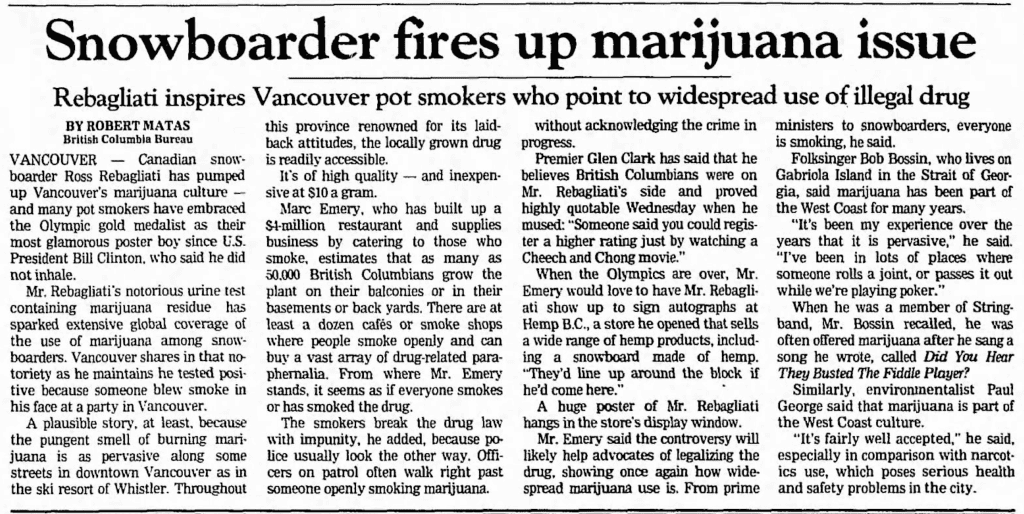
Image #479: “Snowboarder fires up marijuana issue,” The Globe & Mail, Toronto, Ontario, February 13th, 1998, p. 4
 Image #480: “I’m not going to change my friends for you . . . I might have to wear a gas mask from now on . . . ” Image from: CBC Sports Oral Histories: Ross Rebagliati’s golden moment almost goes up in smoke What was happening behind the scenes when the Canadian snowboarder was stripped of his medal at Nagano ’98. Myles Dichter, CBC Sports, December 10, 2020. https://www.cbc.ca/sportslongform/entry/cbc-sports-oral-histories-ross-rebagliatis-golden-moment-almost-goes-up-in
Rebagliati was even put on the Tonight Show with Jay Leno, and was sat next to supermodel Veronica Webb, with whom Rebagliati did flirt.
 Image #481: “Can I show you my Olympic gold medal I won while I was being a badass?” Ross Rebagliati and model Veronica Webb on the Tonight Show, February 16th, 1998. Image from: “He lost (then regained) gold medal over cannabis. Now, he’s selling cannabis,” https://www.thetimes.com/sport/winter-olympics/article/ross-rebagliati-winter-olympics-cannabis-b97gqvn9s
During his appearance on the Tonight Show, Rebagliati explained the arduous appeals process:
“‘We had four chances to win back the medal. And the first and the third I had an opportunity to represent myself. And the first one I had to go in front of 25 people from the medical commission – 25 doctors from around the world. Important people. It was four years since the last Olympics and they wanted to bust somebody. The first one was a 13 to 12 decision against me, so it was controversial right from the first go.’
‘How much marijuana did you have in your system?’” asked Leno.
“‘Just to put it into perspective, it was like a billionth of a gram.’
‘A billionth of a gram. Kev – how much a billionth of a gram going for?’
‘Not much, Jay.’” answered Kevin Eubanks, Leno’s band leader, amongst much laughter from Eubanks and the audience.
“‘Now, a billionth. That seems almost unmeasurable.’
‘Yeah, I know. I guess they got these supercomputers now.’
‘Did they ask you where you think you picked it up?’
‘No. I told them where I picked it up. I mean, I live in Whistler. As most ski resorts have a certain culture. I hang out with a lot of my friends there all the time, and it’s an ongoing thing, and . . . you know . . . secondhand smoke.’
‘Secondhand smoke. So unlike Clinton, you inhaled but didn’t smoke, he smoked but did not inhale.’
‘Exactly.’”
More laughter and applause from the audience.
“‘I mean I admire your honesty. You said you had smoked marijuana as a young man. You put it away because of the Olympics. So you didn’t get a chance to plead your case? They went strictly by the – wadayacall – trace evidence?’
‘Yeah. They were just hard-nosed about it. There was conflicting rules from the IOC and from the FIS and so on. So we lost the first decision. And then it went into another vote that was 3 to 2 – another hung jury. And then I had to go in front of another independent bunch of lawyers from three different countries I think it was called a panel of arbitration or something like that. And I told my story again to them. And there was royalty in the room, too. Prince Samaran from France. (Juan Antonio Samaranch of Spain? President of the IOC from 1980 to 2001) He was actually head of the medical commission. He voted for me from the beginning. He was behind me. We talked. He told me after that meeting to get a good night’s rest. And, so, the next day it went back to the medical commission. It was supposed to be decided by 5 o’clock the next day. It was 6:30 at night at the Japanese police station after seven and a half hours of interrogation – they wanted to find out what the deal was – when I got the call at the police station, I was just like – ‘yeah!’ – I pulled the medal out . . . I hadn’t seen it in four days.’
‘So they didn’t physically take it away from you.’
‘They were asked to. But the guys from the Canadian Olympics Association obviously were behind me. And they didn’t want to. I wouldn’t have given it back anyways.’”
More laughter from the audience.(250)
A final footnote to the story: in 2013, the World Anti-Doping Agency – “WADA” – amended its rules on cannabis, raising the threshold for a positive test from 15 nanograms per milliliter to 150. (251)
 Image #481: David Malmo-Levine addresses the crowd at a “pot dealer dignity” protest at the art gallery, February 8th, 1998. High Society – Rally Dos and Donts [4of5] https://www.youtube.com/watch?v=FSkzFdnAljs
 Image #482: David Malmo-Levine brings pot dealing to the Vancouver Art Gallery, February 8th, 1998. Dealing at the art gallery became a tradition which would continue and escalate in scale in the coming years. High Society – Rally Dos and Donts [4of5] HighSocietyShow https://www.youtube.com/watch?v=FSkzFdnAljs&t=336s
 Image #483: David Malmo-Levine sells pot under “THE DEALER IS IN” sign at the Vancouver Art Gallery, February 8th, 1998. High Society – Western Weed Warriors [1 of 3] HighSocietyShow https://www.youtube.com/watch?v=QI3eakyp-8o&t=307s
 Image #484: “Let cool heads decide,” The Independent, London, England, February 15th, 1998, p. 11
Rebagliati was still in the newspapers when another cannabis controversy hit – the World Health Organization had suppressed a finding that cannabis was safer than alcohol and tobacco. It was a conclusion that was supposed to have appeared in a report in 1997, but was scrapped at the last minute. The disputed passage was leaked to New Scientist after it was withdrawn. It was withdrawn “reportedly in response to pressure from the US National Institute on Drug Abuse and the UN International Drug Control Program.” The WHO report did argue that “like heavy drinking, smoking marijuana can produce psychosis in susceptible people.” (252)
Cannabis Canada was in the news in late February of 1998, when news of an offer of a free subscription to the Saskatoon Public Library was noticed by the local paper. The spokesperson for the library said it would take them a month or so to decide, adding;
“We have pretty strict selection criteria and we try to balance our collection to ensure that the taxpayer gets, whether we’re paying for it or not, material that’s appropriate for their use.” (253)
 Image #485: By April, Marc Emery was forced to sell Hemp B.C. and the Cannabis Cafe to Sister Icee, and was not allowed on the Pot Block. “Only 25 U.S. agents patrol vulnerable border,” The Gazette, Montreal, Quebec, April 8th, 1998, p. 7
On April 20th 1998, a decision in the Caine case was handed down by Judge Frances Howard. (254) The decision seemed irrational, and the irrationality was the focus of the newspaper coverage at the time;
“There is no evidence marijuana use causes health problems, but laws prohibiting the substance do cause harm to society, a B.C. provincial court judge has ruled. But Judge Frances Howard said she could not overturn the nation’s pot laws on constitutional grounds, because Parliament still has the legal right to outlaw marijuana.” (255)
 Image #486: “Judge defends use of pot,” Vancouver Sun, Vancouver, British Columbia, April 21st, 1998, p. 1
 Image #487: “Judge notes costs of alcohol, drugs,” Vancouver Sun, Vancouver, British Columbia, April 21st, 1998, p. 2
So much for checks and balances. If the Canadian government one day decides to take the healthcare system to a totalitarian extreme, and prohibit or over-regulate all diet-related, sex-related and drug-related choices of Canadians, one should not expect any protection from this over-reach or legal paternalism by the courts. The decision, however, did provide much in the way of ammunition for those wishing to launch appeals – which is what ended up happening in Caine;
“Countless Canadians, mostly adolescents and young adults, are being prosecuted in the criminal courts, subjected to the threat of – if not actual – imprisonment, and branded with criminal records for engaging in an activity that is remarkably benign . . . (while) others are free to consume society’s drugs of choice, alcohol and tobacco, even though these drugs are known killers.” (256)
Unfortunately, the judge left enough Reefer Madness wiggle room in the decision to allow the courts above to dodge their responsibility to legalize cannabis;
“All the witnesses from whom I have heard . . . appear to agree that there is no evidence to suggest that low/occasional/moderate users assume any significant health risks from smoking marijuana, as long as they are healthy adults and do not fall into one of the vulnerable groups, namely immature youths, pregnant women and the mentally ill.” (257)
 Image #488: “Toker to appeal roach ruling,” The Province, Vancouver, British Columbia, April 22nd, 1998, p. 6
If we as a species are ever to overcome the over-regulation and cartelization/monopolization of cannabis, we will have to address these myths, and dispel them in the public mind with overwhelming evidence to the contrary. If immature youths, pregnant women and the mentally ill use cannabis properly – taking into account dose, titration, familiarity, quality, purity, potency, freshness, strain selection, setting, mindset, individual physiology, mode of administration, concurrent drug use, and substitution, they too will benefit from smoking marijuana.
None of these concepts are difficult to understand. (258) But even if some people do abuse cannabis, it does not follow that all or some of the non-abusers should be prohibited from access to it. Coffee can also be abused, but it does not follow that it should be denied to the vast majority of coffee users who use it properly just because some might abuse it.
Still, 1998 was the year the mainstream began to question the worst excesses of the war on pot. In April of 1998, the PBS documentary series Frontline produced and aired a show entitled “Busted: America’s War on Marijuana.” A Fort Lauderdale newspaper published a review of the documentary, which focused on the harsh nature of the war;
“Busted: America’s War on Marijuana takes a different approach to the issue of pot. It deals only peripherally with the familiar arguments, pro and con, over legalization and decriminalization. Instead the PBS documentary series focuses on the draconian penalties still on the books for a drug that some states wink at, pop culture laughs at and most users eventually grow out of. Moreover, it is drug whose use, a government study recommended, should be treated like a traffic offense. . . . Young, who had not previous record for violence or drug trafficking, is serving a life sentence for brokering the sale of 700 pounds of marijuana. Foster is doing 93 years for marijuana cultivation. Israel, a mother of four pre-teens, is in the fourth year of a 12-year sentence for conspiracy. Her husband, a first-time offender, says he is a Rastafarian and grew pot for religious reasons. Because she presumably knew what he was doing, Frontline reports, she was charged with conspiracy. It is speculated that if she had testified against her husband – she refused – she would not be behind bars. Coercing spouses to turn on each other is a frequent tactic of prosecutors, according to Frontline. . . . Frontline visits Indiana, one of the most aggressive states in the war against pot. It is shown how every night, state places and helicopters go into the air with sophisticated surveillance equipment to uncover ‘grow rooms’ in residential homes. The tipoff to the airborne police is uncommon heat, which comes from infrared lights used to cultivate pot in enclosed spaces. The surveillance planes can pick up telltale signs even from grow rooms set up under the ground. The proof is in the results. Indiana now makes more marijuana arrests than any other state. Other tactics used across the country aren’t as sophisticated, Frontline reports. Informants are paid outlandish bounties, sometimes reaching into the millions. Other informants are unpaid; these include children who turn in their parents to anti-drug lecturers at school. While there is substantial support for the notion of reducing the punishment to fit the crime, Frontline notes that reforms are probably not around the corner. Judges, politicians and other public figures who might advocate a change in the penalties for marijuana offenses are reluctant to be branded as soft on drugs. Meanwhile, Sen. Orrin Hatch, chairman of the Senate judiciary committee, would like to see sentences stiffened. As long as this attitude continues to hold sway, pot will remain a dangerous drug – if not to your health, to your freedom.” (259)
On the last day of April of 1998, Hemp BC was being raided by police. Hemp BC would be raided repeatedly during 1998 and 1999 – never regarding any verifiable harm done to anyone – always due to some matter of disobedience, or some unverified allegation. The Province covered the April 30th raid this way:
“It was a police raid pot promoter Marc Emery had to watch from a distance even though his name was on the search warrant. As Vancouver police last night moved in on Hemp B.C., and the Cannabis Café on Hastings Street, Emery stood a block away watching the proceedings because of a court order he says won’t let him near the two businesses. He said a recent Rolling Stone magazine article and all the other media coverage on him have sent the police his way. Emery also said he has sold Hemp B.C. to a new owner. But police media liaison Const. Anne Drennan said police checked with city hall and Emery is still listed as owner of the hemp store. She said police moved in after undercover officers were in the shop last weekend and told where to buy pot. Drennan said ‘tens of thousands of dollars’ worth of equipment was seized in the raid. She also said charges are expected. Emery faces numerous charges from past raids on Hemp B.C. and is fighting to get back an estimated $1.6 million worth of marijuana-related merchandise.” (260)
 Image #489: Sister Icee, new owner of Hemp BC, getting arrested in one of the many raids on Hemp BC, most likely sometime in 1998. Photo from the Cannabis Culture archives.
 Image #490: “Rapper arrested for marijuana possession,” The Tribune, Welland, Ontario, May 4th, 1998, p. 2
 Image #491: “Cannabis boosters dispute info on warrant,” The Province, Vancouver, British Columbia, May 4th, 1998, p. 6
A week later, the actual owner of Hemp B.C. – Sister Icee – complained that the police linked her with Emery unfairly. She initially asked for 20 thousand dollars and an apology, but was ignored. So her lawyer sued for one million. (261)
A feature story in the Sydney Morning Herald entitled “THE REAL DOPE”, which trotted out every possible myth about cannabis – cancer, asthma, angina, lowered testosterone, lowered IQ, irregular menstrual cycles, genetic damage, depersonalization, amotivational syndrome, increased depression, youth unemployment, brain damage and, of course, pot-related psychosis – then proceeded to mention the data that debunked the last claim;
“Similarly, Hall finds it impossible to say whether smoking actually causes schizophrenia, which often follows a psychotic episode. In a 23,000-word review of the literature on the subject, he concluded that pot is likely to precipitate schizophrenia and worsen its symptoms, but he also pointed out that reported cases of schizophrenia in the young declined in the 1970s, a period when marijuana consumption was rising.” (262)
During May of 1998, this author had his trial for trafficking arising from the first set of charges stemming from the Harm Reduction Club operation in Vancouver. The most important point arising from this trial was that the judge “accepted as fact” that there was no type of cannabis related harm that could not be mitigated. Judge Curtis then ignored this point as irrelevant and found me guilty anyway. I received a year’s suspended sentence – as long as I was not caught committing any other offences I would not go to jail for a year. Lucky for me, my East Vancouver bail supervisor didn’t urine test me. The whole experience did make one thing clear to me: that concern over harm to others is a pretext for the pot laws – not a reason for them.
This author did do his best to point this fact out – the fact that there was no reason or logic behind the pot war – in the mainstream press. The Province even did a short article on this in response to the ongoing raids on Hemp B.C.:
“The police’s actions resemble more a purposeful economic attack, specifically aimed at the most vocal and education-oriented groups, leaving the guys who just sell crack pipes farther down Hastings alone because they’re not political. A couple more raids like this and even Hemp B.C. can’t continue to function. It will go out of business, and that will be a sad day. Before that day happens, I want to see if the cops have any reason behind their actions.” (263)
The cops had a response, that The Province thoughtfully included in the same article:
“Vancouver police have plenty of reasons, says media liaison Const. Anne Drennan. She cites complaints from nearby businesses, alleged sales to juveniles, evidence of seed sales tied to large marijuana grow operations, and marijuana shipments to the U.S. tied to the importation of cocaine.”
 Image #492: “Pot activist’s query: What’s behind raids?” The Province, Vancouver, British Columbia, May 19th, 1998, p. 12
The short answer to this is that none of these things involved harm to others. If there were complaints from other businesses – which seemed doubtful – it’s not over matters of harm. If juveniles were sold bongs or rolling papers – again, doubtful – they weren’t harmed by them. Pot seeds grow into pot, which is only harmful if it’s moldy or sprayed with chemicals – but Hemp B.C. had organic grow guides too. And if the VPD didn’t like black market cannabis being traded for black market cocaine, they should not have busted Hemp B.C., they should have lobbied to have both drugs legalized and sold separately.
The article should have ended with that response. Instead, it ended with insight from this author regarding the shortcomings of our mass media system, or, perhaps, the adjustment to our democratic process that might make scapegoating difficult or impossible in the future:
“I think a debate could settle this. If any spokesperson or member of the police force was to be faced in an open public debate with me or any other cannabis activist, they’d lose their remaining credibility and these raids would stop. That’s the only way I see it stopping, because the courts are so slow.”
 Image #493: Movie poster for Fear and Loathing in Las Vegas, which premiered May 22nd, 1998.
 Image #494: Screenshot from Fear and Loathing in Las Vegas.
Vancouver’s Cannabis Day 1998 was very similar to Cannabis Day 1997 many respects – we gathered at Victory Square, then marched to the Art Gallery where we picked up even more people, then marched to Sunset Beach, and had a big smoke out with bongos and dancing and such. And the VPD – as they did in 1997 – did again arrest some small-time dealer and threw them in the paddy wagon. But this time we were ready. We surrounded the paddy wagon, linked arms, and began sign songs. We weren’t going anywhere. And neither was the paddy wagon.
 Image #495: Marching from Victory Square up Granville st. to Sunset Beach, Vancouver for Cannabis Day, July 1st, 1998. This author is in one of the tall cat-in-the-hat green pot hats, furthest from the camera. Photo from the Cannabis Culture archive.
 Image #496: Marching towards Sunset Beach, Vancouver on Cannabis Day, July 1st, 1998. Photo from the Cannabis Culture archive.
 Image #497: Unarresting a 16-year-old pot dealer from paddy wagon, step 1: immobilize paddy wagon. Cannabis Day, Sunset Beach, Vancouver, B.C., 1998. Photo courtesy of Cannabis Culture.
 Image #498: Unarresting a 16-year-old pot dealer from paddy wagon, step 2: be sure to surround the paddy wagon so they can’t escape. Cannabis Day, Sunset Beach, Vancouver, B.C., 1998. Photo courtesy of Cannabis Culture.
 Image #499: Unarresting a 16-year-old pot dealer from paddy wagon, step 3: lie down and start singing songs – let the cops know you’re ready for a long siege. “1001 Bottles of Beer on the Wall” is a good one to begin with. “Why Are We Waiting” sung to the tune of “Oh Come All Ye Faithful” is my favourite – only four words to memorize. Cannabis Day, Sunset Beach, Vancouver, B.C., 1998. Photo courtesy of Cannabis Culture.
 Image #500: Unarresting a 16-year-old pot dealer from paddy wagon, step 4: try and look adorable. With lots of cameras around, the cops just hate looking evil on film, so they probably won’t try and use force to remove you. Cannabis Day, Sunset Beach, Vancouver, B.C., 1998. Photo courtesy of Cannabis Culture.
After a while of this, the cop in charge pulled me aside for a private word;
“The person we arrested is a 16-year-old boy – he was arrested for trafficking.”
“Doesn’t matter. It’s a victimless crime. Let him out or arrest all of us.” I responded.
Eventually they let him go into the care of his mom. Ten minutes later he was back on the beach smoking fatties with us. And the whole thing made it on the TV news that night. (264)
 Image #501: Unarresting a 16-year-old pot dealer from paddy wagon, step 5: embarrass the police into handing over the 16-year-old pot dealer into the care of his mom by demonstrating their relative powerlessness in the face of non-violent resistance, dignity and solidarity with all victimless pot criminals, regardless of age. Cannabis Day, Sunset Beach, Vancouver, B.C., 1998. Photo courtesy of Cannabis Culture.
While the cannabis community celebrated its tiny win on Cannabis Day, the powers that be enjoyed the fruits of the hemp ethanol stigmatization and hemp over-regulation seeds that had recently been planted. Gone was any talk of hemp ethanol saving the world – that talking point had been completely abandoned by the movement (except for me and a tiny handful of others) by 1998. Newspaper stories about hemp were inevitably bound to touch on the results of the over-regulation – the steep price for hemp goods, turning them into a status-symbol for the rich:
“Eye-popping price tags have put a damper on the current hemp scenario. Import duties and limited supply of sterilized hemp seeds, oil, fiber and fabric have made hemp-based products an expensive option. A yard of hemp fabric costs between $18 and $40 retail. A pair of Ecolution jeans sell for $73.50 on the Internet. Adidas hemp and recycled-rubber sneakers go for about $80 a pair. A queen-size hemp dovet cover by Calvin Klein will cost a whopping $725.” (265)
Reporters seldom – if ever – questioned the over-regulation . . . or even displayed an awareness of it. The whole world – aside from a small section of the pot community – had accepted the myth that cannabis could possibly harm some young people, so restrictive hemp regulations could not be questioned . . . and shouldn’t really even be mentioned.
 Image #502: “INCREASING THE SUPPLY,” The Indiana Gazette Sun, Indiana, Pennsylvania, Jul 12, 1998, p. 32
 Image #503: “Expert warns marijuana addictive and dangerous,” Times Colonist, Victoria, British Columbia, July 13th, 1998, p. 2
In July of 1998, the police in Nanaimo, B.C., as they did in other places, continued to confuse the effects of cannabis with the effects of cannabis prohibition:
“To say marijuana doesn’t kill anyone is false. There’s a number of unsolved murders in B.C. alone related to marijuana grow ops and sales . . .” (266)
It would have been great if, at that point, the reporter had asked the police how many coffee bean-related murders there were, and if the number of marijuana-related murders would have been similar to the number of coffee bean-related murders if marijuana was regulated like coffee beans. But reporters had not (and have not) yet reached that level of understanding.
 Image #504: “Medical Marijuana Advocates Accused of Cultivation for Sale,” Los Angeles Times, Los Angeles, California, July 24th, 1998, p. 37
1999 was the year clinical trials were being planned for the product that was eventually known as Sativex – and the producers of this pharmaceutical-grade cannabis tincture – the British GW Pharmaceutical (chaired by Geoffrey Guy) and the suppliers of their cannabis seeds, the Dutch HortaPharm BV (owned by Dave Watson) were already talking about it in trade magazines. Of particular interest is this quote:
“Dr. Guy thought that at some stage a comparison of new delivery routes and smoking cannabis might have to be performed, although this would obviously be controversial.” (267)
 Image #505: “UK clinical trials with cannabis could start next year,” The Pharmaceutical Journal, August 1st, 1998, p. 151
As far as this author can tell, these comparative tests have yet to be performed, or if they have been, the results have not been made public. If one speculated as to why this might be the case, the answer would be that the pharmaceutical product is probably not that much more safe or effective than smoked cannabis . . . but it’s definitely more expensive.
 Image #506: “Vancouver’s drug culture giving city an unusual image,” Arizona Republic, Phoenix, Arizona, August 30th, 1998, p. 9
 Image #507: One of Marc Emery’s many mug shots, September 9th, 1998, Vancouver.
Although it came out in 1997, the first true reviews of the book Marijuana Myths, Marijuana Facts by Lynn Zimmer and Dr. John P. Morgan did not appear until the following year. In one of the reviews, the reviewer ended with the following reference;
“‘Marijuana Myths, Marijuana Facts’ may put readers in mind of a recent Doonesbury cartoon in which a wife asks her husband what he and his son were talking about. The father replies that they were having a frank discussion about marijuana. ‘My God,’ the wife exclaims. ‘You didn’t tell him the truth, did you?’” (268)
The book dispelled many myths – 20 myths, to be precise – of which number 10 is of particular importance to this series of articles;
“MYTH: MARIJUANA CAN CAUSE PERMANENT MENTAL ILLNESS. Among adolescents, even occasional marijuana use may cause psychological damage. During intoxication, marijuana users become irrational and often behave erratically.
FACT: THERE IS NO CONVINCING SCIENTIFIC EVIDENCE THAT MARIJUANA CAUSES PSYCHOLOGICAL DAMAGE OR MENTAL ILLNESS IN EITHER TEENAGERS OR ADULTS. Some marijuana users experience psychological distress following marijuana ingestion, which may include feelings of panic, anxiety, and paranoia. Such experiences can be frightening, but the effects are temporary. With very large doses, marijuana can cause temporary toxic psychosis. This occurs rarely, and almost always when marijuana is eaten rather than smoked. Marijuana does not cause profound changes in people’s behavior.” (269)
The authors also took note of the effects of poverty and wealth on those who make up the statistics underlying the cannabis psychosis myth, along with the general population statistic evidence to the contrary:
“Early advocates of marijuana prohibition in the United States said that marijuana needed to be controlled because it caused insanity. They offered reports from India and Egypt, where a large proportion of institutional mental patients, mostly from the lower classes, were known to be cannabis users. In the 1970s, American psychiatrists, scholars, and government commissions criticized these data, pointing out that in Western societies, where more middle-class people used marijuana, there was no apparent association between marijuana and mental illness. They also noted that a statistical association, even if it were found, would not prove that cannabis caused mental illness. . . . Given that the incidence of schizophrenia declined substantially in Western societies in the 1970s, at the same time cannabis use was rising, it seems highly unlikely that marijuana causes schizophrenia in otherwise healthy people.” (270)
 Image #508: MARIJUANA MYTHS, MARIJUANA FACTS, Lynn Zimmer, John P. Morgan, The Lindesmith Center, New York, 1997
Yet another raid occurred on Hemp B.C. on September 30th, 1998. This author was arrested for obstructing the police by putting a sofa in front of the doors and then sitting on the sofa. Photos exist of me pulling the same stunt on the same night with a chair in the back alley, and then post-arrest, sitting on the sidewalk, after being dragged down the block by the cuffs. Video of the arrests is still online. (271) My friend Ian was also arrested. The people of the pot block never made it easy for the cops to do evil. Some of us always got in the way.
 Image #509: Image from the night of the September 30th, 1998 raid. “Canada’s most flamboyant pot activist,” December 1, 1998 https://www.cbc.ca/player/play/video/1.3595591
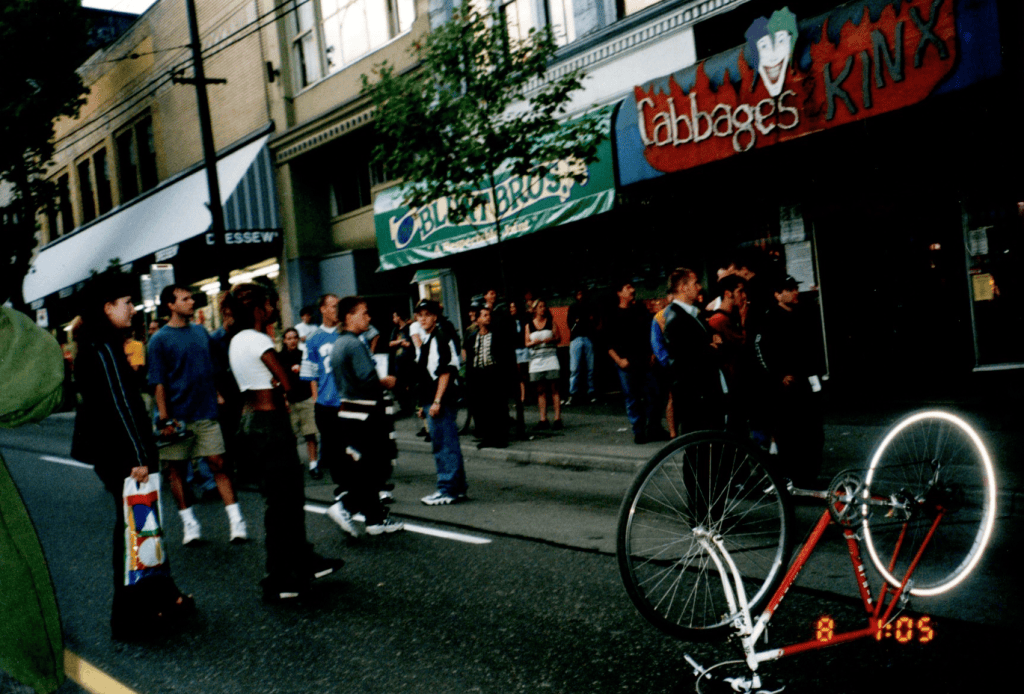
Image #510: Even before I got there, activists were standing in the road, blocking traffic, and making sure everyone knew something was happening on the pot block. Photo from the cannabis culture archive.
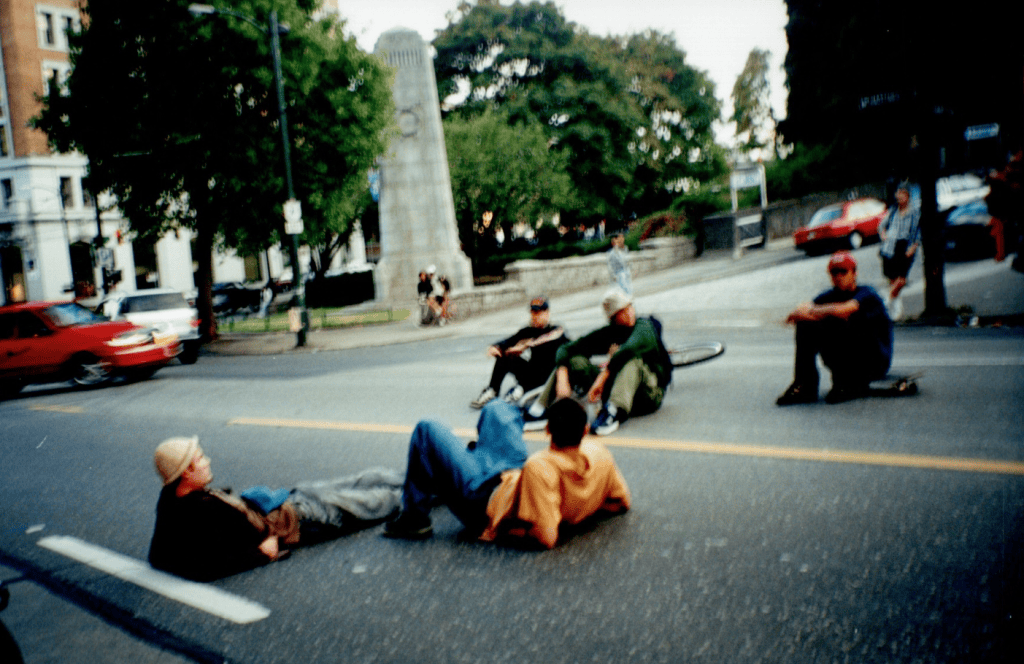
Image #511: Some of the activists even laid down on Hastings st., indicating to everyone that they weren’t about to move. It was at about this point that I arrived on the scene. Photo from the Cannabis Culture archive.
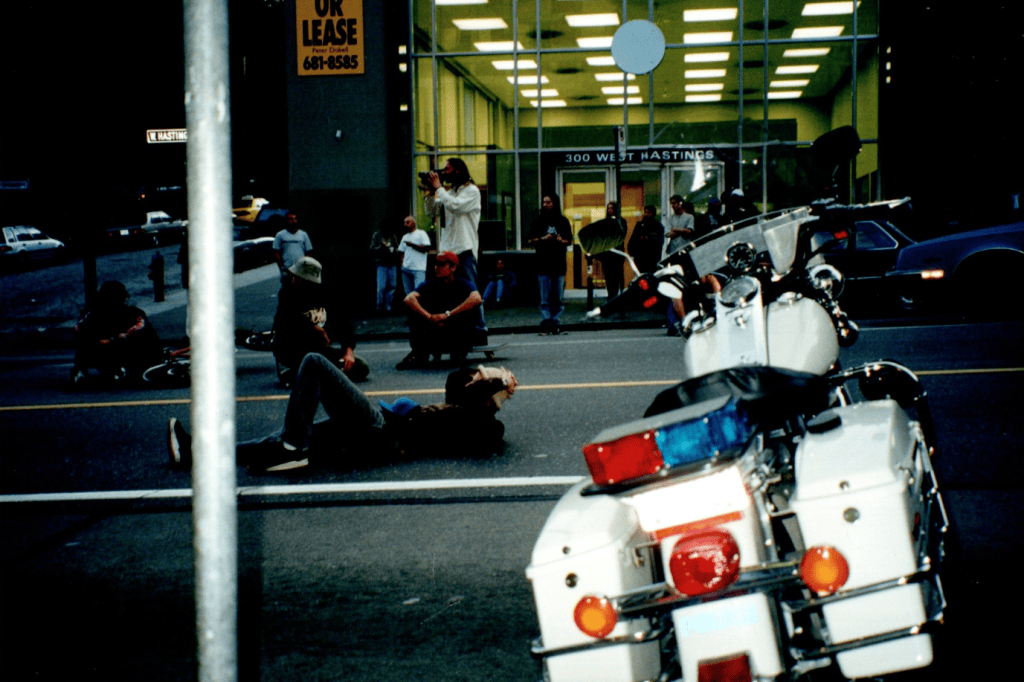
Image #512: Our video camera people began to arrive. News reporters began to arrive. Some sort of confrontation was inevitable. Photo from the Cannabis Culture archive.
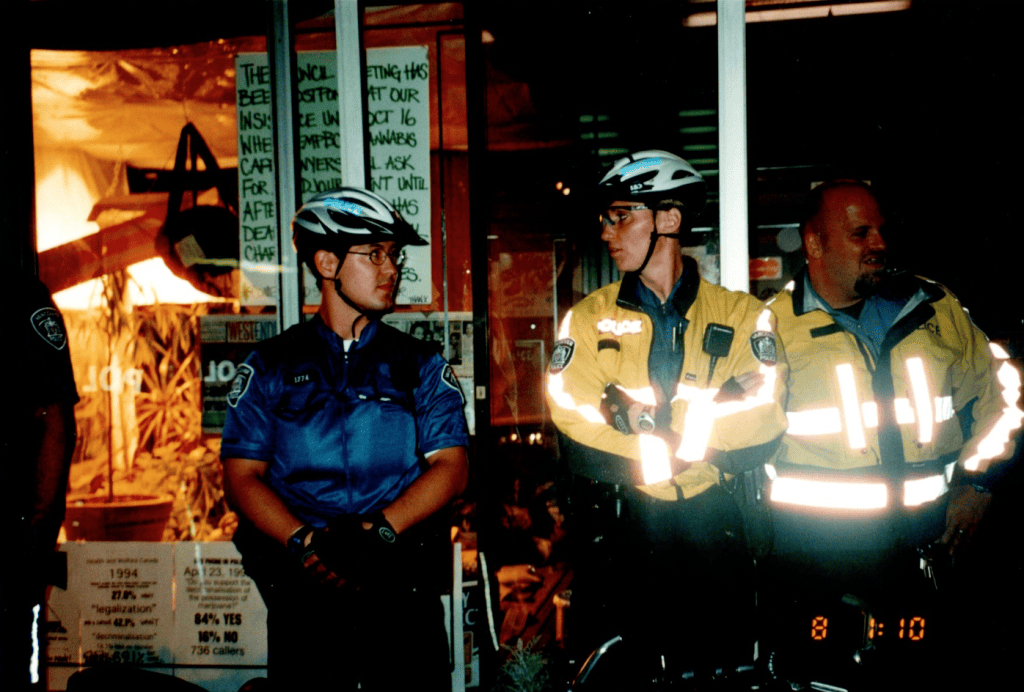
Image #513: The cops formed a line, thinking we were going to try and rush inside the store. Little did they know that our plan was to slow them down by getting in their way. One sign in the window describes a previous raid. Other signs indicate increasing public support for decriminalization and legalization. Photo from the Cannabis Culture archive.
 Image #514: Anti-Reefer Madness information displays and previous raid news reports are hanging in the window. The “raid the pot activist cops” are all giving off serious bastard energy, as usual. September 30th, 1998. Photo from the Cannabis Culture archive.
 Image #515: Marc Emery on raid night. September 30th, 1998. Photo from the Cannabis Culture archive.
 Image #516: The cops don’t like it when you link arms and block them from their raids, slowing them down and defying them. They also don’t like it when you sing stuff like “HELP, POLICE! OUR STUFF IS BEING STOLEN!” September 30th, 1998. Photo from the Cannabis Culture achieve.
 Image #517: The cops hate it when you wedge a broken TV between the door and an electric post, and then stick a big ol’ chair in front of the back door, preventing it from being able to be opened. September 30th, 1998. Photo from the Cannabis Culture achieve.
 Image #518: But the thing the cops like least of all is when you take a big ol’ sofa and stick it right in front of the front doors and sit on it – trapping a bunch of them inside. September 30th, 1998. “Canada’s most flamboyant pot activist,” December 1, 1998 https://www.cbc.ca/player/play/video/1.3595591
 Image #519: Some of the video has managed to survive on the internet. It’s pretty low res, though: Hug Power (Rally Dos and Don’ts 2) [2of3] https://www.youtube.com/watch?v=U9b3552xMvI&t=522s
 Image #520: Ian, busted for unlawful interference in the genocide of the medically autonomous. Again. September 30th, 1998. Photo from the Tia archive.
 Image #521: DML, busted for unlawful interference in the genocide of the medically autonomous – for more times than I could count. September 30th, 1998. Photo from the Cannabis Culture archive.
Getting arrested by getting in the way of their raids seemed like the only way to have even a small effect on what was going on at the time – a weak little veto that hardly slowed them down, but it became more and more effective over time as others joined me on that couch, or in the road. This may have had some effect in the policy that existed after 2000, when the raids on the pot block stopped – at least until the US government got involved.
 Image #522: “Gathered” is such a mild word to describe what we really did. “Hemp shop, café raided,” The Province, Vancouver, B.C., October 1st, 1998, p. 5
The Vancouver Sun reported that nearby business owners were upset with the raids, and worried that eliminating Hemp BC would hurt their own businesses:
“‘It’s going to hand the area over to junkies and drug dealers. That’s the ironic part of it all,’ said Don Vincent, owner of Bassix, a specialty music store. Vincent said the block was a dead zone when he opened up five years ago. The arrival of Hemp B.C. and the Cannabis Café helped create a vibrant street life which attracted new businesses. ‘Hopefully they will stay here and we can keep making this block into a funky area like Queen Street in Toronto. But the city seems to be doing everything it can to stop that. And to stop the revitalization of the East End, which is what they said they’re trying to do.’ . . . Among the merchants worried about Hemp B.C.’s fate is Lisa Sven, who opened the Victory Café at the corner of Hastings and Cambie, in January. Sven said she and other entrepreneurs were attracted to the block because of the street traffic generated by Hemp B.C.. ‘Hemp B.C. and the Cannabis Café are a big economic anchor on this block,’ said Sven. . . . The probable closure of the two controversial stores is also unpopular among some students at the new University of B.C. architectural studio on the 300-block West Hastings. ‘It’s not a matter of whether you agree with what’s happening there. It’s bringing life to the street and making it safer,’ said landscape architecture student Michael Wilkes. He said that almost half of the clientele of many of the businesses on the block are drawn there by Hemp B.C.” (272)
 Image #523: “Closure of Hemp B.C. will hurt nearby businesses, owners say,” The Vancouver Sun, Vancouver, British Columbia, October 8th, 1998, p. 19
 Image #524: Diana standing in front of a hemp field, somewhere in B.C., circa 1998. Photo courtesy Diana.
 Image #525: Advertisement for the Compassion Club on the side – and top – of Diana’s van. Somewhere in East Vancouver, circa 1998. Photo by this author.
 Image #526: Reefer Madness 2 – “The Nature Of Things” Ottawa Citizen, Ottawa, Ontario, October 15th, 1998, p. 50
 Image #527: Jill Fanthorp from the B.C. Compassion Club Society. “Reefer Madness 2 The Nature of Things with David Suzuki” https://www.youtube.com/watch?v=Ko-BSaNhncg See also: High Society – CBC’s The Nature of Things [3of6] https://www.youtube.com/watch?v=eM96D55AchI
 Image #528: Hilary Black from the B.C. Compassion Club Society. “Reefer Madness 2 The Nature of Things with David Suzuki” https://www.youtube.com/watch?v=Ko-BSaNhncg See also: High Society – CBC’s The Nature of Things [3of6] https://www.youtube.com/watch?v=eM96D55AchI
 Image #529: “Initiative Watch,” The Oregonian, Portland, Oregon, October 15th, 1998, p. 4
 Image #530: “Across the nation,” The Oregonian, Portland, Oregon, October 15th, 1998, p. 4
 Image #531: “Bust in Kanesatake,” The Gazette, Montreal, Quebec, October 17th, 1998, p. 4
In October of 1998 – with zero community support from local business owners for a crackdown – the VPD decided to over-police the Pot Block area. They busted pot smokers at Victory Square Park. The busted beggars. They busted buskers. They busted jaywalkers. It got so bad that Sister Icee called a press conference for October 30th – with her lawyer and the B.C. Civil Liberties Association attending – to complain about the fascistic persecution of our community. Ten minutes before the press conference was about to begin, this author went out to Victory Square to play hacky-sac with Adam, the electrician for Hemp B.C.. What happened next was surreal.
A motorcycle cop saw us playing in the park, did a U-turn and parked his bike on the sidewalk. He approached us and looked at me:
“You got some I.D.?” He asked.
“No.” I replied.
“You’re under arrest!” He responded.
I remembered there were some friendly lawyers across the street and started to scream for help. I got a couple screams out and then – from out of nowhere – another cop suddenly appeared and grabbed me by the throat, choking me and preventing me from screaming any further. Lucky for me, my first screams had done the job. Video footage of the event begins at this time, as our volunteer videographer Daniel was also across the street, along with dozens of activists, who all decided to cross the street and see what was going on with me and the cops in Victory Square. Video clearly depicts two cops holding onto me with my feet a foot away from the ground. (273)
 Image #532: The Hacky-Sack Incident. I’m the guy surrounded by cops with a handcuff on my arm. Image from: “Hug Power (Rally Dos and Don’ts 2) [2of3]” https://www.youtube.com/watch?v=U9b3552xMvI
 Image #533: Sister Icee is hugging me from behind, making arresting me quite difficult: “Hug Power.” The fact that the cops were surrounded by activists, lawyers and the media didn’t help them any either. The Hacky-Sack Incident. Image from: “Hug Power (Rally Dos and Don’ts 2) [2of3]” https://www.youtube.com/watch?v=U9b3552xMvI
 Image #534: Of course it made the nightly news – the CBC. And Global. The Hacky-Sack Incident. Image from: “Hug Power (Rally Dos and Don’ts 2) [2of3]” https://www.youtube.com/watch?v=U9b3552xMvI
The video goes on provide a demonstration on how to “unarrest” someone. Three women ended up hugging me, and the media showed up, and lawyers surrounded the police and demanded to know why I was being arrested. Rather than brutalize me and the women hugging me in front of all these witnesses, they chose to let me go – but not before a dozen or so cops showed up as “reinforcements.” I told them not to come back unless they actually had a reason. That made it into the news footage. The six o’clock TV news carried much of the confrontation. The newspaper mentioned the event in passing in the “society” page:
“PHILIP OWEN got applause at the Non-Partisan Association’s recent mayoral dinner in Chinatown’s Floata restaurant where – police board opposition notwithstanding – he told attendees there’ll soon be 40 more coppers on downtown streets. Maybe they’re already hired. At least, it looked like close to 40 who bounced marijuana-decriminalization advocate David Levine for playing hackeysack in Victory Square Friday.” (274)
In a November 1998 article which seems designed to scare people into attending the upcoming “cannabis and psychosis” conference in February 1999, The Age newspaper in Melbourne trotted out all the old myths again, plus this new one concerning the severity of cannabis withdrawal:
“He says he has seen users as young as nine and that many patients, as they try to break their cannabis dependence, have told him it is worse than getting off heroin.” (275)
 Image #535: “Dope’s cruisy image going up in smoke,” The Age, Melbourne, Australia, November 1st, 1998, p. 10
Once again, just in case anyone didn’t understand, heroin withdrawal is a sickness that many users fear with dread. It can often involve the following;
“. . . dysphoria, insomnia, pupillary dilation, piloerection, yawning, muscle aches, lacrimation, rhinorrhea, nausea, fever, sweating, vomiting and diarrhea.” (276)
Cannabis withdrawal – if it exists at all – is simply akin to missing something pleasurable in one’s life, like missing watching TV or missing masturbation. As was pointed out in Marijuana Myths, Marijuana Facts:
“If people experience withdrawal symptoms at all, they are remarkably mild.” (277)
 Image #536: “Big booty of hash burned beyond vapours,” Times Colonist, Victoria, British Columbia, November 7th, 1998, p. 1
 Image #537: “HASHISH VS. MARIJUANA,” Times Colonist, Victoria, British Columbia, November 7th, 1998, p. 2
This author’s second conditional sentence for his second set of charges stemming from the Burnaby part of the Harm Reduction Club operation was handed down in December of 1998. The media coverage of that sentence was complete with this falsehood:
“Burnaby RCMP arrested Malmo-Levine at the Dutch Embassy Flower and Tea Room in February 1997 and confiscated 80 grams of marijuana. They were acting on complaints from parents and administrators of three nearby schools, who claimed children were being enticed to the store, which did $100,000 in business during its three months of operation.” (278)
No children were being “enticed” into the shop. By the time we were in Burnaby we had changed our policy on teens – they needed written and face-to-face permission from a parent or legal guardian to access cannabis. We never “enticed” teens before the policy change, either. We just developed a policy based on the fact that teens would see our ads in Terminal City and would no doubt turn up to our place looking for good cannabis, because many teens are intelligent. One of the definitions of “enticement” is “the act or practice of enticing, especially to evil.” (279) Self-medicating with a non-toxic herb to treat stress, depression, fatigue, loss of appetite, lack of sleep, lack of inspiration, lack of motivation – this is not an act of evil, regardless of the age of the self-medicator. To facilitate such an action is empowerment. We were no more guilty of enticement than Socrates was guilty of corruption.
 Image #538: “Toke or two takes away pain,” The Province, Vancouver, British Columbia, December 30th, 1998, p. 3
 Image #539: The Province, Vancouver, British Columbia, January 5th, 1999, p. 17
The January 7th 1999 edition of the Arizona Republic contained a feature article on medical marijuana, pointing out that Prop 200 – the citizen’s initiative to legalize prescriptions for marijuana was thwarted by the DEA:
“Although Arizona voters in November approved the medical use of marijuana for the second time in two years, doctors fear their privileges to prescribe medication will be revoked if they promote pot, thanks to the shadow of the federal Drug Enforcement Administration.” (280)
The article did a good job of explaining the advantages of med pot, but then went on to sully that information with a bunch of myths, half-truths, conflations with prohibition, and mentioned the lack of safety and efficacy research while omitting the prohibitive cost of that research.
On January 3rd 1999, a drug raid on a house on Center Street in Abbotsford, B.C. resulted in the police shooting and killing the family dog in front of 13 children celebrating a birthday party. A baby was splattered with the dog’s blood. All the children and attendees of the party were left traumatized. The baby’s dad was charged with possession of a pound of marijuana for the purposes of trafficking and possession of personal amounts of heroin and magic mushrooms.
 Image #540: “B.C. police raid children’s party; kill dog,” Calgary Herald, Calgary, Alberta, January 5th, 1999, p. 3
 Image #541: “Raid, birthday party turn messy,” The Abbotsford News, Abbotsford, British Columbia, January 5th, 1999, p. 1
 Image #542: “‘Chunks of dog flesh on car seat’,” The Province, Vancouver, British Columbia, January 5th, 1999, p. 3
 Image #543: Photo from: “Break down of the law,” Reverend Damuzi, March 1, 1999 https://www.cannabisculture.com/content/1999/03/01/1786/
 Image #544: “Save the busts for the balloons,” The Province, Vancouver, British Columbia, January 5th, 1999, p. 19
 Image #545: “Mayor wants Grand Forks to . . . Go To Pot,” Calgary Herald, January 10th, 1999, p. 6
 Image #546: Brian Taylor, circa 1999. Cannabis Culture archive.
 Image #547: Brian Taylor, circa 1999. Cannabis Culture archive.
On January 24th, 1999, a smoke-in protest over this atrocity was held in Abbottsford, and this author was invited to speak. Unbeknownst to me, one of the organizers was determined to be arrested, and proceeded to light up a joint in front of the police chief. He puffed on it and then passed it to the police chief’s daughter. This was happening while I was up on stage, explaining the fine art of “Hug Power” and conscientious obstruction to the crowd. If the “Hacky Sack Incident” of October 30th, 1998 was a textbook example of how to stop the police from arresting someone, the “Abbotsford Smoke-In Fiasco” of January 24th, 1999 (less than three months later) was a textbook example of what not to do – I.E., it doesn’t work on people who are trying to get arrested. Both the organizer and I were arrested – he for possession, I for obstruction. Nevertheless, our confused actions made it into the local paper. (281)
 Image #548: Me. In cuffs. Again. But this time they got me in the paddy wagon. Hug Power (Rally Dos and Don’ts 2) [3of3] https://www.youtube.com/watch?v=RZ6JiFAge50&t=345s
The Australian cannabis psychosis conference came and went. Instead of quotes from the conference filling up the Australian February newspapers (it hardly got mentioned), a feature article on endocannabinoids appeared instead. Of course, it was utilized as another chance for the cannabiphobic Australian press to malign smoked cannabis in favour of a pharmaceutical/proprietary product derived from cannabis:
“Already, scientists are testing cannabinoids with hopes of harnessing the medical power of marijuana to treat pain without its political baggage. A key challenge is separating the curing power of the compounds from their mind-altering side effects.” (282)
”Political baggage” = “public protests against prohibiting/stigmatizing any herbal medicine or any medicine that lacks a proprietary nature.”
 Image #549: “Cannabis warning for schizophrenics,” The Age, Melbourne, Australia, February 17th, 1999, p. 2
On December 5th, 1998, the body of Allister Irvin Marselje was found in a dumpster in the alley on the south side of Vancouver’s pot block. The police said he died of a “turf war” – in essence, he died from the conditions that cannabis prohibition created. Police spokesperson Detective Rick Crook tried to pretend that it was the victims of the policy – not the authors of the policy – who were to blame:
“You kind of think of the pot trade as being peaceful and laid back. This is the last group of people you would imagine to be involved in this kind of violence. . . . I want to make sure the street starts helping out. If they want it to be this peaceful, fun-loving place . . . then it has to have that violent element taken away.” (283)
 Image #550: “Pot gang turf war,” The Province, Vancouver, British Columbia, February 26th, 1999, p. 1
 Image #551: “Violence plagues city’s top pot spot,” The Province, Vancouver, British Columbia, February 26th, 1999, p. 4
It’s impossible to drop a dime on the dangerous organized people and rat them out and it not come back to haunt you – those dangerous organized people sometimes have agents in the police department itself. But the police suggesting that people should work with them was a great way to shift responsibility for Allister’s death from those who support violent-black-market-causing cannabis prohibition to those who won’t – for good reason – cooperate with police.
Also, the police were in denial about how the scene got violent in the first place. When I first arrived on the pot block in 1995, it was pretty peaceful. “There’s plenty of pot and plenty of customers for everyone” said the local organized musicians/dealers, who managed the flow of traffic and settled disputes. But those people were busted by the police. The police repeated busted the “peaceful-fun loving people” over and over again, until the dangerous organized people took their place. The reporter even said as much in the story about Allister, without realizing it:
“A police raid on the café in November caused the then-owner to flee, and one night, the business was vandalized and a new group took control of the sales. . . . Marselje worked for the new regime.” (284)
Some understood it was cannabis prohibition – not “the pot trade” – that killed Allister Marselje. A letter to the editor from Alan Randell – another grieving parent of another victim of the drug war – managed to get published, which summed up the situation perfectly:
“My heart goes out to Gwen Robertson as she tries to come to terms with the tragic death of her son, Allister Marselje (Mom mourns son lost to mean streets, Feb. 28). Allister was one more casualty of the war on drugs and that ridiculous law that seeks to punish individuals for what they ingest into their own bodies. My son, Peter, who was poisoned in 1993 by adulterated street heroin, was another. Like Allister, Peter kept a journal, but I haven’t yet summoned up the courage to read it myself, although his mother has read portions of it to me. However, there is one group of Province readers who are presumably celebrating Allister’s death. To judge from their angry, self-righteous letters back on Jan. 6 in support of the Abbotsford police killing a family dog in a drug raid, they fell that the only good drug dealer is a dead drug dealer. And Allister was, in their terms, a drug dealer. Bigoted and ignorant citizens are needed to maintain the war on drugs, that’s for sure. But a courageous and honourable prime minister could easily sway the howling mob if he had a mind to. It is Jean Chretien, who refuses to lift a finger to stop the drug war and save the lives of our children, at whose door Allister’s death must be laid.” (285)
Nearly all police and all politicians remain willfully ignorant to the role they play in maintaining – even guaranteeing – the violence that comes with the prohibition policies that they almost always support.
 Image #552: “City hemp vote ‘no surprise’,” The Province, Vancouver, British Columbia, March 15th, 1999, p. 25
 Image #553: “HEALER WEED,” The Province, Vancouver, British Columbia, March 28th, 1999, p. 24
 Image #554: “HEALER WEED,” The Province, Vancouver, British Columbia, March 28th, 1999, p. 25
 Image #555: “HEALER WEED,” The Province, Vancouver, British Columbia, March 28th, 1999, p. 25
 Image #556: “You can’t smoke this form of marijuana,” San Antonio Express-News, San Antonio, Texas, May 3rd, 1999, p. 33
 Image #557: Keeping them lit is tricky – as are blowing smoke rings. “Scientist finds new use for marijuana,” San Antonio Express-News, San Antonio, Texas, May 3rd, 1999, p. 35
 Image #558: “AIDS patient can grow, smoke marijuana,” Ottawa Citizen, Ottawa, Ontario, May 11th, 1999, p. 3
Just as the millennium drew to a close, the great 5-year-old experiment that was Hemp B.C. became doomed. On March 8th, 1999, city councillors voted to deny Shelley Francis (a.k.a. Sister Icee) a business license. (286) By the end of May, the closure of Hemp B.C. appeared to be a near certainty:
“Lawyers for Francis last week launched a judicial review in B.C. Supreme Court against city council’s refusal to grant Francis a business license after a controversial show-cause hearing. ‘I’m saddened by the narrow-mindedness of the city council that would perpetuate this stupidness that has been going on for five years.’ said Francis, who bought the two businesses from Marc Emery in March 1998. She said she has been unfairly targeted by police and city council. ‘We are high-profile political activists here, speaking out against unjust marijuana laws in this country. Those laws criminalize otherwise hard-working and innocent Canadians.’” (287)
In spite of many supportive statements from other business owners, and many letters of support in the paper, by June of 1999, Hemp B.C. was gone forever.
 Image #559: “Hemp B.C., Cannabis Cafe owner set to close,” The Province, Vancouver, British Columbia, May 24th, 1999, p. 2
But just as Hemp B.C. – and in some ways the hemp movement – was fading away, the medical pot movement was manifesting to take its place. In 1999, the Institute of Medicine – which changed its name to the National Academy of Medicine in 2015 – published a major report on medical marijuana. Released on March 17th 1999, titled Marijuana and Medicine, it was both groundbreaking and disappointing. A Hawaiian newspaper published some highlights:
“Scientific data shows that the active ingredients in marijuana, known as cannabinoids, may relieve pain, control nausea and vomiting and stimulate appetite. . . . ‘The psychological effect of cannabinoids may contribute to their potential therapeutic value.’ (Getting high can make the patient feel better.) . . . ‘Except for the harms associated with smoking, the adverse effect of marijuana use are within the range of effects tolerated for other medications.’ . . . There is ‘no conclusive evidence that the drug effects of marijuana are casually linked to subsequent abuse of other illicit drugs.’” (288)
 Image #560: MARIJUANA AND MEDICINE – Assessing the Science Base, INSTITUTE OF MEDICINE, NATIONAL ACADEMY PRESS, Washington, D.C., 1999
Aside from the unwarranted smokeaphobia, that was the good news. The bad news was that the Drug Czar – Barry McCaffrey – was doing his best to focus on the smokeaphobia:
“‘The future of cannabinoid drugs lies not in smoked marijuana but in chemically defined (cannabinoid) drugs.’” (289)
The same month that the IOM report was released the Canadian government – no doubt feeling the pressure from activists and academics to do something for those who want medical marijuana – announced “clinical trials”:
“The Canadian government, struggling to keep up with public opinion, made its own bold move this month when Health Minister Allan Rock announced the start of clinical trials. But advocates say Rock is simply side-stepping the issue while he waits to see what happens in the U.S.. They say there is already enough scientific data to support at least a limited form of legalization and ask why Rock has refused to respond to applications for compassionate exemptions.” (290)
In April of 1999, a different kind of medical marijuana activist appeared on the Canadian horizon. Renee Boje – a refugee from the U.S. drug war, made her first appearance in the Canadian media, attempting to get help from Woody Harrelson in order to win her extradition hearing:
“Woody Harrelson, please call Renee Boje. The 29-year-old California woman, who considers herself a pawn in the battle over the legalization of medical marijuana in her home state, is counting on the movie star’s support to help her win refugee status in Canada. Boje, staying with friends on the Sunshine Coast, faces life in prison if she loses an extradition hearing set for April 19 in Vancouver. The graphic artist says she believed medicinal marijuana to be legal in California when she became involved with a campaign to establish a Los Angeles counterpart to Vancouver’s Compassion Club, which distributes pot to the chronically ill. She was hired by activist Todd McCormick to produce artwork for the Cannabis Buyers Club after Californians voted to legalize Proposition 215 in 1996 – a move that the U.S. federal government has vowed to overrule. McCormick, considered one of the world’s leading experts in marijuana cultivation, is at the centre of the biggest dope bust in L.A.’s history. He was openly growing more than 4,000 plants, many of them genetically engineered to treat specific illnesses, at his rented Bel Air mansion. Federal agents say they found plants growing in virtually every room of the five-story home, designed as a medieval castle and surrounded by a moat with drawbridges. They say it was even growing in the turrets – in full view of neighbours such as Elizabeth Taylor and Ronald Reagan. They say he was supplying every medicinal-marijuana club in California. Boje was at the house in July 1997 when police moved in. ‘It was my understanding that everything had been made legal by the state of California.’ she says. ‘He had all the licences he needed to grow.’ Federal authorities decided to prosecute McCormick and other advocates found in the house as a way of challenging Proposition 215. Boje was charged with conspiracy, cultivation, possession and intent to distribute. She says she met Woody Harrelson, an outspoken advocate of medicinal marijuana, several times during her involvement with the L.A. club. Harrelson has put up $500,000 bail for McCormick. Boje came to B.C. a year ago, believing, she says that the charges against her had been dropped. She hooked up with friends in Roberts Creek, suppliers for the Compassion Club, and was at their house in February when an RCMP drug squad moved in. Once again, she was charged with possession and intent to traffic. It was through the RCMP that she learned she’s a fugitive. The U.S. charges, she was told, were reinstated after she came to Canada. Abbotsford lawyer John Conroy says he’ll argue for Boje’s refugee claim on the basis that her alleged crime would be dealt with leniently here – as opposed to a life sentence in the U.S. ‘They don’t get life for murder down there.’ he says. ‘Or rape. It’s just bizarre.’ Boje, meanwhile, is desperately trying to raise funds for her defense. A benefit will be held Friday night at the Roberts Creek Hall. And she’s still waiting for that phone call from Harrelson. ‘I’ve met him a few times and he’s a good guy, very supportive. I think he would help me but I’ve been having trouble getting word to him.’” (291)
 Image #561: “Artist in pot-law battle tries for refugee status”, The Province, Vancouver, British Columbia, Canada, April 7th, 1999, p. 13
The Australian press decided to take one more stab at establishing “cannabis psychosis” as a real thing before the end of the millennium. In the May 27th, 1999 edition of The Age, in an article titled “Marijuana Madness,” Jayashri Kulkarni, the associate professor in the Department of Psychological Medicine, Monash University, claimed that;
“So everyone who uses cannabis is potentially at risk of developing psychosis, and people who already have schizophrenia and smoke dope are at great risk of relapsing. It is imperative that we undertake meaningful education programs to stop people smoking dope. Fuzzy mixed messages about potential harm from cannabis use are unhelpful, particularly when targeting adolescents who tend to think in black-and-white terms. A hard-hitting and brief education program is being trialled by Tim Rotre and colleagues at Dandenong Area Mental Health Service, with messages such as ‘MARIJUANA leads to MADNESS’ and ‘CANNABIS = CRAZY’ being evaluated for their impact.” (292)
 Image #562: “Marijuana Madness”, The Age, Melbourne, Victoria, Australia, May 27th, 1999, p. 17
Of course (as usual) the names of studies weren’t mentioned, the fact that general population statistics weren’t showing an increase in psychosis in spite of massive increases in use rates weren’t mentioned, possible therapeutic effects from different chemical constituents weren’t considered, and a cost-benefit analysis of prohibition was missing. Also missing was any respect for medical autonomy – the very idea that the users could be right and the researchers could be wrong – or even that users had a different cost/benefit analysis based on a different set of values than that of the researchers – was beyond the ability of these journalists to grasp.
 Image #563: “Stoned: Hemp Nation on Trial,” Standard-Freeholder, Cornwall, Ontario, May 30th, 1999, p. 59
 Image #564: “Stoned hemps clear the air of hy-pot-crisy,” The Toronto Star, Toronto, Ontario, June 1st, 1999, p. 37
 Image #565: Stoned: Hemp Nation on Trial – online streaming version: https://warmlandcannabis.com/our-story/
 Image #566: “U.K. tests cannabis for medicinal uses,” Ottawa Citizen, Ottawa, Ontario, June 5th, 1999, p. 3
 Image #567: “U.K. tests cannabis for medicinal uses,” Ottawa Citizen, Ottawa, Ontario, June 5th, 1999, p. 3
 Image #568: “China executes 71 in one day,” Hawaii Tribune-Herald, Hilo, Hawaii, June 27th, 1999, p. 4
 Image #569: Poster for Vancouver’s Cannabis Day 1999 rally by David Malmo-Levine. From the archives of David Malmo-Levine.
 Image #570: Cannabis Day, July 1st, 1999, Vancouver Art Gallery, Vancouver, British Columbia. Photo from the Cannabis Culture archives.
 Image #571: This author. Cannabis Day, July 1st, 1999, Vancouver Art Gallery, Vancouver, British Columbia. Photo from the Cannabis Culture archives.
 Image #572: The “Oh Cannabis” flag still waves. Cannabis Day, July 1st, 1999, Vancouver Art Gallery, Vancouver, British Columbia. Photo from the Cannabis Culture archives.
 Image #573: This author. Cannabis Day, July 1st, 1999, Vancouver Art Gallery, Vancouver, British Columbia. Photo from the Cannabis Culture archives.
 Image #574: Supergirl: a retail pioneer. Cannabis Day, July 1st, 1999, Vancouver Art Gallery, Vancouver, British Columbia. Photo from the Cannabis Culture archives.
 Image #575: “POT PROTEST: Hundreds of people gathered on Canada Day to call for the legalization of marijuana,” The Vancouver Sun, Vancouver, B.C., July 2nd, 1999, p. 21
 Image #576: Sticking another chair in front of another door during another raid. This time on Marc Emery Seeds. 309 West Cordova, Vancouver, British Columbia, some time in June or July of 1999, judging by the hair and the lack of jacket. Photo from the Cannabis Culture archives, taken from Facebook.
 Image #577: Marijuana Man, in the clutches of the VPD. Raid on Marc Emery Seeds. 309 West Cordova, Vancouver, British Columbia, some time in June or July of 1999. Photo from the Cannabis Culture archives.
 Image #578: Shell (second arrest) and Marijuana Man, in the clutches of the VPD. Raid on Marc Emery Seeds. 309 West Cordova, Vancouver, British Columbia, some time in June or July of 1999. Photo from the Cannabis Culture archives.
 Image #579: Raid on Marc Emery Seeds. 309 West Cordova, Vancouver, British Columbia, some time in June or July of 1999. Photo from the Cannabis Culture archives.
 Image #580: “We’re all going to pot,” The Observer, London, England, August 15th, 1999, p. 15
 Image #581: “Bishop: I tried it, but I was disappointed,” Daily Record, Glasgow, Scotland, August 16th, 1999, p. 6
 Image #582: Dana Larsen, selling Cannabis Culture magazines, circa September 1999. Photo from the Cannabis Culture archives.
 Image #583: “American woman fights extradition to U.S.,” The Globe & Mail, Toronto, Ontario, September 2nd, 1999, p. 8
 Image #584: The Documentary GRASS premiered on September 15th, 1999. https://en.wikipedia.org/wiki/Grass_(1999_film)
 Image #585: “Agents Destroy Another Pot Farm,” San Francisco Chronicle, San Francisco, California, September 24th, 1999, p. 10
 Image #586: “1999 Hemp Industries Association (HIA) Convention — with Don E Wirtshafter and Ruth Shamai in Ontario.” September 24th, 1999. Image from the Facebook photos of John Dvořák, dated September 26th, 1999: https://www.facebook.com/photo/?fbid=10157670628984224&set=a.10157669786129224
 Image #587: “Hemp Industries Association Board members at HIA Field Day 1999 – Hockley Valley, ONT Canada” September 26, 1999. Don Wirtshafter stands second from right. Photo originally from https://thehia.org/hemp-industries-association-history Photo taken from the Facebook page of John Dvořák: https://www.facebook.com/photo/?fbid=10157671031629224&set=a.10157669786129224
 Image #588: Doukhobor farmers in Russia, pose in front of their hemp plants. Circa 1999. Photo courtesy of Brian Taylor.
 Image #589: “Looking Back at Matthew McConaughey’s 1999 Arrest for Playing Bongos Naked,” March 29, 2019 https://www.thrillist.com/entertainment/nation/the-beach-bum-matthew-mcconaughey-arrest-bongos
 Image #590: “Actor McConaughey jailed for resisting arrest in Austin,” Corpus Christi Caller-Times, Corpus Christi, Texas, October 26th, 1999, p. 2
 Image #591: “Drug charges against actor dropped,” The Sioux City Journal, Sioux City, Iowa, October 27th, 1999, p. 23
 Image #592: “U.S. woman fights extradition over medical-pot bust,” The Gazette, Montreal, Quebec, November 2nd, 1999, p. 11
 Image #593: Renee Boje, circa 1999. Photo from the Cannabis Culture archives.
 Image #594: Renee Boje, circa 1999, Vancouver. Photo from the Cannabis Culture archives.
 Image #595: “I could be jailed 10 years for watering a few plants,” The Province, Vancouver, British Columbia, November 2nd, 1999, p. 12
 Image #596: “Judge bars Prop. 215 defence in L.A. marijuana trial,” Santa Barbara News-Press, Santa Barbara, California, November 7th, 1999, p. 13
 Image #597: “Woman fighting return to U.S. faces B.C. pot-trafficking charges,” Globe and Mail, Toronto, Ontario, November 12th, 1999, p. 24
 Image #598: “New cannabis won’t give a ‘high’,” The Independed, London, England, December 26th, 1999, p. 6
The 20th century began with industrial hemp, medical cannabis and recreational marijuana all being totally legal all over the world. After a massive propaganda campaign, they all became illegal – in the 1920s in Canada and the 1930s in the United States. The 20th century ended with industrial hemp being recently re-legalized in Canada but massively over-regulated, which killed most of the potential of the market to compete with non-hemp substitutes. Medical marijuana users became legal in five U.S. States (and a few more kinda sorta) but were still hunted and persecuted by the US Federal Government. The Canadian Federal Government – and the Canadian court system – still had not recognized medical marijuana as legitimate. (But soon would. Incrementally.) Recreational pot was still illegal everywhere on earth – even in Holland, where it was simply “tolerated.”
During the next 20 years, medical marijuana would become a global phenomenon, beginning with a patchwork of different legal distribution models across the U.S., and legal across Canada (but only if one jumped through various bureaucratic hoops). In the second decade of the new millennium, legal recreational pot would begin to spread around the world as well. Industrial hemp would still be over-regulated, but it would finally begin to be grown within the United States for more than just “research purposes.” And activists – not governments or courts – would be the ones primarily responsible for making these changes happen. Activists would launch the citizen’s initiatives that got the ball rolling, or change public opinion to the extent that government could make progressive changes to policy without fear of a voter backlash.
The story of exactly how this happened – covered in the next chapters of this series – is extremely important, especially for those who wish to turn the wealth-concentrating, scapegoat-harming, injustice-perpetuating over-regulation of hemp, med pot and rec pot that currently exists into more reasonable, inclusive, harm-minimization regulations.
Post Script – A Word About Marc Emery
Cannabis Culture cut all ties to Marc Emery many years ago, and has been owned and operated by other activists ever since. I’ve addressed Marc Emery’s latest political transformation on my own website, pot-shot.ca.
Citations:
1) “Foreword,” Hemp Today, Ed Rosenthal, editor, Quick Trading Company, San Francisco, 1994, p. xvi
2) Nicole M. Keller, “THE LEGALIZATION OF INDUSTRIAL HEMP AND WHAT IT COULD MEAN FOR INDIANA’S BIOFUEL INDUSTRY,” Indiana International & Comparative Law Review, 2013, p. 577
https://journals.indianapolis.iu.edu/index.php/iiclr/article/view/17887/17854 or https://mckinneylaw.iu.edu/practice/law-reviews/iiclr/pdf/vol23p555.pdf
3) David Malmo-Levine, “Hemp Can Still Save The World,” 2020
4) JON GETTMAN, HEMP AND THE NEW ENERGY TECHNOLOGIES, High Times, January 1996, https://archive.hightimes.com/issue/19960101
5) Hemp Today, Ed Rosenthal, editor, Quick Trading Company, San Francisco, 1994
6) “Fuel of the Future? The Economics, History and Politics of Hemp Fuels,” David Malmo-Levine, 2008 https://web.archive.org/web/20240126143208/http://hemp-ethanol.blogspot.com/2008/01/economics-history-and-politics-of-hemp.html
7) In the 11th edition of The Emperor Wears No Clothes, writer Lynn Osborn suggests Rosenthal’s estimate for hemp biomass production is low; “His 3.5 tons per acre is at the extreme low end of the yields that have been reported; eighteen tons per acre is at the high end.” Jack Herer, “The Emperor Wears No Clothes”, 11th ed., AH HA publishing, Van Nuys, California, 2000, p. 250 Green weight → dry weight ≈ 20–30% of original weight, so 18 tonnes green would be 3.6 to 5.4 tonnes dry.
8) “The highest biomass yield, 16 tonnes dry matter per hectare on an average (6.5 tonnes per acre – dry matter), and the highest methane energy yield per hectare was achieved when the hemp was harvested in September or October, with an average gross methane energy yield of 136 ± 24 GJ per hectare.” “Anaerobic digestion of industrial hemp – Effect of harvest time on methane energy yield per hectare,” E. Kreuger, T. Prade, F. Escobar, S.-E. Svensson, J.-E. Englund, L. Björnsson, Biomass and Bioenergy Volume 35, Issue 2, February 2011, Pages 893-900 https://www.sciencedirect.com/science/article/abs/pii/S0961953410003958?utm_source=chatgpt.com
9) “A yield of 19.4 tonnes/ha (8.7 tons/acre) was recently reported in the Netherlands using a late maturing Japanese landrace (Van der Werfet aL, 1995b).” Feasibility of Industrial Hemp Production in the United States Pacific Northwest, 1998, Agricultural Experiment Station, Oregon State University https://www.votehemp.com/wp-content/uploads/2018/09/sb681.pdf
This source then goes on to explain how different approaches to increasing hemp yield are likely to achieve even better results.
10) “The significantly highest amount of dry biomass yield upto 20 t ha-1 was observed from cultivars ‘Futura 75’ (21.22 t ha-1)…” – approximately 8.59 tonnes per acre. “Industrial hemp for biomass production,” Rudite Sausserde, Aleksandrs Adamovics, September 2013, Journal of Agricultural Engineering 44(2s) https://www.researchgate.net/publication/307917989_Industrial_hemp_for_biomass_production
11) “The Oregon study summarizes hemp yields reported by researchers from various countries since the 1900’s (Ehrensing). Early in this century, U.S. dry-stem yields ranged from 2 to 12.5 tons per acre, but averaged 5 tons per acre under good conditions. Research trials in Europe during the last four decades had dry-matter yields that ranged from 3.6 to 8.7 tons per acre. In the Netherlands, research trials during the late 1980’s reported dry-stem yields of 4.2 to 6.1 tons per acre. Recent commercial production in England produced average dry-matter yields of 2.2 to 3 tons per acre on several thousand acres over several years. Experimental production in Canada during 1995 and 1996 yielded 2.5 to 3 tons of dry stems per acre. According to the study, some of the variation in yield can be attributed to different measurement practices. For example, European authors generally report total above-ground dry matter, including stems, leaves, and seed, versus the dry-stem yields reported by other researchers.” Industrial Hemp in the United States: Status and Market Potential–Potential U.S. Production and Processing, USDA, 2000 https://www.ers.usda.gov/publications/pub-details/?pubid=41757
12) “Intergeneric hybrids (IGHs) KGS 99-100 and GU 04-432, produced significantly higher biomass (43.37 t ha−1 and 35.24 t ha−1, respectively) than commercial sugarcane have genes derived from Erianthus arundinaceus.” Meena MR, Kumar R, Ramaiyan K, Chhabra ML, Raja AK, Krishnasamy M, Kulshreshtha N, Pandey SK, Ram B., “Biomass potential of novel interspecific and intergeneric hybrids of Saccharum grown in sub-tropical climates.” Sci Rep. 2020 Dec 9;10(1):21560. https://pmc.ncbi.nlm.nih.gov/articles/PMC7726553/
13) “The most productive hybrid, biomass type GN-4, exhibited biomass and theoretical ethanol yields >42.1 t ha−1 and 14,913 L ha−1, respectively, at the cropland SHC site.” Tang C, Li S, Li M, Xie GH., “Bioethanol Potential of Energy Sorghum Grown on Marginal and Arable Lands.” Front Plant Sci. 2018 Apr 9;9:440. https://pmc.ncbi.nlm.nih.gov/articles/PMC5900386/
14) “The highest ethanol yield of 91.1 gallons /dry ton hemp stems was observed from Futura 75, while the lowest ethanol yield of 70.6 gallons /dry ton hemp stems was obtained in Codimone.” “M85: Comparative Evaluation of 11 Industrial Hemp Varieties as Potential Energy Crops,” Lalitendu Das, Wenqi Li, Luke Dodge, Joseph Stevens, David W. Williams, Hongqiang Hu, Chenlin Li, Allison E. Ray, Jian Shi, Symposium on BIotechnology For Fuels and Chemicals, April 29, 2019 https://sim.confex.com/sim/41st/meetingapp.cgi/Paper/38795
15) “Plant density effects on yield parameters of three industrial hemp cultivars in the Manawatu,” L.H.J. Kerckhoffs, S. O’Neill, R. Barge and E. Kawana-Brown, Agronomy, New Zealand, 47, 2017 https://www.agronomysociety.org.nz/files/2017_6._Plant_density_effects_on_3_hemp_cvs.pdf “Research conducted by Dr. H.M.G. van der Werf showed that fiber hemp yields can be increased by about 30% by growing very late-flowering cultivars at a relatively low density (<300 plants /m2). The crop self-thins due to inter-plant competition, and it is harvested late in September.” Hemp Husbandry, Robert A. Nelson,
Internet Edition, Copyright 2000, https://www.hempbasics.com/hhusb/hh2cul.htm#HH23
See also:
“The late-flowering cultivar yielded more than the other two cultivars because it grew faster during the latter part of the growing season.” “Plant density and self-thinning affect yield and quality of fibre hemp (Cannabis sativa L.)” H.M.G. van der Werf, M. Wijlhuizen, J.A.A. de Schutter, Field Crops Research, Volume 40, Issue 3, March 1995, Pages 153-164 https://www.sciencedirect.com/science/article/abs/pii/037842909400103J
“Hemp is an above-average energy crop with a large potential for yield improvements.” Thomas Prade, Sven-Erik Svensson, Jan Erik Mattsson, Energy balances for biogas and solid biofuel production from industrial hemp, Biomass and Bioenergy, Volume 40, 2012, Pages 36-52, ISSN 0961-9534 https://www.sciencedirect.com/science/article/abs/pii/S0961953412000657?via%3Dihub
16) “In the most favorable growing conditions, we obtained yields of up to 15,000 kg of stem dry matter per hectare (6,070 kg per acre). Under similar conditions, other crops such as maize, sugar beet or potato produced similar dry matter yields. All results indicate that as far its yield is concerned, fiber hemp is in no way exceptional.” “Hemp facts and hemp fiction” Hayo M.G. van der Werf, Journal of the International Hemp Association, Vol. 1, #2, Dec. 1994, http://www.internationalhempassociation.org/jiha/iha01213.html
17) Lorenz and Morris, August 1995. “How much energy does it take to make a gallon of ethanol?” The Institute For Local Self Reliance https://ilsr.org/wp-content/uploads/files/ethanolnetenergy.pdf
18) “Industrial hemp as a potential bioenergy crop in comparison with kenaf, switchgrass and biomass sorghum,” Lalitendu Das, Enshi Liu, Areej Saeed, David W. Williams, Hongqiang Hu, Chenlin Li, Allison E. Ray, Jian Shi, Bioresource Technology, Volume 244, Part 1, November 2017, Pages 641-649 https://www.sciencedirect.com/science/article/abs/pii/S0960852417313135
19) Visković, J.; Dunđerski, D.; Adamović, B.; Jaćimović, G.; Latković, D.; Vojnović, Đ. Toward an Environmentally Friendly Future: An Overview of Biofuels from Corn and Potential Alternatives in Hemp and Cucurbits. Agronomy 2024, 14, 1195. https://www.mdpi.com/2073-4395/14/6/1195
20) “Corn ethanol is produced through the fermentation, chemical processing, and distillation of corn biomass, and is the most common type of ethanol fuel produced in the United States, which is the world’s leading producer of ethanol fuel (accounting for about 55 percent of global production in 2021).” “Corn ethanol,” 2024 https://www.ebsco.com/research-starters/environmental-sciences/corn-ethanol
See also: “Ethanol, an alcohol blended with gasoline for vehicle fuel, is the most produced (82%) and used (75%) biofuel in the U.S.. The U.S. and Brazil produced 80% of global ethanol in 2022. 94% of U.S. ethanol is derived from corn, while Brazil uses sugarcane.” “Biofuels Factsheet,” Center for Sustainable Systems, University of Michigan https://css.umich.edu/publications/factsheets/energy/biofuels-factsheet
21) “Corn was the most-subsidized crop in 2024; corn farms received $3.2 billion, or 30.5% of all federal farm subsidies. Corn makes up 95% of all US-produced feed grains (a category that also includes oats, barley, and sorghum). It’s used for livestock feed, ethanol production, and food in products like sweeteners, corn oil, beverages, starch, and alcohol.” “Federal farm subsidies: What the data says,” Jun 23, 2025 https://usafacts.org/articles/federal-farm-subsidies-what-data-says/
22) Hemp, Mark Bourrie, Key Porter Books Limited, Toronto, Canada, 2003, p. 67
23) “There is no longer a minimum acreage requirement for industrial hemp cultivation, which was previously at least 10 acres. Although hemp growers must still undergo a criminal record check to obtain an industrial hemp cultivation licence, these will now be valid for one year from the date they are issued.” “Simpler regulations for hemp growers,” February 10, 2017 https://www.grainews.ca/crops/simpler-regulations-for-hemp-growers/
24) “16 (1) Unless testing is not required for an approved cultivar in a region, as indicated in the List of Approved Cultivars, a person who holds a licence to cultivate industrial hemp shall, in order to determine the concentration of THC in the hemp, (a) have samples of the industrial hemp collected in accordance with the methods set out in the Manual; and (b) have the samples tested at a competent laboratory using analytical procedures set out in the Manual.” Industrial Hemp Regulations SOR/98-156 CONTROLLED DRUGS AND SUBSTANCES ACT Registration 1998-03-12 https://laws-lois.justice.gc.ca/eng/regulations/SOR-98-156/20060322/P1TT3xt3.html
25) “THC testing is still in place for certified seed production . . .” “Simpler regulations for hemp growers,” February 10, 2017 https://www.grainews.ca/crops/simpler-regulations-for-hemp-growers/
See also: 29 (1) A holder of a licence that authorizes cultivation for seed must, for the purpose of determining the concentration of THC in the flowering heads and leaves (a) have a representative sample of the flowering heads and leaves collected and dried; and (b) have a portion of the representative sample tested at a competent laboratory using validated test methods.” https://laws-lois.justice.gc.ca/eng/regulations/SOR-2018-145/FullText.html
26) “As referenced in the definition of an ‘approved cultivar’ in subsection 1(1) of the Industrial Hemp Regulations (the regulations), the List of Approved Cultivars sets out the following industrial hemp varieties for commercial cultivation under licence for the year 2026. The list may contain variety names that are synonyms for the same variety. As per subsection 29(1) of the regulations, THC testing is required for the holder of a licence that authorizes cultivation for seed. No varieties are exempt from THC testing requirements. Filter items Showing 1 to 93 of 93 entries.” “List of Approved Cultivars for the 2026 growing season: Industrial hemp varieties approved for commercial production” https://www.canada.ca/en/health-canada/services/drugs-medication/cannabis/producing-selling-hemp/commercial-licence/list-approved-cultivars-cannabis-sativa.html
“Producers will still be required to use approved varieties of certified seed that has been purchased from a member of the Canadian Seed Growers Association.“
27) Arthur Hanks, Canadian Hemp Trade Alliance, personal communication, 2006.
See also: “In 1993 the VIR, with the sole support of the IHA, began a 4 year program to preserve and evaluate its Cannabis germplasm. The collection consists of 397 accessions of Cannabis seeds from three basic eco-geographical groups: Northern, Middle, and Southern, collected from 16 nations (Table 1). The collection represents wild and traditional cultivated varieties as well as products of plant improvement programs. The vast majority of the accessions are classified as low-THC chemotypes of Cannabis sativa L.” Maintenance of Cannabis germplasm in the Vavilov Research Institute Gene Bank – 1993, Nikolai Lemeshev1, Lyudmila Rumyantseva1 and Robert C. Clarke2 http://www.internationalhempassociation.org/jiha/iha01101.html
“Thanks to the implementation of the joint VIR/IHA project, in 1993-1995 a total of 252 hemp accessions were reproduced. All of the samples were either very old seed reproductions (before 1989) or had a small number of seeds. Successful reproductions were received from 134 threatened accessions. In 55 accessions very small number of seeds were produced, so it would be necessary to repeat regeneration. In addition, repeated regeneration is required for 65 accessions, which yielded insufficient seed quantities in 1991-1992 before the VIR/IHA project started.” Maintenance of Cannabis germplasm in the Vavilov Research Institute Gene Bank – 1995, Sofia Kutuzova1, Lyudmila Rumyantseva2 and Robert C. Clarke3
http://www.internationalhempassociation.org/jiha/iha03108.html
“The Cannabis collection preserved at the VIR consists of 496 accessions, representing the wide global diversity of this crop.” Maintenance of Cannabis germplasm in the Vavilov Research Institute Gene Bank – 1996, Sofia Kutuzova 1, Lyudmila Rumyantseva 1, Sergey Grigoryev 1 and Robert C. Clarke 2 http://www.internationalhempassociation.org/jiha/jiha4108.html
28) “”This document provides guidance on completing an application for a licence under the Industrial Hemp Regulations (IHR) to cultivate, import, export, process, sell, provide, test for viability, possess and/or produce a derivative or product of industrial hemp, as defined in section 1 of the IHR.” “Guidance Document for the Industrial Hemp Regulations – APPLICATION FOR AN INDUSTRIAL HEMP LICENCE” https://www.canada.ca/content/dam/hc-sc/migration/hc-sc/hc-ps/alt_formats/hecs-sesc/pdf/pubs/precurs/hemp-indus-chanvre/guide/app-demande/hemp-chanvre/guide_doc-orientation-eng.pdf
29) “(b) Convicted felon ban. A person with a State or Federal felony conviction relating to a controlled substance is subject to a 10-year ineligibility restriction on participating in and producing hemp under the USDA plan from the date of the conviction. An exception applies to a person who was lawfully growing hemp under section 7606 of the Agricultural Act of 2014 (7 U.S.C. 5940) before December 20, 2018, and whose conviction also occurred before that date.” “§ 990.20 USDA requirements for the production of hemp.” https://www.law.cornell.edu/cfr/text/7/990.20
30) “The Canadian Hemp Trade Alliance lists several other changes, such as dropping the prohibition on growing hemp within a kilometre of school grounds and dropping the criminal record check requirement.” “Rules ease up for growing hemp,” October 2, 2018 https://www.grainews.ca/2018/10/02/canadian-hemp-growers-look-forward-to-relaxed-rules/
31) Arthur Hanks, Canadian Hemp Trade Alliance, personal communication, 2006. See also: “Plant Breeder: To be granted recognition as a fully qualified Plant Breeder an individual must meet the following criteria:
1. Ph.D. in plant breeding plus 1 year independent plant breeding experience in a country participating in the OECD Seed Schemes;
– or –
2. M.Sc. in plant breeding plus 3 years independent plant breeding experience in a country participating in the OECD Seed Schemes;
– or –
3. B.Sc. in Agriculture plus 10 years on-the-job training (five years in a country participating in the OECD Seed Schemes) plus
release of a recognized variety; – or4. Ph.D. or M.Sc. in a closely related field/discipline plus seven years on-the-job training, including at least one year’s training in a country
participating in the OECD Seed Schemes. The number of years of training may be reduced depending on the amount and relevancy
of formal training in plant breeding and/or closely related field(s)/ discipline(s);
– or –
5. Ph.D., M.Sc., or B.Sc. in an unrelated field/discipline plus qualification as an Associate Plant Breeder plus successful completion of graduate level course work or equivalent in plant breeding.”
33) In 2021, there were 189,874 farms reporting a total of 153,687,771 acres of agricultural land in Canada. From these figures, dividing total acres by number of farms yields ~810–811 acres per farm. https://www.statcan.gc.ca/fr/recensement-agriculture
34) “For grain production, 12 to 14 pure live seeds per square foot should be sown — or about 500,000-600,000 seeds per acre. Depending on seed size, this is approximately 30 pounds per acre.” “General grain hemp production guidelines in Oregon,” July 2024 https://extension.oregonstate.edu/es/catalog/general-grain-hemp-production-guidelines-oregon
35) HEMP TRADERS WHOLESALE PRICE LIST 2026 https://cdn.shopify.com/s/files/1/0962/4210/6732/files/2026_PRICE_LIST.pdf
36) “Seeded area of hemp stands at 55 400 acres in 2023.” Canada Gazette, Part I, Volume 158, Number 16: Canadian Industrial Hemp Promotion-Research Agency Proclamation, April 20, 2024 https://gazette.gc.ca/rp-pr/p1/2024/2024-04-20/html/reg2-eng.html
37) Arthur Hanks, Canadian Hemp Trade Alliance, personal communication, 2006. “Fuel of the Future? The Economics, History and Politics of Hemp Fuels,” David Malmo-Levine, 2008 https://web.archive.org/web/20240126143208/http://hemp-ethanol.blogspot.com/2008/01/economics-history-and-politics-of-hemp.html
38) “Focus on where you are going to sell your product and seek contracts with food producers. If you can secure this, you will be able to confidently move ahead with planting your crops,”
39) “Hemp is treated quite differently in the US than in Canada. While Canada has consistent federal regulations for the production, processing, and sale of hemp, the US has 50 different regulations that are different in each state. To make matters even more complex, Canadians are largely growing hemp for food while US hemp growers are mainly seeking to cash in on CBD trends.” “US vs Canadian Hemp Cultivation and Regulation,” January 22, 2023 https://groweriq.ca/2021/02/01/us-vs-canadian-hemp-cultivation-and-regulation/
40) “Hemp requires a plentiful supply of moisture throughout its growing season, especially during the first 6 weeks. After it has become well rooted and the stalks are 20 to 30 inches high it will endure drier conditions …”
“Compared with other crops, hemp requires a low level of irrigation and fertilizers after its establishment (Amaducci et al., 2008b; Gandolfi et al., 2013).” Valorisation of hemp inflorescence after seed harvest: Cultivation site and harvest time influence agronomic characteristics and essential oil yield and composition, IND CROP PROD, Jul 2019, Roberta Ascrizzi, Lucia Ceccarini, Silvia Tavarini, […], Luciana G. Angelini https://www.researchgate.net/publication/49639495_Bioconversion_of_industrial_hemp_to_ethanol_and_methane_The_benefits_of_steam_pretreatment_and_co-production/amp https://www.sciencedirect.com/science/article/abs/pii/S0926669019305527 https://www.researchgate.net/publication/334416315_Valorisation_of_hemp_inflorescence_after_seed_harvest_Cultivation_site_and_harvest_time_influence_agronomic_characteristics_and_essential_oil_yield_and_composition
“Unlike flax, hemp is naturally resistant to most pests and diseases and actually acts as a deterrent to weeds. Furthermore, unlike kenaf and other fiber crops, hemp withstands most changes in temperature, making it suitable for growth in many areas.” Dwyer, Susan David (1998) “The Hemp Controversy: Can Industrial Hemp Save Kentucky?,” Kentucky Law Journal: Vol. 86 : Iss. 4 , Article 12.
“Canadian hemp farmers already profit around $250 an acre—up to ten times as much as they’d be getting for corn crops. While using about half the water, which actually allows dry cropping in places that have been ravaged by drought.”
“Can Hemp Really Save the World?” David Bienenstock, Apr 7 2014 https://www.vice.com/en_us/article/mv5b8x/the-great-hemp-experiment-begins
41) “The Hawaiian Natural Energy Institute (’s) … 1990 report concluded that thermochemical (pyrolytic) production of methanol from biomass is the most economical alternative for transportation fuel. They also confirmed Stanford Research Institute’s conclusion from the late seventies that woody or low moisture herbaceous plants are the most efficient biomass resource for thermochemical conversion into liquid fuels such as methanol. It is the cellulose in low moisture herbaceous and woody plants that provides the hydrocarbons necessary for fuel production. Hemp stalks are over 75% cellulose. Hemp is both a low moisture herbaceous and a woody plant.” Jack Herer, “The Emperor Wears No Clothes”, 11th ed., AH HA publishing, Van Nuys, California, 2000, p. 252
42) “With the ability to be grown at all but the very coldest latitudes, Cannabis could form the basis of an internationally distributed (yet locally determined) fuel industry. The chemical composition (high cellulose) and physiology of Cannabis make it an ideal feedstock for ethanol production in comparison to the starch based crops currently used in the US and South America (Lorenz and Morris, 1995).” “Could Cannabis Provide an Answer to Climate Change?” Marc R. Deeley, Journal of Industrial Hemp, Vol. 7(1) 2002 http://www.internationalhempassociation.org/pdf/J237.pdf
“Hemp can flourish in conditions considered less than optimum, and will usually produce more than competitor crops in such instances.”
“Biogas from hemp turned out to be a high yielding alternative to the currently dominating renewable transportation fuels produced from crops grown in Sweden: ethanol from wheat and biodiesel from rapeseed.”
“This study examined the energy yield of hemp (Cannabis sativa L.) cultivated for energy purposes under cold climate conditions in Northern Europe. … As a solid fuel, the adjusted biomass energy yield of hemp was 120% higher than that of wheat straw and similar to that of reed canary grass.”
43) For the “over 75% cellulose” stat, please see: “Physical and Chemical Characteristics of Hemp Stalks and of Seed Flax Straw”, E. R. Schafer F. A. Simmonds Ind. Eng. Chem. 1929, 21, 12, 1241-1244, Publication Date: December 1, 1929
“For a start, cellulose content of hemp hurds has been found to vary between 32 and 38 % (Bedetti and Ciaralli 1976, van der Werf 1994). Possibly, Herer confuses the hurds, which form the woody core of the hemp stem, with the bark, which forms the outer layer of the hemp stem. The bark contains the long bast fibres which are used in textile manufacturing. The cellulose content of the bark is much higher than that of the core. It has been found to lie between 53 and 74 % (Bedetti and Ciaralli 1976, van der Werf 1994).” “Hemp facts and hemp fiction”, Hayo M.G. van der Werf, International Hemp Association, Postbus 75007, 1070 AA Amsterdam, the Netherlands, http://www.hempfood.com/IHA/iha01213.html
“There is much work to be done as far as cultivating plants with high cellulose content to be used for fuel. The much-maligned hemp plant (a fibrous industrial version of marijuana) has been known to provide cellulosic stands 14 feet tall when irrigated in good soils. With cellulose yields of five tones or more per acre, hemp could be a new contender in the energy field, possibly yielding 900 to 1000 gallons per acre in six months.” ALCOHOL CAN BE A GAS, David Blume, The International Institute for Ecological Agriculture, Santa Cruz, California, 2008, p. 133
44) “There is no question that “corn ethanol is energy efficient.” It has “an energy ratio of 1.34 [, which means] for every BTU dedicated to producing ethanol there is
a 34 percent energy gain. Unfortunately, corn puts high demands on land and water resources, and producing biofuel from it is energy and resource-intensive. Industrial hemp, by comparison, because of its high cellulose content has an estimated 540 percent energy gain.”
THE LEGALIZATION OF INDUSTRIAL HEMP AND WHAT IT COULD MEAN FOR INDIANA’S BIOFUEL INDUSTRY Nicole M. Keller, 2013, p. 577
https://journals.indianapolis.iu.edu/index.php/iiclr/article/view/17887/17854 or https://mckinneylaw.iu.edu/practice/law-reviews/iiclr/pdf/vol23p555.pdf
45) “Switchgrass produced 540% more renewable than nonrenewable energy consumed.”
Schmer MR, Vogel KP, Mitchell RB, Perrin RK. Net energy of cellulosic ethanol from switchgrass. Proc Natl Acad Sci U S A. 2008 Jan 15;105(2):464-9. doi: 10.1073/pnas.0704767105. Epub 2008 Jan 7. https://pmc.ncbi.nlm.nih.gov/articles/PMC2206559/
46) “Industrial hemp as a potential bioenergy crop in comparison with kenaf, switchgrass and biomass sorghum,” Lalitendu Das, Enshi Liu, Areej Saeed, David W. Williams, Hongqiang Hu, Chenlin Li, Allison E. Ray, Jian Shi, Bioresource Technology, Volume 244, Part 1, November 2017, p. 641 https://www.sciencedirect.com/science/article/abs/pii/S0960852417313135
47) “Utilisation of biomass in both the energy and transport sectors holds several benefits not least because these can be used to offset or substitute directly for fossil fuels thereby reducing emissions of Greenhouse Gases (GHGs), particularly carbon dioxide (CO2), while simultaneously sequestrating atmospheric CO2 via photosynthesis by creating and enhancing terrestrial “carbon sinks” (IPCC, 1996b). Following the United States’ refusal to consider serious reductions in their emissions, “carbon sinks” are now a universally agreed method to achieve atmospheric carbon reductions as set out in the Kyoto Protocol. The IPCC (1996b) considers fast-growing hardwoods to be the best possible option. Cannabis is, therefore, perfectly placed to be utilised in this area given its chemical composition, which is comparable to that of a hardwood (van der Werf et al., 1999) and rapid growth cycle compared to other high cellulose content organisms.”
Marc R. Deeley, Could Cannabis Provide an Answer to Climate Change? Journal of Industrial Hemp, Vol. 7(1), 2002, pp. 133-138 https://www.tandfonline.com/doi/abs/10.1300/J237v07n01_11
See article beginning at page 133: http://www.internationalhempassociation.org/pdf/J237.pdf
48) “One hectare of industrial hemp can absorb 22 tonnes of CO2 per hectare. It is possible to grow to 2 crops per year so absorption is doubled. Hemp’s rapid growth (grows to 4 metres in 100 days) makes it one of the fastest CO2-to-biomass conversion tools available, more efficient than agro-forestry.”
49) “These fuels have great advantages over the current bio-fuels on the market today, which are energy, land and resource intensive. ‘Hemp is seen as an environmentally friendly alternative to cotton, since growing hemp uses far less irrigation and little or no pesticide, herbicide or fertilizer. Hemp can also absorb carbon monoxide 4 times faster than a forest,’ the journalist explains in the following video.”
Dr. Wing Sung on New Hemp Fiber, Dec 5, 2008 at 2:10 of this video https://www.youtube.com/watch?v=2Gl-UpvnipU&feature=emb_logo
http://crrh.org/news/content/canada-research-cellulosic-ethanol-sustainable-feedstock
50) CannaSystems Canada Inc., White Paper, p. 11
51) Muttil, Nitin, Sadath, Sayaad, Coughlan, Darren, Paresi, Prudvireddy and Singh, Swadesh Kumar (2024) Hemp as A Sustainable Carbon Negative Plant: A Review of Its Properties, Applications, Challenges and Future Directions. International Journal of Integrated Engineering, 16 (2). pp. 1-12. ISSN 2229-838X
52) “‘It’s almost carbon-negative’: how hemp became a surprise building material,” 15 Feb 2024
53) Jikai Zhao, Youjie Xu, Weiqun Wang, Jason Griffin, Kriag Roozeboom, Donghai Wang, “Bioconversion of industrial hemp biomass for bioethanol production: A review,” Fuel, Volume 281, 2020, 118725, ISSN 0016-2361
54) Brar, K.K., Raheja, Y., Chadha, B.S. et al. A paradigm shift towards production of sustainable bioenergy and advanced products from Cannabis/hemp biomass in Canada. Biomass Conv. Bioref. 14, 3161–3182 Published: 19 March 2022 (2024). https://link.springer.com/article/10.1007/s13399-022-02570-6
55) “Study: U.S. Fossil Fuel Subsidies Exceed Pentagon Spending – The world would be richer and healthier if the full costs of fossil fuels were paid, according to a new report from the International Monetary Fund,” TIM DICKINSON May 8, 2019 “The IMF found that direct and indirect subsidies for coal, oil and gas in the U.S. reached $649 billion in 2015. Pentagon spending that same year was $599 billion.” https://www.rollingstone.com/politics/politics-news/fossil-fuel-subsidies-pentagon-spending-imf-report-833035/
56) “Fossil Fuel Subsidies And Impact Greenwashing Are Stalling The Energy Transition”, Wal van Lierop, Nov. 14, 2019
57) https://catalog.extension.oregonstate.edu/sites/catalog/files/project/pdf/sb681.pdf
“The retting process of the straw allows nutrients like nitrogen and potassium to be leached out and accumulate in the soil under the swaths. Of all the nutrients, phosphorus has the highest percentage stored in the seed. The other nutrients are more inclined to be stored in the stalks.”
http://www.hemptrade.ca/eguide/production/nutrient-use
58) Dwyer, Susan David (1998) “The Hemp Controversy: Can Industrial Hemp Save Kentucky?,” Kentucky Law Journal: Vol. 86 : Iss. 4 , Article 12.
59) “Hemp has need for nitrogen to grow well, but this can be satisfied by manure, which is environmentally advantageous where there is a surplus of manure”
A comparison of the biodiversity friendliness of crops with special reference to hemp (Cannabis sativa L.), Suzanne Montford, Journal of the International Hemp Association, Vol. 6 No. 2 December 1999 https://www.druglibrary.net/olsen/HEMP/IHA/jiha6206.html
See also:
60) “Nevertheless, hemp production, including a field retting period, may cause problems of nitrate leaching in water catchments when high amounts of lost plant material is rapidly decomposed in Autumn. Hence, cropping fiber hemp as silage without field retting should be tested as an alternative method.” Hemp: a ground water protecting crop? Yields and nitrogen dynamics in plant and soil Katja Hendrischke1, Thomas Lickfett1, and Hans-Bernhard von Buttlar,, Journal of the International Hemp Association, Vol. 5 No. 1 June 1998http://www.internationalhempassociation.org/jiha/jiha5109.html
61) https://en.wikipedia.org/wiki/Biochar
62) JON GETTMAN, HEMP AND THE NEW ENERGY TECHNOLOGIES, High Times, January 1996, https://archive.hightimes.com/issue/19960101 https://www.ukcia.org/industrial/hemp-fuel.php
63) https://www.bloomberg.com/graphics/2018-us-land-use/
64) “A 212-page online report published by the United Nations Food and Agriculture Organization says 26 percent of the earth’s terrestrial surface is used for livestock grazing.”
“I am not suggesting that we plant hemp on all US pastureland though hemp will grow quite well on it. Raising livestock on pastures is incredibly inefficient land use, but we make it profitable anyway because a good many of us enjoy eating meat. When we desire fresh air and a stable ecosystem in a clean environment as much as we enjoy eating meat we will make energy farming more than profitable.” Lynn Osburn, quoted in Jack Herer, “The Emperor Wears No Clothes”, 11th ed., AH HA publishing, Van Nuys, California, 2000, p. 250
65) “In terms of water consumption, cotton requires 9,758 kg of water per kg, while hemp requires between 2,401 and 3,401 kg of water per kg.” Ecological Footprint and Water Analysis of Cotton, Hemp and Polyester, Nia Cherrett, John Barrett, Alexandra Clemett, Matthew Chadwick, M.J. Chadwick, 2005, Stockholm Environment Institute https://mediamanager.sei.org/documents/Publications/SEI-Report-EcologicalFootprintAndWaterAnalysisOfCottonHempAndPolyester-2005.pdf
“The water footprint of cotton textile is more than three times larger than the water footprint of industrial hemp textile. Products of industrial hemp textile have many advantages over products of cotton textile: industrial hemp is four times softer, industrial hemp is three to eight times stronger, industrial hemp is much more durable, industrial hemp is flame retardant, industrial hemp is not affected by UV rays, industrial hemp is very breathable but also very moisture absorbent. The production areas of cotton textile are for a greater part in water scarce regions in the world. Industrial hemp is mainly grown in parts of the world were a little or no water scarcity is, so production of industrial hemp is less stressful for the environment.”
Global Water Footprint of Industrial Hemp Textile, J. Averink, September 2015, University of Twente, Netherlands https://essay.utwente.nl/68219/1/Averink,%20J.%200198501%20openbaar.pdf
“Conventionally grown cotton uses more insecticides than any other single crop and epitomizes the worst effects of chemically dependent agriculture. Each year cotton producers around the world use nearly $2.6 billion worth of pesticides — more than 10 per cent of the world’s pesticides and nearly 25 per cent of the world’s insecticides. Cotton growers typically use many of the most hazardous pesticides on the market including aldicarb, phorate, methamidophos and endosulfan. Cotton pesticides are often broad spectrum organophosphates — pesticides originally developed as toxic nerve agents during World War II — and carbamate pesticides.” https://www.ethical.org.au/3.4.2/get-informed/issues/cotton-pesticides/
66) 18.19.ENERGY FROM BIOMASS: “Meeting U.S. demands for oil and gas would require that about 6-8% of the land area of the contiguous 48 states be cultivated intensively for biomass production.”
67) “… Bloomberg article states that when you combine land used for animal feed and actual grazing land itself, a whopping 41% of US land (nearly 800 million acres) is used to feed farm animals.” “41% of Land in Contiguous US Is Used to Feed Livestock,” Sami Grover, October 11, 2018 https://www.treehugger.com/land-contiguous-us-used-feed-livestock-4858254
68) “Colorado biomass fuels consultant Agua Das and Colorado School of Mines chemical engineer Thomas B. Reed reported that an acre of hemp can produce power equivalent to a thousand gallons of gasoline.”
Hemp Bound, Doug Fine, Chelsea Green Publishing, White River Junction, Vermont, 2014, p. xxx; See also: http://crrh.org/news/content/biomass-fuels-hemp
http://crrh.org/downloads/Biomass-Fuels-From-Hemp.pdf
69) https://coltura.org/us-gasoline-consumption/
70) https://www.eia.gov/tools/faqs/faq.php
71) “THE MANY SPEECHES OF SEATHL: THE MANIPULATION OF THE RECORD ON BEHALF OF RELIGIOUS, POLITICAL AND ENVIRONMENTAL CAUSES” Eli Gifford, 1998 https://scholarworks.calstate.edu/downloads/1n79h699s
72) “While he was interviewing Inuit elders in Alaska to find out more about their knowledge of beluga whales and how the mammals might respond to the changing Arctic, researcher Henry Huntington lost track of the conversation as the hunters suddenly switched from the subject of belugas to beavers. It turned out though, that the hunters were still really talking about whales. There had been an increase in beaver populations, they explained, which had reduced spawning habitat for salmon and other fish, which meant less prey for the belugas and so fewer whales.” “Native Knowledge: What Ecologists Are Learning from Indigenous People,” April 26, 2018
73) “Hemp/Cannabis as Biomass – and as a Feed Stock,” https://hemp-biorefinery.com/overview/
74) “The Geodyn Solutions – Green Revolution. Hemp is a strain of the Cannabis sativa plant species that is grown specifically for industrial uses.” https://www.geodynsolutions.com/geodyn-solution-hemp-ethanol-and-biofuel/
75) “Powering the Future with Hemp-Based Renewable Energy – Longhorn BioFuel Corp is a Texas-based clean energy company producing sustainable, high-performance biofuels from industrial hemp. From cultivation to clean fuel, we deliver eco-friendly solutions that support communities, businesses, and the planet.” https://longhornbiofuel.com/
76) “Fueling Hemp EUROPE: Cultivating Sustainable Future with Hemp Avatar,” Oscar Baltazar Verdejo 20/05/2025 https://citizens.ec.europa.eu/participation/processes/mmf/f/68/proposals/21385
77) “Transforming Food- and HealthTech for the Circular Change! Hemp Innovations develops products that reduce CO2 with industrial hemp.” https://www.hempinnovations.bio
78) “🇧🇷 Brazil — Raízen Costa Pinto Plant 🇧🇷 Brazil — Raízen Bonfim Plant 🇧🇷 Brazil — Raízen Barra Bioenergy Park 🇧🇷 Brazil — Raízen Univalem Bioenergy Park 🇨🇦 Canada — Iogen Demonstration Plant 🇨🇳 China — China Resources Alcohol Corporation Plant 🇩🇰 Denmark — Inbicon Kalundborg Plant 🇩🇪 Germany — Clariant Straubing Plant 🇷🇴 Romania — Clariant Podari Plant 🇸🇪 Sweden — Sekab Plant 🇺🇸 United States — New Energy Blue Pilot Plant 🇦🇺 Australia — ARENA Cellulosic Ethanol Pilot Plants” – ChatGPT
79) “Lithium Batteries’ Dirty Secret: Manufacturing Them Leaves Massive Carbon Footprint: Once in operation, electric cars certainly reduce your carbon footprint, but making the lithium-ion batteries could emit 74% more CO2 than for conventional cars.” Bloomberg, OCT 16, 2018, https://www.industryweek.com/technology-and-iiot/article/22026518/lithium-batteries-dirty-secret-manufacturing-them-leaves-massive-carbon-footprint “At the moment, recycling lithium-ion car batteries is long-winded and inefficient. In some cases, a battery is shredded and separated into its components, where some materials such as metal may be able to be reused. Or, if it may still hold some charge, it is frozen in liquid nitrogen and smashed into bits. It is estimated that only 20% of the materials can be reused after these processes.” https://www.thegreenage.co.uk/tech/environmental-footprint-electric-cars/
80) “CAMBRIA — There will be no action taken to clean up the site of an ethanol spill from a railroad derailment, but monitoring wells will be installed. State pollution officials said boring tests from the site near Cambria in Blue Earth County showed the soil is naturally very high in organic material, which will help speed the evaporation of ethanol and a small amount of gasoline. And they found the ethanol is being contained well by clay under the topsoil and there has been no migration of pollutants and no pollutants detected in the Minnesota River. ‘They think is will naturally evaporate rather quickly,’ said Nancy Miller, a spokeswoman for the Minnesota Pollution Control Agency. Six Dakota, Minnesota and Eastern Railroad cars derailed Nov. 22 with 30,000 gallons of ethanol, mostly from one tanker, spilling into the dry bed of the Little Cottonwood River.” http://mankatofreepress.com/local/x519261231/Ethanol-spill-decision-No-cleanup-required https://www.cannabisculture.com/content/2010/05/23/hemp-ethanol-spill-would-just-evaporate/
81) Marijuana Medicine, Christian Ratsch, Healing Arts Press, Rochester, Vermont, 2001, p. 64
82) “How hemp could save Afghanistan and the world”, Reverend Damuzi, April 12, 2005 https://www.cannabisculture.com/content/2005/04/12/4272/ “Growing hemp in the desert”, Jun 10, 2019 https://www.havasunews.com/growing-hemp-in-the-desert/article_67d77e50-8c11-11e9-9c03-138d6e48f34d.html “The ‘underground forests’ that are bringing deserts to life”, Geoffrey Lean, 12 Jul 2013, https://www.telegraph.co.uk/news/earth/10176217/The-underground-forests-that-are-bringing-deserts-to-life.html “How to reclaim deserts and reverse climate change”, JO · PUBLISHED JULY 11, 2015 · UPDATED AUGUST 22, 2017 http://healingearth.info/reclaim-deserts-reverse-climate-change/
83) https://www.autoethanol.eu/
https://fuelflex.international/shop/kit-e85/flex-fuel-kit-2-cylinders/ https://www.ethanolflex.com/en/module/faq/frontend.html https://www.ethanolflex.com/en/28-2cyl-e85-ethanol-kits https://www.aliexpress.com/item/1005010634502882.html
84) “According to biofuel expert Tim Castleman, hemp ethanol could be produced for 1.37 per gallon plus the cost of the feedstock, with technological improvements and tax credits reducing the price another dollar or so per gallon!” CIFAR Conference XIV, “Cracking the Nut: Bioprocessing Lignocellulose to Renewable Products and Energy”, June 4, 2001
http://fuelandfiber.com/Hemp4NRG/Hemp4NRGRV3.htm (dead link)
http://pot-facts.ca/hemp-ethanol-is-about-five-times-cheaper-than-gasoline/
http://hemp-ethanol.blogspot.com/2008/01/economics-history-and-politics-of-hemp.html
“Hemp Cellulose for Ethanol: Another approach will involve conversion of cellulose to ethanol, which can be done in several ways including gasification, acid hydrolysis and a technology utilizing engineered enzymes to convert cellulose to glucose, which is then fermented to make alcohol. Still another approach using enzymes will convert cellulose directly to alcohol, which leads to substantial process cost savings.
Current costs associated with these conversion processes are about $1.37[vi] per gallon of fuel produced, plus the cost of the feedstock. Of this $1.37, enzyme costs are about $0.50 per gallon; current research efforts are directed toward reduction of this amount to $0.05 per gallon. There is a Federal tax credit of $0.54 per gallon and a number of other various incentives available. Conversion rates range from a low of 25-30 gallons per ton of biomass to 100 gallons per ton using the latest technology.”
85) “In 1985, legendary cannabis activist Jack Herer published a magnum opus called The Emperor Wears No Clothes, which through painstaking research told the hidden history of hemp—a once-revered crop cultivated for more than 10,000 years that played a vital role in America’s economy from colonial times until the Marijuana Tax Act of 1937 made growing it a federal crime. ‘It’s hard to overstate the importance of the Farm Bill’s passage for the US hemp industry. It’s basically the starting gun.’ Herer’s underground bestseller argued that ending hemp’s misguided prohibition, and allowing a commercial crop to flourish once again, would yield incredible benefits, including but not limited to feeding the world, freeing us from fossil fuels, reversing climate change, replacing plastics, ending the housing crisis, and restoring our planet’s depleted soils. ‘I don’t know if hemp is going to save the world,’ Herer once famously opined, ‘but it’s the only thing that can.’“Hemp Is Finally Legal. Let’s See if It Can Save the World”, David Bienenstock, July 28, 2020
86) “Chief Coroner’s Report of the Task Force into Illicit Narcotic Overdose Deaths”, Dana Larsen, April 15, 1995 https://www.cannabisculture.com/content/1995/04/15/973/#legal https://drugpolicy.ca/wp-content/uploads/2016/11/Cain-Report.pdf
87) “No logic in decriminalizing drug use”, The Province, British Columbia, Canada, July 10th 1995, p. 14
88) https://drugpolicy.ca/our-work/issues/heroin-assisted-treatment/
https://www.theglobeandmail.com/canada/british-columbia/article-bc-health-care-providers-welcome-changes-to-expand-heroin-methadone/ “Project Toadstool,” David Malmo-Levine, November 15, 2023, citations 13 to 20 https://www.cannabisculture.com/content/2023/11/15/project-toadstool/
89) http://pot-facts.ca/no-significant-issues-from-marijuana-legalization-says-colorado-medical-officer/
“No ‘significant issues’ from marijuana legalization, says Colorado medical officer
Social Sharing – Keep marijuana and alcohol separate, Dr. Larry Wolk advises”
Kevin Yarr · CBC News · Posted: Oct 23, 2017
90) http://pot-facts.ca/non-white-pot-arrests-increase-post-legalization-in-4-us-states/
http://pot-facts.ca/pot-arrests-of-black-youth-went-up-after-pot-legalization-in-colorado/
http://pot-facts.ca/rcmp-cover-up-lp-crimes/
http://pot-facts.ca/the-canadian-senate-created-a-loophole-that-allowed-mobsters-to-invest-in-lps/
92) “Don’t make drug use criminal”, The Province, Vancouver, BC, Canada, July 18th, 1995, p. A17
93) “Lowdown from on ‘high’”, The Province, Vancouver, BC, Canada, July 20th, 1995, p. A33
94) “Caffeine is more dangerous than cannabis in every major category of risk,” April 11, 2017 http://pot-facts.ca/caffeine-is-more-dangerous-than-cannabis-in-every-major-category-of-risk/
“Cannabis vs Caffeine: Which is Safer, a Cup of Coffee or a Puff of Weed?” David Malmo-Levine, April 20, 2016 https://www.cannabisculture.com/content/2016/04/20/cannabis-vs-caffeine-which-is-safer-a-cup-of-coffee-or-a-puff-of-weed/
95) Taken from a letter submitted to the Edmonton Journal by Grassroots on June 14th, 1994, but never printed. Reprinted in Potshot #7, p. 57, and #8, pp. 2-4: pot-shot.ca
96) Ubyssey, January 29th, 1993, pp. 8-9
97) The Emperor Wears No Clothes, Jack Herer, 9th printing, BACH, Van Nuys, California, 1993, p. 78
98) The New Age Patriot, Vol. 5, No. 2, summer 1994, p. 10
99) “The Origins of 420 as a Day of Celebrating Marijuana”, Marc Emery, 04/19/2013 https://www.huffingtonpost.ca/marc-emery/420-vancouver-marijuana-canada_b_3112675.html
100) “Vancouver’s 25th annual 4/20 cannabis protest saw a record turnout Despite weeks of the park board’s political posturing, officials report no major incidents and organizers call 4/20 ‘magic’,” Piper Courtenay, April 24th, 2019 https://www.straight.com/cannabis/1232156/vancouvers-25th-annual-420-cannabis-protest-saw-record-turnout
101) “420 Vancouver 2019 LIVE from Sunset Beach, Streamed live on Apr 20, 2019”
102) https://en.wikipedia.org/wiki/420_(cannabis_culture)
103) “Users off the hook”, The Province, June 18th, 1995, p. A5
104) “Eichmann In Jerusalem” Hannah Arendt, Penguin Books, New York, 1963, pp. 80-81; See also: https://en.wikipedia.org/wiki/Theresienstadt_Ghetto
105) “Owen blasts federal drug guidelines”, Vancouver Sun, June 19th, 1995, p. A3
106) “Vancouver Decrim?” Peter Gorman, Highwitness News, High Times, August, 1995, p. 21
107) “Slip into Something HEMP”, The Lincoln Star, Lincoln, Nebraska, June 13th, 1995, p. 17
108) Potshot #10, pp. 36-43, at pot-shot.ca
109) “Hemp shop isn’t worried about police”, Vancouver Sun, Vancouver, BC, Canada, July 20th, 1995, pp. B1, B4
110) “A pretty mellow store”, The Gazette, Montreal, Quebec, Canada, July 23rd, 1995, p. 6
111) “Folks in ‘mellow’ hemp store think marijuana law is outdated”, Edmonton Journal, Edmonton, Alberta, Canada, July 21st, 1995, p. 63
112) “Justice official denies new possession policy”, Vancouver Sun, Vancouver, BC, Canada, July 20th, 1995, p. B4
113) “GOING TO POT” Edmonton Journal, Edmonton, Alberta, Canada, August 20th, 1995, p. 39. Reprinted in Potshot #10, p. 20 https://pot-shot.ca/2017/11/04/issue-10/
114) CANNABIS IN CANADA – THE ILLUSTRATED HISTORY, Dana Larsen, Harry Pothead Press, 2015, p. 61
115) “Just asking for marijuana would soon be a crime”, Edmonton Journal, June 1st, 1993, p. A3
116) “Rushed pot bill angers experts”, The Province, June 2nd, 1993, p. A17
117) “Cracking down on the demon weed”, Globe & Mail, September 24th, 1994
118) “DRUGS – HEALTH RISKS AND LAWS”, The Times-Independent, Moab, Utah, August 24th, 1995, p. 23
119) “GONE TO POT”, Edmonton Sun, Edmonton, Alberta, Canada, August 27th, 1995
120) “Gingrich seeks execution of major drug smugglers”, The Atlanta Constitution, Atlanta, Georgia, August 27th, 1995, p. 3
121) “GOP leaders seek death for more drug carriers”, The Record, Hackensack, New Jersey, September 26th, 1996
122) “‘Sex, Drugs’ has only view of ‘vice’”, The Boston Globe, Boston, Massachusetts, September 22nd, 1995, p. 58
123) “Hemp store thrives as cops shut an eye”, The Province, Vancouver, British Columbia, Sept. 24th, 1995, p. A5
124) “Soother or killer?”, The Province, Vancouver, British Columbia, Sept. 24th, 1995, p. A4
125) “Pot-for-pain plea heard”, The Province, Vancouver, British Columbia, Canada, October 4th, 1995, p. A5
126) Vansterdam Comix, David Malmo-Levine & Bob High, WEEDS, Vancouver, 2018, pp. 65-66
127) The Dutch Cannabis Connections – Selected by Wernard, Great Card Company, The Netherlands, 2004
128) “RCMP raid hemp outlet in NV”, North Shore News, November 5th, 1995, p. 1
129) “Ballots eclipse bill”, Dana Larsen, Cannabis Canada, Vancouver, The Province, Vancouver, British Columbia, Canada, November 10th, 1995, p. 51
130) “Bill to eliminate criminal record for marijuana possession”, Vancouver Sun, Vancouver, BC, Canada, November 15th, 1995, pp. 1, 2
131) “FEDS PUSHING SOFTER POT LAWS” The Toronto Sun, Toronto, Ontario, Canada, November 15th, 1995, pp. 1, 3
132) “Convictions for pot possession untraceable under new bill”, The Edmonton Journal, Edmonton, Alberta, Canada, November 15th, 1995, p. A3
133) “Pot possession off the record,” Calgary Herald, Calgary, Alberta, November 15th, 1995, p. 1
134) “Dope stigma to ease,” The Winnipeg Free Press, Winnipeg, Manitoba, November 15th, 1995, p. 1
135) “Pot law relaxed,” The Nanaimo Daily News, Nanaimo, British Columbia, November 15th, 1995, p. 1
136) “Canadians busted for pot still face border block, lawyer says”, Lindsay Kines, Vancouver Sun, November 16th, 1995, p. B12
137) “DAY WARNS OF U.S. BACKLASH ON MARIJUANA – TIGHTER BORDER SECURITY”, National Post, Toronto, Ontario, Canada, December 16th, 2002, p. 8
138) “Pot pardons may provide little help at U.S. border”, The Vancouver Sun, Vancouver, British Columbia, Canada, October 18th, 2018, p. A9
139) https://en.wikipedia.org/wiki/List_of_international_prime_ministerial_trips_made_by_Justin_Trudeau
140) “Justin Trudeau says he smoked marijuana, makes no apologies” THE CANADIAN PRESS, August 22, 2013 https://globalnews.ca/news/795772/justin-trudeau-says-he-smoked-marijuana/
141) “College campus hemp forum goes to pot”, Abbotsford & Mission News – Saturday, November 18th, 1995, p. 3
142) “Source material for the forgery consisted jointly of Dialogue aux enfers entre Machiavel et Montesquieu (Dialogue in Hell Between Machiavelli and Montesquieu), an 1864 political satire by Maurice Joly;[10] and a chapter from Biarritz, an 1868 novel by the antisemitic German novelist Hermann Goedsche, which had been translated into Russian in 1872.” https://en.wikipedia.org/wiki/The_Protocols_of_the_Elders_of_Zion
143) “Store bans pot smoking”, Vancouver Sun, Vancouver, BC, Canada, November 24th, 1995, p. 24
144) “Pot Seed Merchant, Winked at by Police, Prospers in Canada”, The Wall Street Journal, December 5th, 1995, pp. 1, 4
145) “A potshot at the law”, Toronto Sun, Toronto, Ontario, Canada, December 8th, 1995
146) “Hemp store charged with selling marijuana seeds”, The Vancouver Sun, Vancouver, British Columbia, Canada, January 5th, 1996, pp. 1, 2
147) “Cops taunted in hemp raid”, The Province, Vancouver, British Columbia, Canada, January 5th, 1996, pp. 1, 6
148) “Pot shop raided over its growth”, Edmonton Journal, Edmonton, Alberta, Canada, January 6th, 1996, p. 68
149) “Councillors fuming over hemp store”, The Province, Vancouver, B.C., Canada, January 7th, 1996, p. 5
150) “GROWER ECSTATIC WHEN POLICE NAB HIM”, The Province, Vancouver, B.C., Canada, January 7th, 1996, p. 5
151) “Why Vancouver police should not have busted the Hemp B.C. store”, The Vancouver Sun, Vancouver, British Columbia, Canada, January 9th, 1996, p. 11
152) “200 people join rally for legalization of marijuana,” Vancouver Sun, Vancouver, BC, Canada, February 5th, 1996, p. 14
153) “Pot smokers demand a little more respect”, Penticton Herald, February 5th, 1996
154) “Swinging In Singapore”, Matthew Elrod, July 20, 1996 https://www.cannabisculture.com/content/1996/07/20/1115/
155) “Canadian content,” The Province, Vancouver, BC, Canada, June 18th, 1996, p. 21
156) “Let him do the time”, The Province, Vancouver, B.C., Canada, June 23rd, 1996, p. 32
157) “Joint decisions”, Edmonton Journal, Edmonton, Alberta, Canada, March 10th, 1996, p. 44
158) https://medicalmarijuana.procon.org/source-biographies/sandra-bennett/
159) “LIKE IT OR NOT Hemp is Here”, Santa Cruz Sentinel, Santa Cruz, California, April 21st, 1996, p. 19
160) “Lyster Dewey in the 1913 USDA Yearbook stated that: ‘Hemp is remarkably free from diseases caused by Fungi.’ While he is not far from the truth, there are some fungi, and other enemies as well, that must be taken into account.” Kenyon Gibson, Nick Mackintosh, Cindy Mackintosh, HEMP FOR VICTORY, Whitaker Publishing, London, 2006, p. 187; “Cannabis probably evolved its resin-secreting glandular trichomes primarily as a defense against herbivory (attack by plant-eating organisms), although glands may also prevent desiccation by lowering airflow and reflecting sunlight.” Cannabis: Evolution and Ethnobotany, Robert C. Clarke and Mark D. Merlin, University of California Press, Berkeley, 2013, p. 51
161) “A number of eighteenth century British works even recommend the re-use of the same acreage for hemp as producing better quality in the hemp, such as Mills Husbandry (1792) and the Lincoln Report (1799). The former states: ‘… it is said that the Hemp which grows on an established Hemp-ground is softer and more silky than that which is raised elsewhere,’ while the latter records: ‘The quality of the Hemp is best from old Hemp land: it is worth 2 shillings more per stone than from other lands.’ The Suffolk Report (1797) contains a description of ‘a piece at Hoxne which has been under this crop for seventy successive years.’ Boyce gives an account of this practice in France: ‘M. Charpentier asserts that, contrary to most plants, hemp may be grown continually upon the same soil without any material deterioration.’ Speaking of farming in Illinois, he goes on to say: ‘Hemp was then grown upon the same land for 31 years in succession without fertilizers beyond the return of the foliage and the ashes of the boon, hurds, burned as fuel to run the machinery.’ Dewey records similar observations: ‘The amount of plant food actually removed from the soil by hemp is so small as to demand little attention in considering soil exhaustion. The depletion of the humus is the most important factor, but even in this respect hemp is easier on the land than other crops except clover and alfalfa. The fact that hemp is often grown year after year on the same land for 10 to 20 years, with little or no application of fertilizer and very little diminution in yield, is evidence that it does not exhaust the soil.’ One of the factors of hemp farming is that when only the fibres are taken away, allowing the leaves, root and parts of the stem to replenish the soil, most of the nutrients are returned.” Kenyon Gibson, Nick Mackintosh, Cindy Mackintosh, HEMP FOR VICTORY, Whitaker Publishing, London, 2006, p. 171
162) “Experts warn against potent pot,” The Hanford Sentinel, Hanford, California, April 26th, 1996, p. 17; “‘Modern’ marijuana far more dangerous than its predecessors,” The Daily Herald, Provo, Utah, May 9th, 1996, p. 69
163) “Well, holy smoke,” The Province, Vancouver, B.C., Canada, May 12th, 1996
164) “Marijuana Challenge Up In Smoke,” Victoria Times Colonist, British Columbia, Canada, April 15th, 1997, p. A3
http://ndsn.org/mayjun97/religion.html
165) “Dutch police foil bid to test Canadian drug laws”, The Ottawa Citizen, Ottawa, Ontario, Canada, May 27th, 1996, p. 4
166) “Clearing the smoke on drugs”, The Age, Melbourne, Victoria, Australia, May 30th, 1996, p. 17
167) “Actor dishes out the data on hemp’s industrial virtues”, The Courier-Journal, Louisville, Kentucky, May 31st, 1996, p. 8
168) “Busted on purpose”, South Florida Sun Sentinel, Fort Lauderdale, Florida, June 3rd, 1996, p. 2
169) “Medical Pot Makes the Ballot”, San Francisco Chronicle, June 10th, 1996; “Rx: Marijuana for illness”, San Francisco Examiner, June 10th, 1996, p. 15
170) “Park board to decide merits of cannabis celebration”, Vancouver Sun, Vancouver, British Columbia, Canada, June 24th, 1996, p. 13
171) “Cannabis-Day plan extinguished”, The Vancouver Sun, Vancouver, British Columbia, Canada, June 25th, 1996, p. 3
172) “Cannibis (sic) Day rally promises hugs for cops”, The Province, Vancouver, British Columbia, Canada, June 28th, 1996, p. 2
173) “Waving the flag for marijuana legalization”, The Vancouver Sun, Vancouver, B.C., Canada, July 2nd, 1996, p. B3
174) “Protest a mellow affair”, The Province, Vancouver, B.C., Canada, July 2nd, 1996, p. A2
175) “Brownie Mary’ Fights to Legalize Marijuana”, New York Times, July 6, 1996, p. 6 https://www.nytimes.com/1996/07/06/us/brownie-mary-fights-to-legalize-marijuana.html
176) “Cops try good old-fashioned marijuana raid”, The San Francisco Examiner, February 15th, 1990, p. 4
177) “State police raid S.F. pot store”, The San Francisco Examiner, August 5th, 1996, p. 2
178) “One of the results of the investigations by this committee was the adoption by Congress in 1905, of an Act fixing a duty on crude and manufactured opium imported into the Philippine Islands, giving powers to the Philippine Commission to enact measures to restrict or prohibit the importation of opium, and providing that after March 1, 1908, ‘ It shall be unlawful to import into the Philippine Islands opium, in whatever form, except by the government, and for medicinal purposes only, and at no time shall it be lawful to sell opium to any native of the Philippine Islands except for medicinal purposes.’ At the present time, therefore, all importation of opium into the Philippine Islands has ceased, except for medicinal purposes, and the importation for that purpose is made by the government only.”
Report on the Need for the Suppression of the Opium Traffic in Canada, William Lyon Mackenzie King, 1908
See also: “Report of the Committee Appointed by the Philippine Commission to Investigate the Use of Opium and the Traffic Therein and the Rules, Ordinances and Laws Regulating Such Use and Traffic in Japan, Formosa, Shanghai, Hongkong, Saigon, Singapore, Burmah, Java and the Philippine Islands.” https://www.researchgate.net/publication/323701474_The_Most_Humane_of_Any_that_Could_be_Adopted_The_Philippine_Opium_Committee_Report_and_the_Imagining_of_the_Opium_Consumer’s_World_in_the_Colonial_Philippines_1903-1905
“Use of opium and traffic therein: Message from the President of the United States, transmitting the report of the committee appointed by the Philippine Commission to investigate the use of opium and the traffic therein, and the rules, ordinances, and laws regulating such use and traffic in Japan, Formosa, Shanghai, Hongkong, Saigon, Singapore, Burmah, Java and the Philippine Islands,” Washington, Government Printing Office, 1906, p. 4
179) “Edible and Medicinal Plants of the Rocky Mountains and Neighbouring Territories”, Terry Willard, PhD, Wild Rose College of Natural Healing, Calgary, Alberta, 1992
180) “State police raid S.F. pot store”, The San Francisco Examiner, August 5th, 1996, p. 2
181 “Waiting to exhale”, The Province, Vancouver, British Columbia, Canada, August 8th, 1996, p. 2
182) “Pot smokers light up in Gastown”, The Vancouver Sun, Vancouver, British Columbia, Canada, August 8th, 1996, p. 18
183) “How the Smokin’ Grooves Tour Brought Rap to the Masses”, Eric Drucker, June 15th, 2018 https://pitchfork.com/features/article/how-the-smokin-grooves-tour-brought-rap-to-the-masses/
184) Cypress Hill – I Ain’t Goin’ Out Like That (Smokin’ Grooves Tour 1996)
185 “DOPE DAZE – Hospital’s psychiatric ward feeling effects of increasingly potent marijuana crops”, The Times, Nanaimo, British Columbia, Canada, October 8th, 1996, p. 1
186) “Pot activist’s vote-grabber: I’d sell drugs from city hall”, The Province, Vancouver, British Columbia, Canada, October 11th, 1996, p. 19
187) “It’s Not Legalization, but a User-Friendly Drug Strategy”, Joseph B. Treaster, Dec. 19, 1993, New York Times, section 4, p. 5 https://www.nytimes.com/1993/12/19/weekinreview/the-nation-it-s-not-legalization-but-a-user-friendly-drug-strategy.html See Potshot magazine, issue #10, p. 27: https://pot-shot.ca/2017/11/04/issue-10/
188) “COPS IGNORE ‘LEGAL’ MARIJUANA SALES,” The Province, Vancouver, British Columbia, Canada, October 20th, 1996, p. 6
189) https://en.wikipedia.org/wiki/1996_California_Proposition_215
190) “Voters approve medical marijuana”, San Francisco Examiner, San Francisco, California, November 6th, 1996, p. 24
191) http://vigarchive.sos.ca.gov/1996/general/pamphlet/215text.htm
192) https://en.wikipedia.org/wiki/Talk:1996_California_Proposition_215
193) “Version B”, from the archive of Patrick McCartney, via Steve Kubby
194) https://www.pot.tv/video/2013/11/12/kubby-tv-43-dennis-peron-interview/
http://www.mapinc.org/images/DennisPeronLetter.gif
195) “The Curse of Moderates”, Steve Kubby, July 12, 2009
196) Reefer Madness, Larry Sloman, 1998, St. Martin’s Griffin, New York, pp. 421-422
197) “A Brief History of the Use of Cannabis as an Anxiolytic, Hypnotic, Nervine, Relaxant, Sedative, and Soporific” David Malmo-Levine & Rob Callaway, M.A., 2012
“A Brief History of the Use of Cannabis as an Antidepressant and Stimulant”, David Malmo-Levine & Rob Callaway, M.A., 2012
198) “California’s attorney-General up in arms over Doonesbury cartoon”, Vancouver Sun, Vancouver, British Columbia, Canada, October 4th, 1996, pp. A1, A18
199) “2 words for S.F. pot shop: ‘Oh, wow’, The San Francisco Examiner, January 16th, 1997, pp. A1, A3
200) https://www.nationalfamilies.org/guide/arizona200-full.html
201) https://www.oasisdispensaries.net/blog/history-medical-marijuana-legalization-arizona/
202) David Malmo-Levine & Bob High, Vansterdam Comix, WEEDS, Vancouver, 2018, pp. 108-120
See also: “Vansterdam: slang name the city of Vancouver British Columbia, Canada. It is nick-named this because it is said the pot smoking is as open to the city of Amsterdam in Europe. Vancouver + Amsterdam = Vansterdam” by aasdasd May 10, 2004
“Blowing smoke in Vansterdam,” AUGUST 6 2001, KEN MACQUEEN
203) Ibid, pp. 121-129
204) “Pot smoking club shut down as 3 owners charged”, The Vancouver Sun, Vancouver, British Columbia, Canada, December 6th, 1996, p. 21
205) “Marijuana club reopens after raid”, The Vancouver Sun, Vancouver, British Columbia, Canada, December 9th, 1996, p. 16
206) Vansterdam Comix, David Malmo-Levine & Bob High, WEEDS, Vancouver, 2018, p. 130
207) Potshot #13, pp. 40-56 @ pot-shot.ca
208) DANGER: Marijuana, Ruth Chier, The Drug Awareness Library, The Rosent Publishing Group, Inc., New York, 1996, pp. 5, 14
209) “It is in the realm of emotional development that marijuana does its damage. In any case, it seems there has been a mistake. Pot is not the drug of youth but rather of old age, the threshold of death – a little buzz before Kevorkian. It is a dulling drug, certainly useful as a palliative for the elderly. The young don’t need to have their pain dulled. They need to learn from it.”
“KIDS AND POT”, TIME, December 9th, 1996, p. 22
210) “The War Over Weed”, Newsweek, February 3rd, 1997, p. 22
211) “We’re on a Perilous Path”, Newsweek, February 3rd, 1997, p. 27
212) “Doctor: Bailey suffered from marijuana-induced psychosis”, The Ithaca Journal, Ithaca, New York, February 15th, 1997, pp. 1, 3
213) “Jury hears how Bailey felt hunted”, The Ithaca Journal, Ithaca, New York, February 20th, 1997, p. 2
214) “Doctor: Bailey’s mind-set is unclear”, The Ithaca Journal, Ithaca, New York, February 25th, pp. 1, 4
215) “Research projects on cannabis and psychosis”, The Age, Melbourne, Victoria, Australia, April 19th, 1997, p. 59
216) “Professinal Conference Organiser for a Cannabis and Psychosis Conference”, The Age, Melbourne, Victoria, Australia, June 7th, 1997, p. 117
217) “Venue for the 1999 International Cannabis and Psychosis Conference”, The Age, Melbourne, Victoria, Australia, April 18th, 1998, p. 44
218) “Cannabis Café offers pot smokers tasteful menu high on hemp seeds”, Vancouver Sun, Vancouver, British Columbia, Canada, June 24th, 1997, p. 17
219) “Marijuana arrest is harassment, according to Hemp B.C. store owners”, The Vancouver Sun, Vancouver, British Columbia, Canada, June 28th, 1997, p. 20
220) Vansterdam Comix, David Malmo-Levine & Bob High, WEEDS, Vancouver, 2018, pp. 162-163
221) “Cancer, AIDS patients flock to Vancouver marijuana club”, The Vancouver Sun, Vancouver, British Columbia, Canada, July 19th, 1997, pp. A1, A22
222) “A harvest of misery – Addicts pay the price as pot producers grow ever more brazen”, British Columbia Report, July 21st, 1997, pp. 26-28
223) Practicing Harm Reduction Psychotherapy, An Alternative Approach to Addictions, Patt Denning & Jeannie Little, The Guilford Press, New York, 2012, p. 20
224) HARM Reduction – National and International Perspectives, James A. Inciardi & Lana D. Harrison, editors, Sage Publications, Inc. London, 2000, p. 4
225) “The case for prescription heroin”, Johann Hari, The Spectator, May 2015
https://life.spectator.co.uk/articles/the-case-for-prescription-heroin/ https://web.archive.org/web/20210204234006/https://life.spectator.co.uk/articles/the-case-for-prescription-heroin/ See also: “The high media profile of the work, in the context of a febrile local politics in Liverpool, a powerful British addiction psychiatry establishment and an always-heated international politics of drug control, brought immense political pressure and led eventually to the closure of the clinics.” Toby Seddon, “Prescribing heroin: John Marks, the Merseyside clinics, and lessons from history,” International Journal of Drug Policy, Volume 78, 2020, 102730, ISSN 0955-3959 https://www.sciencedirect.com/science/article/abs/pii/S0955395920300712?via%3Dihub
See also: “Project Toadstool,” November 15, 2023, David Malmo-Levine https://pot-shot.ca/2023/11/15/project-toadstool/
The Merseyside Experiment: Will UK Recall Its Heroin-Prescribing History? Sarah Sinclair January 27, 2026 https://filtermag.org/merseyside-uk-heroin-prescribing-policy/amp/
226) “Police turn blind eye to marijuana for the sick – Officers would only act if people were supplying children or selling drugs for a profit”, The Vancouver Sun, Vancouver, British Columbia, Canada, July 22nd, 1997, p. B1
227) “MP Fry calls for debate on new marijuana law”, The Vancouver Sun, Vancouver, British Columbia, Canada, July 26th, 1997, p. 3
228) R. v. Clay, 1997 CanLII 12451 (ON SC)
229) Ibid
230) “Court rules today on bid to quash marijuana law”, The Ottawa Citizen, Ottawa, Ontario, Canada, August 14th, 1997, p. 5
231) “Tough jail terms will not stop drug trafficking”, Times Colonist, Victoria, British Columbia, Canada, August 13th, 1997, p. 4
232) “Drug advocates counter Dosanjh push”, Vancouver Sun, Vancouver, British Columbia, Canada, August 15th, 1997, p. 5
233) “Opponents, advocates agree: pot’s not for teens”, Santa Cruz Sentinel, Santa Cruz, California, September 17th, 1997, pp. 1, 4
234) The Pharcyde – Pack the Pipe, from Bizarre Ride II the Pharcyde, 1992
235) https://en.wikipedia.org/wiki/Half_Baked
236) “Pot blast surprise”, The Province, Vancouver, British Columbia, Canada, September 25th, 1997, p. A42
237) http://johnconroy.com/library/parker.pdf
238) “Pot has medicinal value: judge”, The Gazette, Montreal, Quebec, Canada, December 11th, 1997, p. 6
239) “Crown appeals medical-pot ruling”, The Gazette, Montreal, Quebec, Canada, December 18th, 1997, p. 8
240) “Obscure case a challenge to pot laws”, The Vancouver Sun, Vancouver, British Columbia, Canada, December 15th, 1997, p. 18
241) “Cops pull pot pals off to the slammer”, The Province, Vancouver, British Columbia, Canada, December 17th, 1997, p. 4
242) “Raid fails to get tokers off the pot”, The Province, Vancouver, British Columbia, Canada, December 18th, 1997, p. 2
243) “The Compassion of Medical Marijuana”, Independent Senior Magazine, February, 1998
244) https://thecompassionclub.org/
245) https://en.wikipedia.org/wiki/Wo/Men%27s_Alliance_for_Medical_Marijuana
246) Witches, Midwives and Nurses, Barbara Ehrenreich and Deirdre English, The Feminist Press, at The City University of New York, 1973, p. 3
247) “The healthcare future is female” Megan Johnson | February 14, 2018
248) “Why does America still have so few female doctors?” Elisabeth Poorman, 14 Jan 2018 https://www.theguardian.com/commentisfree/2018/jan/14/why-are-there-still-so-few-female-doctors
249) “‘There was a lot of pot smoking going on’”, The Ottawa Citizen, Ottawa, Ontario, Canada, February 12th, 1998, pp. 1, 2
250) High Society – Ross Rebagliati on Leno !!! [1of2] https://www.youtube.com/watch?v=nS2h9EQn90E High Society – Ross Rebagliati on Leno !!! [2of2] https://www.youtube.com/watch?v=ohxDRaJLlBc
251) https://en.wikipedia.org/wiki/Ross_Rebagliati#Career
252) “Cannabis ‘safer than alcohol or cigarettes’”, The Guardian, London, England, February 19th, 1998, pp. 1, 3
253) “Library ponders free offer from marijuana magazine”, Star-Phoenix, Saskatoon, Saskatchewan, Canada, February 24th, 1998, p. 3
254) http://johnconroy.com/library/caine-decision.pdf
255) “Pot ban more harmful than pot: B.C. judge”, The Gazette, Montreal, Quebec, Canada, April 21st, 1998, p. 10
256) http://johnconroy.com/library/caine-decision.pdf
257) Ibid.
258) http://pot-facts.ca/cannabis-harm-reduction-concepts-are-not-difficult-to-understand/
259) “Questioning penalties for marijuana”, South Florida Sun Sentinel, Fort Lauderdale, Florida, April 28th, 1998, p. 44
260) “Media coverage sparked Hemp B.C. raid, says owner”, The Province, Vancouver, British Columbia, Canada, p. A17
261) “Sister Icee seeks $1 million for raid on Hemp B.C.”, The Province, Vancouver, British Columbia, Canada, May 8th, 1998, p. 4
262) “THE REAL DOPE”, The Sydney Morning Herald, Sydney, New South Wales, Australia, May 16th, 1998, p. 177
263) “Pot activist’s query: What’s behind raids?” The Province, British Columbia, Canada, May 19th, 1998, p. 12
264) Vansterdam Comix, David Malmo-Levine & Bob High, WEEDS, Vancouver, 2018, pp. 164-166
See also: High Society – Rally Dos and Donts [4of5] at 5:36 of the video https://www.youtube.com/watch?v=FSkzFdnAljs&t=231s
High Society – Rally Dos and Donts [5of5] https://www.youtube.com/watch?v=Ho_Iuc5fbfk
265) “Hemp valued for paper, oil, fabric production”, The Indiana Gazette, Indiana, Pennsylvania, July 12th, 1998, p. D-6
266) “Up in smoke”, Nanaimo City Star, Nanaimo, British Columbia, Canada, July 18th, 1998, p. 5
267) “UK clinical trials with cannabis could start next year”, The Pharmaceutical Journal, August 1st, 1998, p. 151
268) “The straight dope”, Reno Gazette-Journal, Reno, Nevada, September 11th, 1998, p. 83
269) “MARIJUANA MYTHS, MARIJUANA FACTS: A Review of the Scientific Evidence”, Lynn Zimmer & John Morgan, Lindesmith Center, New York, 1997, p. 80
270) Ibid, pp. 81, 83
271) Hug Power (Rally Dos and Don’ts 2) [2of3] (beginning at 1:22) https://www.youtube.com/watch?v=U9b3552xMvI
272) “Closure of Hemp B.C. will hurt nearby businesses, owners say”, The Vancouver Sun, Vancouver, British Columbia, Canada, October 8th, 1998, pp. 19, 22
273) Hug Power (Rally Dos and Don’ts 2) [2of3] (beginning at 3:33) https://www.youtube.com/watch?v=U9b3552xMvI
274) The Vancouver Sun, Vancouver, British Columbia, Canada, November 2nd, 1998, p. 3; See also: Vansterdam Comix, David Malmo-Levine & Bob High, WEEDS, Vancouver, 2018, pp. 167-173
275) “Dope’s cruisy image going up in smoke”, The Age, Melbourne, Victoria, Australia, November 1st, 1998, p. 10
276) https://ndarc.med.unsw.edu.au/blog/yes-people-can-die-opiate-withdrawal
277) “MARIJUANA MYTHS, MARIJUANA FACTS: A Review of the Scientific Evidence”, Lynn Zimmer & John Morgan, Lindesmith Center, New York, 1997, p. 26
278) “Dope dealer to appeal”, The Province, Vancouver, British Columbia, Canada, December 11th, 1998, p. 32
279) https://www.dictionary.com/browse/enticement
280) “The straight dope”, Arizona Republic, Phoenix, Arizona, January 7th, 1999, p. 47
281) “Marijuana smoke-in ‘self-serving’”, The Abbotsford News, Abbotsford, British Columbia, Canada, January 26th, 1999, p. 1
282) “Body’s cannabis: a secret weapon?”, The Age, Melbourne, Victoria, Australia, February 19, 1999, p. 19
283) “Vancouver pot trade violent and deadly”, Calgary Herald, Calgary, Alberta, Canada, February 28th, 1999, p. 8
284) Ibid.
285) “Dad lacks strength to read dead son’s journal”, The Province, Vancouver, B.C., Canada, March 3rd, 1999, p. 31
286) “City hemp vote ‘no surprise’”, The Province, Vancouver, British Columbia, Canada, March 15th, 1999, p. 25
287) “Cannabis Café owner set to close”, The Province, Vancouver, British Columbia, Canada, May 24th, 1999, p. 2
288) “Drop bar to medical pot use”, The Honolulu Advertiser, Honolulu, Hawaii, March 22nd, 1999, p. 8
289) Ibid.
290) “HEALER WEED”, The Province, Vancouver, British Columbia, Canada, March 28th, 1999, p. 24
291) “Artist in pot-law battle tries for refugee status”, The Province, Vancouver, British Columbia, Canada, April 7th, 1999, p. 13
292) “Marijuana Madness”, The Age, Melbourne, Victoria, Australia, May 27th, 1999, p. 17