
Compelling, Comprehensive Evidence Hemp Can Save the World
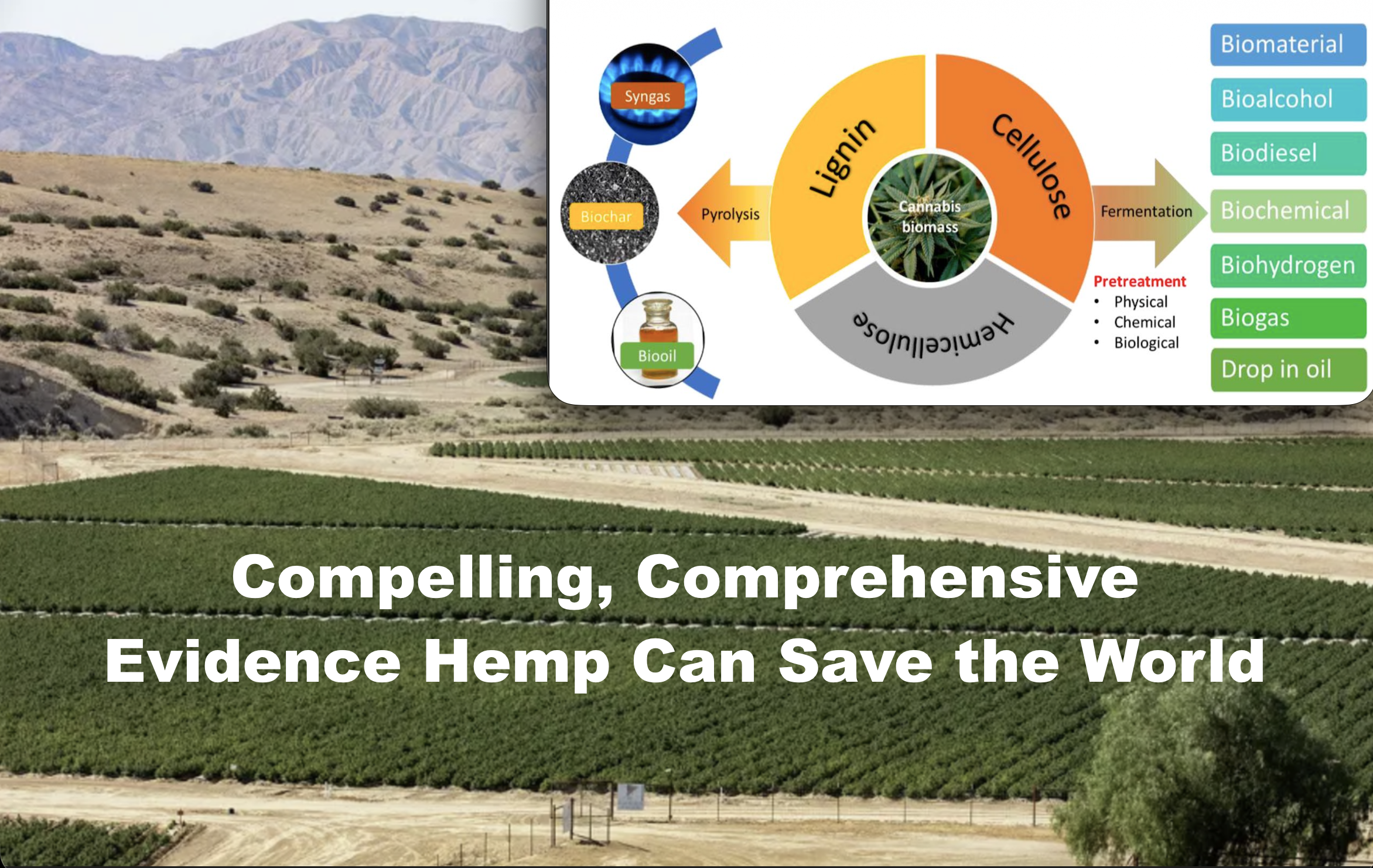
It is now 2026, and humans are in the middle of another war involving oil in the Middle East. It seems inevitable. But is it? Could hemp save us from all these oil wars? In chapter 12 of my articles on the history of Reefer Madness, I provided evidence that David Watson did his best to make sure the Hempsters didn’t insist on reasonable regulations for industrial hemp in 1997, during the Canadian government’s hemp regs roll-out. Reasonable regulations would have reflected that neither industrial hemp nor recreational cannabis was all that dangerous or harmful. The main reason why the Hempsters didn’t insist on reasonable regulations in 1997 was because back in 1994 Ed Rosenthal had convinced most of us that hemp could not save the world, so obtaining reasonable regulations were no longer a life-or-death situation for humanity. An incremental pace for cannabis law reform was acceptable in a lower-stakes scenario.
But Rosenthal was wrong. Hemp could save the world – if it wasn’t over-regulated. If hemp ethanol could compete with non-renewable energy in a reasonable market (such as temporarily shifting to hemp ethanol the subsidies that non-renewables had enjoyed for decades) then the money would math, the hemp ethanol economy could quickly ramp up production and distribution, and humanity would enjoy the clean, affordable, grow-almost-anywhere, climate stabilizing effects of hemp as a fuel crop. Watson made sure that the industrial hemp market would not be reasonable, and that hemp – not oil and gas – would permanently be hobbled. And Rosenthal convinced most of the Hempsters that it would be market forces – not over-regulation – that would determine what the legal hemp economy would look like.
“Hemp has jumped from magazines such as Britain’s The Ecologist and High Times in the U.S., to the press wires, TV, and national journals. Much of this media attention has accepted the ‘hemp hype’ without investigation. Recent books have focused on hemp’s past history and its idealized potential. One popular volume even claims that this plant alone can save the world from ecological disaster. . . . Will it help lead us to a greener future or is it just a pipedream? The market will decide in the next few years.”
– Ed Rosenthal, Forward to Hemp Today, 1994 (1)
“There is no question that ‘corn ethanol is energy efficient.’ It has ‘an energy ratio of 1.34, which means for every BTU dedicated to producing ethanol there is 34 percent energy gain.’ Unfortunately, corn puts high demands on land and water resources, and producing biofuel from it is energy and resource-intensive. Industrial hemp, by comparison, because of its high cellulose content has an estimated 540 percent energy gain.”
– Nicole M. Keller, “THE LEGALIZATION OF INDUSTRIAL HEMP AND WHAT IT COULD MEAN FOR INDIANA’S BIOFUEL INDUSTRY,” Indiana International & Comparative Law Review, 2013 (2)
“At the moment corn is the number one energy crop in the United States – but only because corn is so heavily subsidized, and hemp is so heavily over-regulated.”
– David Malmo-Levine, “Hemp Can Still Save The World,” 2020 (3)
“The disagreement between Ed Rosenthal and Jack Herer in the April 1995 issue of HIGH TIMES is fairly instructive. . . . Herer also engages in frequent hyperbole and is so enthusiastic about hemp’s potential that he sometimes overstates his case. That said, Jack Herer and Lynn Osburn are right on the mark when they claim that biomass is the energy source of the future, and that hemp has exciting contributions to make to bioenergy development. . . . The key to hemp’s potential as an energy source is new technology. To explain this requires an understanding of how developing technologies can extract the energy value of the molecular chains within the seed and stalk of the cannabis plant. Rosenthal is correct that hemp has little or no value as an energy crop today; Herer is correct that it will have considerable value as one in the future.”
– JON GETTMAN, HEMP AND THE NEW ENERGY TECHNOLOGIES, High Times, January 1996 (4)
“A broken heart don’t appear on no x-ray.”
– Dennis Peron, to the author, Vancouver, August 1996
 Image #1: Sophocles, from his lost play Phaedra, circa 420 BCE
In November 1994, Ed Rosenthal published a book called Hemp Today. (5) This was the book that transformed most of the hemp movement from one that claimed hemp could save the world into one that stopped talking about hemp saving the world. When people were led to believe industrial hemp could no longer save the world, they stopped fighting for it as lifeline to our future, and instead treated it like just another novel commodity – a quaint link to the past.
 Image #2: Hemp Today, Ed Rosenthal, editor, Quick Trading Company, San Francisco, 1994
From the end of 1994 onward, no longer did most Hempsters sport a “HEMP CAN SAVE THE PLANET” t-shirt, or wear a “Hemp Can Save the Earth” button. No longer did High Times put “we’ve found a plant that can save the world” or anything similar on the front cover. This removal of the enthusiasm (combined with the hemp over-regulation that was waiting just around the corner) limited the emerging hemp economy to a much smaller market than was possible: mostly hemp seed oil for human consumption, and hemp hurd for animal bedding.
 Image #3: High Times, cover dated January 1996, with the cover mentioning the JON GETTMAN article: HEMP AND THE NEW ENERGY TECHNOLOGIES. Image from: https://archive.hightimes.com/issue/19960101 Article at: https://www.ukcia.org/industrial/hemp-fuel.php
Ever since 1997, this author has been carefully researching this topic. I moved in with hemp activist/farmer Brian Taylor in 1999. I studied the history of hemp and the history of oil. I first began publishing my research in 2008. (6) Each time this author attempted to fact-check Rosenthal, Herer’s conclusions ended up being the ones that fit the evidence better. The same is true today.
 Image #4: “Fuel of the Future? The Economics, History and Politics of Hemp Fuels,” David Malmo-Levine, 2008 https://web.archive.org/web/20240126143208/http://hemp-ethanol.blogspot.com/2008/01/economics-history-and-politics-of-hemp.html
 Image #5: Image from “Hemp Biofuel: A Viable Alternative to Fossil Fuels?” Scarlet Palmer, 07/31/2020 https://sensiseeds.com/en/blog/hemp-biofuel-a-viable-alternative-to-fossil-fuels/
In Hemp Today, Rosenthal and his fellow hemp fuel skeptic Dr. David Walker published two chapters claiming economically viable hemp ethanol fuel was unrealistic. Rosenthal’s chapter was called “Hemp Realities,” and Walker’s chapter was called “Can Hemp Save Our Planet?” Their arguments against Jack Herer’s and Lynn Osburn’s evaluation of hemp ethanol, summarized, are;
1) “… there are many plants which can produce a higher biomass on an annual basis.” (p. 76)
2) “Hemp producers cannot match the low prices of waste paper.” (p. 77)
3) “Hemp cannot be grown on the same field continuously without fertilizer.” (p. 79)
4) Hemp needs too much water and too much land to meet modern fuel needs (pp. 77-80).
5) “Energy production would yield a low profit to farmers.” (p. 81)
6) “It would be dangerous to rely on one species or even one method for virtually all energy needs.” (Ibid)
If one assumes we humans are able to transform society into a sustainable one, in which subsidies are switched from non-renewable energy to renewable energy, in which the health and environmental costs are factored into the cost of each product, and in which the red tape around industrial hemp is removed, then hemp ethanol will immediately become economically viable. None of these things are impossible, or even technically difficult. They could all be done quite easily – with the stroke of a pen – so long as there is enough public pressure to have them done.
 Image #6: “Puritan policy – Morals slow use of hemp and ethanol,” Southern Illinoisan, Carbondale, Illinois, December 6th, 1990, p. 12
Obscenely rich people may need to be convinced that their control over the economy must be relinquished – allowing the wealth of the energy sector to instead flow to millions of farmers and gardeners – so that humans can survive. This admittedly difficult task is also not impossible. A sustainable society is just a matter of educating society about what necessary steps must be taken.
The evidence against Rosenthal’s assertions can be summarized with the following counter arguments, one by one, responding to each of Rosenthal’s and Walker’s arguments.
1) “… there are many plants which can produce a higher biomass on an annual basis.”
There are two problems with this assertion that come up upon close inspection of the details:
A) Is it “green weight” or “dry weight” being discussed? Is it the entire plant, or just the stems? The dry weight is typically 15% to 30% of the green weight. One must specify each time, or the numbers are inaccurate.
B) High biomass by itself does not necessarily translate into an ideal fuel crop – the evidence suggests that one must also factor in the cost per acre, the energy efficiency ratio (how much energy you get out compared to how much energy you put in to make the fuel), the volume of fuel per acre, and the efficacy of each crop as a carbon sink – so that the greenhouse effect can be reversed. If hemp ethanol ends up being cheaper than other types of ethanol because of massive amounts of hemp stalk being available for pennies as a waste product from a huge hempseed and CBD medicine economy, then that scenario becomes much more important than a simple “yield per acre” analysis.
 Image #7: “Kentuckians sometimes referred to hemp as a ‘nigger crop,’ owing to a belief that no one understood its eccentricities as well or was as expert in handling it as the Negro. A Lexingtonian stated in 1836 that it was almost impossible to hire workmen to break a crop of hemp because the work was ‘very dirty, and so laborious that scarcely any white man will work at it,’ and he continued by saying that the task was done entirely by slave labor.” Hopkins, Jame F., A History of the Hemp Industry in Kentucky, Lexington: University of Kentucky, 1951. https://www.edwardtdodge.com/2019/11/10/the-surprising-story-of-hemp-slavery-in-america/ Image from: Herb Museum
On the topic of yield, there is compelling evidence from multiple sources which suggests that Rosenthal’s estimate for hemp biomass production of 3 to 5 tons per acre (p. 71) is low. (7) Keep in mind that a global metric tonne is roughly 10% heavier than a US imperial ton, as measurements from various sources use different standards. Hemp dry weight yields of 6.5 tonnes (8), 8.7 tons (9), 8.59 tonnes (10) and 12.5 tons (11) per acre have been reported . . . so well over double the maximum estimate from Rosenthal at the high end.
As well, there is evidence that Rosenthal’s estimates for dry weight yields of “other-than-hemp” biomass producing plants (pp. 78-79) were ridiculously high – in at least one case it was nearly triple the actual recorded maximum yield. For example, Rosenthal claimed (without citing his source) there were sugarcane yields of dry biomass per acre per year of up to 50 tons. The highest yield that I could find was 43.37 tonnes per hectare – about 17.6 tonnes per acre. (12) For another example, Rosenthal claimed (again, no source) that there were sorghum yields of dry biomass per acre of up to 30 tons. The highest yield that I could find was 42.1 tonnes per hectare – about 17 tonnes per acre. (13)
If you’re going to low-ball hemp yield estimates by well over double and inflate hemp-substitute yield estimates by nearly triple, it’s going to end up being a gross under evaluation of hemp’s potential viability as a fuel crop. Accidentally estimating low yield for hemp and high yield for hemp substitutes is a weird couple of coincidences. But this is just the beginning of the long list of things Rosenthal got wrong.
The French hemp cultivar known as Futura 75 – famous for being high-yielding in seed, fibre and biomass – was responsible for the 8.59 tonnes of dry weight per acre statistic. It also had the strongest yields of hemp ethanol per ton out of multiple cultivars, at 91.1 gallons. (14) That cultivar was bred absent of a hemp fuel market. Breeding will improve yields still further when the incentives for breeding hemp fuel cultivars arise as a result of a reasonably regulated hemp fuel market finally being allowed.
 Image #8: “Futura 75 € 138.75–€ 1,110.00 Futura 75 is the only variety that allows growers in Southern Europe to earn a double income from straw and seed. It is also attractive due to its CBD yield (content and biomass).” https://hemp-impact.com/offer/?product=futura-75
 Image #9: “Hemp Traders September 14, 2021 · The world’s tallest hemp plant was harvested from our farm in California on September 10, 2021. This event was witnessed and conformed by the county department of agriculture. The plant measured an incredible 24 feet, 1 inch which is a world record. The evidence is being submitted to Guinness World Records who will verify our claim. We are now encouraging farmers to break our record. For an inspiring hemp experience, check out our website. www.hemptraders.com [email protected] (562)630-3334” https://www.facebook.com/HempTraders/posts/the-worlds-tallest-hemp-plant-was-harvested-from-our-farm-in-california-on-septe/4282047855195249
 Image #10: “Ganesh Yedi September 23, 2021 · Some of the tall plant from Nepal still there were more tall – Rellevart Himalaya” https://www.facebook.com/photo.php?fbid=1876556149192538&set=p.1876556149192538&type=3
 Image #11: “JinMa Hemp Fiber Seeds” (In Chinese, “Jin” means “gold” or “money” and “Ma” means “hemp.” Image from: https://www.farmtiva.com/seed-catalog/inma-fiber-seeds-7zk2w
 Image #12: “Dwarf germplasm: the key to giant Cannabis hempseed and cannabinoid crops,” Ernest Small, Apr 2018 https://www.researchgate.net/figure/Cross-sections-of-stems-of-Cannabis-sativa-at-internodes-A-Marijuana-plant-B-Fibre_fig6_321779324
 Image #13: “Workers harvest cannabis at a licensed farm in Tochigi Prefecture. | JUNICHI TAKAYASU” https://heritageofjapan.wordpress.com/just-what-was-so-amazing-about-jomon-japan/ways-of-the-jomon-world-2/fashion-clothing-and-jewellery-of-jomon-times/in-the-news-earliest-looms-in-japan-found-in-late-jomon-site-4th-3rd-c-in-kyushu/jomon-people-wore-clothes-made-from-cannabis-sativa-fibres-and-used-the-fibres-for-bow-strings-and-fishing-lines/
 Image #14: “Mitch McConnell wants to legalize hemp — here’s how it’s different from marijuana,” Mar 27, 2018 https://www.businessinsider.com/what-is-hemp-different-from-weed-2018-3
 Image #15: “Industrial Hemp in the United States,” USDA, 1995, p. 17 https://ers.usda.gov/sites/default/files/_laserfiche/publications/41740/15859_ages001ei_1_.pdf
Some of the few fuel-crop specific hemp cultivars are being combined with certain cultivation techniques to boost yields even more. For example, the late-flowing CBD rich Hungarian cultivar Kompolti – along with a particular spacing strategy – achieved a 30% higher yield. (15) Rosenthal did not factor in the possibility of improving the hemp genetics and farming strategies after a 60 year hiatus in the North American (and most of the rest of the world’s) market.
 Image #16: “Kompolti Hemp Seeds – Agromag Kft · High CBD & Biomass Yield · EU Certified Dioecious Strain for Fiber and Flowers Rate and win (0) star star star star star_border Looking for a reliable, all-in-one hemp strain? Kompolti is an EU-certified, dioecious variety famous for its massive biomass, premium fiber, and high-CBD flowers with a unique Kush flavor. Highly adaptable to Mediterranean and continental climates, this Hungarian legend guarantees heavy yields and legal THC levels under 0.2%. Perfect for growers who want maximum versatility without complications.” https://pevgrow.com/en/hemp-seeds-kompolti.html
But it’s not just about yield. There’s also the “cost to turn biomass into fuel” to consider.
In 1994 it was argued by Hayo M.G. van der Werf (in David Watson’s publication, the Journal of the International Hemp Association) that “maize, sugar beet or potato produced similar dry matter yields.” (16) Van der Werf then dismisses the possibility that hemp would make a good fuel crop without first determining what kind of crop could meet the needs of the entire fuel market.
The next year a study was published which asked the question “what crop could provide enough fuel to replace gasoline?” What source of fuel biomass could meet the needs of hundreds of millions – if not billions – of vehicles? Lorenz and Morris had an answer:
“If annual ethanol sales expand beyond 2 billion gallons, cellulosic crops, not starch, will probably become the feedstock of choice. The data in the last column suggest a very large energy gain from converting cellulosic crops into ethanol. Cellulosic crops, like fast growing tree plantations, use relatively little fertilizer and use less energy in harvesting than annual row crops. The crop itself is burned to provide energy for the manufacture of ethanol and other co-products. A major co-product of cellulosic crops is lignin, which currently is used only for fuel but which potentially has a high chemical value. Were it to be processed for chemical markets, the net energy gain would be even greater.” (17)
 Image #17: Hao, X., Liu, C., Cao, H., Liu, Y., Peng, H., and Shen, J. (2015). “Use of byproduct from cellulosic ethanol production as an additive for concrete: A possible win-win strategy?” BioRes. 10(4), 6314-6317. https://bioresources.cnr.ncsu.edu/resources/use-of-byproduct-from-cellulosic-ethanol-production-as-an-additive-for-concrete-a-possible-win-win-strategy/
Image #18: Brar, K.K., Raheja, Y., Chadha, B.S. et al. “A paradigm shift towards production of sustainable bioenergy and advanced products from Cannabis/hemp biomass in Canada.” Biomass Conv. Bioref. 14, 3161–3182 (2024). https://doi.org/10.1007/s13399-022-02570-6
 Image #19: Biofuel Crops by Yield per Acre (North America). Image from: https://chatgpt.com/
And it’s not just about capacity, it’s about the over-all cost determined by whether the biomass used for making fuel with is the primary end product of the crop or a secondary “waste product” of the crop. A study in 2017 concluded that hemp would be more profitable than other fuel crops (kenaf, switchgrass & biomass sorghum) due to the lower costs of converting hemp biomass to ethanol, and the fact that hemp could provide food and fuel from the same crop:
“A comparative cost analysis indicates that industrial hemp could generate higher per hectare gross profit than the other crops if both hemp grains and biofuels from hemp stem were counted. … The potential of converting industrial hemp for biofuels and bio-products in comparison with other biomass feedstocks was evaluated. Dilute acid pretreatment was more effective in term of sugar yield from enzymatic hydrolysis when compared with dilute alkali pretreatment. Cost analysis indicates that industrial hemp could generate higher per hectare gross profit than the other crops. In summary, hemp has great potential to become a promising commodity crop for producing both biofuels and value-added products that can improve the stigma surrounding its applications. Future research will extend the preliminary techno-economic analysis to incorporate harvesting, preprocessing, conversion and the other hemp derived coproducts.” (18)
This author asked ChatGPT whether hemp was a better fuel crop than other high-biomass, low-water use crops. The A.I. program pointed out that hemp was a better multi-use crop, which made it more economically viable, because the biomass could be considered a waste product rather than the primary economic commodity, which would result in a significantly lower end price to the consumer.
 Image #20: Final Comparison between Hemp, Switchgrass & Miscanthus in five key economic viability categories. Image from: https://chatgpt.com/
Put simply, if you’re making $600 bucks per acre from corn stalks biomass, but $1200 per acre from hemp seed and $12,000 per acre from hemp CBD (from the same crop as the hemp seed), you can afford to give away the hemp stalks biomass for free. “Just get it off the farm, out of my way, and save me the hassle of disposing it myself and you can have it.” Fun fact: hemp is a “multi-use” or “multipurpose” crop. Corn is a “competing use” crop. As agronomists recently pointed out:
“Increased energy consumption and climate change, driven by greenhouse gas emissions, pose significant risks to global sustainability. Concerns about using agricultural land for fuel production and its competition with food production have made feedstocks like corn (Zea mays) highly controversial. . . . Hemp (Cannabis sativa) is a multipurpose plant that offers a wide range of different products (Figure 2). Utilizing the entire plant, it finds applications for nutritional, medicinal, and industrial purposes. Hemp’s high biomass (Figure 3a) content and energy yield make it suitable for ethanol production from the whole plant. . . . Hemp can be characterized as a low-cost feedstock crop with minimal pesticide and fertilizer requirements, making it a weed-competitive crop. It can effectively reduce weed growth and is generally regarded as a pesticide-free crop. From an economic standpoint, hemp is a plant that generates minimal waste, with every component, from the roots to the leaves, holding value.” (19)
The most important fact when it comes to fuel crops – a fact that is not in dispute – is that – at the moment – corn is the number one energy crop in the United States (20) – but only because corn is so heavily subsidized – 3.2 billion dollars of corn subsidies in the U.S. in 2024 (21) – and hemp is so heavily over-regulated.
 Image #21: “Federal farm subsidies: What the data says – Federal farm subsidies make up an average of 13.5% of net farm income.” Jun 23, 2025 https://usafacts.org/articles/federal-farm-subsidies-what-data-says/
How is hemp over-regulated? When the Canadian hemp economy was first legalized in 1998, the hemp economy was described as being under “tight controls.” (22) In spite of some of the regulations loosening in 2017, the Canadian hemp economy is still being made artificially expensive. From 1997 until 2017, a minimum of 10 acres was required to have been grown. (23) The hemp initially had to test below 0.3% in THC. (24) THC testing is still in place for certified seed production to this day. (25) Any strain farmers wish to grow still to this day must first be “approved.” (26) Hundreds of potentially profitable industrial strains are denied to farmers. (27) Hemp seed still must be rendered non-viable and tested for viability. (28)
In the US, those with criminal records for cannabis farming are not allowed to grow hemp. (29) This restriction was recently lifted in Canada – after unfairly excluding some farmers from industrial hemp jobs for 20 years. (30)
Hempseed breeding licenses – permitting access to the most economically rewarding element of industrial hemp farming and allowing farmers self-sufficiency and independence – are still difficult to obtain. In Canada, one needs the equivalent of a science degree and 10 years of experience working under an accredited breeder. (31) US seed breeder licensing rules are different, but still onerous. (32) In fact, ChatGPT could only list 15 licensed hemp seed breeders in all of North America! There are only 5 Canadian and 10 American (5 private and 5 public) hemp seed breeders. A revenue stream that should be available to every hemp farmer is monopolized by the lucky few. To truly share the wealth of the hemp economy and maximize hemp’s potential, we need millions of hemp breeders in North America – not 15.
 Image #22: North American Hemp Seed Breeding licensees. Image from: https://chatgpt.com/
To illustrate what a massive scam the hemp seed breeding monopoly is, here are some cost estimates. If the average Canadian farm is 811 acres, (33) and the hemp seed requirements (for a multi-use crop) is around 30 pounds of seed per acre, (34) then the farmer will have to obtain 24,330 pounds of hemp seed. At 6 dollars per pound wholesale (not including shipping costs), (35) that will be a cost of $145,980 – the hemp seed cost to the average Canadian farmer. If every farmer was allowed to breed their own hemp seed, their costs would be the cost of seed production instead – over 90% percent cheaper. That’s a bigger markup than most black market pot dealers take.
 Image #23: “Figure 7. Hemp-licensed area (ha) in Canada since hemp production permits were available beginning in 1998.” Cherney, J.H.; Small, E. Industrial Hemp in North America: Production, Politics and Potential. Agronomy 2016, 6, 58. https://doi.org/10.3390/agronomy6040058 https://www.mdpi.com/2073-4395/6/4/58
Put another way, there was 55,400 acres (22,420 hectares) of hemp grown in Canada in 2023. (36) If each acre required 30 pounds of hemp seed, and each pound cost 6 dollars (again, not including shipping) then the total hemp seed costs for all Canadian hemp farmers in 2023 would be somewhere north of 10 million dollars. Per year. Multiply that by the 30 years hemp has been “legal” in Canada and that’s 300 million. That would make a nice down payment on some hemp fuel production plants and/or distribution networks, had Canadian hemp farmers been given the opportunity to supply themselves with their own hemp seed and pooled the resulting savings in their own interest. And had hemp not been over-regulated, there would have been more hemp farmers, and their combined wealth would have been much greater.
The US market for hemp is approximately ten times bigger than the Canadian market, given the population ratio of the two countries. In 30 years, US hemp farmers would probably spend at least 3 billion dollars on seed that they could have supplied to themselves. That’s ten times the wasted potential – ten times the scam.
The excuse given for the hemp seed breeder cartel is that regular untrained hemp farmers are too dumb to breed good seeds, and hemp genetics will suffer. I asked Arthur Hanks of the Canadian Hemp Trade Alliance about the seed breeder cartel back in 2006, and he responded that;
“Certified seed is supposed to deliver known quantity. For a lot of buyers this is very important. Using common seed might be a false savings.”
“Can you provide me with an example of a false savings?” I asked.
“Well, there was that problem with USO 14 …” Arthur responded. “… breeders were not crossing it back with its parents.”
“But that’s a fuck-up by accredited breeders.” I replied, “So certified seed doesn’t necessarily mean fuck-up free seed.”
“Good point.” Responded Arthur. “It’s also true that cheap common seed will help make biomass hemp fuel more economically viable.”
“Do you think that the seed growers association may be acting like an elitist club that – like doctors and lawyers – is concerned more with controlling an industry than helping clients?”
“There may be some of that in there …” (37)
 Image #24: ” . . . breeding of monoecious hemp varieties USO-14, USO-31 and Glukhovskaya 33 (Dr. V. G. Virovets and Dr. I. Sherban) . . . Variety Name: ‘USO-14’ monoecious (registered 1980). Maintaining Institution: Institute of Bast Crops of Ukranian Academy of Agrarian Sciences. Region of Cultivation (see map): 3, 4, 5, 7, 9, 11″ “Hemp cultivars and research in the former USSR,” Robert C. Clarke, circa 1996 https://www.druglibrary.net/olsen/HEMP/IHA/iha03214.html
It seems to this author that it is the pinnacle of audacity that the very person who had never had any formal training or certification in medicinal cannabis seed breeding (and who gained considerable financial benefits from being a pioneer in cannabis seed breeding) – David Watson – was the same person who insisted that industrial cannabis seed breeders go through an arduous licensing process before they could gain any similar financial benefit (see previous chapter). If certification was necessary to get quality seed, then Skunk #1, Afghani #1, Haze, Durban Poison, and the rest of the seeds that began the medicinal cannabis seed economy in Holland could never have been considered “world class” – as all of Watson’s “Cultivator’s Choice” seed ads promised (see previous chapter). If training wasn’t required to breed “world class” medicinal cultivars, why would training be needed to get “world class” industrial cultivars?
 Image #25: “Seed Variety: varieties selected for seed yield, ideal for the production of oil, flour and food.” https://canapuglia.it/collections/varieta-da-seme
Hemp is so over-regulated, hemp seeds for human food has become the only reliable market for it (in Canada), because hemp seed and hemp seed oil is so valuable as a source of essential fatty acids that consumers will pay a premium price for it in spite of the added costs from the over-regulation. (38) Because of the way “legalization” (over-regulation) rolled out differently in the United States – CBD farming was legalized in the 2018 Farm Bill – CBD farming is the biggest market for U.S. hemp farmers. (39)
 Image #26: Where is CBD Legal in North America in 2026? https://www.covasoftware.com/blog/where-is-cbd-legal-in-north-america-in-2025
 Image #27: Global CBD market current size and projections. “CBD Consumer Health Market Size, Share, and Trends 2025 to 2034,” 29 Jan 2025 https://www.precedenceresearch.com/cbd-consumer-health-market
 Image #28: US CBD market current size and projections. “CBD Consumer Health Market Size, Share, and Trends 2025 to 2034,” 29 Jan 2025 https://www.precedenceresearch.com/cbd-consumer-health-market
Image #29: Global CBD market share by region, 2024. “CBD Consumer Health Market Size, Share, and Trends 2025 to 2034,” 29 Jan 2025 https://www.precedenceresearch.com/cbd-consumer-health-market
 Image #30: Global CBD market share by product type. “CBD Consumer Health Market Size, Share, and Trends 2025 to 2034,” 29 Jan 2025 https://www.precedenceresearch.com/cbd-consumer-health-market
 Image #31: The difference between Over The Counter medicinal CBD products and “Vitamin category” CBD products. Image from: https://chatgpt.com/
If hemp wasn’t over-regulated, it would replace corn as the number one fuel crop in North America. Hemp is a superior energy crop to corn for many reasons. Hemp: A) doesn’t need as much fertilizer or water as corn, switchgrass or other energy crops, (40) B) doesn’t require as much drying as corn does, (41) C) can be grown where other energy crops can’t, (42) D) has long been known to be the highest-cellulose low-moisture crop – ideal for fuel production. The hemp stalks are “over 75% cellulose” according to a 1929 paper from Schafer and Simmonds with more conservative estimates indicating the hurds being between 32% and 38% percent cellulose, while the bark is between 53% and 74%, (43) E) is much more energy efficient than corn. One estimate asserts that corn has a 34 percent energy gain, while hemp has an estimated 540 percent energy gain. (44) This means hemp may be 16 times as efficient an energy crop as corn!
 Image #32: GHA Event Hemp to Biofuel and Bioproducts System https://www.youtube.com/watch?v=UeU1H33QF10&t=962s
 Image #33: Hemp vs Corn – Full Comparison (with Carbon Sequestration). Image from: https://chatgpt.com/
 Image #34: “Jet Flown by United Airlines Entirely Powered by 100% Plant-Based Fuel from Corn Stalk Waste,” Andy Corbley, Dec 9, 2021 https://www.goodnewsnetwork.org/united-airlines-operate-first-flight-with-100-percent-plant-based-fuel-from-corn/
The 540% energy gain estimation was based on a 2008 evaluation of the energy efficiency of switchgrass. (45) Current EROI (Energy Return On Investment) numbers or energy gain percent numbers for hemp do not reflect maximized yields/maximized conversion-to-fuel techniques. Switchgrass and corn both improved their EROI & energy gain after decades of improvements, and hemp will likely see similar improvements upon the removal of over-regulation and the development of the hemp fuel industry.
 Image #35: North American Biofuel Crops By Energy Return On Investment. Image from: https://chatgpt.com/
 Image #36: Energy Return On Investment and energy gain comparison between switchgrass, corn and hemp, based on initial technology/technique and developed or projected technology/technique. Image from: https://chatgpt.com/
 Image #37: Hemp Ethanol: Gasoline-Equivalent Energy per Acre estimates based on 5 different scenarios. Image from: https://chatgpt.com/
A 2017 study compares hemp favourably to switchgrass, because of the high profitability of “multi-use” hemp:
“This study takes combined field trial, lab experiment, and economic analysis approaches to evaluate the potential of industrial hemp in comparison with kenaf, switchgrass and biomass sorghum. Agronomy data suggest that the per hectare yield (5437 kg) of industrial hemp stem alone was at a similar level with switchgrass and sorghum; while the hemp plants require reduced inputs. Field trial also showed that 1230 kg/ha hemp grain can be harvested in addition to stems. Results show a predicted ethanol yield of 82 gallons/dry ton hemp stems, which is comparable to the other three tested feedstocks. A comparative cost analysis indicates that industrial hemp could generate higher per hectare gross profit than the other crops if both hemp grains and biofuels from hemp stem were counted. These combined evaluation results demonstrate that industrial hemp has great potential to become a promising regional commodity crop for producing both biofuels and value-added products.” (46)
 Image #38: Hemp vs. Switchgrass (Energy + Economics). Image from: https://chatgpt.com/
On top of all this, hemp is F) possibly the best carbon sink fuel crop in the world. Recent evaluations of hemp as a carbon sink consider it the “best possible option” (47) and “more efficient than agro-forestry” (48) and that it absorbs C02 “4 times faster than a forest.” (49)
 Image #39: “COAL CONSUMPTION AFFECTING CLIMATE,” The Northam Adviser, Northam, Australia, August 31st, 1912, p. 7
 Image #40: Tom Athanasiou, US Politics and Global Warming, Open Magazine pamphlet series #14, 1991
 Image #41: Australian fire extent during a one month period between December 5th, 2019 and January 5th, 2020. Image from Australia is Burning / A 3D Visualisation https://anthonyhearsey.com/australia-is-burning-a-3d-visualisation
 Image #42: “Stunning map shows 11 years of U.S. wildfires This map by John Nelson shows all major U.S. wildfires (and probably some prescribed fires) since 2001, with yellow being more intense. That bright purple over most of the country except the lucky Northeast is fires that put out maybe half as much energy as a power plant produces in the course of a year.” Jul 23, 2012 https://grist.org/climate-energy/stunning-map-shows-11-years-of-u-s-wildfires/
 Image #43: “Six trends to know about fire season in the western U.S.” Dec 05, 2018 https://science.nasa.gov/earth/natural-disasters/wildfires/six-trends-to-know-about-fire-season-in-the-western-us/
 Image #44: “Six trends to know about fire season in the western U.S.” Dec 05, 2018 https://science.nasa.gov/earth/natural-disasters/wildfires/six-trends-to-know-about-fire-season-in-the-western-us/
 Image #45: Image from: “The weather is getting weirder – The Nature of Things,” https://www.youtube.com/watch?v=jN3aFXaTq90
 Image #46: “Antarctica’s Doomsday Glacier ‘really holding on today by its fingernails’,” Sep. 9, 2022 https://www.theweathernetwork.com/en/news/climate/impacts/antarctica-doomsday-thwaites-glacier-holding-on-by-its-fingernails
 Image #47: “The change seen in these images can largely be pinned on human-caused warming.” “Repeat Photos of Grinnell Glacier,” https://www.nps.gov/articles/000/repeat-photos-of-grinnell-glacier.htm
 Image #48: “Venice mayor declares state of emergency after ‘apocalyptic’ floods,” Nov. 13, 2019 https://www.nbcnews.com/news/world/venice-floods-hit-second-highest-levels-ever-n1081076
 Image #49: Image from: “Venice Has Its Worst Flood in 53 Years,” November 14, 2019 https://www.scientificamerican.com/blog/eye-of-the-storm/venice-has-its-worst-flood-in-53-years/
 Image #50: “Could Cannabis Provide an Answer to Climate Change?” Marc R. Deeley, Journal of Industrial Hemp, Vol. 7(1) 2002, p. 133 www.internationalhempassociation.org/pdf/J237.pdf
 Image #51: “Numerous studies have shown that hemp captures up to 16 tons of greenhouse gas annually, while trees suck up about six tons.” “Cannabis Plants Could Help Fight Climate Change,” Stacy Liberatore, Daily Mail, November 24, 2022 https://www.cannabisculture.com/content/2022/11/24/cannabis-plants-could-help-fight-climate-change/
 Image #52: “Smoke on this! Cannabis plants could help fight climate change because they absorb carbon dioxide more than TWICE as effectively as trees” STACY LIBERATORE, US SCIENCE & TECHNOLOGY EDITOR 24 November 2022 https://www.dailymail.co.uk/sciencetech/article-11467061/Cannabis-plants-help-fight-climate-change-absorbing-carbon-dioxide.html
 Image #53: “Smoke on this! Cannabis plants could help fight climate change because they absorb carbon dioxide more than TWICE as effectively as trees” STACY LIBERATORE, US SCIENCE & TECHNOLOGY EDITOR 24 November 2022 https://www.dailymail.co.uk/sciencetech/article-11467061/Cannabis-plants-help-fight-climate-change-absorbing-carbon-dioxide.html
 Image #54: “Crop Comparison: Ranked by Max Carbon & Profit,” Image from: https://chatgpt.com/
 Image #55: “Fuel Crop Comparison (Profit + Carbon + Total Value),” Image from: https://chatgpt.com/
 Image #56: “Key Insights (What the chart actually shows),” Image from: https://chatgpt.com/
 Image #57: “Greta Thunberg: ‘They see us as a threat because we’re having an impact’,” 21 Jul 2019 https://www.theguardian.com/culture/2019/jul/21/great-thunberg-you-ask-the-questions-see-us-as-a-threat
As one research team put it, hemp isn’t just carbon neutral, it’s carbon negative;
“As global CO2 levels rise, cannabis (hemp) plants grow larger naturally. For every ton grown above-ground, another half a ton of carbon is stored in the soil as root mass, where it belongs. . . . Cannabis is an ancient ‘C3’ plant species which means it can absorb CO2 up to 1200 parts per million. Our modern ‘C4’ plants reach saturation and do not absorb additional CO2 beyond 500 ppm as cannabis does. Cannabis has this remarkable ability to absorb CO2 directly from the atmosphere. As global CO2 levels rise, cannabis (hemp) plants grow larger naturally. For every ton grown above-ground, another half a ton of carbon is stored in the soil as root mass, where it belongs. This creates a ‘carbon negative’ opportunity to capture CO2 for the life of the products made from the crop.” (50)
The academic world has already realized hemp’s carbon negative potential. In a study titled “Hemp as A Sustainable Carbon Negative Plant: A Review of Its Properties, Applications, Challenges and Future Directions,” the authors sum up hemp’s potential to sequester carbon in a range of different industries, including biofuels:
“This review paper has presented an overview of hemp’s properties, applications, challenges, and future directions in the context of its role as a sustainable carbon-negative plant. The key conclusions drawn from this study are as follows: Unique properties of hemp – The review has brought out the unique properties of hemp that make it an ideal candidate for carbon sequestration. Hemp’s rapid growth, high biomass production, and deep root system contribute to its carbon sequestration capabilities, allowing it to absorb and store substantial amounts of carbon dioxide (CO2) during its growth cycle. Such unique properties of hemp have the potential in making it a valuable tool in combating climate change. This review also highlights the importance of hemp’s carbon-rich fibers and their potential for long-term carbon storage in various applications, such as textiles, construction materials, and biofuels.” (51)
 Image #58: Muttil, Nitin, Sadath, Sayaad, Coughlan, Darren, Paresi, Prudvireddy and Singh, Swadesh Kumar (2024) “Hemp as A Sustainable Carbon Negative Plant: A Review of Its Properties, Applications, Challenges and Future Directions.” International Journal of Integrated Engineering, 16 (2). pp. 1-12. https://vuir.vu.edu.au/48906/1/Hemp%20_as_A_Sustainable_Carbon_Negative_Plant.pdf
This carbon-negative potential of hemp has already received publicity through the house building industry, where hempcrete (hemp-based concrete) features carbon capture as just one of many attractive elements of hemp as a building material;
“But more recently its ability to capture more than twice its own weight in carbon – twice as fast as traditional forestry – has come into focus. By some estimates, hemp can capture up to 15 tonnes of CO2 per hectare, through photosynthesis. Hemp cultivation taking up only 25% of the world’s agricultural land used for dairy and livestock would close the UN emissions gap of 23 gigatons of CO2 annually.” (52)
 Image #59: Hempen March 6, 2018 https://www.facebook.com/photo/?fbid=989610054527301&set=a.774202207225983
 Image #60: “Hemp Hurd | A Carbon Negative Alternative” – Hemp In A Pot https://www.youtube.com/watch?v=KVapl_r9BZI
 Image #61: “Builder set to deliver ‘carbon negative’ hemp homes,” East Anglian Daily Times, Ipswich, Suffolk, England, December 20th, 2023, p. S2
 Image #62: “Dear Environmental Leaders, CO2 Reuse Is Key To Negative Carbon Emissions, Profits and Jobs.” The Burlington Free Press, Burlington, Vermont, January 3rd, 2021, p. A5
When asked what combination of utilization strategies would maximize hemp’s “carbon negative” potential as a fuel crop, the AI program ChatGPT suggested that if biomass production was maximized, if significant carbon was stored in hempcrete, roots and hemp biochar (a soil-improvement substance – technically known as a soil amendment – that enhances soil structure, water retention, and nutrient availability) and if some of the hemp was used for biofuels to displace fossil fuels, that strategy could make hemp carbon negative.
 Image #63: Evaluating Crop Options For Meeting Food, Fuel And Climate Stabilization Simultaneously. Image from: https://chatgpt.com/
 Image #64: Hemp Fuel Can Be Carbon Negative. Image from: https://chatgpt.com/
 Image #65: An Academically Defensible Claim Regarding Hemp Ethanol As A Carbon Negative Fuel. Image from: https://chatgpt.com/
This 2020 assessment appears to be very optimistic regarding hemp as an energy crop:
“Industrial hemp biomass is an excellent alternative candidate for bioethanol production due to its high cellulose content compared to other agricultural residues.” (53)
This 2022 assessment also appears (justifiably) optimistic:
“The quest for cheaper technologies required for the bioconversion of lignocellulosic feedstock into sustainable bioenergy and advanced products has placed Cannabis sativa in the limelight. Moreover, hemp is a profitable crop over other energy crops due to its high energy potential (~ 100 GJ/ha/y) and generates fewer carbon footprints. . . . Cannabis is a sustainable future raw material for the production of value-added products and this area needs to be explored further.” (54)
The key to understanding hemp ethanol economics is that the over-regulation of hemp keeps hemp from reaching its true potential in other-than-fuel economies, which then keeps hemp from reaching its true potential in the fuel economy. Subsidies to hemp fuel substitutes (corn and fossil fuels) locks in the disadvantages to hemp, making it even harder for hemp to compete. When hemp is set free from over-regulation, when subsidies are shifted to cleaner, renewable energy, and when hemp is used for everything it can be used for, then there will be lots and lots and lots of waste-hemp lying around that makes hemp biofuels make sense, economically.
It is clear that hemp is the superior fuel crop – when all the factors that make a good fuel crop are considered. It is only the fact that other crops are subsidized and hemp is over-regulated that prevents hemp from being economically competitive at this moment. This situation could change overnight – at the stroke of a pen – if somehow the public became aware of the fraud behind hemp over-regulation and the immediate environmental benefits that would occur if fossil fuels were replaced with hemp ethanol.
2) “Hemp producers cannot match the low prices of waste paper.”
“Low prices” – this is basically an economic question. Waste paper itself would be made from hemp instead of trees if the red tape around industrial hemp would be removed. Waste hemp paper would no doubt be used for many things, including both ethanol production and the manufacture of recycled paper. Ideally there would be a place to take the waste paper that wasn’t used for recycled paper – the cellulose manufacturing plant – which would also be where any other excess cellulose from other sources would be taken. But replacing all the gasoline in the world would require more than the cellulose that wasn’t already used in recycled paper – multipurpose hemp crops that included biomass production would also be required to meet these needs.
But the main factor that determines society’s main fuel choice is not biomass source. The main factor is subsidies. Looking at any economic question regarding hemp ethanol viability without looking at subsidies is missing most of the equation.
According to Rolling Stone magazine, (55) the United States spends $649 billion dollars every year on “direct and indirect subsidies for coal, oil and gas” – and another $599 billion every year on the Pentagon budget, a lot of which is spent on controlling the energy reserves of other countries. According to Forbes magazine, these fossil fuel subsidies are the main obstacle to transitioning to a sustainable energy economy. (56) The decision to subsidize non-renewable, easy-to-monopolize energy is just that – a decision. Our energy grid doesn’t choose us. The market doesn’t choose it. Our representatives – many of whom are beholden to the hemp substitute industries . . . they choose it.
 Image #66: “Study: U.S. Fossil Fuel Subsidies Exceed Pentagon Spending – The world would be richer and healthier if the full costs of fossil fuels were paid, according to a new report from the International Monetary Fund,” TIM DICKINSON May 8, 2019 “The IMF found that direct and indirect subsidies for coal, oil and gas in the U.S. reached $649 billion in 2015. Pentagon spending that same year was $599 billion.” https://www.rollingstone.com/politics/politics-news/fossil-fuel-subsidies-pentagon-spending-imf-report-833035/
 Image #67: “How much in subsidies do fossil fuels receive?” January 27, 2025 https://ourworldindata.org/how-much-subsidies-fossil-fuels
 Image #68: “How much in subsidies do fossil fuels receive?” January 27, 2025 https://ourworldindata.org/how-much-subsidies-fossil-fuels
 Image #69: “No Warming, No War: How Militarism Fuels the Climate Crisis — and Vice Versa,” April 14, 2020 https://ips-dc.org/climate-militarism-primer/
 Image #70: “No Warming, No War: How Militarism Fuels the Climate Crisis — and Vice Versa,” April 14, 2020 https://ips-dc.org/climate-militarism-primer/
 Image #71: “No Warming, No War: How Militarism Fuels the Climate Crisis — and Vice Versa,” April 14, 2020 https://ips-dc.org/climate-militarism-primer/
When those subsidies are switched over to renewable energy sources and when the health and environmental costs of each product is factored into the price and when the red tape around industrial hemp is removed, fossil fuels and non-renewable energy will suddenly become too expensive to produce and a massive demand for renewable energy sources – including hemp ethanol – will make hemp as a fuel crop suddenly viable. You can make lots of biomass-to-ethanol conversion plants – and lots of ethanol conversion kits for cars – and lots of ethanol pumps to fill those cars – with 1.248 trillion dollars. You could probably make enough of those things in the first couple of years to build the necessary infrastructure for hemp ethanol to be competitive – and then end all fuel subsidies forever.
3) “Hemp cannot be grown on the same field continuously without fertilizer.”
This is true, but it is also true that hemp can provide some of its own fertilizer, and hemp biochar may be able to reduce the need for other fertilizers. There are two ways hemp can help with the fertilization of its own field. The first way is the old way – through “field retting” – letting the rain wash the soil nutrients off the stalks and into the field:
“If the crop is retted in the field, nearly all soluble nutrients are washed into the soil during retting (Dewey, 1913).” (57)
 Image #72: “Spreading harvested hemp in Kentucky, 1898” “From fields to bioreactors: hemp water retting,” July 2, 2023 https://lampoonmagazine.com/industrial-hemp-water-retting-bioreactor-fiber-textile-operations-innovation-italy/
According to another source, hemp’s fertilization requirements are minimal:
“Once hemp begins to grow, it requires very little care. Fertilizers, especially those containing nitrogen, can help farmers achieve optimal fiber yields, but little else is required.” (58)
Organic sources of nitrogen include animal manures and guanos, waste from fish and poultry processing plants and animal slaughterhouses, and crops such as alfalfa, cottonseed and soybeans. (59) There is some indication that field retting to replace lost nitrogen may not be ideal, but this needs more research with different fertilization methods to be better understood. (60)
 Image #73: “Water retting of hemp in Yugoslavia. (Courtesy of Dr. J. Berenji, Institute of Field and Vegetable Crops, Novi Sad.)” “From fields to bioreactors: hemp water retting,” July 2, 2023 https://lampoonmagazine.com/industrial-hemp-water-retting-bioreactor-fiber-textile-operations-innovation-italy/
 Image #74: “Figure 10. Shiv changes during retting stalks on the field. Own figure prepared on the basis of research results in the publication (Arufe et al. Citation2021).” Dudziec, P., Warmiński, K., & Stolarski, M. J. (2024). “Industrial Hemp As a Multi-Purpose Crop: Last Achievements and Research in 2018−2023.” Journal of Natural Fibers, 21(1). https://www.tandfonline.com/doi/full/10.1080/15440478.2024.2369186#d1e1737
The second way hemp can help “amend” its own field is through the creation of “biochar” – a byproduct of the pyrolysis hemp ethanol fuel making process. The biochar is added to the field before the sowing of next year’s hemp seeds:
“Returning the biochar into the soil rather than removing it all for energy production reduces the need for nitrogen fertilizers, thereby reducing cost and emissions from fertilizer production and transport.” (61)
 Image #75: “Hemp + Biochar: New Study Explores Big Benefits For Soil and Climate,” 24 Mar, 2025 https://hempco.net.au/hemp-biochar-new-study-explores-big-benefits-for-soil-and-climate/blog
 Image #76: “Understanding Biochar: A Catalyst for Carbon Sequestration,” Jan 26, 2024 https://nationalhempassociation.org/understanding-biochar-a-catalyst-for-carbon-sequestration/
The above quote being true depends upon soil type. Researchers are still learning how to tailor biochar for specific soils, crops or climates. Clearly, more research needs to be done before biochar’s maximum utility is realized. It is clear that the benefits of biochar have not fully been realized because hemp ethanol production has been hampered with over-regulation and unfair subsidies to hemp substitutes. With more intelligent subsidies and more reasonable regulations, the resulting conditions will allow research into retting and biochar fertilization techniques, which will result in hemp fertilization to reach its full potential.
4) Hemp needs too much water and too much land to meet modern fuel needs.
According to one source, the United States has 60 million acres of idle arable land. (62) According to another source, the United States has 52 million acres left fallow, 38.1 million acres for ethanol production (mostly from corn), 127.4 million acres for livestock feed, 21.5 million acres for wheat exports, 13.6 million for “cotton/non-food,” 62.8 million acres for other grain & livestock feed exports, 77.3 million acres for domestic food production, for a total 391.5 million acres of cropland. (63) Separate from all this land use is livestock grazing land – which is extensive. (64)
 Image #77: “Here’s How America Uses Its Land,” July 31st, 2018 https://www.bloomberg.com/graphics/2018-us-land-use/
 Image #78: “Here’s How America Uses Its Land,” July 31st, 2018 https://www.bloomberg.com/graphics/2018-us-land-use/
If the health and environmental costs of each product were factored into the price tag and over-regulation of hemp was removed, hemp would suddenly replace much of these other crops. Fallow land could be replaced with hemp ethanol farming that was either field retted or biochar-amended, in order to replenish soils while at the same time hemp would choke out all the weeds. Corn for ethanol would be replaced with hemp for ethanol – a much more water and energy efficient choice. Livestock – due to its environmental costs – would become more expensive, and hemp seed would then suddenly become a preferable source for protein – and one could get both hempseed and hemp ethanol from the same crop. Cotton – which is pesticide and water intensive – would be replaced with hemp for fabric. (65)
 Image #79: “HEMP CPH // TEXTILES ORGANIC, SUSTAINABLE, ANTIBACTERIAL BY NATURE” https://cdn.shopify.com/s/files/1/0663/9999/4098/files/Hemp-cph-sustain-vs-cotton-linen_6cbc8775-bd09-407b-927c-c97b3b6970ed.pdf
Factoring in the health and environmental costs into the costs of products is not a new concept. These costs are called “externalities” – a cost of an economic activity that affects a third party who did not choose to incur that cost – and they have been the subject of research for over a hundred years. The followers of the economist A.C. Pigou began using the term “externalities” in the 1930s, and the U.S. Clean Air Act (1963) and later Clean Water Act (1972) could be seen as early attempts to address externalities in the United States.
One estimate for how much US land is needed to produce enough biomass energy to meet US needs is “6-8% of the land area of the 48 contiguous 48 states.” (66) For comparison, 41% of US land is used to feed and graze livestock. (67)
Another way to calculate the area needed is to start with the fact that an acre of hemp can produce up to a thousand gallons of ethanol. (68) This would be the equivalent of 800 to 1000 gallons of gasoline, depending on efforts to maximize ethanol engine efficiency, fuel efficiency and which fuel expert you talk to. In 2024, the people of the United States used nearly 138 billion gallons of gasoline (69) down from a peak of nearly 143 billion in 2018. (70) At one thousand gallons per acre, this would require 134 million acres of hemp ethanol-growing land to replace. If you add up all the fallow land, corn ethanol land, cotton land and half the livestock feed land, you get 167.4 million acres – more than enough to become energy self-sufficient.
A willingness to factor in the health and environmental costs into the cost of each product – and thus address externalities head on – is needed to evolve into a sustainable species. We are faced with being forced to consider the ecology, the environment and the wellbeing of ourselves, farmers and future generations in order to survive. The interconnectedness of all things was best articulated in a speech attributed to Chief Seattle:
“Whatever befalls the earth, befalls the sons of the earth. If men spit upon the ground, they spit upon themselves. This we know. The earth does not belong to the white man, the white man belongs to the earth. This we know. All things are connected like the blood which unites our family. If we kill the snakes, the field mice will multiply and destroy our corn. All things are connected. Whatever befalls the earth, befalls the sons and daughters of earth. Man did not weave the web of life; he is merely a strand in it. Whatever he does to the web, he does to himself.” (71)
 Image #80: “Native Knowledge: What Ecologists Are Learning from Indigenous People,” April 26, 2018 https://e360.yale.edu/features/native-knowledge-what-ecologists-are-learning-from-indigenous-people
Many indigenous cultures have these “all things are connected” ecological considerations as foundations of both their concept of the environment and their religious beliefs (72) – it’s not impossible to imagine a global culture emerging with the same ecological foundation within both its economic and spiritual communities. When we see the planet as a single living entity, there are no longer “externalities” – we are all one, and must live as one.
5) “Energy production would yield a low profit to farmers.”
When subsidies are transformed from permanent subsidies to fossil fuels into temporary subsidies to renewable energy – especially hemp ethanol – the economy will get the kick start it needs to quickly replace gasoline. And one can get hemp seeds and CBD and soil amendments from the exact same crop that’s being grown for fuel, making sure farmers enjoy not one but four revenue streams from the same crop.
 Image #81: “Figure 2. Białobrzeskie as a multi-directional industrial hemp variety. Own figure prepared on the basis of research results in the publication (Ji et al. Citation2021).” Dudziec, P., Warmiński, K., & Stolarski, M. J. (2024). “Industrial Hemp As a Multi-Purpose Crop: Last Achievements and Research in 2018−2023.” Journal of Natural Fibers, 21(1). https://www.tandfonline.com/doi/full/10.1080/15440478.2024.2369186#d1e1737
There are already a trickle of hemp ethanol projects – either small scale or research-based – in the works. (73) (74) (75) (76) (77) These projects represent a significant investment into a market with an obviously not-level playing field. This trickle will no doubt become a flood the moment subsidies are switched and over-regulation is removed.
 Image #82: “Big Isle eyed for ethanol plant – Lawmaker: Firm from mainland would make fuel from hemp,” Hawaii Tribune-Herald, Hilo, Hawaii, April 26th, 1999, p. 1
 Image #83: “Big Isle eyed for ethanol plant – Lawmaker: Firm from mainland would make fuel from hemp,” Hawaii Tribune-Herald, Hilo, Hawaii, April 26th, 1999, p. 10
 Image #84: “Hemp Innovations The Movie” https://www.youtube.com/watch?v=9gwT88-eauQ
 Image #85: https://www.hempinnovations.bio/insights
 Image #86: “Powering the Future with Hemp-Based Renewable Energy” https://longhornbiofuel.com
 Image #87: “The Geodyn Solutions – Green Revolution – Hemp is a strain of the Cannabis sativa plant species that is grown specifically for industrial uses.” https://www.geodynsolutions.com/geodyn-solution-hemp-ethanol-and-biofuel/
 Image #88: “Learn About the Story of Hemp-BioRefineries” hemp-biorefinery.com/about/
 Image #89: “A paradigm shift towards production of sustainable bioenergy and advanced products from Cannabis/hemp biomass in Canada,” Kamalpreet Kaur Brar, Yashika Raheja Guru Nanak Dev University Bhupinder Chadha Guru Nanak Dev University Sara Magdouli Springer Biomass Conversion and Biorefinery March 202214(3):3161-3182 https://www.researchgate.net/publication/359256956_A_paradigm_shift_towards_production_of_sustainable_bioenergy_and_advanced_products_from_Cannabishemp_biomass_in_Canada
There are two major cellulosic ethanol manufacturing plants operating in the world (both in Brazil, with more there under construction) and just a handful of “demonstration” plants scattered around the rest of the world. (78) The reason Brazil can make cellulosic ethanol viable is because the sugarcane biomass availability makes sugarcane cheap enough to make it work. If hemp stops being over-regulated and is used to its maximum potential, hemp biomass too would become cheap enough to make it work.
 Image #90: “Raizen celebrates opening of new cellulosic ethanol plant,” Raizen May 29, 2024 https://ethanolproducer.com/articles/raizen-celebrates-opening-of-new-cellulosic-ethanol-plant
6) “It would be dangerous to rely on one species or even one method for virtually all energy needs.”
Perhaps suggesting “all” energy needs can be met with hemp is an exaggeration. But hemp is probably the only currently known crop capable of producing both carbon-negative fuel and significant edible protein/oil from the same land area. Achieving this at climate-relevant scale would require careful balance of biomass vs. seed allocation, advanced processing infrastructure, and management of market variability for co-products. The CBD market would have to be fully researched and maximized. But the vital take-away is that hemp is the zero-choice option when it comes to dealing with carbon sinks AND food production on limited land. Hemp is the answer to the bio-fuel skeptics who claim gasoline can’t be replaced due to “not-enough-land” to both fuel our vehicles and feed our people. Hemp is a key part of any transformation to a sustainable energy grid, and might make the difference between a vibrant bioethanol industry and a stagnant one.
 Image #91: “Reflections on Sources of US Energy Consumed” October 28, 2022 https://conversableeconomist.com/2022/10/28/reflections-on-sources-of-us-energy-consumption/
 Image #92: “How Has U.S. Energy Use Changed Since 1776?” https://cleantechnica.com/2025/07/02/how-has-u-s-energy-use-changed-since-1776/
 Image #93: “How Has U.S. Energy Use Changed Since 1776?” https://cleantechnica.com/2025/07/02/how-has-u-s-energy-use-changed-since-1776/
All the renewable energy systems – sun, wind, wave, geothermal and cellulosic ethanol – should be subsidized instead of non-renewable energy, so that humanity isn’t dependent on just one energy source. Depending on climate and land use, hemp production may be limited by land or water availability or even a year of bad weather, so it makes sense to have many different renewable energy options available. Having said that, it can also be argued that, as a crop that can potentially reverse the Greenhouse effect, and as a fuel source that can be grown nearly anywhere on earth, can be stored in a tank, can be utilized when the sun isn’t shining and the wind isn’t blowing, and can provide food and medicine and weed control and soil amendments all at the same time – hemp has no equal.
Other fuel crops can potentially be carbon negative, and other renewable fuel sources can be carbon neutral (or nearly so), but only hemp can be both a carbon negative fuel and a source of protein. And lithium car batteries have a huge carbon footprint and possible land-fill problems that cellulosic ethanol doesn’t. (79) Ethanol has the added benefit of requiring no cleanup in the case of a spill – it simply evaporates. (80) Hemp can even grow in sand (81) and help turn desert regions into farmland (82) – allowing energy independence for nearly every country on Earth, which would essentially end armed conflict over limited energy resources.
 Image #94: “Giant cannabis plant growing WILD in Britain – and experts predict there’s more out there,” 03 Oct 2014 https://www.mirror.co.uk/news/weird-news/giant-cannabis-plant-growing-wild-4372104
 Image #95: “Giant cannabis plant growing WILD in Britain – and experts predict there’s more out there,” 03 Oct 2014 https://www.mirror.co.uk/news/weird-news/giant-cannabis-plant-growing-wild-4372104
 Image #96: “The man behind California’s brand-new $15M weed ranch,” Lester Black, Aug 15, 2025 https://www.sfgate.com/cannabis/article/santa-barbara-california-biggest-cannabis-farm-20764634.php
No more oil wars. No more oil spills. No more climate destabilization. A $135 to $420 dollar conversion kit turns every gas-powered car into a 85% to 100% hemp ethanol powered car. (83) Hemp ethanol would be about 5 times cheaper than gasoline at the pump (84) – the conversion kit will pay for itself with just a few trips to the gas station.
 Image #97: “Plug-and-Play E85 Flex Fuel Kit Unlock Performance with Integrated Cold Start Assist or Temp Sensor for 4-Cylinder” https://www.aliexpress.com/item/1005010634502882.html
 Image #98: PRO Series 2 Cyl-Ethanol E85 Kits https://www.ethanolflex.com/en/28-2cyl-e85-ethanol-kits
 Image #99: “Technical questions” https://www.ethanolflex.com/en/module/faq/frontend.html
It’s for these reasons that Ed Rosenthal was wrong about hemp ethanol, and Jack Herer was right. It turns out that Herer was correct when he said “I don’t know if hemp is going to save the world, but it’s the only thing that can.” (85)
When I tried to publish my article on hemp ethanol in High Times back in 2006, they sat on it for 6 months and then told me they would only give me 300 words. I had given them 3000. I didn’t know which 9/10ths I could do without. When I attempted to then publish it in Cannabis Culture, Marc Emery sat on it for another 6 months and then told me he wasn’t interested in publishing it – it “wasn’t sexy enough” of a topic. The effects of Rosenthal dismissing the potential of hemp as a fuel crop had destroyed any momentum the hemp movement once had. Saving the world was no longer “sexy” or deserving of any serious attention. After Jon Gettman’s January 1996 article on hemp fuel in High Times, there would be no major attention on hemp ethanol in the major pot media for another 24 years – until my editors at Cannabis Culture finally gave me the support I needed to do the topic justice.
As for why Rosenthal would want to sabotage Herer’s attempt to save the world, I don’t understand it. Professional jealousy? Destruction of the side of the hemp cultivation economy that he’s not the master of? A humanity-threatening-level case of being a contrarian? Just an honest miscalculation? Unlike David Watson, Ed Rosenthal is still alive, and could potentially undo the damage he has done to the hemp movement. If he is unable to find factual error in this review of his work, he should apologize for underestimating hemp’s potential to save the world, and help revitalize a movement that he was responsible for killing, while there’s still time for it to make a difference.
 Image #100: Ed Rosenthal, wearing a “HEMP WILL SAVE THE PLANET” sweatshirt . . . ironically, because he convinced everyone that it couldn’t. High Times magazine, April 1995, p. 45
 Image #101: Rosenthal was prepared to entertain the possibility of pharmaceutical corporations having an interest in hemp prohibition – but ignored the possibility that energy companies (a much larger sector of the economy) had a similar interest. “Hemp the baking soda of plants,” Arizona Daily Sun, Flagstaff, Arizona, July 4th, 1997, p. 48
 Image #102: Ed Rosenthal, still wearing his “HEMP WILL SAVE THE PLANET” sweatshirt in 2026 – over thirty years later. Nobody wears this sweatshirt (or any shirt with a similar message) anymore except Ed . . . and because of Ed. https://www.instagram.com/cannabisculture.official/
Admitting our mistakes is not a trait humans are famous for. I have zero expectations of Rosenthal ever doing so. But with extreme weather events and massive global crop failures looming – hanging over our heads like a Sword of Damocles of our own making . . . it would be nice if Rosenthal helped remove the sword. His reversal of opinion would hold a lot of weight amongst the remaining Hempsters . . . and potential future Hempsters.
Hemp can save the world – but not all by itself. It needs our help. And this time, we can’t let ourselves be convinced by “experts” to settle for anything less than regulations that reflect its relative harmlessness and its vital role in a sustainable society. We must not let shoddy research convince us again that hemp is not the best fuel crop. We must become better researchers. We must know our stuff. And we must bring the hemp movement back to life.
Citations:
1) “Foreword,” Hemp Today, Ed Rosenthal, editor, Quick Trading Company, San Francisco, 1994, p. xvi
2) Nicole M. Keller, “THE LEGALIZATION OF INDUSTRIAL HEMP AND WHAT IT COULD MEAN FOR INDIANA’S BIOFUEL INDUSTRY,” Indiana International & Comparative Law Review, 2013, p. 577
https://journals.indianapolis.iu.edu/index.php/iiclr/article/view/17887/17854 or https://mckinneylaw.iu.edu/practice/law-reviews/iiclr/pdf/vol23p555.pdf
3) David Malmo-Levine, “Hemp Can Still Save The World,” 2020
4) JON GETTMAN, HEMP AND THE NEW ENERGY TECHNOLOGIES, High Times, January 1996, https://archive.hightimes.com/issue/19960101
5) Hemp Today, Ed Rosenthal, editor, Quick Trading Company, San Francisco, 1994
6) “Fuel of the Future? The Economics, History and Politics of Hemp Fuels,” David Malmo-Levine, 2008 https://web.archive.org/web/20240126143208/http://hemp-ethanol.blogspot.com/2008/01/economics-history-and-politics-of-hemp.html
7) In the 11th edition of The Emperor Wears No Clothes, writer Lynn Osborn suggests Rosenthal’s estimate for hemp biomass production is low; “His 3.5 tons per acre is at the extreme low end of the yields that have been reported; eighteen tons per acre is at the high end.” Jack Herer, “The Emperor Wears No Clothes”, 11th ed., AH HA publishing, Van Nuys, California, 2000, p. 250 Green weight → dry weight ≈ 20–30% of original weight, so 18 tonnes green would be 3.6 to 5.4 tonnes dry.
8) “The highest biomass yield, 16 tonnes dry matter per hectare on an average (6.5 tonnes per acre – dry matter), and the highest methane energy yield per hectare was achieved when the hemp was harvested in September or October, with an average gross methane energy yield of 136 ± 24 GJ per hectare.” “Anaerobic digestion of industrial hemp – Effect of harvest time on methane energy yield per hectare,” E. Kreuger, T. Prade, F. Escobar, S.-E. Svensson, J.-E. Englund, L. Björnsson, Biomass and Bioenergy Volume 35, Issue 2, February 2011, Pages 893-900 https://www.sciencedirect.com/science/article/abs/pii/S0961953410003958?utm_source=chatgpt.com
9) “A yield of 19.4 tonnes/ha (8.7 tons/acre) was recently reported in the Netherlands using a late maturing Japanese landrace (Van der Werfet aL, 1995b).” Feasibility of Industrial Hemp Production in the United States Pacific Northwest, 1998, Agricultural Experiment Station, Oregon State University https://www.votehemp.com/wp-content/uploads/2018/09/sb681.pdf
This source then goes on to explain how different approaches to increasing hemp yield are likely to achieve even better results.
10) “The significantly highest amount of dry biomass yield upto 20 t ha-1 was observed from cultivars ‘Futura 75’ (21.22 t ha-1)…” – approximately 8.59 tonnes per acre. “Industrial hemp for biomass production,” Rudite Sausserde, Aleksandrs Adamovics, September 2013, Journal of Agricultural Engineering 44(2s) https://www.researchgate.net/publication/307917989_Industrial_hemp_for_biomass_production
11) “The Oregon study summarizes hemp yields reported by researchers from various countries since the 1900’s (Ehrensing). Early in this century, U.S. dry-stem yields ranged from 2 to 12.5 tons per acre, but averaged 5 tons per acre under good conditions. Research trials in Europe during the last four decades had dry-matter yields that ranged from 3.6 to 8.7 tons per acre. In the Netherlands, research trials during the late 1980’s reported dry-stem yields of 4.2 to 6.1 tons per acre. Recent commercial production in England produced average dry-matter yields of 2.2 to 3 tons per acre on several thousand acres over several years. Experimental production in Canada during 1995 and 1996 yielded 2.5 to 3 tons of dry stems per acre. According to the study, some of the variation in yield can be attributed to different measurement practices. For example, European authors generally report total above-ground dry matter, including stems, leaves, and seed, versus the dry-stem yields reported by other researchers.” Industrial Hemp in the United States: Status and Market Potential–Potential U.S. Production and Processing, USDA, 2000 https://www.ers.usda.gov/publications/pub-details/?pubid=41757
12) “Intergeneric hybrids (IGHs) KGS 99-100 and GU 04-432, produced significantly higher biomass (43.37 t ha−1 and 35.24 t ha−1, respectively) than commercial sugarcane have genes derived from Erianthus arundinaceus.” Meena MR, Kumar R, Ramaiyan K, Chhabra ML, Raja AK, Krishnasamy M, Kulshreshtha N, Pandey SK, Ram B., “Biomass potential of novel interspecific and intergeneric hybrids of Saccharum grown in sub-tropical climates.” Sci Rep. 2020 Dec 9;10(1):21560. https://pmc.ncbi.nlm.nih.gov/articles/PMC7726553/
13) “The most productive hybrid, biomass type GN-4, exhibited biomass and theoretical ethanol yields >42.1 t ha−1 and 14,913 L ha−1, respectively, at the cropland SHC site.” Tang C, Li S, Li M, Xie GH., “Bioethanol Potential of Energy Sorghum Grown on Marginal and Arable Lands.” Front Plant Sci. 2018 Apr 9;9:440. https://pmc.ncbi.nlm.nih.gov/articles/PMC5900386/
14) “The highest ethanol yield of 91.1 gallons /dry ton hemp stems was observed from Futura 75, while the lowest ethanol yield of 70.6 gallons /dry ton hemp stems was obtained in Codimone.” “M85: Comparative Evaluation of 11 Industrial Hemp Varieties as Potential Energy Crops,” Lalitendu Das, Wenqi Li, Luke Dodge, Joseph Stevens, David W. Williams, Hongqiang Hu, Chenlin Li, Allison E. Ray, Jian Shi, Symposium on BIotechnology For Fuels and Chemicals, April 29, 2019 https://sim.confex.com/sim/41st/meetingapp.cgi/Paper/38795
15) “Plant density effects on yield parameters of three industrial hemp cultivars in the Manawatu,” L.H.J. Kerckhoffs, S. O’Neill, R. Barge and E. Kawana-Brown, Agronomy, New Zealand, 47, 2017 https://www.agronomysociety.org.nz/files/2017_6._Plant_density_effects_on_3_hemp_cvs.pdf “Research conducted by Dr. H.M.G. van der Werf showed that fiber hemp yields can be increased by about 30% by growing very late-flowering cultivars at a relatively low density (<300 plants /m2). The crop self-thins due to inter-plant competition, and it is harvested late in September.” Hemp Husbandry, Robert A. Nelson,
Internet Edition, Copyright 2000, https://www.hempbasics.com/hhusb/hh2cul.htm#HH23
See also:
“The late-flowering cultivar yielded more than the other two cultivars because it grew faster during the latter part of the growing season.” “Plant density and self-thinning affect yield and quality of fibre hemp (Cannabis sativa L.)” H.M.G. van der Werf, M. Wijlhuizen, J.A.A. de Schutter, Field Crops Research, Volume 40, Issue 3, March 1995, Pages 153-164 https://www.sciencedirect.com/science/article/abs/pii/037842909400103J
“Hemp is an above-average energy crop with a large potential for yield improvements.” Thomas Prade, Sven-Erik Svensson, Jan Erik Mattsson, Energy balances for biogas and solid biofuel production from industrial hemp, Biomass and Bioenergy, Volume 40, 2012, Pages 36-52, ISSN 0961-9534 https://www.sciencedirect.com/science/article/abs/pii/S0961953412000657?via%3Dihub
16) “In the most favorable growing conditions, we obtained yields of up to 15,000 kg of stem dry matter per hectare (6,070 kg per acre). Under similar conditions, other crops such as maize, sugar beet or potato produced similar dry matter yields. All results indicate that as far its yield is concerned, fiber hemp is in no way exceptional.” “Hemp facts and hemp fiction” Hayo M.G. van der Werf, Journal of the International Hemp Association, Vol. 1, #2, Dec. 1994, http://www.internationalhempassociation.org/jiha/iha01213.html
17) Lorenz and Morris, August 1995. “How much energy does it take to make a gallon of ethanol?” The Institute For Local Self Reliance https://ilsr.org/wp-content/uploads/files/ethanolnetenergy.pdf
18) “Industrial hemp as a potential bioenergy crop in comparison with kenaf, switchgrass and biomass sorghum,” Lalitendu Das, Enshi Liu, Areej Saeed, David W. Williams, Hongqiang Hu, Chenlin Li, Allison E. Ray, Jian Shi, Bioresource Technology, Volume 244, Part 1, November 2017, Pages 641-649 https://www.sciencedirect.com/science/article/abs/pii/S0960852417313135
19) Visković, J.; Dunđerski, D.; Adamović, B.; Jaćimović, G.; Latković, D.; Vojnović, Đ. Toward an Environmentally Friendly Future: An Overview of Biofuels from Corn and Potential Alternatives in Hemp and Cucurbits. Agronomy 2024, 14, 1195. https://www.mdpi.com/2073-4395/14/6/1195
20) “Corn ethanol is produced through the fermentation, chemical processing, and distillation of corn biomass, and is the most common type of ethanol fuel produced in the United States, which is the world’s leading producer of ethanol fuel (accounting for about 55 percent of global production in 2021).” “Corn ethanol,” 2024 https://www.ebsco.com/research-starters/environmental-sciences/corn-ethanol
See also: “Ethanol, an alcohol blended with gasoline for vehicle fuel, is the most produced (82%) and used (75%) biofuel in the U.S.. The U.S. and Brazil produced 80% of global ethanol in 2022. 94% of U.S. ethanol is derived from corn, while Brazil uses sugarcane.” “Biofuels Factsheet,” Center for Sustainable Systems, University of Michigan https://css.umich.edu/publications/factsheets/energy/biofuels-factsheet
21) “Corn was the most-subsidized crop in 2024; corn farms received $3.2 billion, or 30.5% of all federal farm subsidies. Corn makes up 95% of all US-produced feed grains (a category that also includes oats, barley, and sorghum). It’s used for livestock feed, ethanol production, and food in products like sweeteners, corn oil, beverages, starch, and alcohol.” “Federal farm subsidies: What the data says,” Jun 23, 2025 https://usafacts.org/articles/federal-farm-subsidies-what-data-says/
22) Hemp, Mark Bourrie, Key Porter Books Limited, Toronto, Canada, 2003, p. 67
23) “There is no longer a minimum acreage requirement for industrial hemp cultivation, which was previously at least 10 acres. Although hemp growers must still undergo a criminal record check to obtain an industrial hemp cultivation licence, these will now be valid for one year from the date they are issued.” “Simpler regulations for hemp growers,” February 10, 2017 https://www.grainews.ca/crops/simpler-regulations-for-hemp-growers/
24) “16 (1) Unless testing is not required for an approved cultivar in a region, as indicated in the List of Approved Cultivars, a person who holds a licence to cultivate industrial hemp shall, in order to determine the concentration of THC in the hemp, (a) have samples of the industrial hemp collected in accordance with the methods set out in the Manual; and (b) have the samples tested at a competent laboratory using analytical procedures set out in the Manual.” Industrial Hemp Regulations SOR/98-156 CONTROLLED DRUGS AND SUBSTANCES ACT Registration 1998-03-12 https://laws-lois.justice.gc.ca/eng/regulations/SOR-98-156/20060322/P1TT3xt3.html
25) “THC testing is still in place for certified seed production . . .” “Simpler regulations for hemp growers,” February 10, 2017 https://www.grainews.ca/crops/simpler-regulations-for-hemp-growers/
See also: 29 (1) A holder of a licence that authorizes cultivation for seed must, for the purpose of determining the concentration of THC in the flowering heads and leaves (a) have a representative sample of the flowering heads and leaves collected and dried; and (b) have a portion of the representative sample tested at a competent laboratory using validated test methods.” https://laws-lois.justice.gc.ca/eng/regulations/SOR-2018-145/FullText.html
26) “As referenced in the definition of an ‘approved cultivar’ in subsection 1(1) of the Industrial Hemp Regulations (the regulations), the List of Approved Cultivars sets out the following industrial hemp varieties for commercial cultivation under licence for the year 2026. The list may contain variety names that are synonyms for the same variety. As per subsection 29(1) of the regulations, THC testing is required for the holder of a licence that authorizes cultivation for seed. No varieties are exempt from THC testing requirements. Filter items Showing 1 to 93 of 93 entries.” “List of Approved Cultivars for the 2026 growing season: Industrial hemp varieties approved for commercial production” https://www.canada.ca/en/health-canada/services/drugs-medication/cannabis/producing-selling-hemp/commercial-licence/list-approved-cultivars-cannabis-sativa.html
“Producers will still be required to use approved varieties of certified seed that has been purchased from a member of the Canadian Seed Growers Association.“
27) Arthur Hanks, Canadian Hemp Trade Alliance, personal communication, 2006.
See also: “In 1993 the VIR, with the sole support of the IHA, began a 4 year program to preserve and evaluate its Cannabis germplasm. The collection consists of 397 accessions of Cannabis seeds from three basic eco-geographical groups: Northern, Middle, and Southern, collected from 16 nations (Table 1). The collection represents wild and traditional cultivated varieties as well as products of plant improvement programs. The vast majority of the accessions are classified as low-THC chemotypes of Cannabis sativa L.” Maintenance of Cannabis germplasm in the Vavilov Research Institute Gene Bank – 1993, Nikolai Lemeshev1, Lyudmila Rumyantseva1 and Robert C. Clarke2 http://www.internationalhempassociation.org/jiha/iha01101.html
“Thanks to the implementation of the joint VIR/IHA project, in 1993-1995 a total of 252 hemp accessions were reproduced. All of the samples were either very old seed reproductions (before 1989) or had a small number of seeds. Successful reproductions were received from 134 threatened accessions. In 55 accessions very small number of seeds were produced, so it would be necessary to repeat regeneration. In addition, repeated regeneration is required for 65 accessions, which yielded insufficient seed quantities in 1991-1992 before the VIR/IHA project started.” Maintenance of Cannabis germplasm in the Vavilov Research Institute Gene Bank – 1995, Sofia Kutuzova1, Lyudmila Rumyantseva2 and Robert C. Clarke3
http://www.internationalhempassociation.org/jiha/iha03108.html
“The Cannabis collection preserved at the VIR consists of 496 accessions, representing the wide global diversity of this crop.” Maintenance of Cannabis germplasm in the Vavilov Research Institute Gene Bank – 1996, Sofia Kutuzova 1, Lyudmila Rumyantseva 1, Sergey Grigoryev 1 and Robert C. Clarke 2 http://www.internationalhempassociation.org/jiha/jiha4108.html
28) “”This document provides guidance on completing an application for a licence under the Industrial Hemp Regulations (IHR) to cultivate, import, export, process, sell, provide, test for viability, possess and/or produce a derivative or product of industrial hemp, as defined in section 1 of the IHR.” “Guidance Document for the Industrial Hemp Regulations – APPLICATION FOR AN INDUSTRIAL HEMP LICENCE” https://www.canada.ca/content/dam/hc-sc/migration/hc-sc/hc-ps/alt_formats/hecs-sesc/pdf/pubs/precurs/hemp-indus-chanvre/guide/app-demande/hemp-chanvre/guide_doc-orientation-eng.pdf
29) “(b) Convicted felon ban. A person with a State or Federal felony conviction relating to a controlled substance is subject to a 10-year ineligibility restriction on participating in and producing hemp under the USDA plan from the date of the conviction. An exception applies to a person who was lawfully growing hemp under section 7606 of the Agricultural Act of 2014 (7 U.S.C. 5940) before December 20, 2018, and whose conviction also occurred before that date.” “§ 990.20 USDA requirements for the production of hemp.” https://www.law.cornell.edu/cfr/text/7/990.20
30) “The Canadian Hemp Trade Alliance lists several other changes, such as dropping the prohibition on growing hemp within a kilometre of school grounds and dropping the criminal record check requirement.” “Rules ease up for growing hemp,” October 2, 2018 https://www.grainews.ca/2018/10/02/canadian-hemp-growers-look-forward-to-relaxed-rules/
31) Arthur Hanks, Canadian Hemp Trade Alliance, personal communication, 2006. See also: “Plant Breeder: To be granted recognition as a fully qualified Plant Breeder an individual must meet the following criteria:
1. Ph.D. in plant breeding plus 1 year independent plant breeding experience in a country participating in the OECD Seed Schemes;
– or –
2. M.Sc. in plant breeding plus 3 years independent plant breeding experience in a country participating in the OECD Seed Schemes;
– or –
3. B.Sc. in Agriculture plus 10 years on-the-job training (five years in a country participating in the OECD Seed Schemes) plus
release of a recognized variety; – or4. Ph.D. or M.Sc. in a closely related field/discipline plus seven years on-the-job training, including at least one year’s training in a country
participating in the OECD Seed Schemes. The number of years of training may be reduced depending on the amount and relevancy
of formal training in plant breeding and/or closely related field(s)/ discipline(s);
– or –
5. Ph.D., M.Sc., or B.Sc. in an unrelated field/discipline plus qualification as an Associate Plant Breeder plus successful completion of graduate level course work or equivalent in plant breeding.”
33) In 2021, there were 189,874 farms reporting a total of 153,687,771 acres of agricultural land in Canada. From these figures, dividing total acres by number of farms yields ~810–811 acres per farm. https://www.statcan.gc.ca/fr/recensement-agriculture
34) “For grain production, 12 to 14 pure live seeds per square foot should be sown — or about 500,000-600,000 seeds per acre. Depending on seed size, this is approximately 30 pounds per acre.” “General grain hemp production guidelines in Oregon,” July 2024 https://extension.oregonstate.edu/es/catalog/general-grain-hemp-production-guidelines-oregon
35) HEMP TRADERS WHOLESALE PRICE LIST 2026 https://cdn.shopify.com/s/files/1/0962/4210/6732/files/2026_PRICE_LIST.pdf
36) “Seeded area of hemp stands at 55 400 acres in 2023.” Canada Gazette, Part I, Volume 158, Number 16: Canadian Industrial Hemp Promotion-Research Agency Proclamation, April 20, 2024 https://gazette.gc.ca/rp-pr/p1/2024/2024-04-20/html/reg2-eng.html
37) Arthur Hanks, Canadian Hemp Trade Alliance, personal communication, 2006. “Fuel of the Future? The Economics, History and Politics of Hemp Fuels,” David Malmo-Levine, 2008 https://web.archive.org/web/20240126143208/http://hemp-ethanol.blogspot.com/2008/01/economics-history-and-politics-of-hemp.html
38) “Focus on where you are going to sell your product and seek contracts with food producers. If you can secure this, you will be able to confidently move ahead with planting your crops,”
39) “Hemp is treated quite differently in the US than in Canada. While Canada has consistent federal regulations for the production, processing, and sale of hemp, the US has 50 different regulations that are different in each state. To make matters even more complex, Canadians are largely growing hemp for food while US hemp growers are mainly seeking to cash in on CBD trends.” “US vs Canadian Hemp Cultivation and Regulation,” January 22, 2023 https://groweriq.ca/2021/02/01/us-vs-canadian-hemp-cultivation-and-regulation/
40) “Hemp requires a plentiful supply of moisture throughout its growing season, especially during the first 6 weeks. After it has become well rooted and the stalks are 20 to 30 inches high it will endure drier conditions …”
“Compared with other crops, hemp requires a low level of irrigation and fertilizers after its establishment (Amaducci et al., 2008b; Gandolfi et al., 2013).” Valorisation of hemp inflorescence after seed harvest: Cultivation site and harvest time influence agronomic characteristics and essential oil yield and composition, IND CROP PROD, Jul 2019, Roberta Ascrizzi, Lucia Ceccarini, Silvia Tavarini, […], Luciana G. Angelini https://www.researchgate.net/publication/49639495_Bioconversion_of_industrial_hemp_to_ethanol_and_methane_The_benefits_of_steam_pretreatment_and_co-production/amp https://www.sciencedirect.com/science/article/abs/pii/S0926669019305527 https://www.researchgate.net/publication/334416315_Valorisation_of_hemp_inflorescence_after_seed_harvest_Cultivation_site_and_harvest_time_influence_agronomic_characteristics_and_essential_oil_yield_and_composition
“Unlike flax, hemp is naturally resistant to most pests and diseases and actually acts as a deterrent to weeds. Furthermore, unlike kenaf and other fiber crops, hemp withstands most changes in temperature, making it suitable for growth in many areas.” Dwyer, Susan David (1998) “The Hemp Controversy: Can Industrial Hemp Save Kentucky?,” Kentucky Law Journal: Vol. 86 : Iss. 4 , Article 12.
“Canadian hemp farmers already profit around $250 an acre—up to ten times as much as they’d be getting for corn crops. While using about half the water, which actually allows dry cropping in places that have been ravaged by drought.”
“Can Hemp Really Save the World?” David Bienenstock, Apr 7 2014 https://www.vice.com/en_us/article/mv5b8x/the-great-hemp-experiment-begins
41) “The Hawaiian Natural Energy Institute (’s) … 1990 report concluded that thermochemical (pyrolytic) production of methanol from biomass is the most economical alternative for transportation fuel. They also confirmed Stanford Research Institute’s conclusion from the late seventies that woody or low moisture herbaceous plants are the most efficient biomass resource for thermochemical conversion into liquid fuels such as methanol. It is the cellulose in low moisture herbaceous and woody plants that provides the hydrocarbons necessary for fuel production. Hemp stalks are over 75% cellulose. Hemp is both a low moisture herbaceous and a woody plant.” Jack Herer, “The Emperor Wears No Clothes”, 11th ed., AH HA publishing, Van Nuys, California, 2000, p. 252
42) “With the ability to be grown at all but the very coldest latitudes, Cannabis could form the basis of an internationally distributed (yet locally determined) fuel industry. The chemical composition (high cellulose) and physiology of Cannabis make it an ideal feedstock for ethanol production in comparison to the starch based crops currently used in the US and South America (Lorenz and Morris, 1995).” “Could Cannabis Provide an Answer to Climate Change?” Marc R. Deeley, Journal of Industrial Hemp, Vol. 7(1) 2002 http://www.internationalhempassociation.org/pdf/J237.pdf
“Hemp can flourish in conditions considered less than optimum, and will usually produce more than competitor crops in such instances.”
“Biogas from hemp turned out to be a high yielding alternative to the currently dominating renewable transportation fuels produced from crops grown in Sweden: ethanol from wheat and biodiesel from rapeseed.”
“This study examined the energy yield of hemp (Cannabis sativa L.) cultivated for energy purposes under cold climate conditions in Northern Europe. … As a solid fuel, the adjusted biomass energy yield of hemp was 120% higher than that of wheat straw and similar to that of reed canary grass.”
43) For the “over 75% cellulose” stat, please see: “Physical and Chemical Characteristics of Hemp Stalks and of Seed Flax Straw”, E. R. Schafer F. A. Simmonds Ind. Eng. Chem. 1929, 21, 12, 1241-1244, Publication Date: December 1, 1929
“For a start, cellulose content of hemp hurds has been found to vary between 32 and 38 % (Bedetti and Ciaralli 1976, van der Werf 1994). Possibly, Herer confuses the hurds, which form the woody core of the hemp stem, with the bark, which forms the outer layer of the hemp stem. The bark contains the long bast fibres which are used in textile manufacturing. The cellulose content of the bark is much higher than that of the core. It has been found to lie between 53 and 74 % (Bedetti and Ciaralli 1976, van der Werf 1994).” “Hemp facts and hemp fiction”, Hayo M.G. van der Werf, International Hemp Association, Postbus 75007, 1070 AA Amsterdam, the Netherlands, http://www.hempfood.com/IHA/iha01213.html
“There is much work to be done as far as cultivating plants with high cellulose content to be used for fuel. The much-maligned hemp plant (a fibrous industrial version of marijuana) has been known to provide cellulosic stands 14 feet tall when irrigated in good soils. With cellulose yields of five tones or more per acre, hemp could be a new contender in the energy field, possibly yielding 900 to 1000 gallons per acre in six months.” ALCOHOL CAN BE A GAS, David Blume, The International Institute for Ecological Agriculture, Santa Cruz, California, 2008, p. 133
44) “There is no question that “corn ethanol is energy efficient.” It has “an energy ratio of 1.34 [, which means] for every BTU dedicated to producing ethanol there is
a 34 percent energy gain. Unfortunately, corn puts high demands on land and water resources, and producing biofuel from it is energy and resource-intensive. Industrial hemp, by comparison, because of its high cellulose content has an estimated 540 percent energy gain.”
THE LEGALIZATION OF INDUSTRIAL HEMP AND WHAT IT COULD MEAN FOR INDIANA’S BIOFUEL INDUSTRY Nicole M. Keller, 2013, p. 577
https://journals.indianapolis.iu.edu/index.php/iiclr/article/view/17887/17854 or https://mckinneylaw.iu.edu/practice/law-reviews/iiclr/pdf/vol23p555.pdf
45) “Switchgrass produced 540% more renewable than nonrenewable energy consumed.”
Schmer MR, Vogel KP, Mitchell RB, Perrin RK. Net energy of cellulosic ethanol from switchgrass. Proc Natl Acad Sci U S A. 2008 Jan 15;105(2):464-9. doi: 10.1073/pnas.0704767105. Epub 2008 Jan 7. https://pmc.ncbi.nlm.nih.gov/articles/PMC2206559/
46) “Industrial hemp as a potential bioenergy crop in comparison with kenaf, switchgrass and biomass sorghum,” Lalitendu Das, Enshi Liu, Areej Saeed, David W. Williams, Hongqiang Hu, Chenlin Li, Allison E. Ray, Jian Shi, Bioresource Technology, Volume 244, Part 1, November 2017, p. 641 https://www.sciencedirect.com/science/article/abs/pii/S0960852417313135
47) “Utilisation of biomass in both the energy and transport sectors holds several benefits not least because these can be used to offset or substitute directly for fossil fuels thereby reducing emissions of Greenhouse Gases (GHGs), particularly carbon dioxide (CO2), while simultaneously sequestrating atmospheric CO2 via photosynthesis by creating and enhancing terrestrial “carbon sinks” (IPCC, 1996b). Following the United States’ refusal to consider serious reductions in their emissions, “carbon sinks” are now a universally agreed method to achieve atmospheric carbon reductions as set out in the Kyoto Protocol. The IPCC (1996b) considers fast-growing hardwoods to be the best possible option. Cannabis is, therefore, perfectly placed to be utilised in this area given its chemical composition, which is comparable to that of a hardwood (van der Werf et al., 1999) and rapid growth cycle compared to other high cellulose content organisms.”
Marc R. Deeley, Could Cannabis Provide an Answer to Climate Change? Journal of Industrial Hemp, Vol. 7(1), 2002, pp. 133-138 https://www.tandfonline.com/doi/abs/10.1300/J237v07n01_11
See article beginning at page 133: http://www.internationalhempassociation.org/pdf/J237.pdf
48) “One hectare of industrial hemp can absorb 22 tonnes of CO2 per hectare. It is possible to grow to 2 crops per year so absorption is doubled. Hemp’s rapid growth (grows to 4 metres in 100 days) makes it one of the fastest CO2-to-biomass conversion tools available, more efficient than agro-forestry.”
49) “These fuels have great advantages over the current bio-fuels on the market today, which are energy, land and resource intensive. ‘Hemp is seen as an environmentally friendly alternative to cotton, since growing hemp uses far less irrigation and little or no pesticide, herbicide or fertilizer. Hemp can also absorb carbon monoxide 4 times faster than a forest,’ the journalist explains in the following video.”
Dr. Wing Sung on New Hemp Fiber, Dec 5, 2008 at 2:10 of this video https://www.youtube.com/watch?v=2Gl-UpvnipU&feature=emb_logo
http://crrh.org/news/content/canada-research-cellulosic-ethanol-sustainable-feedstock
50) CannaSystems Canada Inc., White Paper, p. 11
51) Muttil, Nitin, Sadath, Sayaad, Coughlan, Darren, Paresi, Prudvireddy and Singh, Swadesh Kumar (2024) Hemp as A Sustainable Carbon Negative Plant: A Review of Its Properties, Applications, Challenges and Future Directions. International Journal of Integrated Engineering, 16 (2). pp. 1-12. ISSN 2229-838X
52) “‘It’s almost carbon-negative’: how hemp became a surprise building material,” 15 Feb 2024
53) Jikai Zhao, Youjie Xu, Weiqun Wang, Jason Griffin, Kriag Roozeboom, Donghai Wang, “Bioconversion of industrial hemp biomass for bioethanol production: A review,” Fuel, Volume 281, 2020, 118725, ISSN 0016-2361
54) Brar, K.K., Raheja, Y., Chadha, B.S. et al. A paradigm shift towards production of sustainable bioenergy and advanced products from Cannabis/hemp biomass in Canada. Biomass Conv. Bioref. 14, 3161–3182 Published: 19 March 2022 (2024). https://link.springer.com/article/10.1007/s13399-022-02570-6
55) “Study: U.S. Fossil Fuel Subsidies Exceed Pentagon Spending – The world would be richer and healthier if the full costs of fossil fuels were paid, according to a new report from the International Monetary Fund,” TIM DICKINSON May 8, 2019 “The IMF found that direct and indirect subsidies for coal, oil and gas in the U.S. reached $649 billion in 2015. Pentagon spending that same year was $599 billion.” https://www.rollingstone.com/politics/politics-news/fossil-fuel-subsidies-pentagon-spending-imf-report-833035/
56) “Fossil Fuel Subsidies And Impact Greenwashing Are Stalling The Energy Transition”, Wal van Lierop, Nov. 14, 2019
57) https://catalog.extension.oregonstate.edu/sites/catalog/files/project/pdf/sb681.pdf
“The retting process of the straw allows nutrients like nitrogen and potassium to be leached out and accumulate in the soil under the swaths. Of all the nutrients, phosphorus has the highest percentage stored in the seed. The other nutrients are more inclined to be stored in the stalks.”
http://www.hemptrade.ca/eguide/production/nutrient-use
58) Dwyer, Susan David (1998) “The Hemp Controversy: Can Industrial Hemp Save Kentucky?,” Kentucky Law Journal: Vol. 86 : Iss. 4 , Article 12.
59) “Hemp has need for nitrogen to grow well, but this can be satisfied by manure, which is environmentally advantageous where there is a surplus of manure”
A comparison of the biodiversity friendliness of crops with special reference to hemp (Cannabis sativa L.), Suzanne Montford, Journal of the International Hemp Association, Vol. 6 No. 2 December 1999 https://www.druglibrary.net/olsen/HEMP/IHA/jiha6206.html
See also:
60) “Nevertheless, hemp production, including a field retting period, may cause problems of nitrate leaching in water catchments when high amounts of lost plant material is rapidly decomposed in Autumn. Hence, cropping fiber hemp as silage without field retting should be tested as an alternative method.” Hemp: a ground water protecting crop? Yields and nitrogen dynamics in plant and soil Katja Hendrischke1, Thomas Lickfett1, and Hans-Bernhard von Buttlar,, Journal of the International Hemp Association, Vol. 5 No. 1 June 1998http://www.internationalhempassociation.org/jiha/jiha5109.html
61) https://en.wikipedia.org/wiki/Biochar
62) JON GETTMAN, HEMP AND THE NEW ENERGY TECHNOLOGIES, High Times, January 1996, https://archive.hightimes.com/issue/19960101 https://www.ukcia.org/industrial/hemp-fuel.php
63) https://www.bloomberg.com/graphics/2018-us-land-use/
64) “A 212-page online report published by the United Nations Food and Agriculture Organization says 26 percent of the earth’s terrestrial surface is used for livestock grazing.”
“I am not suggesting that we plant hemp on all US pastureland though hemp will grow quite well on it. Raising livestock on pastures is incredibly inefficient land use, but we make it profitable anyway because a good many of us enjoy eating meat. When we desire fresh air and a stable ecosystem in a clean environment as much as we enjoy eating meat we will make energy farming more than profitable.” Lynn Osburn, quoted in Jack Herer, “The Emperor Wears No Clothes”, 11th ed., AH HA publishing, Van Nuys, California, 2000, p. 250
65) “In terms of water consumption, cotton requires 9,758 kg of water per kg, while hemp requires between 2,401 and 3,401 kg of water per kg.” Ecological Footprint and Water Analysis of Cotton, Hemp and Polyester, Nia Cherrett, John Barrett, Alexandra Clemett, Matthew Chadwick, M.J. Chadwick, 2005, Stockholm Environment Institute https://mediamanager.sei.org/documents/Publications/SEI-Report-EcologicalFootprintAndWaterAnalysisOfCottonHempAndPolyester-2005.pdf
“The water footprint of cotton textile is more than three times larger than the water footprint of industrial hemp textile. Products of industrial hemp textile have many advantages over products of cotton textile: industrial hemp is four times softer, industrial hemp is three to eight times stronger, industrial hemp is much more durable, industrial hemp is flame retardant, industrial hemp is not affected by UV rays, industrial hemp is very breathable but also very moisture absorbent. The production areas of cotton textile are for a greater part in water scarce regions in the world. Industrial hemp is mainly grown in parts of the world were a little or no water scarcity is, so production of industrial hemp is less stressful for the environment.”
Global Water Footprint of Industrial Hemp Textile, J. Averink, September 2015, University of Twente, Netherlands https://essay.utwente.nl/68219/1/Averink,%20J.%200198501%20openbaar.pdf
“Conventionally grown cotton uses more insecticides than any other single crop and epitomizes the worst effects of chemically dependent agriculture. Each year cotton producers around the world use nearly $2.6 billion worth of pesticides — more than 10 per cent of the world’s pesticides and nearly 25 per cent of the world’s insecticides. Cotton growers typically use many of the most hazardous pesticides on the market including aldicarb, phorate, methamidophos and endosulfan. Cotton pesticides are often broad spectrum organophosphates — pesticides originally developed as toxic nerve agents during World War II — and carbamate pesticides.” https://www.ethical.org.au/3.4.2/get-informed/issues/cotton-pesticides/
66) 18.19.ENERGY FROM BIOMASS: “Meeting U.S. demands for oil and gas would require that about 6-8% of the land area of the contiguous 48 states be cultivated intensively for biomass production.”
67) “… Bloomberg article states that when you combine land used for animal feed and actual grazing land itself, a whopping 41% of US land (nearly 800 million acres) is used to feed farm animals.” “41% of Land in Contiguous US Is Used to Feed Livestock,” Sami Grover, October 11, 2018 https://www.treehugger.com/land-contiguous-us-used-feed-livestock-4858254
68) “Colorado biomass fuels consultant Agua Das and Colorado School of Mines chemical engineer Thomas B. Reed reported that an acre of hemp can produce power equivalent to a thousand gallons of gasoline.”
Hemp Bound, Doug Fine, Chelsea Green Publishing, White River Junction, Vermont, 2014, p. xxx; See also: http://crrh.org/news/content/biomass-fuels-hemp
http://crrh.org/downloads/Biomass-Fuels-From-Hemp.pdf
69) https://coltura.org/us-gasoline-consumption/
70) https://www.eia.gov/tools/faqs/faq.php
71) “THE MANY SPEECHES OF SEATHL: THE MANIPULATION OF THE RECORD ON BEHALF OF RELIGIOUS, POLITICAL AND ENVIRONMENTAL CAUSES” Eli Gifford, 1998 https://scholarworks.calstate.edu/downloads/1n79h699s
72) “While he was interviewing Inuit elders in Alaska to find out more about their knowledge of beluga whales and how the mammals might respond to the changing Arctic, researcher Henry Huntington lost track of the conversation as the hunters suddenly switched from the subject of belugas to beavers. It turned out though, that the hunters were still really talking about whales. There had been an increase in beaver populations, they explained, which had reduced spawning habitat for salmon and other fish, which meant less prey for the belugas and so fewer whales.” “Native Knowledge: What Ecologists Are Learning from Indigenous People,” April 26, 2018
73) “Hemp/Cannabis as Biomass – and as a Feed Stock,” https://hemp-biorefinery.com/overview/
74) “The Geodyn Solutions – Green Revolution. Hemp is a strain of the Cannabis sativa plant species that is grown specifically for industrial uses.” https://www.geodynsolutions.com/geodyn-solution-hemp-ethanol-and-biofuel/
75) “Powering the Future with Hemp-Based Renewable Energy – Longhorn BioFuel Corp is a Texas-based clean energy company producing sustainable, high-performance biofuels from industrial hemp. From cultivation to clean fuel, we deliver eco-friendly solutions that support communities, businesses, and the planet.” https://longhornbiofuel.com/
76) “Fueling Hemp EUROPE: Cultivating Sustainable Future with Hemp Avatar,” Oscar Baltazar Verdejo 20/05/2025 https://citizens.ec.europa.eu/participation/processes/mmf/f/68/proposals/21385
77) “Transforming Food- and HealthTech for the Circular Change! Hemp Innovations develops products that reduce CO2 with industrial hemp.” https://www.hempinnovations.bio
78) “🇧🇷 Brazil — Raízen Costa Pinto Plant 🇧🇷 Brazil — Raízen Bonfim Plant 🇧🇷 Brazil — Raízen Barra Bioenergy Park 🇧🇷 Brazil — Raízen Univalem Bioenergy Park 🇨🇦 Canada — Iogen Demonstration Plant 🇨🇳 China — China Resources Alcohol Corporation Plant 🇩🇰 Denmark — Inbicon Kalundborg Plant 🇩🇪 Germany — Clariant Straubing Plant 🇷🇴 Romania — Clariant Podari Plant 🇸🇪 Sweden — Sekab Plant 🇺🇸 United States — New Energy Blue Pilot Plant 🇦🇺 Australia — ARENA Cellulosic Ethanol Pilot Plants” – ChatGPT
79) “Lithium Batteries’ Dirty Secret: Manufacturing Them Leaves Massive Carbon Footprint: Once in operation, electric cars certainly reduce your carbon footprint, but making the lithium-ion batteries could emit 74% more CO2 than for conventional cars.” Bloomberg, OCT 16, 2018, https://www.industryweek.com/technology-and-iiot/article/22026518/lithium-batteries-dirty-secret-manufacturing-them-leaves-massive-carbon-footprint “At the moment, recycling lithium-ion car batteries is long-winded and inefficient. In some cases, a battery is shredded and separated into its components, where some materials such as metal may be able to be reused. Or, if it may still hold some charge, it is frozen in liquid nitrogen and smashed into bits. It is estimated that only 20% of the materials can be reused after these processes.” https://www.thegreenage.co.uk/tech/environmental-footprint-electric-cars/
80) “CAMBRIA — There will be no action taken to clean up the site of an ethanol spill from a railroad derailment, but monitoring wells will be installed. State pollution officials said boring tests from the site near Cambria in Blue Earth County showed the soil is naturally very high in organic material, which will help speed the evaporation of ethanol and a small amount of gasoline. And they found the ethanol is being contained well by clay under the topsoil and there has been no migration of pollutants and no pollutants detected in the Minnesota River. ‘They think is will naturally evaporate rather quickly,’ said Nancy Miller, a spokeswoman for the Minnesota Pollution Control Agency. Six Dakota, Minnesota and Eastern Railroad cars derailed Nov. 22 with 30,000 gallons of ethanol, mostly from one tanker, spilling into the dry bed of the Little Cottonwood River.” http://mankatofreepress.com/local/x519261231/Ethanol-spill-decision-No-cleanup-required https://www.cannabisculture.com/content/2010/05/23/hemp-ethanol-spill-would-just-evaporate/
81) Marijuana Medicine, Christian Ratsch, Healing Arts Press, Rochester, Vermont, 2001, p. 64
82) “How hemp could save Afghanistan and the world”, Reverend Damuzi, April 12, 2005 https://www.cannabisculture.com/content/2005/04/12/4272/ “Growing hemp in the desert”, Jun 10, 2019 https://www.havasunews.com/growing-hemp-in-the-desert/article_67d77e50-8c11-11e9-9c03-138d6e48f34d.html “The ‘underground forests’ that are bringing deserts to life”, Geoffrey Lean, 12 Jul 2013, https://www.telegraph.co.uk/news/earth/10176217/The-underground-forests-that-are-bringing-deserts-to-life.html “How to reclaim deserts and reverse climate change”, JO · PUBLISHED JULY 11, 2015 · UPDATED AUGUST 22, 2017 http://healingearth.info/reclaim-deserts-reverse-climate-change/
83) https://www.autoethanol.eu/
https://fuelflex.international/shop/kit-e85/flex-fuel-kit-2-cylinders/ https://www.ethanolflex.com/en/module/faq/frontend.html https://www.ethanolflex.com/en/28-2cyl-e85-ethanol-kits https://www.aliexpress.com/item/1005010634502882.html
84) “According to biofuel expert Tim Castleman, hemp ethanol could be produced for 1.37 per gallon plus the cost of the feedstock, with technological improvements and tax credits reducing the price another dollar or so per gallon!” CIFAR Conference XIV, “Cracking the Nut: Bioprocessing Lignocellulose to Renewable Products and Energy”, June 4, 2001
http://fuelandfiber.com/Hemp4NRG/Hemp4NRGRV3.htm (dead link)
http://pot-facts.ca/hemp-ethanol-is-about-five-times-cheaper-than-gasoline/
http://hemp-ethanol.blogspot.com/2008/01/economics-history-and-politics-of-hemp.html
“Hemp Cellulose for Ethanol: Another approach will involve conversion of cellulose to ethanol, which can be done in several ways including gasification, acid hydrolysis and a technology utilizing engineered enzymes to convert cellulose to glucose, which is then fermented to make alcohol. Still another approach using enzymes will convert cellulose directly to alcohol, which leads to substantial process cost savings.
Current costs associated with these conversion processes are about $1.37[vi] per gallon of fuel produced, plus the cost of the feedstock. Of this $1.37, enzyme costs are about $0.50 per gallon; current research efforts are directed toward reduction of this amount to $0.05 per gallon. There is a Federal tax credit of $0.54 per gallon and a number of other various incentives available. Conversion rates range from a low of 25-30 gallons per ton of biomass to 100 gallons per ton using the latest technology.”
85) “In 1985, legendary cannabis activist Jack Herer published a magnum opus called The Emperor Wears No Clothes, which through painstaking research told the hidden history of hemp—a once-revered crop cultivated for more than 10,000 years that played a vital role in America’s economy from colonial times until the Marijuana Tax Act of 1937 made growing it a federal crime. ‘It’s hard to overstate the importance of the Farm Bill’s passage for the US hemp industry. It’s basically the starting gun.’ Herer’s underground bestseller argued that ending hemp’s misguided prohibition, and allowing a commercial crop to flourish once again, would yield incredible benefits, including but not limited to feeding the world, freeing us from fossil fuels, reversing climate change, replacing plastics, ending the housing crisis, and restoring our planet’s depleted soils. ‘I don’t know if hemp is going to save the world,’ Herer once famously opined, ‘but it’s the only thing that can.’“Hemp Is Finally Legal. Let’s See if It Can Save the World”, David Bienenstock, July 28, 2020