
Reefer Madness – 1895 to the Present – Chapter 14: 2000 to 2010 – Vulnerable Groups

At the dawn of the new millennium, this author found himself in front of nine Canadian Supreme Court Justices.
I was there to appeal my conviction for pot dealing. I argued that John Stewart Mill’s harm principle was a principle of fundamental justice, implicitly found in Section 7 and 15 of the Canadian Charter of Rights and Freedoms. I argued that harmless people were protected from harm (protected by the police, protected from the police & protected from punishment by the state) by the harm principle, and that all proper growing, proper dealing and proper use of cannabis was harmless. I repeatedly challenged the Court to come up with holes in my argument. The only response to my challenge was from the Chief Justice Beverley McLachlin, who said “perhaps we’re all convinced.”
It turned out that none of the Justices were convinced. The Court held that there was no such thing as the harm principle – in spite of the fact that it could be found in all of the most important European legal documents of the last 400 years. The Court held that harms from cannabis use could be mitigated, but would probably end up not being mitigated. The Court held that cannabis users were more like cannibals than they were like queers. As a result of their decision, Canadian cannabis legalization (or what passed for it) would have to wait another 15 years. An end to scapegoating would have to wait even longer – perhaps forever. The classic scapegoating technique was played out once again: in the name of protecting “vulnerable groups” from cannabis, the Supreme Court subjected these vulnerable groups to more cannabis prohibition.
Special thanks to the Cannabis Museum for sponsoring the creation of this series. The introduction to this series (Reefer Madness – 1895 to the Present) can be found here. Chapter 1 can be found here. Chapter 2 can be found here. Chapter 3 can be found here. Chapter 4 can be found here. Chapter 5 can be found here. Chapter 6 can be found here. Chapter 7 can be found here. Chapter 8 can be found here. Chapter 9 can be found here. Chapter 10 can be found here. Chapter 11 can be found here. Chapter 12 can be found here. Chapter 13 can be found here.
“The crown – Mr. Frankel – has a responsibility to not mischaracterize my argument as ‘there’s not enough harm.’ It’s not a matter of amount of harm. It’s whether the harms are inherent or whether they are mitigatable. And that applies to those vulnerable groups as well. I think Mr. Conroy made an error when he said that I would prohibit these groups from my club. I wouldn’t and I didn’t. I suggest that the vulnerable groups – the chronic users, the mentally ill, the pregnant mothers and the immature youth – are the ones that need harm reduction the most. They need to be protected from black market harms more than any other people. We can address all the concerns that you might have about these vulnerable groups through harm reduction strategies and methods.”
- David Malmo-Levine, closing remarks, R. V. Malmo-Levine, May 6th, 2003, Supreme Court of Canada (1)
“The majority compared cannabis users to animal abusers (paragraph 109) and pimps (paragraph 109), cannibals (paragraph 117), those who engage in bestiality (paragraph 117), animal abusers again (paragraph 117) and those who commit incest (paragraph 118).”
- David Malmo-Levine, “We The Unpersuaded: a response to the December 23rd, 2003 decision from the Supreme Court of Canada in R. V. Malmo-Levine,” January 2004 (2)
 Image #1: Constitutionality of Marijuana Laws – May 6, 2003 (Part 2 of 4) https://cpac.ca/supreme-court-hearings/episode/constitutionality-of-marijuana-laws–may-6-2003-part-2-of-4?id=cebf2a8f-d429-42b0-afb7-6073176ed709
The Supreme Court of Canada (SCC) constitutional challenge this author was involved in – the one that eventually became known as R. v. Malmo-Levine 2003 (3) was significant for a number of reasons. While the US Supreme Court has dealt with – or had put before them – a couple of medical marijuana cases (4) and declined to review at least one recreational cannabis matter, (5) R. V. Malmo-Levine was the first and only time that a Canadian or US supreme court would rule on the constitutionality of recreational cannabis laws in general, and recreational cannabis dealing in particular.
The case was added to a short list of other cases that dealt with the harm principle (6) – and by doing so, addressed the concept of scapegoating, and how the law could be used to prevent scapegoating in the future. A SCC ruling acknowledging the existence of the harm principle as a principle of fundamental justice might have had the effect of not only protecting all Canadian cannabis users, growers and dealers from being criminalized (or even punished), it might also have had the effect of protecting all harmless people from such sanctions.
If the criminalization of a group or type of people depended on those advocating for such criminalization to prove the group was inherently significantly harmful to others (rather than the target group having to prove that they are not harmful, which was the situation cannabis Canadians faced in 2003) then potential future scapegoats would be more protected from scapegoating than they currently are.
Sure it was a long shot. But it could have ended scapegoating. Scapegoating. Governments constantly attacking various groups of harmless people is one of the greatest shames of humanity. Any attempt to make the evolutionary leap into becoming a species that isn’t constantly persecuting this or that nation, tribe or community of relatively harmless people is worth the attempt – even if that attempt fails … because we learn something each time we try. And because the powers that be can’t maintain this scam forever if it is under persistent, determined attempts to dismantle it.
As well as ending scapegoating, the Supreme Court could have also struck a blow against economic inequality by opening up one of the biggest sectors of the economy – the emerging herbal medicine economy – to anyone with access to dirt, sunlight, fertilizer, water and pot seeds. Growing pot in one’s backyard, sun deck or window box doesn’t harm anyone. Canadians – and eventually everyone else – could have all enjoyed the “window box economy” that could have developed as a result of such a decision.
On top of all that, a finding that the laws against cannabis were unconstitutional because cannabis – used properly – was relatively harmless would have probably eliminated the over-regulation around industrial hemp by debunking the “lax hemp regs lead to cannabis abuse” myth that over-regulation is based on.
Imagine a world without scapegoating, with wealth sharing, and with hemp replacing non-renewables. It would be heaven on earth.
Alas, it was not to be.
But the story of the arguments made in this court case, the work done by the large community of people that made it all possible, and the decision returned by “the Supremes” (as some Canadian lawyers informally refer to the SCC) is perhaps the most interesting aspects of cannabis history in the first decade of the 21st century. This author would like to believe this to be true even if he himself wasn’t one of the main protagonists of this story. In a decade filled with many fantastic attempts at destigmatization and many fantastic attempts and defying and or changing the pot laws by a small army of Vancouver pot activists, this particular legal challenge was special. This legal challenge went straight to the heart of the unreasonableness of the pot laws, and exposed that irrational basis for all those who took the time to read through the decision.
The Roman stoic philosopher Seneca the Younger pointed out that “. . . laws do not persuade just because they threaten . . .” (7) The decision in R. v. Malmo-Levine serves as an excellent example of unpersuasive rationalizations underpinning irrational and unethical laws that governed cannabis prohibition in Canada (and which now govern cannabis legalization/cartelization in Canada), especially when contrasted with the arguments made in the constitutional challenge against such laws. The very lack of persuasiveness of the laws (and the lack of persuasiveness of the Supremes) can account for the widespread violation of these laws and the continued (post 2003) organized resistance to their existence. The pot community’s immediate response to the ridiculous and unpersuasive SCC decision of December 2003 was multiple projects involving a continuation of the cannabis-retail-related civil disobedience and/or destigmatizing/fund-raising direct action of the previous dozen years, returning in full force in September of 2004 and continuing on for the rest of the decade.
The arguments made in the three cannabis cases that joined together at the SCC in May of 2003 had three separate sets of facts and arguments. The first case was R. v. Caine, arising from the arrest of Randy Caine for simple possession, presented by Queen’s Council lawyer John Conroy. The second case was R. v. Clay, arising from the arrest of Chris Clay for selling clones, presented by lawyer Paul Burstein, with assistance from lawyer Karen Unger and – in court at the beginning but behind the scenes during the final stage – Professor Alan Young of Osgoode Law School. The third case was R. v. Malmo-Levine, argued by this author in person, arising from my arrest for selling cannabis buds, based in part on arguments and evidence from the lower courts by John Conroy in Caine, and in part on my own personal harm-reduction observations, legal theories, research and experiences. I was assisted at trial by lawyer Paul Hundal, but was self-represented at the Court of Appeal and Supreme Court appearances. Then there were interveners – from the Attorney General of Ontario, from the British Columbia Civil Liberties Association and from the Canadian Civil Liberties Association. Finally, there was the Crown’s argument, delivered by Queen’s Council lawyer David Frankel.
 Image #2: https://cpac.ca/search?key=Malmo-Levine&page=1&order=desc&type=all
John Conroy has provided an online archive of much of the materials used in the case at johnconroy.com/rvcaine.htm – it’s a treasure trove for any budding pot lawyers out there, as it is based on a lot of expert testimony from experts residing in both the United States and Canada.
As was discussed in the last chapter, the evidence that arose during the Clay trial painted a picture of cannabis being relatively safe when compared with other drugs. In the August 14th, 1997 decision in Clay, the trial judge concluded, amongst other things, that;
“There is no hard evidence that cannabis consumption induces psychoses . . .” (8)
Like the Clay trial, the trial judge in Caine heard testimony regarding all the most popular myths about cannabis from many of North America’s leading experts. The late Dr. Barry Beyerstein, professor of psychology at Simon Fraser University and one of the authors of the Rat Park study with Dr. Alexander, testified that
“If anything, marihuana, far from what Reefer Madness and movies like that would have you believe is not a drug that’s likely to cause violence. In fact, it’s quite the opposite, that it has a calming effect on most people and, in fact, is likely to reduce violent behaviour or aggressive behaviour rather than cause it.” (9)
Dr. Beyerstein also testified that;
“. . . there isn’t sufficient evidence to say that otherwise well-adjusted people who have no previous indication of psychotic tendencies or vulnerabilities who use modest amounts of marihuana, or even large amounts for that matter, are— are driven into psychoses that would not have happened, had they not used the drug.” (10)
Dr. Beyerstein also testified that;
“. . . Gruber and Pope also surveyed something over nine thousand psychiatric records of people that had been admitted to two large hospitals in the Boston area looking for evidence of so-called cannabis psychosis, and came to the conclusion that if people used marihuana only and not in conjunction with other psychotropic substances that there really was no convincing evidence for the so-called cannabis psychosis.” (11)
 Image #3: “David Malmo-Levine leaves the Supreme Court of Canada in Ottawa on Tuesday, after bringing his crusade against the federal marijuana laws to Canada’s top court. The 31-year-old Vancouver man is one of three men appealing convictions for breaking pot laws.” “Pot law wrong, court told,” Edmonton Journal, Edmonton, Alberta, May 7th, 2003, p. 5
Dr. Connolly, a mental health and addiction specialist, testified that;
“The discussion of toxic psychosis, cannabis psychosis and all of that, I think, is over exaggerated in the literature and I think generally responsible scientists, generally minimize the role of this drug but with people with a predisposition, I think this drug, in higher dosages, can have a destabilizing influence on their mental status and their psychiatric stability. . . . to conclude fairly, even where I’m seeing exclusively psychiatric patients where there’s a significant amount of marihuana use, we’re not dealing very often with somebody who’s destabilized because of that use. Sometimes that’s hard to ascertain but clearly, compared to the amount that’s being used as reported by my patients, the instability even in that vulnerable population is fairly minimal.” (12)
In the Caine “leave to appeal” to the Supreme Court, Conroy argued, amongst other things, that;
“. . . the majority of the Court of Appeal erred in failing to apply the limit to the ‘harm principle’ that an act should not count as a crime unless it causes harm that is both serious in nature and degree. . .” (13)
In the factum submitted to the Supreme Court in Clay, Burstein and Young also focus on the degree of harm from cannabis use/misuse in one of their arguments:
“In the face of the findings by the LeDain Commission that the potential harm does not justify the criminal prohibition of cannabis, it is submitted that the state must be required to produce subsequently obtained evidence which positively establishes a measurable degree of harm worthy of a criminal prohibition. Otherwise, it can hardly be said that Parliament’s apprehension of harm is ‘reasonable.’ A belief based on willful blindness can never be reasonable.” (14)
 Image #4: “Federal government defends its pot laws,” The Globe & Mail, Toronto, Ontario, May 7th, 2003, p. 4
In this author’s case, the factum submitted to the Supreme Court revealed a key component of my argument, namely;
“The appellant at the commencement of his trial, asked the court to declare a voir dire in order that he could call evidence with respect to the use of marijuana in a harm reduction context . . . The court invited the appellant to file, in writing, what he considered his best facts. . . . The important fact arising out of that document that the appellant wishes to stress is . . . ‘There in fact are no harmful effects of marijuana on others or society that can’t be reduced in some way through reasonable regulation (i.e. impairment testing).’” (15)
As was outlined in the argument before the Supreme Court by this author, cannabis harm-reduction consisted of correctly applying the knowledge that relates to the following factors involved with proper cannabis use, namely;
“. . . dose, mindset, setting, strain, quality, potency, smoke-cooling, clean ignition & clean mode of administration.” (16)
 Image #5: “Your client’s a fool, counselor,” Fort Worth Star-Telegram, Fort Worth, Texas, May 30th, 2003, p. 65/179
The facts that arose in Clay, Caine and Malmo-Levine regarding cannabis harm reduction were many, and consisted of both historical facts and expert testimony;
“Arab doctors of the 12th century advised that eating cannabis helps against sorrow if you eat a little. The 16th century Chinese master herbalist Li Shizen explained that ‘Hallucinations and an unsteady gait’ come through the immoderate use of cannabis. . . . Dr. Morgan, Dr. Connolly and Dr. Kalant testified that impairment was primarily dose-related. Dr. Beyerstein and Dr. Connolly both testified that risk from smoke can be mitigated in some way, with Dr. Morgan suggesting very wisely that smoking less volume of more potent cannabis – given the non-toxic nature of the cannabinoids and given the universal tendency to self-titrate – would result in less heated plant matter per dose, and as a result, less stress on the lungs. Not that there is much to begin with. In her decision in Caine, Her Honour Judge Howard wrote: ‘Naïve users should be careful if they choose to smoke and should do so with experienced users and in appropriate setting.’ . . . Highlighting the role of education in cannabis harm reduction, the 1991 judgement of the German regional court, heretofore called the Lubeck Decision, stated: ‘In view of the relatively limited dangers that cannabis products involve, a suitable program of education . . . is sufficient to deal with them, and in a less drastic measure.’” (17)
Basically, the Caine and Clay arguments were that the evidentiary record did not exhibit the types of inherent harm from cannabis use that would warrant criminalization, and the Malmo-Levine argument was that any harm that the Crown might mention could be reduced and/or eliminated with reasonable regulations and education of cannabis harm-reduction methods.
 Image #6: https://johnconroy.com/druglaw.htm
All three arguments contended – and the lower courts had found – that there was such a thing as the “harm principle” (18) – one of the “principles of fundamental justice” mentioned in Section 7 (the “liberty” section) of the Canadian Charter of Rights and Freedoms;
“7. Everyone has the right to life, liberty and security of the person and the right not to be deprived thereof except in accordance with the principles of fundamental justice.” (19)
Basically, the harm principle was that “harmless people should not be harmed.” It could be considered the negative corollary of the golden rule: the one thing you should not “do unto others” is harm.
 Image #7: Vansterdam Comix, David Malmo-Levine & Bob High, WEEDS, Vancouver, 2018, p. 204
 Image #8: Vansterdam Comix, David Malmo-Levine & Bob High, WEEDS, Vancouver, 2018, p. 208
 Image #9: Vansterdam Comix, David Malmo-Levine & Bob High, WEEDS, Vancouver, 2018, p. 226
 Image #10: Vansterdam Comix, David Malmo-Levine & Bob High, WEEDS, Vancouver, 2018, p. 227
The Supreme Court of Canada rejected these arguments. First, 8 out of 9 judges claimed that there was no such thing as the harm principle, even though it had been found to be a principle of fundamental justice in the courts below and had been found in all the key documents in the formulation of the concept of justice and constitutional law in Western (and Canadian) society, including but not limited to the first English and French Constitutions, John Stuart Mill’s On Liberty, and modern case law. (20)
Second, the Supremes decided to ignore much more reasonable and justifiable comparisons between the cannabis community with alcohol dealers and the queer community, (21) and instead compare cannabis users to animal abusers, pimps, cannibals, those who engaged in bestiality and those who committed incest. (22) As far as I can tell, this principle – let’s call it the “cannibal principle” (some harmless things should still be criminalized) – only appears in R. v. Malmo-Levine . . . at least in its “explicitly cannibal” form.
Finally, the Supremes did admit that such a thing as cannabis harm reduction exists, but then argued the existence of cannabis harm reduction wouldn’t have enough of an effect to justify finding cannabis prohibition unconstitutional:
“We wish to be clear that we do not accept Malmo-Levine’s argument that Parliament should proceed on the assumption that users will use marihuana ‘responsibly’. We accept his point that careful use can mitigate the harmful effects, but it is open to Parliament to proceed on the more reasonable assumption that psychoactive drugs will to some extent be misused. Indeed, the evidence indicates the existence of both use and misuse by chronic users and by vulnerable groups who cause harm to themselves.” (23)
In the view of this author, the argument that cannabis “will to some extent be misused” is a slippery slope. As was pointed out in the 1839 UK case Stockdale vs. Hansard;
“No valid conclusion as to the use of a thing can be drawn from its abuse.” (24)
It seems intuitive to this author that just because something can be misused, one should not attempt to prevent its legitimate use. All pleasurable or risky or controversial or attractive activities are vulnerable to prohibition if the bar is set that low. Every pastime, every belief system, every recreational activity, every tool, every machine, every religion, every medium of communication, every dietary choice, every type of medicine or drug is prone to possible abuse. Abuse can be minimized through education. Attempting to curtail abuse of actions that could be both abusive or not abusive through punishment will only make matters worse. Humans need to be able to be free to engage in potentially abusive activities if freedom is to be meaningful – even vulnerable humans. Especially vulnerable humans.
The Charter of Rights and Freedoms was supposed to protect freedom to the “greatest extent possible” – this was explicitly stated by the Supreme Court in R. v. Morgentaler (1988) – a case regarding the reproductive rights of women;
“. . . the state will respect choices made by individuals and, to the greatest extent possible, will avoid subordinating these choices to any one conception of the good life.” (25)
Note that “pregnant women” – the ones protected from abortion prohibition in the Morgentaler case – are one of the vulnerable groups that are constantly referred to in various cannabis studies and cannabis court cases. Protecting pregnant mothers is the justification used to grant medical autonomy in Morgentaler but deny medical autonomy in Malmo-Levine. (26)
For the same reason the vulnerable need to be protected from abortion prohibition, the vulnerable need to be protected from cannabis prohibition – because autonomy is important and because the prohibition itself is more destructive than allowing the type of behaviour (in this case cannabis use by vulnerable groups) it is supposed to prohibit.
The Supremes did not bother to weigh the potential harms to vulnerable groups from cannabis prohibition with the potential harms to vulnerable groups from proper cannabis use, and – apparently – the Supremes also assumed cannabis education could not possibly reduce cannabis abuse to insignificant levels. The threats of police violence, of black market violence, of exposure of soft drug customers to hard drugs, of contaminated or otherwise low-quality cannabis, of jail or even of unnecessary suffering or privation arising from fines are much more substantial and real than the harms that come to the young, pregnant mothers, the mentally ill and chronic users from all proper cannabis use or most improper cannabis use – the harms to these groups from cannabis use itself are never proven, never demonstrated, they are simply alluded to, they are assumed, based on (by 2003) 108 years of stigma and propaganda.
If society can’t imagine punishing teens, pregnant women, the mentally ill or chronic coffee drinkers for using caffeine – or even abusing caffeine – we should stop rationalizing punishing these groups for using (or even abusing) cannabis, so long as the individual only harms themselves and not others. The caffeine comparison was put to the Supreme Court by this author, when I mentioned that Dr. Morgan testified that cannabis was “less addicting” than caffeine, and that Dr. Peck pointed out that even heavy users of cannabis did not drain society of healthcare resources. (27)
This author should like to stress the point that – like all people – vulnerable people are still autonomous people and their lives are still their own. Our legal right to autonomy in Canada is most clearly articulated by Justice La Forest in B(R) v. Children’s Aid Society (1995), when, in a SCC case involving the right of children to access medical attention regardless of the wishes of the parents, speaking for the majority, he wrote:
“The individual must be left room for personal autonomy to live his or her own life and to make decisions that are of fundamental personal importance.” (28)
Furthermore, according to Justices Cory, Iacobucci and Major,
“. . . an individual may refuse any medical procedures upon her own person . . .” (29)
The SCC in Malmo-Levine quoted other parts of the B(r) v. Children’s Aid Society decision, but refused to enter into a discussion of the phrase “own life” and its implications in drug law, choosing instead to focus on the phrase “fundamental personal importance,” (30) as if persecuting harmless people for their unimportant characteristics is somehow less evil than persecuting them for their important characteristics.
The ignoring of the phrase “own life” in B(R) v. Children’s Aid Society by the Supreme Court provided the Canadian government the ability to persecute harmless groups. Such a loophole should not exist in any country that promises liberty or dignity to its citizens. If our lives are indeed our own, then we should be able to make any choices that determine the path of that life, regardless of how important or unimportant those choices are. Mark Twain said as much, when he defended osteopathy (a bit like physiotherapy and chiropractic) and stated;
“Whose property is my body? Probably mine. I so regard it. If I experiment with it, who must be answerable? I, not the State. If I choose injudiciously, does the State die? Oh no.” (31)
 Image #11: Vansterdam Comix, David Malmo-Levine & Bob High, WEEDS, Vancouver, 2018, p. 229
The concepts of medical autonomy in general – and herbal autonomy in particular – along with cannabis harm reduction and how Reefer Madness 2.0 is a myth – are the key concepts that today’s pot activists must continue to attempt to educate the general public about. They must do this in spite of the fact that the political and economic and medical establishment are all determined to avoid learning anything about these concepts themselves, and will all go to great lengths to ignore and/or confuse the public about them. A future chapter in this series will look closely at the steps the medical establishment has taken to ignore and confuse the public about medical autonomy, instead focusing on the imagined inherent pathology of cannabis use.
The new millennium began with more news from the medical marijuana front. On January 21st, the Vancouver Province published a story about Jim Wakeford, who recently won the right to smoke pot to alleviate symptoms of AIDS, but who now wanted to win the right to get a safe, clean supply. Wakeford said the federal government
“. . . has access to clinically grown marijuana in Britain and the U.S. but has so far refused to provide any to the 20 individuals permitted to use it.” (32)
This would soon change.
 Image #12: “Government should pay for top pot, says patient”, Province, Vancouver, B.C., January 21, 2000, p. 75/B19
Also on January 21st, both the Vancouver Sun and the Vancouver Province reported on the “Marijuana Patch” – research towards an alternative delivery system funded by the American Cancer Society and the Albany College of Pharmacy. (33) Of course, nothing came of it, because (as was reported in the Province but not the Sun) “Smoking, however, is a fast way to get the drug into the system, an important factor in controlling nausea,” and that (as wasn’t reported in either newspaper) problems with smoking are radioactive chemical fertilizer-related, not tobacco or cannabis-related. (34)
Eight days later, in the January 29th 2000 Vancouver Sun, it was reported that Marcus Richardson – a hemp activist and hashish wizard – was given a discharge for supplying the BC Compassion Club with “six kilograms of marijuana.” Club founder Hilary Black noted the court ruling gave
“. . . a lot of security to growers and other people we deal with. Health Canada has given exemptions to 20 people now in Canada, but there’s no supply.” (35)
On February 10th, the Vancouver Sun reported on the plight of Renee Boje, the refugee from California who faced a 10-year mandatory minimum sentence for watering plants at the “Bel-Air mansion of cancer patient Todd McCormick.” Her lawyer John Conroy estimated she would spend “quite some considerable time” in the appeal process, including the next step: a review of her situation by Justice Minister Anne McClellan. (36)
 Image #13: “Border-hopping to beat the rap,” The Baltimore Sun, Baltimore, Maryland, January 13th, 2000, p. 2
 Image #14: “U.S. woman vows to fight extradition – Wanted in California for growing marijuana, Renee Boje still has many avenues of appeal left.” Vancouver Sun, Vancouver, British Columbia, February 10th, 2000, p. 5
 Image #15: “DRUG WAR REFUGEE,” Playboy, March 2000, p. 56
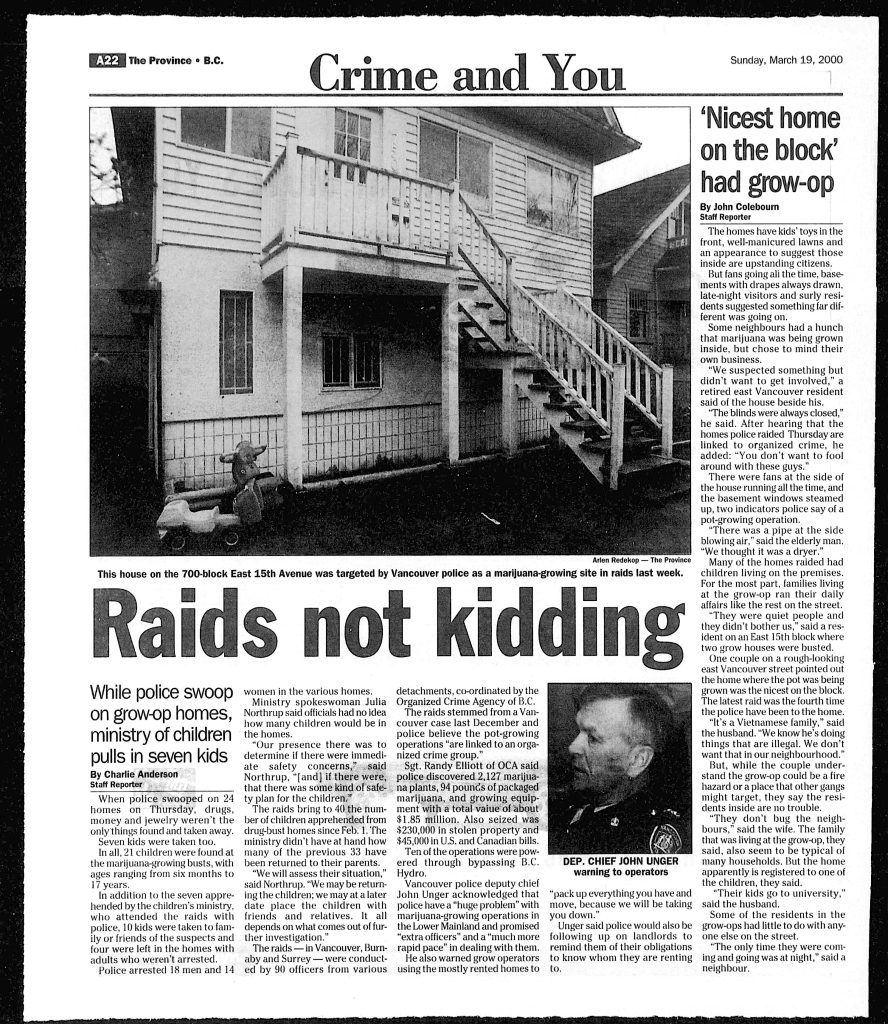
Image #16: “Raids not kidding / ‘Nicest home on the block’ had grow-op,” The Province, Vancouver, British Columbia, March 19th, 2000, p. 22
 Image #17: “Some 5,000 crowd Diag for spring rite,” The Ann Arbor News, Ann Arbor, Michigan, April 2nd, 2000, p. B1
 Image #18: “Some 5,000 crowd Diag for spring rite,” The Ann Arbor News, Ann Arbor, Michigan, April 2nd, 2000, p. B4
By the year 2000, Vancouver cannabis activists had decided on having at least three events per year: the April 20th “420” rally, the Global Marijuana March (held on the first Saturday in May), and the July 1st “Cannabis Day” rally. The April 20th rally ended up being the biggest event, because it involved the most fun, involving the greatest number of entrepreneurs with cardboard signs (and then eventually tables and booths) offering a wide array of cannabis products for sale – and the young folks were just itching to celebrate the return of the warm weather. The April 20th event in the year 2000 involved massive paper-mache puppets (worn like 15-foot-tall backpacks) in the form of a police officer and a witch holding a bag of herbs. The flier for the events advertised “Prize for best sign, costume & plant!” The prizes and the free joint giveaway at 4:20 pm helped grow the size of the crowd big enough to attract and protect pot dealers. It was the pot dealers who ended up being the most powerful attraction and crowd size expander in the 2010-2019 era of Vancouver smoke-ins.
 Image #19: The big witch puppet suit, holding her bag of herbs. Vancouver Art Gallery, Vancouver, B.C., April 20th, 2000. Photo from the Cannabis Culture archive.
 Image #20: The big cop and the big witch puppet suits – Uncle Scam seems to be giving instructions to the cop. Vancouver Art Gallery, Vancouver, B.C., April 20th, 2000. Photo from the Cannabis Culture archive.
 Image #21: Some contestants in the best sign contest. Vancouver Art Gallery, Vancouver, B.C., April 20th, 2000. Photo from the Cannabis Culture archive.
 Image #22: A contestant in the best plant and best sign contest. Vancouver Art Gallery, Vancouver, B.C., April 20th, 2000. Photo from the Cannabis Culture archive.
The poster/flier for all three rallies was combined into one, so that time and energy and money could be saved on promotion. The lettering for the rallies poster/flier was in a white font on a black background – with plenty of pot leaves scattered all over the poster – so it would be visible even if it was placed in high-up, hard to remove places such as lamp posts. This also aided in the growth of the rallies, which eventually aided in cannabis law reform in Canada – especially when the rallies got so large that the entire group could only be photographed with the aid of a helicopter, which happened just ten years later.
 Image #23: Poster advertising the April 20th (420), May 6th, (Global Marijuana March) and July 1st (Cannabis Day) pot rallies which all began at the Vancouver Art Gallery at 2PM. The poster was designed to be easy to read, even if posted up high on the pole (to make it harder to remove). David Malmo-Levine design, 2000.
On April 21st 2000, it was reported that Calgary pot activist and multiple sclerosis sufferer Grant Krieger pleaded guilty to two deliberate breach-of-probation charges, but argued he was “a political prisoner” and that he would “blatantly use marijuana” and that “he was defiant in his resolve to break the law.” The judge ignored a request by the Crown prosecutor to put him in jail, and instead ordered Krieger to pay $825 in fines by January 2001. (37)
 Image #24: “GRANT KRIEGER,” Marijuana crusader skips court, calls himself ‘political prisoner’,” Calgary Herald, Calgary, Alberta, April 21st, 2000, p. 23
 Image #25: “Canadian executed for drugs in Vietnam,” The Times-Transcript, Moncton, New Brunswick, April 27th, 2000, p. 49
 Image #26: “Canadian woman maintains innocence as she’s executed,” Saint John Times Globe, Saint John, New Brunswick, April 27, 2000, p. D2
In a two-part series on May 12th and 13th, the Vancouver Sun looked at the state of affairs of cannabis laws in BC. The first part, titled “BUST OR BACK OFF” and subtitled “CANNABIS: SHOULD BC FOLLOW THE U.S. APPROACH?” lawyer John Conroy got to give his side of the story:
“He looks at the police publicity initiative. They no longer say much bad about marijuana itself, he says, because the evidence is that it is safer than all the other drugs, including alcohol and tobacco. As well, the federal government has committed to investigating its possible medical applications. ‘You can’t kill yourself on the stuff. It’s one of those drugs that’s non-toxic. It’s a mild sedative, and that’s it.’” (38)
 Image #27: “BUST OR BACK OFF,” Vancouver Sun, Vancouver, British Columbia, May 12th, 2000, p. 1
 Image #28: “BUST OR BACK OFF,” Vancouver Sun, Vancouver, British Columbia, May 12th, 2000, p. 16
 Image #29: “BUST OR BACK OFF,” Vancouver Sun, Vancouver, British Columbia, May 12th, 2000, p. 17
Looking at the rest of the article, it’s true the police were not really focused on the harms of cannabis itself – just its illegality, its potency, the gateway theory, and the problems associated with (black market) grow operations and (black market) criminal organizations and the black market itself. Not a word from the police about “the developing minds of young people.”
Part two of the series, titled “TALES OF PROHIBITION,” the focus was on the “speakeasy” or “smokeasy” culture that had arisen in Vancouver, where private clubs where people could buy and smoke cannabis had sprung up over the last few years, along with an entirely new phenomenon: Marc Emery’s Pot TV:
“From the ground floor of his home, with $80,000 in computer gear and a dedicated staff of true believers, hipsters and techno-geeks, Pot-TV has just gone on-line with a 24-hour-a-day Internet Broadcast of marijuana news, views and music. There are still frequent technical glitches, but the agenda is crystal clear: the legalization of marijuana, a bit of fun, plenty of reefer music.” (39)
 Image #30: “B.C. not ready to join U.S. war on pot: poll,” Vancouver Sun, Vancouver, British Columbia, May 13th, 2000, p. 1
 Image #31: “B.C. not ready to join U.S. war on pot: poll,” Vancouver Sun, Vancouver, British Columbia, May 13th, 2000, p. 2
 Image #32: “TALES OF PROHIBITION,” Vancouver Sun, Vancouver, British Columbia, May 13th, 2000, p. 18
 Image #33: “TALES OF PROHIBITION,” Vancouver Sun, Vancouver, British Columbia, May 13th, 2000, p. 19
The construction of Pot TV began on January 1st, 2000. (40) According to Pot TV’s former managing editor, Sri Anil Sthankiya, the station is “the first online streaming video network in the world” and the “oldest, longest running source of cannabis video in the world.” (41) With 51.2K subscribers on YouTube, it’s arguably one of the best platforms on the internet for the most controversial cannabis information to reach the largest audience possible.
Also in part two of the Sun’s report was more coverage of Hilary Black and the BC Compassion Club. The reporter pointed out how Black got her start as an under-age activist/employee at Marc Emery’s Hemp BC, which she used to transform herself into an under-age pot dealer:
“She got her start working a summer job as a 17-year-old at Marc Emery’s former Hemp BC store. Sometimes the elderly or the sick would telephone or walk timidly into the Hastings Street site as though visiting a foreign planet. Tell me about marijuana, they would ask. The first person she gave pot to was an elderly woman, bed-ridden with arthritis, says Black. She went to the woman’s home and climbed onto the bed. They talked and shared a joint. Ten minutes later, the woman was able to get out of bed and make them tea. She was laughing and crying, and she thought this striking dark-haired teenager was some sort of angel. ‘For a 17- or 18-year-old girl, it was really, really inspiring to me . . . that there was something worthy I could do that wasn’t being done.’” (42)
Arguably, if Marc Emery had bought into the stigma-laden idea that teens should be kept away from pot, he would not have hired the 17-year-old Hilary Black, she would not have gone on to destigmatize medical cannabis and pioneer the entire Canadian med pot industry, and it would all probably still be illegal today, or at the very least, the industry would have had far less participation from – and would have been shaped with far less influence of – members of the general public. Teenagers not only gave the world the “420” culture, they gave average Canadians an opportunity to access to the legal cannabis economy.
 Image #34: Renee Boje and Hilary Black at the Compassion Club, circa 2000. Photo from the Cannabis Culture archive.
 Image #35: Bill Small (co-founder and grower for the Compassion Club) and Renee Boje, circa 2000. Photo from the Cannabis Culture archive.
 Image #36: Renee Boje on the Sunshine Coast, circa 2000. Photo from the Cannabis Culture archive.
 Image #37: Some of the first Pot TV hosts (and techs) at the PTV Studio (Marc Emery’s house) on the Sunshine Coast, circa 2000. Left to Right: Richard Cowan (NORML director 1992-1995), David Malmo-Levine, Geo, Greg Williams AKA Marijuana Man. Photo from the Cannabis Culture archives.
 Image #38: Some of the first Pot TV hosts (and guest) at the PTV Studio (Marc Emery’s house) on the Sunshine Coast, circa 2000. Left to Right: Dan Loehndorf, AKA Reverend Damuzi, Renee Boje, (Seattle Hempfest organizer) Vivian McPeak, Chris Bennett. Photo from the Cannabis Culture archives.
 Image #39: Dana Larsen holding Marijuana Party pamphlets in a Marijuana Party T-shirt, circa 2000. Photo from the Cannabis Culture archives.
On June 15th, the New York Times reported on Hawaii becoming the 8th U.S. State to “decriminalize the use of medical marijuana” – the first one to do so through a State-written bill rather than a ballot measure. (43)
 Image #40: “Peter McWilliams; Backed Medical Use of Marijuana,” The Los Angeles Times, Los Angeles, California, June 17th, 2000, p. B7
 Image #41: “Denied Marijuana, A Good Friend Died,” Omaha World-Herald, Omaha, Nebraska, June 22nd, 2000, p. 27
 Image #42: “Hawaii Oks medical marijuana possession,” The Burlington Free Press, Burlington, Vermont, June 26th, 2000, p. 20
July 1st, 2000 was a special “Cannabis Day” celebration at the Vancouver Art Gallery, because of the cardboard signs advertising cannabis sales – “BIG BAGS OF BUD!” – and because one of the musical acts performing that day: The Be Good Tanyas (who went on to be an international sensation, headlining the local Vancouver Folk Festival and providing music for various television programs including Weeds and Breaking Bad). (44)
 Image #43: Jill Fanthorp, compassion club co-founder, operating the big witch puppet suit. Cannabis Day, Vancouver Art Gallery, Vancouver, B.C., July 1st, 2000. Photo from the Cannabis Culture archive.
 Image #44: Jill Fanthorp and David Malmo-Levine. Cannabis Day, Vancouver Art Gallery, Vancouver, British Columbia, July 1st, 2000. Photo from the Cannabis Culture archive.
 Image #45: Marijuana Man, smoking marijuana (as usual). Cannabis Day, Vancouver Art Gallery, Vancouver, British Columbia, July 1st, 2000. Photo from the Cannabis Culture archive.
 Image #46: An early example of pot retail advertising at the Art Gallery. Cannabis Day, Vancouver Art Gallery, Vancouver, B.C., July 1st, 2000. Photo from the Cannabis Culture archive.
 Image #47: The folk music superstars The Be Good Tanyas in an early public appearance. From left to right: Jolie Holland, Frazey Ford, Samantha Parton, and Trish Klein. Cannabis Day, Vancouver Art Gallery, Vancouver, B.C., July 1st, 2000. Photo from the Cannabis Culture archive.
 Image #48: Some examples of signs, banners and flags. Cannabis Day, Vancouver Art Gallery, Vancouver, B.C., July 1st, 2000. Photo from the Cannabis Culture archive.
 Image #49: The Cannabis Culture-mobile, Grand Forks, BC, circa 2000. Photo from the Cannabis Culture archive.
 Image #50: The Cannabis Culture booth at some convention somewhere, probably in Europe. Dana Larsen, Barge and Tia are all hanging out selling mags and merch. Circa late 2000s or early 2001. Photo from the Tia archive.
 Image #51: “Busts headed for new record,” The Leader, Surrey, British Columbia, July 16th, 2000, p. 3
Having recently won a leave to appeal, this author went on a cross-country tour of Canada to promote his argument before the Supreme Court of Canada, and my stop in Saskatoon, Saskatchewan resulted in a bit of attention from the local media, which allowed me to present a truncated version of my argument to the public:
“Levine maintains marijuana is a harmless substance when used properly – and as such the law against it violates section 7 and 15 of the Constitution by unreasonably infringing on individual freedoms. . . . The appeal court judges dismissed it, but one of them gave a dissenting opinion, stating the inherent harm in using marijuana is not enough to warrant it being illegal. . . . Marijuana remains illegal because the powers that be are threatened by the idea of making it freely available, with production and distribution carried out by individuals and small groups rather than large corporations, he said.” (45)
 Image #52: “‘Cannabis consultants’ crusade reaches Saskatoon,” The StarPhoenix, Saskatoon, Saskatchewan, July 29th, 2000, p. 10
Then, suddenly, on July 31st, the Canadian courts struck the first of many blows against the prohibition of cannabis, in the R. v. Parker decision, (46) which involved medical necessity;
“In a ruling that takes a step toward legalizing marijuana, a judge struck down the federal government’s anti-possession law yesterday for Canadians who smoke pot to ease the pain of serious illness. Justice Marc Rosenberg of the Ontario Court of Appeal, declaring the law violates the rights of sick people by forcing them to choose between ‘health and imprisonment,’ gave Ottawa one year to rewrite its legislation. The ruling was a victory for Terry Parker, a 44-year-old Toronto man who smokes three to four joints a day to control severe epilepsy that even brain surgery and more than 100 hospital stays did not ease.” (47)
 Image #53: “Terry Parker (right) who smokes marijuana to eliminate his epileptic seizures, stands to the side as media scrum his lawyers outside Osgoode Hall in Toronto yesterday, after he won in Ontario’s highest court.” “Pot law struck down in Ontario,” The Gazette, Montreal, Quebec, August 1st, 2000, p. 9
 Image #54: “6 Game Changing Moments in Cannabis History that Every Canadian Should Know,” https://ocs.ca/blogs/shopping-for-legal-cannabis/6-game-changing-moments-in-cannabis-history-that-every-canadian-should-know
 Image #55: “GIMME SHELTER – THE RENEE BOJEE STORY,” HEADS MAGAZINE #1, Aug/Sept 2000, p. 8
 Image #56: Photo of David Mariposa-Levine, Darpan van Kuik and Rielle Catpler at the Canna Embassy in Den Hague, Netherlands, during the summer of 2000.
 Image #57: Some really good shit grown on the balcony of the Canna Embassy in Den Hague, Netherlands. The Canna Embassy photo collection can be viewed here: https://www.icmag.com/threads/the-canna-embassy-organic-homegrowers-thread.20407/
 Image #58: A typical year’s garden at the Canna Embassy in Den Hague, Netherlands. The Canna Embassy photo collection can be viewed here: https://www.icmag.com/threads/the-canna-embassy-organic-homegrowers-thread.20407/
 Image #59: David Malmo-Levine in front of the pot activist headquarters in Christiania, Copenhagen, during the Summer of 2000. Photo by Rielle Capler.
A month later, on August 31st, 2000, med pot activists in California were dealing with a belligerent Clinton administration, and (mostly) heartless courts:
“An Oakland medical marijuana club, barred by the U.S. Supreme Court from dispensing pot to sick people, says the legal setback is merely a ‘bump in the road’ and that the true test lies ahead when a lower court reviews the case more closely. The court voted 7-1 Tuesday to grant an emergency Clinton administration request and postpone the federal court rulings that would have allowed the Oakland Cannabis Buyer’s Cooperative to distribute the illegal drug for medicinal use.” (48)
 Image #60: “Pot club: Court setback just a ‘bump in the road’,” The Desert Sun, Palm Springs, California, August 31st, 2000, p. 4
The road to pot policy reform went on to get even more bumpy. On May 14th 2001, the decision in United States v. Oakland Cannabis Buyers’ Cooperative 532 U.S. 483 was handed down. The US Supreme Court rejected the common-law medical necessity defense to crimes enacted under the federal Controlled Substances Act of 1970, regardless of their legal status under the laws of states such as California that recognize a medical use for marijuana. (49)
The US Court system wasn’t entirely heartless. In the case of Conant v. McCaffrey, decided September 7th, 2000, the US District Court for the Northern District of California recognized a Dr.’s right to recommend cannabis as a medicine:
“The government’s interpretation of the registration-revocation provision of the Controlled Substances Act exceeds the statute’s authority. The government is permanently ENJOINED from (i) revoking a class-member physician’s DEA registration merely because the doctor recommends medical marijuana to a patient based on a sincere medical judgment and (ii) from initiating any investigation solely on that ground. This injunction applies whether or not the physician anticipates that the recommendation will, in turn, be used by the patient to obtain marijuana in violation of federal law.” (50)
 Image #61: “DON WIRTSHAFTER KICKED OFF NORML BOARD,” Cannabis Culture, Sept/Oct 2000, p. 32
 Image #62: “DON WIRTSHAFTER KICKED OFF NORML BOARD,” Cannabis Culture, Sept/Oct 2000, p. 33
Back in Vancouver, the Stranjahs In Da Night cannabis cabaret starring “Marijuana Monroe” (AKA Watermelon AKA Mary Jean Dunsdon) and “Neil Dimebag” brought together a reefer-friendly atmosphere, pot-themed comedy, and heroic doses of cannabis-infused gourmet meals. The parties – organized by “DJ Girl” (AKA Cherise Mitchell) had been happening for a year or two, but September 2000 was the first time they advertised in the local paper. (51)
Just north of Vancouver, in a small coastal village called Robert’s Creek, reefer refugee Renee Boje gave an interview to reporter Dan Gardner in October that was given a considerable amount of space in the Ottawa Citizen. “FLOWER CHILD OR FELON?” was the caption above the headshot of Boje. Gardner ended the article with his evaluation:
“In Robert’s Creek, she has found a place where the universe is indeed taking care of her. In this community, artists and environmentalists abound – ‘lots of women in peasant skirts,’ she says. If she wins, she says she’d like to build ‘a collective healing community.’ It would be ‘a place to go for healing in nature. That’s my ultimate dream.’ Spoken like a true flower child.” (52)
 Image #63: “American faces 10 years in jail for tending plants,” Ottawa Citizen, Ottawa, Ontario, October 7th, 2000, p. 1
 Image #64: “American faces 10 years in jail for tending plants,” Ottawa Citizen, Ottawa, Ontario, October 7th, 2000, p. 12
 Image #65: “Kubbys’ lawyer: Pot garden legal,” Sacramento Bee, Sacramento, California, November 1st, 2000, p. 23
Then in November, the Nanaimo Daily News reported on Pot-TV, and the frustration felt by the police in their impotent response to Pot-TV;
“‘It’s supposed to be against the law to possess or distribute information that helps people to use drugs, but when the law was made we certainly didn’t know Web sites existed yet,’ said Sgt. Chuck Doucette of the RCMP drug awareness section in Vancouver.” (53)
 Image #66: “Bud-friendly B.C. shows Pot-TV,” Nanaimo Daily News, Nanaimo, British Columbia, November 6th, 2000, p. 4
The irony of a “drug awareness section” Mountie decrying a website devoted to raising awareness about drugs is not lost on this author. He really should have been working in the “drug ignorance section” instead.
 Image #67: Hilary Black, at the Cannabis Cup in Amsterdam. Don Wirtshafter can be seen in the background. November 2000. Photo by Marcus Bubble man Richardson. Photo from https://x.com/MzBlack/status/954068387528765440/photo/1
 Image #68: “Marijuana’s medical uses will get review from high court,” Journal and Courier, Lafayette, Indiana, November 28th, 2000, p. 3
This author came back from his cross-Canada tour just in time to run as a Marijuana Party candidate in the riding of Vancouver East in the 2000 Canadian federal election, where he placed 6th out of 10 candidates, with a whopping 718 votes. The winner, Member of Parliament Libby Davies of the New Democratic Party, won with 15,058 votes. (54) The Marijuana Party ran 73 candidates in that election. (55)
On December 12th, 2000, The Regina Leader-Post reported on med-pot activist Grant Krieger getting some good news from the courts. The laws against cultivation of marijuana were viewed as unconstitutional – at least for those who had a medical necessity argument;
“A law that prohibits the cultivation of marijuana is unconstitutional because it doesn’t allow for medical use of the drug, an Alberta judge ruled Monday. Justice Darlene Acton threw out a charge of cultivating marijuana against Grant Krieger, who grows and ingests pot to alleviate the symptoms of his multiple sclerosis.” (56)
According to the article, the Government had exempted “more than 70 ill Canadians” from the pot laws, up from the 20 exemptions allotted in January of 2000 when Wakeford won the right to smoke it. Like the Parker decision, the judge gave the government one year to re-write the legislation, to make it “constitutional” again. Many pot activists felt this was too much concern over having some type of law in place against “non-medicinal” cannabis cultivation, and not enough concern about getting rid of laws that were unconstitutional. If a law is unconstitutional, shouldn’t it be tossed the moment it is found to be so? The court did not bother to attempt to prove that having no law at all would be more harmful than another year with a bad law.
On December 28th 2000, Rolling Stone magazine did an interview with outgoing president Bill Clinton. Clinton made a comment in support of decriminalizing marijuana, perhaps to make up for not bothering to decriminalize marijuana nationally himself while he was in power and could have actually done so:
“I think that most small amounts of marijuana have been decriminalized in some places, and should be.” (57)
It’s understandable why Clinton didn’t lift a finger in any kind of drug law reform capacity while president – he was, after all, a member of the Bush crime family, and profited from the traffic in illegal drugs himself. (58) In fact, Clinton had entrenched the drug war more than it ever had been before with a draconian crime bill (which he signed back in 1994), which included an amendment allowing the death penalty for growing 60,000 pot plants . . . or hemp plants. (59)
In 2001, the US National Academies of Sciences Engineering and Medicine – founded in 1863 – released their report, Marijuana As Medicine? The Science Beyond the Controversy. The report questioned the existence of cannabis psychosis as a long-term side effect of cannabis use:
“A major question remains as to whether marijuana can produce severe and lasting psychotic disorders. There are clinical reports of marijuana-induced states that resemble psychoses such as schizophrenia, depression, and mania, with symptoms that last a week or more. Some researchers have argued that the diversity of these symptoms belies the existence of a specific ‘marijuana psychosis.’ Others have concluded that heavy marijuana use— and perhaps even acute use in especially sensitive people—can produce a psychosis characterized by a suite of symptoms such as confusion, amnesia, delusions, hallucinations, anxiety, and agitation. Regardless of which of these interpretations is correct, both camps agree that marijuana use alone—without the influence of additional risk factors—is unlikely to provoke a psychosis that persists longer than intoxication.” (60)
 Image #69: MARIJUANA AS MEDICINE? THE SCIENCE BEYOND THE CONTROVERSY, ALISON MACK & JANET JOY, National Academies Sciences Engineering Medicine, 2001 https://nap.nationalacademies.org/catalog/9586/marijuana-as-medicine-the-science-beyond-the-controversy
On January 7th 2001, a lawyer from Ontario got an op-ed in the Vancouver Province. Lamenting the lack of progress with recreational cannabis charter challenges (specifically in the Clay and Malmo-Levine cases) in spite of progress with the medical cannabis challenges, the lawyer, Karen Selick, cut to the heart of the matter;
“According to Canada’s top court: ‘In a free and democratic society, the individual must be left room for personal autonomy and to make decisions that are of fundamental personal importance.’ . . . Not much can be expected from jurists whose mindset is that the constitution guarantees us liberty for those rare, momentous decisions in our lives, but not for the day-to-day stuff. Does this mean that if the state decides to dictate what time we rise in the morning, the colour of our clothing, how many times we must chew our food and how often we clip our toenails, we’re still living in a free country? How many trivial violations of liberty can they heap on us before we’re forced to admit that this is stifling authoritarianism, not freedom? Besides, what’s the logic of having different rules for decisions of fundamental importance and those of trivial importance? If citizens are so stupid or irresponsible that we can’t handle the little stuff without direction from the state, where will we suddenly acquire the wisdom and character to handle the big stuff? Both courts tried to do a balancing act, weighing the harms to the recreational pot user of keeping marijuana illegal against the harm to ‘society’ of legalizing it. But they omitted something from the equation: The harm a society suffers when its members become so used to having the minutiae of their lives governed for them that they consider it right and normal.” (61)
Most nations don’t even trust their citizens with “the big stuff.” Autonomy needs more champions.
On February 12th, the Honolulu Star-Bulletin did a story about how difficult it was for Hawaiian doctors to trust the federal government not to screw them over for engaging in the state med pot program;
“Patients wanting to use medical marijuana aren’t knocking any doors down to apply under the law passed by last year’s Legislature. Only 27 people statewide have registered to use marijuana for medical purposes since the program began operating Dec. 28, said Keith Kamita, head of the Narcotics Enforcement Division, state Department of Public Safety. . . . ‘There is a lot of nervousness,’ says Pamela Lichty, board president, American Civil Liberties Union of Hawaii Foundation. ‘Paranoia’ might not be too strong a word.’ . . . Physicians are reluctant to participate because they are unclear about the relationship between federal and state laws, she said. ‘And the Hawaii Medical Association has not encouraged their participation or educated its membership.’” (62)
 Image #70: “Fear stymies demand for medical marijuana,” Honolulu Star-Bulletin, Honolulu, Hawaii, February 12th, 2001, p. 1
In Chicago, a struggle of a different type was happening. Instead of facing off against a prohibitionist federal government or an anti-pot medical association, activists were pitted against a municipal government that was looking for excuses to prevent a pot parade, and a court system only too willing to help block such assemblies:
“A federal appeals court Monday reversed a district judge’s decision that the City of Chicago ordinance regulating parades was an unconstitutional prior restraint of speech. In a 2-1 decision, a panel of the 7th Circuit U.S. Court of Appeals found the ordinance wasn’t ‘a form of censorship’ and properly allowed the city to restrict parades based on valid concerns about time, place and manner. Robert MacDonald, a vocal advocate of the legalization of marijuana, had filed federal lawsuits in 1997 and 1998 after the city twice denied him permits to parade through the Loop and along Michigan Avenue. Both times, the city Department of Transportation commissioner cited concerns that the parade would interfere with traffic and block the flow of emergency vehicles. It also said there weren’t enough police officers to protect participants.” (63)
The case would end up at the U.S. Supreme Court the next year. Thomas v. Chicago Park District (2002) created a new standard for preventing free assemblies and parades – the government only needed to pretend they were engaged in “content-neutral time, place and manner regulations” if they wanted to shut down such expression. (64)
As Thomas v. Chicago Park District wound its way through the U.S. courts, the Supreme Court of Canada agreed to hear Clay, Caine and Malmo-Levine all at the same time. (65) Actually, “agreed” is not entirely accurate, as there was a dissenting opinion in Caine and Malmo-Levine (they were bundled in the court below), and – in the Canadian court system – when you have a dissenting opinion combined with an indictable offence (the trafficking charge in Malmo-Levine), it means the Supremes must hear the appeal.
On March 20th, Lawyer Karen Selick put out a new version of her earlier pro-autonomy op-ed, this one in the National Post, mentioning the Supreme Court challenges were going to be heard, but she mis-characterized the cases as all being about simple possession. (66) Caine was simple possession. But Clay was about selling cannabis clones. And Malmo-Levine was about trafficking dried buds.
 Image #71: David Malmo-Levine, Marijuana Advocate, CBC news, circa early 2001.
 Image #72: “HEMP: a lost cause in Oregon?” Capital Press, Salem, Oregon, March 23rd, 2001, p. 18e/82
On March 24th 2001, the BC Marijuana Party rose out of the ashes of Hemp BC, situating its headquarters in the exact same location that Hemp BC used to reside in – 307 West Hastings. Marc Emery gambled that a political party would be more difficult to raid than a hemp store. At the very least the optics would be worse. And, while the political party H.Q. approach did not result in a total end to the raids and harassment, it did indeed result in enough of a buffer to allow pot activists to use the space – in some incarnation or another – for the next 25 years (and counting). The gamble paid off.
 Image #73: BCMP grand opening announcement, Vancouver Sun, March 23rd, 2001, p. 13
 Image #74: Marc Emery with a Marijuana Party lawn sign, standing in front of the 307 W. Hastings BC Marijuana Party headquarters, with BC Marijuana party T-shirts in the window Display. Circa March 2001. Photo from the Cannabis Culture archives.
 Image #75: Scotty wearing a Cannabis Culture T-shirt at the BC Marijuana Party Headquarters, circa March 2001. Photo from the Tia archive.
 Image #76: Don Briere standing in front of the BC Marijuana Party bus. Circa 2001. Photo from the Cannabis Culture archive.
 Image #77: “Marijuana not a one-issue party anymore,” Times Colonist, Victoria, British Columbia, May 4th, 2001, p. 2
The headquarters also contained the Pot TV studio – recently relocated from Marc Emery’s basement on the sunshine coast. The BCMP HQ and PTV studio “grand opening” was announced in a full-page ad in the March 23rd Vancouver Sun. The BCMP party platform included
“. . . legitimizing BC’s cannabis industry, ending the drug war, legalizing prostitution, opposing US cops and nuclear weapons in BC, introducing ballot initiatives and proportional representation . . .” (67)
While Vancouver pot activists were busy promoting a progressive platform, Californian pot activists were busy being divided and conquered by a press determined to promote the idea that recreational cannabis use had nothing whatsoever to do with medicine. In an article about the U.S. Supreme Court hearing the case of “six Northern California clubs – in Oakland, San Francisco, Santa Cruz, Marin County and Ukiah,” the “all use is medical” philosophy of Dennis Peron was dismissed without reason:
“‘Dennis Peron’s major error was that he wanted all uses of marijuana to be medical,’ said Jones. ‘He wanted it to be similar to all other over-the-counter remedies, or similar to St. John’s wort.’” (68)
Again and again, critics of the “recreation is a form of medicine” argument will compare apples with oranges – cannabis with a non-psychoactive herb like St. John’s wort – so they can avoid comparing apples with apples – cannabis with a psychoactive (and ubiquitous) herb like coffee beans. All stimulants, relaxants, anti-depressants and euphorics are medicines when used properly – they treat stress, depression, fatigue, loss of appetite and/or lack of sleep/motivation/focus. The category of “non-medicinal drug” was invented to delegitimize some drug users, in order to justify persecuting them and discriminating against them. It is still used for that purpose today.
 Image #78: “Medical help: Dan Coates, a UC-Berkeley student, smokes marijuana from a bong to control his seizures. On Wednesday, attorneys will face off before the U.S. Supreme Court, trying to reconcile a federal law that deems marijuana illegal with a California law that allows it for sick people. The justices have stepped into a three-year court battle between Northern California clubs, in Oakland, San Francisco, Santa Cruz, Marin County and Ukiah, and the U.S. Department of Justice.” “Supreme Court to hear medical marijuana law,” The San Francisco Examiner, San Francisco, California, March 27th, 2001, p. 4
On March 28th 2001, the San Francisco Examiner reported on the trial of Kenneth E. Hayes – a grower for CHAMP – “Californians Helping Alleviate Medical Problems” – one of the med pot clubs in the Castro (the queer district in San Francisco). Testifying for Hayes was San Francisco District Attorney Terence Hallinan, who argued that, while Prop. 215 only applied to individual patients and their caregivers, “individual patients could elect the club as their caregiver.” (69)
A March 30th op-ed in the Honolulu Star-Bulletin by Pamela G. Lichty, president of the ACLU of Hawaii, pointed out the subterfuge committed by the Hawaii Medical Association, which not only refused to inform their members of a court case which protected a doctor’s right to recommend cannabis, but lied about the NIH studying alternative delivery systems for cannabinoids:
“In addition, HWA President Phillip Hellreich’s assertion in a February Star-Bulletin story that the National Institute of Health is studying alternative delivery systems is wrong: No studies of this sort are under way in the United States.” (70)
 Image #79: “Sinclair remains popular,” The Ann Arbor News, Ann Arbor, Michigan, April 8th, 2001, p. B1
 Image #80: “Sinclair remains popular,” The Ann Arbor News, Ann Arbor, Michigan, April 8th, 2001, p. B2
 Image #81: “Annual Hash Bash attracts 6,000 attendees,” The Daily Illini, Urbana, Illinois, April 10th, 2001, p. 2
 Image #82: The Carnival Band performs at 420 at the Art Gallery in Vancouver, B.C., on April 20th, 2001. The Carnival Band became the house band of the Vancouver pot rallies early on, because they swung, they got the crowd dancing, they drew more people in, they were affordable and – importantly – required no additional amplification. Photo Courtesy of Cannabis Culture.
 Image #83: Contestants prepare for the best sign and best plant contests, Vancouver Art Gallery, Vancouver, B.C., April 20th, 2001. Photo courtesy of Cannabis Culture.
 Image #84: The big black banner reads “COMMUNITY NEEDS, NOT CORPORATE GREED”. Contestants prepare for the best sign and best plant contests, Vancouver Art Gallery, Vancouver, B.C., April 20th, 2001. Photo courtesy of Cannabis Culture.
 Image #85: Balloon tokes at 420 at the Art Gallery in Vancouver, B.C., on April 20th, 2001. Photo Courtesy of Cannabis Culture.
On May 15th, 2001, the Indiana Gazette reported on the recent U.S. Supreme Court ruling that argued federal anti-pot laws over-ride medical necessity arguments. In an absurd ruling that the reporter provided without question or comment, it was reported that
“Writing for the court, Justice Clarence Thomas said the Controlled Substances Act of 1970 ‘reflects a determination that marijuana has no medical benefits worth of an exception.’ The only exemption is for government-funded research projects that involve some 200 people.” (71)
In other words: “There is no such thing as med pot – ignore your own personal experiences and the experiences of those around you. Also ignore the government-funded research project involving hundreds of people. Do as we say, not as we do.” Activists didn’t buy it.
 Image #86: “Craig Harshbarger, who has Tourettes syndrome and asthma, said he would have to take 30 different medications if he weren’t allowed to smoke marijuana.” “Patients fear they’ll be forced to return to streets for ‘pot’,” Indiana Gazette, Indiana, Pennsylvania, May 15th, 2001, p. 9
 Image #87: “High court rejects medical marijuana,” The Fresno Bee, Fresno, California, May 15th, 2001, p. 1
 Image #88: “High court rejects medical marijuana,” The Fresno Bee, Fresno, California, May 15th, 2001, p. 14
 Image #89: David Malmo-Levine, running as a Marijuana Party candidate in Vancouver Mount Pleasant in the 2001 BC Provincial Election, speaking at an all-candidates forum on Shaw Cable Television, circa May 2001. “Malmo-Levine 2001” https://www.youtube.com/watch?v=1V-P00sfcSs
 Image #90: “RIDING BY RIDING RESULTS AROUND THE PROVINCE,” Times Colonist, Victoria, British Columbia, May 17th, 2001, p. 9
On May 29th 2001, the Nanaimo Daily News reported that “the Canadian Police Association has come out strongly against easing marijuana laws” arguing;
“As legalization and permissiveness will increase drug use and abuse substantially, the costs of health care, prevention, productivity loss and enforcement will increase proportionately . . .” (72)
Of course, none of this turned out to be true. According to Dr. Larry Wolk – the Chief Medical Officer in Colorado – (in the three years after legalization in that state began) “We haven’t experienced any significant issues as a result of legalization.” No increase in use. No increase in impaired driving. No increase in hard drug deaths relative to jurisdictions that did not legalize cannabis. (73)
On May 31st, the Honolulu Star-Bulletin reported on a two-day conference called “Marijuana in 2001: Medical and Social Issues.” The event was sponsored by the John A. Burns School of Medicine. Dr. Lester Grinspoon, a key speaker at the conference, was asked by an intrepid reporter who, exactly it was that was pushing to keep marijuana illegal, Grinspoon replied
“. . . he could not answer that. But if it is legalized, he pointed out, ‘conventional drug companies are going to lose.’” (74)
There has been some evidence that this is true. There have been multiple studies done indicating that opioid use – and opioid mortality – has decreased in states that have legalized cannabis for medicinal use. (75) On the second day of the conference, Grinspoon doubled-down on his “pot is superior to pills” argument, stating;
“. . . ‘whole smoked cannabis’ is more effective than a pharmaceutical version of it. He said he has never had a patient who prefers the synthetic Marinol to marijuana. Commercial products also will be more expensive than natural marijuana, he said. In the end, he said, commercial success will depend how vigorously the prohibition against marijuana is enforced.” (76)
In June of 2001, Professor Lyle Craker – a Professor in the Department of Plant, Soil and Insect Sciences at the University of Massachusetts Amherst – applied for a license from the DEA to establish a marijuana production facility for FDA-approved research. Later that year, the DEA claimed the application was lost. Then the DEA rejected a resubmitted photocopy because it didn’t have an original signature. Thus began a rigmarole of the absurd that, after 12 years & dozens of elected representatives pledging support & multiple court appearances & a successful court decision later, the DEA still wouldn’t grant permission for Professor Craker to grow cannabis for medical research, arguably because the DEA didn’t want any researchers to utilize quality cannabis – just the shwag from the University of Mississippi. (77)
In the June 9th 2001 Vancouver Sun, in a story attached to a story about how British Columbia “stands to gain from medical marijuana,” the press began reporting on what would become the Marihuana Medical Access Regulations, or MMAR. The article described the process by which they came into existence:
“On July 31st last year, the Ontario Court of Appeal ruled Canada’s marijuana laws were unconstitutional. The court ruled that the exemption process under the Controlled Drugs and Substances Act – Section 56 – gave the minister of health too much discretion. The court gave Ottawa until July 31to remedy the situation. The federal government did not appeal. Instead, Health Minister Allan Rock drafted new regulations for the use of marijuana for medical purposes. Under the proposed regulations that could become law by August, three categories of people can possess the drug: * Those with terminal illnesses who are expected to die within one year. *Those with symptoms associated with serious medical conditions. *Those suffering from symptoms relieved by smoking pot.” (78)
As expected, the possibility that cannabis could be used as a preventive medicine – to keep healthy people healthy – did not occur to Allan Rock . . . or more likely, was not mentioned as a possibility in order to allow the police to keep at least some of their targets. The MMAR was introduced by the Chrétien government on June 14th, 2001. Neither mental illness nor psychosis was mentioned as a concern by anyone involved. (79)
 Image #91: “Majority in B.C. favour legalizing pot,” The Province, Vancouver, British Columbia, June 25th, 2001, p. 1
 Image #92: “China: 18 executed as drug traffickers,” The Florida Times-Union, Jacksonville, Florida, June 26th, 2001, p. 14
 Image #93: “60 executed for drug crimes,” The Times Leader, Wilkes-Barre, Pennsylvania, June 27th, 2001, p. 2
 Image #94: David Malmo-Levine (this author) hands out joints at the 2001 Cannabis Day rally. The sign behind me – left over from the Harm Reduction Club days – says “DEALERS ARE PEOPLE TOO – I AM NOT A CRIMINAL.” Coincidentally, my shirt says “I’M NOT A CRIMINAL” too. Cosmic. Vancouver Art Gallery, Vancouver, B.C., July 1st, 2001. Photos courtesy of Cannabis Culture.
 Image #95: Dana Larsen stands behind Uncle Scam and speaks to the crowd at Cannabis Day at the Art Gallery in Vancouver, B.C., on July 1st, 2001. Photo Courtesy of Cannabis Culture.
 Image #96: Chris Bennett videotapes Marc Emery while Dana Larsen looks on at Cannabis Day at the Art Gallery in Vancouver, B.C., on July 1st, 2001. Photo Courtesy of Cannabis Culture.
 Image #97: The Cannabis Culture tent at the pot rallies. Pictured are Tia and Scotty, flipping the merch. Cannabis Day at the Art Gallery in Vancouver, B.C., on July 1st, 2001. Photo Courtesy of the Tia archive.
 Image #98: Renee Boje, pot fairy, posing for Cannabis Culture magazine. From the Renee Boje archive.
 Image #99: “DESTINY’S CHILD – Who are the real criminals of the Drug War? A beautiful, spirited woman named Renee Boje? Or the US government that wants her behind bars?” High Times, July, 2001, p. 12
 Image #100: “DESTINY’S CHILD – Who are the real criminals of the Drug War? A beautiful, spirited woman named Renee Boje? Or the US government that wants her behind bars?” High Times, July, 2001, p. 13
On July 12th, the front cover of the Vancouver Sun carried the following horrific headline: “Get ready to dispense pot, Canada’s pharmacists told.” This author recalls reading the body of the story with trepidation, and then heaving a great big sigh of relief, when it was revealed that the person doing the “telling” was just another greedy pharmacist, and not a judge or an elected representative:
“Pharmacists across Canada should be preparing to dispense medicinal marijuana, learning what information to give users about proper doses, side effects and potential interactions, a pharmacist at the B.C. Cancer agency is advising professional colleagues. Robin O’Brien, who also teaches pharmacy students at the University of B.C., said she’s not necessarily an advocate of medicinal marijuana, just a pragmatist who believes that since the federal government is now sanctioning marijuana use for certain ill people, it should hand over the dispensing duties to professionals who can give patients ‘expert counselling’.” (80)
It should go without saying that, if Canada’s pharmacists don’t already know about cannabis and aren’t in the habit of advising anyone regarding its proper use, then they can hardly call themselves “experts” – especially if by that time ordinary laypeople had been giving such advice to each other unofficially for decades, and in a med pot club setting for years.
Rather than this statement from Robin O’Brien being seen as a genuine concern for the best interests of the users of medicine, this statement should be viewed as an early attempt at a distribution monopoly for a reemerging herbal medicine market. This notion of a pot monopoly was not lost on activist Hilary Black, who was asked her opinion of the pharmacist’s plan:
“No one should have the monopoly on distribution and we want to protect the right of people to access the whole plant and pharmacies won’t be selling that.” (81)
The reporter ended the article by quoting O’Brien attempting to associate cannabis smoking with lung cancer – providing the type of myth that would justify the pharmaceuticalization of cannabis into a sublingual product rather than using the smoked whole plant medicine – as one would expect a pharmacist hell-bent on stealing a market away from herbalists and laypeople might try to do.
On July 22nd, a feature article in the Edmonton Journal titled “B.C.’s cash crop” attempted to confuse marijuana-related problems with prohibition-related problems, especially in the caption above the photo:
“Marijuana adds billions to British Columbia’s bottom line, but it can also breed violence, deter post-secondary education and make some small towns economically dependent on it” (82)
Hidden deep within the body of the text was an expert’s proviso – it wasn’t the marijuana that was doing these bad things – it was the prohibition:
“But Wexler stresses the problem is not marijuana per se, but the nature of any industry that is forced underground. ‘Can marijuana be made legal and most of these problems go away?’ asked Wexler. ‘Yes.’ But police aren’t so sure. Since most of the pot produced in B.C. is for export, even if it were legalized in Canada, there would still need to be an illegal element in the trade to smuggle marijuana into the U.S., Doucette said.” (83)
The question arises: if growing, selling and using cannabis is ethical, what makes smuggling it unethical? Is obedience more important than facilitating medical autonomy? Just how important is it to keep herbs from crossing international boundaries? Canada’s opposition to – and Canada’s facilitation of resistance to – slavery and the Vietnam war were both seen as of greater importance to Canada than respect for the ability of the U.S. to control its people and its border. Why is this situation any different? The Devil’s Dictionary provides some insight, with its entry for “boundary:”
“BOUNDARY, n. In political geography, an imaginary line between two nations, separating the imaginary rights of one from the imaginary rights of the other.” (84)
The absurdity of the extreme measures taken to justify a cannabis monopoly were made apparent in an article in the July 30th Vancouver Province, where it was reported that the Flin Flon Prarie Plant Systems low-grade medical marijuana – measuring 5 to 6 percent THC – was going to have a level 7 security classification – “three grades higher” than the Biosafety level 4 “lab in Winnipeg that handles lethal diseases such as the Ebola virus.” (85)
The Canadian pot monopoly began like this: “Do you have a level 7 security compound? No? Well then, you obviously can’t grow medical marijuana.”
As best as this author can determine, it was a full year and eight months into the new millennium before the topic of cannabis psychosis came up in the press. Sure, there were two mentions of “marijuana psychosis” in the year 2000 – one arising from speculation about a motive in an assault trial, (86) the other arising from speculation about a mysterious drug overdose death. (87)
But the first post-millennial mention in the press of cannabis psychosis as a condition mentioned by an actual doctor that this author could find was on August 1st, 2001, when an op-ed by a British Conservative ex-MP and medical doctor – Dr. Thomas Stuttaford – was published in the Edmonton Journal. Dr. Stuttaford stated;
“The ability of cannabis to change the slightly bizarre behaviour of a young person carrying a genetic disposition to schizophrenia, from that described as being characteristic of a schizotypal personality disorder, to the disordered thought and behavioural pattern of someone with a frank psychosis is now accepted. The ability of cannabis to cause other psychotic and neurotic conditions, as well as precipitating schizophrenia, is well documented. Likewise, its deleterious effect on short-term memory, with all its attendant disadvantages, is well known. . . . In Holmberg’s study 10 per cent of the regular cannabis smokers at the age of 16 were recognized as suffering from a psychosis during the ten-year follow-up period. Much of the excess mortality in young cannabis-takers occurred among the psychotic patients who obviously were prone to suicide and accidental death.” (88)
Considering neither Dr. Stuttaford nor the Holmberg study he cited took into account cannabis prohibition – not cannabis per se – could have been responsible for the negative effects cannabis was blamed for, and considering as well that, in the same article, Dr. Stuttaford also mentioned side effects of cannabis which either have evidence to the contrary or are no longer viewed as being based in reality by most researchers (road accidents, cancer, male breast enlargement, impotence, birth defects), and considering too the fact that this particular doctor was exposed as a fraud and a pep-pill pushing huckster in The Guardian just seven years later, (89) we can take his assertions with a grain of salt.
Also in the August 1st Edmonton Journal, in an editorial titled “Marijuana caution is justified,” the editors wrote
“Scientific studies on medical use of the drug are few, and inconclusive.” (90)
If by “scientific”, the editors meant safety and efficacy tests that cost hundreds of millions of dollars, then they might have a point. But if by “scientific” they meant the same “science” that was behind the approval of the standard medicines used in medicine today, they would be mistaken. As Dr. Lester Grinspoon wrote in the revised and expanded edition of Marihuana: The Forbidden Medicine:
“It is often objected, especially by federal authorities, that the medical usefulness of marihuana has not been demonstrated by controlled studies. . . . medicine has always been concerned with mainly with the needs of individual patients. Idiosyncratic therapeutic responses to a drug can be obscured in group experiments, where there is often little effort to identify the features of patients that affect responses. Today drugs must undergo rigorous, expensive, and time-consuming tests to win approval by the Food and Drug Administration for marketing as medicines. The purpose of the testing is to protect the consumer by establishing both safety and efficacy. Because no drug is completely safe (nontoxic) or always efficacious, a drug approved by the FDA has presumably satisfied a risk-benefit analysis. . . . But it is doubtful whether FDA rules should apply to marihuana. First, as we will show more fully in the next chapter, there is no question about its safety. It has been used for thousands of years by millions of people with very little evidence of significant toxicity. Similarly, no double-blind studies are needed to prove marihuana’s efficacy. Any astute clinician who has experience with patients like those described in this book knows that it is efficacious to some degree for many people with various symptoms and syndromes. . . . Physicians also have available evidence of a different kind, whose value is often underestimated. Anecdotal evidence commands much less attention than it once did, yet it is the source of much of our knowledge of synthetic medicines as well as plant derivatives. As Louis Lesagna, M.D., has pointed out, controlled experiments were not needed to recognize the therapeutic potential of chloral hydrate, barbiturates, aspirin, curare, insulin, or penicillin. He asks why regulators are now willing to accept the experiences of physicians and patients as evidence of adverse effects but not as evidence of therapeutic effects.” (91)
When, on August 3rd, the world was finally permitted to see photos of Health Canada’s med pot crop – from the mine shaft in Flin Flon, Manitoba – activists wondered how the government could have possibly effed up so badly. (92) Not only was the cannabis grown in an area famous for being “the largest single source of atmospheric mercury emissions in Canada” (93) and “some of the highest levels of metal contamination in Canada and possibly the world” (94) but the buds were smaller than any buds previously seen before. It honestly looked like a nettle plant.
 Image #101: “Federal Health Minister Allan Rock, right, and Brent Zettl, president and CEO of Prairie Plant Systems, inspect the medicinal marijuana crop hundreds metres below ground in the Trout Lake mine in Flin Flon. Man., on Thursday.” “Health chief has ‘open mind’ on decriminalizing marijuana,” Times Colonist, Victoria, B.C., August 3rd, 2001, p. 3
It came as no surprise, then, when three and a half years later, the consumer advocate group Canadians for Safe Access did a comparative study between the Flin Flon Health Canada Prarie Plant Systems cannabis and activist dispensary cannabis, the Flin Flon cannabis came out higher in metals and microbes and lower in THC than the dispensary cannabis. And then PPS irradiated it – to kill the microbes, but this process also ended up destroying much of the plant’s medicinal value due to the inadvertent destruction of the terpenes. (95) Organic standards would have addressed the microbe problem much more effectively, and a knowledgeable agriculturalist would have known that.
 Image #102: Label on the Prairie Plant Systems “medicinal marijuana.” Note the “Material irradiated” admission at the bottom. Photo by Steven Stairs, from Instagram.
In a letter-to-the-editor in the Edmonton Journal dated August 4th, in response to the editorial on August 1st, a reader pointed out the following fun facts:
“According to a 1995 article in the medical journal The Lancet, the Office of Technology Assessment of the U.S. Congress in 1978 and 1983 declared that only 10 to 20 percent of all procedures have been shown to be efficacious by controlled studies. In 1990, the U.S. National Institute of Health concluded that only 21 of 126 therapeutic and diagnostic technologies it examined were firmly based on research-based evidence. As well, according to the American Medical Association, over two million patients suffered serious adverse drug reactions in 1994, and over 106,000 died from such reactions, making drug reactions the sixth leading cause of death in that country. . . . I only wish that the medical profession applied to all its practices the same standards that it wants to apply to marijuana for medical purposes.” (96)
On August 6th 2001, Maclean’s magazine did a cover story on cannabis. Titled “REEFER MADNESS: THE SEQUEL,” it came with a campy 30s-esque movie-poster illustration and the subtitle: “MEN DIE FOR IT! WOMEN CRY FOR IT! OTTAWA … DEBATES IT!” Inside, we found quotes from both pro and anti-legalization advocates, including Dr. Harold Kalant, who argued that legalization will lead to “an outbreak of lung cancer that would rival that associated with tobacco.” (97)
 Image #103: “REEFER MADNESS: THE SEQUEL – MEN DIE FOR IT! WOMEN CRY FOR IT! OTTAWA . . . DEBATES IT!” Maclean’s magazine, August 6th, 2001
 Image #104: “Reefer MADNESS: THE SEQUEL,” Maclean’s magazine, August 6th, 2001, p. 22
 Image #105: “Reefer MADNESS: THE SEQUEL,” Maclean’s magazine, August 6th, 2001, p. 23
 Image #106: “Reefer MADNESS: THE SEQUEL,” Maclean’s magazine, August 6th, 2001, p. 24
 Image #107: “Reefer MADNESS: THE SEQUEL,” Maclean’s magazine, August 6th, 2001, p. 25
 Image #108: “Rebel with a compelling cause,” Maclean’s magazine, August 6th, 2001, p. 26
 Image #109: “Blowing smoke it Vansterdam,” Maclean’s magazine, August 6th, 2001, p. 28
 Image #110: “Blowing smoke it Vansterdam,” Maclean’s magazine, August 6th, 2001, p. 29
Looking back with hindsight, legalization hasn’t been linked to a single case of lung cancer – if it had, it would, arguably, be on the front cover of every newspaper in the country.
There were also quotes from police officers who touted the now-thoroughly-debunked “gateway” myth, but the closest Maclean’s got to exposing the cannabis-psychosis myth was to quote 1920s Maclean’s contributor Emily Murphy’s cannabis section of The Black Candle:
“Persons using this narcotic smoke the dried leaves of the plant, which has the effect of driving them completely insane. The addict loses all sense of moral responsibility. . . . While in this condition they become raving maniacs and are liable to kill or indulge in any form of violence, using the most savage methods of cruelty without, as said before, any sense of moral responsibility. When coming under the influence of this narcotic, these victims present the most horrible condition imaginable. They are dispossessed of their natural and normal will power, and their mentality is that of idiots.” (98)
The above passage was described as “wildly overblown,” and the article ended with this statement;
“. . . as Emily Murphy proved eight decades ago, marijuana and logic have rarely mixed.” (99)
The author of course meant that marijuana policy and logic have rarely mixed, but marijuana journalism and courage were also a rare combination. This issue of Maclean’s also had an article on Jim Wakeford, and another entitled “Blowing smoke in Vansterdam” about the pot activist scene in Vancouver. The most entertaining excerpt was a description of Marc Emery’s seed catalogue:
“His 12-page seed catalogue reads like a stoner’s version of Wine Spectator. The Western Winds strain, for instance, has ‘invigorating high-energy buzz. Great for conversation, dancing, romance.” (100)
And, just like that, Maclean’s gave its readers the impression that the pot movement was winning the battle for drug peace – not to mention giving the Emery hundreds of thousands of dollars in free pot seed advertising, which in turn meant more money for court cases, full page ads, posters and free joints to hand out at pot rallies, amongst other things. The more attention the seed catalog received, the more sales increased. The more sales grew, the more pages were added to the catalog. The bigger the catalog got, the more power the movement had, and the more attention it – and the movement – received.
A similar feedback loop was happening at the pot rallies in Vancouver. While there had been sales of cannabis at the rallies before – bud raffles beginning July first of 1996, and outright sales of joints beginning on October 19th, 1996, it was always this author or some other cannabis activist doing the sales. With the new millennium, the general public began to join in, and on the 30th anniversary of the Grasstown police riot – August 7th, 2001 – we begin to see pot cookie dealers with little cardboard signs sell their goods at the rally. This was the tentative beginnings of what would slowly and steadily become a massive cannabis farmer’s market in the years that followed.
 Image #111: The Carnival Band. 30th Anniversary of the Grasstown Riot, Maple Tree Square, Vancouver B.C., August 7th, 2001. Photo courtesy of Cannabis Culture.
 Image #112: The Carnival Band. 30th Anniversary of the Grasstown Riot, Maple Tree Square, Vancouver B.C., August 7th, 2001. Photo courtesy of Cannabis Culture.
 Image #113: An excellent protest sign. Colourful. Legible. Thoughtful. Can be read from across the street. 30th Anniversary of the Grasstown Riot, Maple Tree Square, Vancouver B.C., August 7th, 2001. Photo courtesy of Cannabis Culture.
 Image #114: “Yeah, no. We need the square for important stuff.” David Malmo-Levine speaking with a couple of police officers. 30th Anniversary of the Grasstown Riot, Maple Tree Square, Vancouver B.C., August 7th, 2001. Photo courtesy of Cannabis Culture.
 Image #115: “Seriously, you’re going to have to re-route all emergency vehicles off Water St.” David Malmo-Levine speaking with a VPD Sergeant. 30th Anniversary of the Grasstown Riot, Maple Tree Square, Vancouver B.C., August 7th, 2001. Photo courtesy of Cannabis Culture.
 Image #116: VPD provide a motor bike as a protective barrier to our rally. 30th Anniversary of the Grasstown Riot, Maple Tree Square, Vancouver B.C., August 7th, 2001. Photo courtesy of Cannabis Culture.
 Image #117: Renee Boje speaks on the microphone. 30th Anniversary of the Grasstown Riot, Maple Tree Square, Vancouver B.C., August 7th, 2001. Photo courtesy of Cannabis Culture.
 Image #118: U.S. pot activist Richard Cowan speaks on the microphone. 30th Anniversary of the Grasstown Riot, Maple Tree Square, Vancouver B.C., August 7th, 2001. Photo courtesy of Cannabis Culture.
 Image #119: The Beefy Treats perform. 30th Anniversary of the Grasstown Riot, Maple Tree Square, Vancouver B.C., August 7th, 2001. Photo courtesy of Cannabis Culture.
 Image #120: Another excellent sign. 30th Anniversary of the Grasstown Riot, Maple Tree Square, Vancouver B.C., August 7th, 2001. Photo courtesy of Cannabis Culture.
 Image #121: A beautiful banner with a euphoric man smoking a 3D joint. 30th Anniversary of the Grasstown Riot, Maple Tree Square, Vancouver B.C., August 7th, 2001. Photo courtesy of Cannabis Culture.
 Image #122: Illegal cookie sales, 30th Anniversary of the Grasstown Riot, Maple Tree Square, Vancouver B.C., August 7th, 2001. Photo courtesy of Cannabis Culture.
 Image #123: More illegal cookie sales, 30th Anniversary of the Grasstown Riot, Maple Tree Square, Vancouver B.C., August 7th, 2001. Photo courtesy of Cannabis Culture.
A day later, the National Post had an op-ed written by a doctor who argued that medical marijuana was all hype:
“Proponents of legalization frequently tout two uses for medical marijuana: in the management of pain and as an anti-nausea medication. The reality is that marijuana probably doesn’t have much use in either capacity. In a review of all randomized controlled trials comparing the efficacy of cannabinoids with conventional drugs published in the British Medical Journal, marijuana proved to be no more effective than codeine at pain relief – but had several undesirable side effects. . . . In a review of 30 studies involving cannabinoids as a treatment for chemotherapy-induced nausea and vomiting, marijuana was reported to be effective for moderate nausea, but not for severe symptoms. . . . Not surprisingly, then, in a recent editorial of the British Medical Journal, Professor Eija Kalso suggests: ‘The current information is that the adverse effects of cannabinoids outweigh their effectiveness.’” (101)
Notice how the doctor makes comments about the effects of “cannabinoids” and equates them with the effects of “marijuana”? Smoked marijuana is superior to synthetic cannabinoids – or oral opiates – in three ways: 1) the immediacy of the effects (which allows for both titration or “dose control” and immediate relief from pain and nausea) 2) the cost of the medicine (which, if grown at home or in a reasonably regulated legal market, would be pennies per dose) and 3) the safety factor, as cannabis is far less dangerous that opiates or synthetic pain-killers, having no known overdose deaths on record. Because of the medical establishment’s bias against herbal medicine and smoked medicine, whole-plant marijuana is automatically discounted, and cannabis’s medical potential is mis-evaluated based on the inferior synthetic “isolated cannabinoids” version.
This distinction wasn’t lost on American journalist Ellen Goodman. Writing in the Scranton, Pennsylvania Tribune, Goodman noted
“A recent survey in a British medical journal reported that marijuana was no better than other available drugs for severe pain and somewhat better for nausea. But these were marijuana-based medications, not smoked marijuana. The patients sill preferred the marijuana medications by a large margin.” (102)
 Image #124: “When the drug war snares the suburbs,” The Sacramento Bee, Sacramento, California, August 19th, 2001, p. 145
 Image #125: “When the drug war snares the suburbs,” The Sacramento Bee, Sacramento, California, August 19th, 2001, p. 146
The Canadian Police Association and the Canadian Center on Substance Abuse – both justifying their budgets with the myth that cannabis is harmful – were in agreement in 2001 regarding the limits of cannabis law reform. They both wanted cannabis users to face a fine to “send the message” that marijuana was not “OK.” The cause for concern? According to the CCSA;
“It has more tar than tobacco and chronic use is linked to respiratory damage.” (103)
Notice how they didn’t call for fines for possession of cigarettes, for which lung damage isn’t even debatable. Notice too, how “cannabis psychosis” wasn’t even mentioned as a concern. It’s almost as if there are a rotating series of health problems, and as one is debunked, it’s replaced with another, and another, and another, and so forth and so on until enough time has passed that the initial debunking is forgotten and the series is back to the first problem again.
 Image #126: “PROTESTING FOR POT,” Edmonton Journal, Edmonton, Alberta, September 4th, 2001, p. 19
 Image #127: “Marijuana clubs open for chronically ill,” Red Deer Advocate, Red Deer, Alberta, November 3rd, 2001, p. 26
 Image #128: “Drug agents crack down on hemp-based food industry,” The Albuquerque Tribune, Alburquerque, New Mexico, December 12th, 2001, p. 7
 Image #129: “California marijuana seizures dip,” Visalia Times-Delta, Visalia, California, December 19th, 2001, p. 21
 Image #130: How High, released December 21st, 2001. Image from https://www.imdb.com/title/tt0278488/
 Image #131: How High – Czech DVD version. Image from https://cover.box3.net/newsimg/dvdmov/max1342879362-front-cover.jpg
Med pot activist, Proposition 215 organizer, California Libertarian gubernatorial nominee and adrenal cancer survivor Steve Kubby, now living in exile in Canada as another drug war refugee (104) and working at Pot TV in Vancouver, was asked his opinion of the medical marijuana regulations in Nevada, which was described as “prissy” (excessively proper) by the investigative reporter, who noted that patients would have to be fingerprinted in order to qualify. Kubby – who is of “Russian Jewish descent” (105) – had the following response:
“Rather than requiring fingerprints, ‘I think it’d be a lot simpler for everyone involved if they just had us patients tattooed,’ Mr. Kubby advised, possibly indulging in a touch of irony. ‘That way they couldn’t punish us for losing or forgetting our cards. . . . Doctors regularly prescribe really toxic, dangerous, lethal drugs, and no one really cares,’ Mr. Kubby points out. ‘But if it’s a drug that actually makes patients feel good, now we need to fingerprint them and monitor them as criminals.” (106)
Similar criticism of the Canadian medical marijuana regulations were echoed later on this year, in a letter to the editor of the Montreal Gazette, where med pot activist Debbie Stultz-Giffin wrote;
“The eight-month wait Vincenzo Pizzi endured while his application was being approved has not made the process easier. Legal poisons, with side effects far worse than ‘sedation’ and ‘confusion,’ which the article lists as side effects of marijuana use, are much easier and quicker to obtain. There is no legal way for many of those who have been granted an exemption to get their medication. Licensed-personal-grower criteria is invasive and exclusive. Doctors are becoming increasingly leery of prescribing medical marijuana.” (107)
The next day, PPS announced that their Canadian medical marijuana was harvested and “ready to be shipped.” The announcement was accompanied with a photo of their underground pot bunker and (finally) some big buds, (108) but as it turned out, the pot was “pretendica.” It looked good in a photograph, but it was total bunk. They shipped it out with a return form saying that if you opened the package and got a whiff of it, you weren’t allowed to return it for a refund. It was the first and only cannabis in the world that was so bad it came with its own return form. (109)
 Image #132: “The first crop of medical marijuana was grown in a high-security underground mine in Flin Flon, Man.” “First pot shipment ready to go,” Times Colonist, Victoria, B.C., December 22nd, 2001, p. 19 (B3)
This pot was so bad, the group Canadians for Safe Access did an extensive research profile of just how bad it was, including posting pictures of the seedy, stemmy ground-up shwag that was sent to patients next to buds of real organic cannabis. (110)
 Image #133: “VICS Organic Cannabis vs Health Canada product,” “Too many unanswered questions: Health Canada Cannabis,” Image from: http://safeaccess.ca/research/flinflon/index.htm (no longer active).
Not only was it bunk, but it was excessively expensive bunk. Activists, filing an Access to Information Act, found out that Health Canada jacked up the price 1500% on their shwaggy “medical marijuana” that patients did not like and nobody but complete novices would smoke:
“Records obtained under the Access to Information Act show that Health Canada pays $328.75 for each kilogram of bulk medical marijuana produced by Prairie Plant Systems Inc. The company currently has a $10.3-million contract with Health Canada, which expires at the end of September, to grow standardized medical marijuana in an abandoned mine shaft in Flin Flon, Man. Health Canada, in turn, sells the marijuana to a small group of authorized users for $150 — plus GST — for each 30-gram bag of ground-up flowering tops, with a strength of up to 14 per cent THC, the main active ingredient. That works out to $5,000 for each kilogram, or a markup of more than 1,500 per cent. . . . Many patients say they are unhappy with the quality of the Prairie Plant System product. ‘It’s garbage,’ said Tom MacMullen, 43, of Prospect Bay, N.S., who uses marijuana for leg and back pain. ‘It’s just so awful-tasting.’” (111)
Interestingly, Tom MacMullen’s comments about the quality of PPS cannabis – or lack thereof – made it into the CTV news website version of the story, but was edited out of most of the half-dozen newsprint versions.
In 2002, the Hash Marihuana Hemp Museum of Amsterdam published a book entitled “Cannabis”, with a gilded cannabis plant on a hard cover, and glorious full color illustrations with accompanying text in German, English, French and Spanish. (112) Author Mathias Broeckers and publisher – and Sensi Seed Bank owner – Ben Dronkers set a high bar for other museums to meet.
Ross Rebagliati made it back into the news in February of 2002, when it was reported that the U.S. would not let him in to see the Salt Lake City Winter Olympic games because of admissions of past pot use:
“Rebagliati told BCTV-Global on Friday that American officials have told him he can’t enter the U.S. because he admitted using pot in the past. ‘It’s an unfortunate situation for me,’ he said. . . . ‘I don’t see myself as a threat to United States national security, though maybe a threat to the United States snowboard team.’” (113)
 Image #134: “U.S. turns away Rebagliati,” The Vancouver Sun, Vancouver, British Columbia, February 2nd, 2002, p. 2
Compare Rebagliati with Prime Minister Justin Trudeau, who also admitted to past pot use before he became Prime Minister, and he visited the United States 20 times as Prime Minister. (114) Of course, the drug war is rife with examples of “one rule for the rulers, another for the rest of us.”
 Image #135: “Canadian warship sinks drug-smugglers’ vessel,” The Leader-Post, Regina, Saskatchewan, February 15th, 2002, p. 47
 Image #136: Hash Bash, Ann Arbor, April 7th, 2002. Image from: https://hash-bash.com/images/2002-reedcd9.jpg And check out this massive Hash Bash photo and video archive: https://hash-bash.com/annarborhashbasharchiveproject.html#2002

 Image #138: “Event changes as its ideology gives way to partying,” The Ann Arbor News, Ann Arbor, Michigan, April 7th, 2002, p. B1
 Image #139: “Event changes as its ideology gives way to partying,” The Ann Arbor News, Ann Arbor, Michigan, April 7th, 2002, p. B2
 Image #140: “Annual Hash Bash,” The Muskegon Chronicle, Muskegon, Michigan, April 7th, 2002, p. 5D
 Image #141: David Malmo-Levine with the green Cat In The Hat hat is in the background, and Carol Gwilt and Don Briere are in the foreground. April 20th, 2002, Vancouver Art Gallery, Vancouver, B.C.. Photo courtesy of Cannabis Culture.
 Image #142: David Malmo-Levine, handing out joints at 4:18 pm. Dana Larsen can be seen in the background. April 20th, 2002, Vancouver Art Gallery, Vancouver, B.C.. Photo courtesy of Cannabis Culture.
 Image #143: David Malmo-Levine pauses to take a puff while handing out joints at 4:19 pm. April 20th, 2002, Vancouver Art Gallery, Vancouver, B.C.. Photo courtesy of Cannabis Culture.
 Image #144: “TALKING POINT: Arrest of longest surviving adrenal cancer patient,” The Province, Vancouver, British Columbia, April 21st, 2002, p. 21
The first annual “Toker’s Bowl” marijuana judging contest and 4-day-long pot party took place at the beginning of May 2002. Participants were encouraged to march in the Global Marijuana March, held on the first Saturday in May. By the end of the contest, the “Burmese” cultivar – submitted by the Vancouver Island Seed Company – had taken first place. But as this author likes to remind people, the abilities of the grower have as much (and often more) to do with the quality of the cannabis than do the genetics of the plant.
 Image #145: I had already picked a winner by the time the photo was taken. “May 2-5, 2002 CANNABIS CULTURE tokers’ bowl OFFICIAL JUDGES’ PASS – David Malmo-Levine”
 Image #146: The phone number at the bottom indicates Michelle Rainey was the main organizer of the first Tokers’ Bowl. “Tokers’ Bowl Agenda,” May 2nd, 2002, Vancouver, British Columbia.
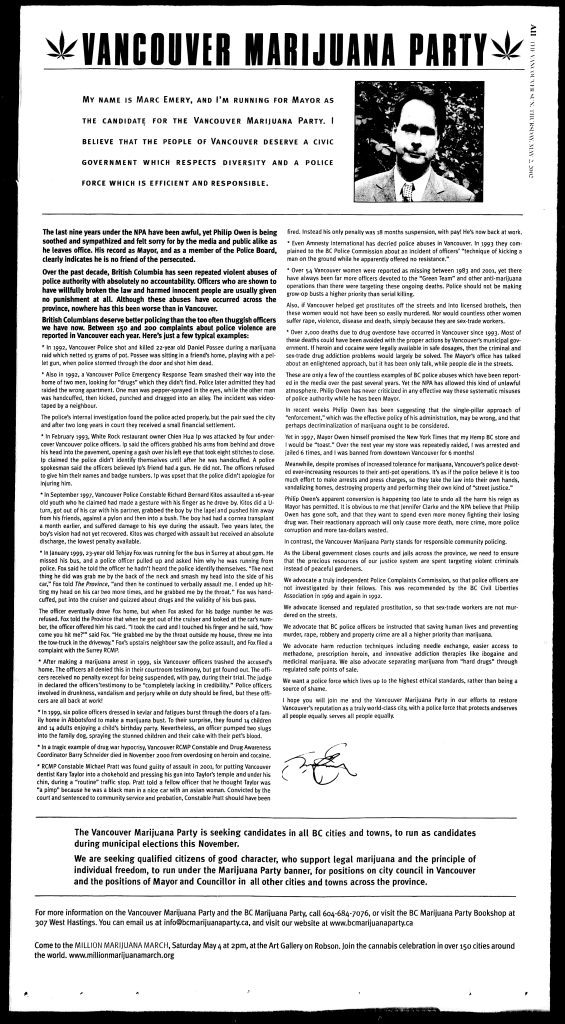
Image #147: “VANCOUVER MARIJUANA PARTY,” Vancouver Sun, Vancouver, British Columbia, May 2nd, 2002, p. 11
 Image #148: “People in New York gather for a pro-cannabis rally on May 4th, 2002. That same day, almost 200 similar events took place around the world to advocate for marijuana legalization. It was dubbed the ‘Million Marijuana March.’” “History of marijuana in America” “Players and doctors call for NFL to reconsider marijuana stance,” November 11th, 2016 https://www.cnn.com/2016/11/11/health/nfl-marijuana-stance/index.html
 Image #149: Activists Cherisse Mitchell, Renee Boje, Hilary Black and Jana Razga on the Tokers’ Bowl cruise. May 4th, 2002. Photo from the Cannabis Culture archive.
 Image #150: Cherisse Mitchell, Karen Watson, Hilary Black and Watermelon AKA Mary Jean Dunsdon . . . destigmatizing cannabis use. “Cannabis angels – Vancouver’s women of weed,” High Times magazine, May 2002, pp. 46-47
 Image #151: “Cannabis angels – Vancouver’s women of weed,” High Times magazine, May 2002, p. 48
 Image #152: Stranjahs IN DA Night business card. From Potshot #16, Summer 2000, p. 85 https://pot-shot.ca/2017/11/04/issue-16/
 Image #153: “stranjahs in da night,” High Times magazine, July 2002, p. 16
 Image #154: Cannabis Culture Tokers’ Bowl Official Ballot. May 5th, 2002.
 Image #155: David Malmo-Levine holds up the tally board with the winners identified from the first Toker’s Bowl cannabis tasting contest. “Cannabis Culture Toker’s Bowl,” Dana Larsen, November 7, 2002. https://www.cannabisculture.com/content/2002/11/07/2609/
 Image #156: Tokers’ Bowl 2002 results from the Vancouver Island Seed Company website: http://vancouverseed.com/ (no longer active).
 Image #157: “Activists push for legalization,” Lansing State Journal, Lansing, Michigan, May 5th, 2002, p. B1
 Image #158: “Activists push for legalization,” Lansing State Journal, Lansing, Michigan, May 5th, 2002, p. B2
 Image #159: “Four charged in pot seizure,” The Journal News, White Plains, New York, May 18th, 2002, p. 11
 Image #160: “Turnout low at Weedstock,” The Capital Times, Madison, Wisconsin, May 28th, 2002, p. 3
The concept of “cannabis psychosis” came up again in June 2002, with an article written by Ros Coward in The Guardian:
“The recent official report from the Advisory Council on the Misuse of Drugs summed up the dominant thinking. ‘Although cannabis may worsen existing mental health problems, the medical experts say there is no evidence that it causes brain damage but the jury is still out on whether chronic use can lead to mental illness.’ Normally if a jury is out on a serious public health issue you might expect them to err on the side of caution. But the council does the opposite, recommending downgrading cannabis from class B to class C, concluding that ‘high use of cannabis is not associated with major health problems for individuals or society.’” (115)
All “caution” was laser-focused on unlikely pot harms while ignoring completely near-certain policy harms. The harms of cannabis prohibition – black market violence, a lack of quality control, police violence, arrests, jails, fines – these were never in dispute. The harms of cannabis use were at best debatable, and most likely originated in a now 127-year-old demonization campaign meant to enslave humanity and separate us from our co-evolutionary plant partner. Why some people chose to ignore the prohibition-related harms and focus only on the cannabis-related harms involved 1) a staggering amount of ignorance and/or 2) the understanding that one rose in status if one articulated the needs of the powerful.
Coward continues:
“Despite these understandable cautions, there is something very odd about the readiness with which the government accepts the view that drugs only exacerbate pre-existing conditions. All the experts I meet take a different view. One psychoanalyst told me that heavy use of cannabis and ecstasy during adolescence can cause mental health problems. ‘Drugs overlay existing mental health problems,’ she said, ‘but they also create their own logic of confusion and disorder.’ That view is also common among psychiatrists, who have coined the term ‘cannabis psychosis.’” (116)
 Image #161: “The truth about drugs – Cannabis can be dangerous and only those pandering to youth culture pretend otherwise,” Ros Coward, The Guardian, London, England, June 3rd, 2002, p. 15
It appears that Coward hasn’t spoken to any of the experts who had, by June of 2002, questioned the existence of “cannabis psychosis.” This would include experts such as Dr. Lester Grinspoon, who had debunked the idea back in 1971 in his book Marihuana Reconsidered, (117) and again in his 1997 book he co-authored with James Bakalar, Marihuana: The Forbidden Medicine. (118) This would also include experts such as Drs. Lynn Zimmer and John Morgan, who had debunked the idea in their 1997 book Marijuana Myths, Marijuana Facts. (119)
This would also include such experts as David Marjot, who published his findings regarding evidence against the existence of “cannabis schizophrenia” in the British Medical Journal in 2002, (120) discussed in greater detail in Chapter 16. This would also include all the cannabis policy experts who had been students of – or in contact with – such researchers, or anyone who had read Indian Hemp Drugs Commission report or the LaGuardia report or Wooton or Le Dain or Shafer. Instead, it appears that Coward limited herself to discussing the subject with those in the medical establishment preoccupied with prescribing synthetic medicines and confusing the predictable symptoms of a denial of medical autonomy with the alleged symptoms of cannabis side effects.
Two letters responding to Coward in the following day’s Guardian reflect this insight. One mentioned the real problem was that
“. . . there are hundreds of thousands of people in this country whose lives are being ruined not by the drugs which they consume, but by the black market which has been created and protected by the wanton ignorance of politicians and journalists.” (121)
The other letter complained about “language that comes straight from the era of Reefer Madness” and called Coward’s assertions that cannabis was “30 times stronger” than in the 70s “nonsense.” (122)
 Image #162: “Masel plugs sponsor,” Wisconsin State Journal, Madison, Wisconsin, June 15th, 2002, p. 6
 Image #163: Cannabis Day 2002 poster, designed by David Malmo-Levine. Each poster was hand-coloured by a team of activists. This was one of the best. The colour really made it pop.
 Image #164: A black and white version of the Cannabis Day poster, along with an example of a “DEA GO AWAY” poster, which was a weekly protest that occurred over the summer of 2002.
 Image #165: A single drummer gets the beat going. Both Canadian and Cannabian flags can be seen. Cannabis Day, Vancouver Art Gallery, Vancouver B.C., July 1st, 2002. Photo courtesy of Cannabis Culture.
 Image #166: A little closer to the stage. More flags and banners with pot leaves can be seen. Cannabis Day, Vancouver Art Gallery, Vancouver B.C., July 1st, 2002. Photo courtesy of Cannabis Culture.
 Image #167: The Beefy Treats perform. Cannabis Day, Vancouver Art Gallery, Vancouver B.C., July 1st, 2002. Photo courtesy of Cannabis Culture.
 Image #168: The Beefy Treats perform. Cannabis Day, Vancouver Art Gallery, Vancouver B.C., July 1st, 2002. Photo courtesy of Cannabis Culture.
 Image #169: David Malmo-Levine addresses the crowd. Cannabis Day, Vancouver Art Gallery, Vancouver B.C., July 1st, 2002. Photo courtesy of Cannabis Culture.
 Image #170: Chris Bennett addresses the crowd. Cannabis Day, Vancouver Art Gallery, Vancouver B.C., July 1st, 2002. Photo courtesy of Cannabis Culture.
 Image #171: The crowd. Cannabis Day, Vancouver Art Gallery, Vancouver B.C., July 1st, 2002. Photo courtesy of Cannabis Culture.
 Image #172: Back when the art gallery had a fountain. Cannabis Day, Vancouver Art Gallery, Vancouver B.C., July 1st, 2002. Photo courtesy of Cannabis Culture.
 Image #173: Another fountain shot. Cannabis Day, Vancouver Art Gallery, Vancouver B.C., July 1st, 2002. Photo courtesy of Cannabis Culture.
 Image #174: David Malmo-Levine addresses the crowd again. Probably to organize a clean-up crew, to be paid in joints – one joint (sometimes more) for every garbage bag filled up. Cannabis Day, Vancouver Art Gallery, Vancouver B.C., July 1st, 2002. Photo courtesy of Cannabis Culture.
 Image #175: An early advertisement for joints. Cannabis Day, Vancouver Art Gallery, Vancouver B.C., July 1st, 2002. Photo courtesy of Cannabis Culture.
On July 18th, 2002, the Montreal Gazette reported that the U.S. DEA was warning Canada not to relax its pot law:
“Canada would hamper the aggressive U.S. war on drugs by adopting a ‘lax policy’ of decriminalizing possession of marijuana, the head of drug enforcement in the United States says. Asa Hutchinson, director of the U.S. Drug Enforcement Administration, predicted more Canadian-grown pot will end up south of the border if federal Justice Minister Martin Cauchon decides to relax Canadian law. ‘It would probably complicate things somewhat for the U.S.,’ Hutchinson said in an interview yesterday. If you have lax marijuana policies right across the border, where possession of marijuana is not considered criminal conduct,’ he said, ‘that invites U.S. citizens into Canada for marijuana use and that will increase the likelihood that both U.S. citizens and Canadian citizens will bring back the Canadian marijuana across the border for distribution and sale.’ . . . ‘We have great respect for Canada and Britain as well, and if they start shifting policies with regards to marijuana it simply increases the rumblings in this country that we ought to re-examine our policy.’” (123)
Hutchinson mentioned both Canadian sovereignty and the opportunity to reexamine US drug policy as if they were bad things. A story attached to this article featured a graph showing an increase in both arrests and charges for cannabis possession. The graph depicted a doubling in cannabis simple possession arrests over the last ten years. (124)
 Image #176: “CANADIAN MARIJUANA LAWS – U.S. opposes ‘lax’ pot policy,” The Gazette, Montreal, Quebec, July 18th, 2002, p. 1
 Image #177: “CANADIAN MARIJUANA LAWS – U.S. opposes ‘lax’ pot policy,” The Gazette, Montreal, Quebec, July 18th, 2002, p. 9
 Image #178: “Pot possession up, but ‘incidental’,” The Gazette, Montreal, Quebec, July 18th, 2002, p. 9
On August 15th, the National Post reported on a raid of the Toronto Compassion Centre – and the arrest of manager Warren Hitzig and three of his co-workers – two days earlier. (125) In what would eventually be known as Hitzig v. Canada, a decision was given January 9th, 2003, which found that the MMAR violated the section 7 rights to liberty and security of Hitzig and his partners who were solving a problem caused by the regulations: those regulations failed “to provide individuals who have a serious medical need to use marijuana with a legal source and safe supply of their medicine.” The MMAR was “declared to be of no force and effect” – but the declaration was then suspended for six months to allow the government to tweak the regulations and argue it was constitutional again, as per usual. (126)
 Image #179: “Bail rules block centre from distributing pot/With supply dry, patients turn to street sources,” The National Post, Toronto, Ontario, August 15th, 2002, p. 15
In response to Hitzig, Health Canada introduced the Regulations Amending the Marihuana Medical Access Regulations (RAMMARs) and announced an interim policy under which authorized Canadians could purchase cannabis and cannabis seeds from Prairie Plant Systems, the first “licensed producer” or “LP.” (127) A unanimous Ontario Court of Appeal upheld Hitzig and declared invalid specific provisions of the MMARs. No suspension of the declaration was granted. The court determined that this remedy would immediately render “the MMAR as modified a constitutionally sound medical exemption.” (128)
At the same time the Hitzig Appeal decision was given, the same Ontario Court of Appeal decided R v. JP. JP was a non-medical case of simple cannabis possession. The court concluded that the prohibition of simple possession of cannabis did not exist when JP was charged, because Parker said that such a prohibition was invalid if there was no “reasonable access,” and Hitzig proved that the access wasn’t reasonable. Thousands of then-pending prosecutions for simple possession were stayed. The JP Court determined that Hitzig “fixed” the regulations and the prohibition was valid once more. (129)
On the 20th of August, 2002, it was announced in the Victoria Times Colonist that pot activist Ian Hunter had died in a boating accident. (130) Rumours of the cause of death involved a freak storm combined with heroic doses of DMT, the latter of which was typical of Ian. Apparently, he was found in the water with a big grin on his face. This author enjoyed all the time he spent with Ian, be it being introduced by a mutual friend in the early 1990s at the Crosstown Café years before the opening of Hemp BC, or the trip Ian and I had taken with our girlfriends from Vancouver to Nelson, stopping at Bromley Rock for a quick dip.
 Image #180: “Pot activist dies in boat accident,” The Times Colonist, Victoria, British Columbia, August 20th, 2002, p. 11
 Image #181: Ian Hunter in the Holy Smoke Culture Shop in Nelson, B.C., circa summer of 2001. Photo by Rielle Capler.
 Image #182: Owners of the Holy Smoke Culture Shop. Image from http://angelfire.com/bc/holysmoke/hsimages.html (website no longer active).
 Image #183: The exterior of the Holy Smoke Culture Shop in Nelson, B.C., second location. From this store, decorated with a massive bong and a massive painting of Peter Tosh smoking a hash pipe, the Holy Smoke crew began selling pot, hash and magic mushrooms in 2004. They were busted in 2006.
 Image #184: My friends Paul, Bird and Dustin next to the entrance to their first location back in 1997. “Paul DeFelice, Bird Cantwell and his dad Dustin Sunflower Cantwell had Holy Smoke Culture Shop open for business Monday despite the suspension of the store’s business licence.” “Holy Smoke Puffs On In Defiance Of City Suspension,” Nelson Daily News, October 23, 1997 https://www.angelfire.com/bc/holysmoke/holylegal.html (website no longer active).
In January of 2002, Allan Rock – prostate cancer patient (131) – ceased to be Canada’s federal Health Minister. The position was taken up by Anne McLellan, who went on to become notorious for both chairing the Marijuana Task Force which drew up the regulations for legal recreational cannabis in Canada, and for working for the Bennett Law Firm in Edmonton, which represented several Licensed Producers.
By late August of 2002, McLellan was insisting on “clinical trials” for cannabis before it could be sanctioned as a medicine by the Canadian government.
“Medical marijuana must go through the same approval processes as any other prescription drug or therapy, said McLellan.” (132)
This wasn’t exactly true. Cannabis wasn’t a “prescription drug,” it was a natural health product. Natural health products had never been monopolized, and the government wanted to either prohibit pot or monopolize it, so it needed to ignore reality and consider cannabis a prescription drug. Before 2004, all herbs were considered either foods or drugs:
“Before January 1st, 2004, natural health products (NHPs) were sold as either drugs or food under the Food and Drugs Act and Regulations because there was no other category under which to classify them.” (133)
After 2004, “herbal remedies” were regulated under the NHP regulations (134) – which do not require the same clinical trials as prescription drugs (135) – but cannabis was excluded, in spite of qualifying as a “herbal remedy” by any metric:
“Natural health products (NHPs) are defined in the Regulations as vitamins and minerals, herbal remedies, homeopathic medicines, traditional medicines (like Traditional Chinese Medicines), probiotics, and other products like amino acids and essential fatty acids.” (136)
McLellan was anti-pot in 2002, and did her best to drag her feet with regards to the roll-out of medical marijuana:
“. . . the health minister has been accused of dragging her feet on the issue, unlike her predecessor, Allan Rock, who took on medicinal marijuana as his signature project. . . . McLellan announced last spring the harvest was unsuitable as medicinal pot because there were too many variations in the crop. ‘If you’re going to do clinical trials, you need a standardized crop – everybody’s got to be ingesting the same thing,’ she said Monday. McLellan has said she’s uncomfortable with the use of marijuana to relieve pain and other conditions, because she’s also responsible for reducing smoking among Canadians. Nonetheless, her department is growing a second marijuana crop, which will be standardized and suitable for clinical trials. McLellan expects trials to begin this fall or early winter.” (137)
Again, just to draw attention to the massive ethical lapse, the “Health” minister saw fit to deny a herbal medicine to the sick and dying because that herbal medicine wasn’t “standardized.” The clinical trials that were so important that suffering Canadians had to wait on them before they could get their medicine were completed over a decade later. One – involving the safety of cannabis used for pain – was initiated in January of 2004, and was finally published in 2015. (138) Another – involving the safety of vaporized cannabis for the treatment of osteoarthritis of the knee – finally got around to being initiated – in 2015 or 2016. (139) The second clinical trial has yet to have its findings published, as of September 2022. (140)
On August 29th, the National Post ran a story about Blunt Bros., a “B.Y.O. Bud café” located at 317 West Hastings, next to the BC Marijuana Party Headquarters. The author of the story was full of contempt for the subject, and had plenty of backhanded complements and faint praise:
“In fact, if you didn’t immediately smell the stench of weed upon entering, you might mistake Blunt Bros. for a very lovely café, a place where you could sit down and enjoy an espresso while reading The New York Times.” (141)
The inference is that – because of the “stench of weed” – Blunt Bros. is, in fact, not a very lovely café, and you can’t enjoy an espresso while reading The New York Times there. The author served as a reminder that scapegoating isn’t limited to hysterics – it also came in “mild contempt.”

Image #185: Blunt Bros. – “one of the two cafes where marijuana smoking is ‘tolerated’.” Circa April 2003. Image from: https://www.geocities.ws/scumdog42/vancouver.html
 Image #186: “U.S. fugitive wins permission to grow pot in B.C.,” Calgary Herald, Calgary, Alberta, September 1st, 2002, p. 7
On September 4th, 2002, the most comprehensive English-language report on cannabis ever commissioned by a government was released. CANNABIS: OUR POSITION FOR A CANADIAN PUBLIC POLICY was the title, and the authors were the Senate Special Committee on Illegal Drugs. It has since come to be known as the Nolin Report, as Senator Pierre Claude Nolin was the chairperson overseeing it. The most stunning recommendation in the report was found on page 52 of the summary – where the Senate wanted cannabis to be treated as a softer drug than alcohol or tobacco, in that 16-year-olds could buy it on their own:
“Amend the Act to create a scheme providing for exemption to the criminal offences provided in the CDSA with respect to the distribution of cannabis. A Canadian resident may obtain a licence to distribute cannabis. The resident must undertake not to distribute to persons under the age of 16; must never have been sentenced for a criminal offence, with the exception of offences related to the possession of cannabis, for which amnesty will be declared; and most agree to procure cannabis only from duly licensed producers. In addition, in accordance with potential restrictions under the Canadian Charter of Rights and Freedoms, licensed distributors shall not display products explicitly and shall not advertise in any manner.” (142)
The fact that nine Canadian Senators unanimously advocated legalizing cannabis, and what’s more, recommended it be considered a softer drug than alcohol or tobacco and regulated as such – including to those age 16 and over – cannot be understated.
 Image #187: CANNABIS: OUR POSITION FOR A CANADIAN PUBLIC POLICY – REPORT OF THE SENATE SPECIAL COMMITTEE ON ILLEGAL DRUGS, SUMMARY REPORT. CHAIR: PIERRE CLAUDE NOLIN. DEPUTY CHAIR, COLIN KENNY. SEPTEMBER 2002 https://sencanada.ca/content/sen/Committee/371/ille/rep/summary-e.pdf
 Image #188: “Legalize pot smoking, senators say – The Special Committee on Illegal Drugs says marijuana should be legalized, and wants amnesty for those already convicted.” Image from 1:40 of the video. https://www.cbc.ca/player/play/1627331404
 Image #189: “Pot should be sold like wine or beer – That’s the shocking advice in a Senate panel’s report on marijuana use: It should be legalized, regulated, taxed and sold to anyone over 16. Experts say the legal sale of pot could mean a $2-billion tax windfall,” The Province, Vancouver, B.C., September 5th, 2002, p. 1
There were many things wrong with the report, including the “no advertising” part and the “no amnesty for pot growers and pot dealers” part, the continued prohibition for “young” users (under 16 years old) part and the fact that “regular” users (under 20 years old) were considered to be automatically suffering from “problem use” that should be prevented part, (143) as was the part about supposed “withdrawal symptoms” experienced by “heavy” users – “heavy” being defined as “several doses per day in an ongoing manner for several years.” (144)
All this nonsense has been completely disproved by my own personal experience and the personal experiences of the hundreds of cannabis activists and members of the cannabis community this author has had the pleasure to work with in my official capacity of a cannabis activist and cannabis retailer. My daily cannabis/hashish use – pretty constant between the ages of 14 to 48 with the exception of the time spent in jail – did not cause me problems while I was using, did not interfere with my applying the knowledge gained through my studies in history, law, medicine, agriculture, or parenthood, nor did it cause any of the scores of cannabis users I knew problems, nor did it cause me any “withdrawal symptoms” when I took a break from using at the age of 48 . . . apart from missing the feeling of being extra relaxed, hungry and happy.
The report had this to say regarding “cannabis psychosis:”
“With respect to psychotic disorders and schizophrenia, the two subjects are controversial, the methodologies weak, the data contradictory and the interpretations are often based on simplistic models of causality. If, in certain circumstances, cannabis can trigger psychotic episodes, they are most often short and resolve rapidly. As for schizophrenia, if it is true that cannabis use is more prevalent in these subjects than in the general population, some feel that it is self-medicating behaviour while others feel that the chronic use of cannabis is a trigger for the schizophrenic process. We feel that the conclusion of professor Roques’ report agrees best with current data: ‘No mental pathology directly related to the overuse of cannabis has been reported, which distinguishes this substance from psychostimuIants such as MDMA, cocaine or alcohol, heavy and repeated use of which can give rise to characteristic psychotic syndromes. Similarly, cannabis does not seem to precipitate the onset of pre-existing mental dysfunctions (schizophrenia, bipolar depression, etc.).’” (145)
Reaction to the report was mixed, to say the least. The Justice Minister for the Chretien Liberal government of the day, Martin Cauchon, favored decriminalization instead. With regards to outright legalization, he was quoted on CBC television saying “Are we ready to go as far? We’ll see.” (146) David Griffin of the Canadian Police Association was there with the parental hysteria spin, calling the recommendations “. . . a back-to-school gift for drug pushers.” (147) Right-wing politician Randy White – at the time a member of the short-lived Canadian Alliance party – said “. . . there’s going to be some significant problems with the Americans, and we shouldn’t underestimate that.” (148) – confirming that many Canadian politicians were more concerned with the opinion of American autocrats than the opinion of informed Canadian politicians, or informed Canadians for that matter.
Criminologist Neil Boyd – normally a voice for progress in drug policy discussions – demonstrated the timidness of his own imagination by limiting the scope of legalization to involve some sort of exclusive market:
“You need to be careful about analyzing the cost and benefits of legalizing the crop because you’d put a lot of people out of work . . .” (149)
 Image #190: “Little chance for Senate’s pot changes, expert says,” The Vancouver Sun, Vancouver, British Columbia, September 5th, 2002, p. 4
This both anticipated the cannabis cartel Prime Minister Justin Trudeau created in 2018, and helped to doom Canada to that exclusive model, by not assuming that an inclusive model that allowed legacy growers and dealers to keep their jobs would be the natural choice. It’s disappointing that criminologists in general, and this criminologist in particular, saw cannabis as a vice, and not the co-evolutionary plant partner that everyone has an inherent right to access for use and/or to sell or trade.
Writing for the Ottawa Citizen, Dan Gardner – as always – had a prescient take, anticipating how politicians would ignore this report like they ignored the last dozen reports;
“Of course, in the long, turbulent history of marijuana in the Western world, there have been precious few responsible politicians – or journalists, to be honest. If we are blessed with such men and women today, the Senate report may be the shot that started the revolution. If not, the report will become just another in the long line of wise studies ignored by the fools who lead us.” (150)
 Image #191: “Senators on marijuana: Smoke ‘em if you got ‘em,” The Ottawa Citizen, Ottawa, Ontario, September 5th, 2002, p. 1
 Image #192: “Senators on marijuana: Smoke ‘em if you got ‘em,” The Ottawa Citizen, Ottawa, Ontario, September 5th, 2002, p. 2
In the same issue of the Ottawa Citizen, the Canadian Police Association’s executive officer, David Griffin, claimed there were nefarious forces at work:
“Mr. Griffin added the association believes powerful lobbies, which stand to benefit commercially from the legal distribution and sale of marijuana, is behind the push for drug legalization. He did not identify the groups.” (151)
This cop was projecting the greed of the establishment on to the legacy market. With the benefit of hindsight, we now know which “powerful lobbies” pushed for the cartel that allowed them and only them to “benefit commercially from the legal distribution and sale of marijuana.” It was It was police officers like Norman Inkster and Julian Fantino and Kash Heed and Barry Daniel, a bunch of Liberal Party insiders including Anne McLellan (152) and a list of other greasy politicians too numerous to count, (153) a bunch of rich business people who contributed to Liberal Party coffers (154) and the members of organized crime that the Liberal Party made sure could invest in Licensed Producers anonymously. (155)
On September 7th, the National Post used the Nolin Report as an opportunity to call for “decriminalization,” pretending it was the “middle road” between two unreasonable extremes:
“While we are encouraged for their enthusiasm for reform, the senators went a step too far in recommending outright legalization. . . . governments should not have a financial incentive to encourage a habit that – like tobacco use – increases the risk of serious health problems, including throat and lung cancer. The committee’s proposal is made all the more troubling by its suggestion that possession should be legal for anyone 16 years of age or older. Minors are prohibited from tobacco and alcohol use because of legitimate concerns surrounding their judgement. . . . Marijuana use – like smoking, unprotected sex and sugary foods – should not be encouraged. But it should not be a criminal offence either.” (156)
Marijuana smoking doesn’t cause throat cancer, but the radioactive chemical fertilizers (that non-organic cannabis is sometimes grown in) do. Count on the National Post to use the combination of a) fraudulent comparisons between cannabis and hard drugs like cigarettes and b) ever-present parental hysteria, in order to keep human beings separated from the co-evolutionary plant partner, and thus enslaved, while at the same time turning a blind eye to the chemical fertilizer industry and all the harm they do.
The interesting thing about the media coverage following the release of the Nolin Report was that not once was “cannabis psychosis” myth mentioned as a reason to disregard the recommendation to legalize. The prohibitionists relied mostly on the “lung cancer” myth and the “gateway drug” myth instead. Abbotsford Chief Ian Mackenzie told the Abbotsford News that;
“I don’t think there is definitive evidence that marijuana is not a problematic drug, or does not lead to other drugs.” (157)
Today, the “lung cancer” and “gateway drug” arguments have been all but abandoned, and with good reason – the evidence is just overwhelming that both arguments are totally bogus. (158)
 Image #193: “Coffee shop man ‘smoked cannabis’ during raid,” The Daily Telegraph, London, England, September 14th, 2002, p. 15
Back in 2002, even the psychiatrist community had noticed that nobody was talking about cannabis psychosis. But the psychiatrist community was determined to do something about it. Robin Murray, a professor of psychiatry at the Institute of Psychiatry and consultant psychiatrist at the Maudsley Hospital – both located in London, England – wrote an article in The Guardian with the intent on getting everyone to believe in Reefer Madness again:
“. . . I have been surprised that in all the recent discussions about cannabis, there have been virtually no mention of the drug’s relationship to psychosis. Psychiatrists have known for 150 years that heavy consumption of cannabis can produce hallucinations. This was thought to be rare and transient until the 1980s when, as cannabis consumption rose across Europe and the USA, it became apparent that people with chronic psychotic illnesses were more likely to be daily consumers of cannabis. Here in Britain, for example, people with schizophrenia do not take more alcohol, heroin, or ecstasy that the rest of us, but they are twice as likely to smoke cannabis regularly.” (159)
 Image #194: “No smoke without fear – Is there really a link between cannabis and psychosis? Robin Murray is in no doubt,” The Guardian, London, England, September 17th, 2002, p. 37
Perhaps schizophrenics were self-medicating with pot. Evidence for the CBD found in cannabis as an effective treatment for psychosis didn’t begin to arise in the medical community until years later, but the evidence has become overwhelming since then. (160) This evidence is discussed in greater detail in Chapter 16.
Robin Murray claimed in the same Guardian article that “the incidence of schizophrenia in south London has double since the 1960s; the use of cannabis and cocaine could be a factor.” First, “cannabis and cocaine”? Talk about confounding variables. It’s similar to saying that playing both tackle football and golf may be responsible for head injuries – the latter seems much more connected to injuries than the former. Second, Murray didn’t cite a source for the “incidence of schizophrenia” statistic. But Murry was a co-author for a study that said exactly that, but in that study he a) didn’t mention cannabis, and b) admitted that “Most studies have shown a decline in incidence” of psychosis, and pointed to numerous other studies that either show a decrease in incidence rates, or no change in incidence rates. (161) By not mentioning – let alone explaining – how “most studies” showed the opposite of what his study claimed in the Guardian article he wrote, Robin Murray was being disingenuous.
Murray was also a co-author of at least eight papers on the topic of cannabis and psychosis. (162) In some of these articles Murray and his co-authors made the argument for a causal relationship between cannabis use and psychosis (Arseneault et al. 2004), in some Murray just argued there was an association rather than a causal relationship (Marconi et al. 2016) and in some this causal relationship was rejected, as it is in Hall et al. 2004:
“It is a plausible hypothesis that high doses of cannabis can produce psychotic symptoms (see Chapters 3 and 5). There is no compelling evidence, however, that there is a specific clinical syndrome that is identifiable as a ‘cannabis psychosis.’ The clinical symptoms reported by different observers have been mixed. These symptoms seem to remit rapidly, with full recovery after abstinence from cannabis.”
A causal relationship between cannabis use and psychosis is also rejected in another Murray-co-authored paper, Kirkbride et al. 2012:
“We found no evidence to support an overall change in the incidence of psychotic disorder over time, though diagnostic shifts (away from schizophrenia) were reported.”
A causal relationship between cannabis use and psychosis was also rejected in a third Murray-co-authored paper, Colizzi et al., 2015. This paper argues that the gene relating to dopamine transmission combined with frequent use – not cannabis use per se – were the dominant factors which influence cannabis-related psychosis:
“Our findings support previous reports suggesting that genetic variation within genes that regulate signaling pathways and impact on dopamine transmission influences the risk of developing a psychotic disorder in cannabis users depending on the frequency of use.”
If cannabis and hashish use actually caused psychosis, there would be increases in psychosis and schizophrenia between the 1960s and 1990s showing up everywhere, all over the world, not just in the handful of reports where the anti-pot researchers get to be lead author and inconvenient evidence is ignored. Many of the reports mentioned are more closely examined in a later chapter.
 Image #195: “Officials burn opium, hashish seized in Kabul,” Statesman Journal, Salem, Oregon, October 17th, 2002, p. 10
 Image #196: “Peggy Haney, 72, right, a Las Vegas grandmother of seven, rolls a fake marijuana cigarette at the Stop DUI headquarters in Las Vegas in this file photo. Stop DUI is opposed to Nevada’s question nine on the November ballot. While the national spotlight in the Nov. 5 election focuses on the battle to control Congress, many voters will have other chances to vent their feelings on some of America’s most contentious social issues.” The Jackson Sun, Jackson, Tennessee, October 27th, 2002, p. 6
On November 4th 2002, TIME did a cover story on cannabis. The Cover asked the question “IS AMERICA GOING TO POT?” and depicted a flip-top pack of home-rolled joints in cigarette-style packaging – except with a big pot leaf instead of a “cigarettes will kill you”-type warning label. The cover also teased one’s interest with this sub-title: “The latest research on what it does to your health.” Inside that section, the author asked six questions: 1) Can it kill you? 2) Does it make you sick? 3) Can it give you cancer? 4) Is it addictive? 5) Does it make you stupid? 6) What about sex? And 7) Do the sick really benefit?
 Image #197: “IS AMERICA GOING TO POT? The battle heats up over legalizing marijuana. PLUS: The latest research on what it does to your health,” TIME magazine, CANADIAN EDITION, November 4th, 2002
 Image #198: “PRO-POT PARTY: Outside a TV-news studio in Las Vegas, demonstrators rally in favor of legalization while the drug czar is interviewed inside,” “THE NEW POLITICS OF POT,” TIME magazine, CANADIAN EDITION, November 4th, 2002, pp. 36-37
 Image #199: “The government says it wants more studies, but they make it harder to get marijuana for research than any other drug.” – Rick Doblin, “THE NEW POLITICS OF POT,” TIME magazine, CANADIAN EDITION, November 4th, 2002, p. 46
The question “Does it make you crazy?” wasn’t asked, and cannabis as a cause of – or a treatment for – psychosis was not mentioned. (163) The article featured yet another photo of the U.S. Government’s pot farm in Mississippi, with many pot plants, but not a bud visible on any of them. It’s as if they were only growing males or something.
In the November 5th 2002 New York Times, an article was written about the arrest of Meile Rockefeller – granddaughter of Nelson Rockefeller, the author of the draconian Rockefeller laws. Meile was arrested protesting those very laws:
“A lawyer who has also been a real-estate developer, Ms. Rockefeller is on the board of the Counseling Service of the Eastern District of New York, a Brooklyn organization that helps people with drug and alcohol problems. With the Rockefeller laws, her druthers are that they be repealed, not merely tinkered with. She wants judges to regain the power to decide whether a prison term or a treatment program works better for an offender and for society, because they ‘are the ones right there on the front lines.’ O.K., big issues aside, how weird was it to be arrested for the first time, even if the scene was well scripted and the police were, as she said, ‘terrific’? Pretty strange, Ms. Rockefeller said. It was so orchestrated that one of those arrested, State Senator David A. Paterson of Manhattan, leaned toward her at the police station and said, ‘Are we in central booking or central casting?’ But make no mistake. ‘It’s a more powerful experience than I expected,’ she said. ‘It’s a tool to be used very, very judiciously.’” (164)
 Image #200: “A ROCKEFELLER IS BUSTED,” Daily News, New York, New York, October 31st, 2002, p. 19
Less than a month later, Marc Emery decided to spend 750 dollars for a table at a fancy hotel to hear the U.S. Drug Czar – John Walters – speak, so that members of the civil disobedience anti-drug war community could all boo and hiss him. At our table was Marc Emery, Chris Bennett, Dana Larsen, Rielle Capler, Philippe Lucas, Michelle Rainey and myself. The Headline at the top of page six of the Vancouver Province read “Local potheads shout down Bush’s drug czar.” It was a fiasco:
“Walters, a member of President George W. Bush’s cabinet, told the crowd that of six million Americans requiring treatment for drug abuse, about 60 per cent are dependent on pot. ‘Lies, lies,’ shouted members of the B.C. Marijuana Party, who got into the meeting by identifying themselves through their corporate entity, Avalon Sunsplash, and paid $750 for a table in the middle of the ballroom at the Sheraton Vancouver Wall Centre.” (165)
 Image #201: “Drug Czar John Walters meets Marc Emery – The next day, former Mayor Phillip Owen, Mayor-elect Larry Campbell and city councilors met with Walters. Owen later told the Vancouver Courier paper ‘It was the most intense meeting of my life. There is no one more uninformed about drugs than the Drug Czar.’ Members of City Council recently told me Walters and his lieutenants threatened, screamed at and insulted the elected Vancouver officials, and guaranteed that if Vancouver pursued legal marijuana policies, the border would be shut down to Canadian commerce heading for America.” “FREE MARC EMERY!” Jodie Emery, May 12, 2010 https://www.cannabisculture.com/content/2010/05/12/4639/
 Image #202: The Prince of Pot – The John Walters Project – Part 1 – Pot TV https://www.youtube.com/watch?v=qkFCC49SXCM&t=273s
 Image #203: The Prince of Pot – The John Walters Project – Part 2 – Pot TV https://www.youtube.com/watch?v=RltMCZmEEwk&t=70s
 Image #204: The Prince of Pot – The John Walters Project – Part 3 – Pot TV https://www.youtube.com/watch?v=ZG1-NXWaPoQ&t=32s
 Image #205: “Protesters David Malmo-Levine (left) and Marc Emery (far right) at the Board of Trade luncheon.” “Local potheads shout down Bush’s drug czar,” The Province, Vancouver, B.C., November 21st, 2002, p. 6
 Image #206: “Protesters David Malmo-Levine (left) and Marc Emery (far right) at the Board of Trade luncheon.” “Local potheads shout down Bush’s drug czar,” The Province, Vancouver, B.C., November 21st, 2002, p. 6
The coverage on the news that night captured some of the responses to this nonsense, including this author, who responded to the “six million need treatment” nonsense with the following:
“There’s three million of us here who smoke pot and none of us need treatment! You want to force three million people to choose between jail and treatment!” (166)
Both the outgoing and incoming Vancouver Mayor also responded to Walter’s claims about pot. Larry Campbell was the Mayor-Elect, and he said;
“Somehow I just haven’t been able to come to grips with marijuana being that devastating a drug. We don’t see that here and I don’t know why we don’t see that here and they see it so clearly there.” (167)
Marc Emery also got on the news that night:
“We’ve got an armed camp going on in the United States and if we don’t want Canada to be like that armed camp we have to take a separate path.” (168)
The outgoing Mayor, Philip Owen, had this to say;
“They arrested and charged 40,000 people in New York City for marijuana offences. Those people – a lot of them – then went to a drug court. The drug court says ‘we can try and save you from a record – we won’t put you in jail, but we’ll put you into treatment.’ You can extrapolate from that that the marijuana users are the ones in treatment. Well, they’re in treatment because of the structure.’” (169)
The Vancouver Sun didn’t actually quote Mayor Owen verbatim, but did summarize his argument;
“Afterwards, Owen questioned Walters’ information that 60 per cent of the six million drug addicts in the United States are addicted to marijuana and represent the bulk of people filling up the American drug-treatment system. Owen said the reason people using marijuana are so prevalent is because the U.S. is more aggressive in arresting people for simple possession and, through the drug court system, they’re forced to choose between jail or treatment.” (170)

Image #207: “Drug plan waste of resources, city told,” Vancouver Sun, Vancouver, British Columbia, November 21st, 2002, p. 1
 Image #208: “Drug plan waste of resources, city told,” Vancouver Sun, Vancouver, British Columbia, November 21st, 2002, p. 2
While internal VPD documents assert that the joint VPD/DEA investigation into Marc Emery began in 2004, Emery figured that investigation actually began in 2002, right after Emery and his associates humiliated the Drug Czar. (171) A week after the Walter’s visit, the Victoria Times Colonist had an editorial calling for mandatory minimum sentences for cannabis cultivation. In the article it was revealed that “officials representing law enforcement agencies across Canada were in Ottawa this week demanding tougher penalties for pot growers.” (172)
 Image #209: “Courts too lenient on pot growers,” Times Colonist, Victoria, British Columbia, November 28th, 2002, p. 14
 Image #210: Times Colonist, Victoria, British Columbia, November 28th, 2002, p. 14
See, it wasn’t that Washington, D.C. was telling Ottawa what to do. It was that the DEA was invited by the VPD to an expensive lunch to give the DEA the opportunity to tell Vancouver cops what to do, and then Canadian cops were telling Ottawa what to do. They all worked together as a team, making an effort to maintain plausible deniability of Washington dictating drug policy to Ottawa.
The article was a classic example of scare tactics: blame cannabis for all the dangers that cannabis prohibition is responsible for. The “mold spores, carbon monoxide, pesticides and electrocution” mentioned in the article wouldn’t exist for cannabis if pot were as legal to grow as any other houseplants, because these dangers don’t really exist for house plants. Those dangers come mostly from having to hide the plant in the basement instead of showing it off in the greenhouse or in the living-room window or on the roof or the kitchen window-box. If the cops really cared about pesticides they would be in favor of organic growing standards, subsidized greenhouses and secure gardening sheds, not continued prohibition. “Cannabis psychosis” wasn’t mentioned as a concern.
On December 5th, 2002, the Windsor Star began to report on a legal challenge by lawyer Brian McAllister that would eventually give Canada a small taste of legalization. The case involved a 16-year-old client and an argument that the laws against possession of cannabis in Canada were invalid because Parliament failed to re-enact them after they were struck down;
“McAllister’s challenge is based on a July 31st, 2000, decision by the Ontario Court of Appeal striking down the federal law prohibiting the possession of less than 30 grams of marijuana. The court found in the case of Terry Parker of Toronto that the law violated the rights of sick people who use marijuana for medical reasons. It gave the government a year to revamp the law and correct the problem. If not, the law prohibiting marijuana possession would become invalid. The federal government responded with the Marijuana Medical Access Regulations, which went into effect July 31 of last year. Under the new rules, those who use marijuana for medical reasons can do so legally if they meet certain requirements. But that wasn’t enough, McAllister is arguing. To satisfy the appeal court, Parliament needed to re-enact the law prohibiting the possession of less than 30 grams of marijuana, he says in a court document laying out his position.” (173)
This court challenge would be heard in late December and a ruling would be provided in early January. In the meantime, the Supreme Court of Canada decided to delay hearing the arguments in Caine, Clay and Malmo-Levine until the Justice Minister first moved ahead with his plans to “decriminalize” pot. (174)
 Image #211: “Windsor lawyer contests pot law,” The Windsor Star, Windsor, Ontario, December 5th, 2002, p. 1
 Image #212: “Windsor lawyer contests pot law,” The Windsor Star, Windsor, Ontario, December 5th, 2002, p. 2
As this was happening, those living in the UK could check out a TV program called “Cannabis Psychosis” on BBC Channel 4, on at 11:05pm:
“Bong. Here is the news: with today’s cannabis being 30 times stronger than 1960s variants, it’s no wonder crimson-eyed youth are screaming into festival tents babbling about worse things than prolonged exposure to Country Joe And The Fish. Time was when all one had to worry about were an attack of the paras and when the next maxi-pack of Monster Munch was coming from. However, in light of the drug’s recent reclassification to Class C, new research indicates direct links between heavy tokin’ and the onset of schizophrenia – for a ‘vulnerable proportion’. (Did I write that or just think it?)” (175)
 Image #213: “Cannabis Psychosis,” Evening Herald, Dublin, Ireland, December 14th, 2002, p. 24
 Image #214: “Cannabis Psychosis,” The Independent, London, England, December 15th, 2002, p. 74
 Image #215: “Cannabis Psychosis,” Evening Herald, Dublin, Ireland, December 16th, 2002, p. 41
A review of the program three days later summed up the message;
“Yes, cannabis can make you psychotic but, it seemed, only if you’ve been smoking tonnes of high-grade skunk since you were 11 and have a genetic loading towards mental illness. Like most things, it’s fine in moderation. Like most things, it’s not the thing that’s the problem, it’s the individual’s attitude towards its consumption.” (176)
 Image #216: “Crazy joint venture,” Evening Standard, London, England, December 17th, 2002, p. 219
 Image #217: “Four held after ‘cannabis cafes’ raid,” Evening Standard, London, England, December 18th, 2002, p. 82
While British audiences were treated to the same “new research” that had been blaming cannabis for psychosis for the last 100 years or so, the editors at the National Post were doing their best to limit the cannabis debate to the Liberal government’s version of “decrim” or the U.S. government’s “total prohibition” approach. Legalization wasn’t even an option worthy of inclusion in their editorial. (177)
A feature story about the now married-with-child Rene Boje in the December 21st Vancouver Sun touched on the US Drug Czar’s John Walters awareness of Boje, his desire to extradite her, and how he had convinced himself that he wasn’t pressuring Canada to resist pot law reform;
“When asked point blank how he felt about the neighbours passing such libertine drug laws, Walters said we could pass any laws we wanted. ‘Canada,’ he reminded us, ‘is a sovereign nation.’ Of course it’s not Canada that needs reminding.” (178)
 Image #218: “Marijuana mama – With extradition to the U.S. looming, and a refugee claim on this side of the border, Renee Boje is an unlikely pawn in the war on drugs,” Vancouver Sun, Vancouver, British Columbia, December 21st, 2002, p. 93

Image #219: “U.S. drug war’s target: A new mom – Here’s how Hollywood-raised Renee Boje became the pot madonna,” Thee Vancouver Sun, Vancouver, British Columbia, December 21st, 2002, p. 95
 Image #220: “U.S. drug war’s target: A new mom – Here’s how Hollywood-raised Renee Boje became the pot madonna,” Thee Vancouver Sun, Vancouver, British Columbia, December 21st, 2002, p. 96

Image #221: Renee Boje circa 2002. From the Renee Boje archive.
 Image #222: “Rene Boje is a U.S. refugee living in Vancouver and seeking asylum there. She is wanted in the United States on marijuana charges. ‘The government here is a lot more compassionate,’ she says.” “Legalized pot seems likely up north,” SEATTLE POST-INTELLIGENCER, Jan 2, 2003 https://www.seattlepi.com/news/article/legalized-pot-seems-likely-up-north-1104543.php
On December 22nd, 2002, a couple of articles ran in the Victoria Times Colonist. One involved the international border horrors that cannabis currently creates, and one suggested – in the title at least – the problem that cannabis legalization would inevitably bring: “Drug law could bring border nightmare” (179) and “We’re innocent pawns, say B.C. truck drivers.” (180) When searching through the “Drug law could bring border nightmare” article, this author found no official who actually said that, indicating the editors were super-imposing their anti-drug law reform bias onto an article about post-9/11 smuggling.
Arguably, the legalization of cannabis in various U.S. states beginning in 2014 and the legalization of cannabis in Canada in 2018 have yet to result in any new “border nightmare” – just the usual hassles for the lower classes that have existed since prohibition began – and any problems caused by anti-pot-smuggling laws could be eliminated entirely by legalizing the rest of the pot economy and allowing an import/export market. Once again, marijuana was blamed for the problems caused by marijuana laws. And once again, legalization didn’t cause any of the problems prohibitionists said it would.
 Image #223: “A row of stores and cafes on East Hastings Street that sell pot paraphernalia and allow pot smoking is testimony to Vancouver’s relaxed attitude toward marijuana.” Legalized pot seems likely up north,” SEATTLE POST-INTELLIGENCER, Jan 2, 2003 https://www.seattlepi.com/news/article/legalized-pot-seems-likely-up-north-1104543.php
Around this time, the Scientologists published THE TRUTH ABOUT JOINTS! – Marijuana and Hashish (181) – a short pamphlet distributed by their “church.” The Scientologists are a combination cult and pyramid scheme that combines a healthy skepticism of psychiatric drugs with a terrible prohibitionist approach to botanical medicines like cannabis in order to promote their drug-treatment program “Narconon,” which has been described by some as a “sham” and a “slick device to lure unsuspecting people into Scientology.” (182)
The Scientology pamphlet asserted that “‘soft’ drugs do not exist.” This was news to the Dutch government, who were educating their young people to understand that soft drugs had acceptable risks and hard drugs had unacceptable risks. (183)
 Image #224: “Drugs: THE TRUTH ABOUT JOINTS! Marijuana and Hashish,” Church of Scientology, 2003
 Image #225: “Drugs: THE TRUTH ABOUT JOINTS! Marijuana and Hashish,” Church of Scientology, 2003, p. 3
 Image #226: “Drugs: THE TRUTH ABOUT JOINTS! Marijuana and Hashish,” Church of Scientology, 2003, p. 4
 Image #227: “Drugs: THE TRUTH ABOUT JOINTS! Marijuana and Hashish,” Church of Scientology, 2003, p. 5
The Scientology pamphlet also asserted that “the risk of lung cancer is 5 to 10 times higher for joint smokers than for cigarette smokers” and that “even small amounts of marijuana can cause temporary sterility in men” and that using marijuana increases the risk of cancer for pregnant women and their babies, and that “Cannabis is one of the few drugs which causes abnormal cell division which leads to severe hereditary defects” – propaganda so outrageous it’s no longer repeated anywhere else, and which doesn’t require debunking.
This concern over lung cancer from smoking cannabis is almost quaint, considering the founder of Scientology – L. Ron Hubbard himself – is on record saying that too little cigarette smoking causes cancer:
“Not smoking enough will cause lung cancer! If anybody is getting a cancerous activity in the lung, the probabilities are that it’s radiation dosage coupled with the fact that he smokes. And what it does is start to run out the radiation dosage, don’t you see.” (184)
The Scientology pamphlet also asserted that as “Monkeys given marijuana in clinical tests became severely brain damaged” – referencing the 1974 Heath/Tulane monkey study debunked in Chapter 10.
 Image #228: “Drugs: THE TRUTH ABOUT JOINTS! Marijuana and Hashish,” Church of Scientology, 2003, p. 7
 Image #229: “Drugs: THE TRUTH ABOUT JOINTS! Marijuana and Hashish,” Church of Scientology, 2003, p. 14
On January 2nd, 2003, a judge in Windsor Ontario threw out a possession charge in Brian McAllister’s challenge to the law against simple possession. The Ottawa Citizen took the opportunity to argue that the “marijuana laws should be scrapped:”
“It’s time the federal government stopped punishing people for choosing to use pot. If it can’t bring itself to legalize marijuana, which we support, it should at least decriminalize it.” (185)
The next day, the government appealed the decision. In spite of cases already beginning to be adjourned until the appeal was decided, the police did their best to downplay the ruling’s significance:
“‘Until there’s a ruling from a higher court, it’s business as usual,’ Windsor deputy police chief Roger Mortimore said.” (186)
 Image #230: “Ottawa will fight ruling that legalized marijuana,” Edmonton Journal, Edmonton, Alberta, January 4th, 2003, p. 6
As if on cue, five days later an Ontario Superior Court handed down a decision in Hitzig, which also argued the federal government’s MMAR regulations were unconstitutional. (187)
 Image #231: “Author claims Christ, apostles were stoners,” The Kingston Wig-Standard, Kingston, Ontario, January 8th, 2003, p. 9
 Image #232: “Was there a whiff of cannabis about Jesus?” Professor Carl Ruck, The Sunday Times, January 12th, 2003 https://web.archive.org/web/20140702082008/http://www.cannabis.net/articles/jesus-cannabis.html
 Image #233: “Court to hear appeal of pot rally shutdown,” The Capital Times, Madison, Wisconsin, January 14th, 2003, p. 2
 Image #234: “Cannabis not a harmless drug, says judge,” Evening Herald, Dublin, Ireland, January 14th, 2003, p. 8
 Image #235: “Christ and cannabis theory is not fresh,” Daily Gazette, Colchester, England, January 21st, 2003, p. 12
Immediately after that ruling, the polling group Strategic Counsel asked Canadians if they wanted marijuana “decriminalized,” in order to limit Canadian pot policy options to that being considered by the Liberal government, hoping everyone would forget the option suggested by court appellants and the Senate. On January 20th, the Vancouver Sun reported that 56 percent of British Columbians favored decriminalization – whatever that meant – the highest percentage in the country. Quebec was the only other province to provide a majority in favor, at 51 percent. The rest of the article was spent describing how awesome it was to grow pot in B.C., and how cool Vancouver’s pot block was, how it was “so much like Amsterdam” even though you couldn’t buy any cannabis at either of the B.Y.O.Bud cafes. (188)
A feature article on decriminalization in the January 21st 2003 Saskatoon, Saskatchewan Star-Phoenix exposed another bias in the pollster community. The poll reported on – this one from Leger Marketing – asked about legalization instead of decriminalization – 46.8 percent of Canadians were in favor and 47.7 percent were opposed. And then the pollsters asked Canadians if they thought the use of harder drugs would increase or decrease post-legalization. Nearly 40 percent thought it would increase and 38 percent thought it would decrease. (189)
What would have been more helpful to the readers would have been if the reporters had looked at hard drug use rates in places like Holland, which tolerated cannabis sales, and compared them with hard drug use rates in prohibitionist countries. For example, in terms of the use of opiates, the U.S. is near the top of the list of countries with high use rates, at #7 in the world, with 1.04 percent of those aged 15-64 using. Canada, with a slightly more liberal attitude, is at #38, with 0.4 percent, and the Netherlands, with de facto legalization, was at #83 out of 130 countries, with 0.13 percent. (190)
The article had a subsection entitled “Harmless fun or a true health hazard?” which didn’t mention cannabis psychosis, but did mention every other myth under the sun, from “developmental problems” of children born to heavily-using mothers, to head and neck cancer, to “impaired memory, word use and drive.” They did say “many experts don’t buy into the argument that marijuana leads to the use of harder drugs such as cocaine or heroin,” but they didn’t say who these experts were, or what made them think that, thus keeping the readers as ignorant as they were before they began reading this article. All these myths were debunked many times by many experts, including the 1997 book Marijuana Myths, Marijuana Facts by Lynn Zimmer and John Morgan, discussed in the previous chapter.
 Image #236: “HERE’S WHAT THE EXPERTS SAY ABOUT MARIJUANA AND TEENS,” Morning Sentinel, Waterville, Maine, March 10th, 2003, p. 4
On March 16th, the Vancouver Province did an article on the “insidious problem” of marijuana gardeners in B.C., quoting B.C. Solicitor-General Rich Coleman to get the scoop on these scofflaw gardeners:
“They are the base of organized crime in British Columbia. They fund the illegal gun trade. They fund the cocaine. They fund the methamphetamine labs. They are responsible for in excess of 60 homicides that we are presently investigating . . .” (191)
Once again, pot prohibition problems were made out to be pot problems. The obvious solution – to legalize and tax and regulate the growers – was not mentioned. Also not mentioned was the fact that the vast majority of pot growers in Canada were unarmed, owning guns at a similar rate to the rest of the Canadian population, according to drug policy expert Susan Boyd:
“In fact, only 6% of the cases included in the study were reported to have firearms on site, which is only slightly higher than the 5.5% of the Canadian population overall that has valid firearms licenses.” (192)
 Image #237: “Tales of the unexpected,” The Guardian, London, England, April 7th, 2003, p. 20

Image #238: “Flag of Novozybkov” https://commons.wikimedia.org/wiki/File:Flag_of_Novozybkov_(Bryansk_oblast).png
 Image #239: “Canada goes to pot,” Winnipeg Sun, Winnipeg, Manitoba, May 1st, 2003, p. 9
 Image #240: “Canada goes to pot,” Winnipeg Sun, Winnipeg, Manitoba, May 2nd, 2003, p. 7
 Image #241: DAVID MALMO-LEVINE’S 2003 CANNABIS CULTURE TOKERS’ BOWL OFFICIAL JUDGES’ PASS
 Image #242: David Malmo-Levine speaks into a microphone riding on the hood of a truck driven by Chris Bennett, driving beneath the B.C. Superior Courts on Smithe St., at the Global Marijuana March, Vancouver, B.C., May 3rd, 2003. Photo courtesy of Cannabis Culture.
 Image #243: An army of proud potheads, some carrying pot plants on their heads, marches past a helpless bike cop, at the Global Marijuana March, Vancouver, B.C., May 3rd, 2003. Photo courtesy of Cannabis Culture.
 Image #244: David Malmo-Levine holds up a joint and a pamphlet explaining his Supreme Court of Canada constitutional challenge, Ottawa Ontario, May 5th, 2003. Photos by Rielle Capler.
On May 6th, 2003, the constitutional challenge of Caine, Clay and Malmo-Levine was finally heard by the Supreme Court, who no longer wanted to wait for the Liberal government to maybe possibly perhaps alter cannabis policy from a criminal punitive system to a non-criminal punitive system. CPAC – the Canadian government media channel – recorded the arguments and broadcast them at a later date. (193)
 Image #245: “Supreme Court pot case goes ahead, despite promise to change law,” The Whitehorse Daily Star, Whitehorse, Yukon, May 6th, 2003, p. 9
 Image #246: “Smoking pot no serious risk, Vancouver activist to argue in Supreme Court,” Vancouver Sun, Vancouver, British Columbia, May 6th, 2003, p. 8
 Image #247: “The Canadian Supreme Court Cannabis Law Challenge Part 2: David Malmo-Levine [2of2]” pottvclassics https://www.youtube.com/watch?v=-r5bjN33P9E
The press coverage of the constitutional challenge in the May 7th newspapers was concise to the point of over-simplification. Newspapers that had endless space to promote every manner of myth and scare story about cannabis were reluctant to provide enough space to debunk such propaganda. The Ottawa Citizen ran the title “Marijuana laws pose a threat to ‘freedom’” – with the word “freedom” in scare quotes. The subtitle read “B.C. man admits smoking drugs before Supreme Court hearing.” While it was true this author got high before making his arguments in front of the Supremes, the fact of the matter was that I only got a little high;
“I was happy, hungry, and relaxed, but I was not impaired.” (194)
 Image #248: “Bolstered by a quick toke of hash and marijuana, Vancouver marijuana enthusiast David Malmo-Levine took his fight for the right to get stoned to the very sober chamber of the Supreme Court of Canada yesterday. . . . ‘I was happy, hungry, and relaxed but I was not impaired.’” “Marijuana laws pose a threat to ‘freedom’ B.C. man admits smoking drugs before Supreme Court hearing,” The Ottawa Citizen, Ottawa, Ontario, May 7th, 2003, p. 5
 Image #249: “Stoned pot activist takes fight to Supreme Court,” The Star Phoenix, Saskatoon, Saskatchewan, May 7th, 2003, p. B9
 Image #250: “Alberta a haven – police chief,” Edmonton Journal, Edmonton, Alberta, May 7th, 2003, p. 5
 Image #251: “Canadian marijuana laws under attack / Feud blooms over pro-pot magazine’s trust fund,” The Herald-Times, Bloomington, Indiana, May 8th, 2003, p. 5
Much of the coverage of the case focused on the fact I had smoked hashish before giving my argument, (195) but that was an indication of the fact that the audacity of that demonstration in performance enhancement was perceived as the only negative they could focus on – and considering how it totally undermined the “inherent impairment” myth, it was more of a positive disguised as a negative.
A nuanced, detailed argument combining the harm principle and harm reduction was reduced to “the right to get stoned.” The following quote was all that made it into the papers;
“‘This court must protect human autonomy, which is the freedom to pursue our own tastes,’ Mr. Malmo-Levine told the nine judges.” (196)
The actual phrase I repeatedly used in my argument was “tastes and pursuits,” tying cannabis policy to the harm principle John Stuart Mill outlined in On Liberty, which referenced “tastes and pursuits” as a fundamental right of every human – in the sentence immediately after all our political rights (thought, belief, opinion, expression, association, assembly) that the political section of the Canadian constitution was based entirely upon.
The Edmonton Journal ran the same concise article, but attached another article about needing to be “tougher” on pot growers. (197) Also guilty of fraudulent journalism to prevent the Mill argument from appearing in the newspaper, The Whitehorse Daily Star changed this author’s quote from “This court must protect human autonomy, which is in essence the freedom to pick and choose our own tastes and pursuits” to “This court must protect human autonomy, which is in in essence the right to pick our own tastes, our own pleasures.” (198) At 18:52 of the CPAC video, the actual quote can clearly be heard. (199)
It’s true reporters were taking notes rather than making recordings in a courtroom, which might explain the argument being misrepresented as a matter of human error. Of course, newspaper editors could have easily overcome this limitation by allowing each of the appellants some space in their publication in order for the arguments to be presented clearly and accurately to the public. But newspapers seem to be in the business of obscuring the truth rather than presenting the truth, with an actual presentation of reality directly provided by those who challenge the edifices of the establishment being more of an exception than a rule. I am fairly certain that most newspaper readers visualized this appellant walking into court in jeans and a t-shirt demanding the “right to get stoned” – based on the media’s spin from both the coverage of the trial and the coverage of the decision.
The court was a process by which lies could be debunked, one at a time, with the aid of expert witnesses – but for a tiny audience. The coverage of trials, on the other hand, allowed for lies to be spread without the possibility of debunking – for a massive audience. The Crown’s case was summarized in a Daily Star article without a response from any of the appellants for “balance”;
“David Frankel, representing the federal Justice Department, noted there is research indicating heavy users can develop bronchial problems, schizophrenics’ conditions can be aggravated by pot use and fetuses can be harmed when pregnant women smoke. Frankel’s bottom line, however, was that the courts are ill-suited to sort out such evidence, assess medical or societal harm and make policy choices.” (200)
First, smoking high-potency organic cannabis through a water filter to remove the heat has not been linked to bronchial problems, even among heavy users. Second, “schizophrenics’ conditions can be aggravated” is a far cry from today’s “pot causes psychosis,” and is also true of caffeine and sugar if the dose is wrong. Thirdly, one of the expert witnesses in Caine – Dr. Morgan – debunked the “fetuses can be harmed” myth in his testimony and in his 1997 book Marijuana Myths, Marijuana Facts. Lastly, the Canadian government had been promising cannabis law reform since 1972 – since the Le Dain commission had published its final report – and had by 2003 not made good on that promise. If the courts were also unable to “sort out such evidence,” then there was no branch of government able to act on the evidence, and our decision-making structure was/is entirely broken. But Frankel was wrong about the courts being “ill-suited” to sort out evidence. In a way, they’re the only institution “suited” to do so. It seems to this appellant that they were capable of sorting out the evidence, assessing the harms and making policy choices, and the reasons that they refused to do so had nothing to do with their capabilities, and had nothing to do with law or reason or truth.
 Image #252: “Marijuana: 30 grams not illegal, judge says,” The Windsor Star, Windsor, Ontario, May 17th, 2003, p. 1
 Image #253: “Marijuana: 30 grams not illegal, judge says,” The Windsor Star, Windsor, Ontario, May 17th, 2003, p. 4
A May 19th, 2003 article in the Edmonton Journal attempted to argue that legalization would be impossible due to the international treaties and tightened U.S. border controls. (201) As of 2026, taking advantage of post-legalization hindsight, both of these concerns have been non-issues.
A May 23rd article from the Vancouver Sun covered the life of Chris Bennett, manager of Pot TV, and how the pot laws in Vancouver were barely enforced. (202)
 Image #254: BCMP Headquarters, circa May 2003. “Seeds, Raids, and the Beginning of the BC Marijuana Party,” Marc Emery, April 29, 2014 https://www.cannabisculture.com/content/2014/04/29/seeds-raids-and-beginning-bc-marijuana-party/
 Image #255: “Pot smoker not bothered about breaking the law – Chris Bennett took his first toke at age 12. He’s be at it ever since,” Vancouver Sun, Vancouver, British Columbia, May 23rd, 2003, p. 23
 Image #256: Scare quotes – the way newspaper editors express subtile disapproval. “Appellant defends ‘substance orientation’,” Press Enterprise Extra, Bloomsburg, Pennsylvania, May 31st, 2003, p. E3
In June 2003, the Windsor Star continued to report on all the pot cases being thrown out of court on account of lawyer Brian McAllister’s successful January court challenge, which was upheld again in May;
“The string of wide grins leaving Ontario Court No. 10 Monday afternoon hinted at the historic event inside as Justice Micheline Rawlins dismissed 22 consecutive cases of marijuana possession. It was the largest wholesale dismissal of unrelated marijuana charges in the province since judges started tossing out cases of possession under 30 grams. . . . Defence lawyer Brian McAllister – who started the trend in January when he convinced Ontario Court Justice Douglas Phillip to dismiss marijuana-possession charges against his 17-year-old client – made the initial argument Monday on behalf of another client. He argued that since Superior Court Justice Steven Rogin two weeks ago upheld the lower court ruling, possessing less than 30 grams of marijuana is no longer illegal in Ontario.” (203)
The article was attached to another article (204) on the looming border tie-ups should Canada dare to differ with the U.S. on cannabis policy – even if it was just to adopt the same type of decrim that 11 U.S. States currently enjoyed. It’s as if the editors of each newspaper had to conjure up some downside to cannabis law reform just in case anyone began to believe it was a good idea. The courts would reinstate cannabis prohibition in October 2003, in a “package deal” in the Hitzig decision. More on that later.
 Image #257: “Marijuana challenge revealed as dopey defense,” Star Tribune, Minneapolis, Minnesota, June 5th, 2003, p. E8
On June 6th, it was reported in a small story in the Ottawa Citizen that Ontario police were now being told not to lay marijuana charges for simple possession under 30 grams. Instead of being front-page news (which was given to fake reforms such as the “no traceable criminal records” promise), it was allowed only three sentences and a tiny headline on page 7. (205)
 Image #258: “Ontario has no marijuana laws now, Ottawa concedes,” Vancouver Sun, Vancouver, British Columbia, June 7th, 2003, p. 7
 Image #259: “Yes, your dudeship,” Johnson City Press, Johnson City, Tennessee, June 8th, 2003, p. 42
The six months that Justice Lederman gave the government to fix the MMAR and begin supplying medical marijuana to the sick and dying in R. v. Hitzig was about to run out on July 9th, so instead of complying, on June 16th “lawyers for the federal government asked the Ontario Court of Appeal” to suspend the decision. (206)
 Image #260: “Evidence tossed after court rules raid too forceful,” The Province, Vancouver, British Columbia, June 22nd, 2003, p. 32
 Image #261: The corporate press already issued their verdict. “‘Substance orientation’ argument doesn’t work,” The Vicksburg Post, Vicksburg, Mississippi, June 26th, 2003, p. 8
 Image #262: More and more covered booths begin to appear at the Art Gallery. Cannabis Day, Vancouver Art Gallery, July 1st, 2003. Photo courtesy of Cannabis Culture.
 Image #263: “Confused by it all?” Standard-Freeholder, Cornwall, Ontario, July 4th, 2003, p. 6
 Image #264: “Court rules for pot fest,” The Capital Times, Madison, Wisconsin, July 25th, 2003, p. 3
 Image #265: The establishment – saying the things powerful people want to hear. “Politicians, courts must jointly sort out pot laws,” The Hamilton Spectator, Hamilton, Ontario, July 28th, 2003, p. 6
US Author Eric Schlosser published a book entitled Reefer Madness in 2003, the first third of which dealt with the topic of marijuana in the United States. On the topic of cannabis and the young, Schlosser had this to say;
“Although marijuana does not turn teenagers into serial killers or irreversibly destroy their brains, it is a powerful intoxicant. Its use can diminish academic and athletic performance. Adolescents experience enough social and emotional confusion without the added handicap of constantly being stoned.” (207)
This author disagrees with Scholosser because this author experienced the beneficial use of cannabis as a teenager first hand – constantly being relaxed, hungry and happy, inspired and focused helped me make it through the oppressive, mind-numbing institutionalization and subjugation that is teenagerhood. Making a minute feel like an hour during the best years of my life made me feel I wasn’t wasting my life, I was milking it for everything I could get out of it. Cannabis was my path away from depression and existentialist angst, my substitute for harder drugs or riskier behavior. It was my sacrament shared by my community of medically and intellectually autonomous peers. “Constantly being stoned” wasn’t a handicap – it was a competitive edge.
 Image #266: Eric Schlosser, holding his latest book: “REEFER MADNESS,” “He still believes – Investigative journalist Eric Schlosser sees the good in America even as he reveals its flaws. His latest, ‘Reefer Madness,’ touches on the failures of the free market.” The Los Angeles Times, Los Angeles, California, July 30th, 2003, p. 55
But then Schlosser ends his cannabis chapter with an astute observation – “reefer madness” was a type of psychosis suffered by the prohibitionist, not by drug users:
“A society that can punish a marijuana offender more severely than a murderer is caught in the grip of a deep psychosis. It has a bad case of reefer madness. For too long the laws regarding marijuana have been based on racial prejudice, irrational fears, metaphors, symbolism, and political expediency. We need a marijuana policy that is calmly based on the facts. An end to the war on marijuana will not come from Congress or the president, from the DEA, the police, the prisons, or the courts. It will come from citizen activism and the ballot box. It will come when ordinary people make their views known. The government’s behavior will not withstand public scrutiny for long. This war is over, if you want it.” (208)
If this is true for cannabis prohibition, it’s twice as true for the cannabis cartel that has in many places replaced cannabis prohibition. The cartel is over, if you want it.
The book received mostly good reviews. The Guardian lamented the fact Schlosser declined to opine on what should be done about harder illegal drugs. (209) Businessweek online wrote “Journalism schools should make required reading of the excellent endnotes in Reefer Madness.” (210)
Of course, anti-pot editors used the opportunity to put their spin on things. The Los Angeles Times attended a book launch of Reefer Madness and quoted a parent who attended as saying
“My kids will absolutely not smoke pot . . . it’s just too dangerous. They could end up in prison.” (211)
The Vancouver Sun used their Reefer Madness book review as yet another opportunity to limit pot policy reform options to “decriminalization.” (212)
 Image #267: “The Inside Dope,” National Post BUSINESS supplement, Toronto, Ontario, August 2003
On September 21st, the Baltimore Sun ran an advertisement created by the National Youth Anti-Drug Media Campaign, a program of the White House Office of National Drug Control Policy, in partnership with the Newspaper Association of America Foundation’s Newspaper in Education program, Community Anti-Drug Coalitions of America and the National Association of Student Assistance Professionals. The ad had the headline “the truth about MARIJUANA – MARIJUANA IS RISKIER THAN YOU THINK.” According to these groups;
“Marijuana hurts young bodies and minds. Marijuana affects the brain and can impair mental health, leading to depression and anxiety. Research shows that kids who are high are more likely to have poor judgement, leading to sex and other risky behaviors . . . Nearly sixty percent of teens in drug treatment have a primary diagnosis of marijuana dependence. And marijuana use is three times more likely to lead to dependence among teens than among adults. . . . In addition to the health risks, using marijuana can lead to failure in school, trouble with the law or risky behaviors that could have lifelong consequences. . . . One marijuana joint can contain as much cancer-causing tar as four tobacco cigarettes, and smoking pot can result in lung and respiratory damage. . . . The truth is marijuana use can interfere with your fun and put a strain on relationships with family and friends.” (213)
Again, no sign of cannabis psychosis as the leading myth of the prohibitionists – this would come later.
 Image #268: “MARIJUANA IS RISKIER THAN YOU THINK.” Baltimore Sun educational supplement, Baltimore, Maryland, September 21st, 2003
 Image #269: The cognitive dissonance required to acknowledge unnecessary penalties of incarceration are what people are running from, and yet wishing to escape such penalties is a “frivolous” concern. Spoken like a reporter who has never spent any time in jail due to partaking in a harmless activity, and who is unable to empathize with anyone who has. I guess some reporters are selected for employment – and permitted continued employment – in a similar manner to law enforcement officials. “Reefer Railway eyed,” The Winnipeg Sun, Winnipeg, Manitoba, September 24th, 2003, p. 13
 Image #270: “Expect more reefer refugees,” The Winnipeg Sun, Winnipeg, Manitoba, September 28th, 2003, p. 67
 Image #271: “Deputies cleared,” Paradise Post, Paradise, California, October 2nd, 2003, p. 1
 Image #272: “Deputies cleared,” Paradise Post, Paradise, California, October 2nd, 2003, p. 10
In October, an appeal court in Ontario shut the door on what activists had been calling the “Summer of Legalization,” with a ruling in the u case which struck down the provisions of the Marijuana Medical Access Regulations (MMAR) that;
“. . . restricted licensed growers from receiving compensation for their product, growing the drug for more than one qualified patient and pooling resources with other licensed producers.” (214)
 Image #273: Hitzig v. Canada, (2003-10-07) https://johnconroy.com/library/Hitzig03-10-07.pdf
The decision was good for Canadian cannabis dispensaries but bad for all the recreational users who had hoped the Judges would have just tossed the laws against simple possession entirely. The Summer of Legalization was over, but everyone in the Canadian pot activist community had their fingers crossed that the Supreme Court would rule in favour of the appeal in Caine, Clay and Malmo-Levine.
 Image #274: “Judges vote to reinstate pot use laws,” The Windsor Star, Windsor, Ontario, October 8th, 2003, p. 1
 Image #275: “Judges vote to reinstate pot use laws,” The Windsor Star, Windsor, Ontario, October 8th, 2003, p. 4
 Image #276: “Court ruling makes it easier for sick Ontarians to get pot / Court revives law against possession,” The Sault Star, Sault Ste. Marie, Ontario, Canada, October 8th, 2003, p. 1
 Image #277: “Court revives law against possession,” The Sault Star, Sault Ste. Marie, Ontario, Canada, October 8th, 2003, p. 2
Around this time there came some good news from the U.S. Supreme Court;
“The U.S. Supreme Court cleared the way Tuesday for state laws allowing ill patients to smoke marijuana if a doctor recommends it. Justices turned down the Bush administration’s request to consider whether the federal government can punish doctors for recommending or perhaps just talking about the benefits of the drug to sick patients. An appeals court said the government cannot.” (215)
This was good news for the 9 U.S. states – Alaska, Arizona, California, Colorado, Hawaii, Maine, Nevada, Oregon and Washington – that had by then some type of medical marijuana regulations, and a green light for the activists or governments of any other states that wanted to create some. And there definitely was going to be more states to add to that list.
 Image #278: “Doctor pot given an OK,” The Herald-News, Passaic, New Jersey, October 15th, 2003, p. 3
The New Democratic Party – or “NDP” as they are called – is Canada’s third or fourth largest (and occasionally second largest, as was the case between 2011 and 2015) political party. The NDP is supported by contributions from labor unions and thus supposedly “left-wing,” but can sometimes be very regressive or backwards-thinking, especially when it comes to First Nations issues, or the environment, or drug policy. Which is why it was such a relief to have NDP leader Jack Layton make statements supporting cannabis legalization, which he did on Pot TV, when interviewed by Marc Emery. This was the first pro-legalization statement by any leader of a major political party in Canada, and put the spotlight on both Layton and Pot TV. His statements made the newspapers across the country on November 8th, 2003;
“Marijuana is a ‘wonderful substance’ that should be legalized, not just decriminalized, says NDP leader Jack Layton. Canadians must be able to freely purchase or grow their own pot, Layton said in a recent interview with Pot TV, a Vancouver-based Internet site. He accused the Liberal government of ‘not going nearly far enough’ with its current plan to ensure simple possession doesn’t result in a criminal record. … ‘The current law being proposed is going to make it a criminal offence to pass a joint from one person to another,’ he said, adding that without a legal supply of marijuana, the government could actually be boosting organized crime. ‘That’s not decriminalization by anyone’s definition.’” (216)
 Image #279: Jack Layton on Marijuana pt2 https://www.youtube.com/watch?v=fq_ESEePVg0
 Image #280: “TV’S BAD BOYS,” MACLEAN’S, November 24th, 2003
 Image #281: “Al-Qaida linked to drugs,” News and Record, Greensboro, North Carolina, December 20th, 2003, p. 2
The Supreme Court of Canada sometimes (until 2026) dressed up in red and white “ceremonial robes” that look like they came from Santa Clause’s closet. But there were no gifts for the pot community under the tree in 2003. The Supreme Court of Canada decided against the appellants Caine, Clay and Malmo-Levine on December 23rd 2003, an appeal which challenged the validity of the entire array of cannabis laws, utilizing sections 7, 12 and 15 of the Constitution to do so.
 Image #282: “Want to be part of the Supreme Court? Here’s how you can become a justice,” August 2, 2016 https://globalnews.ca/news/2860947/want-to-be-part-of-the-supreme-court-heres-how-you-can-become-a-justice/
 Image #283: R. v. Malmo‑Levine; R. v. Caine, [2003] https://decisions.scc-csc.ca/scc-csc/scc-csc/en/item/2109/index.do
Of course, the establishment used the opportunity to gloat, and to also promise “decriminalization” reforms that – as always – never materialized. A comprehensive (and smug) analysis could be found in the Edmonton Journal:
“There is no freestanding right to get stoned, Canada’s top court ruled Tuesday. Tokers hoping for relaxed marijuana laws instead got a lump of coal as the Supreme Court of Canada, by a 6-3 vote, upheld a federal law banning possession of pot. ‘I’m bummed out, man,’ said David Malmo-Levine, a self-styled pot freedom crusader in Vancouver. ‘It’s horrible, it’s a dark day for humanity, it’s a dark day for Canadians, it means that harmless people are not protected by our Constitution.’ Malmo-Levine, 32, and two other men failed to convince a majority of the top judges that pot penalties contravene the country’s constitutional guarantees of fundamental justice. The ban on possessing even tiny amounts does not violate the Charter of Rights and Freedoms, the court said. It also unanimously upheld the law prohibiting possession for trafficking. It’s up to Parliament to decriminalize the drug, says the 82-page ruling – something Prime Minister Paul Martin has signaled could happen with a bill to be reintroduced next year. ‘I’m very glad to see the Supreme Court has sustained the government’s position,’ Martin said in an interview Tuesday. ‘And we will be proceeding with the marijuana bill as planned.’ The bill, proposed under Jean Chretien, would wipe out criminal penalties – including potential jail time and lasting records – for those caught with small amounts of pot.” (217)
Those statements turned out to be a big lie. Not only did the government not “proceed” with decriminalization, but the type of decriminalization they had planned was to have fines that would gradually increase each time you got one. For that to happen, they would have needed to keep records, which wouldn’t be “criminal” records but would have had the same effect as criminal records – they would interfere with travel and employment and do all the other things criminal records interfered with. (218) If you didn’t pay your fine, you could go to jail.
The article continued:
“The legislation died when Parliament ended its most recent session last month. It made possession of less than 15 grams of pot – roughly 15 to 20 joints – a minor offence punishable by fines of $100 to $400. (A summary conviction of simple possession currently carries a penalty of up to six months in jail, a $1,000 fin or both for a first offence. Those convicted of a more serious indictable offence, which is rare, face up to seven years in prison.) Critics said 15 grams is too much to equate with casual use. They warned that increased pot use would play into the hands of biker gangs and other shady suppliers. Martin says a parliamentary committee could review the 15-gram limit and the proposed fines. ‘Perhaps they should be stiffer,’ he said Tuesday. U.S. drug czar John Walters praised Martin on Tuesday for promising to overhaul the bill. ‘I have been encouraged because of the statements he has made about marijuana being a serious drug.’ Walters said in an interview. ‘He has made an effort to show a recognition that he does not side with those who say this is a soft drug, or that this is something you don’t have to pay attention to.’ The proposed pot bill did not legalize the drug. It maintained or increased penalties for large-scale growers and traffickers. Tony Cannavino, president of the Canadian Professional Police Association, which represents 54,000 members, said a national strategy to deter drug use is needed first and lawmakers should act cautiously. ‘Police officers across Canada don’t have the tools and don’t have the proper training to face this legislation,’ he said. Elected lawmakers must decide whether possession of pot is a criminal act, Justice Ian Binnie and now retired Justice Charles Gonthier wrote for the majority in Tuesday’s ruling. Dissenting justices Louis Arbour, Louis LeBel and Marie Deschamps said a law that threatens casual pot users with potential jail time is like killing flies with a sledgehammer. Charter guarantees of fundamental justice are undercut by a law that can convict people ‘whose conduct causes little or no reasoned risk of harm to others,’ wrote Arbour. The majority disagreed. Parliament acted to limit pot use out of a valid state interest in stemming related harms that are not ‘insignificant or trivial,’ the ruling said. The federal government filed a report to the court linking pot use with car crashes, respiratory cancer, addiction and other hazards.” (219)
Again, notice that “cannabis psychosis” didn’t even make the top three myths relied on by the Crown council. Also notice the “cannibal principle” got zero attention in the press.
The article continued:
“In any case, there’s no consensus that proof of harm is a prerequisite for creating a criminal offence, the court majority ruled. At issue were a trio of cases involving two self-described marijuana activists and one man who was caught toking up. All three had also failed to persuade lower courts that the pot law is unconstitutional. Lawyer Alan Young, a University of Toronto professor who has led the charge to reform pot laws, says Parliament has never proven that recreational use causes anything more serious than bronchitis.” (220)
That last sentence pretty much summed the situation up. If you can criminalize a group of millions of people for using a drug that – at worst – causes a cough – than you can criminalize any group of people for any perceived threat. It wasn’t just the pot laws that were upheld with this decision – it was the ability and the right of the state to scapegoat, persecute and brutalize harmless people.
 Image #284: “DAVID MALMO-LEVINE smokes a joint while awaiting the Supreme Court of Canada’s decision on marijuana possession at the headquarters of the B.C. Marijuana Party in Vancouver on Tuesday. The Court ruled 6-3 in Toronto that possessing marijuana remains a criminal offence.” The Herald-Palladium, Saint Joseph, Michigan, December 24th, 2003, p. 3
 Image #285: “A disappointed David Malmo-Levine watches televised coverage at the B.C. Marijuana Party offices in Vancouver on Dec. 23, 2003 of the Supreme Court of Canada’s decision that possession of marijuana remains a crime.” “Legal marijuana: How could it work? Interim step of decriminalization not the answer, say advocates for legal pot,” Daniel Schwartz · CBC News · Sep 04, 2013 https://www.cbc.ca/news/canada/legal-marijuana-how-could-it-work-1.1391130
 Image #286: “Marijuana stays illegal in Canada, top court rules,” The Des Moines Register, Des Moines, Iowa, December 24th, 2003, p. 5
 Image #287: That should read “Pot dealers’ hopes busted” – they downplayed the stakes. “Pot users’ hopes busted,” Edmonton Journal, Edmonton, Alberta, December 24th, 2003, p. 1
 Image #288: They were right about one thing … losing at the Supreme Court didn’t make me quit. “Pot users’ hopes busted,” Edmonton Journal, Edmonton, Alberta, December 24th, 2003, p. 21
 Image #289: “Highest court backs pot law,” Toronto Star, Toronto, Ontario, December 24th, 2003, p. 1
 Image #290: “Highest court backs pot law,” Toronto Star, Toronto, Ontario, December 24th, 2003, p. 6
 Image #291: “Parliament has the right to ban pot, court decides,” The Province, Vancouver, British Columbia, December 24th, 2003, p. 5
 Image #292: “Sorry dude – it’s still illegal,” Nanaimo Daily News, Nanaimo, British Columbia, December 24th, 2003, p. 13
 Image #293: “Canada marijuana ban upheld,” The Blade, Toledo, Ohio, December 24th, 2003, p. 2
 Image #294: “Quotable Quote,” Saint John Telegraph Journal, Saint John, New Brunswick, December 24th, 2003, p. 3
 Image #295: “QUOTE/UNQUOTE,” Times Colonist, Victoria, British Columbia, December 24th, 2003, p. 16
The Vancouver Sun quoted appellant Randy Caine, who had the insight to notice that – even though the constitutional challenge failed to change the law – the process of making the challenge and once again evaluating the evidence of harm (or lack thereof) caused by cannabis had a subtle yet measurable effect on public opinion;
“Caine said he was pleased the issue reached the high court. ‘I think we’ve all sort of come out of the closet,’ said Caine. ‘Ten years ago, I was viewed as a criminal, then I became an outlaw, [but] I think maybe I’m just naughty now.’” (221)
On Christmas Day, this author was asked his opinion of the proposed “decriminalization” bill by reporter Janice Tibbetts of Canwest News Service. My answer was published in various papers across the country the next day;
“‘Their version of decriminalization is worse than not doing anything at all,’ he said. He said the federal bill will be harder on marijuana users because police will be more apt to ticket people than charge them criminally. As a result, Mr. Malmo-Levine predicted, police will have a much larger database of offenders and he said that information could get into the wrong hands, including U.S. authorities. His concerns were raised this fall by a special parliamentary committee and it suggested that the government should make it illegal to share information on marijuana smoking Canadians with foreign jurisdictions. Mr. Cotler would not comment on whether that proposed amendment would be included in his revived bill.” (222)
Both decriminalization and legalization could be good for the cannabis community in general, or bad in general, depending on whether or not it leads to a) punishment switching and/or limited punishment removal, or b) total punishment removal. Cannabis law reform created by prohibitionists or opportunists tends to be closer to the former, and law reform created by genuine activists tends to be closer to the latter.
 Image #296: “A hazy approach to pot law,” Red Deer Advocate, Red Deer, Alberta, December 27th, 2003, p. 5
 Image #297: “PAUSE FOR THOUGHT,” Calgary Herald, Calgary, Alberta, December 29th, 2003, p. 16
 Image #298: “Pot bust biggest ever,” Toronto Star, Toronto, Ontario, January 12th, 2004, p. 4
 Image #299: “More arrested from 2004 brewery grow-op bust,” October 19, 2010 https://www.niagarathisweek.com/news/crime/more-arrested-from-2004-brewery-grow-op-bust/article_d6290707-2fd4-5b39-b2f4-d322771f08db.html
 Image #300: “Police stunned by grow-op’s sophistication,” Toronto Star, Toronto, Ontario, January 13th, 2004, p. 1
 Image #301: “Super bust,” Winnipeg Sun, January 13th, 2004, p. 10
 Image #302: “Most of men charged in gigantic pot growing bust released on bail,” The Sault Star, Sault Ste. Marie, Ontario, January 14th, 2004, p. 2
 Image #303: “Eight of nine men charged in big pot bust granted bail,” Guelph Mercury, Guelph, Ontario, January 14th, 2004, p. 5
By 2004, the term Reefer Madness was not being used that often to describe a condition caused by smoking marijuana. It was mostly being used to either describe the insane cannabis policies enacted by our rulers, or the psychotic propaganda used to justify such policies. For example, the Drug Policy Alliance (founded in 2000 through a merger of the Arnold S. Trebach/Kevin B. Zeese Drug Policy Foundation and the Ethan Nadelmann/George Soros Lindesmith Center) (223) published a pamphlet called SAFETY FIRST: a REALITY-BASED APPROACH to TEENS, DRUGS, and DRUG EDUCATION. In it, the following section addressed the propaganda aspect of Reefer Madness:
“Although the old Reefer Madness-style messages have been replaced by assertions that we now have scientific evidence of the dangers of drugs, the evidence, particularly about marijuana, just isn’t there. When these studies are critically evaluated, few of the most common assertions hold up.” (224)
For an example of insane policies aspect of Reefer Madness, an op-ed titled “Reefer madness” appeared in the Edmonton Journal on January 17th, 2004. (225) The “madness” was in reference to leaving the pot economy to “thieves and murderers” in the black market when “the government could get in the grow business” itself. Never mind the problems with viewing the entire black market as unethical and harmful. Never mind the problems with the idea of the government monopolizing the legal pot industry. The fact that the policy – not the users – were viewed as crazy was an improvement over the original meaning of the term.
 Image #304: “Reefer madness”, Edmonton Journal, Edmonton, Alberta, January 17th, 2004, p. 43
 Image #305: “How dangerous is dope?” The Daily Telegraph, London, England, January 19th, 2004, p. 16
On the 20th of January, various newspapers all over the world began reporting on the world’s first “pot fatality.” According to The Telegraph of London (and reprinted elsewhere);
“A 36-year-old man is believed to have become the first person in Britain to die directly from cannabis poisoning. Lee Maisey smoked six cannabis cigarettes a day for 11 years, an inquest heard. His death, which was registered as having been caused by cannabis toxicity, led to new warnings about the drug, which is due to be reclassified this month as a less dangerous one.” (226)
All manner of “experts” in addiction were trotted out to put their spin on it. One even guessed – wrongly – that the “addict” had eaten enough pot to overdose and die:
“Dr Philip Guy, a lecturer in addictions at the University of Hull, said, ‘Cannabis has changed. Nowadays it is a lot stronger than it used to be. It is not like the nice hippy drug it used to be. It is a distinct possibility that someone could die from extreme toxicity. It has been experimented with to produce stronger varieties.’ Dr Guy said death was more likely if the drug had been eaten instead of smoked. ‘If you eat a large amount of it, it can be deadly. I would not be surprised if in this case the deceased had ingested a fatal amount of cannabis.’” (227)
Except he didn’t die of cannabis after all. What wasn’t reported in the newspapers – limited only to pot community websites – was that there was a review of the facts later on by a Swiss expert, who came to an entirely different conclusion:
“On 20 January 2004 the newspaper Daily Telegraph reported that cannabis was blamed as cause of death of a 36-year-old British man. However, a review of the toxicological data and autopsy report by a Swiss expert revealed that there is no reason to assume that the sudden death of Lee Maisey in August 2003 was due to cannabis. Mr Maisey smoked six cannabis cigarettes a day for 11 years, which was reported in some newspapers to be ‘excessive’. He had complained of a headache on 22 August last year and was found dead at his home next morning. Michael Howells, the local coroner, who led the investigation of the death cause, said Mr Maisey was free from disease and had not drunk alcohol for at least 48 hours. ‘High levels of cannabinoids’ had been found in his blood. The report led to new warnings about the dangers of the drug. Dr. John Henry, a professor of toxicology at Imperial College, London, said: ‘I have not seen anything like this before. It corrects the argument that cannabis cannot kill anybody.’ The Federal Health Ministry of Switzerland asked Dr. Rudolf Brenneisen, a professor at the department for clinical research at the University of Bern, to review the data of this case. Dr. Brenneisen said that the data of the toxicological analysis and collected by autopsy were ‘scanty and not conclusive’ and that the conclusion death by cannabis intoxication was ‘not legitimate’. According to the toxicological analysis of a British laboratory (Forensic Alliance) Mr Maisey’s blood contained 130 nanograms per milliliter (ng/ml) of the THC metabolite THC-COOH. THC could not be detected due to analytical problems. Dr. Franjo Grotenhermen of the nova-Institute in Cologne said: ‘A concentration of 130 ng/ml THC-COOH in blood is a moderate concentration, which may be observed some hours after the use of one or two joints. Heavy regular use of cannabis easily results in THC-COOH concentrations of above 500 ng/ml. Many people use much more cannabis than Mr Maisey did, without any negative consequences.’” (228)
By February of 2004, Canadian cannabis activists were making plans to “Fill The Hill” (Parliament Hill in Ottawa, the location of the Federal government) and protest the existence of the cannabis laws. The event coordinator, Jody Pressman, began to write letters to the editor, announcing the rally. A website – fillthehill.ca – was produced. (229)
 Image #306: “$500,000 in hashish seized,” The Tribune, Campbellton, New Brunswick, March 3rd, 2004, p. A8
 Image #307: “David Crosby arrested on marijuana, gun charges,” Midland Daily News, Midland, Michigan, March 7th, 2004, p. 11
 Image #308: “Straight dope on police scare tactics,” Edmonton Journal, Edmonton, Alberta, March 10th, 2004, p. 17
In an article about the cannabis industry in the March 14th, 2004 Victoria Times Colonist, it was estimated there was 500,000 Canadians “employed in marijuana growing.” (230) For a size comparison, this is nearly double the number of those employed by the largest employer in Canada – the Canadian Federal Government. (231)
 Image #309: “MARIJUANA IN CANADA,” Times Colonist, Victoria, British Columbia, March 14th, 2004, p. 42
Also compare the size of the black-market cannabis industry with the legal cannabis industry. As of June 28th, 2021, there were 710 licenses for cultivation, processing and selling cannabis in Canada, as of November 14th 2022, there were 936, and as of August 1st, 2026, the number has shrunk back down to 913. (232) Many of these licenses are subsidiaries of the same corporation, and/or nameless, numbered, incorporated shell companies. Canadian “legalization” was actually designed to transform a massive sector of the Canadian economy made up of mostly independent businesspeople into a much smaller number of employees of a few privileged corporations, leaving the vast majority of growers as targets for the police.
 Image #310: “53 arrested in raid as Danes target hashish sales,” The Arizona Republic, Phoenix, Arizona, March 17th, 2004, p. 24
On March 22nd, 2004, Marc Emery was arrested by Saskatoon Police for smoking pot with college students on his college cannabis speaking tour. Emery ended up serving 61 days out of his 92-day sentence. (233)
 Image #311: “Marijuana raids result in arrests of five men,” The Buffalo News, Buffalo, New York, April 2nd, 2004, p. C-2
 Image #312: “Hash Bash,” Battle Creek Enquirer, Battle Creek, Michigan, April 4th, 2004, p. 14
 Image #313: Best plant contest at the 420 rally at the Vancouver Art Gallery (Robson Side), April 20th, 2004. Photo courtesy of Cannabis Culture.
 Image #314: Major smoke signal. 4:20 pm, April 20th, 2004, at the Vancouver Art Gallery. Photo courtesy of social media, collected by David Malmo-Levine.
In 2004, the Netherlands was moving to the right, politically, and cannabis policy began to change for the worse. The “Purple Coalition” (a combination of socialist red and liberal blue) that existed between 1994 and 2003 (234) was replaced with a “center-right” coalition called the “Second Balkenende cabinet” (235) and public discussion of drug policy became more conservative and regressive. In an April 22nd article in the Lancaster, Pennsylvania Intelligencer Journal titled “Pot laws under scrutiny as Dutch society shifts rightward,” the news from the Netherlands was about a proposal to reclassify cannabis as a hard drug:
“The government has banned the sale of cannabis near schools, and some officials have suggested that it be sold only to Dutch nationals. Indeed, the crackdown has reduced the number of cannabis coffee shops from 2,000 a few years ago to about 700 today, although they’re still as prevalent as Starbucks outlets are in any large American city.” (236)
The same parental hysteria school proximity ban approach was taken in Vancouver, B.C. in 2015, in order to reduce the number of cannabis dispensaries. There was no such parental hysteria school proximity ban on the sale of tobacco, alcohol or pharmaceuticals in either the Netherlands or Vancouver, highlighting the hypocrisy and the scapegoating which seemed – and seems – to be reserved for cannabis alone.
 Image #315: 311/317 West Hastings, containing Blunt Bros., Cabbages & Kinx, and (upstairs) Spartacus Books, the Kind Seed Company and what used to be the offices of Hempology 101, before the fire. “blunt brothers and cabbages n’ kinks,” 26 May 2003 https://danielquinn.org/gallery/blunt-brothers-and-cabbages-n-kinks/
 Image #316: The Pot Block, circa early 2004. Photo from the Cannabis Culture archive.
 Image #317: Spartacus, Cabbages & Kinx and Blunt Bros. circa early 2004. Photo from the Cannabis Culture archive.
 Image #318: View of the orange/red Dominion Building from the sidewalk in front of Blunt Bros. circa early 2004. Photo courtesy of Cannabis Culture.
 Image #319: Pot Block, looking east from Blunt Bros., circa early 2004. Photo from the Cannabis Culture archive.
 Image #320: Pot Block circa April 2004. Photo courtesy of Cannabis Culture.
 Image #321: Full page Blunt Bros. ad from High Times magazine, July 2002, p. 2. It sort of reminds me of Nevil’s full page High Times Seed Bank ads that came out in 1990, just before Nevil’s business was destroyed by the police. Before the corporate takeover of the pot economy, most of the high-profile pot businesses took turns having the worst luck . . . and then during “legalization” almost all of them had the worst luck all at once. Weird.
On April 25th, 2004, a fire destroyed the building that housed the BYOBud café Blunt Bros., the Spartacus Books anarchist bookstore, the Cabbages & Kinx vintage clothing store, and the offices that used to be home to the original Hempology 101, hosted by Danna Rozek, the co-founder of the first April 20th pot rally. There was major smoke and water damage to The B.C. Marijuana Party headquarters next door, but it survived, and was up and running again in a matter of days. The police were unable to find the perpetrator. (237)
 Image #322: Blunt Brothers/Spartacus Books/Cabbages & Kinks fire, April 25th, 2004, City of Vancouver 2004 Annual Report, p. 21
 Image #323: Escape to Canada (2005) at 55:21 of the film. https://www.youtube.com/watch?v=rEyrci2JQDc
 Image #324: “Fire guts city’s famous ‘pot block’ – Police believe three-alarm blaze was deliberately set in dumpster,” The Vancouver Sun, Vancouver, B.C., April 26th, 2004, p. 9/B1 http://www.mapinc.org/drugnews/v04/n641/a05.html?9167
 Image #325: “Fire guts city’s famous ‘pot block’ – Police believe three-alarm blaze was deliberately set in dumpster,” The Vancouver Sun, Vancouver, B.C., April 26th, 2004, p. 13/B5
 Image #326: “Offbeat stores go up in smoke,” The Province, Vancouver, British Columbia, April 26th, 2004, p. 4
 Image #327: “Global Marijuana March: Skyler Bailey (right) of Shelburne talks with Lance Powell, a student at Johnson State College, in City Hall Park in Burlington on Saturday during the Global Marijuana March. The event, organized by the Vermont Cannabis Coalition, included speakers in support of medical marijuana, information tablets, live music and voter registration services.” The Burlington Free Press, Burlington, Vermont, May 2nd, 2004, p. 35
 Image #328: “May 8, 2004 in Madrid, Spain. Million Joint March (La Marcha del Millón de Porros en Madrid, Mayo 2004). See source. [21]. See archive with the photo.” https://weedwiki.fandom.com/wiki/Template:Featured_Global_Marijuana_March_photo_gallery._Beta
 Image #329: “Seven executed for drugs offences,” Worcester News, Worcester, England, June 26th, 2004, p. 16
On June 28th, 2004, the Drug Czar unveiled his new cool, hip, street-wise anti-drug advertising campaign that came with the slogan “i am MY ANTI-DRUG.” The ad was designed by Brigham Young University advertising major Michael Richardson. (238) Brigham Young University is run by the Mormons, a Christian sect known for their anti-homosexual and anti-drug views (although they are famous for being sugar junkies, and thus hypocrites by virtue of their narrow definition of the word “drug” to exclude sugar). (239)
 Image #330: “2004 Freevibe.com Print Ad, I Am My Anti-drug – Filed Under Pothead – My Decision” https://www.ebay.com/itm/167544414125
 Image #331: “Tokers’ Bowl Thursday, July 1 to Sunday, July 4, 2004 Vancouver, British Columbia” “3rd Annual Cannabis Culture Tokers’ Bowl” https://www.cannabisculture.com/content/2004/07/01/3113/
 Image #332: CANNABIS DAY poster (long and thin, just like the poles they are attached to). Notice my email address at the bottom of the poster. “Green Machine” was my jail name back in 1997 after the second Harm Reduction Club arrest, due to the green dreadlocks I rocked. Vancouver Art Gallery, July 1st, 2004.
 Image #333: Cannabis Day, July 1st, 2004, at the Vancouver Art Gallery. Photo from http://blog-trendy.letudiant.fr/vancouver-chrono/2013/04/30/vancouver-la-rebelle-ou-les-cotes-hippies-des-vancouverois/ (no longer active).
 Image #334: News Journal, Mansfield, Ohio, July 5th, 2004, p. 3
On July 7th, 2004, it was announced that The United States National Survey on Drug use and Health found that “June and July were the most popular time for teens to try marijuana.” The finding – that warm, relaxing, summer holidays were the perfect opportunity to use a herbal relaxant, stimulant and euphoric – was accompanied by a news conference by Drug Czar John Walters, who
“. . . challenged teens and parents to quell marijuana use this summer, noting that the drug has been much more potent and addictive over the last 20 years.” (240)
 Image #335: “Going to Pot,” NATIONAL REVIEW, July 12th, 2004
 Image #336: “U.S.-led forces prepare to fight drugs in Afghanistan,” Palladium-Item, Richmond, Indiana, August 11th, 2004, p. 11
On August 13th, it was announced in the Windsor Star that “Pot may worsen seizures.” Of course, it wasn’t pot that was used in the experiments, it was synthetic THC, and it wasn’t human seizures that were measured, it was rat seizures. The researcher
“. . . is not prepared to dismiss the possibility that marijuana may help control epilepsy, it is also possible users are experiencing a placebo effect.” (241)
Since 2004, much more information has come out regarding the safety and efficacy of cannabis as a treatment for seizures, including an apology from Dr. Sanjay Gupta about his earlier lack of support for cannabis as a medicine, in light of its undeniable anti-epileptic action in children. (242) Many studies on the topic of cannabis in the treatment of seizures have been published, most (but not all) of which focuses on CBD rather than THC, most of which indicate a therapeutic effect. (243) In 2018, the FDA approved a pharmaceutical CBD cannabis extract for the treatment of seizures. (244)
For most of 2004, Vancouver cannabis activists Don Briere and Carol Gwilt had been cleaning up what was once a middle-eastern diner at 1018 Commercial Drive, the first of what hopefully would be many locations that they would have to sell pot out of, and then, when they had many locations all selling it at the same time, they would announce that fact to the press. They obtained a business license from the city on May 4th to sell food and publications, and then donated some space within the café to the “Canadian Cannabis Sanctuary Society” a non-profit, which began selling cannabis quietly thereafter.
Unfortunately, an associate of theirs – Tim Felger of Abbotsford – the organizer/police chief antagonist behind the 1999 “Abbotsford Smoke-In Fiasco” mentioned in the previous chapter, decided to disregard entirely the “many locations” part of the plan and jump straight to the “hype and promotion” part. He alerted the media to the “Da Kine” cannabis store. The dank then hit the fan. (245)
The result was a deluge of media attention, which then led to a massive influx in customers unlike the cannabis world had ever seen before. The Vancouver Sun reported on the event with an article titled “Pot café enjoys brisk business, loyal customers – Buyers feel safer purchasing over the counter than on the street,” which harkened back to the Harm Reduction Club of 1996, which was also located near Commercial Drive. The article began:
“At 5 p.m. on a Friday, Da Kine café is one of the busiest shops in the city. About 30 buyers line up to spend $30 on an eighth of an ounce of marijuana in little plastic bags stashed under the counter. Over the course of an hour, staff serve about 100 customers, mostly young, white, working-class males, who a decade ago would have crammed a bar on a Friday night for an after-work beer. Owner Carol Gwilt, whose business could face closure after a city council hearing Sept. 15, says recent media attention is helping to draw customers. ‘It’s been a good day. And it was really busy, too, before the media attention.’ Justin Cholewa says he recently moved here from Chicago because of shops like this around Commercial Drive. ‘I’ve never seen anything like it. It actually attracted me to come up here to study. Compared to America, [which is] almost in a fascist governing time, it reflects on the whole city because nobody has to be scared of what they’re doing. Nobody has to hide.’” (246)
This sentiment echoed one of the customers of the Harm Reduction Club – who (on October 19th, 1996, the first day of sales) was quoted by the Province, saying “Why should we have to hide? I’m tired of having to hide.” Apparently, the dignity that comes with disobeying such obviously unjust laws was undeniably attractive. Some might even say addictive. Perhaps even contagious. Definitely note-worthy.
 Image #337: “Marijuana toke-out on The Drive – Rayne Ehlert, 24, shows the one-gram package of marijuana she just purchased for $10 at Da Kine café. She’s bought pot at the café several times in the past few months.” “Pot café enjoys brisk business, loyal customers – buyers feel safer purchasing over the counter than on the street,” The Vancouver Sun, Vancouver, B.C., September 4th, 2004, p. 7
So once again, a small handful of pot dealers in Vancouver, B.C., Canada stopped hiding. And so did their customers. The Vancouver Sun reporter managed to notice this author outside Da Kine that day, and so I became a part of this story, too;
“Outside, a man passes out pamphlets for a ‘Drug War History Tour’ set for Wednesday afternoon at the Vancouver public library.” (247)
This “Drug War History Tour” was soon to become part of the “Herb School” project. More on that later.
 Image #338: “Pot café enjoys brisk business, loyal customers – buyers feel safer purchasing over the counter than on the street,” The Vancouver Sun, Vancouver, B.C., September 4th, 2004, p. 13
The Vancouver Sun was careful to include some myths about cannabis – just to demonstrate “objectivity” . . . and to justify the inevitable crackdown;
“Some buyers maintain that marijuana is safer than alcohol, despite reports linking it to paranoia, memory loss, disjointed speech, impaired driving and anxiety disorders.” (248)
No specific mention of psychosis.
 Image #339: “Store selling marijuana in the Commercial Drive area,” The Province, Vancouver, British Columbia, September 5th, 2004, p. 25
Just two days later – before the crackdown arrived – the staff of a second store (across the street from Da Kine) also came out of the closet as pot dealers:
“A second store is openly selling marijuana on Commercial Drive just across the street from the now-famous Da Kine café. But staff at The Spirit Within, which lists the price for various types of marijuana on a large chalkboard sign by its front counter, are far less willing to talk about their business. . . . Hewer said he wasn’t sure how long the store had been open, but said he’d been going there to purchase marijuana for about four months. Hewer said he takes marijuana for various medica conditions, but said he hasn’t received official approval to use the drug from Health Canada.” (249)
 Image #340: One rebel shop owner can send the powers-that-be into a tizzy. But two … two rebel shop owners can make the powers-that-be break out in a rash of assholes and shit themselves to death. “Second store puts pot on the menu,” Vancouver Sun, Vancouver, British Columbia, September 6th, 2004, p. 9/B1
 Image #341: One civil disobedient customer per minute. Now THAT’S what I call a demonstration. “Second store puts pot on the menu,” Vancouver Sun, Vancouver, British Columbia, September 6th, 2004, p. 12/B4
Meanwhile, the Vancouver Province took an online poll to find out what the public actually thought of Da Kine. 66.43% of those who responded were supportive, and 33.57% were opposed. The Province published the results on September 7th. (250)
 Image #342: Support for legal sales in British Columbia was literally 2 to 1. For comparison’s sake, the election of Larry Campbell in 2002 to the post of Mayor of Vancouver was considered a “landslide” – he won with approximately 55.6% of the vote and the next closest candidate got about 28.5%. “Do you think the Da Kine store on Vancouver’s Commercial Drive should be allowed to sell marijuana? Yes: 66.43% No: 33.57%” “ONLINE POLL” The Province, Vancouver, B.C., September 7th, 2004, p. 17
 Image #343: “Our pot shops are a budding, booming brisk business,” Vancouver Sun, Vancouver, British Columbia, September 7th 2004, p. 1
 Image #344: “Our pot shops are a budding, booming brisk business,” Vancouver Sun, Vancouver, British Columbia, September 7th 2004, p. 2
More crackdown justification came on September 8th. The Vancouver Sun did a front-page story titled “City’s open drug culture ‘unsettling’ to tourists.” But the first sentence revealed it was officials – not actual tourists – who were quoted by reporters as being unsettled, and what’s more, that the reporters who covered this story considered obedience to drug prohibition non-problematic, but disobedience a “drug problem”:
“Vancouver’s drug problem was giving the city a reputation as a lawless place where visitors did not feel safe, tourism officials and the Vancouver Board of Trade said on Tuesday. Tourism Vancouver vice-president Walt Judas said visitors had filed many complaints about open drug use on the streets and petty crime in the downtown area. . . . ‘We get convention delegates who report they are quite shocked at the open drug use downtown, and stoned people walking the streets make them feel unsafe.’” (251)
 Image #345: “City’s open drug culture ‘unsettling’ to tourists,” Vancouver Sun, Vancouver, British Columbia, September 8th, 2004, p. 1
 Image #346: “City’s open drug culture ‘unsettling’ to tourists,” Vancouver Sun, Vancouver, British Columbia, September 8th, 2004, p. 2
Just to point out how idiotic this story was, the reporters took at face value a “visible poverty problem” – some might say an exploitation/wealth concentration/capitalism problem – which manifests as desperation and suffering mitigation/drug use in the downtown east side of Vancouver, bought into the whole “stoned people are dangerous people” mythology left over from the 1930s Reefer Madness propaganda, and tried to blame it all on civil disobedience against the pot laws happening on Commercial Drive, which is located 3 kilometres away.
The new mayor wasn’t having any of it:
“Meanwhile, Vancouver Mayor Larry Campbell said although he did not condone the illegal sale of marijuana in city cafes, he did not see what the ‘big deal’ was about it. ‘Where’s the impact? What’s the big deal?’ Campbell said on Tuesday during a media conference at his city hall office. Campbell agreed with fellow Committee of Progressive Electors councillors that there were ‘higher priorities; facing the city than shutting the cafes. He said that before the media highlighted the sale of marijuana in shops on Commercial Drive, the shops had operated for four months without drawing public or police attention.” (252)
On September 9th, the Province did a story titled “Tourists mellow about city’s drug scene”, complete with a photo of this author holding up a blown-up photocopy of the Province’s poll of September 7th:
“Roll out the marijuana-green carpet and the tourists will come, says pot activist David Malmo-Levine. ‘It hasn’t hurt Holland’s tourist industry for the past 30 years one bit,’ he said yesterday after he and two dozen others concluded a walking and pot-smoking tour of the city, highlighting the history of the drug war in Vancouver. His comments followed warnings from Tourism Vancouver and the Vancouver Board of Trade that the city is quickly losing its reputation as a tourist-safe haven because of open drug use, petty crime, homelessness and panhandling. When it comes to marijuana, Malmo-Levine said most tourists simply don’t give a puff. Wreathed in pungent pot smoke at the New Amsterdam Café on West Hastings, Dennis Stephens, 51, from Las Vegas couldn’t have agreed more. ‘I think you should have locations [to smoke marijuana] closer to the airport,’ he exhaled, adding that an American TV report highlighting the city’s relatively liberal attitude toward pot is what attracted him here for a fishing vacation with his son Charles in the first place. Across the table, 26-year-old Charles was smoking a joint of his own and vowed to tell his friends back home in Vegas to get to Vancouver and sample B.C. bud. ‘I look at it as a place you can come, relax without fears of the police.’ Charles said. That attitude is a ‘concern’ to U.S. Consul-General Luis Arreaga. ‘We do not condone American citizens engaging in unlawful practices in another country,’ said Vancouver-based Arreaga. Outside the New Amsterdam Café, British tourist Roy Sands was not aware of Vancouver’s pot-friendly reputation and said it wouldn’t have altered his travel plans if he’d known about places like New Amsterdam and Da Kine on Commercial Drive. ‘We don’t have to [smoke] it. It’s not compulsory, is it?’ the 61-year-old asked. Da Kine’s future may soon go up in smoke. Solicitor-General Rich Coleman said yesterday that the café’s alleged selling of marijuana is a major concern. ‘You’ve got people driving into a neighbourhood, buying marijuana, smoking it and driving away in their cars . . . That, to me, is unacceptable,’ he said. The city will decide what to do with Da Kine’s business licence at a hearing next Wednesday.” (253)
 Image #347: “Tourists mellow about city’s drug scene,” The Province, Vancouver, British Columbia, September 9th, 2004, p. 16
With the local Mayor and Councillors unwilling to support a crackdown, the media then turned to the Solicitor General of B.C., Rich Coleman, who had an entirely different take on the situation, which was shared on the front cover of the Vancouver Sun on September 9th:
“‘You can’t take a soft attitude towards the fact that somebody wants to sell an illegal drug in a store under a business licence in that city,’ Colman said Wednesday, denouncing the city’s weak response to the illegal activity. Coleman does not direct police operations or investigations, but said he is confident the law will be enforced. . . . ‘It is still against the law in this country [for marijuana] to be sold and we have to deal with it. It’s not something we want popping up on every corner because somebody thinks they can break the law. . . . There are some people who actually think it’s okay to molly-coddle with regard to drugs. I don’t buy that,’ Coleman said. ‘I don’t know whether the city councilors or people in Vancouver are not going down to the downtown east side and seeing the impact of these types of things on people in that community, but the fact of the matter is that if someone is breaking the law, my expectation is that the law will be enforced.’” (254)
Once again, the impact of poverty was provided as the example of what the impact of drugs had achieved. Once again, imaginary health and safety concerns were the pretext of crackdowns on scapegoats, while obedience and control were the reason for such crackdowns.
 Image #348: “Coleman slams open pot sales – Solicitor-general condemns city politicians for not taking marijuana shops seriously enough,” Vancouver Sun, Vancouver, British Columbia, September 9th, 2004, p. 1
 Image #349: “Coleman slams open pot sales – Solicitor-general condemns city politicians for not taking marijuana shops seriously enough,” Vancouver Sun, Vancouver, British Columbia, September 9th, 2004, p. 2
The crackdown did arrive. At 5:40 pm on September 9th 2004, the VPD turned Commercial Drive into a war zone, complete with an army of police – some dressed in balaclavas, guns drawn – with a street full of squad cars and paddy wagons and barricades, and helicopters overhead. The crowd that amassed in protest of the raid was large and angry, and let the police know exactly how they felt about the fascistic tactics. The raid made the cover of the local newspapers. Even the neighbourhood business owners were defiant of the raid;
“The crowd cheered as Peg General Store played Bob Marley’s songs Get Up, Stand Up, and I Shot the Sheriff, while others smoked marijuana.” (255)
 Image #350: “POLICE RAID POT SHOP – Heckled by a crowd of 100, dozens of police officers raid Da Kine Café, a Vancouver head shop allegedly selling marijuana for the past four months,” The Province, Vancouver, British Columbia, September 10th, 2004, p. 1
 Image #351: Activist Chris Bennett – the man in the sentence “A man protests …” – featured in a photo on page 3 of the Province. “Cafe ‘openly flouting’ drug laws raided by dozens of city police,” The Province, Vancouver, British Columbia, September 10th, 2004, p. 3
 Image #352: “Cafe ‘openly flouting’ drug laws raided by dozens of city police,” The Province, Vancouver, British Columbia, September 10th, 2004, p. 3
September 10th was also the day the Sun began a seven-part series on organized crime in BC, perhaps in order to replace the image of civil, disobedient pot activists with a gun sitting on a stack of bills owned by a scary Hells Angels member on the front cover. (256)
 Image #353: “Police raid cafe that sold pot, arrest six people,” Vancouver Sun, Vancouver, British Columbia, September 10th, 2004, p. 1 (main edition)
 Image #354: “Police raid cafe that sold pot, arrest six people,” Vancouver Sun, Vancouver, British Columbia, September 10th, 2004, p. 1 (main edition)
 Image #355: “Police raid cafe that sold pot, arrest six people,” Vancouver Sun, Vancouver, British Columbia, September 10th, 2004, p. 2 (main edition)
 Image #356: “Police raid cafe that sold pot, arrest six people,” Vancouver Sun, Vancouver, British Columbia, September 10th, 2004, p. 1 (final edition)
 Image #357: “Police raid cafe that sold pot, arrest six people,” Vancouver Sun, Vancouver, British Columbia, September 10th, 2004, p. 2 (final edition)
 Image #358: “Vancouver going to pot,” The Province, Vancouver, British Columbia, September 10th, 2004, p. 25
 Image #359: Film footage of the cops raiding the Da Kine cafe wearing ski masks, from the film Escape To Canada (2005) at 1:03:18 of the video: https://www.youtube.com/watch?v=rEyrci2JQDc
Then the defiance of the owners – Carol Gwilt and Don Briere – made the cover of the newspapers. They opened up again. The front cover used a pot leaf to direct readers to the “POT CAFÉ KERFUFFLE, A4”. The headline on page 4 announced their scofflaw attitude with the title “Defiant managers keep pot café open.” (257)
 Image #360: Guilt-by-association cover number 2. “POT CAFE KERFUFFLE, A4,” The Vancouver Sun, Vancouver, British Columbia, September 11th, 2004, p. 1
 Image #361: “Defiant managers keep pot cafe open,” The Vancouver Sun, Vancouver, British Columbia, September 11th, 2004, p. 4
 Image #362: “Loverboy Mike Reno signed Michelle Rainey’s T-shirt in lieu of a paper petition in support of the Marijuana Party’s jailed leader.” Vancouver Sun, Vancouver, British Columbia, September 11th, 2004, p. 24
 Image #363: “Gripped by reefer madness,” The Vancouver Sun, Vancouver, British Columbia, September 11th, 2004, p. C9
 Image #364: “Pot cafes a sign of the future,” The Calgary Herald, Calgary, Alberta, September 11th, 2004, p. 21
An editorial in the next day’s Province was supportive to Da Kine. Titled “Gov’t and police pushing a new reefer madness,” op-ed writer James McNulty debunked the Solicitor-General’s reasoning:
“Police deny the raid had anything to do with snarly comments the day before from Coleman, who demanded action because people were ‘buying marijuana, smoking it, and driving away in their cars. People are now under the influence of something. That, to me, is unacceptable.’ Of course Coleman never thought to have police storm-troopers go out and shut down every bar and tavern where people buy alcohol, drink it, and drive away in their cars ‘under the influence of something.’ . . . Using Coleman’s logic, shouldn’t all bars be closed because it is ‘unacceptable’ to be ‘under the influence’ of something? No, apparently, because there is an ‘acceptable’ alcohol limit of .08 per cent of the bloodstream. Coleman knows about that from his days as an RCMP officer, when he took part in a clinical study of the times it took drinkers to reach the legal limit. ‘On my drinking day,’ Coleman has said, ‘it took about 12.8 ounces of rye and I blew [the limit] in 45 minutes.’ While it is OK to drink a certain amount and still legally drive a car, no amount of marijuana is deemed acceptable by Coleman, the police and Ottawa. Despite the fact that millions of Canadians use it for recreation and relaxation to little or no ill effect, marijuana continues to be demonized and falsely lumped in with truly dangerous hard drugs heroin and cocaine. This patent nonsense is compounded by unsubstantiated claims from Tourism Vancouver and the Vancouver Board of Trade that marijuana use in B.C. is harming tourism.” (258)
 Image #365: “Pot cafe has restocked and sold out again in days since police raid,” The Province, Vancouver, British Columbia, September 12th, 2004, p. 7
 Image #366: “Maybe no one told the storm troopers the cafe’s doors are always open,” The Province, Vancouver, British Columbia, September 12th, 2004, p. 23
Da Kine bumped the “organized crime” series from the top of the front cover of the Vancouver Sun on September 13th, with the headline “Business thriving at pot café just days after police raid,” with Carol Gwilt quoted as saying
“‘If they come again it’s just absolutely absurd, and if they got the balls enough to do that, I got the balls enough to open up again . . . This is war.’ Gwilt said she works 15 hours a day seven days a week, and smokes pot during every one of those days for relief from a chronic ‘virtigo condition’ she has had since she was five. ‘I’m able to live each day and get out of my bed because of marijuana.’” (259)
 Image #367: “The crowd at the Da Kine Food and Beverage shop on Vancouver’s Commercial Drive was lined up out the door on Sunday. The café, which sells marijuana, reopened following a police raid Thursday afternoon that temporarily put them out of business.” “Business thriving at pot café just days after police raid – Mayor says store doesn’t have a right to flout the law,” The Vancouver Sun, Vancouver, B.C., September 13th, 2004, p. 1
 Image #368: “Business thriving at pot café just days after police raid – Mayor says store doesn’t have a right to flout the law,” The Vancouver Sun, Vancouver, B.C., September 13th, 2004, p. 1
 Image #369: The inside of Da Kine. Circa September 2004. Photo from the Cannabis Culture archives.
 Image #370: “Carol Gwilt, owner of Da Kine, says she is ‘proud’ of Mayor Larry Campbell for his stance on marijuana.” “Raid was a ‘waste of taxpayers’ money’,” The Vancouver Sun, September 13th, 2004, p. 2
Inevitably, the forces of darkness used every ounce of stigma and parental hysteria and Da Kine was raided again, and finally closed for good. Don ended up doing 9 months in prison for a previous sentence and getting another 2.5 years for Da Kine. Carol, who was arrested again while out on bail for her first arrest, did 17 months in jail. (260)
 Image #371: “Pot society founder back in jail,” Vancouver Sun, Vancouver, British Columbia, September 15th, 2004, p. 17/B1
 Image #372: “Pot society founder back in jail,” Vancouver Sun, Vancouver, British Columbia, September 15th, 2004, p. 22/B6
 Image #373: “Pot cafe has closed its doors, but debate still rages among supporters and critics alike,” Vancouver Sun, Vancouver, British Columbia, September 18th, 2004, p. 1
 Image #374: “Pot cafe has closed its doors, but debate still rages among supporters and critics alike,” Vancouver Sun, Vancouver, British Columbia, September 18th, 2004, p. 5
 Image #375: “CANADA POST PROBES POT SOLD BY MAIL,” The Province, Vancouver, British Columbia, September 19th, 2004, p. 1
 Image #376: “CANADA POST PROBES POT SOLD BY MAIL,” The Province, Vancouver, British Columbia, September 19th, 2004, p. 3
 Image #377: “Da Kine Unspun,” 15 Nov 2004 https://pot-tv.net/archive/shows/pottvshowse-3221.html
 Image #378: This author makes a cameo appearance in this Pot TV documentary on Da Kine: Da Kine – Unspun (Full) https://www.youtube.com/watch?v=oIKQxUuqzp0&t=529s
 Image #379: “We had a whale of a time in wacky Vansterdam in 2004,” The Vancouver Sun, Vancouver, British Columbia, December 26th, 2004, p. 37
 Image #380: “We had a whale of a time in wacky Vansterdam in 2004,” The Vancouver Sun, Vancouver, British Columbia, December 26th, 2004, p. 38
If Canadian police thought they had heard the last from pot activists for that year, they thought wrong. On October 30th, 2004, the Vancouver Sun reported on Winnipeg med pot activist and compassion club operator Chris Buors, who pled guilty to cultivating 59 pot plants and was awaiting sentence. “You can’t be a law unto yourself with impunity” said the Crown, who was hoping to send Buors to jail for a year. (261) In the end, Buors was sentenced to 6 months in jail, after unsuccessfully arguing the police conducted an illegal search. (262)
On November 1st, 2004, Vancouver cannabis activist Watermelon (AKA Mary Jean Dunsdon), who was accused of selling ginger snap cookies “with more snap than is legal” down at Wreck Beach (the nudist beach at the University of British Columbia, at the western edge of Vancouver) got off on a technicality:
“When it all landed in court, Watermelon’s lawyer, John Conroy, questioned the police analyst who examined the ginger snaps. He hadn’t found any microscopic traces of cannabis plant material but discovered traces of cannabinoids – the psychoactive chemical substances found in marijuana – in the cookies and the Crown charged her with possessing cannabis resin. But Conroy pointed out that the analyst hadn’t found resin. ‘In the old days, it wouldn’t have mattered if they hadn’t found resin, just cannabinoids. They would have simply amended the charges in court. But you can’t do that today as it’s prejudicial to the accused,’ Conroy said. ‘If they charged her with cannabinoids, well and good. But they didn’t and the analyst admitted he didn’t find resin and so the judge dismissed the charges.” (263)
 Image #381: Watermelon – AKA Mary Jean Dunsdon. Image from: https://elliottpeters.blogspot.com/2009/07/where-is-watermelon.html
 Image #382: Watermelon’s bust. Image from: https://elliottpeters.blogspot.com/2009/07/where-is-watermelon.html
 Image #383: “Mary Jean was an early pioneer in providing safe cannabis access, working at selling watermelon slices and cannabis-infused cookies on Wreck Beach. She gained national prominence after a series of high profile arrests over her infused edibles, eventually challenging the cannabis cookie laws in court, and winning an important legal victory.” https://www.votewatermelon.ca
 Image #384: “‘Wreck Beach pin-up’ acquitted of trafficking in pot-laced cookies – Naturist and entrepreneur sold ginger snaps ‘with a bit of extra snap’,” The Vancouver Sun, Vancouver, British Columbia, November 1st, 2004, p. 1
 Image #385: “‘Wreck Beach pin-up’ acquitted of trafficking in pot-laced cookies – Naturist and entrepreneur sold ginger snaps ‘with a bit of extra snap’,” The Vancouver Sun, Vancouver, B.C., November 1st, 2004, p. 2
 Image #386: “Wreck Beach’s Watermelon gets off on ginger snaps with extra bite,” The Gazette, Montreal, Quebec, November 1st, 2004, p. 10
 Image #387: Watermelon the cover girl. High Times magazine, September 2000
 Image #388: Watermelon the cover girl #2. High Times magazine, September 2001
 Image #389: Watermelon the cover girl #3. Cannabis Culture #50, August 2004
 Image #390: “Cookie lady charges dropped,” The Vancouver Sun, Vancouver, British Columbia, March 12th, 2005, p. 26
On November 4th, the media was mulling over the pros and cons of the Liberal government’s “decriminalization” bill. The bill would keep track of offenders, and if they offended more than three times, they might have to appear in court. Keeping track of offenders is how to make a “non-criminal record,” which is just as problematic to cannabis users as a criminal record is. Randy White, a right-wing Canadian politician, attacked the plan because it was too liberal:
“White claims 30 grams of marijuana is the equivalent of approximately 60 joints – more than would be required for personal use. ‘Nobody carries that amount unless they are selling it,’ White said. . . . Asked for alternatives to the Liberal plan, White said minimum sentences rather than maximum sentences, which are often not enforced, must be imposed on pot growers.” (264)
On November 10th, the U.S. ambassador to Canada predicted “border gridlock” if Canada decriminalized marijuana. This was more proof that officials – especially U.S. Federal officials – will come up with all kinds of lies to prevent even a suggestion of relaxing the cannabis laws. (265)
On November 29th, 2004, the U.S. Supreme Court heard arguments in Gonzales v. Raich. The case involved the question of whether or not “Congress may ban the use of cannabis even if states approve its use for medicinal purposes.” (266) The national media began to draw attention to the case a couple days earlier. In an article in the Indiana Gazette, the public learned that Angel Raich suffered from “tumors in her brain and uterus, seizures, spasms and nausea” and that, according to her doctor Frank Lucido, marijuana “is the only drug of almost three dozen we have tried that works.” (267)
 Image #391: “Justices to hear marijuana case,” Fort Worth Star-Telegram, Fort Worth, Texas, November 26th, 2004, p. 11
 Image #392: “Remember when GOP supported states’ rights? / Rights for patients, states are in question / Sanity is AWOL in drug war,” Sacramento Bee, Sacramento, California, December 5th, 2004, p. E3
Of course, the cult of mindless obedience meant everything to the U.S. Supreme Court, and compassion for suffering people meant nothing. In 2005, the U.S. Supreme Court found that
“. . . the federal government had the authority to prohibit and prosecute the possession and use of marijuana for medical purposes.” (268)
“. . . even if they live in states where use of the drug is protected by law.” (269)
To make matters worse, Raich lost a 2007 appeal in a 9th circuit court, which ruled;
“For now, federal law is blind to the wisdom of a future day when the right to use medical marijuana to alleviate excruciating pain may be deemed fundamental. Although that day has not yet dawned, considering that during the last ten years eleven states have legalized the use of medical marijuana, that day may be upon us sooner than expected. Until that day arrives, federal law does not recognize a fundamental right to use medical marijuana prescribed by a licensed physician to alleviate excruciating pain and human suffering.” (270)
The heartlessness didn’t end there. In 2012, Raich was kicked out a hospital for using medical marijuana. (271) The last mention of Angel Raich this author could find was about how she visited with Dennis Peron about a week before he died, on January 27, 2018, in San Francisco. (272)
Before 2004 was over, we would hear once again how cannabis caused psychosis, this time from Dr. Nora Volkow, research psychiatrist and head of the National Institute on Drug Abuse since 2003, and “the great-granddaughter of Russian revolutionary Leon Trotsky.” (273) She was interviewed by Vancouver Province columnist Jon Ferry, a hard-right conservative known for denying human-caused climate destabilization. (274) Ferry wrote:
“Volkow herself has done imaging studies on the brains of long-term marijuana users. And she has witnessed first-hand the frightening paranoia the drug can cause. ‘I’ve seen them become psychotic,’ she told me yesterday during a working visit to Vancouver. Volkow is equally insistent marijuana harms a person’s ability to drive an auto, despite what diehard Vancouver pot activists claim, ‘Of course, you can be marijuana-impaired,’ she stressed. It also impairs one’s thinking. ‘Over all, studies have shown that you cannot learn as well, that you can’t memorize as well,’ she said.” (275)
The chances of getting accurate information about the inherent problems of cannabis from an addiction specialist is similar to the chances of getting accurate information about the inherent problems of Judaism from a death camp overseer in Nazi-occupied Europe – the scapegoater has a vested interest in pathologizing the scapegoat. All of Volkow’s cannabis myths are debunked in Chapters 15 and 16.
2004 had one last pot activist story to tell. In November, this author had opened up the Vancouver School Of Drug War History And Organic Cultivation – otherwise known as the Herb School. (276) The Herb School evolved from the Drug War History Walking Tour. It just so happened that my friends Chris Livingstone and Sook Lee (of the Western Aboriginal Harm Reduction Society, or WAHRS) had a small ex-barber shop place for rent – dirt cheap – right next to the supervised injection site (Insite) at 123A East Hastings St, where the walking tour ended. There are still links to the YouTube version of the walking tour online. (277)
 Image #393: Herb School pamphlet, David Malmo-Levine, Vancouver, British Columbia, 2004
 Image #394: Herb School pamphlet, David Malmo-Levine, Vancouver, British Columbia, 2004
 Image #395: High Society – Herb School – walking tour [1 of 5] https://www.youtube.com/watch?v=M5_9U4rL_Ac&t=60s see also: Herb School – walking tour [2 of 5] https://www.youtube.com/watch?v=r9Dbxggvulc&t=392s Herb School – walking tour [3 of 5] https://www.youtube.com/watch?v=SEyvs-Vr4Fg&t=439s Herb School – walking tour [4 of 5] https://www.youtube.com/watch?v=1jQ3A02sH9w&t=5s Herb School – walking tour [5 of 5] https://www.youtube.com/watch?v=W0dVnTmAN1w
The Vancouver Sun did a story on the school on December 11th. It was titled “Prince of pot’s latest project – drug-war tours and ‘herb school’.” Of course, the name “Prince of pot” was usually reserved for Marc Emery. I suppose the editors at the Sun were bound to get confused with so many pot activists crammed into such a small location. Or maybe there was more than one prince of pot. The article began:
“Canada’s most flamboyant marijuana activist is at it again, offering a 90-minute walkabout drug war tour and a herb school for marijuana aficionados. From a store-front base next to the city’s safe-injection site in the Downtown Eastside, David Malmo-Levine is proselytizing like a dozen other tenderloin evangelists. He just isn’t pushing Jesus; he is bushing herb. ‘My main argument is you can teach people to properly use marijuana’ he said, ‘so they don’t hurt themselves.’ Ergo, he founded the ‘herb school,’ just west of Hastings and Main, with a mini-museum, photo display and archive. He offers drug-war tours on Tuesdays and Sundays at 3:p.m., organic grow workshops and colloquia on such issues as the dangers of radioactive chemical fertilizers. He charges between $3 and $30 for his tour through the city’s underbelly, a kind of Calvary of the drug war – here’s the old opium factory, here’s the site of the Gastown Riot, here’s where Prime Minister Mackenzie King made an undercover drug buy . . . Organic nutrients are also available at the school, although Malmo-Levine says no herb is sold on site.” (278)
Of course, that last bit about there not being any herb sold on site was a lie. If you took the drug war history walking tour, you were admitted to the school, where you could get cannabis, hashish, shrooms, and sometimes some botanical DMT when it came in or a small bit of opium if you were already addicted to opiates. I didn’t have qualms with lying to the Sun reporter about the operation – I figured it was similar to hiding Jews in Europe during WW2, in that one had an ethical obligation to hide a scapegoat from a scapegoater.
 Image #396: “David Malmo-Levine outside his museum and ‘herb school’ at 123a Hastings in the Downtown Eastside.” “Prince of pot’s latest project – drug war tours and ‘herb school’,” The Vancouver Sun, Vancouver, B.C., December 11th, 2004, p. 33
 Image #397: David Malmo-Levine with the Herb School – and Insite, the supervised hard drug injection site – in the background, circa December 2004. Photo from The Vancouver Sun. https://vancouversun.com/
 Image #398: David vs. Goliath, Jeremiah Vandermeer, Cannabis Culture, October 5, 2009 https://www.cannabisculture.com/content/2009/10/05/david-vs-goliath/ Photo by Cunning Stunt, taken on August 27th, 2006 https://www.flickr.com/photos/17328648@N00/281598150/in/pool-dtes/
 Image #399: David Malmo-Levine being interviewed by local journalists, one of which is holding a “Drug War History Tour” book, circa late 2004 or early 2005. Photo from The Vancouver Sun. https://vancouversun.com/
 Image #400: David Malmo-Levine inside the Herb School, circa late 2004 or early 2005. Photo from the Malmo-Levine archive.
 Image #401: David Malmo-Levine inside the Herb School, circa 2007. Photo by Rielle Capler.
The Herb School lasted from the beginning of November of 2004 to the end of February of 2008, where it had amassed a large enough clientele to be able to afford to expand the mini-museum into a full-on Herb Museum, which had its own location: 343 East Hastings.
Then, of course, the cops raided, and I ended up doing four months of jail, mostly at Frasier Regional Correctional Center between November 2009 and February 2010. Cannabis Culture covered the trial this way;
“On February 20, 2008, police raided the Herb School and arrested David and four of his coworkers, seizing $42,500 worth of marijuana and hashish (about 4.5 kilos), 196 grams of magic mushrooms, 7 grams of opium, and $5000 in cash. David agreed to plead guilty to the charges, in part to allow his co-accused to have their charges stayed. Though David is facing real jail time, he did not apologize for his actions and beg the court for mercy. He didn’t tell the judge he was a changed man, and plead for forgiveness. He refused to cower at the feet of the giant, and instead puffed-up his chest and took aim at his adversary.” (279)
By the time I was sent to jail, the Herb Museum had moved into the second floor at 307 West Hastings, the current location of Pot TV Studios. The museum was open for a while from 2012 to 2014, but ultimately it was not economically viable, and was sold to Cannabis Museum curator Don Wirtshafter, eventually being shipped across the border to Ohio.
 Image #402: “‘Brain’s own marijuana’ sparks hope,” Ottawa Citizen, Ottawa, Ontario, December 12th, 2004, p. 4
Sometime during 2005, the Canadian government released “Canada’s Drug Strategy – Working together to reduce the harmful use of substances.” In it, one discovered that “Marihuana Grow Operations” are “A Danger to Communities” and that, on a page about “Marihuana for Medical Purposes”
“A Canadian company has been licensed to cultivate and produce for the Government of Canada a consistent and quality marihuana product that is fully characterized and tested and which meets the needs of researchers and patients licensed under the regulations.” (280)
If by “meet the needs of researchers and patients” one means “a product so bad even Dr. Lester Grinspoon – who was on their advisory board – wasn’t allowed to see the results of their in-house testing” or “a product so bad it comes with its own return form” then I guess the Government of Canada was telling the truth. (281)
 Image #403: “Canada’s Drug Strategy”, Government of Canada, 2005
 Image #404: “Canada’s Drug Strategy”, Government of Canada, 2005
 Image #405: “Canada’s Drug Strategy”, Government of Canada, 2005
At around the same time Health Canada published a pamphlet on cannabis titled Straight Talk About Marijuana: FOR EVERY HIGH THERE’S A LOW. BE DRUG WISE. I suspect this one was for the kids. The pamphlet minimized the highs, inflated the lows, and didn’t impart much wisdom. Under “PSYCHOLOGICAL HEALTH RISKS” the pamphlet listed
“Cognitive effects: Regular use of marijuana interferes with the ability to concentrate and impairs learning and some aspects of memory. This can affect a person’s studies and the quality of their work in school or on the job. Mental health: In people that are at high risk for schizophrenia, such as those with a family history of the disorder, marijuana use may trigger psychotic episodes. Some research has shown that frequent marijuana use is a risk factor for later depression and anxiety. Problematic use: Regular high-amount users of marijuana may become dependent, meaning that they do not feel that they can function without marijuana and will, therefore, continue to use it despite its negative impact on their lives. Some marijuana withdrawal symptoms such as cramping and insomnia have been observed.” (282)
Health Canada was unable to differentiate abusive use with proper use, in this pamphlet or anywhere else. There are millions of cannabis users in Canada and tens of millions in the US, and very few of them have experienced difficulty at work, or had psychotic episodes, or felt depressed or anxious or any type of withdrawal symptoms as a result of smoking pot.
It’s easy to foist stigma on drug users. Define all use as problematic, even when it’s not, and then define “dependency” as using that drug in spite of the fact it’s supposedly harming them. The indigenous people of South America were similarly accused of abusing coca leaf by their conquerors – in order to subordinate them, subjugate them to colonial rule and control them – but in fact the use of coca was actually a benefit:
“It was during this long period of oppression that Coca was attacked because it was so esteemed by the Indians, and numerous edicts were issued by both Church and State forbidding its use and even seeking to exterminate the plant. Particularly was this so under the rule of Francisco de Toledo, the fifth viceroy, a man devoted to his sovereign, but narrow-minded and unsympathetic. During his rule there were some seventy ordenanzes issued concerning Coca. . . . In 1569 the Spanish audience at Lima, composed of bishops from all parts of South America, denounced Coca because, as they asserted, it was a pernicious leaf, the chewing of which the Indians supposed gave them strength and was hence: ‘Un delusio del demonio’.” (283)
Today scientists understand that coca leaf is an excellent medicine for fatigue, altitude sickness, (284) stomach problems, (285) as a nutritional supplement, (286) and does not pose any of the problems that cocaine does, when chewed or consumed in low dose beverages:
“The coca leaf, when consumed in its natural form, does not induce a physiological or psychological dependence, nor does abstinence after long-term use produce symptoms typical to substance addiction. . . . Due to its alkaloid content and non-addictive properties, coca has been suggested as a method to help recovering cocaine addicts to wean off the drug.” (287)
Same deal with cannabis, but instead of stigma being foisted on the Indigenous coca users of South America, the stigma is foisted on all cannabis users globally.
The pamphlet was blatantly wrong in at least one other respect – on page 16 it was claimed that “MARIJUANA IS, AND WILL REMAIN, ILLEGAL.” Just ten years later, Justin Trudeau was elected primarily through promising Canadians a type of marijuana legalization that “will suit Canadians broadly.” (288) As is demonstrated in the next chapter, that election promise turned out to be a lie. Trudeau legalized cannabis, but in a way that suited a few Canadians very narrowly.
 Image #406: Straight Talk About Marijuana, Health Canada, 2005
 Image #407: “PSYCHOLOGICAL HEALTH RISKS.” Straight Talk About Marijuana, Health Canada, 2005, P. 13
 Image #408: “… WILL REMAIN, ILLEGAL.” Remain illegal? Like, for ever? For ever ever? Health Canada: as good at predicting the future of their own drug policies as they are at evaluating the safety and efficacy of herbal medicine. Straight Talk About Marijuana, Health Canada, 2005, p. 16
 Image #409: “MOROCCO: 30 tonnes of hashish seized in 2004,” The Province, Vancouver, British Columbia, January 7th, 2005, p. 22
In January, 2005, in his tell-all biography, fellow snowboarder and author Chris Klug called Ross Rebagliati “Bob Marley on a snowboard” – like it was a bad thing. (289)
 Image #410: Pot Block, Vancouver, British Columbia, circa early 2005. Photo from the David Malmo-Levine archive.
On March 3rd, 2005, on a farm a few miles northeast of the town of Mayerthorpe, Alberta, four RCMP were shot and killed by a marijuana grower named James Roszko, who then committed suicide. The Mounties were executing a search warrant looking for stolen property and a marijuana grow operation in his “quonset” or semi cylindrical steel hut. Initial reports paint the picture of a small garden, with “some 20 marijuana plants.” (290) But according to documents obtained by the CBC’s investigative journalism program The Fifth Estate, it was more of a medium-sized operation:
“. . . police seized seven growing marijuana plants, and 88 harvested plants from the residence, plus a further 192 growing marijuana plants along with growing equipment from the quonset.” (291)
The same day of the tragedy, the authorities immediately blamed – not marijuana prohibition – but marijuana growing itself, and called for a “crackdown” on marijuana grow-ops. The media reported this view uncritically:
“Marijuana grow operations are flourishing in Alberta’s rural communities as big-city cops crack down on organized crime groups, government officials and Mounties said Thursday. And just hours after four RCMP officers were gunned down while at a grow operation near Mayerthorpe, authorities pledged to consider tougher penalties for those who cultivate weed. ‘The issue of grow-ops is not a ma-and-pa industry, as we’ve been saying for a number of years. They are major, serious threats to our society, and they are major, serious threats to the men and women on the front line who have to deal with them,’ said Public Safety Minister Anne McLellan. . . . Local drug experts agreed organized crime has filtered out into smaller areas over the past few years.” (292)
It’s interesting that “organized crime” came into the discussion of the Mayerthorpe tragedy media coverage, because in actual fact, the only connection the case had to organized crime were the pretend gangsters who were actually undercover officers who – after the shootings – investigated associates of Roszko. Shawn Hennessey was a young dealer who Roszko sold pot to, and Dennis Cheeseman was his easy-to-manipulate brother-in-law, to whom the officers presented themselves as Hells Angels or something similar. (293)
Hennessey, one of the two scapegoats the cops painted as accessories to the murder, was likely pressured – or threatened – by Roszko into giving him a ride, and says he had no idea about the Mounties at Roszko’s farm or the killer’s intentions. Hennessey feared for his safety and the safety of his family, and was under undue influence by his black-market associations with Roszko. Maybe it would have been easier to deny the killer help if the killer didn’t have compromising information – black market interactions – on his helper. Perhaps, if pot had been legal, it would have been easier to quit working with a sociopath and find a nicer grower to work with. (294)
 Image #411: “Police officers gather at the Quonset hut near Rochfort Bridge where four Mounties were gunned down Thursday. They were investigating a marijuana grow operation.” “Four Mounties shot dead – Gunman’s body found after shootout at Alberta grow op – Officer toll highest since 1885 North-West Rebellion,” Calgary Herald, March 4th, 2005, p, 1
 Image #412: “Shootings were inevitable, top drug officer says / Grow-ops a ‘plague’ on society: RCMP chief,” National Post, Toronto, Ontario, March 4th, 2005, p. 4
The call for the crackdown on growing cannabis came the same day as the tragedy. The next day the editorial board of the Calgary Herald joined the RCMP in calling for a crackdown on grow ops. Two days after the tragedy, the newspapers were filled will a discussion on legalization, and some people arguing that it was cannabis prohibition – not cannabis – that put police lives at risk. One columnist assured their readership that the tragedy had little to do with the pot laws, but noted that at the Liberal Party convention that was happening at the same time in Ottawa
“. . . is all aswirl over two resolutions on marijuana, policy the party is clearly trying to bury by putting them dead last in the convention handbook. One would legalize marijuana. This push, ironically, from Alberta delegates. The other from B.C. would impose a mandatory minimum sentence of two years against grow operators.” (295)
It’s impossible to say for certain that this case would not have unfolded the way it did if the marijuana growing operation James Roszco was guarding was totally legal, or if he would even have ever been guilty of having stolen property if he could – instead of stealing cars – maximize his wealth potential as a cannabis farmer. What is certain – which is covered in detail in a future chapter, is that an average of at least 3 people die every year in North America from cannabis-related arrests or cannabis-related raids gone wrong, and that all of these deaths could be prevented if cannabis were legal for all people in all circumstances. There are no coffee bean arrest-related deaths, because there are no coffee bean-related arrests.
Of course, for the prohibitionists calling for a crackdown, the event was an opportunity to tell more lies about cannabis, to make it seem more dangerous than it really was:
“Alcock’s views stood in stark contrast to those of Public Safety Minister Anne McLellan, who told reporters ‘we should not be sending mixed signals around how we as a government view this.’ The former health minister acknowledged she has been accused of being a ‘puritanical zealot’ over her opposition to legalizing pot. ‘This is a dangerous substance. We know it is a more potent carcinogen than smoke tobacco. That’s what the research tells us. That’s irrefutable. That’s science.’ she said.” (296)
 Image #413: “Liberal cabinet at odds over marijuana policy”, Calgary Herald, Calgary, Alberta, March 5th, 2005, p. 8
Two points: 1) no research anywhere proves that cannabis is a “more potent carcinogen” than tobacco, which is probably why McLellan didn’t cite any, and 2) just 11 years later Anne McLellan was put in charge of the creation of the regulations that legalized cannabis in Canada in 2018, as Task Force Chair on Cannabis Legalization and Regulation, (297) while at the same time serving as Senior Advisor to Bennett Jones Law Firm, who also represents licensed producers such as Tweed, owned by Canopy Growth Corporation. (298)
Either McLellan knew that cannabis wasn’t carcinogenic and she lied about cannabis being a killer drug so that she could keep it illegal until she herself could shape the industry in the interests of her corporate cannabis clients, or else she was totally fine with helping to create the regulations that she honestly believed would give millions of people cancer, as long as she got her cut. I’m not sure which is worse – both options are dripping with greasy hypocrisy and opportunism.
Just in case anyone is interested in the topic of cannabis, “irrefutable” science and lung cancer, there is a definitive statement made by the world’s foremost authority on the subject – Dr. Donald Tashkin. The following was written by Martin Martinez regarding his interactions with Tashkin and recorded on various websites:
“I attended the 1st National Clinical Conference on Medical Marijuana in Iowa in 1998. Arguably the most learned man on the subject of the effects of smoke on the lungs is named Donald Tashkin, Professor of Medicine, Division of Pulmonary & Critical Care, at UCLA. He spoke for almost an hour at the Conference, showing slides of smoke-browned lungs. He showed how marijuana smoke seems to push pollutants towards the outer lining of the lungs. His presentation did not portray marijuana smoke as harmless, but there was no solid evidence of disease associated with the browning of the lungs’ outer lining. Donald Tashkin has conducted the most extensive research involving the largest number of long-term marijuana-only smokers, as well as multi-drug smokers–marijuana, tobacco, cocaine, and other substances, for several decades. His critique of marijuana smoke was completely non-committal. (Considering the government is his largest source of funding, there is little doubt why his lecture at the first medical cannabis conference was short and unsupportive.) When Dr. Tashkin finished his speech, he did not wait to answer questions. He grabbed his materials and bolted for the door. I raced after him and stopped him on the steps outside the conference hall. I showed him the passages I had written about his research in The New Prescription. I stood there and watched him read everything I had written about his work. He agreed that my synopsis was correct. Then I asked him the $64,000 question. I said, ‘Do you know of any cases of marijuana-only smokers who had lung cancer?’ He said ‘Yes, there is one.’ Then he smiled, explaining, ‘He was sixteen years old.’ We both smiled, knowing a teenager could not possibly have sufficient exposure to marijuana smoke to cause lung cancer–his cancer was clearly due to some other cause.” (299)
 Image #414: “Medical Marijuana and Lung Cancer,” Martin Martinez, 11.19.2009 https://www.greenleafclinics.com/medical-marijuana-and-lung-cancer.html
 Image #415: “Tragedy had little to do with pot laws,” Calgary Herald, Calgary, Alberta, March 5th, 2005, p. 8
On the same day that “Public Safety” Minister Anne McLellan was lying about how carcinogenic cannabis was, the editors at the Calgary Herald were calling for two-year mandatory minimums for first time growers and dealers of cannabis, “and much lengthier minimums for subsequent convictions.” Given the previously cited estimates of a half-million Canadians in the pot growing business and the predictable consequences of mandatory minimums for growers and dealers, Canadian prohibitionists saw the Mayerthorpe tragedy as their opportunity to grow Canada’s prison population exponentially. (300)
 Image #416: “EDITORIAL: Let’s declare war on the grow ops – Longer jail terms might help protect police and citizens,” Calgary Herald, March 5th, 2005, p. 16
 Image #417: Editorial Cartoon, Calgary Herald, March 5th, 2005, p. 16
 Image #418: “The fallen,” Ottawa Citizen, Ottawa, Ontario, March 5th, 2005, p. 1
 Image #419: “Let’s just legalize it, senior cabinet minister says / Newest Liberal lets up on pro-marijuana agenda,” Ottawa Citizen, Ottawa, Ontario, March 5th, 2005, p. 6
 Image #420: “Grow-ops and guns go hand in hand / ‘These people don’t care if they shoot at police officers’ / Studies show growers can expect little or no jail time,” Ottawa Citizen, Ottawa, Ontario, March 5th, 2005, p. 7
 Image #421: “Urgent: Honest discussion about marijuana needed,” Ottawa Citizen, Ottawa, Ontario, March 5th, 2005, p. 9
On March 8th, a story about how RCMP Commissioner Guiliano Zaccardelli was “too quick to blame deaths on drugs” came out. Written by Allan Woods, the chief might have been attempting to walk-back comments made before realizing that those calling for legalization of cannabis as a means to end black-market-related violence would get as much public support as they did. Or the chief may have realized that the fact that the matter was more related to gun control than violent gardeners, because killer – James Roszko – “had a long criminal record and should not have had access to weapons.” This gun control fact was pointed out in the Ottawa Citizen version of the article, (301) but was omitted from the Calgary Herald version. (302)
 Image #422: “Just hours after four Mounties were killed, RCMP Commissioner Guiliano Zaccardelli said there needed to be tougher penalties for marijuana growers.” “I was too quick to blame deaths on drugs, RCMP chief admits,” The Ottawa Citizen, March 8th, 2005, p. 1
 Image #423: “I was too quick to blame deaths on drugs, RCMP chief admits,” The Ottawa Citizen, March 8th, 2005, p. 2
 Image #424: “Lax drug laws create Mexico of north: U.S.,” The Ottawa Citizen, March 8th, 2005, p. 5
The fallout from Mayerthorpe continued. In an op-ed in the Saskatoon Star-Phoenix, it was claimed that
“The issue that has so fired up both supporters and opponents of decriminalizing pot appears to have played no role in the carnage. The murdered officers would have gone to Jim Roszko’s farm in growing marijunana had been perfectly legal, or if Roszko hadn’t been growing any. Constables Anthony Gordon, Lionide Johnston, Brock Myrol and Peter Schiemann weren’t looking for pot. They were trying to help two bailiffs repossess a truck.” (303)
Contrary to this popular spin, a closer look at the facts reveals that an inclusive legalization regulatory model for cannabis production would have a major role in preventing such carnage. According to a 2016 inquiry, Roszko owned a “quarter section of land,” or 160 acres. (304) According to one source, you can grow 4,840 pot plants on one acre. (305) So, assuming you take 10 acres off for a barn, a houses and other land use, Roszko would still have 150 acres to grow pot with, which – equals about 726,000 plants, each one 9 square feet wide.
What if, instead of just 300 illegal plants, James Roszko was growing 726,000 legal ones . . . or even 72,600 legal ones (90% less than the maximum possible)? Would he have the same problems financing a vehicle? Doubtful. If growing cannabis was as legal as growing corn, would James Roszko have been as sociopathic as he was living under prohibition? It’s impossible to say for sure. What is certain is that if cannabis was as legal as any other farm crop, then at least some elements of the market – the hashish, extracts and edibles markets certainly – would favour economies of scale, and pot farmers such as Roszko would have an advantage over smaller gardeners or those growing in greenhouses in some respects. But 100% of the reporters covering this story missed the “legal pot farmers wouldn’t be poor” aspect.
In the wake of the Mayerthorpe tragedy, the Vancouver Sun ran a four-part series on cannabis policy, from March 8th to March 11th, where they ended up supporting full legalization of cannabis. (306) In the March 9th article, it was pointed out that, according to the “Canadian Addiction Survey,” 44.5 per cent of Canadians over the age of 15 have used marijuana, an increase from 28.7 per cent a decade earlier. This statistic came into play later on when evaluating whether or not there’s been a steady increase in cannabis use rates since the 1960s, and what it means not to see a steady increase in psychosis rates to match it.
While the views in the series of editorials were enlightened, it still took the deaths of 4 RCMP officers to make them support a rational policy. There were no similar series of such pro-legalization editorials from the editors of the Sun (or even examples of one-off pro-legalization editorials) after the Senate Report which recommended legalization in 2002, or when the appeal to the Supreme Court was made in 2003.
Of course, this pro-legalization stance was not representative of a consensus on the subject. On March 12th, a columnist in the Ottawa Citizen tried to blame James Roszko’s murder spree on cannabis use:
“Caution is necessary before interpreting behaviour described in the media, but reports about James Roszko, 46, suggest pathologies consistent with psychosis – a condition that scientific studies increasingly connect to early use of marijuana. Speaking with the CBC in Calgary, family members said Mr. Roszko started using drugs early in life.” (307)
Notice how the author didn’t specify which “drugs” Roszko used early in life. It could have been cannabis. Or tobacco. Or alcohol. Or caffeine. Or chocolate. Or sugar. Or Ritalin – which began being used on kids with ADHD in the 1960s. (308) The columnist went on to mention “studies from Sweden and New Zealand” which associated cannabis with psychosis but didn’t cite them or the authors of the studies by name.
Interestingly, in the 2016 inquiry into the Meyerthorpe tragedy for the Attorney General, the use of cannabis wasn’t mentioned once as a potential cause of the murder-suicide, but the 12 complaints about the RCMP that Roszko filed and which were ignored by the authorities – which “may never have gone beyond RCMP records” – was mentioned three times. (309) With hindsight, it’s easy to see that it wasn’t pot that drove Roszko crazy, but rather the lack of police accountability.
On March 14th, Edmonton M.P. David Kilgour wrote an article in the Ottawa Citizen which promoted a few of the typical pot-related myths: “today’s marijuana is more potent” and “more intense,” it caused “respiratory damage, impaired memory and decreased motivation” and, without realizing he was providing a classic argument against prohibition, Kilgour then wrote
“There are links between marijuana use and other drugs, which may result from participation in circles where these products circulate.” (310)
Exactly. Black market circles. Eliminate the black-market circles, sell the hard drugs in the pharmacy and the plant medicines in cafes or herb stores, and you eliminate the links between hard drugs and soft drugs. It’s a pity that such simple logic seems beyond the capabilities of most elected representatives.
 Image #425: “Their deaths were senseless and heartbreaking. But should they spur a drug crackdown?” MACLEAN’S magazine, March 14th, 2005
 Image #426: “IS POT REALLY TO BLAME?” MACLEAN’S magazine, March 14th, 2005, pp. 22-23
On March 19th, the first in a series of two articles by Ottawa Citizen columnist Dan Gardner was published, forever putting to rest the myth of “more potent pot equals more dangerous pot.” Gardner’s points were numerous and evidence-heavy. 1) According to a 2004 report by the European Monitoring Center for Drugs and Drug Addiction (EMCDDA), reports of massive increases in cannabis potency “are not supported by the evidence.” 2) In New Zealand, EMCDDA researchers found no increase in potency between 1976 and 1996, while in Australia, there was only a “modest” rise. 3) Before the 1980s, testing samples took weeks, which allowed THC levels to degrade. 4) Increases in “emergency-room mentions did not equate to “cannabis-related problems” and had more to do with the biases of the hospital staff and/or the local levels of stigma attached to candid conversations about cannabis with hospital staff. 5) Increases in “marijuana treatment” rates did not reflect increases in cannabis-use related problems, rather, they reflected the “jail or treatment” choice offered by the newly-created “drug courts.” 6) The EMCDDA noted that hashish was more common than herbal marijuana in several European countries, but there was no evidence that users in those countries suffered from more cannabis-related health problems than in other jurisdictions. 7) A recent Dutch government study concluded that “higher-potency cannabis products did not pose any additional risk.” 8) There was no evidence that THC itself was harmful. 9) There was evidence that users titrated their dose – they stopped after the desired effects were felt – and stopped sooner when using more potent products. 10) More potent cannabis products resulted in less tars and respiratory irritants. (311)
Gardner’s second article – “How science is skewed to fuel fears of marijuana” (312) – was published the next day. It was a landmark article – an exception to the drumbeat of modern-day Reefer Madness anti-pot propaganda coming from the media – and is examined more closely in a future chapter.
M.P. David Kilgour took another stab at cannabis stigmatization in the March 28th 2005 Ottawa Citizen, responding to Gardner’s articles. (313) Kilgour seemingly conceded the points Gardner made about potency and mental illness, but then proceeded to argue that cannabis contains more tar than tobacco, that smoking pot “drastically increases users’ chances of falling ill with cancer and having respiratory problems” and “could therefore prove to be a much bigger public-health problem than tobacco.” Kilgour also argued that cannabis users are unproductive, unmotivated and less educated, and more likely to use harder drugs. All these myths have been debunked elsewhere in this book, or on one of my two websites: pot-facts.ca.
 Image #427: “UM-Flint professor to speak at pro-pot Hash Bash,” The Flint Journal, Flint, Michigan, March 31st, 2005, p. 3
 Image #428: “UM-Flint professor to speak at pro-pot Hash Bash,” The Flint Journal, Flint, Michigan, March 31st, 2005, p. 5
 Image #429: Me, in profile. “reefer madness,” Razor magazine, April 2005, p. 62
 Image #429: “reefer madness,” Razor magazine, April 2005, p. 63
 Image #430: “reefer madness,” Razor magazine, April 2005, p. 64
 Image #431: “reefer madness,” Razor magazine, April 2005, p. 65
 Image #432: “reefer madness,” Razor magazine, April 2005, p. 66
 Image #433: “reefer madness,” Razor magazine, April 2005, p. 67
 Image #434: “Behind Bali bars . . . Australian Shapelle Corpy faces the death penalty after being accused of smuggling marijuana,” The Guardian, London, England, April 1st, 2005, p. 18
 Image #435: The Guardian, London, England, April 1st, 2005, p. 18
 Image #436: “Less of a bash, more issues to hash,” The Ann Arbor News, Ann Arbor, Michigan, April 3rd, 2005, p. B1
 Image #437: “Less of a bash, more issues to hash,” The Ann Arbor News, Ann Arbor, Michigan, April 3rd, 2005, p. B2

Christina Cowan/State Hornet
Image #438: “Aaron Paradiso. Paraplegic. Sacramento, California, USA. April 9, 2005 medical cannabis rally.” https://web.archive.org/web/20070423130556/http://gallery.marihemp.com/sacramento2005april9medmj/425c3cc70288b_94_1
 Image #439: TV Week, British Columbia, April 9 to 15, 2005
On April 15th, 2005, in Mendocino County, California, part of the “Emerald Triangle” marijuana growing region of the West Coast, a pair of stories appeared in the Ukiah Daily Journal. One had to do with an attempt by local officials to control the smell of pot gardens in the city of Ukiah. (314) The other involved a pair of suppliers to a legal med-pot club being arrested after “Deputies detected an odor.” (315) The meeting held by local officials was attended by citizens with various positions on the issue. An example of the anti-pot view was provided by one citizen, who stated;
“The smell is real . . . It doesn’t smell like roses. So I’m for some kind of ordinance restricting it.” (316)
Notice that the concern wasn’t health-related, it was a concern that the flower smell wasn’t that of her preferred flower smell. In either case, the “problem” was that – instead of smelling toxic car exhaust and cigarette smoke, the cannaphobes smelt flowers – but not their favourite kind. Without the stigma attached to cannabis, the “problem” would likely be a beautiful sensation instead. And if society’s energy was put into educating people about the health hazards of car exhaust rather than propaganda against cannabis smoke, people would be having meetings to complain about car exhaust instead of beautiful flowers.
 Image #440: Reefer Madness – The Movie Musical, which premiered on Showtime on April 16, 2005. https://en.wikipedia.org/wiki/Reefer_Madness:_The_Movie_Musical
 Image #441: Reefer Madness – The Movie Musical, which premiered on Showtime on April 16, 2005. https://en.wikipedia.org/wiki/Reefer_Madness:_The_Movie_Musical
 Image #442: The beginnings of the April 20th, 2005 rally at the Vancouver Art Gallery. Photo courtesy of Cannabis Culture.
 Image #443: The beginnings of the April 20th, 2005 rally at the Vancouver Art Gallery. Photo courtesy of Cannabis Culture.
 Image #444: This author, holding the megaphone, at the 4/20 rally at the Vancouver Art Gallery. April 20th, 2005. Photo by W/O Reason, courtesy of Cannabis Culture.
 Image #445: Hemp seeds, little Buddha statues and some kind of cookie for sale at a booth at the 4/20 rally at the Vancouver Art Gallery, April 20th, 2005. Notice the Herb School depicted on a paper plate, and the “Smiling Buddha Park” before it became a park. April 20th, 2005. Photo by W/O Reason, courtesy of Cannabis Culture.
 Image #446: Jef Tek (with joint) and Michelle Rainey. April 20th, 2005. Photo by W/O Reason, courtesy of Cannabis Culture.
 Image #447: Somebody put soap in the Vancouver Art Gallery fountain. Again. April 20th, 2005. Photo by W/O Reason, courtesy of Cannabis Culture.
 Image #448: The crowd at the April 20th, 2005 rally at the Vancouver Art Gallery. Rebecca Ambrose (who would later take over the Vancouver Seed Bank), Jodie Giesz-Ramsay and Mik Mann can all be seen in the bottom right corner of the photo. Photo by W/O Reason, courtesy of Cannabis Culture.
 Image #449: A fatty so big it comes with a handle. Vancouver Art Gallery. April 20th, 2005. Photo courtesy of Cannabis Culture.
 Image #450: “Vancouver, Canada. 420 event at Art Gallery. April 20, 2005.” https://web.archive.org/web/20080621065907/http://gallery.marihemp.com:80/vancouver420in2005/BCMP?full=1
 Image #451: April 20th, 2005, 4:20pm, Vancouver Art Gallery. Photo from the David Malmo-Levine archive.
 Image #452: Jodie Giesz-Ramsay and Rhiannon Rose. April 20th, 2005. Photo by W/O Reason, courtesy of Cannabis Culture.
 Image #453: Jodie Giesz-Ramsay demonstrates how to operate a bong in 2005. From a jodieemery instagram account.
 Image #454: Jodie Giesz-Ramsay poses for Cannabis Culture magazine. Circa June 2005. https://x.com/JodieEmery/media
 Image #455: Jodie Giesz-Ramsay poses for Cannabis Culture magazine. Circa April 2008. https://x.com/JodieEmery/media
 Image #456: “Gladiator star defends woman facing jail in Indonesia,” The Guardian, London, England, April 23rd, 2005, p. 13
 Image #457: “Australian aid in drug case sparks death penalty debate,” Toronto Star, Toronto, Ontario, April 29th, 2005, p. 12
 Image #458: David Malmo-Levine’s CANNABIS CULTURE’S FOURTH ANNUAL TOKERS BOWL 2005 judge’s pass. May 2nd, 2005, Vancouver, British Columbia.
 Image #459: Michelle Rainey, Sean and Dana Larsen. Tokers Bowl, 2002. From the Sean archive.
 Image #460: “AGENDA,” Missoula Independent, Missoula, Montana, May 5th, 2005, p. 13
 Image #461: One of the many posters for the Global Marijuana March, 2005. https://cannabis.shoutwiki.com/wiki/Category:Flat_list_of_event_graphics
 Image #462: A poster for the New York City Global Marijuana March, 2005. https://cannabis.shoutwiki.com/wiki/File:New_York_City_2005_GMM.jpg
 Image #463: The Global Marijuana March poster that Marc Emery paid for, Cannabis Culture produced and who David Malmo-Levine was responsible for mailing out free (hundreds of thousands) to any pot activist anywhere in the world who requested some. https://cannabis.shoutwiki.com/wiki/Category:Flat_list_of_event_graphics
 Image #464: “Calgary Global Marijuana March 2005” https://www.youtube.com/watch?v=hFqdMtxRItk&list=PLF96190C2E83F3333&index=29
 Image #465: “On Saturday May 14th, 2005 Grand Traverse County NORML drew 72 people to their 5th annual march, which began at 2:00 PM at the Traverse City Chamber of Commerce and moved to the local UAW Hall for a rally at 4:20 PM featuring live music and raffles. But when it became apparent that the UAW Hall had been double-booked for both this rally and a postal carriers’ food drive, rally attendees pitched in to help the postal carriers sort the food for distribution to area pantries.” Michigan NORML archives. https://web.archive.org/web/20070106101740/http://www.minorml.org/archives.html#
 Image #466: “March for marijuana,” Rapid City Journal, Rapid City, South Dakota, May 15th, 2005, p. 46
 Image #467: “Drug smuggling trial grips Australians,” National Post, Toronto, Ontario, May 20th, 2005, p. 17
 Image #468: “Aussie sentenced to 20 years for smuggling pot to Indonesia,” The Star-Ledger, Newark, New Jersey, May 28th, 2005, p. 4
 Image #469: “Aussie sentenced to 20 years for drug smuggling,” Lansing State Journal, Lansing, Michigan, May 28th, 2005, p. 3
 Image #470: “Afghanistan: A Harvest of Despair,” Los Angeles Times, Los Angeles, California, May 29th, 2005, p. 25
 Image #471: “Smuggler’s backers in Australia suspected in attack,” Lansing State Journal, Lansing, Michigan, June 2nd, 2005, p. 8
There was more bad news coming from the U.S. Supreme Court. On June 7th, 2005, newspapers reported on a decision in Gonzalez v. Raich, which decided against States’ rights. Justice Stevens wrote the following for the 6-3 majority:
“. . . if there is any conflict between federal and state law, federal law shall prevail . . .” (317)
 Image #472: “NO RELIEF: Diane Monson, with her marijuana plants at her Oroville, Calif., home, was one of two ailing women who brought the Supreme Court case against the U.S. government. Across California, medical marijuana users remain defiant after the ruling.” “Justices Rule U.S. Can Ban Medical Pot – In a 6-3 decision, the high court says federal anti-marijuana statutes override laws in 10 states that allow the plant’s use to ease pain or nausea.” The Los Angeles Times, Los Angeles, California, June 7th, 2005, p. 1
 Image #473: “Supreme Court sanctions arrests,” The San Francisco Examiner, San Francisco, California, June 7th, 2005, p. 5
The courts dished out even more bad news a few days later, but this time in Vancouver, when a B.C. Supreme Court ruled that Renee Boje would be deported to the U.S. to face a ten year mandatory minimum for watering the pot plants of Todd McCormick – a 10-time cancer-survivor in California – in a state which had by then legalized medical marijuana. Luckily for Boje, the court allowed her to be free until her appeal in the fall – a decision which was met with cheers from her many supporters. (318)
 Image #474: “CANNABIS CASTLE – Cotler orders celebrated marijuana activist extradited to U.S. for trial,” National Post, Toronto, Ontario, June 18th, 2005, p. 3
 Image #475: “U.S. ‘pot’ refugee ordered deported,” Vancouver Sun, Vancouver, British Columbia, June 18th, 2005, p. 32/B8
 Image #476: “American medical marijuana advocate could get 10 years for watering plants,” Ottawa Citizen, Ottawa, Ontario, June 18th, 2005, p. 1
 Image #477: “American medical marijuana advocate could get 10 years for watering plants,” Ottawa Citizen, Ottawa, Ontario, June 18th, 2005, p. 6
 Image #478: “Pot refugee can stay,” The Province, Vancouver, British Columbia, June 19th, 2005, p. 11
The Boje saga would finally be resolved in August of 2006, when Renee surrendered herself to the US for an overnight stay in a jail cell in return for being allowed to return to Canada and live her life there under one year probation. The two Americans that the US Government wanted Boje to testify against had either already died (McWilliams) or already served their five-year sentence (McCormick), so Boje’s roll as a pawn to inflict pain on others no longer existed.
 Image #479: Rielle Capler at the Compassion Club herbal apothecary. Photo from the Cannabis Culture archive.
 Image #480: Rielle Capler persons the Compassion Club info-table at the July 1st 2005 Cannabis Day protest at the Vancouver Art Gallery. Photo courtesy of Cannabis Culture.
 Image #481: Rielle Capler persons the Compassion Club info-table at the July 1st 2005 Cannabis Day protest at the Vancouver Art Gallery. Photo courtesy of Cannabis Culture.
 Image #482: This author with the microphone, facilitating the best plant contest at the July 1st 2005 Cannabis Day protest at the Vancouver Art Gallery. Photo courtesy of Cannabis Culture.
 Image #483: “Pot plants thirsting for power,” The Globe and Mail, Toronto, Ontario, July 2nd, 2005, p. 74
The war against medical marijuana continued during this period, with the police busting three dispensaries in San Francisco, and invalidating their medical legitimacy by an attempt to link them to MDMA sales. (319)
Contempt for human medical autonomy was also evident in the Canadian Medical Association’s reaction to the medical marijuana regulations set out by Health Canada in 2005. The Ottawa Citizen reported on this reaction in July of 2005, when they wrote
“‘We’re very unhappy that physicians are going to be put in this position,’ Dr. Hugh Scully, past president of the Canadian Medical Association said yesterday. ‘We’re telling them: Don’t do it if you’re not comfortable with it. And by the way, I don’t know how you’re going to be comfortable with it.’ . . . The new Health Canada regulations published yesterday will allow certain patients with chronic or terminal illnesses to apply to Health Canada for permission to use marijuana to relieve their symptoms. The regulations apply to patients who have less than a year to live; those suffering from AIDS, cancer, multiple sclerosis, spinal cord injuries, severe arthritis or epilepsy; and to patients suffering from other conditions, if marijuana use is recommended by two specialists. In every case, the application must be signed by a doctor, who must indicate that ‘the benefits from the applicant’s recommended use of marihuana would outweigh any risks associated with that use.’ . . . Licences will be issued for patients to grow their own marijuana or to have a friend grow it for them on a non-commercial basis. But buying marijuana seeds to set up such an operation remains an illegal act in Canada. Even the government has had a difficult time finding legal marijuana seeds to grow plants for research, and is relying on seeds confiscated in raids by law enforcement officials.” (320)
In a story right next to that story, Prairie Plant Systems Inc. announced that “300 grams of seeds obtained from Canadian police departments” arrived at their underground growing facility. Apparently, the Canadian government first tried to obtain the shwag strains they grew at the University of Mississippi, but the U.S. National Institute on Drug Abuse wouldn’t allow them to be exported, so they had to rely on black market seeds instead. (321)
 Image #484: “Drug pipeline busted,” The Columbian, Vancouver, Washington, July 22nd, 2005, p. 20
 Image #485: “Cannabis has been linked with mental problems such as depression, paranoia, and cannabis psychosis.” “Concern over shop’s drugs ‘accessories’,” Daily Echo, Bournemouth, England, July 26th, 2005, p. 20
 Image #486: An ad for the BC Marijuana Party Book Store, with the pot seeds shop and Urban Shaman visible in the back of the shop. Photo taken circa July 2005, from the August 2005 issue of Cannabis Culture.
Later that month, Canadian police would be obtaining a massive collection of black market seeds for Prairie Plant Systems to make money from. On July 29th, 2005, a combination VPD, RCMP and DEA raid on Marc Emery’s home, office and storefront business took place, which resulted in the arrest of Emery and his two closest associates, Gregory “Marijuana Man” Williams, and Michelle Rainey-Fenkarek. (322)
The raid was not for drugs, but for cannabis seeds, and the crimes were alleged to all have occurred in Canada – Emery having never once set foot in the U.S. during the investigation. The raid resulted in lots of media attention, and began a conversation in North America as to what the definition of “political prisoner” actually was, because the Canadian Government could resist the extradition of political prisoners.
 Image #487: A protest erupts in front of the BC Marijuana Party Book Store in response to a raid by the DEA on Marc Emery Seeds on July 29th, 2005. This author can be seen sitting on the street, smoking on a joint and using a water bottle as a percussive instrument. Also visible in the photo are Dana Larsen (blue checkered shirt) and Jodie Emery (behind Dana). Photo courtesy of the Vancouver Police Department and the DEA.
 Image #488: Another protest photo from July 29th, 2005, in front of the BC Marijuana Party Bookstore, courtesy of the Vancouver Police Department and the DEA.
 Image #489: Another protest photo from July 29th, 2005, in front of the BC Marijuana Party Bookstore, courtesy of the Vancouver Police Department and the DEA. This author can be seen sitting on the street – Chris Bennett and Jodie Emery nearby.
The DEA indicated the raid was very political by the choice of words they used in the statement they released the day of the raid:
“Major North American Marijuana Trafficker Self-Proclaimed ‘Prince of Pot’ aka Marc Scott Emery Arrested Today. Today’s DEA arrest of Marc Scott Emery, publisher of Cannabis Culture Magazine, and the founder of a marijuana legalization group — is a significant blow not only to the marijuana trafficking trade in the U.S. and Canada, but also to the marijuana legalization movement. His marijuana trade and propagandist marijuana magazine have generated nearly $5 million a year in profits that bolstered his trafficking efforts, but those have gone up in smoke today. Emery and his organization had been designated as one of the Attorney General’s most wanted international drug trafficking organizational targets — one of only 46 in the world and the only one from Canada. Hundreds of thousands of dollars of Emery’s illicit profits are known to have been channeled to marijuana legalization groups active in the United States and Canada. Drug legalization lobbyists now have one less pot of money to rely on.” (323)
 Image #490: A press release from DEA chief Karen P. Tandy, released the day of the raid on Marc Emery Seeds, bragging that “Drug legalization lobbyists now have one less pot of money to rely on.” This evidence runs contrary to the Canadian government’s later assertions that the raid wasn’t political, and that Emery wasn’t a political prisoner – an assertion they used to avoid responsibility for preventing exactly the type of extradition the US/Canadian extradition treaty promised to not allow.
 Image #491: “Uncle Sam orchestrates Vancouver pot busts – ‘PRINCE OF POT MARC EMERY NABBED IN HALIFAX – Seed shipping business shut down by police,” The Vancouver Sun, July 30th, 2005, p. 1
 Image #492: “Uncle Sam orchestrates Vancouver pot busts – ‘PRINCE OF POT MARC EMERY NABBED IN HALIFAX – Seed shipping business shut down by police,” The Vancouver Sun, July 30th, 2005, p. 1
 Image #493: “ANGRY PROTESTERS IN VANCOUVER – While pot advocate Marc Emery was being arrested in Halifax, his supporters gathered Friday outside his Hastings Street store to protest the U.S.-directed raid on the premises.” The Vancouver Sun, July 30th, 2005, p. 1
 Image #494: “Uncle Sam orchestrates Vancouver pot busts – ‘PRINCE OF POT MARC EMERY NABBED IN HALIFAX – Seed shipping business shut down by police,” The Vancouver Sun, July 30th, 2005, p. 4
 Image #495: “Long arm of U.S. law riles protesters,” The Province, Vancouver, British Columbia, July 31st, 2005, p. 8
Documents obtained through Freedom of Information requests revealed that the DEA believed that Emery – “according to Canadian authorities” – was “the biggest seed distributor in the world” and that Emery took $753,712.14 in Western Union wire transfers and “distributed this money to candidates for elections in the United States, Canada, Australia and other countries.” The documents go on to say that;
“In a recent Editor’s Page piece, Emery and assistant editor Giesz-Ramsay boast that ‘my [Emery’s] organizations (including CC) have contributed over $2,000,000 toward court battles, ballot initiatives, jailed individuals, rallies, conferences, marches and elections – all involving cannabis or the drug war.’ It goes on to state, ‘There is virtually no drug reform group or organization in North America that has not received some assistance from us.’ These statements are confirmed by the investigation conducted by the San Francisco PD into the numerous Western Union wire transfers initiated by Marc Emery to many marijuana – political activists around the world.” (324)
According to Emery, this was an undercount:
“I actually gave just under $4,500,000 in cash, check, money order, credit card and western union to those causes and people from 1995 to 2005, but the DEA apparently could only ascertain $2,000,000 of it, from 1999 to 2004.” (325)
 Image #496: Mugshot of Marc Emery, taken August 1st, 2005, from his BOOKING REPORT. Photo courtesy of the Vancouver Police Department and the DEA.
 Image #497: Surveillance photo of Michelle Rainey, taken sometime in 2004-2005. Photo courtesy the Vancouver Police Department and DEA.
 Image #498: The arrest of Greg Williams. “Cannabis Warriors” – Part 1 https://www.youtube.com/watch?v=HLyK7PBZVh8&t=415s
 Image #499: The arrest of Greg Williams. “Canada’s ‘Prince Of Pot’ Fights Extradition To The US” (2006) https://www.youtube.com/watch?v=N0FEXhNInew&t=361s
 Image #500: Interview with Greg Williams. “Cannabis Warriors” – Part 2 https://www.youtube.com/watch?v=v78bxIHn2ww&t=4s
 Image #501: Interview with Michelle Rainey. “Cannabis Warriors” – Part 1 https://www.youtube.com/watch?v=HLyK7PBZVh8&t=415s
 Image #502: Interview with Jef Tek. “Cannabis Warriors” – Part 1 https://www.youtube.com/watch?v=HLyK7PBZVh8&t=415s
 Image #503: Speech by Renee Boje. “Cannabis Warriors” – Part 2 https://www.youtube.com/watch?v=v78bxIHn2ww&t=4s
 Image #504: Interview with Chris Bennett. “Cannabis Warriors” – Part 1 https://www.youtube.com/watch?v=HLyK7PBZVh8&t=415s
 Image #505: Interview with David Malmo-Levine. “Cannabis Warriors” – Part 1 https://www.youtube.com/watch?v=HLyK7PBZVh8&t=415s
 Image #506: Interview with Scotty. “Cannabis Warriors” – Part 1 https://www.youtube.com/watch?v=HLyK7PBZVh8&t=415s
 Image #507: Interview with Lawyer John Conroy. “Cannabis Warriors” – Part 3 https://www.youtube.com/watch?v=8LECIBc-FXc&t=20s
 Image #508: Interview with Marc Emery. “Cannabis Warriors” – Part 4 https://www.youtube.com/watch?v=VSIA3N9iG_s&t=40s
After agreeing to a deal with U.S. officials to do 5 years in Canadian prisons in exchange for his co-conspirators being allowed to walk, the Conservative government in Canada sabotaged the deal and Emery was forced to be extradited to the U.S. (326) Emery ended up doing just over four years in a U.S. prison – most of which spent in the Yazoo County Regional Correctional Facility in Mississippi – for pot seed crimes (327) – crimes which resulted in a $2000 fine in Vancouver back in 1998. (328)
As of November 2022, this author knows of no other Canadian cannabis seed seller getting more than a $2000 dollar fine for selling cannabis seeds. Certainly no one in Canada other than Marc Emery has ever gone to jail for it.
So, just to recap, Emery got over 4 years in a U.S. prison for an offence that Canadian judges were reluctant to punish anyone here at all for – handing out a fine that could be paid with a couple hours of seed sales. There was something very political about the type of penalty Emery faced – especially with all of his millions of dollars in seed sales “confirmed” by the SFPD to have gone to activism and political parties, and the head of the DEA sending out a statement that focused on Emery’s political activities the day of the raid. According to Article 4 (c) of the 1976 U.S./Canada extradition treaty, extradition shall not be granted
“When the offense in respect of which extradition is requested is of a political character, or the person whose extradition is requested proves that the extradition request has been made for the purpose of trying or punishing him for an offense of the above-mentioned character. If any question arises as to whether a case comes within the provisions of this subparagraph, the authorities of the Government on which the requisition is made shall decide.” (329)
Similarly, section 44 of the Canadian Extradition Act of 1999 clearly states that
“The Minister shall refuse to make a surrender order if the Minister is satisfied that (a) the surrender would be unjust or oppressive having regard to all the relevant circumstances; or (b) the request for extradition is made for the purpose of prosecuting or punishing the person by reason of their race, religion, nationality, ethnic origin, language, colour, political opinion, . . .” (330)
In other words, you can extradite political prisoners from Canada to the U.S., regardless of the evidence such a prisoner is a political prisoner, as long as the Canadian government calls them “non-political” – which it did in Emery’s case.
 Image #509: “Suspect killed during a marijuana raid,” Ventura County Star, Ventura, California, August 6th, 2005, p. 32
 Image #510: Weeds premiered on August 8th, 2005. https://en.wikipedia.org/wiki/Weeds_(TV_series) Image from: https://forum.femina.mk/threads/%D0%A2%D1%80%D0%B5%D0%B2%D0%B8-weeds.19383/
 Image #511: Advertising for Weeds. Image from https://popsecret.wordpress.com/2009/05/13/weeds-alanis/
 Image #512: “THE LONG ARM OF UNCLE SAM,” The Vancouver Sun, Vancouver, British Columbia, August 20th, 2005, p. 1
 Image #513: “‘It’s a serious sovereignty issue’,” The North Shore Outlook, North Vancouver, British Columbia, August 25th, 2005, p. 3
 Image #514: “‘It’s a serious sovereignty issue’,” The North Shore Outlook, North Vancouver, British Columbia, August 25th, 2005, p. 10
 Image #515: “‘Prince of Pot’ under fire for Nazi remarks,” Ottawa Citizen, Ottawa, Ontario, August 27th, 2005, p. 1
 Image #516: “‘Prince of Pot’ under fire for Nazi remarks,” Ottawa Citizen, Ottawa, Ontario, August 27th, 2005, p. 4
 Image #517: “Marijuana raid seizures reach 2.6B this season,” The Modesto Bee, Modesto, California, August 29th, 2005, p. 4
 Image #518: Renee Boje speaking to the crowd and David Malmo-Levine holding the megaphone at the Rally to Stop the Weed Witch Hunt, September 3rd, 2005, Vancouver Art Gallery. “Smoke-In protesting women being persecuted around our planet for their association with cannabis, a sacred and healing herb.” https://web.archive.org/web/20070411163357/http://gallery.marihemp.com/mmm2005 Photo from the Cannabis Culture archives.
 Image #519: Renee Boje speaking to the crowd at the Rally to stop the Weed Witch Hunt, September 3rd, 2005, Vancouver Art Gallery. Photo from the Cannabis Culture archives.
 Image #520: “CLOWNING AROUND: Those crazy Danes – Riot police detain a man wearing a clown’s nose during a protest in the hippie enclave of Christiania in central Copenhagen, Denmark, yesterday. People were protesting government plans to impose everyday rules on the once-free enclave. Police arrested 128 squatters during the operation.” The Province, Vancouver, B.C., September 8th, 2005, p. 33
 Image #521: Postcard of Pusher Street in Christiania, obtained in Christiania in 2000 by this author.
 Image #522: Feature image for “Pusher Street – Christiania Open Hash Trade – COPS RAID IN FREETOWN Copenhagen” https://www.youtube.com/@Joshimilestoner/videos
 Image #523: “A hash dealer in Pusher Street.” https://www.amusingplanet.com/2015/07/the-hippie-town-of-christiania.html
 Image #524: 6 kinds of buds. 5 kinds of pre-rolls. 8 kinds of hashish. Photo from: https://www.amusingplanet.com/2015/07/the-hippie-town-of-christiania.html
 Image #525: “Denmark’s anarchic ‘freetown,’ Christiania, falls prey to Europe’s new age of anxiety.” “The last great commune’s unhappy new year,” The Globe and Mail, Toronto, Ontario, December 31st, 2005, p. 55
 Image #526: “The last great commune’s unhappy new year,” The Globe and Mail, Toronto, Ontario, December 31st, 2005, p. 61
 Image #527: “copenhagen: the green light district” https://www.reddit.com/r/trees/comments/241daz/copenhagen_the_green_light_district/
 Image #528: “CHRISTIANIAS COMMON LAW,” https://www.rodnorthcutt.com/intentional-community-research-christiania
On September 10th, 2005, there were rallies in support of Emery at over 30 U.S. or Canadian consulates all over North America. (331) It raised awareness of the issue, and perhaps it helped Emery negotiate from 40 years in jail down to the eventual 4 or so years he served, but considering nobody was hurt and tens of thousands helped by Emery’s conduct, it was an unjust, oppressive outrage none the less.
 Image #529: “Cotler caught in a web of hemp,” The Vancouver Sun, Vancouver, British Columbia, September 10th, 2005, p. C5
 Image #530: Marc Emery speaking at the September 10th, 2005 “Free Marc Emery” protest at the U.S. consulate in Vancouver, B.C.. “5 Things About Marc Emery’s Release From U.S. Prison,” Jul 7, 2014 https://www.huffpost.com/archive/ca/entry/5-things-about-marc-emerys-release-from-u-s-prison_n_5564622
 Image #531: Diana with a bubble gun. On the march to the “Free Marc Emery” protest at the U.S. consulate in Vancouver, B.C., on September 10th, 2005. Photo courtesy of Cannabis Culture.
 Image #532: Diana, now arrived at the U.S. consulate and listening to speeches. The “Free Marc Emery” protest at the U.S. consulate in Vancouver, B.C., on September 10th, 2005. Photo courtesy of Cannabis Culture.
 Image #533: Dana Larsen, speaking to the crowd at the “Free Marc Emery” protest at the U.S. consulate in Vancouver, B.C., on September 10th, 2005. Photo courtesy of Cannabis Culture.
 Image #534: Dana Larsen, speaking to the crowd at the “Free Marc Emery” protest at the U.S. consulate in Vancouver, B.C., on September 10th, 2005. Photo courtesy of Cannabis Culture.
 Image #535: Jill Fanthorp and Hilary Black making a mockery of corporate journalism with extra large fake microphone and TV camera props at the “Free Marc Emery” protest at the U.S. consulate in Vancouver, B.C., on September 10th, 2005. Photo courtesy of Cannabis Culture.
 Image #536: Jill Fanthorp and Hilary Black making a mockery of corporate journalism with extra large fake microphone and TV camera props at the “Free Marc Emery” protest at the U.S. consulate in Vancouver, B.C., on September 10th, 2005. Photo courtesy of Cannabis Culture.
 Image #537: Jill Fanthorp and Hilary Black making a mockery of corporate journalism with extra large fake microphone and TV camera props at the “Free Marc Emery” protest at the U.S. consulate in Vancouver, B.C., on September 10th, 2005. Photo courtesy of Cannabis Culture.
 Image #538: Hilary Black making a mockery of corporate journalism with an extra large fake TV camera prop at the “Free Marc Emery” protest at the U.S. consulate in Vancouver, B.C., on September 10th, 2005. Photo courtesy of Cannabis Culture.
 Image #539: Hilary Black speaks at the “Free Marc Emery” protest at the U.S. consulate in Vancouver, B.C., on September 10th, 2005. Photos courtesy of Cannabis Culture.
 Image #540: Richard Cowan speaks at the “Free Marc Emery” protest at the U.S. consulate in Vancouver, B.C., on September 10th, 2005. Photos courtesy of Cannabis Culture.
 Image #541: A sign at the “Free Marc Emery” protest at the U.S. consulate in Vancouver, B.C., on September 10th, 2005. Photos courtesy of Cannabis Culture.
 Image #542: The Beefy Treats perform at the “Free Marc Emery” protest at the U.S. consulate in Vancouver, B.C., on September 10th, 2005. Photo courtesy of Cannabis Culture.
 Image #543: Renee Boje and Rhiannon Rose at the “Free Marc Emery” protest at the U.S. consulate in Vancouver, B.C., on September 10th, 2005. Photo courtesy of Cannabis Culture.
 Image #544: David Malmo-Levine and Renee Boje giving away some pot plants to members of the crowd at the “Free Marc Emery” protest at the U.S. consulate in Vancouver, B.C., on September 10th, 2005. Image from the film Escape To Canada (2005) at 21:16 of the film. https://www.youtube.com/watch?v=rEyrci2JQDc
 Image #545: “Protesters spark up to make a point,” The Province, Vancouver, British Columbia, September 11th, 2005, p. 21
 Image #546: “Mountie wants parents punished for raising children in a grow-op,” The Province, Vancouver, British Columbia, September 11th, 2005, p. 21
 Image #547: “Pot activist rallies supporters in front of U.S. consulate,” Telegraph-Journal, Saint John, New Brunswick, September 12th, 2005, p. 22
 Image #548: “WEED WARRIORS . . . SUPPORTERS OF MARC EMERY, whom the United States has sought to extradite from Canada for selling kits and seeds for growing marijuana to U.S. citizens over the internet, protest the extradition order in front of the U.S. Consulate in Toronto, on Saturday. Dozens of supporters in over 30 cities targeted U.S. or Canadian consulates and smoked marijuana as a form of protest.” The Morning Star, Vernon, B.C., September 12th, 2005, p. 4
 Image #549: Escape To Canada, released September 19th, 2005 – 9 days after the September 10th rally, which was featured in the film! https://en.wikipedia.org/wiki/Escape_to_Canada
 Image #550: Renee Boje, interviewed in the film Escape To Canada, beginning at the 30 minute mark of the film: Escape To Canada (2005): https://www.youtube.com/watch?v=rEyrci2JQDc
 Image #551: Renee Boje, in her Urban Shaman Entheobotanical shop, circa 2005. Photo courtesy of Cannabis Culture.
 Image #552: An ad for the Urban Shaman Entheobotanical shop, circa 2005, from Cannabis Culture magazine.
 Image #553: “Five held after dope dens raid,” Daily Echo, Bournemouth, England, October 1st, 2005, p. 7
 Image #554: David Malmo-Levine and Renee Boje. Vancouver rally to free Schapelle Corby. Oct. 18, 2005. https://web.archive.org/web/20070412044836/http://gallery.marihemp.com/vancouver2005oct18 Photo courtesy of Cannabis Culture.
 Image #555: David Malmo-Levine and Renee Boje. Vancouver rally to free Schapelle Corby. Oct. 18, 2005. Photo courtesy of Cannabis Culture.
 Image #556: Renee Boje. Vancouver rally to free Schapelle Corby. Oct. 18, 2005. Photo courtesy of Cannabis Culture.
 Image #557: “Narcotics seized pile up at U.S. base,” The Selma Times-Journal, Selma, Alabama, October 26th, 2005, p. 11
In November of 2005, Maclean’s magazine did a cover story on kids smoking up with their parents. (332) Of course, Maclean’s – who has been lying about cannabis since the 1920s – focused their attention on a few unmotivated smokers who used cannabis as an excuse for why their lives were so boring, while ignoring the many over-achieving, exciting-life-having cannabis users they could have focused on instead.
 Image #558: “Pass the weed, Dad – Parents are smoking up with their kids. What are they thinking?” MACLEAN’S magazine, November 7th, 2005
 Image #559: “Australian executed for drug trafficking,” The Grand Rapids Press, Grand Rapids, Michigan, December 2nd, 2005, p. 4
On January 26th, 2006, the Boston Globe ran an article titled “Studies link psychosis to teenage marijuana use.” The reporter took great steps to assure readers that, in spite of all the sketchy anti-pot propaganda of yesteryear, this time, they weren’t lying about it:
“The new research has little hint of ‘Reefer Madness’ alarmism. Rather, a half-dozen long, careful studies published in the last several years have tried to determine whether marijuana-smoking is a cause rather than an effect of mental illness.” (333)
As will be demonstrated in a future chapter, marijuana-smoking is neither a cause nor an effect of mental illness, rather, it may be a trigger in those genetically predisposed to mental illness (which means it’s really a diagnostic tool) and it’s a potential treatment after it’s researched fully and used properly.
 Image #560: “Studies link psychosis to teenage marijuana use”, Boston Globe, Boston, Massachusetts, January 26th, 2006, p. 1
 Image #561: “Studies link psychosis to teenage marijuana use”, Boston Globe, Boston, Massachusetts, January 26th, 2006, p. 19
 Image #562: “Cannabis plants raid,” Lancashire Telegraph, Blackburn, England, February 4th, 2006, p. 2
 Image #563: “CANNABIS PSYCHOSIS: ‘I was paranoid. I couldn’t handle my life anymore,” The Guardian, London, England, February 19th, 2006, p. E22
 Image #563: “CANNABIS PSYCHOSIS: ‘I was paranoid. I couldn’t handle my life anymore,” The Guardian, London, England, February 19th, 2006, p. E22. See also: https://rethink.org/advice-and-information/living-with-mental-illness/mental-wellbeing-and-physical-health/cannabis-and-mental-health/
Both the January 26th Boston Globe article and an article in the February 24th Province argued that cannabis use was responsible for ten percent of psychosis cases:
“We estimate if all cannabis use was eliminated, probably in the region of 10 percent of psychosis cases would disappear.” (334)
 Image #564: “Legalization means more rules: Prof,” The Province, Vancouver, B.C., February 24th, 2006, p. 22
Given the fact that cannabis smoking has never even be eliminated in any jail – let alone the rest of society – it makes one wonder what kind of enforcement regime they had in mind. Also, if this were true, then one would expect to see about a 10% increase in psychosis between 1960 and 2006 all over the western world. This hasn’t been the case in any nation, as is repeatedly indicated in a future chapter.
 Image #565: Jodie Emery at the annual 4/20 rally at the Vancouver Art Gallery, April 20th, 2006. Photo courtesy of Cannabis Culture.
 Image #566: Kaara and Jodie Giesz-Ramsay at the annual 4/20 rally at the Vancouver Art Gallery, April 20th, 2006. Photo courtesy of Cannabis Culture.
 Image #567: David Malmo-Levine and Jodie Giesz-Ramsay at the annual 4/20 rally at the Vancouver Art Gallery, April 20th, 2006. Photo from the Malmo-Levine archive.
 Image #568: David Malmo-Levine holds up a protest sign at the annual 4/20 rally at the Vancouver Art Gallery, April 20th, 2006. Photo courtesy of Cannabis Culture.
 Image #569: Renee Boje, holding a “FREE SCHAPELLE CORBY! AUSTRALIAN WOMAN FACING DEATH FOR CANNABIS IN BALI” sign at the annual 4/20 rally at the Vancouver Art Gallery, April 20th, 2006. Photo courtesy of Cannabis Culture.
 Image #570: Bill Small and Renee Boje at the annual 4/20 rally at the Vancouver Art Gallery, April 20th, 2006. Photo courtesy of Cannabis Culture.
 Image #571: 4:19 pm at the annual 4/20 rally at the Vancouver Art Gallery, April 20th, 2006. Photo courtesy of Cannabis Culture.
 Image #572: 4:21 pm at the annual 4/20 rally at the Vancouver Art Gallery, April 20th, 2006. Photo courtesy of Cannabis Culture.
 Image #573: “RCMP sting dupes drug-runners into handing over $225M cargo,” Calgary Herald, Calgary, Alberta, June 6th, 2006, p. 5
 Image #574: “The only concert I took a picture of: Cypress Hill. They inflated a great big Buddha on stage (with a pretty flower on its belly!) and proceeded to sing a song.” https://fluidmotion.blogspot.com/2006/07/music-pictures-from-bonnaroo.html
 Image #575: Cannabis Day, July 1st, 2006, at the Vancouver Art Gallery. Photo from the David Malmo-Levine archive.
 Image #576: “Nelson shop owner busted,” The Province, Vancouver, British Columbia, July 19th, 2006, p. 23
 Image #577: “Huge cache of hashish seized in Halifax,” The Hamilton Spectator, Hamilton, Ontario, July 22nd, 2006, p. 16
 Image #578: “Joint together – in holy matrimony,” The Globe and Mail, Toronto, Ontario, July 24th, 2006, p. 5
 Image #579: “Powerful herb may have medicinal potential,” Daily Gleaner, Fredericton, New Brunswick, July 26th, 2006, p. D8
 Image #580: “‘Magic mint’ offers legal high,” Times Colonist, Victoria, British Columbia, July 28th, 2006, p. B11
 Image #581: “Cannabis raid part of community clean-up,” Daily Echo, Bournemouth, England, July 29th, 2006, p. 21
 Image #582: 35th anniversary of the Grasstown Riot of 1971. Maple Tree Square, Vancouver, British Columbia, August 7th, 2006. Photo courtesy of Cannabis Culture.
 Image #583: “Renee Boje Legal Battle Finally Resolved,” NORML, August 24, 2006 https://norml.org/news/2006/08/24/renee-boje-legal-battle-finally-resolved/
By August 28th 2006, 10% a psychosis increase from cannabis use had become 13%. In an article titled “Experts resurrect ‘reefer madness’ as reason to crack down on marijuana,” the Ottawa Citizen did their best to aid said experts:
“A pair of articles in the Canadian Journal of Psychiatry had resurrected the ‘reefer madness’ argument about marijuana and its links to mental illness. . . . The link between marijuana use and schizophrenia is generally accepted in the psychiatric community.” (335)
As will be clearly proven in a future chapter, the psychiatric community is split on the link between marijuana use and schizophrenia, and the evidence is very much in favour of there being no link, but you wouldn’t know it from the media coverage.
 Image #584: “While the link between mental illness and marijuana has been ridiculed for years, two epidemiologists say smoking cannabis increases the risk of schizophrenia in teens. Above, Neve Campbell dances during the taping of Reefer Madness, a television adaption of a satirical musical of the same name, which is based on a salacious 1936 exploitation flick – later a counterculture cult classic – about the dangers of marijuana.” “Experts resurrect ‘reefer madness’ as reason to crack down on marijuana,” The Ottawa Citizen, Ottawa, Ontario, August 28th, 2006, p. 3
The article continued:
“One 15-year study of 50,000 young people in Sweden, for example, found that those who had tried marijuana by the time they were 18 were 2.4 times more likely to receive a diagnosis of schizophrenia. The Swedish researchers concluded that 13 per cent of schizophrenia cases could be averted if all cannabis use was prevented. . . . The question is how to present the evidence to teens without falling back on the old ‘reefer madness’ message, which teens find laughable, said Mis. Wood, who frequently speaks to groups of teens about drug issues. . . . Alan Young, a criminal law expert at York University’s Osgoode Hall who has been at the forefront of legal battles surrounding marijuana, said linking marijuana and mental illness has been done for decades. ‘This is that old hobgoblin that resurfaces now and again. There’s nothing new in the literature. They just keep rehashing the old literature.’ Mr. Young argues that there isn’t enough of a causal link in high enough numbers for the link to be a concern. If marijuana presented a real threat, there would be an epidemic of schizophrenia. The figures show that the percentage of schizophrenics in society has remained stable, he said.” (336)
As usual, issues such as personal human autonomy, or the scapegoating of the harmless, or the enslavement of humanity using parental hysteria, or the beneficial use of cannabis by teens for teen-related problems, or the ravages of cannabis prohibition on teens – these issues didn’t arise. They almost never did.
 Image #585: “Activist ignores the odds in bid to unseat Kohl,” Oshkosh Northwestern, Oshkosh, Wisconsin, September, 10th, 2006, p. B5
 Image #586: “Pot activist sells seeds to advance cause – Dana Larsen flouts law with new Vancouver store to promote legalization,” Vancouver Sun, Vancouver, British Columbia, September 15th, 2006, p. 2
 Image #587: “Support called in for large grow-op,” The Observer, Agassiz/Harrison, British Columbia, September 27th, 2006, p. 3
In February, 2006, Canada got a new Prime Minister: “Conservative” Stephen Harper. In 2005, as leader of the opposition, Harper used the Mayerthorpe tragedy to push for mandatory minimums for cannabis growing. (337) By September of 2006, when around 1,000 Canadians had signed up to the legal medical marijuana system, Harper cut the med pot research budget created by the Liberal government back in 2000:
“‘These cuts slow the possibilities of getting more scientific information to the general public on how to use cannabis,’ said Rielle Capler of the B.C. Compassion Club on Commercial Drive. ‘This government is not prioritizing the needs of critically and chronically ill Canadians.’” (338)
In October of 2007, Harper avoided mentioning cannabis in relation to his pending mandatory minimum sentencing legislation despite the fact that it included a mandatory 6-month sentence for growing 6 plants or more. (339)
On March 17th, 2010, Harper claimed to have lived a “drug-free” life, (340) in spite of there being quite a few photos circulating of him drinking alcohol. (341) On April 20th (4/20) 2014, an 18-year-old girl was rushed to hospital in an ambulance as a result of alcohol poisoning, after attending a birthday party for Harper’s 18-year-old son, with Stephen Harper away instead of acting as a chaperone. (342) On October 3rd 2015, Harper called marijuana “infinitely worse” than tobacco. (343)
Accompanying the new Harper government were a bevy of prohibitionist columnists, urging him to crack down on pot. For example, on October 27th, 2006, the Ottawa Citizen ran an op-ed piece titled “IT’S TIME FOR MARIJUANA CRACKDOWN.” In it, author Margret Kopala wrote
“A study by two British Columbia universities documents rising cannabis use among adolescents while another from Australia confirms an association between adolescent cannabis use and early adult psychosis. Considered together (both papers are available online), they, like Chiarelli, set alarm bells ringing. A measure of its importance, the first paper was published as the cover story of the August edition of the Canadian Journal of Psychiatry. ‘Cannabis and Psychosis’ reviews six longitudinal studies involving cohorts aged 15-24 years from five countries and studies that controlled for factors such as other drug use and personal characteristics. It concludes that if a drug for pharmaceutical use presented similar adverse effects, it would be withdrawn from the market or prescribed with clear warnings. Although a relationship between cannabis and psychosis in vulnerable adolescents has been hypothesized, this study is the first to argue the biological plausibility of causality. It’s bottom line finding? The earlier the consumption of larger quantities of cannabis by adolescents, the greater the risk of developing psychosis in young adulthood.” (344)
 Image #588: “IT’S TIME FOR MARIJUANA CRACKDOWN,” MARGRET KOPALA, The Ottawa Citizen, Ottawa, Ontario, October 27th, 2006, p. 13
Firstly, it’s interesting that Kopala did not explain what she meant by “vulnerable adolescents.” Does she mean “below a certain age”? Does she mean “addicted to other drugs”? When one takes a close look at the article she’s referencing; “Is Cannabis Use a Contributory Cause of Psychosis?” and then scrolls down to page 563 and read the actual “bottom line finding” at the end of the article, the reader discovers that study says nothing about early consumption of large quantities of cannabis, and instead explains that “vulnerable” means “genetically predisposed to psychosis” – which explains why psychosis rates haven’t increased during a time when cannabis use rates have skyrocketed:
“The evidence from prospective epidemiologic studies suggests that it is most likely that cannabis use precipitates schizophrenia in individuals who are vulnerable because of a personal or family history of schizophrenia. This hypothesis is consistent with the stress–diathesis model of schizophrenia and evidence that a genetic vulnerability to psychosis increases the risk that cannabis users will develop psychosis. A vulnerability hypothesis is also consistent with the fact that the treated incidence of schizophrenia did not obviously increase during the 1970s and 1980s when there were substantial increases in cannabis use among young adults in Australia and North America.” (345)
The real bottom line is that cannabis doesn’t “cause” psychosis in anyone but those who were genetically doomed to suffer from it anyway, but you can’t justify a crackdown with such a truth, so Kopala was counting on her readers to not check on her to see if she was telling the truth.
 Image #589: Herb School Cup strain list, Vancouver, British Columbia, circa October 2006. Kush won first place, Purple Kush won second place, and Pink Kush won third place. Photo from the Sean archive.
 Image #590: Herb School Cup strains, Vancouver, British Columbia, circa October 2006. Photo from the Sean archive.
 Image #591: Sean, organizer of the Herb School Cup. Vancouver, British Columbia, circa October 2006. Photo from the Sean archive.
 Image #592: Matt, participant in the Herb School Cup. Vancouver, British Columbia, circa October 2006. Photo from the Sean archive.
 Image #593: Poster from the 19th Annual High Times Cannabis Cup. November 19th-23rd, 2006. Image from: https://posterfoundry.com/high-times-19th-cannabis-cup-poster/
 Image #594: “19th Annual Cannabis Cup Coffeeshop Strain Entries,” From the Sean archive. Arjan’s Ultra #1 won first place, G13 x Haze won second place, and Martian Mean Green won third place. See also: https://cannabiscupwinners.com/blog/2006/11/25/2006-shiva-cannabis-cup/
 Image #595: “Hemp: Rope or dope?” Grand Forks Herald, Grand Forks, North Dakota, February 10th, 2007, p. 4
 Image #596: “Court rules against dying woman,” The High Point Enterprise, High Point, North Carolina, March 15th, 2007, p. C4
 Image #597: “Court rules against dying woman in marijuana case,” The Star-Democrat, Easton, Maryland, March 15th, 2007, p. 2
 Image #598: “Picture of the Hash Bash in Ann Arbor, Michigan, taken April 7th, 2007, around 12:55 PM. The speaker in this photo is the bald man in the leather jacket close to the large replica cannabis leaf on a pole, on the left side of the image. I am the author of this work and release it under the Creative Commons Attribution ShareAlike license.” https://commons.wikimedia.org/wiki/File:Apr.7.07.HashBash.JPG
 Image #599: “Hash Bash flash,” Ann Arbor News, Ann Arbor, Michigan, April 8th, 2007, p. A3 https://aadl.org/taxonomy/term/64323
 Image #600: “Hash Bash flash,” Ann Arbor News, Ann Arbor, Michigan, April 8th, 2007, p. A4
 Image #601: Government pot: high in metals and microbes, seedy, stemmy, and the few cannabinoids and terpenes that manage to manifest are irradiated. Comes with its own return form. But hey, at least it’s expensive. “Feds’ weed too costly,” The Windsor Star, Windsor, Ontario, April 16th, 2007, p. 9
 Image #602: Chronological context banner at the Vancouver Art Gallery for the 420 rally – April 20th, 2007. Photo from the Cannabis Culture archive.
 Image #603: Jodie Giesz-Ramsay, recently having become Jodie Emery, at the 420 rally in Vancouver. April 20th, 2007. Photo courtesy of Cannabis Culture.
 Image #604: Rhiannon Rose making sales and/or purchases, while Marijuana Man keeps the camera person high at the 420 rally in Vancouver. April 20th, 2007. Photo courtesy of Cannabis Culture.
 Image #605: LEAP representative – https://en.wikipedia.org/wiki/Law_Enforcement_Action_Partnership – at the 420 rally in Vancouver. April 20th, 2007. Photo courtesy of Cannabis Culture.
 Image #606: Herb School alumni at the 420 rally in Vancouver. April 20th, 2007. Photo courtesy of Cannabis Culture.
 Image #607: The Herb School sign at the 420 rally in Vancouver. April 20th, 2007. Photo courtesy of Cannabis Culture.
 Image #608: Dana Larsen working the Vancouver Seed Bank booth at the 420 rally in Vancouver. April 20th, 2007. Photo courtesy of Cannabis Culture.
 Image #609: Rebecca Ambrose demonstrating how bubble bags can be used to make hashish – were someone to put buds in the water-filled bags – while working the Vancouver Seed Bank booth at the 420 rally in Vancouver. April 20th, 2007. Photo courtesy of Cannabis Culture.
 Image #610: David Malmo-Levine on the microphone at the 420 rally in Vancouver. April 20th, 2007. Photo courtesy of Cannabis Culture.
 Image #611: Best sign contest, April 20th, 2007, Vancouver Art Gallery. Photo courtesy of Cannabis Culture.
 Image #612: Best plant contest, April 20th, 2007, Vancouver Art Gallery. Photo courtesy of Cannabis Culture.
 Image #613: Best plant contest, April 20th, 2007, Vancouver Art Gallery. Photo courtesy of Cannabis Culture.
 Image #614: The runner up in the best plant contest was also the prize in a raffle to benefit the B.C. Cancer Agency. April 20th, 2007, Vancouver Art Gallery. Photo courtesy of Cannabis Culture.
 Image #615: The winner of the best plant contest, April 20th, 2007, Vancouver Art Gallery. Photo courtesy of Cannabis Culture.
 Image #616: Big P – another Herb School alumni – April 20th, 2007, Vancouver Art Gallery. Photos courtesy of Cannabis Culture.
 Image #617: Big P – another Herb School alumni – 4:20 pm, April 20th, 2007, Vancouver Art Gallery. Photo courtesy of Cannabis Culture.
 Image #618: 4:21 pm, April 20th, 2007, Vancouver Art Gallery. Photos courtesy of Cannabis Culture.
 Image #619: The big clock in the background was a little slow. 4:21 pm, April 20th, 2007, Vancouver Art Gallery. Photos courtesy of Cannabis Culture.
 Image #620: David Malmo-Levine wearing the big green hat at the 420 rally in Vancouver. April 20th, 2007. Photo courtesy of Cannabis Culture.
On June 14th, 2007, the Wall Street Journal ran a story about how the FDA rejected rimonabant (AKA Acomplia) from approval in the United States. Rimonabant – produced and marketed by Sanofi-Aventis – is a reverse-agonist (sometimes called inverse agonist or antagonist) for the cannabinoid receptor CB1. (346)
This author published his findings on “Buzzkill Tech” back in 2005, differentiating between the three types of synthetic compounds which act on human receptor sites in the brain;
“Receptor Blockers: There are three sub-types of these. ‘Agonists’ are compounds that enter and activate the receptor sites on brain cells, acting as a synthetic substitute. ‘Partial agonists’ are a weak synthetic substitute that blocks part of the drug’s effect. The ‘antagonists’ are those that block the receptor site without activating it at all: ‘total buzzkill.’” (347)
The Wall Street Journal article on rimonabant pointed out the reason for the FDA rejection of the drug – rimonabant wasn’t just killing the munchies, it was killing the ability to feel good:
“A Food and Drug Administration panel unanimously rejected Acomplia, a weight-loss drug from Sanofi-Aventis SA, on concerns the drug increases the number of psychiatric events like depression and suicidal thinking among users. The decision is a blow to the Paris-based drug maker, which is hoping to sell Acomplia on the U.S. market. The FDA typically follows its panels’ advice but isn’t required to do so. The FDA is set to make a final decision on whether to approve Acomplia, known generically as rimonabant, by the end of July. ‘It was quite obvious there was serious concern about the safety profile of rimonabant,’ said Eric Colman, deputy director of the FDA’s metabolic and endocrine drug product office, noting that the 14 voting members said additional safety information is needed before the FDA should consider approving the drug.” (348)
In spite of concerns over suicidal thoughts and depression, rimonabant was approved for use in the United Kingdom in 2008, (349) but the marketing approval “has since been removed by the European Regulatory Authorities.” (350)
 Image #621: “Pot advocate sick in jail: family,” Calgary Herald, Calgary, Alberta, June 21st, 2007, p. 29
 Image #622: A strong contender for the best plant contest. Cannabis Day, Vancouver Art Gallery, July 1st, 2007. Photo courtesy of Cannabis Culture.
On July 10th, 2007, the Montreal Gazette published an article about how Canada had the highest cannabis use rates in the industrialized world, with a 16.8 per cent of Canadians aged 15 to 64 having used some type of cannabis product in 2004, (351) and another op-ed about how decriminalization was preferable to Harper’s “war on drugs” mentality. (352)
Not only newspaper editors were in favour of “decrim” – of streamlining cannabis prohibition to make it function better, to widen the net and punish more users and go even harder on growers and dealers – but “Liberal” politicians were, too. On July 11th, the Vancouver Province published an article entitled “Decriminalize pot: Campbell,” quoting ex-Vancouver mayor – and now Senator – Larry Campbell, who either didn’t read the Senate Report of 2002, or else read it and disagreed with its findings. Campbell thought growers and dealers needed to be put out of work, while users needed some type of “post-legalization punishment.” Campbell thought “possession should result in a fine only.” But growing should be taken over by the government and legalized and monopolized:
“‘We should take over the growing side. That’s the problem. Legalize it, tax the hell out of it and put the money into health care,’ he said.” (353)
Of course, many people in British Columbia thought that the government should stop all cannabis-related punishments altogether and include the previously criminalized growers and dealers in the legal economy. But the newspaper editors didn’t consider such opinions newsworthy.
 Image #623: “Decriminalize pot: Campbell,” The Province, Vancouver, British Columbia, July 11th, 2007, p. 3
 Image #624: “The true North, stoned and free,” The Globe and Mail, Toronto, Ontario, July 16th, 2007, p. L2
On July 26th, 2007, op-ed author Margret Kopala supplied the Ottawa Citizen with another stunningly atrocious logic-defying anti-pot tirade. She began:
“Scientific developments have established that as many as one in four cannabis users is genetically at risk for developing schizophrenia or a related psychotic disorder.” (354)
Let’s do the math. If Canada has a 16.8 per cent of those over 15 using cannabis as was reported on July 10th – just 16 days before Kopala’s article was written – and there were approximately 34 million Canadians in 2007 (355) and about 5,579,840 of those Canadians were 14 years of age and under in 2006 (356) then that leaves about 28.4 million Canadians over the age of 15 in 2007. 16.8 percent of 28.4 million is – ballpark figure – 4,771,200 million Canadian cannabis users, give or take. Kopala wants her readers to believe that “one in four” of these cannabis users (not lifetime users, but has-used-in-the-past-year users) “is genetically at risk for developing schizophrenia” or something similar. So that would mean 1,192,800 cannabis users were primed and ready to go crazy – over a million potheads just one toke away from the psyche ward.
But schizophrenia rates for Canada were around 185.942 per 100,000 people (357)
or about 63,240 cases in 34 million people. 63,240 (the number of Canadian schizophrenics) is far smaller a number than 1,192,800 (the supposed number of “just about to go crazy” Canadian potheads) – about 18 or 19 times smaller a number. Something just doesn’t add up. Maybe only one in 20 “at risk” users smoke enough pot to push them over the edge.
And in spite of the July 7th, 2007 statistic claiming that Canada had the highest number of pot users in the world, it didn’t result in Canada having the highest number of schizophrenics in the world – in fact, Canada’s schizophrenic rate is one of the lowest on earth – 16th lowest out of 192 countries. (358) Even more interestingly, of the countries with the highest rates of schizophrenia, five of the top seven countries have the death penalty for cannabis trafficking – Indonesia, the Philippines, Malaysia, Brunei and Singapore. (359)
Maybe cannabis use rates aren’t connected to schizophrenia at all – perhaps, rather, a denial of human autonomy or tyranny or totalitarianism are more closely related. Freedom is a basic human need. When you don’t have it, you go nuts. Cabin fever (360) and being “stir-crazy” (361) are actual, documented psychoses. It’s not much of a stretch to imagine denials of human freedom and autonomy that arise from imprisonment for herbal crimes may also have a negative effect on mental health.
In a similar article published the next day on July 27th, 2007, in various newspapers all over the U.S., it was reported that a U.K. study by Stanley Zammit linked cannabis use to psychosis, although “the overall risk remains very low:”
“But because of the drug’s wide popularity, the researchers estimate that about 800 new (U.K.) cases of psychosis could be prevented by reducing marijuana use.” (362)
The United Kingdom has a similar schizophrenia rate to Canada’s – 185.182 out of 100,000 people. (363)
The population of the U.K. in 2007 appeared to be somewhere around 61 million people. Which means there were about 112,850 schizophrenics in the UK in 2007. And these “scientists” wanted to decrease that number by 800 . . . to 112,050. They didn’t care if it meant millions of people going to jail for many years, many more millions forced into “treatment” (for their intelligent preference for a non-lethal, not-toxic, effective herbal relaxant and euphoric), a few being killed by botched arrests or dying in prison – all so that the number of schizophrenics could be reduced by less than 1 percent.
The Canadian version of that article dropped the “about 800 new cases” stat and replaced it with an even more scary stat:
“In the case of Britain, about 40 percent of young adults and adolescents have used cannabis, according to figures cited in the study. By extrapolation, about 14 per cent of cases of psychotic episodes among young British adults would be avoided if cannabis were not consumed, the paper contends.” (364)
Hmmm . . . how to prevent cannabis from being consumed? “A crackdown!” says every reactionary columnist, politician, police official and judge – and there were and are plenty of them.
Academics are careful not to seem too bloodthirsty – they just recommend that cannabis remain illegal, and when current laws are deemed ineffective and reducing use rates, politicians and cops and pundits support more intense enforcement efforts. Take, for example, a statement by researchers Wayne Hall and Louisa Degenhardt, who were cited by crackdown proponent Margret Kopala:
“Conclusions: We should discourage young adults seeking treatment in mental health services from using cannabis and inform them of the probable mental health risks of cannabis use, especially of early and frequent use. We must exercise caution in liberalizing cannabis laws in ways that may increase young individuals’ access to cannabis, decrease their age of first use, or increase their frequency of cannabis use. We should consider the feasibility of reducing the availability of high-potency cannabis products.” (365)
The inability of these researchers to understand fully the concept of beneficial use – or their inability to weigh the risks and benefits of prohibition properly – are explored in detail in a later chapter.
 Image #625: BCMP headquarters, 307 West Hastings St., Vancouver, British Columbia, September 2007. Image from Google Maps.
 Image #626: Inside BCMP headquarters, 307 West Hastings St., Vancouver, British Columbia, circa 2007. Photo from the Cannabis Culture archives.
 Image #627: “A STONERS GUIDE TO DOWNTOWN VANSTERDAM,” A Cannabis Culture centrefold by Bob High which includes the CCHQ, the Herb School, The Herb Museum, The Vancouver Seed Bank, Shakti, and the BC Compassion Club, from issue #68 of Cannabis Culture, October/November, 2007.
 Image #628: Renee Boje (right) at her Commercial Drive Shakti lounge, circa 2007. Photo from the Renee Boje archive.
 Image #629: “Here is a photo of a ceremony I held at Shakti honouring the Goddess Bast. I prepared cannabis bhanglasse for it and by the end all the women were either topless or naked.” – Renee Boje. Photo from the Renee Boje archive.
 Image #630: The Herb School, 123 East Hastings, Vancouver, British Columbia, September 2007. Image from Google Maps.
 Image #631: The Herb School sign, circa 2007. Photo from the Cannabis Culture archive.
 Image #632: The Herb Museum – original location – circa October 2007. 343 East Hastings, Vancouver, British Columbia. Photo from the Cannabis Culture archive.
 Image #633: Marijuana Olympics poster. Held at the Herb Museum, June 24th, 2008. From the David Malmo-Levine archive.
 Image #634: Herb School crew. Vansterdam Comix, David Malmo-Levine & Bob High, WEEDS, Vancouver, 2018, p. 267
 Image #635: Herb School crew. Vansterdam Comix, David Malmo-Levine & Bob High, WEEDS, Vancouver, 2018, p. 268
 Image #636: Herb School common room, 123 East Hastings St., Vancouver, British Columbia, circa 2007.
 Image #637: Woody Harrelson, totally fried on both sides, inside the Herb School, circa 2007. Photo by Guppy Easterbrook.
 Image #638: Woody Harrelson and David Malmo-Levine inside the Herb School, circa 2007. Photo by Guppy Easterbrook.
 Image #639: “CANNABIS FARMER IS JAILED,” The Bolton News, Bolton, England, September 29th, 2007, p. 1
On October 6th, 2007, the Montreal Gazette published a short article about how the federal government’s new anti-drug strategy was unpopular in certain circles, namely Quebec’s compassion club community:
“The plan, announced Thursday, commits $64 million, two-thirds of which will be spent on treatment and prevention programs, the rest on beefing up drug law enforcement. Raymond Berger worries that a crackdown on drugs will mean problems for Montreal’s Compassion Club, where he buys marijuana each week to help him deal with the effects of his chemotherapy and AIDS treatments. The club does not have a licence to sell medical marijuana. Club director Marc-Boris St. Maurice believes the get-tough approach will backfire. ‘If you treat drug users as criminals you are pushing people away from society, you are alienating them with that criminal label . . . that is not the way you are going to help them,’ he said.” (366)
 Image #640: “HEMP – THE LITTLE WEED THAT COULD,” The Oregonian, Portland, Oregon, October 14th, 2007, pp. 8-9
 Image #641: “Police urge public to help beat cannabis ‘factories’ – HOUSE RAIDS NET £1.2m DRUGS HAUL,” Telegraph & Argus, Bradford, England, November 20th, 2007, p. 1
 Image #642: “HOUSE RAIDS NET £1.2m DRUGS HAUL,” Telegraph & Argus, Bradford, England, November 20th, 2007, p. 2
 Image #643: “THE CANNABIS FARM IN AN OLD FOLK’S HOME,” The Bolton News, Bolton, England, November 24th, 2007, p. 1
On the cover of the December 31st, 2007 Life & Style Weekly, one of those grocery-store check-out magazines one inevitably looks at while in line to pay for one’s sundry items, were the two angelic faces of Sean Preston and Jayden James Spears, the children of Britney Spears and Kevin Federline – high-profile entertainers in the music industry. Underneath their faces ran the headline reflecting a typical tear-jerking story of personal crisis, but this time it was all marijuana related. “EXCLUSIVE: BRITNEY’S KIDS TO BE TESTED FOR DRUGS – The crisis at home is the most heartbreaking it’s ever been!” The parental hysteria nob was turned up to 11. The inside was a predictable mix of hyperbole and out-and-out lies;
“Kevin Federline has long complained that ex Britney Spears has their kids hooked on sugar and fast food. But now Britney’s accusing Kevin of exposing their children to something far more dangerous: marijuana.” (367)
This author must confess, I’m on team Kevin on this one. According to the Center for Disease Control, childhood obesity is a “serious problem” in the US, “putting children and adolescents at risk for poor health:”
“Obesity prevalence among children and adolescents is still too high. For children and adolescents aged 2-19 years in 2017-20181: The prevalence of obesity was 19.3% and affected about 14.4 million children and adolescents. Obesity prevalence was 13.4% among 2- to 5-year-olds, 20.3% among 6- to 11-year-olds, and 21.2% among 12- to 19-year-olds.” (368)
The heath risks of obesity, according to the CDC, are;
“. . . High blood pressure and high cholesterol, which are risk factors for cardiovascular disease. Increased risk of impaired glucose tolerance, insulin resistance, and type 2 diabetes. Breathing problems, such as asthma and sleep apnea. Joint problems and musculoskeletal discomfort. Fatty liver disease, gallstones, and gastro-esophageal reflux (i.e., heartburn). . . . Psychological problems such as anxiety and depression. Low self-esteem and lower self-reported quality of life. Social problems such as bullying and stigma. Future Health Risks . . . Adult obesity is associated with increased risk of several serious health conditions including heart disease, type 2 diabetes, and cancer. If children have obesity, their obesity and disease risk factors in adulthood are likely to be more severe.” (369)
Compare these concerns with those of second-hand cannabis smoke;
“While getting lungfuls of second-hand pot smoke or vapour wouldn’t necessarily make a child feel ‘high,’ it could make them feel dizzy and sick, said MacKillop, adding that the adverse effects would depend on how much they breathed in. Those effects could last for a few hours.” (370)
Virtually guaranteed lifelong, debilitating diseases from regular consumption of sugar and fast foods, versus temporary dizziness from second hand pot smoke, in certain extreme circumstances. It’s like comparing Adderall to oranges.
 Image #644: “Britney’s kids to be tested for DRUGS – The custody battle’s heating up – and now the pot star’s accusing Kevin Federline of smoking pot around the boys,” Life & Style Weekly, December 31st, 2007
 Image #645: “Britney’s kids to be tested for DRUGS – The custody battle’s heating up – and now the pot star’s accusing Kevin Federline of smoking pot around the boys,” Life & Style Weekly, December 31st, 2007, pp. 30-31
The Life & Style Weekly article also stated
“Exposure to second-hand pot smoke increases the children’s risk of asthma, lung infections and respiratory problems, says family physician Dr. Joel Furhman. ‘If they’re getting high,’ Dr. Furhman adds, ‘that could lead to learning and memory problems.’”
There are no studies cited that back up these claims. We do know that marijuana does not impair lung function in typical doses, “according to the largest and longest study ever to consider the issue.” (371) We also know that studies on teen cannabis first-hand smokers did not lead to “cancer, asthma or respiratory problems.” (372) And we also know from other studies that “components of marijuana smoke, although they damage cells in respiratory tissue, somehow prevent them from becoming malignant.” (373) When someone claims that second-hand cannabis smoke causes “asthma, lung infections and respiratory problems,” then the burden of proof is on them to produce the studies that contradict the evidence that has amassed on cannabis and lung function thus far.
The same thing can be said of the Government of Canada, which in 2008 released a pamphlet titled Talking with Your Teen about Drugs, which claimed that
“Marijuana smoke is harmful for the lungs and throat. It contains more than 400 chemicals of which many can cause cancer.” (374)
 Image #646: “Talking with Your Teen about Drugs,” Government of Canada, 2008
 Image #647: If you don’t believe it will cause medical problems, we’ve included all these additional legal problems! Just don’t do it! “Talking with Your Teen about Drugs,” Government of Canada, 2008, p. 6
 Image #648: OK, you can have medical marijuana, but you have to be really, REALLY sick to use it – like on your death bed or something. “Talking with Your Teen about Drugs,” Government of Canada, 2008, p. 7
The Scientology folks were also at it again in 2008, with THE TRUTH ABOUT DRUGS pamphlet. In it, they outline marijuana’s long-term effects, claiming;
“Long-term use can cause psychotic symptoms. It can also damage the lungs and the heart, worsen the symptoms of bronchitis and cause coughing and wheezing. It may reduce the body’s ability to fight lung infections and illness.” (375)
 Image #649: “THE TRUTH ABOUT DRUGS,” 2008, Foundation for a Drug-Free World. “The Foundation for a Drug-Free World is a nonprofit, international drug education program proudly sponsored by the Church of Scientology and Scientologists in pursuit of the humanitarian objectives of a drug-free, crime-free world where human rights are a reality—as envisioned by L. Ron Hubbard and spearheaded by David Miscavige.” https://www.drugfreeworld.ca/about-us/about-the-foundation.html
 Image #650: How many Scientologists does it take to change a light bulb? Give me $30,000 dollars and I’ll tell you. “THE TRUTH ABOUT DRUGS,” 2008, Foundation for a Drug-Free World, pp. 12-13
Neither pamphlet cites any studies to back up these claims. Both provide websites, though. The Canadian Government’s website – drguprevention.gc.ca – is no longer active, but claims made by their latest websites are dealt with in detail in a future chapter. Scientology’s website – drugfreeworld.org – is still active, but their marijuana page (376) cites zero studies regarding lung damage. It does reference a link from the National Institute on Drug Abuse (377) that does refer to “breathing problems”, and cites the 2017 National Academies of Sciences, Engineering, and Medicine “The Health Effects of Cannabis and Cannabinoids” report as evidence of that, but doesn’t provide any page numbers to make it easy to look it up. (378)
As for “psychotic symptoms” – again, no studies are cited. The closest they come is a link to a news report about a study about cannabis-induced “brain changes” (379) which, after some searching, revealed an actual online study of such changes in the brain (380) but the study in question doesn’t really go into details regarding whether the “changes” in question are of the “damage” variety or the “neurogenesis” – enhanced brain performance – type.
 Image #651: “CANNABIS FACTORIES RAIDS £2m worth of drugs seized,” DAILY ECHO, Bournemouth, England, January 24th, 2008, p. 1
 Image #652: “CANNABIS FACTORIES RAIDS £2m worth of drugs seized,” DAILY ECHO, Bournemouth, England, January 24th, 2008, pp. 6-7
 Image #653: My interview regarding hemp with Daryl Hannah for her website. “hemp,” dhlovelife https://www.youtube.com/watch?v=OPYatcLUuhE&t=103s
 Image #654: Daryl Hannah, filming David Malmo-Levine at the Herb School in Vancouver, speaking on the topic of hemp as an ecologically-friendly resource, circa early 2008. Photo from the Malmo-Levine archive.
On February 20th 2008, the VPD raided the Herb School. This author and 4 others were arrested. The incident is recorded on pages 273 to 281 of Vansterdam Comix, in case anyone wishes to know the details. The media coverage of the raid was rather truncated.
 Image #655: “Vancouver BC: Herb School Raided,” February 20, 2008 https://www.cannabisculture.com/content/2008/02/20/5163/
On the 21st of February, the Vancouver Sun ran a story about the raid which didn’t mention the name of any arrestee. The story was only 31 lines long, and focused on the police’s perspective, and came with a photo of the police standing around outside the school. (381)
 Image #656: “Police arrested six people at the Vancouver School of Drug War History and Organic Cultivation Wednesday.” “Police arrest six on drug trafficking allegations,” The Vancouver Sun, Vancouver, B.C., February 21st, 2008, p. 19
The next day, not in the main edition but instead in the late edition of the newspaper, the Province published a blurb ten lines long, mentioning my name, and the time I was released. That was the entire extent of the Province’s coverage of the Herb School for its entire 3.5 year existence. (382)
 Image #657: “DAVID MALMO-LEVINE – Pot activist arrested – Marijuana crusader David Malmo-Levine has been charged with drug trafficking after a police raid on the Vancouver School of Drug War History in the 100-block of East Hastings Street. Kirk Tousaw, Malmo-Levine’s lawyer, said his client was released from jail at 6 p.m. yesterday and will be back in court Wednesday.” The Province, Vancouver, B.C., February 22nd, 2008, p. 2
At the end of the trial, the Sun ran an op-ed by pot-beat reporter Ian Mulgrew in October of 2009, which outlined a bit of the Herb School’s operation;
“Malmo-Levine, whose last convictions for trafficking in 1998 led to a landmark Supreme Court of Canada ruling, did business from a store on East Hastings Street next to the safe-injection site. He called it the Herb School. Malmo-Levine and his associates also conducted ‘Drug War History’ walking tours of the downtown, identifying sites in Chinatown, for instance, where at the turn of the last century there were numerous opium factories. After a lecture on how to safely use marijuana, ‘students’ could make purchases. Two undercover Vancouver cops who tried to get into the Herb School only to buy pot were turned away because the wouldn’t take the tour and lecture. . . . The VPD dubbed the raid on the Herb School ‘Operation Herbicide.’ ‘As if they didn’t notice the irony of attacking non-toxic, non-carcinogenic herbs with such a toxic, carcinogenic metaphor,’ Malmo-Levine quipped in court. He pleaded guilty to the trafficking charges but presented a mountain of evidence on sentencing urging the judge to recognize the perniciousness of the prohibition and to ‘provide hope to others.’ (Provincial Court Judge Joseph) Galati noted that the Supreme Court did not buy Malmo-Levine’s arguments and neither did he. ‘Used properly cannabis may well be a remarkable substance,’ he said, but no one was above the law.” (383)
 Image #658: Obedience to an irrational and immoral law is a sign of an unsustainable, doomed-to-eventual-obliteration society. “High-minded drug policy is not above the law,” Vancouver Sun, Vancouver, British Columbia, October 30th, 2009, p. A6
I did address Judge Galati’s “no one was above the law” point when I spoke to sentence, but I guess the Judge saw fit to ignore my reasoning;
“The court can choose to give little weight to the opinion of the Crown that civil disobedience is not necessary to be effective at drug law reform and instead focus on the uncontested facts of the matter – the fact that the Senator pointed to the government’s ignoring the science for 37 years and ignoring the Senate’s recommendations to legalize cannabis sales for the last 7 years, or the fact that Mr. Dana Larsen had first hand personal experience with the irrationality found within all major political parties in Canada. Consider also the fact that the only examples of progress in the battle for drug peace are 1) the legalization of industrial hemp, 2) the Canadian court’s recognition of medicinal marijuana and 3) the Supervised Injection Site – all of which came into reality as a direct result of acts of civil disobedience. There would be no legal hemp industry if it wasn’t for Brian Taylor growing it without permission in 1994 and then getting voted in as Mayor. There would be no medicinal marijuana program in 1999 if it wasn’t for the Compassion Clubs opening up in 1995. And the official Insite program would not exist today if it wasn’t for the unofficial supervised injection site. If obedience results in no significant gains and disobedience is the only thing that works, what does the court expect re-legalization activists to attempt in the future?” (384)
 Image #659: “David vs. Goliath”, Jeremiah Vandermeer, Cannabis Culture, October 5, 2009 https://www.cannabisculture.com/content/2009/10/05/david-vs-goliath/
This reasoning was echoed in my “grounds for appeal,” written while in jail:
“The Canadian power structure cannot shut down every legal channel for reform while at the same time jailing or threatening to jail all who choose the only effective channel for reform. The harm principle exists in the world’s first constitution, rights #4 and #5 of the French Declaration of the Rights of Man and of Citizen. It exists in John Stewart Mill’s quote on liberty, where it was called the right of ‘tastes and pursuits’, and if it cannot be said the harm principle is found in section 7 of the Canadian charter, it can be argued that it is found in the principles of sentencing. But it makes a mockery of justice to negate the harm principle in favor of what can only be called the ‘obedience principle’. Recidivism can only be used to justify a jail sentence if there is evidence of significant harm or a reason to suspect significant harm eventually arising inherently from the actions of the accused. To continue to incarcerate the harmless under the auspices of ‘encouraging a respect for the law’ – especially since the Le Dain Commission and the Senate Report have identified the faulty cannabis law itself as the origin of the disrespect for the law – insures only that justice is not done, and in this age of information, not seen to be done. It is an affront to natural law to hear the argument that those involved in civil disobedience and victimless crimes should be incarcerated if they are repeat offenders, as if repeated victimless conduct could somehow create harm out of mid-air. Drawing such a distinction only creates confusion.” (385)
The ‘principles of sentencing’, by the way, can be found in section 718 of the Criminal Code of Canada, where in subsection 718.2 e) it states
“. . . all available sanctions, other than imprisonment, that are reasonable in the circumstances and consistent with the harm done to victims or to the community should be considered for all offenders . . .” (386)
At no time did the Crown provide any evidence that the Herb School – or myself – caused any actual harm to any named individual. No “victims” took the stand. No victim impacts statements were produced. No complaints of harm done were made public in any way, shape or form. Mindless obedience to the law – not preventing harm to society – was the only consideration of the police or the Crown or the court.
 Image #660: “Dana Larsen, Tommy Chong and Shelby Chong at the Rio Theatre, 1660 East Broadway, Vancouver, British Columbia, circa early 2008.
 Image #661: “Pot dispenser suing Modesto,” Modesto Bee, Modesto, California, March 5th, 2008, p. B1. See also: “Luke Scarmazzo Talks Serving 14 Years For Running Licensed Cannabis Dispensary,” https://www.youtube.com/watch?v=0Z1uNPJmjLk
 Image #662: “Pot dispenser suing Modesto,” Modesto Bee, Modesto, California, March 5th, 2008, p. B3
 Image #663: “Vancouver Herb Museum – MY HOMAGE TO PSYCHOACTIVES,” David Malmo-Levine, Cannabis Culture magazine, #70, April 2008, p. 88
 Image #664: “Vancouver Herb Museum – MY HOMAGE TO PSYCHOACTIVES,” David Malmo-Levine, Cannabis Culture magazine, #70, April 2008, p. 89
 Image #665: “Vancouver Herb Museum – MY HOMAGE TO PSYCHOACTIVES,” David Malmo-Levine, Cannabis Culture magazine, #70, April 2008, p. 90
 Image #666: Punk Rockers and tent booths pop up at the 2008 4/20 event at the Vancouver Art Gallery. Photo courtesy of Cannabis Culture.
 Image #667: Don Briere (smiling, with sunglasses) at the 4/20 event at the Vancouver Art Gallery, April 20th, 2008. Photo courtesy of Cannabis Culture.
 Image #668: The pot plant booth at the 4/20 event at the Vancouver Art Gallery, April 20th, 2008. Photo courtesy of Cannabis Culture.
 Image #669: The smoke signal is thick at 4:21 pm on April 20th, 2008 at the Vancouver Art Gallery. Photo courtesy of Cannabis Culture.
On April 29th, 2008, the New York branch of the American Civil Liberties Union released a report titled MARIJUANA ARREST CRUSADE: RACIAL BIAS AND POLICE POLICY IN NEW YORK CITY, 1997-2007. (387)
The report highlighted the racist war on marijuana:
“From 1997 to 2006, the New York City Police Department arrested and jailed more than 353,000 people simply for possessing small amounts of marijuana. This was eleven times more marijuana arrests than in the previous decade, and ten times more than in the decade before that. All of these 353,000 people were charged with misdemeanors, the lowest level of criminal offense. Even so, nearly everybody was handcuffed, put in the back of a police car or van, and taken to the local police station where they were photographed and fingerprinted by the arresting officer. Most people were then incarcerated overnight in one of the city’s large jails. Marijuana possession arrests in New York City are racially skewed. Blacks were 52% of the arrests, but only about 26% of the city’s population. Hispanics were 31% of the arrests, but about 27% of the population. Non-Hispanic Whites were 15% of the arrests, but over 35% of New York’s population. From 1997 to 2006, New York City arrested and jailed approximately 185,000 Blacks, 110,000 Latinos, but only 53,000 Whites for possessing small amounts of marijuana. U.S. Government surveys of high school seniors have consistently found that Whites use marijuana at higher rates than do Hispanics and Blacks. U.S. Government surveys of young adults 18 to 25 have also consistently found that young Whites use marijuana at higher rates than do young Hispanics and Blacks. Nonetheless, the NYPD arrests Whites for possessing marijuana at much lower rates than it arrests Hispanics or Blacks. In New York City, the marijuana arrest rate of Hispanics is nearly three times the arrest rate of Whites, and the marijuana arrest rate of Blacks is five times the arrest rate of Whites. The marijuana possession arrests are also skewed in terms of gender and age. Most people arrested were younger than 26; about 91% were men. For more than ten years, New York City has arrested on average nearly 100 people a day for possessing small amounts of marijuana, mostly young Black and Latino men.” (388)
 Image #670: “MARIJUANA ARREST CRUSADE RACIAL BIAS AND POLICE POLICY IN NEW YORK CITY 1997 – 2007,” HARRY G. LEVINE AND DEBORAH PETERSON SMALL, NEW YORK CIVIL LIBERTIES UNION / WWW.NYCLU.ORG / APRIL 2008 https://www.nyclu.org/sites/default/files/publications/nyclu_pub_marijuana_arrest_crusade.pdf
The report also pointed out how “decrim as drug policy reform” was a total farce;
“Despite talk of ‘civil citations’, from 1997 to 2006 the NYPD arrested and jailed more than 353,000 people for simple possession – eleven times more marijuana arrests than in the previous decade! The rest of the country only experienced a two-to-threefold increase in arrests.” (389)
 Image #671: “MARIJUANA ARREST CRUSADE – RACIAL BIAS AND POLICE POLICY IN NEW YORK CITY 1997 – 2007,” HARRY G. LEVINE AND DEBORAH PETERSON SMALL, NEW YORK CIVIL LIBERTIES UNION / WWW.NYCLU.ORG / APRIL 2008 https://www.nyclu.org/sites/default/files/publications/nyclu_pub_marijuana_arrest_crusade.pdf
 Image #672: “MARIJUANA ARREST CRUSADE – RACIAL BIAS AND POLICE POLICY IN NEW YORK CITY 1997 – 2007,” HARRY G. LEVINE AND DEBORAH PETERSON SMALL, NEW YORK CIVIL LIBERTIES UNION / WWW.NYCLU.ORG / APRIL 2008 https://www.nyclu.org/sites/default/files/publications/nyclu_pub_marijuana_arrest_crusade.pdf
 Image #673: “MARIJUANA ARREST CRUSADE – RACIAL BIAS AND POLICE POLICY IN NEW YORK CITY 1997 – 2007,” HARRY G. LEVINE AND DEBORAH PETERSON SMALL, NEW YORK CIVIL LIBERTIES UNION / WWW.NYCLU.ORG / APRIL 2008 https://www.nyclu.org/sites/default/files/publications/nyclu_pub_marijuana_arrest_crusade.pdf
 Image #674: “Apr 25, 2008 Press Release – NYC Marijuana Possession Arrests Skyrocket, Illustrate NYPD Racial Bias, New Report Shows” https://www.nyclu.org/press-release/nyc-marijuana-possession-arrests-skyrocket-illustrate-nypd-racial-bias-new-report-0
The report revealed the insidious tactic police officers used to guarantee an arrest would be made in spite of “decrim.” New York State decriminalized marijuana possession in 1977, making it a violation like speeding or driving through a stop light. When police officers coerced or intimidated people into showing marijuana in the open, though, they were able to classify it as a misdemeanor and arrest for it. (390)
 Image #675: Not to mention you can get hemp seed and hemp stalk (for fuel) from the same crop. “Consider hemp for ethanol production,” Wisconsin State Journal, Madison, Wisconsin, April 27th, 2008, p. 16
 Image #676: “REEFER MADNESS – Gordon Brown is expected today to announce tougher laws against cannabis possession, even though medical experts and the police believe he is wrong.” The Independent, London, England, May 7th, 2008, pp. 16-17
In May of 2008, this author found himself in the horrifying position of finding himself in a photo – smoking a joint in a pot-leaf decorated hat – a photo which was used as the image to accompany an article promoting the Reefer Madness myth. Titled “Not your mother’s reefer,” it was written by Barbara Kay, who considers herself a “mainstream conservative” but holds many beliefs of and affiliations with what can only be described as the “far right.” (391) Claiming there was a “25-fold increase” in THC found in street pot between 1997 and 2008, Kay then wrote
“In March 2007, The Lancet, Britain’s leading medical journal, declared cannabis to be more dangerous and addictive than LSD and Ecstasy. About the same time, Professor Colin Blakemore, chief of the Medical Research Council (and in 1997, the moral authority behind The Independent’s liberalization campaign) unequivocally reversed his cannabis-friendliness: ‘The link between cannabis and psychosis is quite clear now; it wasn’t 10 years ago.’ . . . Psychiatry professor Robin Murray of London’s Institute of Psychiatry estimates that cannabis usage is causally linked to a full 10% of the U.K.’s 250,000 bipolar patients: ‘The number of people taking cannabis may not be rising, but what people are taking is much more powerful . . . we may see more people getting ill as a consequence.’ Indeed, just this past February, the European Respiratory Journal reported on a New Zealand study indicating that long term cannabis use increases the annual risk of lung cancer in young adults by 8% for every year of use.” (392)
 Image #677: A photo of this author serves as the example of a psychotic pot smoker in an op-ed by Barbara Kay. “The verdict on the new marijuana is in, and it’s ‘guilty.’ I would therefore respectfully ask the Post to reconsider its editorial stance on the legalization of ‘pot,’ clearly a superannuated description of cannabis today, and in future commentary on this issue, so critical to our youth’s health, exercise a little more intellectual – ahem – sobriety.” “Not your mother’s reefer,” The National Post, May 22nd, 2008, p. 18
Robin Murray’s many misleading statements were addressed in this chapter above. Suffice to say that it appears Murray switched over from concerns about cannabis-related psychosis and/or schizophrenia to concerns about cannabis-related bipolar disorder, because the case for the former was too weak and/or challenged too often. In the one study this author could find that looked at incidence of bipolar disorder between the year 2000 and 2010 in the U.K., rates appeared rise and fall by about the same rate, remaining close to 13.5 out of every 100,000 people over the ten-year period. (393)
Furthermore, cannabis use rates and bipolar incidence rates do not dovetail – between 2004 and 2007, U.K. bipolar rates were trending downward, (394) whereas during the same period U.K. cannabis use rates were trending upwards. (395)
The National Post printed my response to Kay’s column, which mentioned that strain selection mitigates unwanted effects and Professor Donald Tashkin couldn’t find an example of a marijuana-only smoker who got lung cancer from smoking pot. (396)
 Image #678: “Cannabis, our health, and criminals”, National Post, Toronto, Ontario, May 23rd, 2008, p. 15
The editors at the National Post also responded with a fairly insightful reply, some of which is worth quoting;
“As for the ‘link’ between marijuana and mental illness, it is still being debated, and the consensus is that marijuana may play a role in precipitating it amongst those who are predisposed to it. Few scientists consider the drug itself a cause of psychotic behaviour, but adolescents and those with a family history or early signs of schizophrenia are increasing their risk by consuming it. Heavy long-term abuse may play some role in depression, though it is difficult to factor out the other lifestyle variables that might make a hardcore pot smoker miserable. None of these effects, obviously, have been strong enough to skew public health statistics very much in pot-friendly Canada; compared with the accepted impact of tobacco and alcohol, they are puerile trivialities. So may we expect Ms. Kay to don her bonnet, pick up her hatchet and take up the battle against the legal poisons that openly kill thousands of Canadians every year – as opposed to an illicit one that millions enjoy, and that rarely, if ever, takes a life?” (397)
That last quip about a bonnet and a hatchet was a reference to Carrie Nation, the hatchet-wielding anti-alcohol activist who smashed saloons and became the symbol of short-sighted intolerance and the ignorant self-righteousness behind alcohol prohibition. (398)
 Image #679: “A trip to Bali goes horribly wrong,” South Florida Sun-Sentinel, Fort Lauderdale, Florida, June 30th, 2008, p. 3E
 Image #680: GANJA QUEEN Directed by Janine Hosking Australia, 2007 “A behind-the-scenes look at the trial of Schapelle Corby, who was sentenced to 20 years in prison for smuggling marijuana into Indonesia.” https://mubi.com/en/ca/films/ganja-queen
 Image #681: Ganja Queen (2007) https://vimeo.com/223772729
 Image #682: Cannabis Day at the Vancouver Art Gallery. 4:18 pm. July 1st, 2008. Photo from the Cannabis Culture archive.
 Image #683: The BCMP Bookstore/Vapour Lounge/HQ, 307 West Hastings, Vancouver British Columbia, circa 2008. Photo from the Wikimedia Commons: https://commons.wikimedia.org/wiki/File:BC_Marijuana_Party_Bookstore_-_Vancouver.jpg
 Image #684: The Body Politic – Jodie Emery campaigns hard for Ron Paul in the summer of 2008. Image from Jodie’s X page: https://x.com/JodieEmery/status/1569447242272247809/photo/1
 Image #685: “Inter-agency marijuana raid nets 15,113 plants,” The Fresno Bee, Fresno, California, September 4th, 2008, p. ZA1
 Image #686: “Inter-agency marijuana raid nets 15,113 plants,” The Fresno Bee, Fresno, California, September 4th, 2008, p. 5
By 2008 the “pot linked to psychosis” concept was the main method of stigmatization, and the articles continued to be produced saying as much, without any counter-evidence presented or any opposing opinions provided. The Vancouver Province printed a short article titled “Pot use in youth linked to psychosis” in September of 2008, which claimed that “use of cannabis accounts for about 10 per cent of cases of psychosis.” (399) The reason why this statistic is suspect will be explored fully in a future chapter. This author believes that the denial of political and medical autonomy is responsible for a much higher percentage of the incidence of psychosis, but does not anticipate research grants being provided to investigate such potential causes any time soon.
 Image #687: “Pot use in youth linked to psychosis,” The Province, Vancouver, British Columbia, September 11th, 2008, p. 43
 Image #688: “Pot raids net another record,” Record Searchlight, Redding, California, September 13th, 2008, p. 1
Speaking of the denial of political autonomy, on September 18th, the NDP tossed out pot activist Dana Larsen’s candidacy over his activities at his Vancouver Seed Bank, specifically the selling of coca seeds. (400) The NDP were certainly progressive on some issues, and were early supporters of full cannabis legalization, with leader Jack Layton’s public statements to that effect back in November of 2003. But the B.C. wing of the NDP were not as progressive, and put “enormous pressure” (401) on Dana Larsen to resign, which he did.
 Image #689: “NDP chokes on coca connection,” The Province, Vancouver, British Columbia, September 18th, 2008, p. 12
There were two sad stories that arose from this fiasco. The first was the NDP’s inability to value the coca plant for its medicinal qualities. There are at least 14 alkaloids in the coca leaf, and only one – cocaine – has been researched in a meaningful way. In low dose beverages, coca is a non-problematic and beneficial herbal medicine. (402)
The second sad story was the inability of high-profile pot activist Marc Emery to support Larsen. Larsen was not quoted in the story of his ousting, but Emery was:
“‘I guess he must have talked about it,’ Emery said. ‘It’s so stupid. And that’s the basis by which they’re bouncing him.’ Emery said the NDP has over-reacted, but Larsen has let down the marijuana community. ‘I don’t blame the party for reprimanding him, and asking him to resign,’ he said. ‘We are particularly disappointed. We sent him out there to make us proud.” (403)
It’s difficult to understand how having an inconsistent view about stigmatized herbal medicines and human medical autonomy – as Emery did – was or is a winning drug peace strategy – especially coming from a self-professed “libertarian” like Emery. History will demonstrate that Larsen was the more forward-thinking of the two, as the truth behind the many benefits of coca leaf medicine becomes as well known as the benefits of cannabis medicine currently is.
Interestingly, a Conservative won the riding that Larsen was bounced from running in in 2008, and kept it until 2015, when the Liberal party regained the riding. The Liberals were led by Justin Trudeau, who’s main campaign promise was the legalization of marijuana. (404) Had the NDP not been so spineless, the famously pro-legalization Larsen might have won the riding in 2008 and set a precedent for other drug peace/herbal activists to follow. It has been the experience of this author that representative democracy is almost always unable to include novel ideas in its decision-making process. Too often those who possess insight are weeded out by party hacks. The success of representative democracy seems dependent on its ability to allow – or tolerate – elements of direct democracy, and direct action, and civil disobedience, to educate the voting public and inspire “leaders” to progressive policy.
 Image #690: “NDP loses another pro-marijuana election candidate,” Niagara Fall Review, Niagara, Ontario, September 20th, 2008, p. 5
But civil disobedience had a price. Take the Holy Smoke Culture Shop in Nelson, for example. Nelson, B.C. is a city that is made up of mostly white people, about half hip and half square. As was reported in the Guardian;
“After the lumber industry entered into decline, Nelson was able to make the transition from a typical rural lumber town into a thriving arts and mountain sports hotbed, due in part to the wealth generated by marijuana growers.” (405)
Holy Smoke opened up in 1996, just as marijuana activism began heating up in B.C.. Proprietors Paul Defelice, Dustin Sunflower Cantwell, and Alan Middlemiss turned the shop into an informal community center of the hip. The shop evolved from a bong shop/hemp store into one that provided a full cannabis retail service.
 Image #691: “From left to right, Paul DeFelice, Alan Middlemiss and Dustin Cantwell in front of the Nelson courthouse during their trial in August 2009. (Submitted by Paul DeFelice)” “Exhibition celebrates half a century of cannabis culture in the Kootenays – The Grow Show exhibition at Touchstones Nelson museum runs until Feb. 27, 2022″ Dec 13, 2021 https://www.cbc.ca/news/canada/british-columbia/the-grow-show-nelson-touchstones-museum-1.6210214
But by 2008, their luck had run out. After a raid on Holy Smoke on July 15th 2006, their case wound its way through the courts. In September of 2008, their arguments made it into the local newspaper:
“His clients sold pure marijuana for a good price, protecting customers from the police-documented menace of pot laced with hard drugs such as crystal meth, Skogstad said. Holy Smoke also sold marijuana to people who needed the drug for medical conditions, he said. Outside court, Skogstad said the Holy Smoke pot business provided harm reduction similar to Insite, the controversial Vancouver facility where heroin and cocaine addicts shoot up under medical supervision.” (406)
 Image #692: “Head-shop workers face hard time”, The Province, Vancouver, B.C., September 28th, 2008, p. 4
They argued that dealing cannabis was a “necessity” to reduce harm from prohibition-related harms, but this reasoning was ignored by the Judge. Judge Don Sperry even dismissed expert testimony from Dr. Robert Melamede, as the scientist “was a marijuana advocate and prone to mixing science with anecdote, fact with hypothesis.” (407) The evidence found in this book proves that such a critique is more typical of the prohibitionists than it is of the legalizers.
 Image #693: If the law is used to perpetrate a terrible injustice such as the genocide of the medically autonomous, then it is the law – not those who resist it – that must relent. Of course, Judges are reluctant to say so, because saying so implicates them in that terrible injustice. It is a case of the fox guarding the big house. “Court of Appeal says no to civil disobedience,” Vancouver Sun, Vancouver, British Columbia, June 3rd, 2010, p. 10
The Holy Smoke trio were found guilty, the shop was closed by December, and Defelice was sentenced to a year in prison. He appealed, and in 2010 his sentence was reduced to 9 months of house arrest. (408) Defelice and his partners were dedicated environmentalists who resisted logging and pioneered hemp as an alternative to logging. This awareness came through in the media surrounding their cannabis activism;
“As crazy as it sounds pot can save the planet. Instead we’ve made it into another problem.” (409)
It came as no surprise to anyone that when cannabis was legalized in 2018, the opportunists couldn’t wait to cash in on Nelson’s reputation for being a center of cannabis commerce. On Jan. 16th, 2020, Nelson’s City Council voted
“. . . to support an exemption of section 37 of the B.C. Cannabis Control Regulation, which would open the door for cannabis events, farm tours and possibly lounges in the region.” (410)
Rather than give the Holy Smoke crew their store back or paying them restitution – or even apologize for shutting them down – the City focused its efforts on branding itself as a cannabis-friendly community, while other opportunists moved into the old Holy Smoke headquarters to cash in on the hard work of the legacy retailers. (411)
 Image #694: Ben Masel at the 2008 Great Midwest Harvest Festival. “Masel initiated the festival in 1971 and oversaw its organization until his death. Created: 5 October 2008” https://en.wikipedia.org/wiki/Great_Midwest_Marijuana_Harvest_Festival
 Image #695: “Candidates’ past caught in Web,” National Post, Toronto, Ontario, October 15th, 2008, p. 54
 Image #696: “GOT POT?” Alberni Valley Times, Port Alberni, British Columbia, November 14th, 2008, p. 8
 Image #697: The Vancouver Medicinal Cannabis Dispensary: 882 East Hastings. Also visible is the Vancouver Seed Bank: 872 East Hastings, Vancouver, British Columbia. Google Maps, April 2009.
 Image #698: The Vancouver Seed Bank: 872 East Hastings, Vancouver, British Columbia. Google Maps, April 2009.

Image #699: The Vancouver Seed Bank: 872 East Hastings, Vancouver, British Columbia, circa 2008. Photo courtesy of Cannabis Culture.
Not all the 2008 court news was bad news. An improvement to the MMAR manifested through other decisions, namely Sfetkopoulos 2007, (412) and Sfetkopoulos 2008. (413) Media coverage of the cases explained how the MMAR was to be adjusted to allow for one grower to supply more than one medical cannabis user:
“Canadians prescribed marijuana to treat illness will have more choice in where to buy their drugs after a court ruling Monday that ends the federal government’s monopoly on supplying medical marijuana to patients. Justice Department lawyers had sought to appeal a lower-court ruling that granted licensed producers the right to grow marijuana for more than one patient. But the Federal Court of Appeal dismissed the government’s challenge, saying it was not persuaded by government lawyers who argued that growers supplying more than one patient would lead to an unregulated industry. … Authorized users who cannot grow their own marijuana can designate a grower, or obtain government-issued marijuana supplied by Prairie Plant Systems in Manitoba. But a group of 30 patients who challenged the regulations argued the government pot was weak, and they should have the option to select their source. . . . There are about 2,000 people legally allowed to use marijuana for medical purposes, but the lower court found only 20 per cent buy it from the government supplier.” (414)
 Image #700: “A BRIGHT GREEN SPOT IN THE ECONOMY,” The Vancouver Sun, Vancouver, British Columbia, November 15th, 2008, p. 8
 Image #701: “A BRIGHT GREEN SPOT IN THE ECONOMY,” The Vancouver Sun, Vancouver, British Columbia, November 15th, 2008, p. 9
On February 1st, 2009, the British Tabloid newspaper “News Of The World” published a photo of 8-time Olympic gold-medal swimmer Michael Phelps hitting a bong. The photo was taken at a party back on November 6th of 2008. Unlike fellow Olympic gold medalists Ross Rebagliati, who won the first gold medal in snowboarding in 1998, or Usain Bolt, who would admit to smoking pot as a youth later on in 2009, Phelps wasn’t just any old Olympian. By 2009, Phelps was the record holder for most gold medals in one Olympic games – 8. By 2016, Phelps would have won more Olympic medals than any other athlete in history – 28. In spite of speculation that Phelps’ pot fiasco would ruin his career, he just kept winning more medals, married a beauty queen, and retired to live in the most affluent neighborhood in the entire state of Arizona. (415)
When the fastest person on the snow (Rebagliati), the fastest person in the water (Phelps) and the fastest person on land (Bolt) have all admitted to smoking pot, a curious mind might wonder if cannabis smoking was a performance enhancer. Unfortunately, not many reporters took the opportunity to investigate cannabis’s potential as a medicine for athletic achievement. Instead, reporting focused on his bad choices and the bad example Phelps set for young people.
 Image #702: “14-times Olympic gold medal winner caught with cannabis pipe – WHAT A DOPE,” “Michael Phelps party antics made headlines across the world – Credit: News Group Newspapers Ltd” https://www.thesun.co.uk/sport/1594225/michael-phelps-the-woman-behind-the-olympic-swimmers-transformation-from-bong-smoker-and-drink-driver-to-dedicated-dad-and-fiance/
 Image #703: “Phelps says sorry for puffing the pipe”. Feb 2 2009 https://www.theguardian.com/sport/2009/feb/02/swimming-michael-phelps-marijuana
“WHAT A DOPE” was the News Of The World’s headline. “Michael Phelps’ latest ‘regrettable’ decision may cost him with sponsors” was the headline in The Idaho Statesman. (416) “Sports has worse drug issues than Phelps’ dopey behavior” and “Not a big deal? Sponsors, fans standing behind Phelps” were the twin stories in the Baltimore Sun. In fact, when “performance enhancement” was brought up in the former article it was dismissed as an impossibility, with zero investigation into possible effects on lung function:
“We’re to be outraged because Phelps might’ve been partaking in something that actually hinders your performance, that has no effect on competition, that really has no impact on anything, except, perhaps, Phelps’ pocketbook?” (417)
 Image #704: “The law is the problem, not Phelps,” The Vancouver Sun, Vancouver, British Columbia, February 5th, 2009, p. 23
 Image #705: “Sunk!” The Independent, London, England, February 7th, 2009, p. 33
 Image #706: “Seeing pot through benign soft lens ignores hard realities of grow ops,” The Globe and Mail, Toronto, Ontario, February 7th, 2009, p. 2
Popular Science did a story about cannabis and athletic performance. First, they helpfully pointing out the double standard used by US Swimming;
“But when US Swimming went and suspended Phelps for two months for, ultimately, acting his age, we felt compelled to write something. The ‘Science’ part of Popular Science restricts us from condemning the insanity of the punishment (note, however, they did nothing following his 2003 DUI).” (418)
Next, they managed to misunderstand completely time-slowdown, thinking cannabis had the opposite effect – time ”speed-up”;
“Spatial perception is distorted and time perception is impaired so that perceived time goes faster than clock time.” (419)
This author is guessing the Popular Science reporter has never smoked pot, or talked to anyone who has ever smoked pot. Time slow-down is almost universally experienced as an effect of cannabis smoking and understood as an advantage in any activity where reaction time is a factor.
More recently, members of the pot community have articulated the advantages that cannabis has provided athletes. While not explicitly pointing to time slow-down, enhanced “focus” is mentioned, which is essentially a result of the time slow effect:
“Many athletes state that marijuana helps to alleviate pain, improve focus, facilitate recovery and healing, reduce anxiety and make boring exercises less boring. Studies have shown that cannabis is linked to lower BMI, which is essential for many athletic endeavors (maybe not sumo wrestling). Good sleep is vital for athletes to stay sharp during the day, and for recovering the body during the night. Several studies link marijuana to a good night’s sleep, therefore ganja can be very beneficial for athletes. THC has also been proven to cause bronchodilation, which improves the airflow to the lungs of a cannabis consuming athlete. Pain-relieving properties of marijuana helped and improved the performance of many athletes. Due to the opioid crisis in the heavy contact sports, cannabis could potentially replace opioids as a safer alternative. Triathlete Cliff Drusinsky consumes cannabis to stay focused, he also uses CBD topical oil on his muscles, which he claims helps with his recovery process. Basically, cannabis seems to have many health and performance benefits for athletes.” (420)
On February 3rd, 2009, the Vancouver Province reported on a decision handed down in the case of R. v. Beren. Mathew Beren was a pot grower who grew for the Vancouver Island Compassion Society, a compassion club in Victoria, B.C.. He was charged with producing over 1000 cannabis plants for medical purposes. The judge ruled that “one user/one grower” and “patients pooling their growing resources” provisions of the MMAR were unconstitutional, and granted Beren an absolute discharge. (421)
Beren, and his lawyer Kirk Tousaw, took their win and monetized it, by joining up with the licensed producer Canopy Growth, and eventually getting their own licence to grow 12 years later. (422) It appears that Tousaw has ended his role in advocacy related to ending the prohibition of cannabis for all growers, dealers and users, and instead has limited his post-legalization activities to efforts to improve the situation for small-scale growers. Tousaw has stopped arguing cannabis is a drug which should be allowed to be consumed by poor people in public, (423) and now advocates for regulations similar to alcohol, (424) which is not allowed to be consumed in public.
On February 20th, 2009, an op-ed appeared in the Vancouver Sun which attempted to associate cannabis growers with “gangsters” who are “shooting up our streets.” Without citing any examples, “veteran British Columbia journalist” Ed Watson laid the blame for murder and mayhem at the feet of the pot community in his article titled “Boycott weed, stop gang violence.” (425)
 Image #707: “Boycott weed, stop gang violence,” Vancouver Sun, Vancouver, British Columbia, February 20th, 2009, p. 15
As was pointed out above, Professor Susan Boyd provided evidence that the vast majority of Canadian pot growers don’t even have guns – the gun ownership rate for growers was about the same as that of the general Canadian population. (426)
This author managed to respond to the article in the letter pages of the February 24th, Sun:
“It’s a false dilemma to be forced to choose between another police task force and a marijuana boycott when addressing the problem of drug-prohibition-related violence. The police will only recommend increased budgets and a cannabis boycott would be no more popular today than an alcohol boycott would have been during alcohol prohibition. Neither suggestion will work at all. Cannabis and alcohol are not simply pick-me-ups; they are relaxants essential to our health. A cannabis boycott will only result in a stressed, depressed, fatigued, uninspired, obedient population entirely lacking in dignity. Legalization isn’t to be put off until an impossible-to-achieve boycott becomes effective and the shooting stops. Legalization is the only answer to gang violence, as it respects human autonomy and the intelligent preference for herbs over more toxic stimulants, relaxants and euphorics such as coffee, alcohol and tobacco. Ending alcohol prohibition in North America provided the perfect example of an effective solution to gang violence. Let’s all stop ignoring the obvious.” (427)
 Image #708: “Marijuana boycott wouldn’t work,” Vancouver Sun, Vancouver, British Columbia, February 24th, 2009, p. 8
 Image #709: “Man charged following internet cannabis video,” Bridgwater Mercury, Bridgewater, England, February 24th, 2009, p. 3
This reasoning was echoed a few days later in the reporting on an “anti-gang” meeting of victims’ advocates and Prime Minister Stephen Harper. While the victims’ advocates and PM pushed for “tougher anti-gang laws,” cannabis legalization activists and local politicians pushed for a more enlightened approach:
“‘We’re saying that the gangster wouldn’t exist if there wasn’t drug prohibition,’ said Jodie Emery, a Green Party candidate in the upcoming B.C. election. ‘If the sentences are more severe, gangs would be more violent towards police.’ Later, Vancouver Mayor Gregor Robertson, who also met Harper yesterday, said Canada’s prohibition on marijuana use ‘certainly is contributing to the gang problem right now. The government should ‘regulate, control and tax marijuana,’ said Robertson. ‘I think the prohibition approach is not working.’” (428)
 Image #710: “Jodie Emery, wife of pot activist Marc, protests outside the round-table anti-gang discussion yesterday in Vancouver.” “Victims’ advocates happy after meeting with Harper,” The Province, Vancouver, B.C., February 27th, 2009, p. 2

Image #711: Jodie Emery and Star, Cannabis Culture Headquarters, February 2009. From the Malmo-Levine archive.

Image #712: David Malmo-Levine at the Herb Museum which had recently relocated to the second floor of the Cannabis Culture Headquarters at 307 West Hastings, Vancouver, British Columbia, February 2009. From the Malmo-Levine archive.

Image #713: David Malmo-Levine standing in the entrance to the New Amsterdam Cafe, 301 West Hastings, Vancouver, British Columbia, February 2009. From the Malmo-Levine archive.

Image #714: The many sandwich boards of the Pot Block. February 2009. From the Malmo-Levine archive.
 Image #715: “25 arrested in marijuana raids in Washington,” The Register-Guard, Eugene, Oregon, February 28th, 2009, p. 13
 Image #716: “End ‘war on science’ against marijuana,” Southern Illinoisan, Carbondale, Illinois, March 12th, 2009, p. 4
On March 31st 2009, the National Post came out with another cannabis psychosis article. Titled “Heavy use of marijuana may lead to psychosis,” it contained no mention of the general population stats that disproved the theory, and no quotes from researchers who held a different view. As the evidence in a future chapter proves, this is typical of the media. The Spanish study covered in the article defined daily use as heavy use:
“While people with good social and academic adjustment before the onset of psychosis illness – defined as having more than five friends; good academic function; good motor coordination and sensory integration; and no family history of psychosis – need a strong environmental factor, such as smoking cannabis every day, to develop psychosis.” (429)
If one looks at Canadian data for schizophrenia incidence rates between 2002 and 2016, rates have been going down. (430) while during the same period, cannabis user rates (431) and volume of cannabis consumed (432) have both increased.
Considering that – back in 2004 – 44.5% of Canadians reported using cannabis at least once in their lifetimes, and 18.1% have used daily. (433) Cannabis use rates have increased since 2004, while the percentage of lifetime users who have reported daily use has remained about 18%. (434) This means, then, that the overall number of daily users is increasing, while the percentage of lifetime users that report daily use remains the same. Even if user rates had remained the same up to today, those percentages would translate to approximately 16 million lifetime users (44.5 percent of 37 million = 16,465,000) and nearly 3 million daily users (18.1 percent of 16,465,000 = 2,980,165). But if we then look at the total number of people suffering from schizophrenia in Canada, it’s about 300,000. (435)
At this stage it’s important to point out that most schizophrenics have never even tried cannabis, with an estimated 16% of schizophrenics being current users and 27% being lifetime users. (436) Arguably, if heavy/daily cannabis use caused a lot of psychosis, then the 3 million Canadian daily users would have a noticeable effect on schizophrenia incidence rates. But schizophrenia incidence is going down, while cannabis use rates – including the over-all number of daily users – is going up. How can anyone argue that daily pot use leads to more psychosis? The ones that do are counting on their audience not to look closely at the math.
 Image #717: “Transient arrested in marijuana raid,” Record Searchlight, Redding, California, April 1st, 2009, p. 9
 Image #718: “Reality check: Does cannabis cause psychosis?” The Chilliwack Progress, Chilliwack, British Columbia, April 3rd, 2009, p. 25
 Image #719: “A day to celebrate at the annual Hash Bash,” The Ann Arbor News, Ann Arbor, Michigan, April 5th, 2009, p. 3
On April 13th 2009, Usain Bolt’s past pot use became public knowledge in North America. In an article in the Calgary Herald, Bolt’s comments in the German tabloid Bild were reprinted;
“When you’re a child in Jamaica, you learn how to roll a joint. Everyone tried marijuana, including me, but I was really young. . . . Nobody in my family or those close to me smoke and I don’t hang out with people who smoke.” (437)
 Image #720: “Who’s admitting to having smoked pot today? Usain Bolt – Track and field,” Calgary Herald, Calgary Alberta, April 13th, 2009, p. 22
On April 14th, it was reported that Bolt had “apologized for suggesting all young Jamaicans roll joints.” (438) In spite of Jamaica’s reputation for being a major cannabis consumption nation, (439) recent estimates of Jamaican secondary school student cannabis use rates are around the 20 to 21 percent mark, in the time period between 2010 and 2017. (440)
 Image #721: David Malmo-Levine (in the bunny ears) and Renee Boje. Circa early 2009. From the Malmo-Levine archive.
 Image #722: The remaining Pot Block, West Hastings St., Vancouver, British Columbia, April 2009. Image from Google Maps.
 Image #723: April 20th, 2009, Vancouver Art Gallery 4/20 event. “La Fiesta del 420 en el mundo . . . Fiesta del 420 en Vancouver” https://www.alchimiaweb.com/blog/420/
 Image #724: “Hundreds of people took part in big smoke-in to promote legalization of marijuana in front of the Vancouver Art Gallery on April 20, 2009, including Colton Landing, 15, (left) and Mitchell Brown, 14.” IAN SMITH/VANCOUVER SUN
 Image #725: How to hack the Vancouver Art Gallery’s big sign. Bring your own big sign, stick it right under their big sign, and have it cosmically blend well, messaging-wise. Vancouver Art Gallery, 4:20 pm, April 20th, 2009. Photo courtesy of Cannabis Culture.
 Image #726: The 2009 4/20 smoke signal was even thicker than the previous year. Vancouver Art Gallery, 4:20 pm, April 20th, 2009. Photo courtesy of Cannabis Culture.
 Image #727: “2009 4:20 4/20 Marijuana Rally at the Vancouver Art Gallery” https://www.youtube.com/watch?v=5VOhnbvz7XQ
 Image #728: “Boulder, US: A cloud hangs over students smoking cannabis during the annual ‘420’ event at the University of Colorado,” “21 April 2009: A selection of the best images from around the world,” 21 Apr 2009 https://www.theguardian.com/world/gallery/2009/apr/21/1
 Image #729: Global Marijuana March. “Toronto, Canada. May 2, 2009.” https://weedwiki.fandom.com/wiki/Template:Featured_Global_Marijuana_March_photo_gallery._Beta
 Image #730: The Province, Vancouver, British Columbia, May 10th, 2009, p. 2 / “Jodie Emery interview” https://theprovince.com/video/f469a5f8-afd8-11ec-b00e-1e804014e975/jodie-emery-interview
 Image #731: The Province, Vancouver, British Columbia, May 13th, 2009, p. 3
 Image #732: “Vancouver-Fraserview,” “PRELIMINARY PROVINCIAL ELECTION RESULTS,” Times Colonist, Victoria, British Columbia, May 14th, 2009, p. 4
 Image #733: “Gardai smash into €4m cannabis depot with battering ram,” Irish Independent, Dublin, Ireland, May 21st, 2009, p. 6
 Image #734: “CANADIAN DARES U.S. ON DRUG WAR,” News and Record, Greensboro, North Carolina, June 1st, 2009, p. 12
 Image #735: “Prince of Pot blows smoke in the face of U.S. war on drugs,” Fort Worth Star-Telegram, Fort Worth, Texas, June 28th, 2009, p. Z24
 Image #736: “Michelle Rainey on what ideacity means,” IdeaCity, Toronto, Ontario, June 2009 https://www.youtube.com/watch?v=UrqBTABG_N0&t=426s
 Image #737: Hard core pot dealers at the 2009 Cannabis Day event at the Vancouver Art Gallery. Photo from the Malmo-Levine archive.
 Image #738: “Incoming!” The joints are visibly flying through the air as this author yeets them into the crowd at the 2009 Cannabis Day event at the Vancouver Art Gallery. Insisting that only those sitting down will be yeeted joints is the best way to avoid stampedes. Photo from the Cannabis Culture archive.
 Image #739: “Pot activists dodge jail,” The Province, Vancouver, British Columbia, July 19th, 2009, p. 13
 Image #740: “Two arrested in marijuana raid,” Fresno Bee, Fresno, California, July 23rd, 2009, p. 2
The “cannabis use leads to psychosis” narrative was one of the dominant spins of 2009, with London’s Daily Telegraph July 28th story titled “Study links stinkweed to psychosis in men” picked up in various North American newspapers, in various forms, with various alternate titles. (441) The headline always mentioned “cannabis” – or in this case “stinkweed” – but neither cannabis nor stinkweed was involved in the study. Instead, the study involved injectable THC, with none of the factors that mitigated THC – no CBD, no terpenes, and no self-titration using the immediate effects of the smoked medicine as an advantage. The effects of injected THC were then assumed to be identical to those of smoked cannabis, and acute effects were made to seem like permanent effects by terrible journalism.
In August, the Canadian government announced it was giving over a half-million dollars to “educate” Canadians “about the link between smoking pot and an increased risk of psychosis” – even though the headline in the Edmonton Journal dropped a zero and stated incorrectly that it was “$50,000” instead. (442) The bottom of the Edmonton Journal story had a skeptical voice – med pot activist Philippe Lucas – for “balance:”
“Philippe Lucas, executive director of the Vancouver Island Compassion Society, pointed to a study released this year that found no increase in the rate of schizophrenia or psychoses in the U.K. from 1996 to 2005. ‘Despite a massive increase in the use of cannabis in the general population . . . we haven’t seen an associated rise in the rates of schizophrenia and psychosis,’ said Lucas, who’s also a city councilor. Lucas said there are people with a pre-existing disposition to certain mental health issues who may need to avoid marijuana. But he stressed Health Canada has approved using marijuana to treat other conditions, like depression and bipolar disorder.” (443)
The Windsor Star version of the same story mentioned the link between cannabis and psychosis without the “balance” comments of Lucas. (444) This bias against a balance requirement in “cannabis-psychosis link” stories but for a balance requirement in “no cannabis-psychosis link” stories is clarified in Chapter 16.
Lucas made similar arguments two months later in an article in the Victoria Times Colonist, where he said
“‘. . . for some people with medical conditions and particularly with mental-health disorders, cannabis has been incredibly helpful,’ Lucas said in a recent interview. Certain strains of cannabis are regularly used by people with doctors’ recommendations to help with bi-polar disorders, psychosis, depression or anxiety, said Lucas. ‘Yet for some there seems to be a very negative effect and that’s not altogether surprising, [for] people who have a history of mental-health disorder who are then taking a psychoactive substance like cannabis,’ he said. . . . ‘What we do find at the Compassion Society is that there are certain strains that are more effective at treating people’s anxiety than others.” (445)
Unfortunately, Lucas was hired by Tilray in February 2014 to be the head of their “Patient Research and Services” department, (446) and since that time, in spite of a statement Lucas made about “70 years of misinformation, propaganda and drug war rhetoric” including “the well-known 1936 flick Reefer Madness,” (447) Lucas has said nothing since beginning work for Tilray that would challenge the notion that cannabis causes psychosis. In fact, if you consider that Lucas made those last comments in 2016, and that 1936 plus 70 years equals 2006, then Lucas was arguing, essentially, that the “misinformation” ended in 2006 if not before – otherwise he would have said it was at least 80 years of misinformation.
 Image #741: “Legalization the only way to win drug war,” The Province, Vancouver, British Columbia, August 26th, 2009, p. 6
 Image #742: “Lots of POT – Authorities seize 23,000 plants, arrest 4 in latest Grant County marijuana plantation raid,” The Blue Mountain Eagle, John Day, Oregon, August 26th, 2009, p. 1
 Image #743: “Lots of POT – Authorities seize 23,000 plants, arrest 4 in latest Grant County marijuana plantation raid,” The Blue Mountain Eagle, John Day, Oregon, August 26th, 2009, p. 5
On September 3rd, 2009, the Vancouver Province published an article about the sad story of Marilyn Holsten, an “almost blind, diabetic double-amputee” who was about to be evicted from her Vancouver apartment at the end of September, but who instead died of a heart attack, arguably as a result of the stress of the prospect of being a homeless almost blind, diabetic double-amputee. She was being evicted because neighbours complained about the smell of her medical marijuana, even though there was a policy in place to “allow residents to smoke cigarettes inside the building.” Marc and Jodie Emery had donated a $750 Volcano vaporizer to minimize the smell, and had hired a lawyer for her arbitration hearing in June, but she still lost. (448)
 Image #744: “B.C. Green Party candidate Jodie Emery, wife of pot activist Marc Emery, at the ‘memorial protest’ for Marilyn Holsten.” “Protest over plan to evict pot user – MARILYN HOLSTEN: Double-amputee, who used medical marijuana, died last week,” The Province, Vancouver, B.C., September 3rd, 2009, p. 13
At the end of September, the Nanaimo Daily News published a photo of Dr. Michael Aldrich smoking a joint, with the caption “Pot supporters urge California to regulate, tax weed,” which was covering the story of the California citizen’s initiative called “the Regulate, Control and Tax Cannabis Act of 2010” – otherwise known as Prop. 19. (449)
 Image #745: “Pot supporters urge California to regulate, tax weed – Dr. Michael Aldrich smokes medicinal marijuana during the annual convention of the National Organization for the Reform of Marijuana Laws (NORML) in San Francisco, California on Friday. The convention kicked off a statewide signature-gathering effort aimed to support the Regulate, Control and Tax Cannabis Act of 2010, which advocates said would regulate cannabis like alcohol, and give local governments the ability to tax and regulate its sale.” Nanaimo Daily News, Nanaimo, B.C., September 26th, 2009, p. 8
Prop 19 would split the movement into those in favor of anything labelled legalization – no matter how odious – and those skeptical of the types of legalization that limited the number of growers and retailers to a privileged few. Journalists often made it seem like it was “dignity-expanders are pro Prop 19, and entrenched med pot growers/dealers are anti Prop 19” (450) but instead it would more accurately be described as a battle over whether the future pot economy would remain inclusive or become exclusive. The vote occurred in November of 2010, and will be covered in greater detail in the next chapter, as will other attempts at establishing pot cartels through voter initiatives in other U.S. states.
Interestingly, it was at this time that the use of cannabis as a treatment for psychosis – as well as a replacement for other types of anti-psychotic medicines – began to gain attention in the mass media. In a cover story in the September 28th 2009 edition of Fortune magazine, in an article titled “Is Pot Already Legal?” in a long list of synthetic pharmaceuticals, “anti-psychotic” medicines were cited as one of the many types of medicines that med pot users were using cannabis as a substitute for:
“It’s even possible that legalization would reduce national health-care costs, by easing demand for costly pharmaceuticals. In the most recent issue of O’Shaughnessy’s, one doctor reported that his cannabis patients had either stopped or cut back their use of ‘analgesics of all kinds [including] Tylenol, aspirin, and opioids; psychotherapeutic agents including anti-anxiety medications, anti-depressants, anti-panic, obsessive-compulsive, anti-psychotic, and bi-polar agents; gastrointestinal agents including anti-spasmodics and anti-inflammatory medications; migraine preparations; anticonvulsants; appetite stimulants; immuno-modulators and immunosuppressives; muscle relaxants; multiple sclerosis management medications; ophthalmic preparations; sedative and hypnotic agents; and Tourette’s syndrome agents.’” (451)
 Image #746: “IS POT ALREADY LEGAL? Medical marijuana is doing more than changing the way the drug is perceived. It’s giving activists a chance to show how a legitimized pot business could work.” FORTUNE magazine, DISPLAY UNTIL SEPTEMBER 28TH, 2009
 Image #747: “Pot prince awaits extradition,” The Province, Vancouver, British Columbia, September 29th, 2009, p. 3
In October of 2009, the calls for a crackdown on the L.A. pot community began. The crackdown on the nascent med pot dispensary community in Los Angeles – which had blossomed from zero shops in 1996 to around 1000 by 2009 – was to be expected because “everyone agrees” that the number of dispensaries was “too high”, according to Solomon Moore of the New York Times, in a story which was titled “TOO HIGH” and was picked up by newspapers all over the country:
“LOS ANGELES – There are more marijuana stores here than public schools. Signs emblazoned with cannabis plants or green crosses sit next to dry cleaners, gas stations and restaurants. The dispensaries range from Hollywood-day-spa fabulous to shoddy-looking storefronts with hand-painted billboards. Absolute Herbal Pain Solutions, Grateful Meds, Farmacopeia Organica. Cannabis advocates claim that more than 800 dispensaries have sprouted here since 2002; some law enforcement officials say it is closer to 1,000. Whatever the real number, everyone agrees it is too high. And so this, too, is taken for granted: Crackdowns on cannabis clubs will soon come in this city, which has more dispensaries than any other.” (452)
 Image #748: “TOO HIGH: L.A. looks to crack down on number of medical pot dispensaries in city”, Wisconsin State Journal, Madison, Wisconsin, October 19th, 2009, p. 11
Notice how the author of this article compared the number of L.A. dispensaries with the number of L.A. public schools – which was not only comparing apples with oranges, but also hitting all the right parental hysteria buttons. Comparing the number of dispensaries with the number of coffee shops and places to purchase bulk coffee and cups of coffee would have been more accurate, but less panic-inducing. As well, there appeared to be some concern that poor people – those who could only afford hand-painted billboards – were making money for themselves rather than being employees of some corporation – although the concern was phrased somewhat differently, and less obviously.
The article ended with a quote from a seemingly reasonable med pot advocate: Don Duncan of the group Americans for Safe Access, which was formed in 2002:
“Don Duncan, a spokesman for Americans for Safe Access, a leader in the medical marijuana movement, said that over-the-counter cash purchases should be permitted butt that dispensaries should be nonprofit organizations. ‘I am under no illusions that everyone out there is following the rules,’ said Duncan, who runs his own dispensary in West Hollywood. ‘But just because you accept money to reimburse collectives does not mean you’re making profits.’” (453)
The real story behind the crackdown may never be told. Pot activists heard rumours at the time on marijuana discussion forums about how Duncan and his associates used their power and influence to establish an informal cannabis cartel:
“Failure to achieve zoning for collectives is vital to understanding the next steps. This failure is a direct result of the California Cartel based out of Oakland, CA., a lobby group calling themselves ‘Americans For Safe Access’. This group allegedly started with organized crime money from Amsterdam, which founder Don Duncan brought with him to set up Berkeley Patient Group and Harborside in Oakland, a city known for gangs and drugs, where $politicians$ were easily had. To dominate what they saw as a lucrative commercial pot market, first calling themselves the Berkley Patient Alliance, they lobbied to have themselves a ‘restrictive permit’ which would forbid other collectives and eliminate competition. This worked and just those two stores bring in well over $70 million per year. Don Duncan then moved to LA and set up several stores, one of which is LAPCG. Sources say this store brings in about $30,000 per day. Duncan was quickly able to secure a local politician in his back pocket and carve out a “restrictive permit” to keep other stores out of West Hollywood. Duncan also operated under CannBe Corporation and Harborside Management Associates with a new blueprint strategy and began his quest to get the federal government to allow him sole and his investors sole distribution rights. Just some of the multi-million-dollar marijuana monopoly of Don Duncan Americans for Safe Access is a front lobby, not a social movement. They hold groups and operate like a cult, insisting that members never question, but only follow orders. Follow leaders around with signs, stand behind them, as the leaders go in the back room and make deals for themselves and their wealthy investors. ASA is not about medical marijuana. Not about medical patients. Not about ending arrests and prosecutions. ASA is about greed. ASA leaders and followers will do anything to secure their right to sell marijuana, including threaten murder, commit assault, set people up, conduct smear campaigns, disrupt meetings and threaten people in groups working on zoning or rights for all medical marijuana users. There are no limits. ASA is a front for organized crime, pure and simple. It is important for us all to watch Don Duncan’s stores to see if they are closed, as the government is threatening to do to the average citizen. These stores are Berkeley Patient Group, Harborside, LAPCG, Mother Earth Cooperative – El Cajon, (Mother Earth Cooperative expects to rake in 50 million per year if they can close all stores in San Diego) Desert Organic Solutions store in Palm Springs, Santa Barbara and Venice Beach. Combined these stores bring in an estimate $150 million per year. So why are you being told you are violating the law while the largest marijuana dealer in the state of California remains untouched? ASA – Don Duncan has a blueprint which has worked successfully in numerous cities. This is a blueprint where he creates chaos, undermines all attempts at zoning, and then walks in and offers himself as the solution to the chaos he helped create in order to secure himself an exclusive license to sell marijuana in that city. This has been confirmed repeatedly and has spread to other states where they use $$$ mega money to lobby politicians looking at medical marijuana to reject allowing patients to grow for themselves and instead encourage governments to allow 4 stores for which they negotiate at least two of those stores for themselves securing their marijuana millions. This is a simple version of that blueprint: Encourage massive stores to open at once by sponsoring and/or heavily promoting a school which will operate with unethical compliance with the ASA agenda. In San Diego this is ‘Legal Cannabis Institute’. Due Diligence will show that Nicole Scott and her common law husband were recently involved in a federal fraud case for defrauding investors of approx. $4 million dollars – google ‘James E Franklin Federal Case’ for more info Find shady lawyers who will lead seminars or classes for $99.00 where the lawyer (in San Diego this is Kim Simms and Lance Rogers) will instruct that you too can enter the ‘cannabusiness’ for several thousand more dollars you can legally sell marijuana out of a retail storefront. Kim Simms had just graduated law school with no real legal experience yet was violating attorney ethics for soliciting clients and advising them to break the law by setting up retail storefronts. Lance Rogers was working for Davidovich and the ASA restrictive permitting plan the entire time he was taking in thousands by advising that retail stores were legal, all the while knowing full well that they would be shut down once his deal with Davidovch ASA ‘Mother Earth’ was finalized. (If you used either of these attorneys, as well as Jeff Lake, Jessica McElfresh, James Warner, or any other attorney whose primary business seems to be taking several thousand dollars to assure you that you can operate a retail storefront you should seek new council immediately and if you get arrested do not use the attorney who set you up in this store or anybody they recommend. These attorneys are legally responsible for advising you to do this. They cannot and will not help you and protect their own interest at the same time. One of them is under indictment already and the others are being investigated. Sending that attorney a demand letter for a full refund is a legitimate reaction, and a bar complaint is a simple two page paper which should be done by each and every storefront which is being shut down after operating at the advice of one of these attorneys. Google ‘California Bar Complaint’. Start up a magazine appearing to represent marijuana interest but really presenting disinformation creating chaos and promoting ignorance as to the reality of the ASA agenda. In San Diego this is ASA propaganda magazine NUG MAG which was started by Dion Markgraaf, San Diego ASA founder, and controlled by Eugene Davidovich, current San Diego ASA leader. This magazine will promote the school and attorneys that are knowingly part of this ASA blueprint When the city has approximately 100 stores, Don Duncan and ASA lobbyists will approach city officials that giving them an exclusive right to sell marijuana is the answer to what they will call ‘the proliferation of dispensaries’, which they created to setup the very scenario, which uniformed city officials who are not aware that this is an organized crime syndicate will sometime fall for In San Diego this is Mother Earth Cooperative which Eugene Davidovich and Don Duncan set up and found front man Bob Reidell who is a lifelong friend of ASA leader Dion Markgraaf ASA store Mother Earth was the plan all along The shutdowns begin. – This is where we currently are at this point Once the shutdowns start, ASA group will convince it’s most loyal followers that ‘safe access’ means they help locate collectives and groups, even those actually working as cultivation groups to eliminate them. Anybody perceived as ‘competition’ will be set up or eliminated. Even if you do not live in San Diego it is important that you fully understand this blueprint because San Diego activist were warned prior to the start, and as they worked on achieving zoning that would allow collective groups to operate under state law, they were no match for the organized crime and violence, threats and harassment set up by Don Duncan’s San Diego ASA. Americans for Safe Access is nothing more than an organized crime cartel, using short haircuts and ties to present the appearance to government that they are legitimate, all the while threatening murder and mayhem outside the city and county offices.” (454)
As of November 2022, the allegedly ASA-affiliated stores Berkeley Patient Group, Harborside, and LAPCGA are all still active, (455) while the allegedly ASA-affiliated Mother Earth Cooperative has been renamed OutCo (456) and Desert Organic Solutions has been renamed Vibe. (457)
As of 2022, Americans for Safe Access currently lobbies for a nation-wide medical pot regulation scheme that would treat cannabis as a prescription drug, rather than a herbal medicine accessible to all (no gatekeeper, and no cartel possible). (458) Regulating cannabis as a prescription medicine would guarantee some type of exclusivity for the producers and distributors of the herb. Interestingly Americans for Safe Access is supported, in part, by Canopy Growth – the second largest cannabis corporation in Canada. (459)
 Image #749: MCCA (Medical Cannabis & Cannabinoid Act) Briefing Materials https://www.safeaccessnow.org/mcca_briefing_materials#gsc.tab=0
 Image #750: “Medical-pot rule may impact Ariz. initiative,” Arizona Republic, Phoenix, Arizona, October 19th, 2009, p. 63
 Image #751: “Feds ease medical-pot policy,” Arizona Republic, Phoenix, Arizona, October 20th, 2009, p. 1
 Image #752: “Feds ease medical-pot policy,” Arizona Republic, Phoenix, Arizona, October 20th, 2009, p. 4
 Image #753: “Feds ordered to end medical pot arrests,” The Tennessean, Nashville, Tennessee, October 20th, 2009, p. 4
Also in October 2009, this author argued that he should not be sentenced to jail time for his Herb School operation. The case seemed to be less about the harms – or lack thereof – of cannabis and more about the harms – or lack thereof – of civil disobedience. I argued that not only were there no harms from the type of drug peace civil disobedience that I engaged in, but that there were benefits to such civil disobedience obvious to anyone who was familiar with the history of drug peace activism:
“The court can choose to give little weight to the opinion of the Crown that civil disobedience is not necessary to be effective at drug law reform and instead focus on the uncontested facts of the matter – the fact that the Senator pointed to the government’s ignoring the science for 37 years and ignoring the Senate’s recommendations to legalize cannabis sales for the last 7 years, or the fact that Mr. Dana Larsen had first hand personal experience with the irrationality found within all major political parties in Canada. Consider also the fact that the only examples of progress in the battle for drug peace are 1) the legalization of industrial hemp, 2) the Canadian court’s recognition of medicinal marijuana and 3) the Supervised Injection Site – all of which came into reality as a direct result of acts of civil disobedience. There would be no legal hemp industry if it wasn’t for Brian Taylor growing it without permission in 1994 and then getting voted in as Mayor. There would be no medicinal marijuana program in 1999 if it wasn’t for the Compassion Clubs opening up in 1995. And the official Insite program would not exist today if it wasn’t for the unofficial supervised injection site. If obedience results in no significant gains and disobedience is the only thing that works, what does the court expect re-legalization activists to attempt in the future?” (460)
The judge’s response was to ignore this history and argue instead that “No one was above the law.” (461) I was sentenced to six months, and ended up serving 4 with good behaviour.
In November 2009, while this author was “enjoying” his new surroundings at the Fraser Regional Correctional Center, High Times magazine was publishing the article he co-authored with the esteemed Dr. Lester Grinspoon in their 35th anniversary edition. Titled “PATENTED POT VS. THE ‘HERBAL’ GOLD STANDARD,” it looked at the topic of whether or not cannabis medicine could or should be patented. The article was edited to fit on one page, (462) but fortunately, the original article survived in its entirety on the internet. The following sections – missing from the High Times article – is particularly instructive, as it goes into the issue in great detail:
“In the August 1st, 1998 issue of the British based Pharmaceutical Journal, GW’s Executive Chairman Dr. Geoffrey Guy mentioned the fact that ‘at some stage a comparison of new delivery routes and smoking cannabis might have to be performed, although this would obviously be controversial.’ When asked about such comparative studies in early 2004, GW Senior Medical Advisor Dr. Ethan Russo stated that none were planned. . . . Ethan Russo, an employee of GW Pharmaceuticals, writing for the on-line journal ‘Cannabinoids’, listed the benefits of pharmaceuticalized cannabis medicines in his article ‘Cannabinoid Medicine and the Need for the Scientific Method’. They are; 1) pharmaceuticalized cannabis products will gain widespread trust of physicians and medical consumers, 2) crude herbal materials can’t be standardized, 3) smoked cannabis causes coughing and ‘cytological alterations’, 4) sharing joints can lead to sharing diseases, 5) even vaporization is inefficient, unpredictable and unsafe, 6) there’s not enough evidence of smoked cannabis working, 7) the FDA will not accept the type of evidence that exists regarding the efficacy of smoked cannabis, 8) it is difficult to establish the dose of smoked cannabis, 9) crude herbal materials are full of micro-organisms and 10) most of the non-GW Pharmaceuticals strains of cannabis have no CBD in them. In our view none of Russo’s claims are accurate; 1) the pharmaceutical industry is currently losing the trust of consumers as herbal medicines make a comeback, 2) ‘crude herbal materials’ can easily be standardized without patents if the herb is legal and regulated , 3) more potent products such as bubblehash and devices such as water-pipes and vaporizers reduce coughing – there’s no evidence that the ‘cytological alterations’ are anything other than a slight color alteration, a manifestation of bronchial irritation , 4) there are devices such as chillums and techniques for holding joints that can eliminate the spread of disease through preventing the spread of saliva, 5) there’s no evidence that smoke and/or vaporization is inferior to oral sprays because GW and Bayer will not do comparative studies, 6) US and Canadian governments have suppressed most studies on smoked marijuana but there are thousands of anecdotal accounts, and those thousands of stories collectively comprise a clinical bibliography more comprehensive than that of any synthetic, 7) the FDA has never required controlled experiments to recognize the therapeutic potential of chloral hydrate, barbiturates, aspirin, curare, insulin, or penicillin, 8) it is much easier to control the dose of smoked cannabis than oral sprays because the effects of smoked cannabis take 1 to 5 minutes to work and sprays take 15 to 40 minutes to work, 9) properly grown organic cannabis is relatively free of microbes and metals, and 10) if cannabis were legal, those high CBD strains would be more easily circulated among all breeders.” (463)
 Image #754: “Second person quits in drug row,” Dorset Echo, Weymouth, England, November 2nd, 2009, p. 6
 Image #755: “Is cannabis very harmful? Don’t be a dope,” The Daily Telegraph, London, England, November 2nd, 2009, p. 27
 Image #756: “Two more scientists quit as drugs row grows,” The Independent, London, England, November 2nd, 2009, p. 6
 Image #757: “Two more scientists quit as drugs row grows,” The Independent, London, England, November 2nd, 2009, p. 6
 Image #758: “Let’s be honest: legalise drugs and society would benefit,” The Independent, London, England, November 2nd, 2009, p. 27
 Image #759: “Sacked drugs adviser crossed line into politics, says Johnson,” Daily Telegraph, London, England, November 2nd, 2009, p. 6
 Image #760: “Three men indicted in $500,000 marijuana raid,” The Bay City Times, Bay City, Michigan, November 5th, 2009, p. 1
 Image #761: “Dangers of drugs,” Daily Echo, Bournemouth, England, November 17th, 2009, p. 18
The decade ended with yet another “marijuana damages the developing brains of the young” article, using yet another study of rats subjected to “cannabinoids” rather than observing actual teens smoking actual pot. And, for the second time, a photograph of this author – this time smoking from a bong – accompanied a “pot causes psychosis” article, because the image of a rat being injected with THC wouldn’t have had the “guilt by association” effect that was desired by the researchers and the newspaper editors. (464)
 Image #762: For the second year in a row an image of this author accompanied a newspaper article about cannabis causing brain damage. “Marijuana advocate David Malmo-Levine exhales while smoking a hookah in Vancouver. A new McGill University study links daily dope use by teenagers to emotional ills later in life.” “Toking teens risk brain damage: study,” The Gazette, Montreal, Quebec, December 18th, 2009, p. 6
Upon discovering the articles and my accompanying photos a few years after they were published, I had to ask myself: why had I become the poster child for brain-damaged potheads? Did I look like someone who was already brain damaged? Or did “they” want the work I did explained away as the result of a damaged brain? Perhaps it was a bit of column “a” and a bit of column “b.” I did look a lot better in my photos than the media’s cartoon version of me (see image #5 in this chapter) so I figured there was at least a little character assassination going on.
Perhaps one had to be a bit brain damaged to think that the establishment would allow reason to shape the drug laws. Only the most block-headed activist would see the law as anything other than the tool of the powerful to maintain their privilege and their control of the common folk.
Or perhaps proving the laws were based on something other than reason was the best way to both expose the flaws in the legal system and gain even more public support for pot law reform.
Or perhaps we Gen X pot activists were all just sick of trying to work with politicians and instead were using our remaining “zero choice option” of direct action.
It was a pretty greasy move to try and associate me with brain damage while I was incarcerated – otherwise I would have been free to write a sternly worded response, just Iike I did the previous time the corporate press did this to me.
The “cannibal principle” used by the Supreme Court of Canada in R. v. Malmo-Levine would remain hidden in the decision rather than found on the front page of every newspaper, and so whatever it was that compelled the Supreme Court to reject pot law reform also remained hidden, and support for legalization continued to grow unaffected by whatever it was that motivated Canada’s top judges.
What happened in the second decade of the twenty first century would be that a public-opinion savvy Canadian politician named Justin Trudeau would take advantage of all the public support for pot legalization created by the Canadian pot activist community – public support that was completely unaffected by the Supreme Court decision – and use it to win the biggest electoral landslide in Canadian history – but instead of allowing the activists to benefit from the legal pot economy they helped to create, he set up a corporate pot cartel for his rich buddies instead.
The US pot economy, on the other hand, became a patchwork of different models in different states. Whether or not the distribution model favoured the consumers or favoured the rich depended on whether it was a group of activists or a group of opportunists who wrote the law.
Citations:
1) David Malmo-Levine, closing remarks, R. V. Malmo-Levine, May 6th, 2003, Supreme Court of Canada, reproduced in Vansterdam Comix, David Malmo-Levine & Bob High, WEEDS, Vancouver, 2018, p. 226
Found at minute number 27 in this video: “Supreme Court Hearings – Constitutionality of Marijuana Laws – May 6, 2003 (Part 4 of 4)” https://www.cpac.ca/supreme-court-hearings/episode/constitutionality-of-marijuana-laws–may-6-2003-part-4-of-4?id=e8228a79-ac7b-4b0a-821b-cbf18a2d4807
2) David Malmo-Levine, “We The Unpersuaded”, a response to the December 23rd, 2003 decision from the Supreme Court of Canada in R. V. Malmo-Levine, written in January, 2004, reproduced in Vansterdam Comix, David Malmo-Levine & Bob High, WEEDS, Vancouver, 2018, p. 233
3) R. v. Malmo-Levine; R. v. Caine, 2003 SCC 74 (CanLII), [2003] 3 SCR 571 https://www.canlii.org/en/ca/scc/doc/2003/2003scc74/2003scc74.html
See also: R. v. Clay, 2003 SCC 75 (CanLII), [2003] 3 SCR 735 https://www.canlii.org/en/ca/scc/doc/2003/2003scc75/2003scc75.html
4) U.S. Supreme Court Upholds Federal Government Power to Prohibit “Medical Marijuana” Use Under State Law, June 16, 2005, The U.S. Supreme Court has upheld the power of the federal government to seize and destroy “medical marijuana,” i.e., marijuana being grown domestically for personal and medicinal use for seriously ill patients, as a valid exercise of the government’s Commerce Clause authority under the U.S. Constitution. Gonzalez v. Raich, No. 03-1454, (U.S. Sup. Ct., June 6, 2005).
The federal statute criminalizing cannabis should be declared unconstitutional, according to a petition filed with the U.S. Supreme Court. The 3-year-old case, if the Supreme Court decides to hear it, could have implications on the legalization of marijuana federally. But it’s likely a long shot that the Supreme Court will hear the case. Washington v. Barr (U.S. Attorney General William Barr) was filed Wednesday on behalf of five plaintiffs, including a 14-year-old epileptic girl turned legalization activist, and an Iraq war veteran. Three of the plaintiffs must carry medical cannabis with them at all times because they need daily doses to live, according to the plaintiffs’ lawyers.
Marijuana legalization plaintiffs make final plea to US Supreme Court, August 14, 2020
Supreme Court Brief: Prohibition of Marijuana Is Unconstitutional Due to Feds’ Own Statements and Actions COLIN KALMBACHER, Sep 16th, 2020
5) Supreme Court Declines Case On Marijuana Decriminalization Measures Blocked From Local Ballots, May 26, 2020
6) Chat GPT’s list of high court cases involving John Stewart Mill and the harm principle: R v Malmo-Levine (2003) R v Caine (2003) Lawrence v Texas (2003) Bowers v Hardwick (1986) Stanley v Georgia (1969) Paris Adult Theatre I v Slaton (1973) People v Alvarez (2002) Brandenburg v Ohio (1969) R v Brown (1993) R v Wilson (1996) Shaw v Director of Public Prosecutions (1962) Dudgeon v United Kingdom (1981) Handyside v United Kingdom (1976) Navtej Singh Johar v Union of India (2018) Justice K.S. Puttaswamy v Union of India (2017) National Coalition for Gay and Lesbian Equality v Minister of Justice (1998) Washington v Glucksberg (1997) Cruzan v Director, Missouri Department of Health (1990) Jacobson v Massachusetts (1905) Reference re Section 293 of the Criminal Code of Canada (2011) Doe v Ventura (2000) Commonwealth v Bonadio (1980) Naz Foundation v Government of NCT Delhi (2009) https://chatgpt.com See also: https://en.wikipedia.org/wiki/Genocide
7) Lucius Annaeus Seneca (4 BCE – 65), Moral letters to Lucilius/Letter 94, On the Value of Advice, paragraph 37 https://en.wikisource.org/wiki/Moral_letters_to_Lucilius/Letter_94
8) R. v. Clay, 1997 CanLII 12451 (ON SC)
9) Testimony of Dr. Barry Beyerstein, trial transcripts from November 27, 1995.
http://johnconroy.com/library/nov2795.pdf
10) Testimony of Dr. Barry Beyerstein, trial transcripts from March 11, 1996.
http://johnconroy.com/library/mar1196.pdf
11) Testimony of Dr. Barry Beyerstein, trial transcripts from March 13, 1996.
http://johnconroy.com/library/mar1396.pdf
12) Testimony of Dr. Allen Connolly, trial transcripts from January 27, 1997.
http://johnconroy.com/library/jan2797.pdf
13) Caine Notice of application of leave to appeal to the Supreme Court of Canada, October 26th, 2000, p. 2
http://johnconroy.com/library/caine_leave.pdf
14) Factum for the Clay case, submitted to the Supreme Court of Canada, November 29th, 2001, p. 24
http://johnconroy.com/library/clay_factum.pdf
15) Factum for the Malmo-Levine case, submitted to the Supreme Court of Canada, circa 2001, p. 8
http://johnconroy.com/library/malmo_factum.pdf
16) David Malmo-Levine, argument, R. V. Malmo-Levine, May 6th, 2003, Supreme Court of Canada, reproduced in Vansterdam Comix, p. 209
The Canadian Supreme Court Cannabis Law Challenge Part 2: David Malmo-Levine [1of2] at the 8 minute mark:
See also: http://pot-facts.ca/cannabis-harm-reduction-concepts-are-not-difficult-to-understand/
17) David Malmo-Levine, argument, R. V. Malmo-Levine, May 6th, 2003, Supreme Court of Canada, reproduced in Vansterdam Comix, pp. 210-211
18) “The harm principle holds that the actions of individuals should only be limited to prevent harm to other individuals. John Stuart Mill articulated this principle in On Liberty, where he argued that ‘The only purpose for which power can be rightfully exercised over any member of a civilized community, against his will, is to prevent harm to others.’” https://en.wikipedia.org/wiki/Harm_principle
19) Section 7, Canadian Charter of Rights and Freedoms
20) “Even if the ‘harm principle’ relied upon by the accused could be characterized as a legal principle, it does not meet the other requirements. First, there is no sufficient consensus that the harm principle is vital or fundamental to our societal notion of criminal justice. While the presence of harm to others may justify legislative action under the criminal law power, the absence of proven harm does not create an unqualified s. 7 barrier to legislative action. Nor is there any consensus that the distinction between harm to others and harm to self is of controlling importance. Finally, the harm principle is not a manageable standard against which to measure deprivation of life, liberty or security of the person. While the ‘harm principle’ is not a principle of fundamental justice, the state nevertheless has an interest in the avoidance of harm to those subject to its laws which may justify legislative action. Harm need not be shown to the court’s satisfaction to be ‘serious and substantial’ before Parliament can impose a prohibition. Once it is demonstrated, as it has been here, that the harm is not de minimis, or not ‘insignificant or trivial’, the precise weighing and calculation of the nature and extent of the harm is Parliament’s job.”
R. v. Malmo-Levine; R. v. Caine, 2003 SCC 74 (CanLII), [2003] 3 SCR 571 https://www.canlii.org/en/ca/scc/doc/2003/2003scc74/2003scc74.html
The harm principle is found in article 5 of the first English-language constitution from 1647:
“That the laws ought to be equal, so they must be good and not evidently destructive to the safety and well-being of the people.”
Article 5, “An Agreement of the People for a firme and present Peace, upon grounds of common right and freedome …”, presented to the Army Council, E. 412, 21. October 28, 1647.
http://www.constitution.org/eng/conpur074.htm
The harm principle is found in articles 4 and 5 of the first French constitution (and first nationally-adopted constitution) from 1789:
“Liberty consists in being able to do anything that does not harm others: thus, the exercise of the natural rights of every man has no bounds other than those that ensure to the other members of society the enjoyment of these same rights. These bounds may be determined only by Law. The Law has the right to forbid only those actions that are injurious to society. Nothing that is not forbidden by Law may be hindered, and no one may be compelled to do what the Law does not ordain.”
DECLARATION OF HUMAN AND CIVIC RIGHTS
OF 26 AUGUST 1789 https://www.conseil-constitutionnel.fr/sites/default/files/as/root/bank_mm/anglais/cst2.pdf
The harm principle is not only found in John Stuart Mill’s 1859 book “On Liberty”, but in the very next sentence immediately following the list of political rights that Pierre Trudeau copied nearly word for word for the Canadian Constitution. The Supreme Court erred in not recognizing the importance of that proximity of context – that Mill’s list of liberty-related rights was left incomplete by excluding “tastes and pursuits” being mentioned by name in the Canadian Constitution, leaving the state with a “scapegoating loophole” which allowed the persecution of the harmless as an option of Canadian statecraft. This element was not discussed at all by the Supreme Court, but should have been;
“This, then, is the appropriate region of human liberty. It comprises, first, the inward domain of consciousness; demanding liberty of conscience, in the most comprehensive sense; liberty of thought and feeling; absolute freedom of opinion and sentiment on all subjects, practical or speculative, scientific, moral, or theological. The liberty of expressing and publishing opinions may seem to fall under a different principle, since it belongs to that part of the conduct of an individual which concerns other people; but, being almost of as much importance as the liberty of thought itself, and resting in great part on the same reasons, is practically inseparable from it. Secondly, the principle requires liberty of tastes and pursuits; of framing the plan of our life to suit our own character; of doing as we like, subject to such consequences as may follow; without impediment from our fellow-creatures, so long as what we do does not harm them even though they should think our conduct foolish, perverse, or wrong. Thirdly, from this liberty of each individual, follows the liberty, within the same limits, of combination among individuals; freedom to unite, for any purpose not involving harm to others: the persons combining being supposed to be of full age, and not forced or deceived. No society in which these liberties are not, on the whole, respected, is free, whatever may be its form of government; and none is completely free in which they do not exist absolute and unqualified. The only freedom which deserves the name, is that of pursuing our own good in our own way, so long as we do not attempt to deprive others of theirs, or impede their efforts to obtain it. Each is the proper guardian of his own health, whether bodily, or mental or spiritual.”
ON LIBERTY, John Stuart Mill, (1859) CHAPTER I INTRODUCTORY https://www.utilitarianism.com/ol/one.html
One might rightly argue that the “pursuit of happiness” mentioned in the 1776 US Declaration of Independence was one of the “tastes and pursuits” that Mill had in mind:
“We hold these truths to be self-evident, that all men are created equal, that they are endowed by their Creator with certain unalienable Rights, that among these are Life, Liberty and the pursuit of Happiness . . .”
Declaration of Independence, Congress, July 4, 1776
The harm principle is even found in recent US case law – in the case of the People v. Alvarez, from the Supreme Court of California, in May, 2002;
“In every criminal trial, the prosecution must prove the corpus delicti, or the body of the crime itself — i.e., the fact of injury, loss, or harm, and the existence of a criminal agency as its cause.”
People v. Alvarez (2002) https://law.justia.com/cases/california/supreme-court/4th/27/1161.html
The harm principle even found its way into the drug laws of Columbia, in 1994, and again in 2009:
“In July 2009, the Columbian Supreme Court of Justice reconfirmed the 1994 ruling of the Constitutional Court by determining that the possession of drugs for personal use ‘cannot be the object of any punishment,’ when the incident occurred ‘in the exercise of his personal and private rights, [and] the accused did not harm others.’”
Drug Law Reform Trend in Latin America
(Information by Martin Jelsma, TNI Drugs & Democracy Programme Coordinator. Transnational Institute, 2009.) https://www.akzept.org/pdf/volltexte_pdf/nr23/drogenpo_inter/tnItrends_latam0110.pdf
The Supreme Court of Canada did not explain how the harm principle was both 1) not a principle of fundamental justice, and 2) found in all these sources of fundamental justice.
Taken from “Be The Change : How to Defend Yourself in Court from ‘Legalization’”, David Malmo-Levine, December 20, 2018
The Crown’s argument that the harm principle was not a principle of fundamental justice can be found here: https://aspercentre.ca/wp-content/uploads/2017/06/Malmo-Levine-Respondent.compressed.1.pdf
21) David Malmo-Levine, argument, R. V. Malmo-Levine, May 6th, 2003, Supreme Court of Canada, reproduced in Vansterdam Comix, pp. 210, 221-222
22) See paragraphs 109, 117 and 118 in R. v. Malmo-Levine (2003).
23) Paragraph 100, R. v. Malmo-Levine. https://www.canlii.org/en/ca/scc/doc/2003/2003scc74/2003scc74.html
24) Only that Latin maxim – not the English translation – was mentioned in the original decision; “ab abusu ad usum non valet consequential”.
John Joseph Stockdale against James Hansard, Luke Graves Hansard, Luke James Hansard, and Luke Henry Hansard 1 IN THE COURT OF QUEEN’S BENCH, Original Citation: (1839) 9 Ad & E 1 English Reports Citation: 112 E.R. 1112 1839. http://www.uniset.ca/other/cs3/112ER1112.html
25) Wilson J., R. v. Morgentaler, 1988, 1. S.C.R. 30, p. 30, 166
26) R. v. Malmo-Levine, December 23, 2003, paragraph 298
27) David Malmo-Levine, argument, R. V. Malmo-Levine, May 6th, 2003, Supreme Court of Canada, reproduced in Vansterdam Comix, pp. 211
28) https://scc-csc.lexum.com/scc-csc/scc-csc/en/item/1220/index.do paragraph 317
29) Ibid, p. 319
30) R. v. Malmo-Levine, 2003, paragraph 85 https://www.canlii.org/en/ca/scc/doc/2003/2003scc74/2003scc74.html
31) Mark Twain, “Osteropathy”, 1901, Mark Twain’s Speeches, Harper & Brothers, 1910, p. 253
32) “Government should pay for top pot, says patient”, Province, Vancouver, B.C., January 21, 2000, p. 75
33) “How about a marijuana patch?”, Province, January 21st, 2000, p. 75
“Marijuana ‘patch’ to be studied as way to ease pain”, Vancouver Sun, January 21st, 2000, p. 13
35) “Judge orders discharge in pot case”, Vancouver Sun, January 29th, 2000, p. A4
36) “U.S. woman vows to fight extradition”, Vancouver Sun, February 10th, 2000, p. 5
37) “Marijuana crusader skips court, calls himself ‘political prisoner’”, Calgary Herald, April 21st, 2000, p. 23
38) “CANNABIS: SHOULD BC FOLLOW THE U.S. APPROACH?”, Vancouver Sun, May 12th, 2000, pp. A1, A16-A17
39) “TALES OF PROHIBITION”, Vancouver Sun, May 13, 2000, pp. 18-19
40) https://www.cannabisculture.com/content/2014/02/28/marc-emery-prison-blog-how-i-began-my-plan-overgrow-government/
41)https://www.ourcommons.ca/Content/Committee/421/HESA/Brief/BR9074756/br-external/SthankiyaSriAnil-e.pdf
42) “TALES OF PROHIBITION”, Vancouver Sun, May 13, 2000, pp. 18-19. See also: “Founder Hilary Black was only a teenager when she took her first step towards eventually changing the course of cannabis laws in Canada.” How compassion club filary Black changed the course of cannabis law in Canada https://www.cbc.ca/radio/thecurrent/hilary-black-b-c-cannabis-compassion-1.4869239
43) “Hawaii Becomes First State to Approve Medical Marijuana Bill”, New York Times, June 15th, 2000, p. A23
44) https://en.wikipedia.org/wiki/The_Be_Good_Tanyas
45) “‘Cannabis consultants’ crusade reaches Saskatoon”, The StarPhoenix, July 29th, 2000, p. 10
46) Regina v. Parker, July 31st, 2000
47) “Pot law struck down in Ontario”, The Gazette, Montreal, Quebec, August 1st, 2000, p. 9
48) “Pot club: Court setback just a ‘bump in the road’”, The Desert Sun, Palm Springs, California, California, August 31st, 2000, p. 4
49) https://www.law.cornell.edu/supct/html/00-151.ZS.html
50) https://www.aclu.org/sites/default/files/FilesPDFs/conant_courtdecision.pdf
51) The Vancouver Sun, September 8th, 2000, p. 85
52) “American faces 10 years in jail for tending plants”, The Ottawa Citizen, October 7th, 2000, pp. 1, 12
53) “Bud-friendly B.C. shows Pot-TV”, Nanaimo Daily News, Nanaimo, B.C., November 6th, 2000, p. 4
54) Times Colonist, Victoria, B.C., November 28th, 2000, p. 26
55) https://en.wikipedia.org/wiki/Marijuana_Party_(Canada)
56) “Pot-growing ban suspended”, The Leader-Post, Regina, Saskatchewan, December 12th, 2000, p. 2
57) Bill Clinton, December 28, 2000 https://www.rollingstone.com/politics/politics-news/bill-clinton-the-rolling-stone-interview-2-40256/
58) Vansterdam Comix, David Malmo-Levine & Bob High, WEEDS, Vancouver, 2018, pp. 363, 387
See also: Hopsicker, Daniel, Barry & ‘the boys’ – THE CIA, THE MOB AND AMERICA’S SECRET HISTORY, Mad Cow Press, U.S.A, 2001
“After returning to Ft. Campbell on Friday, I called Director Colby and told him of the delivery and my discovery. I told him that when I opened the cooler, which was ultimately taken by Governor Clinton, it contained several kilos of an off-white powdery substance and lots of money.”
The Tatum Chronicle, D.G. “Chip” Tatum, PEGASUS: An American Spy Story, Book Two, The Chronicles, P.O. Box 895082, Leesburg, Florida 34789 (352) 787-0867 https://www.whatreallyhappened.com/RANCHO/POLITICS/MENA/TATUM/tatum.html
The Mena Connection- Official Digital Version https://www.youtube.com/watch?v=r-xtMjkul0c
Compromised: Clinton, Bush, and the CIA, Reed, Terry; Cummings, John, 1931- Publication date: 1995
59) Tom Angell, founder of the Washington, D.C.-based nonprofit Marijuana Majority, said that legal retailers, producers and growers who traffic in state-approved recreational pot could fall under Sessions’ federal guidelines for capital punishment, which include 60,000 kilograms of marijuana product or $20 million in gross receipts in a year. … Citing a bill signed by President Bill Clinton in 1994 that allowed capital punishment in “non-homicidal narcotics offenses,” Sessions said in a letter to his troops Monday that “I strongly encourage federal prosecutors to use these statutes, when appropriate, to aid in our continuing fight against drug trafficking and the destruction it causes in our nation.” https://www.nbcnews.com/politics/politics-news/legal-pot-business-owners-ponder-possibility-death-row-n858946
Finally, there is a federal capital punishment on the books for large quantities of marijuana — a substance with no known lethal dose that is legal for recreational use in nine states plus the District. The threshold is huge — 60,000 kilograms, or 60,000 plants, enough to fill several shipping containers. https://www.washingtonpost.com/news/wonk/wp/2018/03/26/heres-how-much-marijuana-youd-need-to-be-eligible-for-the-death-penalty-under-federal-law/
60) Original citation from Institute of Medicine. Marijuana and Medicine, 1999, pp. 105-106, cited in “Marijuana As Medicine? The Science Beyond the Controversy”, chapter 3: HOW HARMFUL IS MARIJUANA?, Alison Mack and Janet Joy, National Academies of Sciences Engineering and Medicine, 2001
61) “If pot’s okay for medicinal use, it’s fine for recreational, too”, The Province, Vancouver, B.C., January 7th, 2001, p. 32
62) “Fear stymies demand for medical marijuana”, Honolulu Star-Bulletin, February 12th, 2001, pp. 1, 12
63) “Appeals court upholds city’s parades control”, Chicago Tribune, March 13th, 2001, p. 93
64) Thomas v. Chicago Park District (2002) https://mtsu.edu/first-amendment/article/680/thomas-v-chicago-park-district
65) “Validity of pot laws on trial”, Edmonton Journal, March 16th, 2001, p. 5
66) “Not a tokin’ freedom”, National Post, Toronto, Ontario, March 20th, 2001, p. 19
67) The Vancouver Sun, March 23rd, 2001, p. 13
68) “Supreme Court to hear medical marijuana law”, San Francisco Examiner, March 27th, 2001, p. 4
69) “Hallinan takes the stand for pot grower”, San Francisco Examiner, March 28th, 2001, p. 4
70) “Fear undermines Hawaii’s medical marijuana law”, Honolulu Star-Bulletin, March 30th, 2001, p. 19
71) “Patients fear they’ll be forced to return to streets for ‘pot’”, The Indiana Gazette, Indiana, Pennsylvania, May 15th, 2001, p. 9
72) “Police join debate on pot reform”, Nanaimo Daily News, May 29th, 2001, p. 6
73) “No ‘significant issues’ from marijuana legalization, says Colorado medical officer”, CBC News, Oct. 23rd, 2017
74) “Harvard doctor praises marijuana as miracle drug”, Honolulu Star-Bulletin, May 31st, 2001, p. 6
75) “Medical cannabis laws are associated with significantly lower state-level opioid overdose mortality rates.”
Medical Cannabis Laws and Opioid Analgesic Overdose Mortality in the United States, 1999-2010, Marcus A. Bachhuber, MD; Brendan Saloner, PhD; Chinazo O. Cunningham, MD, MS; Colleen L. Barry, PhD, MPP, JAMA Intern Med., 2014 https://jamanetwork.com/journals/jamainternalmedicine/fullarticle/1898878
See also: https://norml.org/marijuana/fact-sheets/relationship-between-marijuana-and-opioids/
Pot instead of opiates? Total substitution success rate 25% – partial substitution success rate 75%-97%
76) “Doctors have right to suggest pot for patients, lawyer insists”, Honolulu Star-Bulletin, June 1st, 2001, p. 7
77) “The DEA: Four Decades of Impeding And Rejecting Science”, Prepared By: Drug Policy Alliance www.drugpolicy.org MAPS www.maps.org
78) “Using pot for medical purposes gets clearer route in Canada”, Vancouver Sun, June 9th, 2001, p.5
79) Marihuana Medical Access Regulations https://laws-lois.justice.gc.ca/eng/regulations/SOR-2001-227/index.html
Registration SOR/2001-227 14 June, 2001 CONTROLLED DRUGS AND SUBSTANCES ACT Marihuana Medical Access Regulations P.C. 2001-1146 14 June, 2001
http://cannabislink.ca/gov/mmar1.html
80) “Get ready to dispense pot, Canada’s pharmacists told”, Vancouver Sun, July 12th, 2001, pp. 1, 2
81) Ibid.
82) “B.C.’s cash crop”, Edmonton Journal, July 22nd, 2001, p. 43
83) Ibid.
84) The Project Gutenberg EBook of The Devil’s Dictionary, Ambrose Bierce, 1911
85) “Fed’s low-grade pot plants require top-level security”, Province, July 30th, 2001, p. 11
86) “Man jailed for ‘cruel, vicious’ attack”, The Age, Melbourne, Victoria, Australia, September 21st, 2000, p. 29
87) “Tears flow as inquest examines fateful day”, Times Colonist, Victoria, B.C., November 17th, 2000, p. 3
88) “The other side of cannabis isn’t pretty”, Dr. Thomas Stuttaford, Times of London, reprinted in the Edmonton Journal, August 1st, 2001, p. 11
89) “Pep, zing, oomph, energy. You won’t find them here”, Ben Goldacre, Sat 15 Mar 2008 https://www.theguardian.com/commentisfree/2008/mar/15/3?gusrc=rss&feed=news
“He was accused by Dr Ben Goldacre in The Guardian of using an article in The Times to promote energy replacement pills that appear to have nothing more than a placebo effect. He was parodied in the satirical magazine Private Eye as ‘Dr Thomas Utterfraud’.” https://en.wikipedia.org/wiki/Thomas_Stuttaford
90) “Marijuana caution is justified”, Edmonton Journal, August 1st, 2001, p. 12
91) Marihuana: The Forbidden Medicine, Lester Grinspoon and James Bakalar, Revised and Expanded Edition, 1997, Yale University Press, pp. 226-227
92) “Health chief has ‘open mind’ on decriminalizing marijuana”, Times Colonist, Victoria, B.C., August 3rd, 2001, p. 3
93) “The Flin Flon copper–zinc smelter is a site of concern as it has been the largest single source of atmospheric mercury emissions in Canada until operations ceased on July 1, 2010. The smelting and mining activities resulted in mercury contamination to the local environment.” Historic mercury and heavy metal deposition in Flin Flon, Manitoba reconstructed from lake sediment cores https://open.canada.ca/data/en/dataset/3a3942c7-5fcb-4143-a014-45287edd0e22
94) “Water near an abandoned mine outside Flin Flon has some of the highest levels of metal contamination in Canada and possibly the world, according to a federal government scientist.” “Abandoned Mines Leave Dirty Legacy of Toxic Water”, February 10th, 2003 Winnipeg Free Press, Helen Fallding
Environmental Web Sources and Data about Flin Flon Mines Area http://safeaccess.ca/research/flinflon/flinflon.htm
95) http://safeaccess.ca/research/flinflon/opnltr0105.htm#qandp
Dispensary cannabis is safer than LP cannabis
96) “Plenty of medical procedures lack studies to prove benefits”, Edmonton Journal, August 4th, 2001, p. 15
97) “REEFER MADNESS: THE SEQUEL”, Maclean’s Magazine, August 6th, 2001, pp. 23-24
98) Ibid, p. 25
99) Ibid.
100) “Blowing smoke in Vansterdam”, Maclean’s Magazine, August 6th, 2001, p. 29
101) “Legalized pot: more smoke than fire”, National Post, Toronto, Ontario, August 8th, 2001, p. 17
102) “Ottawa’s cure for reefer madness”, The Tribune, Scranton, Pennsylvania, August 24th, 2001, p. 4
103) “Tokers unlikely to get more than a slap on the wrist”, The Province, Vancouver, B.C., August 31st, 2001, p. 6
104) https://en.wikipedia.org/wiki/Steve_Kubby
105) Candidate Kubby, Pete Brady, May 1, 1999 https://www.cannabisculture.com/content/1999/05/01/1453/
106) “Fingerprinting the sick”, Elko Daily Free Press, Elko, Nevada, September 8th, 2001, p. 4
107) “Access to medicinal pot still a hassle”, The Gazette, Montreal, Quebec, December 11th, 2001, p. 22
108) “First pot shipment ready to go”, Times Colonist, Victoria, B.C., December 22nd, 2001, p. 19
“‘It’s garbage,’ said Tom MacMullen, 43, of Prospect Bay, N.S., who uses marijuana for leg and back pain. ‘It’s just so awful-tasting.’”
“Health Canada markup on certified dope: 1,500%,” Canadian Press, April 15, 2007
110) http://safeaccess.ca/research/flinflon/index.htm
http://safeaccess.ca/research/flinflon/flinflon.htm
http://safeaccess.ca/research/flinflon/opnltr0105.htm#qandp
111) “Health Canada markup on certified dope: 1,500%,” Canadian Press, April 15, 2007 https://www.ctvnews.ca/health-canada-markup-on-certified-dope-1-500-1.237478
112) Cannabis, Mathias Broeckers, The Hash Marihuana Hemp Museum, Amsterdam, 2002
113) “U.S. turns away Rebagliati”, Vancouver Sun, February 2nd, 2002, p. 2
114)https://en.wikipedia.org/wiki/List_of_international_prime_ministerial_trips_made_by_Justin_Trudeau
115) “The truth about drugs”, The Guardian, London, Greater London, England, June 3rd, 2002, p. 15
116) Ibid.
117) Marijuana Reconsidered, Lester Grinspoon, Harvard University Press, Cambridge, Massachusetts, 1971, pp. 254-270
118) Marihuana: The Forbidden Medicine, Lester Grinspoon and James Bakalar, Revised and Expanded Edition, 1997, Yale University Press, pp. 240-242
119) “MARIJUANA MYTHS, MARIJUANA FACTS: A Review of the Scientific Evidence”, Lynn Zimmer & John Morgan, Lindesmith Center, New York, 1997, pp. 80-86
120) “Cannabis schizophrenia – does it exist?” 21 December 2002, David H. Marjot, Consultant Psychiatrist, Retired, Editorials, Cannabis and mental health, BMJ 2002; 325 doi: https://doi.org/10.1136/bmj.325.7374.1183 (Published 23 November 2002) Cite this as: BMJ 2002;325:1183 https://www.bmj.com/content/325/7374/1183/rapid-responses
121) “A hash on drugs policy”, The Guardian, London, England, June 4th, 2002, p. 15
122) Ibid.
123) “U.S. opposes ‘lax’ pot policy”, The Gazette, Mountreal, Quebec, July 18th, 2002, pp. 1, 9
124) “Pot possession up, but ‘incidental’”, The Gazette, Mountreal, Quebec, July 18th, 2002, p. 9
125) “Bail rules block centre from distributing pot”, National Post, Toronto, Ontario, August 15th, 2002, p. 15
126) “[8] For the reasons given below, I find the MMAR to violate the applicants’ s. 7 rights to liberty and security of the person in a manner inconsistent with the principles of fundamental justice. The Regulations fail to provide individuals who have a serious medical need to use marijuana with a legal source and safe supply of their medicine. This violation is not saved by s. 1 of the Charter. By way of remedy, the MMAR are declared to be of no force and effect. This declaration of unconstitutionality is suspended for six months.”
Hitzig v. Canada, 2003 CanLII 3451 (ON S.C.) COURT FILE NO.: 02-CV-230401CM1 02-CV-226629CM1 573/2002 DATE: 20030109 ONTARIO SUPERIOR COURT OF JUSTICE, January 9th, 2003
127) https://www.canada.ca/en/health-canada/services/health-concerns/reports-publications/controlled-substances-precursor-chemicals/regulations-amending-marihuana-medical-access-regulations.html
128) Hitzig v. Canada, 2003 CanLII 30796 (ON CA), October 7th, 2003
129) Her Majesty the Queen v. J.P. (a young person); Criminal Lawyers’ Association, Intervenor* [Indexed as: R. v. P. (J.)] 64 O.R. (3d) 757 [2003] O.J. No. 1949 Court File No. 03-CR-00002 Ontario Superior Court of Justice, Rogin J. May 16, 2003
130) “Pot activist dies in boat accident”, Times Colonist, Victoria, B.C., August 20th, 2002, p. 11
131) Allan Rock undergoes prostate cancer surgery in Toronto CBC News · Posted: Feb 14, 2001 https://www.cbc.ca/news/canada/allan-rock-undergoes-prostate-cancer-surgery-in-toronto-1.285668
132) “McLellan insists on pot trials”, Calgary Herald, August 27th, 2002, p. 10
133) General Questions – Regulation of Natural Health Products
134) Drugs and Health Products, Health Canada https://www.hc-sc.gc.ca/dhp-mps/prodnatur/legislation/acts-lois/prodnatur/index-eng.php
Natural Health Products Regulations (SOR/2003-196), Government of Canada
Natural Health Products Regulations P.C. 2003-847 5 June, 2003
135) “Health Canada is committed to regulating NHPs under the Natural Health Products Regulations, which means NHPs are not subject to non-prescription and prescription drug requirements.”
136) General Questions – Regulation of Natural Health Products
137) “McLellan insists on pot trials”, Calgary Herald, August 27th, 2002, p. 10
138) The Journal of Pain Log in ORIGINAL REPORT| VOLUME 16, ISSUE 12, P1233-1242, DECEMBER 01, 2015 Cannabis for the Management of Pain: Assessment of Safety Study (COMPASS) Mark A. Ware Tongtong Wang Stan Shapiro Jean-Paul Collet for the COMPASS study team, September 15, 2015 https://www.jpain.org/article/S1526-5900(15)00837-8/fulltext
139) “First Health Canada Approved Medical Cannabis Clinical Trial Starts Patient Recruitment Landmark trial will be first to study safety and efficacy of a series of cannabinoid profiles SASKATOON, June 23, 2015 /CNW/ – Prairie Plant Systems and CanniMed, Canada’s most well-established and reliable producer of medical cannabis, along with researchers at McGill University Health Centre and Dalhousie Universities, officially start patient engagement today on the CAPRI Trial (Cannabinoid Profile Investigation of Vaporized Cannabis in Patients with Osteoarthritis of the Knee), a randomized, double blind, placebo controlled, proof-of-concept, crossover clinical trial of single dose vaporized cannabis in adults with painful osteoarthritis of the knee.” https://www.longwoods.com/newsdetail/5506/print
“The first Health Canada approved cannabis clinical trial studying arthritis began in 2016. The CAPRI Trial (Cannabinoid Profile Investigation of Vaporized Cannabis in Patients with Osteoarthritis of the Knee) will compare the effects of different ratios of THC and CBD as well as the short term safety of vaporized cannabis. Results have not yet been published.”
There’s no known cure for arthritis, but marijuana works wonders By TREY RECKLING THE FRESH TOAST | AUG 16, 2017 https://www.nydailynews.com/life-style/no-cure-arthritis-marijuana-works-wonders-article-1.3415877
“A Health Canada study that aims to find if medical cannabis can help repair arthritic joints and relieve pain is currently underway at Dalhousie University in Halifax, Nova Scotia. Researcher Dr. Jason McDougall, the professor of pharmacology and anesthesia, heads up the comprehensive, three-year project. The project kicked off in 2015 with the CAPRI trial (Cannabinoid Profile Investigation of Vaporized Cannabis in Patients with Osteoarthritis of the Knee), involving researchers in Halifax and Montreal. The randomized, double-blind, placebo-controlled study involves exposure to six different strains of cannabis through vaporization; all six strains contain different levels of THC and CBD.”
How to use cannabis to treat the inflammation and pain of arthritis
140) “No Study Results Posted on ClinicalTrials.gov for this Study” as of November 10th, 2022
141) “More that lattes on the menu”, National Post, Toronto, Ontario, August 29th, 2002, p. 15
142) CANNABIS: OUR POSITION FOR A CANADIAN PUBLIC POLICY REPORT OF THE SENATE SPECIAL COMMITTEE ON ILLEGAL DRUGS SUMMARY REPORT CHAIR PIERRE CLAUDE NOLIN DEPUTY CHAIR COLIN KENNY SEPTEMBER 2002, p. 52 https://sencanada.ca/content/sen/Committee/371/ille/rep/summary-e.pdf
http://publications.gc.ca/site/eng/246855/publication.html
143) “Finally, we note that regular use does not necessarily mean problem use. At the same time, we have learned that early onset and rapid progression towards regular use are factors in problem use. In other words, and this will be important for choosing public policy and interventions, initiation at a young age (under age 16) and rapid progression towards regular use (under age 20) are markers that should be used to identify and prevent heavy use.”
Ibid, p. 124
144) “In recent years, clinical data has been accumulated on withdrawal symptoms in heavy cannabis users (several doses per day in an ongoing manner for several years).”
Ibid, p. 163
145) CANNABIS: OUR POSITION FOR A CANADIAN PUBLIC POLICY REPORT OF THE SENATE SPECIAL COMMITTEE ON ILLEGAL DRUGS SUMMARY REPORT CHAIR PIERRE CLAUDE NOLIN DEPUTY CHAIR COLIN KENNY SEPTEMBER 2002, p. 151
146) “Legalize pot smoking, senators say” at 2:01 of video.
147) Ibid, at 2:20 of video.
148) Ibid, at 2:45 of video.
149) “Little chance for Senate’s pot changes, expert says”, Vancouver Sun, September 5th, 2002, p. 4
150) “Legalization can no longer be snickered away”, Dan Gardner, The Ottawa Citizen, September 5th, 2002, pp. 1-2
151) “Senators on marijuana: Smoke ‘em if you got em”, The Ottawa Citizen, September 5th, 2002, pp. 1-2
152) Questions raised over marijuana task force chair’s ties to industry, APRIL 12, 2017 https://www.theglobeandmail.com/news/national/questions-raised-over-marijuana-task-force-chairs-ties-to-industry/article34694710/
153) https://nowtoronto.com/news/cops-politicians-cashing-in-on-cannabis
154) Trudeau’s lead on legalizing marijuana lobbied during cash-for-access fundraiser, NOVEMBER 29, 2016 https://www.theglobeandmail.com/news/politics/trudeaus-marijuana-czar-lobbied-during-cash-for-access-fundraiser/article33084843/
Trudeau defends Liberal fundraising event attended by marijuana lobbyists, NOVEMBER 30, 2016 https://www.theglobeandmail.com/news/politics/trudeau-defends-liberal-fundraising-event-attended-by-marijuana-lobbyists/article33097424/
Pot monopolists lobbied the Liberals for a “captive market”
155) Licensed cannabis growers have ties to organized crime, Enquête investigation finds Despite security checks by Health Canada, investors with Mafia connections involved in legal production Marie-Maude Denis · CBC News · Posted: Nov 01, 2018 https://www.cbc.ca/news/canada/montreal/cannabis-health-canada-enquete-investigation-1.4887997
The Canadian Senate created a loophole that allowed mobsters to invest in LPs
156) “Smoking marijuana shouldn’t be a crime”, National Post, Toronto, Ontario, September 7th, 2002, p. 19
157) “Much smoke surrounds Senate’s report on pot”, The Abbotsford News, Abbotsford, B.C., September 7th, 2002, p. 3
158) http://pot-facts.ca/the-gateway-or-stepping-stone-theory-is-all-bunk-pot-use-doesnt-lead-to-harder-drug-use/
http://pot-facts.ca/pot-smoking-helps-prevent-lung-cancer/
Big Tobacco knew radioactive particles in cigarettes posed cancer risk but kept quiet
159) “No smoke without fear”, Robin Murray, The Guardian, London, England, September 17th, 2002, p. 37
160) Multiple mechanisms involved in the large-spectrum therapeutic potential of cannabidiol in psychiatric disorders, Alline Cristina Campos, Fabricio Araújo Moreira, Felipe Villela Gomes, Elaine Aparecida Del Bel, Francisco Silveira Guimarães, Philos Trans R Soc Lond B Biol Sci . 2012 Dec 5;367(1607):3364-78. https://pubmed.ncbi.nlm.nih.gov/23108553/
Cannabidiol as a potential treatment for psychosis, C.D. Schubart, I.E.C. Sommer, P. Fusar-Poli, L. de Witte, R.S. Kahn, M.P.M. Boks, European Neuropsychopharmacology (2014)
Cannabis and schizophrenia, Cochrane Systematic Review – Intervention Version published: 14 October 2014 Benjamin C McLoughlin, Jonathan A Pushpa‐Rajah, Donna Gillies, John Rathbone, Hannele Variend, Eliana Kalakouti, Katerina Kyprianou
A systematic review of the antipsychotic properties of cannabidiol in humans, Tabitha A Iseger, Matthijs G Bossong, Schizophr Res . 2015 Mar;162(1-3):153-61. https://pubmed.ncbi.nlm.nih.gov/25667194/
The relationship between cannabidiol and psychosis: A review, Thayanne Brandão Guimarães Silva, Cássio Queiroz Balbino, Anderson Fábio Moura Weiber, Ann Clin Psychiatry . 2015 May;27(2):134-41. https://pubmed.ncbi.nlm.nih.gov/25954940/
Translational Investigation of the Therapeutic Potential of Cannabidiol (CBD): Toward a New Age, José A. Crippa, Francisco S. Guimarães, Alline C. Campos, Antonio W. Zuardi, Front Immunol. 2018; 9: 2009.
The Potential of Cannabidiol as a Treatment for Psychosis and Addiction: Who Benefits Most? A Systematic Review
Albert Batalla, Hella Janssen, Shiral S. Gangadin, Matthijs G. Bossong, J Clin Med. 2019 Jul; 8(7): 1058.
Cannabidiol as a potential treatment for psychosis, Cathy Davies and Sagnik Bhattacharyya, Ther Adv Psychopharmacol. 2019;
Cannabidiol as an Adjunctive Treatment for Schizophrenia, Anahita Bassir Nia, MD, April 15, 2019, Psychiatric Times, Volume: 36 Issue: 4
161) “Most studies have shown a decline in incidence (Geddes et al, 1993; Munk-Jorgensen, 1995). However, many examined only admissions, at a time when a smaller proportion of psychiatric patients was being admitted to hospital, when routine case registers may not have been accurate and when clinical diagnoses were susceptible to change over time. Some studies have shown little or no change. Oldehinkel & Giel (1995), for example, found little change in all first psychiatric contacts between 1976 and 1990, for broadly defined schizophrenia in The Netherlands. Folnegovic et al (1990) found that admission rates did not change between 1965 and 1984. In Nottingham (UK), where the diagnoses were made by consensus, there has been an increase in psychosis as a whole but a decrease in narrowly defined schizophrenia (Brewin et al, 1997). Two studies used methodology similar to that used in our study. The first was conducted in parallel with this study, in rural south-west Scotland between 1979 and 1998. It showed that an apparent decline in the administrative incidence of schizophrenia was in fact due to a narrowing of the concept of schizophrenia that local clinicians were using (Allardyce et al, 2000). There was no change in consistent OPCRIT-derived ICD and DSM schizophrenia diagnoses. The second study, in south Verona in Italy, found a decrease in ICD-10 paranoid and undifferentiated schizophrenia, but only in males, between 1975 and 1995 (Balestrieri et al, 1997).”
Incidence of schizophrenia in south-east London between 1965 and 1997, The British Journal of Psychiatry, Volume 182, Issue 1, Published online by Cambridge University Press: 02 January 2018 J. Boydell , J. Van Os , M. Lambri , D. Castle , J. Allardyce , R. G. McCreadie and R. M. Murray https://www.cambridge.org/core/journals/the-british-journal-of-psychiatry/article/incidence-of-schizophrenia-in-southeast-london-between-1965-and-1997/471E2D3A5C4FEFC8EFB3252DB18EE08C
162) Is there a specific ‘cannabis psychosis’? Wayne Hall, Louisa Degenhardt, Marijuana and Madness: Psychiatry and Neurobiology, ed. D. Castle and R. Murray, Cambridge University Press, 2004, pp. 89-100 https://www.academia.edu/2868493/Is_there_a_specific_cannabis_psychosis_
Causal association between cannabis and psychosis: examination of the evidence, Arseneault L, Cannon M, Witton J, Murray RM., Br J Psychiatry. 2004 https://dunedinstudy.otago.ac.nz/files/1571961763679.pdf
Trends in cannabis use prior to first presentation with schizophrenia, in South-East London between 1965 and 1999, J. BOYDELL , J. VAN OS , A. CASPI , N. KENNEDY , E. GIOUROUKOU , P. FEARON , M. FARRELL and R. M. MURRAY Psychological Medicine>Volume 36 Issue 10, 20 July 2006 https://www.cambridge.org/core/journals/psychological-medicine/article/abs/trends-in-cannabis-use-prior-to-first-presentation-with-schizophrenia-in-southeast-london-between-1965-and-1999/177A5A19541ABC1AA8A86212C4A5D6C3
MARKERS OF SOCIAL ISOLATION AND CANNABIS USE IN A SOUTH EAST LONDON FIRST EPISODE PSYCHOSIS SAMPLE, Laura Gittens, Marta Di Forti, Craig Morgan, Helen Fisher,Valeria Mondelli, Rowena Handley, Nilay Hepgul, Sonija Luzi,Marques Tiago, Monica Aas, Sarah Masson, Corrine Prescott,Manuela Russo, Poonam Sood, Ben Wiffen, Paola Dazzan,Carmine Pariante, Kathy Aitchison, John Powell, Robin Murray Institute of Psychiatry, London, UK, Abstracts /Schizophrenia Research 102/1–3, Supplement 2 (2008) 1–279 https://www.academia.edu/12515843/MARKERS_OF_SOCIAL_ISOLATION_AND_CANNABIS_USE_IN_A_SOUTH_EAST_LONDON_FIRST_EPISODE_PSYCHOSIS_SAMPLE
Incidence of schizophrenia and other psychoses in England, 1950-2009: a systematic review and meta-analyses, Kirkbride JB1, Errazuriz A, Croudace TJ, Morgan C, Jackson D, Boydell J, Murray RM, Jones PB. PLoS One. 2012 https://www.ncbi.nlm.nih.gov/pmc/articles/PMC3310436/
Proportion of patients in south London with first-episode psychosis attributable to use of high potency cannabis:a case-control study, Marta Di Forti, Arianna Marconi, Elena Carra, Sara Fraietta, Antonella Trotta, Matteo Bonomo, Francesca Bianconi, Poonam Gardner-Sood, Jennifer O’Connor, Manuela Russo, Simona A Stilo, Tiago Reis Marques, Valeria Mondelli, Paola Dazzan, Carmine Pariante, Anthony S David,Fiona Gaughran, Zerrin Atakan, Conrad Iyegbe, John Powell, Craig Morgan, Michael Lynskey, Robin M Murray, http://www.thelancet.com/psychiatry, Published Online February 18, 2015 https://www.academia.edu/28194732/Proportion_of_patients_in_south_London_with_first_episode_psychosis_attributable_to_use_of_high_potency_cannabis_a_case_control_study
Interaction between functional genetic variation of DRD2 and cannabis use on risk of psychosis, Colizzi M, Iyegbe C, Powell J, Ursini G, Porcelli A, Bonvino A, Taurisano P, Romano R, Masellis R, Blasi G, Morgan C, Aitchison K, Mondelli V, Luzi S, Kolliakou A, David A, Murray RM, Bertolino A, Di Forti M. Schizophrenia Bulletin. 2015;41(5):1171–1182. https://www.ncbi.nlm.nih.gov/pmc/articles/PMC4535639/
Meta-analysis of the Association Between the Level of Cannabis Use and Risk of Psychosis, Arianna Marconi, Marta Di Forti, Cathryn M. Lewis, Robin M. Murray, Evangelos Vassos, Schizophr Bull. 2016 Sep; 42(5): 1262–1269. https://www.ncbi.nlm.nih.gov/pmc/articles/PMC4988731/
163) “THE NEW POLITICS OF POT”, Time magazine, November 4th, 2002, pp. 34-46
164) “NYC; Proud Of the Name, Not the Laws”, New York Times, Nov. 5, 2002, Section B, p. 1
165) “Local potheads shout down Bush’s drug czar”, November 21st, 2002, The Province, Vancouver, B.C. p. 6
166) CityPulse on Citytv Vancouver, Nov. 20th, 2002 At 9:38 of the video.
Marc Emery vs John Walters Part 2. Originally aired on November 20th 2002 Marc, friends and members of the BCMP covertly acquired a table at a luncheon-speech organized by the Vancouver Board of Trade and featuring the US Drug Czar John Walters. Many say this triggered Marc Emery’s prosecution and eventual extradition to the US. https://www.youtube.com/watch?v=dppNc4vuq58
See also:
Marc Emery VS John Walters Part 1. On November 20th 2002 Marc, friends and members of the BCMP covertly acquired a table at a luncheon-speech organized by the Vancouver Board of Trade and featuring the US Drug Czar John Walters. https://www.youtube.com/watch?v=hIRHVwqHMJQ
167) Ibid, at 10:07 of the video.
168) Ibid, at 10:19 of the video.
169) Ibid, at 10:25 of the video.
170) “Drug plan waste of resources, city told”, The Vancouver Sun, November 21st, 2002, pp. 1, 2
171) “Emery won few friends in President George W. Bush’s administration when former drug czar John Walters, apparently seeking to stamp out rumblings of marijuana decriminalization among Canada’s then-ruling Liberal Party, addressed the Vancouver Board of Trade in 2002. Emery surreptitiously bought a table at the event, and along with fellow activists David Malmo-Levine and Chris Bennett, heckled Walters mercilessly. The next day, activists blew marijuana smoke in Walters’ face during a tour of downtown Not long after that, they figure, is when the U.S. investigation of Emery was launched. But his friends say that only increased his sense of mission — and self-esteem. ‘A lot of people take great offense when he gets compared to people like Martin Luther King and Gandhi, and they say, ‘Marc, you can’t compare yourself to someone like that.’ And he says, ‘These are men who stood up for things … who suffered for what they represented, and to many, many people, they were the leader of their movement,’’ Jodie said. ‘Marc does have a gigantic ego,’ she said. ‘Majestic,’ said Malmo-Levine.”
“‘Prince of Pot’ is at a low”, The Los Angeles Times, June 12th, 2010, pp. A1, A14-A15
172) “Courts too lenient on pot growers”, Times Colonist, Victoria, B.C., November 28th, 2002, p. 14
173) “Windsor lawyer contests pot law”, The Windsor Star, Windsor, Ontario, December 5th, 2002, pp. 1-2
174) “Court awaits clarity on pot laws”, Calgary Herald, Calgary, Alberta, December 14th, 2002, pp. 1, 4
175) “Cannabis Psychosis”, The Guardian, London, England, December 14th, 2002, p. 412
176) “Gone to pot”, The Guardian, London, England, December 17th, 2002, p. 50
177) “When pot policies collide”, National Post, Toronto, Ontario, December 16th, 2002, p. 19
178) “U.S. drug war’s target: A new mom”, Vancouver Sun, December 21st, 2002, p. 95
179) “Drug law could bring border nightmare”, Times Colonist, Victoria, B.C., December 22nd, 2002, p. 5
180) “We’re innocent pawns, say B.C. truck drivers”, Times Colonist, Victoria, B.C., December 22nd, 2002, p. 5
181) “THE TRUTH ABOUT JOINTS! – Marijuana and Hashish”, Church of Scientology of Toronto, 696 Yonge Street, Toronto, Ontario, 2003
182) Chicago Daily Herald (Letters to the Editor). January 4, 2001, citation 130 https://en.wikipedia.org/wiki/Church_of_Scientology
183) “Under the Dutch law there is a difference between hard drugs (drugs that carry an unacceptable risk), and soft drugs (drugs that carry an acceptable risk). Hemp products, or cannabis, are considered to be soft drugs.”
“What you can expect of cannabis”, The Netherlands Institute on Alcohol and Drugs (NIAD) Educational Department, P.O. Box 725, 3500 AS Utrecht, 1994
184) Saint Hill Special Briefing Course 35 (19 July 1961). https://en.wikiquote.org/wiki/L._Ron_Hubbard
Not Enough Smoking Causes Lung Cancer https://www.youtube.com/watch?v=WsH0kg43ACA
See also: https://forum.exscn.net/threads/who-actually-saw-hubbard-take-drugs.25963/
185) “Marijuana laws should be scrapped”, Ottawa Citizen, January 3rd, 2003, p. 14
186) “Ottawa appeals pot ruling”, The Windsor Star, Windsor, Ontario, January 4th, 2003, pp. 1, 2
187) “Medical-marijuana laws ruled unconstitutional”, Vancouver Sun, January 10th, 2003
188) “B.C. – a pot-friendly, pot-profitable province”, Vancouver Sun, January 20th, 2003, p. 13
189) “Weed – Will Canada decriminalize marijuana?”, Star-Phoenix, Saskatoon, Saskatchewan, January 21st, 2003, p. 16
190) https://en.wikipedia.org/wiki/List_of_countries_by_prevalence_of_opiates_use
191) “B.C. becoming the promised land for marijuana growers”, The Province, Vancouver, B.C., March 16th, 2003, p. 6
192) www.johnconroy.com/pdf/Affidavit-of-Susan-Boyd-January-15-2014.pdf
193) The Canadian Supreme Court Cannabis Law Challenge Part 1: Paul Burstein [1of5] https://www.youtube.com/watch?v=u1JrqUCisi0
The Canadian Supreme Court Cannabis Law Challenge Part 1: Paul Burstein [2of5] https://www.youtube.com/watch?v=n2deUBqt_6w
The Canadian Supreme Court Cannabis Law Challenge Part 1: Paul Burstein [3of5] https://www.youtube.com/watch?v=ld584tm5O2g
The Canadian Supreme Court Cannabis Law Challenge Part 1: Paul Burstein [4of5] https://www.youtube.com/watch?v=gROwAtHm40g
The Canadian Supreme Court Cannabis Law Challenge Part 1: Paul Burstein [5of5] https://www.youtube.com/watch?v=C2CZRW9n9Zg
The Canadian Supreme Court Cannabis Law Challenge Part 2: David Malmo-Levine [1of2] https://www.youtube.com/watch?v=Id71dnrLkxk
The Canadian Supreme Court Cannabis Law Challenge Part 2: David Malmo-Levine [2of2] https://www.youtube.com/watch?v=-r5bjN33P9E&t=2s
The Canadian Supreme Court Cannabis Law Challenge: John Conroy [1of3] https://www.youtube.com/watch?v=nR132IxAziY
The Canadian Supreme Court Cannabis Law Challenge: John Conroy [2of3] https://www.youtube.com/watch?v=B4wyJWWkgDQ
The Canadian Supreme Court Cannabis Law Challenge: John Conroy [3of3] https://www.youtube.com/watch?v=AYuoPLRUUgA
The Canadian Supreme Court Cannabis Law Challenge Part 4: S.David Frankel [1of4] https://www.youtube.com/watch?v=6y56Jrk0F50
The Canadian Supreme Court Cannabis Law Challenge Part 4: S.David Frankel [2of4] https://www.youtube.com/watch?v=Xv4wGVgngn0
The Canadian Supreme Court Cannabis Law Challenge Part 4: S.David Frankel [3of4] https://www.youtube.com/watch?v=A9pyFYBa0Ns
The Canadian Supreme Court Cannabis Law Challenge Part 4: S.David Frankel [4of4] https://www.youtube.com/watch?v=ya7Vj7tEGbI
The Canadian Supreme Court Cannabis Law Challenge Part 5: Closing Arguements [1of4] https://www.youtube.com/watch?v=_ov_i5dtBJg
The Canadian Supreme Court Cannabis Law Challenge Part 5: Closing Arguements [2of4] https://www.youtube.com/watch?v=zEUpmi-nM8s
The Canadian Supreme Court Cannabis Law Challenge Part 5: Closing Arguements [3of4] https://www.youtube.com/watch?v=ZB2KEC-YvIk
The Canadian Supreme Court Cannabis Law Challenge Part 5: Closing Arguements [4of4] https://www.youtube.com/watch?v=KOQmpDUq6X8
Press Conference: Charter Challenge [1of2] https://www.youtube.com/watch?v=CyOT5TjsdCk
Press Conference: Charter Challenge [2of2] https://www.youtube.com/watch?v=9iEXb26xmLA
The Canadian Supreme Court Cannabis Law Challenge: Interviews [1of2] https://www.youtube.com/watch?v=dffiNfkqpW0
The Canadian Supreme Court Cannabis Law Challenge: Interviews [2of2] https://www.youtube.com/watch?v=4HaJzxXZIlY
194) “Marijuana laws pose a threat to ‘freedom’”, Ottawa Citizen, May 7th, 2003, p. 5
195) “Pot crusader takes ‘a couple of hits’ of bubble hash before Supreme Court address”, The Province, Vancouver, B.C., May 7th, 2003, p. 26
196) Ibid.
197) “Pot law wrong, court told”, “Alberta a haven – police chief”, Edmonton Journal, Edmonton, Alberta, May 7th, 2003, p. 5
198) “Marijuana activist brings graphic pro-pot argument to Supreme Court”, Whitehorse Daily Star, Whitehorse, Yukon, May 7th, 2003, p. 12
199) The Canadian Supreme Court Cannabis Law Challenge Part 2: David Malmo-Levine [2of2] https://www.youtube.com/watch?v=-r5bjN33P9E&t=2s
200) “Marijuana activist brings graphic pro-pot argument to Supreme Court”, Whitehorse Daily Star, May 7th, 2003, p. 12
See also:
http://aspercentre.ca/wp-content/uploads/2017/06/Malmo-Levine-Respondent.compressed.1.pdf
201) “Proposed pot law won’t change much”, Edmonton Journal, Edmonton, Alberta, May 19th, 2003, p. 14
202) “Pot smoker not bothered about breaking the law”, Vancouver Sun, Vancouver, British Columbia, May 23rd, 2003, p. 23
203) “‘Parade’ of pot cases kicked out”, Windsor Star, Windsor, Ontario, June 3rd, 2003, pp. 1, 4
204) “Pot law may cause tie-ups”, Windsor Star, Windsor, Ontario, June 3rd, 2003, p. 4
205) “Police told not to lay marijuana charges”, Ottawa Citizen, Ottawa, Ontario, June 6th, 2003, p. 7
206) “One last stab at delaying legal cannabis”, Ottawa Citizen, Ottawa, Ontario, June 17th, 2003, p. 6
207) Reefer Madness, Eric Schlosser, 2003, Houghton Mifflin Company, New York, pp. 73
208) Ibid, p. 74
209) “Hashish to ashes”, Andrew Antthony, 18 May 2003 https://www.theguardian.com/theobserver/2003/may/18/society
210) “What Is America Smoking?” Michelle Conlin, MAY 19, 2003 https://web.archive.org/web/20110910165313/http://www.businessweek.com/magazine/content/03_20/b3833046_mz005.htm
211) “He still believes”, The Los Angeles Times, Los Angeles, California, July 30th, 2003, p. 55
212) “Ugly truths about sex, drugs and strawberries”, Vancouver Sun, Vancouver, British Columbia, August 16th, 2003, p. 79
213) “the truth about MARIJUANA”, The Baltimore Sun, Baltimore Maryland, September 21st , 2003, p. 78
214) “Court fixes Ottawa’s medicinal pot program, reinstates possession law”, Whitehorse Daily Star, Whitehorse, Yukon, Canada, October 8th, 2003, p. 11
215) “Doctors may recommend pot”, Hawaii Tribune-Herald, Hilo, Hawaii, October 15th, 2003, p. 1
216) “NDP leader boosts legalization of ‘wonderful’ pot”, Vancouver Sun, Vancouver, B.C., November 8th, 2003, p. 2
Jack Layton on Marijuana! https://www.youtube.com/watch?v=g5-x6NVYBYM
217) “Pot users’ hopes busted”, Edmonton Journal, Edmonton, Alberta, December 24, 2003, pp. 1, 21
218) See Fact #9, “DESCRIMinalization: Decrim Myths, Decrim Facts”, David Malmo-Levine, Cannabis Culture, October 1, 2009 https://www.cannabisculture.com/content/2009/10/01/descriminalization-decrim-myths-decrim-facts/
219) “Pot users’ hopes busted”, Edmonton Journal, Edmonton, Alberta, December 24, 2003, pp. 1, 21
220) Ibid.
221) “Parliament has the right to ban pot, court decides”, The Province, Vancouver, B.C., December 24th, 2003, p. 5
222) “Liberals bringing marijuana bill back”, National Post, Toronto, Ontario, December 26th, 2003, p. 20
223) https://drugpolicy.org/about-us#history-of-dpa
224) “SAFETY FIRST: a REALITY-BASED APPROACH to TEENS, DRUGS, and DRUG EDUCATION”, Marsha Rosenbaum, PhD, 2004, Drug Policy Alliance, San Francisco, pp. 9-10
225) “Reefer madness”, Edmonton Journal, Edmonton, Alberta, January 17th, 2004, p. 43
226) “Britian marks first pot fatality”, Calgary Herald, Calgary, Alberta, January 20th, 2004, p. 5
227) “Cannabis poisoning kills Welsh addict – A WELSHMAN is thought to have become the first in Britain to die directly from cannabis poisoning.” WalesOnline, 20 JAN 2004 https://www.walesonline.co.uk/news/wales-news/cannabis-poisoning-kills-welsh-addict-2454253
228) Daily Telegraph of 20 January 2004, Neue Zuericher Zeitung of 28 January 2004, personal communications www.cannabis-med.org/english/bulletin/ww_en_db_cannabis_artikel.php?id=166&search_pattern=Cannabidiol,CBD
See also: https://sensiseeds.com/en/blog/how-many-people-have-died-from-cannabis/
229) “Prohibition worse than pot itself”, The Abbotsford News, Abbotsford, B.C., February 3rd, 2004, p. 6
230) “Pot Wars”, Times Colonist, Victoria, B.C., March 14th, 2004, pp. 37, 42-43
231) https://www.canada.ca/en/treasury-board-secretariat/services/innovation/human-resources-statistics/population-federal-public-service.html#toc3
232) Licensed cultivators, processors and sellers of cannabis under the Cannabis Act, Government of Canada
233) “Marc Emery arrested,” Pete Brady on March 23, 2004 https://www.cannabisculture.com/content/2004/03/23/3387/
234)https://en.wikipedia.org/wiki/Politics_of_the_Netherlands#1994%E2%80%93present
235) https://en.wikipedia.org/wiki/Second_Balkenende_cabinet
236) “Pot laws under scrutiny as Dutch society shifts rightward”, Intelligencer Journal, Lancaster, Pennsylvania, April 22nd, 2004, p. 37
237) “Fire guts city’s famous ‘pot block’”, Vancouver Sun, Vancouver, B.C., April 26th, 2004, p. 9
238) “Federal government airing BYU students’ anti-drug campaign nationwide,” June 28, 2004 https://news.byu.edu/news/federal-government-airing-byu-students-anti-drug-campaign-nationwide
239) https://universe.byu.edu/2018/06/05/some-mormons-substitute-sugar-addictions-for-other-addictions-1/
240) “Teens most likely to use marijuana in summertime”, The Hays Daily News, Hays, Kansas, July 7th, 2004, p. 16
241) “Pot may worsen seizures – Experiments on rats contradict previous expectations”, Windsor Star, Windsor, Ontario, August 13th, 2004, p. 7
242) “Take the case of Charlotte Figi, who I met in Colorado. She started having seizures soon after birth. By age 3, she was having 300 a week, despite being on seven different medications. Medical marijuana has calmed her brain, limiting her seizures to 2 or 3 per month.”
Why I changed my mind on weed Dr. Sanjay Gupta, CNN Chief Medical Correspondent Updated 8:44 PM EDT, Thu August 8, 2013 https://www.cnn.com/2013/08/08/health/gupta-changed-mind-marijuana/index.html
243) “Survey respondents included 117 parents of children with epilepsy (including 53 with IS or LGS) who had administered CBD products to their children. Perceived efficacy and tolerability were similar across etiologic subgroups. Eighty-five percent of all parents reported a reduction in seizure frequency, and 14% reported complete seizure freedom. … The median duration and the median dosage of CBD exposure were 6.8 months and 4.3mg/kg/day, respectively. Reported side effects were far less common during CBD exposure, with the exception of increased appetite (30%). A high proportion of respondents reported improvement in sleep (53%), alertness (71%), and mood (63%) during CBD therapy.”
Perceived efficacy of cannabidiol-enriched cannabis extracts for treatment of pediatric epilepsy: A potential role for infantile spasms and Lennox-Gastaut syndrome, Shaun A Hussain, Raymond Zhou, Catherine Jacobson, Julius Weng, Emily Cheng, Johnson Lay, Phoebe Hung, Jason T Lerner, Raman Sankar, Epilepsy Behav . 2015 Jun;47:138-41. https://pubmed.ncbi.nlm.nih.gov/25935511/
“Our findings suggest that cannabidiol might reduce seizure frequency and might have an adequate safety profile in children and young adults with highly treatment-resistant epilepsy.”
Cannabidiol in patients with treatment-resistant epilepsy: an open-label interventional trial, Orrin Devinsky, Eric Marsh, Daniel Friedman, Elizabeth Thiele, Linda Laux, Joseph Sullivan, Ian Miller, Robert Flamini, Angus Wilfong, Francis Filloux, Matthew Wong, Nicole Tilton, Patricia Bruno, Judith Bluvstein, Julie Hedlund, Rebecca Kamens, Jane Maclean, Srishti Nangia, Nilika Shah Singhal, Carey A Wilson, Anup Patel, Maria Roberta Cilio, Lancet Neurol . 2016 Mar;15(3):270-8. https://pubmed.ncbi.nlm.nih.gov/26724101/
“TIL-TC150 was safe and well tolerated in our subjects. TIL-TC150 treatment resulted in a reduction in seizure counts, spike index on EEG, and improved quality of life measures. This study provides safety and dosing information for THC-containing cannabinoid preparations.”
A prospective open-label trial of a CBD/THC cannabis oil in dravet syndrome Bláthnaid McCoy, Laura Wang, Maria Zak, Sameer Al-Mehmadi, Nadia Kabir, Kenda Alhadid, Kyla McDonald, Grace Zhang, Rohit Sharma, Robyn Whitney, Katia Sinopoli, O. Carter Snead III, 01 August 2018, Annals of Clinical and Translational Neurology published by Wiley Periodicals, Inc on behalf of American Neurological Association. https://onlinelibrary.wiley.com/doi/full/10.1002/acn3.621
“Adjunctive CBD in patients with LGS or DS experiencing seizures uncontrolled by concomitant anti-epileptic treatment regimens is associated with a greater reduction in seizure frequency and a higher rate of AEs than placebo.” Efficacy and Safety of Cannabidiol in Epilepsy: A Systematic Review and Meta-Analysis Simona Lattanzi, Francesco Brigo, Eugen Trinka, Gaetano Zaccara, Claudia Cagnetti, Cinzia Del Giovane & Mauro Silvestrini, Drugs, volume 78, pages 1791–1804 (2018) https://link.springer.com/article/10.1007/s40265-018-0992-5
“Cannabidiol (CBD) is one of the cannabinoids with non-psychotropic action, extracted from Cannabis sativa. CBD is a terpenophenol and it has received a great scientific interest thanks to its medical applications. This compound showed efficacy as anti-seizure, antipsychotic, neuroprotective, antidepressant and anxiolytic. The neuroprotective activity appears linked to its excellent anti-inflammatory and antioxidant properties.”
Use of Cannabidiol in the Treatment of Epilepsy: Efficacy and Security in Clinical Trials, Serena Silvestro, Santa Mammana, Eugenio Cavalli, Placido Bramanti, and Emanuela Mazzon* Molecules. 2019 Apr; 24(8): 1459. https://www.ncbi.nlm.nih.gov/pmc/articles/PMC6514832/
“The 12 interviewed neurologists generally perceived medical cannabis as a viable treatment option for children with drug-resistant epilepsy; however, participants identified important gaps in the evidence and implications for their practices.”
Neurologists’ perspectives on medical cannabis for pediatric drug-resistant epilepsy in Canada: A qualitative interview study, Jesse Elliott, Deirdre DeJean, Beth K Potter, Doug Coyle, Tammy Clifford, Bláthnaid McCoy, George A. Wells, Seizure, April 17, 2020 https://www.seizure-journal.com/article/S1059-1311(20)30108-4/fulltext
244) “On June 25, 2018, the U.S. Food & Drug Administration (FDA) approved EPIDIOLEX® (cannabidiol, CBD) oral solution for the treatment of seizures associated with two epilepsy syndromes – Lennox-Gastaut syndrome and Dravet syndrome – in people two years of age or older. Epidiolex represents a new medication option for children with these types of epilepsy. It is also the first ever FDA approved medication to treat seizures in Dravet syndrome.” https://www.epilepsy.com/learn/treating-seizures-and-epilepsy/other-treatment-approaches/medical-marijuana-and-epilepsy
245) Vansterdam Comix, David Malmo-Levine & Bob High, WEEDS, Vancouver, 2018, pp. 244-251
246) “Pot café enjoys brisk business, loyal customers”, Vancouver Sun, Vancouver, B.C., September 4th, 2004, pp. B1, B6
247) Ibid, p. B6
248) Ibid.
249) “Second store puts pot on the menu”, Vancouver Sun, September 6th, 2004, pp. B1, B4
250) “Online Poll … Monday’s question: Do you think the Da Kine store on Vancouver’s Commercial Drive should be allowed to sell marijuana? Yes: 66.43% No: 33.57%”, The Province, Vancouver, B.C., September 7th, 2004, p. 17
251) “City’s open drug culture ‘unsettling’ to tourists”, Vancouver Sun, September 8th, 2004, pp. 1, 2
252) Ibid.
253) “Tourists mellow about city’s drug scene”, The Province, Vancouver, B.C., September 9th, 2004, p. 16
254) “Coleman slams open pot sales”, Vancouver Sun, Vancouver, B.C., September 9th, 2004, pp. 1, 2
255) “Police raid café that sold pot, arrest six people”, Vancouver Sun, Vancouver, B.C., September 10th, 2004, pp. 1, 2
256) “The RCMP’s gangster ‘hit list’”, The Vancouver Sun, September 10th, 2004, p. 1
257) “Defiant managers keep pot café open”, Vancouver Sun, Vancouver, B.C., September 11th, 2004, p. 4
258) “Gov’t and police pushing a new reefer madness”, The Province, Vancouver, B.C., September 12th, 2004, p. 24
259) “Business thriving at pot café just days after police raid”, Vancouver Sun, Vancouver, B.C., September 13th, pp. 1, 2
260) Vansterdam Comix, David Malmo-Levine & Bob High, WEEDS, Vancouver, 2018, pp. 252-264
261) “Marijuana crusader faces jail after plants exposed”, Vancouver Sun, Vancouver, B.C., October 30th, 2004, p. A9
262) “Buors busted”, December 2nd, 2004, cannabisculture.com
263) “Wreck Beach’s Watermelon gets off on ginger snaps with extra bite”, Montreal Gazette, Montreal, Quebec, November 1st, 2004, p. 7
264) “White slams bill to decriminalize pot possession”, The Abbotsford News, Abbotsford, B.C., November 4th, 2004, p. 2
265) “U.S. envoy predicts border gridlock if pot decriminalized”, Nanaimo Daily News, Nanaimo, B.C., November 10th, 2004, p. 9
266) https://en.wikipedia.org/wiki/Gonzales_v._Raich
267) “Medical marijuana usage at stake”, Indiana Gazette, Indiana, Pennsylvania, November 27th, 2004, p. 14
268) Dying Woman Loses Appeal on Marijuana as Medication March 15, 2007 https://www.nytimes.com/2007/03/15/us/15marijuana.html
269) Supreme Court: Feds can prosecute medical pot users, June 6, 2005 https://www.sfgate.com/health/article/Supreme-Court-Feds-can-prosecute-medical-pot-2630169.php
270) https://casetext.com/case/raich-v-gonzales
271) Angel Raich, Cancer Patient, Kicked Out Of Hospital For Using Medical Marijuana 03/13/2012 https://www.huffpost.com/entry/angel-raich_n_1342586
272) “About a week before his death, Angel Raich, a patient who fought her case all the way to the US Supreme Court, visited Dennis and he asked her to keep fighting for patients.”
“Be Like Dennis”, Keith Mansur, 02/12/2018
273) https://www.drugabuse.gov/about-nida/directors-page
274) “Vancouver Province Jon Ferry’s Wonderful World of the Illogical”, Mar 16, 2009
275) “Trotsky’s great granddaughter says no to pot”, The Province, Vancouver, B.C., December 8th, 2004, p. 6
276) Vansterdam Comix, David Malmo-Levine & Bob High, WEEDS, Vancouver, 2018, pp. 265-281
277) 2004 Herb School Drug War History Walking Tour
278) “Prince of pot’s latest project – drug-war tours and ‘herb school’”, Vancouver Sun, Vancouver, B.C., December 11th, 2004, p. 33
279) “David vs. Goliath”, Jeremiah Vandermeer, Cannabis Culture, October 5, 2009 https://www.cannabisculture.com/content/2009/10/05/david-vs-goliath/
280) “Canada’s Drug Strategy”, Government of Canada, 2005
281) “Translating The Medical Marijuana Mistruths of Prairie Plant Systems”, David Malmo-Levine, October 25, 2013
282) “Straight Talk About Marijuana”, Health Canada, Ottawa, Ontario, 2005
283) HISTORY OF COCA: ‘THE DIVINE PLANT OF THE INCAS’, W. Golden Mortimer, M.D., 1901, 1974 edition, Fitz Hugh Ludlow Memorial Library, And/Or press, San Francisco, pp. 107, 108
See also: The Amazing World of the Coca Leaf, David Malmo-Levine, August 31, 2021 https://www.cannabisculture.com/content/2021/08/31/the-amazing-world-of-the-coca-leaf/
The Amazing World Of The Coca Leaf – Beyond Cocaine Kingpins, Cowboys and Criminals, Pot TV, Oct 28, 2021 https://www.youtube.com/watch?v=qSb86dyzD04
284) Bauer, I. Travel medicine, coca and cocaine: demystifying and rehabilitating Erythroxylum – a comprehensive review. Trop Dis Travel Med Vaccines 5, 20 (2019). https://tdtmvjournal.biomedcentral.com/articles/10.1186/s40794-019-0095-7
285) Coca: The History and Medical Significance of an Ancient Andean Tradition, Amy Sue Biondich, Jeremy David Joslin, Emergency Medicine International, 2016 https://www.hindawi.com/journals/emi/2016/4048764/
286) Coca Myths, Anthony Henman Pien Metaa, DEBATE PAPERS June 2009 no17 Drugs and Democracy Programme, Transnational Institute www.ungassondrugs.org/images/stories/debate17.pdf
287) https://en.wikipedia.org/wiki/Coca#Pharmacological_aspects
288) “Marijuana legalization policies still in research stage, Trudeau says”, Globe & Mail, DECEMBER 17, 2015 https://www.theglobeandmail.com/news/british-columbia/marijuana-legalization-policies-still-in-research-stage-trudeau-says/article27832672/
289) “Boarder’s book slams Rebagliati”, The Province, Vancouver, B.C., January 23rd, 2005, p. 19
290) “IS POT REALLY TO BLAME?”, Maclean’s, March 14th, 2005, p. 25
291) https://en.wikipedia.org/wiki/Mayerthorpe_tragedy citation #5
http://www.banksproductions.com/indi/hail-of-bullets.html
292) “Crackdown pledged on marijuana grow-ops”, Edmonton Journal, Edmonton, Alberta, March 4th, 2005, p. A4
293) “He said Cheeseman was scared because he thought the undercover officers were real criminals. ‘He was scared for his life,’ he said. ‘He thought they were Hells Angels.’”
Two men sentenced in Mayerthorpe case CTV.ca News Staff Published Friday, January 30, 2009 https://www.ctvnews.ca/two-men-sentenced-in-mayerthorpe-case-1.365464
See also: Bad Day at Barhead (2008) – The Fifth Estate https://www.youtube.com/watch?v=EufiLsuUWsY
294) FEB 4, 2009 Mayerthorpe tragedy : Collateral Damage https://www.cbc.ca/fifth/m_episodes/40-years-of-the-fifth-estate/mayerthorpe-tragedy-collateral-damage
295) “Tragedy had little to do with pot laws”, Calgary Herald, Calgary, Alberta, March 5th, 2005, p. 8
296) “Liberal cabinet at odds over marijuana policy”, Calgary Herald, Calgary, Alberta, March 5th, 2005, p. 8
297) https://stratcann.com/2020/09/30/anne-mclellan-task-force-chair-on-cannabis-legalization-and-regulation-on-two-years-of-legal-cannabis-in-canada/
298) CANNABIS LEGALIZATION IS A CONFLICT OF INTEREST Caleb McMillanCALEB MCMILLANAUGUST 17, 2016
299) Medical Marijuana and Lung Cancer, Martin Martinez, 11.19.2009 https://www.greenleafclinics.com/medical-marijuana-and-lung-cancer.html
300) “Let’s declare war on the grow ops – Longer jail terms might help protect police and citizens”, Calgary Herald, Calgary, Alberta, March 5th, 2005, p. 16
301) “I was too quick to blame deaths on drugs, RCMP chief admits”, The Ottawa Citizen, Ottawa, Ontario, March 8th, 2005, pp. 1, 2
302) “Top cop regrets shooting from lip”, Calgary Herald, Calgary, Alberta, March 8th, 2005, p. 4
303) “Police deaths stress need to rethink useless laws”, StarPhoenix, Saskatoon, Saskatchewan, March 10th, 2005, p. A11
304) Report to the Minister of Justice Fatality Inquiries Act and Attorney General Public Fatality Inquiry, p. 2 https://open.alberta.ca/dataset/b1360153-b288-41a3-8637-112e0786d79b/resource/5556b599-6eb2-4ec6-bb79-eb19b7eb3bf8/download/2015-fatality-report-mayerthorpercmp.pdf
305) MJ plants typically require 9 square feet per plant. An acre is 43,560 square feet. Thus, without any added row spacing beside the 9 sq. ft., you can fit 4,840 plants. https://www.reddit.com/r/theydidthemath/comments/4pntou/request_how_many_marijuana_plants_could_be_grown/
306) “Marijuana prohibition caught hold for neither rhyme nor reason”, Vancouver Sun, Vancouver, B.C., March 8th, 2005, p. 12
“Rising use of pot proves the law can’t solve all our problems”, Vancouver Sun, Vancouver, B.C., March 9th, 2005, p. 12
“Canada’s middle way on the legalities of pot might be the worst way”, Vancouver Sun, Vnacouver, B.C., March 10th, 2005, p. 10
“Canada could be a world leader in smarter drug strategies”, Vancouver Sun, March 11th, 2005, p. 16
307) “MARIJUANA IS DANGEROUS, NOW AND IN THE FUTURE”, Ottawa Citizen, Ottawa, Ontario, March 12th, 2005, p. 23
308) https://en.wikipedia.org/wiki/Methylphenidate#History
309) “He had the CPIC record, at least one open file and he also had anecdotal historical information, all of which had compelled him to caution his officers. The anecdotal information doubtless arose, in part, from the fact that Roszko had made 12 complaints against the RCMP during the period 1993 through 2000.” (p. 18) “Nonetheless it is probable that he also harboured historical grievances, his numerous complaints against the RCMP all having been dismissed, I was told, as simply vexatious.” (p. 20) “I comment that, as this query implies, if communication is to be meaningful it must proceed in both directions. As an example, it appears that the numerous complaints made by Roszko against the RCMP may never have gone beyond RCMP records.” (p. 25)
Report to the Attorney General – Public inquiry into the deaths of Cst. Anthony Gordon, Cst. Lionide Johnston, Cst. Brock Myrol, Cst. Peter Schiemann and Mr. James Roszko, January 18, 2016 https://open.alberta.ca/dataset/fatality-inquiry-2015-march-27/resource/5556b599-6eb2-4ec6-bb79-eb19b7eb3bf8
Report to the Minister of Justice Fatality Inquiries Act and Attorney General Public Fatality Inquiry https://open.alberta.ca/dataset/b1360153-b288-41a3-8637-112e0786d79b/resource/5556b599-6eb2-4ec6-bb79-eb19b7eb3bf8/download/2015-fatality-report-mayerthorpercmp.pdf
310) “We must not encourage marijuana use”, Ottawa Citizen, Ottawa, Ontario, March 14th, 2005, p. 13
311) “IS POT FAR MORE POTENT THAN IN THE PAST?”, Dan Gardner, Ottawa Citizen, Ottawa, Ontario, March 19th, 2005, p. 17
312) “How science is skewed to fuel fears of marijuana”, Dan Gardner, Ottawa Citizen, March 20th, 2005 pp. 1, 7
313) “The case for legitimizing marijuana use doesn’t pass scrutiny”, David Kilgour, Ottawa Citizen, March 28th, 2005, p. 11
314) “City plan to control pot grows criticized”, Ukiah Daily Journal, Ukiah, California, April 15th, 2005, pp. 1, 13
315) “Cannabis club protests marijuana arrests”, Ukiah Daily Journal, Ukiah, California, April 15th, 2005, pp. 1, 13
316) “City plan to control pot grows criticized”, Ukiah Daily Journal, Ukiah, California, April 15th, 2005, pp. 1, 13
317) “Justices Rule U.S. Can Ban Medical Pot”, Los Angeles Times, June 7th, 2005, pp. 1, 20
318) “U.S. ‘pot’ refugee ordered deported”, Vancouver Sun, Vancouver, B.C., June 18th, 2005, p. 32
319) “19 Charged in Alleged Drug Ring”, Los Angeles Times, Los Angeles, California, June 24th, 2005, p. 6
320) “New marijuana rules upset doctors”, Ottawa Citizen, Ottawa, Ontario, July 5th, 2005, p. 4
321) “Government’s first crop is planted”, Ottawa Citizen, Ottawa, Ontario, July 5th, 2005, p. 4
322) “‘Prince of Pot’ activist arrested in Canada”, Spokesman-Review, Spokane, Washington, July 30th, 2005, p. 13
“Uncle Sam orchestrates Vancouver pot busts – ‘PRINCE OF POT’ MARC EMERY NABBED IN HALIFAX”, Vancouver Sun, July 30th, 2005, pp. 1, 4
323) “Statement from DEA Administrator Karen P. Tandy, U.S. Department of Justice, Drug Enforcement Administration, Karen P. Tandy, Administrator, www.dea.gov
Online at http://www.freemarc.ca/group/freemarcca/tag/karen-tandy
324) U.S. Department of Justice, Drug Enforcement Administration, REPORT OF INVESTIGATION, File No. RL-04-0009, File Title Marc EMERY, p. 2 of 5
Online at http://www.freemarc.ca/group/freemarcca/prison-blog-dea-admits-all-my-seed-money-went-activism
325) www.freemarc.ca/group/freemarcca/prison-blog-dea-admits-all-my-seed-money-went-activism
326) “‘Prince of Pot’s deal with U.S. shot down by Ottawa’”, Vancouver Sun, Vancouver, B.C., March 28th, 2008, pp. 1, 13
327) Marc Emery, B.C.’s ‘prince of pot,’ returns to Vancouver Vancouver marijuana activist greeted by well-wishers today at Victory Square CBC News · Posted: Aug 17, 2014 https://www.cbc.ca/news/canada/british-columbia/marc-emery-b-c-s-prince-of-pot-returns-to-vancouver-1.2738700
328) “Emery agrees to 5 years in Canadian prison”, Vancouver Sun, Vancouver, B.C., January 14th, 2008, pp. 1, 2
329) Treaty on Extradition Between the Government of Canada and the Government of the United States of America E101323 – CTS 1976 No. 3 https://www.treaty-accord.gc.ca/text-texte.aspx?id=101323
330) Extradition Act S.C. 1999, c. 18
331) “WEED WARRIORS”, The Morning Star, Vernon, British Columbia, Canada, September 12th, 2005, p. 4
332) “Pass the weed, Dad”, Macleans, November 7th, 2005, pp. 26-31
333) “Studies link psychosis to teenage marijuana use”, Boston Globe, Boston, Massachusetts, January 26th, 2006, pp. 1, 19
334) “Legalized pot means more enforcement”, The Province, Vancouver, B.C., February 24th, 2006, p. 22
335) “Experts resurrect ‘reefer madness’ as reason to crack down on marijuana”, Ottawa Citizen, August 28th, 2006, p. 3
336) Ibid.
337) “Hon. Stephen Harper (Leader of the Opposition, CPC): Mr. Speaker, today the families of the four RCMP officers tragically murdered near Mayerthorpe, Alberta are in Ottawa and they are seeking some changes to the criminal justice system. Since this tragedy, we have continued to see a shocking rise in gun crime and gun violence right across this country but no action at all from the government. Will the Prime Minister join with police officers, their families and others across the country in committing to mandatory minimum sentences for serious repeat and violent crimes?”
38TH PARLIAMENT, 1ST SESSION EDITED HANSARD • NUMBER 125 CONTENTS MONDAY, SEPTEMBER 26, 2005 https://www.ourcommons.ca/DocumentViewer/en/38-1/house/sitting-125/hansard
338) “Tories criticized for slashing Canada’s medicinal marijuana program”, Vancouver Sun, September 29th, 2006, p. 9
339) Oct. 4th, 2007
Stephen Harper avoided mentioning cannabis in relation to his mandatory minimum sentencing legislation despite the fact that it includes a mandatory prison sentence of 6 months for “grow ops” of 6 plants or more! It doesn’t seem like Mr. Harper wants the general public to know who this legislation will actually target. https://sites.google.com/site/harperanddrugpolicy/home
340) https://www.youtube.com/watch?v=RFp210pZSKk&t=71s
Harper Blows More Hot Air on YouTube Marijuana Questions By Jeremiah Vandermeer, Cannabis Culture on March 17, 2010 https://www.cannabisculture.com/content/2010/03/17/harper-blows-more-hot-air-youtube-marijuana-questions/
341) “At an event last week at which he cracked jokes about Liberal Leader Justin Trudeau’s plan to legalize pot, the prime minister said ‘I don’t drink alcohol, but I have lots of friends who do,’ according to The National Post. Harper’s claim to abstain isn’t exactly backed up by the photographic record (see below). And then there are the comments he made in 2004 while leader of the Canadian Alliance. ‘I like to tell people I was offered a joint once, but I was too drunk to smoke it,’ Harper joked. That’s the sort of quote the prime minister may not want to see back in the news in light of the heavily-circulated photo of Peter MacKay drinking from a beer bong that surfaced after the justice minister slammed Justin Trudeau for admitting he smoked marijuana while serving as an MP. This isn’t even the first time Harper’s drinking has caused a kerfuffle. The prime minister got himself into trouble with at least one Irish politician earlier this year for choosing to be photographed imbibing at the Guinness brewery.”
“Stephen Harper Doesn’t Drink Alcohol, Except When He Does (PHOTOS),” The Huffington Post Canada 09/16/2013 11:52am EDT | Updated February 28, 2014 https://www.huffingtonpost.ca/2013/09/16/stephen-harper-alcohol-beer-wine-booze-drinking-photos_n_3935054.html
342) Drunken girl, 18, rushed from Canadian Prime Minister’s mansion in the middle of the night with alcohol poisoning ‘after attending his teenage son’s birthday party’ By SNEJANA FARBEROV PUBLISHED: 23:36 EDT, 23 April 2014 https://www.dailymail.co.uk/news/article-2611817/Drunken-girl-18-rushed-Canadian-Prime-Ministers-mansion-middle-night-alcohol-poisoning-attending-teenage-sons-birthday-party.html
343) Stephen Harper calls marijuana ‘infinitely worse’ than tobacco – Conservative leader condemns drug traffickers, who profit off ‘destroying people’s health’ Haydn Watters · CBC News · Posted: Oct 03, 2015 https://www.cbc.ca/news/politics/stephen-harper-pot-marijuana-1.3255727
344) “IT’S TIME FOR MARIJUANA CRACKDOWN”, Ottawa Citizen, October 27th, 2006, p. 13
345) Is Cannabis Use a Contributory Cause of Psychosis? Louisa Degenhardt, MPsych(Clinical), PhD1 , Wayne Hall, PhD2 Can J Psychiatry, Vol 51, No 9, August 2006 https://journals.sagepub.com/doi/pdf/10.1177/070674370605100903
346) https://pubchem.ncbi.nlm.nih.gov/compound/Rimonabant
347) Buzzkillers, David Malmo-Levine, April 26, 2005 https://www.cannabisculture.com/content/2005/04/26/4191/
348) FDA Panel Rejects Sanofi Drug for Obesity By Jennifer Corbett Dooren and Jeanne Whalen, June 14, 2007 https://www.wsj.com/articles/SB118174200915533871
349) “NHS gets new ‘slimming drug’,” The Independent, London, England, June 25th, 2008, p. 10
350) “The marketing approval for Rimonabant has since been removed by the European Regulatory Authorities.”
Rimonabant: From RIO to Ban Amir H. Sam, Victoria Salem, and Mohammad A. Ghatei, 06 Jul 2011, Journal Of Obesity https://www.hindawi.com/journals/jobe/2011/432607/
351) “Canada scores high on the herb”, Montreal Gazette, Montreal, Quebec, July 10th, 2007, p. 2
352) “Marijuana laws a confusing mess”, Montreal Gazette, Montreal, Quebec, July 10th, 2007, p. 16
353) “Decriminalize pot: Campbell”, The Province, Vancouver, B.C., July 11th, 2007, p. 3
354) “THE SCARY SCIENCE OF MARIJUANA”, Ottawa Citizen, Ottawa, Ontario, July 26th, 2007, p. 14
355)https://upload.wikimedia.org/wikipedia/commons/7/78/Population_Canada_ver_4.png
356) https://www150.statcan.gc.ca/n1/daily-quotidien/070717/dq070717a-eng.htm
357) https://en.wikipedia.org/wiki/Epidemiology_of_schizophrenia
358) Ibid.
359) https://en.wikipedia.org/wiki/Capital_punishment_for_cannabis_trafficking
“Brunei has a mandatory death penalty for many narcotics offenses. Under the current law, possession of heroin, ecstasy, and morphine derivatives of more than 15 grams, Cocaine of more than 30 grams, Cannabis of more than 500 grams, Syabu (Methamphetamine) of more than 50 grams, or Opium of more than 1.2 kg., carries the death penalty.”
360) https://en.wikipedia.org/wiki/Cabin_fever
361) https://en.wiktionary.org/wiki/stir-crazy
362) “Study: Drug increases psychosis risk”, Index-Journal, Greenwood, South Carolina, July 27th, 2007, p. 6
“Marijuana may raise psychosis risk, study says”, Journal News, White Plains, New York, July 27th, 2007, p. 19
“Study links pot use to psychoses”, Capital Times, Madison, Wisconsin, July 28th, 2007, p. 2
363) https://en.wikipedia.org/wiki/Epidemiology_of_schizophrenia
364) “Cannabis use linked to psychotic illnesses”, The Province, Vancouver, B.C., July 27th, 2007, p. 36
See also: “Study links cannabis with psychosis”, Ottawa Citizen, Ottawa, Ontario, July 28th, 2007, p. 9
365) What Are the Policy Implications of the Evidence on Cannabis and Psychosis? Wayne Hall, PhD1 , Louisa Degenhardt, MPsych(Clinical), PhD2 https://journals.sagepub.com/doi/pdf/10.1177/070674370605100904
366) “Drug strategy worries critics”, The Gazette, Montreal, Quebec, October 6th, 2007, p. 11
367) “Britney’s kids tested for DRUGS”, Life & Style Weekly, December 31st, 2007, pp. 30-33
368) https://www.cdc.gov/obesity/data/childhood.html
369) https://www.cdc.gov/obesity/childhood/causes.html
370) “Kids exposed to pot through second-hand smoke or edibles at risk for adverse effects”, Sheryl Ubelacker, The Canadian Press, October 17, 2018
See also:
371) “Marijuana does not impair lung function—at least not in the doses inhaled by the majority of users, according to the largest and longest study ever to consider the issue, which was published today in the Journal of the American Medical Association.”
Study: Smoking Marijuana Not Linked with Lung Damage Marijuana smokers performed better on tests of lung function compared to nonsmokers and cigarette smokers By Maia SzalavitzJan. 10, 2012
372) “Teen Marijuana Use Not Linked to Later Depression, Lung Cancer, Other Health Problems, Research Finds”, August 4, 2015 https://www.apa.org/news/press/releases/2015/08/marijuana-use
373) Media Ignored Expert’s Shocking Findings That Marijuana Helps Prevent Lung Cancer: Now It’s Med-School Material UCLA professor Donald Tashkin will share his research discoveries to medical students this week. By Fred Gardner / AlterNet October 24, 2012, https://pot-facts.ca/pot-smoking-helps-prevent-lung-cancer/
374) “Talking with Your Teen about Drugs”, Government of Canada, 2008, Publications, Health Canada, Ottawa Ontario, p. 6
375) “THE TRUTH ABOUT DRUGS”, Foundation for a Drug-Free World., 2008, Los Angeles, p. 13
376) https://www./drugfacts/marijuana.html
377) https://www.drugabuse.gov/publications/drugfacts/marijuana
378) National Academies of Sciences, Engineering, and Medicine. The Health Effects of Cannabis and Cannabinoids: Current State of Evidence and Recommendations for Research. Washington, DC: The National Academies Press; 2017.
The current National Academies of Sciences, Engineering and Medicine website has a page on cannabis health problems that hyperlinks “breathing problems:”
The hyperlink is a website from lung.org:
This website provides evidence from several studies, including one from Dr. Donald Tashkin, who (as indicated above) reports no real breathing problems to speak of. “4. Tashkin DP. Effects of marijuana smoking on the lung. Ann Am Thorac Soc. 2013;10(3):239-47.”
379) https://www.wbur.org/commonhealth/2014/04/16/marijuana-brain-effects-study
380) Cannabis Use Is Quantitatively Associated with Nucleus Accumbens and Amygdala Abnormalities in Young Adult Recreational Users Jodi M. Gilman, John K. Kuster, Sang Lee, Myung Joo Lee, Byoung Woo Kim, Nikos Makris, Andre van der Kouwe, Anne J. Blood and Hans C. Breiter Journal of Neuroscience 16 April 2014, 34 (16) 5529-5538; DOI: https://doi.org/10.1523/JNEUROSCI.4745-13.2014 https://www.jneurosci.org/content/34/16/5529
381) “Police arrest six on drug trafficking allegations”, Vancouver Sun, Vancouver, B.C., February 21st, 2008, p. 19
382) “Pot activst arrested”, The Province, Vancouver, B.C., February 22nd, 2008, p. 2
383) “High-minded drug policy is not above the law”, Vancouver Sun, Vancouver, B.C., October 30th, 2008
384) “David vs. Goliath”, Jeremiah Vandermeer, Cannabis Culture, October 5, 2009 https://www.cannabisculture.com/content/2009/10/05/david-vs-goliath/
385) David Malmo-Levine, Fraser Regional Correctional Center, Maple Ridge, BC, November 5th, 2009
386) https://laws-lois.justice.gc.ca/eng/acts/c-46/page-189.html#h-130884
See also: Sentencing in Canada, Julia Nicol, Legal and Social Affairs Division, Library of Parliament, 2020-05-22
387) “MARIJUANA ARREST CRUSADE RACIAL BIAS AND POLICE POLICY IN NEW YORK CITY 1997 – 2007”, HARRY G. LEVINE AND DEBORAH PETERSON SMALL, NEW YORK CIVIL LIBERTIES UNION / WWW.NYCLU.ORG / APRIL 2008 marijuana-arrests.com/docs/MARIJUANA-ARREST-CRUSADE.pdf
388) Research and Policy Library https://www.reentry.net/library/item.194032-Marijuana_Arrest_Crusade_Racial_Bias_and_Police_Policy_in_New_York_City_199
389) DESCRIMinalization: Decrim Myths, Decrim Facts, David Malmo-Levine, Cannabis Culture, October 1, 2009
390) “Perhaps the most common legal method that New York City police have used for many years to find concealed marijuana and arrest people for having it ‘open to public view’ is by stopping people and asking them to reveal anything they are ‘not supposed to have.’ Or by just directing them to hand it over. Generally this is coupled with a threat of serious consequences if they do not immediately do so. … This kind of threat to search is a trick – because in most such cases the police have no legal justification for a search. But the people stopped, mostly young and nonwhite, do not know that or are too intimidated to say ‘no.’ As Jerome Skolnick explained in his classic study Justice Without Trial, police know ‘how to manipulate such encounters so as to appear forceful in the encounter – using, for example, a command voice – then later testifying that the person ‘volunteered’ to be searched, when it was clearly in that individual’s self-interest not to be searched.’”
“MARIJUANA ARREST CRUSADE RACIAL BIAS AND POLICE POLICY IN NEW YORK CITY 1997 – 2007”, HARRY G. LEVINE AND DEBORAH PETERSON SMALL, NEW YORK CIVIL LIBERTIES UNION / WWW.NYCLU.ORG / APRIL 2008 marijuana-arrests.com/docs/MARIJUANA-ARREST-CRUSADE.pdf
391) “She stated her respect for Ezra Levant and Faith Goldy…”
392) “Not your mother’s reefer”, National Post, Toronto, Ontario, May 22nd, 2008, p. 18
393) “Recording of Severe Mental Illness in United Kingdom Primary Care, 2000-2010”, Sarah Hardoon, Joseph F Hayes, Ruth Blackburn, Irene Petersen, Kate Walters, Irwin Nazareth, David P. J. Osborn, PLoS ONE 8(12):e82365, December 2013, p. 3
394) Ibid.
395) Proportion of 16 to 59 year old’s in England and Wales reporting use of cannabis ever in their lifetime from 2001/02 to 2019/20, Published by D. Clark, Jan 19, 2021 https://www.statista.com/statistics/976850/cannabis-use-in-the-uk/
396) “Cannabis, our health, and criminals”, National Post, Toronto, Ontario, May 23rd, 2008, p. 15
397) “Barbara Kay vs. Mary Jane”, National Post, Toronto, Ontario, May 23rd, 2008, p. 14
398) https://en.wikipedia.org/wiki/Carrie_Nation
399) “Pot use in youth linked to psychosis”, The Province, Vancouver, B.C., September 11, 2008, p. 43
400) “NDP chokes on coca connection”, The Province, Vancouver, B.C., September 18th, 2008, p. 12
401) Dana Larsen, personal communication
402) Biological activity of the alkaloids of Erythroxylum coca and Erythroxylum novogranatense, M. Nováka, C.A. Salemink, I. Khan, Journal of Ethnopharmacology Volume 10, Issue 3, May 1984, Pages 261-274 https://www.sciencedirect.com/science/article/abs/pii/0378874184900151
See also: https://cocaleafcafe.com/about-coca/
“The Amazing World of the Coca Leaf”, David Malmo-Levine, August 31, 2021 https://www.cannabisculture.com/content/2021/08/31/the-amazing-world-of-the-coca-leaf/
403) “NDP chokes on coca connection”, The Province, Vancouver, B.C., September 18th, 2008, p. 12
404) “The NDP said on Saturday that retired school counsellor Bill Forst will replace Larsen in the riding of West Vancouver-Sunshine Coast-Sea to Sky Country.”
“NDP denies deal with pot activist Marc Emery” CTV.ca News Staff, September 20, 2008 https://www.ctvnews.ca/ndp-denies-deal-with-pot-activist-marc-emery-1.325466
405) “Marijuana may cause Canada’s economic comedown”, Douglas Haddow, 5 Aug 2010 https://www.theguardian.com/commentisfree/cifamerica/2010/aug/05/marijuana-industry-canada
406) “Head-shop workers face hard time”, The Province, Vancouver, B.C., September 28th, 2008, p. 4
407) Ibid.
408) “A BC MARIJUANA STORY” July 28, 2010 https://powdercanada.com/2010/07/a-bc-marijuana-story/
409) “CLOSING OUT A CHAPTER ON NELSON’S COUNTER CULTURE”
14 Oct 2008 Nelson Daily News (CN BC) www.mapinc.org/drugnews/v08/n949/a06.html?1044
410) “Kootenay council votes to restore and grow cannabis tourism in Nelson and beyond”, Kelly Coulter, Feb 03, 2020
411) Ibid.
412) Sfetkopoulos et.al. v. Attorney General of Canada, December 03, 2007
413) 2008 FC 33, Canada (Attorney General) v. Sfetkopoulos 2008 FCA 328,
October 27, 2008
414) “Ottawa’s pot plea dismissed – Medical marijuana users claim victory”, The Windsor Star, Windsor, Ontario, October 28th, 2008, p. 16
415) https://en.wikipedia.org/wiki/Michael_Phelps#Personal_life
416) “Michael Phelps’ latest ‘regrettable’ decision may cost him with sponsors”, The Idaho Statesman, Boise, Idaho, February 2nd, 2009, p. Sports2
417) “Sports has worse drug issues than Phelps’ dopey behavior”,“Not a big deal? Sponsors, fans standing behind Phelps”, Baltimore Sun, Baltimore, Maryland, February 3rd, 2009, p. D1
418) Is Pot a Performance Enhancer? The unfair science behind the M(J) Phelps suspension BY BRETT ZARDA FEBRUARY 09, 2009 https://www.popsci.com/scitech/article/2009-02/pot-performance-enhancer/
419) Ibid.
420) “Athletes Are Using Cannabis As A Training Tool”, January 13th, 2017
421) R v. Beren 2009 BCSC 429,
R. v. Beren and Swallow 2009 BCSC 429 http://canlii.ca/t/22z7f
422) “Building the West Coast team and welcoming Kirk Tousaw and Mat Beren to the Canopy Growth family”, NEWS PROVIDED BY Canopy Growth Corporation Jun 25, 2018 https://www.newswire.ca/news-releases/building-the-west-coast-team-and-welcoming-kirk-tousaw-and-mat-beren-to-the-canopy-growth-family-686492351.html
423) “Moreover, pot laws are inconsistently applied across Canada, Tousaw says. ‘I’m a white, middle-class father of two. If I’m using marijuana in my own home, I run virtually no risk of being arrested.’ The homeless, who smoke up in parks, for example, are much more likely to be charged, he says. ‘It’s just another way that the law discriminates against both visible minorities and those with lower socio-economic standing.’”
“Tories ditch Liberal plans to ease pot laws”, Edmonton Journal, Edmonton, Alberta, March 8th, 2006, p. 2
424) https://cannabishealth.com/author/kirktousaw/
“Amend the marketing and advertising rules to allow cannabis to be treated more like beer and wine than tobacco and pharmaceuticals.” https://cannabishealth.com/kirk-tousaw-medical-cannabis-production-part-2/
See also: https://www.cannabisculture.com/content/2021/05/18/killed-over-pot/
425) “Boycott weed, stop gang violence”, Vancouver Sun, Vancouver, B.C., February 20th, 2009, p. A15
426) Affidavit of Susan Boyd, Allard vs. The Queen, January 15th, 2014
http://www.johnconroy.com/pdf/Affidavit-of-Susan-Boyd-January-15-2014.pdf
427) “Marijuana boycott wouldn’t work”, Vancouver Sun, Vancouver, B.C., February 24th, 2009, p. 8
428) “Victims’ advocates happy after meeting with Harper”, Vancouver Sun, February 27th 2009, p. 2
429) “Heavy use of marijuana may lead to psychosis”, National Post, Toronto, Ontario, March 31st, 2009, p. 18
430) https://health-infobase.canada.ca/ccdss/data-tool/
431) “Experimental Estimates of Cannabis Consumption in Canada, 1960 to 2015”, Ryan Macdonald and Michelle Rotermann, Economic Analysis Division and Health Analysis Division, December 18, 2017, Chart 1 https://www150.statcan.gc.ca/n1/pub/11-626-x/11-626-x2017077-eng.htm
432) ibid, Chart 3
433) Canadian Addiction Survey (CAS): A National Survey of Canadians’ Use of Alcohol and Other Drugs: Prevalence of Use and Related Harms: Highlights, November 2004, p. 6
434) Canadian Cannabis Survey 2020: Summary, figure 6 https://www.canada.ca/en/health-canada/services/drugs-medication/cannabis/research-data/canadian-cannabis-survey-2020-summary.html
435) “Schizophrenia is a serious mental illness that affects 300,000 Canadians.” https://schizophrenia.ca/learn-more-about-schizophrenia/
436) Cannabis use disorders are a common comorbidity for schizophrenia and related psychotic disorders, with a recent meta-analysis estimating current cannabis use at 16%, and lifetime cannabis use at 27%, with higher rates in males and in first episode schizophrenia individuals (Koskinen et al., 2010). Associations between Adolescent Cannabis Use and Brain Structure in Psychosis, Psychiatry Res Neuroimaging. 2018 Jun 30; 276: 53–64. https://www.ncbi.nlm.nih.gov/pmc/articles/PMC5959798/#R38
437) “Who’s admitting to having smoked pot today?”, Calgary Herald, Calgary, Alberta, April 13th, 2009, p. 22
438) “Usain Bolt denies marijuana use”, The Evening Sun, Hanover, Pennsylvania, April 14th, 2009, p. 13
439) “Cannabis is locally known as ganja, and internationally cannabis consumption plays a prominent role in the nation’s public image, being tied to cultural touchstones such as Rastafari and reggae music.” https://en.wikipedia.org/wiki/Cannabis_in_Jamaica
440) “The findings of the study revealed that 20.30% of the students reported lifetime use of cannabis which is approximately equivalent to one in five students having used cannabis. This was a marginal decrease from the reported lifetime use of cannabis among students in Jamaica in 2010 (21.56% vs 20.30%). It is higher than the past-year use of 16.5% among Canadian secondary school students in 2013–14 (4) and eighth grade students in the USA (12.7%), but very much lower than the 41.8% among USA students in 2013.”
Cannabis Use among Secondary School Students in Jamaica: Factors Associated with Age of InitiationT Bernard, WD Abel, P Whitehorne-Smith, G Mitchell, E Thompson, K Lalwani, C Sewell, DC Oshi, West Indian Med J 2017; 66 (5): 546 https://www.researchgate.net/publication/320636546_Cannabis_Use_among_Secondary_School_Students_in_Jamaica_Factors_Associated_with_Age_of_Initiation
441) “Study links stinkweed to psychosis in men”, Edmonton Journal, Edmonton, Alberta, July 28th, 2009, p. 3
“Study finds cannabis use can cause psychosis”, Calgary Herald, Calgary, Alberta, July 28th, 2009, p. 7
“Study clearly links cannabis to psychosis”, Vancouver Sun, Vancouver, B.C., July 28th, 2009, p. 16
442) “Gov’t puts up $50,000 to warn of pot-psychosis”, Edmonton Journal, August 19th, 2009, p. 5
443) Ibid.
444) “Ottawa funds pot, psychosis link study”, Windsor Star, Windsor, Ontario, August 19th, 2009, p. 19
445) “Drug good for some, bad for others”, Times Colonist, Victoria, B.C., October 25th, 2009, p. 8
446) https://ca.linkedin.com/in/philippe-lucas-phd-59351354
447) “High-end pot business tries to shake off stoner stigma”, Edmonton Journal, Edmonton, Alberta, March 15th, 2016, p. 34
448) “Protest over plan to evict pot user”, The Province, Vancouver, B.C., September 3rd, 2009, p. 13
449) “Pot supporters urge California to regulate, tax weed”, Nanaimo Daily News, September 26th, 2009, p. 8
450) “Legalization’s Opponents: Critics of Prop. 19 range from skeptical to rabid — and some of them come from inside the movement”, JOHN GELUARDI, October 07, 2010 https://www.northcoastjournal.com/humboldt/legalizations-opponents/Content?oid=2131426
451) “Is Pot Already Legal?”, Fortune magazine, September 28th, 2009, pp. 140-161
452) “TOO HIGH: L.A. looks to crack down on number of medical pot dispensaries in city”, Wisconsin State Journal, Madison, Wisconsin, October 19th, 2009, p. 11
453) Ibid.
454) BiG H3rB Tr3E, 10-27-2011, 20:09
455) https://www.mybpg.com/
456) https://lajolla.com/article/best-dispensary-san-diego/#h-outco-el-cajon
457) https://www.vibebycalifornia.com/dispensary-locations/
458) “Based on its recognized medical potential and varying potential for abuse, cannabis should be placed in a new schedule, Schedule V(A), meaning that a prescription would be required for cannabis, but it would be widely accessible for patients and could be recommended by physicians as a first-line medication.”
“ENDING THE FEDERAL CONFLICT: CHANGING THE PARADIGM ON MEDICAL CANNABIS”, AmericansForSafeAccess.org, March 2020, p. 5
459) “#2 Canopy Growth Corp. (WEED.TO)”
10 Biggest Canadian Marijuana Companies, August 27, 2021
“Canopy Growth is honoured to have supported Americans for Safe Access, one of the largest medical cannabis patient organizations, in sending over a dozen patients from across the world to the United Nations’s Commission on Narcotic Drugs (CND) in Vienna, Austria. Patients were able to participate in side events, meet with delegates regarding the importance of safe medical cannabis access and watch the CND deliberations.”
460) “David vs. Goliath,” Jeremiah Vandermeer, Cannabis Culture, October 5, 2009
461) “High-minded drug policy is not above the law,” Vancouver Sun, Vancouver, British Columbia, October 30th, 2009, p. A6
462) “PATENTED POT VS. THE ‘HERBAL’ GOLD STANDARD”, High Times, November 2009, p. 98
463) “Patented Pot vs. the Herbal Gold Standard”, Lester Grinspoon and David Malmo-Levine, September 23, 2009
464) “Toking teens risk brain damage: study”, Montreal Gazette, Montreal, Quebec, December 18th, 2009, p. 6



.png)


