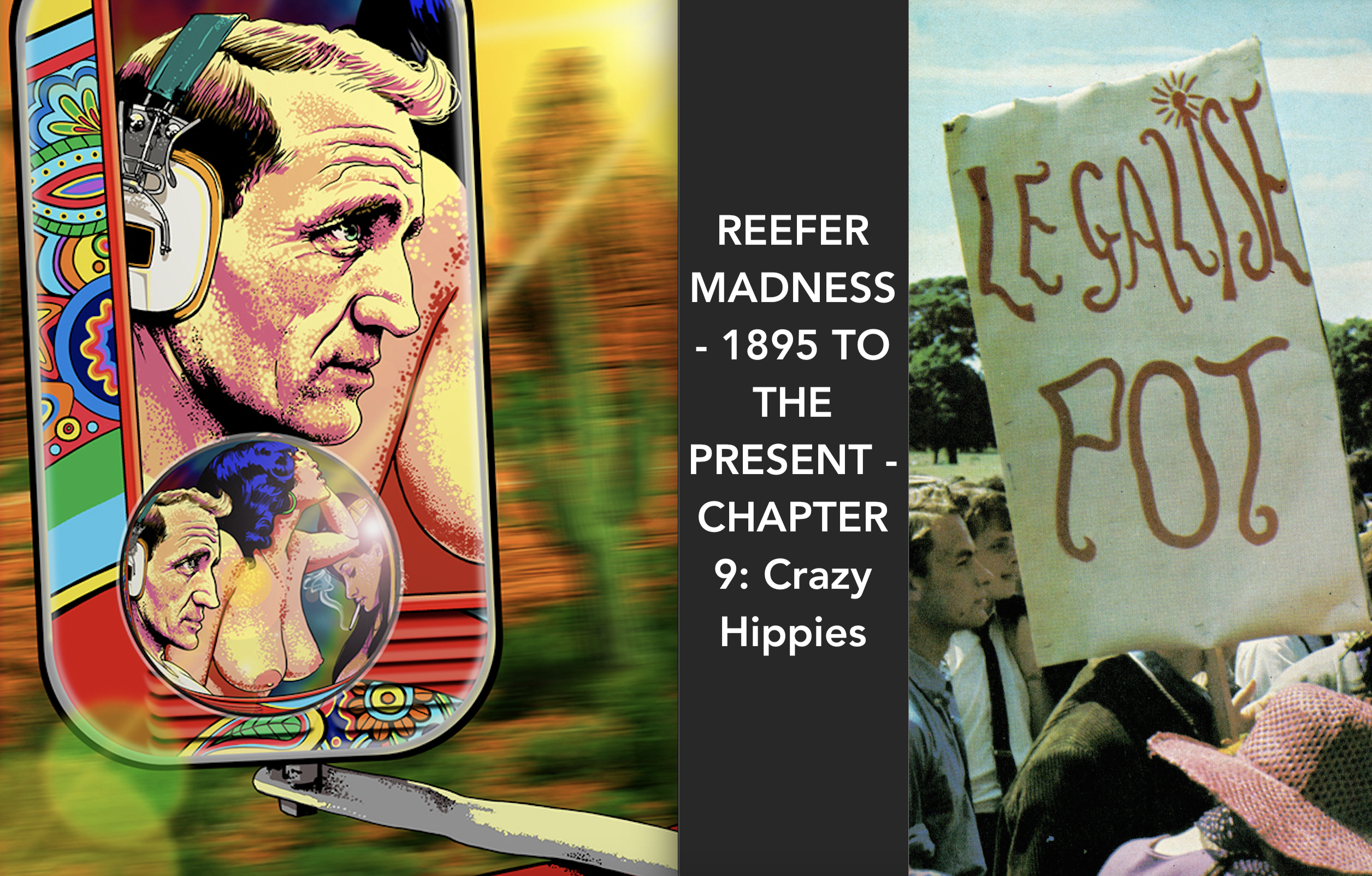
Reefer Madness – 1895 to the Present – Chapter 12: 1990 to 1997 – Not In Control
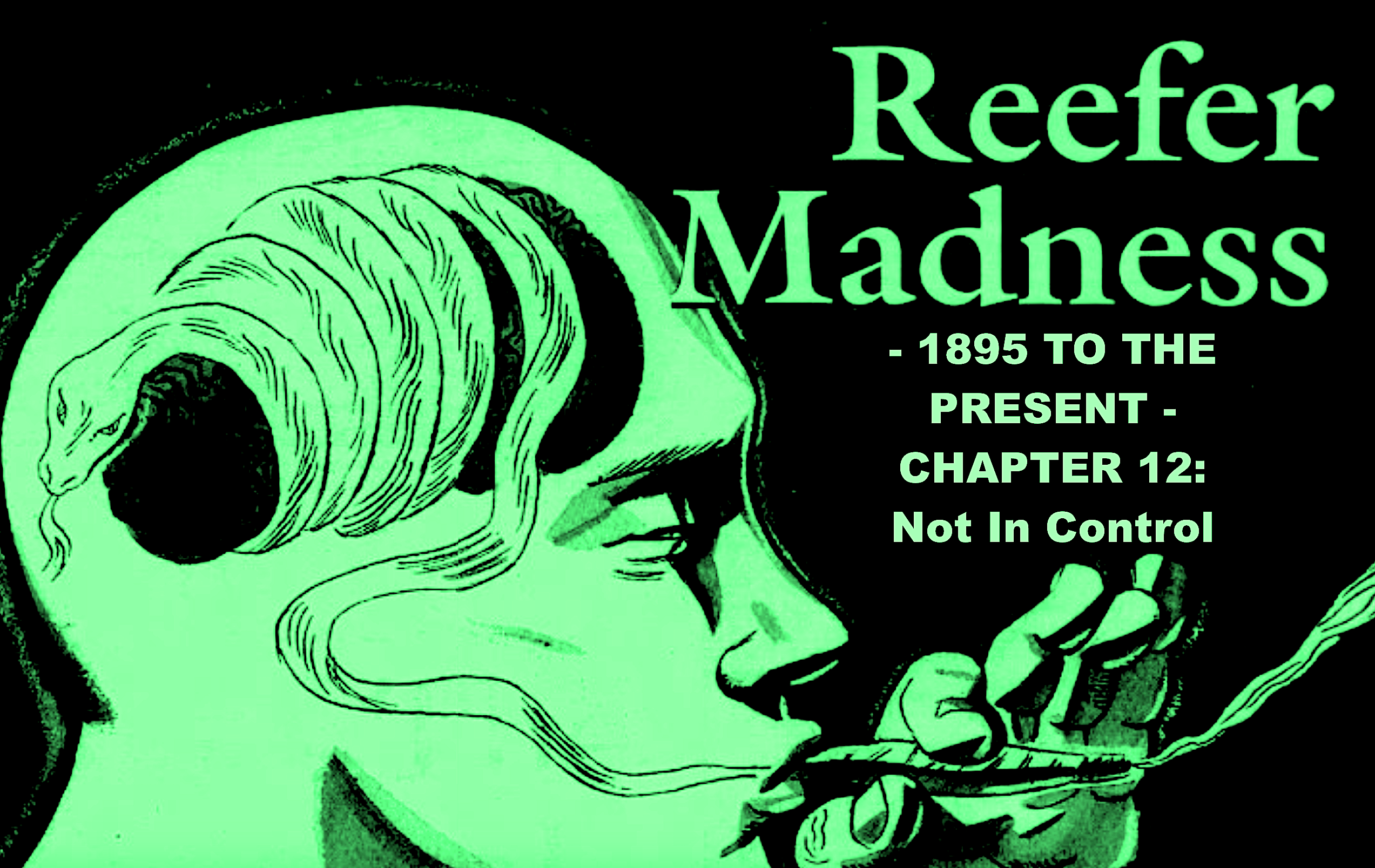
The 1990s. A time when the Hempsters exploded onto the scene and took control of the narrative.
Had the movement stayed unified, we might have had everything we wanted by the end of the 1990s: legalization of industrial, medicinal and recreational cannabis for every person in North America without any restrictions other than fair trade organic standards. But we didn’t stay united, and all we got at the end of the 1990s – in the US – was (arguably, sometimes) med pot in California, Oregon, Washington, Alaska and Maine, and – in Canada – hemp seed oil, hemp bedding for animals and the possibility that the cops might – might – put cancer patients and their pot suppliers on a lower raid priority than other harmless pot criminals. Or not.
Special thanks to the Cannabis Museum for sponsoring the creation of this series. The introduction to this series (Reefer Madness – 1895 to the Present) can be found here. Chapter 1 can be found here. Chapter 2 can be found here. Chapter 3 can be found here. Chapter 4 can be found here. Chapter 5 can be found here. Chapter 6 can be found here. Chapter 7 can be found here. Chapter 8 can be found here. Chapter 9 can be found here. Chapter 10 can be found here. Chapter 11 can be found here.
“Rebellion is a young man’s game. . . . Once we get out of the 80s, the 90s are going to make the 60s look like the 50s.”
- Dennis Hopper, at the end of the film Flashback, 1990
“But the reason the pro-marijuana lobby want marijuana legal has little to do with getting high, and a great deal to do with fighting oil giants like Saddam Hussein, Exxon and Iran. The pro-marijuana groups claim that hemp is such a versatile raw material, that its products not only compete with petroleum, but with coal, natural gas, nuclear energy, pharmaceutical, timber and textile companies. It is estimated that methane and methanol production alone from hemp grown as biomass could replace 90% of the world’s energy needs. If they are right, this is not good news for oil interests and could account for the continuation of marijuana prohibition.”
– Hugh Downs commentary on hemp, ABC News, NY, November 1990 (1)
“Emery is an intense 36-year-old, married with two teenagers, short hair, round glasses, who has the air of a passionate young college professor. He wears a white shirt with a button that says: ‘Hemp Can Save the Earth.’”
-“For hemp lovers at the end of their rope, there’s legal plotting for pot,” Vancouver Sun, July 14th, 1994 (2)
“If we are going to ‘save the world with hemp,’ then our work is cut out for us. Basic technology has been lost. The genotypes of thousands of cultivars of hemp have been destroyed. Our industrial capacity to spin and weave natural fibres has been dismantled. It will take years of work and millions of dollars in investment to reestablish this industrial base. When one considers that the alternative to this commitment is potential global extinction, it’s time we got started.”
– Don Wirtshafter, “The Schlichten Papers,” from the book Hemp Today, edited by Ed Rosenthal, 1994 (3)
“When you smoke marijuana, you’re not in control”
– Marijuana anti-drugged driving PSA broadcast on TVB Pearl, Hong Kong, March 1990 (4)
 Image #1: Marijuana anti-drugged driving PSA broadcast on TVB Pearl in March, 1990. Image from: https://www.youtube.com/watch?v=S_rgRlMTEBE
 Image #2: Marijuana anti-drugged driving PSA broadcast on TVB Pearl in March, 1990. Image from: https://www.youtube.com/watch?v=S_rgRlMTEBE
The 1990s was a decade of cannabis-based rebellion. The cannabis community, after having survived the 1980s, pushed back against the repression and stigma. The pendulum once again swung the other way. The leadership of that rebellion, arguably, passed half-way through the decade from the man who spread awareness of the potential for hemp to save the world – Jack Herer – to the man who spread awareness of the potential for medical marijuana to save lives – Dennis Peron.
But the hemp rebellion was betrayed by two of the core members of the “old guard.” Ed Rosenthal, the man who became the most often quoted and published grow guru – the leader of the home-grow revolution – and the first custodian of the Hemp, Marijuana and Hash Museum of Amsterdam, also drove a knife into the heart of the hemp movement with the publication of his book Hemp Today in 1994. Dave Watson – another grow expert, cannabis genetics collector, cannabis antique bottle collector and American living in Holland – twisted the knife and killed what was left of the hemp movement by helping to ram through the over-regulation of industrial hemp in Canada in 1997.
I believe each of these two men did the hemp movement a disservice, as my investigation of their actions over the years has revealed that Rosenthal’s attack on hemp as a viable fuel crop was completely unjustified, and Watson’s facilitation of hemp over-regulation was at best an unnecessary placation of authority, and at worst a crime against humanity and most living things on planet earth, dooming us all to suffer from the crop failures, forest fires and rising sea levels that come with hemp-ethanol-deficit-related climate destabilization.
This author is in a unique position to pass such judgments against these men because a) he met each of these men – Jack Herer, Dennis Peron, Ed Rosenthal, and Dave Watson – during the 1990s cannabis rebellion, and b) studied their activities closely, from within the movement.
From September of 1989 to March of 1990, this author hitchhiked all over North America, Europe and Morocco. After buying Anarchy Comics in the Bound Together bookshop on Haight Street in October of 1989, and after seeing “LEGALIZE CANNABIS” spray-painted on a wall in an otherwise pristine town in Switzerland in January of 1990, having smoked hash on a boat ride from Gibraltar to Tangier in early February, I found myself in Amsterdam and finally visited a marijuana-selling “coffeeshop.” It was late February of 1990 – and I had stepped inside The Grasshopper.
 Image #3: The author, feeding pigeons at the Palace of Fine Arts in San Francisco, California, one day before the Loma Prieta earthquake, October 16th, 1989.
 Image #4: The author, sitting on a ruptured sidewalk in San Francisco, one day after the Loma Prieta Earthquake, October 18th, 1989.
 Image #5: “LEGALIZE CANNABIS” graffiti, somewhere in Switzerland, January 1990. Photo taken by the author.
 Image #6: The author, holding a big juicy orange and a friend from high-school. Valencia, Spain, late January 1990.
 Image #7: The author, buying water from a very well-dressed water salesman, in the markets of the labyrinth of souks in Marrakech, February 1990.
 Image #8: The Grasshopper, which has now been transformed into a bagel shop, located at Nieuwezijds Voorburgwal 59, 1012 RD Amsterdam. They had excellent hashish for sale. Photo taken by author, February 1990.
I marvelled at the cannabis and hashish menu, then asked the bud tender to provide me with his best gram of hash. I got totally “fried on both sides,” as the kids say. I sat there in the coffeeshop, looking out the window, admiring the cleanliness of the Dutch streets, the health and wealth and vitality of the locals, the orderliness of its not-legal-yet-very-tolerated marijuana distribution system, and the civility of it all. I wondered what it was about the Dutch that allowed them to be this progressive, this clean, this orderly, this caring of the less fortunate, this respectful for individual autonomy, but prevented my fellow Canadians from doing the same thing. I eventually arrived at the answer: nothing. Nothing did.
 Image #9: Amsterdam, January 1990 – right before the author’s visit. Image from: http://www.thecannachronicles.com/police-blow-1990/
There was no reason not to have the same – or better – cannabis distribution system in Canada. In fact, Canadians had liberated the Dutch from their Nazi occupiers in WW2, as every Dutch person I met there would remind me, upon hearing that I was Canadian. Why not take advantage of the freedom we fought for – and they enjoyed – by learning from it and copying it and improving upon it?
It wouldn’t be until 1992 that I would get a copy of Jack Herer’s The Emperor Wears No Clothes, which showed me and others the scope of cannabis’s potential to replace non-renewable resources, reverse the Greenhouse Effect, and save the world. The book also showed me (and others) a compelling way to approach the legalization debate, intellectually.
 Image #10: The Emperor Wears No Clothes, Jack Herer, HEMP / Queen of Clubs Publishing, Van Nuys, California, 1992 edition.
I acquired my copy of Emperor – and my desire to become a cannabis historian – in June of 1992, after watching a play entitled Saskatchebuzz, performed by the Edmonton-based comedy troupe Three Dead Trolls in a Baggie. (5)
 Image #11: “Nutty, lowball Canuck charm is unsquelchable,” Edmonton Journal, June 24th, 1992, p. 54
The play involved the following premise: What if Saskatchewan were to legalize hemp/marijuana and secede from Canada? It was a laugh riot. At the end of the show, the actor Wes Borg sold copies of The Emperor Wears No Clothes to members of the audience. I bought one. I read it. I had wanted to fight evil empires and help save the world since I turned six years old and saw Star Wars: A New Hope – the first movie I had ever seen on the big screen. I was now 21 years old, and Jedi master Herer showed me the way to make a difference. I now had a mission.
 Image #12: Bus shelter ad, Edmonton, Alberta, circa 1993. Photo by author.
 Image #13: Billboard ad, Edmonton, Alberta, circa 1993. Photo by author.
In June of 1993 I began to help organize smoke-ins in Edmonton. I used the Yippie publication Blacklisted News (which I had bought in Berkeley on my second trip to the San Francisco Bay Area in 1992) to learn some strategies from those who had organized most of the previous smoke-ins. I also learned some arrest-resistance tactics from the documentary film Berkeley In The Sixties. Combining Yippie and Berkeley assertiveness techniques, I came up with a formula for maximizing the effects of cannabis-related civil disobedience, when we began holding smoke-ins in Edmonton in 1993. I would call it “Hug Power.” My co-conspirators and I achieved some success in getting front-page attention to the cause.
 Image #14: Blacklisted News: Secret Histories from Chicago ’68 to 1984, New Yippie Book Collective, Bleecker Publishing, New York, 1983.
 Image #15: Berkeley in the Sixties, 1990, Image from: https://vimeo.com/ondemand/berkeleyinthe60s See also streaming free online: Berkeley In The Sixties [Produced and Directed by Mark Kitchell, 1990] https://www.diggers.org/berkeley_in_the_sixties.htm#Intro
I met Jack Herer once – in 1993 – when he came up for the first annual Hempfest in Salmo, B.C., August 27-29th of that year. I showed him my 2-page summary of Emperor in the University of Alberta student newspaper The Gateway that was printed in the January 28th, 1993 edition. (6)
“You wrote this?” He asked.
“Yup.” I answered.
He seemed impressed. I don’t remember much of the rest of the conversation, except for a feeling of confirmation that I was on the correct path through life.
 Image #16: “Why they banned it – how it can save the world – marijuana – The miraculous super-chemical,” Gateway, University of Alberta student newspaper, January 28th, 1993, p. 8. Image from Potshot #5, p. 1: https://pot-shot.ca/2017/11/04/issue-5/
 Image #17: “Why they banned it – how it can save the world – marijuana – The miraculous super-chemical,” Gateway, University of Alberta student newspaper, January 28th, 1993, p. 9. Image from Potshot #5, Summer 1994, p. 2: https://pot-shot.ca/2017/11/04/issue-5/
 Image #18: Poster for HEMPFEST 93. From the photos section of the Facebook page of Paul DeFelice.
 Image #19: The author, wearing the “FUCK THE POLICE” shirt he bought in Berkeley, California, attending the HEMPFEST 93 event, Hidden Creek Ranch, BC, August 28th, 1993. Photo by Jana.
 Image #20: “Lighting a torch for hemp,” The Province, Vancouver, British Columbia, August 29th, 1993, p. A17
 Image #21: The author, speaking onstage at HEMPFEST 93, wearing a black hat with the Yippie insignia, August 29th, 1993.
By 1995, the Edmonton smoke-ins were attracting hundreds of participants, musicians, journalists, and the ire of the established order. (7)
Soon-to-be world-famous pot seed seller and hemp/marijuana activist Marc Emery needed someone to help throw pot rallies in Vancouver, and I needed a pot job. I didn’t enjoy any of the Edmonton jobs I had experienced so far: a drug-store clerk, a vinyl-siding installer, a donut tender and a hospital security guard (making sure the alcoholics didn’t make a break for the tavern and drink on their tobacco smoke breaks). I saw no future in the hemp-substitute industries.
So in September of 1995, I was flown out to Vancouver by Marc to begin my life as a profession pot activist. I had turned pro. I had gotten sponsored. I felt like a pro-skater or pro-surfer . . . only cooler. Instead of riding a board, I rode a high. Instead of getting big air, I got a big dignity kick from helping to organize the breaking of stupid laws out in the open, en masse.
In early 1996, Ed Rosenthal had come to Vancouver to visit our growing movement. Ed was to become the grow advice columnist in Cannabis Canada magazine (which became Cannabis Culture magazine in 1998). My meeting with him didn’t go very well. He was a bit peeved at me for using illustrations from his grow guides in my pot zine Potshot to help teach people how to properly sex their pot plants so that they could grow sinsemilla. I was trying to teach as many people to grow as possible. He was trying to make money, and suggested that I (who was making 10 dollars per hour at the time) hire my own illustrator if I wanted to teach people using the power of image.
 Image #22: “New Hype About Hemp,” San Francisco Chronicle, May 4th, 1993, p. 39
 Image #23: “all the dope,” The Sydney Morning Herald, April 29th, 1994, p. 49
 Image #24: Ed Rosenthal approaching the microphone, Vancouver City Hall anti-raid-on-Hemp-BC-protest, February 3rd, 1996. The author is standing directly behind him. Photo from Cannabis Culture.
 Image #25: Image from Potshot #8, March 1995, p. 57: https://pot-shot.ca/2017/11/04/issue-8/
It would be one thing if I had copied and sold his entire book – or an entire chapter of his book. That would be unjustified theft. But I had only stolen one image from it. And I gave him credit for producing the image. (8) My belief is that images are more similar to words than to entire works – if we have to pay someone every time we want to use one, our ability to evolve and get smarter as a species is hampered – not helped – by proprietary concerns. I was thinking that the benefit to our community from everyone being able to sex marijuana plants outweighed the benefit of everyone within our community holding a strict proprietary view of information. I still believe that.
I understand not everyone shares my view – especially those who struggle to pay their rent by commodifying information . . . such as writers like Rosenthal, or such as artists. When I mentioned Rosenthal to my artist associate Bob High (who was my art partner on Vansterdam Comix), he told me that he was angry that Rosenthal took a picture of Bob’s mural at the Blunt Bros. café in Vancouver, stuck it in his The Big Book of Buds (9), and gave himself a photo credit without crediting Bob for producing the art – or even asking Bob’s permission to put it in his book. Those proprietary information rules are sure tricky. I’m happy that Rosenthal didn’t pursue legal action against me, though.
 Image #26: Image from The Big Book of BUDS, Quick American Archives, Ed Rosenthal, editor, 2001, p. 123
 Image #27: Ed Rosenthal, circa 2022. Image from: https://growupconference.com/speakers/ed-rosen (image since taken down).
My meeting with Dennis Peron was different. He came to Vancouver in August of 1996 to speak at the 25th anniversary rally of the Grasstown police riot. We discussed his theory – that I agreed with – that all pot use was a form of medical use – that it was all legitimate.
“A broken heart don’t appear on no X-ray.” he told me.
 Image #28: Dennis Peron in Vancouver, August 1996. Jordan Emery is directly behind him. Photo from Cannabis Culture.
The meaning behind that statement – that some of the conditions that cannabis was used to treat could not be quantified or even detected through traditional medicine techniques – would stick with me through my career, and help me understand how applicable a broad a definition of medicine was to understanding medical marijuana and to helping marijuana users.
 Image #29: Dennis Peron, sitting behind an array of bowls of various strains of cannabis, at Peron’s Big Top pot supermarket, circa 1977. Image from the X account of Chris Blackburn, circa 2019. https://x.com/CJBdingo25
 Image #30: Dennis Peron, sitting behind an array of bowls of various strains of cannabis, at Peron’s Big Top pot supermarket, circa 1977. Image from the X account of Chris Blackburn, circa 2019. https://x.com/CJBdingo25
 Image #31: “Suspect Wounded,” The Times, San Mateo, California, July 21st, 1977, p. 3
 Image #32: “Pot ‘supermarket’ raided by police,” Times-News, Twin Falls, Idaho, September 7th, 1977, p. 12
 Image #33: “Marijuana merchant’s defence: Someone’s got to have pounds,” The San Francisco Examiner, San Francisco, California, October 21st, 1977, p. 41
 Image #34: “S.F. FAVORS END TO PROSECUTING POT SMOKERS,” The Los Angeles Times, Los Angeles, California, November 9th, 1978, p. 26
 Image #35: Dennis Peron, circa 1980s. Image from: https://www.paradiseburning.com/single-post/2018/02/12/Winning-the-War-on-Drugs-An-Interview-with-Dennis-Peron
On August 4th 1996, Peron’s club in San Francisco was raided by the California state police – who accused Peron of making “non-medical” sales. Marc Emery called me and asked me if I could find Peron, who was hanging out at the Vancouver Pride Parade. Somehow I found him and told him the bad news. He immediately took the next plane back to San Francisco to do what he could to turn that crisis into an opportunity. By November of that same year, Proposition 215 (a citizen’s initiative he and Brownie Mary initiated) was voted into law, and medical marijuana suddenly became legal in California and Arizona. Every election period since 1996, mostly through the power of citizens initiatives, medical marijuana would sweep across the United States, and the effects of this expansion of dignity and tolerance would be felt globally.
 Image #36: Jack Herer and Dennis Peron, circa 1997. Image from: https://radiosarajevo.ba/vijesti/svijet/otac-medicinske-marihuane-preminuo-u-72-godini/289413
Dave Watson was a man who was well respected in the pot movement. Watson was the Chairman of the International Hemp Association and president of Hortapharm, the Dutch company that provided G.W. pharmaceuticals with all their cannabis genetics. His alias was “Jingles” in California and later “Sam the Skunkman” in Dutch growing circles. Watson was busted in the US city of Santa Cruz in the mid 1980s and then appeared in Holland one month later with hundreds of thousands of amazing pot seeds to sell. He also magically received the “only license to study medical cannabis in Holland.” He certainly had some powerful, mysterious friends. (10)
 Image #37: “David Watson and Diana Angled in the 1960s.” Image from: https://www.cannabisbusinesstimes.com/top-stories/news/15736155/legendary-cannabis-breeder-david-watson-aka-sam-the-skunkman-dies
 Image #38: “Selgnij” (Jingles spelled backwards), author of the “Sun, Soil, Seeds & Soul” article, (most likely David Watson), from Blotter magazine, issue #4, 1979. Image from: http://www.thecannachronicles.com/sun-soil-seeds-soul-1979/
 Image #39: Quote from “The Mysterious Mr. Watson,” September 9, 2018 by Steven Hager: https://stevenhager.net/2018/09/09/16076/
 Image #40: Very likely a photo of part of the seed collection that authorities allowed to be moved from California to Holland to begin the Dutch cannabis seed economy, including the winner of the first Cannabis Cup – Skunk #1. From the “Sun, Soil, Seeds & Soul” article, (most likely David Watson), from Blotter magazine, issue #4, 1979. Image from: http://www.thecannachronicles.com/sun-soil-seeds-soul-1979/
 Image #41: Quote from “The Man Who Would be King of Cannabis,” August 4, 2023 by Steven Hager: https://stevenhager.net/2023/08/04/the-man-who-would-be-king-of-cannabis/
 Image #42: Image from “Sam the Skunkman: The Evolution of Hybrids,” Mark Smith, Updated on 02/12/2025: https://sensiseeds.com/en/blog/sam-the-skunkman-the-evolution-of-hybrids/
 Image #43: Quote from The Grow Show – Mel Frank [3of4], in an interview with Marijuana Man for PotTV, beginning at 6:11 of the video: https://www.youtube.com/watch?v=qvkcfrcXmMM
 Image #44: The Grow Show – Mel Frank [3of4], in an interview with Marijuana Man for PotTV, beginning at 6:11 of the video: https://www.youtube.com/watch?v=qvkcfrcXmMM
 Image #45: Quote from Robert Connell Clarke, on David Watson getting the first (and for many years, only) license to grow pot from the Government of Holland, Hash Church, Season 11, episode 20, “Special Rob Clarke Q and A”, May 18th, 2025, https://www.youtube.com/watch?v=Zel-SV4rV3Y beginning at 31:20 of the video.
 Image #46: Robert Connell Clarke, on David Watson getting the first (and for many years, only) license to grow pot from the Government of Holland, Hash Church, Season 11, episode 20, “Special Rob Clarke Q and A”, May 18th, 2025, https://www.youtube.com/watch?v=Zel-SV4rV3Y beginning at 31:20 of the video.
 Image #47: Quote from “David Watson Aka Sam the Skunkman,” Marco Renda & Joe Petri, July 25, 2024: https://www.hscrew.ch/en/blogs/cannaspiracy-reality/david-watson-aka-sam-the-skunkman
 Image #48: Image of a DEA license from November 18th, 1993 that allowed Watson – through his company HortaPharm – to supply cannabidiolic acid (CBDA) – a precursor to CBD – to a researcher in the United States. Image from https://www.icmag.com/threads/skunkman-sam-wasnt-a-dea-collaborator.18134580/
Watson came to Vancouver to speak at the Commercial & Industrial Hemp Symposium on February 19th, 1997 (11) – where Health Canada – the government agency responsible for the new hemp regulations – came to announce the “legalization” of industrial hemp. The tight controls hemp was placed under guaranteed a seed breeder monopoly – in order to breed and sell hemp seeds for others to grow with, you needed to have the equivalent of ten years apprenticeship underneath another licensed breeder plus a science degree. It would also severely limit which hemp products would be economically viable. And Dave Watson was there to sell the community on these regulations being necessary.
The way Watson prevented there being any real discussion of the over-regulation/monopoly at the Hemp Symposium was to argue that any such talk was a “marijuana issue” and they were “separating the issues.” During the Q and A part of his talk, I asked a question:
“My concern is farmers having self-sufficiency . . . my question to you is, given the proven environmental and health benefits of hemp and the necessity that we get these benefits now, and given these regulations hurt hemp farming, do you feel that it is cowardly and maybe even immoral that people in the hemp industry don’t speak up against these unnecessary restrictions?”
Mr. Watson was unimpressed with my question, and responded thus:
“Well do you think it is the proper thing to do to put a millstone around the hemp industry by forcing them to legalize marijuana for you?”
“Not for me. Not for me. But so that farmers don’t have to go to this company and that company to beg them for seed, instead of growing our own seeds and having self-sufficiency. Why should we have to kowtow to these obviously irrational (and maybe genocidal) interests?”
“My personal opinions don’t really matter in this issue but I think there are to separate issues . . . one is industrial hemp and one is recreational and medicinal cannabis – they don’t belong together.”
“You heard my question.”
“We are separating the issues, sir. This isn’t a conference to deal with the other.” (12)
 Image #49: The author, speaking to David Watson at the Commercial & Industrial Hemp Symposium, February 19th, 1997, in Vancouver. Photo from Cannabis Culture.
 Image #50: How David Watson helped prevent any discussion of the over-regulation of industrial hemp, at the Commercial & Industrial Hemp Symposium, February 19th, 1997, recorded in the film The Hempen Road, 1997. Quote from 1:11:49 of the video: https://www.youtube.com/watch?v=PbLegWsujxA
 Image #51: David Watson, speaking to the author, at the Commercial & Industrial Hemp Symposium, February 19th, 1997, recorded in the film The Hempen Road, 1997. Beginning at 1:11:49 of the video: https://www.youtube.com/watch?v=PbLegWsujxA
And thus Watson prevented the one real opportunity of over-regulation of industrial hemp being challenged in a public setting in Canada – if not all of North America. Instead of “the market” deciding what the potential for industrial hemp would be – as Ed Rosenthal said would happen – the Canadian government (with the help of Dave Watson) decided instead.
It should be noted that the International Hemp Association – of which Dave Watson was Chairman – did publish a cursory protest letter to Health Canada in early 1998, arguing for slightly looser regulations and slightly higher THC levels, but did not question the premise that hemp seed breeding should be limited to professionals (in fact it was argued that farmers should not be able to save, share, trade and sell their own seeds) and did not question the treatment of cannabis as a hard drug;
“Enforcement under a system similar to Europe will be nearly failure proof, if the new Canadian regulations follow Europe’s lead. The various European systems require that only certified hemp varieties can be purchased for sowing and only from a licensed seed seller, by a licensed grower with a declared end use for the crop. This system has proven quite effective everywhere it is used.” (13)
So it wasn’t just the “separation of issues” during the Hemp Expo of 1997. Watson’s “personal opinion” was to be in favour of a hemp seed breeder monopoly regardless of what agreed upon limitations existed during one 1997 hemp symposium.
 Image #52: “DAVID WATSON AND GEOFFREY GUY at the 1998 meeting of the International Cannabinoid Research Society in La Grand Motte, France.” Image from: https://beyondthc.com/wp-content/uploads/2016/09/BAyer-GW-2003.pdf
And the “effectiveness” Watson mentioned in the above quote (In keeping the wrong people from growing hemp? In preventing industrial hemp from achieving its true potential?) can be attested to by the lack of hemp paper, hemp clothing, hemp plastics, hemp concrete, hemp pressed particle board and hemp ethanol available for purchase, in spite of hemp being “legal” in Canada for nearly 30 years. The hemp seed breeder monopoly (and other over-regulation) kept prices artificially high, and priced hemp out of most markets. The excuse for a hemp seed breeding monopoly was that it would prevent screw-ups in breeding, but screw-ups happened anyway. Just ask Arthur Hanks – formerly of the Canadian Hemp Trade Alliance – about how accredited breeders fucked up USO 14.
 Image #53: Watson, photographed “at a secret location between the airport and the city of Amsterdam,” at the HortaPharm greenhouse. “Cannabis: a year that changed minds,” The Independent, London, England, September 27th, 1998, p. 10
My intuition says that David Watson was provided with many favours to get to be in the position of power and authority that he enjoyed in 1997, and was asked to do some favours in return. But I could be wrong about David Watson. Maybe he was just a guy who – all on his own – found a way to avoid jail from a California pot bust, and – all on his own – found a way to smuggle thousands and thousands of pot seeds into Holland, and – all on his own – found a way to get one of the only DEA licenses in the world to breed marijuana and sell extracts, and then decided – all on his own – to prevent any discussion of hemp over-regulation, because he felt it was the best way to legalize industrial hemp, which would end up being the fastest path to our collective liberation.
 Image #54: “David with Mahmoud ElSohley, who ran the DEA UMiss cannabis research centre, & Roger Pertwee of the University of Aberdeen, at an ICRS (International Cannabinoid Research Society) meeting.” Image from https://www.icmag.com/threads/skunkman-sam-wasnt-a-dea-collaborator.18134580/
But as the world suffers from climate destabilization – forest fires, ice caps melting, flooding, crop failures – and the time runs out to do anything about it (for example switching our energy grid over to hemp ethanol and reversing the greenhouse effect), every incremental step towards legalization can also be seen as a possible unnecessary delay in salvation (especially when these incremental steps are being chosen and significant steps are being ignored as a result), and the chances of these unnecessary delays becoming a “devastating-to-humanity” compromise – no matter how well-meaning David Watson was with his compromises – is already higher than zero.
Perhaps we’ll never know. But perhaps we can learn from Watson’s example, and realize that the voices arguing most loudly for incremental steps are almost invariably the people who have found themselves with some type of exclusivity . . . some type of privilege . . . some position of importance . . . some kind of status . . . something to lose if the established order is overturned and hemp is suddenly regulated like the soft drug – the herbal medicine – that it is.
Are the people calling for incremental steps inviting universal access to the cannabis economy? Or are they resisting it in some way? In my opinion, the people who call for cannabis to be regulated like fair trade organic coffee beans are almost always the people who’s income won’t be impacted negatively if cannabis stopped being regulated like the hard drug that it isn’t.
And maybe – just maybe – the “hemp conspiracy” doesn’t have anything to do with one particular invention or hemp substitute or prohibition-related money-making operation – the decordicator, or nylon, or gasoline, or a hemp seed breeder’s monopoly, or Marinol, or Sativex, or filling the jails with cannabis criminals for all the cheap labour for the prison industry. Because a major effort to demonize cannabis began before most of these inventions came on the scene . . . way back in 1895.
Maybe the hemp conspiracy is just an unconscious realization that cannabis is our coevolutionary plant partner, and to deny it to people or limit who has access to it is the easiest way to enslave people, and powerful people want slaves – prison labour or wage slaves. Powerful people tend to reward those who articulate or realize their needs. Ambitious people realize this intuitively – without a single meeting with (or message from) the powerful being necessary. Maybe the hemp conspiracy is informal, and involves nothing other than intuition and greed.
The 1990s began with a continuation of the 1980s situation: an onslaught of anti-pot propaganda in every kind of mass medium, along with a small but determined group of hemp activists spreading awareness in new and exciting ways.
US school children could sign-out Focus On Marijuana from the library, and learn important facts such as “Marijuana harms the growing minds of young people” (14) and that “The cells in the brain and the nervous system are also damaged by marijuana.” (15) Canadian school children could sign out WHAT YOU SHOULD KNOW ABOUT DRUGS & ALCOHOL, and learn that marijuana “interferes with emotional growth and personality development of adolescents.” (16) All use is seen as abusive. The effects of familiarity and dose are ignored. The gateway theory is trotted out. Neither psychosis nor schizophrenia are mentioned directly in these 1990 publications, however.
 Image #55: Focus On Marijuana, Paula Klevan Zeller, Twenty-First Century Books, Frederick, Maryland, 1990
 Image #56: “He may not be on the team for long.” Focus On Marijuana, Paula Klevan Zeller, Twenty-First Century Books, Frederick, Maryland, 1990, p. 32
 Image #57: WHAT YOU SHOULD KNOW ABOUT DRUGS & ALCOHOL, Tyrell Press, Gloucester, Ontario, 1990
 Image #58: “. . . many users go on to abuse harder drugs.” WHAT YOU SHOULD KNOW ABOUT DRUGS & ALCOHOL, Tyrell Press, Gloucester, Ontario, 1990, p. 13
1990 was also the year Cartoon All-Stars to the Rescue was broadcast on TV and released on VHS. The cartoon is the story of “Michael – a teenager” who “is using marijuana and stealing his father’s beer.” (17)
“Winnie the Pooh, Bugs Bunny, Alf, The Teenage Mutant Ninja Turtles and a host of other animated all-stars” combat the evil influence of “Smoke” – “a deceptive and corrupting character who’s leading Michael down the road to a drug-abuse dead end.” The 30-minute cartoon involves sequences within Michael’s mindscape that seem more LSD-inspired than pot-inspired. The VHS cover promises that “DRUGS DON’T STAND A CHANCE AGAINST THESE GUYS!” The “education” promised on the back cover is a combination of cliché, falsehoods and scare tactics that does a terrible job of educating children about drug use and abuse but a wonderful job of scapegoating the users of cannabis.
 Image #59: CARTOON All-Stars TO THE RESCUE, Academy of Television Arts and Sciences Foundation, distributed by Buena Vista Home Video, 1990, VHS https://www.youtube.com/watch?v=lwDTB7yVN9I
 Image #60: CARTOON All-Stars TO THE RESCUE, Academy of Television Arts and Sciences Foundation, distributed by Buena Vista Home Video, 1990, VHS https://www.youtube.com/watch?v=lwDTB7yVN9I
 Image #61: CARTOON All-Stars TO THE RESCUE, Academy of Television Arts and Sciences Foundation, distributed by Buena Vista Home Video, 1990, VHS https://www.youtube.com/watch?v=lwDTB7yVN9I
This “drug education” should be viewed as one part of the establishment’s expansion of the drug war. In January of 1990, President Bush had called for a 11.6 percent increase in the drug war budget – to an all-time high of 10.6 billion dollars. A third of that money was to go to “education, prevention and treatment,” a third to “domestic enforcement” and a third to “border interdiction and international operations” such as the invasion of Panama a month earlier. The severity of Bush’s anti-drug rhetoric had also increased;
“We are proposing the death penalty for drug kingpins and those responsible for drug-related killings, and even, in some cases, attempted killings.” (18)
One might argue that the up to 4000 deaths from Bush’s invasion of Panama counted as “drug-related killings,” (19) but the drug war has always been a “do as I say, not as I do”-type of situation.
 Image #62: Malaysia executed Indonesian national Basrie Masse for possession of just over 2 pounds of pot. “Malaysia executes marijuana dealer,” The Toronto Star, Toronto, Ontario, January 20th, 1990, p. 20
 Image #63: Basri Masse, 1981. Image from: “Hanged in a Neighboring Country – Indonesia has made every effort to protect its citizens from the death penalty in Malaysia. However, Indonesia still practices the death penalty.” Hendri F. Isnaeni, June 23, 2024. https://www.historia.id/article/digantung-di-negeri-jiran
 Image #64: According to Amnesty International, hundreds of people have been executed by Malaysia for drug crimes between 1975 and 1995. “The death penalty: No solution to illicit drugs” 1995 https://www.amnesty.org/en/documents/act51/002/1995/en/ Very few details survive regarding the circumstances of Masse’s case. “Indonesian hanged for drug trafficking,” Standard-Freeholder, Cornwall, Ontario, January 20th, 1990, p. 24
 Image #65: How To Keep Your Family & Neighborhood DRUG FREE, New Body fitness magazine “gets in on the drug war” booklet, 1990
 Image #66: “. . . cocaine, opium, and marijuana. . .” “Singapore to execute drug dealers,” The Atlanta Journal, Atlanta, Georgia, February 15th, 1990, p. 17
Operation Green Merchant – begun in October of 1989 – was a DEA operation designed to attack those selling grow equipment and grow information – neither of which were illegal (see Chapter 11, image #393). But that didn’t stop the DEA from conducting nationwide raids, and the operation became front page news on the Spring 1990 edition of Sinsemilla Tips, which would cease publication by the end of the year.
 Image #67: The Spring, 1990 issue of Sinsemilla Tips mentions “Operation Green Merchant,” an attack on the people who advertised in High Times magazine – especially Nevil Schoenmakers – the seed breeder nemesis of David Watson.
One of the targets of Operation Green Merchant was Nevil Schoenmakers, the world’s first international marijuana seed retailer. (20) Journalist/activist Todd McCormick summed up the events this way;
“The DEA’s ‘Operation Green Merchant’ started on October 26th 1989, and by the end of 1991, the operation had arrested 1,262 people, busted 977 indoor grows and confiscated $17.5 million dollars in assets. On July 24, 1990, Nevil was arrested in Australia while visiting his family. Even though Cogo provided the DEA with over 11,000 addresses, Nevil was only charged with sending a total of 1,921 seeds to DEA agents and growers in the New Orleans area from 1985 to 1990, but he was also charged with the cultivation of more than 1,000 plants, by tying him to the conspiracy charges of people who purchased his seeds and grew cannabis in the United States. Nevil served 11 months in prison in Australia while he awaited extradition to the United States.” (21)
Steve Hager, the former Editor In Chief of High Times magazine, has found compelling evidence that Dave Watson may have been involved in Operation Green Merchant and the Nevil Schoenmaker bust:
“. . . was Operation Green Merchant designed to steal Nevil’s throne? There seems to be some sort of ongoing disinfo op to minimize the essential role of Nevil’s Seed Bank in establishing the core genetics employed around the world today. I have to wonder where Nevil would be today had it not been for Operation Green Merchant, a New Orleans-centered op wherein a prosecutor claimed the Cannabis Cup I created was a front for seed distribution, and by buying ads in High Times, Nevil was shuffling his illegal profits to the magazine. In the media, Operation Green Merchant was played as an attack on High Times magazine, but in hindsight, I suspect Nevil was the real target, simply because he ended up neutralized, leaving the door open for Michael Taylor and Dave Watson. . . . When Watson first arrived in the mid-1980s, he’d joined forces with Wernard Bruining, who’d founded the first coffeeshop Mellow Yellow (after the Donovan song) in 1972. However, Bruining became alarmed by the scale of Watson and Taylor’s mission for world cannabis domination, and soon withdrew from the team. Around this time all Mellow Yellow grow ops got busted and these were the first indoor grow busts in Holland’s history. . . . I realize Watson has a booster team supporting his role in documenting and assembling important cannabis strains, and he rewards them with his marvelous hash, but I couldn’t help but notice an illuminating comment made by Nevil online a few years ago: ‘It would have been about ’95, but I’m terrible with dates, but I was working at the Castle for Ben and they came to see me. They wanted to enlist my help in delineating the ancestries of the strains that I had put out. Ben still wasn’t selling anything that I hadn’t made (to the best of my knowledge). I found this to be a remarkable request for a number of reasons. I asked them why? What followed rocked my world. They told me that they were cooperating with the Australian Federal Police, who wanted to establish links between growing operation in Australia using genetic fingerprinting and the information I was to provide. This would lead to longer prison sentences. I’d recently done 11 months in maximum security remand in Australia and alarm bells are going off in my head like crazy. But I can be cool under pressure and decided to draw them out. They knew I had children in Australia and couldn’t go and see them. The suggestion was raised that cooperating might help my chances to be able to go back. They thought they had me. I said that I needed time to consider this proposal and needed some kind of documentary proof that they were genuine. No problem, I was told. On a later visit I was provided with documents from the Australian Federal Police demonstrating that this and much more was indeed the case. I said that I wished to show these documents to a legal adviser before making any decisions and was given their permission to do so. I went to Mario Lap, who used to work for the N.I.A.D. (Dutch institute for alcohol and drugs) and was an adviser to the Dutch Labor Party on cannabis affairs. He has a good paralegal mind and is well acquainted with law as it relates to cannabis. He was horrified as to the implications of those documents and didn’t particularly like American spooks operating in his back yard. He made further inquiries with the various Dutch ministries as to who these people were and who they were connected with and how they got their permits for Hortapharm. Mario is on record as to what he concluded and how that lead to their losing the Hortapharm license, My repeating it would only be hearsay. He may still have the original documents. Some time later when Hortapharm had lost their license and the Dutch law had been changed and seed breeding was illegal in Holland, we were all fairly bitter. Sam wanted a showdown which Arjan ended up organizing. Sam, Rob, Arjan and I met in a coffee shop. I don’t think Scott [Shantibaba] was there. They accused me of bringing down Hortapharm and I accused them of destroying the Dutch scene in order to get a monopoly. They came with their rationalizations the end justifying the means etc, but neither of us denied anything much. Nothing was achieved and we never saw each other again.’ —N.” (22)
 Image #68: What was “Operation Green Merchant” really about? “Who is the real King of Cannabis?” Steven Hager, September 9, 2018 https://stevenhager.net/2018/09/09/who-is-the-real-king-of-cannabis/
 Image #69: Image from “The Man Who Would be King of Cannabis,” Steven Hager, August 4, 2023 https://stevenhager.net/2023/08/04/the-man-who-would-be-king-of-cannabis/
 Image #70: By the late 1980s, Nevil was taking out a full page full colour ad for The Seed Bank every issue. Image from High Times magazine, July 1989, p. 61
 Image #71: Watson also advertised in High Times, although not as big or as often. In this ad he provides no address or promise of a catalogue, just promotion for his cultivar “Skunk #1” along with the California breeding collective Sacred Seeds (which he belonged to) and the Dutch seed company Cultivator’s Choice (which belonged to him). Image from High Times magazine, July 1989, p. 73
 Image #72: By 1990, Nevil’s High Times Seed Bank ads had achieved extreme levels of beauty, legitimacy and respectability. The March 1990 issue of High Times magazine featured a full page/full colour ad for Nevil’s Seed Bank Catalogue. Like Marc Emery did with Cannabis Culture magazine years later, the seed sales paid for a huge chunk of the magazine print run and the investigative journalism and even some of the activism. No wonder the cops wanted to bust the seed merchants. Image from High Times magazine, March 1990, p. 68
 Image #73: Other seed ads began to sprout up. Image from High Times magazine, March 1990, p. 66
 Image #74: Image from High Times magazine, March 1990, p. 71
 Image #75: Image from High Times magazine, March 1990, p. 70
 Image #76: The April 1990 issue of High Times magazine. Image from: https://hightimes.com/magazine/april-1990/
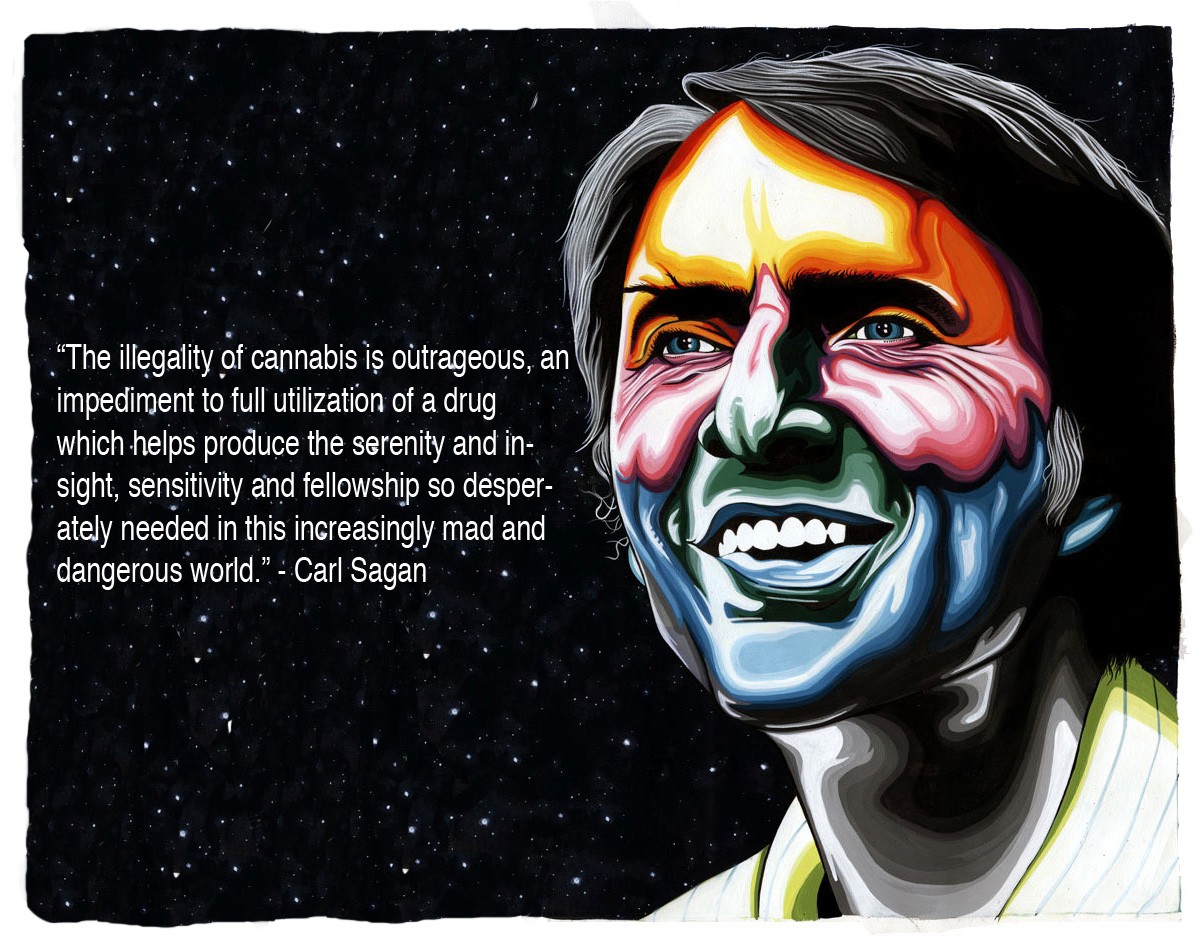
 Image #77: In a letter dated April 27th, 1990, renowned scientist Carl Sagan called for a “systematic attempt to rebut” the Partnership for a Drug-Free America commercials. ”Marihuana Reconsidered: A Look Into Carl Sagan’s Quiet Love for Cannabis and Beyond,” January 25, 2021 https://ecigarettereviewed.com/carl-sagan-marihuana-reconsidered/
 Image #78: Image from ”They Say Pot is Cool. They’re Pulling Your Strings,” Partnership for a Drug-Free America, 1990s https://www.chisholm-poster.com/posters/CL61122.html
 Image #79: Image from KSMO 62 “Puppet Boy” PSA – Partnership for a Drug-Free America, 1991. https://www.youtube.com/watch?v=0TKtCIZNgvw
 Image #80: “DWEEB WEED,” Partnership for a Drug-Free America poster, 1991. Image from ebay.com (no longer available).
 Image #81: “A DRUG TEST FOR PARENTS,” Partnership for a Drug-Free America poster, 1991. Image from eBay.ca.
 Image #82: “Sinsemilla,” The State, Columbia, South Carolina, May 6th, 1990, p. 47
 Image #83: “Sinsemilla,” The State, Columbia, South Carolina, May 6th, 1990, p. 55
 Image #84: “Sinsemilla,” The State, Columbia, South Carolina, May 6th, 1990, p. 55
 Image #85: “Hemp tour ’90,” The Gazette, Cedar Rapids, Iowa, May 11th, 1990, p. 4
 Image #86: “Fans gather around Jack Herer’s bus on a tour in the 90’s.” Photo by Jeannie Herer. Image from https://www.leafly.ca/news/politics/searching-jack-herer-emperor-american-cannabis
 Image #87: “China executes 14 drug dealers,” The Toronto Star, Toronto, Ontario, June 27th, 1990, p. 37
Throwing certain sections of the cannabis community under the bus in order to carve out exclusivity in distribution is a reoccurring theme in cannabis history, be it the prophet/priest/king anointing oil monopoly Moses set up in Exodus 30:33, or Watson’s efforts in Holland in 1995, or Richard Lee’s “make Richard Lee a billionaire initiative” otherwise known as Prop 19 in California in 2010, or the Canadian Liberal Party elite’s pot cartel otherwise known as the Cannabis Act in 2018 – the latter two examples of which will be explored in greater detail in future chapters.
 Image #88: Nevil’s arrest announcement. “Man arrested on drug charges,” The Daily Advertiser, Lafayette, Louisiana, July 25th, 1990, p. 7
 Image #89: The 1987 Seed Bank catalogue, with Nevil Schoenmakers on the back cover. Image from https://thefarmer.com/threads/the-history-of-og-kush.65593/page-14 (image since taken down).
 Image #90: “American Who Mailed Self Marijuana Faces Death Penalty in Malaysia Trial,” The Los Angeles Times, Los Angeles, California, August 1st, 1990, p. 161
 Image #91: “65-year-old arrested for growing marijuana plants,” The Breeze Journal, Breeze, Illinois, August 2nd, 1990, p. 1
Operation Green Merchant wasn’t the only anti-pot operation the man had going on. Operation Green Sweep was an attempt to eradicate the pot growing community of Humboldt County, California, utilizing hundreds of U.S. Army soldiers, National Guardsmen, and federal agents. It was the first time the U.S. military were used to combat pot growers. The same 7th Infantry Division was used in December 1989 to invade Panama. (23) The operation was supposed to have gone on until August 10th, but was cut short by 5 days – most likely due to protests from the locals. (24) In one photo of the anti-Green Sweep protest, a protester can clearly be seen holding up a copy of The Emperor Wears No Clothes. (25)
 Image #92: A protester near the centre of the photo holds up a copy of the Emperor Wears No Clothes. “Emerald Triangle lawmen decry lack of funds,” The Press Democrat, Santa Rosa, California, August 3rd, 1990, p. 14
 Image #93: “‘Operation Green Sweep’ utilizes military,” The Napa Valley Register, Napa, California, August 3rd, 1990, p. 16
 Image #94: “Residents protest marijuana sweep,” The Sacramento Union, Sacramento, California, August 3rd, 1990, p. 1
 Image #95: “Residents protest marijuana sweep,” The Sacramento Union, Sacramento, California, August 3rd, 1990, p. 1
 Image #95: “Drug trial delayed,” The Press Democrat, Santa Rosa, California, August 21st, 1990, p. 5
 Image #96: Final issue of Sinsemilla Tips – covering “Operation Green Sweep” – November 1990.
The author of that book, Jack Herer, was in the paper the next month, in Lansing, Michigan, on a “Hemp Tour” – promoting the industrial and medicinal uses of cannabis, along with Dana Beal and other drug peace activists. (26) The tour went on for four months and involved 27 US states. (27)
 Image #97: “Pot backers rally in peace at KSU,” The Akron Beacon Journal, Akron, Ohio, September 19th, 1990, p. 30
 Image #98: “Shouting hurrahs for hemp,” Lansing State Journal, Lansing, Michigan, September 24th, 1990, p. 13
 Image #99: “Shouting hurrahs for hemp,” Lansing State Journal, Lansing, Michigan, September 24th, 1990, p. 13
 Image #100: “Judge: U.S. suspect in drug trial improperly questioned,” The Sacramento Bee, Sacramento, California, October 4th, 1990, p. 30
The US elections of 1990 struck a severe blow to the rights of the Alaskan pot community – and a setback to the legalization movement in general – when small-scale possession and cultivation was re-criminalized. A legal case in 1975 – Ravin v. State – established the legalization of small amounts of cannabis, based on a privacy defense. (28) On Nov. 6th, 1990, that defense was voted away by the citizens of Alaska in a 55% to 45% vote. Marie Majewske, the Anchorage grandmother behind the initiative, was quoted in the papers with this reaction;
“I think that this will say to people that the law didn’t work, and we need to be looking in the other direction, toward a drug-free environment for our children. The only way to do that is to tell them it’s illegal.” (29)
The police, however, admitted that the vote was largely symbolic, as their practice to respect people’s privacy would not change very much. (30)
 Image #101: “Alaska’s anti-marijuana movement gets national attention,” The Peninsula Clarion, Kenai, Alaska, October 8th, 1990, p. 3
 Image #102: “Bennett stumps Alaska to help banish marijuana,” Sentinel Tribune, Bowling Green, Ohio, October 26th, 1990, p. 3
 Image #103: “2nd Huge Pot Farm Is Raided,” The Los Angeles Times, Los Angeles, California, November 18th, 1990, p. 106
 Image #104: “Sleuths find 2nd underground pot farm,” The Fresno Bee, Fresno, California, November 18th, 1990, p. 2
 Image #105: “NORML continues to push for legalizing marijuana,” The High Point Enterprise, High Point, North Carolina, December 2nd, 1990, p. 35
 Image #106: “NORML continues to push for legalizing marijuana,” The High Point Enterprise, High Point, North Carolina, December 2nd, 1990, p. 44
 Image #107: “Mother testifies at Malaysia drug trial to save son,” The Sacramento Bee, Sacramento, California, December 21st, 1990, p. 26
The book Marijuana – one of many topics covered within the “Drug Abuse Prevention Library” became available in 1991. Within it, one learned that
“Some teens use drugs because they think it makes them more creative. You hear someone say all the time that getting ‘high’ makes the music sound better. They also say they see colors and art with more vision. This is not actually true. The drug alters the mind so that it thinks music sounds better. It also changes vision so that colors seem brighter. The truth is that while users think they are making their vision more clear, they are actually destroying the brain cells that are used to see.” (31)
 Image #108: MARIJUANA, Sandra Lee Smith, The Drug Abuse Prevention Library, 1991, The Rosen Publishing Group, Inc., New York, 1991
 Image #109: “A marijuana joint seems harmless, but it can damage your mind.” MARIJUANA, Sandra Lee Smith, The Drug Abuse Prevention Library, 1991, The Rosen Publishing Group, Inc., New York, 1991, p. 2
 Image #110: “The marijuana that grows in Mexico is much stronger than the American variety.” MARIJUANA, Sandra Lee Smith, The Drug Abuse Prevention Library, 1991, The Rosen Publishing Group, Inc., New York, 1991, p. 14
 Image #111: “People at a pot party are not being creative; they are really damaging their brains.” MARIJUANA, Sandra Lee Smith, The Drug Abuse Prevention Library, 1991, The Rosen Publishing Group, Inc., New York, 1991, p. 47
 Image #112: How to Drug-Proof Kids: A Parents’ Guide to Early Prevention, Jodi M. Freeman, Ags Pub, Circle Pines, Minnesota, 1991, p. 108
In spite of the onslaught of anti-pot propaganda, the Hempsters began to acquire some prominent allies. In November of 1990, respected journalist Hugh Downs reported on the facts contained in The Emperor Wears No Clothes, focusing on the hemp fuel aspect. (32) Downs also wrote the introduction to the 1992 book “Drug Legalization: For and Against.” On his last episode of 20/20
“. . . he was asked if he had any opinions of his own that he would like to express: he responded that marijuana should be legalized.” (33)
 Image #113: “Sacramento man gets 5 years, not death, in Malaysian trial,” The Sacramento Bee, Sacramento, California, January 16th, 1991, p. 13
 Image #114: “Sacramento man gets 5 years, not death, in Malaysian trial,” The Sacramento Bee, Sacramento, California, January 16th, 1991, p. 14
 Image #115: “Police refuse request to raid pro-pot party,” Anchorage Daily News, Anchorage, Alaska, March 15th, 1991, p. 45
 Image #116: More reporting on Nevil’s arrest. “Mail-Order Marijuana Seeds Lead To Arrest,” St. Louis Post-Dispatch, St. Louis, Missouri, May 5th, 1991, p. 17
 Image #117: “Alaskans blow smoke at pot law,” Santa Barbara News-Press, Santa Barbara, California, June 2nd, 1991, p. 7
 Image #118: The Bart Simpson sign has Bart saying “DOWN WITH THE CZAR.” “JUST SAY YES,” The Miami Herald, Miami, Florida, June 8th, 1991, p. 57
 Image #119: “HEMP FOR VICTORY” 1991 TOUR t-shirt, sold by Jack Herer, worn by a protester on the far right of the previous image. Image from: https://ilgmforum.com/t/the-late-great-jack-herer/4002
The alternative media also began to support the Hempsters. In February of 1991, lead singer of the punk rock band Dead Kennedys Jello Biafra released his third spoken word album: I Blow Minds For A Living, which contained the track “Grow More Pot” – a poem/diatribe inspired by The Emperor Wears No Clothes. I had actually heard I Blow Minds before I had gotten a copy of Emperor. It ended with this statement;
“Need I say more, on why our beloved fearless leaders go out of their way to censor our access to information so damn much? Can you imagine the mass outrage if this kind of stuff ever really got out? And people knew that this big drug problem that they keep reading about and hearing about is being caused by the government themselves? And people knew how easily each one of us individually could turn our ecological and human crisis around without resorting to Nazi bullshit like oil wars and drug wars by just saying ‘no!’ to George Bush!” (34)
 Image #120: I Blow Minds For A Living, Jello Biafra spoken word album #3, cover, released June 12th, 1991. Image from: Jello Biafra – I Blow Minds For A Living (Full Album) https://www.youtube.com/watch?v=o3_KgrxLuOE
Still, the stigma onslaught continued. “Brain and reproductive system damage” were listed as the physical effects of cannabis use in a March 1991 drug abuse insert in The Daily Item, a Sunbury Pennsylvania newspaper. (35) But when it came time – as it did in July of 1991 – for Bush to appoint a right-wing judge to the Supreme Court (Clarence Thomas), the disclosure of past cannabis use was no longer seen as a disqualifying criteria. (36) More of that “do as I say, not as I do” ethic.
 Image #121: “A burning question,” Irish Independent, Dublin, Ireland, June 15th, 1991, p. 12
 Image #122: “Cannabis: an issue unresolved,” The Citizen, Gloucester, Gloucestershire, England, June 28th, 1991, p. 14
 Image #123: “Cannabis: an issue unresolved,” The Citizen, Gloucester, Gloucestershire, England, June 28th, 1991, p. 40
 Image #124: “Senators say Thomas pot puffs won’t block chance to join court,” The News-Star, Monroe, Louisiana, July 12th, 1991, p. 14
 Image #125: “GRASS-ROOTS SUPPORT,” Rockford Register Star, Rockford, Illinois, July 12th, 1991, p. 3
 Image #126: “Gauging reefer madness,” The Houston Chronicle, Houston, Texas, July 12th, 1991, p. 10
 Image #127: “Star will miss his show,” Context: “A photo of the West Australian of August 2, 1991, reporting Nevil Schoenmakers’ disappearance.” https://www.smh.com.au/national/king-of-cannabis-nevil-schoenmakers-stages-a-quiet-comeback-20150218-13iazv.html Image from: https://www.icmag.com/threads/sensi-seeds-catalogue-pre-1991.18136357/page-2
On August 17th, 1991, the first of many Seattle Hempfests took place. Originally dubbed the WASHINGTON HEMP EXPO, the handbill for the event stated;
“ALTERNATIVE RESOURCE AND ENERGY FAIR – DISCOVER THE TRUTH ABOUT THE MOST MISUNDERSTOOD PLANT ON EARTH” (37)
 Image #128: Poster for the first Washington Hemp Expo – August 17th, 1991, Seattle, Washington. Image from PROTESTIVAL, Vivian McPeak, AH HA Publishing, Austin, Texas, 2011, p. 20
In September of 1991, another recently-converted Hempster joined the fray. A Canadian bookseller and libertarian activist named Marc Emery – who was convicted in July of selling “obscene materials” (the rap album Nasty As They Wanna Be by 2 Live Crew) – risked violating his probation by selling 25 copies of The Emperor Wears No Clothes – plus 100 copies of the Freak Brothers comic book – in violation of section 462.2 of the Criminal Code of Canada, which forbids the selling of books that are “designed to promote, encourage or advocate the production, preparation or consumption of illicit drugs.” Emery had made arrangements with law professor Alan Young to challenge the law on constitutional grounds if charged. (38)

Image #129: “C’mon, charge me,” London Free Press, London, Ontario, September 4th, 1991. Image from Potshot #13, p. 3: https://pot-shot.ca/2017/11/04/issue-13/
 Image #130: “Bookseller to challenge law on drug literature,” London Free Press, London, Ontario, September 4th, 1991, p. B7. Image from Potshot #12, p. 5: https://pot-shot.ca/2017/11/04/issue-12/
 Image #131: “Joseph P. Chaisson American Legion post to benefit from sales of movie poster,” The Bangor Daily News, Bangor, Maine, September 10th, 1991, p. 14
In the October 7th Globe & Mail, Emery let it be known that he still hadn’t been charged for breaking the drug literature laws, but was doing his best to do so, going so far as to invite High Times editor Steven Hager across the border to sign copies of High Times, which Emery “smuggled” across the border at an earlier date. (39)
 Image #132: “Liam Lacey finds lots to admire in Marc Emery, champion of free speech,” The Globe and Mail, Toronto, Ontario, October 7th, 1991, p. 35
 Image #133: “BANNED IN CANADA FOR 6 YEARS,” Marc Emery’s ad for HIGH TIMES magazine in The Gazette, The University of Western Ontario, circa October 1991. Image from: https://www.cbc.ca/news/canada/how-marc-emery-turned-to-marijuana-activism-1.2707973
 Image #134: “CITY LIGHTS BOOKSHOP” ad in The Gazette, The University of Western Ontario, circa October 1991. Image from https://www.cannabisculture.com/content/2014/02/28/marc-emery-prison-blog-how-i-began-my-plan-overgrow-government/
In November of 1991, Prop. P – a citywide initiative in San Francisco in support of medical marijuana – passed by a 4 to 1 margin. Dennis Peron almost single-handedly put in on the ballot himself. (40) The wording of Prop P was
“The People of the City and County of San Francisco recommend that the State of California and the California Medical Association restore hemp medical preparations to the list of available medicines in California. Licensed physicians shall not be penalized for or restricted from prescribing hemp preparations for medical purposes. The term ‘hemp medical preparations’ means all products made from hemp, cannabis, or marijuana, in all forms that are designed, intended, or used for human consumption, for the treatment of any disease, the relief of pain, or for any healing purpose, including the relief of asthma, glaucoma, arthritis, anorexia, migraine, multiple sclerosis, epilepsy, nausea, stress, for use as an antibiotic, an anti-emetic, or as any healing agent, or as an adjunct to any medical procedure for the treatment of cancer, HIV infection or herbal treatment.” (41)
 Image #135: “Medicinal marijuana vote sends a message,” The San Francisco Examiner, San Francisco, California, November 7th, 1991, p. 12
One news story at the time pointed out that the proposition follows in the footsteps of one several years earlier that “endorsed the free distribution of clean syringes to battle the AIDS epidemic”. The distribution of syringes was illegal, but there were no successful convictions after the proposition was passed. (42)
 Image #136: “Pee-wee pleads:” Wausau Daily Herald, Wausau, Wisconsin, November 8th, 1991, p. 2
 Image #137: Image and quote from the film Pee-wee as Himself, 2025
 Image #138: Image from: Pee Wee Herman’s Drug PSA (1991) https://www.youtube.com/watch?v=JD_XYbbRX54
In the November 13th, 1991 letter section of the English newspaper The Guardian, a Consultant Forensic Psychiatrist from Birmingham mentioned the practice of “re-diagnosing” patients with chronic schizophrenia as having “cannabis psychosis” in order to deny them proper care. (43)
 Image #139: An early story about LEAD – a group co-founded by Dana Larsen. “Richmond artist’s chronic pain spawns champion of legalized drug use,” The Vancouver Sun, Vancouver, British Columbia, December 18th, 1991, p. 17
In December of 1991, Marc Emery made the local paper by failing to charge himself with selling literature related to illegal drug use. He went to court to file charges against himself, “but was told to come back another day.” The Justice of the Peace on duty at the time needed to consult with legal authorities to “get direction” on whether she could let Emery charge himself. (44)
 Image #140: “Emery put off in try to have self charged,” The London Free Press, London, Ontario, December 24th, 1991. Image from Potshot #12, p. 5: https://pot-shot.ca/2017/11/04/issue-12/
In January of 1992, after receiving direction, the Justice of the Peace told Emery that she would not let him or his staff charge him, calling it “frivolous and a waste of court time.” Emery then announced he would set up a card table and sell the literature outside London, Ontario police headquarters on February 23rd. (45) To make sure people attended, in January Emery took out an ad in the Gazette, the student newspaper of the University of Western Ontario, located in the same London, Ontario town Emery lived in. The ad featured the words “MARIJUANA: IT CAN SAVE THE WORLD!” in massive font at the top. The ad reads like a violent explosion of the spirit of justice, finally freed from the shackles of ignorance. The following is a verbatim transcript of the ad:
“PROTEST RALLY Against FASCIST VICE SQUAD COPS, JUDGES, LAWYERS, AND POLITICIANS who keep us down by making us NIGGERS in a society where we have criminal records for ENJOYING THE SAFEST OF ALL RECREATIONAL SUBSTANCES, have our homes invaded by POLICE STATE PIGS, have the state hysteria machine whipping up propaganda to have our children and neighbours ‘turn us in’, have our choice of recreational substance (MARIJUANA) kept at black market prices ($250 an ounce!) while TENS OF THOUSANDS OF CANADIANS WHO VITALLY REQUIRE MARIJUANA FOR PAINFUL AILMENTS are denied legal access. PROTEST THE BILLIONS of dollars of our tax money that goes to providing paychecks for the sleazy cops, judges, jailers, lawyers, etc., who make a living out of persecuting the over 2,000,000 Canadians (last STATS CANADA report) who use marijuana annually. We could be jailed, persecuted, fined, beaten up by vicious narcs, have our property and vehicles seized! End the police state tyranny! Legalize the plant that can save the world! FUCK THE MOTHERFUCKING POLICE, JUDGES, LAWYERS, POLITICIANS! You have only one right in this country, and that’s ‘the right to remain silent’! Well, fuck that right! If you want your individual rights, freedom and dignity, you’re going to have to kick some ass to get it! Now’s an opportunity to vent some of your feelings, opinions and points of view. Where: POLICE STATE HEADQUARTERS: Directly in front of police dept. at Dundas and Adelaide. When: NOON, SUNDAY, FEBRUARY 23. We are seeking as many concerned people to turn out at this protest as possible. If you have glaucoma, Crohn’s Disease, chemotherapy reactions, and any of over 30 illnesses that marijuana is an effective remedy for symptoms, then we need your participation! If you’ve been busted for possessing, growing, or selling, we need you to come and protest, too! If you are appalled at laws that prevent even the discussion of marijuana, as we have in Canada, come and protest. Protesters who carry signs and demonstrate at least an hour get a free copy of a current HIGH TIMES magazine! Hot apple cider and sandwiches available for demonstrators who stick around for at least a few hours. Also, Marijuana Grower Guides, Marijuana Cookbooks, HIGH TIMES, SENSIMILLA TIPS magazine and many other publications will be on sale at SPECIAL REDUCED PRICES for this event only. All this will be sold in front of the police dept. front door. GET OFF YOUR ASS AND GET INVOLVED! CALL 660-6174!” (46)
 Image #141: “Controversial bookseller can’t get himself charged,” London Free Press, London, Ontario, January 7th, 1992. Image from Potshot #12, p. 5: https://pot-shot.ca/2017/11/04/issue-12/
 Image #142: “Cannabis past, cannabis future,” Kennebec Journal, Augusta, Maine, February 22nd, 1992, p. 37
 Image #143: “MARIJUANA: IT CAN SAVE THE WORLD! PROTEST RALLY,” The Gazette, The University of Western Ontario, circa January 1992, obtained from Marc Emery. Image from Potshot #12, p. 6: https://pot-shot.ca/2017/11/04/issue-12/
On the day of the rally, Emery wore a long-sleeved shirt with the words “HEMP CAN SAVE THE PLANET!” written in bold with the image of a pot leaf wrapped around the planet. In spite of handing out free HIGH TIMES magazines to the “more than 100 people” who showed up, and urging the sowing of pot seeds in judge’s yards and picketing four London lawyers who were active in prosecuting drug cases, Emery couldn’t get himself charged. Perhaps in a fit of frustration, Emery also announced his plans to move to Thailand with his family in the summer. (47)
 Image #144: “Rebel bookseller defies drug law,” London Free Press, London, Ontario, February 24th, 1992. Image from Potshot #12, p. 7: https://pot-shot.ca/2017/11/04/issue-12/
 Image #145: “Marc Emery Prison Blog: How I Began My Plan to Overgrow the Government,” Marc Emery, February 28, 2014 https://www.cannabisculture.com/content/2014/02/28/marc-emery-prison-blog-how-i-began-my-plan-overgrow-government/
 Image #146: “Sow pot in judges’ yards, Emery urges protesters,” London Free Press, London, Ontario, February 24th, 1992. Image from Potshot #12, p. 5: https://pot-shot.ca/2017/11/04/issue-12/
 Image #147: “The High Times Interview: Marc Emery,” (they misspelled his name “Mark Emory” in the interview!), High Times, July 1992, p. 12
 Image #148: “The High Times Interview: Marc Emery,” High Times, July 1992, p. 15. See Potshot #12, pp. 8-10: https://pot-shot.ca/2017/11/04/issue-12/
In March of 1992, Bill Clinton was finally asked the right “direct question” on whether or not he had ever used drugs;
“Over the last two years, Clinton has been asked numerous times whether he ever used drugs. He elaborately avoided a direct answer, saying he never violated any state or federal laws. On Sunday, a reporter noted how he told the New York Daily News he never violated ‘the laws of my country’ and asked if he ever violated international drug laws. ‘When I was in England I experimented with marijuana a time or two and didn’t like it,’ the Arkansas governor said. ‘I didn’t inhale and I didn’t try it again.’ Clinton was at Oxford from 1968 to 1970. Later, in an interview with CBS-TV’s ‘Up To The Minute’ program, Clinton said he made the disclosure because ‘no one had ever asked me the direct question before . . . and I really do believe that public people really do have a right to some privacy.’” (48)
Translation: “It took a while for someone to come up with a way to ask the question that would not allow me to dodge it, and individuals should be allowed just enough privacy to avoid indicating how a representative might represent the will of the people, but not enough to be allowed to assert full medical autonomy.”
 Image #149: “Clinton says he smoked marijuana,” The Palm Beach Post, West Palm Beach, Florida, March 30th, 1992, p. 85
 Image #150: “Clinton Admits He Tried Pot As Student 20 Years Ago,” Albuquerque Journal, Albuquerque, New Mexico, March 30th, 1992, p. 3
 Image #151: “WEED ASKED HIM THAT!” Daily News, New York, New York, March 30th, 1992, p. 1
 Image #152: “Bill’s new old flame an Oxford maryjane,” Daily News, New York, New York, March 30th, 1992, p. 5
Six weeks later came a terrible tragedy. On May 12th, 1992, four West Vancouver police raided a North Vancouver basement suite to execute a search warrant looking for “2.2 pounds” of marijuana. (49) They ended up shooting and killing a 22-year-old named Daniel Possee – the son of Derek Possee, a local soccer star of the Vancouver Whitecaps soccer team. The police ended up finding just 15 grams of pot in the suite. Daniel Possee’s name wasn’t even on the warrant. The target – Daniel’s sister Kelly – wasn’t home that day.
 Image #153: “Mounties ask how raid turned fatal,” The Vancouver Sun, Vancouver, British Columbia, May 14th, 1992, p. 1
 Image #154: “Shooting victim described as great kid who respected police,” The Vancouver Sun, Vancouver, British Columbia, May 14th, 1992, p. 3
 Image #155: “Dad wants accounting from police,” The Vancouver Sun, Vancouver, British Columbia, May 15th, 1992, p. 1
 Image #156: A photo of Daniel Possee at his funeral, killed in a pot raid that netted 15 grams of weed. “Case will not rest, family vows,” Vancouver Sun, Vancouver, B.C., May 22nd, 1992, p. 4
 Image #157: “LEGALIZE DRUGS, AVOID TRAGEDY,” The Province, Vancouver, British Columbia, May 25th, 1992, p. 26
 Image #158: “Beijing: China executes drug dealers,” The Ann Arbor News, Ann Arbor, Michigan, June 27th, 1992, p. 3
 Image #159: “China executes at least 27 drug traffickers,” The Gazette, Montreal, Quebec, June 27th, 1992, p. 15
 Image #160: “. . . heroin, morphine, opium, marijuana and cocaine.” “China executes 27 drug traffickers,” The Boston Globe, Boston, Massachusetts, June 27th, 1992, p. 4
 Image #161: “FATHER BITTER,” The Province, Vancouver, British Columbia, October 22nd, 1992, p. 5
 Image #162: “Police officer who shot Daniel Posse returns to drug squad,” The Vancouver Sun, Vancouver, British Columbia, October 24th, 1992, p. 7
 Image #163: “SLAIN BY BULLET, NOT DRUGS,” The Province, Vancouver, B.C., October 28th, 1992, p. 32
 Image #164: “WHY I SHOT DANNY,” The Province, Vancouver, British Columbia, November 19th, 1992, p. 1
 Image #165: “I pulled trigger as gun swung toward us,” The Province, Vancouver, B.C., November 19th, 1992, p. 5
Daniel was caught by surprise by the raid team with a Crosman 2100 Classic pellet rifle in his hands, made to look like a pump-action shot gun – he was shooting it for target practice. The first report in the media two days later claimed the police “shot him once in the chest with a 9-mm pistol.” (50) The description of being shot “in the chest” was later changed to “a bullet struck him in the left side” after an inquest had examined the case more carefully. (51) Had there not been an inquest, it would have been unlikely that the fact that Possee wasn’t even facing the police when he was killed would have been made public.
 Image #166: “I pulled trigger as gun swung toward us,” The Province, Vancouver, B.C., November 19th, 1992, p. 5
 Image #167: “Break down of the law,” Reverend Damuzi, Cannabis Culture, 01 Mar, 1999 https://web.archive.org/web/20070809034639/http://www.cannabisculture.com/articles/1786.html
The shooting was the third police shooting in North Vancouver in the previous 26 months. North Vancouver RCMP Cpl. Glenn Magark shot an unarmed 18-year-old burglary suspect in January, 1992, and a 32 year old man in the chest during a drug raid who had a remote control in his hand that Magark thought was a weapon. (52)
Early reports claimed that Kelly Possee and her boyfriend were “heavily involved in the sale of illicit drugs.” (53) During the inquest, it was revealed that “The couple were non-violent and didn’t own guns, police were told.” (54)
 Image #168: “A knock could have saved Possee,” The Province, Vancouver, British Columbia, November 20th 1992, p. 2
The real tragedy was that, in spite of the unnecessary prohibitive drug laws themselves being blamed in multiple opinion editorials and letters to the editor (55) for the unnecessary death of Daniel Possee, the drug laws were never a subject of the inquiry into his death. The official inquiry, prompted by the death of Possee and others, begun in December of 1992, headed by BC Supreme Court Justice Wally Oppal, was limited to;
“. . . how police use deadly force, how they handle complaints and how they respond to women, natives, and other ethnic groups. Oppal will also consider the use of guns by security firms.” (56)
Other preventable deaths have occurred in Canada as a result of bad cannabis laws. Four RCMP officers were shot and killed while investigating a marijuana grow op on a farm outside Mayerthorpe, Alberta in 2005, (57) and a 46-year-old black man who was involved in a small scale cannabis distribution network was shot by police in Montreal in 2016. (58)
One of the most horrible aspects of the entire tragedy was how the West Vancouver police chief tried to blame the tragedy on pot users in general, and Daniel Possee in particular. He was set straight in the letter pages of the Province newspaper;
“With reference to the death of Daniel Possee, West Vancouver police chief Hal Jenkins says, ‘my reaction to it is this thing, tragic as it is, is really a casualty of the illicit use of drugs.’ This policeman adds insult to fatal injury, not only to the Possee family but to all citizens who deplore the use of guns in police raids involving marijuana cases. The father is right. The young man was killed by a bullet, not by a puff of smoke. The attitude of the police chief who is blaming this young man’s death on the ‘illicit use of drugs’ bespeaks a continuing danger that these shootings will continue. Chief Jenkins is wrong. Dead wrong.” (59)
Meanwhile, back in the United States, the drumbeat of marijuana stigmatization continued unabated. In a lengthy op-ed, Jessie Moser, the “executive director of ALERT – Partnership for a Drug-Free Valley,” based in a suburb of Allentown Pennsylvania, blamed cannabis for a host of problems;
“In adolescents, use of marijuana can have detrimental effects on normal development. Motivation and cognition may be altered, making the acquisition of new information difficult. It can also cause paranoia and psychosis.” (60)
The document cited to back up these claims was the DEA/U.S. Department of Education booklet A Parent’s Guide To Prevention. The booklet is updated every few years, but the arguments have all been around for decades. The latest version is from 2017 and can be found online. The 2017 version’s title is “Growing Up Drug Free – A Parent’s Guide To Prevention” – with the title underscoring the idea that there’s no such thing as beneficial use for young people – prevention/abstaining is the only acceptable option. Both the federal “schedule 1” classification of cannabis (no accepted medical use) and the age limits in states where cannabis is legal are used to bolster the stigma and bunk science regarding supposed inherent harms from cannabis. For example, this passage from the 2017 guide:
“Young people today receive conflicting messages about marijuana. Under federal law, marijuana is a Schedule I controlled substance defined as a drug with no currently accepted medical use and a high potential for abuse. But some states and the District of Columbia allow marijuana use for personal (“recreational”) or certain medical use. This may confuse youngsters and make it hard for parents to explain that even in states where marijuana use is permitted it is still illegal for youth and young adults under 21, and to discuss why marijuana is not a healthy choice.” (61)
Entertaining the idea that cannabis is a healthy choice for teens was and is beyond the pale.
In California in August 1992, two very different hearings were happening at the same time – both of them attended by “Brownie Mary” Rathbun (see previous chapter). On August 5th, the Napa Valley Register reported on hearings in San Francisco which about 30 people testified to the board of supervisors about the efficacy of medical marijuana – including Rathbun, oncologists, specialists in mental health, and even a former San Francisco Police Commissioner. (62) Rathbun was also in attendance earlier in the day and 50 miles to the North, in Sonoma County Municipal Court, getting her knuckles rapped for wearing cannabis-leafed jewelry to her felony drug-possession case. When she got to the San Francisco medical marijuana hearing, she received a standing ovation from the audience, and smiles from supervisors. (63)
The early nineties was a time where musicians of all types became more outspoken about cannabis policy. In September of 1992, an article was published about the Black Crowes, Cypress Hill, Willie Nelson, Sinead O’Connor, Frank Foster, Chris Novoselic, Matt Cameron, Mike Bordin and Chris Robinson all made pro-pot and/or pro-hemp statements. (64)
On September 23rd, 1992, the first “hemp rally” of the decade took place in Vancouver. There was no reported civil disobedience other than blocking traffic:
“About 125 demonstrators calling for the legalization of marijuana tied up rush-hour traffic yesterday by marching through downtown Vancouver. The protesters, calling themselves Patriotic Canadians for Hemp, say the plant is 10 times more efficient than trees for making paper, and forests could be saved by legalizing the plant. Police said they had difficulty preventing irate drivers from running down the protesters when they blocked all traffic on the Granville Street Bridge.” (65)
 Image #169: Patriotic Canadians For Hemp was Chris Bennett’s organization. “Pot demo snarls traffic,” The Province, Vancouver, British Columbia, September 24th, 1992, p. 4
 Image #170: “Protesters shout: legalize it!” Ubyssey, University of British Columbia, September 25th, 1992
“Patriotic Canadians for Hemp” was an organization begun by (soon to be) cannabis historian Chris Bennett and his partner Tracy Chester. (66) The protest began at Canada Place to protest a forestry conference, moved to the Pacific Press building to alert the media, then stopped on the Granville St. Bridge, blocking traffic in both directions. (67) Bennett would later go on to prominence in the cannabis movement, managing Marc Emery’s Pot TV and writing several key histories of cannabis while also running the Urban Shaman entheogen shop.
 Image #171: Chris Bennett on CBC’s Marketplace, circa 1992-1993 Image from: CBC – Market Place 1992-93 https://www.youtube.com/watch?v=PZWE3FxOE2Q
 Image #172: Hemp oil on CBC’s Marketplace, circa 1992-1993 Image from: CBC – Market Place 1992-93 https://www.youtube.com/watch?v=PZWE3FxOE2Q
 Image #173: Chris Bennett. Notice the poster for HEMPFEST 93 (image #15) in the background. Image from: “Vox TV 1993 Chris Bennett” https://www.youtube.com/watch?v=fpgLcVHEuvw&t=88s
 Image #174: Image from: “Vox TV 1993 Chris Bennett” https://www.youtube.com/watch?v=fpgLcVHEuvw&t=88s
 Image #175: Image from: “Vox TV 1993 Chris Bennett” https://www.youtube.com/watch?v=fpgLcVHEuvw&t=88s
In October of 1992, the group “LEAD” (League for Ethical Action on Drugs) at Simon Fraser University hosted Elvy Musikka, one of the few Americans who were prescribed cannabis, and brought her to campus to speak. Elvy suffered from glaucoma, and smoking pot lowers the “intraocular pressure” on her eyes, allowing her to see. (68) LEAD was an organization co-founded by Dana Larsen, who, like Chris Bennett, would become prominent in the fight to legalize cannabis, first as the editor of Marc Emery’s Cannabis Canada/Cannabis Culture magazine, and later on the driving force behind such drugpeace organizations as the Vancouver Seed Bank, the Medicinal Cannabis Dispensary, Sensible B.C., Get Your Drugs Tested, and the Coca Leaf Café & Mushroom Dispensary.
 Image #176: “Tour aims to push pot as medical treatment,” The Vancouver Sun, Vancouver, British Columbia, October 27th, 1992, p. 27
 Image #177: Dana Larsen, student activist and co-founder of the League for Ethical Action on Drugs. Image from The Peak, Simon Fraser University, Burnaby, British Columbia, May 21st, 1992, p. 1
Another long-time cannabis activist who was gaining prominence in 1992 was Don Wirtshafter, who began to gain attention – along with country music legend Willie Nelson – for producing hemp products. In 1992, the Chicago Tribune ran a story about Nelson’s “Hemp Clothes Collection” and Wirtshafter’s Hemp Seed Cookbook. (69)
 Image #178: “Willie’s new fabric find: It was always on his mind,” Chicago Tribune, Chicago, Illinois, November 11th, 1992, p. 95
 Image #179: THE HEMP SEED COOKBOOK, Don Wirtshafter, 1991
Wirtshafter founded the Ohio Hempery in 1991. He was a lawyer who went to law school “for environmental reasons,” but his friends “kept getting busted for pot” – hemp activism was his way of combining the solution to these two pressing problems into one. (70) He now runs the Cannabis Museum. (71) Wirtshafter’s career is explored in greater detail in a future chapter.
 Image #180: Don Wirtshafter, washing dishes, circa 1975-1976. Photo by Michelle Ajamian, from the Cannabis Museum Facebook photo archive.

Image #181: Ohio Hempery logo. From the Cannabis Museum Facebook page: “The Ohio Hempery was birthed out of the vision of the Cannabis Museum’s founder and collector Don E Wirtshafter in 1990. Don E wanted to bring true cannabis hemp products to people. He would end up traveling the world to keep the Hempery supplied with hemp. Countries outside the reach of US foreign policy had been able to retain their hemp economies. The Hempery imported items that were farmed and processed in Eastern Europe and Asia. A joint venture with a Chinese mill brought hemp cloth and fashions to the United States. Thirty years later, Don E is still involved in the hemp industry. In his own words, ‘Our obsession with marijuana continues to handcuff farmers from growing hemp.’ Don E hopes the Cannabis Museum’s vast collections will help educate and change minds about the continuation of all draconian drug law, especially with regards all farmers abilities to freely grow hemp. The Ohio Hempery logo became a strong symbol of Don E’s mission. Planting Seeds and making change… Inspired by an illustration from the classic, The Rein of Law – Tales of the Kentucky Hemp Field by James Lane Allen, the logo was made by Southeast Ohio’s own legendary artist, Kevin Morgan. Naturally, it made from an even more perfect icon for The Cannabis Museum and it’s mission to do the same.”
 Image #182: “New ‘green’ store here offers recycled products,” The Plain Dealer, Cleveland, Ohio, March 7th, 1994, p. 40
 Image #183: “THE SEARCH FOR THE INVENTOR OF THE HEMP DECORDICATOR,” High Times magazine, February 1994, p. 10
Back in 1992, most museum exhibits about drugs focused on the “abuse” side of the issue. That didn’t stop cannabis historian Michael Aldrich from using the medium as a platform for cannabis law reform advocacy. In November of 1992, a Texas newspaper did a story on the “Altered States: Alcohol and Other Drugs in America” exhibit. Aldrich used the exhibit as a soapbox for his reformist views:
“Scott G. Eberle, the Strong Museum’s chief historian and vice president for research and interpretation, said that he believed drug legalization was an option. Michael R. Aldrich, another symposium speaker, advocates it outright. Curator of the Fitz Hugh Ludlow Memorial Library in San Francisco and head of an AIDS outreach program, Aldrich maintained that drug enforcement in America has been bound up with racism and sexism and attempts ‘to protect white women from any other race’.” (72)
 Image #184: “For 563 Canadians, mistakes mean life – or death – in a foreign prison,” The Edmonton Journal, Edmonton, Alberta, November 29th, 1992, p. 31 (D3)
 Image #185: “Hangings of Kevin Barlow and Brian Geoffrey Chambers in Malaysia destroyed families’ lives,” February 20, 2015 https://www.heraldsun.com.au/news/law-order/true-crime-scene/hangings-of-kevin-barlow-and-brian-geoffrey-chambers-in-malaysia-destroyed-families-lives/news-story/cbcd26256052e0d64370bd7ab1f40996
 Image #186: Interview with Kevin Barlow and Brian Chambers. Image from: kevintandoori https://www.instagram.com/reel/DUdBHnGEx3C/
 Image #187: Image from: “First Foreigners to Face Execution for Drug Trafficking in Malaysia” https://www.youtube.com/watch?v=ynzBnMkQ560 See also: https://cj.my/122052/the-hanging-of-kevin-barlow-and-brian-chambers/
 Image #188: “Warning painted on the walls of Pudu Prison, 1999” Image from: https://en.wikipedia.org/wiki/Barlow_and_Chambers_execution
 Image #189: DRUGS – WHAT YOUR KID SHOULD KNOW, K. Wayne Hindmarsh, APOTEX INC., 1993 See “Regulatory issues:” https://en.wikipedia.org/wiki/Apotex
 Image #190: DRUGS – WHAT YOUR KID SHOULD KNOW, K. Wayne Hindmarsh, APOTEX INC., 1993, p. 29
 Image #191: DRUGS – WHAT YOUR KID SHOULD KNOW, K. Wayne Hindmarsh, APOTEX INC., 1993, p. 34
 Image #192: “The effects of marijuana on the brain result in serious problems for the user. Cannabis syndrome or ‘Marijuanaism’ is a common clinical entity. Doctors are seeing the symptoms more frequently during routine patient medicals. They report seeing patients with decreased motivation, shortened attention and concentration spans, lack of interest in the world around them, limited range of thought and feeling, inability to prepare realistically for the future, unrealistic thinking, impaired communication skills and general apathy. It is sad to see young people behave in this manner. Their whole life is ahead of them and they ‘could care less’! Because of these effects, it is not uncommon for them to lose friends, drop out of school, lose jobs and fight with their families. Marijuana users could, very quickly, become a cost to society as they can no longer function normally. . . . use can lead to permanent damage not only to the users but possibly to their offspring.” DRUGS – WHAT YOUR KID SHOULD KNOW, K. Wayne Hindmarsh, APOTEX INC., 1993, p. 38
 Image #193: DRUGS – WHAT YOUR KID SHOULD KNOW, K. Wayne Hindmarsh, APOTEX INC., 1993, p. 41

Image #194: “Cops Bust Pot Farm On Potrero Hill,” San Francisco Chronicle, San Francisco, California, January 9th, 1993, p. 17
 Image #195: “High,” David Malmo-Levine, The Gateway, University of Alberta, February 11th, 1993, p. 7. Image from Potshot #5, p. 8: https://pot-shot.ca/2017/11/04/issue-5/
In March of 1993, the marijuana issue became prominent once more – this time because the woman who was about to become Prime Minister of Canada had admitted to smoking marijuana in the 1960s, while at the same time taking a dig at Bill Clinton by saying “And I inhaled the smoke.” After observing the lack of political fallout from Clarence Thomas and Bill Clinton admitting to the same thing, the admission was met with yawns and accusations of hypocrisy:
“She dodged a question about whether marijuana should be legalized. On parliament Hill, politicians greeted the story with shrugs – slightly nervous ones if they were Tories, more jocular if they were Liberals or New Democrats. . . . Solicitor General Doug Lewis, the minister responsible for the RCMP, said with a laugh: ‘That’s agriculture.’” (73)
 Image #196: “‘60s tale of marijuana fails as burning issue with MPs in Ottawa,” Times-Colonist, Victoria, British Columbia, March 27th, 1993, p. 13
 Image #197: “‘60s tale of marijuana fails as burning issue with MPs in Ottawa,” Times-Colonist, Victoria, British Columbia, March 27th, 1993, p. 13
 Image #198: “Campbell caught in pot debate”, Star-Phoenix, Saskatoon, Saskatchewan, Canada, May 22nd, 1993, p. 1
 Image #199: “Campbell says she knew smoking dope was illegal,” Toronto Star, Toronto, Ontario, May 23rd, 1993, p. 12
Of course, missing from the discussion was the fact that it should have been simply an “agriculture” issue for everyone, not just the ruling class. Kim Campbell went on to become Prime Minster in June, but not before saying what she had done wasn’t against the law. (74) She then walked back the comment the next day, after it appeared that her “above the law” attitude didn’t track well with her conservative base. (75) Campbell’s party ended up getting trounced in the next election – losing 154 seats and retaining only 2, it was the worst defeat in Canadian political history.
During this period, the hemp economy was growing exponentially. Don Wirtshafter was interviewed about his success in a syndicated article that made the rounds of various newspapers in April of 1993;
“Don Wirtshafter, president of The Ohio Hempery, says his 2-year-old company will record about $1 million in gross sales this year from a variety of hemp products. ‘From my vantage point, I’m seeing a very rapid change in attitude,’ says Wirtshafter, an Athens, Ohio, criminal defense attorney and one of about a dozen hemp product importers in the United States. ‘People understand that this plant has been unfairly singled out for prohibition.’” (76)
 Image #200: “HIGH ON HEMP (clothes),” Lansing State Journal, Lansing, Michigan, April 20th, 1993, p. D1
By this time, the various forces for cannabis activism in Vancouver had joined forced to put on a really big smoke-in – the first big one since the Grasstown Smoke-In and Street Jamboree of 1971. It was organized, primarily, by 17-year-old high school student Chris Lang, who had assistance from The Patriotic Canadians for Hemp, LEAD, and “Friends International” – an educational/research organization formed by Janice and Leeroy Campbell back in 1983, which published the Hempfest Times newsletter. Because of the attention brought to the pot issue by the Bill Clinton and Kim Campbell admissions and the Possee killing, and because it was organized by a high-school student, the rally got a lot of attention from both of the local newspapers:
“Lower Mainland high-school students are being invited to play hooky at noon hour on Friday and join in a marijuana ‘smoke-in.’ Organizer Chris Lang, 17, a North Vancouver student, says he’s ‘doing it for the environment,’ and claims he has distributed handbills to 20 schools. He’s hoping that about 1,000 school and college students will walk out of their classes and light up joints during the ‘legalization rally’ at the Vancouver Art Gallery. By facing arrest, he says, they’ll be supporting decriminalization of the drug. The rally is backed by pro-legalization groups Patriotic Canadians for Hemp, the League for Ethical Action on Drugs (LEAD) and Friends International. Vancouver school trustee Craig Hemer warned that students attending the rally would have to face the consequences of leaving class. ‘I cannot see the school system allowing students leaving schools,’ said Hemer. Burnaby drug counsellor Rob Axsen of non-profit group Odyssey 1 was also alarmed at the message the rally would send to teens. ‘I have worked with a lot of kids who are psychologically dependent on marijuana,’ he said. ‘It concerns me and I see it as exploitative.’ But Lang says his poster campaign is receiving strong support from students. ‘It’s always, like, ‘right on’ and ‘it can help the environment,’ ‘ he says. Last month’s adolescent health survey of B.C. school teens found that only 25 per cent of Grade 10 to Grade 12 students had ever smoked marijuana. But Simon Fraser University criminology professor Neil Boyd says it’s probably more like 50 per cent. ‘The gateway drugs are tobacco and alcohol,’ says Boyd, who wants marijuana laws relaxed. Boyd links the teenagers’ actions to a revival of ’60s hippie values. In Ottawa, Skeena MP Jim Fulton is soon to table a private member’s bill to legalize marijuana. Vancouver police say they’re aware of the rally.” (77)
 Image #201: “Chris Lang, a 17-year-old student in North Vancouver, shows off a pamphlet about a marijuana decriminalization rally happening in Vancouver, B.C.” “Throwback: Student smoke-in pushed,” Stephanie Ip, Apr 18, 2018. Image from: https://theprovince.com/news/local-news/throwback-student-smoke-in-pushed
 Image #202: “Teenagers plan ‘smoke-in’ rally,” Calgary Herald, Calgary, Alberta, April 21st, 1993, p. 2
“Leeroy James Campbell isn’t typical of most pot smokers. The former police officer started using the drug a decade ago at the age of 52 for ‘health reasons.’ Every two days he smokes a couple of marijuana joints in his West End home in an effort to keep his blood pressure low and to help alleviate stress. ‘I used to have a violent temper but now I’m a pussy-cat.’ he says. ‘When I started using pot 10 years ago it literally changed my life. I don’t take dope to get high. I take it for medicinal purposes. For 20 years, from 1960 to 1983 I had high blood pressure, but I threw my medication away after I started smoking pot.’ Campbell, who worked in Jamaica as a police officer for five years and is now a writer, said he has never been busted for smoking marijuana. ‘I’ve always been a law-abiding citizen. I know the law. I don’t flout the law. I try to be discreet. I don’t go out on the street and smoke it. I smoke it in the confines of my home.’ Campbell added there needs to be a national movement to educate people about the tremendous benefit of cannabis. . . . West Vancouver Grade 12 student Chris Lang will be among the 1993 crime statistics. He goes to court in July on a possession charge after allegedly being found with one joint in his pocket by Vancouver police. Lang, 17, is so angry that he may end up with a criminal record that he is helping to organize a Vancouver rally this Friday at the Vancouver Art Gallery to try and get marijuana decriminalized.” (78)
 Image #203: “SUPPORTERS OF LEGALIZATION of marijuana include Janice and Leroy Campbell of Vancouver.” Vancouver Sun, Vancouver, British Columbia, April 21st 1993, p. 2
 Image #204: FRIENDS INTERNATIONAL (Janice and Leroy Campbell) hemp exhibit complete with live pot plant, Art Gallery, Robson street side, summer 1993. Photo courtesy of Janice Campbell.
“Marijuana needs to be decriminalized, says the father of Danny Possee, who was fatally shot by police last year during a drug bust that went awry. ‘With the way marijuana is used nowadays it’s regarded the same as a beer or a regular cigarette,’ Derek Possee said Tuesday. ‘They should decriminalize it. We’ve had (Conservative leadership candidates) Kim Campbell and Jean Charest come out and say they’ve smoked marijuana. It’s a fact of life. We have to be realistic.’ Although Possee doesn’t advocate legalizing the drug entirely, he believes Canadians should no longer be charged with a criminal offence for simply possessing a small amount of marijuana. Possee said his 22-year-old son is dead primarily because police did a ‘hard entry’ to search for a ‘soft drug’. ‘At the low level they thought it was being trafficked in, a knock on the door – a regular entry – should have been used.’ he said. Instead, the police raided the North Vancouver house Danny Possee was staying in with their guns drawn after an informant told RCMP there were two kilograms of marijuana inside. ‘The (amount) was hearsay. The informant even said they were laid-back, mellow and always left the doors open . . . Why can’t we talk to kids anymore? Our world over-reacts to so many things.’ said Possee. During an inquest into Danny Possee’s death, which continues in May, police testified they always draw their guns when making a drug raid regardless of the type of drugs and suspects involved. Danny Possee was playing with a pellet gun at the time police raided the house. And in the end, two baggies, containing 14 grams of marijuana, were seized from the house.” (79)
 Image #205: “Possee’s dad says scrap possession offence,” The Vancouver Sun, Vancouver, British Columbia, April 21st, 1993, p. 20
 Image #206: “Police expect peaceful ‘smoke-in’,” Vancouver Sun, Vancouver, British Columbia, April 21st 1993, p. 20
 Image #207: “Pot shots,” The Province, Vancouver, British Columbia, April 21st, 1993, p. 26
The rally went well, with the cops hanging back and the media providing a fair amount of coverage. The Globe & Mail revealed that Chris Lang was involved with the earlier September 1992 rally. Apparently between that 1992 rally and this 1993 rally, he was arrested for simple possession – and when Kim Campbell and Jean Charest (the two front-runners for the Conservative Party top spot) then admitted to smoking it, that was the last straw;
“He had organized a smoke-in last September, attended by about 200 people, but decided to organize this rally after Conservative leadership candidates Kim Campbell and Jean Charest admitted they had smoked marijuana. ‘O yeah, we timed it,” Mr. Laing (sic) said with a knowing smile as the crowd began to gather on the steps of the gallery.” (80)
 Image #208: Image from: High Society – Rally Dos and Donts [2of5] – HighSocietyShow https://www.youtube.com/watch?v=l1EGVePW21s
 Image #209: Darren’s Video of 1st Hemp Rally – TheHerbMuseum303 https://www.youtube.com/watch?v=rpHKkoBkNXg&t=278s
 Image #210: Darren’s Video of 1st Hemp Rally – TheHerbMuseum303 https://www.youtube.com/watch?v=rpHKkoBkNXg&t=278s
 Image #211: Darren’s Video of 1st Hemp Rally – TheHerbMuseum303 https://www.youtube.com/watch?v=rpHKkoBkNXg&t=278s
 Image #212: Darren’s Video of 1st Hemp Rally – TheHerbMuseum303 https://www.youtube.com/watch?v=rpHKkoBkNXg&t=278s
 Image #213: “Protesters marching for legalized marijuana fail to get meeting with Vancouver mayor,” The Vancouver Sun, Vancouver, British Columbia, April 24th, 1993, p. 3
 Image #214: “Protesters marching for legalized marijuana fail to get meeting with Vancouver mayor,” The Vancouver Sun, Vancouver, British Columbia, April 24th, 1993, p. 3
 Image #215: “JOINT ACTION – With Tory leadership candidates talking openly about their experiments with marijuana, much of the stigma must be gone but that didn’t stop 1,000 people from rallying in Vancouver yesterday to support the drug’s legalization and salute its environmental benefits.” “Memories of riot go up in smoke,” Globe & Mail, Toronto, Ontario, April 25th, 1993, p. 1 – Potshot #1, pp. 10, 12: https://pot-shot.ca/2017/11/04/issue-1/
 Image #216: “Memories of riot go up in smoke,” Globe & Mail, Toronto, Ontario, April 25th, 1993, p. 1 – Potshot #1, pp. 10, 12: https://pot-shot.ca/2017/11/04/issue-1/
 Image #217: “Cannabis clothing seen as alternative,” The Province, Vancouver, British Columbia, April 25th, 1993, p. 21
 Image #218: “Protesters light up,” The Province, Vancouver, British Columbia, April 25th, 1993, p. 21
In May of 1993, a bunch of Hempsters had a non-smoking pot rally in Edmonton, Alberta, marching with a banner which read: “POT CAN SAVE OUR TREES.” (81)
 Image #219: “Marchers want pot legalized,” The Edmonton Sun, Edmonton, Alberta, May 12th, 1993. Image from: Potshot #1, p. 10: https://pot-shot.ca/2017/11/04/issue-1/
 Image #220: “Memorial service set Saturday for those held killed by pot law,” Times Colonist, Victoria, British Columbia, May 14th, 1993, p. 27
 Image #221: “Just asking for marijuana would soon be a crime,” Edmonton Journal, Edmonton, Alberta, June 1st, 1993, p. 3
 Image #222: “Next line on paper – Uses for hemp could fill book,” Chicago Tribune, Chicago, Illinois, June 6th, 1993, section 7, p. 3
 Image #223: “Ottawa to double fines for possession of marijuana,” The Gazette, Montreal, Quebec, June 2nd, 1993, p. 7. See Potshot #12, p. 52: https://pot-shot.ca/2017/11/04/issue-12/
Don Wirtshafter and the Ohio Hempery received more attention in June of 1993, with a story about the DEA renewing the license to import hemp seeds. Wirtshafter stressed the environmental benefits;
“The whole environmental movement is embracing hemp as one way to have a sustainable economy . . . I was coming at it from the environmental standpoint that this is necessary for us to survive on the planet.” (82)
 Image #224: “Government renews OK to import hemp seeds,” The Morning Call, Allentown, Pennsylvania, June 20th, 1993, p. 4
 Image #225: “China executes 59 drug dealers,” The Orlando Sentinel, Orlando, Florida, June 27th, 1993, p. 238
On July 17th 1993, this author stepped into the picture. After having read The Emperor Wears No Clothes, after having written a two-page summary of its contents for the University of Alberta student newspaper The Gateway that was published in January of 1993 (and after having also written an admission of being a pot smoker which was published in February in the same newspaper), and after having hitch-hiked all over the U.S. for the second time in my life – this time stopping in Berkeley to pick up the Yippie bible Blacklisted News, which had a section on how to do a smoke-in, this author decided to become a pot activist. I came back to Edmonton and helped to organize a group called Grassroots which would assist with the postering for the rally. I was ready to become a cannabis activist . . . and a cannabis criminal. If I could no longer travel to the U.S. as a result – so be it.
 Image #226: Blacklisted News: Secret Histories from Chicago ’68 to 1984, New Yippie Book Collective, Bleecker Publishing, New York, 1983, p. 675
The first problem to overcome was to devise a strategy regarding what to do if the police moved in to arrest people smoking pot. Fighting back with violence wasn’t an option – the Yippies had tried that and it either resulted in bad press or a bunch of beat-up protesters facing lots of jail time. And doing nothing was also not an option, as the hopeless vibe created by passively allowing arrests would destroy the spirit of the movement, and would result in fewer and fewer participants in future smoke-ins.
As luck would have it, the solution presented itself to this author in the form of a documentary film. Berkeley In the 60s was a 1990 documentary about the civil rights movement in Berkeley, California, and the tactics used by the protesters to win battles with the police. (83)
 Image #227: Berkeley In The Sixties [Produced and Directed by Mark Kitchell, 1990] https://www.diggers.org/berkeley_in_the_sixties.htm#Intro
 Image #228: Berkeley In The Sixties [Produced and Directed by Mark Kitchell, 1990] https://www.diggers.org/berkeley_in_the_sixties.htm#Intro
One of the tactics was to hold on to each other by linking arms when the police came to arrest students who were occupying a building, making it difficult for them to pry everyone apart. The Berkeley activists made sure cameras were there to record any brutality that might occur in the event of police frustration and impatience, and to share images of solidarity and resistance with the rest of the world. I thought the fight for pot peace was at least as important at the fight for civil rights – calling for at least as drastic and risky measures. “Hug Power” was born. It would serve the movement well for the next three decades.
The poster for the rally, which was expertly drawn by the same childhood friend who introduced me to cannabis smoking back when I was fourteen years old, read
“‘JOINT’ SMOKE-IN & HEMP RALLY”, SAT. JULY 17, HIGH NOON, OFF WHYTE GAZEBO, 104 ST 83 AVE. The hemp plant has been with us from the beginning. We’ve used it to make our clothes, our paper, oil for our food and lamps, our medicine and in the thirties we were about to use it to run our cars on, when a bunch of gangsters, pretending to be respectable businessmen, made it illegal so they could make tonnes of money selling us inferior substitutes. Well, no more. We will party. We will brake the law. We will dance. We will march. And we will decide on a solution to the problem in a democratic way. There will be no gangsters. BYO bongos, ‘cause there’ll be an open stage. BYO dope, ‘cause we don’t know any cool dealers to ‘sponsor’ the occasion. This is only the first of as many gatherings as we need. For more info, phone the GRASSROOTS hotline: 429-3730.”
The poster had an image of people smoking pot and being so high they were floating upside down. In the background were a bunch of hemp plants and a gravestone which read;
“R.I.P. – HERE LIES THE TREE CUTTIN’ EARTH RAPIN’ CORPORATE AGRI-BUSINESS LEECHES – HEMP WAS THEIR UNDOING”
 Image #229: JOINT’ SMOKE-IN & HEMP RALLY event poster, Edmonton, Alberta, JULY 17th, 1993, illustration by Jimmy Jack the Mac. Potshot #2, p. 1: https://pot-shot.ca/2017/11/04/issue-2/
Sure it was a bit optimistic . . . but if you’re taking on the powers-that-be, you need to be unreasonably optimistic. A day before the rally, the newspapers gave Grassroots some advance publicity by linking our phone number with the office space used by an environmentally-active municipal politician. (84) Tooker Gomberg was a strong supporter of the hemp movement, and allowed Grassroots to meet at the Multipurpose Rumpus Room – where EcoCity had its offices, where local bands created their mosh pits, and where I lived for a while.

Image #230: EcoCity multipurpose Rumpus Room, near 95th street and Jasper Avenue in Edmonton Alberta. Home to the author in 1993 and a meeting place for Grassroots, a cannabis relegalization activist community in Edmonton, Alberta. Photo by Jana, circa 1993.
 Image #231: “Alderman laughs off pot shots over cannabis connection,” Edmonton Journal, Edmonton, Alberta, July 16th, 1993, p. 17
 Image #232: “Phone number up in smoke,” Edmonton Sun, Edmonton, Alberta, July 16th, 1993
When organizing the smoke-in, the teenage girl contingent noticed that the date of the rally was nearly two years to the day of Gwen Jacobs getting arrested for being topless in Guelph, Ontario. Her case was at the time under appeal, and the girls wanted to show their support for her fight for topless equality. (85)
Everyone in the group agreed that total human autonomy was the ultimate goal, so all these bullshit victimless crimes – toplessness/nudity, pot laws, rallies with no permit etc. – might as well be addressed at the same time. It was understood that naked teenage breasts are probably some of the most taboo entities in the universe, and that breaking that taboo would no doubt get the attention that the issue of human autonomy deserved.
The day finally came. A crowd gathered. I stood in front of the Gazebo and made an impassioned speech. I pulled out a fatty, lit it, and asked if anyone wanted a hit. People lined up beside me. We passed it around. The stigma started to evaporate. Then we decided to march over to my old High School a couple blocks away – Old Strathcona – for some more smoking pot out of the spotlight. The teen girls took their tops off. Then some women took their tops off. The sun was shining. It was looking like a pretty nice day, quite frankly.
We travelled back to the Gazebo, where we were going to gather to march on the logging companies to voice our protest against them cutting down trees. Then the cops decided they were going to move in to arrest the teens for toplessness. The crowd didn’t like that, and gathered around the cops to voice their displeasure. The cops backed down. Then we marched across the High Level Bridge, and stopped off briefly at the Legislature grounds before blowing some pot smoke at ALPAC – the Alberta-Pacific Forest Industries Inc. headquarters, which if memory serves me was at the south west corner of 109th st. and Jasper Avenue. Then we marched back to Gazebo Park, I danced naked for a bit to an acid jazz group that had set up there in our absence, and then I removed the walking stick I had inserted inside my mock joint to keep it from falling apart, and lit one end, and we took photos “smoking” the big fake joint.
 Image #233: The author, orating. JOINT SMOKE-IN & HEMP RALLY, Gazebo Park, Edmonton, Alberta, July 17th, 1993. Photo by Jana.
 Image #234: The author, pontificating. Or maybe exhaling. JOINT SMOKE-IN & HEMP RALLY, Gazebo Park, Edmonton, Alberta, July 17th, 1993. Photo by Jana. Image from Potshot #9, p. 3: https://pot-shot.ca/2017/11/04/issue-9/
 Image #235: JOINT SMOKE-IN & HEMP RALLY, Gazebo Park, Edmonton, Alberta, July 17th, 1993. Photo by Jana. Image from Potshot #9, p. 3: https://pot-shot.ca/2017/11/04/issue-9/
 Image #236: The author, holding a big one while another protester blows through it to produce an impressive flame. JOINT SMOKE-IN & HEMP RALLY, Gazebo Park, Edmonton, Alberta, July 17th, 1993. Photo by Jana.
 Image #237: The author and some friends puffing on a fatty at the Gazebo. JOINT SMOKE-IN & HEMP RALLY, Gazebo Park, Edmonton, Alberta, July 17th, 1993. Photos by Jana.
 Image #238: POTSHOT #5, A zine by David Malmo-Levine. June 1994. Photo by Jana. Image from https://pot-shot.ca/2017/11/04/issue-5/
Of course, the media focused on the topless teenage girls and mentioned the pot smoking as more of a side note, as we Grassroots members (including the girls) figured they would. Both the Edmonton Sun and the Edmonton Journal covered the rally on their front pages;
“Shades of the ‘60s visited a Strathcona rally to legalize marijuana Saturday. More than 300 youthful protesters cheered speechmaking in support of legal pot-smoking and many joined in the law-defying toking. The Woodstock feel was complete when five girls, all under 16, went topless at the rally and in a march on the Legislature. A noon-hour rally at Old Strathcona’s Gazebo Park to legalize marijuana turned into a retro ‘60s protest complete with nudity, drugs and rock and roll. Demonstrators smoked dope, bared their breasts, and listened to a local band play psycho-jazz while proclaiming the environmental benefits of the hemp plant. ‘Hemp has been with us since the beginning.’ Said 24-year-old David Malmo-Levine, leader of the pro-hemp group Grassroots. ‘We’ve used it to make our clothes, our paper, oil for our food and lamps, our medicine, and in the 1930s we were about to run our cars on fuel made from hemp. But a bunch of corporate gangsters, pretending to be respectable businessmen, had their political lackeys make the plant illegal so they could make tons of money selling us inferior substitutes.’ More than 300 of Grassroots’ supports, most of them under the age of 25, nodded their heads in agreement as Malmo went through a long explanation of why marijuana, the narcotic derived from the hemp plant, should also be legal. ‘Alcohol’s legal and so are cigarettes. I can tell you they’re a lot worse for you than toking is. I had my first joint when I was fifteen, and I’m still normal.’ Although no uniformed police officers were present, Malmo dared the authorities to arrest him for possession of the banned substance as protesters filled the park with the pungent smoke of marijuana. The rally was temporarily suspended around one o’clock to make way for a wedding ceremony. But when it re-grouped in a playing field behind Old Scona high school, five of the female demonstrators took off their tops. ‘It’s a hot summer day and guys are going around bare-chested, so I don’t see why I can’t do the same thing. I think men and women are educated enough to understand that this is not a sexual thing.’ Said one girl smoking a marijuana cigarette. All five were under the age of 16. They said their parents knew they were at the pro-hemp protests and supported their beliefs. The demonstrators eventually returned to the park. Sixty of them, with the bare-chested women leading the way, marched down Whyte Avenue and across the High Level Bridge to the legislature grounds. Thirty of the protesters then went to the headquarters of the Alberta Pacific Forest Industries at 109th Street and Jasper Avenue. They staged a sit-in in the building’s lobby for 40 minutes. ‘Al-Pac cuts down so many trees. For all the fiber extracted from four acres of trees, hemp could produce the same amount from one acre.’ Said Malmo-Levine. Sgt. Mike Tabler said police were aware of what happened Saturday afternoon but wanted to avoid a confrontation. Several demonstrators were identified and police will investigate whether or not to lay charges for indecent exposure and possession of marijuana, he said.” (86)
 Image #239: “A ‘60s feel to pot rally,” Edmonton Journal, Edmonton, Alberta, Canada, July 18th, 1993, p. 1
 Image #240: “Unidentified protester debates her cause with a police officer Saturday in Old Strathcona,” “Protesters smoke-up, dress down at rally,” Edmonton Journal, Edmonton, Alberta, July 18th, 1993, p. 9
 Image #241: “TOPLESS TIFF,” Edmonton Sun, Edmonton, Alberta, July 18th, 1993, p. 1 – Potshot #1, p. 13: https://pot-shot.ca/2017/11/04/issue-1/
The Edmonton Journal article had an adjoining article on the next page regarding the likelihood of legalization;
“The 300 protesters who demonstrated Saturday for the legalization of hemp are whistling in the wind, says Marvin Loos, past-president of the Alberta Criminal Trial Lawyers Association. ‘The government perceives the general public wants a crackdown on criminals, and drug use and possession is one of the things they are targeting.’ As it stands, the possession of any hemp plant is an offence under the Criminal Code. The hemp plants used for making cloth, paper, oil, and other non-drug products contain virtually no tetra-hydra cannabis, marijuana’s active chemical ingredient. But Loos said the law makes no distinction between different species of hemp. ‘Certainly it can be argued that a more sophisticated reading of the Criminal Code is required, but don’t count on it.’ he said.” (87)
From this point on, Canada’s victimless crime laws began to erode. The Ontario Court of Appeal found that Gwen Jacobs was not guilty of indecency in 1996, winning the right of Canadian women to go topless in the process. In 1997 industrial hemp was legalized (sort of), in 2000 medical marijuana was legalized (sort of), and in 2018 recreational cannabis was legalized (sort of). While it will take more activism to get to reasonable regulations from these over-regulations, it’s safe to assume that cannabis law reform wouldn’t even have gotten as far as it has gotten without the civil disobedience propelling the subject, repeatedly, onto the front pages. In fact, had the Hempsters not arrived on the scene when they did, the whole world – including the North American west coast – could have gone the way of China, Malaysia and the Philippines . . . executions, death squads and genocide. The Canadian government certainly was trying to increase the intensity of the war on cannabis as fast as it could, what with the increased fines, increased powers of search and increased number of offences proposed in Bill C-7.
Ultimately, the girls who bared their breasts that day did not get charged. But the powers that be couldn’t let them get away with it without a vicious finger wagging and lecture about appropriateness;
“A team of topless Edmonton teens will have to wait a few more days to see if their bare-breasted weekend escapade will end up in court. City police say they’re still considering whether to recommend criminal charges against the girls who tossed their tops at a pro-drug rally Sunday. ‘There’s no decision yet,’ said police spokesman Annette Bidniak. ‘We’re still mulling it over.’ Police said earlier this week they planned to give the provincial Justice department the names of at least two of the teens so officials can decide on charges. The two were among at least five girls – aged 13 to 15 – who painted flowers on their breasts and pro-drug slogans on their backs before their topless march from Old Strathcona to the legislature. The girls said they doffed their duds to protest laws that prevent women from going topless. An Ontario woman, who claims she has the same right as men not to wear a shirt, is appealing a conviction and fine for indecent exposure. Liberal women’s issues critic Colleen Soetaert said the girls deserve a good warning not to do it again. ‘I’d like to see them reprimanded,’ said Soetaert, who’s the MLA for Spruce Grove-Sturgeon-St. Albert. ‘I wouldn’t like to see them lay charges. The Justice Department has more pressing issues.’ Soetaert branded the incident ‘probably an issue more of education’ than punishment, saying the teens need to be told they’re wrong. ‘The norm for our society is that (baring your breasts) is socially unacceptable,’ she said. ‘Personally, I don’t think it’s the right thing to walk around bare-breasted.’” (88)
The conservative weekly newsmagazine Alberta Report tried to tie the topless protest to getting raped “late at night” or “in a back alley” – to attempt to confuse the very different issues of safety in public and safety in isolation, to make sure women were too afraid to ever demand true equality with men, and to unburden men from ever having to create a safer world for women and children:
“Some teenage girls in Edmonton’s Old Strathcona weren’t thinking of leering or dangerous men when they decided to tie the women’s rights movement to a pot-smoking protest in favour of legalizing marijuana. About five stoned teeny-boppers doffed their shirts and led a grass-smoking parade down Whyte Avenue. ‘It’s all about equality and freedom,’ 15-year-old Anna told reporters. ‘If we truly had democracy we could all smoke weed and we’d be able to take our shirts off.’ . . . Gwen Landolt is unconvinced. ‘This is Peter Pan, Never-land stuff.’ she scoffs. ‘People are not perfectible and there has never been a perfect world where it was perfectly safe for a woman to walk alone dressed as she pleased late at night without fear.’ The social engineers who tell women they have a right to put themselves in dangerous positions are not going to be there to stop a man when he doesn’t listen, she adds. ‘All of the public policy and social contract in the world is not going to prevent an attack on a woman in a back alley.’ Agrees William Gairdner, author of The Trouble With Canada.” (89)
One marijuana myth that got pushed a lot during the 1990s was the “vehicular mayhem” myth: the myth that cannabis-related impairment was a serious problem. For example, The Partnership for a Drug-Free America took out a full-page ad in the July 30th, 1993 edition of the Texas paper The Kerrville Times. Entitled “HOW MARIJUANA INTERFERES WITH DRIVING SKILLS,” it made the following argument:
“Marijuana interferes with driving skills in many of the same ways that alcohol does. For example, some studies show that marijuana impairs: COORDINATION – Marijuana interferes with muscle coordination. This could affect a driver’s ability to maneuver a vehicle quickly and accurately when necessary. REASONING – Marijuana users may think they’re in control and perfectly capable of driving – but they’re not! VISION – Drivers who use marijuana have trouble adjusting to the glare of oncoming headlights, and may experience double vision. TRACKING ABILITY – This essential skill, which involves the ability to follow a moving object with the eyes, is significantly impaired by marijuana use. DANGER ISN’T ALWAYS OBVIOUS! The effects of marijuana may last for several hours after the feeling of being ‘high’ passes.” (90)
These full-page ads – and articles or ads in newspapers (91) or letters to the editor (92) or “public service announcement” TV ads that appeared all over the world (93) has led to a stigma on the use of cannabis by drivers. Actual research regarding cannabis and driving– much of it done in the 1990s – would reveal this myth of “inherent impairment” to be false.
In 1992, a US National Highway Transportation Safety Administration study – The Incidence and Role of Drugs in Fatally Injured Drivers – would find that pot is rarely involved in driving accidents, except when combined with alcohol, and would conclude “the THC-only drivers had an [accident] responsibility rate below that of the drug free drivers.” The study was buried for six years before being released, because (according to a researcher familiar with the project) “it contradicts the government’s official anti-drug line that illicit drugs are a major public safety hazard.” (94)
A 1993 Dutch study by H.W.J. Robbe from the Institute for Human Psychopharmacology and sponsored by the U.S. Department of Transportation, National Highway Transportation Safety Administration – Marijuana and actual Driving Performance – found that “Drivers under the influence of marijuana tend to over-estimate the adverse effects of the drug on their driving quality and compensate” whereas “Drivers under the influence of alcohol tend to under-estimate the adverse effects of the drug on their driving quality and do not invest compensatory effort.” (95) The study concluded that “THC’s adverse effects on driving performance appear relatively small.” (96)
 Image #242: INFLUENCE OF MARIJUANA ON DRIVING, H.W.J. ROBBE, Institute for Human Psychopharmacology, University of Limburg, Maastricht, Netherlands, 1994
A 1998 Australian study conducted by the University of Adelaide and Transport South Australia – the “largest study ever done linking road accidents with drugs and alcohol” – found that marijuana smokers were “marginally less likely to have an accident than those who were drug free.” The study spokesman, Dr. Jason White was quoted in the newspaper saying “Essentially it is the same as if there was no drug.” (97) The report concluded, “there was no indication that marijuana by itself was a cause of fatal accidents.” (98)
A 1999 Canadian University of Toronto meta-analysis of marijuana driving studies suggests that
“. . . people with recreational amounts of marijuana in their system – three or four joints of average strength marijuana over three to four hours – are about half as likely to cause an accident as people who drink enough to register 0.05 milligrams of alcohol per 100 milliliters of blood – substantially less than the legal limit.” (99)
The study stated that “drivers who consumed a moderate amount of pot typically refrained from passing cars and drove at a more consistent speed.” (100)
Obviously, novice users or those who use heroic doses can be impaired by cannabis, and these people should not operate heavy machinery if they are impaired. But those who take heroic doses of caffeine should not drive either. The real difference between caffeine impairment and cannabis impairment is that caffeine is not tested for in those who cause traffic accidents, nor is it asked about when the police pull you over for swerving or at a impaired-driver-hunt at a holiday road-block. Cannabis users are still a persecuted minority – even post-legalization – and it will take a massive education campaign to both effectively prevent impaired driving and finally prevent the police, the courts, the politicians and the public from assuming cannabis impairment is inherent with all users under all circumstances.
One of the most subversive articles ever published about industrial hemp appeared in August of 1993. Ostensibly written to discuss the upcoming HempFest near Nelson, BC, it hit the nail on the head of hemp politics – discussing the conflict of interest involving the influence of the hemp-substitute industries in the media itself – a topic landscape where most reporters feared to tread;
“Hemp’s leaves and buds are medicinal, the seeds edible and oil-producing, the stalks usable for paper, fabric and fuel. It grows like, yes, a weed, reflects more ultraviolet rays and uses more carbon dioxide than other plants – so it could help reduce the greenhouse effect while completely altering our reliance on fossil fuels and other non-renewable resources. If all of this is true, it makes you realize that corporations with vested interests in those other resources wouldn’t ever want to hear anything about marijuana, except how it gets you stoned. Which is – gosh – just about the only thing you ever do hear.” (101)
One might also add that those within the pot community who wished to become part of the establishment would anticipate the needs of powerful people and help malign hemp as a fuel crop and help justify the over-regulation of industrial hemp based on various forms of reefer madness … which is – gosh – probably what eventually happened.
The Institute for Adversarial Irony – “a corporate sounding name for the irreverent team of video maker Glen Andersen and writer Ian Hunter” – created a plaque to commemorate the Gastown Riot – and managed to get the Vancouver Sun to take a photo of them and the plaque and report on the historical event, which was 22 years old at the time. The plaque read;
“Upon this site on the evening of August 7th 1971, 100 activists gathered peacefully for the ‘Gastown Smoke-in,’ eventually attracting over 1,200 more passive participants. They were protesting existing marijuana laws and the on-going excessive police interrogation of young people. Suddenly 4 mounted police on horseback followed by a hundred riot-equipped Vancouver police officers invaded the confused, alarmed crowd. In the three-hour drama that followed, the Gastown riot pitted police against protester with tourists, shopowners and members of the media caught in the melee. 78 people were arrested and dozens were injured. In an effort to improve community relations, Gastown merchants organized a ‘Love-in’ the next week which was attended by 20,000 people. Thenceforth began Gastown’s revitalization.” (102)
 Image #243: “‘Hippie’ plaque recalls Gaston riot,” The Vancouver Sun, Vancouver, British Columbia, August 9th, 1993, p. 3
On the first day of the 1993 Hempfest, Vancouver’s Province newspaper mentioned that Jack Herer would be speaking, and that the police would not be allowed to patrol the site. (103) On the last day of Hempfest, the Province interviewed Jack Herer:
“It’s the height of ignorance (to cut down trees for paper). Hemp makes better paper than any other fibre. It’s four times cheaper, lasts five times to 50 times longer and uses one-seventh the amount of chemicals to break down the lignen. . . . Hemp is annual, sustainable and renewable. How can you outlaw the No. 1 plant on the planet?” (104)
 Image #244: “THE MARIJUANA DEBATE,” The Edmonton Journal, August 29th, 1993, p. A7
On September 16th, 1993, Elvy Mussika was turned away at the Canadian border when she tried to enter with two days-worth of her legal-in-the-US cannabis prescription joints. Border police seized her 20 joints and fined the sponsor of her trip $1,300 dollars. (105)
On September 25th, 1993, this author helped to organize another smoke-in in Edmonton, during which he was told by police that he would be arrested later in the week – for trafficking – when the cameras were no longer pointed at him. In response, I prophetically stated:
“I think it’s a privilege to be arrested for something so important so early in the ‘90s.” (106)
 Image #245: Poster for the September 25th, 1993 Smoke-In at Gazebo Park, Edmonton, Alberta. Image from Potshot #4, p. 2: https://pot-shot.ca/2017/11/04/issue-4/
 Image #246: Photo of the author, taken by the Edmonton Police, Gazebo Park (Dr. Wilbert Mcintyre Park), 104th street & 83rd Avenue, Edmonton, Alberta, September 25th, 1993.
 Image #247: Photo of the author in the Edmonton Sun: “Pot rally may be a bust,” The Edmonton Sun, September 26th, 1993, p. 10. Image from Potshot #4, p. 3: https://pot-shot.ca/2017/11/04/issue-4/
 Image #248: “Pot protest may lead to trafficking charges,” The Edmonton Journal, Edmonton, Alberta, September 26th, 1993, p. 19
 Image #249: ON LINE Malmo-Levine interview Oct ’93 – TheHerbMuseum303 https://www.youtube.com/watch?v=m4VwEFDSsBs&t=791s
I was arrested at my house on Monday, October 4th, 1993 – a week and a half after the smoke in – and eventually sentenced for the crime of “trafficking in a narcotic” to 10 hours of community service at the Salvation Army. I was also charged with “committing an indecent act” because I exposed myself as part of the protest for total autonomy during the July 17th rally. The Student University newspaper Gateway allowed me to contextualize both charges:
“When asked why police didn’t arrest Malmo-Levine during the rally, Spielman said ‘at that time police were still investigating.’ Malmo-Levine disagrees. ‘If I was engaged with 150 other people in an unjustifiable act like rape or murder, the cops would wade in because they’d know they’d be in the right. But with this, they know there’s no justification for what they’re doing.’ . . . Malmo-Levine was also charged with ‘committing an indecent act,’ for exposing his genitals at an earlier hemp rally in July. ‘I was attempting to draw a connection between one victimless crime and another. I notice they didn’t rush the crowd at that point either.’” (107)
 Image #250: “Pot rally organizer charged with trafficking,” The Edmonton Journal, Edmonton, Alberta, October 6th, 1993, p. B2
 Image #251: “HEY MAN! THIS THING’S LOADED!” The Gateway, University Of Alberta, October 7th, 1993. Image from Potshot #9, p. 6: https://pot-shot.ca/2017/11/04/issue-9/
 Image #252: “Hemp rally organizer arrested,” The Gateway, University of Alberta, October 7th, 1993, p. 2. Image from Potshot #9, p. 7: https://pot-shot.ca/2017/11/04/issue-9/
As hard as we fought for freedom and autonomy in the early 1990s, the forces of repression and obedience fought just as hard against us. An Edmonton Alderman appropriately named Ron Hayter told the Edmonton Police Commission that “Convicted drug traffickers should be hanged.” Capital punishment had been abolished for all crimes in Canada aside from treason and mutiny 17 years earlier. The last time anyone had been executed in Canada was 1962. (108) Hayter didn’t differentiate between hard and soft drugs, either;
“Hater later told The Edmonton Sun he believed pushers can be as dangerous to society as killers. ‘I’m a strong believer in using strong means against convicted drug traffickers,’ said Hayter. ‘If I had my way, they would be hanged.’” (109)
 Image #253: “Hang drug dealers, says Hayter,” The Edmonton Sun, Edmonton, Alberta, November 2nd, 1993, p. 22
 Image #254: “I smoked all kinds of things,” Toronto Star, Toronto, Ontario, January 4th, 1994, p. 1
 Image #255: Quote from: “Trudeau glare is there for televised memoirs,” Toronto Star, Toronto, Ontario, January 4th, 1994, p. 21. Image from the downloaded PDF: https://www.cannabisculture.com/content/2016/02/23/protecting-the-young-and-the-poor-from-prohibition/ – p. 100
 Image #256: “Reefer madness hits the chattering classes,” Evening Standard, London, England, February 16th, 1994, p. 149
A few months later, in Australia, a coroner blamed “cannabis-induced psychosis” for a young man’s suicide;
“A coroner has attacked moves to decriminalize marijuana after he found the drug contributed to the death of a young man who committed suicide. The coroner, Mr. Colin Elliot, said last week, in the inquest of Bradley James Stark, that the 19-year-old suffered from cannabis-induced psychosis, which led him to hang himself in May last year in Newcastle. Mr. Elliot said he accepted evidence that marijuana has the capacity to render some young people more susceptible to schizophrenia and psychotic disturbance. ‘As was indicated in evidence, and I accept as fact, cannabis cannot be now regarded as a ‘soft drug’, it is seemingly unpredictable as to effect upon individuals, but certainly statistics establish that five percent of users become psychotic or schizo-affective’ he said in his judgment on Thursday.” (110)
 Image #257: “Marijuana drove teenager to suicide, coroner finds,” The Sydney Morning Herald, Sydney, Australia, February 18th, 1994, p. 1
Of course, if this was true, then we would see an increase in psychosis or schizophrenia between the early 1970s and the late 1990s, when there was a five-fold increase in cannabis use rates in Western countries. But we don’t see the increase in psychosis anywhere (this topic will be discussed thoroughly in future chapters). Add this to the pile of already disproven lies made about pot.
Australian pundits (who were similarly armed with zero evidence of inherent harm from cannabis) took the opportunity afforded them by this Coroner’s assessment of cannabis as a “suicide herb” to dredge up every slander from the last 40 years and shame users for “the childish attraction” while warning the general public of the “serious health crisis” it posed. (111)
Hidden amongst the chorus of voices calling for a crackdown on cannabis users, there was one voice of reason. Far away from the headlines, at the end of a story about cannabis the suicide herb, was a statement made from Dr. Greg Chesher, a pharmacologist and honorary professor at Sydney University, who had the good sense to look at the general population statistics and see if there was indeed a “serious health crisis” caused by cannabis. He arrived at the opposite conclusion;
“. . . Dr. Greg Chesher, a pharmacologist, said there was no evidence that cannabis could cause schizophrenia. ‘But while the evidence is hotly disputed, the incidence of cannabis use is going up and reports of schizophrenia are going down. If they are directly correlated there should be a significant increase in schizophrenia.’” (112)
The drug peace army lost many good soldiers to the grim reaper in the 1990s. Comedian Bill Hicks on February 26th 1994, musician Jerry Garcia on August 9th 1995, activist/author Tim Leary May 31st 1996, astronomer Carl Sagan on December 20th 1996, poet Allen Ginsberg April 5th 1997, and writer William S. Burroughs on August 2nd 1997. Each of these men, in their own way, took the world closer to understanding drug effects and drug policy, and their contributions were appreciated and would be missed by the drug peace community.

Image #258: Bill Hicks. Image from: https://genius.com/Bill-hicks-on-advertisers-and-marketing-annotated
 Image #259: “Comedian Bill Hicks passed away on Feb. 26, 1994 from pancreatic cancer. He was 32.” High Comedy: Bill Hicks’ ‘Mandatory Marijuana’ Routine https://www.celebstoner.com/high-tunes/comedy/2018/02/26/bill-hicks-marijuana/
 Image #260: “Marijuana. Exhibit A.” Jerry Garcia at Woodstock. From the film Woodstock, 1970, at 00:21:57 of the film.
 Image #261: “Check your emotions at the door to paradise.” Tim Leary Image from: https://www.nitch.com/posts/1666284688
 Image #262: CARL SAGAN – A Life, Keay Davidson, John Wiley & Sons, Inc., New York, 1999, p. 282

Image #263: Carl Sagan. Image from: https://1.bp.blogspot.com/-Ibm8Vxl3WEo/UGxjFQVmRUI/AAAAAAAAAZM/0cIXwWUHxPQ/s1600/marijuana-quote-carl-sagan.jpg
 Image #264: “An original photo of Allen Ginsberg by Canadian artist and photographer, David Boswell, 1978.” Amatoria Fine Art Books Instagram account: Image from: https://www.instagram.com/p/DSfbs1IlJRf/
 Image #265: William Burroughs and Allen Ginsberg in conversation 1991 – 2 (“Marijuana Habits”) January 22, 2019 https://allenginsberg.org/2019/01/w-j-22/
 Image #266: William Burroughs, Literary Renegade, Then and Now,” October 12, 2018. Image from: https://www.moresbypress.com/william-s-burroughs-renegade-then-and-now.html
 Image #267: “Marijuana users must be made responsible,” The Age, Melbourne, Australia, February 27th, 1994, p. 12
 Image #268: CAPTAIN AMERICA AND THE NEW WARRIORS CONTINUE THE WAR AGAINST DRUGS, #2, MARVEL COMICS, 1994
 Image #269: CAPTAIN AMERICA AND THE NEW WARRIORS CONTINUE THE WAR AGAINST DRUGS, #2, MARVEL COMICS, 1994, p. 4
 Image #270: CAPTAIN AMERICA AND THE NEW WARRIORS CONTINUE THE WAR AGAINST DRUGS, #2, MARVEL COMICS, 1994, p. 7
 Image #271: CAPTAIN AMERICA AND THE NEW WARRIORS CONTINUE THE WAR AGAINST DRUGS, #2, MARVEL COMICS, 1994, p. 11
 Image #272: “Hemp laws bring new buzz,” Nanaimo Times, Nanaimo, British Columbia, March 29th, 1994, p. A3
 Image #273: “HASH BASH ’94,” The Ann Arbor News, Ann Arbor, Michigan, April 3rd, 1994, p. 21
 Image #274: “HASH BASH ’94,” The Ann Arbor News, Ann Arbor, Michigan, April 3rd, 1994, p. 22
At the April 3rd, 1994 rally at Gazebo Park in Edmonton, this author was arrested ten minutes before the rally was to begin two blocks away. The police, who had seen our poster (which promised “the world’s largest joint”), was disappointed to find that the main organizer only had a gram and a half on him. In the meantime “Ed” – a “Potter’s House Christian” – came to the rally to warn the participants about how cannabis “opens the doorway to the demonic world,” which resulted in a spontaneous round of applause from the crowd, who knew exactly what response would irritate the sanctimonious types the most. (113)
 Image #275: Poster for the April 3rd, 1994 SMOKE-IN/HEMP RALLY. Image from Potshot #5, p. 29: https://pot-shot.ca/2017/11/04/issue-5/
 Image #276: “Pot Supporter arrested on way to rally,” The Edmonton Journal, Edmonton, Alberta, April 4th, 1994, p. 11
 Image #277: Hookahman (including members of Three Dead Trolls In A Baggie), performing at the April 4th Smoke-In and Hemp Rally, Gazebo Park. Image from Potshot #5, p. 33: https://pot-shot.ca/2017/11/04/issue-5/
On April 5th, a story appeared in the Edmonton Journal about the newly-formed Old Strathcona Area Council, a collection of pot-user-hating “residents, merchants, churches and community organizations:”
“Three pro-marijuana rallies have taken place in Gazebo Park on 83rd Avenue in the last year. Residents say they’re not opposed to free speech. But the arrest of an organizer on his way to the most recent rally Sunday, and bare-breasted teen girls last summer, have let an air of notoriety that Old Strathcona doesn’t want. ‘We don’t want the police and the news media to be seizing on the issue of openly smoking pot, which is against the law.’ said council chairperson Mike Hoover. ‘We don’t want to keep anybody out. We just want them to obey the laws and show courtesy to other human beings. We’re a very tolerant neighborhood.’” (114)
Translation: “We’re not going to just stand here and do nothing while young people resist oppression and shape their world into something more reasonable! We’re going to reinforce the values we hold dear – obedience, conformity, and an extreme irrational fear of euphoria – by bitching about it at the top of our lungs!”
Meanwhile in Vancouver, a rally (organized by local pot activist Ian Hunter) was set for April 23rd, 1994, to convene at Sunset Beach. The Parks Board – notoriously right wing – refused to grant permission:
“Parks board chairman Malcolm Ashford said the board hasn’t given BRO (British Columbia Rally Organization) permission to hold a rally in the park. If the group is going to use Sunset Beach Park with a permit, the board may ask for police intervention, he said. ‘If their attitude is ‘we don’t have a permit, we’ll do it anyway,’ then that’s opening the floodgates for people to do whatever they want in our parks,’ Ashford said.” (115)
 Image #278: “Hemp advocates to march anyway – Board denied permission,” Georgia Straight, April 1994. Image from Potshot #10, p. 11: https://pot-shot.ca/2017/11/04/issue-10/
Nobody – not even progressive Vancouver – was safe from the cult of obedience. Still, the rally went on as planned, and the police did not interfere, and nobody got hurt from the cannabis they consumed that day.
 Image #279: April 23rd, 1994 Hemp Peace Rally, Sunset Beach, Vancouver, British Columbia. Image from the HEMPFEST TIMES NEWSLETTER #12, June 1994, p. 12
 Image #280: April 23rd, 1994 Hemp Peace Rally, Sunset Beach, Vancouver, British Columbia. Image from the HEMPFEST TIMES NEWSLETTER #12, June 1994, p. 16
 Image #281: April 23rd, 1994 Hemp Peace Rally, Sunset Beach, Vancouver, British Columbia. Image from the HEMPFEST TIMES NEWSLETTER #12, June 1994, p. 17
 Image #282: “Have they had it?” The Province, Vancouver, British Columbia, April 24th, 1994, p. 5
 Image #283: “Next thing we know Hunter is firing up a bowl live and onstage in NYU’s auditorium. It was an outrageous act to do such a thing in a public space in 1994 and the large crowd cheered mightily in appreciation.” New York University, New York City, May 21st, 1994. Image from: https://www.kerouac.com/hunter-s-thompson-jack-kerouac-great-influence/
 Image #284: New York University, New York City, May 21st, 1994. Image from: https://www.kerouac.com/hunter-s-thompson-jack-kerouac-great-influence/
 Image #285: Unfortunately, the over-regulation (justified by Reefer Madness 2.0) prevented hemp from saving the world. “How good arguments go up in smoke,” The Province, Vancouver, British Columbia, May 30th, 1994, p. 14
In June of 1994, The Age (a newspaper in Melbourne, Australia) decided to do an extensive expose on the dangers of cannabis laws. Entitled “The evil weed: THE LAW AND MARIJUANA,” (116) the article began – not with the “suicide herb” talking point – but instead tied suicide to cannabis prohibition:
“Contact with the legal system arising from the use of marijuana is being linked to Australia’s high teenage suicide rate by the president of the Australian Medical Association, Dr. Brendan Nelson. Dr. Nelson, who has succeeded in fostering a national debate on the issue of marijuana laws, believes current criminal remedies might be more harmful than the actual use of the drug. ‘We’ve had one kid commit suicide every day in this country since 1987,’ he said yesterday. ‘There are numerous reasons why they do it. I include among those reasons children forced to be educated beyond their natural abilities, uncertainty about career and employment, the recession, particularly in rural Australia, and the problems that arise from being involved with the law through the use of cannabis and marijuana. The reasons why kids commit suicide are complex, but one of the things that will lead kids to it is getting into trouble, not only with the family but with the law. Remember, a quarter of teenagers last year smoked marijuana: a lot of them were caught. For some kids it can be too much to bear. Being in trouble with your family is one thing, being in trouble with the police and getting a criminal conviction is too much for them to handle, especially if they are kids on the way up and they’re doing well at school and then get caught. One of the reasons is, they know a criminal record will destroy their lives . . . at least they perceive it to.”
 Image #286: “The evil weed – THE LAW AND MARIJUANA,” The Age, Melbourne, Australia, June 1st, 1994, p. 13
But then Dr. Nelson had to go and ruin a perfectly good analysis with some reefer madness:
“Dr. Nelson said it was not his intention to play down the harmful health effects of marijuana, nor was he seeking to decriminalize fully the use and possession of the drug. ‘But we’ve got to look at it in terms of the way we treat offenders at law. Is the treatment worse than the problem we’re trying to treat? There is no question that smoking even one joint of marijuana is injurious to your health in many ways. But giving a kid a criminal record, which they then carry for the remainder of their lives, can arguably cause as much, if not more, harm. What we are saying is, for your first offence you shouldn’t get a criminal conviction. For recurrent offenders – for small amounts of personal use and possession – no jail terms, into rehabilitation and education. For trafficking and wholesale growing, keep them in jail.’”
 Image #287: “Like mixing alcohol and tobacco,” The Age, Melbourne, Australia, June 1st, 1994, p. 16
Dr. Nelson didn’t want to eliminate persecution – just streamline it and make it more nuanced and effective. This is similar to today’s legalization/cartelization – just a streamlining of persecution and repression, in order to appear to be progress while maintaining society’s hierarchical structures, some of the stigmatized scapegoats, and most of the enslavement. The article had a subsection article which referred to a 1987 Swedish study and a 1992 American study that link cannabis to schizophrenia, but – as usual – failed to cite the studies or the authors. (117)
 Image #288: “Dennis Peron and Jason Menard display marijuana for sale at the S.F. Buyers Club,” HOLY SMOKE, Winter, 1994, pp. 30-31
 Image #289: “Chinese execute drug dealers,” The Republican, Springfield, Massachusetts, June 27th, 1994, p. 8
 Image #290: Grassroots Edmonton, at the Legislative Grounds, Capital Plaza (now Violet King Henry Plaza), Edmonton, Alberta. Circa June 1994.
 Image #291: Poster for Cannabis Day 1994, Hawrelak Park, Edmonton, Alberta, July 1st, 1994. https://www.flickr.com/photos/cannabisculture/albums/72157630304460986/with/7450693470/
 Image #292: Cannabis Day, July 1st, 1994, Gazebo Park, Edmonton, Alberta. Photo by Mike LaRiviere.
 Image #293: Cannabis Day, July 1st, 1994, Gazebo Park, Edmonton, Alberta. Photos by Jana.
 Image #294: Cannabis Day, July 1st, 1994, Gazebo Park, Edmonton, Alberta. Photos by Jana.
 Image #295: Cannabis Day, July 1st, 1994, Gazebo Park, Edmonton, Alberta. Photo by Jana.
 Image #296: Cannabis Day, July 1st, 1994, marching south on 104th street, Edmonton, Alberta. Photo by Mike LaRiviere.
 Image #297: Cannabis Day, July 1st, 1994, marching south on 104th street, Edmonton, Alberta. Photo by Mike LaRiviere.
 Image #298: Cannabis Day, July 1st, 1994, marching west on Whyte avenue, Edmonton, Alberta. Photo by Mike LaRiviere.
 Image #299: Cannabis Day, July 1st, 1994, marching west towards Hawrelak Park, Edmonton, Alberta. Photos by Mike LaRiviere.
 Image #300: Cannabis Day, July 1st, 1994, Hawrelak Park, Edmonton, Alberta. Photos by Jana.
 Image #301: Cannabis Day, July 1st, 1994, Hawrelak Park, Edmonton, Alberta. Photo by Jana.
 Image #302: Cannabis Day, July 1st, 1994, Hawrelak Park, Edmonton, Alberta. Photo by Mike LaRiviere.
 Image #303: Cannabis Day, July 1st, 1994, Hawrelak Park, Edmonton, Alberta. Photo by Jana.
 Image #304: A cult member of the Potter’s House Christian church came to provide us with debate. Cannabis Day, July 1st, 1994, Hawrelak Park, Edmonton, Alberta. Photos by Mike LaRiviere.
 Image #305: The author, obliging the Potter’s House Christian in debate. Cannabis Day, July 1st, 1994, Hawrelak Park, Edmonton, Alberta. Photo by Mike LaRiviere.
 Image #306: The author. Some time after Cannabis Day. Edmonton, Alberta. Photo by Jana.
 Image #307: “THE JESUS PUSHERS,” David Malmo-Levine, The Solstice, University of Alberta, July 14th, 1994. Image from Potshot #6, p. 45: https://pot-shot.ca/2017/11/04/issue-6/
 Image #308: Post-rally analysis by this author, for a post-rally postering project. Summer 1994.
 Image #309: New Age Patriot, Volume 5, Number 2, Summer 1994.
 Image #310: “70 arrested during Hash Bash celebration,” Image from: New Age Patriot, Volume 5, Number 2, Summer 1994, p. 10.
 Image #311: International Drug Policy Day, April 2nd, 1994. Primary Site: “Hash Bash” in Ann Arbor, Michigan. Image from: New Age Patriot, Volume 5, Number 2, Summer 1994, pp. 12-13.
On April 15th, 1994, Marc Emery opened up an office for his Hemp BC wholesale/mail order operation – selling High Times magazines, grow guides, hemp clothes and anything cannabis related. On July 7th, 1994, Marc and his new friend Ian Hunter moved the operation into the husk of an old, firebombed ex-Albanian communist bookstore at 324 West Hastings Street. (118) By July 14 the Vancouver Sun was reporting on his venture while he sported a button that said “Hemp Can Save The Earth:”
“His dream is to have his store’s sandblasted brick wall lined with humidors full of buds from all over the world, but mostly from B.C. ‘Sooner or later they’re going to come around to our point of view, whether it’s not or 10 or 20 years from now. All it takes is the stroke of a pen, and we’re here to push the pen.’” (119)
 Image #312: “For hemp lovers at the end of their rope, there’s legal plotting for pot,” Vancouver Sun, July 14th, 1994, p. 19
 Image #313: “For hemp lovers at the end of their rope, there’s legal plotting for pot,” Vancouver Sun, July 14th, 1994, p. 19
Emery’s dream of being allowed to participate in the recreational cannabis economy was realized, briefly, 22 years later, and then dashed under the heel of cartelism. The betrayal of the promise of legalization of recreational cannabis will be discussed more in a future chapter.
In a chart published in the New York Times on August 2nd, 1994, and reprinted in other newspapers later in the month, (120) drug addiction experts Dr. Jack E Henningfield of the NIDA and Dr. Neal L. Benowitz of U of C at San Francisco ranked six drugs: nicotine, heroin, cocaine, alcohol, caffeine and marijuana – based on five different types of dangers: withdrawal, reinforcement, tolerance, dependence and intoxication. Marijuana was the least dangerous of the six drugs.
 Image #314: Experts Rate Problem Substances, Daily World, Opelousas, Louisiana, August 9th, 1994, p. 5
In another story about HEMP BC in September, the reporter announced the first “test crop” of industrial hemp in Canada:
“Four hectares of the male of the species is growing legally on a farm in Tillsonburg, Ont. as a test case. If the idea takes off and the government backs it, Canada could have a textile industry, a new source of paper, building materials, fuel, protein food, skin care oil and so on.” (121)
Arguably, that type of broad-based hemp industry could very well have materialized. But hemp became over-regulated and unnecessarily expensive, and viable hemp commodities were limited to seed for human consumption, probably because consumers were prepared to pay an unnecessary premium for the nutritional benefits, but not for any other aspect.
 Image #315: POTSHOT #6, A zine by David Malmo-Levine, September 1994. Illustration by Jimmy Jack The Mac. https://pot-shot.ca/2017/11/04/issue-6/
 Image #316: Grassroots Edmonton, protesting a lack of fair debate on Bill-C7 from the Edmonton Journal, September 3rd, 1994. Photo by Jana.
 Image #317: “About 20 members of a group called Grass Roots staged a protest march between the provincial legislature and the Edmonton Journal building Saturday to complain about a letter they wrote to the editor that was never published. The group says it wants a fair debate on the issue of legalizing marijuana.” Edmonton Journal, Edmonton, Alberta, September 4th, 1994, p. 13
 Image #318: The Daily Item, Sunbury, Pennsylvania, September 19th, 1994, p. 5
 Image #319: “This business smokes,” The Province, Vancouver, British Columbia, September 20th, 1994, p. 59 (B7)
 Image #320: “Westerner is hanged before dawn as appeals fail,” Evening Standard, London, England, September 23rd, 1994, p. 95
In late September of 1994, the Canadian media finally got around to reporting on the worst-case scenario regarding Bill C-7 – the latest iteration of the proposed Canadian pot law:
“But the Quebec Bar Association told the C-7 subcommittee that the new police powers go too far. The association points out that the bill gives police the power to ‘search any person found in the place set out in the warrant,” even in the absence of convincing evidence that the person possesses an illegal substance or something linked to drug possession, trafficking or production. ‘If we are going to search the Forum in Montreal, I think it would be considered an abuse to search the 16,000 spectators,’ association member Michel Denis told the subcommittee.” (122)
 Image #321: “Cracking down on the demon weed,” The Globe and Mail, September 24th, 1994, p. 68 (D2)
This aspect of the legislation ended up being dropped from the final version and did not arise in future legislation. But who knows what kind of draconian drug war genocide would have ensued had the Hempsters not arisen in Canada to challenge the prohibitionist’s evil machinations?
On October 5th, 1994, the first big Canadian cannabis court victory of the modern era came out of an Ontario Courtroom, when Justice Ellen MacDonald delivered the verdict in Iorfida v. MacIntyre – a decision which struck down the prohibition on cannabis literature:
“The case was launched by Umberto Iorfida in 1992 after he was charged with publishing flyers and possessing videos promoting the legalization of marijuana. Iorfida is the president of the National Organization for the Reform of Marijuana Laws in Canada. The charges were later dropped but Iorfida and his lawyer Edward Morgan proceeded on their own to challenge the constitutionality of the literature ban. During a four-day hearing in November 1993, Morgan argued that the law, enacted in 1988, was too broad. He said the law had the effect of chilling literary and artistic expressions that, overtly or by implication, commented on the use of drugs. MacDonald agreed. She wrote: ‘It catches not only literature which glamorizes or promotes the use of drugs but also political speech advocating law reform, religious speech, medical and health-related speech, artistically inspired speech and popular speech.’ The ruling will have far-reaching effects, Morgan said in an interview. ‘You can promote illicit drug use in an article, or in an ad,’ he said.” (123)
 Image #322: “Judge strikes down drug literature law,” Nanaimo Daily News, Nanaimo, B.C., October 7th, 1994, p. 12
 Image #323: Umberto Iorfida. Photo from Cannabis Culture archives.
 Image #324: “Umberto was awarded the High Times Freedom Fighter of the Month Award in September ’97.” Link to image at: https://nintharticle.com/norml-canada-1996-2004/article1.html
This victory was – up until this time – the greatest court victory in the history of Canadian cannabis-related legal challenges, for it opened up the market for cannabis literature to exist in Canada, more or less unmolested by the police. This victory would be followed by other Canadian cannabis activist court victories beginning in the year 2000, which would incrementally expand the protected activities within the medical cannabis market.
In October of 1994, California State Attorney General’s Imperial Valley Narcotics Task Force raided a “test crop” of industrial hemp in the US and shut it down:
“Reefer madness is a thing of the past, and the turned-on generation of the 1960s is deep into middle age and taking heart pills. It’s time to take a fresh look at hemp as a straight-world cash crop. At least that was Don Wirtshafter’s idea. Early this year, Wirtshafter and three partners got permission from local authorities and the U.S. Department of Agriculture to grow three-fourths of an acre of hemp at a USDA research facility in California’s Imperial Valley. The idea, Wirtshafter said, was to demonstrate hemp’s economic usefulness in making just about anything you can name. The planted varieties, both Wirtshafter and the USDA agree, were no good for smoking. Everything was going fine until July 25, when the California State Attorney General’s Imperial Valley Narcotics Task Force raided the facility, and in a few quick passes, plowed it under. According to Task Force commander Steve Grossman, samples from the ‘grow’ had enough chemicals to qualify it as marijuana …” (124)
 Image #325: “Partners in Hemp Promote Uses of Outlawed Crop,” Albuquerque Journal, Albuquerque, New Mexico, October 23rd, 1994, p. 33
Immediately after Iorfida, the hemp movement would suffer the first of two massive defeats: the publishing of – and general acceptance of – the findings of Ed Rosenthal and his associate David Walker, who would argue that hemp would not make a very good fuel crop, and thus take the wind out of the hemp movement, making David Watson’s job in 1997 of selling hemp over-regulation to the hemp community (covered at the beginning of this chapter) all that much easier. It is Rosenthal and Walker’s arguments that will be looked at in greater detail in the next chapter, as we finish off our review of the history of cannabis in much of the English-speaking world in the 1990s.
One final quote I wish to draw attention to. In the September 3rd, 1996 New York newspaper Newsday article on “Reefer Madness Revisited,” the author makes the common error of arguing that the ability to accurately assess the dangers of cannabis is a problem of a technological nature. Under the subtitle “New research methods promise to take a better measure of marijuana’s perils,” the reporter writes;
“Controversy has swirled around marijuana for decades. From the antimarijuana hysteria for the ‘reefer madness’ era of the 1930s to the casual, wide-spread acceptance of pot smoking during the 1960s and ‘70s to the ‘zero tolerance’ drug laws of the Reagan era and the recent push for medical use of marijuana, the crusades for and against pot have been marked often by hyperbole and misinformation. But scientists say new research tools, including sophisticated brain scanners and methods for studying the brain’s system of chemical messengers – have been helping them to separate myth from reality regarding the drug’s effects.” (125)
 Image #326: “Reefer Madness Revisited,” Newsday, New York, New York, September 3rd, 1996, p. 81
 Image #327: “Reefer Madness Revisited,” Newsday, New York, New York, September 3rd, 1996, pp. 86-87
What instantly occurred to me – and what really should have occurred to a professional reporter – were the following two questions: Why did the medical establishment always provide misinformation instead of simply admitting their ignorance? More importantly, if scientists were in the habit of making up myth after myth about cannabis for decades, how would the recent invention of brain scanners stop them from wanting to make up new – more sophisticated – myths?
A change in technology does not remove the misinformation impetus.
The truth is that understanding “Reefer Madness” has very little to do with understanding reefer. It has very little do do with understanding madness. It has everything to do with understanding the medical establishment.
Maybe this reporter thought everyone who promoted the previous “Reefer Madness” myths were just guessing about the effects of cannabis the best they could manage. Or perhaps this particular reporter felt – intuitively – like their job depended on them not understanding the medical establishment. Perhaps this reporter didn’t have the confidence to ask these questions. Perhaps they didn’t have the trust of – or support of – their editors. Perhaps they knew something was fishy but they just didn’t have access to the vast amount of evidence that scientists were lying through their teeth about cannabis over the past 100 years.
Once again, we are reminded that hindsight is always 420.
Citations:
1) Hugh Downs commentary on hemp, ABC News, NY, November, 1990
2) “For hemp lovers at the end of their rope, there’s legal plotting for pot,” Vancouver Sun, July 14th, 1994, p. 19
3) Hemp Today, Ed Rosenthal, Quick American Archives, Oakland California, 1994, p. 54
4) Marijuana anti-drugged driving PSA broadcast on TVB Pearl in March, 1990
5) Ordering Chaos: The Canadian Fringe Theatre Phenomenon, Erika Paterson BJ.A., University of Victoria, 1997, https://dspace.library.uvic.ca See also: “Nutty, lowball Canuck charm is unsquelchable”, Edmonton Journal, June 24th, 1992, p. 54
6) http://peel.library.ualberta.ca/newspapers/GAT/1993/01/28/8/
7) See “Potshot” magazine #1-#9 at pot-shot.ca
8) Potshot #8, p. 57, pot-shot.ca
9) The Big Book Of Buds: Marijuana Varieties From the World’s Great Seed Breeders, Ed Rosenthal, Quick American Archives, Oakland California, Dec 6 2001, p. 123
10 “The Mysterious Mr. Watson”, Steven Hager, September 9, 2018 https://stevenhager.net/2018/09/09/16076/ See also: “Who is the real King of Cannabis?” Steven Hager, September 9, 2018 https://stevenhager.net/2018/09/09/who-is-the-real-king-of-cannabis/ “DAVID WATSON AKA SAM THE SKUNKMAN AKA SAM SELEZNY AKA Dr. FrankenbeanStein AKA Dr. FrankenWeedStein AKA King of Snitchcraft” https://pastebin.com/rDUaWDYK
11) Canada’s Commercial and Industrial Hemp Symposium http://www.internationalhempassociation.org/jiha/jiha4118.html
12) Transcripts of the Commercial & Industrial Hemp Symposium, February 19th, 1997, quoted in Vansterdam Comix, David Malmo-Levine & Bob High, WEEDS, Vancouver, 2018, pp. 151-157 See also: The HempenRoad (1997) ~ Documentary about industrial cannabis and medical marijuana @ 1:11:39 https://vimeo.com/122077349
13 IHA Reply to Proposals for Canadian Industrial Hemp Regulations, Submitted to Jean Peart, Manager, Hemp Project, Health Canada by the International Hemp Association on January 5, 1998 http://www.internationalhempassociation.org/jiha/jiha4222.html
14) Focus On Marijuana, Paula Klevan Zeller, Twenty-First Century Books, Frederick, Maryland, 1990, p. 10
15) Ibid, p. 37
16) WHAT YOU SHOULD KNOW ABOUT DRUGS & ALCOHOL, Tyrell Press, Gloucester, Ontario, 1990, p. 12
17) Cartoon All-Stars to the Rescue, Academy of Television Arts and Sciences Foundation, distributed by Buena Vista Home Video, 1990, VHS https://www.youtube.com/watch?v=lwDTB7yVN9I
18) “Bush seeks stiffer penalties” Journal and Courier, Lafayette, Indiana, January 26th, 1990, p. 3
19) The Panama Deception, 1992, Barbara Trent https://www.youtube.com/watch?v=5VnT5Lmv68Y https://en.wikipedia.org/wiki/The_Panama_Deception
20) “Operation Green Merchant” Ray Boyd on October 15, 2005 https://www.cannabisculture.com/content/2005/10/15/4557/
21) “Legacy of a Legend”, Todd McCormick, April 2, 2019 https://growmag.com/growmag_feature/legacy-of-a-legend/ (taken offline)
22) ”Who is the real King of Cannabis?”, Steven Hager, September 9, 2018 https://stevenhager.net/2018/09/09/who-is-the-real-king-of-cannabis/
23) “‘Operation Green Sweep’ utilizes military”, The Napa Valley Register, Napa California, August 3rd, 1990, p. 16
24) “Though the operation was scheduled to continue until August 10th[4] all operations ceased on August 5, most likely due to the escalating demonstrations.” https://en.wikipedia.org/wiki/Operation_Green_Sweep
25) “Raid foes frustrate land chief”, The Press Democrat, Santa Rosa, California, August 3rd, 1990, pp. 1, 14
26) “Shouting hurrahs for hemp”, Lansing State Journal, Lansing, Michigan, September 24th, 1990, p. 13
27) “Pot backers rally in peace at KSU”, The Akron Beacon Journal, Akron, Ohio, September 19th, 1990, p. 30
28) https://en.wikipedia.org/wiki/Ravin_v._State
29) “Alaskans vote to strike down nation’s most liberal pot law”, Intelligencer Journal, Lancaster, Pennsylvania, November 8th, 1990, p. 6
30) “Alaskans may vote away liberal marijuana law”, Albany Democrat-Herald, Albany, Oregon, October 8th, 1990, p. 8
31) Marijuana, Sandra Lee Smith, The Drug Abuse Prevention Library, 1991, The Rosen Publishing Group, Inc., New York, 1991, pp. 46-47
32) Hugh Downs commentary on hemp, ABC News, NY, November, 1990 https://www.druglibrary.net/schaffer/hemp/downs2.htm
33) https://en.wikipedia.org/wiki/Hugh_Downs#Public_service_and_political_views
34) Jello Biafra, “Grow More Pot”, I Blow Minds For A Living, 1991 https://en.wikipedia.org/wiki/I_Blow_Minds_for_a_Living
35) The Daily Item, Sunbury, Pennsylvania, March 6th, 1991, p. 37
36) “Thomas’ marijuana use won’t bar confirmation, senators say”, The Times and Democrat, Orangeburg, South Carolina, July 12th, 1991, p. 6
37) PROTESTIVAL, Vivian McPeak, AH HA publishing, 2011, p. 20
38) “Bookseller to challenge law on drug literature”, The London Free Press, September 4th, 1991, pp. A1, B7
39) “Cross Current”, Globe & Mail, Oct. 7, 1991
40) ”Force Behind Proposition 215 Says His Push Began as ‘Legacy of Love’”, DEC. 1, 1996, Los Angeles Times https://www.latimes.com/archives/la-xpm-1996-12-01-mn-4581-story.html
41) http://www.marijuanalibrary.org/Proposition_P_Nov_1991.html
42) “Medicinal marijuana vote sends a message”, The San Francisco Examiner, November 7th, 1991, p. 12
43) “Little room for the mentally ill”, Dr. Michael Bond, The Guardian, London, England, November 13th, 1991, p. 22
44) “Emery put off in try to have self charged”, The London Free Press, December 24th, 1991
45) “Controversial bookseller can’t get himself charged”, The London Free Press, January 7th, 1992
46) “MARIJUANA: IT CAN SAVE THE WORLD! PROTEST RALLY,” The Gazette, The University of Western Ontario, January 1992, obtained from Marc Emery
47) “Sow pot in judges’ yards, Emery urges protesters”, The London Free Press, February 24th, 1992
48) “Clinton Says He Tried Pot 20 Years Ago”, Albuquerque Journal, Albuquerque, New Mexico, March 30th, 1992, pp. 1, 3
49) “Dad demands answers”, The Province, Vancouver, British Columbia, Canada, May 15th, 1992, p. 4
50) “Shooting victim described as a great kid who respected police”, Vancouver Sun, Vancouver, British Columbia, Canada, May 14th, 1992, p. 3
51) “A knock could have saved Possee”, The Province, Vancouver, B.C., Canada, November 20th, 1992, p. 2
52) “Police suspected sister of trafficking in drugs”, The Vancouver Sun, May 15th, 1992, p. 20
53) “VICTIM’S SISTER WAS RAID TARGET”, The Province, Vancouver, British Columbia, May 15th, 1992, p. 1
54) “I pulled trigger as gun swung toward us”, The Province, Vancouver, B.C., Canada, Nov. 19th, 1992, p. 5
55) “Shooting demands a tough look at Canada’s drug laws”, Vancouver Sun, Vancouver, British Columbia, Canada, May 20th, 1992, p. 14; “ANTI-DRUG LAWS TO BLAME FOR POSSEE’S DEATH”, The Province, Vancouver, British Columbia, Canada, June 5th, 1992, p. 53; “Marijuana ban’s cost”, Times Colonist, Victoria, British Columbia, Canada, June 18th, 1993, p. 4; “Body rights”, Times Colonist, Victoria, British Columbia, August 5th, 1998, p. 11
56) “Attendance sparce for police inquiry”, The Province, Vancouver, B.C., Canada, December 8th, 1992, p. 4
57) “The four ROYAL CANADIAN MOUNTED POLICE officers gunned down on the morning of Thursday, March 3, lost their lives while guarding a crime scene – a cache of supposedly stolen auto parts and a marijuana growing operation belonging to a notorious local thug named James Roszko. … the deaths were an indictment of Canada’s lax attitude toward recreational drugs like pot. The country had barely begun mourning the fallen officers when the calls began for more police, tougher sentencing, and a broad crackdown on what RCMP commissioner Giuliano Zaccardelli called the “plague” of marijuana production in our society.” “Four RCMP Officers Killed In Grow Op Raid” https://thecanadianencyclopedia.ca/en/article/four-rcmp-officers-killed-in-grow-op-raid
58) “Bony Jean-Pierre, 46, has died of his injuries after he was shot by police during a drug raid in Montreal North last Thursday.” “Bony Jean-Pierre, man shot during Montreal North drug bust, has died”, CBC News, Apr 04, 2016 https://www.cbc.ca/news/canada/montreal/montreal-north-drug-raid-1.3520308 “Arrested in Montréal-Nord on March 31 for conspiracy, possession and trafficking of narcotics, François saw closely the intervention that led to the death of Bony Jean-Pierre , then to riots in the borough. Party of poker with his band, narcotics and, above all, fear of dying: he tells of this disastrous day. … On the program, every day: poker, dice, video games and marijuana. François rejects the idea of an important place to sell drugs. ‘It was a betting house, no traffic. Everyone came with their consumption or we helped out. We bought the pot elsewhere. There are no citizens who came to ask for drugs. But there was a lot of back and forth, even taxi drivers who came to play.’ It is in front of this accommodation that Bony Jean-Pierre will eventually die.” https://journalmetro.com/actualites/montreal/995340/un-temoin-raconte-la-frappe-ou-jean-pierre-bony-a-trouve-la-mort/ “Bony Jean-Pierre, a 47-year-old Black man, was shot in the head by a rubber bullet by the tactical squad of the Service de la police de Montréal (SPVM) in Montréal-Nord over the weekend. He died this morning in the hospital. It occurred during a minor drug-bust, and numerous witnesses he was un-armed and posed no physical threat to law enforcement. Since the story broke, media have already begun to justify the violent intervention and resulting fatal injury because marijuana was found at the site.” https://robynmaynard.com/another-black-life-taken-by-the-montreal-police-collateral-damage-in-a-racist-war-on-drugs/
59) “SLAIN BY BULLET, NOT DRUGS”, Peter C. Ritchie, Vancouver, The Province, Vancouver, British Columbia, Canada, October 28th, 1992, p. 32
60) “Just say ‘no’ to legalization of marijuana and other drugs”, The Morning Call, Allentown, Pennsylvania, June 11th, 1992, p. 19
61) https://www.dea.gov/sites/default/files/2018-06/growing-up-drug-free-2017.pdf
62) “Supervisors in SF hear testimony on the medical use of marijuana”, The Napa Valley Register, Napa, California, August 5th, 1992, p. 22
63) “‘Brownie Mary’ takes cannabis crusade to court”, The Anniston Star, Anniston, Alabama, August 6th, 1992, p. 25
64) “Leaf and let leaf”, The Province, Vancouver, British Columbia, Canada, Sept. 21st, 1992, p. 43
65) “Pot demo snarls traffic”, The Province, Vancouver, British Columbia, Canada, September 24th, 1992, p. 4
66) ”Holy Marijuana!”, Dev, May 2, 2011, Vancouver Magazine https://www.vanmag.com/holy-marijuana
67) Ubyssey, Student Newspaper of the University of British Columbia, September 25th, 1992
68) “Tour aims to push pot as medical treatment”, The Vancouver Sun, Vancouver, British Columbia, Canada, October 27th, 1992, p. 27
69) “Willie’s new fabric find: It was always on his mind”, Chicago Tribune, November 11th, 1992, p. 95
70) Hemp Bound, Doug Fine, Chelsea Green Publishing, White River Junction, Vermont, 2014, pp. 70-72;
72) “Museum exhibit explores cycle of drug abuse, temperance”, The Monitor, McAllen, Texas, November 26th, 1992, p 48
73) “‘60s tale of marijuana fails as burning issue with MPs in Ottawa”, Times Colonist, Victoria, British Columbia, Canada, March 27th, 1993, p. 13
74) “Campbell caught in pot debate”, Star-Phoenix, Saskatoon, Saskatchewan, Canada, May 22nd, 1993, p. 1
75) “I knew I broke law: Kim”, The Province, Vancouver, British Columbia, Canada, May 23rd, 1993, p. 23
76) “Hemp is becoming him as an alternative to cotton”, Democrat and Rochester, New York, April 5th, 1993, p. 15, see also “Hemp: An industry or just a pipe dream”, The News Journal, Wilmington, Delaware, April 10th, 1993, p. 27; “Fabric of the future?” Argus-Leader, Sioux Falls, South Dakota, April 17th, 1993, p. 7; “HIGH ON HEMP (clothes)”, Lansing State Journal, Lansing, Michigan, April 20th, 1993, p. 27; “Clothes makers high on prospects of hemp”, St. Cloud Times, Saint Cloud, Minnesota, April 25th, 1993, p. 14
77) “Student smoke-in pushed”, The Province, APRIL 21, 1993, JOHN BERMINGHAM https://theprovince.com/news/local-news/throwback-student-smoke-in-pushed
78) “Ex-officer takes pot not for a high but to lower blood pressure, he says”, The Vancouver Sun, Vancouver, British Columbia, Canada, April 21st, 1993, pp. 17, 20
79) “Possee’s dad says scrap possession offense”, The Vancouver Sun, Vancouver, British Columbia, Canada, April 21st, 1993, p. 20
80) “Memories of riot go up in smoke”, Globe & Mail, April 25th, 1993, pp. 1, 5
81) “Marchers want pot legalized”, The Edmonton Sun, May 12th, 1993
82) “Government renews OK to import hemp seeds”, The Morning Call, Allentown, Pennsylvania, June 20th, 1993, p. 4
83) https://en.wikipedia.org/wiki/Berkeley_in_the_Sixties https://christiebooks.co.uk/anarchist_films/berkeley-in-the-sixties-1990-mark-kitchell/
84) “Alderman laughs off pot shots over cannabis connection”, Edmonton Journal, Edmonton, Alberta, Canada, July 16th, 1993, p. 17
85) https://en.wikipedia.org/wiki/Topfreedom_in_Canada “Gwen Jacob vows to continue fight for right to go topless – CBC archival footage of Gwen Jacob after she was found guilty of indecent exposure in 1992” https://www.youtube.com/watch?v=InBA19px4_s
86) “‘A ‘60s feel to pot rally – Protestors smoke up, dress down at rally”, Edmonton Journal, Edmonton, Alberta, Canada, July 18th, 1993, pp. 1, 9
87) “Legalizing pot unlikely – lawyer”, Edmonton Journal, Edmonton, Alberta, Canada, July 18th, 1993, p. 10
88) “No word on topless charges, The Edmonton Sun, Edmonton, Alberta, Canada, July 22nd, 1993, p. 17
89) “Advice for a perfect world”, Alberta Report, September 1st, 1993
90) “HOW MARIJUANA INTERFEREDS WITH DRIVING SKILLS”, The Kerrville Times, Kerrville, Texas, July 30th, 1993, p. 6
91) “Marijuana can cause impairment from a minimum of seven to 24 hours after the ‘high.’ It may stay in your body fat for up to 30 days.” “Did You Know?” Leader-Telegram, Eau Claire, Wisconsin, October 23rd, 1997, p. 18 “We have enough problems with alcohol which is legal – how many stoned drivers are you going to have on marijuana if it’s legalized?” “More help needed to fight drug war”, The Abbotsford News, Abbotsford, British Columbia, Canada, August 3rd, 1994, p. 13
92) “We have drug drivers, now we have to worry about ‘stoned’ drivers, too?” “Marijuana Leads to Harder Drugs”, Albuquerque Journal, Albuquerque, New Mexico, July 22nd, 1999, p. 13
93) “When you smoke marijuana, you’re not in control” Marijuana PSA broadcast on TVB Pearl in March, 1990
“PSA: Marijuana Impaired Driving/BBQ”
“Stoned Drivers Are Killers” / Anti-Marijuana Anti-Pot PSA Video
“PSA: Marijuana Impaired Driving/TV”
“MADD commercial”
“The first in a series of PSAs created by Reprise Digital compares drugged driving to doing something lethal like trying to slice the top off a pineapple at high speed (a guy cuts off the cord of his pendant kitchen lamp, although it could have been so much worse). The protagonist’s girlfriend then asks him to go and get some tacos, but he declines, saying ‘Nope, I’m high’ and says he’ll order in instead. The film ends with the tagline ‘If you feel different, you drive different.’
“https://adage.com/creativity/work/ad-councilnhtsa-drug-impaired-driving/2167441”
94) 1992 National Highway Transportation Safety Administration study: The Incidence and Role of Drugs in Fatally Injured Drivers, by K.W. Terhune, et al. of the Calspan Corp. Accident Research Group in Buffalo, NY (Report # DOT-HS-808-065)
http://www.drugsense.org/tfy/nhtsa1.htm
95) 1993 National Highway Transportation Safety Administration study: Marijuana and actual Driving Performance, By Hindrik WJ Robbe and James F O’Hanlon. Institute for Human Psychopharmacology, University of Limburg, 1993 (English Translation: IHP, University of Limburg, Masstricht, 1994) p. 178
www.erowid.org/plants/cannabis/cannabis_driving4.shtml
96) https://www.erowid.org/plants/cannabis/cannabis_driving4.shtml#abstract
97) “Cannabis crash risk less: study”, The Age, Melbourne, Victoria, Australia, October 21st, 1998, p. 5
98) “Stoned drivers are safe drivers”, Dana Larsen, January 11, 2005 https://www.cannabisculture.com/content/2005/01/11/4131/
99) “Marijuana and driving: No legal limit”, The Ottawa Citizen, Ottawa, Ontario, Canada, September 17th, 2000, pp. 1, 8
100) “Stoned drivers are safe drivers”, Dana Larsen, January 11, 2005 https://www.cannabisculture.com/content/2005/01/11/4131/
101) “Contemplating hemp”, The Province, Vancouver, British Columbia, Canada, August 4th, 1993, p. 14
102) “‘Hippie’ plaque recalls Gastown Riot”, The Vancouver Sun, Vancouver, British Columbia, Canada, August 9th, 1993, p. 3
103) “Festival fosters fibre”, The Province, Vancouver, British Columbia, Canada, August 27th, 1993, p. 2
104) “Lighting a torch for hemp”, The Province, Vancouver, B.C., Canada, August 29th 1993, p. 17
105) “Pot ‘medicine’ prescription for trouble”, The Vancouver Sun, Vancouver, British Columbia, Canada, September 16th, 1993, p. 1
106) “Pot rally may be a bust”, The Edmonton Sunday Sun, September 26th, 1993, p. 10
107) “Hemp rally organizer arrested”, Gateway, October 7th, 1993, p. 2
108) “Capital punishment in Canada”, CBC News, Mar 16, 2009
109) “Hang drug dealers, says Hayter”, The Edmonton Sun, Tuesday, November 2nd, 1993, p. 22
110) “Coroner blames marijuana”, The Age, Melbourne, Victoria, Australia, February 20th 1994, p. 6
111) “Marijuana users must be made responsible”, The Age, Melbourne, Victoria, Australia, February 27th, 1994, p. 12
112) “Marijuana drove teenager to suicide, coroner finds”, The Sydney Morning Herald, Sydney, New South Wales, Australia, February 18th 1994, p. 1
113) “Pot rally up in smoke”, The Edmonton Sun, Edmonton, Alberta, Canada, April 4th, 1994
114) “Old Strathcona fights slurs on image”, Edmonton Journal, Edmonton, Alberta, Canada, April 5th, 1994, p. 13
115) “Hemp advocates to march anyway”, Georgia Straight, April 22-29th, 1994, online in Potshot #10, page 11, @ pot-shot.ca
116) “The evil weed: THE LAW AND MARIJUANA”, The Age, Melbourne, Victoria, Australia, June 1st, 1994, pp. 13, 16
117) “Like mixing alcohol and tobacco”, The Age, Melbourne, Victoria, Australia, June 1st, 1994, p. 16
118) “The Hemp BC Story”, Marc Emery on December 15, 1994
“A History of Vansterdam”, David Malmo-Levine on March 29, 2010
119) “For hemp lovers at the end of their rope, there’s legal plotting for pot”, Vancouver Sun, July 14th, 1994, p. 19
120) “Experts Rate Problem Substances”, Daily World, Opelousas, Louisiana, August 9th, 1994, p. 5
121) “This business smokes”, The Province, Vancouver, British Columbia, Canada, September 20th, 1994, p. 59
122) “Cracking down on the demon weed,” The Globe and Mail, September 24th, 1994, p. 68 (D2)
123) “Judge strikes down drug literature law”, Nanaimo Daily News, Nanaimo, British Columbia, Canada, Oct. 7th, 1994, p. 12 See also: Iorfida et al. v. MacIntyre et al. [Indexed as: Iorfida v. MacIntyre] Ontario Court (General Division), Ellen MacDonald J. October 5, 1994
http://www.efc.ca/pages/law/court/Iorfida.v.MacIntyre.html
124) “Hemp experiment up in smoke”, Tucson, Arizona, October 19th, 1994, p. 2
125) “Reefer Madness Revisited,” Newsday, New York, New York, September 3rd, 1996, p. 81