Reefer Madness – 1895 to the Present – Chapter 11: 1980-1990 – Brain Damage
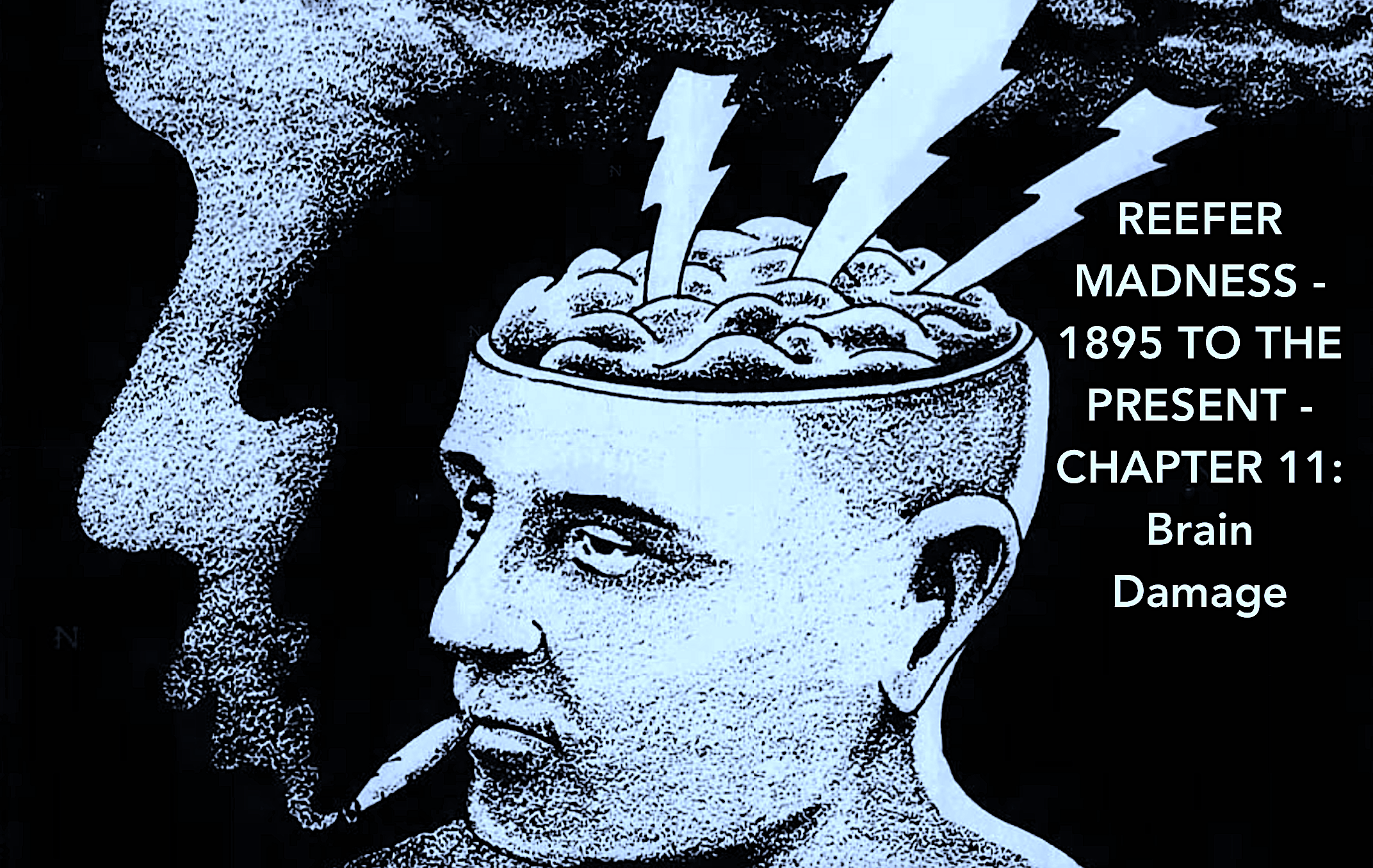
The conclusions from Dr. Robert Heath’s 1970s “pot smoke kills brain cells in monkeys” fraudulent research would be repeated over and over again in the mass media in the 1980s, along with the conclusions from Dr. Gary Huber’s 1979-1980 “pot smoke harms the lungs of rats” fraudulent research, and the conclusions from Dr. Robert Abrams’s 1988 “pot smoke harms sheep fetuses” fraudulent research. These lies (or sometimes thinly veiled insinuations) were spread repeatedly, in almost every newspaper and TV station in the country, echoed by politicians and journalists, with little to no fact checking. Only devoted readers of Playboy and those lucky enough to obtain a copy of Jack Herer’s The Emperor Wears No Clothes had a hope of finding out the truth behind Heath’s fraudulent methodology. Most of the public would have to figure out on their own that the effects of pot smoke – from NIDA moldy chemmy bunk shwag – on animals strapped into smoking contraptions could not be equated to the effects of small hits of high-quality herb or hash by free-range humans taking regular doses at a leisurely pace. Some figured it out right away. Some still haven’t figured it out.
Special thanks to the Cannabis Museum for sponsoring the creation of this series. The introduction to this series (Reefer Madness – 1895 to the Present) can be found here. Chapter 1 can be found here. Chapter 2 can be found here. Chapter 3 can be found here. Chapter 4 can be found here. Chapter 5 can be found here. Chapter 6 can be found here. Chapter 7 can be found here. Chapter 8 can be found here. Chapter 9 can be found here. Chapter 10 can be found here.
“Rhesus monkeys were strapped into a chair and then strapped into a gas mask and given the equivalent of 63 Columbian strength joints in ‘five minutes, thru the gas masks’! losing no smoke! When NORML/Playboy hired researchers to examine the reported results against the actual methodology, they laughed. They discovered almost immediately Heath had completely (on purpose? amateurism?) omitted (or failed to include) among other things, the ‘carbon monoxide’ the monkeys inhaled during these intervals of 63 joints in five minutes.”
- Jack Herer, The Emperor Wears No Clothes, First Revised Edition, Queen of Clubs publishing, Seattle, Washington, December, 1985 (1)
“There is one truly pernicious symptom – specifically related to marijuana – which seems to be evidence in every chronic pot user, youngster or adult. This is the extraordinary refusal to accept the hard scientific evidence about the harmful effects of marijuana. The user will scoff at the evidence, twist it, pervert it, call it ‘reefer madness’ – anything except look it straight in the face.”
- Dr. Harold Voth, quoted by Peggy Mann, “Marijuana critics compile growing list of health dangers,” Star Tribune, Minneapolis, Minnesota, June 19th, 1981 (2)
“In each monkey several thousand brain cells were examined under the electron microscope. Some brain cells from all sites examined showed some structural changes. The greatest changes, however, were in the limbic area. When compared to cells from exactly the same brain area of control monkeys, the changes were striking. They included: – A significant widening of the synaptic cleft, where the flow of ‘messages’ jumps from one nerve cell to the next. ‘This,’ said Heath, ‘causes a slowing down in the movement of the messages, and may impair some brain processes. – The synaptic cleft is filled with dense material. ‘We haven’t identified what this is,’ said Heath. ‘However, this condition is seen in humans with early brain damage.’ – A ‘clumping’ of synaptic vesicles containing the chemical activators of the brain, impairing their function. ‘This,’ said Heath, ‘is another condition we find in cases of early brain damage in humans, as seen in autopsies. It could account for the quick, inexplicable mood changes typical of chronic young pot smokers.’”
- “When a brain goes to pot,” The Ottawa Citizen, Ottawa, Ontario, May 30th, 1981 (3)
“Obviously, most people’s beliefs about scientific matters are not based on a direct examination of the technical literature. They depend on persons recognized as ‘experts,’ whose approach may range from skeptical to dramaturgical. For most citizens, these views are in turn filtered, simplified, and distorted through accounts in the media. Starting around 1980, alarming newspaper stories about the health effects of marijuana became quite frequent. The headlines reflected the tenor: ‘Physical, psychological effects of cannabis, a dangerous drug’ said the Halifax Chronicle-Herald on May 18, 1981; and ‘2,500 scientific studies indicate marijuana can be a health hazard – specialist’ …”
- Illicit Drugs In Canada – A Risky Business, Judith C. Blackwell, Patricia G. Erickson, editors, Nelson Canada, Scarborough, Ontario, 1988 (4)
“During a visit by the first lady Thursday to an elementary school class on drug abuse prevention, Sabra told Mrs. Reagan that her father, who is divorced from her mother, smokes marijuana ‘all the time’. Mrs. Reagan later advised Sabra to ‘stand hard’ and to tell her father to quit smoking marijuana ‘as soon as possible,’ the sixth-grade girl said. But Sturmer, who owns an auto body repair shop, said he had no intention of giving up pot smoking, which he contends is less harmful than drinking alcohol and should be legalized.”
- “Marijuana-smoking dad tells Nancy to mind own business,” Brad Cain, AP, The Anniston Star, Anniston, Alabama, Sept. 7, 1984 (5)
“In the 1920s-30s it was not cost effective to prepare large amounts of methanol, because of the cheapness of oil and because of the almost equal cost of heating the cellulose. But with modern improvements . . . this is no longer the case . . . The fuel – HEMP or other celuloses – for the methanol, while growing, provides oxygen to the air, consumes carbon dioxide for its cell structure, and does not pollute when burned. Science Digest reports that Cornell University in 1981-82 bioengineered an incredible new process which makes the ‘breakdown’ (composting) process by cellulase fifty times quicker and cheaper than the 1920s & 30s.”
- Jack Herer, The Emperor Wears No Clothes, First Revised Edition, Queen of Clubs publishing, Seattle, Washington, December, 1985 (6)
The 1980s was a decade that involved a great amount of repression – repression against the pot legalization movement (a movement that manifested in the mid 1960s and made a few superficial gains in the 1970s), and repression against the cannabis using/illegal drug-using community in general. If this community perpetrating this repression had a public face, that face would be that of US First Lady Nancy Reagan.
But the 1980s also contained the first efforts of the “second wave” of legalizers – a new group separate from NORML and the Yippies – a community that would ultimately be responsible for bringing “semi-legalization” into existence (first with the inclusive, non-corporate med pot economy and then with the very corporate recreational pot cartel). This group was the hope of the people holding out for total, universal cannabis legalization, a form of legalization which includes young users and non-wealthy growers and dealers. This group became known as “The Hempsters,” and their leader was a man named Jack Herer.
Before either of these two individuals and their movements are examined, some insight can be gained from noting that this author himself began using cannabis in the 1980s. Before 1983, I had believed the government hype – that pot would give one cancer and make one crash their car. And then late one night – sometime around 1983 when I was about 12 years old – I woke up and smelled pot burning in my own home, at a party my mom was having. I confronted her about it the next day and told her of my lung-cancer and car-crash concerns. She assured me that pot didn’t give anybody lung cancer – at least not if someone were just an occasional user – and that she wasn’t planning on driving anywhere on the rare occasions she decided to smoke it. My mind was blown. I began to question the veracity of government propaganda (and the concept of criminality itself) from that point on.
 Image #1: This author, 1984, before ever smoking pot.
I suppose I have NORML Canada to thank for my early exposure to pot. One of the founders of NORML Canada – Clay Ruby, a lawyer from Ontario – had introduced my parents to pot in the late 1960s. I also have the Vancouver chapter of the Yippies to thank for my interest in pot activism, for it was also around 1983 that I came across the over-sized comic book The Collected Adventures of Herald Hedd, which contained a story about the Grasstown Riot – a riot which began as a Yippie-organized smoke-in. These activists – indirectly – prepared me for the experimentation in drug use and direct action that might not have otherwise taken place.
But the real culprit in this author’s slide into cannabis criminality/activism came from cannabis itself. Even the first time I smoked it – especially the first time I smoked it – that fateful summer day in 1985, the effects felt so strangely familiar, so fantastically enjoyable, so “entheogenic,” that I had the instant realization that the government was wrong on this issue – this substance made me laugh and think and made me play hacky-sack like an inspired, focused athlete. I knew it was a wonderful boon to humanity. I knew from then on which side I was on. I was on the side of cannabis.
“The man” could go eff himself.
 Image #2: This author, late summer 1985, shortly after first smoking pot.
Later on in my late teens, when my political sophistication grew, I realized that I was an anarchist.
The etymology of anarchy reveals its true nature and appeal. “An” means “without” and “archos” means “ruler” . . . “anarchy” is the state of being without a ruler.
I had come to understand that decisions made by the few were made in the interests of the few – with the limited wisdom and knowledge and insight of the few – while decisions made by the many would be made in their interests with their wisdom and knowledge and insight. Hierarchy itself was pathological and needed to be eliminated – or at least minimized to the extent that it no longer resulted in poor decision-making, corruption and unnecessary suffering and death. The war on drugs was a perfect example of why rulers sucked, and needed to be replaced with gatherings of equals, making decisions together.
The legalization of cannabis seemed to me to be a path to that anarchist “world without rulers” – both as the economy needed to fund the non-hierarchical community that would grow inside the dying husk of the hierarchical one, and as the sacrament that could make “the establishment is totally effed in the head” epiphany easier to have. Cannabis would supply both the cash/community league/beachhead of the new, sustainable community and the “everything should be re-evaluated while in this new headspace” mindset needed for humans to evolve.
Meanwhile, Nancy Reagan and her “Just Say No” philosophy ruled the 1980s, and nearly everyone (myself included) were limited to keeping our heads down, our protests minimized and our joints and chunks of hashish hidden from the cops. I usually kept my little piece of hash pressed on a quarter in my pocket. On the rare occasion cannabis flowers came into my possession, it was kept in a little black and grey plastic film canister. There were exactly zero paraphernalia shops in Edmonton, Alberta when I was growing up.
When someone in my peer group said “I spent my hash quarter on bus fare” – everyone else instantly understood the tragedy that had transpired. When someone came to school with burns on their lips, everyone in my peer group understood that a hooter wasn’t available for hot knife hoots that sesh, and a hot knife to the lips accident had occurred. For those who don’t know about “hot knives” – they were butter knives with the ends heated on a stovetop in order to vaporize little balls of hash – hoots – in between the heated ends. A “hooter” was a cardboard toilet paper roll used as an intermediate path for the smoke between the hot knives and someone’s mouth – to avoid burns. “Silver bullets” were little balls of cannabis flower wrapped in aluminum foil, as replacements for hash hoots. “Where have all the butter knives gone?” – a common complaint in the households of hashish aficionados.
Both Nancy and Ronald Reagan were anti-pot since at least the late 1960s – when Ronald was the governor of California and his anti-war, anti-establishment foes all smoked pot. In 1969, then Governor Reagan called drug use an “epidemic” and stood next to doctors who blamed “anarchists” for supplying students with inhibition-releasing drugs like marijuana – a “symbol of rebellion” – quickly turning one into “a dropout”. (7)
In December 1974 – 6 months after Dr. Heath’s monkey studies were given attention through the Senate Hearings – Governor Reagan said;
“‘The most reliable scientific sources’ now say that ‘permanent brain damage is one of the inevitable results of the use of marijuana.’” (8)
Nancy Reagan’s participation in cannabis stigmatization originated in the 1970s. She is quoted in 1972, touting the reefer madness line of the prohibitionists:
“We are talking about a drug which is unpredictable in its effects and about which an increasing body of scientific evidence is building that it is permanently damaging to mind and body.” (9)
Video exists of Ronald Reagan on the campaign trail in 1980, bringing the Reefer Madness mentality up to potentially presidential status for the first time;
“Leading medical researchers are coming to the conclusion that marijuana – pot, grass, whatever you want to call it – is probably the most dangerous drug in the United States, and we haven’t begun to find out all of the ill effects, but they are permanent ill effects. The loss of memory, for example . . .” (10)
 Image #3: Reagan running for president on a euphoriphobic platform. Image from: “How Marijuana Ruined Ronald Reagan’s Valentine’s Day,” February 14, 2019 https://www.marijuanamoment.net/how-marijuana-ruined-ronald-reagans-valentines-day/
Upon entering the White House, the Reagans ended up being a powerful anti-pot team, with Ronald being the likeable one, and Nancy being the witty one;
“At a news conference later, Reagan described marijuana as the most dangerous drug. It was dangerous, he said, because research showed marijuana is more likely to cause cancer and heart disease than tobacco. A reporter objected, ‘But you don’t smoke as much marijuana.’
Again Reagan was silent, looking stumped.
Nancy Reagan: ‘You wouldn’t know.’
Reagan: ‘I wouldn’t know.’” (11)
 Image #4: “Guns, Grass and Money – America’s Billion-Dollar Marijuana Crop,” Newsweek, October 25th, 1982, p. 43
When it came to who, exactly, was responsible for the mighty slogan that would summarize the Reagans drug policy – if not the entire decade: “Just Say No” – there are two schools of thought on that. The first one is the official version;
“Former First Lady Nancy Reagan was best known for her fierce protection of her husband Ronald, but her aggressive ‘Just Say No’ anti-drug campaign put her squarely in the public eye. She was already an anti-drug crusader before arriving at the White House, but once there, she took the public fight to the next level. Mrs. Reagan came up with the idea for the campaign when speaking to schoolchildren in Oakland, California, according to the Reagan Foundation & Library website. ‘A little girl raised her hand,’ the former first lady is quoted as saying, ‘and said, ’Mrs. Reagan, what do you do if somebody offers you drugs?’ And I said, ’well, you just say no.’ And there it was born. I think people thought we had an advertising agency over who dreamed that up – not true.’ The campaign’s effectiveness remains an open question. It was launched in 1982.”(12)
The second version, however, is much more probable;
“According to ‘The Yale Book of Quotations,’ however, the slogan, though ‘closely identified with Nancy Reagan,’ was ‘originated by the advertising agency Needham Harper & Steers.’ . . . ‘They presented it to Nancy Reagan and she absolutely loved it,’ Ms. Roughsedge said.” (13)

Image #5: “Nancy Reagan at a ‘Just Say No’ Rally at The White House, 5/22/1986” Image from: https://commons.wikimedia.org/wiki/File:Nancy_Reagan_at_a_%22Just_Say_No%22_rally_at_the_White_House.jpg
After 1982, the slogan became ubiquitous and the propaganda push went into high gear;
“The mood toward drugs is changing in this country and the momentum is with us. We’re making no excuses for drugs – hard, soft or otherwise. Drugs are bad and we’re going after them.” (14)
And go after them they did. The propaganda began to have a real effect: the already-small support for pot legalization became even smaller;
“Last week Ronald Reagan unveiled a major expansion in the federal government’s war against drug trafficking, and Nancy Reagan re-emphasized her campaign to wean American youth from drugs. Public opinion is firming up: troubled by new reports of marijuana’s medical hazards and perhaps by the bloody toll of smuggling in South Florida, a new NEWSWEEK Poll shows that the percentage of Americans who oppose pot’s legalization has risen by eight points, to 74 percent, since 1977.” (15)
 Image #6: “Nancy Reagan’s most memorable ‘Just Say No’ moments,” March 7th, 2016. Image from: https://www.prweek.com/article/1386405/nancy-reagans-memorable-just-say-no-moments
Beyond simple sloganeering, the Reagans also did their best to chuck any positive data regarding cannabis down an Orwellian memory hole – just in time for 1984;
“The Reagan/Bush Administration put a soft ‘feeler’ out in September of 1983 for all American universities and researchers to destroy all 1966-76 cannabis research work, including compendiums in libraries.” (16)
One of the problems with being a fact-free ideologue was that a number of other fact-free ideas would be propagated by similar people all around you, undermining your message:
“Dr. Carlton Turner, director of the White House Drug Abuse Policy Office under President Ronald Reagan . . . was forced to resign as drug czar in 1986 after proclaiming publicly that marijuana caused homosexuality, a breakdown of the immune system, and therefore AIDS.” (17)
 Image #7: “Pot-smoker to Nancy: Mind own Business,” Great Falls Tribune, Great Falls, Montana, September 7th, 1984, p. 2
 Image #8: “Pot-Smoking Dad To Ignore Nancy,” The Indianapolis News, Indianapolis, Indiana, September 7th, 1984, p. 3
Between the spraying of Mexican cannabis with paraquat – a practice which began in the late 1970s (18) – and associating drug importation with murder, the Reagans poisoning of and fear-mongering about imported cannabis could be said to have contributed to the rise of domestic cannabis cultivation which occurred in the 1980s. Nancy Reagan was quoted in 1988, saying;
“The casual user may think when he takes a line of cocaine or smokes a joint in the privacy of his nice condo, listening to his expensive stereo, that he’s somehow not bothering anyone,” she said. “But there is a trail of death and destruction that leads directly to his door.” (19)
Of course the trail of death and destruction was entirely prohibition-related – not drug-related – and didn’t exist at all if a person grew their own pot. But as with all other types of scapegoating, the repression intensified, with harsher and harsher penalties the inevitable result of the stigmatization of millions of harmless people. All of the Reagan’s anti-pot and anti-drug propaganda resulted in repressive legislation that would determine the fate of millions of cannabis criminals in the US for the decades to come;
“The Comprehensive Crime Control Act of 1984, the Anti-Drug Abuse Act of 1986, and the Anti-Drug Abuse Amendment Act of 1988 raised federal penalties for marijuana possession, cultivation and trafficking. Sentences were to be determined by the amount of pot involved; ‘conspiracies’ and ‘attempts’ were to be punished as severely as completed acts; and a hundred marijuana plants now carried the same sentence as a hundred grams of heroin.” (20)
 Image #9: “First Lady Nancy Reagan expresses her feelings about drugs while riding horses with her husband, President Ronald Reagan” “The Illegalization of Marijuana: A Brief History,” May, 2014 Image from: https://origins.osu.edu/article/illegalization-marijuana-brief-history
The extent of the Reagan’s hypocrisy was fully realized, first beginning in the late 1980s, when journalists and then whistleblowers revealed the extent of the CIA’s own drug smuggling operations run out of the White House during the Reagan Era, (21) and again in the early 1990s, when it was revealed that the Reagans themselves smoked marijuana in the Governor’s mansion. (22) More information on CIA drug trafficking during the Reagan/Bush era can be found in the citations section of this chapter, below.
 Image #10: “The (Not-So) Secret History of the War on Drugs,” Charles Shaw, 2009 Image from: https://realitysandwich.com/secret_history_drugs/
 Image #11: “Central America wars, 1980s,” Virginia S. Williams, Roger Peace, and Jeremy Kuzmarov, with contributions from Brian D’Haeseleer, Richard Grossman (Northeastern Illinois University), and Michael Schmidli (Bucknell University), March 2018. Image from: https://peacehistory-usfp.org/central-america-wars/
 Image #12: Frontline – Guns Drugs and the CIA (1988) Image from: https://www.youtube.com/watch?v=pef78TCzS5c
 Image #13: Lines of Deceit: Cocaine and The White House, Other Americas Radio, August 31st, 1990 Image from: https://www.youtube.com/watch?v=xrDTf6fspdw
 Image #14: THE CIA AS ORGANIZED CRIME, Douglas Valentine, Clarity Press, Inc., Atlanta, Georgia, 2017, p. 27 https://www.claritypress.com/product/the-cia-as-organized-crime/
 Image #15: THE CIA AS ORGANIZED CRIME, Douglas Valentine, Clarity Press, Inc., Atlanta, Georgia, 2017. Image from: https://www.claritypress.com/product/the-cia-as-organized-crime/
 Image #16: THE CIA AS ORGANIZED CRIME, Douglas Valentine, Clarity Press, Inc., Atlanta, Georgia, 2017. Image from: https://www.claritypress.com/product/the-cia-as-organized-crime/
 Image #17: Image from: https://en.wikipedia.org/wiki/Drug_lord
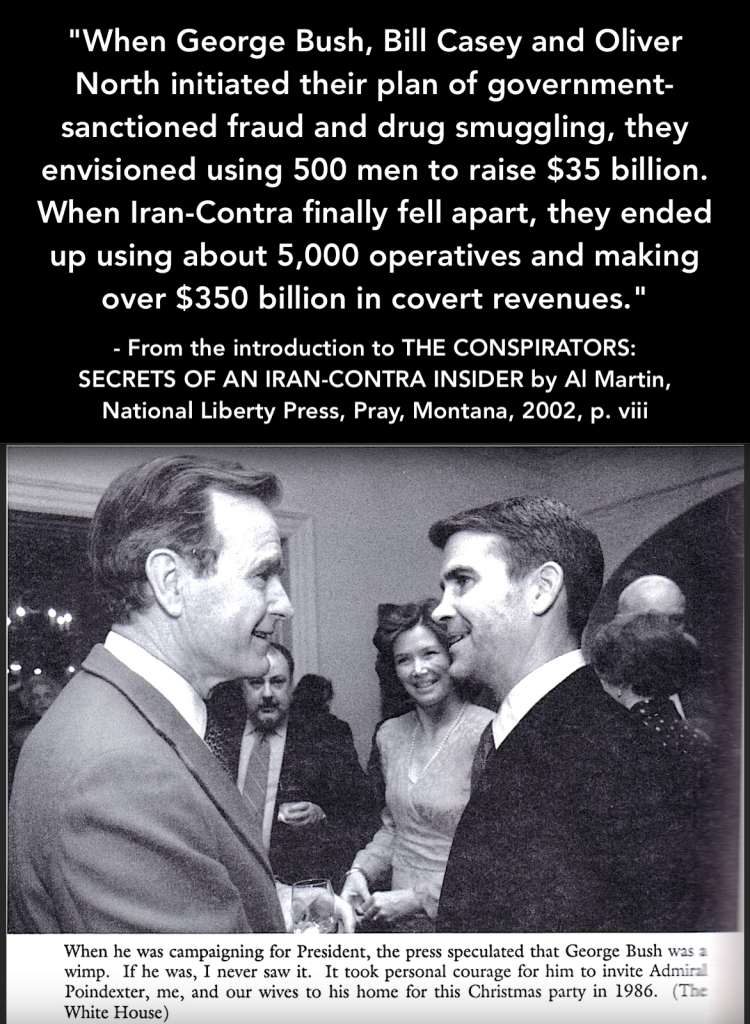
Image #18: Quote from The Conspirators: Secrets of an Iran-Contra Insider, Lt. Cmdr. Al Martin, US Navy (Ret), National Liberty Press, Pray, Montana, 2002. Image from Under Fire, Oliver North, Harper Collins, New York, 1991, p. 271
 Image #19: “People facing criminal charges in connection with Racine’s drug war,” The Journal Times, Racine, Wisconsin, February 3rd, 1989, p. 6
While all this anti-drug activity was going on, a dedicated group of pot activists out in California began publishing, distributing and speaking about the until-then hidden history of cannabis, pointing out the many industrial and nutritional uses. This group was led by Jack Herer, who by 1985 had published the first of many editions of his revolutionary book; The Emperor Wears No Clothes.
 Image #20: “INITIATIVE: Drive Centered in Valley,” The Los Angeles Times, Los Angeles, California, November 25th, 1982, p. 331
This book would be the first book to bring the full scope of the nutritional, environmental, and medicinal potential of cannabis to a wide audience. And it would be the first to attempt to debunk all the different variations of “Reefer Madness” in a more accessible-to-the-public manner than any previous attempt. Key parts of that debunking – such as exposing Dr. Heath and his “poisoning monkeys with carbon monoxide and blaming the ensuing dead brain cells on cannabis” study – have been addressed in other parts of this book. But the part that was most astounding to readers – and that would motivate many people (including myself) to devote their lives to cannabis legalization – was the section on the potential of an alcohol-based fuel derived from cannabis stalks to be used as a replacement for gasoline;
“The book Solar Gas, 1980, Science Digest; OMNI Magazine, The Alliance for Survival, The ‘Green Party’ of West Germany and others, put the TOTAL figure of our energy costs at eighty percent of our TOTAL dollar expense of living for each human being. . . . eighty-two percent of the TOTAL value of all issues traded on the New York Stock Exchange, other world stock exchanges, etc. are tied directly to 1) energy supply companies (oil, Exxon, Shell, etc.), wells/coal mines, (Con Edison, and so forth); 2) energy transportation, (pipeline, oil shipping and delivery companies) and/or 3) refineries and retail sales (Exxon, Mobil, Shell, So. Calif. Edison, N.Y. Edison, et al.) Eighty-two percent of all your dollars translates roughly into 33 of every of every 40 working hours you work is to pay for, in one way or another, the ultimate energy cost in the goods and services (transportation, heating, cooking, lighting) you purchase. Our current fossil energy sources also supply about 80 percent of the solid and airborne pollution which is slowly poisoning the planet. (See U.S. EPA report 1983 on coming world catastrophe from carbon dioxide imbalance caused by burning fossil fuels and lack of new, compounded by destruction of old, plant life.) The cheapest substitutes for these expensive and wasteful energy methods is not wind or solar panels, nuclear, geo-thermal, and the like, but using the natural spreadout light of the sun to grow cellulose to be converted into methane gas and methanol wood alcohol. In the 1920s and ‘30s, most American cars and farm vehicles were sold with the option to run either on methanol or gasoline or both. During the gas shortages of World War II, methanol was widely used by farmers and even the military. It is still used by most racing cars today. Methanol does not pollute! When burned it emits only carbon dioxide and water vapors; and while growing it takes three times as much carbon dioxide out of the air before eventually putting (when burned) one-third of it back . . . whereas oil or coal only can pollute – never clean – because its source – vegetation or dinosaur – died millions of years ago. The early Oil Barons . . . aware in the Twenties of the possibilities of Ford’s methanol scheme (Henry Ford even grew marijuana on his estate after 1937 to prove the cheapness of methanol) and its cheapness, dropped and kept oil prices incredibly low – between $1.00 to $2.00 per barrel (there are 42 gallons in an oil barrel) for almost 50 years until 1970. So low, in fact, that no other energy source could compete with them . . . and when they were sure of the lack of competition, the price jumped to almost $40.00 per barrel in the next ten years.” (23)
 Image #21: Jack Herer, Image from: https://cannabismuseum-amsterdam.com/jack-herer/
Herer then goes on to make the case for the economics of hemp ethanol (see this author’s own updated version of this argument in the 1994 section of the next chapter) and then drew attention to the consequences of not making the transition from fossil fuels to cellulosic ethanol;
“The world struggle for money is actually a struggle for energy, as it is through energy that we may produce food, shelter, transportation, and entertainment. It is this struggle which often erupts into open war. It may not be that if we remove the cause, the conflicts will also be removed, but the possibility is strong enough that we must try. Ultimately, the world has no intelligent choice environmentally but to give up fossil fuels. (Carl Sagan: and U.S. E.P.A., 1983, predicting a world-wide disaster in the making within 30 to 50 years).” (24)
 Image #22: Image from: https://pot-shot.ca/2020/01/29/hemp-can-still-save-the-world/
With hindsight being what it is, with the increased land and ocean temperatures, the increased number and severity of forest fires, the rising sea levels and the melting ice caps and glaciers and the looming crop failures, climate destabilization refugees and catastrophic feedback loops that we are no longer able to ignore here in 2025, Herer’s prediction of a “world-wide disaster” “within 30 to 50 years” – made 40 years ago – seems bang on.
 Image #23: “Jack Herer in Washington, DC, in 1989.” Image from: https://en.wikipedia.org/wiki/Jack_Herer
While we can no longer ignore the problem, the world has, by 2025, forgotten the solution – but for a while in the early 1990s, it looked as if that solution was on the verge of becoming available. But something happened in the mid 1990s to derail hemp ethanol – and hemp paper and hemp clothing and practically everything other than hemp foods – from becoming available, stopping hemp from reaching its true potential – even though hemp was “legalized” in Canada in 1997. This betrayal of the hemp movement will be explored in great detail in the next chapter.
 Image #24: “Jack Herer and Dana Beal at the September 1989 Great Midwest Marijuana Harvest Fest in Madison, Wisconsin.” Image from: https://en.wikipedia.org/wiki/Jack_Herer
Suffice to say, the dream of hemp saving the world was enough to inspire a whole new generation of cannabis activists to devote their lives to the cause, which ended up being a game changer in the late 1980s and early 1990s. This second wave of pot activism would have a profound effect on cannabis policy, even if the powers that be found a way to derail (perhaps temporarily, perhaps permanently) industrial/nutritional/medicinal hemp from its full potential and full return as the co-evolutionary plant partner of humanity.
 Image #25: Jack Herer. Image from: https://cannabismuseum-amsterdam.com/jack-herer/
 Image #26: Jack Herer. Image from: https://mamakana.co.uk/blogs/blog-mama-kana/jack-herer-the-hemp-activist
The 1980s assault on cannabis began on day one of the decade, with a January 1st article written by none other than Phyllis Schlafly, an arch-conservative, anti-feminist, anti-choice, anti-queer, anti-immigrant, anti-pot right-wing activist, who invoked Dr. “suffocate-the-monkeys” Heath and the infamous and now discredited (25) Dr. Gabriel Nahas in her efforts to characterize the harms of cannabis as “not trivial.”
In an article entitled “Trivialization of marijuana major problem” (26) Schlafly made reference to Nahas’s and Paton’s 1979 book: “Marijuana: Biological Effects,” (27) which quotes Heath’s work in the chapter on the brain, along with many other similarly faulted studies such as one involving the application of large amounts of THC in an ethanol (alcohol) solution through a tube shoved up rat’s noses, (28) then taking note of the effects of this torture, and then extrapolating from that activity what smoking whole-plant cannabis (through the mouth, without alcohol) would do to a human’s ability to learn.
This THC/alcohol “hose through the nose” rat study was done by Canadian pharmacologists Fehr, Kalant and Knox at the Addiction Research Foundation in Ontario. Dr. Kalant would become the number one Canadian cannabis academic for the next thirty years and the Government’s expert cannabis witness in the many court cases of the 1990s. By 1981, the “Rat Park” studies conducted at Simon Frasier in Burnaby, BC would get some scientists questioning the veracity of these animal studies. More on that below.
Unlike most newspaper articles discussing the dangers of cannabis, Schlafly’s actually had a reference to a book one could find in the library. Still, it would take decades for scientists to debunk all the claims made: “effects on unborn and nursing babies” (endocannabinoids are found in mother’s milk), “amotivation” (misidentified resistance to indoctrination and the tedium of being transformed into a corporate cog by uninspiring teachers and a lackluster school curriculum), “decreasing grades in school” (often a result of being suspended or expelled for cannabis use), “paranoid thinking” (often justified persecution-awareness) and other such manifestations of cannabis-prohibition-related ignorance or of other negative aspects of cannabis prohibition or of the effects of a pathological society being mistaken for the effects of cannabis itself.
The 1980s also began with a high-profile pot bust: Paul McCartney – soon to be “Sir” Paul McCartney, as his many run-ins with the law over cannabis in the 1970s and 1980s (29) did not stop him from getting knighted by the Queen in 1997. On January 16th, 1980, McCartney was arrested for 219 grams of marijuana after arriving at Tokyo International Airport. The arrest made all the papers, some of which printed photos of him and his family arriving at the airport, or photos of him taken into custody by the police, or photos of a fat bag of the sticky stuff yanked from the top of his luggage. (30) One of McCartney’s biographers told the full story in 2009:
“The uniformed man was just another customs functionary: he hadn’t come looking to get anyone in trouble or cause an international incident. For a moment Paul wondered if he was going to pretend he hadn’t seen a thing and simply zip up the suitcase and wish them well in their visit to his country. But of course he couldn’t do that. Paul was busted. He spent ten days in near-solitary confinement, forced to sweep out his own cell, bathe with the other prisoners, and ponder that Japanese law basically required marijuana smugglers (e.g., the sort of person who brings half a pound of grass into their country) to pay for their crime with seven full years of rock-breaking labor. Paul was spared this fate, ultimately. But not before the tour had been canceled, at vast expense to the promoter, the band sent home, and his raised-thumb-and-wink reputation got knocked down a few pegs.” (31)
 Image #27: “Why did Paul take pot into Japan in 1980?” Tuesday, July 12, 2016 Image from: www.meetthebeatlesforreal.com/2016/07/why-did-paul-take-pot-into-japan-in-1980.html
 Image #28: “Paul McCartney busted – Customs officer displays ‘hemp’ in McCartney’s luggage,” the Anniston Star, Anniston, Alabama, January 17th, 1980, p. 26
 Image #29: The Courier-Journal, Louisville, Kentucky, January 17th, 1980, p. 1
 Image #30: “Clipped ‘Wings’ – Ex-Beatle is arrested in Tokyo for marijuana, The Courier-Journal, Louisville, Kentucky, January 17th, 1980, p. 2
 Image #31: “Former Beatle Paul McCartney is rushed from a police car to a drug investigation unit in Tokyo after spending a night in jail on Jan. 17, 1980. He was arrested at Tokyo’s Narita Airport after customs officers found marijuana in his luggage. (AP Photo/Sadayuki Mikami)” Image from: https://flashbak.com/busted-famous-people-arrested-for-smoking-marijuana-1949-1980-25188/
 Image #32: “Why did Paul take pot into Japan in 1980?” Tuesday, July 12, 2016 www.meetthebeatlesforreal.com/2016/07/why-did-paul-take-pot-into-japan-in-1980.html
 Image #33: “Marijuana Called Safe In Preventing Nausea,” Winston-Salem Journal, Winston-Salem, North Carolina, January 17th, 1980, p. 8
Just as McCartney was being arrested in Japan, an article was being released all over the United States on the topic of how dangerous cannabis was. With titles such as “U.S. Official Says Marijuana Is Serious Health Hazard” (32) and “Use of marijuana called dangerous” (33), the article reported on testimony given by Dr. William Pollin, the director of the National Institute on Drug Abuse (NIDA), to a Senate Judiciary subcommittee to the effect that marijuana “impairs learning, memory and intellectual performance” and “interferes with the functions of the heart, lungs and immune system.” Of course, with a heroic dose, the same could be said for any drug. Pollin was using scary words like “interfere” – which could mean anything – and trying to confuse the effects of heroic doses or the effects on novice users with cannabis’s effects with common doses and regular users.
The idea that society should “discourage use of marijuana in adolescents and teen-agers because their physical and mental processes are still being developed” – a talking point that has become the most often-heard cannabis-related statement in the 21st century – is also found in this article. Both Dr. Gabriel Nahas and Dr. Lester Grinspoon were also quoted, but the much less hysterical and more accurate Dr. Grinspoon was given a fraction of the column space the prohibitionists were allotted.
The concept of legalization was explored in a February 2nd article in the Atlanta Constitution (34), with quotes from both NORML and the soon-to-be-Drug Czar of soon-to-be-president Ronald Reagan and director of the University of Mississippi marijuana research farm, Carlton E. Turner. Turner was quoted as saying;
“We know more about marijuana than anyone else in the world. . . . Marijuana is a crude drug . . . So-called experts on marijuana have no idea what it is. The crude plant contains some 421 chemical components. And each component would have to win FDA (Federal Drug Administration) approval before it could be legally marketed. It will take 500 years of research to test every component of the drug individually. As a scientist, I would never be willing to put a compound like that on the market. To advocate a legal market for the drug would be violating my ethics as a scientist.”
Of course, an actual scientist would not limit their evaluation of the utility of cannabis medicine to dwelling on the lack of research on each individual component but would also look at the effects of the combined components on the general population, and would weigh that against the effects of the prohibitionist policy on the subjects of that policy – perhaps even going so far as to factor in the pros and cons of human autonomy and the role of scientist as either advisor or gatekeeper. In spite of his multiple degrees in organic chemistry, Turner was an ideologue pretending to be a scientist – much like the prohibitionists of today, pretending to be impartial while at the same time in denial of their own bias. Lucky for the world that a little over half the US States had citizen’s initiatives that could over-rule their paternalistic government or Turner’s endless number of excuses to delay legalization under the guise of science.
No actual studies were cited in that article, or in the Des Moines Tribune article of February 2nd 1980; “New concerns about marijuana, the drug that defies prediction,” or in the Casper Star-Tribune article of February 4th; “The Truth about marijuana,” or in the Rapid City Journal article of April 13th; “Pot viewed as threat to nation’s social, economic future,” or in an London, England Observer article of May 11th, “New setbacks for ‘legal pot’ campaign.”
 Image #34: “New concerns about marijuana, the drug that defies prediction,” Des Moines Tribune, Des Moines, Iowa, February 2nd, 1980, p. 18
 Image #35: “Just How Bad Are Marijuana Effects?” The Miami Herald, Miami, Florida, February 22nd, 1980, p. 33
 Image #36: “Just How Bad Is Pot?” The Miami Herald, Miami, Florida, February 22nd, 1980, p. 35
Admittedly, a horrible textbook – the NIDA Marijuana and Health – 1980 report – was cited by the New York Democrat and Chronicle article of May 26th; “Smoking (marijuana) hazardous to health?” and was also cited in the The Palm Beach Post article of June 22nd; “Studies Show Health Hazard Caused by Pot,” but the NIDA was an organization with a mandate to stigmatize cannabis. Even their name – the National Institute on Drug Abuse – seemed to deny the possibility of the beneficial use of illegal drugs. The NIDA conducted zero studies of illegal drug benefits, but were cited in nearly every article in the media – a media with an implied mandate to conduct a risk-benefit analysis. Many of these articles were printed again and again in newspapers across the country over the course of the year.
No studies were cited in the Saskatoon, Saskatchewan Star-Phoenix article of October 15th, 1980; “Marijuana feared caused ‘alcoholism’,” or in the Indianapolis News article of October 18th; Marijuana Effects May Be Years Off,” or in the Phoenix, Arizona Arizona Republic commentary of November 28th; “Marijuana: Potent forms of pot can unleash latent flaws in user’s personality,” or in most of the other anti-pot articles of the 1980s. But all of these articles suggested that cannabis caused psychosis and/or damaged the brain. The double standard in pot policy is that those who want to keep pot illegal never have to provide actual proof that it’s harmful, while those who want to legalize it like a soft drug never have enough proof regardless of how much evidence of its relative harmlessness they provide.
A February 11th 1980 article in The Guardian regarding the “three-day International Cannabis Alliance for Reform” conference held in Amsterdam was generally positive, with many activists sharing insight about many types of activism. The article described a bunch of highly-motivated pot activists meeting in a country of highly-motivated people – many of whom were high and motivated at the same time. The article ends with the following debunking of a common myth of the day;
“But Amsterdam made it hard to believe that dope-smokers become apathetic and ‘antimotivational,’ as some scientists fear.” (35)
An article in the March 1980 scientific journal Chest by Huber et al. attempted to argue that human beings smoking pot were weakening their lungs and making them vulnerable to infection by smoking black market pot … by subjecting rats to smoke from government pot and then arguing it was essentially the same situation.
 Image #37: Marijuana, tetrahydrocannabinol, and pulmonary antibacterial defenses, G.L. Huber, Val Pochay, W. Pereira, J.W. SHEA, April 1980, Chest 77(3):403-10, p. 404 Image from: https://www.researchgate.net/publication/16952410_Marijuana_tetrahydrocannabinol_and_pulmonary_antibacterial_defenses
 Image #38: Marihuana Biological Effects Hardcover – 1979 by Nahas, Gabriel G. and Sir William D. M,. Paton, editors. Pergamon Press (Robert Maxwell’s publishing company). Image from: https://www.biblio.com/book/marihuana-biological-effects-nahas-gabriel-g/d/1481949338
 Image #39: “AN EXPERIMENTAL ANIMAL MODEL FOR QUANTIFYING THE BIOLOGICAL EFFECTS OF MARIJUANA ON THE DEFENSE SYSTEM OF THE LUNG,” GARY L. HUBER, VAL E. POCHAY, JOHN W. SHEA, WILLIAM C. HINDS, ROBERT R. WEKER, MELVIN W. FIRST, G. CLINTON SORNBERGER, from Marihuana Biological Effects, Nahas, Gabriel G. and Sir William D. M,. Paton, editors, Pergamon Press, Oxford, 1979, p. 307
 Image #40: AN EXPERIMENTAL ANIMAL MODEL FOR QUANTIFYING THE BIOLOGICAL EFFECTS OF MARIJUANA ON THE DEFENSE SYSTEM OF THE LUNG,” GARY L. HUBER, VAL E. POCHAY, JOHN W. SHEA, WILLIAM C. HINDS, ROBERT R. WEKER, MELVIN W. FIRST, G. CLINTON SORNBERGER, from Marihuana Biological Effects, Nahas, Gabriel G. and Sir William D. M,. Paton, editors, Pergamon Press, Oxford, 1979, p. 305
The government pot used in the research was described as “marijuana research cigarettes, National Institute on Drug Abuse.” (36) These cigarettes could legally and historically have only come from one place – the NIDA’s Oxford Mississippi pot farm at the University of Mississippi. (37)
This Mississippi research cannabis was notorious for being a “sub-optimal study drug.” This understatement was made by researchers who were quoted in a 2017 PBS story on the “moldy samples” and “no federal testing standards” for research pot:
“‘It didn’t resemble cannabis. It didn’t smell like cannabis,’ Sisley says. What’s more, laboratory testing found that some of the samples were contaminated with mold, while others didn’t match the chemical potency Sisley had requested for the study. … As part of the original study protocol, the marijuana that Sisley received was tested at an independent laboratory in Colorado, which found a high level of total yeast and mold (TYM) in several samples. … The Chicago tests also found all four samples contained trace amounts of lead, though well below the levels generally considered to be hazardous, at least for adults.” (38)
 Image #41: “A look inside Oxford’s massive marijuana research facility,” Jul. 13, 2021 Image from: https://www.wlbt.com/2021/07/13/look-inside-oxfords-massive-marijuana-research-facility/
A 2021 TV news story about NIDA’s marijuana farm described the research pot as “years old” and interviewed other researchers who claimed their subjects described it as “harsh” – asserting they would never again use the material for research. (39)
 Image #42: “University of Mississippi cannabis garden, 2014” Image from: https://www.youtube.com/watch?v=95_pJymwoDA
 Image #43: University of Mississippi Marijuana Project, circa 2011 Image from: https://www.youtube.com/watch?v=2XAjJcBUQic
Clues about the “sub-optimal” research pot and the non-organic farming techniques it was subjected to would arise in a newspaper article from August 24th, 1988. Apparently it was fertilized with chemical fertilizer (ammonia) instead of guanos and other organic alternatives.
 Image #44: “Marijuana farm yields success,” The Greenwood Commonwealth, Greenwood, Mississippi, August 24th, 1988, p. 1
There’s also evidence of herbicide contamination at the Ole Miss marijuana farm. In a story from 1981, it was mentioned that herbicides were tested on marijuana growing at the Oxford farm.
 Image #45: “Ole Miss researchers grow marijuana – legally,” The Sanford Herald, Sanford, North Carolina, November 17th, 1981, p. 13
Evidence exists that herbicides can persist in the soil for a dozen years.
 Image #46: “Glyphosate remains in forest plant tissues for a decade or more” [For. Ecol. Manage. 493 (2020) 119259] Forest Ecology and Management, Volume 521, 1 October 2022, Pages 120166 N. Botten, L.J. Wood, J.R. Werner. Image from: https://www.sciencedirect.com/science/article/pii/S0378112721003479
Aside from chemical fertilizers, chemical herbicides, microbes and other contaminants, the pot the mice were smoking was substandard in other ways. According to the University of Mississippi’s own website, (40) NIDA didn’t start growing sinsemilla until 1984 – four years after Dr. Huber smoked up his rats! Not only were those rats probably smoking chemmy moldy heavy metal bunk, but they were smoking seedy females – maybe even males too. It’s difficult to find a photograph of a bud from that farm that doesn’t look like ditch weed. Mississippi cruderalis.
 Image #47: “Thick, leafy marijuana plants nearly obscure a worker at the Research Institute of Pharmaceutical Sciences in Oxford, Mississippi. On this 5.6 acre tract, the Institute grows all the marijuana used in government-sponsored research.” Image from: NATURE’S HEALING ARTS: FROM FOLK MEDICINE TO MODERN DRUGS, THE NATIONAL GEOGRAPHIC SOCIETY, 1977, p. 158
 Image #48: Ole Miss NIDA pot farm, 1976. Image from: https://pharm.olemiss.edu/marijuana/history/
 Image #49: “GOV’T GROWN GRASS,” – High Times magazine cover story on the Ole Miss NIDA pot farm. High Times, November 1976.
 Image #50: “THE GARDEN – Inside the Government Pot Farm,” High Times magazine, November 1976, p. 59
 Image #51: “THE GARDEN – Inside the Government Pot Farm,” High Times magazine, November 1976, p. 60
 Image #52: “THE GARDEN – Inside the Government Pot Farm,” High Times magazine, November 1976, p. 62
 Image #53: “1970.” Image from: https://pharm.olemiss.edu/marijuana/history/
 Image #54: High Times magazine, February, 1982.
 Image #55: Dr. Carlton Turner, “Interview: Carlton Turner,” High Times magazine, February, 1982, p. 34.
 Image #56: “THE GARDEN – Inside the Government Pot Farm,” High Times magazine, November 1976, p. 62
 Image #57: “THE GARDEN – Inside the Government Pot Farm,” High Times magazine, November 1976, p. 62
 Image #58: “THE GARDEN – Inside the Government Pot Farm,” High Times magazine, November 1976, p. 63
 Image #59: Best? “Old Miss researchers grow U.S.’ best grass,” The Globe, Worthington, Minnesota, November 28th, 1975, p. 14
 Image #60: “Ole Miss researchers grow marijuana – legally,” The Sanford Herald, Sanford, North Carolina, November 17th, 1981, p. 13
 Image #61: “Legal pot farm set up for study at Ole Miss,” Enterprise-Journal, McComb, Mississippi, November 30th, 1984, p. 21
 Image #62: “Ole Miss harvests ‘best pot’ crop,” The Clarksdale Press Register, Clarksdale, Mississippi, November 24th, 1984, p. 14
 Image #63: That doesn’t look like sinsemilla. “Ole Miss harvests ‘best pot’ crop,” The Clarksdale Press Register, Clarksdale, Mississippi, November 24th, 1984, p. 14
 Image #64: Dense? “Ole Miss harvests ‘best pot’ crop,” The Clarksdale Press Register, Clarksdale, Mississippi, November 24th, 1984, p. 14
 Image #65: “Ole Miss harvests ‘best pot’ crop,” The Clarksdale Press Register, Clarksdale, Mississippi, November 24th, 1984, p. 14
 Image #66: “Ole Miss harvests ‘best pot’ crop,” The Clarksdale Press Register, Clarksdale, Mississippi, November 24th, 1984, p. 14
Just to drive the point home, I think all the rats, mice, sheep, monkeys and other assorted unlucky lab animals could have done way better than the moldy, chemmy, heavy-metal laden zero-bud bunk shwag the NIDA was hooking them up with. All the experiments done in the United States with NIDA cannabis – which were all of the experiments done, period – were doomed to fail.
 Image #67: “AMERICA AND MARIJUANA,” The Philadelphia Inquirer, Philadelphia, Pennsylvania, March 2nd, 1980, p. 239
 Image #68: “Warning: Marijuana May Be Dangerous After All,” The Philadelphia Inquirer, Philadelphia, Pennsylvania, March 2nd, 1980, p. 249
 Image #69: “Warning: Marijuana May Be Dangerous After All,” The Philadelphia Inquirer, Philadelphia, Pennsylvania, March 2nd, 1980, p. 250
 Image #70: “Warning: Marijuana May Be Dangerous After All,” The Philadelphia Inquirer, Philadelphia, Pennsylvania, March 2nd, 1980, p. 251
The March 23rd edition of the Danville, Kentucky paper The Advocate-Messenger had a look-back segment “From The Advocate Files” that examined a story from 1905 about “a new machine for harvesting hemp” that “apparently made big improvements in the year’s crop”;
“‘Our establishment has handled about 800,000 pounds of hemp already this season’ said Cogar, who called the crop the best in yield and quality ever raised in Boyle County. The hemp was being sold at 4 ½ cents per pound.” (41)
A further investigation reveals that the machine in question was a hemp breaking machine (42), and that George Cogar owned an office building and warehouse of George Cogar Hemp and Grain at the corner of Harding St. and West Walnut St. in Danville, Kentucky. (43) Hemp seed and bales of hemp fiber were processed in this building, which still stands, according to a recent search on Google Maps.
In a March 23rd article entitled “Children use more marijuana” in the Mansfield, Ohio News-Journal, the parental hysteria button was pushed again, as the author focused on the fact that more children are using cannabis than ever before. This hysteria was encouraged with a statement that will be repeated more often as time goes on;
“Even the most ardent supporters of the right to use marijuana are reluctant to defend its use by elementary and junior high school students, some of whom are reportedly stoned in class.” (44)
When a informal, “raise your hand” poll of those who go to rallies, protests and smoke-ins in the 1990s, 2000s and 2010s has been taken by this author from the speaker’s microphone, a consistent, large majority of those polled report having started using in their teens. These protesters are never counted as “ardent supporters” of the right to use marijuana by reporters, even though they protest for that right through civil disobedience rather than lobbying or letters to the editor.
The very idea that cannabis could be used by the young as a preventive medicine for stress and depression seems so outrageous and controversial that it is seldom discussed, even in activist circles. But given the fact that young people have always been users of cannabis, have always sought out the effects, and continue to use it in spite of great penalties, one must entertain the fact that cannabis use may indeed be helping them. The evidence suggests that cannabis is a relatively safe (45) and effective (46) treatment for exactly the type of stress and depression that the young experience, and if they have no representation in the activist community, it could be as a result of fear amongst activists of being labeled a threat to children as a result of the massive amount of stigma over teen cannabis use rather than the belief that teens are undeserving of advocacy. The question as to whether or not cannabis harms the young will be addressed fully in Chapters 15 and 16 of this book.
Another such parental hysteria-inducing article – “Young marijuana smokers warned” – appeared in the California newspaper, The San Bernardino County Sun, on March 28th. The article quotes NIDA head Dr. William Pollin, doing his very best to focus on cannabis misuse and the “unknown potential future harms” of proper cannabis use to justify cannabis prohibition while at the same time ignore the “known immediate benefits” of proper cannabis use and the “known immediate harms” of cannabis prohibition;
“Many young people want to view marijuana as a simple herb with the power to enhance their lives. In fact, research is showing it to be a complex drug which can negatively effect learning and motor coordination, and may eventually lead to serious health problems.” (47)
The article made reference to the NIDA report: “Marijuana and Health – 1980.” With regards to the long-term effects on the brain, the NIDA report surprisingly seemed to reflect Dr. Grinspoon’s findings in his 1971 book “Marijuana Reconsidered” – that “cannabis psychosis” only appears in the Eastern literature, possibly due to such literature being limited to “inadequate or circumstantial evidence riddled with discrepancies,” (48) while cannabis psychosis in Western literature is rarely mentioned;
“While more serious psychiatric problems such as a cannabis-related psychosis have been reported in countries with a long tradition of use, such reactions do not appear common here.” (49)
To be sure, the report is rife with what modern cannabis historians describe as “public officials who continually inflate the dangers and deny the benefits of cannabis” (50), going so far as to insinuate that cannabis is more carcinogenic than cigarettes (51) and that it might cause birth defects (52) neither of which has turned out to be true (see this chapter below).
The therapeutic effects mentioned in the report were limited to an anti-nausea drug for chemotherapy, and a drug to treat glaucoma, but only in the form of isolates;
“It should once again be emphasized that although marijuana, THC and related drugs have shown some therapeutic promise, much work remains to be done and that any pharmaceuticals developed will be chemically related but not identical to the constituents of the natural material. Such compounds would be chosen to minimize undesirable effects and to provide a better-focused therapeutic effect.” (53)
None of this has turned out to be true, either. Chemotherapy patients have benefitted from the instantaneous effects of smoked cannabis – it’s cheaper, it works faster, and there’s no chance of vomiting up the smoke, unlike a pill or a tincture, which can be hard for someone suffering from nausea to swallow successfully. Furthermore, the effects of some cannabinoids mitigate the effects of others – such as CBD being an antidote for THC overdose. The whole plant medicine works better than the isolated components. With the benefit of hindsight, statements such as “choosing components to minimize undesirable effects” can be seen as proprietary focus for pharmaceutical companies and scapegoating/population-control justification for governments rather than anything that actually benefits the user of the medicine.
 Image #71: “3rd Pot Smoke-In Includes Plans for Voters to Sign Up,” The Atlanta Journal, Atlanta, Georgia, April 3rd, 1980, p. 39
 Image #72: “Arrested At ‘Smoke-In’,” Jacksonville Journal, Jacksonville, Florida, April 7th, 1980, p. 2
 Image #73: “1,000 Rally for Legalizing Pot,” The Atlanta Journal, Atlanta, Georgia, April 7th, 1980, p. 67
 Image #74: “Police Arrest 30 At Pot Smoke-In In Piedmont Park,” The Atlanta Journal, Atlanta, Georgia, April 7th, 1980, p. 29
In an April 20th, 1980 letter to the editor in the Philadelphia Inquirer from Rev. William Deane, Pennsylvania State Coordinator of NORML, it was revealed that, in a previous article entitled “Marijuana May Be Dangerous After All” published in the Inquirer’s insert “Today” on March 2nd, 1980, the author was guilty of a number of sins of omission, including;
“. . . the study of Dr. Sassenrath, which implicated THC with high-risk pregnancy, did not mention the fact that Dr. Sassenrath injected monkeys the equivalent of 27 marijuana cigarets a day. The study cited by Dr. Heath implicating marijuana with brain damage did not mention that Dr. Heath fed his monkeys the human equivalent of 63 marijuana cigarets a day.” (54)
 Image #75: Where the Buffalo Roam, 1980. Image from: https://www.imdb.com/title/tt0081748/
 Image #76: Image taken from Where the Buffalo Roam, released April 25th, 1980
 Image #77: “Token smoke-in,” Southern Illinoisan, Carbondale, Illinois, April 27th, 1980, p. 1
 Image #78: “Marijuana smoke-in,” The Ledger, Lakeland, Florida, May 5th, 1980, p. 21
 Image #79: “MARIJUANA SMOKE IN,” Daytona Beach Morning Journal, Daytona Beach, Florida, May 5th, 1980, p. 6
 Image #80: “New setbacks for ‘legal pot’ campaign,” The Observer, London, England, May 11th, 1980, p. 1
 Image #81: “New setbacks for ‘legal pot’ campaign,” The Observer, London, England, May 11th, 1980, p. 1
Even in articles designed to stigmatize use by young people such as the one in the May 22nd, 1980 edition of the Paterson, New Jersy paper The News, occasionally some reporters accurately reported on the lack of evidence of brain damage from cannabis use;
“No convincing report has yet been published to show that marijuana permanently damages the brain. It would not be surprising if there were some effect from heavy, prolonged use, but the weight of the evidence, at the moment, suggests that there is none.” (55)
 Image #82: “Unmasking an old menace,” The Plain Dealer, Cleveland, Ohio, May 23rd, 1980, p. 33
 Image #83: Does Cannabis Inherently Harm Young People’s Developing Minds? By David Malmo-Levine, Cannabis Culture on November 11, 2014. Image from: https://www.cannabisculture.com/content/2014/11/11/Does-Cannabis-Inherently-Harm-Young-Peoples-Developing-Minds/
 Image #84: “Unmasking an old menace,” The Plain Dealer, Cleveland, Ohio, May 23rd, 1980, p. 33
 Image #85: “HOMEGROWN,” HARVEST, #3, May 1980, p. 26
In June 1980, a new magazine appeared; War on Drugs, which was published by the “National Anti-Drug Coalition.” Both the magazine and the coalition were products of Lyndon Larouche – a scapegoating neo-fascist pretending to be a leftist, who liked hanging out with Willis Carto’s Liberty Lobby and the KKK. (56)
 Image #86: War on Drugs – THE MAGAZINE OF THE NATIONAL ANTI-DRUG COALITION (a Lyndon LaRouche front), Vol. 1, No. 1, June 1980. Image from: https://www.yumpu.com/en/document/read/24475912/the-biological-effects-of-marijuana-ftp-directory-listing/1
The magazine was another soap box for Drs. Nahas and Heath, and was used to launch attacks on NORML and the Yippies. Many of their War on Drugs magazines are available to view online at Yumpu.com – they are excellent examples of extremist euphoriphobic hate literature . . . possibly the most extreme anti-drug propaganda the US has ever seen.
For example, the May 1981 edition of the magazine went so far as to blame Bob Marley’s depression on his cannabis use rather than his (by then) terminal cancer (which had not been limited to his lungs as they reported but had spread to his entire body), and blame his cancer (which began in his foot) on either marijuana smoking or (in all seriousness) reggae music:
“Last fall, reggae degenerate and pot promoter Bob Marley of Jamaica turned himself in to a hospital in Munich, West Germany in a state of deep depression resulting from excessive marijuana consumption, according to the German daily Bild Zeitung. The doctors found, however, that not only was Marley psychologically ‘burned out,’ but that he was also suffering from lung cancer. While some medical authorities say that marijuana smoking brought on Marley’s condition, a portion of the medical community is investigating the possibility that raggae music causes cancer.” (57)
 Image #87: War on Drugs – THE MAGAZINE OF THE NATIONAL ANTI-DRUG COALITION, Vol. 2, No. 4, May 1981, p. 11
On June 8th, 1980, a story appeared in the Ohio newspaper Dayton Daily News about the government forcing cancer patients wishing to use cannabis to treat “the pain and discomfort of chemotherapy” to be potentially used as guinea pigs for a big pharma product instead;
“Even if Mrs. Levine is allowed to take part in the state program, her legal access to marijuana is not assured. Instead, participants will be divided into two groups, one to test the effects of marijuana and the other to try a synthetic anti-nausea drug called Torecan. . . . State officials say restrictions were necessary to obtain approval by the Food and Drug Administration, the National Institute for Drug Abuse and the Drug Enforcement Administration. Because marijuana is a controlled substance, the federal government has required each of the experimental marijuana therapy programs in 18 states to be research-oriented. . . . In Illinois, which last year became the first state to administer a marijuana-therapy program . . . Phase one will include a double-blind mechanism; patients will not know whether they are taking marijuana or a substitute.” (58)
 Image #88: “Pot prescription,” Dayton Daily News, Dayton, Ohio, June 8th, 1980, p. 85
Torecan, by the way, has toxicity side effects far more serious than those presented by cannabis, including “convulsions,” “respiratory depression” and “unexpected deaths apparently due to cardiac arrest.” (59)
The safety and efficacy testing protocols, which require all drugs to be subjected to control groups and double-blind mechanism, were originally meant to protect test subjects from taking unnecessary risks and protect results from researcher bias or the placebo effect. But these protocols were invented as a result of problems with synthetic medicine: Elixir of sulfanilamide deaths in 1937 and Thalidomide birth defects in 1961. (60) They did not originate as a result of herbal medicine, which has a massive heritage of documentation and empirical study to draw from (instead of a testing protocol) to prevent misapplication and abuse.
Requiring cannabis and other herbs to meet these synthetic drug testing protocol requirements has not made herbs any safer, rather, has been a method of continuing prohibition over some herbs and preventing others from attaining the legitimacy needed to have them endorsed by physicians and subsidized by various forms of healthcare systems and medical insurance models – providing synthetic medicine an unfair advantage over herbal medicine in the marketplace.
In spite of smoked cannabis working better than orally-ingested cannabis or synthetic THC due to ease of ingestion, ease of titration, affordability and immediate onset of effects, synthetics were still assumed to be superior to whole-plant cannabis by the medical community. The reason (or pretext) provided in a July 1980 article on cannabis as a cancer treatment was that cannabis smoke was automatically equated with tobacco smoke;
“The idea of a patient smoking pot for medical reasons has very real disadvantages, for it would appear to endorse medically the idea of smoking – a situation doctors have been trying to reverse for two decades (with little success).” (61)
Just a few months earlier, in April of 1980, internal memos within Philip Morris were circulated amongst the executives which reveal that the company was aware of radioactive heavy metals in both tobacco and tobacco smoke, and that there was a possibility that this – and not the tobacco – was what was causing the lung cancer;
“210- Pb and 210 -Po are present in tobacco and smoke. . . . For alpha particles from Po-210 to be the cause of lung cancers in unlikely due to the amount of radioactivity of a particular energy necessary of induction. Evidence to date, however, does not allow one to state this is an impossibility. The recommendation of using ammonium phosphate instead of calcium phosphate is probably a valid but expensive point.” (62)
 Image #89: “The first scientific paper on polonium-210 in tobacco was published in 1964, and in the following decades there would be more research linking radioisotopes in cigarettes with lung cancer in smokers. While external scientists worked to determine whether polonium could be a cause of lung cancer, industry scientists silently pursued similar work with the goal of protecting business interests should the polonium problem ever become public. Despite forty years of research suggesting that polonium is a leading carcinogen in tobacco, the manufacturers have not made a definitive move to reduce the concentration of radioactive isotopes in cigarettes. The polonium story therefore presents yet another chapter in the long tradition of industry use of science and scientific authority in an effort to thwart disease prevention. The impressive extent to which tobacco manufacturers understood the hazards of polonium and the high executive level at which the problem and potential solutions were discussed within the industry are exposed here by means of internal documents made available through litigation.” “The Polonium Brief A Hidden History of Cancer, Radiation, and the Tobacco Industry,” Brianna Rego, September 2009 https://www.researchgate.net/publication/40447832_The_Polonium_Brief_A_Hidden_History_of_Cancer_Radiation_and_the_Tobacco_Industry Image from: https://www.researchgate.net/figure/Philip-Morris-memorandum-from-Paul-A-Eichorn-of-the-R-D-department-to-Robert-Seligman_fig1_40447832
 Image #90: “The recommendation of using ammonium phosphate instead of calcium phosphate is probably a valid but expensive point” Image from: https://pot-facts.ca/big-tobacco-knew-radioactive-particles-in-cigarettes-posed-cancer-risk-but-kept-quiet/
The EPA insists that this radiation is “naturally occurring” (63) ignoring evidence that this is a result of the tobacco companies choosing to use radioactive chemical fertilizers instead of organic fertilizer. Organic fertilizers are more expensive but are limited to background levels of radiation. (64)
Unfortunately, the medical establishment is more profit-oriented than health-oriented, and as a result the interests of consumers are always secondary to the interests of producers. This manifests in many ways, one of which being that smoked medicine is made unsafe through radioactive chemical fertilizers, and then that lack of safety is used to justify using synthetics instead of whole plant medicine. The tobacco corporations save money on fertilizers by purchasing synthetic ones rather than organic ones, and the pharmaceutical corporations retain their advantages over herbal medicine at the same time, while billions of people all over the world are denied access to safe, organic cannabis medicine and millions die each year from cancer caused by unnecessarily radioactive tobacco.
Tobacco doesn’t kill. Greed kills.
More on radioactive fertilizers/tobacco below.
On June 15th, 1980, Dr. W.D.M. Paton, co-author with Nahas of the 1979 book Marijuana: Biological Effects, wrote a letter to the London newspaper The Observer, in response to a letter written by Sally Ward of the Legalize Cannabis Campaign, claiming cannabis was toxic, comparing it to alcohol, nicotine, digitalis, valium, DDT and PCBs. Just how toxic was cannabis? The doctor couldn’t say, because each individual element within cannabis needed to be identified, isolated and tested individually;
“But the work takes time, and cannot be rushed, since it entails identifying in the tissues (not merely the blood) all the products formed from cannabis (many previously unknown), before following what happens to them and their possible interaction with the tissues.” (65)
On the surface this appears to be a pretext rather than a reason, as it’s apparent to even the non-accredited that if cannabis does not cause a toxic reaction in its whole plant form, the isolates within it won’t be toxic either, unless the isolates are used in massive, heroic doses – which is a good enough reason to leave it in its whole-plant form in the first place.
 Image #91: “A Growing Danger – Substantial Body Of Evidence Mounting Against Marijuana,” The Daytona Beach News-Journal, Daytona Beach, Florida, June 24th, 1980, p. 5
 Image #92: NIDA Research MONOGRAPH SERIES 31 – Marijuana Research Findings: 1980, DEPARTMENT OF HEALTH AND HUMAN SERVICES, Rockville, Maryland, June 1980 Image from: https://www.govinfo.gov/content/pkg/GOVPUB-HE20-PURL-gpo117694/pdf/GOVPUB-HE20-PURL-gpo117694.pdf
In July, the second issue of Larouche’s War on Drugs came out, complete with scary photos of microscopic slides from Heath’s monkey-suffocating study – describing the amount of cannabis used as being “moderate.” (66)
 Image #93: War on Drugs – THE MAGAZINE OF THE NATIONAL ANTI-DRUG COALITION (a Lyndon LaRouche front), Vol. 1, No. 2, July 1980. Image from: https://www.yumpu.com/en/document/read/49279603/presidency-1980-ftp-directory-listing/1
 Image #94: War on Drugs – THE MAGAZINE OF THE NATIONAL ANTI-DRUG COALITION (a Lyndon LaRouche front), Vol. 1, No. 2, July 1980, p. 3. Image from: https://www.yumpu.com/en/document/read/49279603/presidency-1980-ftp-directory-listing/5
 Image #95: “Coast-to-coast busts net Canada’s top hash haul,” Edmonton Journal, Edmonton, Alberta, July 11th, 1980, p. 9
Along with this massive propaganda push came legislation – much of it in the form of anti-head shop (paraphernalia store) legislation. One municipal politician from St. Charles, Missouri, openly contemplated using a local ordinance involving the “vending of any article obnoxious to the health of the inhabitants of the city” to shut down the head shop – but changed his mind, awaiting one specifically designed to attack paraphernalia shops, so it “would stand up in court.” (67)
Just 9 days earlier, a drug literature and paraphernalia prohibition that had existed for two years in Georgia was invalidated for “constitutional infirmity” by the U.S. Federal Court of Appeal, in the case of High Ol’ Times v. Busbee. (68)
 Image #96: “‘Caddyshack’ Unites Bill Murray and Chevy Chase After ‘SNL’ Fight,” Ryan Reed, July 25, 2020 Image from: https://ultimateclassicrock.com/caddyshack-bill-murray-chevy-chase/
 Image #97: “Marijuana Plants Harvested By Officers,” Hardin County Independent, Elizabethtown, Illinois, July 31st, 1980, p. 1
 Image #98: “3 Marijuana Fields Cut By Officers,” The Mayfield Messenger, Mayfield, Kentucky, August 7th, 1980, p. 1
On August 8th, 1980, a story came out about the US government withholding high-grade cannabis and providing low-grade shwagweed to cancer patients in research programs. The government wanted the research to fail so badly, they were prepared to let cancer patients suffer and die as collateral damage. (69)
An article in the “Spotlight” section of the August 14th Indianapolis News entitled “Marijuana Is Now Explosive Business” talked about how much money pot smugglers and dealers were making, while another article next to it – “‘Legalizing Marijuana Would Put Pushers Out Of Business’” attempted to limit possible legalizing scenarios to only those excluding participation from black market entrepreneurs, in spite of the fact that excluding the legacy market did not happen at the end of alcohol prohibition. Of course, less money is required to participate in the cannabis economy, so it could simply be a matter of class war to have a double standard in the treatment of modern-day poor herbal criminals and yesteryear’s wealthy alcohol criminals. With the benefit of hindsight, one can argue that this is exactly the type of double standard that exists in the Canadian – and most of the US State-based – cannabis legalization models today. (70)
At this point in our examination of Reefer Madness – the bunk science behind cannabis psychosis – we get to the “it’s not reefer madness, but” era. Where those reporting on marijuana politics say that society has rejected exaggerated stories about cannabis psychosis from the 1930s, but accepts wholeheartedly and unreservedly the current batch of the barely-less exaggerated stories about cannabis psychosis or brain damage or lowered I.Q.s of today. An excellent example of this type of reporting could be found in the August 16th, 1980 edition of the Montreal, Canada newspaper The Gazette. (71) The author begins the article with this paragraph;
“Almost no one, it seems, believes in reefer madness any more. Not your local member of Parliament, and not even your friendly neighborhood Mountie.”
Then the author goes on for a few paragraphs about how the Pierre Trudeau government has been holding out promise of pot law reform for the last eight years – ever since the Le Dain commission published its final report in 1972;
“This was followed up as little as six weeks ago by yet another promise, this time by Justice Minister Jean Chretien, whose responsibility it is to carry out the reform. He said a bill to soften the penalties for marijuana possession will be introduced in the House of Commons ‘within a few weeks’.”
But of course, it never happened. Chretien promised “decrim” twice more as Prime Minister – first in November of 1995 when Chretien was prime minister and pushed Bill C-8 through, which promised to eliminate “traceable” criminal records for possession (72) but actually didn’t, (73) and then again in 2003 when he as prime minister joked that he would have “a joint in one hand and money for the fine in another” (74) – decrim was debated for a while and then defeated in May of 2004, then debated again in November of 2004, and dropped by 2006, then re-introduced in 2009 in a private member’s bill that went nowhere. (75) Then Pierre Trudeau’s son Justin became Prime Minister in 2015 and promised pot legalization that came with “freedom” and “dispensaries” and “a model that would suit Canadians broadly”. (76) Once he was elected he stopped talking like that and provided a cannabis cartel for the rich instead.
It’s as if a progressive cannabis policy is a carrot on a string hanging from the end of a stick that an endless series of politicians can use to get elected and then fail to deliver on, only to have their successor take the carrot/string/stick and fool the public again.
The 1980 Gazette article continued to discuss reefer madness, except they called it a “short-circuit” of the brain;
“In recent years, clinical evidence that marijuana does pose a health hazard has been accumulating. It is bad for your lungs, much in the same way as cigarettes, and heavy extended abuse can short-circuit the brain, much like alcohol. It is particularly dangerous for the young in that it can affect the maturation process in adolescents, lead to male impotence and diminish memory capacity and motivation.”
Of course, none of this has turned out to be true. There has been zero evidence of cannabis “short-circuiting” anyone’s brain. But just to drive the point home about how all this false information is actually the truth this time and different from the “murderous rage” stories of yesteryear, the reporter makes sure to differentiate between the two propaganda campaigns;
“But I still think a good information campaign would be the most effective thing to keep consumption down among teenagers. And I don’t mean anything like the reefer madness scare; the kids know that’s not true and they’d just laugh if you were to go about it that way.”
As usual, none of the “health hazard” information comes with so much as a citation.
 Image #99: “RCMP Superintendent Donald Heaton, the chairman of the Ontario police chiefs’ association’s drug committee also makes the argument for an information campaign. The association was one of a dozen Ontario organizations, including the province’s teachers and home school associations, who joined forces in an appeal to the government to stay its hand shortly after the impending marijuana reform was announced in the throne speech. … ‘Our concern,’ said their petition to the government, ‘is that youth is closely watching for changes in the law which would suggest to them that the federal government regards marijuana as relatively harmless. . . . According to Walter Baker, the Conservative House Leader, such a deal would subvert the legislative process. ‘The process,’ he says, ‘is designed to let the public have its day on any given bill. The way the government is trying to go about this, hoping to get quick passage in one day, would deny the public, and even Parliament, the right to be heard. The way things are going, I don’t expect this bill to be passed this year. . . . Or maybe not even for several years.” “Why marijuana reform is going up in smoke, The Gazette, Montreal, Quebec, August 16th, 1980, p. 17
Another common propaganda technique apart from the “it’s not reefer madness, but” approach is the “THC content increase” gambit. For example, the September 24th, 1980 edition of the Utah daily the Sun-Advocate contained an article entitled “THC content increases in marijuana, hashish.” (77) It began with an unsourced statistic which was difficult to verify;
“In 1975, the average confiscated sample of marijuana contained 0.4 percent THC; in 1979, the average THC content was about 4 percent – a tenfold increase. Sinsemilla, a cultivated form of marijuana which is becoming more frequently available in this country, may contain as much as 7 percent THC.”
As the 1980s turned into the 1990s and then the 2000s and the 2010s, these numbers would continue to increase – all with the same claim – that the cannabis became more dangerous as a result. The fact is that the opposite is true – users titrate (stop smoking when they achieve the desired effect) and thus higher potency cannabis involves less burning plant matter per dose, which means less heat and less stress on the lungs.
The story continues with what is almost certainly an out-right lie;
“In the past, hashish, which averages about 2 percent THC, contained more THC than marijuana. However, with the increased potency of marijuana on the streets, it is now frequently stronger than hashish.”
It’s generally acknowledged today that hashish has always been potent – it generally measures at more than 40 percent THC – but saying that would have made people suspicious of the “dangerous amounts of THC in marijuana” part of the story so they invented a much lower THC statistic. (78)
The fact of the matter is that the average THC levels of seized cannabis buds in the Western world has increased over time – to match the increased knowledge of Western world growers over time – but hashish will stay about the same high level of quality over all, because techniques for making high quality hashish have existed for centuries. A domestic hashish market didn’t exist in North America until the 1990s – all hashish before then was imported from places that had a well-established hashish-making culture.
Nobody provided any evidence that psychosis rates were rising in the 1980s – ditto the lung cancer rates of marijuana-only smokers – which means the two most common insinuations regarding “health hazards” of the THC potency scare-tactic were baseless. The myth of ever-increasing THC levels of North American cannabis is addressed more fully in the November 2011 section of Chapter 14.
 Image #100: “Harvest includes tons of marijuana,” The World, Coos Bay, Oregon, September 27th, 1980, p. 3
In a story in the September 28th, 1980 edition of the Chicago Tribune, (79)once again the supposed harms of cannabis were outlined by a psychiatrist (who cited no studies or books);
“Marijuana is terrible, and condoning its use is worse . . . Take a walk through any high school. The kids who are high aren’t learning. Adolescence is a key time for growing and maturing. And if you’re blitzed during that time, you never get another chance. There are a lot of people out there who think we can magically ‘fix’ their little darlings when they get messed up on dope. Well, we can’t. There are no easy answers . . . We lose a lot of kids.”
But then this reporter did a rare thing and quoted other more pot-friendly authorities – historian Michael Aldrich, and psychiatrist Dr. Todd Mikuriya;
“Aldrich said marijuana use spread through the Moslem empire and across northern Europe after a 13th Century Persian monk happened upon a plant growing wild, chewed a few leaves, felt its effects and declared that it was holy. . . . To stop more widespread use – particularly among white persons – states passed laws prohibiting marijuana use, culminating with a 1937 federal law, Mikuriya said. The legislation was coupled with a tremendous anti-marijuana publicity campaign. ‘The idea of ‘reefer madness’ was perpetuated by the government’ he said ‘the line was that marijuana had no redeeming social value – that it caused insanity, homosexuality, violence – anything deviant. . . . People used marijuana as a non-prescription Valium . . . it’s never going to leave us.”
Unfortunately, when quoting both pro and con pot experts, the cons would mention brain damage or psychosis of some kind, and the pros would comment (or were quoted) on other topics, leaving readers with the impression that the brain damage or psychosis must be true.
 Image #101: “Marijuana in America: A generation turns on,” Chicago Tribune, Chicago, Illinois, September 28th, 1980, p. 16
 Image #102: “Marijuana in America: A generation turns on,” Chicago Tribune, Chicago, Illinois, September 28th, 1980, p. 16
 Image #103: “Marijuana in America: A generation turns on,” Chicago Tribune, Chicago, Illinois, September 28th, 1980, p. 16
 Image #104: “Weather cools ‘smoke-in’ participation,” Southern Illinoisan, Carbondale, Illinois, October 3rd, 1980, p. 1
 Image #105: “’Babylon,’ A Rare Window Into Roots Reggae – And Being Black In 1980 London,” March 13th, 2019. Image from: https://www.forbes.com/sites/davidalm/2019/03/13/babylon-offers-a-rare-window-into-roots-reggae-and-being-black-in-1980-london/
 Image #106: Image from: Babylon, released November 1980
 Image #107: Floyd as the caterpillar in the Muppet version of Alice in Wonderland, The Muppet Show, Season 5, episode 6, November 9th, 1980. Guest star: Brooke Shields.
 Image #108: “Yippies airing ‘60s demands in Chapel Hill,” The Greensboro Record, Greensboro, North Carolina, November 10th, 1980, p. 17
On November 12th, 1980, the Calgary Herald did a story about what experts thought legalization would look like. (80) Speculation as to what legalization would look like back in 1980 mirrors the mass-media-proposed legalization models of today in that there is no “soft drug” option – cannabis is nearly always compared to alcohol or tobacco, and regulating it like other herbs or coffee beans is beyond the pale. The four options provided by academics working at Ontario’s Addiction Research Foundation were limited to;
- Maintaining the status quo – the Narcotic Control Act as it stood in 1980
- Legalized sales through government regulation
- Legalized sales through grower’s cooperatives licensed by the government
- Decriminalization – similar to decrim models in the USA, with fines for users and continued prohibition for growers and dealers.
The reporter ended the article with some “disadvantages” and other problems with legalization;
“The serious disadvantages of legalization are that it would mean a ‘significant risk’ of increased use. Canada would first have to withdraw from the 1961 Single Convention on Narcotics, and would probably run into international criticism as a result. It would then run into constitutional battles with the provinces over the tax money.”
Of course, with hindsight, none of those concerns turned out to be true. The experience with legalization in various US States since 2014 and Canada since 2018 has been that use might have increased post legalization but abuse was reduced through educational campaigns that were made easier by legalization. (81) The international treaties turned out to be a non-issue and international criticism was virtually non-existent – as were the “tax battles” between provinces and the Canadian federal government. It’s as if these were all contrived excuses to prevent legalization from ever happening. The same can be said for most of the health concerns expressed at any time over the last 130 years.
In an article entitled “Experts square off over pot-derived cancer drug,” all the “experts” put proprietary concerns over the concerns of the patient, and limited legitimate cannabis medicine to synthetic isolates in pill form. Oblivious to the obvious advantages of smoked whole-plant cannabis, one of the experts is quoted as saying;
“If you vomit once or twice, you can’t get the next dose down.” (82)
Of course, smoked whole plant cannabis (not even an option according to the experts in the article) works instantly, can’t be vomited out, is much, much cheaper than synthetic THC, and can be grown in your own back yard – the last two facts of which might very well account for the medical establishment ignoring it as an option and favoring synthetic THC instead.
At least one political leader in the Western Hemisphere did not fall for the anti-pot propaganda. Edward Seaga, the newly elected prime minister of Jamaica, described as “pro-Western, pro-capitalist, and in some quarters, politically closer to Ronald Reagan than to Jimmy Carter” argued that the ganja trade was “keeping the economy alive” and that
“Medical reports seem to suggest there’s no conclusive evidence that ganja is harmful, and therefore the extent to which it can be considered a moral problem in that respect is not as clear-cut.” (83)
 Image #109: “Jamaica: Where there’s dope, there’s hope,” The Gazette, Montreal, Quebec, November 15th, 1980, p. 32
Cannabis psychosis – or any other cannabis-related health problems – were almost never mentioned in the pot garden bust reports in the newspapers, nor the autobiographical stories of the smugglers and the growers that appeared from time to time, such as the 1980 book POT FARMIN’ IN AMERICA by Bill Bhang.
 Image #110: POT FARMIN’ IN AMERICA, Bill Bhang, Art Enterprises, Stokes, North Carolina, 1980
 Image #111: “UNC pot ‘smoke-in’ has festive, illegal air,” The News and Observer, Raleigh, North Carolina, November 17th, 1980, p. 23
 Image #112: War on Drugs – THE MAGAZINE OF THE NATIONAL ANTI-DRUG COALITION, Special Reprint Edition, December 1980
 Image #113: “Police smash hashish ring under cover of snowstorm,” The Gazette, Montreal, Quebec, December 5th, 1980, p. 3
The health effects were primarily debated by healthcare professionals and politicians at this point – apart from the occasional concerned citizen in the letter pages and opinion columns. The police and the priests focused on making arrests and saving sinners, leaving medical arguments to the professionals. But the professionals were not united on the issue. And a study came out in 1981 that would change everything that had to do with drug research involving animals.
The study (submitted in late 1980 and published in 1981) entitled “Effect of Early and Later Colony Housing on Oral Ingestion of Morphine in Rats” – one of the papers in the Rat Park series – was conducted by psychologists Alexander, Beyerstein, Hadaway and Coambs, at Simon Fraser University in Burnaby, B.C., Canada. The Rat Park experiments had nothing to do with marijuana, but would turn the worlds of animal drug experimentation – and animal experimentation in general – on its head. The premise of these series of studies was that the tiny, boring, zero-stimulation environment that experimental rats were kept in drove them to taking drugs that they wouldn’t normally take. The conclusions of this particular paper were dramatic:
“Rats living in a colony at the time of testing consumed less MHCI (morphine hydrochloride) than isolated rats, whatever their early housing condition, even though they had been exposed to the early environment for 44 days and to the contemporaneous environment for only 15 days prior to the start of the experiment. . . . Two broad conclusions are suggested. First, the consumption of opiates by animals in self-administration experiments may be strongly facilitated by the typically isolated housing conditions during intake testing. Generalizations from such experiments should be qualified by this possibility. Second, some attributes which differ between the two housing environments in this experiment must affect a powerful control mechanism for opiate self-administration. Full analysis of the effect requires determining which attributes of the two environments are most critical and how their effect on opiate consumption is mediated.” (84)
 Image #114: “A small group of colleagues at Simon Fraser University, including Robert Coambs, Patricia Hadaway, Barry Beyerstein, and myself undertook to test the conclusion about irresistibly addicting drugs that had been reached from the earlier rat studies. We compared the drug intake of rats housed in a reasonably normal environment 24 hours a day with rats kept in isolation in the solitary confinement cages that were standard in those days. This required building a great big plywood box on the floor of our laboratory, filling it with things that rats like, such as platforms for climbing, tin cans for hiding in, wood chips for strewing around, and running wheels for exercise. Naturally we included lots of rats of both sexes, and naturally the place soon was teeming with babies. The rats loved it and we loved it too, so we called it ‘Rat Park’.” “Addiction: The View from Rat Park,” Bruce K. Alexander, Professor Emeritus, Simon Fraser University, 2010 Image from: https://www.brucekalexander.com/articles-speeches/rat-park/148-addiction-the-view-from-rat-park
The paper goes on to speculate as to why rats hanging out together in a “park” like atmosphere don’t take as much morphine as ones alone in boring little cages. One reason could be that the morphine interferes with the rats having sex and socializing. Another reason could be because morphine helps deal with the stress of being trapped alone in a boring little cage. The message was clear – setting was a major factor – maybe THE major factor – which determined abusive or excessive drug behavior. The other message was also pretty clear – researcher bias had been providing drug prohibitionists the results they were seeking out – the results they intuitively knew their establishment grant-giving masters wanted to hear – the results that would justify harsh drug laws – for decades. The drugs weren’t causing abusive drug-taking behaviour in lab rats – the researcher’s choice of tiny cages were.
 Image #115: “Rat Park Journal Article 1981” Image from: https://www.brucekalexander.com/articles-speeches/rat-park
The Rat Park experiments also exposed the “Myth of the Demon Drug:” (85) drugs were supposedly irresistible to humans, once they had that first taste. These drugs weren’t really as powerful as first thought, and reducing poverty and harsh living conditions would probably result in less drug abuse among humans. Of course, the “powers that be” who actually wanted both harsh living conditions and a lack of medical autonomy – for population control and economy-consolidation reasons – felt threatened by such experiments, and so funding for Rat Park was cut off the next year. In spite of the experiments being replicated and verified repeatedly by other researchers, (86) the Rat Park experiments continue to be dismissed by the establishment to this day (87) – an establishment whose entire drug war edifice requires that the “Myth of the Demon Drug” remains intact and unchallenged. (88)
 Image #116: An online comic strip about Rat Park by Stuart McMillen from May 2013. Image from: https://www.stuartmcmillen.com/comic/rat-park/
It is a fact that many drug researchers are still in denial of the effects of researcher bias on experiments that lead to pro-drug-war conclusions. Keep this fact in mind when reading the following chapters, especially when it comes time to reconcile the massive amounts of conflicting evidence over “Reefer Madness 2.0:” the inherent harm cannabis supposedly inflicts on the developing minds of young people, arising out of the prohibitionist side of the 21st century research community.
On January 15th, 1981, the headlines on the front page of the San Francisco Examiner told the bad news: “Brownie Mary, 57, busted.” Brownie Mary, AKA Mary Rathbun, AKA Mary Jane Philips, had been busted the night before with “20 pounds of high-grade marijuana, quantities of psilocybin mushrooms, cocaine and Seconal, along with 54 dozen freshly baked sinsemilla-laced brownies.” (89)
 Image #117: “Brownie Mary, 57, busted,” The San Francisco Examiner, San Francisco, California, January 15th, 1981, p. 1
Brownie Mary was an icon of the med pot community in the Castro – the gay neighborhood of San Francisco. She became famous in her activities as a one-woman compassion club who delivered medicine to the cancer patients – and the emerging AIDS community – both of which relied on her for life-sustaining and hard-to-find herbal medicine. Given 3 years of probation and 500 hours community service in punishment for her first bust, Mary served part of her sentence as a volunteer in the Shanti project. (90) She had known med pot activist Dennis Peron since 1974. (91)
 Image #118: “Brownie Mary, 57, busted,” The San Francisco Examiner, San Francisco, California, January 15th, 1981, p. 20
Mary would be busted twice more – in December of 1982 and again in 1992 – but would argue medical necessity in those last two cases. She got another 200 hours community service for her second bust. She became the first volunteer at the AIDS ward – Ward 86 – at San Francisco General Hospital. Her third bust was high profile and single-handedly changed people’s perceptions of what a pot dealer was. During that case the San Francisco Board of Supervisors made August 25th Brownie Mary Day in honor of her volunteer work at Ward 86. She celebrated Brownie Mary Day with 5000 supporters at a rally in front of San Francisco City Hall, and famously told the crowd;
“‘If the narcs think I’m gonna stop baking brownies for my kids with AIDS, they can go fuck themselves in Macy’s window,’ she cried out, her fists up in the air.” (92)
Eventually, with all the support and media attention, the charges on her were dropped. Feeling like she had enough community support to win a medical necessity test case in court, she joined up with Peron to set a trap for the police;
“‘We set up Brownie Mary’s Cafe in the basement of Dennis’s house,’ Entwistle recounts. ‘We went through the motions of physically selling pot to these people, we took money, put pot on a scale, weighed it out, and allowed media to film it with folks consuming it in the room. But [the police] wouldn’t bust us is what happened.’ And so the real Buyers Club was born, filling what was a desperate need in San Francisco.” (93)
More on Peron, the Buyer’s Club and Prop 215 in the next chapter.
In a full-page ad that appeared in the March 21st, 1981 Vancouver Sun, Allstate insurance company suggested that decriminalizing marijuana would cause traffic accidents, because of “irrefutable research” that indicated “one of every eight victims had been using cannabis.” Had they tested for caffeine – another drug which impaired in large doses – they would have found that an even higher percentage of victims had been using that drug, but because caffeine was never stigmatized and cannabis was always stigmatized, caffeine escaped attention whereas causality with cannabis impairment was always assumed. (94)
 Image #119: “Decriminalization of Marijuana. Let’s understand all of the issues before it gets carved in tablets of stone,” Full page ad, The Vancouver Sun, Vancouver, British Columbia, March 21st, 1981, p. 163
 Image #120: Home grown, Vol. 1 No. 10, March 1981. Image from: https://www.homegrownmagazine.co.uk/buy-issues/homegrown-magazine-vol-1-no-10
 Image #121: “Parents Get Message On Drug Abuse,” Concord Monitor, Concord, New Hampshire, April 10th, 1981, p. 2
 Image #122: Overthrow (April-May 1981 – Vol. 3 No. 2): A Yipster [Yippie!] Times Publication (With Centerfold Poster – 5th AVENUE POT PARADE). Image from: https://www.abebooks.com/magazines-periodicals/Overthrow-April-May-1981-Vol-Yipster-Yippie/30794348051/bd
In another Canadian anti-decriminalization article – this time in the Montreal Gazette on May 9th – Nixon and Ford’s Drug Czar – Dr. Robert Dupont – “changed his mind” about marijuana because of
“. . . mounting medical evidence that marijuana adversely affects male and female sex organs, causes cancer and brain damage when used regularly and particularly by the young.” (95)
Dr. Dupont failed to cite any of this evidence, of course.
 Image #123: “In U.S., second thoughts about easing ‘pot’ laws,” The Gazette, Montreal, Quebec, May 9th, 1981, p. 26
 Image #124: “Jamaican reggae singer Marley dead at 36,” The Birmingham News, Birmingham, Alabama, May 12th, 1981, p. 16
 Image #125: “POT: America’s secret epidemic,” Peggy Mann, The San Antonio Light, San Antonio, Texas, May 17th, 1981, p. 16
 Image #126: “Jail-bound,” Toronto Star, Toronto, Ontario, May 22nd, 1981, p. 2
 Image #127: “WARNING: Pot-smoking can damage your brain,” Joe Hall & Peggy Mann, Toronto Star, Toronto, Ontario, May 22nd, 1981, p. 1
 Image #128: “How pot may harm your baby,” Peggy Mann, The Toronto Star, Toronto, Ontario, May 24th, 1981, p. 12
 Image #129: “News on pot almost all bad – 2,500 scientific studies indicate marijuana can be a health hazard, specialist says,” Peggy Mann, Toronto Star, Toronto, Ontario, May 25th, 1981, p. 8
 Image #130: “Park Smoke-in takes aim at ‘unfair’ marijuana laws,” Edmonton Journal, Edmonton, Alberta, May 28th, 1981, p. 19
 Image #131: “When a brain goes to pot,” Peggy Mann, The Ottawa Citizen, Ottawa, Ontario, May 30th, 1981, p. 69
 Image #132: “Researchers link brain damage to marijuana use,” The Gazette, Montreal, Quebec, June 2nd, 1981, p. 8
 Image #133: “Montrealer delves into pot’s effects on psyche,” The Gazette, Montreal, Quebec, June 2nd, 1981, p. 8
 Image #134: “Montrealer delves into pot’s effects on psyche,” The Gazette, Montreal, Quebec, June 2nd, 1981, p. 8
 Image #135: “The crowd was laid back at the smoke-in rally,” Edmonton Journal, Edmonton, Alberta, June 8th, 1981, p. 3
 Image #136: “Distinctive aroma of marijuana smoke persisted at 3,000-strong smoke-in at Borden Park,” Edmonton Journal, Edmonton, Alberta, June 8th, 1981, p. 15
 Image #137: “Marijuana critics compile growing list of health dangers,” Peggy Mann, Star Tribune, Minneapolis, Minnesota, June 19th, 1981, p. 31
 Image #138: “. . . but many pot horror stores going up in smoke,” Star Tribune, Minneapolis, Minnesota, June 19th, 1981, p. 31
 Image #139: “New field of marijuana in Seneca,” Democrat and Chronicle, Rochester, New York, July 4th, 1981, p. 3
 Image #140: “Does Pot Smoking Damage Brain Cells?” The Daily Item, Port Chester, New York, August 8th, 1981, p. 19
In August of 1981, the Reefer Raiders – the group of activists working with Jack Herer to put cannabis legalization on the ballot in California – began to get attention in the mass media. (96) And the collection of hemp-related facts that Herer’s group used to hand out that would one day manifest into Herer’s magnum opus The Emperor Wears No Clothes also began to receive attention. Just for “journalistic balance,” however, the reporter saw fit to throw some contemporary Reefer Madness in their historical review;
“Here are some of the highs and lows in the history of the weed from its glory days of previous centuries to the more recent controversies of the past;
- Sometime in the first century AD, the Chinese were credited with making the first paper from bark and hemp.
- From 1619 to 1769, the British paid bounties to American farmers for growing hemp to make the canvas for British ships.
- In 1762, Virginia imposed penalties on farmers who didn’t raise hemp. George Washington and Thomas Jefferson were among the hemp growers not penalized.
- In 1793, the cotton gin was invented. With no similar technology for hemp, less clothing was made from marijuana.
- In 1930, Harry Anslinger was named first commissioner of the U.S. Bureau of Narcotics.
- The Marijuana Tax Act of 1937 was passed. A Denver judge handing down the first conviction for possession said: ‘I consider marijuana the worst of all narcotics. Under its influence, men become beasts.’
- During World War II, the Department of Agriculture distributed marijuana seeds to farmers. Although it was against the law, farmers produced 62,000 tons of hemp for rope and other materials in 1943 alone.
- Millions of white middle-class Americans began smoking marijuana in the 1960s.
- In 1972, California’s first marijuana initiative was defeated by a vote of 5,400,000 to 2,700,000. Roughly 80,000 Californians were arrested the same year on felony and misdemeanor marijuana charges.
- Gov. Ronald Reagan vetoed legislation making possession of small amounts a misdemeanor. Before leaving office, he declared: ‘The most reliable scientific sources say permanent brain damage is one of the inevitable results of the use of marijuana.’
- In 1974, an University of California scientist said chromosome damage in even moderate marijuana smokers is ‘roughly’ the same as that in person surviving ‘atom bombing with a heavy level of radiation.’
- Sen. James Eastland of Mississippi said 35 million Americans have used marijuana, and said top scientists have found that marijuana can do serious genetic damage to future generations along the lines of the drug thalidomide.
- Gov. Edmund Brown Jr. signed the marijuana decriminalization bill in 1975, making possession of less than an ounce of pot a misdemeanor. Various scientists say pot is bad for bronchitis, but possibly helpful for asthmatics.
- In 1980, California officials and doctors complained about long delays in receiving shipments of legal marijuana from the federal government for preventing nausea in cancer patients undergoing chemotherapy and easing fluid pressure in the eyes of persons with glaucoma.
- Various estimates of the cash value of California’s illegal marijuana crops range as high as $2 billion. The U.S. Drug Enforcement Administration says California grass is regarded as ‘the best in the world.’
- Former Los Angeles Police Chief Ed Davis, newly elected state senator, predicts that marijuana will be ‘recriminalized’ in 1983.” (97)
 Image #141: “Animal studies show pot damage to brain cells,” Peggy Mann, Star-Phoenix, Saskatoon, Saskatchewan, August 21st, 1981, p. 31
 Image #142: The Independent-Record, Helena, Montana, September 24th, 1981, p. 1
 Image #143: “Marijuana vs. Alcohol,” The Independent-Record, Helena, Montana, September 24th, 1981, p. 1
 Image #144: “Nebraska Officers Say Marijuana Hunters Beating Bushes ‘Hot and Heavy,” The Daily Oklahoman, Oklahoma City, Oklahoma, October 11th, 1981, p. 9
An article In the October 16th, 1981 Guardian about a report issued by the British Advisory Council on the Misuse of Drugs mentioned that “evidence on brain damage is inconclusive.” (98)
In an article in the October 18th, 1981 Louisville, Kentucky paper the Courier-Journal about pot growing in Kentucky, a 1942 photo was published of a hemp farm with a man next to a hemp field that towered over him in spite of him standing on the roof of his truck. It not only speaks to the long history of successful hemp growing in Kentucky, but also hemp’s potential as a fuel crop – it’s like a forest that regenerates itself every three to four months. (99) The Courier-Journal was doing a series on cannabis that week, with the next day’s paper providing a photo-exhibit of the differences between feral hemp and sinsemilla, complete with growing instructions. (100)
 Image #145: “Marijuana is becoming an important cash crop,” The Courier-Journal, Louisville, Kentucky, October 19th, 1981, p. 2
 Image #146: “Marijuana is becoming an important cash crop,” The Courier-Journal, Louisville, Kentucky, October 19th, 1981, p. 2
 Image #147: “Three held in hashish seizure,” The Gazette, Montreal, Quebec, October 20th, 1981, p. 3
Hashish was/is a popular item for smugglers because it is much more condensed and therefore easier to transport than cannabis flowers are. And hashish seizure photos were popular with the press, because the size of the seizures seemed to be constantly breaking records over the course of the decade. For example, there was a Montreal, Quebec, Canada seizure on October 20th 1981, involving 500 pounds, (101) an article reporting “more than 12 million worth of marijuana” and 41 bales of hash worth millions of dollars, with “more than 50 million of hashish” remained in a sunken boat was printed on page one of the October 26th 1981 edition of The Record newspaper from Hackensack, New Jersey, (102) an article in the November 5th 1981 Gazette of Montreal featured a photo of “part of a three-ton haul of Lebanese hashish” worth “40 million” (103) and a November 11th 1981 story in the Atlanta Constitution involved “$12 million worth of opium and hashish.” The Constitution broke it down this way;
“… 58.62 pounds of opium and 27.84 pounds of hashish were confiscated. The opium was worth about $200,000 a pound and the hashish had a street value of $1000 a pound.” (104)
 Image #148: “Drug-laden boat seized, then sinks,” The Record, Hackensack, New Jersey, October 26th, 1981, p. 1
 Image #149: “Mounties grab 3 tons of hashish,” The Gazette, Montreal, Quebec, November 5th, 1981, p. 10
The record-breaking seizures continued. A March 25th 1982 article in the Melbourne, Australia newspaper The Age reported on a “110 million” hash bust involving “2.15 tonnes” of hashish – “almost as much as all the cannabis seized in Australia in 1980.” (105) The dollar amount of this bust was inflated to $120 million in the Sidney Morning Herald’s reporting the same day. (106)
 Image #150: “$120m hashish haul from container,” The Sydney Morning Herald, Sydney, Australia, March 25th, 1982, p. 2
A Dayton Ohio paper reported on a million-dollar hash bust involving 300 pounds of blonde hashish:
“‘We’ve had bigger ones (raids) on the west coast but never in the mid-west and especially in Ohio,’ said an agent for the Federal Drug Enforcement Administration.” (107)

Image #151: “Troopers Hold 2 In Sale Of Hashish,” The Pittsburgh Press, Pittsburgh, Pennsylvania, March 6th, 1983, p. 2
The Montreal Gazette reported on a bust from June 16th 1983, involving the seizure of 72 pounds – or $750,000 dollars-worth – of “Golden Elephant” hashish (with a gold-leaf stamp of an elephant placed on each hashish brick to assure genuine quality). That worked out to $10,416 per pound, or about $23.25 per gram, which means that the value was calculated as if the smuggler was going to go around and sell each and every gram at maximum retail prices rather than sell it to a few different dealers for wholesale price as one would expect. It seems very likely that the police wanted to inflate the value of their seizure, to inflate their own importance. (108)
 Image #152: “Police hit ‘Golden Elephant’ ring as $750,000 of hashish seized,” The Gazette, Montreal, Quebec, June 16th, 1983, p. 7
On August 21st 1983, the Orlando Sentinel reported that Dutch police found “more than 4 tons of Lebanese hashish in bales of rice marked as an Italian gift to Third World nations.” The “street value” was estimated at “More than $5 million.” (109) On February 28th 1984, it was reported in the Philadelphia Inquirer that four people were sentenced to 10 years in prison for attempting to smuggle 29,965 pounds of hashish into the US. The hash was valued at up to $90 million dollars. Federal authorities said it was the third largest seizure of hashish in U.S. history. (110) In a November 27th 1984 article titled “Egypt, U.S. seize 20 tons of hashish,” the claim was made that the seizure was “the largest single haul of hashish ever in Egypt and possibly in the world.” The seizure was valued at “$50 million, based on the Egyptian street value of about $2,500 for 2.2 points of hashish.” (111) The seizure was reported on in both U.S. and Canadian newspapers. (112)
There was more. April 26th 1985: 1,800 pounds of hash seized in Pakistan – the seizure was the “largest in history.” (113) May 25th 1985: 13 tons of hashish seized in Lockporte, Nova Scotia, with an “estimated street value of $238 million” – the “largest ever hashish seizure in North America.” (114)
 Image #153: “Pakistani Police Grab 1,800 Pounds Of Hashish,” The Daily Herald, Provo, Utah, April 26th, 1985, p. 2
June 25th 1987: 2,740 pounds of hashish was seized in Washtenaw County, Michigan – “about 28 times the amount that the Drug Enforcement Administration has confiscated nationwide this year.” The retail value was estimated at $2.2 million. (115)
 Image #154: “Huge stash of hashish seized in Washtenaw,” Detroit Free Press, Detroit, Michigan, June 25th, 1987, p. 64
May 25th 1988: 30 tons of hashish and 15 tons of marijuana with a combined value of $162 million was found beneath the deck of a barge as it slipped underneath the Golden Gate Bridge in San Francisco. (116)
 Image #155: “West Coast drug haul sets record,” The Record, Hackensack, New Jersey, May 25th, 1988, p. 8
This was just a cursory look into hashish seizures in North America in the 1980s – this author could have easily found more if he had looked a bit harder. And it is an undisputed fact that only a small fraction of the hashish that is smuggled into North America is seized. Those who now make arguments that high-potency cannabis products are a new thing in western nations are obviously talking nonsense. Please keep this in mind when the arguments for cannabinoid hyperemesis syndrome (CHS) being a result of high potency products only becoming available after 1996, when CHS first appeared. Hashish can be super-potent, and this author spent the last half of the 1980s smoking enough hashish with his friends every weekend for us all to get eyelid cartoons.
 Image #156: “Pot rates as major cash crop,” The Florida Times-Union, Jacksonville, Florida, November 17th, 1981, p. 17
 Image #157: “Pot rates as major cash crop,” The Florida Times-Union, Jacksonville, Florida, November 17th, 1981, p. 17
 Image #158: “Arthur Elgort: Keith Richards and Mick Jagger, New York, 1981” Image from: https://www.1stdibs.com/art/photography/black-white-photography/arthur-elgort-keith-richards-mick-jagger-new-york/id-a_149322/
 Image #159: “A young woman crash-lands her plane in Jamaica. A local named Countryman rescues her and leads her away from the authorities, who have fabricated a story about the plane, involving drug and arms smuggling by the CIA, in order to gain popularity in an upcoming election.” Countryman, 1982 Image from: https://mubi.com/en/ca/films/countryman-1982
On February 26th, 1982, the National Academy of Sciences’ Institute of Medicine released a report entitled Marijuana and Health, (117) which was reported on in many newspapers, with some reporters using a “No Evidence Of Long-Term Pot Effects” spin (118) and others using a “pot merits ‘serious concern’” reaction. (119) Amongst the speculation regarding possible harms, falsehoods, deceptions, animal-study-laden researcher bias and statements that could be said of all soft drugs, there was also these very honest bits of information;
“And, the committee could find no conclusive evidence that prolonged use of marijuana causes changes in the brain or in human behavior that are not reversible once drug use is discontinued.” (120)
“. . . there is no conclusive evidence the drug is addictive, leads to the use of ‘harder’ drugs, affects the structure of the brain or causes birth defects.” (121)
“Marijuana does not cause brain damage.” (122)
 Image #160: Another report that recommended decrim – a recommendation ignored by most newspapers. Marijuana and Health, Institute of Medicine; Division of Health Sciences Policy, 1982 Image from: https://nap.nationalacademies.org/catalog/18942/marijuana-and-health
 Image #161: “Marijuana’s effect on health remains a serious concern,” Corpus Christi Caller-Times, Corpus Christi, Texas, March 21st, 1982, p. 116
 Image #162: “Menninger,” Rapid City Journal, Rapid City, South Dakota, March 24th, 1982, p. 43
Interestingly, the key recommendation of the NAS study was to decriminalize possession of marijuana, but this recommendation was not mentioned in most if not all of the newspaper articles about the study, and was only mentioned in passing in a TIME magazine article about the study in July of 1984;
“When the Committee on Substance Abuse and Habitual Behavior turned in its study on marijuana laws, the N.A.S. president flatly disavowed its recommendations, and the academy brushed it aside in the apparent hope it would fade away for lack of attention. No press conference, no press release, no public announcement at all. The reason: the committee urged that the possession or private use of small amounts of marijuana should no longer be a crime.” (123)
The attention the study did get mostly focused on the negative findings. In one newspaper, the headline read “Marijuana health effects likened to tobacco,” (124) but the body of the text indicated it was a “strong possibility” rather than a certainty, a possibility which would not be borne out by the facts when further studies on marijuana-only smokers were conducted.
In 2006, this speculation over cannabis smoking-related lung cancer was laid to rest when the US’s leading expert on lung cancer – Dr. Donald Tashkin – weighed in, providing a much-quoted summary (125) of his findings:
“The largest study of its kind has unexpectedly concluded that smoking marijuana, even regularly and heavily, does not lead to lung cancer. The new findings ‘were against our expectations,’ said Donald Tashkin of the University of California at Los Angeles, a pulmonologist who has studied marijuana for 30 years. ‘We hypothesized that there would be a positive association between marijuana use and lung cancer, and that the association would be more positive with heavier use,’ he said. ‘What we found instead was no association at all, and even a suggestion of some protective effect.’” (126)
Back in 1982, Dr. Tashkin was a source used by those who wished to make the case that marijuana smoke was more deadly than tobacco smoke;
“Smoking one marijuana joint a day causes more harm to the respiratory system than smoking 16 non-filtered cigarettes, a physician specializing in marijuana research said here yesterday. Dr. Donald P. Tashkin, associate professor of medicine, pulmonary division, University of California at Los Angeles School of Medicine, said that ‘respiratory irritants’ entering the lungs in smoke from one marijuana joint cause 25 percent more narrowing of large upper air passages than such irritants from 16 cigarettes. . . . He told about 300 persons attending the conference and reporters at a news conference later that marijuana smoke contains 50 percent more cancer-causing substances (hydrocarbons) than a comparative quantity of tobacco smoke.” (127)
At exactly the same year as this pot/cancer spin was being reported, a detailed exchange was taking place in the New England Journal of Medicine about what exactly caused cancer in tobacco. This quote from researchers Beverly S. Cohen and Naomi H. Harley of the New York University School of Medicine is of extreme importance, but has been virtually ignored by the entire marijuana-research and marijuana-activist communities:
“. . . Po210 is the only component in cigarette smoke tar that has produced cancers by itself in laboratory animals as a result of inhalation exposure.” (128)
 Image #163: Image from: https://erowid.org/plants/tobacco/tobacco_health3.shtml
 Image #164: “Chemical fertilizers are radioactive and the real cause of tobacco-related cancer” Image from: https://pot-facts.ca/chemical-fertilizers-are-radioactive-and-the-real-cause-of-tobacco-related-cancer/
 Image #165: Image from: https://www.researchgate.net/figure/Radiation-Contamination-Process-Source-Dee-2016-Radon-222-and-Leads-210-are-the-decay_fig1_335080019
 Image #166: “Radioactive Smoke: A Dangerous Isotope Lurks in Cigarettes,” January 2011. Image from: https://www.scientificamerican.com/article/radioactive-smoke/
Putting aside, for a moment, the inhumanity of animal research, one would think that given that fact, the possibility of the radioactive chemical fertilizers – not the tobacco plant or the cannabis plant – being the primary (or perhaps the only) factor in smoking-related lung cancer should be explored at some point. Millions of lives could be saved every year from a horrible, painful, cancerous death by doing so – not just from tobacco-related cancer, but from cancer related to eating non-organic foods and using non-organic medicinal herbs in general. But researchers have been reluctant to point their fingers at big chemical. Most of the ones I’ve shown such evidence to show no interest in looking into the role billion-dollar agri-chem corporations have played in spreading cancer through selling their radioactive products.
In an extremely rare and honest look at cannabis history, a newspaper in Jackson, Mississippi reviewed the history of cannabis as a pharmaceutical product. Admittedly, it was an extremely short article buried in their back pages, but the information was accurate, instructive and went against the prevailing conventional wisdom of the day:
“Oddly, in 1851, marijuana extract was recommended in a U.S. drug manual for more than a dozen ailments. In the early 1900s, the U.S. drug company Parke-Davis was a leading importer of ‘pot’ and sold it in extract and bulk form. Bulk marijuana was purchased by Russian and Polish immigrants with respiratory ailments, who placed it on their radiators and inhaled its vapors. Imported marijuana varied in strength, so Parke-Davis began growing cannabis americana in an attempt to standardize potency. Marijuana fell into disfavor as a pharmaceutical product by the 1930s. . . . However, 28 medical products still contained marijuana, though it often was not on the label. The Marijuana Tax Act of 1937 made it difficult to prescribe cannabis. The act was opposed by the birdseed industry, which annually used 4 million pounds of German hemp seed for pigeon food, and by the American Medical Association, which said ‘a restudy of the drug by modern means may show other advantages to be derived from its medical use.’” (129)
 Image #167: “Yippies conduct Statehouse ‘smoke-in’,” The Lima News, Lima, Ohio, May 2nd, 1982, p. 55
 Image #168: “Pot smoke-in draws hundreds,” The Journal Times, Racine, Wisconsin, May 2nd, 1982, p. 3
 Image #169: “Pot smoke-in at Statehouse,” The Akron Beacon Journal, Akron, Ohio, May 2nd, 1982, p. 30
 Image #170: Image from: https://www.ebaumsworld.com/pictures/totally-excellent-movie-facts/84560706/
On July 14th, 1982, the film Pink Floyd – The Wall was released. An adaption of the album The Wall by the band Pink Floyd (released November 30th, 1979), both the film and the album captured the zeitgeist of the 1980s. The film/album touch on many dark themes, one of which is the creeping fascism in Western democracies. And the song “In The Flesh” – a song about a fascist rally and the scapegoating required to fuel the hate fascism thrives upon – included the following lyrics which parodied the reactionary forces of the day;
“Are there any queers in the theater tonight?Get them up against the wall!There’s one in the spotlight, he don’t look right to me,Get him up against the wall!That one looks Jewish!And that one’s a coon!Who let all of this riff-raff into the room?There’s one smoking a joint,And another with spots!If I had my way,I’d have all of you shot!” (130)
The album became one of the best-selling albums of all time, selling over 19 million copies during the 1980s. (131) The film based on the album was released on VHS in 1983. For those who grew up in the 1980s and who listened to Pink Floyd (nearly all pot smokers did so, as the time-distortion, special effects-laden soundscapes and angst-ridden lyrics were for many smokers the perfect accompaniment to the cannabis high), the message was not lost on its audience: cannabis persecution wasn’t about health concerns. It was about fascist scapegoating.
An August 16th, 1982 newspaper article on a pot bust from Alabama stood out from others in two ways. The first way was how the Marijuana Grower’s Guide by Mel Frank and Ed Rosenthal became the biggest part of the story – mentioned in the headline and featured in the only photo accompanying the story. The story was practically an advertisement for the book, noting that it contained “just about everything anybody would ever want to know about growing pot,” “color photographs” and was written by “the world’s foremost authorities on pot agronomy.” The article then shared some advice on “how to hide the fields and the art of attaching the plants to wood stakes so they cannot be seen from the air.” The other notable aspect of this piece was the quote from Chief Deputy Billy Duke, who attempted to provide some stigma;
“My experience is that marijuana leads to harder drugs . . . I don’t say it happens all the time, but those who deal with hard stuff usually begin with marijuana.” (132)
This is the “gateway” or “stepping stone” theory – very popular with prohibitionists to this day (most recently Senator Joe Biden, running for election in 2019, who argued that the gateway theory was a concern of his). (133) This theory has been debunked over and over again:
“More than half of American adults have tried cannabis, according to data compiled by the Centers for Disease Control. Statistically, the overwhelming majority of these individuals never go on to try another illicit substance, an empirical reality that persuaded investigators at the RAND Corporation to conclude, ‘[M]arijuana has no causal influence over hard drug initiation.’ Moreover, by the time these individuals reach age 30, most of them have significantly decreased their cannabis use or no longer indulge in the substance at all. Even more noteworthy is the reality that cannabis appears to act as a substitute or, in some cases, an exit drug for those struggling with drug abuse.” (134)
An article depicting Northern California pot growers as terrorists appeared in the San Bernardino County Sun on August 22nd 1982, (135) raising hysteria about domestic pot cultivation to new heights while failing to mention anywhere in the article that black market violence was a consequence of cannabis prohibition rather than an inherent quality of cannabis growing itself;
“Through terror, intimidation and force of arms, The New Lawless are denying the public the right to use its own land, effectively sealing off thousands of acres of Northern California’s most spectacular scenery from the law-abiding.”
In fact, in one sentence the reporter seemed to suggest that the violence was a direct result of cannabis use;
“What we had was a bunched of doped-up Native Americans who were shooting at each other in downtown Hoopa, in the middle of the day . . . with the tourists driving by.”
 Image #171: “REEFER MADNESS,” Omni magazine, September 1982, p. 43
While some stories about cannabis were racist and terrifying, others were more comical or ridiculous, such as one with a headline about how the “Ozarks pot rates with best” underneath a photo of a handful of seeds, stems and leaves – the bud was difficult to identify. The text of the story did mention cannabis indica and the sinsemilla growing technique – apparently the photographer didn’t have a regular supply of the good stuff on hand . . . or perhaps he or she wanted to appear unable to identify “the best” in order to feign ignorance and keep their job. (136)
 Image #172: “Growers score big profits – Ozarks pot rates with best,” The Springfield News-Leader, Springfield, Missouri, October 4th, 1982, p. 1
The October 25th, 1982 edition of Newsweek magazine had a cover story about the emerging domestic pot cultivation culture in the United States. The cover photo continued with the “grower as terrorist” theme of the day, depicting a pot grower in his field of cannabis, wearing a ski mask and holding a pitchfork in one hand and an automatic rifle with the banana clip in the other.
 Image #173: “Guns, Grass and Money – America’s Billion-Dollar Marijuana Crop,” Newsweek, October 25th, 1982
Some very good photos of sinsemilla buds and indoor pot gardens came with the article, along with a photo of Nancy Reagan looking at an anti-marijuana cartoon display, and some more general Reefer Madness-esque misinformation with zero citations to the source of the data;
“Some of those suspected effects from chronic use include impaired lung function, decreased sperm counts and sperm motility, interference with ovulation and prenatal development, diminished immune response and possibly lung cancer.” (137)
 Image #174: “Guns, Grass and Money – America’s Billion-Dollar Marijuana Crop,” Newsweek, October 25th, 1982, p. 36
 Image #175: “Guns, Grass and Money – America’s Billion-Dollar Marijuana Crop,” Newsweek, October 25th, 1982, p. 37
 Image #176: “Guns, Grass and Money – America’s Billion-Dollar Marijuana Crop,” Newsweek, October 25th, 1982, p. 37
 Image #177: “Guns, Grass and Money – America’s Billion-Dollar Marijuana Crop,” Newsweek, October 25th, 1982, p. 41
On November 7th, 1982, a Kentucky newspaper reported on the Amsterdam hashish scene. A few important details of how the Dutch de facto pot legalization operated at this time were revealed:
“The Milky Way youth center has everything – music, movies, dancing and six kinds of hashish on sale – all right across the street from the police station. ‘Lebanon, Red Lebanon, Moroccan, Turkish, Kashmir, Afghan.’ Reads the multinational menu at the hashish sales booth in the city-subsidized youth center. . . . At the core of the hashish traffic is a nationwide law enforcement policy of neglecting hashish enforcement and concentrating on the trade in ‘hard drugs,’ which police define as heroin, cocaine and amphetamines. A 1976 amendment to the drug law reduced to a finable misdemeanor possession of up to 30 grams (about an ounce) of marijuana products for personal use, but still forbids dealing in the substance. Even so, 1980 prosecutors guidelines drawn up by the Justice Ministry stress enforcement of laws against ‘hard drug’ traffickers rather than house dealers in soft drugs, unless they advertise their product or act ‘provocatively.’ Police decisions to prosecute must be approved by the local prosecutor’s office, according to the guidelines. Hashish has been the soft drug of choice here ever since the drug culture took root in the 1960s, with Lebanon the major source. Its popularity is reflected in the position of the Justice Ministry’s consultation bureau for alcohol and drugs. ‘It’s not really physically addictive,’ maintained a spokeswoman for the bureau. ‘It shouldn’t really harm your mind and body. But of course nobody’s really sure about that.’ . . . On a recent visit by a reporter, customers were buying more than the 30-gram limit. And while de Boer said sales aren’t allowed to children, purchasers are not asked to show proof of age.” (138)
 Image #178: “Amsterdam hash market thrives with city sanction,” The Odessa American, Odessa, Texas, November 10th, 1982, p. 41
While teens in Amsterdam were stopping by the “youth centers” to pick up an ounce or two of hashish without being hassled by the cops, the “smoke shops” of Los Angeles were dealing with much more hostile conditions while doing their best to collect signatures for the right of adults to possess and grow. On November 25th, 1982, a Los Angeles newspaper featured efforts by Jack Herer and his associates to put “decriminalization” on the ballot:
“From the building at 14416 Victory Blvd., a cadre of supporters will coordinate an effort to collect the 385,000 signatures needed to put on the ballot in the next election a measure that would remove criminal sanctions against the possession and cultivation of marijuana. . . . The landlord’s advice to the group? Herer smiles. ‘He ordered us never to smoke pot in here.’” (139)
 Image #179: “Tiny village is Hash City, Lebanon,” The Capital Times, Madison, Wisconsin, November 29th, 1982, p. 11
In a 1982 book about the anti-pot research community, author Peggy Mann visited US researchers on both coasts and the American south as well. (140) Calling her book Pot Safari, Mann gathered all the Reefer Madness she could fit into 136 pages, including an interview with the notorious Dr. Robert Heath and his assistant Dr. Fitzjarrell – “or Fitz as everyone calls him” (141) – who was busy conducting his monkey suffocation studies at the time. The fraud regarding the amount of smoke the monkeys were subjected to was perpetuated by an author all-too-ready to take the word of the researchers without bothering to look too closely at the research;
“‘. . . people who don’t want to hear the bad news turn it off by saying ‘No wonder Dr. Heath’s brain cell studies came out the way they did. He gave his monkey’s 80 to 100 joints a day.’ . . . ‘Of course,’ said Fitz, ‘nothing could be farther from the truth. Rhesus monkeys are expensive. Each one costs $1,500 or more. We spend months carefully exposing the monkeys to pot smoke. Then we spend up to a year carefully examining and photographing thousands of brain cells in each monkey. What would be the point of all that work and all that expense, unless it was directly related to amounts of pot human beings are smoking?’” (142)
 Image #180: Pot Safari, Peggy Mann, Woodmere Press, New York, 1982
 Image #181: Pot Safari, Peggy Mann, Woodmere Press, New York, 1982, p. 13
The obvious answer is to provide an excuse to exclude cannabis from the medicine and energy economies, in order to keep the billions in synthetic pill and synthetic fuel profits safe from natural competition. Such a motive is seen as a “conspiracy theory” by those coincidence theorists whose paycheck depends upon them not understanding the pathology of elite deviance.
Mann continues with the conversation;
“‘How much pot did the monkeys get?’ I asked.
‘This slide,’ said Fitz, ‘was from a ‘Heavily Smoked Monkey’ – as we term it. The group was exposed to the smoke of two to three ‘monkey sized joints’ five days a week, for six months – which is over two years in human terms.’
‘How big is a monkey-sized joint?’
‘A quarter of the size of a tobacco cigarette.’
‘And what strength THC do you use?’ I asked.
‘Two percent. Less potent than ‘good Columbian pot’ smoked in the United States today.” (143)
 Image #182: Pot Safari, Peggy Mann, Woodmere Press, New York, 1982, p. 30
 Image #183: “The man who fried gay people’s brains,” Robert Colvile, 06 July 2016 Image from: https://www.independent.co.uk/life-style/health-and-families/health-news/the-man-who-fried-gay-people-s-brains-a7119181.html
 Image #184: Dr. Heath. “The man who fried gay people’s brains,” Robert Colvile, 06 July 2016 Image from: https://www.independent.co.uk/life-style/health-and-families/health-news/the-man-who-fried-gay-people-s-brains-a7119181.html
One might recall from the last chapter that more skeptical reporters revealed the actual amount used by Heath was 20 to 240 cigarettes per day (144) – or “63 Colombian strength joints in ‘five minutes, through gas masks,’ losing no smoke.” (145)
240 (strong) joints per day is 80 times more than 3 (weak) joints per day. This was scientific fraud on a massive scale. The effects of the Heath monkey asphyxiation study were far reaching. Heath and/or his studies were mentioned in numerous government hearings, newspaper articles, magazines, and letters to the editor then used to justify cannabis prohibition (and hemp prohibition) during the 1970s and 1980s. (146)
 Image #185: “A comeback for hemp, alias marijuana,” The Courier-Journal, Louisville, Kentucky, January 4th, 1983, p. 6
 Image #186: “A comeback for hemp, alias marijuana,” The Courier-Journal, Louisville, Kentucky, January 4th, 1983, p. 6
The book Cannabis and Health Hazards came out in 1983. Published by the Addiction Research Foundation (now part of the Centre for Addictions & Mental Health) which was an agency of the Government of Ontario, Canada (147) along with the World Health Organization, this book was a collection of the “proceedings of an ARF/WHO scientific meeting on adverse health and behavioral consequences of cannabis use.” (148)
 Image #187: CANNABIS and Health Hazards – PROCEEDINGS OF AN ARF/WHO SCIENTIFIC MEETING ON ADVERSE HEALTH AND BEHAVIORAL CONSEQUENCES OF CANNABIS USE, Edited by Kevin O’Brien Fehr and Harold Kalant, ADDICTION RESEARCH FOUNDATION, Toronto, 1983
The book was edited by Kevin O’brien Fehr and Harold Kalant, who, if the reader will recall earlier this chapter, were part of the booze/THC “hose through the nose” rat study published in the 1979 book Marijuana: Biological Effects. In the section of the book labeled “CANNABIS PSYCHOSIS,” researcher Juan Carlos Negrete attempted to make the case for a causal relationship between cannabis and psychosis. Beginning his review of the evidence with a statement regarding the lack of evidence in the Western world for such a relationship, Negrete states;
“In general, the available evidence thus far is so uncertain that some authors after reviewing it have concluded that the case for cannabis psychosis, as a discrete clinical entity, has yet to be made (Murphy, 1963; Edwards, 1976).” (149)
Negrete separates cannabis psychosis into four categories;
“(i) a psychotic state of the acute brain syndrome type;
(ii) a schizophrenia-like acute psychosis without mental confusion;
(iii) a protracted psychotic illness featuring cognitive deficit, along with paranoid and/or affective symptoms;
(iv) a variety of psychotic manifestations developing as withdrawal reactions.” (150)
With the benefit of hindsight, one can concede that the first two categories are a result of overdoses, and the last one is not supported by modern evidence and is no longer asserted to exist by the vast majority of the medical community. It is the third category which should be examined closely, as this is the “chronic psychosis caused by cannabis use” condition that continues to be asserted by a sizeable percentage of the medical establishment to this day. Under the heading “Chronic Psychosis,” the author described the evidence for this condition;
“The protracted psychotic illness resulting from chronic cannabis abuse has been described as a mixture of the most diverse phenomenology: self-neglect, absentmindedness and lethargy, periods of psychomotor excitement and violent behavior, disorientation with respect to time, delusions of persecution and of grandeur, impoverishment of intellectual functions, and memory deficit – these symptoms are said to follow a recurring course over a period of months or years. Christozov (1965) made a most detailed description of this condition based on 140 cases treated at the Berrechid Mental Hospital in Morocco. Chopra et al. (1942) analyzed the characteristics of ‘chronic’ cannabis psychosis and stressed the resemblance they have to ‘dementia and mania.’ Long lasting mental symptoms were also reported in two Nigerian children who had been given intoxicating doses of cannabis (Binitie, 1975).” (151)
The reader should keep in mind that the first report was about Morocco, the second was about India, and the third was about Nigeria – all developing countries with high rates of poverty. As Dr. Grinspoon noted in his 1971 book Marijuana Reconsidered (discussed in the previous chapter), evidence from developing countries is suspect, because
“. . . the authors based their findings of ‘hemp insanity’ largely on inadequate or circumstantial evidence riddled with discrepancies.” (152)
Grinspoon also mentions that extreme malnutrition and poverty could be responsible for such symptoms. (153) Both of these points are also made by Negrete;
“. . . it is likely that some psychoses, which might otherwise evolve towards a quick recovery, would persist for a longer time in an institution with inadequate facilities. Mikuriya (1968) visited Morocco and remarked that many of these patients while in hospital were seldom seen by medical staff; that their diagnosis had been made without adequate information; and that the standard neurological and physiological tests had not been performed. Another important factor is the social background of these patients; most are described as destitute and derelict, frequently living on skid row (or its equivalent) with no family ties or means of support. The prolonged stay in hospital may have been as much due to these adverse social conditions as the illness itself. Moreover, there might be other poverty-related illnesses involved. Murphy (1963) pertinently remarks that it is difficult to distinguish the cannabis psychosis described in Morocco from similar states associated with chronic malnutrition and endemic infection.” (154)
The only other evidence cited for the existence of cannabis psychosis were two studies, one from England (Davidson and Wilson, 1972) and one from the Bahamas (Spencer, 1970), which Negrete goes on to explain as cases of subjects continuing to use cannabis and suffering from reoccurring overdoses while being studied, or because of an underlying “psychogenic” psychosis that cannabis triggers but does not cause. (155)
Wikipedia explains “psychogenic” this way;
“Psychogenic disease (or psychogenic illness) is a name given to physical illnesses that are believed to arise from emotional or mental stressors, or from psychological or psychiatric disorders. It is most commonly applied to illnesses where a physical abnormality or other biomarker has not yet been identified. In the absence of such ‘biological’ evidence of an underlying disease process, it is often assumed that the illness must have a psychological cause, even if the patient shows no indications of being under stress or of having a psychological or psychiatric disorder. Examples of diseases that are believed by many to be psychogenic include psychogenic seizures, psychogenic polydipsia, psychogenic tremor, and psychogenic pain. There are problems with the assumption that all medically unexplained illness must have a psychological cause. It always remains possible that genetic, biochemical, electrophysiological, or other abnormalities may be present which we do not have the technology or background to identify.” (156)
On January 28th, 1983, the Beatrice Daily Sun printed a front-page story about a Nebraska police officer who took it upon himself to educate the locals about the dangers of cannabis smoking. Lt. William Fitzgerald displayed an array of paraphernalia (including the obligatory scary-looking skull bong) while spouting off a list of the latest myths:
“Continued use of marijuana reduces one’s ability to understand relationships in complex issues, creates an inability to concentrate, causes poor posture and balance and can cause irregular sleeping habits, Fitzgerald said. Marijuana users also tend to avoid vigorous activity and can become very moody, he added. . . . Fitzgerald has attended several drug enforcement seminars during the past few years, including a school sponsored by the Drug Enforcement Association of Nebraska. . . . Reproductive ability can decrease, and there is a greater chance for birth defects. Marijuana may even cause men to develop female-like breasts, he said, while women may have smaller breasts, less fatty tissue, and more chest and facial hair and acne. Smoking three to five marijuana cigarettes also has the same cancer-producing capabilities of smoking 122 tar-and-nicotine cigarettes, Fitzgerald said.” (157)
 Image #188: “Marijuana smoking prevalent in Beatrice, says policeman,” Beatrice Daily Sun, Beatrice, Nebraska, January 28th, 1983, p. 1
 Image #189: “Controlling marijuana – a booming industry,” Vancouver Sun, Vancouver, British Columbia, February 18th, 1983, p. 5
On the other side of the debate, a newspaper in Missouri reported on Robert Randall, a glaucoma patient and the first of the 15 lucky people to get a prescription for medical marijuana under the Compassionate Investigational New Drug program that arose from his victory in the 1976 case United States v. Randall:
“The first successful articulation of the medical necessity defense in the history of the common law, and indeed, the first case to extend the necessity defense to the crimes of possession or cultivation of marijuana.” (158)
Randall was in Missouri to testify in favor of a bill that would allow medical prescriptions of marijuana. The article explained Randall’s defense;
“He said he was acquitted in court because of an English common law doctrine of medical necessity. ‘It means it is wiser to commit a crime because the crime can prevent a greater evil,’ Randall said. Now, he gets government-grown marijuana free, by prescription, and smokes two cigarettes five times a day. He says he did not get high because his body has grown immune to the normal effects of marijuana and responds only to the element that relieves the pressure within his eyes.” (159)
 Image #190: “Medical Marijuana Supported,” St. Louis Post-Dispatch, St. Louis, Missouri, February 25th, 1983, p. 25
Randall was not alone in his efforts. Wisconsin activists continued to push for legalization in spite of the best efforts of Nancy Reagan to put the kybosh on such activities. A newspaper reported on the Hash Bash without naming it – to hide the historical context and the annual nature of the event, presumably. Activists managed to convey their dignity regardless;
“‘The herb should be free,’ declared Rober L. Kundert, Madison, who said he is president of the American Cannabis Society. Glancing around the crowd, Kundert said it was made up of ‘beautiful people who know the herb is not hurting them.’” (160)
 Image #191: High Times magazine, April 1983
 Image #192: Rick James photographed by Chester Simpson while recording at the studio with the Mary Jane Girls – 1983. Image from: https://pbs.twimg.com/media/CepjBPBWEAE2b2T.jpg
 Image #193: High Times magazine, May 1983
 Image #194: “Marijuana debates still smoking,” Chicago Tribune, Chicago, Illinois, May 27th, 1983, p. 171
In an attempt to justify the June 24th 1983 mass arrests of 26 people involved in a marijuana distribution ring, police in Lancaster, Ohio played the parental hysteria card:
“I especially hate it when people sell dope to kids and get them involved. This is what really spurs me on.” (161)
This statement was made in spite of the fact that kids were not mentioned anywhere else in the article, and the only point of sale mentioned was a gun shop.
 Image #195: “These ‘smoke shops’ are selling marijuana,” The Morning Call, Allentown, Pennsylvania, June 28th, 1983, p. 33
 Image #196: “Florida’s Paraquat Program Quiet,” The Palm Beach Post, West Palm Beach, Florida, July 17th, 1983, p. 422
A far more measured assessment of the risks of cannabis appeared in the July 21st, 1983 edition of the Reno Gazette, where psychiatry professor Dr. Ed Lynn rated smoking marijuana “less dangerous” than cigarettes or alcohol;
“Marijuana isn’t completely safe, a Reno psychiatrist said Wednesday, but – as mind-altering drugs go – it’s much less dangerous than alcohol or cigarettes. The latter two are linked to death and disease, said Dr. Ed Lynn, psychiatry professor at the University of Nevada School of Medicine, while marijuana is not. . . . Lynn disagrees with the idea that smoking pot leads to harder drugs. That assumption was made because of one study in which 100 heroin addicts were asked if they’d ever tried pot. All raised their hands. ‘You could have asked them how many drank Coca-Cola or masturbated and then argued that masturbation leads to heroin use.’ . . . ‘Chronic psychosis is very uncommon’ he said, unless someone is ‘on the edge of psychosis anyway.’” (162)
 Image #197: “Court date precedes pot news conference,” Edmonton Journal, Edmonton, Alberta, August 11th, 1983, p. 8
On August 26th, 1983, Dan Aykroyd – famous for being an original cast member of Saturday Night Live and the co-author and co-star of the 1980 smash hit comedy The Blues Brothers – got busted for possession of marijuana. An off-duty cop had witnessed Aykroyd “drinking and smoking marijuana.” He was found with 3.5 grams. (163) The arrest did not harm his career at all – he immediately went on to co-author and co-star in Ghostbusters – the highest grossing comedy of all time up to that point. (164)
 Image #198: “Dan Aykroyd arrested with ‘small amount’ of pot,” The Times, Trenton, New Jersey, August 28th, 1983, p. 12
 Image #199: Dan Aykroyd arrested in the film Trading Places, released in June, 1983
 Image #200: “Early harvest – Police reap a wealth of marijuana gardens,” The South Bend Tribune, South Bend, Indiana, August 31st, 1983, p. 14
 Image #201: “Early harvest – Police reap a wealth of marijuana gardens,” The South Bend Tribune, South Bend, Indiana, August 31st, 1983, p. 14
 Image #202: “War on pot rages in West County,” Sonoma West Times and News, Sebastopol, California, September 7th, 1983, p. 1
 Image #203: “Officials Wrestle With Growing Marijuana Problem,” The Wichita Eagle, Wichita, Kansas, September 9th, 1983, p. 6
 Image #204: “Marijuana – How Growers Water a High Risk Crop,” Florence Morning News, Florence, South Carolina, September 11th, 1983, p. 2
 Image #205: “No Tractors or Weather Worries For State’s Marijuana Harvesters,” The Daily Oklahoman, Oklahoma City, Oklahoma, October 9th, 1983, p. 9
The stigma-foisting continued. In spite of the ongoing total lack of evidence, the long-term effects of cannabis were listed as “fatigue, paranoia, possible psychosis” in a “Chemical information chart” in an Albany, Oregon newspaper on the 26th of October, 1983. (165)
 Image #206: “Despite gains, drug war is uphill battle,” The Miami News, Miami, Florida, December 20th, 1983, p. 15
And the high-profile busts continued as well. Linda McCartney – ex-Beatle Paul’s wife – was busted on January 17th 1984 for possession of marijuana – in the same place that she and Paul were busted for the exact same thing two days earlier. (166) McCartney’s patience must have been wearing thin, because he let loose with an impromptu speech at the airport in favour of some realism and perspective;
“’Let’s get one thing straight, whatever you think I’ve done, this substance cannabis is a whole lot less harmful than rum punch, whiskey, nicotine and glue, all of which are perfectly legal,’ McCartney told reporters at the airport.” (167)
 Image #207: “Linda McCartney runs afoul of drug law twice in 3 days,” Arizona Republic, Phoenix, Arizona, January 18th, 1984, p. 66
Asked by reporters if he would continue to “take drugs,” McCartney responded by saying ”Never again.” And then immediately he gave an exaggerated wink. (168) Usually the media (or someone’s own lawyer) would prevent such an argument from being made and getting reported on. McCartney was an exceptional target in the war on pot users, in that he fought back in a very public manner.
 Image #208: Paul McCartney after Pot arrest (1984) Image from: https://www.youtube.com/watch?v=6KF_lpBvteo
 Image #209: Paul McCartney Calls for Cannabis to be Decriminalised (1984) Image from: https://www.youtube.com/watch?v=kf8J6EsMY4Q&t=1s
 Image #210: “Galion drug raids result in 13 arrests, 27 citations,” Telegraphy-Forum, Bucyrus, Ohio, February 10th, 1984, p. 1
 Image #211: “Marijuana and its medicinal value,” Asbury Park Press, Asbury Park, New Jersey, 12th February 12th 1984, p, 61
It was reported in February of 1984 in multiple newspapers that the US Secretary of State under William McKinley and Theodore Roosevelt – John Hay – had tried hashish as a student at Brown University back in 1857. As the reporter explained;
“In those days, mind-altering drugs enjoyed greater respectability than today, since many people linked them with artistic creativity.” (169)
 Image #212: “The Secretary of State Who Tried Hashish,” The Boston Globe, February 19th, 1984, p. 624
One might argue that the many people who were familiar with mind-altering drugs have always linked them with creativity, and it’s the levels of stigma – more than the link with creativity – that was the difference between hash’s respectability in the 1850s and in the 1980s.
In a March 22nd 1984 feature in a Louisiana paper titled “From The Sheriff’s Desk” written by a Ramson K. Vidrine, M.D., in a series entitled “FOR KIDS ONLY: WHAT YOU SHOULD KNOW ABOUT MARIJUANA,” under the heading “Can Marijuana Cause Brain Damage?” the author stated
“It is a real possibility. When marijuana is smoked, its mind-changing ingredient, THC, reaches and affects the brain. Scientists are now trying to learn whether these affects produce long-term physical damage to the brain.” (170)
 Image #213: “UM ‘smoke-in’ is out:” The Evening Sun, Hanover, Pennsylvania, May 1st, 1984, p. 38
 Image #214: “WORLD CANNABIS MARCH,” New York, May 5th, 1984, from the back cover to Overthrow Magazine, April 1984. “Overthrow (March 1984 – Vol. 6 No. 1): A Yipster [Yippie!] Times Publication” Image from: https://www.abebooks.com/magazines-periodicals/Overthrow-March-1984-Vol-Yipster-Yippie/31256707294/bd
The stigma-foisting was then ramped up to 11 when, in a May 1984 article entitled “Dangers of smoking pot are getting too low a profile,” the author saw fit to begin her argument with the following hogwash;
“On any kind of reasonable worry scale, concern about the effects of marijuana on health and behavior should rank a lot higher than dioxin, EDB, the burning of cyanide-tainted film, radiation from nuclear power plants and toxic wastes.” (171)
EDB, by the way, is ethylene dibromide, a highly toxic pesticide and once-used additive to gasoline and a known carcinogen. Basically, the author put pot at the top of the list of things people shouldn’t put in their bodies.
The source this article uses to make that claim was a book called Correlates and Consequences of Marijuana Use, published by the NIDA. Upon inspection of this document, one finds that none of those claims are made by the many researchers who contributed to the text – with some researchers (Abel, Carter, Comitas, Rubin, McGlothlin) taking a neutral or positive view of cannabis use. Furthermore, when looking specifically at what the text says about cannabis psychosis, one finds that all the authors who mentioned psychosis talk in terms of acute – not chronic – psychosis, discuss the limitations of data-gathering in developing nations that doesn’t meet Western standards, or fail to establish causality.(172)
In June of 1984, Life magazine did a feature story on the pot smugglers of the small southern Florida town of Everglades City. The story began with a revealing statement regarding the police’s opinion of the attitudes of the smugglers:
“You know what really amazes me? It’s like they think they have a grievance. They don’t feel the least bit guilty or ashamed. They don’t even think they did anything wrong.” (173)
 Image #215: “Benton Woman Held On Marijuana Count,” The Herald-Palladium, Saint Joseph, Michigan, July 31st, 1984, p. 19
 Image #216: “Berrien Drug Riders Strike,” The Herald-Palladium, Saint Joseph, Michigan, July 31st, 1984, p. 19
 Image #217: “Pilots get bird’s-eye view of Polk County marijuana,” The Tampa Tribune, Tampa, Florida, August 15th, 1984, p. 40
 Image #218: “Pilots get bird’s-eye view of Polk County marijuana,” The Tampa Tribune, Tampa, Florida, August 15th, 1984, p. 40
 Image #219: “Pilots get bird’s-eye view of Polk County marijuana,” The Tampa Tribune, Tampa, Florida, August 15th, 1984, p. 40
 Image #220: “Pilots get bird’s-eye view of Polk County marijuana,” The Tampa Tribune, Tampa, Florida, August 15th, 1984, p. 40
 Image #221: “Media the massage at High Noon briefing,” Edmonton Journal, August 18th, 1984, p. 10
 Image #222: “Annual smoke-in draws fewer puffs,” Edmonton Journal, Edmonton, Alberta, August 26th, 1984, p. 38
 Image #223: “CAMP set up to burn California marijuana,” Alabama Journal, Montgomery, Alabama, September 12th, 1984, p. 11
 Image #224: Hashish, Suomi La Valle, Quartet Books, London, 1984 Image from: https://www.beatbooks.com/pages/books/39589/suomi-la-valle/hashish
 Image #225: “ANYBODY WHO SAYS . . . THE PERFUME OF HASHISH IS NOT GOOD . . . IS LYING.”Hashish, Suomi La Valle, Quartet Books, London, 1984, p. 3 Image from: https://www.ideanow.online/store/Hashish-p121072695
 Image #226: Hashish, Suomi La Valle, Quartet Books, London, 1984 p. 78-79 Image from: https://www.beatbooks.com/pages/books/39589/suomi-la-valle/hashish
 Image #227: Hashish, Suomi La Valle, Quartet Books, London, 1984 p. 109 Image from: https://www.modestbooks.co.uk/product/suomi-la-valle-hashish
 Image #228: “SADUS AT HIGH ALTITUDE.” Hashish, Suomi La Valle, Quartet Books, London, 1984, p. 119. Image from: facebook.com
This “done nothing wrong” attitude has persisted amongst growers, smugglers and users to this day, in spite of most of the academic world and the media attempting to install a sense of shame in them. For example, on October 6th 1984, an article in the Ontario newspaper The Windsor Star was filled with anecdotal stories of shameful behavior:
“. . . there is a lingering depressive effect on the brain and the gonads. A dose as small as two joints a week over a long period produces a measurable result in adolescents. They often show faulty mental performance and retarded sexual development. A larger dose simply compounds any problems and takes much longer to remedy. . . . Someone I knew who once showed great promise academically dropped out of high school after messing with marijuana and it took her years to regain her self respect. Certain of my classmates at university faltered and stalled halfway through their degrees. Their ambitions literally burned away by smoking grass. I’ve also seen a couple who liked to unwind with a little pot, unravel their marriage and permanently damage their children’s lives.” (174)
 Image #229: “Troopers take to the air to spot well-hidden pot,” The News Journal, Wilmington, Delaware, October 7th, 1984, p. 12
 Image #230: “Rural ‘Pot’ War’s Big Battle May Be in City Courtroom,” The Los Angeles Times, Los Angeles, California, October 14th, 1984, p. 3
 Image #231: “THE STRAIGHT DOPE: DRUGS IN PHILADELPHIA: MARIJUANA,” Philadelphia Daily News, Philadelphia, Pennsylvania, October 26th, 1984, p. 42
 Image #232: “THE STRAIGHT DOPE: DRUGS IN PHILADELPHIA: MARIJUANA,” Philadelphia Daily News, Philadelphia, Pennsylvania, October 26th, 1984, p. 42
 Image #233: “Pennsylvania Pot: A Growth Industry,” Philadelphia Daily News, Philadelphia, Pennsylvania, October 26th, 1984, p. 43
 Image #234: “Don’t legalize drug; prosecute growers,” USA TODAY, McLean, Virginia, October 27th, 1984, p. 6
 Image #235: USA TODAY, McLean, Virginia, October 27th, 1984, p. 6
 Image #236: “Pot plantations,” El Paso Times, El Paso, Texas, November 18th, 1984, p. 1
 Image #237: “Pot plantations,” El Paso Times, El Paso, Texas, November 18th, 1984, p. 18
 Image #238: “‘Choking’ mailed marijuana,” The Honolulu Advertiser, Honolulu, Hawaii, November 20th, 1984, p. 13
 Image #239: “Key to the operation: Max’s nose,” The Honolulu Advertiser, Honolulu, Hawaii, November 20th, 1984, p. 13
 Image #240: “U.S. drug use more widespread, huge pot seizures may reveal,” Wisconsin State Journal, Madison, Wisconsin, November 25th, 1984, p. 38
1985 saw the release of the MARIJUANA: Its Effects on Mind & Body edition of the Encyclopedia of Psychoactive Drugs, written by Miriam Cohen, Ph.D. (175) In spite of having many interesting and informative graphics, the author failed to distinguish between use and abuse, calling users “abusers.” (176) To her credit, the author does concede that “there is no conclusive evidence that it causes permanent brain damage” (177) and that the unpleasant effects “usually occur when too much marijuana is smoked.” (178)
 Image #241: THE ENCYCLOPEDIA OF PSYCHOACTIVE DRUGS: MARIJUANA: Its Effects on Mind & Body, Miriam Cohen, Chelsea House Publishers, New York, 1985
 Image #242: THE ENCYCLOPEDIA OF PSYCHOACTIVE DRUGS: MARIJUANA: Its Effects on Mind & Body, Miriam Cohen, Chelsea House Publishers, New York, 1985, p. 67
1985 also saw the publication of The Marijuana Question by Helen C. Jones & Paul W. Lovinger – a modern-day Reefer Madness hit piece in the guise of an objective review of the facts. In what must be described as a collection of every negative thing ever said about cannabis collected in one volume, the book quoted extensively from fraudulent doctors such as Heath and Nahas, while the “mind” chapter achieved its aim to conflate acute reactions and permanent damage. In the “commentary” section at the end of the book, the authors summed up the collection of cherry-picked evidence:
“Studies of cannabis and the mind have been abundant. Most of them have dealt with ‘acute’ effects, the immediate reactions to intoxication. The temporary disabling effects of cannabis and its main mind-altering ingredient, THC, on brain activity – perception, learning, thought, emotion, coordination, judgment, have been chronicled repeatedly and these often are spectacular. Few dispute them or deny that marijuana can trigger mental illness in susceptible individuals. (Even small doses can do this.) There is less agreement on long-range consequences. Nevertheless, possible harm to the developing nervous system and mind of the child has even some marijuana partisans concerned.” (179)
Translation: “Enough confusion has been sown between bad data that conflates acute impairment and permanent damage – and enough stigma has been sown to illicit massive amounts of parental hysteria – to make even the most ardent pro-pot activists hesitate to defend use by the young.”
 Image #243: THE MARIJUANA QUESTION – AND SCIENCE’S SEARCH FOR AN ANSWER, Helen C. Jones & Paul W. Lovinger, Dodd, Mead & Company, New York, 1985
 Image #244: THE MARIJUANA QUESTION – AND SCIENCE’S SEARCH FOR AN ANSWER, Helen C. Jones & Paul W. Lovinger, Dodd, Mead & Company, New York, 1985, p. 53
 Image #245: THE MARIJUANA QUESTION – AND SCIENCE’S SEARCH FOR AN ANSWER, Helen C. Jones & Paul W. Lovinger, Dodd, Mead & Company, New York, 1985, p. 368
1985 was also the year pot activists began to make “clipping zines” – magazines that collected and reprinted news stories and magazine articles for reflection and archiving, making history more relevant than ever before. This was done with both Mary Jane – A Journal Of Modern Cannibinology, and within the appendix of the first and subsequent printings The Emperor Wears No Clothes.
 Image #246: “MARY JANE – A Journal Of Modern Cannibinology,” CATALYST #15, McKettner Publishing, Seattle, Washington, 1985
 Image #247: Jack Herer, The Emperor Wears No Clothes, Queen of Clubs publishing company, in care of Homestead Book Company, Seattle, Washington, First Revised Edition, December 1985, front cover
 Image #248: Jack Herer, The Emperor Wears No Clothes, Queen of Clubs publishing company, in care of Homestead Book Company, Seattle, Washington, First Revised Edition, December 1985, back cover
 Image #249: “$7m drug haul: three charged,” The Sydney Morning Herald, Sydney, Australia, January 12th, 1985, p. 11
 Image #250: “Marijuana growers plant deadly traps,” Chicago Tribune, Chicago, Illinois, January 13th, 1985, p. 15
 Image #251: “Writer is trying to take the lid off pot,” Pittsburgh Post-Gazette, Pittsburgh, Pennsylvania, January 17th, 1985, p. 60
 Image #252: Marijuana Alert, Peggy Mann, McGraw Hill, New York, 1985 Image from: https://articulo.mercadolibre.com.ar/MLA-744444593-marijuana-alert-peggy-mann-en-ingles-_JM
 Image #253: Marijuana Alert, Peggy Mann, McGraw Hill, New York, 1985 Image from: https://articulo.mercadolibre.com.ar/MLA-744444593-marijuana-alert-peggy-mann-en-ingles-_JM
 Image #254: “The battle over marijuana catches fire as a health issue,” The Philadelphia Inquirer, Philadelphia, Pennsylvania, January 31st, 1985, p. 39
Unfortunately, the mid 1980s were an abysmal time for the pot community. There was virtually no progressive legislation of any kind. The mass media was nearly 100 percent anti-pot. The prohibitionists had dominated the marijuana debate, mostly because the most prominent pot activists had conceded too many points before the debate began. For example, when a reporter interviewed both Kevin Zeese, then head of NORML, and Peggy Mann, the highest profile anti-pot author in America, for an article on “The Marijuana Debate,” (180) Zeese had lost the debate before it began by buying into the hype of his oppressors.
Zeese stated that “Adolescent use of any drug is irresponsible” – forgetting that the other soft drugs – sugar, caffeine and chocolate – could all be used responsibly by teens (and have been for hundreds of years) and – when used in moderation – without much evidence of harm. Furthermore, when stress and depression – universally experienced by teens – was left untreated or treated with synthetic drugs, these conditions had sometimes deadly consequences. Zeese did not realize (or was not brave enough to admit) that cannabis prohibition almost always harmed teens much more than cannabis misuse ever did, that teens could be taught to use cannabis properly, and that the resulting over-regulation post-legalization using “inherent harm to teens” as a pretext ended up doing massive damage to the cannabis community – and to humanity.
Zeese also conceded that “heavy use of marijuana can cause lung damage” – when the evidence to date had not factored out heat or tobacco use or the heavy metals found in radioactive chemical fertilizers as confounding variables. Zeese let the prohibitionists evaluate cannabis harms based on misuse rather than the proper use that could be much more easily encouraged and achieved under a legal framework. Zeese was not the assertive or well-read representative the movement so desperately needed at the time – and the movement suffered for it.
In January of 1985, the area in Northern California responsible for much of the outdoor marijuana cultivation in the state became referred to as the “Emerald Triangle” in newspaper articles. (181)
This was an attempt to conflate cannabis with opium production, as the “Golden Triangle” was the name for the area in Asia – between Thailand, Laos and Myanmar (Burma) – where opium production was centered in the last half of the 20th century. The term “Golden Triangle” was first coined by the CIA (182) – it’s unclear who named the Emerald Triangle.
 Image #255: “Collier lawmen burn marijuana confiscated in east Naples area,” News-Press, Fort Myers, Florida, May 14th, 1985, p. 15
 Image #256: “Bad days for pot growers,” The San Francisco Examiner, San Francisco, California, August 4th, 1985, p. 17
 Image #257: “Pot pullup off to good start,” The Vincennes Sun-Commercial, Vincennes, Indiana, August 6th, 1985, p. 6
 Image #258: “Police, agents sweep U.S. in pot raids,” The Morning News, Wilmington, Delaware, August 6th, 1985, p. 3
 Image #259: “U.S. Pot Sweep Cuts Carolinas Crop,” The Charlotte Observer, Charlotte, North Carolina, August 6th, 1985, p. 1
 Image #260: “Nationwide Marijuana Sweep Lowers Yields In The Carolinas,” The Charlotte Observer, Charlotte, North Carolina, August 6th, 1985, p. 7
 Image #261: “Nationwide marijuana sweep bags 105,000 plants,” The Desert Sun, Palm Springs, California, August 6th, 1985, p. 5
 Image #262: “7 Million Pot Plants Found in Indiana,” The Star Press, Uncle, Indiana, August 6th, 1985, p. 12
 Image #263: “Marijuana Hauls Mount Nationwide,” The Herald-Palladium, Saint Joseph, Michigan, August 6th, 1985, p. 12
 Image #264: The Post-Crescent, Appleton-Neenah-Menasha, Wisconsin, August 18th, 1985, p. B-3
 Image #265: “Pot plot not a popular spot,” The La Cross Tribune, La Cross, Wisconsin, September 1st, 1985, p. 34
The onslaught of bunk science continued with the syndicated columnist Sue Rusche’s September 5th article in the Greenwood, South Carolina newspaper The Index-Journal. Her column was titled “STRAIGHT TALK ON DRUGS,” and the title of the article was “Marijuana is worse than tobacco.” (183) In it, she argued that the article in a 1985 edition of the Journal of Forensic Sciences, researcher R.R. Morris M.D. found proof that
“Two years of marijuana smoking produced more injury in the lungs of one subject, a 15-year-old-boy, ‘than is found in people smoking tobacco over many years,’ says Dr. Morris. The nation will probably experience a greater incidence of lung disease and cancer as a result of its involvement with marijuana, he concludes.”
As pointed out earlier in this chapter, the uptick in cannabis-related cancer and lung disease never materialized. Even single examples were nowhere to find. Then Rusche did the exact same thing with “mental disorders:”
“A second report appears in the May 15, 1985, issue of Emergency Medicine. In ‘The Toxic Emergency,’ Donald B. Kunkel, M.D., says more attention should be paid to marijuana use as a cause of mental disorders. One study, reported in the British medical journal, Lancet, showed 60 percent of 117 psychiatric admissions in Cape Town, South Africa, had positive urine tests for cannabinoids, chemical constituents of marijuana. Diagnoses of the patients included manic-depressive psychosis, paranoid schizophrenia and catatonic schizophrenia.”
We know that a caffeine overdose would also produce various types of “mental disorders,” and we also know that if you tested those admitted to a Cape Town insane asylum, probably over 90 percent would test positive for caffeine, given how it’s found in coffee, tea, chocolate, headache medicine and various other medicines and foods. When this author was put in various jails and lockups in Alberta and British Columbia for cannabis activism, coffee was often the only hot beverage available. Perhaps this is also true in some hospitals.
These facts do not mean caffeine causes mental problems. It just means that popular substances like caffeine and cannabis can be found in the urine of the majority of people who find themselves in psychiatric hospitals and jails.
An article in the October 24th 1985 Missoula, Montana paper The Missoulian featured a story about Portland, Oregon magazine publisher Tom Alexander, and his magazine Sinsemilla Tips. The “Paraquat Pot scare” of the late 1970s, (184) combined with a crackdown at the border such as “Operation Intercept” in 1969 and other similar efforts (185) resulted in increased interest in domestic cultivation. This increase – along with a raid on Alexander’s personal garden – inspired him to stop growing pot and instead teach others how to grow pot. As was stated in the article;
“The seeds for Sinsemilla Tips magazine were planted six years ago, when authorities arrested Tom Alezander and seized his 1,324-plant marijuana crop. A 30-hour stint in jail rid Alexander of any desire to raise the crop, even though he said a police officer told him ‘my crop contained some of the best buds he’d ever seen.’ Alexander found a technical error in the search warrant used in the raid near Corvallis, and marijuana cultivation charges were dropped. Alexander went back to his turn-of-the-century house in Western Oregon’s Coast Range – this time not to raise marijuana but to publish the nation’s only trade magazine on the subject. ‘There was no electricity, so with kerosene lamps I put together a 16-page magazine on newsprint.’ . . . ‘I knew nothing about journalism, but I had 1,000 copies printed up and I took them to Humboldt County,’ one of California’s premier marijuana-growing areas. ‘I sold them all at 50 cents apiece.’” (186)
 Image #266: “From grower to publisher,” The Missoulian, Missoula, Montana, October 24th, 1985, p. 31
Sinsemilla Tips ended up being more than just a grower’s magazine. Each issue also contained a political side to it, encouraging people to get involved with their local pot politics. Sinsemilla Tips also encouraged organic cultivation standards. For example, in the Fall/Winter 1985 issue a reader’s poll indicated that 34% of the growers who responded chose organic fertilizer, with the number increasing to 46% for those who were only growing for themselves. (187)
 Image #267: Sinsemilla Tips, Vol.5 No. 3, Summer 1985 Image from: https://www.worldofcannabis.museum/post/cannabis-americana
 Image #268: Sinsemilla Tips, Vol.5 No.4, Fall/Winter 1985
While 1985 saw the pro-pot crowd step up their grow game and – with the publication of The Emperor Wears No Clothes – their legalization game, 1985 also brought with it some of the worst anti-pot propaganda . . . in the form of the made for TV movie Tough Love. The plot was described this way:
“In this story, assistant high school principal Rob Charters (Bruce Dern) and his wife Jan (Lee Remick) are good suburban parents with one model child Scott (Eric Schiff) and a 17-year-old son Gary (Jason Patric) who has been using drugs. Gary’s violent behavior convinces Rob and Jan that to save Gary they must lock him out, refuse to help him when he is jailed and let him live in poverty. For the Charters it is heartrendering as they wonder if they have made the right choice. After Gary learns that his friend Kristen has died of an overdose he returns home and agrees to sign a TOUGHLOVE contract. In a poignant reunion, the Charters realize TOUGHLOVE has given them a chance to put their family back together. TOUGHLOVE is a peer support group which helps parents cope with feelings of guilt, failure and helplessness as they deal with troubled teenagers by learning that being tough on your kid may be the most loving thing you can do.” (188)
 Image #269: TOUGHLOVE, TOUGHLOVE International, Daylestown, PA, FRIES HOME VIDEO, 1985
The movie depicts the “downward spiral” of starting off with “an oz. of shwag” (low quality cannabis) and then moving on to “sleeping on dirty towels in a run-down apartment with a huge coke habit, in what seems like days” says an Internet Movie Database Reviewer. (189)
 Image #270: Image from the film TOUGHLOVE, 1985. Image from: “Jason Patric’s First Movie (Toughlove) 1985” https://www.youtube.com/watch?v=V35iWUKBNsM
A much more realistic depiction of pot smoking could be found in the 1985 John Hughes-directed classic: The Breakfast Club. Considered by many to be one of the greatest films of the 1980s and by some to be the best “high school movie” of all time, (190) the pot-smoking scene in the film is much more realistic than most depictions of teenage pot smoking before or since. The sharing of cannabis brings teens from different backgrounds together. They socialize, laugh, dance, share secrets and end up rising above the obstacles they face, together. And nothing bad happens to them as a result of getting relaxed, hungry and happy the herbal way – just like in real life.
 Image #271: Image taken from The Breakfast Club, released February 7th, 1985
 Image #272: Image taken from The Breakfast Club, released February 7th, 1985
 Image #273: “drugs in hawaii – marijuana,” Honolulu Star-Advertiser, Honolulu, Hawaii, November 18th, 1985, p. 21
 Image #274: “Products of pakalolo,” Honolulu Star-Advertiser, Honolulu, Hawaii, November 18th, 1985, p. 21
 Image #275: “Lebanese Hashish Production Falls,” Albuquerque Journal, Albuquerque, New Mexico, November 29th, 1985, p. 27
Also in 1985, the Partnership for a Drug-Free America (PDFA) was founded. In typical Orwellian fashion, their “anti-drug” message was funded by mostly hemp-substitute industries, including many corporate drug suppliers from the alcohol, tobacco and pharmaceutical industries. (191)
 Image #276: “Marijuana” – McGruff the Crime Dog, National Crime Prevention Council/Enjoy The Ride Records, 1986. Image from: https://www.youtube.com/watch?v=2ISXS5c5Cnk
Just as in a story about Turkey in 1954, about Egypt in 1966, and about the USA in 1970, the death penalty was once again mentioned in US newspapers in relation to cannabis crimes. In a January 12th, 1986 story in the Indianapolis Star, there was another story about the death penalty in Egypt, but this time it would be an mandatory death penalty instead of an optional one:
“Egypt is turning to the hangman’s noose and stiffening its law enforcement to fight a burgeoning drug-abuse problem that many experts contend results from too much exposure to Western ways. The death penalty for drug crimes has been on the books as an option for judges since 1966, but it never was used. In October, however, interior Minister Ahmed Rushdy announced that the government will have the People’s Assembly, or parliament, make death mandatory, not optional, for dealers in hard drugs. Since then, judges have sentenced a Sri Lankan, an Egyptian and a Somali to hang for narcotics smuggling. Prosecutors also are demanding death for two Columbians, a Chilean, three Tanzanians and three Egyptians, all of whom were crew members on a ship transiting the Suez Canal en route to North Yemen with six tons of hashish in cans marked as tomato paste.” (192)
To drive the point home, this article – wherever it was printed – was accompanied by a photo of a “drug smuggler” standing by “his load of hashish.” The implication was that hashish is a hard drug, and the death penalty was required to vanquish the hashish pusher. As well, the article mentioned how the need for a warrant was removed in the case of drug searches after the assassination of President Anwar Sadat in 1981. What was not mentioned was that his assassination had nothing whatsoever to do with drugs or drug criminals. It was almost as if every tragedy was/is seized upon by the establishment as an opportunity to roll back civil liberties and install some more of their genocidal machine.
 Image #277: “Egypt revives death penalty for dealers in hard drugs,” The Indianapolis Star, Indianapolis, Indiana, January 12th, 1986, p. 16
 Image #278: Hashish is a “hard drug”? “Egypt revives death penalty for dealers in hard drugs,” The Indianapolis Star, Indianapolis, Indiana, January 12th, 1986, p. 16
As of 1995, there were still at least 12 countries that had retained the death penalty for explicitly for cannabis crimes:
“. . . Bahrain, Brunei Darussalam, Iran, the Republic of Korea, Malaysia, Myanmar, the Philippines, Qatar, Singapore, Sudan, Taiwan and the USA.” (193)
 Image #279: “Reagan aide defends drug tests,” The Atlanta Journal, Atlanta, Georgia, January 23rd, 1986, p. 16
On the 26th of January, 1986, a story appeared in the Danville, Kentucky paper the Advocate-Messenger about the harvesting of hemp at the turn of the century – complete with five amazing images from postcards of the era. The article stated that “production of the plants, the stems of which were used to make rope, is no longer legal” – although they refrained from attempting to explain why. (194)
 Image #280: “Hemp harvest,” The Advocate-Messenger, Danville, Kentucky, January 26th, 1986, p. 18
 Image #281: “Hemp harvest,” The Advocate-Messenger, Danville, Kentucky, January 26th, 1986, p. 18
 Image #282: “Hemp harvest,” The Advocate-Messenger, Danville, Kentucky, January 26th, 1986, p. 18
 Image #283: “Hemp harvest,” The Advocate-Messenger, Danville, Kentucky, January 26th, 1986, p. 18
Hemp was suggested as a way to settle the farm crisis in a February 25th 1986 front page article in the Capital Times – a Madison, Wisconsin newspaper. The “Wisconsin Marijuana Political Action Committee” was handing out copies of the Emperor Wears No Clothes at the local high school;
“Milton was chosen for the campaign kickoff because the school district implemented a policy two years ago requiring urine tests for suspected drug or alcohol users. The test has been administered to some students, although Milton school officials won’t say how many.” (195)
 Image #284: “Here’s a proposal to settle farm crisis: Legalize hemp,” The Capital Times, Madison, Wisconsin, February 25th, 1986, p. 1 (21)
Just two days later, Jack Herer himself was photographed – along with his accomplice McGee M. Benson – for an article about their handing out copies of the Emperor Wears No Clothes – subtitled “Everything you should have learned about marijuana but weren’t told in school” – to high school students in Riverside, California (a suburb of Los Angeles). (196)
 Image #285: “Marijuana backers roll out a new strategy”, The San Bernardino County Sun, San Bernardino, California, February 27th, 1986, pp. 17
The campaign was ingenious. The handing out of marijuana information to high school students was just dangerous enough to get media attention, but because it was mostly about hemp, it was just wholesome enough for the activists to keep the moral high ground, in spite of the misgivings of the school principal, Doug Wolf;
“‘They’re using these kids as bait to get media coverage, which I consider to be a totally intolerable act,’ Wolf said. Before the bell rang, Wolf asked Herer to go across the street, but a police officer informed them the sidewalk in front of the school is public property.”
Suddenly all that parental hysteria used to keep the younger generation safe from facts and evidence vanished completely, and the establishment was powerless to do anything about it. The principle spoke out against the contents of the Emperor – making himself sound foolish in the process;
“What concerns Wolf is that the pro-marijuana book quotes from official government sources. ‘The fact that it references various documents lends credibility to the book,’ he said. ‘From that standpoint, our kids take (it) as being the truth. Therein lies the fallacy and the problem.’”
The fact that it could actually be the truth was beyond principal Wolf’s ability to fathom. If he himself actually possessed the truth, his response would have been counter-evidence, not an attempt to suppress the information by forcing the activists to cross the street. It could have been a teachable moment, but something inside Wolf knew he didn’t have the truth on his side.
In the Iowa newspaper the Quad-City Times, on March 16th 1986, in a little “snippet” of news on a page with various bits of health advice, under the heading “PSYCHOSIS AND MARIJUANA USE” came this admonition:
“If you or your family have a history of mental illness, especially schizophrenia, don’t start smoking marijuana. Patients with schizophrenia who are well-stabilized on anti-psychotic medications may go into relapse if they start smoking it. Marijuana may also cause delusions in some patients. Fortunately, the patients may return to their stable state after they stop using it. (J.J. Dave, M.D., AFP, Vol. 31, No. 5)” (197)
Of course, we now know that THC can complicate schizophrenia, but CBD can be used to treat it, which might be why some schizophrenics choose to self-medicate with cannabis. (198)
Also, the role of cannabis as a diagnostic tool for schizophrenia may be being overlooked due to the stigma around the herb and its unfounded reputation as a cause of psychosis. There is some evidence that early treatment for schizophrenia has better outcomes. Being able to choose the time and place to discover if you’re schizophrenic may be an advantage that cannabis smoking could facilitate. (199)
On March 25th of 1986, an article by Miles Corwin came out in the Los Angeles Times titled “Stronger Marijuana Spurs New Concern.” It was then released all over North America. It went by many titles, from “New potency of marijuana magnifies threat” in the March 26th Calgary Herald (200) to “Marijuana no longer seen as harmless drug” in the March 30th Rapid City Journal of South Dakota (201) to “New, potent pot alarms scientists” in the April 7th Hackensack New Jersey paper The Record. (202) The most alarmist presentation would have to be the March 30th Cincinnati Enquirer, which presented the article with a graphic of a marijuana plant in the foreground and a mushroom cloud in the background behind a massive title: “The Marijuana MENACE.” (203)
 Image #286: “The Marijuana MENACE,” The Cincinnati Enquirer, Cincinnati, Ohio, March 30th, 1986, p. 87
There were many outrageous statements made in the article – all of which turned out to be false. For example, the Dr. Ethel Sassenrath monkey study was mentioned, which – as was pointed out earlier in the decade – involved injecting monkeys with synthetic THC – “the equivalent of 27 marijuana cigarets a day.” (204)
THC without CBD and other cannabinoids and terpenes found in whole plant cannabis is not the same drug, and is associated with worse outcomes, especially at high doses. A THC overdose is much more serious than a cannabis overdose. (205) The article also contained the myth of cannabis-related birth defects, but this too has been debunked on numerous occasions. (206)
 Image #287: “Junior Editors’ Quiz on MARIJUANA,” The Tyler Courier-Times, Tyler, Texas, March 31st, 1986, p. 15
 Image #288: “Junior Editors’ Quiz on MARIJUANA,” The Tyler Courier-Times, Tyler, Texas, March 31st, 1986, p. 15
In a letter on May 1st 1986, and again in a article on June 19th 1986, the Australian medical establishment did their best to stigmatize cannabis in the local press. The letter – from a small-town psychiatrist living just south of Brisbane – stated that he sees “about 20 people every year” who go permanently “crazy” from smoking pot. (207) In the article from June 19th titled “Pot: the new menace on the roads,” a Melbourne doctor specializing in drug treatment had a description of his “cannabis-addicted patients” the reporters argued was “not much different from descriptions of addiction to the harder drugs, including heroin:”
“They all have the features of cannabis psychosis . . . They have a mixture of problems: aggression, hostility, poor motivation, apathy, drug craving, loss of weight and short-term memory, paranoid feelings and diminished sociability, work performance and intellectual pursuits.” (208)
 Image #289: “Pot: the new menace on the roads,” The Age, Melbourne, Australia, June 19th, 1986, p. 11
The fact that all of those problems could be the result of the misuse of alcohol or pills (confounders often overlooked by anti-pot propagandists) or the misuse of cannabis (misuse that comes with the black market or prohibition-related ignorance) or perhaps even the result of the stigma and persecution that comes with being scapegoated for having an intelligent preference of a non-toxic relaxant and euphoric, is beyond the understanding of these men with a vested interest in cannabis prohibition. As Upton Sinclair pointed out,
“It is difficult to get a man to understand something, when his salary depends upon his not understanding it!” (209)
 Image #290: “World wide origin of illicit drugs,” South Idaho Press, Burley, Idaho, August 8th, 1986, p. 11
Unfortunately, NORML spent much of the 1980s parroting prohibitionist talking points, insuring zero progress in eliminating prohibition. In an August 10th, 1986 article on police efforts to eradicate crops in Alabama, NORML head Kevin Zeese was quoted as saying;
“To get booze, young people must ask someone to buy it for them at the liquor store. To get marijuana, they just go to school. . . . Marijuana is a drug and any drug can be harmful. Marijuana can even be addictive.” (210)
The same thing can be said of coffee beans. But intuitively, we know the answer to teen caffeine abuse is to teach moderation and respect, not to subject teens to criminal penalties. It was – and still is – a mistake for pot activists to argue that cannabis is in the same category with alcohol and other hard drugs.
 Image #291: “State making progress in war against marijuana, official says,” The Montgomery Advertiser, Montgomery, Alabama, August 10th, 1986, p. 1
 Image #292: “TURN IN A PUSHER,” The Vincennes Sun-Commercial, Vincennes, Indiana, August 13th, 1986, p. 33
 Image #293: “Police spoiling marijuana harvest,” The Journal Herald, Dayton, Ohio, August 22nd, 1986, p. 6
 Image #294: “Up in smoke,” Edmonton Journal, Edmonton, Alberta, August 23rd, 1986, p. 65
 Image #295: High Times magazine, September 1986
In an article about “fake pot” (in this case, parsley or other herbs held out to be cannabis), a reporter from Louisiana made the case that it was in the black market dealer’s interests to sell fake pot instead of the real thing:
“Although state law makes selling fake marijuana a crime, the penalty usually is about half that if caught selling the real thing, Miller said. Also, Miller said trying to prove that a dealer actually falsely represented the substance as marijuana is extremely difficult. ‘If I walk up to him and say I want some marijuana and he hands me a bag of bunk and says nothing, I don’t have a case because he didn’t actually represent it as marijuana,’ Miller said.” (211)
 Image #296: “Faux pot: More fake marijuana seen,” The Times, Shreveport, Louisiana, September 10th, 1986, p. 5
The real story should be that cannabis prohibition results in more people smoking things that are not cannabis – things that are sometimes much more toxic and dangerous when smoked than smoking actual cannabis. The other real story is that the media is complicit in encouraging the black market to commit fraud by drawing attention to the benefits of fraud for the black market dealers – or any people thinking of becoming black market dealers.
 Image #297: “DRUG & ALCOHOL ABUSE – Big problems, few answers,” The Maple Ridge News, Maple Ridge, British Columbia, October 1st, 1986, p. 58
 Image #298: “STRAIGHT FACTS ABOUT DRUGS & DRUG ABUSE,” Health and Welfare Canada, 1983
 Image #299: “Pick The New Official NATIONAL FLOWER:” The Times, Shreveport, Louisiana, October 4th, 1986, p. 8
In a sad but all-too-often-repeated story of the war on cannabis users, the September 24th 1986 Wisconsin paper – the Green Bay Press – reported on a police officer who shot and killed a handcuffed “marijuana suspect.” To make matters worse, it appears that anti-drug hysteria and anti-psychotic synthetic drugs both had a role to play in the cop’s decision to pull the trigger. (212)
 Image #300: “Sauk City officer accused of killing handcuffed man,” The Post-Crescent, Appleton, Wisconsin, September 17th, 1986, p. 1
The victim was named John Graham, a 49-year-old who was shot twice in the head on the driveway outside his Sauk City, Wisconsin apartment. The police officer who shot him – John Mueller – lied about Graham “resisting and assaulting” him and claimed (immediately after the shooting) that Graham wasn’t wearing cuffs. (213) The police officer who was with him at the time – John Buss – let the authorities know right away what actually happened. (214)
 Image #301: “Murder charge levied on Mueller,” Baraboo News Republic, Baraboo, Wisconsin, September 18th, 1986, p. 1
 Image #302: “Murder charge levied on Mueller,” Baraboo News Republic, Baraboo, Wisconsin, September 18th, 1986, p. 4
 Image #303: “Chief: officer ‘snapped’,” The Journal Times, Racine, Wisconsin, September 19th, 1986, p. 1
The police searched Mueller’s house, and found anti-psychotic/anti-depressant drugs, including chlorpromazine. Mueller had been hospitalized in recent years for a “nervous disorder.” He had quit taking anti-depressants a week before he killed Graham. A UPI story captured the stark reality of the downside of the Reagan’s drug-war hysteria in encouraging such extra-judicial executions;
“The shooting occurred just two days after the Reagans appeared on national television urging Americans to declare an all-out war on drugs and pushers. In some cases, the president said, some drug pushers should be executed. The deputies found numerous pieces of Reagan memorabilia along with copies of letters addressed to the president. There was a Wisconsin State Journal newspaper dated Sept. 15, 1986, containing four stories about drugs, one of them on the Reagans’ speech. There were numerous letters from the Republican Party to Mueller and one from Mueller to Reagan. Investigators also found a prescription bottle containing a depressant, Chlonpromazine. In the complaint requesting the search, Mueller’s brother, Wayne, said John had been taking the medication but had stopped one week before the shooting. The complaint added that Wayne Mueller had told detectives that his brother had ‘stated something about a chemical imbalance he was experiencing.’” (215)
 Image #304: “Officer charged in shooting was treated for ‘nervous disorder,” The Duluth News-Tribune, Duluth, Minnesota, September 19th, 1986, p. 3
 Image #305: “Cop on crusade against drugs, lawyers say,” The La Crosse Tribune, La Crosse, Wisconsin, October 1st, 1986, p. 7
 Image #306: The Capital Times, Madison, Wisconsin, December 27th, 1986, p. 18
 Image #307: “Murder in Sauk City,” The Capital Times, Madison, Wisconsin, December 27th, 1986, p. 18
Mueller would later be ruled insane in February of 1987, be committed to an insane asylum indefinitely, and then go on to die of cancer in June of 1988. (216)
While that drama was unfolding in Wisconsin, farther east, in Allentown, Pennsylvania, researchers were ignoring the fact that hashish was smoked for centuries so that those researchers could make people scared of sinsemilla. Researchers also ignored the Rat Park experiments in order to continue to make assumptions about smoked marijuana based on more injections of synthetic THC into a bunch of extremely bored rats in boring cages.
The only difference was that now reporters were combining these two bunk science Reefer Madness myths into one article. “Marijuana ingredient linked to brain cell loss” was the title of the AP article, which mentioned THC “causes a loss of brain cells in rats” and also mentioned that THC levels in seized pot “has risen from 0.5 percent in 1974 to 3.5 percent in 1985.” And just in case the reader only read headlines, they had a separate article right next to it entitled “Today’s marijuana called more potent than drug of ‘70s”, saying;
“Sinsemilla samples often tested at THC levels of 6.5 percent.” (217)
One can easily find examples of the exact same argument being made recently. From the April 27th, 2017 edition of The News Journal, from Wilmington Delaware, in a story titled “Teens thing marijuana use is no big deal. They’re wrong,” the author states:
“Marijuana is more potent now than what people were smoking 30 years ago. In fact, the average THC (the psychoactive ingredient in pot) content of marijuana has increased from less than 3 to 4 percent in the 1990s, to nearly 13 percent today.” (218)
Just a reminder, that “Hashish, which can have a THC content of more than 40 percent, has existed for centuries . . .” (219)
If the human race survives another 40 years of hemp over-regulation, we will no doubt one day open the newspapers to read “40 years ago – back in 2026 – THC levels in cannabis were less than 15 percent – but now they have risen to nearly 25 percent!” Some researchers speculate there is a biological limit to how high the percentage of THC weight to the weight of the rest of the plant could be. Most of the time the “limit” numbers are between 30 and 35 percent. But then there are many claims to over 40 percent circulating on the internet, so the matter is far from settled. What we do know is that titration is a thing – people stop when they’re high enough – just like people do when they smoke enough hash, so potency scares are nothing more than hype from scientists who don’t smoke pot, don’t understand titration, and like injecting animals with synthetics to prevent titration and prevent the synergistic effects of whole-plant medicine and give the establishment the results they want to hear.
Returning to the 1980s . . . the murder of John Graham did not go unnoticed by the pot activist community. Madison, Wisconsin was host to the Great Midwest Marijuana Harvest Festival, and the activists there wasted no time in pointing to the deadly drug war rhetoric of the Reagans;
“Mueller may be charged with pulling the trigger, but Graham was also killed by those in Washington, D.C., who have helped create the recent hysteria against drug use, activist Ben Masel said. Organizer Leslie Peterson agreed. ‘I think, yeah, you have to draw a connection,’ she said.” (220)
The gathering was a who’s who of US pot activism in 1986, and the reporter was careful to let everyone get two cents in;
“Dennis Peron, of San Francisco, described how he operated a marijuana supermarket in that city during the 1970s, where marijuana was sold in various forms. As part of a petition drive, he also wrote a bill to legalize marijuana in San Francisco. ‘We’re going to have our freedom and marijuana is going to be legal,’ he shouted. Jack Herer, an activist who helped put a legalization law on a ballot in Oregon, said if people had more information about marijuana, they would not be against its use. . . . ‘Marijuana use has increased 600 times since 1937,’ but problems with its use have not increased at a great rate, he said. . . . What the war on drugs has done is cut into the marijuana market, making marijuana more expensive than cocaine, said Dana Neal (sic), an activist from New York City.” (221)
Dennis Peron was partially right – marijuana did become legal for some. But his prediction won’t be fully true until the young and the poor one day reap the benefits of legalization. Jack Herer was right that activists should be looking at the general population statistics – they reveal the truth about all the problems that haven’t manifested in spite of massive increases in cannabis use rates. And Dana Beal (reporters often misspelled his name for some reason) was right about the effects of prohibition on the price of cannabis.
In November of 1986, the informal rules of the Dutch cannabis coffeeshop scene found their way into the Los Angeles Times:
“A 1976 law draws a distinction between narcotics and drugs considered to have a lower risk, such as cannabis products like marijuana and hashish. . . . Anyone found with up to one ounce of cannabis is technically guilty of a minor offense, but arrests are rarely made and prosecution virtually unknown. In any case, the maximum penalty for such a small amount is one month in prison or a $200 fine. Those found exceeding the ounce limit by selling, delivering, dealing or growing larger quantities of cannabis, however, are seriously penalized. . . . Hard drug addicts and children under 16 are kept out. Employees are fired if they use cocaine.” (222)
Two weeks later, a Wisconsin paper reporting on the Dutch coffeeshop scene provides an interesting statistic;
“Statistics show heroin use has declined slowly since 1984, he said. The average user age has dropped from 29 to 26. The number of users younger than 20 is down dramatically to 3 percent.” (223)
Did easy access to excellent soft drugs have an effect on people starting hard drugs later and getting off them sooner? Intuition says this could be the case.
 Image #308: “Business as usual for marijuana growers,” Daily Press, Newport News, Virginia, November 30th, 1986, p. 126
 Image #309: “Police seize indian hemp worth $10m,” The Sydney Morning Herald, Sydney, Australia, December 18th, 1986, p. 4
The final notable drug story of the year involves the Soviets blaming the CIA for hashish smuggling out of Afghanistan;
“Authorities last month found 1.2 tons of Afghan hashish in a consignment of raisins bound for West Germany, the largest drug seizure in Soviet history, the official Tass news agency said yesterday. Soviet officials said the drugs, valued at $30 million, were part of a shipment to the West by Afghan guerrillas who planned to use the profits to finance their war against Soviet troops in Afghanistan. The drug trade is approved by the CIA, the officials charged. . . . Tass charged that Afghan rebels based in Pakistan were involved in large-scale heroin smuggling to Western Europe and the United States, and contended that the rebels had CIA protection.” (224)
 Image #310: “Soviets: 1.2 tons of hashish seized; CIA-aided Afghans are to blame,” The Philadelphia Inquirer, Philadelphia, Pennsylvania, December 19th, 1986, p. 16
With all that has been revealed about CIA drug operations in the last 40 years (see citation #21 and images #10 through #19 from this chapter), it’s almost certainly true. Black ops cost money, and are sometimes funded by drug money – most CIA secret wars, coups and assassinations since 1953 have been funded that way, at least in part. US military involvement in Vietnam, Nicaragua and Afghanistan all appear to be heavily associated with CIA drug operations.
 Image #311: “Vintage Just Say No To Drugs & Alcohol Tobacco Board Game 1987” Lifegames Inc. Image from: https://www.ebay.com/
 Image #312: The Guardian, London, England, January 22nd, 1987, p. 10
 Image #313: “Alaska Legislature unlikely to ban marijuana use in home,” Anchorage Daily News, Anchorage, Alaska, February 5th, 1987, p. 1
“Chemical Dependency Counselors” – those who make money from the drug war by convincing people their intelligent preference for a herbal relaxant, anti-depressant and euphoric is unreasonable – use vague, unscientific language and anecdotal stories to justify their income. Such was the case with an article in the Coshocton, Ohio newspaper The Tribune in a February 8th 1987 article entitled “Numerous, unknown chemicals make marijuana dangerous.” Jesse Higginbotham, working for the Coshocton County Drug & Alcohol Council, Inc., writes:
“Chemical over-stimulation of brain pleasure centers and cumulative sedation of the central nervous system may contribute to the emotional flatness and ‘spacey’ gaps in thinking that are reported by heavy users. Unfortunately, slang descriptions of abusers as ‘burnouts’ and ‘airheads’ seem to portray these brain changes very accurately.” (225)
No studies were cited. The fact that Higginbotham was a “Chemical Dependency Counselor” was all the legitimacy needed to consider his opinion as sacrosanct.
 Image #314: “‘Should marijuana be decriminalized?’” Anchorage Daily News, Anchorage, Alaska, February 28th, 1987, p. 21
 Image #315: “Have we gone to pot?” Santa Cruz Sentinel, Santa Cruz, California, March 20th, 1987, p. 48
In a March 1987 story about the changing of a Tampa, Florida street name from “Mary Jane Arbor Court” to “Arbor Court,” it was revealed by historian Michael Aldrich that “Mary Jane” was a code name for marijuana that “originated in Louisiana and Texas around 1910 and was the most common word for marijuana in the United States by 1920. (226)
In the same month, the president of the American Lung Association of Utah – after spreading lies about cannabis and lung disease – decided to share his knowledge of cannabis and the mind as well;
“If lung damage isn’t convincing enough, marijuana is well know (sic) for its effect on the mind, producing even permanent changes . . .” (227)
Again, no studies cited – just the assurances of R. James Steenblik, a man whose credentials, apparently, are “. . . a bachelor of science degree in banking and finance from the University of Utah in 1967 . . .” (228)
Three days later, the “Hashish Museum” announced it would open in Amsterdam in a week. In spite of assurances that “police have chemically treated the drugs to make them unfit for human consumption.” pot lovers could still get high next door to the museum. (229) On April 3rd, 1987, a story about the museum came with a photo of museum curator and grow guru Ed Rosenthal, displaying a “food can and other items used for smuggling.” (230)
 Image #316: “Hashish museum opens in Europe,” Asbury Park Press, Asbury Park, New Jersey, April 3rd, 1987, p. 70
A day later, the news announced that the museum had been shut down by police after only one day of being open, with the Minister of Justice claiming that it was a “public nuisance.” A local prosecutor was quoted as saying
“We have reasons to believe that the activities of the museum consists of forms of publicity with the intention to promote using and selling quantities of soft drugs.” (231)
Museum owner Ben Dronkers challenged the closure in court and won, opening up the museum again a week after it was closed. (232)
The effort to make drugs seem more dangerous than they were continued. In an article from the April 2nd 1987 Detroit Free Press entitled “Drugs: A new high,” the author claimed;
“When marijuana contains two percent THC, research shows that severe psychological damage, paranoia, and psychosis can occur. Since the 1980s most marijuana has contained four to six percent THC – twice the amount that could cause grave damage.” (233)
The “research” was not cited.
 Image #317: “BUSTED,” Abbeville Meridional, Abbeville, Louisiana, April 29th, 1987, p. 2
 Image #318: “RIP OFF PRESS INC. PRESENTS UNDERGROUND CLASSICS: DEALER McDOPE NO. 1,” Second printing, May 1987.
In a May 21st, 1987 article in a Tennessee newspaper entitled “Marijuana not a lesser evil”, author Nellie McNeil responds to a “Legalized Marijuana Parade” (sic) that she witnessed. She argued that;
“. . . marijuana used by young people may interfere with the development of adequate social skills, and it encourages escapism. This escapism prevents young people from learning how to make decisions and from forming their value system. It also impairs short-term memory, the sent of time and the ability to perform tasks that require concentration and coordination.” (234)
Forgetting for a moment the preponderance of marijuana users in the professional music and sports world, the very act of participating in the pro-marijuana legalization parade that the author witnessed was in itself a demonstration of – not escapism, but courage in the face of injustice, not indecision, but decisiveness, not avoiding forming a value system, but proudly announcing a value system: a defence of herbal medicine and medical autonomy, in the face of the full power of the state in opposition.
 Image #319: “Hard line of a ‘soft’ drug,” The Sydney Morning Herald, Sydney, Australia, June 10th, 1987, p. 23
In a June 19th, 1987 letter to the editor of the Sydney Morning Herald, a psychiatrist wrote:
“As a psychiatrist, I have observed for more than 20 years the increasing incidence of drug-related psychosis. The 3,170 Australians killed in 1984 by alcohol were indeed more fortunate than the thousands who were mentally incapacitated at best, or psychotic at worst, by the use of marijuana – the most common ‘recreational drug’ involved in a mental disorder often clinically indistinguishable from schizophrenia.” (235)
No evidence was provided to back up this assertion. Keep in mind that, in 2003, researchers from Sydney had – with evidence – concluded that;
“There was a steep rise in the prevalence of cannabis use in Australia over the past 30 years and a corresponding decrease in the age of initiation of cannabis use. There was no evidence of a significant increase in the incidence of schizophrenia over the past 30 years.” (236)
The psychiatrist from 1987 ended his letter this way;
“The marijuana law reformers point only to the apparent emptiness of their own lives if they feel so strongly about the need to use a ‘recreational drug’.”
It’s possible that this psychologist needed strong medicine – perhaps a bottle or two of fine Australian wine for “liquid courage” – to invent the statistics and the stigma necessary to demonize the scapegoat and “treat” perfectly healthy people for their intelligent preferences. Or maybe they could do that while sober.
 Image #320: “Tips sought on marijuana sites,” The South Bend Tribune, South Bend, Indiana, July 1st, 1987, p. 8
 Image #321: “Marijuana making a big comeback in Florida,” The Tampa Tribune, Tampa, Florida, July 4th, 1987, p. 118
 Image #322: “Local police gearing up for assault on cannabis,” Bennington Banner, Bennington, Vermont, August 1st, 1987, p. 1
 Image #323: “Use of marijuana and hashish,” The Philadelphia Inquirer, Philadelphia, Pennsylvania, September 3rd, 1987, p. 12
In September of 1987, Canada introduced powerful new anti-drug paraphernalia laws, with penalties involving hundreds of thousands of dollars in fines and prison, which eventually resulted in the closing down of all of it’s “head shops” in the following years. (237)
 Image #324: “Marijuana ‘crop’ harvested near Maysville,” St. Joseph Gazette, St. Joseph, Missouri, September 25th, 1987, p. 15
In a October 11th, 1987 article in a Texas newspaper titled “Marijuana smokers light up despite evidence – Scientists claim only dopes smoke dope,” all the usual horror stories were trotted out, but no evidence was cited. Instead, opinions and propaganda were held out as evidence. The author mentioned a Partnership For A Drug-free America ad that linked cannabis use with senility in teenagers. (238) The article quoted Dr. Reese T. Jones, a researcher at Langley Porter Psychiatric Institute in San Francisco, who stated;
“There is no question that THC (tetrahydrocannabinol, the psychoactive ingredient in marijuana and hashish) produces brain damage . . . people will get angry with my using those words for it. Maybe they would call it brain dysfunction or something like that, but there is no question that for several hours after use, marijuana alters the way the brain works in all sorts of ways for several hours. The issue is, do the deleterious effects linger for just those few hours, or a few days, or weeks or years? . . . Where my brain and the brains of my children are concerned, I tend to be a cautious sort.” (239)
It seems to this author that, if cannabis smoking actually lead to a “dysfunctional” brain, fewer people would do it, and fewer still would extoll its virtues. And what the evidence actually tells us is that cannabis smoking leads to neurogenesis – the creation of more brain cells – which is perhaps one of the main reasons why people smoke it. (240)
 Image #325: “IF YOU FEEL FORTUNATE YOUR CHILD JUST SMOKES MARIJUANA, THEN YOU SHOULD KNOW MORE ABOUT MARIJUANA,” The Houston Chronicle, Houston, Texas, October 29th, 1987, p. 66
 Image #326: “Marijuana use still on increase in U.S.,” The Lewiston Daily Sun, Lewiston, Maine, November 7th, 1987, p. 11
On October 29th, 1987, President Reagan nominated Douglas Ginsburg to the Supreme Court of the United States. He was immediately exposed as a former pot smoker by National Public Radio reporter Nina Totenberg, and due to the uproar, withdrew his nomination on November 7th. (241)
 Image #327: “Ginsburg out, cites marijuana ‘clamor’” The Tennessean, Nashville, Tennessee, November 8th, 1987, p. 8
In an article in the November 9th Calgary Herald, the origin of the uproar over Ginsburg was linked to – not disobedience, nor health-related concerns, but the underlying racism behind the war on pot;
“The fear and outrage prompted by marijuana have come more from our belief that it exposes users to the same illegal subculture that supports the use of other drugs, and from the symbolic freight that marijuana carries – a symbolism that taps into American racism and tension between the established classes and alienated subcultures. As Musto points out, America first began to get concerned about marijuana in the 1930s, when states with large numbers of Mexican migrant workers began to fear that marijuana would turn them into uncontrollable crazies.” (242)
 Image #328: “Ginsburg doing what’s expected as one of ‘culture-carrying elite,” Calgary Herald, Calgary, Alberta, November 9th, 1987, p. 5
 Image #329: “Drugs – they’re here,” Hope Standard, Hope, British Columbia, November 10th, 1987, p. 7
 Image #330: “State’s laws on marijuana once harshest in nation,” The Houston Chronicle, Houston, Texas, November 15th, 1987, p. 34
 Image #331: “GOING TO POT?” North Jersey Herald and News, Passaic, New Jersey, November 22nd, 1987, p. 72
 Image #332: “Marijuana – 20 years later,” The Boston Globe, Boston, Massachusetts, November 23rd, 1987, p. 25
Other writers provided a different spin to the Ginsburg fiasco, with one arguing that marijuana “deposits a black, tarry substance in the synaptic clefts, which impedes the thought process.” After making this claim with zero citations, the author then stated that “We cannot afford to be sending confusing messages to our children.” – referring to the “other ensuing confessions” by other politicians after Ginsburg was outed, implying that being truthful about one’s cannabis use was too “confusing”, and that lying was preferable. (243)
 Image #333: “Did a generation go to pot?” Edmonton Journal, Edmonton, Alberta, November 29th, 1987, p. 12
 Image #334: “Marijuana hysteria of late ‘60s burns out,” Wisconsin State Journal, Madison, Wisconsin, December 7th, 1987, p. 15
On Christmas Eve, 1987, newspapers reported on the impending release of a Swedish study of 45,570 Swedish conscripts. The study attempted to suggest a causal relationship between cannabis use and schizophrenia, (244) which is what the media also implied:
“Swedish men who reported using marijuana on more than 50 occasions were six times as likely as non-users to develop schizophrenia, according to a 15-year study published today.” (245)
 Image #335: “Schizophrenia risk increases with pot use,” The Lincoln Star, Lincoln, Nebraska, December 24th, 1987, p. 3
This 15-year study began in 1972 – right around the same time the LeDain and Shafer Reports found no association between cannabis and schizophrenia. A more recent analysis of the data suggests that those who are predisposed to schizophrenia are likely to self-medicate for that condition with cannabis:
“The data are readily accommodated by hypothesis 2—that the population of individuals with or predisposed to a diagnosis of schizophrenia includes some who are inclined to seek out some addictive substances (such as tobacco and cannabis). When such substances are available, these individuals are disposed by their illness to consume more or stronger forms.” (246)
The lead researcher of the 1987 study, Sven Andreasson, went on to a successful career in biotechnology, proprietary medicine, and vaccine manufacture. (247)
 Image #336: “Drug paraphernalia: Outlawed in 38 states – but not in Hawaii,” Honolulu Star-Advertiser, Honolulu, Hawaii, January 10th, 1988, p. 37
 Image #337: “Drug paraphernalia: Outlawed in 38 states – but not in Hawaii,” Honolulu Star-Advertiser, Honolulu, Hawaii, January 10th, 1988, p. 37
More than once a journalist wrote a pro-cannabis article only to receive an anti-cannabis title from their editor. In a February 21st 1988 article in the Cincinnati Enquirer entitled “Marijuana: Longtime smokers may face mental, physical problems,” the body of the text was more destigmatizing than stigmatizing:
“In cultures where marijuana use was heavy and constant, in such countries as Jamaica, Costa Rica and Greece, studies turned up nothing ominous. . . . In 1982, a panel assembled by the Institute of Medicine of the National Academy of Sciences attempted to assess the risks of marijuana in a report that ‘satisfied no one’ . . . the 1982 report said there was ‘no conclusive evidence that prolonged use of marijuana causes changes in the brain or in behavior that are not reversible once drug use is discontinued.’”
But the article ended with this statement, in a way designed to justify the scary headline;
“Jones of the University of California at San Francisco said he finds it reassuring that despite long and widespread use of the drug – federal officials estimate 8,000 to 10,000 metric tons consumed in the nation in 1985 – there has been little evidence of physical harm from effects on the immune system. But, he said, ‘Deep in my heart I have the feeling that regular marijuana users really aren’t functioning right.’” (248)
 Image #338: High Times magazine, #151, March 1988, p. 24
 Image #339: “Marijuana raid,” San Antonio Express-News, San Antonio, Texas, April 18th, 1988, p. 30
 Image #340: High Times magazine, May 1988
 Image #341: “More teens are turning from drugs,” Pottsville Republican, Pottsville, Pennsylvania, May 7th, 1988, p. 62
 Image #342: “Scots grew cannabis 700 years ago,” Edmonton Journal, Edmonton, Alberta, June 17th, 1988, p. 3
In a debate between NORML national director Jon Gettman and drug reformer Arnold S. Trebach, the legalization of all drugs was debated – with NORML arguing against it. Gettman wrote;
“I am not advocating that we continue to jail people with cocaine and heroin problems. But the legalization of those drugs, though it may address the crime problems associated with the black markets, would not directly address the problems of cocaine and heroin abuse.” (249)
This was a ridiculous statement, and anyone considering themselves a drug law reformer should have known better. Heroin and cocaine abuse may exist within a legal distribution system, but the effects of such abuse would be minimized when compared with abuse under criminalization. Problems related to purity, consistency, price, stigma, police, criminal organizations, rehabilitation, ignorance, and illegal drug money financing all types of terrorism could all be minimized if not eliminated under a legal framework. There is an avalanche of research that affirms this to be true, beginning with the Rolleston Committee’s report of 1926 – and such research was available back in 1988 to those who looked for it. (250)
On June 21st 1988, the trial of Joe “Friday” Welch took a turn towards Reefer Madness, when the murder he committed was blamed on marijuana smoking;
“The neurologist who prescribed steroids to Joe ‘Friday’ Welch the week before he stabbed 14-year-old Billy Joe Morris said Monday that Welch’s marijuana smoking could have caused a psychosis that led to the youth’s slaying. Dr. Selwyn-Lloyd McPherson was one of nine witnesses Portage County Prosecutor John J. Plough called to rebut testimony by defense witnesses. Defense attorneys James Aylward and Fran Ricciardi, who rested their case Friday, attempted to convince a three-judge panel that the slaying was the result of a combination of the stress of a back injury that kept Welch from his job and the prescription of steroids, which experts testified can cause psychosis. . . . McPherson, who studied tropical medicine in Jamaica, Barbados, Trinidad and a number of other Central American countries, said he learned a great deal about the effects of marijuana while interning in those regions. ‘Marijuana can produce a number of complications,’ McPherson said, adding one of them is a marijuana psychosis. ‘The list is as long as my arm.’ When asked whether he’d ever seen a person react violently to marijuana use, McPherson said he had. McPherson also said he had spent the past weekend researching the drug he prescribed for Welch – a corticosteroid called Decadron – and had found no case in which corticosteroids had caused psychosis. But Aylward pointed out in cross-examination that the Physicians’ Desk Reference listed ‘mood swings, a change in personality and psychosis’ among possible side effects of the drug.” (251)
Welch was eventually found innocent by reason of insanity, and was committed to a maximum-security mental hospital. A report submitted by a local psychologist recommended he be committed because of “serious drug and alcohol problems,” but didn’t mention either marijuana or corticosteroids as the origin of the problem. Both the defense and the prosecution endorsed the recommendation. (252) Welch was released in 1992, but was required to submit to periodic drug testing and attend Alcoholics Anonymous meetings as part of the conditions of his release. (253)
In late June of 1988, a case that had wound its way through the courts for the last 16 years finally reached a climax: “NORML vs. DEA.” (254) The case involved NORML’s efforts to reschedule cannabis into Schedule II (available by prescription) from Schedule I (no medicinal value), and the DEA’s attempts to stop them. NORML had doctors and patients testify, and the DEA had the medical establishment: “The American Medical Association, the American Cancer Society, the American Academy of Ophthalmology, the Food and Drug Administration and the Department of Health and Human Services” were all opposed. The argument came down to whether or not whole plant marijuana (as opposed to synthetic THC) had any medical value. The DEA argued that “the plant itself contains other untested chemicals and smoking it creates health hazards associated with no other drug.” NORML exposed the fraud behind the “untested” argument:
“The real reasons THC is available by prescription but marijuana is not may be economic and political rather than medical. Nobody can get a patent on pot, pointed out attorney Kevin Zeese, who represents NORML. The system for getting new drugs approved depends on private drug makers to conduct the costly tests to prove their safety and efficacy. No pharmaceutical company has been willing to invest the necessary millions on a new drug application for marijuana, since it couldn’t control the other producers who grow and smuggle billions of dollars worth of illegal pot.” (255)
 Image #343: High Times magazine, July 1988
 Image #344: The Post-Crescent, Appleton, Wisconsin, July 6th, 1988, p. 4
When the position of the DEA was defended by Lee Dogoloff, the executive director of the (now inactive) American Council for Drug Education, in an article in July of 1988, Dogoloff stated:
“Marijuana smoke contains more cancer-causing agents than tobacco. A study published recently in the ‘New England Journal of Medicine’ revealed that three marijuana cigarettes are equivalent to approximately 20 tobacco cigarettes! (In fact, cancer-causing agents in marijuana make it against the law for it to be approved as a drug for treatment).” (256)
As was addressed previously in this chapter with the work of Dr. Tashkin, that information was a total fraud, and has since been disproven time and time again. Marijuana-only smokers do not go on to get lung cancer (or emphysema or brown lung syndrome) from smoking marijuana. (257)
 Image #345: “Show Me: Officials Skeptical Of War On Pot,” St. Louis Post-Dispatch, St. Louis, Missouri, July 17th, 1988, p. 1
 Image #346: “TOLERATING DRUGS – Amsterdam’s bold experiment,” El Paso Times, El Paso, Texas, July 24th, 1988, p. 1
 Image #347: “TOLERATING DRUGS – Amsterdam’s bold experiment,” El Paso Times, El Paso, Texas, July 24th, 1988, p. 1
 Image #348: “TOLERATING DRUGS – Amsterdam’s bold experiment,” El Paso Times, El Paso, Texas, July 24th, 1988, p. 1
 Image #349: “TOLERATING DRUGS – Amsterdam’s bold experiment,” El Paso Times, El Paso, Texas, July 24th, 1988, p. 8
 Image #350: “TOLERATING DRUGS – Amsterdam’s bold experiment,” El Paso Times, El Paso, Texas, July 24th, 1988, p. 8
 Image #351: “Pot Trial: Dope Or Drug?” Philadelphia Daily News, Philadelphia, Pennsylvania, July 27th, 1988, p. 31
 Image #352: “Hashish ring busted,” Chippewa Herald-Telegram, Chippewa Falls, Wisconsin, July 26th, 1988, p. 11
 Image #353: “DRUG KING BUSTED,” Daily Record, Glasgow, Scotland, July 26th, 1988, p. 1
 Image #354: “BEHIND BARS: DRUG KING OF THE WORLD,” Daily Mirror, London, England, July 28th, 1988, p. 1
 Image #355: “SIMPLE LIFE OF MY MATE THE DRUG BILLIONAIRE,” Daily Mirror, London, England, July 28th, 1988, p. 18
 Image #356: MR NICE – AN AUTOBIOGRAPHY, HOWARD MARKS, Vintage/Random House, London, 1998
 Image #357: “Howard Marks – Mr Nice – His Life & His Legacy,” Sensi Seeds, 05/01/2020 Image from: https://sensiseeds.com/en/blog/howard-marks-mr-nice-his-life-his-legacy/
 Image #358: Mr. Nice, 2010 Image from: https://www.imdb.com/title/tt1183911/
 Image #359: “Tributes pour in as ‘Mr Nice’ Howard Marks dies of cancer aged 70 – Renowned cannabis smuggler became a campaigner for the legalisation of recreational drugs after being released from prison,” 11 APR 2016 Image from: https://www.manchestereveningnews.co.uk/news/uk-news/tributes-pour-mr-nice-howard-11166571
 Image #360: Scene from Mr. Nice, 2010
 Image #361: “Marijuana raids net 25 suspects,” The Houston Post, Houston, Texas, July 30th, 1988, p. 1
On August 16th 1988, a story appeared in a Fort Lauderdale, Florida newspaper about a California judge who ruled that cannabis was a “medical necessity” for glaucoma patient Elvy Musikka, and acquitted her of cultivation. She became the third person in the US to successfully use the necessity defense for cannabis use. (258)
 Image #362: “Judge quits woman of growing pot,” South Florida Sun Sentinel, Fort Lauderdale, Florida, August 16th, 1988, p. 2
 Image #363: “Glaucoma patient fought long battle to get marijuana,” South Florida Sun Sentinel, Fort Lauderdale, Florida, August 16th, 1988, p. 10
 Image #364: “Marijuana growers seem unhurt by drought,” The South Bend Tribune, South Bend, Indiana, August 23rd, 1988, p. 21
On August 24th, 1988, a Mississippi newspaper did a front-page story on the University of Mississippi cannabis research farm – where the government got all its cannabis that it conducted tests with, and where the handful of legal users got their supply from. The story had a photo of a farm hand putting ammonia on the plants – confirming suspicions that the plants used by the government to evaluate cannabis safety were not organically grown. (259)
An earlier story about the “Ole Miss” cannabis research farm back in 1984 revealed that, in spite of growing cannabis on that farm since 1968, 1984 was the first time they grew sinsemilla, indicating they were evaluating the medical safety and efficacy of cannabis (and supplying medical users and research scientists) with substandard materials. The farm’s director – Dr. Mahmoud A ElSohly – stated publicly that marijuana was “even worse” than cigarettes.” (260) ElSohly doubled down on this position in 1992, stating that smoking pot was “far more dangerous than smoking tobacco.” (261)
That turned out not to be true – even if you were smoking the government’s moldy budless chemmy shwagweed.
On September 7th, 1988, the papers reported on the decision in NORML v. DEA: the Judge, Francis L. Young, recommended reclassifying marijuana as a Schedule II drug so that it could be prescribed by physicians to treat nausea from chemotherapy and the spasms from MS. (262) The most often quoted section of the ruling was
“Marijuana, in its natural form, is one of the safest therapeutically active substances known to man. By any measure of rational analysis marijuana can be safely used within a supervised routine of medical care.” (263)
 Image #365: “Legalize marijuana, DEA judge suggests,” San Antonio Express-News, San Antonio, Texas, September 7th, 1988, p. 2
 Image #366: “DEA judge suggests legalizing marijuana for medical reasons,” The Houston Chronicle, Houston, Texas, September 7th, 1988, p. 2
The DEA ignored the recommendation, and in 1994 the Court of Appeals allowed the DEA’s decision to ignore the recommendation to stand. In 2002, activists attempted reclassification again and were denied, and were denied again in 2013, with the government arguing that “insufficient studies” have been done, ignoring the fact that these studies cost millions of dollars. (264) Dr. Lester Grinspoon of Harvard Medical School estimated back in 2000 that such studies would cost more than $200 million:
“Today, the medical establishment takes the position that there is no scientific evidence to demonstrate that cannabis has medicinal usefulness, based on the fact that there is a paucity of double-blind controlled studies addressing this. This scarcity is likely to persist for some time; because the cost of such studies are generally underwritten by pharmaceutical firms who stand to gain if they can demonstrate the therapeutic usefulness of a patented drug and win Food and Drug Administration (FDA) approval for it, and because marijuana is a naturally occurring herb that cannot be patented, these firms will simply not invest the more than $200 million necessary to perform such studies.” (265)
Today, it costs “about $5 billion on average to develop a drug” according to a professor at UC Berkeley in 2015. (266)
 Image #367: “Marijuana gets silent approval,” The Boston Globe, Boston, Massachusetts, September 11th, 1988, p. 135
On September 23rd, 1988, the Wisconsin State Journal reported on the fight for Wisconsin pot activist Ben Masel to get a permit for his “Great Midwest Marijuana Harvest Festival.” One of the pretexts for denying a permit was the “janitorial costs incurred by the state after past rallies.” Masel responded to this charge, insisting;
“‘I personally purchased and distributed numerous trash bags at past rallies,’ Masel said in his testimony Thursday. About 120 people participated in the cleanup last year, after which the Capitol lawn was ‘cleaner than you’ll find it any other day of the year,’ said Masel . . .” (267)
This anti-freedom-of-assembly-tactic is similar to one that other pot rally activists have encountered. For example, this author has personally experienced the Vancouver Parks Board going so far as to refuse to pick up the garbage bags that were collected at a rally at Sunset Beach until the next day (changing the routine from the last 20 years of rallies, where the garbage bags would be picked up by the city at around 1 am) and then holding a press conference next to the garbage pile the next day. (268)
Contrast this with an alcohol-based event just three months later in the same place – the “Celebration of Light,” which involved many beaches – not just one – many more city workers involved in cleaning it up (beginning at 5 am) and spread out over many days, but no organizers bothering to help clean up, and no press conference held by the Parks Board. (269) The double standard in the treatment of the cannabis community by the Parks Board and the media is visible to all but the most booze-addled.
On October 5th, 1988, a story in the Miami Herald told the tale of Dr. Robert Abrams and his smoked sheep fetuses. The first problem with his research was that he too was using NIDA Mississippi research shwag. The second problem was that research on marijuana use by pregnant women during this time period did not control for other drugs – a problem that was explained in the article:
“Recent studies have linked marijuana use by pregnant women to shortened gestation, low birth weight and an increase in fetal malformations. Abrams points out, however, that the simultaneous use of alcohol, tobacco and other potentially harmful drugs is common among marijuana smokers, and that human studies must, therefore, be considered inconclusive.” (270)
 Image #368: “Pot’s effect on the unborn,” The Miami Herald, Miami, Florida, October 5th, 1988, p. 148
The “pot smoke harms the fetus” myth would be completely debunked within ten years with the publication of Lynn Zimmer and John Morgan’s Marijuana Myths, Marijuana Facts. The authors – both doctors – presented evidence that:
“STUDIES OF NEWBORNS, INFANTS, AND CHILDREN SHOW NO CONSISTENT PHYSICAL, DEVELOPMENTAL, OR COGNITIVE DEFICITS RELATED TO PRENATAL MARIJUANA EXPOSURE. Marijuana has no reliable impact on birth size, length of gestation, neurological development, or the occurrence of physical abnormalities. The administration of hundreds of tests to older children has revealed only minor differences between the offspring of marijuana users and nonusers, and some are positive rather than negative.” (271)
 Image #369: “Anti-drug crusade barely touches trafficking,” Waco Tribune-Herald, Waco, Texas, October 16th, 1988, p. 10
On October 23rd 1988, a New Jersey paper reported on Unimed and their medicine Marinol – a synthetic form of THC in sesame oil capsules approved for use by the DEA in 1985. (272) The company reported its wholesale revenues were;
“. . . about $2 million, one-eighth of the total market for second-try, anti-nausea therapies. . . . Unimed is testing Marinol to be used in combination with other anti-nausea drugs and to stimulate cancer patients appetites. If those treatments prove successful, the potential market for Unimed could expand to more than $500 million . . .” (273)
 Image #370: “Branchburg firm hopes for opening of marijuana-based medications market,” The Courier-News, Bridgewater, New Jersey, October 23rd, 1988, p. 53
 Image #371: “Branchburg firm hopes for opening of marijuana-based medications market,” The Courier-News, Bridgewater, New Jersey, October 23rd, 1988, p. 58
 Image #372: MARINOL bottle, 25 x 5 mg capsules. Photo by Bert Easterbrook for the Herb Museum
On July 2nd, 1999, Marinol was rescheduled from Schedule II to Schedule III – which made it easier to prescribe – because it had a “lower abuse potential . . . as compared to substances in Schedule II.” (274) On July 5th, 2016, the FDA approved “Syndros”, which was basically Marinol in liquid form, for cancer and AIDS patients. (275) The makers of Syndros, Insys Therapeutics, Inc., had other cannabis-based medicines lined to be approved for a number of other applications, such as a CBD liquid for childhood epilepsy, infant spasms and a horrible childhood disease called “Parder-Willi syndrome” that involved an uncontrollable appetite, and a THC inhaler for anorexia in cancer patients and agitation in Alzheimer’s disease. (276) A number of writers have recently commented about the hypocrisy of allowing a patentable synthetic version of cannabis to be sold while a much safer medicine – cannabis itself – remains illegal. (277)
 Image #373: “Growing pot in the 1980s : Secret Gardens (1988) – The Fifth Estate” Image from: https://www.youtube.com/watch?v=Ddu928xiDd8
 Image #374: Partnership for a Drug-Free America full page ad, Sarasota Herald-Tribune, Sarasota, Florida, November 11th, 1988, p. 122
On November 15th 1988, a reporter summarized the contents of The Emperor Wears No Clothes for the Seymour, Indiana newspaper The Tribune, including this super important insight about hemp fighting climate destabilization;
“Since 1937, about half the forests in the world have been cut down to make paper. If hemp had not been outlawed, most would still be standing, oxygenating the planet. Hemp pulp could be used for methanol at competitive prices . . . we might not be facing the Greenhouse Effect.” (278)
 Image #375: “The ‘evil’ scourge of society,” The Sydney Morning Herald, Sydney, Australia, January 19th, 1989, p. 12
On March 14th, 1989, Dr. Red Leeson, an Australian scientist, had a story written about him in a Melbourne newspaper about how he wanted to use hemp to “transform large areas of desert into arable land:”
“‘Because cannabis is quick growing and can be grown all over the place in the oddest of spots, it would be ideal . . . it grows like crazy in the big desert.’ He said that in desert soils lacking water and organic matter the plant’s deep root system and dense feeding fibers enabled it to use every bit of nutrient over a wide area. ‘This is how it survives and grows with such rapidity in the most unfavorable conditions.’ By adding organic matter and drawing water from below the surface, the cannabis plant would quickly provide the right conditions for crops.” (279)
Dr. Leeson’s proposal to use industrial hemp to reclaim Australia’s deserts and turn it into cropland was turned down by the police and other officials because they were worried “people might grow standard cannabis among them.” Confirmation of cannabis being able to grow in sand was obtained in the book Marijuana Medicine by Christian Ratsch, who supplied a photo of a cannabis plant growing in sand. (280)
 Image #376: Hemp growing in sand. Image from MARIJUANA MEDICINE, Christian Ratsch, Healing Arts Press, Rochester, Vermont, 1998, p. 64
On April 21st, 1989, pot activists met in the small city of Carbondale, Illinois for a pro-legalization rally. The met under a banner reading “SAVE AMERICA’S FARMS! HEMP: MIRACLE SOURCE OF FOOD, FIBER, FUEL & MEDICINE.” At the rally Jack Herer spoke:
“The hemp plant, Herer said, yields more cellulose than corn, making it an ideal fuel producer. And, he said, one acre of hemp produces paper pulp equivalent to four acres of timber. It also is an excellent material for cloth, paints and lacquers and even food, as it is second in protein only to soybeans, Herer said. Herer takes the argument one step further, insisting that hemp can literally save the earth, because the hearty, easily grown plant is the solution to both the global warming problem and world energy needs.” (281)
 Image #377: “Pot smokers laud wonders of weed,” Southern Illinoisan, Carbondale, Illinois, April 22nd, 1989, p. 1
Herer also made it into the Bloomington, Illinois newspaper The Pantagraph when he went to Washington D.C. to protest the Smithsonian Museum failing to mention hemp in any of its exhibits, including an American maritime history exhibit, where all the sails and ropes were made from hemp;
“‘The Smithsonian exhibit doesn’t make the slightest mention of hemp even though it’s responsible for 90 percent of the things on display,’ said organizer Jack Herer.” (282)
 Image #378: “Study looks at mercury in pot,” The Courier-News, Bridgewater, New Jersey, April 23rd, 1989, p. 18
 Image #379: “Pot rally brings whiff of the 1960s,” Chicago Tribune, Chicago, Illinois, April 26th, 1989, p. 55
 Image #380: “Pot smuggling declines, but use remains steady,” South Florida Sun Sentinel, Fort Lauderdale, Florida, May 19th, 1989, p. 5
 Image #381: “State marijuana crop grows,” Johnson City Press, Johnson City, Tennessee, June 15th, 1989, p. 26
 Image #382: “Marijuana plot,” Teche News, St. Martinsville, Louisiana, June 1989, p.1
 Image #383: PARTNERSHIP FOR A DRUG-FREE AMERICA full page ad, The Houston Chronicle, Houston, Texas, August 2nd, 1989, p. 90
 Image #384: “Guardsmen, State Lawmen Continue Marijuana Raids,” Tulsa World, Tulsa, Oklahoma, August 25th, 1989, p. 1
 Image #385: “Growers, police gear up for pot harvesting,” The Bulletin, Bend, Oregon, September 1st, 1989, p. 9
 Image #386: “Officials fret marijuana problem may worsen,” The Ann Arbor News, Ann Arbor, Michigan, September 1st, 1989, p. 8
In September of 1989, William Bennett, President Bush’s new “Drug czar” – a term for a cabinet-level position anti-drug strategy coordinator first thought up in 1982 by Senator Joe Biden (283) – set drug control “targets” to coincide with Bush’s big anti-drug speech of September 5th. The targets included to;
“. . . cut the number of drug users by 10 percent from now until the end of 1991 . . . Cut the number of adolescent drug users by 10 percent . . . Increase the number of people reporting that they disapprove of illegal drugs by 10 percent … cut by 10 percent the number of people reporting that illicit drugs are easy to get . . . cut domestic marijuana production by 10 percent by 1992.” (284)
According to one Indiana newspaper, the total anti-drug budget would be 7.9 billion, with much of the anti-drug budget increases targeting users, “including non-addicts who take drugs for so-called recreational purposes.” “Marijuana eradication efforts would be doubled from $8 million to $16 million.” The “Democratic (Party’s) response” to Bush’s plan was articulated by Senator Joe Biden, who said;
“‘. . . the president’s plan is not tough enough, bold enough’ to deal with the drug problems. He accused Bush of trying to fight the drug wars ‘on the cheap.’” (285)
A drug peace activist response to the plan was written by Ethan Nadelmann, and published in the September 7th edition of various newspapers, under various titles such as “REEFER MADNESS? Not again!” Nadelmann writes;
“All the evidence suggests that targeting and punishing marijuana users are not merely foolish but costly, counterproductive and immoral. Most marijuana users are not drug addicts but responsible citizens who work in the legal economy, pay taxes and care for their families.” (286)
 Image #387: The Akron Beacon Journal, Akron, Ohio, September 7th, 1989, p. 15
 Image #388: Journal Star, Lincoln, Nebraska, September 7th, 1989, p. 14
 Image #389: “LEGALIZE IT?” Tallahassee Democrat, Tallahassee, Florida, September 10th, 1989, p. 102
 Image #390: “Marijuana Raid,” The Press and Post, Hoosick Falls, New York, September 19th, 1989, p. 1
 Image #391: “Police join the marijuana harvest,” Detroit Free Press, Detroit Michigan, September 19th, 1989, p. 3
 Image #392: “MARIJUANA PLANT,” The Herald-Palladium, Benton Harbour, Michigan, September 29th, 1989, p. 33
 Image #393: “119 Arrested In Marijuana Raids,” The Asheville Citizen, October 27th, 1989, p. 11
 Image #394: “Marijuana in U.S. moves indoors, rises in quality,” The Sunday Oregonian, Portland, Oregon, October 29th, 1989, p. 20
Jack Herer, and soon-to-be-founder of the Ohio Hempery (and future founder of the Cannabis Museum and publisher of this book) Don Wirtshafter joined forces and with the help of the Ohio chapter of NORML and the Ohio University Ecology Club put on a hemp conference at the university and covered by the Akron Beacon Journal. The chair of the Ohio NORML chapter, Cliff Barrows, said;
“. . . marijuana helps people live longer, is a valuable cash crop in southern Ontario, and by additional cultivation could reverse the greenhouse effect of the gradual warming of the earth’s surface.” (287)
 Image #395: “On a crusade for cannabis,” The Akron Beacon Journal, Akron, Ohio, November 13th, 1989, p. 19
Saving the world from climate destabilization would not be easy due to the ongoing anti-pot propaganda campaign that was happening everywhere on earth. For example, on November 24th, 1989, the “Richmond Alcohol and Drug Abuse Team” (RADAT) of Richmond, BC, Canada, were spreading the Reefer Madness in their local paper:
“Marijuana addiction has increased. (RADAT executive director Tom) Hollywood says RADAT encounters people with marijuana-induced psychosis. ‘People don’t realize it is ten times more potent now than it used to be. It is being bred for strength. It’s dangerous but people don’t realize it. They treat it just like alcohol.’” (288)
 Image #396: “The drug crisis,” Mount Vernon Argus, White Plains, New York, November 19th, 1989, p. 83
 Image #397: “WHY DOPE HAS LOST ITS COOL,” The Age, Melbourne, Australia, November 26th, 1989, p. 18
 Image #398: “. . . more blacks, Hispanics . . . ” “Expert: Drug use changes makeup of jail population,” The Noblesville Ledger, Noblesville, Indiana, December 6th, 1989, p. 3
 Image #399: “Huge marijuana crop comes tumbling down,” News-Press, Fort Myers, Florida, December 8th, 1989, p. 19
 Image #400: “Hydroponic expertise makes strong ganja,” The Tribune, Williams Lake, British Columbia, December 14th, 1989, p. 6
And finally, to finish off possibly the most anti-drug decade of all time, the 80s boy band the New Kids On The Block released a VHS tape of their Hangin’ Tough album, complete with a cover photo of the boys hangin’ around a “Drug-Free School Zone” sign near a playground fence, along with a bold assertion during an interview segment in the video that smoking pot was “harder” than drinking alcohol. (289)
 Image #401: New kids on the Block – “Hangin Tough Special”, 1989 VHS (at 8:10 of video) https://www.youtube.com/watch?v=lwqL8gI0LWo
At the end of the 1980s, it seemed as though pot activists were too scared to make a comparison between cannabis and other soft drugs like coffee or tea or chocolate or herbal medicines, while pot prohibitionists had no trouble making the argument that cannabis was more dangerous than alcohol (or even carcinogenic pesticides) and that cannabis users had to be hunted down like witches with hundreds of millions of dollars allocated to law enforcement to do the job. The planet seemed doomed to succumb to climate destabilization, the people seemed doomed to succumb to unnecessary poverty and fascistic scapegoating for an intelligent preference to the best herbal relaxant/stimulant/euphoric.
But then, something else happened.
As the prohibitionists continued with their rhetoric, and the cops continued with their oppression, and the academics continued with their ever more slightly sophisticated campaign of demonizing drugs and scoffing at the notion of medical autonomy, a whole new generation came into their power. They were “Generation X” – the children of the rebellious baby boomers.
Gen X would begin their rebellion in the early 1990s and a few of them would never let up or give up. They did not fear arrest. They were not violent with the police, nor were they passive. They did not buy into the stigma, or accept the limits placed upon them by their opposition. And they would not accept anything other than reasonable regulation of cannabis – regardless of what half measures were offered up by the establishment. Their effect on the effort to legalize cannabis – for every grower, every dealer, every user – would have the most profound effect on drug policy since the beginning of drug prohibition. Their efforts to create total cannabis legalization – and global drug peace – continue apace this very day.
Citations:
- Jack Herer, The Emperor Wears No Clothes, First Revised Edition, Queen of Clubs publishing, Seattle, Washington, December, 1985, p. 75
- Dr. Harold Voth, quoted by Peggy Mann, “Marijuana critics compile growing list of health dangers,” Star Tribune, Minneapolis, Minnesota, June 19th, 1981, p. 31
- “When a brain goes to pot,” The Ottawa Citizen, Ottawa, Ontario, May 30th, 1981, p. 69
- Illicit Drugs In Canada – A Risky Business, Judith C. Blackwell, Patricia G. Erickson, editors, Nelson Canada, Scarborough, Ontario, 1988, pp. 358-359
- “Marijuana-smoking dad tells Nancy to mind own business,” Brad Cain, AP, The Anniston Star, Anniston, Alabama, Sept. 7, 1984, pp. 1,2
- Jack Herer, Emperor Wears No Clothes, First Revised Edition, Queen of Clubs publishing, Seattle, Washington, December, 1985, p. 66
- “Public Education On Drug Abuse,” The Times, San Mateo, California, Sept. 19, 1969, p. 22 See also: 1956 “THE DANGEROUS DRUGS,” ANTI-DRUG FILM ON BARBITURATES AND AMPHETAMINE ABUSE, narrated by Ronald Reagan https://www.youtube.com/watch?v=G_BGZgt_3eM
- “Reagan Warns Against Easing ‘Pot’ Penalties,” The Los Angeles Times, December 5th, 1974, p. 35
- “Mrs. Reagan Against Pot Legalization,” The Los Angeles Times, March 14th, 1972, p. 69
- Ron Mann, Grass: A Marijuana History, 1999, at 1:10:20 https://www.filmsforaction.org/watch/grass-a-marijuana-history-narrated-by-woody-harrelson/
- “Presidential candidates’ wives: protective women of iron will,” The Santa Fe New Mexican, Santa Fe, New Mexico, 14 Sept. 1980, p. 2
- “12 videos from Nancy Reagan’s ‘Just Say No’ campaign,” Mike Roe, March 7, 2016 http://www.scpr.org/news/2016/03/07/58308/12-videos-from-nancy-reagan-s-just-say-no-campaign/?slide=1
- “Robert Cox, Man Behind the ‘Just Say No’ Antidrug Campaign, Dies at 78,” SAM ROBERTS, JUNE 22, 2016, New York Times http://www.nytimes.com/2016/06/23/business/media/robert-cox-man-behind-the-just-say-no-antidrug-campaign-dies-at-78.html?_r=0
- President Ronald Reagan, in a Radio Address to the Nation, Oct.2, 1982
Quoted in Smoke & Mirrors, Dan Baum, Little Brown & Co, Boston, 1997, p.16 - “Guns, Grass – And Money,” Newsweek, October 25th, 1982, p. 38
- Jack Herer, The Emperor Wears No Clothes, 11th ed., AH HA publishing, Van Nuys, California, 2000, p. 43
- David R. Ford, Marijuana – Not Guilty As Charged, 1997, p. 110
- https://en.wikipedia.org/wiki/Paraquat#%22Paraquat_pot%22
- “Nancy Reagan ties drug use to murder,” Statesman Journal, Salem, Oregon, March 1st, 1988, p. 2
- Eric Schlosser, Reefer Madness, Houghton Mifflin Company, Boston, 2003, p. 25
- La Penca: On Trial In Costa Rica, Tony Avirgan and Martha Honey, Editorial Porvenir, Costa Rica, 1987; Out Of Control, Leslie Cockburn, Atlantic Monthly Press, New York, 1987; “COKE AND DAGGER,” Bill Weinberg, Overthrow, Vol. 9, #2, Fall, 1987, pp. 1, 2, 16, Inside the Shadow Government: Declaration of Plaintiffs’ Counsel Filed By the Christic Institute, U.S. District Court, Miami, Florida March 31, 1988, Edith Holleman & Andrew Love, Christic Institute, 1988; The Politics of Heroin: CIA Complicity in the Global Drug Trade, Alfred W. McCoy. Brooklyn: Lawrence Hill Books, 1991; Cocaine Politics – Drugs, Armies, And The CIA In Central America, Peter Dale Scott and Jonathan Marshall, University of California Press, Los Angeles, 1991; Powderburns, Celerino Castillo III and Dave Harmon, Mosaic Press, Buffalo, New York, 1994; Compromised: Clinton, Bush and the CIA, Terry Reed & John Cummings, Penmarin Books, Inc., Clandestine Publishing, Woodacre, California, 1995; Defrauding America, Rodney Stich, Third Edition, Diablo Western Press, Alamo, California, 1998; Whiteout – The CIA, Drugs and the Press, Alexander Cockburn and Jeffrey St. Clair, Verso, New York, 1998; Dark Alliance, Gary Webb, Seven Stories Press, New York, 1998; Drug War, Dan Russell, Kalyx, Camden, NY, 2000; Barry & The Boys, Daniel Hopsicker, Mad Cow Press, Eugene, Oregon, 2001; The Conspirators: Secrets of an Iran-Contra Insider, Lt. Cmdr. Al Martin, US Navy (Ret), National Liberty Press, Pray, Montana, 2001; Kill The Messenger, Nick Schou, Nation Books, New York, 2006; The Great Heroin Coup: Drugs, Intelligence & International Fascism, Henrik Kruger, Trineday Walterville, Oregon, Updated, 2015; The CIA As Organized Crime, Douglas Valentine, Clarity Press, Inc., Atlanta, Georgia, 2017; Vansterdam Comix, David Malmo-Levine & Bob High, Weeds, Vancouver, BC, Canada, 2018, pp. 289-390 See also: “George H.W. Bush: Biggest. Drug Lord. Ever.” David Malmo-Levine, May 16, 2017 https://pot-shot.ca/2017/05/16/george-h-w-bush-biggest-drug-lord-ever/ “American Made-Up: photos that prove that Barry Seal was with the CIA in the 1950s and 1960s,” David Malmo-Levine, October 2, 2017 https://www.cannabisculture.com/content/2017/10/02/american-made-photos-prove-barry-seal-cia-1950s-1960s/ “George H.W. Bush: Biggest. Drug Lord. Ever. (Part 2),” David Malmo-Levine February 1, 2018 https://pot-shot.ca/2018/02/01/george-h-w-bush-biggest-drug-lord-ever-2/ “Let’s take a quick trip back to the 1980s and enjoy this primary source documentation. Note the part where the Attorney General says that the CIA doesn’t have to tell anyone at all about narcotics activity.”
 https://www.hongpong.com/hp-archives/topics/conspiratoria/index.html
  Noriega with George H.W. Bush, then US vice president, in Panama City in 1983.” https://www.buzzfeednews.com/article/davidmack/panama-noriega-dies
  “Noriega (right) in a meeting with George HW Bush in 1983” https://www.theguardian.com/world/gallery/2017/may/30/manuel-noriega-a-life-in-pictures
  “In March 1985, Tatum wrote in his ‘flight transcription” about meeting Noriega, Gov. of AK (Clinton) and Barr “concerning missing monies’.” https://www.lawfulpath.com/forum/viewtopic.php?t=1366&start=30.
https://nsarchive2.gwu.edu/NSAEBB/NSAEBB2/docs/doc02.pdf “Also see the letter to Chip Tatum, signed by George H.W. Bush, that authorises him to kill a liability, with the words ‘If loss of life occurs (…) you shall be exempt and protected from prosecution’.” https://www.lawfulpath.com/forum/viewtopic.php?t=1366&start=30
  “Former C I A Agent Chip Tatum On George H W Bush Bill Clinton’s Cocaine Smuggling Connection” https://www.youtube.com/watch?v=kTSPAi2uHe4
  Under Fire, Oliver North, Harper Collins, New York, 1991, p. 270
  La Penca: On Trial In Costa Rica – The CIA vs The Press, Edited by Tony Avirgan & Martha Honey, Editorial Porvenir, Costa Rica, 1987
  Contragate: The Tip Of An Iceberg The Secret Team Behind Contragate, Agenda, May 1987 https://aadl.org/node/245186
  The Affidavit of Daniel P. Sheehan, Agenda, May 1987 https://aadl.org/node/245186
  “The Christic Institute lawsuit, free from the political pressures on the Special Prosecutor and Congressional Select Committees, is pursuing the full truth behind the IranContra scandal which includes 25 years of criminal activity by the Secret Team. For a copy of the Affidavit, send $10 to the Christic Institute, 1324 North Capitol Street NW, Washington, DC 20002 (202) 797-8106 Attorney Daniel P. Sheehan: General Counsel for the Christic Institute.” Agenda, May 1987 https://aadl.org/node/245218
  THE IRAN-CONTRA HEARINGS: Two Protesters Seized in outburst, July 10th, 1987 https://www.latimes.com/archives/la-xpm-1987-07-10-mn-1966-story.html
  Time magazine, July 20th, 1987
  “COKE AND DAGGER,” Bill Weinberg, Overthrow, Vol. 9, #2, Fall, 1987, pp. 1, 2, 16.
 Out Of Control, Leslie Cockburn, Atlantic Monthly Press, New York, 1987
  IRAN-CONTRA SCANDAL TRADING CARDS, Featuring THE SECRET TEAM, Paul Brancato & Salim Yaqub, Eclipse Enterprises, Forestville, California,1988
  Oliver North’s mugshot from United States v. Oliver L. North (Source: National Archives), taken the day of his arrest, circa March 16th, 1988 https://levin-center.org/what-is-oversight/portraits/the-iran-contra-affair/
  Inside the Shadow Government: Declaration of Plaintiffs’ Counsel Filed By the Christic Institute, U.S. District Court, Miami, Florida March 31, 1988, Edith Holleman & Andrew Love, Christic Institute, 1988
  “Shadowplay – The Secret Team,” Alan Moore & Bill Sienkiewicz, Brought To Light, Eclipse Books, Forestville, California, 1989
  Noriega’s mug shot after his surrender to U.S. forces in 1990 https://en.wikipedia.org/wiki/Manuel_Noriega
  TIME magazine, October 28th, 1991
 “Mexico Drug Plane Used for US ‘Rendition’ Flights: Report” https://www.banderasnews.com/0809/nr-renditionflights.htm
  Dec 14, 2007 – An airplane destined for CIA with several tons of cocaine crashed https://gigazine.net/gsc_news/en/20071214_plane_cocaine/
  Oct 12, 2007 Was Crashed Gulfstream II Drug Plane Owned By CIA? https://www.aero-news.net/index.cfm?do=main.textpost&id=a1703b3a-3003-4d1e-8775-f0f33e267df4
 - “Book: Reagans smoked marijuana,” News-Press, Fort Meyers, Florida, April 7th, 1991, p. 16
- Jack Herer, The Emperor Wears No Clothes, Queen of Clubs publishing company, in care of Homestead Book Company, Seattle, Washington, First Revised Edition, December 1985, p. 65
- Ibid, p. 67
- Jack Herer, The Emperor Wears No Clothes, 11th Edition, AH HA publishing, Van Nuys, California, 2000, p. 110
- “Trivialization of marijuana major problem,” The Newark Advocate, Newark, Ohio, January 1st, 1980, p. 4
- G.G. Nahas & W. D. M. Paton, Marijuana: Biological Effects, Pergamon Press, Oxford, 1979, pp. 713-730
- Ibid, pp. 681-691; See also: https://en.wikipedia.org/wiki/Nasogastric_intubation
- https://en.wikipedia.org/wiki/Paul_McCartney#Drugs
- “McCartney held in Japan,” The Advocate-Messenger, Danville, Kentucky, January 16th, 1980, p. 2; “Ex-Beatle Held On Drug Charge,” The Indianapolis News, Indianapolis, Indiana, January 16th, 1980, p. 3; “Paul McCartney busted,” The Anniston Star, Anniston, Alabama, January 17th, 1980, p. 26;
“Clipped ‘Wings’ – Ex-Beatle is arrested in Tokyo for marijuana,” The Courier-Journal, Louisville, Kentucky, January 17th, 1980, p. 2; “On Hazard of Pot – Boredom,” The San Francisco Examiner, January 27th, 1980, p. 146; “Paul McCartney Arrested in Tokyo on Marijuana Possession,” CBS Evening News – January 16, 1980 https://www.youtube.com/watch?v=U6bUrakFjhQ “Paul McCartney: Paul’s Arrest In Tokyo” https://www.youtube.com/watch?v=PhX_j26CApg “Paul McCartney arrested in Japan 1980” https://www.youtube.com/watch?v=RgknFVVTkWg - Peter Ames Carlin, Paul McCartney: A Life, Touchstone, New York, p. 253
- “U.S. Official Says Marijuana Is Serious Health Hazard,” Sheboygan Press, Sheboygan, Wisconsin, January 16th, 1980, p. 4
- “Use of marijuana called dangerous,” The La Crosse Tribune, La Crosse, Wisconsin, January 17th, 1980, p. 22
- “Pipe Dreams: Legalizing Pot,” The Atlanta Constitution, Atlanta, Georgia, February 2nd, 1980, pp. 1, 4
- “Lots of smoke and lots of fire,” The Guardian, London, England, February 11th, 1980, p. 13
- “Marijuana, tetrahydrocannabinol, and pulmonary antibacterial defenses,” G.L. Huber, Val Pochay, W. Pereira, J.W. Shea, April 1980, Chest 77(3):403-10, p. 404 https://www.researchgate.net/publication/16952410_Marijuana_tetrahydrocannabinol_and_pulmonary_antibacterial_defenses
- “Since 1968, the school has operated the only legal marijuana farm and production facility in the United States. The National Institute on Drug Abuse contracts to the university production of cannabis for use in approved research studies and for distribution to the seven surviving medical marijuana patients grandfathered into the Compassionate Investigational New Drug program.[140] The facility is the only source of marijuana medical researchers can use to conduct Food and Drug Administration-approved tests.[141][142]” https://en.wikipedia.org/wiki/University_of_Mississippi
- “Scientists say the government’s only pot farm has moldy samples — and no federal testing standards,” Mar 8, 2017 https://www.pbs.org/newshour/nation/scientists-say-governments-pot-farm-moldy-samples-no-guidelines
- “harsh,” at 4:38 of the video. “A look inside Oxford’s massive marijuana research facility,” Jul. 13, 2021 https://www.wlbt.com/2021/07/13/look-inside-oxfords-massive-marijuana-research-facility/
- “1984: Marijuana plants grown outdoors at the Marijuana Project. – Experimental techniques were developed to grow ‘sinsemilla’ (Spanish for ‘no seed’) in which only female plants are allowed to mature in order to develop dense buds with high concentrations of cannabinoids. Today this is the predominate cultivation method for production of drug-type marijuana.” https://pharm.olemiss.edu/marijuana/history/
- “From The Advocate: 75 years ago . . . 1905,” The Advocate-Messenger, Danville, Kentucky, March 23rd, 1980, p. 43
- “THE HEMP CROP,” Kentucky Advocate, Danville, Kentucky, March 24th, 1905, p. 3
- “Building housed bustling hemp cleaning operation,” The Advocate-Messenger, Danville, Kentucky, May 9th, 1993, p. 26
- “Children use more marijuana,” News-Journal, Mansfield, Ohio, March 23rd, 1980, p. 38 See also: “Even marijuana supporters question use by youngsters,” The Pantagraph, Bloomington, Illinois, March 30th, 1980, p. 44
- “Cannabis legalization in Canada is truly Reefer Madness 2.0,” David Malmo-Levine, March 25th, 2019 https://dispensingfreedom.com/2019/03/25/david-malmo-levine-cannabis-legalization-in-canada-is-truly-reefer-madness-2-0/
- David Malmo-Levine & Rob Callaway, M.A., A Brief History of the Use of Cannabis as an Anxiolytic, Hypnotic, Nervine, Relaxant, Sedative, and Soporific, 2012 https://www.academia.edu/11761753/A-Brief-History-of-the-Use-of-Cannabis-as-an-Anxiolytic-Hypnotic-Nervine-Relaxant-Sedative-and-Soporific; David Malmo-Levine and Rob Callaway, M.A., A Brief History of the Use of Cannabis as an Antidepressant and Stimulant, 2012 https://www.academia.edu/11761666/A-Brief-History-of-the-Use-of-Cannabis-as-an-Antidepressant-and-Stimulant
- “Young marijuana smokers warned,” The San Bernardino County Sun, San Bernardino, California, March 28th, 1980, p. 2
- Lester Grinspoon, Marijuana Reconsidered, Harvard University Press, Cambridge, Massachusetts, 1971, p. 254
- Marijuana – Research Findings: 1980, Editor: Robert C. Petersen, Ph.D., NIDA Research Monograph 31, June 1980 (presented to Congress February, 1980), DEPARTMENT OF HEALTH AND HUMAN SERVICES, Public Health Service, Alcohol, Drug Abuse, and Mental Health Administration, pp. 3-4 https://archives.drugabuse.gov/sites/default/files/monograph31.pdf https://archive.org/stream/bweiner_hazeldenbettyford_31/31_djvu.txt
- Martin A. Lee, Smoke Signals, Scribner, New York, 2012, p. 392,
- NIDA Research MONOGRAPH SERIES 31 – Marijuana Research Findings: 1980, DEPARTMENT OF HEALTH AND HUMAN SERVICES, Rockville, Maryland, June 1980, p. 3 https://www.govinfo.gov/content/pkg/GOVPUB-HE20-PURL-gpo117694/pdf/GOVPUB-HE20-PURL-gpo117694.pdf
- Ibid.
- Ibid, p. 4
- “No Consultation,” The Philadelphia Inquirer, Philadelphia, Pennsylvania, April 20th 1980, p. 302
- “Playing in the ‘grass’: Even 12-year-olds do it,” The News, Paterson, New Jersey, May 22nd, 1980, p. 57
- https://en.wikipedia.org/wiki/Lyndon_LaRouche#1974:_Contacts_with_far_right_groups,_intelligence_gathering
- “In May 1981 the music world lost a legend when reggae artist Bob Marley died after a four-year battle with a melanoma skin cancer that started on his toe.” “Bob Marley, genomics, and a rare form of melanoma,” August 20, 2014 https://news.cancerresearchuk.org/2014/08/20/bob-marley-genomics-and-a-rare-form-of-melanoma/ “The reggae rot,” War on Drugs, Vol. 2, No. 4, May, 1981, National Anti-Drug Coalition, New York, p. 11 http://wlym.com/archive/oakland/docs/19810505-WOD.pdf See also: David Malmo-Levine & Bob High, Vansterdam Comix, Weeds, Vancouver, BC, Canada, 2018, p. 351-353 https://www.yumpu.com/en/document/view/29088262/magazine-of-the-national-anti-drug-coalition-august- https://www.yumpu.com/en/document/view/49279603/presidency-1980-ftp-directory-listing https://www.yumpu.com/en/document/view/38416389/here-lyndonlaroucheorg
- “Pot prescription – Experiments delay relief cancer patients find in marijuana,” Dayton Daily News, Dayton, Ohio, June 8th, 1980, p. 85
- “Manifestations of acute overdosage of TORECAN (thiethylperazine) can be expected to reflect the CNS effects of the drug and include extrapyramidal symptoms (E.P.S), confusion and convulsions with reduced or absent reflexes, respiratory depression and hypotension.” https://pubchem.ncbi.nlm.nih.gov/compound/Thiethylperazine#section=Interactions “… it should be noted that sudden and unexpected deaths apparently due to cardiac arrest have been reported in a few instances in hospitalized psychotic patients previously showing characteristic ECG changes.” https://www.rxlist.com/torecan-drug.htm
- https://en.wikipedia.org/wiki/Elixir_sulfanilamide https://www.the-scientist.com/foundations/the-elixir-tragedy-1937-39231 https://en.wikipedia.org/wiki/Thalidomide https://helix.northwestern.edu/article/thalidomide-tragedy-lessons-drug-safety-and-regulation
- “’Pot’ helpful in cancer cases,” Sydney Morning Herald, July 27th, 1980, p. 127
- “At last! Polonium 210 in cigarettes hits the news,” December 12, 2006 http://transform-drugs.blogspot.com/2006/12/at-last-polonium-210-in-cigarettes_12.html See also: “Winters-TH, Franza-JR, Radioactivity in Cigarette Smoke,” New England Journal of Medicine, 1982; 306(6): 364-365 https://erowid.org/plants/tobacco/tobacco_health3.shtml “Radioactive tobacco,” David Malmo-Levine 02 Jan, 2002 www.whale.to/a/radioactive_tobacco.html “Big Tobacco knew radioactive particles in cigarettes posed cancer risk but kept quiet,” September 27, 2018 http://pot-facts.ca/big-tobacco-knew-radioactive-particles-in-cigarettes-posed-cancer-risk-but-kept-quiet/ “Waking a Sleeping Giant: The Tobacco Industry’s Response to the Polonium-210 Issue,” Monique E. Muggli, MPH, Jon O. Ebbert, MD, Channing Robertson, PhD, and Richard D. Hurt, MD Am J Public Health. 2008 September; 98(9): 1643–1650. doi: 10.2105/AJPH.2007.130963, PMCID: PMC2509609, PMID: 18633078 https://www.ncbi.nlm.nih.gov/pmc/articles/PMC2509609/ “Hrayr Karagueuzian on radioactive particles in cigarettes,” UCLA, Aug 8, 2011 https://www.youtube.com/watch?v=8yFHKE3kRDA&feature=emb_logo
- “Tobacco farmers use fertilizer to help their crops grow. These fertilizers contain a naturally-occurring radionuclide, radium. Radium radioactively decays to release radon gas, which then rises from the soil around the plants. As the plant grows, the radon from fertilizer, along with naturally-occurring radon in surrounding soil and rocks, cling to the sticky hairs on the bottom of tobacco leaves, called trichomes. Radon later decays into the radioactive elements lead-210 and polonium-210. Rain does not wash them away. Polonium-210 is an alpha emitter and carries the most risk.” https://www.epa.gov/radtown/radioactivity-tobacco
- “Interestingly, according to several studies, Indian cigarettes, which are made of scarcely fertilized tobacco, are 6 to 15 times less radioactive compared to the American ones, which derive from intensively fertilized plants [74] . . . Regulating and reducing this harmful radiation, which comes from fertilizers, could help reduce lung cancer incidence [151]. Tobacco radiation could be reduced by applying various solutions, which may also work combined. A) Use of alternative polyphosphate sources, such as organic fertilizers from animals [151].” “Polonium and Lung Cancer,” Vincenzo Zagà, Charilaos Lygidakis, Kamal Chaouachi, Enrico Gattavecchia, J Oncol. 2011; 2011: 860103., Published online 2011 Jun 23. doi: 10.1155/2011/860103 PMCID: PMC3136189 PMID: 21772848 https://www.ncbi.nlm.nih.gov/pmc/articles/PMC3136189/ See also: David Malmo-Levine & Dana Larsen, “Radioactive buds?” December 30, 2002 https://www.cannabisculture.com/content/2002/12/30/2673/ http://acsa.net/HealthAlert/RadioBacco.html http://www.acsa2000.net/HealthAlert/lungcancer.html http://www.acsa2000.net/HealthAlert/radioactive_tobacco.html https://scienceblog.cancerresearchuk.org/2008/08/29/radioactive-polonium-in-cigarette-smoke/ https://www.independent.co.uk/life-style/health-and-families/health-news/tobacco-firms-kept-quiet-on-polonium-role-in-cigarettes-907194.html Rego, Brianna. “The Polonium Brief: A Hidden History of Cancer, Radiation, and the Tobacco Industry.” Isis, vol. 100, no. 3, 2009, pp. 453–84. https://www.researchgate.net/publication/40447832_The_Polonium_Brief_A_Hidden_History_of_Cancer_Radiation_and_the_Tobacco_Industry “Chemical fertilizers are radioactive and the real cause of tobacco-related cancer,” April 11, 2017 http://pot-facts.ca/chemical-fertilizers-are-radioactive-and-the-real-cause-of-tobacco-related-cancer/ “There are currently ‘no legal limits to heavy metal content in either cannabis or tobacco in Canada’,” April 15, 2017 http://pot-facts.ca/there-are-currently-no-legal-limits-to-heavy-metal-content-in-either-cannabis-or-tobacco-in-canada/
- “Toxic risks in cannabis,” The Observer, London, England, June 15th, 1980, p. 10
- “Marijuana – a hard drug,” War on Drugs, Vol. 1, No. 2, July, 1980, National Anti-Drug Coalition, New York, p. 29 https://www.yumpu.com/en/document/read/49279603/presidency-1980-ftp-directory-listing
- “Chief Seeking To Head Off ‘Head Shops’,” St. Louis Post-Dispatch, St. Louis, Missouri, July 18th, 1980, pp. 49, 50
- High Ol’ Times, Inc. v. Busbee, United States Court of Appeals, Fifth Circuit Jul 9, 1980, 621 F.2d 135 (5th Cir. 1980) https://casetext.com/case/high-ol-times-inc-v-busbee-2 See also: http://www.efc.ca/pages/law/court/Iorfida.v.MacIntyre.html
- “Low-grade pot burns marijuana therapists,” Detroit Free Press, Detroit, Michigan, August 8th 1980, p. 58
- “Marijuana Is Now Explosive Business”/ “‘Legalizing Marijuana Would Put Pushers Out Of Business’,” Indianapolis News, Indianapolis, Indiana, August 14th 1980, p. 27
- “Why marijuana reform is going up in smoke,” The Gazette, Montreal, Quebec, August 16th, 1980, p. 17
- “FEDS PUSHING SOFTER POT LAW – Potheads high on grass law changes,” The Toronto Sun, Toronto, Ontario, November 15th 1995, pp. 1, 3; “Pot possession off the record,” Calgary Herald, Calgary, Alberta, November 15th, 1995, p. 1; “Easing the pot law,” The Gazette, Montreal, Quebec, November 15th 1995, p. 10; “Dope stigma to ease,” Winnipeg Free Press, Winnipeg, Manitoba, November 15th 1995, pp. A1, A3; “Bill to eliminate criminal record for marijuana possession,” The Vancouver Sun, Vancouver, B.C., November 15th 1995, pp. A1, A2; “Convictions for pot possession untraceable under new bill,” Edmonton Journal, Edmonton, Alberta, November 15th 1995, p. 3
- “Canadians busted for pot still face border block, lawyer says,” Vancouver Sun, Vancouver, Canada, November 16th, 1995, p. B12
- “Chretien says he may have a joint in his hand if his party’s pot law is passed,” National Post, Toronto, Ontario, Canada, October 4th, 2003, p. 5; “PM’s pot talk shameful: U.S. drug czar,” Star-Phoenix, Saskatoon, Saskatchewan, Canada, October 10th, 2003, p. 34
- “DESCRIMinalization: Decrim Myths, Decrim Facts,” David Malmo-Levine, Cannabis Culture, October 1, 2009 https://www.cannabisculture.com/content/2009/10/01/descriminalization-decrim-myths-decrim-facts/
- “Justin Trudeau lied about supporting pot dispensaries in order to get elected,” April 11, 2017 http://pot-facts.ca/justin-trudeau-lied-about-supporting-pot-dispensaries-in-order-to-get-elected/
- “THC content increases in marijuana, hashish,” Sun-Advocate, Price, Utah, September 24th, 1980, p. 14
- “Hashish, which can have a THC content of more than 40 percent, has existed for centuries, and high THC marijuana has been available to those willing to pay for it since the 1970s, if not earlier.” “All the Things the New Anti-Weed Crusade Gets Horribly Wrong – It’s Reefer Madness all over again, somehow,” Maia Szalavitz, Jan 14 2019, vice.com https://www.vice.com/en_us/article/pa5j48/all-the-things-the-new-anti-weed-crusade-gets-horribly-wrong
- “Pot – a generation turns on,” Chicago Tribune, Chicago, Illinois, September 28th, 1980, pp. 1, 16
- “Control of cannabis criticized by research body,” Calgary Herald, Calgary, Alberta, November 12th 1980, p. 31
- “Wolk noted marijuana has caused a few more visits to the ER, but most of those people are visitors, not residents. He credits an extensive education campaign with helping residents use marijuana safely.” “No ‘significant issues’ from marijuana legalization, says Colorado medical officer”, Kevin Yarr · CBC News · Posted: Oct 23, 2017 https://www.cbc.ca/news/canada/prince-edward-island/pei-colorado-marijuana-wolk-1.4366892
- “Experts square off over pot-derived cancer drug,” The Minneapolis Star, Minneapolis, Minnesota, November 13th, 1980, pp. 38, 39
- “Jamaica: Where there’s dope, there’s hope,” The Gazette, Montreal, Quebec, Canada, November 15th, 1980, p. 32
- Alexander, Beyerstein, Hadaway and Coambs, “Effect of Early and Later Colony Housing on Oral Ingestion of Morphine in Rats,” Department of Psychology, Simon Fraser University, Burnaby, B.C., Canada, Pharmacology, Biochemistry & Behavior, Vol. 15, 1981, pp. 571-576 https://www.brucekalexander.com/pdf/Rat%20Park%201981%20PB&B.pdf
- “Rat Park closed forever more than 30 years ago. In its heyday, it was a very large plywood box on the floor of my addiction laboratory at Simon Fraser University. The box was fitted out to serve as a happy home and playground for groups of rats. My colleagues and I found that rats that lived together in this approximation of a natural environment had much less appetite for morphine than rats housed in solitary confinement in the tiny metal cages that were standard in those days. Who could be surprised by this finding? The only people who acted surprised at the time – and a bit offended – were those addiction researchers who believed that the great appetite for morphine, heroin, and cocaine that earlier experiments had demonstrated in rats housed in the tiny solitary confinement cages proved that these drugs were irresistible to all mammals, including human beings. I call this idea the ‘Myth of the Demon Drug.’ This myth was the backbone of mainstream theories of addiction in those days.” Bruce K. Alexander, “Rat Park versus The New York Times” http://www.brucekalexander.com/articles-speeches/281-rat-park-versus-the-new-york-times
- Chauvet C, Lardeux V, Goldberg SR, Jaber M, Solinas M, “Environmental enrichment reduces cocaine seeking and reinstatement induced by cues and stress but not by cocaine,” Neuropsychopharmacology, Dec;34(13):2767-78. Epub 2009 Sep 9 https://www.ncbi.nlm.nih.gov/pubmed/19741591 Solinas M, Chauvet C, Thiriet N, El Rawas R, Jaber M, “Reversal of cocaine addiction by environmental enrichment,” Proc Natl Acad Sci USA, 2008 Nov 4;105(44):17145-50. doi: 10.1073/pnas.0806889105. Epub 2008 Oct 27. https://www.ncbi.nlm.nih.gov/pubmed/18955698 Neuropsychopharmacology. 2012 Jun;37(7):1579-87. doi: 10.1038/npp.2012.2. Epub 2012 Feb 15. “Loss of environmental enrichment increases vulnerability to cocaine addiction.” Nader J1, Chauvet C, Rawas RE, Favot L, Jaber M, Thiriet N, Solinas M. https://www.ncbi.nlm.nih.gov/pubmed/22334125 Neuropsychopharmacology. 2009 Apr;34(5):1102-11. doi: 10.1038/npp.2008.51. Epub 2008 May 7. “Environmental enrichment during early stages of life reduces the behavioral, neurochemical, and molecular effects of cocaine.” https://www.ncbi.nlm.nih.gov/pubmed/18463628
- https://theoutline.com/post/2205/this-38-year-old-study-is-still-spreading-bad-ideas-about-addiction
- http://www.stuartmcmillen.com/comic/rat-park/#page-1 https://en.wikipedia.org/wiki/Rat_Park https://www.brucekalexander.com/articles-speeches/rat-park/148-addiction-the-view-from-rat-park
- “Brownie Mary, 57, busted”, San Francisco Examiner, January 15th, 1981, pp. 1, 20
- A project that provides “support to people with life-threatening illness” https://www.shanti.org/about-us/our-story/
- Brownie Mary’s Marijuana Cookbook and Dennis Peron’s Recipe for Social Change, 1996, Rathbun & Peron, Californians For Compassionate Use, San Francisco, pp. 7, 36, 39
- “Brownie Mary Is the Reason You Can Get Medical Marijuana Today – At the height of the HIV/AIDS crisis, she baked nearly 600 brownies a day”, MADISON MARGOLIN, APRIL 29, 2019 https://www.bonappetit.com/story/brownie-mary
- Ibid.
- “Decriminalization of Marijuana. Let’s understand all of the issues before it gets carved in tablets of stone.” Vancouver Sun, March 21st, 1981, p. 163
- “In U.S., second thoughts about easing ‘pot’ laws,” Montreal Gazette, May 9th, 1981, p. 26
- “Campaign for New Marijuana Laws,” Los Angeles Times, August 12th, 1981, pp. 63, 70
- “Some Highs and Lows in History of the Weed,” Los Angeles Times, August 12th, 1981, pp. 63, 70
- “Harm from cannabis ‘doubtful’,” The Guardian, October 16th, 1981, p. 2
- “Kentucky’s pot rolling up profits,” The Courier-Journal, Louisville, Kentucky, October 18th, 1981, pp. 1, 3
- “New joint ventures blossoming in state”, The Courier-Journal, Louisville, Kentucky, October 19th, 1981, pp. 1, 2
- “Three held in hashish seizure”, The Gazette, Montreal, Quebec, Canada, October 20th, 1981, p. 3
- “Drug-laden boat seized, then sinks”, The Record, Hackensack, New Jersey, October 26th, 1981, p. 1
- “Mounties grab 3 tons of hashish”, The Gazette, Montreal, Quebec, Canada, November 5th, 1981, p. 10
- “Opium, Hashish Seized At Savannah Port”, The Atlanta Constitution, Atlanta, Georgia, November 11th, 1981, p. 13
- “Police grab $110m hashish cargo”, The Age, Melbourne, Victoria, Australia, March 25th, 1982, p. 1
- “$120m hashish haul from container”, The Sydney Morning Herald, Sydney, New South Wales, Australia, March 25th, 1982, p. 2
- “$1 million in hashish found in 3 drug raids”, Dayton Daily News, Dayton, Ohio, April 22nd, 1982, p. 29
- “Police hit ‘Golden Elephant’ ring as $750,000 of hashish seized”, The Gazette, Montreal, Quebec, Canada, June 16th, 1983, p. 7
- “HASHISH ARRESTS”, The Orlando Sentinel, Orlando, Florida, August 21st, 1983, p. 297
- “4 sentenced for shipping of hashish”, The Philadelphia Inquirer, Philadelphia, Pennsylvania, February 28th, 1984, p. 3
- “Egypt, U.S. seize 20 tons of hashish”, The Independent-Record, Helena, Montana, November 27th, 1984, p. 11
- “RECORD HAUL OF HASHISH”, The Province, Vancouver, British Columbia, Canada, November 28th, 1984, p. 22
- “Pakistani Police Grab 1,800 Pounds Of Hashish”, April 26th, 1985, The Daily Herald, Provo, Utah, p. 2
- “Hashish on trawler seized”, The Leader-Post, Regina, Saskatchewan, Canada, May 25th, 1985, p. 84; “RCMP raid nets hashish worth $238 million”, The Windsor Star, Windsor Star, Windsor, Ontario, Canada, May 25th, 1985, p. 9
- “Huge stash of hashish seized in Washtenaw”, Detroit Free Press, June 25th, 1987, p. 1, 13, 64
- “West Coast drug haul sets record”/ “Feds uncover drugs worth $162M”, The Record, Hackensack, New Jersey, May 25th, 1988, pp. 8 /11
- Marijuana and Health: Report of a Study by a Committee of the Institute of Medicine, Division of Health Sciences Policy, National Academy Press, Washington, D.C., 1982 https://files.eric.ed.gov/fulltext/ED218568.pdf
- “Study Finds No Evidence Of Long-Term Pot Effects”, The Leaf-Chronicle, Clarksville, Tennessee, February 26th, 1982, p. 15
- “Scientists say pot merits ‘serious concern’,” The Evening Sun, Baltimore, Maryland, February 26th, 1982, pp. 1, 4
- Ibid, p. 4
- “Study Finds No Evidence Of Long-Term Pot Effects”, The Leaf-Chronicle, Clarksville, Tennessee, February 26th, 1982, p. 15
- “Menninger”, Rapid City Journal, Rapid City, South Dakota, March 24th, 1982, p. 43
- “The Potshot That Backfired”, Time magazine, July 19th, 1982, p. 79
- “Marijuana health effects likened to tobacco,” The Courier, Waterloo, Iowa, February 28th, 1982, p. 1
- Smoke Signals, Martin Lee, 2012, Scribner, New York, pp. 348-349
- “Study Finds No Cancer-Marijuana Connection”,Marc Kaufman, Washington Post Staff Writer, Friday, May 26, 2006 https://www.washingtonpost.com/wp-dyn/content/article/2006/05/25/AR2006052501729.html
- “Perils of Pot Are Detailed by Specialist”, Honolulu Star Bulletin, Honolulu, Hawaii, March 26th, 1982, p. 15
- Citation #9, Beverly S. Cohen, Ph.D. Naomi H. Harley, Ph.D. New York University School of Medicine, New York, NY 10016, Winters-TH, Franza-JR, Radioactivity in Cigarette Smoke, New England Journal of Medicine, 1982; 306(6): 364-365 https://erowid.org/plants/tobacco/tobacco_health3.shtml
- “When ‘Pot’ Was Legal”, Clarion-Ledger, Jackson, Mississippi, March 14th, 1982, p. 280
- http://www.pink-floyd-lyrics.com/html/in-the-flesh-2-wall-lyrics.html
- https://en.wikipedia.org/wiki/The_Wall#Release_and_reception https://en.wikipedia.org/wiki/List_of_best-selling_albums
- “Pot Book Is Hottest Marijuana Raid Item”, Alabama Journal, Montgomery, Alabama, August 16th, 1982, p. 14
- https://www.cnn.com/2019/11/18/politics/joe-biden-marijuana-gateway-drug/index.html
- “Memo to Homeland Security: Marijuana is not a gateway drug. Science says so.” BY PAUL ARMENTANO, OPINION CONTRIBUTOR – 04/20/17 https://thehill.com/blogs/pundits-blog/crime/329728-memo-to-homeland-security-marijuana-is-not-a-gateway-drug-science See also: http://pot-facts.ca/the-gateway-or-stepping-stone-theory-is-all-bunk-pot-use-doesnt-lead-to-harder-drug-use/
- “The Pot Outlaws – High drama growing in Northern California as marijuana farmers defy law enforcement”, County Sun, San Bernardino, California, August 22nd, 1982, p. 37
- “Ozarks pot rates with the best”, The Springfield News-Leader, Springfield, Missouri, October 4th, 1982, pp. 1, 2
- “Guns, Grass – And Money”, “Smoking More or Less?”,Newsweek, October 25th, 1982, p. 40
- “Dutch hashish market thrives while police look the other way”, Messenger-Inquirer, Owensboro, Kentucky, November 7th, 1982, p. 28
- “Valley ‘Head Shops’ Push Marijuana Initiative”, Los Angeles Times, November 25th, 1982, pp. 323, 331
- Pot Safari, Peggy Mann, Woodmere Press, New York, 1982
- Ibid, p. 24
- Ibid, p. 26
- Ibid.
- “Marijuana debate heating up again”, Ukiah Daily Journal, Ukiah, California, July 31st, 1974, p. 15
- The Emperor Wears No Clothes, Jack Herer, AH HA publishing, Van Nuys, California, eleventh edition, 2000, pp. 109, 111 https://jackherer.com/emperor-3/chapter-15/
- Marihuana-hashish epidemic and its impact on United States security: hearings before the Subcommittee to Investigate the Administration of the Internal Security Act and Other Internal Security Laws of the Committee on the Judiciary, United States Senate, Ninety-third Congress, second session [-Ninety-fourth Congress, first session] .. ,1974 https://archive.org/stream/marihuanahashish00unit#page/n5/mode/2up 1974: Cannabis ’causes brain damage’ http://news.bbc.co.uk/onthisday/hi/dates/stories/october/2/newsid_2540000/2540141.stm “Time to Change Attitudes on Marijuana Usage?”, Honolulu Star-Bulletin, August 29th, 1978, p. A15; “Marijuana – a hard drug”, War on Drugs, Vol. 1, No. 2,, July, 1980, p. 29; Letter To The Editor, Detroit Free Press, Detroit Michigan, December 19th, 1980, p. 8; “Effects: Marijuana known to affect the mind and body; just how and to what extent still under research”, The Central New Jersey Home News, New Brunswick, New Jersey, June 10th, 1981, p. 51; “Marijuana critics compile growing list of health dangers . . .”, Star Tribune, Minneapolis, Minnesota, June 19th, 1981, p. 31; “Marijuana’s benefits vs. hazards”, The Santa Fe New Mexican, Santa Fe, New Mexico, July 21st, 1982, p. 37; “Scientists warn of smoking signals”, Journal Gazette, Mattoon, Illinois, February 1st, 1984, p. 3; “Reader disputes tie between marijuana, brain damage”, The Atlanta Constitution, Atlanta, Georgia, May 17th, 1984, p. 159; “Marijuana is not harmless”, The World, Coos Bay, Oregon, June 18th, 1986, p. 4; “Threat of marijuana ignored”, Star-Phoenix, Saskatoon, Saskatchewan, Canada, July 25th, 1986, p. 5; “Prolonged ‘Pot’ Use May Cause Serious Brain Damage Later”, The Herald-Palladium, Saint Joseph, Michigan, November 25th, 1986
- “The former Addiction Research Foundation (ARF), 1949 – 2008, founded in 1949 as the Alcoholism Research Foundation, was an agency of the Government of Ontario. In its role as a research, treatment and educational institution, dissemination of innovation was an important function and resulted in a publishing role. In close proximity to the University of Toronto, with many cross appointed faculty and researchers, the University of Toronto Libraries collected ARF Publications over the years. ARF was a founding partner of the Centre for Addiction and Mental Health which continues to have a publishing arm.” https://archive.org/details/addictionresearchfoundation?tab=about
- Cannabis and Health Hazards, edited by Kevin O’brien Fehr and Harold Kalant, Addiction Research Foundation, Toronto, Canada, 1983
- Ibid, p. 591
- Ibid.
- Ibid, p. 593
- Marijuana Reconsidered, Lester Grinspoon, Harvard University Press, Cambridge, Massachusetts, 1971, p. 254
- Ibid, pp. 261-262
- Cannabis and Health Hazards, pp. 593-594
- Ibid
- https://en.wikipedia.org/wiki/Psychogenic_disease
- “Marijuana smoking prevalent in Beatrice, says policeman”, Beatrice Daily Sun, Beatrice, Nebraska, January 28th, 1983, p. 1
- https://en.wikipedia.org/wiki/Robert_C._Randall See also: “The Judge Who Ruled Marijuana is Medicine” FRED GARDNER, MARCH 2, 2009 https://www.counterpunch.org/2009/03/02/the-judge-who-ruled-marijuana-is-medicine/ “Urgent Compassion: Medical Marijuana, Prosecutorial Discretion and the Medical Necessity Defense”, Andrew J. LeVay, 5-1-2000 http://lawdigitalcommons.bc.edu/cgi/viewcontent.cgi?article=2153&context=bclr
- “Medicinal Marijuana Supported”, St. Louis Post-Dispatch, St. Louis, Missouri, February 25th, 1983, p. 25
- “Pot backers turn out”, Fond Du Lac Commonwealth Reporter, Fond Du Lac, Wisconsin, April 25th, 1983, p. 5
- “Police Arrest 26 To Climax Extensive Drug Investigation – Timing Is Everything In Drug Bust Success”, Lancaster Eagle-Gazette, Lancaster, Ohio, June 24th, 1983, p. 1
- “Smoking marijuana reportedly less dangerous than cigarettes, alcohol”, Reno Gazette-Journal, Reno, Nevada, July 21st, 1983, p. 32
- “Aykroyd charged with possession”, News Press, Fort Meyers, Florida, August 27th, 1983, p. 4
- https://en.wikipedia.org/wiki/Ghostbusters
- “Chemical information chart”, Albany Democrat-Herald, Albany, Oregon, October 26th, 1983, p. 9
- “No Peace Pipes For McCartneys With the Police”, The Town Talk, Alexandria, Louisiana, January 18th, 1984, p. 32
- https://www.upi.com/Archives/1984/01/17/Former-Beatle-Paul-McCartneys-wife-Linda-was-arrested-for/3382443163600/ Paul McCartney after Pot arrest (1984) https://www.youtube.com/watch?v=6KF_lpBvteo
- https://www.youtube.com/watch?v=JB_hi57fckg (watch for the wink at the very end of the clip) https://www.nytimes.com/1984/01/18/world/london-police-arrest-former-beatle-s-wife.html
- “The Secretary of State Who Tried Hashish”, The Pittsburgh Press, Pittsburgh, Pennsylvania, February 19th, 1984, p. 382; see also Detroit Free Press, Detroit, Michigan, February 19th, 1984, p. 276
- “FOR KIDS ONLY: WHAT YOU SHOULD KNOW ABOUT MARIJUANA”, Basile Weekly, Basile, Louisiana, March 22nd, 1984, p. 6
- “Dangers of smoking pot are getting too low a profile,” The Gazette, Montreal, Quebec, Canada, May 29th 1984, p. 11
- Correlates and consequences of marijuana use, Glantz, Meyer D; National Institute on Drug Abuse; METROTEC, Inc, Rockville, MD : U.S. Dept. of Health and Human Services, Public Health Service, Alcohol, Drug Abuse and Mental Health Administration, National Institute on Drug Abuse ; [Washington, D.C. : Supt. of Docs., U.S. G.P.O., distributor], 1984, pp. 74-75, 172-173, 211, 215, 230, 270 https://archive.org/details/correlatesconseq00glan/page/230
- “TROUBLE IN EVERGLADES CITY”, Life magazine, June 1984, pp. 72-86
- “Hemp has gone to pot”, The Windsor Star, Windsor, Ontario, Canada, October 6th, 1984, p. 30
- MARIJUANA, Its Effects on Mind & Body, Miriam Cohen, Ph.D., Chelsea House Publishers, New York, 1985
- Ibid, p. 19
- Ibid, p. 67
- Ibid, p. 21
- The Marijuana Question, Helen C. Jones & Paul W. Lovinger, Dodd, Mead & Company, New York, 1985, p. 459
- “The Marijuana Debate: The Burning Issue: Does Use Equal Abuse?”, Hartford Courant, Hartford, Connecticut, February 7th, 1985, p. 77
- “Representatives of the marijuana plagued ‘Emerald Triangle’ of Humboldt, Trinity and Mendocino counties were scheduled to meet in Ukiah today with state and federal officials to plan for next year’s summer’s Campaign Against Marijuana Planting.” “CAMPers huddle as third season begins,” Ukiah Daily Journal, Ukiah, California, January 8th, 1985, p. 1 “Bad days for pot growers – State gets tough in Emerald Triangle”, San Francisco Examiner, August 4th, 1985, p. 17; “Agents hit ‘Emerald Triangle’”, The Press-Tribune, Roseville, California, August 6th, 1985, p. 7
- “While its peaceful, untouched landscape has more recently become a draw for visitors, the Golden Triangle – a term coined by the CIA – gained notoriety in the 1920s as one of the world’s most prolific opium producers, until it was eclipsed by Afghanistan.” “TRAVELLER’S GUIDE: THE GOLDEN TRIANGLE”, Aoife O’Riordain, 22 February 2014 https://www.independent.co.uk/travel/asia/travellers-guide-the-golden-triangle-9143820.html
- “Marijuana is worse than tobacco”, The Index-Journal, Greenwood, South Carolina, September 5th, 1985, p. 13; the same article was reprinted in the September 18th 1985 edition of the San Francisco Examiner on page 133 under the column name “Strike back!” and the title “New pot evidence”, and in the September 19th, 1985 edition of the Hazleton, Pennsylvania Standard-Speaker on page 20 under the column name “Striking Back” and the title “Marijuana is reported to be worse than tobacco”.
- https://en.wikipedia.org/wiki/Paraquat#%22Paraquat_pot%22
- https://en.wikipedia.org/wiki/Operation_Intercept
- “From grower to publisher”, The Missoulian, Missoula, Montana, October 24th, 1985, p. 31
- Sinsemilla Tips, Vol. 5 No. 4, Fall/Winter 1985, pp. 29-30
- https://www.amazon.com/Tough-Love-Being-Loving-Thing/dp/B0029Y1FP4
- Toughlove (1985 TV Movie), Best movie ever, acarlson222 October 2005 “This movie is quite possibly the funniest thing ever to an adolescent boy. My middle school heath teacher had a copy of this and we’d make our substitute teachers play it every time. The scene were Gary(the main, drug-addicted, character) gets caught with what looks like an oz. of shwag weed is HYSTERICAL. Best movie ever. Gary’s descent into drug addicting is completely unreasonable. He goes from smoking around a joint per day and living with his parents, to sleeping on dirty towels in a run-down apartment with a huge coke habit, in what seems like days.” https://www.imdb.com/title/tt0090189/reviews
- The Breakfast Club is known as the “quintessential 1980s film” and is considered as one of the best films of the decade. In 2008, Empire magazine ranked it #369 on their The 500 Greatest Movies of All Time list. It then rose 331 places to rank at #38 on their 2014 list. Similarly, The New York Times placed the film on its Best 1000 Movies Ever list and Entertainment Weekly ranked the film number 1 on its list of the 50 Best High School Movies. … In 2016, the film was selected for preservation in the United States National Film Registry by the Library of Congress as being “culturally, historically, or aesthetically significant” https://en.wikipedia.org/wiki/The_Breakfast_Club
- “In the mid-1980s, a small group of advertising professionals with wide–ranging experience on diverse campaigns, and working in conjunction with a nonprofit trade association called the American Association of Advertising Agencies, proposed a marketing campaign not to sell one more product or service, but rather to un-sell teenaged drug abuse. The group was formed officially in 1985.[8][12] Among the initial group was Los Angeles “ad guru” Phillip Joanou,[8] Thomas Hedrick,[8] Doria Steedman,[6] and Ginna Marston from the Ted Bates advertising agency. The group saw the merits of using a focused approach similar to that for a commercial product or service. In earlier decades, public service ads or PSAs had been shown by networks whenever it had been convenient for their schedules, regardless of the intended audience of the ad. Many PSAs aired late at night when most people had gone to sleep. In other situations, networks used PSAs as filler when slots opened up in their commercial lineup regardless of any consideration for reaching specific audiences. Marston urged, instead, a targeted focused anti-drug campaign similar to one for selling a specific brand of cereal or an automobile, but instead the campaign would unsell drugs[13] or rather sell the benefits of not using drugs. … PDFA was the subject of criticism when it was revealed by Cynthia Cotts of the Village Voice that their federal tax returns showed that they had received several million dollars worth of funding from major pharmaceutical, tobacco and alcohol corporations including American Brands (Jim Beam whiskey), Philip Morris (Marlboro and Virginia Slims cigarettes, Miller beer), Anheuser Busch (Budweiser, Michelob, Busch beer), R.J. Reynolds (Camel, Salem, Winston cigarettes), as well as pharmaceutical firms Bristol Meyers-Squibb, Merck & Company and Procter & Gamble. In 1997 it discontinued any direct fiscal association with tobacco and alcohol suppliers, although it still receives donations from pharmaceutical companies.[51] There has been criticism that some of its PSAs have had ‘little proven effect on drug use.’” https://en.wikipedia.org/wiki/Partnership_for_Drug-Free_Kids
- “Egypt revives death penalty for dealers in hard drugs”, The Indianapolis Star, Indianapolis, Indiana, January 12th, 1986, p. 16
- “THE DEATH PENALTY No solution to illicit drugs”, Amnesty International October 1995 AI Index: ACT 51/02/95, p. 10 https://www.amnesty.org/download/Documents/172000/act510021995en.pdf
- “Hemp harvest”, The Advocate Messenger, Danville, Kentucky, January 26th, 1986, p. 18
- “Here’s a proposal to settle farm crisis: Legalize hemp”, The Capital Times, Madison, Wisconsin, February 25th, 1986, p. 1
- “Marijuana backers roll out a new strategy”, The San Bernardino County sun, San Bernardino, California, February 27th, 1986, pp. 17, 21
- “PSYCHOSIS AND MARIJUANA USE”, Quad-City Times, Davenport, Iowa, March 16th, 1986, p. 191
- “‘Cannabis use was associated with an improvement in general functioning, a finding that was also evident in our earlier study with a sample of patients with longer illness history.’ The contrast may indicate that the ‘impacts of cannabis on people with psychosis are quite complex and variable,’ offers the team. Interestingly, there is also some evidence that compounds in marijuana could be useful for treating the disorder.” http://www.leafscience.com/2014/07/28/marijuana-worsen-schizophrenia-study-shows/ “Initial clinical trials suggest that CBD is safe, well-tolerated and may have antipsychotic effects in patients with psychosis. There is some indication that CBD may be particularly effective in the early stages of the disorder, such as in patients at clinical high risk and those with first episode psychosis.” “Cannabidiol as a potential treatment for psychosis”, Cathy Davies, Sagnik Bhattacharyya First Published November 8, 2019 Review Article https://doi.org/10.1177/2045125319881916 https://journals.sagepub.com/doi/full/10.1177/2045125319881916 “Cannabidiol (CBD), the non-intoxicating compound in marijuana, continues drawing attention as a potential treatment for disorders and illnesses ranging from epilepsy to cancer. Now a new brain imaging study suggests that a single dose of CBD can reduce symptoms of psychosis by “resetting” activity in three brain areas. If replicable, the study offers the first evidence-based explanation for how CBD works in the brain to counteract psychosis, with results that could help generate new treatments.” “Study: CBD From Marijuana May ‘Reset’ The Brain To Counteract Symptoms Of Psychosis”, David DiSalvo, Aug 31, 2018 https://www.forbes.com/sites/daviddisalvo/2018/08/31/study-cbd-from-marijuana-may-reset-the-brain-to-counteract-symptoms-of-psychosis/#656b3f7e6a36 November 2018 “Effect of Cannabidiol on Medial Temporal, Midbrain, and Striatal Dysfunction in People at Clinical High Risk of Psychosis – A Randomized Clinical Trial”, Sagnik Bhattacharyya, MBBS, MD, PhD1; Robin Wilson, MBBS, MRCPsych1; Elizabeth Appiah-Kusi, MSc1; et alAisling O’Neill, MSc1; Michael Brammer, PhD2; Jesus Perez, MBBS, MD, PhD3; Robin Murray, DSc, FRCPsych, FRS1; Paul Allen, PhD1,4; Matthijs G. Bossong, PhD1,5; Philip McGuire, MD, PhD, FRCPsych1, JAMA Psychiatry. 2018;75(11):1107-1117. doi:10.1001/jamapsychiatry.2018.2309 https://jamanetwork.com/journals/jamapsychiatry/fullarticle/2697762 “Cannabidiol as an Adjunctive Treatment for Schizophrenia”, Anahita Bassir Nia, MD, April 15, 2019 https://www.psychiatrictimes.com/schizophrenia/cannabidiol-adjunctive-treatment-schizophrenia “These results support the idea that CBD may be a future therapeutic option in psychosis, in general and in schizophrenia, in particular.” Curr Pharm Des. 2012;18(32):5131-40. “A critical review of the antipsychotic effects of cannabidiol: 30 years of a translational investigation.” Zuardi AW1, Crippa JA, Hallak JE, Bhattacharyya S, Atakan Z, Martin-Santos R, McGuire PK, Guimarães FS. https://www.ncbi.nlm.nih.gov/pubmed/22716160 “In conclusion, CBD treatment is a promising and novel tool with several potential applications in the treatment of psychotic disorders, substance use disorders, and their comorbidity. Large-scale trials are needed to establish its clinical utility.” J Clin Med. 2019 Jul; 8(7): 1058. Published online 2019 Jul 19. doi: 10.3390/jcm8071058, PMCID: PMC6678854 PMID: 31330972 “The Potential of Cannabidiol as a Treatment for Psychosis and Addiction: Who Benefits Most? A Systematic Review” Albert Batalla,1,*† Hella Janssen,1,† Shiral S. Gangadin,1,2 and Matthijs G. Bossong1 https://www.ncbi.nlm.nih.gov/pmc/articles/PMC6678854/
- “Recently it has been suggested that early diagnosis of schizophrenia is a good thing. A doctor at the University of Oxford stated; ‘…10 per cent of those under the age of 18 in high-income countries could benefit from specialist mental health care in their childhood.’” http://www.cbc.ca/news/health/mental-illness-best-detected-early-in-schools-doctors-say-1.2791671
- “New potency of marijuana magnifies threat”, Calgary Herald, Calgary Alberta, Canada, March 26th, 1986, p. 5
- “Marijuana no longer seen as harmless drug”, Rapid City Journal, South Dakota, March 30th, 1986, p. 51
- “New, potent pot alarms scientists”, The Record, Hackensack New Jersey, April 7th, 1986, pp. 1, 6
- “The Marijuana MENACE: Potency increases, worries researchers”, The Cincinnati Enquirer, Cincinnati, Ohio, March 30th, 1986, p. 87
- “No Consultation”, The Philadelphia Inquirer, April 20th, 1980, p. 302
- “Seek emergency medical attention if you think you have used too much of this medicine. Symptoms of a dronabinol overdose may include dry mouth, extreme drowsiness, feeling extremely happy or sad, fast heartbeat, memory problems, urinating less than usual or not at all, disorientation, unusual thoughts or behaviors, problems with speech or coordination, panic, fainting, or seizure (convulsions).” dronabinol https://www.cardiosmart.org/Healthwise/d008/66/d00866 “Signs and symptoms following MILD MARINOL® (Dronabinol) Capsules intoxication include drowsiness, euphoria, heightened sensory awareness, altered time perception, reddened conjunctiva, dry mouth and tachycardia; following MODERATE intoxication include memory impairment, depersonalization, mood alteration, urinary retention, and reduced bowel motility; and following SEVERE intoxication include decreased motor coordination, lethargy, slurred speech, and postural hypotension. Apprehensive patients may experience panic reactions and seizures may occur in patients with existing seizure disorders. The estimated lethal human dose of intravenous dronabinol is 30 mg/kg (2100 mg/ 70 kg).” MARINOL® (Dronabinol) Capsules https://www.accessdata.fda.gov/drugsatfda_docs/label/2005/018651s021lbl.pdf
- “No consistent patterns of facial features were identified among the marijuana-exposed group. Maternal consumption of two or more ounces of alcohol per day, on average, in early gestation was found to be associated with fetal alcohol syndrome-like facial features identified both clinically and morphometrically. Cocaine use reported by 13 of the 80 women was independently associated with mild facial dysmorphic features of hypertelorism and midfacial flattening.” Pediatrics. 1992 Jan;89(1):67-77. “Analysis of facial shape in children gestationally exposed to marijuana, alcohol, and/or cocaine.” Astley SJ1, Clarren SK, Little RE, Sampson PD, Daling JR. https://www.ncbi.nlm.nih.gov/pubmed/1728025 “Overall, there is substantial evidence of a statistical association between cannabis smoke and lower birth weight, but there is only limited, insufficient, or no evidence in support of any other health endpoint related to prenatal, perinatal, or neonatal outcomes.” “The Health Effects of Cannabis and Cannabinoids: The Current State of Evidence and Recommendations for Research.” National Academies of Sciences, Engineering, and Medicine; Health and Medicine Division; Board on Population Health and Public Health Practice; Committee on the Health Effects of Marijuana: An Evidence Review and Research Agenda. Washington (DC): National Academies Press (US); 2017 Jan 12. https://www.ncbi.nlm.nih.gov/books/NBK425751/ Conclusions: “The absence of any differences between the exposed on nonexposed groups in the early neonatal period suggest that the better scores of exposed neonates at 1 month are traceable to the cultural positioning and social and economic characteristics of mothers using marijuana that select for the use of marijuana but also promote neonatal development.” Pediatrics, February 1994, Volume 93, Number 2, pp. 254-260, American Academy of Pediatrics, From the Schools of Nursing, Education, and Public Health, the University of Massachusetts, Amherst. Received for publication Sep 21, 1992; accepted Jun 30, 1993. Pediatrics (ISSN 0031 4005). Copyright © 1994 by the American Academy of Pediatrics. “Prenatal Marijuana Exposure and Neonatal Outcomes in Jamaica: An Ethnographic Study”, Melanie C. Dreher, PhD; Kevin Nugent, PhD; and Rebekah Hudgins, MA http://druglibrary.org/schaffer/hemp/medical/can-babies.htm?fbclid=IwAR0Ycp8u9KoEIJPCP_ukirxx5DVRK6x6xfrLxy7l2FjE7jn9WkdjgVrHotA “Our testing showed that the children of women who used ganja had better alertness, stability and adjustment than children of women who didn’t use ganja. This was measured at the age of one month. We measured children again at four years and at five years of age, and found that there were no apparent deficits in the children of marijuana-using mothers. In fact, in many ways, they were better off than children of non-smoking mothers. The ganja-using mothers also seemed better off than non-users.” “Dr. Melanie Dreher, reefer researcher,” Pete Brady on November 1, 1998 https://www.cannabisculture.com/content/1998/11/01/1404/
- “Crazy from dope”, The Sydney Morning Herald, Sydney, New South Wales, Australia, May 1st, 1986, p. 12
- “Pot: the new menace on the roads”, The Age, Melbourne, Victoria, Austrialia, June 19th, 1986, p. 11
- I, Candidate for Governor: And How I Got Licked (1935), ISBN 0-520-08198-6; repr. University of California Press, 1994, p. 109. https://en.wikiquote.org/wiki/Upton_Sinclair
- “Opponents: Eradication solves little”, The Montgomery Advertiser, Montgomery, Alabama, August 10th, 1986, p. 2
- “Faux pot: More fake marijuana seen”, The Times, Shreveport, Louisiana, September 10th, 1986, p. 5
- “Drug found in policeman’s home”, Green Bay Press-Gazette, Green Bay, Wisconsin, September 24th, 1986, p. 6; “COP CHARGED IN KILLING OF DRUG SUSPECT”, Peter Rex, Special to The Tribune CHICAGO TRIBUNE, September 18th, 1986 https://www.chicagotribune.com/news/ct-xpm-1986-09-18-8603090860-story.html
- “Suspect Mueller fired by police”, Wisconsin State Journal, Madison, Wisconsin, October 31st, 1986, p. 27
- “Warden John Buss 3: A life-changing fatal case also edits career”, J.M. Haas, DNR Bureau of Law Enforcement, July 11, 2012, Wardens in Action, https://dnr.wi.gov/topic/WardenWire/WardenWire_Lookup.asp?id=27
- “Police officer had quit drug”, Kenosha News, Kenosha, Wisconsin, September 23rd, 1986, p. 7; UPI ARCHIVES, SEPT. 23, 1986 “A Sauk-Prairie police officer had saved news articles of…” https://www.upi.com/Archives/1986/09/23/A-Sauk-Prairie-police-officer-had-saved-news-articles-of/6105527832000/
- “John Mueller, drug suspect killer, dies,” Wisconsin State Journal, Madison, Wisconsin, June 23rd, 1988, p. 41
- “Marijuana ingredient linked to brain cell loss”, “Today’s marijuana called more potent than drug of ‘70s”, The Morning Call, Allentown, Pennsylvania, September 26th, 1986, p. 3; See also: “Marijuana ingredients cause brain cells to age”, “Marijuana potency has risen to satisfy frequent users”, South Idaho Press, Burley, Idaho, September 28th, 1986, p. 22
- “Teens thing marijuana use is no big deal. They’re wrong”, The News Journal, Wilmington Delaware, April 27th, 2017, p. E2
- “All the Things the New Anti-Weed Crusade Gets Horribly Wrong. It’s Reefer Madness all over again, somehow”, Maia Szalavitz, Jan 14 2019, 10:31am https://www.vice.com/en_us/article/pa5j48/all-the-things-the-new-anti-weed-crusade-gets-horribly-wrong
- “Pro-marijuana speakers cite drug-war hysteria”, Wisconsin State Journal, Madison, Wisconsin, September 28th, 1986, p. 35
- Ibid.
- “In Amsterdam, Cannabis Is High on CoffeeShop Menu – ‘Low-Risk’ Drug Sales Considered Acceptable”, The Los Angeles Times, November 2nd, 1986, p. 15
- “Dutch go easier on drug addicts”, Chippewa Herald-Telegram, Chippewa Falls, Wisconsin, November 17th, 1986, p. 6
- “Soviets: 1.2 tons of hashish seized; CIA-aided Afghans are to blame”, The Philadelphia Inquirer, Philadelphia, Pennsylvania, December 19th, 1986, p. 16; See also: “Afghans Say CIA Aided Smugglers Of Hashish”, Intelligencer Journal, Lancaster, Pennsylvania, December 29th, 1986, p. 3
- “Numerous, unknown chemicals make marijuana dangerous”, The Tribune, Coshocton, Ohio, February 8th, 1987, p. 8
- “Ordinary street paves way to extraordinary tale”, The Tampa Tribune, March 21st, 1987, pp. 13, 17
- “The truth about marijuana”, Emery County Progress, Castle Dale, Utah, March 24th, 1987, p. 4
- “FIRST SECURITY BANK OF UTAH ELECTS SENIOR VICE PRESIDENT” Deseret News Jun 10, 1988. https://www.deseret.com/1988/6/10/18768225/first-security-bank-of-utah-elects-senior-vice-president
- “First hashish museum”, Democrat and Chronicle, Rochester, New York, March 27th, 1987, p. 2
- “Hashish museum opens in Europe”, Asbury Park Press, Asbury Park, New Jersey, April 3rd, 1987, p. 70
- “Police close hashish museum”, Asbury Park Press, Asbury Park, New Jersey, April 4th, 1987, p. 2
- https://hashmuseum.com/en/about-us/history-museum
- “Drugs: A new high”, Detroit Free Press, April 2nd, 1987, p. 85
- “Marijuana not a lesser evil”, Kingsport Times-News, Kingsport, Tennessee, May 21st, 1987, p. 8
- “Pot luck”, The Sydney Morning Herald, Sydney, New South Wales, Australia, June 19th, 1987, p. 14
- “Testing hypotheses about the relationship between cannabis use and psychosis”, Degenhardt L1, Hall W, Lynskey M., Drug Alcohol Depend. 2003 Jul 20;71(1):37-48. https://www.ncbi.nlm.nih.gov/pubmed/12821204
- “Section 462.2 was introduced to the House of Commons by way of Private Members’ Bill C-264, on September 14, 1987. Bob Horner, M.P. for Mississauga North, was responsible for the introduction of the Bill. It was enacted the following year after being examined by a House of Commons legislative committee in May and June 1988. It passed on third reading in the House of Commons on August 22, 1988 and was proclaimed in force later in 1988.” http://www.efc.ca/pages/law/court/Iorfida.v.MacIntyre.html 462.2 Every one who knowingly imports into Canada, exports from Canada, manufactures, promotes or sells instruments or literature for illicit drug use is guilty of an offence and liable on summary conviction (a) for a first offence, to a fine not exceeding one hundred thousand dollars or to imprisonment for a term not exceeding six months or to both; or (b) for a second or subsequent offence, to a fine not exceeding three hundred thousand dollars or to imprisonment for a term not exceeding one year or to both. R.S., 1985, c. 50 (4th Supp.), s. 1. https://laws-lois.justice.gc.ca/eng/acts/c-46/section-462.2-20030101.html
- 1987 PDFA Anti-Drug Commercial (Marijuana: A Frightening Experiment) https://www.youtube.com/watch?v=KogodHNjIUs
- “Marijuana smokers light up despite evidence”, The Monitor, McAllen, Texas, October 11th, 1987, p. 100
- Miami’s Community Newspapers: “Cannabis: Neurogenesis and Neuroprotectant“, Michelle Weiner, DO, MPH, 2015 Aug; 172 (16): 3950-3963 https://communitynewspapers.com/featured/cannabis-neurogenesis-and-neuroprotectant/ The role of cannabinoids in adult neurogenesis, Jack A Prenderville, Áine M Kelly, and Eric J Downer, Br J Pharmacol. 2015 Aug; 172(16): 3950–3963. Published online 2015 Jun 16. doi: 10.1111/bph.13186 PMCID: PMC4543605 PMID: 25951750 https://www.ncbi.nlm.nih.gov/pmc/articles/PMC4543605/
- https://en.wikipedia.org/wiki/Douglas_H._Ginsburg
- “Ginsburg doing what’s expected as one of ‘culture-carrying elite’”, Calgary Herald, Calgary, Alberta, Canada, November 9th, 1987, p. 5
- “Marijuana nothing to joke about: Drug invades, attacks human body”, Florida Today, Cocoa, Florida, November 25th, 1987, p. 7
- Lancet. 1987 Dec 26;2(8574):1483-6. “Cannabis and schizophrenia. A longitudinal study of Swedish conscripts”, Andréasson S1, Allebeck P, Engström A, Rydberg U. https://www.ncbi.nlm.nih.gov/pubmed/2892048
- “Study: More Schizophrenia Among Marijuana Users”, Philadelphia Daily News, Philadelphia, Pennsylvania, December 24th, 1987, p. 16
- The Lancet, Psychiatry, CORRESPONDENCE| VOLUME 2, ISSUE 5, P381-382, MAY 01, 2015 “Cannabis and psychosis”, Timothy J Crow, Published: May, 2015DOI: https://doi.org/10.1016/S2215-0366(15)00167-4, PlumX Metrics https://www.thelancet.com/journals/lanpsy/article/PIIS2215-0366(15)00167-4/fulltext See also: “All of this evidence provides a consistent but modest support for the SMH (self-medication hypothesis) for ‘some patients, some substances, and some symptoms.’” “Substance‐Abusing Schizophrenics: Do They Self‐Medicate?” Santanu Goswami M.D. Surendra K. Mattoo M.D. Debasish Basu M.D. Gagandeep Singh M.D., First published: 18 February 2010, The American Journal on Addictions, https://onlinelibrary.wiley.com/doi/full/10.1080/10550490490435795 “Schizophrenics Report Subjective Relief From Cannabis, Study Says”, Saturday, 13 September 2008, Adelaide, Australia: Patients diagnosed with schizophrenia report obtaining subjective relief from cannabis to control various symptoms associated with the disease, according to survey data published in the International Journal of Mental Health Nursing. An investigator at Flinders University in South Australia interviewed 30 patients aged between 18 and 65 who had a DSM-IV comorbid diagnosis of schizophrenia and cannabis ‘abuse.’ The investigator reported that over half of the respondents reported using cannabis to control schizophrenic symptoms. Of those interviewed, 25 patients reported that smoking cannabis reduced their anxiety; 21 patients said that marijuana helped them to forget childhood trauma; and 12 stated that cannabis “enhanc[ed] their spiritual awareness.” Ten respondents reported that cannabis “makes the voices louder and clearer;” eight patients said that pot “enhanced their cognitive processes;” and five stated that it “increased their physical or mental energy.” Finally, eight patients said that the legalization of cannabis would “improve their mental state” because it would reduce the anxiety and paranoia associated with using an illegal drug. Commenting on the study, NORML Advisory Board Member Dr. Mitch Earleywine, author of the book “Understanding Marijuana: A New Look at the Scientific Evidence,” said that these patients’ testimonials lend credibility to the theory that a large part of the association between marijuana and schizophrenia may be explained by self-medication. “It’s not that cannabis use is causing schizophrenia,” he said. “It’s that patients notice the initial symptoms of schizophrenia and turn to marijuana for relief.” https://norml.org/news/2008/09/13/schizophrenics-report-subjective-relief-from-cannabis-study-says
- https://ir.novavax.com/news-releases/news-release-details/novavax-appoints-sven-andreasson-senior-vice-president-corporate
- “Marijuana: Longtime smokers may face mental, physical problems”, Cincinnati Enquirer, Cincinnati, Ohio, February 21st, 1988, pp. 132, 136
- “Drugs – Should sale be legalized to remove profit?”, Wausau Daily Herald, Wausau, Wisconsin, June 19th, 1988, p. 27
- https://en.wikipedia.org/wiki/Rolleston_Committee A Report of the Departmental Committee on Morphine and Heroin Addiction to the British Ministry of Health, Walter L. Treadway, Public Health Reports (1896-1970), Vol. 44, No. 33 (Aug. 16, 1929), pp. 1995-2000, Published by: Sage Publications, Inc., DOI: 10.2307/4579355, https://www.jstor.org/stable/4579355, Page Count: 6 https://www.jstor.org/stable/4579355?seq=1 The Making of the Rolleston Report, 1908–1926, Virginia Berridge, First Published January 1, 1980 Research Article https://doi.org/10.1177/002204268001000102 https://journals.sagepub.com/doi/abs/10.1177/002204268001000102 https://search.proquest.com/openview/64538f67cfb38a0f2b75a62498d100d6/1?pq-origsite=gscholar&cbl=34918 https://www.pri.org/stories/2018-09-27/canada-some-doctors-are-prescribing-heroin-treat-heroin-addiction https://www.bccsu.ca/wp-content/uploads/2019/02/Report-Heroin-Compassion-Clubs.pdf “EL PROBLEMA DE LA COCA EN EL PERU (The problem of coca in Peru),” Monge, Dr. Carlos Monge, Anales de la Facultad de Medicina (Annals of the Faculty of Medicine), 1946, p. 315 https://revistasinvestigacion.unmsm.edu.pe/index.php/anales/article/view/9638/8451 https://second.wiki/wiki/informe_de_la_comisic3b3n_de_estudio_de_las_hojas_de_coca https://tureng.com/en/spanish-english/coqueo “In 1992, the PSA launched the ‘WHO/UNICRI Cocaine Project’, which according to a press release in March 1995 was the largest global study on cocaine use ever undertaken. The conclusions strongly conflicted with accepted paradigms so that almost as soon as the Briefing Kit started to circulate in the UN corridors, USA officials used their full weight to prevent the release of the study. Years of work and hundreds of pages of valuable facts and insights about coca and cocaine by more than 40 researchers were, in effect, ‘burned’.” “WHO: ‘Six Horsemen ride out’,” 16 June 2010 https://www.tni.org/en/static/item/269-who-six-horsemen-ride-out
- “Welch’s drug use analyzed”, The Akron Beacon Journal, Akron, Ohio, June 21st, 1988, p. 5
- “Man who killed Portage youth is committed to mental hospital”, The Akron Beacon Journal, Akron, Ohio, July 7th, 1988, pp. 24, 25
- “Judge rules that killer must stay near Toledo”, The Akron Beacon Journal, Akron, Ohio, February 8th, 1992, p. 24
- “DPF and ACT launched numerous and successful print ad campaigns supporting medical cannabis (often citing the very favorable legal opinion from the 1988 NORML vs DEA decision directing the DEA to lower the legal status of cannabis so as to allow for medical research and patient access) …” https://www.cannabisbusinessexecutive.com/2018/06/fifty-years-marijuana-became-re-legalized-america-part-6-1988-1992/ See also: http://freedomofmedicineanddiet.blogspot.com/2008/05/1988-dea-administrative-judge-young.html
- “Government dispenses it, but still forbids prescription pot”, Tucson Citizen, Tucson, Arizona, June 21st, 1988, p. 11
- “Prescribing marijuana more harmful than good”, The La Cross Tribune, La Crosse, Wisconsin, July 12th, 1988, p. 4
- “While cannabis smoke has been shown to increase symptoms of chronic bronchitis, it has not been definitively shown to be associated with shortness of breath or irreversible airway changes. The evidence surrounding the development of lung cancer is less clear; however, preliminary evidence does not suggest association.” Breathe (Sheff). 2018 Sep; 14(3): 196–205. doi: 10.1183/20734735.020418, PMCID: PMC6118880 PMID: 30186517 “Marijuana and the lung: hysteria or cause for concern?” Luis Ribeiro1 and Philip W. Ind2 https://www.ncbi.nlm.nih.gov/pmc/articles/PMC6118880/
- “Judge acquits woman of growing pot”, South Florida Sun Sentinel, Fort Lauderdale, Florida, August 16th, 1988, pp. 2, 10
- “Marijuana farm yields success”, The Greenwood Commonwealth, Greenwood, Mississippi, August 24th, 1988, p. 1
- “Ole Miss harvests ‘best pot’ crop”, The Clarksdale Press Register, Clarksdale, Mississippi, November 24th, 1984, p. 14
- “Marijuana In Medicine”, St. Louis Post-Dispatch, St. Louis, Missouri, June 6th, 1992, pp. 39, 42
- “Judge Oks marijuana as medicine”, The Daily Item, Sunbury, Pennsylvania, September 7th, 1988, p. 2
- http://www.druglibrary.org/schaffer/library/studies/young/index.html
- https://norml.org/news/2013/09/05/25-years-ago-dea-s-own-administrative-law-judge-ruled-cannabis-should-be-reclassified-under-federal-law
- “Marijuana Medicine”, Christian Ratsch, Healing Arts Press, Rochester, Vermont, 2001, p. x
- “‘Heart on a chip’ reduces time and cost in drug testing for safety and efficacy”, March 10, 2015 https://www.kurzweilai.net/heart-on-a-chip-reduces-time-and-cost-in-drug-testing-for-safety-and-efficacy
- “Organizer: Pot rally will go on”, Wisconsin State Journal, Madison, Wisconsin, September 23rd, 1988, p. 1
- https://bc.ctvnews.ca/drug-haze-gone-garbage-remains-but-4-20-pot-event-largely-trouble-free-1.2869563
- https://www.cbc.ca/news/canada/british-columbia/fireworks-spectators-leave-mess-in-english-bay-1.3693289
- MARINOL (dronabinol) capsules, for oral use, CIII, Initial U.S. Approval: 1985 https://www.accessdata.fda.gov/drugsatfda_docs/label/2017/018651s029lbl.pdf
- “Branchburg firm hopes for opening of marijuana-based medications market”, The Courier-News, Bridgewater, New Jersey, October 23rd, 1988, pp. 53, 57
- “As stated by HHS, Marinol (synthetic dronabinol in sesame oil and encapsulated in a soft gelatin capsule) was approved by the FDA for medical use on May 31, 1985 and placed in schedule II based on its accepted medical use and high abuse potential. On July 2, 1999, Marinol was rescheduled from schedule II to schedule III because of the findings of the DEA that the difficulty of separating dronabinol from the sesame oil formulation and the delayed onset of behavioral effects due to oral route administration supported a lower abuse potential of Marinol as compared to substances in Schedule II. 64 FR 35928.” “Schedules of Controlled Substances: Placement of FDA-Approved Products of Oral Solutions Containing Dronabinol [(-)-delta-9-trans-tetrahydrocannabinol (delta-9-THC)] in Schedule II” A Rule by the Drug Enforcement Administration on 03/23/2017 https://www.federalregister.gov/documents/2017/03/23/2017-05809/schedules-of-controlled-substances-placement-of-fda-approved-products-of-oral-solutions-containing
- PHOENIX, July 05, 2016 (GLOBE NEWSWIRE) — Insys Therapeutics, Inc. (“Insys” or “the Company”) (NASDAQ:INSY) today announced that the U.S. Food and Drug Administration (FDA) has approved Insys’ dronabinol oral solution, SyndrosTM, an orally administered liquid formulation of the pharmaceutical cannabinoid dronabinol, a pharmaceutical version of tetrahydrocannabinol (“THC”). Syndros is approved for use in treating anorexia associated with weight loss in patients with AIDS, and nausea and vomiting associated with cancer chemotherapy in patients who have failed to respond adequately to conventional antiemetic treatments. Syndros is currently awaiting scheduling by the U.S. Drug Enforcement Administration. Insys Therapeutics Announces FDA Approval of Syndros™ July 05, 2016 06:55 ET | Source: Insys Therapeutics, Inc. https://www.globenewswire.com/news-release/2016/07/05/853588/0/en/Insys-Therapeutics-Announces-FDA-Approval-of-Syndros.html
- CLINICAL TRIAL PARTICIPATION https://www.insysrx.com/science/clinical-trial-participation
- “Synthetic Weed Gets FDA Approval, This Time in Liquid Form” Madison Margolin, Jul 27 2016 https://www.vice.com/en_us/article/3dapvv/fda-approves-liquid-synthetic-weed-syndros “Synthetic THC is safer than actual weed, according to the DEA” Keegan Hamilton, Nov 22 2017 https://www.vice.com/en_us/article/pazz48/synthetic-thc-is-safer-than-actual-weed-according-to-the-dea “The DEA approves synthetic marijuana as medicine while the real thing remains illegal”, November 25, 2017, Miroslav Tomoski https://herb.co/news/legalization/dea-approved-synthetic-marijuana/
- “Crimping progress by banning hemp”, The Tribune, Seymour, Indiana, November 15th, 1988, p. 2
- “Scientist wants to grow cannabis in the desert”, The Age, Melbourne, Victoria, Australia, March 14th, 1989, p. 18
- “Pot’s effect on the unborn – UF researchers find oxygen reduction in sheep,” The Miami Herald, Miami, Florida, October 5th, 1988, p. 148
- Marijuana Myths, Marijuana Facts, Lynn Zimmerman and John Morgan, The Lindesmith Center, New York and San Francisco, 1997, p. 98
- Marijuana Medicine, Christian Ratsch, Healing Arts Press, Rochester, Vermont, 2001, p. 64
- “Pot smokers laud wonders of weed”, Southern Illinoisan Carbondale, Illinois, April 22nd, 1989, p. 1
- “Pro-pot group pickets museum to argue hemp’s place in history”, The Pantagraph, Bloomington, Illinois, June 18th, 1989, p. 2
- https://en.wikipedia.org/wiki/Office_of_National_Drug_Control_Policy
- “Drug czar sets easy goals to bring successful results”, The Indianapolis Star, Indianapolis, Indiana, September 3rd, 1989, p. 10
- “Focus on: The Bush Drug Plan – Bush: ‘The rules have changed’”, The Republic, Columbus, Indiana, September 6th, 1989, p. 2
- “REEFER MADNESS? Not again!”, Lincoln Journal Star, Lincoln, Nebraska, September 7th, 1989, p. 14
- “On a crusade for cannabis”, The Akron Beacon Journal, Akron, Ohio, November 13th, 1989, pp. 6, 21
- “Richmond Drug and Alcohol Abuse Team is Dealing with addiction”, Richmond Review, Richmond, British Columbia, Canada, November 24th, 1989, p. 3
- New kids on the Block – “Hangin Tough Special”, 1989 VHS (at 8:10 of video) https://www.youtube.com/watch?v=lwqL8gI0LWo