Reefer Madness – 1895 to the Present – Chapter 10: 1970-1980 – Another Trick
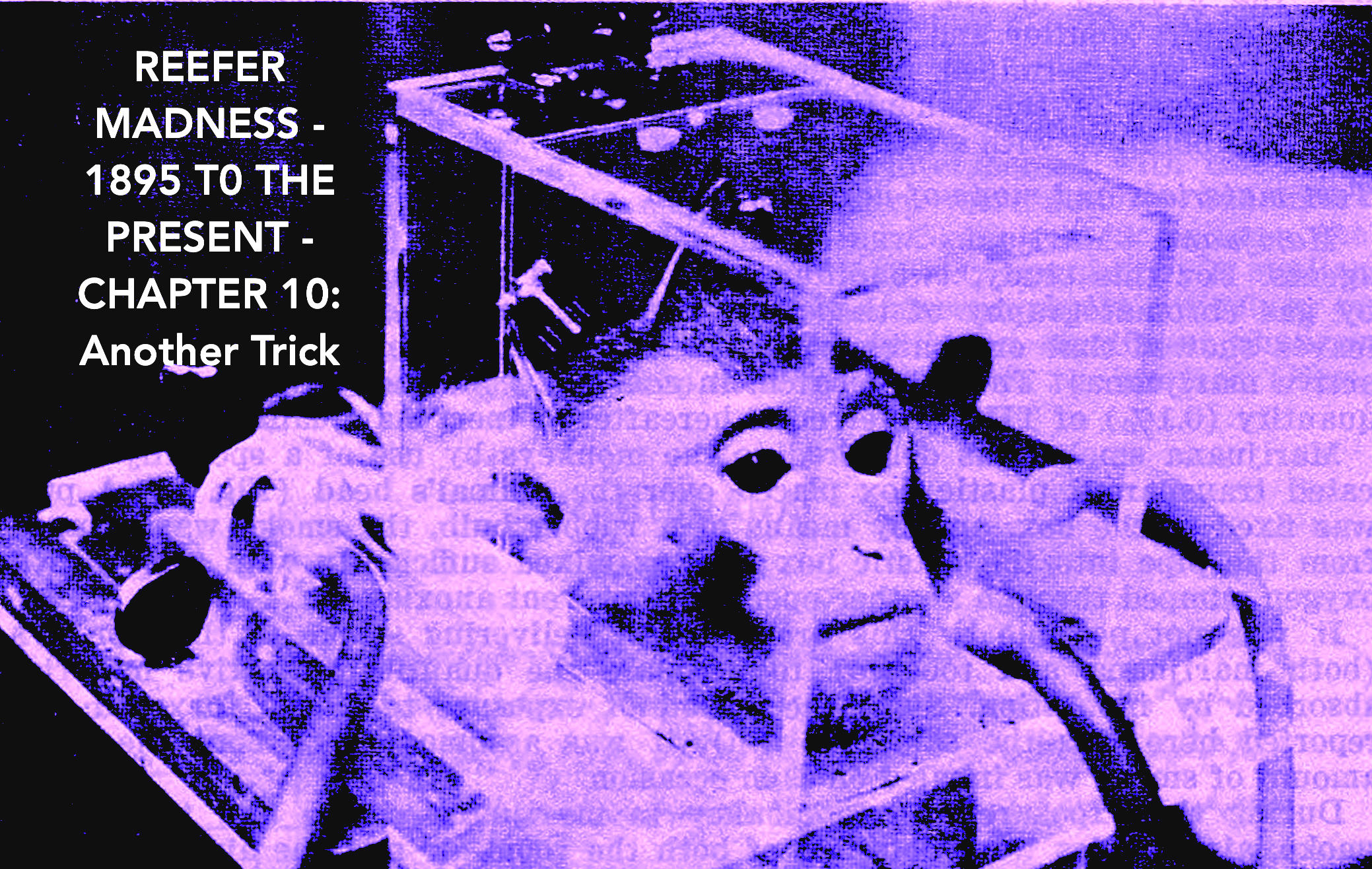
The 1970s. Prohibitionist tactics became much more sophisticated. Instead of the ancient techniques of limiting cannabis use to those of special status or associating unsanctioned use with devil worship, or lying about what exactly the assassins used it for, or blaming pot for criminality or insanity it had nothing to do with, or confusing the effects of regular doses with heroic doses, the new tactic was to fake lab results by subjecting lab monkeys to “63 joints in 5 minutes” every day for 3 months. The monkeys weren’t suffering from the effects of cannabis – they were suffering from the effects of oxygen deprivation (and cruel, fraudulent scientists). Most reporters took these new conclusions seriously, because educated men in lab coats would never lie. It was “science.”
Special thanks to the Cannabis Museum for sponsoring the creation of this series. The introduction to this series (Reefer Madness – 1895 to the Present) can be found here. Chapter 1 can be found here. Chapter 2 can be found here. Chapter 3 can be found here. Chapter 4 can be found here. Chapter 5 can be found here. Chapter 6 can be found here. Chapter 7 can be found here. Chapter 8 can be found here. Chapter 9 can be found here.
“At first glance, the possibility of hemp paper making a comeback may seem pretty remote. However, when we consider the alternatives: a rapidly diminishing timber supply, clearcutting in our national forests, ecological disasters from lost watersheds and oxygen resources, deteriorating books in libraries, and escalating woodpulp paper prices; the repeal of anti-hemp legislation and a crash program to raise hemp and flax may be our best, if not only way out.”
- Jack Frazier, “Hemp Paper Reconsidered,” High Times #1, 1974 (1)
“Autonomy is the death knell of authority, and authority knows it: hence the ceaseless warfare of authority against the exercise, both real and symbolic, of autonomy – that is, against suicide, against masturbation, against self-medication, against the proper use of language itself!”
- Thomas Szasz, Ceremonial Chemistry: The Ritual Persecution Of Drugs, Addicts, and Pushers, Anchor Press/Doublday, New York, 1974 (2)
“You want to know what this was really all about? The Nixon campaign in 1968, and the Nixon White House after that, had two enemies: the antiwar left and black people. You understand what I’m saying? We knew we couldn’t make it illegal to be either against the war or black, but by getting the public to associate the hippies with marijuana and blacks with heroin, and then criminalizing both heavily, we could disrupt those communities. We could arrest their leaders, raid their homes, break up their meetings, and vilify them night after night on the evening news. Did we know we were lying about the drugs? Of course we did.”
- John Ehrlichman, to Dan Baum for Harper’s Magazine in 1994, about President Richard Nixon’s war on drugs, declared in 1971 (3)
“Several people, spearheaded by Hunter Thompson, attacked the current strategy of decriminalized pot as ‘another trick.’”
- High Times #19, March 1977 (4)
If the 1960s were the decade where the cannabis community came out of the closet and began its rebellion against discrimination and oppression, the 1970s were the decade where that rebellion was simultaneously intensified and diverted into less radical, more reformist pursuits.
The two most important voices in the debate about Reefer Madness in the 1970s were both anti-prohibitionists. The voice for moderate reform was Keith Stroup – the founder of NORML, and ultimately the person most responsible for taking the movement away from the “total medical and vocational autonomy”- focused Yippie rabble-rousers and substituting it with the “reform”- focused lawyers.
The other voice of major importance in the debate was a psychiatrist and academic with libertarian views of medical autonomy: Thomas Szasz. Szasz pointed out that global drug policy wasn’t about health, it was about persecuting scapegoats. Szasz revealed that drug prohibition shared more in common with witch burning and Jew hunting than it did with the prevention and treatment of disease.
Keith Stroup was a young attorney who was inspired by consumer advocate Ralph Nader and bankrolled by nudie mag magnate (and free expression advocate and anti-racist activist and watch the “Secrets Of Playboy” documentary because he’s also very problematic) Hugh Hefner to create a consumer advocacy group for consumers of pot. Stroup originally envisioned NORML as the “National Organization for the REPEAL of Marijuana Laws”, but after a discussion with Ramsey Clark (LBJ’s attorney general), opted to change the REPEAL to REFORM;
“Clark had one specific suggestion: Make it the National Organization for the Reform of Marijuana Laws, not Repeal. ‘Repeal’ was a scare word, Clark cautioned, but there was a long and honorable tradition of political reform in the United States. Stroup had been unconvinced when Larry Schott made the same suggestion, but he followed Clark’s advice at once.” (5)
 Image #1: “Slow Progress For Grass Backer,” Stevens Point Journal, Stevens Point, Wisconsin, October 11th, 1971, p. 24
While the first legalization organization – LEMAR (LEgalize MARijuana) – promoted legalization models that were free of “government monopoly”, free of “any system of licensing that is more selective or restrictive than our present system of alcoholic beverages control” and free of “bribery and corruption” (6) and another drug peace organization – Amorphia – favored “FREE, LEGAL BACKYARD MARIJUANA!” (7) and the Yippies favored legalizing marijuana “so that the drug laws can no longer be used as a weapon” against the poor, (8) NORML limited its goals to “decriminalization” – a deceptive term that, on the surface, appeared to be punishment elimination, but could simply mean replacing a set of criminal punishments with a set of equally if not even worse “non-criminal” punishments. (9)
 Image #2: “1970: Norml, the National Organization for the Reform of Marijuana Laws, is founded by a lawyer, R. Keith Stroup. The organization advocates through lobbying and litigation for the legalization of marijuana. • The Pot Lobby (Jan. 21, 1973)” Image from: https://archive.nytimes.com/screenshots/www.nytimes.com/interactive/2013/10/27/us/marijuana-legalization-timeline.jpg
By 1977, NORML was beginning to feel the pressure from the rank and file to expand their advocacy to include “full legalization” – one which will protect “the Third World growers and the neighborhood dealers,” As one NORML member put it at their 1977 gathering;
“Be it resolved that NORML adopt a policy for full legalization of marijuana. One that clearly opposes government manipulation of grass legislation, will protect the trade, the Third World growers and the neighborhood dealers who’ve risked an awful lot of freedom providing us with marijuana.” (10)
 Image #3: “Seeks marijuana law reform – Lawyer R. Keith Stroup lives a NORML existence,” Chicago Tribune, Chicago, Illinois, April 2nd, 1974, p. 24
Stroup countered with the argument that decriminalization would prevent the corporate take-over of the cannabis economy;
“NORML chief Keith Stroup, a decrim supporter, opposed legalization ‘for three years or so,’ in favor of a current push toward decriminalization until a consumer-based distribution system could be arranged. Stroup argued that corporate giants would devour and destroy the dope market.” (11)
 Image #4: “Background on National Organization for the Reform of Marijuana Laws (U.S.)” Image from: findingaids.library.umass.edu/ead/mums757
Unfortunately, Stroup did not understand that the difference between an inclusive legalization model and a cartel-type of legalization model wouldn’t be the timing of the roll-out or a focus on a “consumer-based distribution system,” it would be whether or not “legalization for all” was the explicit focus or merely implied. With hindsight, it is clear to see that small-scale growers and dealers will be left out of any legalization model unless they are explicitly and unrelentingly advocated for by the activists behind the authorship of that model. If anyone other than explicitly “anti-monopoly activists” create the model, the cartel is a near certainty.
 Image #5: “Pot Smokers Owe Last Night’s Historic Ballot Wins to This Man” Image from: https://nymag.com/vindicated/2016/11/pot-smokers-owe-last-nights-ballot-wins-to-this-man.html
After 1977, the legal cannabis economy was slowly and easily monopolized by corporations, who first created synthetic-THC drugs such as Nabilone (AKA Cesamet), and Marinol (AKA Dronabinol) – both first approved by the FDA in 1985 (12) – and then pharmacized whole-plant cannabis drugs such as Sativex (first approved in Canada in 2005) (13), using the stigma on “unstandardized” medicine as an excuse for exclusivity for their products – similar to how some dispensaries and licensed producers are justifying their cartel in today’s legal cannabis market. To my knowledge, at no time did NORML ever act to prevent the actual corporatization of cannabis, other than pay lip service to the idea. NORML’s “endorse monopolistic initiatives with reservations” strategy will be explored more fully in chapter 14.
According to Dr. Lester Grinspoon of Harvard Medical School (in an article co-authored with this author), the advantages of natural, “unpharmaceuticalized” unstandardized (at least to the extent of preventing a corporate monopoly) cannabis far outweigh the disadvantages;
“Ethan Russo, an employee of GW Pharmaceuticals, writing for the on-line journal ‘Cannabinoids’, listed the benefits of pharmaceuticalized cannabis medicines in his article ‘Cannabinoid Medicine and the Need for the Scientific Method’. They are; 1) pharmaceuticalized cannabis products will gain widespread trust of physicians and medical consumers, 2) crude herbal materials can’t be standardized, 3) smoked cannabis causes coughing and ‘cytological alterations’, 4) sharing joints can lead to sharing diseases, 5) even vaporization is inefficient, unpredictable and unsafe, 6) there’s not enough evidence of smoked cannabis working, 7) the FDA will not accept the type of evidence that exists regarding the efficacy of smoked cannabis, 8) it is difficult to establish the dose of smoked cannabis, 9) crude herbal materials are full of micro-organisms and 10) most of the non-GW Pharmaceuticals strains of cannabis have no CBD in them. In our view none of Russo’s claims are accurate; 1) the pharmaceutical industry is currently losing the trust of consumers as herbal medicines make a comeback, 2) ‘crude herbal materials’ can easily be standardized without patents if the herb is legal and regulated , 3) more potent products such as bubblehash and devices such as water-pipes and vaporizers reduce coughing – there’s no evidence that the ‘cytological alterations’ are anything other than a slight color alteration, a manifestation of bronchial irritation , 4) there are devices such as chillums and techniques for holding joints that can eliminate the spread of disease through preventing the spread of saliva, 5) there’s no evidence that smoke and/or vaporization is inferior to oral sprays because GW and Bayer will not do comparative studies, 6) US and Canadian governments have suppressed most studies on smoked marijuana but there are thousands of anecdotal accounts, and those thousands of stories collectively comprise a clinical bibliography more comprehensive than that of any synthetic, 7) the FDA has never required controlled experiments to recognize the therapeutic potential of chloral hydrate, barbiturates, aspirin, curare, insulin, or penicillin, 8) it is much easier to control the dose of smoked cannabis than oral sprays because the effects of smoked cannabis take 1 to 5 minutes to work and sprays take 15 to 40 minutes to work, 9) properly grown organic cannabis is relatively free of microbes and metals, and 10) if cannabis were legal, those high CBD strains would be more easily circulated among all breeders.” (14)
The heads of NORML opposed legalization in the 1970’s because they feared a corporate cannabis monopoly. They somehow thought it was better for growers and dealers to be arrested than to be put out of business permanently by police for the benefit of the corporations who were beginning to imagine exclusive production and distribution arrangements. Admittedly, this was before Marinol, before Sativex, before the pot cartels and “limited number of licenses” models were created. Still, the rank and file – and the Yippies and other abnormal agitators who were too radical for NORML – had the intuition needed to imagine how easy it would be for the government and the wealthy to set themselves up with a limited pot monopoly and get away with it. These activists insisted that NORML ask for more than “decrim” as a result of such intuition.
In 1979, due to pressure from the rank and file, NORML changed it’s position of strict decriminalization and began publicly calling for both decrim and legalization at the same time:
“It’s only taken us nine years to say we wanted legal dope,” said NORML founder Keith Stroup in a moment of clarity. “. . . nine years of being hypocrites to ourselves and the smugglers who bring in the dope we smoke.” (15)
But the damage had already been done. The gains of the movement were limited to decrim. By the end of the 1970s, 11 states had enacted initiatives to decriminalize in some way. As late as 2004, Stroup had insisted that decrim “would remove the consumer from the criminal justice system, and eliminate nearly 90% of the current marijuana arrests” in the USA. (16)
This notion that the decrim strategy would lead to a decrease in arrests was debunked the very next year by none other than NORML itself (under new leadership), when they released a report indicating that – in spite of “more than 25 percent of the U.S. population lives under some form of marijuana decriminalization” (17) arrests had increased;
“In 1970 there was an estimated 188,682 arrests for the drug – by 2003 the number had increased to 755,000. So it’s clear that despite the decriminalization effort, the chances of a marijuana user being arrested have significantly increased.” (18)
 Image #6: “NORML pursues decriminalization,” Casper Star-Tribune, Casper, Wyoming, May 27th, 1977, p. 12
And while it’s true that some forms of decrim have involved significant punishment reduction, it’s also true that most forms of decrim have involved a punishment increase, in the form of increased arrests rates (net widening), horrific “non-criminal” punishments such as “mandatory treatment” or an increase in the number of people spending time in jail for unpaid fines. (19)
For example, simple pot possession arrests of targeted communities (Grateful Dead show attendees) in Wisconsin instantly increased 18 times more than what they were previous to decrim, due to high fines incentivizing arrests. (20)
For another example, in New York City arrests increased by 11 times in the 1990s after decriminalization in 1977 left a loophole allowing for arrest if the cannabis was “in public view.” Police officers simply intimidated people into being searched and charged them for having their pot “in public view” after they emptied their pockets. (21)
For an extreme example, in Singapore cannabis possession is not viewed as a criminal problem, but rather a “behavioral problem.” Under their 1977 “decrim” pot law, those caught with under 500 grams are subject to “the cane” and “mandatory treatment,” consisting of being put into a “rehabilitation centre” where they are subjected to military training, group therapy, and two years of urine tests after they get sent home. Those caught with over 500 grams get executed. Despite this harsh treatment, “addiction” (use rates) continued to rise, resulting in even harsher measures from the government in the form of amendments in 1995 to the “Misuse of Drugs Act,” (22)
The fact of the matter is, scapegoats throughout history have always been given the option of fighting for half-measures or full equality – be it the Jewish leadership who were fooled by the Nazis into focusing on exceptional Jews and abandoning the unexceptional Jews to the holocaust, (23) or the witches who settled for “punishment reduction” and “decriminalization” – spread out over centuries, (24) or the homosexuals and other sexual deviants who have instead wisely focused on fighting for equality instead of “decrim,” and have achieved many of their goals, albeit incrementally. (25)
The academic who first articulated the similarities between the drug war and other forms of scapegoating was Thomas Szasz. A psychiatrist of the libertarian variety who first made a name for himself in 1961 with his revolutionary book The Myth Of Mental Illness, Szasz then published his most profound and relevant-to-drugs work – Ceremonial Chemistry – in 1974, and did for the drug peace movement what he did for the anti-psychiatry movement: he summarized the evidence against the core assumptions that both psychiatric medicine and the drug war were based on.
 Image #7: “Offbeat psychiatrist lectures here today,” The Sacramento Union, Sacramento, California, September 20th, 1977, p. 10
Szasz pointed out that the word “addiction” originally meant “not-necessarily-problematic attraction” – as in an attraction to reading or to politics – and that it only became associated with problems after the beginning of the drug war. (26) Szasz also pointed out that the origin of the words “pharmacology” and “pharmacopeia” wasn’t “medicine” or “poison” or “drug”, but rather “pharmakos,” which meant “scapegoat”. (27)
 Image #8: “Scholars to tackle universal issues,” Syracuse Herald-Journal, Syracuse, New York, January 29th, 1979, p. 4
Szasz compared previous religion-based scapegoating with modern drug-based scapegoating in a number of ways, including the motive behind the scapegoating. Efforts to hunt down witches, Jews and drug users appeared to be – on the surface – concern over public health and safety, but upon closer inspection, were all about control over substantial sectors of the economy;
“The Church, Michelet remarks, ‘declares, in the fourteenth century, that if a woman dare cure without having studied, she is a witch and must die.’ Of course, ‘studying’ here refers to studying the Scriptures and qualifying, in effect, as a priest. In the same way, in the twentieth century, Medicine declares that if a man, woman, or child dares to dispense drugs without having a medical license – and dispenses a ‘dangerous drug’ without being specially registered with the Bureau of Narcotics and Dangerous Drugs – then he or she is a ‘pusher’ and must be severely punished, perhaps by life imprisonment.” (28)
 Image #9: “Dr. Szasz, Pupils Debate,” The Post-Standard, Syracuse, New York, February 8th, 1975, p. 26
Szasz did not fear the established medical institutions that – up until that point – had mostly avoided criticism of their position on cannabis policy;
“The American Medical Association’s position on self-medication and drug controls has at least been consistent during the past fifty years. It has never told the truth about drugs (as that ‘truth’ was seen and recorded by contemporary chemists and pharmacologists), if telling it was in conflict with government policies or with the Association’s desire to gain exclusive control over the use of certain substances. For example, the New York Academy of Medicine issued its report on marijuana which declared its use ‘completely harmless,’ the Journal of the American Medical Association ‘hurled a few invectives at the Academy, warning that ‘Public officials will do well to disregard this unscientific study and to continue to regard marijuana as a menace wherever it is purveyed.’” (29)
 Image #10: “New drug approach urged,” Edmonton Journal, Edmonton, Alberta, March 29th, 1975, p. 9
 Image #11: “Mental illness doesn’t exist, psychiatrist says at U. Of R.,” Democrat and Chronicle, Rochester, New York, February 27th, 1974, p. 23
In 1978, the Los Angeles Times reprinted an article that appeared first in Reason magazine, which contained a quote from Szasz that nicely summed up his concept of autonomy. He wrote;
“The argument that people need the protection of the state from dangerous drugs but not from dangerous ideas is unpersuasive. No one has to ingest any drug he does not want, just as no one has to read a book he does not want. Insofar as the state assumes control over such matters, it can only be to subjugate its citizens – by protecting them from temptation, as befits children – and by preventing them from assuming self-determination over their lives, as befits an enslaved population.” (30)
 Image #12: “A Celebration of the Life and Work of Thomas Szasz” 1920-2012 Image from: https://www.upstate.edu/psych/szasz.php
While the moderate and radical policy-reformers of the 1970s conducted their various ballot initiatives and smoke-ins, the prohibitionists were in retreat. By 1972 both the Shafer Commission and the Le Dain Commission had released their final reports – neither report seemed to indicate any imminent serious, provable danger to the public from marijuana possession or sales. Unfortunately, the “caution” that experts suggested society use was focused almost entirely on preventing drug law reform by focusing on the unknown dangers of cannabis, rather than preventing harm to the pot community by focusing on the proven dangers of cannabis prohibition. Continued prohibition of various harmless pot-related activities – such as cannabis sales – was advocated by all but a handful of pot activists, academics and visionaries.
 Image #13: NEW FACTS ABOUT MARIJUANA, Ambassador College Research Department, AMBASSADOR COLLEGE PRESS, Pasadena, California, 1970, p. 30
 Image #14: A HANDBOOK for PARENTS about DRUGS, Toronto Addiction Research Foundation, January 1970
 Image #15: A HANDBOOK for PARENTS about DRUGS, Toronto Addiction Research Foundation, January 1970, p. 3
 Image #16: A HANDBOOK for PARENTS about DRUGS, Toronto Addiction Research Foundation, January 1970, p. 14
 Image #17: A HANDBOOK for PARENTS about DRUGS, Toronto Addiction Research Foundation, January 1970, p. 15
The only thing different about the prohibitionists was that medical expert had taken the place of the police officer as the main go-to point person for reporters investigating the issue. Scientists such as Gabriel Nahas, Robert Heath and Harold Kalant conducted a full-time crusade against cannabis, often conducting the most fraudulent research to back up their concerns. Lies about cannabis psychosis never disappeared – they just became more sophisticated.
The decade began with an article comparing alcohol to cannabis. The Le Dain and Shafer reports were less than 2 years away from being published, and the experts suggested that there may soon be discovered some justification for the pot laws;
“‘The National Institute on Mental Health has just begun a crash program to find out more about drugs. They’ve put a lot of money into it and it will be late this year before the results are in. Can’t anyone wait one year to start taking pot?’ . . . ‘We’re stuck with a law for now that may be unfair. But what if the report shows that three million brain cells are destroyed every time you smoke a reefer?’ . . . Killinger said the assumption by youth today that marijuana can’t hurt you is a fair conclusion so far but ‘they may be wrong once the tests are finished. There has been such limited research. There are 28 chemicals in the smoke of marijuana and the different ratios of the ones may produce other effects not known about yet.” (31)
A newspaper in South Bend, Indiana, reported the possibility of legalization of cannabis in Canada – with what may be the first published photo of a Canadian cannabis-themed smoke-in protest ever – on Parliament Hill in Ottawa.
The caption of the photo read;
“SMOKING DEMONSTRATION – Student demonstrators who held a sit-in on Parliament Hill in Ottawa recently claimed they were smoking marijuana to protest raids on places frequented by students in the area. Canada is reviewing the marijuana problem.” (32)
 Image #18: “SMOKING DEMONSTRATION,” The South Bend Tribune, South Bend, Indiana, January 18th, 1970, p. 13
The article accompanying the photo, titled “Canada Studies Legalized Marijuana but Fears U.S.,” revealed that;
“The Canadian government appears to be considering the legalization of marijuana but one problem with such a move would be reaction in the United States. ‘If marijuana were freely available in Canada, you would probably have to close the U.S. border,’ one government source said. ‘There would have to be careful surveillance of every person crossing into the States. That’s an awful lot of border to close off like that and the U.S. Government could bring a lot of pressure to bear on the Canadian Government against legalization. Prime Minister Pierre Elliott Trudeau, in an offhand remark during his Christmas vacation in the French Alps, said marijuana may be legalized in the near future if current research show it is not dangerous. . . . Health minister John Munro has noted there appears to be no definite medical evidence that marijuana has any short-term effects. He gave the go-ahead to government and university researchers to carry out studies of the long term and possible side effects of marijuana use.”
An unnamed “liberal member of Parliament” said that there should be a moratorium on pot prosecutions “to keep youngsters from being branded with a criminal record for doing something that soon may not be a crime.”
 Image #19: “Canada Studies Legalized Marijuana but Fears U.S.,” The South Bend Tribune, South Bend, Indiana, January 18th, 1970, p. 13
 Image #20: Trudeau Albums, Otherwise Inc. Editions/Penguin, Toronto, 2000, p. 75
In an article titled “Facts, Not Myths, Needed On Marijuana: Psychiatrist” in a Michigan newspaper, Dr. Lester Grinspoon was quoted, along with Professor Margaret Mead. Dr. Grinspoon stated;
“We obviously need to reduce the emotionalism surrounding the subject and replace myths with facts as far as they can be determined. . . . There is no evidence that marijuana is more likely than alcohol or tobacco to lead to the use of narcotics. . . . No cases of murder or sexual crime due to marijuana have been established. . . . (Marijuana) intoxication induces a lethargy that is not conducive to any physical activity, let alone the committing of crimes. . . . In most situations, one cannot be certain which came first: The drug on the one hand or the depression or personality disorder on the other.” (33)
At least some of the reporting on arrests during this period provided a lack-luster effort to stigmatize. For example, a story about a series of arrests for harvesting ditch weed in Lafayette, Indiana, was accompanied by this statement;
“Although marijuana is not technically a narcotic or generally physically addicting, it comes under the jurisdiction of the Federal Bureau of Narcotics. Anyone caught with it in his possession may be fined $100 an ounce (up to $2,000) and be sentence to jail from 2-20 years, depending on whether it’s a first or second offense.” (34)
In other words, the reasons provided to avoid smoking cannabis weren’t medical, they were legal.
 Image #21: “Forbidden Marijuana Flourishes in Lafayette Area Cornfields,” Journal and Courier, Lafayette, Indiana, January 28th, 1970, p. 20
 Image #22: “Forbidden Marijuana Flourishes in Lafayette Area Cornfields,” Journal and Courier, Lafayette, Indiana, January 28th, 1970, p. 20
 Image #23: “FREE JOHN SINCLAIR BENEFIT,” GARDEN AUDITORIUM, Vancouver, B.C., February 1st, 1970
 Image #24: “FREE JOHN SINCLAIR BENEFIT,” GARDEN AUDITORIUM, Vancouver, B.C., February 1st, 1970
 Image #25: “Go Easy on Pot Smokers, Campus Probe Tells Rock,” Daily News, New York, New York, February 17th, 1970, p. 59
Meanwhile, up in Canada, 29 year old Robert Wenman, Member of the Legislative Assembly for Delta, BC for the far-right Social Credit party, shared his insight into the cannabis debate with an editorial in the Surrey Leader newspaper;
“Even your own sons and daughters will know friends who have deteriorated because they have used marijuana. Many young people have already fallen into the pit of drug abuse and a rehabilitation program will have to be embarked upon.” (35)
Wenman then proposed work camps up north for marijuana “pushers.”
On March 1st, 1970, a Kentucky newspaper published a review of various punishments for marijuana crimes around the world. The article ended on a somber note;
“Although it has never been invoked, death is the potential penalty in four states for someone convicted of selling marijuana to minors. It’s a possibility in Louisiana and Missouri on a first offense, in Georgia for a second offense, and in Colorado for a third offense when someone under 25 is induced to use marijuana.” (36)
At some point these death penalties were replaced with long prison sentences and massive fines. Louisiana reduced the penalty for minors from death to 45 years, with a 90-year maximum for a second offence. (37) Missouri reduced the death penalty down to a 15-year maximum. (38) Georgia replaced the death penalty with a mandatory minimum of 5 to 20 years and/or a fine up to 20,000 dollars for “involvement of a minor.” (39) Colorado replaced the death penalty with penalties ranging from 6 months to 32 years – and fines ranging from one thousand to one hundred thousand dollars for distribution to a minor based on the amount of cannabis, regardless of whether the offence was a first offence or not. (40) US Federal law still allows for the death penalty for growing 60,000 cannabis plants, regardless of plant size and regardless of whether or not the plants are medicinal or industrial. (41) There was even open speculation that this death penalty applied to Canadian cannabis seed sellers who were extradited to the US for selling over 60,000 cannabis seeds to US citizens. (42)
In the same month of the Kentucky “marijuana death penalty” story, another article appeared regarding soldiers testifying about the My Lai massacre in Vietnam, and the fact that a soldier had admitted some of the guys in his unit had smoked pot the night before. Dr. Joel H. Kaplan had testified that “as a major commanding a psychiatric detachment at Nha Trang” he “became quickly convinced that marijuana was a major cause of mental disorders there:”
“Contrary to many popular opinions held here in the States, the drug could cause people to become fearful, paranoid, extremely angry and led, in a number of cases, to acts of murder, rape and aggravated assault.” (43)
The fact that both the military’s policy of “free-fire zones” and the CIA’s civilian-targeting “Phoenix program” guaranteed large numbers of civilian casualties was hidden behind a smokescreen (see the end of the previous chapter).
 Image #26: “American Soldiers Smoking Weed Out of a Shotgun Barrel (1970) Back to the Past” Image from: https://www.youtube.com/watch?v=C8MYu7BnjmE
 Image #27: “American Soldiers Smoking Weed Out of a Shotgun Barrel (1970) Back to the Past” Image from: https://www.youtube.com/watch?v=C8MYu7BnjmE
 Image #28: “Sergeant Claims GIs Smoked Marijuana Before Massacre,” Palladium-Item, Richmond, Indiana, March 25th, 1970, p. 3
Like reporters in the 1920s and 1930s, reporters in the early 1970s were able to make people afraid of cannabis by confusing the effects of heroic doses with the effects of typical doses. It was never pointed out that high-dose impairment also occurred with caffeine. But they were also looking for new ways to spin the dangers of cannabis, like the following story from a Warren, Pennsylvania newspaper on April 14th, 1970. In an article deceptively-titled “No Pipe Dream: ‘Pot’ Can Be Harmful,” the author took the looming danger of “synthetic marijuana,” added excessive use, used a hypothetical “teen” to maximize parental hysteria, and then applied the predictable consequences of such abuse to non-synthetic “pot:”
“What would happen if a teenager could pop five marijuana tablets into his mouth and wash them down in less time than it would take to smoke a single marijuana cigarette? The odds are he would start promptly on his ‘trip,’ with possible serious consequences. This is no pipe dream. Such a thing will be within reason as soon as chemists make synthetic marijuana tablets and knowledge of the technique becomes available to laboratories that traffic in illegal drugs. Scientists believe this to be inevitable, and it will add substantially to the risks of marijuana use which now are subject to much controversy.” (44)
Hindsight being 20/20, we now know that synthetic marijuana will never become as popular as real pot for two reasons: 1) it’s not as pleasurable as the real thing (due to the synergistic effects of all the cannabinoids and terpenes working together in actual cannabis and the lack of this synergy in synthetic cannabis) and 2) unlike LSD and the natural fungus “ergot” which it’s based on, botanical cannabis is always cheaper and easier to grow than it would be to synthesize. Who wants to feel ill for more than 100 dollars when one can feel great for less than 5 dollars?
The US National Institute of Mental Health suggested that marijuana use led to brain damage, in a paper released in early 1970, citing unknown reports from other countries;
“The National Institute of Mental Health said in a paper released Tuesday by a House crime committee the question of possible brain damage from chronic use of strong marijuana preparations such as hashish still is unanswered. And any authoritative conclusions on long-term marijuana effects are premature until present studies are completed, hopefully in two years, the institute said. . . . In some countries of the Middle East and Near East, where cannabis preparations have been a part of the culture, it is believed chronic use of the strong preparations, such as hashish, is associated with psychosis and brain damage in some people.” (45)
 Image #29: “NEGR0 ARRESTED IN SLIDELL MARIJUANA POSSESSION,” St. Tammany Farmer, Covington, Louisiana, April 17th, 1970, p. 2
 Image #30: Abbie Hoffman, wearing a Yippie Flag (a pot leaf on a red star on a black flag) as a cape, speaks at New Haven Green, Yale University at a Black Panther’s rally on May 1st, 1970. Image from: https://www.pbs.org/independentlens/chicago10/images/yip_abbiespeaking.jpg (image since removed)
 Image #31: “Spectator with Yippie flag draped over balcony at press conference at Center Church on the Green featuring.” 1970 May 1, Yale Alumni Magazine Photographs Image from: https://onlineexhibits.library.yale.edu/s/black-panther-may-day/item/2548#
 Image #32: “High Times Greats: Dana Beal,” January 7, 2021 Image from: https://hightimes.com/culture/high-times-greats-dana-beal/
 Image #33: “May 13 to 20, 1970: This groovy image was featured on the cover following a weekend of riots in Downtown Vancouver.” “Far out: 6 retro Georgia Straight covers that celebrate cannabis,” Amanda Siebert, November 13th, 2017 Image from: https://www.straight.com/cannabis/990391/far-out-6-retro-georgia-straight-covers-celebrate-cannabis#
The early 1970s seemed to have two messages arise from newspaper reporters: 1) we don’t know what the long-term effects are, and 2) the laws are a bit too strict and we should reduce the penalties. Such was the case in the May 17th, 1970 3-page feature article in the Democrat and Chronicle;
“‘The plant itself is not a drug. Dr. Helen Nowlis, a University of Rochester professor and nationally known expert on drugs, notes that marijuana is a drug ‘only by virtue of it being so labeled in the Marijuana Tax Act of 1937 and subsequent legislation.’ Actually, she maintains, marijuana ‘is no more a drug than tea leaves or coffee beans . . .’ . . . ‘If I were asked to designate the greater evil – current use of marijuana or the impact of the drug laws on the attitude of young people towards the law – I would without hesitation name the latter,’ she has written.” (46)
As was pointed out in the introduction of this series, the etymology of the word “drug” is most likely “dry wares” such as dried herbs. So rather than coffee, tea and cannabis not being drugs, etymologically, they’re all drugs.
The article went on to list the “Fables and Facts” surrounding cannabis, and under the fable of “Marijuana is harmless,” the response was;
“Instances of acute panic, depression, and psychotic states are known, though they are infrequent. Certain kinds of individuals can also become overinvolved in marijuana use and can lose their drive. We do not know the effects of long-term use.”
As realistic research on the effects of cannabis began to take place, reporting on the possible beneficial effects of cannabis rose from about 0.1 percent of all reporting, to slightly above 1 percent. By far the doctor with the clout needed to discuss the benefits of cannabis use and still retain his job was Harvard professor Dr. Lester Grinspoon, who was quoted in the following article from the Delaware County Daily Times:
“At the close of a paper on marijuana at the annual meeting of the American Psychiatric Association, Dr. Lester Grinspoon commented that there is ‘a great deal of misinformation and fear-generating mythology surrounding the drug’ and that the medical community has been both ‘victim and agent’ of this situation. Grinspoon, director of psychiatric research at the Massachusetts Mental Health Center in Boston and an associate professor at the Harvard Medical School, said, for example, that by their own admission, 65 per cent of the GIs in Vietnam used marijuana at least once during their tour of duty. He also said that by comparison with other wars, the psychiatric casualty rate is low. Putting these two facts together, Grinspoon arrived, if not at a conclusion, then at least at the point where he could ask some rather provocative questions: is marijuana, to some extent, protecting the soldiery from the psychoses usually lumped together under the term ‘combat fatigue’? And could the drug prove valuable, as some studies have indicated, in withdrawing patients from barbiturate and alcohol addiction and in treating other disorders such as chronic lack of appetite (anorexia nervosa) or migraine headache? The mere asking of such questions is almost heretical.” (47)
 Image #34: Good Times, Vol. 3 No. 22, May 29th, 1970. ”Heads Together: Weed and the Underground Press Syndicate, 1965–1973″ Image from: https://www.artbook.com/9783907236543.html
 Image #35: “TWO LIDS OF MARIJUANA,” Fond Du Lac Commonwealth Reporter, Fond Du Lac, Wisconsin, June 9th, 1970, p. 1
Newspaper editors had no problem calling for more research and increased penalties at the same time – again, the precautionary principle only applying to the drugs themselves but not to the effects of the policy. In a June 9th 1970 editorial from a paper in Wisconsin, this “punish as we research” approach was outlined:
“If one accepts the premise that marijuana is illegal and therefore possession and use of pot should be curbed, the obvious question is, ‘how?’ If that premise is accepted, these recommendations are then valid: 1. There must be more cooperation among communities to trade undercover policemen. 2. More men must be employed by the police department. The City of Fond du Lac force numbers 55 men, yet national standards call for 1.9 men per 1,000 population. With or without the pill and pot problem, our local police force should be more near 70 men in total strength. 3. Operation Intercept, a cooperative crackdown of marijuana at the Mexican border, slowed down the pot market and raised marijuana prices in the U.S. There must be more international understanding and effort, if the problem of marijuana and drugs are to be stopped at the source. 4. There should be more scientific study of marijuana’s effects on the human body. 5. The courts must be severe with the pushers and those convicted more than once for marijuana possession and use. 6. Continued education is the most important approach to marijuana control.” (48)
 Image #36: “Black militant’s lawyer says evidence planted,” The Miami News, Miami, Florida, June 11th, 1970, p. 46
 Image #37: Teen-Age Booby Trap, Malcolm Ater, Bureau of Narcotics & Dangerous Drugs, 1970 Image from: https://archive.org/details/Hooked_201607/page/n1/mode/2up
 Image #38: Teen-Age Booby Trap, Malcolm Ater, Bureau of Narcotics & Dangerous Drugs, 1970 Image from: https://archive.org/details/Hooked_201607/page/n1/mode/2up
 Image #39: Teen-Age Booby Trap, Malcolm Ater, Bureau of Narcotics & Dangerous Drugs, 1970 Image from: https://archive.org/details/Hooked_201607/page/n1/mode/2up
 Image #40: Teen-Age Booby Trap, Malcolm Ater, Bureau of Narcotics & Dangerous Drugs, 1970 Image from: https://archive.org/details/Hooked_201607/page/n1/mode/2up
 Image #41: Teen-Age Booby Trap, Malcolm Ater, Bureau of Narcotics & Dangerous Drugs, 1970 Image from: https://archive.org/details/Hooked_201607/page/n1/mode/2up
On June 20th, 1970, the release of the Interim Report of the Commission of Inquiry into the Non-Medical Use of Drugs – Canada’s Le Dain Commission – was reported on, with much attention in the press. A majority of the Commission members recommended that the penalty for simple possession of every drug – including heroin – should be limited to a “maximum fine” of 100 dollars (49) as an “interim measure” until their final report was issued, with no possibility of jail for unpaid fines (50) and a suspended sentence for a first offense, criminal records destroyed after two years, and “the Mounties and local police forces would be encouraged to end the practice of using undercover agents to entice young people into the crime of trafficking in order to gain convictions.” (51) The most progressive member of the commission – Marie-Andree Betrand – wrote a one-paragraph dissent, arguing for legalization of simple possession of cannabis;
“I find myself in disagreement with my colleagues on the Commission in respect of the offense of simple possession of cannabis. In my opinion the prohibition against such possession should be removed altogether. I believe that this course is dictated at the present time by the following considerations: the extent of use and the age groups involved; the relative impossibility of enforcing the law; the social consequences of its enforcement; and the uncertainty as to the relative potential for harm of cannabis.” (52)
In other words, a precautionary principle that applied to both the effects of the drug and the effects of the law.
 Image #42: “MORE RESEARCH, CLINICS – The LeDain Formula,” Times Colonist, Victoria, B.C., June 19th, 1970, p. 6
 Image #43: INTERM REPORT OF THE COMMISSION OF INQUIRY INTO THE NON-MEDICAL USE OF DRUGS, Information Canada, Ottawa, 1970
Initial newspaper coverage of the release of the interim report did not mention cannabis psychosis, but the report itself had some interesting things to say on the subject;
“The possibility of psychiatric disorders associated with cannabis use has received considerable attention. Although there are some well documented examples of very intense and nightmarish short-term reactions (usually among inexperienced users in unpleasant situations and with high doses), these cases seem to be relatively rare and generally show a rapid recovery. Although many regular users have had an experience with cannabis which was in some way unpleasant, ‘freak-outs’ are apparently rare. Ungerleder has reported 1,887 ‘adverse reactions’ to marijuana in the Los Angeles area. These data are difficult to interpret since no clear definition of adverse reaction is provided and no follow-ups were made. By contrast, Unwin in Montreal reports ‘I have seen only three adverse reactions in the past two years; all following the smoking of large amounts of hashish and all occurring in individuals which a previous history of psychiatric treatment for psychiatric or borderline conditions.’ The few cases of prolonged psychosis which have been reported have usually been attributed to an early personality predisposition, although this hypothesis is not always easy to substantiate. Earlier notions of a specific ‘cannabis psychosis’ have generally been abandoned since there is little evidence of such a distinct psychiatric entity. Smith in San Francisco, reports that he has never observed ‘cannabis psychosis’ in over 35,000 marijuana users seen at the Haight-Ashbury clinic.” (53)
The conclusion of the interim Le Dain commission report – that cannabis-related psychosis is mostly acute, a function of dose and familiarity and setting – with prolonged psychosis a function of genetic pre-disposition – will be reaffirmed again and again in future studies and reports.
 Image #44: “LeDain drug report ‘leak’ sparks political uproar,” The Vancouver Sun, Vancouver, B.C., June 16th, 1970, p. 7
 Image #45: “LeDain proposes easier law for marijuana possession fine instead of jail term,” Toronto Star, Toronto, Ontario, June 19th, 1970, p. 10
 Image #46: “Drug misuse control urged,” The Gazette, Montreal, Quebec, June 20th, 1970, p. 13
Two days later, TIME magazine came out with coverage of the Le Dain commission interim report. There was no mention of cannabis psychosis, but there were a few photos of cannabis use and one of the Le Dain commission during the course of their work. TIME itself had full page ads for alcohol and tobacco on the back and inside covers, but to its credit, did print the following as part of their coverage;
“‘How can you justify yourself in being so hypocritical?’ demanded a student. ‘You are smoking and you let us smoke, though we all know smoking can kill you. Yet you put us in jail for smoking marijuana because you’re not sure whether it harms us.’” (54)
 Image #47: “The Le Dain Report and Canada’s Drug Culture,” TIME magazine, Canadian Edition, June 22nd, 1970
 Image #48: “The Le Dain Report and Canada’s Drug Culture,” TIME magazine, Canadian Edition, June 22nd, 1970, p. 6
 Image #49: “The Le Dain Report and Canada’s Drug Culture,” TIME magazine, Canadian Edition, June 22nd, 1970, p. 7
 Image #50: “The Le Dain Report and Canada’s Drug Culture,” TIME magazine, Canadian Edition, June 22nd, 1970, p. 8
 Image #51: “Stonies: Not hazardous to your health.” Georgia Straight, Vancouver, B.C., June 24th, 1970 Image from: https://www.straight.com/cannabis/990391/far-out-6-retro-georgia-straight-covers-celebrate-cannabis#
On July 4th, 1970, the first of many public, planned, intentional Smoke-Ins organized by the Youth International Party – the “Yippies” – took place in Washington, DC. The Yippie magazine Overthrow described the day from the view of the protesters;
“Freaks began pouring into D.C. a week before the 4th – some hitching all the way from California or Texas in response to the smoke-in call first issued last December. Unbeknownst to the smoke-in planners, the White House decided in mid-June to pull off the biggest flag waving mindfuck ever July 4th, in the same area as the smoke-in. The result was chaos, cultural confrontation, and the first national anti-war demonstration without leaders. . . . Washington Metro Police estimated the smoke-in at 15,000. D.C.’s Quicksilver Times put it at 25,000. A few straight families sitting on blankets in the sea of freaks seemed totally lost. The Smoke-In, spread by word of mouth, with little media coverage, outnumbered the straights without even trying.” (55)
 Image #52: “The album cover of Honor America Day recordings of the event. The album contains an iconic version of Kate Smith’s God Bless America, but does not recognize protests at the event. Photograph courtesy the Library of Congress.” “PHOTOS: July 4, 1970, Was Politicized in DC. And Things Got Crazy,” ANDREW BEAUJON & LAUREN BULBIN, JULY 3, 2019 Image from: https://www.washingtonian.com/2019/07/03/photos-july-4-1970-was-politicized-in-dc-and-things-got-crazy/
 Image #53: “When weed activists held a massive ‘smoke-in’ on the National Mall,” Alex Arbuckle, April 19, 2016 Image from: https://mashable.com/archive/1970-smoke-in
 Image #54: “When weed activists held a massive ‘smoke-in’ on the National Mall,” Alex Arbuckle, April 19, 2016 Image from: https://mashable.com/archive/1970-smoke-in
 Image #55: ”It’s 4:20 Somewhere,” April 20, 2019 https://ghostsofdc.org/2019/04/20/its-420-somewhere/ Original image from: “Washington Area Spark – NLF and marijuana leaf flags at Honor America Day: 1970” https://www.flickr.com/photos/washington_area_spark/31367212644/in/album-72157649828438546/
 Image #56: “When weed activists held a massive ‘smoke-in’ on the National Mall,” Alex Arbuckle, April 19, 2016 Image from: https://mashable.com/archive/1970-smoke-in
 Image #57: “Anti-‘America Day’ Youths Cavort In Washington Mall Pool,” The Ann Arbor News, Ann Arbor, Michigan, July 5th, 1970, p. 1
 Image #58: “‘Old-Style Fourth’ Emphasizes Unity,” The Spokesman-Review, Spokane, Washington, July 5th, 1970, p. 1
According to coverage in the Yippie press, the Yippies crashed Nixon’s event – “Honor America Day” – and there was pot smoke, skinny dipping in the reflecting pool, tear gas, arrests, a Neo-Nazi counter-protest, and general confusion. The establishment press hardly mentioned the protest. In spite of the Nixon administration claiming that their event was a success, Honor America Day was never repeated. For the Yippies, however, the Fourth of July D.C. smoke-in became an annual event and continued for decades. (56) From this point on, the smoke-in became the primary method of those with little financial means to express their dissent against the marijuana laws – not just in the United States, but in Canada and in other nations.
In August and September 1970, in both Canada and the US, efforts were made by newspaper reporters to undermine the research being done by the Canadian Le Dain and US Shafer commissioners, drudging up as many of the old scare-stories as possible. No reports were cited – just some names of some anti-pot doctors, psychiatrists and addiction experts were dropped, and the effects of both proper use and abuse were confused. (57)
The pocketbook edition of A Child’s Garden of Grass – a humorous “how to smoke pot” satire for the novice user – was published in September of 1970. It was filled with both silliness and practical advice for the beginner, such as this example found in the chapter on “The Effects of Grass:”
“But feeling ‘persecuted’ when you are stoned is a fully justified and valid feeling in the vast majority of cases because what you are doing is against the law and there are real people who are really trying to arrest you. The feeling is indeed a bummer, but a protective one.” (58)
 Image #59: “First-edition cover of Jack Margolis’ popular A Child’s Garden of Grass (1970), which was later made into a comedy album which was in fact hilarious.” Image from: https://faroutcompany.com/jack-margolis-1970/
 Image #60: Newspaper ad for Beyond the Valley of the Dolls, The Philadelphia Inquirer, Philadelphia, Pennsylvania, September 4th, 1970, p. 16
 Image #61: Beyond the Valley of the Dolls, 1970
 Image #62: Beyond the Valley of the Dolls, 1970
On September 7th, 1970, Newsweek magazine came out with a cover story on cannabis. The cover depicted a lit joint in focus in the foreground, a long-haired person out of focus in the background and the words: “MARIJUANA: Time to Change The Law?” in big letters alongside the joint. The article mentioned cannabis-related psychosis twice. The first time, in the context of law professor John Kaplan’s (not to be confused with Dr. Joel Kaplan, who testified that cannabis resulted in the My Lai massacre in Vietnam back in February of 1970) transformation from legalization skeptic to legalization supporter;
“Back in 1966, he was asked to join a blue-ribbon panel of California law professors to recommend changes in the state’s penal code, and it fell to him to prepare the initial study of the drug laws. Kaplan, who calls himself ‘a law-enforcement man, a conservative and a registered Republican,’ knew virtually nothing about the subject at the start. ‘I thought marijuana drove you crazy and made you a criminal,’ he recalls. Months of research led him to discard these notions and a good many others put forward by marijuana hard-liners.” (59)
 Image #63: “MARIJUANA: Time to Change The Law?” Newsweek, September 7th, 1970
 Image #64: “MARIJUANA: Time to Change The Law?” Newsweek, September 7th, 1970, p. 20
The second mention of psychosis was within a list of the current likely points of debate over the safety of pot;
“Psychosis: This is an acute form of bad trip, in which the smoker shows signs of temporary derangement. By all accounts, the phenomenon is quite rare. According to Dr. Andrew Weil, who has studied marijuana for several years, almost all ‘psychotic’ reactions are in fact very severe panics, usually on the part of people who are turning on for the first time and ‘interpret the physical or psychologic effects of the drug to mean that they are dying or losing their minds.’ The panic will subside as the effects wear off and it can be eased if the person is simply reassured that his experience is natural for marijuana smokers and will disappear within a few hours. Toxic overdoses of marijuana, too, can produce psychotic effects – hallucinations, paranoia, disorganization of thought – that have been known to last for days or even weeks. But it is the rare grass smokers who does not limit his intake so as to get pleasantly high and no more – overdoses are reported mostly in cases where someone has eaten the stuff (usually baked into cookies or, in lab experiments, in the form of pure THC) and hence been unable to regulate his high. One thing that worries some authorities is that most marijuana available in the U.S. today is quite mild compared with strains grown, for example, in Southeast Asia (some Thai marijuana is reportedly three times as strong as high-grade Mexican varieties). Today’s normal social high, they may be ready to grant, is fairly harmless, but what may happen if the stronger strains or even pure THC becomes available?” (60)
Hashish is stronger than pot. Tonnes were being smuggled into the country. People weren’t going crazy from that either.
 Image #65: “MARIJUANA: Time to Change The Law?” Newsweek, September 7th, 1970, pp. 28-29
As evidenced by the above attempt at an even-handed approach, slowly but surely, the facts began to have a more noticeable effect on the public debate in the mass media. Not all of the debate, mind you. Some of it continued to be pretty insane. For example, Nixon’s Vice President, Spiro Agnew, in a speech to a group of Republicans gathered in Las Vegas, made the following statement about a famous Beatle’s tune:
“I get high with a little help from my friends. It’s a catchy tune, but until it was pointed out to me, I never realized that the ‘friends’ were assorted drugs.” (61)
According to Beatle’s historian Dave Rybaczewski, the song wasn’t about “assorted drugs” as friends but rather actual friends – the other three Beatles – who all happened to have some pot on them and wanted to help out Ringo (the singer of the song) with his loneliness by sharing their effective herbal anti-depressant with him:
“The song then shifts to the subject matter of loneliness and isolation because of his ‘love’ being away. ‘Does it worry you to be alone?’ his friends ask. His answer to their questions about being ‘sad because you’re on your own’ is ‘no, I get by with a little help from my friends,’ not to mention them supplying him with drugs to ‘get high’ and not think about being so lonely. . . . ‘It’s a catchy tune, but until it was pointed out to me, I never realized that the ‘friends’ were assorted drugs with such nicknames as ‘Mary Jane,’ ‘Speed’ and ‘Benny.’’ This quote from a speech by Vice-President Spiro Agnew in Las Vegas on September 4th, 1970 supposedly blew the whistle on the actual meaning of this popular song. He informed his audience that the music of the day was presenting drug use in ‘such an attractive light that, for the impressionable, ‘turning on’ becomes the natural and even the approved thing to do.’ This speech was taken seriously enough that the FCC created a pamphlet detailing a list of popular songs that radio stations dare not play if they want to keep their licenses. ‘It’s really about a little help from my friends, it’s a sincere message,’ John Lennon had stated in defense of the drug related accusations. However, Paul explained it differently. ‘Because it was the pot era, we had to slip in a little reference: ‘I get high.’’” (62)
 Image #66: Newspaper ad for Russ Meyer’s Cherry & Harry & Raquel, The Oregon Daily Journal, Portland, Oregon, September 18th, 1970, p. 29
 Image #67: Russ Meyer’s Cherry & Harry & Raquel, 1970
 Image #68: Russ Meyer’s Cherry & Harry & Raquel, 1970
In an editorial titled “The Reason for Not Using It – Marijuana ‘We Know So Little About It,” a psychiatrist from the University of Iowa – Dr. Albert S. Norris – discussed the difficulty in (but not the researcher bias inherent in) studying cannabis psychosis by studying hospitalized mental patients. In a response to the question “Does marijuana produce mental illness?” Dr. Norris stated;
“Several reports describe psychotic complications of marijuana use. It is difficult to evaluate the effects of marijuana in patients who are hospitalized because of mental complications. They bring into the situation their own premorbid personalities. Even when cooperative, they cannot be sure the substance they used was marijuana, what dose it was, or whether it was adulterated with another drug. One cannot make any statements with confidence about the incidence or likelihood of mental complications with the use of marijuana. It does appear, however, that it can produce psychotic reactions, including panic states, under some conditions, with some people, at some dose levels.” (63)
Of course, this statement, like most statements about cannabis, is also true of caffeine. Most humans would have a “panic state” if they drank 20 or more cups of coffee. And if one were to study “caffeine psychosis” by examining mental patients who happened to drink coffee it would reveal more about the bias of the person conducting the study than it would about the effects of caffeine on mentally healthy individuals.
Given the lack of consensus over the possible negative effects of cannabis during the early 1970s, reporting on arrests seldom mentioned the effects. Such was the case in reporting on those picking ditch weed in Indiana, where 4-month sentences for first time offenders and 2 to 10 year maximums for “peddlers or repeat violators” was mentioned without controversy. (64)
 Image #69: “Indiana’s Wild Pot Fields Prove Too Tempting to Youth,” Chicago Tribune, Chicago, Illinois, October 4th, 1970, p. 37
 Image #70: “Indiana’s Wild Pot Fields Prove Too Tempting to Youth,” Chicago Tribune, Chicago, Illinois, October 4th, 1970, p. 37
 Image #71: Georgia Straight, September 30th-October 7th, 1970. Image from: https://issuu.com/dragonflyarchive/docs/georgiastraightvol4no129sept30oct71
More researcher bias was revealed in a story about the “injecting of pregnant rats, hamsters and rabbits with highly concentrated doses of pure marijuana resin” and “three minutes” of “marijuana smoke,” resulting in “genetic defects.” It is unclear if it was the injection or the oxygen deprivation that caused the defects, but the message was clear: rodents should avoid injecting marijuana resin and asphyxiating themselves. (65)
By 1970, there was nothing the anti-pot community wouldn’t blame cannabis for. In a short “Medical Memo” in a San Mateo, California newspaper, the columnist – an M.D. – tried to blame acne on cannabis use – with an accompanying illustration of a blemished woman smoking a joint;
“It seems that obstinate skin conditions resembling acne are much more common among marijuana users than among nonusers in the same group. So long as they are on ‘pot’ it does little good trying to clear up the repulsive pimples and pustules. Personal cleanliness is not a forte among drug users, including marijuana smokers.” (66)
The 1970 book Marijuana and your child, by Jules Saltman, seemed to be an attempt at a measured and balanced look at the effects of cannabis. After determining that the long-term moderate use of cannabis did not appear to cause any long-lasting damage, the author reviewed the evidence available on long-term heavy use;
“The most dramatic outcries against pot smoking and the direst warnings of its long-term effects are generally based on the foreign experience in India, Africa and the Philippines (where the ‘running amok’ and ‘homicidal binges’ of heavy users have been described). Most of these pictures are obviously overdrawn. But even if only the more sober foreign evidence – of the Indian Hemp Drugs Commission and the Chopras, for example – is applied to the American scene, the prospect is not reassuring. The Commission, in its conclusions, said that (in contrast to moderate use, which it found ‘practically attended by no evil results at all’): ‘Excessive use does cause injury . . . tends to weaken the constitution and to render the consumer more susceptible to disease . . . indicates and intensifies mental instability . . . both indicates and intensifies more weakness or depravity.’ The Chopras found, according to Dr. Kalant, that: ‘The smoking of ganja and charas, particularly in excess, was unquestionably correlated with a higher incidence of ill effects, the most conspicuous of which were diseases of the respiratory and digestive systems, a lower than normal number of offspring in their families, and emotional and social maladjustment.’ In a recent paper, Dr. G.S. Chopra includes some piteous photographs to illustrate his statement that ‘Typical ganja abusers are thin, emaciated persons with a sallow look’ and with other psychological and social deficiencies. There is much more to the foreign evidence than these two examples, of course. These are the most scientific and believable. But other commentators, not so sober as the Commission and the Chopras, have recited far more horrifying findings, not all of it of the ‘running amok’ variety. For example, in many countries cannabis has long been regarded by thoughtful, if not always dependably scientific, observers as an important cause of psychosis. One study of 2,300 Moroccan men in psychiatric hospitals in 1956 states that one quarter of them were diagnosed as having ‘cannabis psychosis’ (presumably from use of kif). However, American authorities wonder how the diagnoses were made and whether Western scientists would approve of the methods of the study – and even what ‘cannabis psychosis’ means. ‘The symptoms said to be characteristic of this syndrome’ says Dr. Grinspoon, ‘are also common to other acute toxic states including, particularly in Morocco, those associated with malnutrition and endemic infections.’ . . . In checking the psychiatric histories of drug abusers admitted to Bellevue Hospital, Drs. Samuel Gershon and Leon Hekimian of New York University found that most of the marijuana users had shown signs of mental illness some time before the smoked pot. ‘Which came first, mental illness or drug abuse?’ is still one of the questions that science has to answer, says Dr. Gershon. Even Dr. Milman and other psychiatrists convinced of the dangers of pot do not often claim that the weed by itself causes mental disorders. Presumably a user who is well integrated and mentally sound is safe, in that respect. Evidence of psychotic effects happening so often as to refute this has not been seen. From the statistical point of view, neither the Chopras nor Western scientists (for one, psychiatrist H. B. M. Murphy of McGill University in Montreal) have found psychosis noticeably more prevalent among cannabis users than it is in the general population. In fact, Dr. Grinspoon suggests that pot ‘might protect some people from psychosis. Among users of the drug the proportion of people with neuroses or personality disorders is unusually higher than in the general population; one might therefore expect the incidence of psychoses also to be higher in this group. The fact that it is not suggests that for some mentally disturbed people the escape provided by the drug may serve to prevent a psychotic breakdown.” (67)
At this point in history a number of books on the topic of sex and cannabis were released – non-fictional accounts of various anecdotes (the Sexual Power of Marijuana, 1970) or the fictionalized erotic novel (Sweet Lips, Swap Lips, 1970, Marijuana As A Sexual Stimulant, 1971). These books had much to say about the euphoric, relaxant and time-slow effects of cannabis, but not much to say about cannabis psychosis. (68)
A 48-page illustrated pamphlet – New Facts About Marijuana – was published in 1970 by Ambassador College. (69) The College was a four-year liberal arts college run by the Evangelical organization the “Worldwide Church of God-” described by some as a “doomsday cult.” (70) In the pamphlet there is a section dealing with “psychotic reactions:”
“A psychosis is far worse than a mere ‘personality disorder’ – a psychosis is a severe mental derangement. And it is charged that marijuana can generate – or can at least precipitate – a psychotic reaction. Many scientific papers have been published on the relationship between the cannabis drugs and psychoses. Psychiatrists in India, Morocco, Egypt, and Nigeria have repeatedly emphasized that marijuana can produce insanity. In his editorial in the March 14th, 1968 issue of Science, Philip H. Abelson wrote: ‘The inconclusive information about marijuana is not reassuring . . . Some of the effects of marijuana seem reminiscent of LSD. Large doses may produce confusion, disorientation, and increased anxiety and psychoses lasting hours or sometimes weeks. In the Middle East habitual use of marijuana leads to cannabis psychosis whose victims are reminiscent of the derelicts of skid row.’” (71)
Large doses of caffeine will do that too. The pamphlet also attempts to link cannabis smoking with brain damage in the section dealing with “brain function:”
“Commenting on his clinical observations of marijuana smokers, Dr. West of UCLA declared: ‘What I have seen is . . . what I believe to be biological changes in brain function because of the use of marijuana.’ His observations showed some marijuana users suffered from permanent personality changes, apathy, inability to concentrate, impaired skill at communicating with others, fragmentation in flow of thought and loss of insight. And what most people do not realize is that any destruction of brain tissue is absolutely permanent – because brain cells do not regenerate and cannot ever be repaired. Another scientist, Dr. Constandinos J. Miras of the University of Athens, found a clear connection between brain changes induced by marijuana and deranged behavior. Studying chronic marijuana smokers, he found abnormal brainwave readings. In the case of some longtime users, Dr. Miras noted chronic lethargy and loss of inhibitions, indicating to him significant organic brain change. Irreparable brain destruction. Is this what you want? You can have it by smoking marijuana.” (72)
As it turns out, cannabis use has been associated with neurogenesis – the creation of new brain cells – a topic which is explored in Chapter 15. As well, it’s hard to take seriously the association of long-term cannabis use and “apathy” and “lethargy” and various types of brain damage when this author has both decades of experience with heavy pot smoking and is engaged in yet another extensive research project involving thousands of hours of reading and many thousands of citations.
 Image #72: A BRIEF LEGAL HISTORY OF MARIHUANA, MICHAEL R. ALDRICH, Ph. D., DO IT NOW, AMORPHIA, Inc., 2073 Greenwich, San Francisco, California, 1971 Image from: https://stressedanddepressed.ca/wp-content/uploads/2015/07/Aldritch-ReduceSize-BriefLegalHistoryMJ2.pdf
 Image #73: THE marijuana review, vol. 1 – no. 6, jan.-jun. 1971
On the other end of the debate spectrum, the January-June 1971 issue of The Marijuana Review was published. Within its pages were such notable articles as Tim Leary’s communication upon escaping from jail, Ken Kesey’s response to Leary’s escape, Mike Aldrich’s plan to turn rolling paper sales into drug peace activity funding, John Sinclair’s manifesto written from prison, and Allan Ginsberg’s expose of CIA drug trafficking in Laos. But by far the most applicable submission on the topic of cannabis psychosis, researcher bias and scientific fraud was the William S. Burroughs short story: “Carrion Road” – accompanied by an illustration by famed underground comix cartoonist Kim Deitch – from which this excerpt was taken:
“Doctor Bates and his assistant doctor Finlay, working on a small budget under rigorous scientific conditions, present what they term incontrovertible proof of damage resulting from the use of marijuana. (Doctor Bates on screen in his laboratory. He appears with his assistant and two grey narcs). Dr. Bates: ‘The ingestion voluntary or otherwise of marijuana resin can cause wide spread damage to the internal organs and irreversible damage to the brain and spinal cord ending in psychosis. . . . incurable psychosis. Many of the animals became permanently paralyzed after receiving one injection of this so called harmless resin. (He walks over to a cabinet and points to a large bottle of oily coal black liquid: CANNABIS RESIN – SKULL AND CROSS BONES – The doctor fills a huge syringe.) Bring in the pregnant hamster. (The pregnant hamster is brought in and held down screaming on table by burly attendants. The doctor holds up the syringe. As he talks he advances on the squealing hamster) Our experiments have conclusively demonstrated that marijuana use is one of the primary causes of congenital birth defects. (He plunges the needle into the hamster’s swollen belling injecting 20 ccs of the oily black resin) Often murdering the unborn child in the womb. Now here we have a healthy young male mouse. (A mouse is brought in. The doctor refills his syringe and injects it into the mouse which swells up and turns black. The lays the hypo down sadly.) Extensive necrosis of liver and kidneys. This fortunate young mouse died before he could become insane.” (73)
 Image #74: THE marijuana review, vol. 1 – no. 6, jan.-jun. 1971, p. 13
In this “fictional” narrative, Burroughs exposes the fraud of animal abuse involving massive doses of cannabis by heartless scientists resulting in the stigma of “incurable psychosis” and “irreversible damage to the brain and spinal chord” from cannabis use being foisted on the cannabis community. This “fictional” scenario was exactly what was going on in real life, as the exposure of the Heath/Tulane monkey studies would reveal just a few years later.
In a January 4th, 1971 article in the Boston Globe entitled “Marijuana is not yet proved medically guilty,” the latest science on cannabis-related psychosis was summarized:
“Another major concern in any consideration of changes in the marijuana laws is the long-term effect of this drug on the brain. It has already been stated that no documented tissue damages or changes have been reported. This unfortunately is not a satisfactory reassurance since it may mean only that suitable autopsies have not been performed on marijuana users, or that the subtle changes in brain chemistry or function cannot be detected with current techniques. The psychiatric effects of marijuana remain a central concern and a controversial issue. On the basis of the literature it is fair to conclude that the vast majority of American psychiatrists report no cases of psychosis or other serious mental illness caused directly by marijuana. There are many reports from this country, however, in which marijuana appears to be a factor contributing to mental breakdown in a person who already was in a borderline state, took up marijuana use with an existing unstable personality structure, or had pre-existing mental illness. Reports from foreign countries are for the most part reversed. Psychiatrists on Morocco, Algeria, India and elsewhere report mental illness to be caused by marijuana use in a small but measurable percentage of cases. . . . One of the difficulties with those foreign reports is that no proof is available that marijuana was the only drug used. Further, the form of the drug is usually hashish, a much more potent form of marijuana than that generally used or available in this country. Further, there are many who upon review of the statistics from these countries report the incidence of mental illness among those who use marijuana is no greater than the incidence of mental illness in the population at large. Another difficulty in attempting to assess the effects, if any, of marijuana on brain function stem from the generalization that many of the foreign reports are based on retrospective, population-wide studies of essentially long-term use of high potency forms of marijuana. There are no controlled studies of long-term use of marijuana in this country. Marijuana has been used by hundreds of millions of persons for more than 2000 years in many parts of the world. The studies are limited, but it is reasonable to conclude that marijuana is not causing widespread insanity or brain damage since there are no scientific reports of such findings, and such an effect is not reported as part of the cultural heritage in these nations.” (74)
 Image #75: “Marijuana is not yet proved medically guilty,” The Boston Globe, Boston, Massachusetts, January 4th, 1971, p. 14
 Image #76: “Athletes Arrested,” The Duluth News Tribune, Duluth, Minnesota, January 23rd, 1971, p. 6
 Image #77: Woodstock (one more time), Richard Hubbard, Award Books, New York, New York, 1971
 Image #78: “New approach to study of marijuana problem,” Rome News-Tribune – Feb 28, 1971, “Project E206,” www.thecannachronicles.com/project-e206-1969/
 Image #79: “Results from Toronto marijuana study in 1972 still not public,” Toronto Star, April 8th, 2013. Image from: https://www.thestar.com/news/canada/results-from-toronto-marijuana-study-in-1972-still-not-public/ (article since removed)
 Image #80: “Project E206,” Image from: www.thecannachronicles.com/project-e206-1969/
 Image #81: “Project E206,” Image from: www.thecannachronicles.com/project-e206-1969/
 Image #82: “Marijuana Causes Psychological Upset In Normal Youths, AMA Journal Says,” Statesman Journal, Salem, Oregon, April 19th, 1971, p. 1
 Image #83: Hippie Gardener, circa 1970s. Image from: https://www.historictalk.com/en/glimpse-past-rare-photographs-historical?
 Image #84: Hippie Gardener Getting Arrested, circa 1970s. Image from: https://www.historictalk.com/en/glimpse-past-rare-photographs-historical?
 Image #85: “Don’t Bogart that Joint: Mayday 1971,” Image from: https://flickrhivemind.net/Tags/vietnam/Recent (now protected by paywall)
 Image #86: Bianca Pérez-Mora Macias weds Mick Jagger, May 12th, 1971 Image from: https://www.tagesanzeiger.ch/sex-drugs-und-rumluemmeln-838006960149
 Image #87: Ann Arbor Sun, May 21-27, 1971. Image from: https://www.jstor.org
 Image #88: “Picture Reminds When Hemp Was Important,” The Advocate-Messenger, Danville, Kentucky, May 30th, 1971, p. 35
 Image #89: Yippie poster for the July 4th, 1971 smoke-in in Washington D.C. Image from: https://www.worldofcannabis.museum/post/yippies
 Image #90: Abbie Hoffman: Hoffman (right) smoking marijuana in a bong at WBCN studio, July 1971 https://www.digitalcommonwealth.org/search/commonwealth-oai:ff36bz34t
 Image #91: “More Study Needed – Marijuana Called Safe For Most,” Courier-Post, Camden, New Jersey, July 16th, 1971, p. 33
 Image #92: “NAKED LUST IN A HASHISH HAREM,” True Danger, August, 1971
 Image #93: “Sweet Leaf,” Black Sabbath 45 album sleeve, released August 6th, 1971
 Image #94: “STONED, DRUNK ACTIONS DIFFER,” The Times-Picayune,” New Orleans, Louisiana, August 17th, 1971, p. 18
In July of 1971, Tom Campbell – the Mayor of Vancouver, B.C., Canada – had unleashed “Operation Dustpan” – an attempt by private investigators and undercover police to figure out who was selling pot in the youth-centric neighborhoods of Kitsilano and Gastown to facilitate the police to make mass arrests. Campbell had positioned himself as the law and order candidate, similar to President Nixon’s successful law and order campaign in the US, and had equipped the police with three foot sticks with which to beat the hippies. In the first ten days of operation Dustpan, 109 people were arrested. (75)
 Image #95: “Had hashish, youths banned from Gastown,” The Globe and Mail, Toronto, Ontario, July 27th, 1971, p. 4
 Image #96: “Drug raid wrecks young people’s cafe,” The Vancouver Sun, August 7th, 1971, p. 12
The young people victimized by this operation had only one means to organize effective resistance against it – the Georgia Straight underground newspaper. The paper was located in Gastown, about one block away from the Gassy Jack statue in Maple Tree Square. A group of Yippies had decided to respond to the crack-down with a “Smoke-In and Street Jamboree”, scheduled for Saturday, August 7th. The August 6th issue of the Georgia Straight printed the “five-point program” of the demonstrators;
- Total solidarity with the more than 100 people arrested so far in Operation Dustpan.
- An immediate end to the harassment and intimidation campaign which is being carried out in Gastown by Tom Campbell’s police under the codename Operation Dustpan. We want an end to campaign which is designed to drive all poor people out of Gastown. We want an end to arbitrary police questioning and illegal searches. We want an end to Gestapo practices such as blocking the doors of a pub and searching everyone – without exception – who happens to be in that pub.
- An immediate end to the physical brutality currently used by Vancouver police against long hairs in Gastown, Native people in Gastown, older residents of Gastown, Hip People in the Fourth Ave. area, and poor people generally.
- Legalization of marijuana. We want marijuana legalized so that the drug laws can no longer be used as a weapon to drive poor hip people out of Gastown, or even send us to jail, while more affluent people who may also smoke marijuana are made welcome in the area’s emporiums of plastic.
- We want Larry Killam, Ian Rogers, and the other big businessmen who own and control Ga$town to donate at least 10% of their profits for the next month to a legal defense fund for the victims of Operation Dustpan. (76)
An article accompanied the demands titled “How Not to Get Busted at the Grasstown Smoke-In,” which advised, amongst other things, how to identify and defuse “agent provocateurs.”
 Image #97: August 6th, 1971 Georgia Straight ad for the Gastown Smoke-In and Street Jamboree, to take place on Saturday, August 7th, 1971.
 Image #98: “A handbill for the Grasstown Smoke-In and Street Jamboree in Gastown on Aug. 7, 1971. Police moved in and what had been a peaceful protest turned into the Gastown Riot. The design evokes art nouveau artist Alphonse Mucha, but the artist is unknown. Neil Whaley collection.” “Gastown Riot: A young family was caught in the middle as police descended on protesters,” August 6th, 2021 Image from: https://vancouversun.com/news/local-news/gastown-riot-a-young-family-was-caught-in-the-middle-as-police-descended-on-protesters
 Image #99: “Back of a handbill for the Grasstown Smoke-In and Street Jamboree in Gastown on Aug. 7, 1971. Neil Whaley collection.” “Gastown Riot: A young family was caught in the middle as police descended on protesters,” August 6th, 2021 Image from: https://vancouversun.com/news/local-news/gastown-riot-a-young-family-was-caught-in-the-middle-as-police-descended-on-protesters
On the night of August 7th at 8:30 pm, approximately 250 people showed up at Maple Tree Square and began to mill about, blocking traffic. They pulled out an 8-foot-long fake joint and a few real ones and began to beat on drums and chant things like “power to the people.”
 Image #100: “An eight-foot-long mock marijuana joint at the Gastown Smoke-In street party, which devolved into the Gastown Riot when police charged the crowd of two thousand, beat them with riot sticks, and arrested seventy-nine people. August 7, 1971” Glenn Baglo photo, from the book Vancouver in the Seventies, Kate Bird, Greystone Books, Vancouver/Berkeley, 2016, p. 41
By 10pm, there were 2000 people gathered in the square. The local radio stations had first reported on the event but then stopped, creating a “blackout.” The news editor of station CKNW, the area’s top-rated radio news station, stated; “We looked at it, the way we did reports there, and we saw that the crowds were growing and so we decided we weren’t helping any.” (77) More accurately, they were helping the people instead of the police, so they stopped.
 Image #101: Protesters at the Gastown Smoke-In, one holding a Yippie Flag. Glenn Baglo, August 7th, 1971, Vancouver Sun.
 Image #102: Protesters at the Gastown Smoke-In, one holding a Yippie Flag. Glenn Baglo, August 7th, 1971, Vancouver Sun. Image from: https://www.knowledge.ca/program/150-stories-shape-british-columbia/short/e7/gastown-riot
 Image #103: “Mounted and riot police move toward protesters before the Gastown Riot, Aug. 7, 1971. Note the size of the police batons, which they used to beat protesters and in some cases innocent bystanders.” Photo by Glenn Baglo /PNG.
The police charged the crowd on horseback and then were followed by many officers on foot – both uniform and undercover – all brandishing those 3-foot-long clubs. They rode into a crowd that contained infants (as photos revealed) – putting lives at risk. They put many people in the hospital and beat merchants in the doorways of their businesses. Then they made a tactical error – they beat up reporters. As a result, newspapers across Canada put photos of police brutality on the front pages – and the police learned that violence was not as powerful a force as the media could be.
 Image #104: “RCMP officers rode into a crowd of more than 1,000 pro-marijuana demonstrators on Aug. 7, 1971, in what became known as the Gastown Riot.” Making Headlines – 100 Years of The Vancouver Sun, Shelly Fralic, Vancouver Sun, Vancouver, B.C., 2012, p. 116 Grasstown Police Riot, August 7th, 1971. Photo by Glenn Baglo
 Image #105: Grasstown Police Riot, August 7th, 1971. Photo by Glenn Baglo
 Image #106: “Remembering the 1971 rally that started Vancouver’s history of pot protests,” April 20th, 2018. Image from: https://www.cbc.ca/news/canada/british-columbia/remembering-the-1971-rally-that-started-vancouver-s-history-of-pot-protests-1.4627875
 Image #107: “Undercover Vancouver police officers arresting a ‘long hair.’ Vancouver Police Museum & Archives P00881.” Image from: https://activehistory.ca/blog/2021/05/21/gastown2021/
 Image #108: “Gastown riots over Vancouver smoke-in August 14, 1971 Archives – Crackdown on dope users causes rifts among local politicians and citizens.” Image from: https://www.cbc.ca/player/play/video/1.3595007
 Image #109: “On August 7th, 1971, Vancouver’s Yippie Party and writers from The Georgia Straight organized a pro-marijuana ‘smoke-in’ at Maple Tree Square to oppose Vancouver drug policies. Thousands of supporters gathered in the Gastown district, dancing in the street to live music, raising their fists along to demonstrator speeches, and licking LSD soaked popsicles. Imagine: a sea of shaggy heads bobbing along to psychedelia beneath a haze of marijuana smoke lingering above. The festivities came to a sudden halt after a protester allegedly broke a window, which served as a catalyst for officers on site to act. Chaos quickly ensued as uniformed, plain clothes, and mounted officers charged the crowd, displaying a level of extreme violence and unnecessary brutality towards protesters.” Image from: https://www.vancouverpolicemuseum.ca/post/the-gastown-riots-of-1971
 Image #110: “E7 Gastown Riot: Vancouver Sun photographer, Glenn Baglo, reflects on what it was like to be at the centre of the Gastown Riot, capturing the event on film.” Image from: https://www.knowledge.ca/program/150-stories-shape-british-columbia/short/e7/gastown-riot See also: “Marijuana ‘smoke-in’ turns violent in Vancouver’s Gastown Riot,” August 15, 1971 https://www.cbc.ca/player/play/video/1.4628094
 Image #111: “E7 Gastown Riot: Vancouver Sun photographer, Glenn Baglo, reflects on what it was like to be at the centre of the Gastown Riot, capturing the event on film.” Image from: https://www.knowledge.ca/program/150-stories-shape-british-columbia/short/e7/gastown-riot See also: “Marijuana ‘smoke-in’ turns violent in Vancouver’s Gastown Riot,” August 15, 1971 https://www.cbc.ca/player/play/video/1.4628094
 Image #112: ”Vancouver riot prompts charges of police brutality,” The Calgary Herald, Calgary, Alberta, August 9th, 1971, p. 1
 Image #113: “A crowd mills around the Maple Tree Square in Gastown early Saturday night as a few uniformed police keep an eye on events during the ‘Gastown Smoke-In and Street Jamboree’,” The Province, Vancouver, B.C., August 9th, 1971, p. 3
 Image #114: “YOUTH TELLS OF BEATING,” Windsor Star, Windsor, Ontario, August 9th, 1971, p. 31
 Image #115: “GET UP OR WE’LL BREAK YOUR OTHER LEG” Georgia Straight, Vol. 5 #191, Vancouver, B.C., August 10th to 13TH, 1971, p. 2
To this day, the Vancouver Police Museum blames the hippies and Yippies for the riot that happened that night:
“The festivities came to a sudden halt after a protester allegedly broke a window, which served as a catalyst for officers on site to act.” (78)
A closer look at the evidence from multiple witnesses reveal that the police themselves – using undercover officers – threw rocks and bottles and encouraged the crowd to “rush the pigs” in order to justify a heavy-handed response:
“One narc, known only to me by the name of Doug, I had witnessed this same pig, heaving bricks and bottles through windows, specifically the Bank of Commerce at the corner of Robson and Burrard. I noticed as did many others a rather heavy man in a short sleeve bright yellow shirt, yelling ‘Get the pigs, kill the pigs’. This man was pointed out to me a number of times by people who had encountered him as a narcotics officer. Another witness, a reporter from another newspaper witnessed an undercover cop standing by a paddy wagon, yelling ‘Rush them, rush the pigs.’ I am quite convinced that the initial rock and bottle throwing at the riot squad was began by these agent provocateurs.” (79)
“A member of the Victoria Symphony orchestra told the Gastown inquiry today she heard one plainclothes policeman shout ‘. . . the pigs’ and saw another throw a bottle before mounted officers entered Gastown’s Maple Tree Square Aug. 7. Shirley Cox, 28, said she was then living in Vancouver and had gone to Gastown to meet friends there. She said before police rode into the square she heard one plainclothes policeman shouting the expression. ‘I saw another man, who later turned out to be a plainclothes officer, throw a bottle,’ she added. ‘I thought he threw it at a window but later found there was no window there so I must have heard the sound of the bottle breaking.’ She said she knew the two were policemen in plain clothes because a little later she saw them issued with riot helmets and sticks from a police van. Miss Cox said she would recognize the officer who was shouting if she saw him again in person. ‘I was shown a whole series of photographs but could not identify him from that.’ she said. She described the man as very heavy, quite tall with red hair and a lot of bushy hair on his face. He was wearing a red and yellow checkered shirt and shorts, she added.” (80)
 Image #116: “A member of the Victoria Symphony orchestra told the Gastown inquiry today she heard one plainclothes policeman shout ‘. . . the pigs’ and saw another throw a bottle before mounted officers entered Gastown’s Maple Tree Square Aug. 7.” “Witness says officer hurled bottle – 2 IN PLAIN CLOTHES ‘LATER ISSUED RIOT GEAR’,” The Vancouver Sun, September 24th, 1971, p. 1
 Image #117: “A member of the Victoria Symphony orchestra told the Gastown inquiry today she heard one plainclothes policeman shout ‘. . . the pigs’ and saw another throw a bottle before mounted officers entered Gastown’s Maple Tree Square Aug. 7.” “Witness says officer hurled bottle – 2 IN PLAIN CLOTHES ‘LATER ISSUED RIOT GEAR’,” The Vancouver Sun, September 24th, 1971, p. 6
The checker-shirted cop was photographed by a Georgia Straight photographer and identified as an undercover cop.
 Image #118: “PLAINCLOTHESMEN INCITE RIOT,” PAUL WATSON, Georgia Straight, Vol. 5 #191, Vancouver, B.C., August 10th, 1971, p. 2
 Image #119: “PLAINCLOTHESMEN INCITE RIOT,” PAUL WATSON, Georgia Straight, Vol. 5 #191, Vancouver, B.C., August 10th, 1971, p. 2
The next week there was a “kiss and make up party” in the same location of the smoke in, with lots of beer and marijuana. Traffic was blocked again. This time 15,000 people attended, and the police didn’t beat anyone up.
The next month there was an inquest, and it ended up being a white-wash of the police aggression – the organizers were blamed for the violence, and “more officers” was the proposed solution. In 2008, a huge photo exhibit “reenactment” of the riot has been put up at the atrium of the Woodwards Building near the site of the riot (81) – but the police brutality and agent provocateurs are missing from the picture. The legacy of the Gastown Riot (or “Grasstown Riot” as the pot community calls it) – aside from small gatherings every five years to commemorate the beginnings of the drug peace movement in Canada – is that the police are hesitant to crack down on pot protests in Vancouver. This hesitancy has led to a community of resistance, including but not limited to “bring your own bud” cafes, medical cannabis dispensaries, cannabis farmers markets and other similar projects. Without the organizers of the Grasstown smoke-in, the activism of the modern period would have been less likely to have been successful – or even to have been attempted.
 Image #120: “Abbot and Cordova, 7 August 1971” by Stan Douglas. Image from: https://vancouvergraffiti.wordpress.com/tag/gastown-riot/
 Image #121: “U.S. and Mexico Renew Pledge to Fight Drugs,” El Paso Herald-Post, El Paso, Texas, August 11th, 1971, p. 1

Image #122: A poster for the Madison 1ST ANNUAL MARIJUANA HARVEST AND SMOKE-IN, SEPT. 25TH, 1971. “Contested Cannabis: A History of Marijuana in Wisconsin and the Wider World” Aug 13, 2023 Image from: https://www.pointshistory.org/post/contested-cannabis-a-history-of-marijuana-in-wisconsin-and-the-wider-world-digital-ex
 Image #123: “Contested Cannabis: A History of Marijuana in Wisconsin and the Wider World” Aug 13, 2023 Image from: https://www.pointshistory.org/post/contested-cannabis-a-history-of-marijuana-in-wisconsin-and-the-wider-world-digital-ex
 Image #124: “Contested Cannabis: A History of Marijuana in Wisconsin and the Wider World” Aug 13, 2023 Image from: https://www.pointshistory.org/post/contested-cannabis-a-history-of-marijuana-in-wisconsin-and-the-wider-world-digital-ex
On September 26th, 1971, young Danish anarchists liberated an old army barracks in the heart of Copenhagen – the capital and most populated city in Denmark – and turned it into an autonomous zone called Christiania. (82) Christiania became famous for out-in-the-open street-booth hashish sales, and remains open to this day, in spite of being regularly raided by authorities. Christiania has even made their own currency, complete with coins that have pot leaves on them, along with snails (to remind everyone to do things slowly).
 Image #125: Christiania photo archive, “Christiania arkiv,” p. 7, FOTO, christiania.org https://www.christiania.org/gallery/nggallery/christiania-1974/christiania-arkiv
 Image #126: “Face value on cannabis leaf and snail . . . Issuer: Christiania . . . Year: 2019, Value : 1 Løn . . . Composition: Brass” Image from: https://en.numista.com/catalogue/pieces188077.html
 Image #127: “Freetown of Christiania, Punker Queen, 1984, Ag, 13.25 g” Image from: https://www.lot-art.com
 Image #128: “A naked woman rides a smiling dragon. She has on roller skates and holds a smoking joint in one hand […]» from catalogue entry on the reverse of 1 FED, 2018, silver 925, enamel, 30 mm.” “The display tells the fascinating story of the currency called 1 fed (literally ‘1 fatty’ because its value is equal to one gram of hash), which was launched by the pushers of the Freetown Christiania commune in 1976 as an alternative to the Danish krone, one of countless initiatives aimed at seceding from the Danish state.” Image from: https://kunstkritikk.com/dope-money/
 Image #129: “FREE CITY . . . Copenhagen’s Christiania’s fight to keep their lifestyle intact,” The Tampa Times, Tampa, Florida, September 11th, 1976, p. 4
 Image #130: “Things to know about the bohemian community of Freetown Christiania in Copenhagen,” December 19th, 2023 Image from: https://www.contiki.com/six-two/article/things-to-know-about-freetown-christiania/
 Image #131: “TRAILER – Christiania – 40 Years of Occupation, 2014” Image from: https://vimeo.com/98800342
 Image #132: “Documentary – Christiania a free way of life – 2013 – VOSTFR” Image from: https://www.youtube.com/watch?v=is7Zt4FwvnY
 Image #133: “UNDERGROUNDERS ALL,” The Morning Call, Allentown, Pennsylvania, September 24th, 1971, p. 1
 Image #134: “Jerry Rubin, Yoko Ono, John Lennon & Abbie Hoffman, New York City, circa October 5th, 1971. Photo Anita Hoffman. Image from: https://www.reddit.com/r/HistoryPorn/comments/26uk4h/abbie_hoffman_john_lennon_yoko_ono_jerry_rubin/
 Image #135: Image of Abbie Hoffman and John Lennon sharing a glass water pipe. Circa October 5th, 1971. Photo Anita Hoffman.
By October of 1971, NORML began to get some press. Unfortunately, Keith Stroup did not fight for equality with the users of other soft drugs. Instead, he fought for the very limited right to use cannabis without going to jail, leaving users, growers and dealers who searched for equality with other soft drug users without any lobbyists;
“If NORML has its way, marijuana could be purchased legally by adults – those 18 or over – at state-licensed stores, like liquor stores. Advertising would be prohibited. . . . ‘We do not advocate the use of marijuana,’ Stroup says in his standard pitch. ‘But we know of no medical, legal or moral justification for sending those to jail who do use it.’” (83)
Like the plastic marijuana plant on Stroup’s desk, NORML’s very limited platform could not and did not result in any actual euphoria for those who were seeking real substance from reform efforts. By agreeing with the establishment that cannabis was a hard drug which could not be advertised or sold like medicinal herbs and/or coffee beans, NORML doomed reform efforts to inherent discrimination, further oppression and monopoly.
 Image #136: The Calgary Albertan, Calgary, Alberta, November 10th, 1971, p. 9
 Image #137: Detroit Free Press, Detroit, Michigan, November 26th, 1971, p. 43
By December of 1971, the name “John Sinclair” had become synonymous with the injustice of the war against the cannabis community. Sinclair was a poet, a manager of the proto-punk/hard rock band MC5, and founder of the White Panther Party – a white version of the Black Panthers who were anti-racist and sympathetic to the Black Panthers. He became a household name – at least in the counter-culture – when he was given a sentence of 9.5 to 10 years for giving away two joints to an undercover narcotics agent back on December 22nd, 1966. (84)
 Image #138: “SINCLAIR APPEAL,” Lansing State Journal, Lansing, Michigan, October 27th, 1971, p. 2
 Image #139: Daily News, New York, New York, December 1st, 1971, p. 62
 Image #140: The John Sinclair Freedom Rally poster. Image from: “A Founder Looks at 50: The “Free John Sinclair” Rally; Public Protests Sometimes Matter,” Keith Stroup, NORML Legal Counsel, July 24, 2020 https://norml.org/blog/2020/07/24/a-founder-looks-at-50-the-free-john-sinclair-rally-public-protests-sometimes-matter/
 Image #141: Cover of the John Sinclair Freedom Rally program. Image from: https://aadl.org/freeingjohnsinclair/freedom_rally_program
 Image #142: From page 6 of the John Sinclair Freedom Rally program. Image from: https://aadl.org/freeingjohnsinclair/freedom_rally_program
Wikipedia accurately sums up the events that followed;
“Various public and private protests culminated in the ‘John Sinclair Freedom Rally’ at Ann Arbor’s Crisler Arena in December 1971. The event brought together celebrities including Lennon and Yoko Ono; musicians David Peel, Stevie Wonder, Phil Ochs and Bob Seger, Archie Shepp and Roswell Rudd; poets Allen Ginsberg and Ed Sanders; and countercultural speakers including Abbie Hoffman, Rennie Davis, David Dellinger, Jerry Rubin, and Bobby Seale. Three days after the rally, Sinclair was released from prison when the Michigan Supreme Court ruled that the state’s marijuana statutes were unconstitutional. These events inspired the creation of Ann Arbor’s annual pro-legalization Hash Bash rally, which continues to be held as of 2018, and contributed to the drive for decriminalization of marijuana in Ann Arbor.” (85)
 Image #143: “Pot Rally Aids Sinclair,” Detroit Free Press, December 11th, 1971, p. 3
 Image #144: Allen Ginsberg standing in front of a “FREE JOHN NOW!” poster. December 10th, 1971. Image origin unknown.
John Lennon’s contribution to the concert included a song called “John Sinclair”, which included the lines “If he was the C.I.A./Selling dope and making hay/He’d be free, they’d let him be,” ensuring that those in the C.I.A. would forever consider Lennon the most high-profile threat to their illegal drug operations. (86)
 Image #145: John Lennon wearing a pink t-shirt with a green pot leaf, John Sinclair Freedom Rally, Chrisler Arena, December 10, 1971 Image from: https://www.youtube.com/watch?v=eqbHsUcuN6I
 Image #146: John Lennon wearing a pink t-shirt with a green pot leaf, John Sinclair Freedom Rally, Chrisler Arena, December 10, 1971 Image from: https://www.youtube.com/watch?v=eqbHsUcuN6I
 Image #147: From page 5 of the John Sinclair Freedom Rally program. Image from: https://aadl.org/freeingjohnsinclair/freedom_rally_program
Upon being released from jail Sinclair was asked “what he thought of marijuana after all he’d been through,” he cheerfully told them “I want to smoke some joints, man.” (87)
 Image #148: “John Sinclair through years,” April 2, 2024 Image from: https://www.freep.com/picture-gallery/news/local/michigan/detroit/2024/04/02/john-sinclair-through-years/73179752007/
 Image #149: “JOHN SINCLAIR WITH DAUGHTERS . . . expresses desire to smoke some marijuana” Fort Lauderdale News, Fort Lauderdale, Florida, December 14th, 1971, p. 13
 Image #150: “Sinclair Free, Asks For ‘Joint’,” Lansing State Journal, Lansing, Michigan, December 14th, 1971, p. 1
The half pornographic film, half-documentary Aphrodisiac! was released in 1971. The movie was the first film to review the history of cannabis legislation in the United States, explaining that the stigma was a result of a propaganda campaign and that the La Guardia report debunked the reefer madness mythology of the 1930s. The movie also contained insightful street interviews with a few citizens of Los Angeles, indicating that those familiar with cannabis use preferred it to alcohol in the act of making love. The movie had an early depiction of interracial sex – pretty brave material for that era. Unfortunately, the movie gets a bit “rapey” when venturing into the history of sexual relations (the old cave-man trope), and the sex scenes are awkward and contrived – much of the sexuality in the film didn’t age very well. (88)
 Image #151: APHRODISIAC (1971; Impulse). Image from: https://shockcinemamagazine.com/aphrodisiac.html
 Image #152: Aphrodisiac, 1971
 Image #153: Aphrodisiac, 1971
 Image #138: Aphrodisiac, 1971
 Image #154: Aphrodisiac, 1971
 Image #155: Aphrodisiac, 1971
 Image #156: Aphrodisiac, 1971
In 1971, the book Go Ask Alice was published. Pretending to be an actual diary of a teenage girl, the book was in fact a literary hoax and anti-drug propaganda. The message seemed to be that using marijuana inevitably led to heroin use and prostitution. Unfortunately, the book struck a tone with teens who found it less bland than their usual assigned reading, and has since become a best seller, with a 1973 made-for-TV movie starring William Shatner and a 1976 play – regularly put on by high schools ever since. (89)
 Image #157: Go Ask Alice, “Anonymous” (probably written by a Mormon named Beatrice Sparks and passed off as a real diary), famous 1971 book about drug addiction. https://en.wikipedia.org/wiki/Go_Ask_Alice Image – a 1986 edition – from: https://unifiedgoods.com/en-ca/products/1986-go-ask-alice-2
Also released in 1971 was the book Marijuana Reconsidered by Dr. Lester Grinspoon. A Harvard medical professor who also served for 40 years as senior psychiatrist at the Massachusetts Mental Health Center in Boston, (90) Grinspoon began his investigation into the harms of cannabis, believing it to be a dangerous and medically useless drug. According to his 1994 introduction to the reprinted edition of Marijuana Reconsidered, Grinspoon
“. . . first became interested in cannabis when its use increased explosively in the 1960s. At that time I had no doubt that it was a very harmful drug that was unfortunately being used by more and more foolish young people who would not listen to or could not believe or understand the warnings about its dangers. When I began to study marihuana in 1967, my aim was to define scientifically the nature and degree of those dangers. But as I reviewed the scientific, medical, and lay literature, my views began to change. I came to understand that I, like so many other people in this country, had been misinformed and misled. There was little empirical evidence to support my beliefs about the dangers of marihuana. By the time I had completed the research that formed the basis for the book, originally published in 1971, I was convinced that cannabis was far less harmful than I had believed. The book’s title, Marihuana Reconsidered, reflected that change in view.” (91)
 Image #158: Lester Grinspoon, Marijuana Reconsidered, Harvard University Press, Cambridge, Massachusetts, 1971
Grinspoon devoted an entire chapter of his book to exploring the evidence (or lack thereof) of chronic psychosis caused by cannabis use. He divided that chapter into two sections – the evidence from the East (India, Africa, Asia and the Middle East) and from the West.
In the Eastern section, Grinspoon pointed out that;
“. . . the authors based their findings of ‘hemp insanity’ largely on inadequate or circumstantial evidence riddled with discrepancies.” (92)
Grinspoon pointed out several examples of such discrepancies; a reason was often required to be provided in order to put someone in an insane asylum, and ganja smoking was a handy excuse. (93) The symptoms for cannabis psychosis were identical to those for non-cannabis psychosis, leading to misdiagnosis. (94) Proof of ganja use was automatically assumed to be proof of a causal relationship. (95) Acute, temporary psychosis from large doses was mistaken for permanent psychosis. (96) Cannabis could be a trigger to already-existing or genetic predisposition to psychosis rather than a cause of psychosis in healthy people. (97) Symptoms of psychosis are similar to those of extreme malnutrition and poverty, which can be both mistaken for, and amplify, acute cannabis psychosis. (98)
In the section on Western literature, Grinspoon notes that the number of reports linking cannabis to psychosis have diminished considerably since the 1920s and 1930s;
“As H.S. Becker points out, such reports after the 1940’s are relatively rare despite the very large increase in the use of the drug.” (99)
The discrepancies found in Western reports included misidentification of non-cannabis-related psychosis as cannabis-related, (100) ascribing to cannabis behavior that could have been caused by the abuse of less-stigmatized alcohol (101) or less-understood LSD (102), acute panic attacks from overdose as psychosis (103) and even shell-shock from war as cannabis-related instead of trauma related. (104) Grinspoon also brings up the fact that there is some evidence to suggest that soldiers in Vietnam could be self-medicating with cannabis to deal with the trauma of that war. (105)
Grinspoon was perhaps the first doctor to recognize the fact that – in spite of a massive increase in cannabis use rates – there was no noted increase in psychosis rates in the general population;
“If there is any factual basis for the contention that marihuana, as it is used in the United States, causes psychosis, then one would expect the tremendous increase in its use would directly occasion a substantial increase in the number of cases diagnosed and admitted to hospitals and written about in scientific journals and the press. That this hasn’t happened is substantiated by some observations of D. E. Smith. Unlike a clinician who occasionally sees one or two drug cases, he is Medical Director of the Haight-Ashbury Medical Clinic and Consultant on Drug Abuse at the San Francisco General Hospital: in this capacity he has had extensive experience with large numbers of marihuana users, and he has conducted research into the drug practices of a marihuana-using subculture. He writes: ‘At San Francisco General Hospital 5000 acute drug intoxications were treated in 1967. Despite the high incidence of marijuana use in San Francisco, no ‘marijuana psychoses’ were seen. In fifteen months of operation the Haight-Ashbury Clinic has seen approximately 30,000 patient-visits for a variety of medical and psychiatric problems. Our research indicates that at least 95% of the patients had used marijuana one or more times, and yet no case of primary marihuana psychosis was seen. There is no question that such an acute effect is theoretically possible, but its occurrence is very rare.’” (106)
The statistics regarding this fact become much more incontrovertible in the first 20 years of the 21st century, but those researching cannabis psychosis after the publication of Marijuana Reconsidered really have no excuse not to take this fact into account and ignore the general population statistics, which have never recorded a significant increase in psychosis in any western nation, in spite of large increases in cannabis use rates.
 Image #159: THE COLLECTED ADVENTURES OF THE FABULOUS FURRY FREAK BROTHERS, #1, Gilbert Shelton, Rip Off Press, San Francisco, 1971
 Image #160: THE FABULOUS FURRY FREAK BROTHERS, #5, Gilbert Shelton, Dave Sheridan, Rip Off Press, San Francisco, 1977
 Image #161: THE FABULOUS FURRY FREAK BROTHERS, #5, Gilbert Shelton, Dave Sheridan, Rip Off Press, San Francisco, 1983 reprint
Also in 1971, the concept of the number “420” as a code for cannabis smoking first appeared amongst a group of teens at San Raphael High School in San Raphael, Marin County, California – just across the Bay from San Francisco. As well as being the off-season headquarters of the Grateful Dead, San Raphael had a reputation for being a mecca of cannabis culture. The town was immortalized in Shel Silverstein’s 1972 poem “The Smoke Off” – a poem about a contest between the world’s greatest joint roller and the world’s most rapacious pot smoker. (107)
The group of 420 inventors was known as “the Waldos” because they hung out at “the wall” – a ledge in the center of the San Raphael High School campus – where they would engage with other students in witty banter. (108) The Waldo’s home page has the most accurate account of the origins of the now-world-famous numerical code for cannabis smoking;
“The time is 1971, The Waldos are sitting on the wall one day at San Rafael High School, making fun of everybody passing by as usual. A friend of the Waldos, Bill, came over to share something. He unfolded a treasure map explaining that his brother was in the U.S. Coast Guard stationed at the Pt. Reyes Peninsula north of San Francisco. He and some other U.S. Coast Guardsman were growing a patch of weed and it was ready for harvest, however they were now fearful that their commanding officer was onto them. Wanting to be safe and not wanting to get busted they decided to abandon the project, and gave Bill and his chosen friends permission to go harvest. Bill and fate picked The Waldos. A plan was made to search for the plants. School let out on a staggered flex schedule, typically at 3:10. Some of the Waldos had football practice for approximately one hour afterwards, so the plan was to meet at the campus statue of chemist Louis Pasteur at 4:20PM. During the day, every time they would see each other in the halls, they would remind each other of the meeting time and place by saluting with ‘420 Louis’. . . . The search went on for weeks. ‘Louis’ was dropped and the greeting was shortened “420”, which instantly became Waldo secret code for getting high. Teachers, coaches, administrators, parents and everyone else were oblivious. The Waldos could communicate anything about weed among themselves with just the tiniest inflection. The Waldos never found the weed patch, but the Waldos and other Waldo Safaris continued on.” (109)
This term for pot smoking was picked up – first by the Grateful Dead and the “Deadheads” – their fans – and then by High Times magazine, which spread it to the rest of the world. (110)
 Image #162: “The Original ‘420’ Flag” Image from: https://420waldos.com/documented-proof/
 Image #163: “Waldo Larry” Image from: https://420waldos.com/about-the-waldos/
What does the story of the Waldos signify? To this author, the story is evidence that – far from being harmed by their experience with cannabis, the Waldos found inspiration from it. Inspiration, not only to invent neologisms that would help them and others evade capture, but also to forge a new identity for their community, and eventually to give the global cannabis community a holiday of its own. The fact that “420” is a teen-invented term is a signal to activists that teens need championing – to insure they are included in any future legalization model, so that they too can enjoy herbal autonomy, and their past, present and future linguistic/conceptual contributions can continue to enrich the rest of the cannabis community.
 Image #164: Bill Cosby Talks To Kids About Drugs, Uni/MCA Records, November 10th, 1971. Image from: https://www.reddit.com/r/mildlyinteresting/comments/19dwoqo/found_this_bill_cosby_talks_to_kids_about_drugs/
 Image #165: “Snakes in the grass by John Knudsen – 1971” Image from: https://www.thecannachronicles.com/snakes-in-the-grass-1971/
 Image #166: Rolling Papers package cover, AMORPHIA, circa 1971

Image #167: Tom Forcade attends the State Of The Union address. January 20th, 1972. Sean Howe, Twitter, February 5th, 2019
 Image #168: “‘Grass’ stashed,” News-Pilot, San Pedro, California, January 28th, 1972, p. 12
 Image #168: “Timothy Leary with Michael Horowitz and Robert Barker. Immensee, Switzerland, Feb. 1972. Photo: Susan Leary. Leary Archives, New York Public library” “How a scholarly hippie got pulled into the orbit of the psychedelic revolutionary whom then-President Nixon labelled ‘the most dangerous man in America’ This is Part 3 of a series.” Image from: https://boingboing.net/2017/08/30/interview-with-timothy-leary-a.html
 Image #169: “Most Robberies Linked to Drug Addicts,” The State, Columbia, South Carolina, March 19th, 1972
 Image #170: “Nixon Urges ‘Total War’ on Drugs,” The News and Observer, Raleigh, North Carolina, March 21st, 1972
On March 22nd, 1972, the media reported on the release of the much-anticipated Shafer Commission. Formally known as the National Commission on Marihuana and Drug Abuse, the commission was first announced on May 26th, 1971 (the day this author was born), and put into motion by Richard Nixon, who selected former Pennsylvania Governor Raymond P. Shafer to lead the commission, a Governor who had come out against legalization of cannabis back in 1968.
 Image #171: MARIHUANA: A SIGNAL OF MISUNDERSTANDING, The Official Report of the National Commission on Marihuana and Drug Abuse, New American Library, New York, March 1972
Nixon was himself against pot, and also on May 26th, 1971, had this to say about the possibility of legalization;
“You know, it’s a funny thing, every one of the bastards that are out for legalizing marijuana is Jewish. What the Christ is the matter with the Jews, Bob? What is the matter with them? I suppose it’s because most of them are psychiatrists.” (111)
Nixon’s remark on the day of my birth hit close to home. Both of my parents were psychologists, and my dad was also Jewish.
Nixon’s very non-Jewish commissioners recommended “removal of all criminal penalties for private marijuana use” but “stopped short of asking for legalization.” The newspapers reported that
“. . . there is no evidence it causes addiction, brain damage or birth defects or that it can kill people. They did say that long-term, chronic use (smoking almost constantly daily) leads to a lack of motivation and drive.” (112)
The report itself had this to say about cannabis psychosis;
“No outstanding abnormalities in psychological texts, psychiatric interviews or coping patterns have been conclusively documented in studies of cannabis users in other countries of the world. Further research in this important area is necessary before definite conclusions can be drawn relating or linking marihuana to mental dysfunction because available psychological tests do not measure certain higher mental functions very accurately. Cannabis use has long been known to precipitate short-term psychotic-like episodes in predisposed individuals or those who take excessive doses. Some observers report that the prevalence of short-term psychoses as well as the psychotic episodes of longer duration in heavy cannabis users are compatible with the prevalence rate of psychosis in the general population and, therefore, may not be attributable to cannabis use. In fact, some believe that in populations under stress where marihuana is widely used, occurrences of the acute psychotic-like episodes occur less often than one would expect in such a population. Other researchers have disagreed with these conclusions, and the matter is still controversial.” (113)
 Image #172: “March 1972 – The Shafer Report. Raymond Shafer, right, discussing the findings of the National Commission on Marijuana and Drug Abuse in March 1972. He is joined by two other members of the commission, Senator Jacob K. Javits, left, and Dana L. Farnsworth.” Associated Press Image from: https://archive.nytimes.com/www.nytimes.com/interactive/2013/10/27/us/marijuana-legalization-timeline.html#/#time283_8147
 Image #173: “RECOMMENDS DISCOURAGEMENT,” Clarion-Ledger, Jackson, Mississippi, March 23rd, 1972, p. 1
 Image #174: “OPPOSES PUBLIC USE, TRAFFICKING, LEGALIZATION – Panel Urges Relaxing of ‘Pot’ Penalties,” Clarion-Ledger, Jackson, Mississippi, March 23rd, 1972, p. 1
Nixon was anti-pot, and he selected people he thought were also anti-pot for his commission. On June 17th, 1971, the year before the report was released, Nixon announced a “new all-out offensive” against drugs, including cannabis. Finding out that the report would go against his drug war offensive, Nixon called for an “all-out offensive” on drug addiction the day before the Shafer Commission was released, again calling it “public enemy No. 1,” and ignored all the recommendations in the report. (114)
Some historians have considered June 17th, 1971 to be the start of the modern “war on drugs”;
“Police officers, judges, and prison guards opposed to drug prohibition gathered in Washington, D.C., Tuesday to mark an eye-opening milestone: the 40th Anniversary of President Richard Nixon’s War on Drugs. ‘America’s public enemy number one in the United States is drug abuse,’ Nixon declared in a June 17, 1971 press conference. ‘In order to fight and defeat this enemy, it is necessary to wage a new, all-out offensive.’ Just two years later he escalated his rhetoric yet again, asserting that ‘this Administration has declared all-out, global war on the drug menace,’ and creating the Drug Enforcement Agency.” (115)
 Image #175: “Easter Be-in, a comic map of Stanley Park, unsigned, but based on the typographic style, presumably Rand Holmes. Published in the early days of the Georgia Straight, March 30th, 1972.” Image from: https://illustratedvancouver.ca/tagged/Rand%20Holmes
 Image #176: “Song turns on be-in throng,” The Vancouver Sun, Vancouver, B.C., April 3rd, 1972, p. 29
 Image #177: “PARK JAMMED FOR BE-IN,” The Province, Vancouver, B.C., April 3rd, 1972, p. 21
 Image #178: “Cops stand by as kids get high,” Reporting on Ann Arbor’s first annual Hash Bash, April 2nd, 1972. Image from: https://www.safermichigancoalition.com/wp-content/uploads/2023/04/cops_get_high.jpg
 Image #179: “New York City. April 29, 1972 event flyer. Dana Beal holding it. May Day is J-Day” Image from: https://weedwiki.fandom.com/wiki/Dana_Beal
On May 17th, 1972, Canada’s Le Dain Commission released its final report on cannabis. The conclusions regarding mental health echoed those of the interim report, but remained inconclusive. The dissenting opinion, by Marie-Andree Bertrand, summed up the science in the most realistic fashion;
“Although scientists have not been able to agree on the concept of a ‘cannabis psychosis,’ and a large number of them refuse to accept it as a specific disorder, it sometimes happens that heavy dosage will trigger an acute psychosis. In North America, these incidents are exceedingly rare. According to David E. Smith, writing in 1968, adverse reactions to cannabis were extremely rare at the Haight-Ashbury clinic in San Francisco, where more than 30,000 patients, suffering from various drug problems, had been treated. It is true that there are reports from non-industrial countries (often in the East) of psychoses and chronic behavioral disturbances in some long-term users, characterized by lack of ambition, lassitude and inability to plan. However, it has not been established that cannabis use is a cause of – or even that it preceded – the conditions described, nor has it been established that these conditions are found more frequently among cannabis users than in the population strata to which the users belong – usually the lower socio-economic classes in these countries.” (116)
 Image #180: CANNABIS: A REPORT OF THE COMMISSION OF INQUIRY INTO THE NON-MEDICAL USE OF DRUGS, Information Canada, Ottawa, 1972
 Image #181: CANNABIS: A REPORT OF THE COMMISSION OF INQUIRY INTO THE NON-MEDICAL USE OF DRUGS, Information Canada, Ottawa, 1972, p. 20
The press reported on it the next day. The front page of the Calgary Herald contained praise for the primary recommendation – that “penalties for simple possession be removed” from the criminal code – drew praise from “some church, social and medical groups” and condemnation from “justice and police officials.” The front page contained a sub-story entitled “Agreements bind Canada on drug laws” that – with the benefit of hindsight from post-legalization 2019 – appeared to be not as “binding” as claimed. (117)
 Image #182: “Clergymen, doctors back legalized marijuana,” Edmonton Journal, Edmonton, Alberta, May 18th, 1972, p. 1
Discussion of the possible negative side effects of cannabis was placed on page 3 of the Calgary Herald, and was an exercise in speculation. Every possible harm – regardless of how little evidence existed for it – was mentioned. This author shall quote this part of the story in full, highlighting each use of a non-conclusive, speculative word in italics;
“Are marijuana and hashish more dangerous than alcohol? That key question, says the Le Dain commission’s report on cannabis, cannot definitely be answered with present data. The report tabled Wednesday in the Commons says use of cannabis, from which marijuana and hashish originate can retard an adolescent’s emotional maturing, impair the ability of automobile drivers, cause mental problems and lead to the use of other drugs. The report describes these as the four main areas of social concern. But alcohol causes problems for society, too, and the report asserts, in a delicately-worded and heavily qualified sentence: ‘On the whole, the physical and mental effects of cannabis, at the levels of use presently attained in North America, would appear to be much less serious than those which may result from excessive use of alcohol.’ That comparison is between present cannabis and excessive use of alcohol. No comparison is made between ‘normal’ cannabis use and ‘normal’ alcohol use, or between excessive use of the two substances, perhaps because of the difficulty in determining what is normal or excessive cannabis use. Also, the commission warns that ‘conditions of relatively easy availability’ will lead to an increase in ‘the levels of use presently attained in North America.’ Whatever the comparison between alcohol and cannabis, the report leaves no doubt that the commission believes cannabis presents serious dangers. ‘The regular use of cannabis by adolescents has, in all probability, a harmful effect on the maturing process,’ it says, identifying this concern as the major social concern. ‘It seems completely unrealistic to assume that adolescents, beginning as early as the age of 12, can persistently resort to cannabis intoxication with its hallucinogenic effects without seriously interfering with the capacity to cope with reality that is an essential part of the process of maturation.’ It says alcohol intoxication is different than cannabis intoxication. While alcohol intoxication blunts perception and lessens inhibitions, ‘an hallucinogenic experience may lead to an extreme intensification of the process of perception as well as to qualitative distortion of space-time relationships.’ ‘Such experiences are often also associated with striking changes in one’s perception of his own body image and personal identity. This special nature of hallucinogenic experiences conceivably may have a lasting traumatic impact on the maturation of a 12-or-13-year-old who is probably not yet capable of assimilating this kind of experience without suffering harm.’ The commission says moderate doses ‘produces significant impairment of capacities required in driving.’ A problem for policemen is that there is still no way to prove that someone is impaired because of cannabis use. Cannabis can produce ‘acute panic reactions or psychotic episodes’ at certain dose levels, the commission says, but such occurrences appear infrequent and of short duration. ‘They indicate, however, that the effect of cannabis upon the mind is a potent one.’ The possibility that long-term use of cannabis can produce serious mental disorders cannot be decisively evaluated because of the lack of data and the difficulty of studying personality changes, the report says. ‘It is not unreasonable to assume that persistent resort to cannabis intoxication may produce mood changes and impairment of will and mental capacity that have nothing to do with freely-chosen attitudes and life style, but may, for example, be the result of some biochemical effect on the balance of mood-regulating neurotransmitters in the brain.’ Can cannabis use lead to use of other drugs? The report again emphasizes lack of data and the fact that the majority of cannabis users do not use such drugs as heroin, but says: ‘We believe that by stimulating a taste for drug experiences, lowering inhibitions about experimenting with more dangerous drugs and leading to personal associations and involvement in a pattern of life which emphasizes an interest in drugs, cannabis must be reckoned as a potent factor contributing to the grown of multiple drug use.’ The report also notes that cannabis use may be ‘a catalyzing and reinforcing aspect of the ‘cultural conflict’ in today’s society. It describes the physical dangers of cannabis use as similar to those of tobacco, plus the possibility of harm to unborn children. There is no clear evidence of danger to fetuses, the report says, ‘although it is prudent for women not to use cannabis during pregnancy.’ It notes briefly that some doctors have speculated that chronic use of cannabis may shrink brain tissue.” (118)
The amount of cherry-picking necessary to select all the scariest possibilities from the report – and ignore all the possible positive effects of cannabis, all the negative effects of cannabis prohibition and all the evidence that could be used to debunk the myth of inherent negative effects – demonstrated a clear anti-cannabis bias on the part of this newspaper reporter and their editor. As will be revealed in future chapters, none of these many speculations have turned out to be true.
 Image #183: “Why Canada banned pot (science had nothing to do with it),” Toronto Star, December 1st, 2013. Image from: https://www.thestar.com/news/canada/why-canada-banned-pot-science-had-nothing-to-do-with-it/article_d77f6c94-6597-51f3-adc7-f2b9051ec1e7.html
 Image #184: Gerald LeDain. “Why Canada banned pot (science had nothing to do with it),” Toronto Star, December 1st, 2013. Image from: https://www.thestar.com/news/canada/why-canada-banned-pot-science-had-nothing-to-do-with-it/article_d77f6c94-6597-51f3-adc7-f2b9051ec1e7.html
 Image #185: “Why Canada banned pot (science had nothing to do with it),” Toronto Star, December 1st, 2013. Image from: https://www.thestar.com/news/canada/why-canada-banned-pot-science-had-nothing-to-do-with-it/article_d77f6c94-6597-51f3-adc7-f2b9051ec1e7.html
To their credit, the Calgary Herald also saw fit to report on the dissenting opinion of Marie-Andree Bertrand. To their shame, they buried it in the back pages – page 59, amidst the classified ads. This passage also deserves to be appreciated in full, as a testament to her bravery in the face of an establishment determined to demonize cannabis regardless of the facts, and as proof that it was possible to arrive at a reasonable conclusion regarding the legalization of cultivation and distribution if one’s mind was open and one paid careful attention to the evidence. If only the majority of the academics of today were in possession of such intestinal fortitude:
“Marie-Andree Bertrand firmly believes adults should be able to buy marijuana at government outlets modeled after liquor stores. She also believes the drug should be produced in Canada at a provincially-controlled quality and price attractive enough to ruin the black market trade. The vivacious Miss Bertrand – a University of Montreal criminologist – is the only Le Dain Commission member who favors complete legalization of marijuana and hashish. A few months ago, she believed that penalties for possession of cannabis ought to be removed but penalties retained for trafficking in the drug. ‘But the more I read about marijuana, the clearer it became that penalizing and not normalizing the habit is not the answer,’ she declared in an interview Wednesday. Miss Bertrand began adopting a more liberal stance on marijuana when she discovered that most cases of misuse or ‘bad trips’ happened to people unfamiliar with the drug. For example, she tells of parents in San Francisco’s Haight-Ashbury district who borrowed their children’s marijuana and quickly began flooding drug treatment clinics. ‘When the majority of users get used to marijuana’s normal effects,’ she contends, ‘more people experience fewer bad trips.’ The Le Dain report estimates as many as 1.5 million Canadians have used marijuana or hashish at one time or other, and Miss Bertrand doubts the experience has done them much physical or mental damage. She sees the legalization of pot as a move leading to a further increase in the number of users but worries that prohibition is more harmful. ‘The majority of my colleagues, though they would remove the prohibition against simple possession, do not take into account that the necessity of dealing in an illegal market will foster criminality among users,’ she says. Miss Bertrand suggests that the provinces should be given responsibility for placing controls on marijuana similar to those governing the sale and use of liquor. In her view, the drug should only be sold to persons who have reached the age of majority, usually 18, but this presents a major philosophical problem. ‘I’m perfectly aware that the setting of 18 as the legal age for marijuana use means that adults are stealing a habit started by young people,’ she admits. ‘In other words, we as adults would be arranging things our own way when the use of drugs is still very much their thing.’ In her recommendations, Miss Bertrand makes it clear she favors continued research into adverse health, personal and social behavior resulting from the controlled legal distribution of cannabis. She is equally adamant that any system for producing and marketing cannabis should be run by the federal and provincial governments. Her minority report casts serious doubt on the effectiveness of law enforcement against the use of cannabis. In fact, she says police action falls ‘accidentally, almost randomly’ on about 1 per cent of offenders. And because the stiffer penalties for trafficking in marijuana and hashish haven’t been particularly effective in removing cannabis from circulation, Miss Bertrand things the law is useless. ‘Canadians who cultivate the plant do so with little risk of arrest as long as they do not engage in any large-scale activity,’ she says. Another conclusion of the commission’s only female member is her conclusion that it isn’t possible to prove that the use of cannabis leads to the use of other drugs.” (119)
 Image #186: “Minority report favors marijuana legalization,” Calgary Herald, Calgary, Alberta, May 18th, 1972, p. 59
Bertrand wasn’t the only dissenting opinion. Commissioner Ian Campbell recommended that the prohibition of simple possession be retained. He had nothing new to add to the topic of “cannabis psychosis” – in the report or in interviews. He was the only commissioner to be quoted at length by CBC television. (120)
 Image #187: “Drug ‘myths’ are criticised,” The Sydney Morning Herald, Sydney, Australia, June 23rd, 1972, p. 19
 Image #188: Newspaper ad for the 3rd annual Yippie/Zippie INDEPENDENCE SMOKE-IN, MIAMI BEACH: “Bring Yr’ Own Stash,” July 4th, 1972. Image from: https://pictures.abebooks.com/inventory/md/md31754699632.jpg
 Image #189: “Ex-Beatle McCartney, Wife Busted in Sweden Pot Case,” The San Francisco Examiner, San Francisco, California, August 11th, 1972, p. 9
 Image #190: “Negro Charged On Marijuana Count,” The Sabine Index, Many Louisiana, August 17th, 1972, p. 1
 Image #191: “Two Charged Here With Possession Of Marijuana,” Homer, Louisiana, September 7th, 1972, p. 1
On November 7th, 1972, the “first attempt to legalize marijuana by ballot measure in the history of the United States” went to a vote. Entitled “Proposition 19” – otherwise known as the “California Marijuana Initiative” or “CMI”, it was resoundingly defeated, 66.5% No votes to 33.5% Yes votes. If it had passed, the measure would have removed penalties in the State of California for persons 18 years of age or older for using, possessing, growing, processing, or transporting marijuana for personal use. (121)
 Image #192: 1972 California Marijuana Initiative poster: Decriminalize Marijuana; Yes on Prop. 19 Image from: https://artvee.com/dl/decriminalize-marijuana-yes-on-proposition-19/
 Image #193: Harold Head cartoon, Georgia Straight, November 9th to 16th, 1972, p. 11
In the 1972 book HIPPIES, DRUGS AND PROMISCUITY by Suzanne Labin, the ridiculous was once again brought back into the cannabis debate;
“Prolonged use of marijuana and, particularly, hashish, destroys the ability to take action and, besides that, it renders the person asocial, irritable, violent, and sometimes murderous. Hassan-Ibn-Sabbah’s ‘assassins’ became assassins under the repeated use of the drug. And the band of hippies, mesmerized by Charles Manson, who carried out the absurd and hellish butchery of Sharon Tate and six of her guests in her Beverly Hills villa, were hashish smokers. The outbursts of rage, assault, rape, suicide, and other crimes committed by beings who had once seemed reasonably stable can no longer be reckoned up.” (122)
As with the My Lai Massacre, the Manson murders had little to do with cannabis and everything to do with the effects of a deliberate “monster-making machine.” Manson was a “police informant for years,” (123) was introduced to both guitar and Scientology (a mind control cult) during his last stint in prison, (124) met with his old friend and the lawyer who later went on to represent RFK’s assassin Sirhan Sirhan – George E. Shibley – (125) immediately before being let out into the Summer of Love and was given a green and white school bus and a credit card as he left prison. (126)
When researching “Operation Chaos” – a joint CIA-FBI effort to bring “chaos” to “prominent persons,” “political dissidents” and “restless youth” (127) – it’s important to note that a synonym for “chaos” is “helter-skelter” – which is also the name of the most popular book on the Manson Murders. The evidence tying the Manson murders to Operation Chaos is within the realm of possibility, while the evidence tying the Manson murders to cannabis use is based on a mis-reading of Marco Polo’s “Old Man of the Mountain” story (see Chapter 2) and bunk science that gets debunked every couple of decades.
 Image #194: The Dutch Experience: The inside story: 30 years of hash & grass coffeeshops, Nol van Schaik, realdealpublishing.com, 2002 https://archive.ph/20130201050749/http://reefersmoke.com/2009/10/dutch_canabis_coffeeshop_history/ Image from: https://www.thegiftofmagic.nl/dutch-experience (no longer online)
 Image #195: CANNTHROPOLOGY: Amsterdam’s Reefer Revolution Image from: https://issuu.com/nwleaf/docs/alaskaleaf_june2021/s/12382964
 Image #196: Possibly the first mention of the Mellow Yellow coffeeshop in the media: “Early retirement from life: Hippies International,” The San Francisco Examiner, San Francisco, California, February 24th, 1976, p. 5
 Image #197: Copyright Kings II: La historia Sam the Skunkman y la DEA Por Alexander Dickens Publicado el 10 mayo, 2018 Image from: https://florprohibida.com/blog/copyright-kings-2-sam-skunkman-y-la-dea/
The year 1972 is rounded out by a few films – one pro pot, and two anti-pot. The film Weed was directed by Alex de Renzy – a notorious pornographic movie pioneer and sex documentary producer. Weed begins with possibly the only surviving footage of the Shafer Commission hearings, and then takes a global tour of the world of cannabis in 1971, including, “Mexico, Canada, Cambodia, Nepal, and Saigon, Vietnam in order to show the ubiquity and availability of marijuana all over the globe.” (128)
 Image #198: WEED: Alex de Renzy, 1972 Documentary Image from: https://www.youtube.com/watch?v=yMIvSq7Hix0
 Image #199: WEED: Alex de Renzy, 1972 Documentary Image from: https://www.youtube.com/watch?v=yMIvSq7Hix0
 Image #200: Newspaper ad for REEFER MADNESS, WILD WEED, AND Alex de Renzy’s WEED AROUND THE WORLD (1973). The San Francisco Examiner, San Francisco, California, December 15th, 1973, p. 10
The Big Score – aka A Ton of Grass Goes to Pot is the story about drug smugglers who attempt to smuggle a ton of pot across the border using a hot air balloon. The film is a cautionary tale about buying cannabis sight unseen. It also falls into the film category of “schlock” – a film with very little, if any, redeeming value. As one movie reviewer succinctly put it: “We’re gonna need a lot more than a ton of pot to make it through this movie.” (129) This author couldn’t even find any screenshots with any grass to use for this article.
The third film also goes by two titles: The Cat Ate The Parakeet and POT! PARENTS! POLICE! The full film isn’t available online, but judging from the trailer (130) and the Internet Movie Database (IMDb) website plot summary, it’s schlock that’s designed to inspire parental hysteria;
“1965, the San Fernando Valley: Johnny is 13, his dad travels a lot and mom is clueless. When Johnny’s dog Honeycomb dies suddenly and dad isn’t sympathetic, Johnny takes off on his bike. A hippie couple in a pickup truck befriend him after nearly running him off the road, and let him join them in a wine and pot party. They leave him at a bus stop, a cop finds him, and the cop and dad wonder what’s up. Next day, dad tries to talk to Johnny who’s mum about the hippies. They bring him his bike, take him to their apartment, and more drugs appear. The lad leaves, but by now, dad and the cop are on Johnny’s trail. Can Johnny warn his hippie pals in time, and can he and dad connect?” (131)
 Image #201: “The Cat Ate the Parakeet,” Star-Herald, Scottsbluff, Nebraska, August 17th, 1974, p. 28
 Image #202: “POT! PARENTS! POLICE! (aka THE CAT ATE THE PARAKEET)” 1972 Image from: https://www.thevideobeat.com/beatnik-hippie-drug-movies/pot-parents-police-1972.html
 Image #203: Newspaper ad for “POT! PARENTS! POLICE!” The Blade-Crescent and the Progress-Advance, Sebewaing, Michigan, April 3rd, 1975, p. 19
 Image #204: Pot! Parents! Police! Movie poster. IMDB page. Image from: https://www.imdb.com/title/tt0135613/mediaviewer/rm4259041025/?ref_=tt_ov_i
One reviewer went as far as to say “I’m not entirely sure this isn’t a put-on, and the filmmakers weren’t satirizing anti-recreational drug use hysteria.” (132)
1973 also had a pot movie: Acapulco Gold. Not to be confused with a 1976 (some sources say 1978) drama if the same name, the 1973 version is a documentary, with a little bit of animation thrown in to add to the “trippyness” of it all. The film is interesting, not only for its animation and for its depiction of the perils of small-scale smuggling across the US/Mexican border, but also for the bit of hemp history and archival footage in the middle of the film. The origin of the film is fascinating:
“Originally reported by the Ann Arbor Sun on November 15, 1974, ‘Acapulco Gold’ ’s director/producer Bob Grosvenor, a first-time filmmaker, felt compelled to make the documentary after he was caught growing about 5,000 cannabis plants in California. Grosvenor’s case was one of the state’s largest domestic cultivation cases at the time. After he posted bail and waited for his trial, Grosvenor decided to recruit cameraman Steve Rosen to document the illegal harvest, cultivation, and smuggling of cannabis across America. The impromptu filmmakers began by meeting up with members of the Kaw Valley Hemp Pickers, a counterculture group of farmers, bikers, middle-class dropouts and hippies in Lawrence, Kansas, to document the harvesting of undomesticated Midwestern hemp, commonly referred to as ditch weed. The crew joined the group of pickers as they snuck into the fields of unsuspecting farmers to cut down and harvest the unripe hemp plants in pursuit of a possible high.” (133)
 Image #205: Acapulco Gold, movie poster, 1973
 Image #206: Newspaper ad for Acapulco Gold, San Francisco Chronicle, San Francisco, California, December 5th, 1973, p. 48
 Image #207: Acapulco Gold, 1973 Image from: Acapulco Gold (1973) https://www.youtube.com/watch?v=JDAK8lL0WYU
 Image #208: Acapulco Gold, 1973 Image from: Acapulco Gold (1973) https://www.youtube.com/watch?v=JDAK8lL0WYU
 Image #209: Acapulco Gold, 1973 Image from: Acapulco Gold (1973) https://www.youtube.com/watch?v=JDAK8lL0WYU
 Image #210: Acapulco Gold, 1973 Image from: Acapulco Gold (1973) https://www.youtube.com/watch?v=JDAK8lL0WYU
 Image #211: Acapulco Gold, 1973 Image from: Acapulco Gold (1973) https://www.youtube.com/watch?v=JDAK8lL0WYU
 Image #212: Dr. Atomic #2, Larry S. Todd, Last Gasp Ecofunnies, 1973
 Image #213: Dr. Atomic #2 back cover, Larry S. Todd, Last Gasp Ecofunnies, 1973
 Image #214: “Racial Prejudice Query Is Right, Court Rules,” The Burlington Free Press, Burlington, Vermont, January 18th, 1973, p. 2
 Image #215: “Court Rules Blacks Can Question Jurors About Racial Prejudice,” The Paducah Sun, Paducah, Kentucky, January 18th, 1973, p. 14
 Image #216: Arizona Republic, Phoenix, Arizona, January 19th, 1973, p. 8
 Image #217: “Jury finds Leary guilty of escape,” The Tribune, Chicago, Illinois, April 4th, 1973, p. 1
The science which debunked the Reefer Madness stigma was beginning to have an effect – not only on reducing the stigma culturally, but reducing punishments as well. In a series of municipal ordinances (beginning with Ann Arbor, Michigan in 1972), local communities began to assert control over the enforcement of their own pot community. Berkeley, California – long recognized as a progressive neighborhood – engaged in this process. The first version of the Berkeley Marijuana Initiative was passed on April 17th, 1973. (134) It was an ordinance which “required approval from the city council in order for marijuana-related arrests to be made by police officers.” (135)
 Image #218: “Berkeley business booming,” Reno Gazette-Journal, Reno, Nevada, April 5th, 1973, p. 1
 Image #219: “Tom Accinelli came up with a fundraising idea for a ‘Win a Kilo’ marijuana raffle at a dollar a ticket, drawing national attention to the Berkeley Marijuana Initiative. Courtesy of the Berkeley Historical Society.” “A new look at Berkeley’s 1970s battles over policing, marijuana, apartheid,” October 31st, 2021 Image from: https://www.berkeleyside.org/2021/10/31/berkeley-historical-society-from-the-streets-to-the-ballot-box-berkeley-politics-in-the-1970s
 Image #220: Ticket #875. “A raffle ticket. Courtesy of the Berkeley Historical Society,” “A new look at Berkeley’s 1970s battles over policing, marijuana, apartheid,” October 31st, 2021 Image from: https://www.berkeleyside.org/2021/10/31/berkeley-historical-society-from-the-streets-to-the-ballot-box-berkeley-politics-in-the-1970s
 Image #221: Ticket # 9257 for the Berkeley Marijuana Initiative, 1973. Image from Mike Howard on Facebook: https://www.facebook.com/groups/berkeleyhistory/posts/4110866769226291/
Unfortunately, the Berkeley City Council was made up of mostly pro-drug war zealots who found various excuses to defy the will of the people. (136) The second version of the initiative – “BMI 2” – “made sale, transportation, possession, and growing of marijuana the lowest-ranking priority for area police,” and was passed in 1979. (137)
 Image #222: Ad for Arnold’s Wrecking Co., The Tennessean, Nashville, Tennessee, June 10th, 1973, p. 148
 Image #223: Arnold’s Wrecking Co., 1973
 Image #224: Arnold’s Wrecking Co., 1973
 Image #225: Arnold’s Wrecking Co., 1973
 Image #226: Ad for Arnold’s Wrecking Co., Florida Today, Cocoa, Florida, June 26th, 1973, p. 30
Of course, the fight between the establishment and the counter-culture wasn’t just a matter of various levels of government – it was also found in various types of media. For example, the 1973 book Festival was another attempt to project the crimes of older generation onto the younger one, as the front and back cover attested to;
“It’s money-hungry rock music promoters against left-wing student terrorists – with a nation’s youth caught in the crossfire! . . . A ‘Flying Festival of Peace and Love’ was what they called it – the world’s top rock artists playing to capacity crowds, spreading beautiful vibrations everywhere. But the organizers themselves couldn’t have cared less about vibes – money was what they were after. Cheating, blackmail and brutality were all just part of the game. Pretty, sixteen-year-old Susie Clare had come from a country town to listen to the music, to be with her man, to smoke his dope, to share his bed. But that was before the ‘festival of peace and love’ turned into an agonizing bummer of hatred and senseless violence!” (138)
Keep in mind this is 1973 – the vast majority of the “senseless violence” occurring at this time was provided by Nixon’s “War On Drugs,” the Vietnam war (which wouldn’t end for another two years) and non-imaginary government-sponsored terror activities, such as the CIA coup in Chile, the US Government’s ceaseless attacks on Cuba or “Operation Chaos” – attacking the “restless youth” back in the USA.
 Image #227: “Racism Found in Courtroom,” Oroville Mercury Register, Oroville, California, June 22nd, 1973, p. 4
 Image #228: “Imogene Cole, who identified herself as a 49-year-old ex-prostitute from Hawaii, speaks vehemently against repealing Ann Arbor’s lenient marijuana ordinance at a City Council meeting in July 1973. She wore a button supporting legalized prostitution and held up what she said was a marijuana cigarette.Cecil Lockard | Ann Arbor News archives courtesy of OldNews.AADL.org “Ann Arbor in the 1970s: Commie High, Briarwood Mall, Hash Bash and more,” December 28, 2024 Image from: https://www.mlive.com/news/ann-arbor/2024/12/ann-arbor-in-the-1970s-commie-high-briarwood-mall-hash-bash-and-more.html
If cannabis was the main symbol of the counter-culture, then the Rockefeller family was the main symbol of the establishment. Which brings us to the Rockefeller Drug Laws which were signed into law in the State of New York on May 8th, 1973 – touted as “the toughest (drug laws) in the nation:”
“Under the Rockefeller drug laws, the penalty for selling two ounces (57 g) or more of heroin, morphine, “raw or prepared opium,” cocaine, or cannabis or possessing four ounces (113 g) or more of the same substances, was a minimum of 15 years to life in prison, and a maximum of 25 years to life in prison.” (139)
 Image #229: “State of the State: ROCKY ASKS LIFE FOR PUSHERS – Calls for War on Drug Menace,” Daily News, New York, New York, January 4th, 1973, p. 1
 Image #230: “Rocky Asks Life for Pushers – Tough Proposals on Dope Stun the Legislature,” Daily News, New York, New York, January 4th, 1973, p. 3
 Image #231: “How Dope Cases Choke Courts,” Daily News, New York, New York, January 4th, 1973, p. 36
Governor Nelson Rockefeller, the architect of these laws, had plans on running for president, and created these laws to appear “tough on crime” – just like Richard Nixon tried to appear. These laws resulted in a massive increase in drug incarceration, with over 90% of these being non-whites. It took years of reform efforts – including civil disobedience by Nelson Rockefeller’s granddaughter Meile in 2002 – to replace them with laws more in line with the rest of the country. (140)
The protests against these laws began on September 1st, 1973 – the day they came into effect. The New York chapter of the Yippies – represented in the press that day by Aaron “Pie Man” Kay (so named because of his habit of hitting famous people involved with bad activities with cream pies as a form of protest) came out in force. 50 Yippies held a smoke in in Central Park, and when the cops arrived, they ditched their joints and about half of them marched to the New York City office of Gov. Rockefeller, but were turned away by police. (141)
 Image #232: “Harsh Pot Law Greeted With Dis-Jointed Protest,” Fort Lauderdale News, Fort Lauderdale, Florida, September 2nd, 1973, p. 2
 Image #233: “So we’re sitting there with Fela [at The Shrine] and one of Fela’s guys comes up, he’s crouching and he’s got a packet of Rothmans cigarettes. They’re all joints. He goes, ‘You want one of these?’ I say, ‘no thanks,’ so he carries around and gets to Ginger Baker who says ‘Yeah man! Sure!’ Then Fela shouts, ‘Ginger Baker! The only man I know never refuse a smoke!’ So I go, ‘A-ha! Ok, I’ll have one of those.’ Man. I tripped out. It was so strong. It was stronger than anything I’ve ever had, I don’t know if there was something in it. But in the end it was a good night.” “Paul McCartney Smoked the Strongest Weed of His Life With Fela Kuti,” September 6th, 2018 Image from: https://www.okayafrica.com/paul-mccartney-smoked-the-strongest-weed-of-his-life-with-fela-kuti/268381
 Image #234: “Marijuana Called Safe,” Wisconsin State Journal, Madison, Wisconsin, October 14th, 1973, p. 18
 Image #235: “reproduction of live cannabis made by electron microscopy,” JOURNAL OF PSYCHEDELIC DRUGS, VOL. 6 No. 3, STASH Press, Madison, Wisconsin, July-September, 1974, p. 365
 Image #236: Raphael Mechoulam, Marijuana: Chemistry, Pharmacology, Metabolism, and Clinical Effects, New York, Academic Press, 1973. First edition. Image from: https://www.abebooks.com/first-edition/Marijuana-Mechoulam-Raphael/31846339722/bd
 Image #237: Raphael Mechoulam, Marijuana: Chemistry, Pharmacology, Metabolism, and Clinical Effects, New York, Academic Press, 1973. Image from: https://beyondthc.com/wp-content/uploads/2015/04/Mechoulam1973_Marijuana-Preface.pdf
 Image #238: MARIJUANA: MEDICAL PAPERS 1839-1972, EDITED BY TOD H. MIKURIYA, M.D., MEDI-COMP PRESS, OAKLAND, CALIFORNIA, 1973
Im Image #239: “Researchers interested in the history of marijuana and medicine will appreciate learning about the Tod Mikuriya Papers (1933–2015), a newly-available archival collection here at the National Library of Medicine (NLM). Tod Mikuriya (1933–2007) was a psychiatrist and medical marijuana activist. In addition to his work in addiction medicine and biofeedback, he is well-known for compiling Marijuana: Medical Papers, 1839–1972, a master bibliography of historical resources on marijuana, and for campaigning for California Proposition 215 (Prop 215) which legalized medical marijuana in the state in 1996.” “Tod Mikuriya Papers Now Available for Research,” February 25th, 2020 Image from: https://circulatingnow.nlm.nih.gov/2020/02/25/tod-mikuriya-papers-now-available-for-research/
Surprisingly, the 1973 report entitled Marihuana And Health from NIDA – the National Institute on Drug Abuse (a notoriously anti-cannabis institution of the U.S. Department of Health, Education and Welfare) (142) – was non-committal (even a bit skeptical) on the subject of cannabis-related psychosis:
“The issue of possible brain damage was highlighted early in the year by a report on thirteen young adults referred for psychiatric treatment. The authors’ clinical impression was that the symptoms shown (apathy, mental sluggishness, loss of interest in personal appearance, recent memory problems, mental confusion etc.) were related to the level of marihuana use and its toxic effects on the brain. Some of the symptoms described are like those of acute marihuana intoxication and in view of the inherent sampling bias (the patients were referred for their difficulties rather than randomly chosen from a population of users; they had also used other drugs), it is difficult to be certain of the role that cannabis played. Since there is no simple test of cannabis intoxication, it is possible that some of the patients were actually using the drug shortly before examination. In the Jamaican study there was no evidence of brain damage in the sample studied.” (143)
Towards the end of the report, an even more skeptical statement was provided;
“In summary, the acute psychoses reported by Tennant and Bernhardson after sudden increase in cannabis use or a single high dose seem to be compatible with previous reports of a cannabis toxic psychosis which is usually short-lived, self-limiting, and without apparent lasting psychological consequences. Tennant’s and Geerling’s reports suggest that such acute psychoses due to cannabis alone are not frequent occurrences. The acute psychoses occurring after the use of hashish in combination with other drugs emphasize the possibility of synergistic interactions of various drugs of abuse. The chronic psychoses which occurred in association with cannabis use seem, for the most part, to be little different from chronic schizophrenia. In Bernhardson’s study, a majority of those with chronic psychosis had a psychosis prior to cannabis use, thus making it doubtful that cannabis was a cause. Most of those chronic patients in both Tennant’s and Bernhardson’s reports who did not have prior psychoses come from the age group that is at highest risk for the onset of schizophrenia; therefore, some sort of appropriate control population would have to be examined before an association between cannabis and chronic psychosis could be established. Even this would not establish a causal relationship. Therefore, cannabis as a sufficient cause of chronic psychosis seems to remain unproven. This, of course, does not rule out the possibility that heavy cannabis use may play a rule in precipitating or aggravating chronic schizophrenic psychoses.” (144)
 Image #240: MARIHUANA AND HEALTH – Third Annual Report to the U.S. Congress From the Secretary of Health, Education, and Welfare, NIDA, 1973
By 1974, the Canadian medical establishment had marshaled its anti-pot forces to malign and denigrate the conclusions found in the Le Dain report, which threatened the income of the hemp-substitute industries, not least of which those who produced, recommended and distributed psychiatric drugs. In a feature article in the Windsor, Ontario newspaper The Windsor Star, a reporter gathered together three psychiatrists, one RCMP Drug Enforcement officer and one addiction expert to comment on “The Case Against Cannabis.” (145)
 Image #241: “THE CASE AGAINST CANNABIS,” The Windsor Star, Windsor, Ontario, February 9th, 1974, p. 100
 Image #242: “THE CASE AGAINST CANNABIS,” The Windsor Star, Windsor, Ontario, February 9th, 1974, p. 100
Dr. F. A. Dunsworth – practicing psychiatrist, associate professor at Dalhousie Univesity and past president of both the Canadian Psychiatric Association and the Medical Society of Nova Scotia – had this to say on the topic of cannabis and psychosis;
“In the past year, I have seen convincing new evidence which I believe clearly indicates that marijuana should not be made available for general use. It indicates that the onset of a number of mental symptoms in both healthy and borderline cases appear clearly linked to regular marihuana smoking. These include overt psychosis, depressions leading to suicide attempts, apathy and school dropouts, anxiety, inattention to grooming and a lessening of mental capabilities. The drug also accentuates the normal problems of the adolescent and the difficulty of controlling impulses.”
 Image #243: “THE CASE AGAINST CANNABIS,” The Windsor Star, Windsor, Ontario, February 9th, 1974, p. 103
Under the category of “recent findings,” the author mentions data from unnamed reports regarding brain damage;
“It has also been put forward that it may cause shrinkage of the brain itself. Photographs taken of the brains of young, heavy users showed atrophy similar to that caused by old age or long years of alcohol abuse.”
 Image #244: “THE CASE AGAINST CANNABIS,” The Windsor Star, Windsor, Ontario, February 9th, 1974, p. 104
 Image #245: “The Great Commemorative Medallion for the Decriminalization of Marijuana Act of 1974,” Marijuana Reform League, Los Angeles, 1974. Image origin unknown. See also: https://repository.uclawsf.edu/cgi/viewcontent.cgi?article=1255&context=ca_ballot_inits
 Image #246: Georgia Straight advertisement for ANUS CLENCHING ADVENTURES WITH HAROLD HEDD, #2, Rand Holmes, FEB 7-FEB 14, 1974. Image from: https://www.straight.com/life/575491/throwback-thursday-7-cheeky-covers-and-comics-early-70s#
 Image #247: Image from: “Rand Holmes, Vancouver’s underground comix artist,” September 22, 2010 Image from: https://www.thesnipenews.com/2010/09/rand-holmes/
 Image #248: “Vancouver’s Gastown, 56A Powell Street, with Georgia Straight and Grasstown Books, 1973 Source: CVA 1095-07643” Image from: https://www.facebook.com/photo/?fbid=10162868357692377&set=a.10152101514842377
Meanwhile, back in Michigan, where the Free John Sinclair rally/concert of 1971 set the stage for future pot activism in the state, the back-and-forth battle between the people and their rulers had manifested in pot laws often described as “the most lenient in the country.” In September of 1972, activists enacted an ordinance in Ann Arbor, Michigan which amounted to a 5 dollar fine for simple possession – similar to a parking ticket. What followed was an attempt at rollback by the courts, which resulted – in April of 1974 – in possibly one of the most brilliant anti-scapegoating measures in US legal cannabis history;
“In the first test case, decided on September 29, 1972, a district court judge ruled the ordinance unconstitutional as an ‘intrusion of Ann Arbor in the judicial functions of the State of Michigan.’ . . . Despite the adverse court ruling, the city’s marijuana ordinance remained in place until June 1973, when it was repealed by the city council. The local debate attracted attention from a number of national media outlets, including CBS and NBC television news programsand The New York Times. During the council’s vote to repeal, about 150 spectators packed council chambers to light up joints in protest, and one protester hurled a cherry pie at Mayor James Stephenson. On April 2, 1974, voters in Ann Arbor overruled the council’s decision by amending the city charter with the famous Section 16.2, which, in somewhat altered form, remains in effect today. The charter section reinstated the $5 civil-infraction penalty for possession, use, giving away, or selling of marijuana and prohibited city police from enforcing the more stringent state laws. The same day, the neighboring city of Ypsilanti adopted a similar measure. . . . Part of Section 16.2 declared that no city police officer ‘shall complain of the possession, control, use, giving away, or sale of marijuana or cannabis to any other authority except the Ann Arbor city attorney; and the city attorney shall not refer any said complaint to any other authority for prosecution.’ In doing so, the provision effectively denied state courts the opportunity to declare the measure unconstitutional, as had occurred in 1972, since a test-case opportunity would thus never come before a state judge.” (146)
 Image #249: Ann Arbor Sun, Volume 2, Issue 4, Feb. 22-March 8, 1974 Image from: https://www.jstor.org/stable/community.28032674
 Image #250: “Confiscated ‘Acapulco Gold,” Richmond Times-Dispatch, Richmond, Virginia, March 9th, 1974, p. 2
 Image #251: “2 Cities OK $5 Fine for Using Pot,” Detroit Free Press, Detroit, Michigan, April 2nd, 1974, p. 1
 Image #252: “No Vote Needed Here,” Detroit Free Press, Detroit, Michigan, April 2nd, 1974, p. 3
 Image # 253: Ann Arbor Sun, Volume 2, Issue 7, April 5-19, 1974 Image from: https://www.jstor.org/stable/community.28032677
 Image #254: “Here Are Willie Nelson’s Mug Shots From 1974 And 2010” Image from: https://www.businessinsider.com/willie-nelson-birthday-mugshots-arrests-2013-4
On June 23rd, 1974, a Hawaiian newspaper published an evaluation of pot’s effects on health. Various health authorities were quoted, some stigmatizers and some agents of truth. Dr. Joel Fort of Berkeley, California, was quoted as saying that on a “harmfulness scale of 0 to 10”, caffeine would rank a 1, alcohol and tobacco a “9 or 10” and marijuana “only 3”. But the most interesting quote was from a study by Dr. Vera Rubin, conducted in Jamaica (and published in 1976), which compared users and non-users, and concluded;
“. . . no significant social, psychological or physiological differences between the two groups, other than that the non-users seemed slightly more prone to serious crime. Non-using Jamaicans tend to be devoted to rum.” (147)
 Image #255: “Marijuana: illegal, but gaining acceptance,” Honolulu Star-Bulletin, Honolulu, Hawaii, June 23rd, 1974, p. 27
Perhaps one of the greatest “cannabis-related brain damage” frauds of all time was the Heath/Tulane monkey study. This study got lots of attention through the Hearings before the US Senate, conducted in May and June of 1974. (148)
When the results became public, some policy experts – and some reporters – met the conclusions of the monkey study with a healthy dose of skepticism:
“Thomas E. Bryant, president of the independent Drug Abuse Council, contended that some of the studies ‘appear to have set out to support a preconceived notion. The result has been a series of reports, some of which resemble propaganda more nearly than scientific research,’ said Bryant. As one example, Bryant cited research done by Dr. Robert G. Heath of Tulane University. Heath said his experiments with cannabis preparations in rhesus monkeys showed that heavy marijuana smoking can cause permanent brain damage. The Department of Health, Education and Welfare has concluded, however in a new annual report on marijuana research that ‘definitive conclusions regarding cannabis use and possible brain damage cannot be reached at this time.’ One problem with the Heath study may be the dosage levels used. For most scientific research purposes, chronic heavy dosage is considered to be about seven marijuana cigarettes a day. In the Heath study, dosage came out to between 20 cigarettes a day the lowest level and 240 – equivalent to a chain smoker smoking one pack of cigarettes per hour, day and night – at the high level. Not surprisingly, two of Heath’s monkeys died from respiratory complications. Some critics of Heath’s study say it could be compared to studying the impact of alcohol by giving a monkey 240 shots of whiskey a day.”
The article concluded by quoting Bryant again;
“All too often, he said, ‘startling claims originally made by individual researchers are often later disproved. Unfortunately, the public is usually left with the original, unfounded impression,’ he said.” (149)
 Image #256: “TU PSYCHIATRIST MAKES POT TEST,” The Times-Picayune, New Orleans, Lousiana, June 18th, 1972, p. 30
 Image #257: “Smoking pot linked to brain damage,” Hattiesburg American, Hattiesburg, Mississippi, June 28th, 1974, p. 7
 Image #258: MARIHUANA-HASHISH EPIDEMIC AND ITS IMPACT ON UNITED STATES SECURITY, MAY 9, 16, 17, 20, 21 AND JUNE 13, 1974, U.S. GOVERNMENT PRINTING OFFICE, WASHINGTON: 1974. Image from: http://mamacoca.org/docs_de_base/La_Representacion_Social_del_narcotrafico/marihuanahashishussecutirty1971_archiveorg.pdf
 Image #259: MARIHUANA-HASHISH EPIDEMIC AND ITS IMPACT ON UNITED STATES SECURITY, MAY 9, 16, 17, 20, 21 AND JUNE 13, 1974, U.S. GOVERNMENT PRINTING OFFICE, WASHINGTON: 1974, p. 53. Image from: http://mamacoca.org/docs_de_base/La_Representacion_Social_del_narcotrafico/marihuanahashishussecutirty1971_archiveorg.pdf
 Image #260: MARIHUANA-HASHISH EPIDEMIC AND ITS IMPACT ON UNITED STATES SECURITY, MAY 9, 16, 17, 20, 21 AND JUNE 13, 1974, U.S. GOVERNMENT PRINTING OFFICE, WASHINGTON: 1974, p. 357. Image from: http://mamacoca.org/docs_de_base/La_Representacion_Social_del_narcotrafico/marihuanahashishussecutirty1971_archiveorg.pdf
 Image #261: Dr. Robert Heath tortures monkeys. Image from: https://www DOT get NO SPACE ty images DOT ca/detail/video/tulane-university-school-of-medicine-building-sign-vs-news-footage/551409327?adppopup=true
 Image #262: Monkeys tortured in order to stigmatize cannabis and enslave humanity. Image from: https://www DOT get NO SPACE tyimages DOT ca/detail/video/scientists-at-tulane-medical-center-perform-tests-on-news-footage/1271433248
 Image #263: “Monkeys on marijuana show behavior changes, possible brain damage,” The Evening News, Harrisburg, Pennsylvania, July 1st, 1974, p. 17
 Image #264: “Pot ‘danger’ fairly new myth – Former societies valued drug’s effects,” Fort Worth Star-Telegram, Fort Worth, Texas, July 12th, 1977, p. 19
The “lies promoted on the front page, repeatedly” combined with “lies debunked hidden away in the back pages, once” technique is a classic population control method, used by rulers for all kinds of scams – including scapegoating. (150) It was most recently utilized in the great CBD and Vape scares of 2019, which will both be explored in detail in Chapter 14. In the 1980s, the Heath/Tulane monkey study was thoroughly debunked as a result of NORML and Playboy suing to see the lab notes:
“As reported in Playboy, the Heath ‘Voodoo’ Research methodology involved strapping Rhesus monkeys into a chair and pumping them with equivalent of 63 Colombian strength joints in ‘five minutes, through gas masks,’ losing no smoke. Playboy discovered that Heath had administered 63 joints in five minutes over just three months instead of administering 30 joints per day over a one-year period as he had first reported. Heath did this, it turned out, in order to avoid having to pay an assistant’s wages every day for a full year. The monkeys were suffocating! Three to five minutes of oxygen deprivation causes brain damage ‘dead brain cells.’ (Red Cross Lifesaving and Water Safety Manual) With the concentration of smoke used, the monkeys were a bit like a person running the engine of a car in a locked garage for 5, 10, 15 minutes at a time every day! The Heath Monkey study was actually a study in animal asphyxiation and carbon monoxide poisoning.” (151)
Attempts at replicating the study failed:
“The findings were challenged and ultimately dismissed by a pair of larger, better-controlled studies – one by Dr. William Slikker of the National Center for Toxicological Research and the other by Charles Rebert and Gordon Pryor of SRI International – that attempted to replicate Dr. Heath’s results without success. The studies showed no change in the brain structure of monkeys that were given daily doses of marijuana for up to one year.” (152)
 Image #265: Doonesbury, Omaha World-Herald, Omaha, Nebraska, December 19th, 1974, p. 16
In spite of the occasional skeptical reporter, the majority of the coverage of the Heath/Tulane monkey studies was positive, (153) and unfortunately for humanity, such sketchy, suspect, researcher-bias strewn studies continued to be cranked out by lickspittle academics, and the majority of the reporting on Reefer Madness continued, unabated.
 Image #266: “Marijuana destroyed,” Chicago Tribune, Chicago, Illinois, August 23rd, 1974, p. 15
 Image #267: Front cover, GEORGE CARLIN, Toledo Window Box, 1974 Image from: https://www.ebay.com/itm/175372739548
 Image #268: Back cover, GEORGE CARLIN, Toledo Window Box, 1974 Image from: https://www.ebay.com/itm/175372739548
 Image #269: George Carlin’s American Dream, 2022, episode 1. Image from flixtor.to
In October of 1974, an unpublished, unnamed report from somewhere in the United States was used to argue that cannabis was “more hazardous than previously suspected” in a Regina, Saskatchewan newspaper. The report – or a different report, the reporter wasn’t clear about it – “published recently in Science, the journal of the American Association for the Advancement of Science” said;
“. . . the new evidence suggests the prolonged, heavy use of marijuana, or less frequent use of the more potent hashish, is associated with at least six different types of potential hazard.”
The research indicated that cannabis caused (or “may cause”);
“. . . sharp personality changes that lead to a marked deterioration in what is normally considered good mental health; and most important, may cause potentially irreversible brain damage.” (154)
 Image #270: Thomas Szasz, Ceremonial Chemistry: The Ritual Persecution Of Drugs, Addicts, and Pushers, Anchor Press/Doublday, New York, 1974
 Image #271: “Psychoanalyst Issues Blast At Colleagues,” The Fresno Bee, Fresno, California, November 10th, 1974, p. 99
In December of 1974, yet another reporter – this time in Mississippi – provided yet another litany of anti-pot propaganda, with this little amazing quote thrown in for good measure;
“Dr. Jacqueth, head of our state mental hospital at Whitfield said that if marijuana is ever legalized, he has a little island picked out in the South Pacific where he will go. He says our country will be ruined because of the devastating effects it has on the brains of our young people. He speaks from experience. He has seen these effects first-hand at Whitfield.” (155)
If only all the pot prohibitionists had made this pledge, and followed up on it, North America would one day be a much better place for it – but highly unfortunate for anyone who already may be living on that island.
While all of this anti-pot nonsense was being rammed down people’s throats, the counter-culture was stepping up its game. The Underground Press Syndicate (UPS) – a coordinated effort to share content amongst the various youth-controlled newspapers in North America – had a fellow named Tom Forcade at its helm. The UPS was left wing and “pro cannabis.” (156) It was also a massive cooperative effort in content-sharing. According to Dean Latimer, High Times writer and “sordid affairs editor;”
“Forcade formalized it (UPS) and streamlined it. All the three-hundred-some publishers involved formally signed an agreement that any APS (Alternative Press Syndicate – a later-chosen name for the same organization) journal could reprint any art or text from any other APS journal without fear of copyright violation.” (157)
Forcade was also a pot smuggler – one who was both notoriously busy and notoriously difficult to arrest – who learned how to fly in his short time in the Air Force and who used his smuggling money to educate the young on various issues important to progressives. In the words of pot historian Martin Lee;
“Forcade used the wealth he accrued from smuggling to unleash a frontal attack on marijuana prohibition.” (158)
Forcade also was a master of non-violent protest, and invented a new form of protest – the “political pie in the face” protest. According to one reporter;
“Forcade’s pieing of Otto Larsen, chairman of the President’s Commission on Obscenity and Pornography in 1970, seems to have been the first such action.” (159)
It was also in 1970 that Forcade began funding both ends of the pot movement – he donated 50 grand to NORML every year, and financed the smoke-ins which also began (in an organized fashion) that year. (160)
While all this was going on, Forcade also found time to help edit Abbie Hoffman’s seminal work of resource reallocation: Steal This Book, published in 1971. When there was a disagreement between the two over payment, Forcade helped to invent a “within the movement” mediation court system. The photograph of Hoffman attempting to shake Forcade’s hand during the mediation process was in all the newspapers. (161) One might speculate that this attempt by the establishment press to depict a rift in the counter-culture ended up being millions of dollars of free publicity for a book that both Hoffman and Forcade earned an income from, establishing it as a counter-culture classic in the process.
In the summer of 1974 Forcade began publishing High Times magazine – like Playboy magazine, the articles and appearance was upscale, but drugs would be the main focus. At first, he couldn’t find any magazine distributors to distribute it. Instead, he used his network of pot dealers to include a free copy with each pound sold, and that got the ball rolling. (162)
 Image #272: High Times, Vol. 1, Trans-High Corporation, New York, first printing, Summer 1974
 Image #273: High Times issue #2, Trans-High Corporation, New York, Fall 1974
Within three years, the circulation of High Times had grown to 400,000 copies – with a “pass along” readership ten times that size. (163)
To recap, Forcade invented, helped to invent and/or popularized 1) pot-smuggling as a form of pot-activist fundraising – funding both lobbying and civil disobedience, 2) underground press content-sharing, 3) pie throwing as a form of political protest, 4) an alternative justice system, and 5) an (eventually) mainstream cannabis community media empire. Forcade’s infrastructure spun off into a thousand other projects, some of which have become movements in their own right, including both the entrepreneur and civil disobedient elements of the Canadian pot movement, the hemp movement, and the medical marijuana movement.
For example, the first issue of High Times contained both a 5-page excerpt of Jack Frazier’s booklet “The Marijuana Farmers” entitled “Hemp Paper Reconsidered” – an exploration of the potential for hemp to change the world, and “Marijuana – Wonder Drug” – an article which foretold the rise of the medical marijuana movement/economy. (164)
When Canadian pot activist and cannabis seed seller Marc Emery moved to Vancouver in 1994, he began his entrepreneurial pot activism by selling High Times magazines door to door. (165) This author himself first learned about smoke-ins through reading about the Grasstown Riot in the Alternative Press Syndicate’s Georgia Straight’s Harold Hedd comix, and later through the Yippies Blacklisted News book – all were the result of projects Forcade was involved with. Jack Herer even cites High Times #1 as the source of his inspiration to start the hemp movement;
“It can produce paper, fiber, food, and fuel. One of the most amazing things I found was the first issue of High Times, which had an article titled ‘Hemp Paper Reconsidered’ by Jack Frazier. You should reprint that article. . . . Then I read Frazier’s book, ‘The Marijuana Farmers,’ and it just blew me away.” (166)
Forcade (and Jack Frazier) inspired Jack Herer, and he – with his 1985 book about hemp, The Emperor Wears No Clothes – in turn inspired a generation of activists. Truly, through the high-functioning pot smuggler Tom Forcade, the idea of legalization transformed into a culture of legalization and a nation of legalizers.
Possibly the only two people who had a greater influence than Tom Forcade on cannabis culture in the 1970s (or any other period) were Bob Marley and Peter Tosh of the reggae group The Wailers. 1974 was the year the band became more public and obvious in their support for the herb – beginning with the second version of the album cover for the single “Catch A Fire.” The first version, released in 1973, looked like a big zippo lighter. The second version, released a year later, had a close-up shot of Marley smoking a spliff the size of a carrot.
 Image #274: “Bob Marley & The Wailers: Catch A Fire (Original Jamaican Version) Coming On LP!!” Image from: https://twitteringmachines.com/bob-marley-the-wailers-catch-a-fire-original-jamaican-version-lp/
The Wailers had been writing songs about ganja since 1971, when their album Soul Revolution had two songs about the herb: “Kaya” (another name for pot) and “African Herbsman” (about a pot dealer). Marley – without Tosh – released the album Natty Dread in 1974, with the track “Rebel Music” on it – a song about a road block, and having to throw away “my little herb stalk.” In 1976 Tosh released the album Legalize It, with an iconic album cover featuring Tosh in a pot field. The title track ended up being the anthem for pot activists all over the world, and one of the best-selling singles ever produced on the island of Jamaica. (167)
 Image #275: Peter Tosh, Legalize It, June 1976
 Image #276: Peter Tosh. Taken from ONE LOVE: Life with BOB MARLEY and The Wailers – Words and Photographs by Lee Jaffe, W.W. Norton & Company, New York – London, 2003, p. 111
 Image #277: Peter Tosh. Taken from ONE LOVE: Life with BOB MARLEY and The Wailers – Words and Photographs by Lee Jaffe, W.W. Norton & Company, New York – London, 2003, p. 113
 Image #278: High Times, September 1976
Unlike Cheech and Chong a few years later, Marley and Tosh’s support for cannabis was unequivocal. They used it properly, with reverence, in a manner that didn’t leave them impaired, and thus it was not seen as a mixed-blessing or a vice, but a true blessing. Unlike High Times magazine, their music was global – crossing all borders, reaching many audiences that a drug-magazine didn’t have access to. Their destigmatization work was very effective – it has lingered long after their suspicious deaths in the 1980s. (168)
Bob Marley is on the short list of those artists to have sold the largest number of records in world history. (169) Having been a ganja smoker since his early teens, (170) his life serves as an example of the possible effects of teen pot smoking on the brain – living a life that could connect with hundreds of millions of people all over the world, filling each one with positive vibrations.
The book Weed: the Adventures of a Dope Smuggler was also published in 1974, and like Forcade, the author was trained to fly by the US Air Force, only to quit and become a pot smuggler. Jerry Kamstra, a counter-culture activist and bookseller, told the tale of his adventures in Mexico shopping for a ton (literally) of cannabis to bring back with him to the USA. A summary of the book provided by Newsweek magazine can be found on the back cover;
“California dope smuggler Jerry Kamstra got $5000 to set up a photographic expedition to secret marijuana fields in Mexico’s mountainous state of Guerrero. These ‘adventures’ recount that bush-hopping, mule-trekking project plus a lot of other chuckles and nail-biters from a smuggler’s notebook. There’s enough dope lore to interest potheads, square smokers and maybe even narcs.” (171)
 Image #279: WEED – Adventures of a Dope Smuggler, Jerry Kamstra, 1974
The book has some interesting photos and the only map of the marijuana-growing regions of Mexico that this author is aware of. The book makes no mention of cannabis psychosis, though.
 Image #280: “Marijuana Lobbying Hits New High In State Senate,” The Chapel Hill News, Chapel Hill, North Carolina, April 16th, 1975, p. 3
Neither does a 1975 edition of the Yipster Times – the Yippie’s newsletter, that eventually became known as Overthrow. The Yippies were very focused on the minutiae of civil disobedience and smoke-ins, or the various scandals of the Nixon, Ford and Carter administrations, or even the evil doings of the CIA, but didn’t have much to say on the topic of debunking the myths about cannabis that the establishment used to attack the cannabis community with.
 Image #281: 1975 Yipster Times cover and poster for the Sixth Annual 4th of July SMOKE IN, hosted by the Yippies in Washington D.C., circa June 1975
 Image #282: “Police Nab 3 In Drug Case,” The Beaufort Gazette, Beaufort, South Carolina, August 21st, 1975, p. 1. By a strange coincidence – or perhaps not – the race of the black people arrested for pot crimes stops being a newsworthy topic right around the same time as black people begin to appear as police officers.
 Image #283: “Largest Southeast seizure ever nets some 18 tons of marijuana,” Sun Herald, Biloxi, Mississippi, August 25th, 1975, p. 14
 Image #284: “Shrimp boat Hazel B sits in Savannah harbor after seizure,” Tallahassee Democrat, Tallahassee, Florida, August 25th, 1975, p. 15
 Image #285: Newspaper ad for “GIGI GOES POT,” Corpus Christi Caller-Times, Corpus Christi, Texas, September 15th, 1975, p. 23
 Image #286: “Teenage Gigi and her best friend Tammy take a brief holiday to The Big Apple, chaperoned by Gigi’s parents. While the adults are attending Broadway shows, the girls explore the seedy Times Square area, marijuana, a ‘free love’ party, and each other’s budding young bodies.” Gigi Goes to Pot, 1971 Image from: https://www.imdb.com/title/tt0219039/?ref_=mv_close
 Image #287: “Charges Dismissed,” The Town Talk, Alexandria, Louisiana, November 20th, 1975, p. 10
On the subject of debunking cannabis myths, the editorial in the sixth issue of High Times magazine – October/November of 1975 – had some interesting insights;
“One can scarcely open the morning paper these days without reading a new study on marijuana. According to assorted grinds who hung in long enough to finish medical school and internship, marijuana does this and marijuana does that. Most of these studies are favorable, a few are unfavorable, but that’s not the point. Unfortunately, most pot research has little applicability to real life, since the marijuana the researchers are using is totally unlike the marijuana the public is smoking. The government, which supplies the marihuana to researchers, has failed to recognize the fact that there are dozens of different types of pot, each with its own distinctive head, strength, subtlety and side effects. Thus, the studies being done are not necessarily relevant to you and the marijuana you are smoking. Most government marijuana comes from a small government-run farm in Mississippi. Can we really take government-grown marijuana seriously? There has been no investigation of the vast differences between types of marijuana and their effects. This must be scientifically investigated first, before government studies of ‘marijuana’ can be meaningful, because right now the government doesn’t even know anything about marijuana.” (172)
Given what is now known about the wide variety of cultivars and their varying cannabinoid and terpene profiles, this observation has proven to be an accurate one. It is unfortunate that the concept of variation in cannabis cultivars has still not been acknowledged by those who argue prohibition must be maintained and by those who focus their research on the possible harms of cannabis, even while it is a given within the small research community who manage – against all odds – to somehow study pot’s benefits.
By 1976, the term “sinsemilla” had become popularized. A Spanish word meaning “without seed,” it is a method of growing female cannabis plants without seed germination, which allows for all of the plant’s energies to focus on resin production instead. The book Sinsemilla – written by Jim Richardson and published in Berkeley, California – came out in 1976, with many fine color photographs of the process of growing sinsemilla. (173)
 Image #288: Jim Richardson, Sinsemilla: Marijuana Flowers, And/Or Press, Berkeley, California, 1976
The magazine Sinsemilla Tips – produced by Tom Alexander and first produced in 1980 as a result of a raid on Alexander’s pot farm in 1979 (174) – gave a big boost to the home growers of North America. This innovation can be seen as a major driving force of the shift from a mainly import market to a mainly domestic market in Canada and the U.S. – a shift that has now become permanent. By the late 1970s, the best weed available suddenly became the weed one grew in one’s own backyard.
Also in 1976 – on March 25th, to be exact – possibly the most famous (and certainly the most debonair) of all the marijuana mug-shots was taken by the Rochester, New York Police Department. David Bowie – more famous for his fondness for cocaine than for his pot consumption – was arrested for possession of half a pound of the devil’s lettuce. (175)
 Image #289: “David Bowie’s mugshot from 1976 arrest with Iggy Pop is going up for auction – It was taken in Rochester in New York,” Damian Jones, 14th July 2022 Image from: https://www.nme.com/news/music/david-bowies-mugshot-from-1976-arrest-with-iggy-pop-is-going-up-for-auction-3269490
 Image #290: “Drug Charges – Bowie Says He’s Innocent,” The State, Columbia, South Carolina, March 26th, 1976, p. 14
Also charged was 3 of Bowie’s friends including Iggy Pop – a punk pioneer and famous lead-vocalist in his own right. Another person charged – a 20-year-old woman named Chi Wah Soo – may have been the inspiration for Bowie’s song “China Girl.” Co-authored by Iggy Pop in 1977, the music video features the Chinese wedding blanket Soo gave to Bowie:
“At the arraignment, Soo gave Bowie her traditional Chinese wedding blanket. Although Soo cannot be sure the song ‘China Girl’ was written about her, she does believe her blanket appears in the music video.” (176)
Bowie was a world-famous musician at the time, which might have had something to do with the jury’s reluctance to indict;
“As the Democrat and Chronicle later wrote, ‘Bowie faces a minimum of 15 years’ imprisonment on the drug charge but could get as little as five years’ probation if convicted.’ But in May 1976, as the paper wrote, ‘the charges were effectively dismissed after a grand jury declined to indict the legendary artist. Bowie never performed in Rochester again.’” (177)
Bowie was one of many famous musicians arrested for cannabis. But the Bowie mug shot is the only mug shot called “the coolest mug shot of all time” (178) – perhaps because Bowie managed to convey his intrinsic dignity even under these conditions, and his fans could relate to it. There is even a documentary film being made about the arrest. (179)
 Image #291: “HASH BASH IS SMASH,” The Herald-Palladium, Saint Joseph, Michigan, April 2nd, 1976, p. 1
 Image #292: May 1st New York Smoke In, Yippie!, 1976
 Image #293: The last example of a “negro bust report” this author could find. Also, take careful note of the “first person, no quotations marks” statement in the last paragraph – as if to say the reporter and the police speak with one voice. “Man arrested for marijuana distribution,” The St. Tammany News-Banner, Covington, Louisiana, November 3rd, 1976, p. 19
While stars like Bowie brought dignity to the drug using community, the establishment continued to attempt to take that dignity away. The month after Bowie’s arrest, Ontario’s Blue Cross – working with the Addiction Research Foundation of Ontario – produced a pamphlet called Drug Abuse: The Chemical Cop-Out. The pamphlet dismisses any beneficial use of pot as a form of “cop out,” and focuses on speculation found in the Le Dain report about possible harm from long term excessive use of cannabis;
“The prestigious Canadian LeDain Commission reported in its findings, for example, that in certain types of individuals and at certain levels of use, cannabis may have the long range effect of causing mental problems. It must also be pointed out, however, that short-term effects are insignificant with no evidence of long-range physical effects ‘resulting from the current levels of consumption.’ The Commission identified, with regard to marijuana, its four major areas of concern as: adolescent maturation, automobile operation, mental deterioration (in long-term, heavy users), and the growth of multi-drug use.” (180)
In this manner drug prohibitionists left the door open for stigma and over-regulation down the road – even if pot became legal for adults – which is exactly what ended up happening in Canada and many US states post-legalization. Call it the prohibitionist’s “fallback position.”
The pamphlet contains an introduction by TV celebrity Art Linkletter. (181) Linkletter famously blamed his daughter Diane’s apparent suicide on LSD, which according to Linkletter had been “lurking in her bloodstream for months.” According to modern science, LSD “leaves the system of the user within 15-28 hours” and there “won’t be any signs of LSD or its metabolites about 24-36 hours after intake.” (182) As well, “toxicology tests found no LSD in her body after she died.” (183)
Coincidentally, or maybe not, the last person to see Linkletter’s daughter before she died was horror movie writer/producer David Durston, who was also the last person to see TV personality and Tonight Show regular Carol Wayne alive (she, like Diane Linkletter, also died under mysterious circumstances). (184) Durston wrote and directed “I Drink Your Blood”, a horror film about a murderous Charles Manson-esque cult that forced people to take LSD. (185)
Encouraged by the success of High Times, a number of similar glossy pot/drug magazines began to appear in the last half of the 1970s: Marijuana Monthly (February, 1976), Inside Dope (spring, 1976), Head (April, 1976), Rush (late 1976), HomeGrown (June 1977), Stone Age (winter, 1978), Hi-Life (December, 1978) and the Canadian magazine Harvest (1979). While debunking marijuana myths were seldom if ever the main focus of these magazines, they did serve a role in destigmatization, bringing an entire community of non-psychotic, high-functioning cannabis users closer together.
 Image #294: Inside Dope Vol. 1 No. 1, Can-Am Media, New York, Spring 1976
 Image #295: Head magazine, October 1976
In 1976 (or 1978) the second film of the 1970s with the title Acapulco Gold was released. (186) The one short pot scene at the beginning wasn’t actual cannabis, the DEA agent was the good guy, most of the movie was about heroin smugglers, and no amount of scantily-clad blonde beach bunny could make this film watchable. The 1973 film of the same name was much better.
 Image #296: “See former child evangelist MARJOE GORTNER as an ordinary Joe who gets involved in a dangerous DRUG SMUGGLING scheme in beautiful HAWAII! This is a movie made especially for the DRUG CULTURE,” Acapulco Gold, 1976. See also: https://www.imdb.com/title/tt0077118/

Image #297: “A hippie musician needs to make $60,000 through selling high grade Panama Red in just three days to pay back a drug smuggler known as The Money Man.” Panama Red, 1976 Image from: https://www.imdb.com/title/tt0244120/
 Image #298: Newspaper ad for Panama Red, Ledger-Enquirer, Columbus, Georgia, November 13th, 1976, p. 13

Image #299: ‘Panama Red’ – official film trailer 1976. https://www.youtube.com/watch?v=HWtEra7url4
Another cannabis-related film came out in 1976 – entitled The Marijuana Affair – but no online copies exist . . . just a movie poster and a newspaper movie review. What’s worse, the movie review was written by a reviewer who was denied a showing of the film – he could only pass on the information that it was shot on location in Jamaica, it was R rated, and it involved intrigue. (187)
 Image #300: Movie poster for THE MARIJUANA Affair. 1975. Image from: The Marijuana Affair https://www.imdb.com/title/tt5702022/
 Image #301: Newspaper ad for THE MARIJUANA AFFAIR, The Philadelphia Inquirer, Philadelphia, Pennsylvania, December 13th, 1976, p. 18
A much better source of information about the Jamaican cannabis scene would be the 1976 paperback edition of Ganja in Jamaica: The effects of marijuana use by Vera Rubin and Lambros Comitas, otherwise known as The Jamaican Study in cannabis research circles. First published in 1975 under the title Ganja In Jamaica: A Medical Anthropological Study of Chronic Marijuana Use, it was sponsored by the Center for Studies of Narcotic and Drug Abuse and The National Institute of Mental Health. Both of these authors were anthropologists who had studied under Margret Mead at Columbia University. (188)
 Image #302: Vera Rubin & Lambros Comitas, Ganja In Jamaica: The effects of marijuana use, Anchor Books, Garden City, New York, 1976
The studies were carried out between 1970 and 1972, with an intense study of 30 ganja smokers and 30 non-smokers. In the section dealing with psychology, the following conclusion was reached;
“The comparisons of psychological test results between groups of cannabis smokers and non-smokers indicate no consistent differences; the few statistically significant differences found are considered chance findings. The data clearly indicate that long-term cannabis use by these men did not produce demonstrable intellectual or ability deficits when they were without the drug for three days nor is there evidence to suggest schizophrenia or permanent brain damage.” (189)
Keep in mind that Jamaican smokers were notorious for heavy use. If cannabis psychosis was a reality, and if it was associated with heavy use, it would have shown up in Jamaica. But it didn’t.
Reporters began making use of the book as soon as it came out. In December of 1976, The Sydney Morning Herald put out a special five-day series on “The Marihuana Debate.” The first of the five articles covered possible negative side effects. The reporters focused on two recent reports – the Eastland Report (190) (heavy stigmatization) and the Jamaican Study (zero stigmatization).
In the article, the reporters outlined the findings of both studies, found no fault with the Jamaican study, and proceeded to debunk the Eastland report;
“Both studies have been critically examined in the Australian context by the NSW Health Commission and the country’s only marihuana research team, headed by Associate Professor G. A. Starmer, of the pharmacology department of Sydney University. In a lengthy submission to the NSW parliamentary committee on drugs last year, the commission tabled a detailed analysis of the Eastland findings by Dr. G. B. Chesher, who works with Professor Starmer. Dr. Chesher was critical of the basis on which the Eastland committee conducted its investigations and reached its conclusions. He said that the ‘broad spectrum’ technique employed by the Eastland committee to review the available scientific evidence involved the selective commission of any findings which contradicted the main intent of the senator’s report – ‘even when these contradictions were made in his hearings by his carefully selected witnesses.’ . . . On the claim of irreversible brain damage, Dr. Chesher said that much of the evidence came from a British neurologist, Dr. A. M. G. Campbell and his associates, whose conclusions have previously been criticized by other commissions of inquiry and even by one of the other expert witnesses appearing before the Eastland committee. The other witness, Dr. Robert Kalody, had said that in the 10 cases cited by Dr. Campbell as evidence of brain atrophy, all 10 men had previously used LSD, eight had also used amphetamines, several heroin or morphine, four had significant head injuries and once had a previous history of convulsions.” (191)
 Image #303: “He Smokes Pot – Legally – with OK of PHS Medics,” The Bay City Times, Bay City, Michigan, January 2nd, 1977, p. 1
 Image #304: “Man Smokes Reefer in Polling Booth,” March 1st, 1977, High Times. Image from: “Cannabis rights activist Ben Masel smoking a joint while voting in the 1976 Presidential election. Taking advantage of an apparent law that prohibits arrest while voting.” https://www.reddit.com/r/HistoryPorn/comments/t2q3da/cannabis_rights_activist_ben_masel_smoking_a/
 Image #305: “Hash Bash Crowd On Diag, April 2, 1977” Image from: https://aadl.org/N116_0056_016
 Image #306: “Hash Bash Crowd In Front Of Graduate Library, April 2, 1977” Image from: https://aadl.org/N116_0056_002
 Image #307: “Hash Bash Crowd On Steps Of Graduate Library, April 2, 1977” Image from: https://aadl.org/N116_0056_008
 Image #308: “Police Scuffle With Hash Bash Attendee On Diag, April 2, 1977” Image from: https://aadl.org/N116_0056_012
 Image #309: “Passing A Joint On The Diag At Hash Bash, April 2, 1977” Image from: https://aadl.org/N116_0056_013 See also: https://www.mlive.com/news/g66l-2019/04/9de0d746255993/a-history-of-hash-bash-and-marijuana-activism-in-ann-arbor.html
 Image #310: “HASH BASH,” The Herald-Palladium, Benton Harbor Michigan, April 2nd, 1977, p. 8
 Image #311: “HASH BASH,” The Galion Inquirer, Galion, Ohio, April 2nd, 1977, p. 8
 Image #312: “MAMA’S ARRESTED,” The Herald-Palladium, Benton Harbour, Michigan, April 2nd, 1977, p. 8
 Image #313: “Sixth ‘Hash Bash’ Hits U-M Campus,” The Herald-Palladium, Benton Harbour, Michigan, April 2nd, 1977, p. 8
 Image #314: “Police Say No But Can’t Halt Teen Revelers,” The Tennessean, Nashville, Tennessee, April 3rd, 1977, p. 9
 Image #315: “Bob Marley, the 31 year old reggae singer, arriving at Marylebone Magistrates Court in London, where he was charged with possessing cannabis.” April 6th, 1977 Image from: https://flashbak.com/busted-famous-people-arrested-for-smoking-marijuana-1949-1980-25188/bob-marleycourt/
 Image #316: “Singer admits drug charges,” The Birmingham Post, Birmingham, England, April 7th, 1977, p. 5
 Image #317: “HomeGrown Magazine. VOL.1 No.1 Collector’s Edition. June 1977.” Image from: https://www.homegrownmagazine.co.uk/buy-issues/homegrown-magazine-vol-1-no-1
 Image #318: “NATIONAL GUARDSMAN,” San Antonio Light, San Antonio, Texas, June 2nd, 1977, p. 18
On July 1st, 1977, in the city of Edmonton, Alberta, a tradition was begun that would carry on until the end of the 1970s, and then be reborn again in the 1990s. “Cannabis Day” – borrowing from the Yippies July 4th national holiday smoke-in strategy of taking advantage of an over-taxed police force and newspaper photographers looking for iconic images to describe the state of democracy that year – Cannabis Day took place on Canada’s national holiday: “Dominion Day.” Dominion Day wouldn’t be called “Canada Day” until 1982 – the year Canada received its own Constitution. (192) So “Cannabis Day” predates “Canada Day” by 5 years, and its official flag – the pot leaf – represents a plant that has so many more uses than the maple-leafed Canadian one. (193)
 Image #319: “Poster advertising Yippie-sponsored Pittsburgh Smoke-In, Schenley Park, July 2, 1977,” Image from: https://en.wikipedia.org/wiki/Smoke-in
 Image #320: “Yippie van makes a few passes by the July 4th Smoke-In, Lafayette Park, Washington, D.C., 1977” Image from: https://www.reddit.com/r/OldSchoolCool/comments/d6ejkr/yippie_van_makes_a_few_passes_by_the_july_4th/
 Image #321: “Yippie banner displayed at Washington, D.C. Smoke-In, July 4, 1977.” Image from: https://en.wikipedia.org/wiki/Youth_International_Party
 Image #322: Film footage of July 4th Smoke-In at Washington DC, 1977 Image from: https://archive.org/details/July4thSmoke-inAtWashingtonDc
 Image #323: “Marijuana grab hits $5 million,” Star-Phoenix, Saskatoon, Saskatchewan, July 18th, 1977, p. 32
 Image #324: “Marijuana grab hits $5 million,” Star-Phoenix, Saskatoon, Saskatchewan, July 18th, 1977, p. 32
On July 12th, 1977, The Ottawa Citizen announced in an article titled “UK moves to relax cannabis law” the happy news that
“Imprisonment of first offenders on summary conviction for possession of cannabis is to discontinue in Britain under the Criminal Law Bill which is currently passing through Parliament. The change reflects new thinking among research scientists who have failed to identify medical evidence to back the still widespread social disapproval of cannabis consumption, despite many years of painstaking investigation.” (194)
Later that year, a number of US papers reported on the bumper crop of cannabis from the Beqaa valley in Lebanon:
“Farmers in Lebanon’s Beqaa valley are preparing to harvest their biggest hashish crop in history, worth about $900 million to them and at least $9 billion to dealers around the world. . . . Although most of the hashish is exported, the demand is growing at home because of its calming effects on nerves left jittery by the war.” (195)
As was pointed out by Dr. Grinspoon earlier in this chapter, cannabis is seen by some as a medicine to mitigate shell shock – as an “anti-psychotic”.
 Image #325: “Hashish to market,” Sioux City Journal, Sioux City, Iowa, September 7th, 1977, p. 29
 Image #326: “Agentes policiales transbordan et cargamento de marijuana ocupado” (“Police officers transfer the seized marijuana shipment”). “Capturan a nueve con 20 toneladas de marihuana” (“Nine arrested with 20 tons of marijuana”), El Miami Herald, Miami, Florida, September 14th, 1977, p. 3
 Image #327: Mountain Girl / The Primo Plant Growing Sinsemilla Marijuana 1st Edition, October 1977 Image from: https://www.ebay.com/itm/204997804125
 Image #328: Home Grown – EUROPE’S FIRST DOPE MAGAZINE, Vol. 1 No. 2, Winter 1977 Image from: https://www.dazeddigital.com/artsandculture/article/33013/1/europes-first-zine-dedicated-to-cannabis-is-now-online
 Image #329: Head magazine, December 1977
 Image #330: “‘Robert S. Mueller III, then Assistant U.S. Attorney in San Francisco, and Daniel Addario, Special Agent in charge, DEA San Francisco, standing in front of a 547 pound hashish seizure’. Concord, California January 1978” “Mueller Report, 1978,” April 23, 2019 Image from: www.thecannachronicles.com/mueller-report-1978/
 Image #331: “Yippies unveil ‘soft’ strategy,” Tallahassee Democrat, Tallahassee, Florida, March 20th, 1978, p. 11
In 1978, in the Beatles parody film The Rutles/All You Need Is Cash – written by comedians Neil Innes and Monty Python member Eric Idle and starring an all-star cast of rock and comedy greats including George Harrison – in an animated segment of the film during the song “Cheese and Onions,” a dinosaur appears to be eating cannabis from a giant field of the stuff, in reference to the open secret of the Beatles’ love for pot. (196)
 Image #332: Album art for the booklet inside the February 1978 Eric Idle and Neil Innes album “The Rutles.” Image from: https://www.45cat.com/vinyl/album/hs3151 See also: “Cheese And Onions” from “The Rutles: All You Need Is Cash (1978)” https://www.youtube.com/watch?v=sEwySvgfwLE
In 1978, coverage of the annual April Fools “Hash Bash” in Ann Arbor, Michigan, became somewhat surreal, when the News-Press newspaper in Fort Myers, Florida, put a story about Nabilone – the synthetic cannabinoid THC – being used to mitigate the nausea that comes with chemotherapy on the same page as coverage of the pro-cannabis protest. And sandwiched between the two stories is a story about how Betty Ford – the wife of the former President Gerald Ford – had a bad reaction to chemotherapy drugs. (197)
It is now understood that cannabis is a more-effective anti-nausea medicine than synthetic THC for a number of reasons, not least of which being a) CBD (a non-THC cannabinoid also found in cannabis) has anti-nausea properties (198) and b) it’s quicker and easier for those who are nauseous to put and keep smoke in their lungs than a pill in their stomach. Nauseous people may puke up a pill, but the medicine from the smoke is retained in the body regardless.
Furthermore, there is a massive amount of evidence to suggest that cannabis is more effective as a form of tumor-shrinking than chemotherapy itself. (199) Both the chemotherapy researchers and Betty Ford would have been better served had they attended the Hash Bash – but hindsight is always 4/20.
 Image #333: “HASH BASH,” The Daily News, Lebanon, Pennsylvania, April 3rd, 1978, p. 20
 Image #334: “Pot Laws Protested,” Daily Press, Newport News, Virginia, April 8th, 1978, p. 34
 Image #335: “Poster advertising Yippie-sponsored Smoke-In at Ohio State University, April 29, 1978.” Image from: https://en.wikipedia.org/wiki/Youth_International_Party
 Image #336: Home Grown – EUROPE’S FIRST DOPE MAGAZINE, Vol. 1 No. 3, Summer 1978 Image from: https://www.dazeddigital.com/artsandculture/article/33013/1/europes-first-zine-dedicated-to-cannabis-is-now-online
 Image #337: “Some tokin’, jokin’, little provokin’,” Edmonton Journal, Edmonton, Alberta, July 3rd, 1978, p. 16
As the 1970s wore on, the April 1st Hash Bash in Ann Arbor and the July 1st smoke-in in Washington DC and the various other acts of civil disobedience – large and small – in the North American pot activist scene evolved into a sort of stalemate. The police would attempt to limit civil disobedience as much as possible, scooping up the disobedient pot smokers around the periphery of the crowd when they felt strong enough, and would certainly act against anyone who tried to do more than just simply possess cannabis, but it would take the next generation of cannabis activists to figure out how to expand freedom and dignity beyond the smoke-in. The “seed sales,” “buyer’s clubs,” “BYO Bud cafes,” “recreational retail cannabis” and “compassion clubs” of the 1990s and the “cannabis farmers markets” of the 21st century would have to wait.
 Image #338: “POLICE ARRESTED YIPPIE IN FRONT OF WHITE HOUSE,” The Minneapolis Star, Minneapolis, Minnesota, July 4th, 1978, p. 14
 Image #339: “Yippies demonstrate in capital, flaunt marijuana, taunt police,” The Minneapolis Star, Minneapolis, Minnesota, July 4th, 1978, p. 14
 Image #340: “Marijuana smokers protest in Washington,” The Decatur Herald, Decatur, Illinois, July 5th, 1978, p. 1
 Image #341: “Marijuana protest,” Messenger-Inquirer, Owensboro, Kentucky, July 7th, 1978, p. 19
In spite of the upsurge in activism and the debunking of old myths, the propaganda war was still being won by the euphoriphobes. In a 1978 Gallup Youth Survey, 52 percent of US teens felt marijuana was “physically harmful,” and 56 percent “accept as fact” that for most people marijuana was “physically addictive or habit forming and that it leads to the use of hard drugs such as heroin.” (200)
 Image #342: “Teens see pot as harmful,” Messenger-Inquirer, Owensboro, Kentucky, July 7th, 1978, p. 19
We now know none of this is true – many of today’s prohibitionists have even dropped the “physically addictive” and “stepping-stone” myths. But decades of propaganda had an effect, and the majority of the public – even the young – were still fooled.
A rare story about hemp-related machinery made it into a Cedar Rapids, Iowa paper in July of 1978 – the accompanying photo depicted a rare “hemp-turning machine” from the WW2 “Hemp For Victory” war effort. (201) It appears that hemp has finally returned to Iowa and will be allowed to be grown again in 2020. (202)
 Image #343: “Hemp-turning invention is now called an antique,” The Gazette, Cedar Rapids, Iowa, July 23rd, 1978, p. 24
 Image #344: “Say It Isn’t So – There’s Bad News About Marijuana,” The Los Angeles Times, Los Angeles, California, August 6th, 1978, p. 101
 Image #345: “Say It Isn’t So – There’s Bad News About Marijuana,” The Los Angeles Times, Los Angeles, California, August 6th, 1978, p. 101
 Image #346: “YIPPIES RETURN,” The Marion Star, Marion, Ohio, August 26th, 1978, p. 1
 Image #347: “Banner at Halloween Yippie Smoke-In, Columbus, Ohio, 1978” Image from: https://en.wikipedia.org/wiki/Youth_International_Party
 Image #348: “Cherokees Found Many Uses For Hemp,” Asheville Citizen-Times, Asheville, North Carolina, September 15th, 1978, p. 11
1978 was the year of possibly the most iconic cannabis-related movie of all time – Cheech & Chong’s Up In Smoke. Directed by Lou Adler (producer of the Rocky Horror Picture Show), it was a box-office success, and became the first of many “stoner comedies”. While perpetuating stereotypes about the occasionally-impaired and/or “unmotivated to participate in the rat race” cannabis smoker, it none-the-less provided them with a certain dignity, in that the main characters displayed a type of morality, doing no harm to others, while the police were the ones who were seen as the harmful ones, and slightly more stupid, in spite of not smoking any pot at all. The implicit message was that the cannabis smoker was, for all their faults, the hero of the story. Audiences could relate. (203) The full-page ad for Up in Smoke in the Miami News bore the heading “Don’t go straight to see this movie!” (204) Get it?
 Image #349: Movie poster, Cheech and Chong’s Up in Smoke, 1978 Image from: https://www.imdb.com/title/tt0078446/?ref_=tt_mv_close
 Image #350: “I could probably smoke this whole joint, man, and still walk away.” Cheech and Chong’s Up in Smoke, 1978, at 12:20 of the video.
 Image #351: Movie poster, Cheech and Chong’s Up in Smoke, 1978 Image from: https://www.imdb.com/title/tt0078446/?ref_=tt_mv_close
 Image #352: Full page newspaper ad, Cheech and Chong’s Up in Smoke, The Miami News, Miami, Florida, September 29th, 1978, p. 43
Speaking of comedy, 1978 ended with another story about the hashish fields of Lebanon, in a story that was not only accompanied by one of the most beautiful images of a massive field of knee-high colas up until that time, but also a comedic look at the difficulty the local government had in enforcing the pot laws;
“In the early 1960s, the army burned the crops and soldiers participated in the project enthusiastically because they got overtime, but the operations were judged inefficient and costly. Then they cut down hashish plantations, but generally at harvest time, leaving the crop on the ground for the owners to collect, free of charge. Later they encouraged substitutes such as sunflowers but some growers never received the promised premium and others took the support prices but kept on planting hashish.” (205)
The story ended with this clue about how the world might achieve “peace in the middle east”;
“There’s no hard and fast rule but generally the planters are Moslems and the dealers Christians. Even during the civil war, while Christians and Moslems were hurling mortars and grenades at each other, here in the Bekaa, Christian-Moslem business deals went on as usual.” (206)
 Image #353: “Hashish Lebanon’s principal cash crop,” Red Deer Advocate, Red Deer, Alberta, October 7th, 1978, p. 30
 Image #354: STONE AGE, Stone Age Corporation, New York, Winter 1978
 Image #355: “Widow assesses Forcade’s suicide, Syracuse Herald-Journal, Syracuse, New York, November 21st, 1978, p. 7
 Image #356: Hi Life, Vol. 1, No. 1, HiLife Press, New York, 1978
 Image #357: Horsemouth sets himself up in business selling records but when gangsters steal his bike things start to turn nasty. As tensions build, Horsemouth and friends plot to end the gangsters reign of terror and restore justice to the people of Kingston.” Rockers, 1978 https://www.imdb.com/title/tt0079815/?ref_=mv_close Image from: https://i0.wp.com/jablogz.com/wp-content/uploads/2015/01/horsemouth-smokes-shwag.jpg?resize=670%2C445&ssl=1 See also: https://en.wikipedia.org/wiki/Rockers_(1978_film)
 Image #358: Dope Comix #1, Kitchen Sink Enterprises, 1978
 Image #359: Dope Comix #2, Kitchen Sink Enterprises, 1978
 Image #360: Dope Comix #4, Kitchen Sink Comix, 1981
 Image #361: Dope Comix #5, Kitchen Sink Press, 1984
 Image #362: POT: WHAT IT IS, WHAT IT DOES, Ann Tobias, Greenwillow Books, New York, 1979
 Image #363: POT: WHAT IT IS, WHAT IT DOES, Ann Tobias, Greenwillow Books, New York, 1979, pp. 40-41
 Image #364: POT: WHAT IT IS, WHAT IT DOES, back cover, Ann Tobias, Greenwillow Books, New York, 1979
 Image #365: “Dying man fights cancer with marijuana,” Fremont Tribune, Fremont, Nebraska, January 13th, 1979, p. 16
The Rock and Roll magazine Circus Weekly printed a cover story about marijuana. Along with coverage of the latest legal goings-on, they printed an article titled “The dangers of pot,” with another “we don’t know enough about it so you better not use it” article. The decade ended as it began – with “unknown dangers” justifying the prohibition. Here is the final paragraph;
“In short, little has changed since 1972 when the National Commission on Marijuana and Drug Use first called pot a fairly innocuous drug. As one scientist concluded, ‘The potential harmfulness of marijuana to the user is on a much lower order of magnitude than the potential harmfulness of such other drugs as alcohol, tobacco, amphetamines, barbiturates and hallucinogens.’ Still a final note of caution: all the evidence isn’t in.” (207)
 Image #366: “POT DANGERS REVEALED,” Circus Weekly, #206, January 15th, 1979
 Image #367: “20 TONS OF HASHISH,” The Pittsburgh Press, Pittsburgh, Pennsylvania, March 21st, 1979, p. 4
 Image #368: “Berkeley voters okay marijuana,” Rapid City Journal, Rapid City, South Dakota, April 18th, 1979, p. 11
 Image #369: “Tests Halted on Aid for Cancer Patients,” Honolulu Star-Bulletin, Honolulu, Hawaii, June 7th, 1979, p. 10
 Image #370: “‘Grass-roots’ stance,” Edmonton Journal, Edmonton, Alberta, July 3rd, 1979, p. 31
 Image #371: Overthrow magazine advertisement for July 4th, 1979 smoke-in. “Designed by Walter Keagan from Overthrow magazine” “Light Up For Liberty – The Lost Age of the Smoke-In,” July 4, 2023 Image from: https://parallelnarratives.com/2023/07/04/light-up-for-liberty-the-lost-age-of-the-smoke-in/
 Image #372: “Legalize Pot: 1979 The annual demonstration to legalize marijuana was held July 3 and 4, 1979.” Image from: https://www.flickr.com/photos/washington_area_spark/sets/72157632505510024/
 Image #373: Canada’s first “HEAD MAGAZINE:” HARVEST, #1, The Headway Copy Co. Ltd., Edmonton, Alberta, SEPTEMBER/OCTOBER 1979
 Image #374: “Marijuana crop,” Baxter Bulletin, Mountain Home, Arkansas, September 6th, 1979, p. 5
 Image #375: Hi Life, Vol. 1, No. 11, November 1979
 Image #376: Harvest, #2 December 1979
Our analysis of the 1970s ends with a letter to the editor in the London newspaper The Guardian, regarding a psychiatrist who needed to reassure the public that in spite of the exaggeration of the reefer madness days, there was still lots to fear about cannabis. In a letter entitled “Cannabis is not as harmless as it’s made out”, Dr. I. G. Christio lays out the residue stigma that survived the 1970s;
“Megan Doolittle . . . has considerable justice on her side in attacking and deploring some of the more hysterical evidence put forward against cannabis. However, it is wrong that the Legalize Cannabis Campaign should get away with the misleading evidence which they themselves are now offering the public. . . . I must have seen about 12 young people over the years who undoubtedly had recurrent attacks of serious mental illness associated with cannabis use. In fairness to cannabis, these young people had always also used LSD. However, once they began having horrifying or distressing experiences, some would have spontaneous recurrences of these bad experiences without further exposure to LSD. In all these cases the trigger was the smoking of cannabis. . . . if substantial doses are taken by mouth, subjects can have experiences very similar to those with LSD and these can in some cases be horrifying to the person. In addition to episodes of psychosis – one of which required compulsory admission under the Mental Health Act – I am quite sure I have seen numbers of young people who, though never mentally ill, have had their motivation and drive impaired by the use of cannabis when taken several times a day.” (208)
There was no mention of just how much LSD these pot-victims had taken, or whether or not a large enough dose of caffeine could trigger the same LSD flashbacks that cannabis triggered, or the comparative brain damage of cannabis abuse with being brutalized in jail from a weed charge or having one’s food budget decimated by a large pot fine, or even whether it was police/judges or it was peer educators who would be most effective at encouraging moderate, judicious cannabis use amongst the young. As usual, the majority of the psychiatrist community could be counted on to ask the “right” questions (the ones that didn’t threaten the status quo), and avoid questions that might expose the war on pot as the fraud that it was.
The 1970s was the decade where the “marihuana with an ‘h'” began to fall out of fashion, as well as the term “negro” and the habit of white newspaper editors to attempt to associate cannabis crimes with those of African ethnicity. The overt racism might have subsided a bit, but the covert racism sped along as usual, and would increase under the 1980’s Reagan administration , with the U.S. prison system swelling with non-white targets.
 Image #377: Image from: https://books.google.com/ngrams/
The activist-heavy 1970s set the stage for the backlash of the 1980s – a decade where pot activism (and the cannabis culture) was nearly eradicated. But the 1980s would also contain the seed of a future cannabis culture – a stronger culture that would grow and prosper and eventually turn into a nearly undefeatable and unstoppable army of dignity and truth. This seed turned out to be . . . an industrial and nutritional hempseed.
Citations:
1) Jack Frazier, “Hemp Paper Reconsidered,” High Times #1, summer of 1974, p. 21
2) Thomas Szasz, Ceremonial Chemistry: The Ritual Persecution Of Drugs, Addicts, and Pushers, Anchor Press/Doublday, New York, 1974, p. 175
3) John Ehrlichman, to Dan Baum for Harper’s Magazine in 1994, about President Richard Nixon’s war on drugs, declared in 1971, first quoted in “Legalize It All: How to win the war on drugs,” Dan Baum, Harper’s Magazine, April 2016 https://harpers.org/archive/2016/04/legalize-it-all/
4) Hunter S. Thompson, High Times #19, March 1977, p. 31
5) Patrick Anderson, High In America, Viking Press, New York, 1981, pp. 42-43
6) “San Francisco Crime Committee Recommends Repeal Of Prohibition,” The Marijuana Review, Vol. 1, #8, Oct-Dec. 1971, p. 11
7) Amorphia rolling papers, 1971
8) David Malmo Levine & Dana Larsen, “. . .And the Pigs went MAD!” Cannabis Canada, #5, May 1, 1996, pp. 29-41
See also: “Why Remembering the Grasstown Riot is Important,” David Malmo-Levine, Cannabis Culture, August 6, 2016
9) “DESCRIMinalization: Decrim Myths, Decrim Facts,” David Malmo-Levine, Cannabis Culture, October 1, 2009
10) Margaret Sarber, “1977 NORML Formal: DOES DECRIM REALLY WORK?” Blacklisted News, Yippie Book Collective, Bleeker Publishing, 1983, p. 277
11) High Times #19, March 1977, p. 31
12) “Valeant returns synthetic cannabinoid to USA,” 17th May 2006
http://www.pharmatimes.com/news/valeant_returns_synthetic_cannabinoid_to_usa_996830
See also: Marijuana and Medicine: Assessing the Science Base, Joy, Watson & Benson, editors, Institute of Medicine, National Academy Press, Washington, D.C., 1999, p. 202 https://www.ncbi.nlm.nih.gov/books/NBK230708/
13) Fact Sheet – SATIVEX, 2005-04-13
14) Lester Grinspoon & David Malmo-Levine, “Patented Pot vs. the Herbal Gold Standard,” 2009 https://www.pot.tv/video/2009/09/23/patented-pot-vs-herbal-gold-standard/
15) Stone-Age Magazine, Spring 1979, p. 13
16) “Decriminalization would remove the consumer from the criminal justice system, and eliminate nearly 90% of the current marijuana arrests in my country.” Keith Stroup, “Beyond Prohibition: Legal Cannabis in Canada” May 8th, 2004
http://cannabislink.ca/legal/bcclamay8.htm
17) https://norml.org/aboutmarijuana
“More than 25 percent of the U.S. population lives under some form of marijuana decriminalization, and according to government and academic studies, these laws have not contributed to an increase in marijuana consumption nor negatively impacted adolescent attitudes toward drug use.” http://www.connecticutnorml.org/about-marijuana/
18) https://norml.org/component/zoo/category/rethinking-the-consequences-of-decriminalizing-marijuana
19) David Malmo-Levine, “DESCRIMinalization: Decrim Myths, Decrim Facts” Cannabis Culture, October 1, 2009
20) Ben Masel, personal communication. See also: “Marijuana: Wisconsin Towns Join Decriminalization Trend,” psmith, May 10, 2007 https://stopthedrugwar.org/chronicle/2007/may/10/marijuana_wisconsin_towns_join_d
21) Harry G. Levine, “Marijuana Arrests in New York City 1977 – 2006,” Testimony before the New York State Assembly Committees on Codes and Assemblies, May 2007
See also:
22) Steven Erlanger, “In Malaysia and Singapore, a Mixed Drug Picture,” New York Times, Dec. 15th, 1989 – reprinted in Potshot #15 – pp. 80-81: pot-shot.ca
23) Hanna Arendt, Eichmann in Jerusalem; A Report On The Banality Of Evil, Penguin Books, New York, 1963, p. 132
24) https://en.wikipedia.org/wiki/Witchcraft_Acts
http://en.wikipedia.org/wiki/Fraudulent_Mediums_Act_1951
25) https://en.wikipedia.org/wiki/Gay_pride
26) Thomas Szasz, Ceremonial Chemistry: The Ritual Persecution Of Drugs, Addicts, and Pushers, Anchor Press/Doublday, New York, 1974, p. 6
27) Ibid, p. 19
28) Ibid, p. 67
29) Ibid, pp. 128-129
30) Thomas Szasz, “America’s War on Drugs: the Moral Equivalent of the Inquisition,” The Los Angeles Times, January 8th, 1978, p. 53
31) “Marijuana Vs. Alcohol,” Fort Lauderdale News, January 11th, 1970, p. 22
32) “Canada Studies Legalized Marijuana but Fears U.S.,” The South Bend Tribune, South Bend, Indiana, January 18th, 1970, p. 13
33) “Facts, Not Myths, Needed On Marijuana: Psychiatrist,” Lansing State Journal, Lansing, Michigan, January 25th, 1970, p. 66. An extended version of the article was printed with the title “Marijuana, Pot, Tea, Grass, Hay: Debate Goes On” in the February 1st, 1970 edition of the Fresno Bee The Republican, Fresno California, p. 60
34) “Forbidden Marijuana Flourishes in Lafayette Area Cornfields,” Journal and Courier, Lafayette, Indiana, January 28, 1970, p. 20
35) “Wenman Hostile re Drug Promoters,” Surrey Leader, Surrey, British Columbia, Canada, February 19th, 1970, p. 12
36) “War on Marijuana Goes Worldwide; States Ponder Penalty Changes,” The Courier-Journal, Louisville, Kentucky, March 1st, 1970, p. 98
37) https://norml.org/laws/item/louisiana-penalties-2
38) https://norml.org/laws/item/missouri-penalties-2
39) https://norml.org/laws/item/georgia-penalties
40) https://norml.org/laws/item/colorado-penalties
41) https://en.wikipedia.org/wiki/Capital_punishment_for_cannabis_trafficking
See also: Coker v. Georgia and Kennedy v. Louisiana
42) “Under American law, selling more than 60,000 seeds qualifies for the death penalty. Emery is the first person to be arrested with enough seeds to qualify.” “’Prince of Pot’ sows the seeds of his own destruction,” Tony Thompson, 30 Apr 2006
43) “Sergeant Claims GIs Smoked Marijuana Before Massacre,” Palladium-Item, Richmond, Indiana, March 25th, 1970, p. 3
44) “No Pipe Dream: ‘Pot’ Can Be Harmful,” Warren Times-Mirror and Observer, Warren, Pennsylvania, April 14th, 1970, p. 14
45) “Perils of Marijuana Still Unanswered,” The Daily Journal, Vineland, New Jersey, April 16th, 1970, p. 21
46) “The Drug Boom in Rochester,” Democrat and Chronicle, Rochester, New York, May 17th, 1970, pp. 1, 92, 94, 95
47) “Heretical questions needed about the effect of marijuana,” Delaware County Daily Times, Chester, Pennsylvania, May 26th, 1970, p. 6
48) “Pills and Pot in Fond du Lac,” Fond Du Lac Commonwealth Reporter, Fond Du Lac, Wisconsin, June 9th 1970, p. 4
49) Interim Report of the Commission of Inquiry into the Non-Medical Use of Drugs, Information Canada, Ottawa, 1970, p. 242
50) Ibid, p. 243
51) “Drugs: A Tentative Answer and a Focus for Debate,” TIME, Canadian edition, June 22nd, 1970, p. 6
52) Interim Report of the Commission of Inquiry into the Non-Medical Use of Drugs, p. 258
53) Ibid, pp. 79-80
54) “Drugs: A Tentative Answer and a Focus for Debate,” TIME, Canadian edition, June 22nd, 1970, p. 9
55) “HONOR AMERIKA DAY,” Blacklisted News – Secret Histories from Chicago to 1984, Youth International Party Information Service, Bleecker Publishing, 1983, pp. 4-5
56) ibid, p. 487-496 See also: https://en.wikipedia.org/wiki/Youth_International_Party#Smoke-ins “What brought them to Washington, D.C. on July 4, 1970 was an event called ‘Honor America Day,’ with comedian and military favorite Bob Hope and the Rev. Billy Graham as co-hosts to be held outdoors on the grounds of the Lincoln Memorial and Reflecting Pool. It was too good an opportunity to pass up, and so thousands of Yippies and Hippies gathered at the Washington Monument, smoking copious amounts of marijuana, and then marched on the stage, with Yippie! and Vietcong/NLF/NVA flags flying. When cops blocked them in the aisles, they waded through the Reflecting Pool, some people stripping down for a skinny-dip. Tear gas grenades flew through the air, affecting protesters and ‘pro-Americans’ both. The event degenerated into chaos as arrests were made, fistfights broke out and gas wafted through the night. On the next July Fourth, the Yippies gathered again on the Capitol Mall, for what is now recognized as the first actual July 4 Washington, D.C. Smoke-In, an event that has endured for forty years, with no interruption. Even when the Yippie! cabal decided to skip D.C. in favor of national Bicentennial celebrations in Philadelphia, a crowd of stalwarts from D.C. and Maryland maintained the tradition.” “History: A Brief History of the NYC Cannabis Parade” https://web.archive.org/web/20171010005429/https://cannabisparade.org/history/
57) “The LeDain report on drugs is a big snow job – Apparent bias in favor of marijuana,” The Gazette, Montreal, Quebec, August 1st, 1970, p. 8
“Research Bares Perils Of ‘Pot’ – Pro-Marijuana Campaign Dangerously Misleading,” Ray Cromley, The News, Frederick, Maryland, August 26th, 1970, p. 30
“Marijuana is Deadly,” Ray Cromley, The Billings Gazette, Billings, Montana, September 1st, 1970, p. 6
58) Jack S. Margolis & Richard Clorfene, A Child’s Garden of Grass, Pocket Books, New York, 1970, p. 49
59) “Marijuana: Is It Time for a Change in Our Laws?” Newsweek, September 7th 1970, p. 21
60) Ibid, pp. 22, 27 – The first half of this quote was reprinted in the December, 1970 edition of Reader’s Digest, p. 90
61) “Agnew’s Song is Solo, Music Leaders Contend,” Sitka Daily Sentinel, September 16th, 1970, p. 2
62) “With A Little Help From My Friends History”, Beatlesebooks.com
http://www.beatlesebooks.com/help-from-my-friends
63) “The Reason for Not Using It – Marijuana ‘We Know So Little About It,” Iowa City Press-Citizen, Iowa City, Iowa, October 3rd, 1970, p. 4, see also “Psychiatrist Says Few Facts Are Known About Marijuana,” Sioux City Journal, Sioux City, Iowa, October 7th, 1970, p. 17
64) “Indiana Pot Fields Prove Too Tempting to Youth,” Chicago Tribune, October 4th, 1970, p. 37
65) “Rats produce retarded offspring after inhaling marijuana smoke,” Star-Phoenix, Saskatoon, Saskatchewan, October 28, 1970, p. 37
66) “Drug Use, Bad Skin,” The Times, San Mateo, California, December 21st, 1970, p. 23
67) Jules Saltman, Marijuana and your child, Grosset & Dunlap, Inc., New York, 1970, p. 64-66
68) Barbara Lewis, The Sexual Power of Marijuana, Ace Books, New York, 1970; J.X. Williams, Sweet Lips, Swap Lips, Greenleaf Classics Inc., San Diego, California, 1970; Yale Norton, Marijuana As A Sexual Stimulant, Cameo Library, Inc., North Hollywood, California, 1971
69) New Facts About Marijuana, Ambassador College Research Department, Ambassador College Press, Pasadena, California, 1970
70) https://en.wikipedia.org/wiki/Grace_Communion_International
71) New Facts About Marijuana, p. 18
72) Ibid, p. 21
73) William S. Burroughs, “Carrion Road,” The Marijuana Review, Vol. 1, No. 6, January-June, 1971, pp. 12-13
74) “Marijuana is not yet proved medically guilty,” The Boston Globe, January 4th 1971, pp. 1, 14. See also the Evening edition, p. 26
75) David Malmo-Levine & Dana Larsen, “And The Pigs Went Mad!” Cannabis Culture #5, May 1996, p. 32
76) Georgia Straight, August 6th-9th 1971
77) David Malmo-Levine & Dana Larsen, “And The Pigs Went Mad!” Cannabis Culture #5, May 1996, p. 39
78) The Gastown Riots of 1971
JULY 18, 2015 2 ARCHIVES, BLOG, VANCOUVER POLICE HISTORY
79) “PLAINCLOTHESMEN INCITE RIOT,” Paul Watson, Georgia Straight, August 10th-13th, 1971, p. 2
80) “Witness says officer hurled bottle – 2 IN PLAIN CLOTHES ‘LATER ISSUED RIOT GEAR’,” The Vancouver Sun, Vancouver, B.C., Canada, September 24th, 1971, p. 5
81) https://en.wikipedia.org/wiki/Woodward%27s_Building
“Although the photograph is a re-creation of a single point in history, its presence in Vancouver’s downtown serves as a reminder of a battle still being fought.”
The Gastown Riots of 1971, Updated: Jul 6, 2020 https://www.vancouverpolicemuseum.ca/post/the-gastown-riots-of-1971
82) https://en.wikipedia.org/wiki/Freetown_Christiania
83) “Lobby Works Unsuccessfully in Capital to Establish Legal Status for Marijuana,” Fond Du Lac Commonwealth Reporter, Fond Du Lac, Wisconsin, October 11th, 1971, p. 11
84) “The Sentencing Of John Sinclair,” Ann Arbor Sun, October 29, 1971 https://aadl.org/node/194074
See also: “John Sinclair’s Politics And Pot,” The Record, Hackensack, New Jersey, January 3rd, 1971, p. 53
85) https://en.wikipedia.org/wiki/John_Sinclair_(poet)
86) David Malmo-Levine & Bob High, Vansterdam Comix, 2018, pp. 354-359 – see also; David Malmo-Levine, “George H.W. Bush: Biggest. Drug Lord. Ever.” (Part 2), February 1, 2018 https://www.cannabisculture.com/content/2018/02/01/george-h-w-bush-biggest-drug-lord-ever-2/
87) “Sinclair Free, Asks for ‘Joint’,” Lansing State Journal, Lansing Michigan, December 14th, 1971, p. 1
88) APHRODISIAC (1971; Impulse) http://www.shockcinemamagazine.com/aphrodisiac.html
89) https://en.wikipedia.org/wiki/Go_Ask_Alice
90) “Lester Grinspoon, M.D., associate professor emeritus of psychiatry at Harvard Medical School, served for 40 years as senior psychiatrist at the Massachusetts Mental Health Center in Boston. A fellow of both the American Association for the Advancement of Science and the American Psychiatric Association, he was the founding editor of both the Annual Review of Psychiatry and the Harvard Mental Health Letter.” https://web.archive.org/web/20100703133130/http://www.health.harvard.edu/editors/Lester_Grinspoon_MD.htm
91) Lester Grinspoon, Marihuana Reconsidered, introduction to the 1994 reprint
http://www.rxmarijuana.com/FURTHER_RECONSIDERATION.htm
92) Lester Grinspoon, Marijuana Reconsidered, Harvard University Press, Cambridge, Massachusetts, 1971, p. 254
93) Ibid, pp. 254-255
94) Ibid, p. 257
95) Ibid, p. 258
96) Ibid, pp. 259-260
97) Ibid, p. 261
98) Ibid, pp. 261-262
99) Ibid, p. 262
100) Ibid, p. 263
101) Ibid, pp. 264-265
102) Ibid, p. 266
103) Ibid, p. 267
104) Ibid.
105) Ibid, pp. 267-268
106) Ibid, p. 270
107) The Smoke Off, Shel Silverstein, 1972 https://www.youtube.com/watch?v=ohFHsOBuLc4 https://lyricsplayground.com/alpha/songs/t/thegreatsmokeoff.html
108) “More Waldo Culture for Outsiders…the Brotherhood of Waldos Waldo Humor” https://420waldos.com/more-waldos-culture/
109) “Point Reyes 420 Marijuana Cannabis Searches” https://420waldos.com/point-reyes-searches/
110) https://big.assets.huffingtonpost.com/First420story.jpg
“The Hazy History of ‘420’ 420 doesn’t begin with the police, but rather in the 1970s with a group of students in California.” BRYNN HOLLAND, UPDATED: APR 20, 2022, ORIGINAL: APR 19, 2017 https://www.history.com/news/the-hazy-history-of-420
For an alternate history, check out: “The 420 Truth” https://guyperry.wixsite.com/beebmarcos420/the-420-truth
111) “Nixon on the Drug War, Blacks, Gays, Hippies and Jews,” Steve Bloom, March 24, 2016 https://www.celebstoner.com/blogs/doug-mcvay/2016/03/24/richard-nixon-on-the-drug-war,-blacks,-gays,-hippies-and-jews/
“May 13, 1971, between 10:30am and 12:30pm — Oval Office Conversation 498-5– meeting with Nixon, Haldeman and Ehrlichman” http://www.csdp.org/research/nixonpot.txt
112) “No penalty urged on marijuana use,” The Boston Globe, Boston, Massachusetts, March 22nd, 1972, pp. 1, 24
113) MARIHUANA: A SIGNAL OF MISUNDERSTANDING, The Official Report of the National Commission on Marihuana and Drug Abuse, New American Library, New York, March 1972, pp. 106-107
114) “Remarks About an Intensified Program for Drug Abuse Prevention and Control.” June 17, 1971
See also: “Nixon Urges ‘Total War’ on Drugs,” The News and Observer, Raleigh, North Carolina, March 21st, 1972, p. 3
115) CONOR FRIEDERSDORF, “The War on Drugs Turns 40,” June 15, 2011
116) CANNABIS: A REPORT OF THE COMMISSION OF INQUIRY INTO THE NON-MEDICAL USE OF DRUGS, Information Canada, Ottawa, 1972, p. 307
https://www.druglibrary.org/schaffer/Library/studies/ledain/ldctoc.html “CONCLUSIONS AND RECOMMENDATIONS of Marie- Andree Bertrand”
117) “Le Dain reaction: strong stands on both sides” & “Agreements bind Canada on drug laws,” The Calgary Herald, Calgary, Alberta, Canada, May 18th, 1972, p. 1
118) “Effects of cannabis appear to be less serious than alcohol: Le Dain,” The Calgary Herald, Calgary, Alberta, Canada, May 18th, 1972, p. 3
119) “Minority report favors marijuana legalization,” The Calgary Herald, Calgary, Alberta, Canada, May 18th, 1972, p. 59
120) https://www.cbc.ca/archives/entry/ledain-tables-final-report-recommending-decriminalization
“Le Dain tables final report recommending decriminalization of marijuana,” https://www.cbc.ca/player/play/1627328995
121) https://en.wikipedia.org/wiki/California_Proposition_19_(1972)
122) Suzanne Labin, HIPPIES, DRUGS AND PROMISCUITY, translated by Stephanie Winston, Arlington House, New York, 1972, p. 75
123) Nikolas Schreck, “Charles Manson Superstar,” DVD liner notes, 2002
124) Vincent Bugliosi, Helter Skelter, 1974, pp. 196, 635
125) “LOS ANGELES — (UPI) — Hippie cult leader Charles Manson hopes to finance his legal defense against seven counts of murder in the Sharon Tate slayings by selling a record album. George E. Shibley, the lawyer who is handling Sirhan B. Sirhan’s appeal and who has identified himself as an old friend of Manson, says the defendant is conducting negotiations with a record company. Shibley said the negotiations are in connection with tapes Manson recorded prior to his arrest.”
“Manson Hopes To Pay His Way With Record Album,” San Francisco Examiner, December 26th, 1969, p. 18 http://www.maebrussell.com/Manson%20Family/Manson%20Wants%20to%20Make%20Record.html
See also: “George E. Shibley (1910-1989) was a left-wing lawyer who represented the Chicano defendants in the 1942 ‘Sleepy Lagoon,’ California case (later the basis for the film Zoot Suit). He also represented seamen and longshoremen and a number of labor unions on the West Coast, and later represented Sirhan Sirhan, convicted assassin of Robert Kennedy.”
http://dlib.nyu.edu/findingaids/html/tamwag/tam_237/bioghist.html
126) “A prominent attorney by the name of George Shibley who works with groups in the Middle East—in Beverly Hills he has powerful connections—met with Charles Manson just before he got out of jail in Treasure Island. No one will know what conversation transpired between Mr. Shibley [and Manson], or why he was up there. Or why Charles Manson is unknown. This illegitimate child of a sixteen year-old girl, no family or kin. No one would know how Charles Manson would get such a famous Beverly Hills attorney to visit him before he was paroled. No one will ever know the conversation that transpired between those men. But what we do know is that when Charles Manson got out of Treasure Island in 1967, at the height of the Haight Ashbury scene, he got a large bus. And he did not buy it. He did not have a job, and he had credit cards for gasoline. In the trial some subject was made up that one of the girls stole a credit card from her family to buy Charlie gasoline. I am sure the parents would have had him arrested before long; you can’t go for two years on a stolen credit card. Charlie was never arrested. And one of the questions in one of the articles I have is, it simply said: He had a credit card. In order to do a study of a covert operation, or a murder, or a simple murder: Who paid for the gasoline for Charlie Manson?” Mae Brussell,Assassination, Broadcast of October 13, 1971
http://maebrussell.com/Transcriptions/16.html
127) Vansterdam Comix, pp. 342-349 See also: Tom O’Neill with Dan Piepenbring, Chaos: Charles Manson, the CIA, and the Secret History of the Sixties, Little, Brown & Company, New York, 2019, pp. 211, 223-226, 429
128) Weed, 1972, Internet Movie Database https://www.imdb.com/title/tt0218716/plotsummary?ref_=tt_ov_pl
129) “The Cinema Snob: A TON OF GRASS GOES TO POT,” Sep 14, 2016 https://www.youtube.com/watch?v=Ss-P2aAlQGs
130) “The Cat Ate The Parakeet August 1972” https://www.youtube.com/watch?v=Dvg2qStJ4OA
131) The Cat Ate The Parakeet, 1972, Internet Movie Database
132) The Cat Ate the Parakeet, 1972, Directed by Phillip Pine, Synopsis: A lonely kid meets a hippy couple who introduce him to booze and pot. He gets into trouble at home and with the law.”
133) https://www.marijuana.com/news/2018/09/the-strain-the-documentary-the-legend-acapulco-gold/
“Acapulco Gold, 1973”
“Acapulco Gold (1973)” https://www.youtube.com/watch?v=JDAK8lL0WYU
134) “Marijuana bill brings protest,” The Anniston Star, Anniston, Alabama, May 2nd, 1973, p. 7
135) https://www.palmsdetoxca.com/california/history-of-drugs
136) “The Berkeley Four’s City Council, l973 – l974” https://berkeleyinthe70s1.homesteadcloud.com/g-73-74
137) https://www.palmsdetoxca.com/california/history-of-drugs
138) Bryan Hay, Festival, Pocket Books, New York, 1973
139) https://en.wikipedia.org/wiki/Rockefeller_Drug_Laws
140) Ibid.
141) “Harsh Pot Law Greeted With Dis-Jointed Protest,” Fort Lauderdale News, (Fort Lauderdale, Florida), September 2nd, 1973, p. 2
142) “Our efforts to initiate medical marijuana research have been hindered by the National Institute on Drug Abuse (NIDA) and the Drug Enforcement Administration (DEA) since our founding in 1986. NIDA’s previous monopoly on the supply of marijuana for research and the DEA’s prior refusal to allow researchers to grow their own has restricted medical marijuana research for decades.”
The University of Mississippi grows and harvests cannabis for studies funded by the National Institute on Drug Abuse, yet because NIDA’s congressionally mandated mission is to research the harmful effects of controlled substances and stop drug abuse, the institute isn’t interested in helping establish marijuana as a medicine. “If you’re going to run a trial to show this is going to have positive effects, they’re essentially not going to allow it,” Lyle Craker, a professor and horticulturist at the University of Massachusetts Amherst, says.
“Why It’s So Hard For Scientists To Study Medical Marijuana,” Shaunacy Ferro, Popular Science, April 18, 2013
143) MARIHUANA AND HEALTH: Third Annual Report to the U.S. Congress, From the Secretary of Health, Education, and Welfare, NATIONAL INSTITUTE ON DRUG ABUSE, Rockville, Maryland, 1973, pp. 16-17
144) Ibid, p. 152
145) “THE CASE AGAINST CANNABIS,” The Windsor Star, Windsor, Ontario, Canada, February 9th, 1974, p. 100, 103-105
146) https://en.wikipedia.org/wiki/Cannabis_laws_in_Ann_Arbor,_Michigan
147) “Pros and cons of pot and health,” Honolulu Star-Bulletin, Honolulu, Hawaii, June 23rd, 1974, p. 27
148) Marihuana-hashish epidemic and its impact on United States security: hearings before the Subcommittee to Investigate the Administration of the Internal Security Act and Other Internal Security Laws of the Committee on the Judiciary, United States Senate, Ninety-third Congress, second session [-Ninety-fourth Congress, first session] .. ,1974
149) “Marijuana debate heating up again,” Ukiah Daily Journal, Ukiah, California, July 31st, 1974, p. 15
150) Deborah E. Lipstadt, Beyond Belief: The American Press And The Coming Of The Holocaust, 1933- 1945, Free Press, New York, 1986: “In this book, Deborah Lipstadt argues that, from 1933 to 1945, the American press failed to treat the destruction of European Jews as urgent news. When newspaper did report on the horrors being perpetrated, they adopted a skeptical posture, burying small stories with ambiguous headlines on inside pages.”
151) Jack Herer, The Emperor Wears No Clothes, AH HA publishing, Van Nuys, California, eleventh edition, 2000, pp. 109, 111 https://jackherer.com/emperor-3/chapter-15/
152) http://www.truthonpot.com/2012/11/02/does-marijuana-cause-brain-damage/
“Myth: Pot Kills Brain Cells”
See also: “Heath/Tulane Study on Brain Cells (1974)” https://vimeo.com/20772616
“Changing People’s Minds, Tulane Style A Tale From Two Perspectives: In the 1950’s, Tulane psychiatrist Robert G. Heath and coworkers engaged in studies of the human brain that were sponsored by U.S. government agencies and included black prisoners among its experimental subjects. What follows are two views of those studies from very different perspectives.” http://www.tulanelink.com/tulanelink/twoviews_04a.htm
“Tulane heaped praise on Dr. Robert G. Heath for his participation in U.S. Government-sponsored experiments on mind control. U.S. Government-Sponsored Mind Control and Tulane An Interview with Valerie B. Wolf, Claudia S. Mullen, and Chris deNicola Ebner”
http://www.tulanelink.com/mind/interview_04a.htm
153) “1974: Cannabis ’causes brain damage’”
http://news.bbc.co.uk/onthisday/hi/dates/stories/october/2/newsid_2540000/2540141.stm
154) “Cannabis more hazardous than previously suspected,” The Leader-Post, Regina, Saskatchewan, Canada, October 9th, 1974, p. 23
155) “Decriminalize the use of marihuana?” The Delta Democrat-Times, Greenville, Mississippi, December 12th, 1974, p. 37
156) Judith Stamps, “Some Thoughts on Thomas King Forcade,” January 12, 2015
157) Annie Nocenti & Ruth Baldwin, editors, High Times Reader, Nation Books, New York, 2004, p. 314
158) Martin Lee, Smoke Signals, Scribner, New York, 2012, p. 150
159) “Throwing Custard Pies Looks Like Fun. It’s Also Art,” Anthony Haden-Guest, 02.18.18
160) Patrick Anderson, High In America, The Viking Press, New York, 1981, pp. 174-179
161) “Abbie Hoffman Accused Before ‘Court’ of Peers,” Michael T. Kaufman, New York Times, Sept. 2, 1971
“Yippie ‘Court’ Rules Against Abbie,” The Morning Call, Allentown, Pennsylvania, September 24th, 1971, p. 3
162) “Tom creates High Times,” Jul 3, 2009, Steven Hager, At 3:54
163) Smoke Signals, p. 151
164) High Times, Vol. 1, Trans-High Corporation, New York City, Summer 1974, pp. 17-21, 36
165) “Marc Emery: The Prince of Pot speaks out,” Dana Larsen, January 1, 1999
166) “Interview: Jack Herer by Steven Hager”
167) Timothy White, Catch a Fire – The Life of Bob Marley, Henry Holt & Co., New York, 1989, p. 269
168) Vansterdam Comix, pp. 351-353, 383
169) https://en.wikipedia.org/wiki/List_of_best-selling_music_artists
170) Catch a Fire – The Life of Bob Marley, p. 216
171) Jerry Kamstra, WEED, Bantam Books, New York, 1974
172) High Times #6, October/November 1975, p. 6
173) Jim Richardson, Sinsemilla: Marijuana Flowers, And/Or Press, Berkeley, California, 1976
174) “Billed as ‘the nation’s only technical journal for the marijuana industry,’ Sinsemilla Tips was created in 1980 by a grower named Tom Alexander as a sort of revenge fantasy against the establishment. Alexander had been living on a primitive 160-acre homestead in the backwoods of Corvallis, Oregon, where he planted around half an acre of quality Hawaiian genetics. But before he could harvest his first crop, a timber scout spotted his garden and reported it to the sheriff. On September 27, 1979, 16 officers with semi-automatic rifles raided his homestead – confiscating his 1,200-plus plants and arresting him and his wife. Fortunately for them, the charges were ultimately dismissed due to an error on the search warrant regarding the location of his property. The authorities still kept his weed though, of course . . . and weeks later, three of the sheriffs involved were arrested by state police for attempting to sell it themselves. Unlike Alexander, however, who’d faced a $100,000 fine and possible 20 years in prison, the crooked cops were sentenced to just three years of probation. Incensed by this blatant injustice, the outraged outlaw set out to exact his revenge on the establishment through the written word. He decided to write a book about Cannabis cultivation, but was quickly persuaded by his grower friends to publish an ongoing journal instead. Without a lick of experience in journalism or publishing, Alexander sat down with a typewriter, a kerosene lantern (he had no electricity), and some rubber cement and got to work. The result was a 16-page, typo-ridden newsletter that he christened Sinsemilla Tips.”
“Cannthropology: Sinsemilla Story In the late 1970s, a new magazine emerged that would revolutionize Cannabis cultivation in America: Sinsemilla Tips.”
175) “The story behind David Bowie’s 1976 weed arrest and subsequent mugshot,” THE DENVER POST | PUBLISHED: January 11, 2016 | UPDATED: April 18, 2016 https://www.denverpost.com/2016/01/11/the-story-behind-david-bowies-1976-weed-arrest-and-subsequent-mugshot/
176) “Woman at David Bowie’s Rochester arrest ends 40-year silence,” Geoff Graser, Jan. 21, 2017 https://www.democratandchronicle.com/story/lifestyle/2017/01/21/chi-wah-soo-breaks-her-silence-davie-bowie-arrest/96306624/
178) “David Bowie took the coolest mugshot of all-time after a marijuana arrest in 1976,” Matt Levin, Jan. 11, 2016 Updated: Dec. 15, 2017 https://www.chron.com/crime/article/David-Bowie-took-the-coolest-mugshot-of-all-time-6751376.php
179) “BOWIE GOES TO JAIL: A documentary feature film that tells the true story behind David Bowie’s 1976 arrest in Rochester, NY as told by the people who were there. Sign the mailing list below for updates on the film.” https://www.bowiegoestojail.com/about/
180) Drug Abuse: The Chemical Cop-out, Ontario Blue Cross/Addiction Research Foundation, April 1976, p. 12
181) Ibid, p.3
182) “LSD Detection Tests: How Long Does Acid Stay In Your System?” Last Updated: July 14, 2022 Authored by Olivier George, Ph.D. https://addictionresource.com/drugs/lsd/how-long-stays-in-system/
183) “TV Show Host Art Linkletter Dies at 97,” April 11, 2016 https://www.foxnews.com/entertainment/tv-show-host-art-linkletter-dies-at-97
184) https://en.wikipedia.org/wiki/Diane_Linkletter
185) https://en.wikipedia.org/wiki/I_Drink_Your_Blood
186) “Acapulco Gold – 1978” https://www.youtube.com/watch?v=czkjH3-eigA
“Acapulco Gold (1978) – Feature”
187) “Delayed ‘Marijuana Affair’ Follows Drug Adventurer,” Philadelphia Daily News, Philadelphia, Pennsylvania, December 9th, 1976, p. 44
188) Vera Rubin and Lambros Comitas, Ganja in Jamaica: A medical anthropological study of chronic marihuana use, Mouton, The Hague, Paris, 1975
http://cifas.us/pdf/Comitas%20Pdf%20Files/Long%20Manuscripts/1975a%20Ganja%20in%20Jamaica.pdf
189) Vera Rubin & Lambros Comitas, Ganja In Jamaica: The effects of marijuana use, Anchor Books, Garden City, New York, 1976, p. 123
190) MARIJUANA DECRIMINALIZATION: HEARING BEFORE THE SUBCOMMITTEE TO INVESTIGATE JUVENILE DELINQUENCY OF THE COMMITTEE ON THE JUDICIARY, UNITED STATES SENATE, NINETY-FOURTH CONGRESS, FIRST SESSION, Pursuant to 8. Res. 72, Section 12, INVESTIGATION OF JUVENILE DELIQUENCY IN THE UNITED STATES, S. 1450, WHICH AMENDS CERTAIN PROVISIONS OF THE CONTROLLED SUBSTANCES ACT RELATING TO MARIJUANA, MAY 14, 1976
See also Senator Eastland’s 1974 report: “MARIHUANA-HASHISH EPIDEMIC AND ITS IMPACT ON UNITED STATES SECURITY”
191) “The Marihuana Debate: Strong arguments from both of the lobbies,” The Sydney Morning Herald, December 13th, 1976, p. 7
192) https://en.wikipedia.org/wiki/Dominion_Day
193) David Malmo-Levine, “The Origin of Cannabis Day,” June 27, 2012
194) “UK moves to relax cannabis law,” Ottawa Citizen, July 12th, 1977, p. 6
195) “Farmers to reap record crop of ‘Lebanese Gold’,” Sioux City Journal, Sioux City, Iowa, September 7th, 1977, p. 29, see also “Record harvest of hashish in Lebanon,” The Pantagraph, Bloomington, Illinois, September 6th, 1977, p. 5
196) https://en.wikipedia.org/wiki/The_Rutles#All_You_Need_Is_Cash,_1978
197) “Hash Bash,” “Betty Ford stricken by drug reaction,” “Cousin to pot helps curb cancer-drug side effects,” News-Press, Fort Meyers, Florida, April 2nd, 1978, p. 4
198) Ethan B Russo, “Taming THC: potential cannabis synergy and phytocannabinoid-terpenoid entourage effects”, Br J Pharmacol. 2011 Aug; 163(7): 1344–1364.
199) “Multiple animal and preclinical studies, as well as a few case and/or pilot studies strongly suggest that cannabinoids are cancer fighting agents for a wide range of cancers, including breast carcinoma (Cafferal et al., 2010; Cafferal, Sarrió, Palacios, Guzmán, & Sánchez, 2006; De Petrocellis et al., 1998; Ligresti et al., 2006; McAllister, Christian, Horowitz, Garcia, & Desprez, 2007), prostate cancer (Mimeault, Pommery, Wattez, Bailly, & Hénichart, 2003; Ruiz, Miguel, & Diaz-Laviada, 1999; Sarfaraz, Afaq, Adhami, & Muhktar, 2005), pancreatic adenocarcinoma (Carracedo et al., 2006; Michalski et al., 2008), colorectal carcinoma (Patsos et al., 2005), skin carcinoma (Casanova et al., 2003), neuroblastoma (Guzmán, 2003), lung carcinoma (Guzmán, 2003; Preet, Ganju, & Groopman, 2008), uterus carcinoma (Guzmán, 2003), oral cancer (Whyte et al., 2010), cervical carcinoma (Ramer & Hinz, 2008), lymphoma (Gustafsson, Christensson, Sander, & Flygare, 2006; Gustafsson et al., 2008), gliomas (Blázquez et al., 2003; Blázquez et al., 2004; Galve-Roperh et al., 2000; Guzmán et al., 2006; Massi et al., 2004; Sánchez, Galve-Roperh, Canova, Brachet, & Guzmán, 1998), leukemia cells (Jia et al., 2006; Powles et al., 2005), and biliary tract cancers (Leelawat, Leelawat, Narong, & Matangkasombut, 2010). In fact, the evidence overwhelmingly demonstrates that the cannabinoids have anticancer properties, with hundreds of peer-reviewed studies to date demonstrating these effects (see http://www.cannabisscience.com/ for a list of over 800 peer-reviewed cannabis and cancer references).” Rob Callaway, M.A., “Cannabis Myths Exposed,” (unpublished) See also: “Chemotherapy warning as hundreds die from cancer-fighting drugs,” Sarah Knapton, 30 AUGUST, 2016 https://www.telegraph.co.uk/science/2016/08/30/chemotherapy-warning-as-hundreds-die-from-cancer-fighting-drugs/
200) “Teens see pot as harmful,” Messenger-Inquirer, Owensboro, Kentucky, July 7th, 1978, p. 19
201) “Hemp-turning invention is now called an antique,” The Gazette, Cedar Rapids, Iowa, July 23rd, 1978, p. 24
202) “Iowa’s Hemp Law” https://iowaagriculture.gov/hemp
203) https://en.wikipedia.org/wiki/Up_in_Smoke
204) Up In Smoke full page ad, The Miami News, Miami, Florida, September 29th, 1978, p. 43
205) “Hashish Lebanon’s principle cash crop,” Red Deer Advocate, Red Deer, Alberta, Canada, October 7th, 1978, p. 30
206) Ibid.
207) “The dangers of pot,” Circus Weekly, #206, January 15th, 1979, p. 21
208) “Cannabis is not as harmless as it’s made out,” The Guardian, London, England, December 24th, 1979, p. 8